Japanese StudentsʼPerceptions of Soft Skills:
Teaching Professional Skills & CLIL
Sarah Louisa BIRCHLEY
Abstract
This short paper explores Japanese university studentsʼperceptions of the soft skills necessary for international business.It begins with definitions and a discussion on how and why Professional Skills should be taught in universities in Japan,arguing for the cautious introduction of CLIL for business students. The content of a Professional Skills course⎜
a key feature of which is the awareness-raising of soft skills⎜is explained and defined.
This is followed by the results of a qualitative analysis of studentsʼperceptions of the necessity of soft skills for international business in Japan. The paper concludes with a discussion of professional skills, soft skills, and CLIL in the Japanese university context before providing recommendations for the future of such programs.
Ⅰ. Introduction
New forms of knowledge and new forms of delivery,particularly the introduction of virtual classrooms and the extensive use of ICT in teaching and learning,characterize higher education in Asia. This is leading to improved access to education. All of these changes should, theoreti-
cally, be providing students with the skills necessary to function successfully in the global workplace. Lauder, Brown and Ashton (
2008)ascertain:
International companies are becoming more concerned with their employees professional soft skills,specifically critical and analytical thinking,teamwork,and interpersonal skills.(p.12)
Yet, research indicates that despite the new forms of knowledge and delivery in higher education,these skills are not the most predominant skills developed at universities in Asia
(Ng,
2008)
.There are many challenges for business educators in Asia.Drawing on the authorʼ s context of Japan,I argue that there are three challenges to teaching courses related to business communi-
cation and professional skills in Japan in particular; educators, content, and purpose. Firstly, generally speaking, there are three groups of educators; Japanese professors of business, non- Japanese professors of English
/Communication studies who come from a background in business
or intercultural communication, and Japanese
/non-Japanese instructors with TESOL qualifica- tions but no prior knowledge or experience of business. This results in different pedagogical approaches to the teaching of business communication.
Secondly,the definition of
Business Communication and Professional Skills-related courses israther nebulous and poorly-defined. As such, some educators teach basic communication skills,
some approach it purely from a linguistic perspective working within an ESP paradigm and teach such topics as checking-in to a hotel, taking a business message on the phone, etc while others teach it entirely in L
1and focus on case studies, etc. There are extensive variations in content and assessment.
Thirdly, there is great debate surrounding the purpose of teaching business communication and professional skills.Are we providing a theoretical underpinning for students to build on when they enter the workplace? Are we providing students with skills they can use immediately?Are we teaching what companies would like us to be teaching?Many students find that when they enter the workplace, their companies re-train them to fit the cultural norms of that particular company and they begin to question the true function of their university classes.
The author of this paper was asked to teach a Professional Skills and a Business Communi- cation course with the mandate that the courses should prepare students for business and that students should gain well-defined and well-developed business skills alongside English language proficiency.As a doctoral student of management,the author was familiar with the concepts of business and her background in TESOL sufficiently qualified her to teach the language compo-
nent of the course,yet the planning and execution of the course required an extensive evaluation of suitable pedagogies and approaches. This paper will outline the rationale behind the methods employed in teaching professional skills to Japanese university students, before looking at how the students themselves perceive soft skills
―a crucial component for successful international business.
Ⅱ . Context
1. Why we should teach Professional Skills
By looking at the job description below
(Figure
1),for students who excel at English
―whohave experience overseas, and who wish to work in a truly bilingual environment
―Englishproficiency is the least of the requirements they should be concerned with.
What is more important is the ability to be ʻ fluent in Japanese and English work behaviorʼ
Japanese StudentsʼPerceptions of Soft Skills:Teaching Professional Skills & CLIL188
as this focus on ʻ behaviorʼand being a ʻ cultural fitʼmeans that it is no longer possible to be just linguistically competent; intercultural communicative competence is critical. Oberst and Jones
(2004)when looking at engineers, stated that the changing world economy;student and profes-
sional mobility; the use of communications technology and the increasingly loud voice of the social imperative were key drivers pushing engineering education towards a new focus on developing soft and professional skills. They went as far as to say that along with soft skills,
engineers needed an ability to understand the growing social consciousness around the world.
Shuman, Besterfield, and McGourty
(2005), continued this rhetoric by proposing that giving engineers these key professional skills,they would add value to US engineering graduates. The vocabulary used in the advertisement, ʻ hands-onʼ , ʻ key playerʼʻ sound problem solver,ʼʻ indepen-
dentʼare the skills and competencies that students must leave university with if they want to work in an international business environment. The necessity of these skills calls for a new teaching approach. I argue that General English, General Business English classes,and ESP are no longer sufficient.
2. A Definition of Professional Skills
The definition of a ʻ
skillʼhas become much wider since the beginning of the
21st century.
Payne
(2000)described the definition of ʻ skillsʼas being ʻ broaderʼand ʻ more equivocalʼthan it has ever been including theʻ galaxyʼofʻ softʼʻ transferableʼskills
(Keep,1998) .A ʻ skillʼcan mean whatever “employers and policy makers want it to mean”( Payne,
2000: p.
361)and I argue,
instructors, too have the freedom to define skills themselves.
Shuman, Besterfield, and McGourty
(2005), in their research defined professional skills in two categories;process skills
(communication,teamwork,etc
)and awareness skills(knowledge of contemporary issues,etc
).Although this definition is quite clear,for the purpose of this paper,
Figure 1:Example of a job advertisement for a bilingual employee in an international company in Japan
(Source:daijob.com)
and when the initial professional skills course was designed, professional skills were broadly defined as:
A core set of competencies
―both innate and acquired―necessary to successfully functionand thrive in a corporate environment
(Birchley & McCasland,
2012)Professional skills develop over time and are continually refined by the individual while in the field. Based on this definition, a Professional Skills for International Business Framework
(Figure 2)was designed as a useful means of categorizing and better understanding the profes- sional skills needed by a new generation of business students
⎜a classification that calls for the integration of English and professional skills. The framework does not just define professional skills but acts as a set of cognitive,behavioral,and affective competencies that support appropri-
ate interaction and communication in the workplace. The following section will outline the framework and clear definitions.
I believe that at the core of a successful businessperson is initiative. Initiative is described as theʻ power or ability to begin or to follow through energetically with a plan or task;enterprise,
gumption and determinationʼand ʻ the ability to assess and initiate things independently.ʼ
(OED,
2012). This powerful skill was researched by Frese, Fay, et. al.
(2011)who conceptualized it asa ʻ behavioral syndrome.ʼThey found in their research in Germany that initiative positively
Figure 2:Professional Skills for International Business Framework
190 Japanese StudentsʼPerceptions of Soft Skills:Teaching Professional Skills & CLIL
correlated with a need for achievement,action orientation,career planning,and executing plans.
They also found that people with higher initiative existed as entrepreneurs and those unemployed who found a job faster also had more initiative than those lacking initiative.In my classes,I am concerned with dispositions of initiative,independence,and verbal assertiveness as these are also crucial for success in international business.From a language teacherʼ s perspective,it is also very important to take a linguistic way of looking at initiative. Utterances and transferences of control between participants in the conversation as can be seen in Figure
3should also be highlighted to students. There are differences between task orientated and advice giving dialogues, different types of discourse and linguistic constructions. The concept of initiative is central to business and language and should be given adequate attention.
I also ascertain that initiative as Yonezawa et.al (2012)suggest,shares commonalities with the concept of
Kaizen in Japan. A deeper discussion of this assumption is outside the confines ofthis paper yet it is an essential concept to consider when working in a Japanese context.
Thus, based on the discussion above, I consider initiative a core professional skill for international business.
The second concentric circle in the framework
(Figure
2)consists of ʻ Fundamental skillsʼ and ʻ Hard skills.ʼThese are skills that should be taught in university and should be skills that ALL graduating students should possess.The next concentric circle is Professional Skills
―the skills that students entering professional contexts should be aware of.The table below
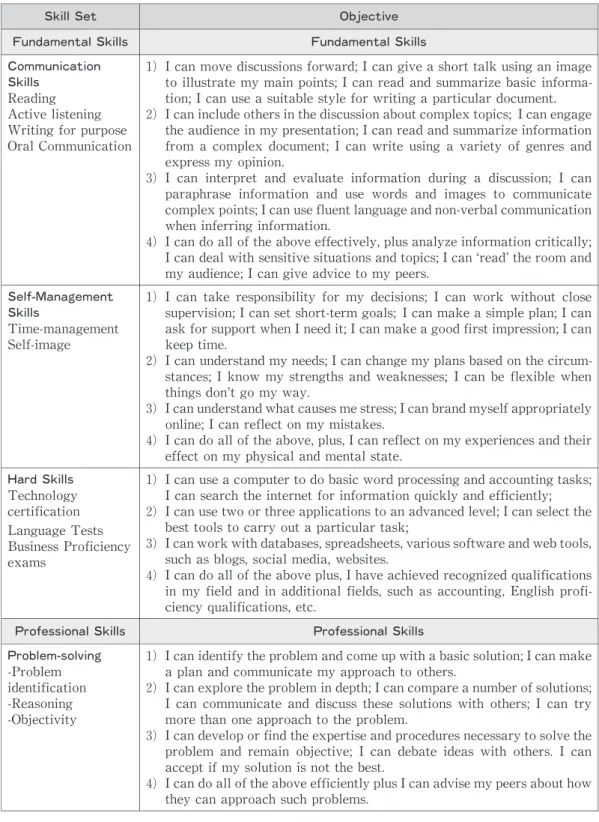
(Table
1)lists ʻ Can doʼstatements that act as an inventory of these fundamental and professional skills to help students and instructors clearly visualize their goals and their competencies.
Situation A
A:I wish I knew how to balance these figures.
B:Yeah.
A:What do you think we should do?
B:I donʼt know. Itʼs really difficult.
A:Sure, Iʼm confused.
B:Maybe Jim has an idea.
A:I hope so, Iʼm getting desperate. Letʼs ask him.
Situation B
A:I wish I knew how to balance these figures...
B:I have a plan to open it!OK, put these variables here, then change that...
A:Huh... here?
B:Look Iʼll do it myself, itʼll be quicker....see...
Figure 3:Initiative in Language
Table 1:Can do Statements for Fundamental & Professional Skills Development
Skill Set Objective
Fundamental Skills
Fundamental Skills Communication Skills
Reading Active listening Writing for purpose Oral Communication
1)I can move discussions forward;I can give a short talk using an image to illustrate my main points;I can read and summarize basic informa- tion;I can use a suitable style for writing a particular document.
2)I can include others in the discussion about complex topics; I can engage the audience in my presentation;I can read and summarize information from a complex document; I can write using a variety of genres and express my opinion.
3)I can interpret and evaluate information during a discussion; I can paraphrase information and use words and images to communicate complex points;I can use fluent language and non-verbal communication when inferring information.
4)I can do all of the above effectively,plus analyze information critically;
I can deal with sensitive situations and topics;I can ʻreadʼthe room and my audience;I can give advice to my peers.
Self-Management Skills
Time-management Self-image
1)I can take responsibility for my decisions; I can work without close supervision;I can set short-term goals; I can make a simple plan;I can ask for support when I need it;I can make a good first impression;I can keep time.
2)I can understand my needs;I can change my plans based on the circum- stances;I know my strengths and weaknesses; I can be flexible when things donʼt go my way.
3)I can understand what causes me stress;I can brand myself appropriately online;I can reflect on my mistakes.
4)I can do all of the above,plus,I can reflect on my experiences and their effect on my physical and mental state.
Hard Skills Technology certification Language Tests Business Proficiency exams
1)I can use a computer to do basic word processing and accounting tasks;
I can search the internet for information quickly and efficiently;
2)I can use two or three applications to an advanced level;I can select the best tools to carry out a particular task;
3)I can work with databases,spreadsheets,various software and web tools, such as blogs, social media, websites.
4)I can do all of the above plus,I have achieved recognized qualifications in my field and in additional fields, such as accounting, English profi- ciency qualifications, etc.
Professional Skills Professional Skills
Problem-solving -Problem identification -Reasoning -Objectivity
1)I can identify the problem and come up with a basic solution;I can make a plan and communicate my approach to others.
2)I can explore the problem in depth;I can compare a number of solutions;
I can communicate and discuss these solutions with others; I can try more than one approach to the problem.
3)I can develop or find the expertise and procedures necessary to solve the problem and remain objective; I can debate ideas with others. I can accept if my solution is not the best.
4)I can do all of the above efficiently plus I can advise my peers about how they can approach such problems.
192 Japanese StudentsʼPerceptions of Soft Skills:Teaching Professional Skills & CLIL
These Can-do statements can provide a self-evaluation checklist for students. Self- assessment can provide students with agency and reflection.Students can think about what they have learned,how well they have learned it and how what they have learned fits together. They also have a washback effect on the classroom and at a program level and can foster better communication and clearer outcomes. If students are aware of the skills they need to master,
they have some way to focus their learning and growth.Just as students experience in language learning through the Common European Framework for Languages, and the associated Can do statements and language portfolio,students studying business and professional skills should also be able to tell the story of what skills they possess and what direction they want to take in the future. Their ʻ professional skills portfolioʼand ʻ skills experience historyʼshould be something they themselves and their teachers should value.
Leadership
‑Human relations
‑Vision and goal setting
‑Motivation
‑Direction skills
‑Intuition
‑Integrity
1)I can explain my own vision,set goals for myself and take responsibility for my actions.
2)I can assist in assigning roles to other and can help others prioritize and coordinate goals.
3)I can motivate and encourage other people in my team.
4)I can understand the differences between a group and a team and I can explain I can be aware of change and am prepared to communicate to others how I think it should be dealt with.
Teamwork
‑cooperation
‑motivation
1)I can work in a team;I can engage with others in a meaningful way.
2)I can cooperate effectively with others in a team and feel no restraint in communicating my opinion.
3)I can understand the way the team views me and my contribution to the team.
4)I can understand the differences between a group and a team and I can explain this to others;I can take a leadership role in the team; I can understand the sensitivities of my fellow team mates and can support them when necessary.
Professional Skills
Professional Skills
1)I can recognize that cultural biases exist in the world;I can understand that there are differences in verbal and non-verbal communication among people.
2)I can give examples of cultural biases that exist in Japan;I can under- stand and explain some differences in verbal and non-verbal communica- tion among people in Asia
3)I can give examples of cultural biases that exist in the wider-world;I can understand and explain some differences in verbal and non-verbal com- munication that exist in the wider world.
4)I can recognize and respond to cultural biases,I can demonstrate exten- sive knowledge of other cultures, I can appreciate and appropriately respond to verbal and non-verbal communication from other cultures;I can initiate and develop interactions with culturally different others.
International Understanding
‑Self-awareness
‑Linguistic
‑Interpretation
‑Intercultural understanding
3. Teaching Professional Skills for International Business 3.1.
In the Japanese context in question, I argue that using a Content and Language Integrated Learning
(CLIL
)approach is the preferable method for teaching Professional Skills to Japanesestudents. CLIL can be defined as a dual-focused educational context in which an additional language
(not L1) is used as a medium in the teaching and learning of non-language content
(
CLIL Compendium,
2012). Table
2outlines the focus and purpose of study for monolingual students such as those in university in Japan.
Table 2:Focus and Purpose of a CLIL Approach in a Japanese University Professional Skills Course (adapted from the CLIL Compendium)
A. Build cultural knowledge
‑Explore global business customs, ability to observe Japan from an outside perspective via an overseas component.
B. Develop intercultural communication skills
‑Offer practical opportunities to use via an overseas component, provide opportunities for interaction with non-Japanese around the university.
C. Learn about specific neighboring countries and or minority groups
‑Focus on China Korea and S.E. Asia, and second generation Japanese living and working in Japan.
D. Introduce a wider cultural context
‑Provide students with an opportunity to take part in an overseas business internship.
1.
Cultural Dimension
2.
Environment Dimension
A. Prepare for internationalization
‑Invite interns from the UK, USA as regular visitors to the class, encourage overseas opportunities.
B. Access international certification
‑Help students prepare for Japanese Business English examinations and BULATS, IELTS and TOEIC.
C. Enhance the school profile
‑Promote the course and overseas internship in school brochures, online and through TV and radio.
A. Improve overall target language competence
‑Conduct regular language assessments and support students taking ELT tests.
B. Develop oral communication skills
‑Include individual presentation and group discussion tasks as part of assess- ment.
C. Deepen awareness of both mother tongue and target language
‑Draw out similarities and differences between L1and L2particularly through business pragmatics.
D. Introduce target language
‑Introduce through authentic reading materials,support with online flashcards, blog posts and videos.
3.
The Language Dimension
4.
Content Dimension
A. Provide opportunities to study content through different perspectives
‑Both practical and literature based discovery of content, encourage learners to refer to personal experience.
B. Access specific subject target language terminology
‑Introduce students to Professional Skills glossaries, wordlists and corpora.
C. Prepare for future studies and working life
‑Practice job interview and group discussion techniques in class, hold simula- tions of office‑based situations, encourage role‑play.
194 Japanese StudentsʼPerceptions of Soft Skills:Teaching Professional Skills & CLIL
The Professional Skills
(PS)course taught at a university in Japan is part of an accelerated program for students in the top
10% of the university. Students are required to test-in to the course,after being put forward by their teachers in the freshmen year.The accelerated program,
ALPS is a course in Academic Language and Professional Skills. The course is a three-year program. In the first year, the students are taught from a generic textbook with a focus on Academic English. In the second and third year of the program, the course is split into two strands,Academic Language and Professional Skills,with students required to take both strands.
As the sole teacher of the PS strand,I have developed the course to follow the focus and purpose of a CLIL course
(as outlined in the table above
)The intended learning outcomes of the Professional Skills course are focused on what a student is expected to know, understand, and do after the two-year program. Students are expected to understand the main concepts of business,understand the value of thinking globally,
be able to demonstrate the ability to communicate effectively and understand and utilize business-related professional skills in a variety of tasks both inside and outside the classroom.
The PS course is entirely web-based with a class blog taking part of the function of an online course book. Materials are sourced from a variety of authentic and relevant sources and the web-based nature allows them to be the most up-to-date and engaging materials possible. Over the course of two years, the course aims to introduce the following Professional Skills.
5.
Learning Dimensions
A. Complement individual learning strategies
‑Conduct a Birkman test on all students to ascertain their personality ten- dencies and preferred individual learning strategies.
B. Diversify methods and forms of classroom practice C. Increase learner motivation
Table 3:Professional Skills Covered in ALPS 3 and 4 Year (PS Strand)
Time management, forecasting,ideas, brainstorming, strategies, designs, dreams, structures, implementation, administration, trust, time manage- ment.
W ord, Excel, PowerPoint, Mac software,Blogging,Tab- let interfaces, Social Media, design, presentation, images, internet, research
Brainstorming, communication, dreams, ideas, promotion, design, color use
New goals, motivation, analysis, evaluation, review, training, development,leadership,decision- making, planning, organizing, conflict,team building,delegating
Trouble shooting,morale,sat- isfaction, productivity, effi- ciency, support, customer ser- vice
Speeches, presentations, workshops, interviews, negotiation, networking, memos, letters, reports, advertising, commercials,intercultural understand- ing, rapport building
Communication Problem Solving Management
Creativity
Computer Skills
Planning & Organizing
Over the past two years the PS course has been developed following two key insights from CLIL research. Firstly, the
4Cʼ s Framework
(Coyle,
1999,
2006)and secondly, the guidelines oncreating quality CLIL materials by Mehisto
(2010). Coyleʼ s framework
(2006)is built on the following principles:
1
. Content
2. Cognition
3. Communication
4. Culture
With regard to content,the key factor is the personalization of learning,providing students with opportunities to create their own knowledge,which is another reason for the lack of formal textbook for the course. This content is related to cognition and these thinking processes must be analyzed in terms of linguistic demands placed on the students. Communication lines within the classroom must be transparent and accessible and teachers must take care when teaching through the medium of L2 . Finally, students need to be exposed to the relationships between cultures and language.Coyle(2006)stresses that intercultural awareness is fundamental to CLIL and as such, it is a prominent feature of this Professional Skills for Course. Mehistoʼ s
(2010)criteria can be seen in Table
4and has informed my thinking when developing materials.The students in the course come with a world-view and their world-view acts as a filter to all their experiences and incoming observations. The majority of students have already had experience studying either short or long-term overseas, they actively seek out friendships with non-Japanese via social media, networking events, etc; they are highly motivated to study
Japanese StudentsʼPerceptions of Soft Skills:Teaching Professional Skills & CLIL 196
Fostering cooperative learning
Fostering cognitive fluency through scaffolding Helping make learning meaningful
Creating a safe learning environment Fostering critical thinking
Seeing ways of incorporating authentic language and language use Including self, peer and other types of formative assessment Fostering learning skills development and learner autonomy Systematically fostering language proficiency
Making language intentions and process visibleTable 4:Criteria for Creating Materials
English and they hold aspirations to have a career in which they can use English on a daily basis.
These students already know how to learn from other students and have prior experience of ʻ learning by doingʼ . They have a voice and they develop the ability to co-construct new ideas and are not afraid to share their voice with others. As for my role as the sole teacher of the PS course I do not see myself as the primary source of information, rather, I encourage students to co-construct knowledge.I attempt to actively engage students in experiences that challenge their previous conceptions and constantly use student responses in the planning of next lessons. I see one of my key roles as assisting students to understand their own cognitive processes through actively using language like ʻ classifyʼ , ʻ analyzeʼ , ʻ createʼ , ʻ organizeʼ , etc. I encourage student autonomy and initiative and feel free and willing to let go of classroom control as I feel happy that I can facilitate clear communication from the students. Finally, I do not separate knowing from the process of finding something out. A CLIL approach combined with a constructivist- learning environment provides the framework for this PS course.
3.2
There is much debate surrounding ESP,Content-Based teaching and CLIL and the differences and similarities between them. An in-depth discussion is outside the bounds of this paper yet I argue that the predominant difference between ESP and CLIL is that CLIL is common for all professionals whereas ESP is for English language professionals. ESP and CLIL are two separate dimensions with Garcia
(2009)defining CLIL as an ʻumbrellaʼterm that ʻ embraces any type of program where any second language is used to teach non-linguistic content matterʼ
(p.
209). McBeath
(2011)argues that “CLIL is not a matter of putting old wine in new bottles. CLIL, to[him]
,looks more like putting old wine in old bottles and slapping on a new label”. He supports this argument citing the extensive body of theory in ESP
(Robinson,
1991).
Yet, I argue that there is a difference;particularly as the needs analysis in ESP is such a fundamental requirement.The nature of specificity is what differentiates it from CLIL. Return- ing to Japan,in the future,if and when Japan begins to improve language teaching at the primary and junior levels, teachers in universities will be faced with students who will be expecting courses that take a CLIL approach.A number of private universities in Japan are already moving in this direction.This not only attracts highly motivated Japanese students but also students from neighboring Asian countries. With competition between universities in Japan intensifying, universities developing CLIL based courses are finding themselves more attractive to potential students.CLIL is still a work in progress and if it is given in the wrong place,at the wrong time, and in the wrong environment it can be disastrous. Both teachers and students need to be
carefully selected but when selected, it provides an excellent challenge for both teachers and students.
I argue that in this context
―a university,an advanced course,with students of high languageproficiency
―it is a beneficial approach to attempt to implement.4. Soft Skills as an Essential Professional Skill
Soft skills are key professional skills that are a prominent part of the Professional Skills
course described above. They are introduced alongside and through the skills listed in Table 3.
When Daniel Goleman stated in
1998that “
67% of abilities deemed essential for effective performance were emotional competencies”
(p.
30)it became clear that theseʻsoftʼcompetencies were critical for professional development. As a student entering university myself in
1998, reading this seminal work proved highly influential in my career,his work acts as a cornerstone of my approach to teaching to this day.
The soft skills rhetoric is permeating discussions of management education
(Navarro,2008 ; Myers and Tucker,2005 ;Rubin and Dierdorff,2009 ;McGahern,2009) .The Association of MBAs (AMBA)concluded in their
2010report that:if anything,the MBA should be shifting away from the more functional areas of management teaching, towards the development of more rounded individuals with the soft skills to lead and the ability to integrate thinking to create sustainable, ethical, and stakeholder-focused management decisions
(AMBA,
2010, p
54).
A universal definition of Soft Skills is illusive.Yet Tucker,et.al.2000 ,McLarty(1998) ,Nabi
(2003)and Elias and Purcell
(2004)identify key transferable soft skills in their work. The Chartered Institute for Professional Development
(CIPD)in the U.K.,published a seminal report in
2010that presented a business case for soft skills, ʻUsing the Head and Heart at Workʼ .They detail with much accuracy the definitions and descriptions of soft skills
(CIPD,
2010:p.
15‑16). Figure 4 shows the categories of soft skills as defined by the CIPD. This list provides a useful starting point for establishing what soft skills are.
The working definition I use in this paper and in my teaching is that by Weber,et al.(
2009):
Hard skills are associated with the technical aspects of performing a job.These skills usually require the acquisition of knowledge,are primarily cognitive in nature and are influenced by
Japanese StudentsʼPerceptions of Soft Skills:Teaching Professional Skills & CLIL 198
an individualʼ s IQ source. Soft skills are defined as the interpersonal, human, people or behavioral skills needed to apply technical knowledge and skills in the workplace. (p.354)
Students in the PS course are introduced to the concept of soft skills through various activities and tasks.The following section will outline Japanese studentsʼperspectives of the soft skills necessary for international business in Japan.
Ⅲ. Method
The next section of this research presents the results of a qualitative study to ascertain Japanese university studentsʼperceptions of the importance of soft skills for international business and careers. Students who had been taking the above-described Professional Skills course taught via a CLIL approach in L
2(English
)and who were senior-year students(either actively seeking employment or those who had already secured a position for after graduation) were selected to take part in the focus groups.Focus groups were conducted in June2011 and June
2012. Eight focus groups with four members in each group were held. In order to maintain students anonymity, the quotes used in the discussion are only labeled as M for male or F for female. Each session lasted approximately
35minutes and students were asked to discuss the topic:
The importance of soft skills for international business in Japan
The discussions were recorded using SoundNote software and transcribed. The discussions were held in English and data derived through the focus groups was teamed with autobiographi-
Figure 4:What are Soft Skills?
(Source:CIPD,2010)
cal sketches for analysis. Coding was carried out with coding themes that were developed via grounded theory methodology
(Glaser and Strauss,1968) .
Although the sample size is relatively small,it is intended to provide a snap-shot of students perceptions. The results also form part of a longitudinal study whereby the same students will take part in a group discussion in March
2013discussing the same topic after having been in employment for one year.
Ⅳ. Results and Discussion
The following section will detail the results of the focus groups and will present students perceptions of soft skills in international business in Japan.It is presented in a narrative style in order to represent the studentsʼvoices.
Despite having covered soft skills in class and students being actively involved in job-hunting, it seemed that students still had difficulty in defining what constituted soft skills.The majority of students focused on ʻ Communication Skillsʼas the definitive soft skill:
Communication skills are the most important skills. (F) Difficult to get good communication skills. (M)
Lack of communication skills is a serious problem in Japan, it is the biggest soft skill. (F)
Yet, one student challenged the notion and stated:
Creativity is a soft skill too, we should not forget, it is important, I donʼ t understand why the focus is always on communication. There are many soft skills. (M)
This opened up discussion for another student to claim that although she recognized commu- nication as an umbrella term ʻ one big word for everythingʼ (F) is important, ʻ flexibility and working under pressure is also importantʼ (F). To which other students concluded that:
ʻ yes, it is bigger than just simple communication, honesty is a soft skills and the ability to understand someoneʼ s opinionʼ . (F)
And despite ʻ dealing with pressure and endurance skills
l being considered
n negative soft
skillsʼ
(F
), they were sti l as ʻ essential as egotiati o n in business ʼ
(M
).
[ ]
Japanese StudentsʼPerceptions of Soft Skills:Teaching Professional Skills & CLIL 200
Studentsʼdifficulty ascertaining which skills were most important and how to define them could be related to the influence of experience in their lives.Those students who could relate an actual real-life experience could quite eloquently express the connection of that experience with soft skills. For example, one male student told a story of why he believed creativity was an essential soft skill:
To change and improve a company we need creativity. For example, when I was a high school student, the teacherʼ s room had no atmosphere you couldnʼ t enter. Then, when I was in the 3rd year a new teacher came, the atmosphere changed immediately and people started having conversations. What is more is that the school was better than before he came. He was creative in opening the doors and this was due to his soft skills. (M)
This moment obviously left a great impression on the student, one that four years later he could draw on and share as a way of supporting his opinion.
Another student citied ʻ listeningʼas a key soft skill for business.Her rationale was based on her experience of her part-time job working in a shop:
In my part-time job I must obey the boss order and I think vertical society is not good for younger workers, all workers have to have listening skills to listen to their boss. It is an important soft skill because if you donʼ t have it your boss will be angry. (F)
In addition to this student,a peer also drew on her experience working as an intern in a hotel and she stated:
In Japanese business world and society boss says all workers must obey me. So worker canʼ t talk their own opinion if the boss says the rule is A but I think it is B the boss is king so I canʼ t say anything. So we have to endure pressure or stress and have a strong mind.
She went one to support her opinion that the ʻ ability to cope under pressureʼ was a key soft skill to show ʻ clear emotions ʼand ʻ sometime we have to check emotion at the door.ʼEmotional intelligence was deemed a key soft skill in her eyes.
A studentsʼexperience overseas also has an impact on their perception of companies and soft
skills, for example a student who went to Canada expressed the following opinion:Showing the perceived differences between the importance of personality in Japan and Canada.
In Japan, qualification works out as a most persuasive hard skill to convince companies. The documents that they mind are only for the entrance of new employees. After the ceremony of new employees, the human resource division never pays attention for who works for the office,
namely the real documents have a power.
In Canada, the job interview is of more concern rather than the resume. (F)
Japan is considered a document-based society with hard skills on paper being more carefully taken into consideration. While in Canada, a successful performance at interview and the importance of the individualʼ s character is considered more important.
As was mentioned in the previous section,students are very conscious of the expectations of Japanese employers:
Japanese job markets want too many soft skills from students (M)
They feel that:
Before you enter the company it is important to get skills but Japanese companies have also too much training I think it is too much. Do they want skills before we go or give us skills when we get a job? I donʼ t understand their expectations (M)
Personnel sections just focus on communication skills and no others (F)
It seems that students who are actively seeking employment are vey confused by what employers expect and this is due in part to the varying sources of information that they encounter.
There appear to be eight main sources of information for students seeking work
(Figure 5
). There does not seem to be a consistent message transferred to the students regarding soft skills.
Students thought that it was ʻ difficult to obtain soft skillsʼas ʻ we can learn hard skills in school for instance ʼbut we ʻ need to talk with individuals or friends or employees ʼ
(M) to learn soft skills. Or we need to go ʻ to a special school for soft skillsʼ
(F
).
Many students cited confusion between the different information from these sources,
Japanese StudentsʼPerceptions of Soft Skills:Teaching Professional Skills & CLIL 202
In the west I found a survey online that said that out of 5000 people, 80% of respondents said creativity was the most important soft skill. It is different in Japan. Communication is more important. Well, thatʼ s what one
t of
i
my teachers said. (M)
To which another student replied,
Yeah, I agree, I read online that if I have a high TOEIC score it doesnʼ t matter in relation to soft skills. But everyone, my mom, teacher, career center staffs, and recruit fair tells me I need a high TOEIC score. Which is correct information? (F)
The university career center is the on-campus hub for career support and guidance yet students were also confused by information from these official sources:
What I feel is that the career center pushes us to acquire hard skills, they set up classes for hard skills but there are not opportunities to improve sof
r
sk
u
lls like classes for discussion. (F)
Outside bodies at recruitment fairs and outside consulting agencies were also giving students conflicting information:
Last year a careers advisor at a fair told me there were just three soft skills 1. eye contact, 2. speaking an listening and 3. reaction, these a
t e j
i st communication basic skills, there are many more soft skills than tha , r ght F) ? (
[ ]
Figure 5:Sources of Information for Job-Seeking Students
In Japan, the existence of mentors and ʻ senpaiʼsenior students is also important for job-seekers, one student stated that ʻ leadership skills importantʼand ʻ if you donʼ t have a strong mentor you wonʼ t get the good soft skills trainingʼbecause,ʻ they are only people who can teach you this ʼ .This is a powerful indictment of the importance of societal roles and the hierarchical structure in Japan.
Finally, the discussion also highlighted that there were some students who fell through the cracks when it comes to career education.Students who wanted to go into teaching and students who intended to study abroad did not attend such job seminars on soft and hard skills, group interview training, etc. Therefore, they missed opportunities to develop soft skills for the workplace. As one student stated:
Talking with you
t
other students
e
I learn many new things, I want to be a teacher so I donʼ t do job seminars and training, just teachers test, and we donʼ t learn soft skills for teaching.
Maybe the school expects me to just have them ? I
r was
a
lucky I learn in professional skills class. Teachers need soft skills more than hard skills. If you have hard skills that is good but then you cant communicate with students. We need more lessons in soft skills for teachers.
This brief look at studentsʼperceptions of soft skills has only just touched the surface of what could be an engaging longitudinal study.How will these studentsʼperceptions change after being members of society,working in careers for a year? And what can educators and career advisor professionals take from these candid comments?
Ⅴ. Recommendations
Based on the discussions above and the authorsʼinitial experience of teaching the Profes- sional Skills course there are a number of recommendations for other instructors developing or teaching such courses. Firstly, when teaching Professional Skills, it is vital to draw in as many references to studentsʼreal-life experience as possible in order to help the student better under- stand the skill in question.
Secondly, it is important to clearly poin
i
out similariti
n
s and differences between Japanese business culture and employee expectations and those in other countries. Students with experi- ence overseas often are able to view Japan from outside and fo
s
mul
a
te comparative opinions that are sometimes negative about Japan and the employment system. Th
y s can lead stude
a ts to feel frustrated in recruitment itu tions or when the are working in p rt - time jobs. Th a ey r e
[ ]
[ ]
Japanese StudentsʼPerceptions of Soft Skills:Teaching Professional Skills & CLIL 204
perplexed by the differences.From a non-Japanese teachers perspective,I feel it is important that when teaching professional skills in a CLIL setting, I must be acutely aware of not biasing students with information against a Japanese context. It is easy for non-Japanese teachers to be seen to be ʻ othering.ʼStudents should be presented with both fair and accurate representations of both Japanese business and examples of other global business situations. Othering hampers intercultural communication and the successful development of soft and other professional skills.
Connected to this, is the teachers responsibilily to communicate with other information- giving sources the students will encounter in order to build a better picture of the kinds of information the students are receiving and processing. It is clear students are overwhelmed by the multitude of advice. Educators have to help them filter this.
Thirdly, it is important to bring in outside speakers to add depth to the course content.
Having students interact with and receive support and advice from their seniors or near-peer role models is an important aspect of learning,but it must be done carefully. Some students imagine that this is the best way to develop soft skills and so this should be implemented.
Fourthly, a practical component should be added to the course.For example,have students go out and observe behavior in business or make internships,whether in-country or overseas,an integral part of the course. Have students engage in reflection activities based on these experi- ences utilizing double loop learning models.
Fifth, allow students to develop their own understanding of soft skills; soft skills and professional skills should never be taught in a one way, teacher centric approach. Professional Skills classrooms should be based on constructivist theories of learning that also borrow aspects of experiential learning.
Sixth, in Japan, it would be beneficial to see more Japanese native speaking teachers teaching in Professional Skills and Business Communication CLIL classrooms. Japanese native speaking teachers are superb role models for learners and have the appropriate academic knowledge of their fields;most have MBAs or higher qualifications from overseas institutions and have excellent commands of the English language. They can offer a great deal of valuable experience in comparison to English native language teachers,who may lack training or experi- ence in business. Ideally, a course that is developed and taught by both a native Japanese and a non-native Japanese in tandem would be ideal as each teacher can offer different strengths to the
course and an equal team teaching environment may prove an innovative way of motivating and inspiring students.
Finally, if done correctly, CLIL has shown itself to be an appropriate teaching approach in a university setting in Japan. Looking at the students understanding and perception of soft skills, Professional Skills and soft skills are best learned with a small amount of highly focused and relevant formal input in-class through engaging tasks and classroom activities, combined with real-world experience.
Ⅵ. Conclusion
To conclude, teaching professional skills through a CLIL approach has utilized a holistic methodology. By examining the studentsʼperceptions of the soft skills necessary for interna- tional business we can see that they have been able to not only assimilate and understand new knowledge in the first language but they can also use their L
2,English,to construct meaning and express their opinions
(Coyle, Hood and Marsh,
2010). The professional skills classes have attempted to infiltrate the language not just focus on the language and has gone some way to improving the learnersʼskills and understanding, cognitive processes, and intercultural under- standing.
References
Association of MBAs. (2010).The post downturn MBA: An agenda for change. London:AMBA.
Ayne,J.(2000). The unbearable lightness of skill:the changing meaning of skill in UK policy discourses and some implications for education and training. Journal of Education Policy. Vol15, No 3.
pp.353‑369.
Birchley,S.L.and McCasland,P.(2012).Innovative Internships:New Directions in Study Abroad.Paper presented at the Asia-Pacific Association for Buisness Communication, Seoul, Korea.
Chia, Y.M.(2005). Job offers of multinational accounting firms: the effects of emotional intelligence, extra-curricular activities,and academic performance.Accounting Education.Vol14,No1.pp.75‑93. CIPD Using the heart at work(2010). http: www.cipd.co.uk (retrieved in September2012)
CLIL Compendium(2012). www.clilcompendium.com/(retrieved in September2012).
Coyle, D., Hood, P., Marsh, D.(2010). CLIL⎜Content and Language Integrated Learning. Cambridge:
Cambridge University Press.
Coyle, D.(2007). The CLIL quality challenge. In Marsh, D. & Wolff, D.,Diverse Contexts―Converging Goals: CLIL in Europe. Frankfurt am Main:Peter Lang, pp. 47‑60.
Coyle D.(2006). Content and Language Integrated Learning⎜Motivating Learners and Teachers.The Scottish Language Review13,1‑18.http: www.strath.ac.uk scilt slr iss 200613 (retrieved in Septem- ber2012).
Japanese StudentsʼPerceptions of Soft Skills:Teaching Professional Skills & CLIL 206
Coyle, D.(1999). ʻTheory and planning for effective classrooms: supporting students in content and language integrated learning contextsʼin Masih, J (Ed):Learning Through a Foreign Language London: CILT
Coyle, D. (2006). Developing CLIL:Towards a Theory of Practice.Monograph 6 APAC Barcelona Daijob(2012). www.Daijob.com(accessed March 2012)
Frese, M., Fay, D., T.Hilburger, K.Leng(2011). The concept of personal initiative: Operationalization, reliability and validity in two German samples.Journal of Occupational Organizational Behavior.
Goleman, D.(1998).Working with emotional intelligence. New York:Bantam Books.
Glaser, Barney G. and Anselm Strauss.The Discovery of Grounded Theory: Strategies for Qualitative Research. Chicago, IL: Aldine Publishing Co,1967 .
Keep, E.(1998).Britainʼs VET policy and the third way⎜following a high skills trajectory or running up a dead- end street. Paper presented to a seminar at Cardiff, 24‑25September.
Kolb,D.A.(1984).Experiential learning: experience as the source of learning and development.Englewood Cliffs, NJ:Prentice-Hall.
Lauder,H.,Brown,P.and Ashton,D.(2008).Globalization,Skill formation and the varities of Capitalism Approach.New Political Economy. Volume13, Issue, 1.
McBeath, Neil.(2006). Overpriced and Pointless; Reinventing Course Materials. Paper delivered at the 12th International TESOL Arabia Conference.
Mehisto, P.(2010). The Core of CLIL: A synthesis of good pedagogy and good CLIL practice.CLIL Conference in Trieste, Conference Proceedings Italy .
Mehisto, P., Marsh, D., Frigols, M.-J.(2008):Uncovering CLIL: Content and Language Integrated Learning in Bilingual and Multilingual Education. Oxford: Macmillan Publishing.
Myers, L.L. and Tucker, M.L.(2005)Increasing awareness of emotional intelligence in a business curriculum.Business Communication Quarterly. Vol 68, No1. pp.44‑51.
Navarro, P.(2008). The MBA core curricula of top-ranked US business schools: a study of failure?
Academy of Management Learning and Education. Vol7, No1. pp.108‑123.
Ng,C.H.(2008).ʻLearning for Achievementʼas a Collective Goal in Re-culturing Teaching and Learning in Hong Kong Classrooms. In Abstract from Book Chapter Education in the Asia-Pacific region:
Issues, concerns and prospects. Netherlands:Springer. Australasia(HERDSA), pp.599‑608.
Oberst,B.S.,and Jones,R.C.,(2004).Canaries in the Mineshaft:Engineers in the Global Workplace,(CD) Proceedings, 2004 American Society for Engineering Education Conference.
Pink, D.(2005).A whole new mind: why right-brainers will rule the future.London:Marshall Cavendish Rubin, R. and Dierdorff, E.C.(2009). How relevant is the MBA? Assessing the alignment of required curricula and required managerial competencies.Academy of Management Learning and Education.
Vol8, No2. pp.208‑224.
Schon, D.A.(1983).The reflective practitioner: how professionals think in action. Aldershot:Ashgate.
Shuman, L., Besterfield, M., McGourty, J.(2005). The ABET “Professional Skills”⎜ Can They Be Taught?Can They Be Assessed?Journal of Engineering Education pp. 41‑55.
Shuman, L.J., Atman, C.J., Eschenbach, E.A., Evans, D., Felder, R.M., Imbrie,... Yokomoto, C.F.(2002). The Future Of Engineering Education,(CD)Proceedings,2002Frontiers in Education Conference, Institute of Electrical and Electronic Engineers.
Weber,M.R.,Finley,D.A.,Crawford,A.and Rivera,D.(2009). An exploratory study identifying soft skill competencies in entry-level managers.Tourism and Hospitality Research. Vol9 . pp.353‑361.
Wong, J. K. K.(2004). Are styles of Asian International students culturally or contextually bound?
International Education Journal,4⑷.