Feature-Driven Acquisition of L2 Reciprocals
journal or
publication title
英米文学
volume
54
page range
83-102
year
2010-03-15
URL
http://hdl.handle.net/10236/10099
Feature-Driven Acquisition of L2 Reciprocals
*Nao Ishino
Synopsis: The UG-based L2 acquisition of anaphoric binding within
the generative framework has promoted extensive research on the realm of Second Language Acquisition. Notwithstanding the fact that reciprocals are commonly believed to behave the same as reflexives in obeying Chomsky’s (1981) definition of Binding Theory (A), reciprocals in L2 have been researched far less than reflexives.
This paper, thus, aims at demonstrating that Exclusively Selective
Transfer Hypothesis, which has recently been developed and elaborated
in Ishino and Ura (2009 a) under the feature-based theory within the Minimalist Program, conforms perfectly to the empirically novel and ex-perimentally firm observation on the syntactic feature transfer from the L1 reciprocal otagai to the corresponding lexical item in L2, each other, in the course of the L2 acquisition.
Key words: Second Language Acquisition, Binding Theory (A),
recipro-cals, inter-language, syntactic feature transfer
1. Introduction
The acquisition of anaphoric binding within the generative framework has stimulated and promoted extensive research on the realm of Second Language Acquisition (SLA). Reciprocals, which are commonly believed, just as reflexives, to obey Chomsky’s (1981) definition of Binding Theory (A), have been researched far less than reflexives within the UG-based studies on SLA.
The aim of this paper, which is consequent upon this state of the current SLA research, is two-fold: (I) to report the empirically new dis-covery about the syntactic feature transfer from the reciprocal in L1
────────────
*This paper was presented at Doshisha University and Kwansei Gakuin University. I would like to thank the audience at those meetings for comments and judgments. I would like to express my sincere gratitude to Hiroyuki Ura and Kiyomi Kusumoto for valuable com-ments on the materials presented herein. All remaining errors are my own.
(native language) to the corresponding lexical item in L2 (target lan-guage) at the intermediate acquisition stage called inter-language (IL) grammar, and (II) to demonstrate that Exclusively Selective Transfer
Hypothesis, which has recently been developed and elaborated in Ishino
and Ura (2009 a) and will herein be defended under the feature-based theory within the Minimalist Program, conforms perfectly to the new discovery concerning the L2 acquisition of reciprocals.
The argumentation in this paper will be developed in the following manner: (a) First, we will exhibit the result of our experiments, which were conducted for the purpose of figuring out both the binding domain of the Japanese reciprocal otagai in L1 grammar of Japanese and that of the reciprocal each other in the grammar of the intermediate acquisi-tion stage of Japanese learners of English (JLsE) as a second language. In the literature on Japanese syntax, it is generally assumed that the Japanese reciprocal otagai shows the same locality as the English recip-rocal each other with respect to anaphoric binding. Contrary to this as-sumption, our experimental results clearly reveal that otagai differs from each other in the syntactic features that determine its binding do-main. It is also revealed that otagai shows the same locality as
zibun-zisin, one of the Japanese complex reflexive forms: It is reported by
Ishino and Ura (2009 a) that their experimental studies reveal that
zibun-zisin cannot be bound from the outside of a tensed clause but can
be bound from the outside of a non-tensed clause as well as within any type of clause.
(b) Theoretically, we will defend Ishino and Ura’s (2009 a)
Exclu-sively Selective Transfer Hypothesis through examining the result of our
experiments and elucidate the syntactic mechanism of the L2 acquisi-tion of reciprocals. It will be argued that the inappropriate transfer of the syntactic features of the L1 reciprocal in the IL grammar leads to the misunderstanding of the syntactic behavior of the L2 reciprocal, and it will be shown that only Ishino and Ura’s (2009 a) Exclusively Selective
Transfer Hypothesis can explicate our newly discovered data about the
Nao Ishino 84
locality concerning the anaphoric binding of each other in the IL gram-mar.
Section 2 and 3 will review and scrutinize some approaches to L2 binding: Parameter Resetting Hypothesis (cf. Hirakawa 1990, and Watanabe et al. 2008), Transfer Hypothesis (cf. Yuan 1994, and Benett and Progovac 1998) and Exclusively Selective Transfer Hypothesis (cf. Ishino and Ura 2009 a). In section 4 and 5, we will offer an empirically novel and experimentally firm observation on the transfer of the syntac-tic features from the reciprocal in L1 to the one in L2. We will vindicate
Exclusively Selective Transfer Hypothesis through exploring the
experi-mental results. Finally, section 6 will conclude the present paper with some discussion on a few remaining issues and on future advancement of this research.
2. Background: UG-based SLA
Since the early 1980s, UG-based SLA researches have concentrated their attention on UG accessibility, asking whether L2 learners have no
access, direct access or indirect access to UG. No Access Hypothesis is
represented by Fundamental Difference Hypothesis (cf. Bley-Vroman 1990), the hypothesis which supports the idea that UG survives only as the language-specific L1 grammar and is not available at all in SLA. Under the UG-based SLA studies, it is assumed that L2 learners have the grammatically consistent system as their IL grammar at their inter-mediate acquisition stage because grammatical errors in the course of acquiring L2 represent rule-governed behaviors, which shows that they are constrained by UG. SLA researches have been targeting their aims not only on the issue as to providing practical improvement in L2 teach-ing but also on the issue as to sheddteach-ing light on the grammatical ability of IL.
Given the heretofore well-known fact that IL grammar is con-strained by UG, No Access Hypothesis has turned out to be
ate. SLA researches have shifted their concern from the aforementioned issues to the issue as to theorizing about the role of UG and its interac-tion with L1 grammar in SLA (i.e., what is called “parameter (re)set-ting”). The current UG-based SLA researches are curious as to what the initial stage of SLA is; namely, as to whether it is L1 grammar or UG (cf. White 2003).
SLA studies made substantial progress, greatly affected by the Principles and Parameters approach in generative grammar. Under the studies of FLA (First Language Acquisition), children have been consid-ered to have UG innately and its concomitant parameters in LAD (Lan-guage Acquisition Device). It has also been assumed that certain set of parameter values determine language-particular properties of each lan-guage. Children analyze Primary Linguistic Data (PLD) with the use of UG, and they set the parameter values through positive evidence and successfully establish the core grammar of their L1 without fail. In SLA, on the other hand, an important issue arises as to how L2 learners set the L2 parameter values when the target language (L2) differs from the source language (L1) in a given parameter. Pioneering works on SLA have been greatly affected by the Principles and Parameters approach in generative grammar; however, the current SLA researches are con-ducted within the framework of Minimalist Program and aims to estab-lishing feature-based acquisition theory.
The previous approaches to L2 binding addressed important issues empirically and theoretically: (A) They have been concerned only with the acquisition of reflexive binding (see Section 3), and they have paid scarce attention to the L2 acquisition of reciprocals. (B) The proponents of the earlier approaches lay their theoretical foundations on the language-particular parameters and have not yet taken into considera-tion lexical item-particular feature-based analyses. In the next secconsidera-tion, let us scrutinize three approaches, all of which have been proposed inde-pendently for the purpose of explaining the L2 acquisition of reflexive binding, focusing particularly on the hypothesis recently proposed by
Nao Ishino 86
Ishino & Ura (2009 a): Exclusively Selective Transfer Hypothesis (hence-forth, ESTH).
3. Trend to Feature-based Analysis on L2 acquisition
Earlier studies on SLA with reference to Binding Theory (A) have only taken into consideration the L2 acquisition of reflexives and the pa-rameter (re)setting mechanism of their binding domains in the IL gram-mar. According to the commonly assumed definition of Binding Theory Condition (cf. Chomsky 1981, 1995), an anaphor must be bound in its local domain, the domain which is called “binding domain”. The binding domain of an anaphor is alleged to be parametrically determined (cf. Wexler and Manzini 1987). In the literature on the L2 acquisition of re-flexives, the issue as to whether the parameter value of a reflexive in L1 undergoes resetting in the course of learning L2 (i.e., in the gram-mar of IL) has been much debated. There have been two predominant hypotheses concerning the parameter value resetting in IL: One is
Pa-rameter Resetting Hypothesis (see Hirakawa 1990, and Watanabe et al.
2008, among others) and the other is Transfer Hypothesis (see Yuan 1994, and Benett and Progovac 1998, among others). Almost all the pre-vious approaches in SLA with reference to Binding Theory (A) have paid attention only to the acquisition of reflexives without any reference to reciprocals, which are expected to behave the same as reflexives with regard to their binding domain (cf. Chomsky 1981). Consequently, this paper, following essentially Ishino and Ura’s (2009 a) theory of L2 bind-ing, aims at shedding new light on the feature-based L2 acquisition on Binding Theory (A) by providing a newly-discovered data concerning the syntactic behaviors of otagai in L1 Japanese and each other in the IL grammar of
1
JLsE.
3. 1. Exclusively Selective Transfer Hypothesis
Under the assumption with ESTH, Ishino and Ura (2009 a) have
onstrated that JLsE select one of their L1 reflexive forms (i.e.,
zibun-zisin) and transfer its syntactic features (‘parameter values’ in the
ter-minology of the previous approaches) to utilize the L2 reflexive in their IL grammar. They have argued that only ESTH is able to clear out all the problems immanent in the previous parameter-based analyses. Ishino and Ura (2009 a) proposes the theory of ESTH by maintaining that the concept of the language-particular parameter setting must be refined conceptually in accordance with the feature-based differences be-tween the lexical items in L1 and those in L2 within the framework of minimalist syntax. The current work lends support to ESTH with par-ticular focus on the L2 acquisition through syntactic feature transfer of the L1 reciprocal to the corresponding L2 one.
As for the L2 acquisition of reciprocals, ESTH predicts that JLsE (exclusively) select otagai from their L1 lexical items and transfer its syntactic features to those of L2 reciprocal each other. Consequently, the syntactic features of otagai are realized in L2 reciprocals in the JLsE’s IL grammar. While on the other hand, the two aforementioned ap-proaches have attempted to explain the syntactic mechanism in the L2 acquisition of reflexives according to the parameter (re)setting analyses. In the next subsections, we will demonstrate that the parameter-(re)set-ting approaches have serious conceptual disadvantages and that they fail to predict and explain some experimental results.
3. 2. Parameter Resetting Hypothesis
Parameter Resetting Hypothesis (henceforth, PRH) (e.g., Finer and
Broselow 1986, Hirakawa 1990, and Watanabe et al. 2008, to mention only a few) lays its theoretical foundation on the hypothesis about Wex-ler and Manzini’s (1987) Governing Category Parameter (GCP), accord-ing to which five types of bindaccord-ing domains are cross-laccord-inguistically viable in UG, the core idea of which is depicted in (1).
Nao Ishino 88
(1) Governing Category Parameter (Wexler and Manzini 1987:53) α is a governing category for β if α is the minimal category which
con-tainsβ and a. has a subject, or b. has an INFL, or c. has a TNS, or d. has an indicative TNS, or e. has a root TNS
Proponents for PRH within the studies on the L2 acquisition of ana-phoric binding for JLsE have taken into consideration only one of the reflexive forms in Japanese; namely, zibun, the syntactic property of which corresponds to the (e)-type under the hypothesis assuming GCP. Consequently, they mistakenly purport that the parameter value for the Japanese reflexives counts solely as the (e)-type. Because the English reflexive is of the (a)-type, they have concluded that JLsE set their IL parameter value intermediate between those values; namely, the (c)-type on the basis of the subset relation of GCP. Proponents of PRH, thus, argue that JLsE adopt neither the value of L1 nor that of L2; rather they adopt the parameter values intermediate between those val-ues. Their conceptual disadvantage is that there is neither any theoreti-cal rationale nor even any suggestion as to why JLsE reset their pa-rameter value to (c)-type but not any of the other intermediate parame-ter values (i.e., (b) or (d) in GCP).
Moreover, if their theory is applied to the L2 acquisition of recipro-cals, the parameter value of the English reciprocal in the IL grammar of JLsE is supposed to be of (b)-type (i.e., a minimal category with INFL); for, the L1 reciprocal corresponds to the (c)-type and the L2 one corre-sponds to the (a)-type. According to PRH, JLsE are obliged to adopt the (b)-type parameter value, which lies between the (a)-type and the (c)-type. Since a non-tensed IP counts as a minimal category with INFL, PRH predicts that the non-tensed IP in the (b)-type languages turns out to be the binding domain; whereby, it leads to the prediction that each
other in the IL grammar is always clausebound irrespective of whether
it is within a tensed CP or within a non-tensed IP. Contrary to this pre-diction, our experimental results show that the parameter value for
each other in the IL grammar is of (c)-type, as will be described later in
section 4; whence, a serious defect of PRH emerges.
3. 3. Transfer Hypothesis
The other predominant hypothesis is Transfer Hypothesis (henceforth, TH) (Yuan 1994, and Benett and Progovac 1998). They found the theo-retical rationale of TH upon Pica’s (1987) generalization: Mono-morphemic reflexives, such as zibun in Japanese, allow long-distance binding, and poly-morphemic reflexives, such as himself in English, re-quire local binding. TH presumes that the morphological complexity of the L1 reflexive determines the parameter values on the binding do-main for the L2 reflexive in the IL grammar.
Crucially, they fail to distinguish the two types of Japanese complex reflexives, zibun-zisin and kare-zisin, with the misunderstanding that they have the same parameter value on the locality condition. Concep-tual disadvantage of their theory is that their prediction will vary de-pending on which lexical item is regarded as the L1 reflexive. Moreover, their analysis cannot be applied to the English reciprocal each other, which morphologically consists of two free morphemes; accordingly, it cannot be analyzed as simple or complex.
ESTH does not have the aforementioned conceptual disadvantages of the existing theories of L2 acquisition. Not only does ESTH have a conceptual advantage over any other parameter-(re)setting approach, but ESTH is also given empirical support by the following experimental results. Now let us turn our attention, in the next section, to the syntac-tic behaviors of the Japanese reciprocal and the IL reciprocal observed in our experiments.
Nao Ishino 90
4. Experiments
4. 1. Subjects
107 JLsE in the sophomore year at Kwansei Gakuin University partici-pated in our experiments.
4. 2. Procedure of the experiments
We embarked on two types of experiments: Co-referential Judgment Test for the purpose of figuring out the locality condition on the binding do-mains of the L1 and L2 reciprocals, and Grammatical Judgment Test for the purpose of examining the acceptability of split antecedents. 4. 2. 1. Co-referential judgment
Before setting about the experiments, we beforehand explained how to answer to each test sentence. The subjects of our experiments were asked to identify the antecedent of a given reciprocal in order to figure out the binding domains of otagai and each other. They were first given the example as in
2
(2).
(2) Joe and Meg think that Tom and Bill hate each other.
NP 1 NP 2
A. NP 2 (Tom and Bill)
B. either NP 1 (Joe and Meg) or NP 2 (Tom and Bill)
“LC” and “LD” are the abbreviations of “local binding” and “long-distance binding”, respectively, in the sense clarified in
3
footnote. With the employment of these terminologies, we have classified the binding properties of the L1 and L2 reciprocals that were revealed by our ex-periments.
4. 2. 2. Grammatical judgment
The subjects of our experiments were asked to determine whether a given sentence is grammatical or not. The subjects who regarded the given sentence as grammatical allowed split antecedents. It should be noted here, that the English reciprocal each other actually disallows
split antecedents in the L1 grammar of English.
4. 3. Types of Sentences
The English sentences in (3), (4), and (5) and the Japanese ones in (6) and (7) were used in our experiments. (8) and (9) are adopted to probe the possibility of split antecedents. (8) is ungrammatical in the L1 grammar of
4
English.
(3) English embedded tensed clause:
[Joe and Meg]1think that [[Tom and Bill]2hate each other*1/2].
(4) English embedded non-tensed clause (ECM):
[Joe and Meg]1expect [[Tom and Bill]2to understand each other*1/2].
(5) English embedded non-tensed clause (with overt C):
[Joe and Meg]1hope for [[Tom and Bill]2to understand each other*1/2].
(6) Japanese embedded tensed clause:
[Taro to Jiro]1-wa [[Hanako to Kyoko]2-ga otagai*1/2 -o
and -TOP and -NOM each other -ACC
kirat-teir-u] to omot-ta.
hate-PROG-PRES C think-PAST
‘Taro and Jiro think that Hanako and Kyoko hate each other.’ (7) Japanese embedded non-tensed clause (Causative):
[Taro-to Jiro]1-wa [[Hanako to Kyoko]2-ni otagai1/2 -o
and -TOP and -DAT each other -ACC
hihans]-ase-ta. criticize-CAUSE-PAST
‘Taro and Jiro let Hanako and Kyoko criticize each other.’ (8) Split antecedents in English:
Tom1talked with Mary2about each other*1+2
(9) Split antecedents in Japanese:
Ken1-wa Naomi2-ni otagai*1+2 -nituite hanashi-ta.
-TOP -DAT each other about talk-PAST
‘Ken told Naomi about each other.’
Nao Ishino 92
4. 4. Results and Data Analysis 4. 4. 1. Group Results
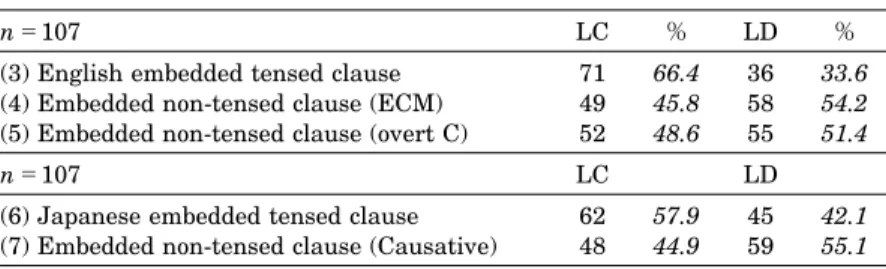
Table 1 and Table 2 below represent the overall responses reported in this experiment. 66.4% of the subjects correctly identified the local ante-cedent of a given English reciprocal in the embedded tensed clause (see LC in (3)). 33.6% of them erroneously allowed LD in the embedded tensed clause (see LD in (3)), whereas 51.4 to 54.2% of the subjects erro-neously allowed LD in the embedded non-tensed clauses, as in (4) and (5). Let us turn our attention to the contrast between the English recip-rocal and its Japanese counterpart. 57.9% of the subjects disallowed LD in the embedded tensed clause (see LC in (6)); conversely, 55.1% of them allowed LD in addition to LC in the same
5
context.
In Table 2, we see that 80.4% of the subjects allowed split antece-dents for the Japanese reciprocal otagai and 72.4% of them allowed split antecedents for the English reciprocal each other even though (8) is ungrammatical in the L1 grammar of English.
4. 4. 2 Individual Results
Interesting and worth noting though they are, the aggregate data that
Table 1 Results of Co-referential
6
Judgment LC versus LD for L 1/L 2 reciprocals
n=107 LC % LD %
(3) English embedded tensed clause (4) Embedded non-tensed clause (ECM) (5) Embedded non-tensed clause (overt C)
71 49 52 66.4 45.8 48.6 36 58 55 33.6 54.2 51.4 n=107 LC LD
(6) Japanese embedded tensed clause (7) Embedded non-tensed clause (Causative)
62 48 57.9 44.9 45 59 42.1 55.1
Table 2 Results of Grammatical Judgment Acceptability of split antecedents
n=107 OK % Out %
(8) Split antecedents in English (9) Split antecedents in Japanese
78 86 72.9 80.4 29 21 27.1 19.6
we presented in the preceding subsections are insufficient in revealing the transfer of the syntactic behavior of the L1 reciprocal otagai to the L2 reciprocal each other. Each of the responses of an individual subject should be compared and analyzed much more closely.
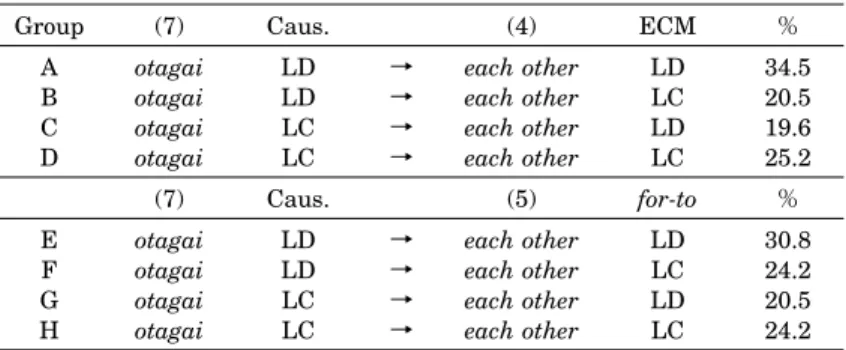
In Table 3. 1, the subjects classified in Group A, D, E, and H are expected to transfer the syntactic features of their L1 reciprocal to the L2 one; for, the reciprocal in their IL grammar behaves the same as the L1 reciprocal with respect to the locality of binding domain. As for Group C and G, on the other hand, it is obvious that the subjects do not transfer the syntactic features of their L1 reciprocal.
The point to notice is that Group B and Group F are excluded from our consideration under discussion. This is because we suppose that those who have already acquired the English-type parameter value (i.e., those who have successfully acquired the correct usage of the English reciprocal) ought to be included in Group B and Group F; for, the sub-jects classified in those groups correctly identified the local antecedent (i.e., LC) in the English embedded non-tensed clauses. The UG-based SLA researches within the generative paradigm should focus on the L2 learner’s IL grammar. Because Group B and Group F are alleged to be no longer at an intermediate L2 acquisition stage as for the acquisition of reciprocals, we have concluded that Group B and Group F should be excluded from the consideration under
7
discussion.
Table 3. 1 Individual Results of Co−referential Judgment
Group (7) Caus. (4) ECM %
A B C D otagai otagai otagai otagai LD LD LC LC → → → → each other each other each other each other LD LC LD LC 34.5 20.5 19.6 25.2 (7) Caus. (5) for-to % E F G H otagai otagai otagai otagai LD LD LC LC → → → → each other each other each other each other LD LC LD LC 30.8 24.2 20.5 24.2 Nao Ishino 94
Similarly, Group D and H also may include the subjects who might have successfully acquired the L2 parameter value; however, it is equally likely that the subjects who have transferred the syntactic fea-ture of their L1 reciprocal are included in these two groups. Hereby, we do not exclude Group D and Group H from our consideration under dis-cussion.
Table 3. 2 shows that the comparisons of the collected data as to those who have transferred their L1 syntactic feature to the L2 one and those who have not transferred their L1 syntactic feature. As for the IL English reciprocal in the ECM construction, we estimate 75.2% of them (i.e., Group A plus Group D) have transferred their L1 syntactic feature to L2 one, whereas 24.7% of them (i.e., Group C) are expected not to have transferred their L1 syntactic feature to the L2 one. As for the IL English reciprocal in the embedded non-tensed clause with overt C, we estimate that 72.8% of them (i.e., Group E plus Group H) have trans-ferred, whereas 27.1% (i.e., Group G) have not. These figures clearly show that JLsE selectively transfer their L1 syntactic feature to the
cor-Table 3. 2 Transfer versus Not transfer
J to E Transfer (%) Not transfer (%) (7) causative → (4) ECM (7) causative → (5) for-to 75.2 72.8 24.7 27.1
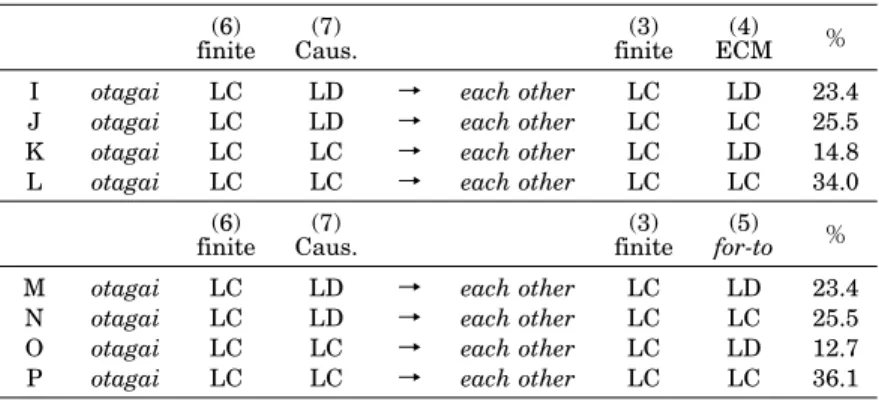
Table 4. 1 Individual Results of Co-referential Judgment (6) finite (7) Caus. (3) finite (4) ECM % I J K L otagai otagai otagai otagai LC LC LC LC LD LD LC LC → → → → each other each other each other each other LC LC LC LC LD LC LD LC 23.4 25.5 14.8 34.0 (6) finite (7) Caus. (3) finite (5) for-to % M N O P otagai otagai otagai otagai LC LC LC LC LD LD LC LC → → → → each other each other each other each other LC LC LC LC LD LC LD LC 23.4 25.5 12.7 36.1 Feature-Driven Acquisition of L2 Reciprocals 95
responding L2 lexical item in their IL grammar.
Next, we confine our attention to the subjects who correctly allowed both LC for their IL reciprocal in the embedded tensed clause and LC for the L1 reciprocal in the embedded tensed clause. Table 4. 1 shows the individual results in which each of the JLsE’s answers for the IL re-ciprocals with their answers for the L1 rere-ciprocals is under comparison.
According to Table 4. 2, which shows the comparison between the “transfer” group and the “not transfer” group, we see that far more JLsE have transferred their L1 syntactic feature to the L2 reciprocals.
We have thus claimed that JLsE exclusively select and transfer the syntactic features of otagai to the L2 reciprocal. Next, we will provide further evidence in favor of this claim.
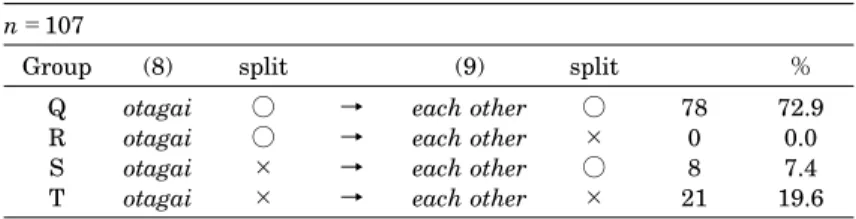
Table 2 indicates that 86 subjects accepted split antecedents in Japanese. ESTH predicts that the syntactic feature of L1 reciprocal is transferred to the L2 reciprocal in the IL grammar. Thanks to our as-sumption, ESTH predicts that many JLsE erroneously allow split ante-cedents in English. We conclude that in Table 5, all of those who ac-cepted split antecedents in Japanese have transferred the syntactic fea-tures of otagai to each other, resulting in misunderstanding that each
other allows split antecedents. It should be noted that none of the JLsE
Table 4. 2 Transfer versus Not Transfer
J to E Transfer (%) Not transfer (%) (7) causative → (4) ECM (7) causative → (5) for-to 79.4 82.3 20.5 17.6
Table 5 Individual Results of Grammatical Judgment
n=107
Group (8) split (9) split %
Q R S T otagai otagai otagai otagai ○ ○ × × → → → → each other each other each other each other ○ × ○ × 78 0 8 21 72.9 0.0 7.4 19.6 Nao Ishino 96
who accepted split antecedents in Japanese correctly recognized that the English reciprocal does not tolerate split antecedents.
5. Discussion
On the basis of such experimentally obtained data concerning the bind-ing domains of the English and the Japanese reciprocals, we now pro-pose that the two previous approaches that we reviewed in subsection 3. 2. and 3. 3. (i.e., PRH/TH) should be disapproved. Our experimental data, hence, lend support to ESTH, which argues in favor of the trans-fer of the syntactic features of L1 lexical items.
Now, it is hereby natural to conclude that JLsE (exclusively) select and transfer the syntactic features (parameter values) of L1 lexical items to L2 ones in the course of the L2 acquisition process of recipro-cals. ESTH is, therefore, highly pertinent to the actual experimental re-sults.
Another piece of newly-discovered evidence in favor of ESTH comes from the data on acceptability of split antecedents, as is shown in Table 2 and Table 5. The Japanese reciprocal otagai has the syntactic feature which allows split antecedents, so that we are led to predict with ESTH that JLsE transfer its syntactic feature (parameter value) to understand the L2 reciprocal each other; as a result, they accept split antecedents for each other, which is ungrammatical in the L1 grammar of English. It is clearly shown in Table 2 and Table 5 that this prediction is indeed borne out, as expected.
6. Conclusion
The purpose of this paper was to defend ESTH in SLA and to lend sup-port to it by providing the experimental evidence under the framework of the UG-based SLA. Our observation and its analysis can be recapitu-lated in the following three points:
(i) Trying out an experiment for the purpose of explicating the bind-ing domain of the Japanese reciprocal otagai, we detected that otagai only requires the local binding (i.e., LC) in embedded tensed clauses, but allows both of the local and the long-distance binding (i.e., LD) in embedded non-tensed clauses. The empirically novel and experimentally obtained observation on the binding domain and the acceptability of split antecedents for the Japanese reciprocal “otagai” have been thus re-ported in this paper.
(ii) We have empirically confirmed that JLsE initially select the syntactic features of the L1 reciprocal and transfer its syntactic features to the L2 reciprocal in their IL grammar, misunderstanding the English reciprocal within embedded non-tensed clauses as being tolerant both to the local and to the long-distance binding (i.e., LD).
(iii) We defended ESTH, which strongly suggests that the language-particular parameter re-setting approach should be shifted to the syn-tactic feature-based approach in the studies of the acquisition of bind-ing. Theoretically, this paper thus lends solid support to Ishino & Ura’s (2009 a) ESTH with our empirically new evidence.
The language-particular parameter re-setting approach in the stud-ies of the L2 acquisition of binding should therefore be discarded. The shift from old theories to the Minimalist theory of syntax raises new is-sues on the parameter re-setting approach in SLA. SLA studies have reached a turning point with an emphasis on the syntactically feature-based approach under the minimalist framework, the issue of which will be left to the future research.
Note
1 As White (2003) explains, non-native grammars are said to be inter-language grammars in this paper. Though inter-inter-language grammars are alleged to be systematic and represent rule-governed behaviors, they have not been fixed yet and are still transitional in the course of the L2 acquisition.
2 As for the example in (2), the answer A (i.e., LC) corresponds to the inter-pretation under which Joe and Meg think that Tom hates Bill and Bill hates
Nao Ishino 98
Tom. On the other hand, the answer B (i.e., LD) corresponds to the interpreta-tion under which Joe thinks that Tom and Bill hate Meg and Meg thinks that Tom and Bill hate Joe, in addition to the local binding.
3 Throughout this paper, “local binding (LC)” is used to refer to the binding dependency between an anaphor and its antecedent, both of which are within a single clause, irrespective of whether the clause is tensed or non-tensed, and “long-distance binding (LD)” is used otherwise. Incidentally, Ishino and Ura (2009 a) has revealed, from their experimental studies, that zibun allows LD in any context, whereas zibun-zisin disallows LD astride a tensed-clause boundary, though allowing LD astride a non-tensed-clause boundary. As for pronoun-zisin (=kare-zisin, kanojo-zisin, or karera-zisin), the experiment by Ishino and Ura (2009 a) has revealed that it disallows any LD.
4 (2) is repeated here as (3). In (4), LD means that Joe expects Tom and Bill to understand Meg and that Meg expects Tom and Bill to understand Joe. In (5), LD means that Joe hopes for Tom and Bill to understand Meg and Meg hopes for Tom and Bill to understand Joe.
5 Another Grammatical Judgment Test was carried out as a follow-up ex-periment for the purpose of confirming the binding domains of the L1 and L2 re-ciprocals in the IL grammar. 253 JLsE in the freshman at Kwansei Gakuin Uni-versity participated in our experiment. Table 6 shows the result in which we see that the L2 reciprocal is regarded as LC in embedded tensed clauses, while it may be regarded as LD in the embedded non-tensed clauses.
(10) English embedded tensed clause:
*Joe and Meg think that [the man hates each other]. (11) English embedded non-tensed clause (ECM):
*Joe and Meg expect [the man to understand each other]. (12) English embedded non-tensed clause (with overt C):
*Joe and Meg hope for [the man to understand each other]. (13) Japanese embedded tensed clause:
Hanako to Kyoko-wa [sono otoko-ga otagai -ni and -TOP the man -NOM each other-DAT kisushi-ta] to it-ta.
kiss-PAST C say-PAST
‘Hanako and Kyoko said that the man kissed each other.’ (14) Japanese embedded non-tensed clause (ECM):
Hanako to Kyoko-wa [Yamada-kyoju-o otagai-ni kibishiku] omot-ta. and -TOP Prof. Yamada-ACC each other-DAT strict think-PAST ‘Hanako and Kyoko believed Prof.Yamada to be strict to each other.’
6 From Table 2, we see that the Japanese reciprocal otagai behaves the same as zibun-zisin, one of the three reflexives in Japanese, with respect to the locality of their binding dependencies (see Ishino and Ura (2009 b) for the theo-retical rationale behind this observation).
7 Throughout this paper, we address ourselves exclusively to the L2 acqui-sition of the syntactic properties of the reciprocals; ignoring the L2 acquiacqui-sition of their phonological, morphological, or semantic aspects.
References
Aikawa, T. 2002. Reflexives. In N. Tsujimura (ed.), The handbook of Japanese
linguistics, 154−90. Blackwell.
Bennett, S, and L. Progovac. 1998. Morphological status of reflexives in second language acquisition. In S. Flynn, G. Martohardjono and W. O’Neil (eds.),
The generative study of second language acquisition, 187−214. Lawrence
Erlbaum Associates.
Berwick, R. 1985. The acquisition of syntactic knowledge. Cambridge, Mass.: MIT Press.
Bley-Vroman, R. 1990. The logical problem of foreign language learning.
Linguis-tic Analysis, 20: 3−49.
Chomsky, N. 1981. Lectures on government and binding. Foris. Chomsky, N. 1995. The minimalist program. MIT Press.
Eubank, L. 1994. Optionality and the initial state in L2 development. In T. Hoekstra and B. D. Schwartz (eds.), Language acquisition studies in
genera-tive grammar. 369−88.
Hawkins, R. 2001. Second language syntax: A generative introduction. Blackwell. Hirakawa, M. 1989. The governing category parameter in second language
acqui-sition. In Y. Otsu (eds.), MITA Working Papers in Psycholinguistics 2: 27− 40.
Hirakawa, M. 1990. A study of the L2 acquisition of English reflexives. Second
Language Research 6. 1: 60−85.
Hoji, H. 2006. Otagai. In A. Ueyama (ed.), Theoretical and empirical studies of Table 6 Results of Grammatical Judgment
n=253 Out→
LC (%)
OK→ LD (%) (10) English Embedded tensed clause
(11) Embedded non-tensed clause (ECM) (12) Embedded non-tensed clause (overt C)
68.4 45.2 45.0 31.6 54.8 55.0 (13) Japanese embedded tensed clause
(14) Embedded non-tensed clause (ECM)
79.4 52.6 20.6 47.4 Nao Ishino 100
reference and anaphora: Toward the establishment of generative grammar as an empirical science. 126−38.
Ishino, N. 2009. Syntactic feature transfer hypothesis in SLA: With special refer-ence to reciprocals. Talk presented at the 4 th annual meeting of The Kan-sai Regional Branch of The English Literary Society of Japan, held at Dosh-isha University.
Ishino, N. and H. Ura 2009 a. Exclusively Selective Transfer Hypothesis in L2 acquisition and multiple parameters for Japanese reflexives. Talk presented at the 139th biannual meeting of the Linguistic Society of Japan, held at Kobe University.
Ishino, N. and H. Ura 2009 b. Japanese binding and its neoteric parameter. Ms., Kwansei Gakuin University.
Katada, F. 1991. The LF representation of anaphors. Linguistic Inquiry 22. 2: 287−314.
MacLaughlin, D. 1995. Universal Grammar and L2 acquisition of reflexive bind-ing: Some learners acquire a non-L1/non-target system. Paper presented at the Annual Meeting of the Second Language Research Forum (Ithaca, NY). MacLaughlin, D. 1998. The acquisition of the Morphosyntax of English reflexives
by non-native speakers. In Maria-Luise Beck (eds.), Morphology and its
in-terfaces in second language knowledge, 195−226: John Benjamins.
Mihara, K., and K. Hiraiwa(三原健一・平岩健).2006.『新日本語の統語構造』松 柏社.
Pica, P. 1987. On the nature of the reflexivization cycle. North Eastern Linguistic
Society 17: 483−99.
Reinhart, T., and E. Reuland. 1993. Reflexivity. Linguistic Inquiry 24: 657−720. Pollard, Carl, and Ivan A. Sag. 1992. Anaphors in English and the scope of
bind-ing theory. Lbind-inguistic Inquiry 23. 2: 261−303.
Selinker, L. 1972. Interlanguage. International review of applied linguistics 10: 209−31.
Shirahata, T., and M. Bannai(白畑知彦・坂内昌徳).2006.『第二言語習得研究入 門』新曜社.
Thomas, M. 1995. Acquisition of the Japanese reflexive zibun and movement of anaphors in logical form. Second Language Research 11. 3: 206−34. Wakabayashi, S. 1996. The nature of interlanguage: SLA of English reflexives.
Second Language Research 12. 3: 266−303.
Watanabe, E., C. Fuji, Y. Kabuto, and K. Murasugi. 2008. Experimental evidence for the parameter resetting hypothesis: The second language acquisition of English reflexive-binding by Japanese speakers. Nanzan Linguistics: special
issue 3:263−83.
Wexler, K, and M. Manzini 1987. Parameters and learnability in binding theory. Feature-Driven Acquisition of L2 Reciprocals 101
In T. Roeper and E. Williams (eds.), Parameter setting, 41−76. Reidel. White, L. 2003. Second language acquisition and universal grammar. Cambridge
University Press.
Yuan, B. 1994. Second language acquisition of reflexives revisited. Language 70: 539−45.
Yusa, N. 1998. A minimalist approach to second language acquisition. In S. Flynn, G. Martohardjono and W. O’Neil (eds.), The generative study of
sec-ond language acquisition, 215−38. Lawrence Erlbaum Associates.
Nao Ishino 102