§ 1. Peltier Current Lead for Alternative Current Mode
Yamaguchi, S. (Chubu Univ.), Shimada, Ryu. (Tokyo lnst. Tech.)
Peltier current lead (PCL) was proposed to reduce a heat leakage of the current lead for superconducting low temperature systems]). Numerical studies have been done to analyze the PCL 2) and also to fix the optimum design of the PCL 3). Peltier effect transfers the heat from low temperature side to high temperature side by the dc current. However, when we consider the electric application, alternative current is important and common in the present time.
Therefore, we develop and study the Peltier current lead for alternative current mode.
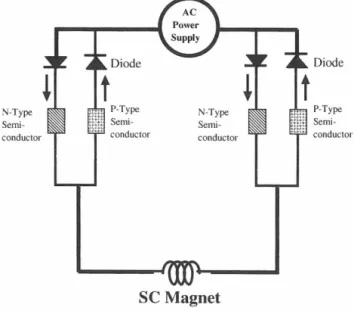
Figure 1 shows the alternative current PCL. In order to apply to the ac mode, the switching device is needed because when the current direction is reversed, the heat is transferred from high temperature side to low temperature side. The diode is used in the figure, and we can also use GTO, FET and other switching devices. Because of this constitution, the thermal conduction is doubled because there are two pairs of thermoelectric element. Peltier heat transfer is halved because the current can only flow in one semiconductor at any time, moreover, the wave form of the current is not constant and the half-wave rectified sine-curve. The frequency of the commercial power line is 50 to 60 Hz, however, the time constant of heat transfer is slow as compared with this frequency experimentally obtained4) therefore we can introduce the time average method to analyze this system.
Experimentally the time constant of the heat transfer is almost 1000 time longer than that of the commercial frequency4), Therefore, we calculate the effective values of the current and heat flow for the system at first. Then we can evaluate the transport parameters, such as the Seebeck coefficient, the electrical resistivity and the thermal conductivity of the semiconductor. By this model, the effective current is half of the peak current. Thermal conductivity and electrical resistivity are the same, and the Seebeck coefficient is 2/n times that of the original.
Examples of the calculation results are shown in figure 2. The dotted line shows the heat leakage in dc mode, and the solid line in half-
wave rectified current mode. We can conclude that the PCL is still effective even in HWDC mode.
Diode Diode
N-Type P-Type N-Type P-Type
Semi- Semi- Semi- Semi-
conductor conductor conductor conductor
SC Magnet
Fig. 1. An concept of Alternative current PCL.
1.12 r---n--r__~-r__~ _ _ r____r_--.
\
\ , , ,
\
\ , , , , , , ,
... ... ,
... ... , , ,
1.09 L--__'__~__'_----"~ ... ----"~__'_---I
220 230 240 250 260
eu rrent (A)
Fig. 2. Heat leakage versus current for dc mode and half-wave rectified current mode.
Reference
1) S. Yamaguchi, K. Takita, o. Motojima: "A Proposal of Peltier current lead", Proc. 16th lnt.
Cryogenic Eng. Conf.! lnt. Cryogenic Mat. Conf., May 1996.pp.1159-1162
2) H. Okumura, S. Yamaguchi, "One Dimensional Simulation for Peltier Current Leads", IEEE Trans Appl. Supercond. 1997;7(2):715-718".
3) K. Sato, H. Okumura and S. Yamaguchi, Numerical calculations for Peltier current lead designing", Cryogenics, vol.41 , p.497, 2001.
4) T. Yamaguchi et aI, "Pletier current lead experiment for alternative current mode", accepted for publication in 1. Cryogenic Eng.
and Superconduct., Japan.
211