Acta Med. Nagasaki 61: 55−60−
Introduction
In liver or pancreatic cancer patients, body weight loss and malnutrition can be severe after pancreatic resection be- cause of the invasiveness of radical surgery and advanced tumor stage (1, 2). To promote early recovery after major surgery, nutritional support in the perioperative period is necessary and hormonal support is one of the important treatments. However, there is considerable scope to improve
the effectiveness of supportive treatments.
Ghrelin was discovered as an intrinsic ligand for the growth hormone-secretagogue receptor (GHS-R) in 1999 by Kojima et al. (3). Endogenous ghrelin is mainly produced in the stomach. Ghrelin has multiple functions, such as orexi- genic action on the hypothalamus or gastrointestinal motili- ty, stimulating growth hormone secretion, anti-inflammatory activities, and affecting the strength of skeletal muscle, as well as various other metabolic functions (3-5). In particular,
Relationship between serum ghrelin level and physiology in patients who underwent hepatectomy and pancreatectomy
Atsushi Nanashima1,2, Goushi Murakami2, Katsunori Takagi2, Junichi Arai2, Yorihisa Sumida2, Tomoaki Kodama3 and Takeshi Nagayasu2
1 Division of Hepato-biliary Pancreatic Surgery, Department of Surgery, University of Miyazaki Faculty of Medicine, 5200 Kihara, Kiyotake, Miyazaki 889-1601, Japan
2 Department of Surgical Oncology, Nagasaki University Graduate School of Biomedical Sciences, 1-7-1 Sakamoto, Nagasaki 852-8501, Japan
3 Department of Health and Nutrition, Faculty of Health Management, Nagasaki International University, 2825-7 Hausutenbosu-machi, Sasebo 859-3243, Japan
Aim: Ghrelin is a peptide that is secreted from the stomach and plays a role in appetite, weight gain, and skeletal muscle com- position. In the present clinical study, we examined the relationship between ghrelin level and physiology in patients who had undergone major liver and pancreas surgery.
Methods: Serum ghrelin level was measured before and after hepatectomy and pancreatectomy. The relationships between nutritional status and postoperative alterations of parameters including the ghrelin level were examined.
Results: In 32 patients, the preoperative plasm acyl- (AG) or des-acyl-ghrelin (DAG) and AG/DAG ratio were not significantly different based on gender, type of operation, age and each disease. AG tended to be correlated with the respiration quotient but this was not statistically significant (p=0.08). AG was significantly negatively correlated with hemoglobin and albumin lev- els. The postoperative plasma ghrelin level was significantly decreased at day 1 in comparison with preoperative levels (p<0.05) and recovered to preoperative levels at day 3. There were no significant differences between hepatectomy and pan- createctomy groups, with no changes of postoperative metabolic parameters.
Conclusions: Although serum ghrelin level was transiently decreased, this level was immediately recovered and not influenced by the surgical procedures or its invasiveness.
ACTA MEDICA NAGASAKIENSIA 61: 55−60, 2017 Key words: human ghrelin level, postoperative nutrition, hepatectomy, pancreatectomy
Address correspondence: Atsushi Nanashima, MD, Division of Hepato-biliary Pancreatic Surgery, Department of Surgery, University of Miyazaki Faculty of Medicine, 5200 Kihara, Kiyotake, Miyazaki 889-1601, Japan
Tel.: +81 985 85 2905, Fax: +81 985 85 3780, E-mail: [email protected] Received December 12, 2016; Accepted February 2, 2017
ghrelin is a powerful gastrointestinal appetite-stimulating hormone, and is regulated by the circadian rhythm (6). Re- cently, clinical trials of compounded human ghrelin (CHG) and been conducted in an attempt to increase oral feeding and weight gain, inducing early recovery and anti-inflamma- tory protection after invasive surgery, namely, gastrectomy and esophagectomy, in cancer patients (7-10). Ghrelin has been used for the improvement of cancer-associated cachex- ia or chemotherapy-related cachexia (11, 12).
In the present study, we thus examined changes of body weight and calorie intake, the relationship between ghrelin level and clinical features, laboratory data and nutritional evaluation to clarify its physiology.
Patients and Methods Patient demographics.
The subjects were 32 patients with liver or pancreatic dis- eases who underwent major hepatectomy or pancreatectomy in the Division of Surgical Oncology, Department of Sur- gery in Nagasaki University Graduate School of Biomedical Sciences between April 2012 and December 2013. They in- cluded 19 men and 13 women with a mean age of 63±12 years (range, 26-79 years). The diseases included hepatocel- lular carcinomas in five patients, metastatic liver carcinomas in four, intrahepatic cholangiocarcinomas in one, cystic liver in one, bile duct carcinomas in six, papillary carcinoma in two, intraductal papillary mucin producing neoplasm in three, pancreatic carcinoma in eight, duodenal carcinoma in one and metastatic pancreas cancer (originated from renal cell carcinoma) in one.
The volume of liver to be resected was estimated before surgery based on the results of the indocyanine green reten- tion rate at 15 min (ICG R15). The liver volume, excluding any tumor volume (cm3) was measured by computed tomog- raphy (CT) volumetry. In this cohort, we performed major hepatectomy over two segments in 11 patients including bil- iary reconstruction in two, and pancreatectomy in 21 (in- cluding pancreaticoduodenectomy in 17). Postoperative he- patectomy- or pancreatectomy-related complications did not occur during measurement in any patient. The study design was approved by the Ethics Review Board of Nagasaki Uni- versity Hospital (#12090391), and informed consent for data collection was provided by each patient.
Evaluated parameters and protocol of ghrelin administra- tion
Clinical data, conventional liver functions and surgical data were analyzed. Peripheral blood samples for plasm acyl- or des-acyl-ghrelin and leptin level were collected from each patient in stable condition early in the morning during hospitalization. Blood samples were centrifuged at 1000 rpm for 10 min, and plasma was stored at -20 degrees Celsius. These samples were assayed using the enzyme im- mune-assay.
We used the Inbody S20 Body Composition Analyzer, which employs the bioelectrical impedance analysis method (Biospace Co. Ltd., Korea) for body composition analysis.
Indirect calorimetry was performed by the respiratory me- tabolism measuring apparatus Vmax series (Nihon Kohden Co., Tokyo, Japan).
Statistical analysis
Continuous data are expressed as means +/- SD. Data were compared between groups using one-way analysis of variance (ANOVA) and were examined with the Mann- Whitney U-test. Comparisons of categorical data were per- formed with the Chi-squared test. Potentially predictive variables were identified using a significance level of p<0.05 by univariate analysis. A two-tailed P value < 0.05 was con- sidered significant. The Statistical Package for Social Sci- ences (SPSS) version 18.0 software (SPSS, Chicago, IL) was used for all statistical analyses.
Results
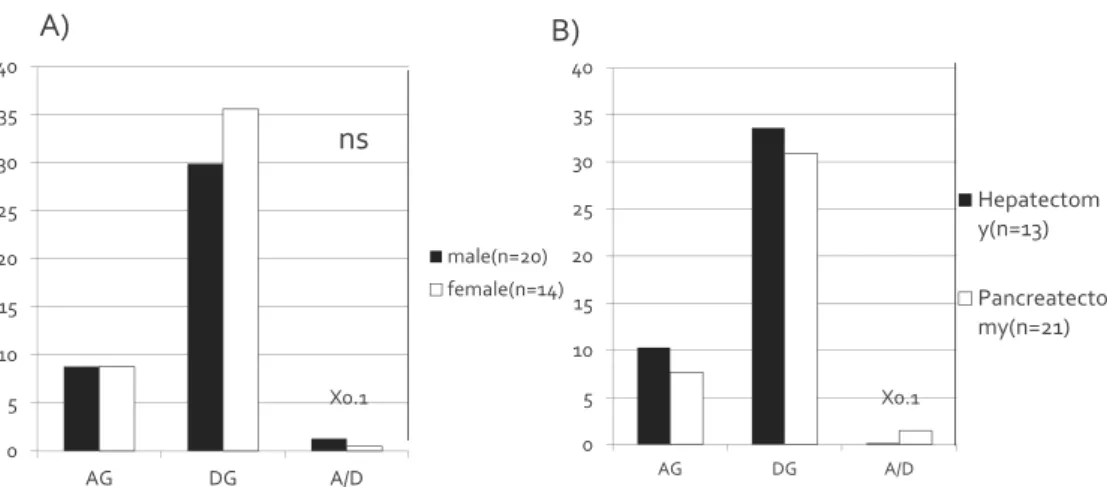
For the 32 patients, preoperative mean value of plasm acyl- (AG) or des-acyl-ghrelin (DAG) and AG/DAG ratio were 8.8±9.7, 32.0±19.1 and 0.10±0.24 fmol/ml, respec- tively. AG, DAG and AG/DAG ratio were not significantly different between males and females (Figure 1A) and be- tween hepatectomy and pancreatectomy (Figure 1B). Age and each parameter (AG, DAG and AG/DAG ratio) were not significantly correlated; r=0.125, 0.040 and 0.174, respec- tively.
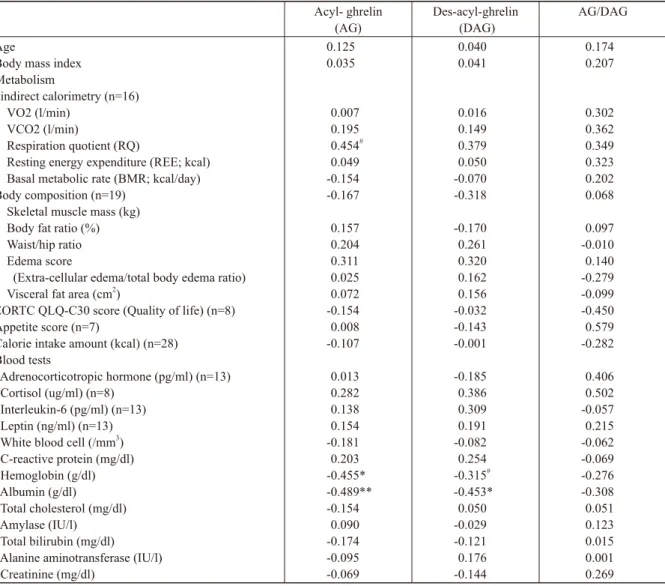
Figure 2 shows the AG, DAG and AG/DAG ratio for each disease. There were no significant differences between the groups. Table 1 shows the correlation between each param- eter of ghrelin and preoperative laboratory data. AG tended to be correlated with respiration quotient, which indicates the combustion rate of nutrients, but this was not statistically
57 Atsushi Nanashima et al.: Ghrelin levels in hepato-pancreatic surgery
significant (p=0.08). Otherwise, ghrelin levels were not sig- nificantly correlated with other parameters of metabolism, body composition, quality of life or appetite score and calo- rie intake amount. AG was significantly negatively correlat- ed with hemoglobin and albumin levels, DG showed a sig- nificantly negative correlation with albumin level.
Figure 3 A-C shows that the postoperative plasma ghrelin
level and AG, DG and AG/DAG ratio were significantly de- creased at day 1 in comparison with preoperative levels (p<0.05) but recovered to preoperative levels at day 3. Fig- ure 3D shows the postoperative plasma AG and AG/DAG ratio level for each operation type; there were no significant differences between hepatectomy and pancreatectomy groups.
0 5 10 15 20 25 30 35 40
AG DG A/D
male(n=20) female(n=14)
X0.1
ns
0 5 10 15 20 25 30 35 40
AG DG A/D
Hepatectom y(n=13) Pancreatecto my(n=21) X0.1
Figure 1
A) B)
0 5 10 15 20 25 30 35 40 45
AG DG A/D
HCC(n=5) ICC(n=1) IPMN(n=4) PC(n=8) BDC(n=6) MLC(n=4)
Duodenal papilla cancer Metastatic pancreas cancer Liver cystic tumor
Figure 2
Figure 1: AG, DAG and AG/DAG ratio for each A) gender and B) operation.
Figure 2: AG, DAG and AG/DAG ratio for each liver or pancreas disease for operation.
AG(fmol/ml) DG(fmol/ml)
AG/DG
A) AG B) DG
C) AG/DAG
0 2 4 6 8 10 12 14 16 18 20
0 10 20 30 40 50 60 70 80
0 10 20 30 40 50 60 70
80 D) AG in each operation
-5 0 5 10 15 20 25
ns
Pancreatectomy Hepatectomy
Figure 3: Changes of postoperative level of A) AG, B) DG and C) AG/DAG. D) Comparison of changes of AG level in each operation.
Acyl- ghrelin
(AG) Des-acyl-ghrelin
(DAG) AG/DAG
AgeBody mass index Metabolism
indirect calorimetry (n=16) VO2 (l/min)
VCO2 (l/min)
Respiration quotient (RQ)
Resting energy expenditure (REE; kcal) Basal metabolic rate (BMR; kcal/day) Body composition (n=19)
Skeletal muscle mass (kg) Body fat ratio (%) Waist/hip ratio Edema score
(Extra-cellular edema/total body edema ratio) Visceral fat area (cm2)
EORTC QLQ-C30 score (Quality of life) (n=8) Appetite score (n=7)
Calorie intake amount (kcal) (n=28) Blood tests
Adrenocorticotropic hormone (pg/ml) (n=13) Cortisol (ug/ml) (n=8)
Interleukin-6 (pg/ml) (n=13) Leptin (ng/ml) (n=13) White blood cell (/mm3) C-reactive protein (mg/dl) Hemoglobin (g/dl) Albumin (g/dl) Total cholesterol (mg/dl) Amylase (IU/l) Total bilirubin (mg/dl) Alanine aminotransferase (IU/l) Creatinine (mg/dl)
0.125 0.035
0.007 0.195 0.454# 0.049 -0.154 -0.167 0.157 0.204 0.311 0.025 0.072 -0.154 0.008 -0.107 0.013 0.282 0.138 0.154 -0.181 0.203 -0.455*
-0.489**
-0.154 0.090 -0.174 -0.095 -0.069
0.040 0.041
0.016 0.149 0.379 0.050 -0.070 -0.318 -0.170 0.261 0.320 0.162 0.156 -0.032 -0.143 -0.001 -0.185 0.386 0.309 0.191 -0.082 0.254 -0.315# -0.453*
0.050 -0.029 -0.121 0.176 -0.144
0.174 0.207
0.302 0.362 0.349 0.323 0.202 0.068 0.097 -0.010 0.140 -0.279 -0.099 -0.450 0.579 -0.282 0.406 0.502 -0.057 0.215 -0.062 -0.069 -0.276 -0.308 0.051 0.123 0.015 0.001 0.269
#: p=0.08, *p<0.05, **p<0.01
Table 1. Correlation between ghrelin levels and laboratory data of patients before operation
59 Atsushi Nanashima et al.: Ghrelin levels in hepato-pancreatic surgery
Ghrelin is mainly secreted from endocrine cells in the body of stomach, but is also secreted from A-like cells of the pancreas and small intestine (13-15). Regulation of appetite is controlled by the humoral and autonomic nerve system via peripheral signals such as gastric distention, peptides or me- tabolites, which stimulate the nucleus of the hypothalamus (16). In the next step, feeding behavior is eventually regu- lated in the cerebral cortex association cortex (17). Ghrelin induces this feeding behavior accompanied with taste sensa- tion, motilin, glucocorticoid and growth hormone. In con- trast, satiety signals include insulin, dopamine release, in- flammation, cytokine release and leptin. Ghrelin has multiple functions in appetite gain, secretion of growth hormone, en- ergy assimilation, anti-inflammatory response and cardio- vascular protection (18-20). Thus, ghrelin has been used for treatment of cardiac failure, anti-aging, anorexia or cachex- ia. By administration of human ghrelin, the daily food intake of anorexia patients increased, and muscle mass or body fat amount increased in patients undergoing hip joint surgery (21, 22). Rikkunshito, a herbal medicine, induces expression of the receptor for ghrelin and, therefore, gastric movement or appetite was improved in patients undergoing gastrecto- my (23). However, the effects of ghrelin were limited in comparison with direct administration of human ghrelin.
Takiguchi and Doki et al. indicated improvement of nutri- tion, quality of life, enhanced recovery after surgery (ERAS), shortening of hospital stay and effect of anti-inflammatory cytokines in esophageal and gastric surgery (7-10, 24). In general, surgery induces massive stresses including decom- position of the lean mass of skeletal muscle. In the concept of ERAS, acceleration of appetite, early ambulation, gating and acceleration of gastro-intestinal movements are neces- sary (25). To maintain skeletal muscular mass after major surgery, adjuvant treatments such as ghrelin administration and rehabilitation are essential.
In the present study, we firstly examined the changes of plasma ghrelin level during the perioperative period. The preoperative AG level was not associated with clinicopatho- logical parameters, but was positively associated with respi- ration quotient, i.e., the combustion rate of nutrients. The relationship between ghrelin and energy balance was not clarified, and ghrelin level was increased in thermal injury patients and related with energy balance according to previ- ous reports (26-28). Otherwise, AG was not correlated with other indirect energy parameters, body composition, or calo- rie intake. Ghrelin levels (AG and DAG) were negatively correlated with hemoglobin and serum albumin levels. We
speculate that the consumption of nutrients is reflected by a massive nutritional combustion as shown above. However, the direct cause of consumption was not obvious in our se- ries.
The plasma ghrelin level transiently decreased immedi- ately following hepatectomy or pancreatectomy, but recov- ered soon at day 3. No change of AG level was observed at days 5 and 7. Although the ghrelin was consumed immedi- ately after surgery, production of ghrelin might be rapid be- cause of its short half-life. Doki et al. clarified the improve- ment of nutritional effect of CHG administration after major esophagectomy. (7-10, 24) Garin et al. reported on the short- term safety of ghrelin administration and its efficacy as an appetite stimulant in diverse patient populations (29). Pro- spective clinical trials of anamorelin treatment, an oral ghre- lin-receptor agonist with appetite-enhancing and anabolic activity, have been conducted to improve cachexia (30, 31).
Anamorelin treatment for 12 weeks had a favorable clinical response profile in patients with cancer anorexia-cachexia syndrome. This finding supported further investigation in this setting. Approval for CHG treatment by the national health insurance system in Japan to improve cachexia, mal- nutrition or decreased skeletal muscles would be anticipated, as well as approval of anamorelin in Western series (32).
In conclusion, plasma ghrelin levels are decreased after major stressful hepatectomy or pancreatectomy. Ghrelin deficit is supposed to be a cause of poor appetite and malnu- trition.
Grant support: This investigation was supported by a Grant-in-Aid for Scientific Research from the Ministry of Health, Labour, and Welfare of Japan (#10103853), between 2012 and March 2014.
Discussion
References
1. Cooper C, Burden ST, and Molassiotis A: An explorative study of the views and experiences of food and weight loss in patients with opera- ble pancreatic cancer perioperatively and following surgical interven- tion. Support Care Cancer. 23:1025-1033, 2015.
2. Tisdale MJ: Metabolic abnormalities in cachexia and anorexia. Nutri- tion. 16:1013-1014, 2000.
3. Kojima M, Hosoda H, Date Y, Nakazato M, Matsuo H and Kangawa K: Ghrelin is a growth-hormone-releasing acylated peptide from stomach. Nature. 402:656-660, 1999.
4. Asakawa A, Inui A, Kaga T, Yuzuriha H, Nagata T, Ueno N, Makino S, Fujimiya M, Niijima A, Fujino MA and Kasuga M: Ghrelin is an appetite-stimulatory signal from stomach with structural resemblance to motilin. Gastroenterology. 120:337-345, 2001.
5. Muccioli G, Tschöp M, Papotti M, Deghenghi R, Heiman M and Ghigo E: Neuroendocrine and peripheral activities of ghrelin: implications
in metabolism and obesity. Eur J Pharmacol. 440:235-254, 2002.
6. Patton DF and Mistlberger RE: Circadian adaptations to meal timing:
neuroendocrine mechanisms. Front Neurosci. 7:185,2013.
7. Takachi K, Doki Y, Ishikawa O, Miyashiro I, Sasaki Y, Ohigashi H, Murata K, Nakajima H, Hosoda H, Kangawa K, Sasakuma F and Im- aoka S: Postoperative ghrelin levels and delayed recovery from body weight loss after distal or total gastrectomy. J Surg Res. 130:1-7, 2006.
8. Doki Y, Takachi K, Ishikawa O, Miyashiro I, Sasaki Y, Ohigashi H, Nakajima H, Hosoda H, Kangawa K, Sasakuma F, Motoori M and Imaoka S: Ghrelin reduction after esophageal substitution and its cor- relation to postoperative body weight loss in esophageal cancer patients. Surgery. 139:797-805, 2006.
9. Takiguchi S, Takata A, Murakami K, Miyazaki Y, Yanagimoto Y, Kurokawa Y, Takahashi T, Mori M and Doki Y: Clinical application of ghrelin administration for gastric cancer patients undergoing gastrec- tomy. Gastric Cancer. 17:200-205, 2014.
10. Takiguchi S, Murakami K, Yanagimoto Y, Takata A, Miyazaki Y, Mori M and Doki Y: Clinical application of ghrelin in the field of sur- gery. Surg Today. 45:801-807, 2015.
11. Molfino A, Formiconi A, Rossi Fanelli F and Muscaritoli M: Ghrelin:
from discovery to cancer cachexia therapy. Curr Opin Clin Nutr Me- tab Care. 17:471-476, 2014.
12. Argilés JM and Stemmler B: The potential of ghrelin in the treatment of cancer cachexia. Expert Opin Biol Ther. 13:67-76, 2013.
13. O'Connor A, O'Moráin C. Digestive function of the stomach. Dig Dis.
32:186-191, 2014
14. Raghay K, Gallego R, Scoazec JY, Garcia-Caballero T, Morel G. Dif- ferent ghrelin localisation in adult human and rat endocrine pancreas.
Cell Tissue Res. 352:487-494, 2013.
15. Kumar R, Salehi A, Rehfeld JF, Höglund P, Lindström E, Håkanson R.
Proghrelin peptides: Desacyl ghrelin is a powerful inhibitor of acy- lated ghrelin, likely to impair physiological effects of acyl ghrelin but not of obestatin A study of pancreatic polypeptide secretion from mouse islets. Regul Pept. 164:65-70, 2010.
16. Kalsbeek A, Bruinstroop E, Yi CX, Klieverik LP, La Fleur SE, Fliers E. Hypothalamic control of energy metabolism via the autonomic nervous system. Ann N Y Acad Sci. 1212:114-129, 2010.
17. Schloegl H, Percik R, Horstmann A, Villringer A, Stumvoll M. Peptide hormones regulating appetite--focus on neuroimaging studies in hu- mans. Diabetes Metab Res Rev. 27:104-112, 2011.
18. Müller TD, Nogueiras R, Andermann ML, Andrews ZB, Anker SD, Argente J, Batterham RL, Benoit SC, Bowers CY, Broglio F, Casan- ueva FF, D'Alessio D, Depoortere I, Geliebter A, Ghigo E, Cole PA, Cowley M, Cummings DE, Dagher A, Diano S, Dickson SL, Diéguez C, Granata R, Grill HJ, Grove K, Habegger KM, Heppner K, Heiman ML, Holsen L, Holst B, Inui A, Jansson JO, Kirchner H, Korbonits M, Laferrère B, LeRoux CW, Lopez M, Morin S, Nakazato M, Nass R, Perez-Tilve D, Pfluger PT, Schwartz TW, Seeley RJ, Sleeman M, Sun Y, Sussel L, Tong J, Thorner MO, van der Lely AJ, van der Ploeg LH, Zigman JM, Kojima M, Kangawa K, Smith RG, Horvath T, Tschöp MH. Ghrelin. Mol Metab. 4:437-460, 2015.
19. Khatib MN, Simkhada P, Gode D. Cardioprotective effects of ghrelin in heart failure: from gut to heart. Heart Views. 15:74-76, 2014.
20. Takiguchi S, Murakami K, Yanagimoto Y, Takata A, Miyazaki Y, Mori M, Doki Y. Clinical application of ghrelin in the field of surgery.
Surg Today. 45:801-807, 2015.
21. Uehara M, Yasuhara D, Nakahara T, Harada T, Koyama KI, Ushikai M, Asakawa A, Inui A. Increase in energy intake leads to a decrease in obestatin in restricting-type of anorexia nervosa. Exp Clin Endo- crinol Diabetes. 119:536-539, 2011.
22. Akamizu T, Iwakura H, Ariyasu H, Murayama T, Sumi E, Teramukai S, Goto K, Ohnishi E, Akiyama H, Kawanabe K, Nankaku M, Ichi- hashi N, Tsuboyama T, Tamai K, Kataoka M, Nakamura T, Kangawa K; Osteoarthritis-Total Hip Replacement Clinical Study Team. Effects of ghrelin treatment on patients undergoing total hip replacement for osteoarthritis: different outcomes from studies in patients with cardiac and pulmonary cachexia. J Am Geriatr Soc. 56:2363-2365, 2008.
23. Gunji S, Ueda S, Yoshida M, Kanai M, Terajima H, Takabayashi A.
Effects of rikkunshito, a kampo medicine, on quality of life after prox- imal gastrectomy. J Surg Res. 185:575-580, 2013.
24. Takata A, Takiguchi S, Murakami K, Miyazaki Y, Miyata H, Taka- hashi T, Kurokawa Y, Yamasaki M, Nakajima K, Mori M, Kangawa K, Doki Y. Effects of ghrelin administration on the early postoperative inflammatory response after esophagectomy. Surg Today. 45:1025-1031, 2015.
25. Nicholson A, Lowe MC, Parker J, Lewis SR, Alderson P, Smith AF.
Systematic review and meta-analysis of enhanced recovery pro- grammes in surgical patients. Br J Surg. 101:172-188, 2014.
26. Wade CE, Mora AG, Shields BA, Pidcoke HF, Baer LA, Chung KK, Wolf SE. Signals from fat after injury: plasma adipokines and ghrelin concentrations in the severely burned. Cytokine. 61:78-83, 2013.
27. Balasubramaniam A, Wood S, Joshi R, Su C, Friend LA, Sheriff S, James JH. Ghrelin stimulates food intake and growth hormone release in rats with thermal injury: synthesis of ghrelin. Peptides. 27:1624-1631, 2006.
28. Komarowska H, Jaskula M, Stangierski A, Wasko R, Sowinski J, Ruchala M. Influence of ghrelin on energy balance and endocrine physiology. Neuro Endocrinol Lett. 33:749-756, 2012.
29. Garin MC1, Burns CM, Kaul S, Cappola AR. Clinical review: The human experience with ghrelin administration. J Clin Endocrinol Metab. 98:1826-1837, 2013.
30. Garcia JM, Boccia RV, Graham CD, Yan Y, Duus EM, Allen S, Friend J. Anamorelin for patients with cancer cachexia: an integrated analysis of two phase 2, randomised, placebo-controlled, double-blind trials.
Lancet Oncol. 16:108-116, 2015.
31. Northrup R1, Kuroda K, Duus EM, Barnes SR, Cheatham L, Wiley T, Pietra C. Effect of ghrelin and anamorelin (ONO-7643), a selective ghrelin receptor agonist, on tumor growth in a lung cancer mouse xenograft model. Support Care Cancer. 21:2409-2415, 2013.
32. Baracos VE. Skeletal muscle anabolism in patients with advanced cancer. Lancet Oncol. 16:13-14, 2015.