原 著
ICD 植込みの実際:
AED で蘇生された先天性心疾患症例 6 例の検討
佐藤 誠1)*,井上 完起2),石井 卓1),吉敷 香菜子1),稲毛 章郎1), 中本 祐樹1),石川 友一3),上田 知実1),嘉川 忠博1),朴 仁三1)
1(公財)日本血圧研究所附属榊原記念病院小児循環器科) 2)(公財)日本血圧研究所附属榊原記念病院循環器内科
3)心臓画像クリニック(CVIC)飯田橋
* 現所属:山形大学医学部小児科
Clinical Strategy for the Use of Implantable Cardioverter Defibrillators:
The Outcome in Six Patients with Congenital Heart Disease Who Were Resuscitated Using an Automated External Defibrillator
Makoto Satoh1)*, Kanki Inoue2), Taku Ishii1), Kanako Kishiki1), Akio Inage1), Yuki Nakamoto1), Yuichi Ishikawa3), Tomomi Ueda1), Tadahiro Yoshikawa1), and In-Sam Park1)
1) Department of Pediatric Cardiology, Sakakibara Heart Institute, Japan Research Promotion Society for Cardiovascular Diseases, Tokyo, Japan
2) Department of Cardiology, Sakakibara Heart Institute, Japan Research Promotion Society for Cardiovascular Diseases, Tokyo, Japan
3) Cardiovascular Imaging Clinic, Iidabashi, Tokyo, Japan
* Current affiliation: Department of Pediatrics, Yamagata University Faculty of Medicine, Yamagata, Japan Background: Increasing number of automated external defibrillators (AED) has been installed in public insti- tutions nationwide. Therefore, there is increasing interest in the prognosis of patients who survived after inci- dences of ventricular fibrillation (VF) and were resuscitated using AEDs. However, little information is available about VF survivors with congenital heart disease (CHD).
Methods: Six CHD patients (median age: 17.1 years), who were resuscitated using an AED and subsequently underwent implantable cardioverter defibrillator (ICD) implantation in our hospital between November 2006 and October 2012, were reviewed. Patient demographics and periprocedural data of the ICD were analyzed.
Results: Underlying diseases consisted of two patients with tetralogy of Fallot and one each of corrected trans- position of the great arteries, subaortic stenosis, myocardial infarction post-surgery for congenital mitral regur- gitation, and anomalous origin of the coronary artery. In five patients, repair of the cardiac abnormality was si- multaneously performed with the ICD implantation. During a median follow-up period of 3.9 years, one patient received appropriate therapy (once) and three patients received inappropriate therapies (eight times in total).
Conclusions: Here we reported on our strategy and the clinical outcome of VF survivors with CHD who under- went ICD implantation at our hospital. Our treatment policy for ventricular tachycardia/VF includes aggressive intervention of the underlying cardiac abnormality and jeopardized hemodynamics using cardiac medications and surgery in addition to ICD implantation. As a result of this useful strategy, all patients are still alive without residual disability.
背景:公共機関の自動体外式除細動器(AED)設置が一般化しつつあり,AEDによるVF survivorの 予後に感心が高まっている.しかし先天性心疾患(CHD)を基礎にもつVF survivorの蘇生後経過に 関してはほとんど報告がない.
2015年3月12日受付,2015年9月8日受理
別刷り請求先:〒990‒9585 山形県山形市飯田西二丁目2番2号 山形大学医学部小児科 佐藤 誠 doi: 10.9794/jspccs.31.322
方法:2006年11月から2012年10月にAEDで蘇生され当院で植込み型除細動器(ICD)植込みを施 行されたCHD症例(年齢中央値17.1歳)6例に関して患者背景,ICD作動状況等を検討した.
結果:基礎疾患はファロー四徴症2例,修正大血管転位症,大動脈弁下狭窄,先天性僧帽弁逆流術後 心筋梗塞,冠動脈起始異常が各1例であった.ICD植込みと併行し外科治療介入が5例で行われた.
ICD作動状況は追跡期間中央値3.9年で適切作動1例(1回),不適切作動3例(合計8回)であった.
全例後遺症なく社会生活に復帰し,追跡期間中死亡例は認めなかった.
結論:当院ではCHDを基礎にもつVF survivorの診療において,VFの原因となる血行動態の問題点 を積極的に治療し,ICD植込みを併行して行う方針としている.全例後遺症なく生存しており,有効 な治療戦略と考える.
Keywords: implantable cardioverter defibrillator, automated external defibrillator, ventricular fibrilla- tion, congenital heart disease
はじめに
2004年に一般市民の自動体外式除細動器(AED) 使用が認められ,学校や公共機関にAEDが普及して いる1).それに伴い,小児においてもAEDによる心 室細動(VF) survivorの増加,VF survivorにおける 植込み型除細動器(ICD)二次予防症例の増加が報告 されており2, 3),小児循環器医がこれらの診療に携わ る機会が増加すると考えられる.ICD植込みに関し ては不整脈やデバイス管理に精通した成人担当の循 環器専門医が主導となることが多いが,殊に先天性 心疾患(CHD)を基礎にもつ患者においては小児循 環器医が主導で診療にあたる必要がある.CHDの診 療においては手術や術前術後管理,麻酔,人工心肺技 術の向上をうけ,周術期の死亡が減少し,術後遠隔 期の突然死が問題視されている4).しかしCHD患者 のAED蘇生例に関しては背景や予後に関する報告は 少なく,蘇生後の治療に関しても明らかになってい ない.VF survivorのICD植込みはClassIの適応で あるが,CHD患者の持続性心室頻拍(sustained VT) ではカテーテルアブレーションや外科手術も治療選択 として考慮するとされている5).CHD患者のVTに 対するアブレーション治療は有効とする報告6)があ る一方,VFに移行する不安定なsustained VTの場合 には不整脈の治療のみではなく,不整脈の誘因と考え られる血行動態の問題を治療することが重要とされて いる7, 8).当院ではCHD症例を多く扱いCHD症例 のVF survivorを数例経験している.当院の診療方針 は,不整脈再発のリスク評価,致死性不整脈の誘因と なりうる血行動態の問題の評価を行い,外科的修復が 可能であれば積極的に外科治療介入を考慮し,かつ基 本的に全例ICD植込みも施行するとしている.今回 我々はAEDで蘇生されたCHD症例を検討し,蘇生
後の現状と当院の治療方針について報告する.
方 法
2006年11月から2012年10月までにAEDで蘇生 され当院でICD植込みを施行された小児循環器科担 当症例9例のうち特発性心室細動,拡張型心筋症,肥 大型心筋症の3例を除いたCHD症例6例,年齢中央 値17.1歳(14.4〜23.3歳)に関して患者背景,ICD 植込み前の不整脈リスク因子,AED蘇生からICD植 込みまでの経過,ICD情報と植込み後作動状況,ICD 植込みに併行した治療,ICD植込み前後の循環動態 の変化を検討した.
心室遅延電位(LP)は2項目以上陽性を陽性,心 収縮は造影検査で左室駆出率(LVEF)50%未満,右 室駆出率(RVEF)45%未満を低下,BNPは基準値以 上を高値,VT誘発試験では血行動態が破綻し電気的 除細動を要するsustained VTもしくはVFが誘発さ れたものを陽性と定義した.
結 果
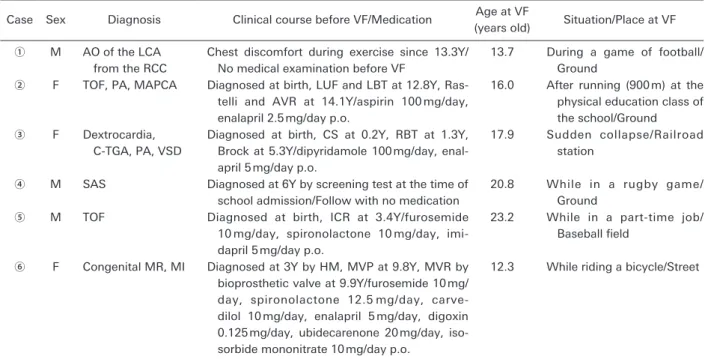
基礎心疾患はファロー四徴症(TOF)2例,修正大 血管転位症(C-TGA),大動脈弁下狭窄(SAS),先 天性僧帽弁逆流(MR)術後心筋梗塞(MI),冠動脈 起始異常が各1例であった.6例中5例はVF発症前 に基礎疾患が診断されており,VF発症年齢は中央値 17.0歳(12.3〜23.2歳),6例中3例は運動に関連し てVFを発症していた(Table 1).致死性不整脈のリ スク評価として行った検査ではLP陽性例が2例,ホ ルター心電図でVTを認めた例はなく,非持続性心室 頻拍(NSVT)を1回認めた例が1例,心臓MRIで 遅延造影(LGE)陽性例が1例,心収縮低下例が3例,
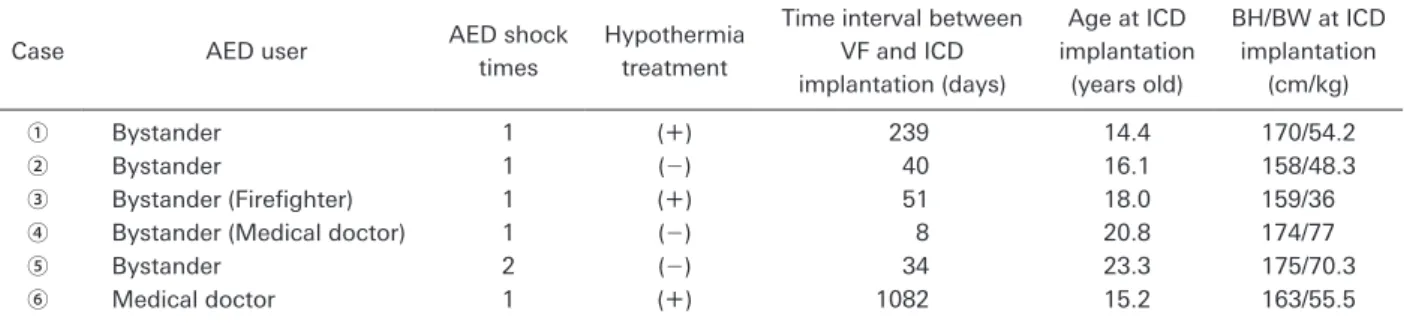
BNP高値例が4例,VT誘発試験陽性例は3例であっ た(Table 2).AED使用者は偶然居合わせた消防隊 員や医師を含めてBystanderが5例,ドクターカーで 駆け付けた医師が1例であり,ICD植込みまでの期 間は中央値45.5日(8〜1,082日),ICD植込み年齢 は中央値17.1歳(14.4〜23.3歳)であった(Table 3).
ICD植込み後の作動状況は追跡期間中央値3.9年(0.3
〜8.2年)で適切作動が1例(1回),禁止された運 動等による不適切作動が3例(合計8回)であった
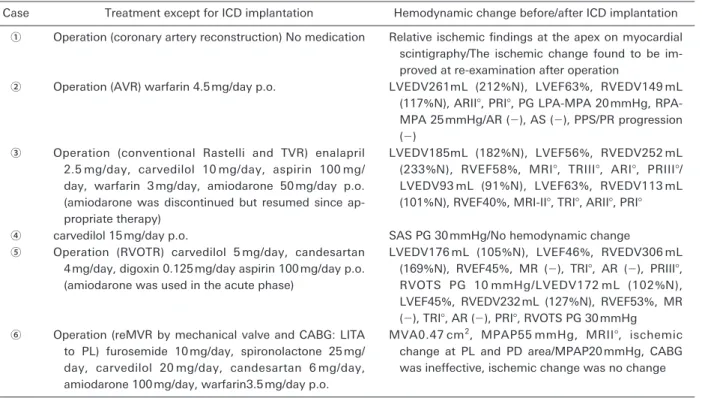
(Table 4).VF発症後の抗不整脈薬はcarvedilolが4 例,amiodaroneが3例 に 使 用 さ れ た.amiodarone 使用3例のうち2例はICD植込み後一定期間で中止 されたが,そのうち1例はamiodarone中止後VTに よる適切作動を認め内服を再開した.ICDと併行し て外科手術が5例に行われた.症例①では心筋虚血所 見を伴う冠動脈の起始異常に対して冠動脈再建術を行 い,術後4か月の心筋シンチグラムで虚血所見の改善 を確認した.症例②では大動脈弁の逆流,左室拡大に Table 1 Patient background
Case Sex Diagnosis Clinical course before VF/Medication Age at VF
(years old) Situation/Place at VF
① M AO of the LCA from the RCC
Chest discomfort during exercise since 13.3Y/
No medical examination before VF
13.7 During a game of football/
Ground
② F TOF, PA, MAPCA Diagnosed at birth, LUF and LBT at 12.8Y, Ras- telli and AVR at 14.1Y/aspirin 100 mg/day, enalapril 2.5 mg/day p.o.
16.0 After running (900 m) at the physical education class of the school/Ground
③ F Dextrocardia, C-TGA, PA, VSD
Diagnosed at birth, CS at 0.2Y, RBT at 1.3Y, Brock at 5.3Y/dipyridamole 100 mg/day, enal- april 5 mg/day p.o.
17.9 Sudden collapse/Railroad station
④ M SAS Diagnosed at 6Y by screening test at the time of school admission/Follow with no medication
20.8 While in a rugby game/
Ground
⑤ M TOF Diagnosed at birth, ICR at 3.4Y/furosemide
10 mg/day, spironolactone 10 mg/day, imi- dapril 5 mg/day p.o.
23.2 While in a part-time job/
Baseball field
⑥ F Congenital MR, MI Diagnosed at 3Y by HM, MVP at 9.8Y, MVR by bioprosthetic valve at 9.9Y/furosemide 10 mg/
day, spironolactone 12.5 mg/day, carve- dilol 10 mg/day, enalapril 5 mg/day, digoxin 0.125 mg/day, ubidecarenone 20 mg/day, iso- sorbide mononitrate 10 mg/day p.o.
12.3 While riding a bicycle/Street
VF: ventricular fibrillation, M: male, F: female, Y: years old, p.o.: per os, AO: anomalous origin, LCA: left coronary artery, RCC: right coronary cusp, TOF: tetralogy of Fallot, PA: pulmonary atresia, MAPCA: major aorto-pulmonary collateral artery, LUF: left unifocalization, LBT: left modified Blalock-Taussig shunt, Rastelli: Rastelli procedure, AVR: aortic valve replacement, C-TGA: corrected transposition of the great arteries, VSD: ventricular septal defect, CS: central shunt, RBT: right modified Blalock-Taussig shunt, Brock: Brock procedure, SAS: subaortic stenosis, ICR: intracardiac repair, MR: mitral regurgitation, MI:
myocardial infarction, HM: heart murmur, MVP: mitral valvuloplasty, MVR: mitral valve replacement.
Table 2 Risk factors for lethal arrythmia before ICD implantation
Case Late potential VT episodes in Holter ECG
LGE in cardiac MRI
Cardiac function (angiography)
BNP
(pg/mL) VT study
① Negative (−) Negative LVEF 52% 17.2 Positive (susVT)
② Negative (−) Negative LVEF 63%
RVEF 40%
48.7 Negative
③ Negative (−) Negative LVEF 56%
RVEF 58%
51.3 Positive (VF)
④ Positive (−) Negative LVEF 54% 7.5 Positive (VF)
⑤ Positive (−) Negative LVEF 46%
RVEF 45%
39.2 Negative
⑥ ND NSVT Positive LVEF 36% 482 Negative
VT: ventricular tachycardia, LGE: late gadolinium enhancement, BNP: brain natriuretic peptide, EF: ejection fraction, susVT:
sustained ventricular tachycardia, ND: no data, NSVT: non-sustained ventricular tachycardia.
対して大動脈弁置換術(AVR)を行い,術後は超音 波検査で大動脈弁の狭窄や逆流を認めず,左室拡大の 改善を確認しフォローアップを継続している.症例③ は前医のカテーテル検査で心内修復術適応なしと判断 され姑息手術のみ施行されていたが,再度カテーテル 検査を行い,conventional Rastelli手術が可能と判断 し,右室流出路再建(RVOTR),心室中隔欠損閉鎖,
BTシャント離断に加え三尖弁逆流(TR)に対して三 尖弁置換術を施行した.術後1年7か月のカテーテ ル検査で右室拡張末期容積(RVEDV)は252 mLか ら113 mL,左室拡張末期容積(LVEDV)は185 mL から93 mL,TRはIII°からI°と両心室の容量負荷所 見の改善,TRの改善を認めた.症例⑤では肺動脈 弁逆流,右室拡大に対して3弁付き人工血管を用い たRVOTRを施行し,術後6か月のカテーテル検査 でRVEDVは306 mLから232 mL, RVEFは45%から 53%と右室容量負荷所見,右室収縮能の改善を確認
した.症例⑥はMRに対して僧帽弁形成(MVP),
生体弁による僧帽弁置換術(MVR)を施行されてい た例である.VF発症時は術後僧帽弁狭窄(MS)が 進行し,肺高血圧(PH)を呈していたほか,後下行 枝(PD),後側壁枝(PL)領域に心筋虚血,梗塞所 見を認めた.MSに対して機械弁によるMVR,心筋 虚血に対して左内胸動脈(LITA)とPLの冠動脈バ イパス術(CABG)を施行したが,術直後の冠動脈 CTでCABGは無効と判断された.MS,PHに関し てはMVR術後超音波検査で改善を確認しており,
経過観察中増悪は認めなかった(Table 5).同期間に CHDを 基 礎 に も つVF survivorのsustained VTに 対してアブレーションを施行した例は認めなかった.
1例(症例⑥)がICDに関連する感染のためICD, リード全抜去を要し,その後患者の同意が得られず再 植込みは行われなかったが,VF発症後4.8年の追跡
期間でVT/VF再発を認めなかった.全例運動機能や
Table 3 Clinical courses after the resuscitation by the use of AED and performing ICD implantation
Case AED user AED shock
times
Hypothermia treatment
Time interval between VF and ICD implantation (days)
Age at ICD implantation
(years old)
BH/BW at ICD implantation
(cm/kg)
① Bystander 1 (+) 239 14.4 170/54.2
② Bystander 1 (−) 40 16.1 158/48.3
③ Bystander (Firefighter) 1 (+) 51 18.0 159/36
④ Bystander (Medical doctor) 1 (−) 8 20.8 174/77
⑤ Bystander 2 (−) 34 23.3 175/70.3
⑥ Medical doctor 1 (+) 1082 15.2 163/55.5
AED: automated external defibrillator, ICD: implantable cardioverter defibrillator, BH: body height, BW: body weight.
Table 4 ICD data and therapy data
Case Generator Mode Shock
coil DFT
(J)
Programming data (bpm)
VF/VT
Max HR at exercise ECG (bpm)
Follow-up
(years) ICD therapy
① Medtronic Virtuoso VR VVI Dual 15 231/182 186 6.4 Inappropriate therapy (4 times, ST due to exercise)
② SJM EPIC+DR
→Fortify ST DR
DDD (VIP) Dual 20 231/182 140 8.2 (−)
③ SJM Fortify ST DR DDD (VIP) Single 15 222/171 114 3.0 Appropriate therapy (once, ATP for VT)
④ Medtronic Secura DR DDD (MVP) Dual 15 222/171 177 4.8 Inappropriate therapy (3 times, ST due to exercise, FFRS,TWOS)
⑤ Medtronic Protecta XT DR
DDD (MVP) Single 10 222/171 160 2.4 Inappropriate therapy (once, ST due to exercise)
⑥ Medtronic Secura DR DDD (MVP) Dual 15 222/171 89 0.3 (−)
DFT: defibrillation threshold, SJM: St. Jude Medical, ST: sinus tachycardia, TWOS: T-wave oversensing, VIP: ventricular intrin- sic preference, MVP: managed ventricular pacing, ATP: antitachycardia pacing, VT: ventricular tachycardia, FFRS: far-field R wave sensing.
神経学的後遺症を認めず社会生活に復帰し,追跡期間 中死亡例は認めなかった.
考 察
CHD症例では不整脈のリスク評価として一般的 に 行 わ れ るLP, ホ ル タ ー 心 電 図, 心 臓MRIで の LGE,VT誘発試験の検査結果のみからは致死性不整 脈のハイリスク症例を事前に予測して対応すること は困難であり,疾患や個々の症例に応じたリスク評 価が重要である.2008年のAHAガイドライン9)で も,「CHD患者で有症状のsustained VTを認める場 合,血行動態カテーテル及び電気生理学的検査をし てICD植込みが勧められる(ClassI)」としており,
我々も心臓カテーテル検査を重視している.致死性不 整脈発生の頻度の高いTOFではリスク因子が検討さ れており,①シャント術の既往,②誘発されるVT,
③QRS幅180 ms以上,④心室切開,⑤NSVT,⑥左 室拡張末期圧(LVEDP)12 mmHg以上が致死性不整 脈のリスク因子と報告されている10)が,これらの因 子は治療で改善を期待できないものが多い.血行動態 の異常による心室への圧負荷,容量負荷は重要な致死
性不整脈の誘因であり11, 12),かつ治療により改善の 可能性がある.症例に応じてこれらの血行動態の問題 点を評価し,治療することはその後の致死性不整脈の リスクを減らすために最も重要と考えられる7, 8).そ こで当院では修復が必要な血行動態に関しては外科治 療を含めた治療を積極的に行う戦略としている.
以上のようにVT/VFの予測は個々の症例の病態に 応じて必要な検査を行い評価する必要があるが,予 測困難な場合も多い.さらにVT/VFが発生した場合 には蘇生に成功し後遺症なく社会復帰に至る例は稀 であり,VF survivorのVT/VF再発リスクは高い.
そこで我々はCHDを基礎にもつVF survivorの診療 において血行動態の問題点の治療に加えて積極的な ICD植込みを施行しており,遠隔モニタリングシス テムを活用しICD作動時やリードトラブルなどの早 期対応や患者通院の負担軽減に努めながらICD管理 を行っている.2012年に上田らが当院におけるCHD 症例のICD植込みに関する報告を行っている13)が,
CHD症例のICD適切作動は25%と稀ではなく,本 検討の症例③のように外科手術により血行動態の改善 を得られた症例にも適切作動で救命されている例が存 在する.
Table 5 Treatment after VF and hemodynamic change
Case Treatment except for ICD implantation Hemodynamic change before/after ICD implantation
① Operation (coronary artery reconstruction) No medication Relative ischemic findings at the apex on myocardial scintigraphy/The ischemic change found to be im- proved at re-examination after operation
② Operation (AVR) warfarin 4.5 mg/day p.o. LVEDV261mL (212%N), LVEF63%, RVEDV149 mL (117%N), ARII°, PRI°, PG LPA-MPA 20 mmHg, RPA- MPA 25 mmHg/AR (−), AS (−), PPS/PR progression (−)
③ Operation (conventional Rastelli and TVR) enalapril 2.5 mg/day, carvedilol 10 mg/day, aspirin 100 mg/
day, warfarin 3 mg/day, amiodarone 50 mg/day p.o.
(amiodarone was discontinued but resumed since ap- propriate therapy)
LVEDV185mL (182%N), LVEF56%, RVEDV252 mL (233%N), RVEF58%, MRI°, TRIII°, ARI°, PRIII°/ LVEDV93 mL (91%N), LVEF63%, RVEDV113 mL (101%N), RVEF40%, MRI-II°, TRI°, ARII°, PRI°
④ carvedilol 15 mg/day p.o. SAS PG 30 mmHg/No hemodynamic change
⑤ Operation (RVOTR) carvedilol 5 mg/day, candesartan 4 mg/day, digoxin 0.125 mg/day aspirin 100 mg/day p.o.
(amiodarone was used in the acute phase)
LVEDV176 mL (105%N), LVEF46%, RVEDV306 mL (169%N), RVEF45%, MR (−), TRI°, AR (−), PRIII°, RVOTS PG 10 mmHg/LVEDV172 mL (102%N), LVEF45%, RVEDV232 mL (127%N), RVEF53%, MR (−), TRI°, AR (−), PRI°, RVOTS PG 30 mmHg
⑥ Operation (reMVR by mechanical valve and CABG: LITA to PL) furosemide 10 mg/day, spironolactone 25 mg/
day, carvedilol 20 mg/day, candesartan 6 mg/day, amiodarone 100 mg/day, warfarin3.5 mg/day p.o.
MVA0.47 cm2, MPAP55 mmHg, MRII°, ischemic change at PL and PD area/MPAP20 mmHg, CABG was ineffective, ischemic change was no change
AVR: aortic valve replacement, PG: pressure gradient, PPS: peripheral pulmonary stenosis, TVR: tricuspid valve replacement, RVOTS: right ventricular outflow tract stenosis, RVOTR: right ventricular outflow tract reconstruction, CABG: coronary artery bypass graft, LITA: left internal thoracic artery, PL: posterior lateral, MVA: mitral valve area, PCWP: pulmonary capillary wedge pressure, MPAP: mean pulmonary arterial pressure, PD: posterior descending.
致死性不整脈再発予防のためには外科的な血行動態 の修復のほかに抗心不全,抗不整脈の薬物治療が重要 である.β blockerは抗心不全効果のほか,VT/VF抑 制の効果も認められており14, 15),運動時に致死性不 整脈を起こす頻度の高い若年者に特に有効と考え,
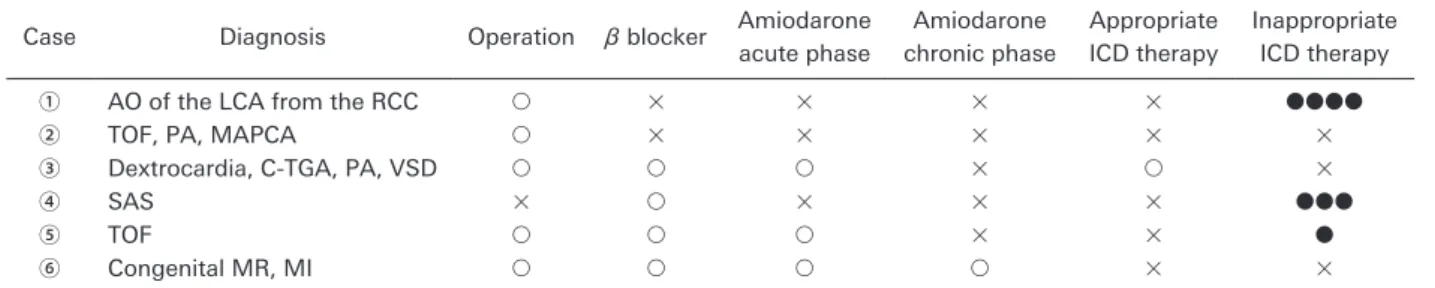
我々は積極的に投与している.そしてこれらの治療を 行ってもNSVTやVT/VFを認める症例やVT/VF急 性期治療に不整脈の電気生理学的機序をコントロー ルするamiodaroneを投与している16).患者の希望 等で抗不整脈薬を投与していない症例もいるが,そ のような症例においてもICDに記録された不整脈モ ニターを指標に不整脈管理を厳重に行いながら,抗不 整脈薬の導入を検討する方針としている.カテーテル アブレーションに関しては,アブレーションに耐えう るVTであれば試みる価値はあると考えるが,本検討 のAEDで蘇生されたCHD症例においては対象とな る症例は認めなかった.アブレーションの対象外と考 えた症例であってもICD植込み後,上記方針で管理 を行った後もVTを認める場合にはアブレーションを 再度検討すべきであると考えられる.本検討症例での 手術,抗不整脈薬,ICD作動状況についてTable 6に 示す.適切作動を1例に認めたが,amiodarone再開 により,その後0.6年の観察期間中はVT/VFの再発 を認めていない.患者背景が異なり症例数も少ないた め,現状では手術,抗不整脈薬,作動状況について一 定の傾向は認めなかった.
ICD植込みに伴う問題点は不適切作動を3例に認 め,ICDに関連する感染を1例に認めた.不適切作 動に関しては競技運動に参加しても11%と低い頻度 を報告しているもの17)から,50%程度と高い頻度を 報告しているもの18, 19)まで報告によって様々である が,本検討のように患者数の少ない検討では高頻度 になる傾向がある.本検討同様,若年者のVFの発生 には運動が関与している例が多く,またそれらの例で
はICD植込み後も運動を行い不適切作動を認めるこ とがある.当院ではICD植込み前後に,運動負荷心 電図を施行し最高心拍数を確認してVT/VF zoneや VT detectionの設定を調整しているが,活発で心拍 数も上昇しやすい若年者では症例に応じたICDの適 切なプログラミングを行ったうえで運動制限を中心と した生活指導やβ blocker内服等で基礎心拍を安定さ せることが不適切作動回避に必要と考えられた.本検 討の不適切作動の内訳は①洞性/上室性頻拍6回,
②T波oversensing1回,③上室性頻拍かつfar field R wave sensingによる心室性不整脈誤認識1回であっ た. そ れ ぞ れ ①VT/VF zone変 更,discriminator time out変更,波形認識機能設定,上室性/心室性頻 拍鑑別機能設定変更,β blocker導入,増量,②運動 負荷でT波を確認し心室感度調整,③post ventricu- lar atrial blanking変更,心房感度調整,上室性/心室 性頻拍鑑別機能設定等で対応した.小児ICD植込み 患者の特徴は本検討のように不適切作動が多いことの ほか,リードトラブル,頻回の電池交換,静脈閉塞,
除細動閾値(DFT)上昇等の問題が多いことが報告 されている20).本検討では検討期間中にリードトラ ブル,静脈閉塞,DFT上昇による問題は認めなかっ たが,1例がICDに関連する感染のためICD,リー ド全抜去を要した.
CHD症例に対するVT/VF一次予防については情 報が少なく,定まった見解はない.ICDに関連する トラブルの検討も含め,CHDを基礎にもつVF sur- vivorへのICD植込みの有用性,当院の治療方針の妥 当性,患者予後に関しては長期経過でさらなる検討 を要する.しかし現時点では二次予防症例に積極的に ICD植込みを行いデータの蓄積をすることは,一次 予防の対象とすべきハイリスク因子の検討や問題とな る血行動態の治療が致死性不整脈再発に与える影響の 評価を行うためにも有用と考えられる.そして現状で
Table 6 Operation and antiarrhythmic medicine and ICD therapy data
Case Diagnosis Operation β blocker Amiodarone
acute phase
Amiodarone chronic phase
Appropriate ICD therapy
Inappropriate ICD therapy
① AO of the LCA from the RCC ○ × × × × ●●●●
② TOF, PA, MAPCA ○ × × × × ×
③ Dextrocardia, C-TGA, PA, VSD ○ ○ ○ × ○ ×
④ SAS × ○ × × × ●●●
⑤ TOF ○ ○ ○ × × ●
⑥ Congenital MR, MI ○ ○ ○ ○ × ×
AO: anomalous origin, LCA: left coronary artery, RCC: right coronary cusp, TOF: tetralogy of Fallot, PA: pulmonary atresia, MAPCA: major aorto-pulmonary collateral artery, C-TGA: corrected transposition of the great arteries, VSD: ventricular septal defect, SAS: subaortic stenosis, MR: mitral regurgitation, MI: myocardial infarction.
は二次予防症例にICDを植込む際は特異度よりも感 度を重視した設定にせざるをえないが,ハイリスク因 子が明らかになれば不適切作動を防ぐICD設定の調 整が行える可能性がある.
VF予防から救命,ICD管理に至るまで各段階で小 児循環器医は幅広い役割を期待されるが,特にCHD 症例においては個々の症例の多彩さのため不整脈予測 のための検査が一律でなく,症例に応じてきめ細やか なフォローアップを行う必要がある.VF survivorの 蘇生後はICD植込み,ICD管理を含めた不整脈管理 が重要であり,不整脈専門医の協力を仰ぐ必要があ るが,CHD症例におけるVT/VFの発生には血行動 態の問題が大きく関わっており,CHDを基礎にもつ VF survivorの診療においては小児循環器医が主導で 診療にあたる必要がある.
結 論
当院ではCHDを基礎にもつVF survivorの診療 において,VFの誘因となる血行動態の問題点を評価 し,外科手術を含めた積極的な治療介入を行ったうえ でICD植込みも行う方針としており,全例が後遺症 なく社会生活に復帰している.有用な治療戦略と考え 報告した.CHD症例のVF survivorの診療において は,CHDに伴う血行動態の異常の評価,治療が重要 であり,小児循環器医が主導で診療にあたり,致死性 不整脈の再発予防に努める必要がある.
引用文献
1) Mitamura H: Public access defibrillation: Advances from Japan. Nat Clin Pract Cardiovasc Med 2008; 5: 690‒692 2) Mitani Y, Ohta K, Yodoya N, et al: Public access de-
fibrillation improved the outcome after out-of-hospital cardiac arrest in school-age children: A nationwide, pop- ulation-based, Utstein registry study in Japan. Europace 2013; 15: 1259‒1266
3) 吉田修一郎,大橋直樹,西川浩,ほか:小児期・青年期 に植え込み型除細動器治療を施行した症例の検討.日小 児循環器会誌2013; 29: 228‒232
4) Silka MJ, Bar-Cohen Y: A contemporary assessment of the risk for sudden cardiac death in patients with congrnital heart disease. Pediatr Cardiol 2012; 33: 452‒460
5)奥村謙,相澤義房,青沼和隆,ほか:循環器病の診断 と治療に関するガイドライン(2010年度合同研究班報 告).不整脈の非薬物治療ガイドライン(2011年改訂 版).日心臓血管外会雑誌2014; 43: 1‒21
6) Zeppenfeld K, Schalij MJ, Bartelings MM, et al: Catheter
ablation of ventricular tachycardia after repair of congen- ital heart disease: Electroanatomic identification of the critical right ventricular isthmus. Circulation 2007; 116:
2241‒2252
7) Sherwin ED, Triedman JK, Walsh EP, et al: Update on in- terventional electrophysiology in congenital heart disease:
Evolving solutions for complex hearts. Circ Arrhythm Electrophysiol 2013; 6: 1032‒1040
8) Walsh EP: Interventional electrophysiology in patients with congenital heart disease. Circulation 2007; 115:
3224‒3234
9) Goldberger JJ, Cain ME, Hohnloser SH, et al: American Heart Association/American College of Cardiology Foun- dation/Heart Rhythm Society Scientific Statement on Noninvasive Risk Stratification Techniques for Identifying Patients at Risk for Sudden Cardiac Death: A scientific statement from the American Heart Association Council on Clinical Cardiology Committee on Electrocardiogra- phy and Arrhythmias and Council on Epidemiology and Prevention. Circulation 2008; 118: 1497‒1518
10) Khairy P, Harris L, Landzberg MJ, et al: Implantable car- dioverter-defibrillators in tetralogy of Fallot. Circulation 2008; 117: 363‒370
11) Boulaksil M, Noorman M, Engelen MA, et al: Longitu- dinal arrhythmogenic remodeling in a mouse model of longstanding pressure overload. Neth Heart J 2010; 18:
509‒515
12) Ip JE, Cheung JW, Park D, et al: Temporal associations between thoracic volume overload and malignant ven- tricular arrhythmias: A study of intrathoracic impedance.
J Cardiovasc Electrophysiol 2011; 22: 293‒299
13) Uyeda T, Inoue K, Sato J, et al: Outcome of implantable cardioverter defibrillator therapy for congenital heart dis- ease. Pediatr Int 2012; 54: 379‒382
14) Zhou Q, Xiao J, Jiang D, et al: Carvedilol and its new an- alogs suppress arrhythmogenic store overload-induced Ca2+ release. Nat Med 2011; 17: 1003‒1009
15) Kruger A, Aronow WS, Lai H, et al: Prevalence of appro- priate cardioverter-defibrillator shocks in 1038 consecu- tive patients with implantable cardioverter-defibrillators.
Am J Ther 2009; 16: 323‒325
16) Connolly SJ, Dorian P, Roberts RS, et al: Comparison of β-blockers, amiodarone plus β-blockers, or sotalol for prevention of shocks from implantable cardiovertor de- fibrillators: The OPTIC Study: A randomized trial. JAMA 2006; 295: 165‒171
17) Lampert R, Olshansky B, Heidbuchel H, et al: Safty of sports for athletes with implantable cardioverter-defibril- lators. Circulation 2013; 127: 2121‒2030
18) Gradaus R, Wollmann C, Kobe J, et al: Potential benefit from implantable cardioverter-defibrillator therapy in children and young adlescents. Heart 2004; 90: 328‒329 19) Korte T, Koditz H, Niehaus M, et al: High incidence of
appropriate and inappropriate ICD therapies in children and adolescents with implantable cardioverter defibrilla- tor. Pacing Clin Electrophysiol 2004; 27: 924‒932
20) Shah MJ: Implantable cardioverter defibrillator-related complications in the pediatric population. Pacing Clin Electrophysiol 2009; 32: S71‒S74