vvvvvvvv’vv’vvv’vvv
報 告
NAx.vvvv’vN.rv’v’vvvvvv
中学生の謡うつ傾向,および彼らのストレス対処行動,
ソーシャルサポートとの関連
一日本とタイの比較一
飯島久美子1),Susheewa Wichaiku112),
川村 留美4),大島 智恵5)
渡邉タミ子3)
〔論文要旨〕
タイは仏教国であり,相互扶助や家族の一体感が強いとされており,こうしたことが中学生の心理的 状態にどのような影響を及ぼしているのかを検討すべく,本研究では,日本およびタイの中学生を対象
に,うつの状態ストレス対処方法,ソーシャルサポートの状況を比較することとした。
日本の中学生1,105名,タイの中学生697名を対象として,自記式の質問紙を用いて調査を行った。調 査の主な項目は,1)欝状態一BirlesonのDSRSC(Depression Self」Rating Scale for Children),2)対 処行動,3)ソーシャルサポートである。
DSRSCの平均得点は,日本1L82±5.62,タイ13.14±3.27と日本の方が低かった。
ストレス対処法として積極的対処法は,日本,タイいずれもよく取られていたが,認知的対処法,サ
ポート希求はタイの方が高かった。父親母親同胞によるサポートはタイの方が日本より高かった。Key words:うつ状態,対処行軌ソーシャルサポート,中学生,タイ,日本
1. Introduction
While junior high school students go through remarkable changes both mentally and physi-
cally, they must also take high school en-
trance examinations, which add tremendous
stress to their daily lives. Stress research on students in puberty have shown that they experience a wide variety of stressors like anxiety over tests and scores, interpersonal relationships with friends and teachers, school
life, and parent-child relationshipsi)N‘) . More-
over, social support, self-esteem, countering stress and other activities are related to de-
pression as a stress response5ト10). However,
the nature and contribution made by stressors of different kinds may vary across cultures.
Fo’r example, parental control, an important variable which contributes negatively to ad-
justment in adolescents in the Westii), does not seem to affect Asian youngsters in the
same negative wayi2) .Depression of Junior High School Students and its Related Coping Behaviors and Social Supports : A Comparison between Japan and Thailand
Kumiko liJiMA, Susheewa WicHAiKuLL, Tamiko WATANABE, Rumi KAwAMuRA, Tomoe OosHiMA 1)山梨大学留学生センター&大学院医学工学総合研究部(研究職)
2)Boromarajonani College of Nursing Nopparat Vajira(研究職/看護師)
3)新潟大学医学部保健学科(研究職/看護師)
4)元)市川南中学校(養護教諭) 5)山梨大学大学院医学工学総合研究部(研究職/看護師)
別刷請求先:飯島久美子 山梨大学留学生センター&大学院医学工学総合研究部 〒409-3898山梨県中央市下河東1110
Tel/Fax : 055-273-8289
(1837)
受付06.6.15
採用07.3.20
第66巻 第3号,2007
工nrecent years, Thailand’s urban centers have experienced a rapid rise in economic
development, and an economical gap hasdeveloped between these cities and farming villages. This economic gap between rich and poor appears to contribute to increased prosti-
tution and AIDS among children. The family type had shifted from large to nuclear. Thai-
land was originally a Buddhist country, and
the Buddhist mind is rooted in the lives of itspeople. Moreover, although their feelings vis-
a-vis respect for elders and the importance of family are strong, various changes have led to mental health issues becoming a major concern血Thailand , and studies on children
have been laun6hed as a resulti3)Ni5) .On the other hand, in Japan, there are less
internal economic disparities, and the nuclear family is more rooted in its,family lifestyle.
Therefore, the purpose of this study is to compare levels of depression, coping behav-
ior, and social support between junior high school students in Thailand and Japan, and to
explore the predictors of menta! health state .ll. Subjects and Methods
1,388 Japanese junior high school students
at 4 juni’or high schools in Kofu City, Yama-nashi Prefecture, Japan volunteered for this study. The survey period was from Novem-
ber 6 to December 20, 2002. The homeroom teacher distributed questionnaires using an
anonymous, self-recording method to eachclas.s, and the surveys were conducted under totally voluntary conditions. After being filled out, the questionnaires were placed in sealed envelopes by the students themselves and col-
lected by the homeroom teacher. 1,000 Thai junior high school students at 4 junior high schools in Bangkok city suburbs were also surveyed in the same way. The survey period
was from August 4 to December 20 , 2003 .The survey included questions about 1) de-
mographics, 2) depression !evel, 3) coping
477
behavior, and 4),social support.
To measure the state of mental health,
we used the Japanese version of DSRSC (18 items) created by Murata et al.i6)based on
Birleson’s childhood depression inventory(DSRSC : Depression Self Rating lnven-
tory for Children) . Each item was assessed
by three choices(NEVER, SOMET工MES,
YES), and was graded from O to 2, in the direction of declining mental health status.
Thus, DSRSC total scores ranged from O to 36. 16 points represented the cutoff value,
and more than 16 points indicated depression,
signifying the mental health level was lower the higher the scores were.
For the stress coping behavior, we used a coping inventory for junior high school stu-
dents created by Miura et al.i’) , consisting of a sub・一inventory from “active coping”, and “de-
sire for support” to “cognitive coping”. Ac-
tive coping means trying to solve problems in a positive way i desire for support has to do with attempting to make someone understand oneself and cognitive coping is going with the flow. Each item was assessed by. four choic-
es二NEVER(O points),ALMOST NEVER(1 point), OCCASSIONALLY (2 points), and
OFTEN (3 points) .
For social support, we used the lnventory of Expectancy for Social Support (IESS) for students created by Hisada et al.i8). While IESS consisted of 16 items, two items be-
lieved to be inappropriate as questions for junior high school students (“Would you be sympathetic if you knew that your relation-
ship was over” and “Would you willingly of-
fer to help someone when they were working
on a job that could not be completed by one
person” j were deleted, and the remaining 14
items were used. The subjects were asked
to response to same items on each 5 sources
of support (father, mother, siblings, school
teacher, and friend) ’and applied scores as
ABSOLUTELY NO (O points) , MAYBE NO (1
point) , MAYBE YES (2 points) ・and ABSO-
LUTELY YES (3 points) .
In’addition, for・ the questionnaire used by junior high school students in Thailand, the original English version of the DSRSC, and the other inventories and items which were translated by experts into English were trans-
lated into Thai by Thai English experts.
The analysis was conducted using Statistical Processing Software SPSS Ver.11.5 for Win-
dows .’
In addition, testing between groups was performed using a t-test for DSRSC scores,
coping inventory scores, and social support scores.
For ethical considerations , we described the
purpose of the study to the principa!s, school nurses and home teachers at each school to assure their understanding of the ・survey. Af-
ter that, the homeroom teachers explained to the junior high school students the purpose of the questionnaire, that their responses. were to be calculated using all numerical values,
and that individuals would not be identified.
皿.Results
There were valid responses from 1,105 out of 1,388 Japanese junior high school students
(79.60/o) and from 697 out of 1,000 Thai
junior high school Students (69.70/o). The percentage of male students was 50.4 O/o in Japan and 47・.80/o in Thailand. This excludes 16 responses by Japanese students where the
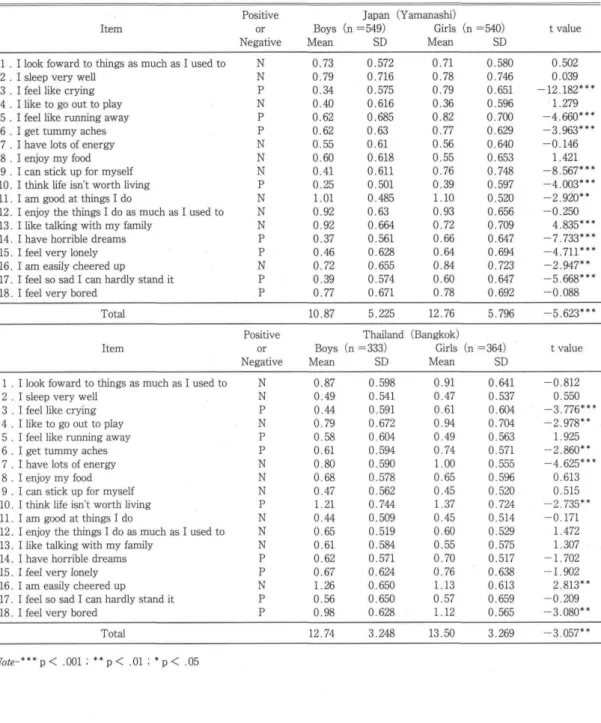
gender was unknown.Table 1 shows the family structure of the subjects. While the percentage of “parent and child” nuclear families did not change, there were more single-parent families in Japan.
In contrast, students in Thailand appeared to live more often with relatives, even when they had no parent (X2=297.672:p=.OOO).
1.Menta且Health State.
Table,2 shows the average score for each DSRSC item. The Cronbach a coefficient was O.808 in Japan, but was lower in Thailand at O..566, and we do・not know whether this depends on the particular responses of these
subjects or by coincidence .Among most items there was a significant difference between Japan and Thailand. Es-
pecially the score of item 4, item 7, item 10,
item 16 and item 18 was higher in Thailand
students compared to in Japan. However,that of item 12 and item 13 was higher in Japanese students compared to Thailand.
The average score of all students ,in Japan was 11.82±8.62; and in Thailand was 13.14
Table 1 Total Number (and Proportion) of Farnily Structure of Subjects
Japan (Yamanashi) Thailand (Bangkok)
Nuclear families
640 ( 58,3) 410 ( 58.8)
Enlarged families with Grand Parents with Other Relatives
Single with GP*Single with OR”
352
310 1 38 3
( 32.1)
(28.2)
〈 O.1)
( 3.5)
( O.3)
202
njQゾ417・Qゾーn∠
( 29.7)
(10.5)
(14.2)
( 2.0)
( 3.0)
Single Parents 104 ( 9.5) ag ( 6.3)
No Parents,
2 ( O.2) 36 ( 5.2)
Tota1
1,098(100.0) 697 (100.0)
Note-X2検定:γ2 = 297 . 672;df=6;p<.001 ’ : Single parents with grand parents ” : Single parents with other relatives
第66巻 第3号,2007
479
Table 2 Differences and ・t Values of Paired Contrasts on Mean Scores of Each DSRSC ltems of Two Groups
Item
Positive or
Negative
Japan (Yamanashi)
(n =1 , 105)
Mean SD
Thailand (Bangkok)
(n =697)
Mean SD
t value
1.Ilook foward to things as much as I used to
2 . 1 sleep very wel1
3 . 1 feel like crying 4 . 1 like to go out to play
5.Ifeel like running away 6.1 get tummy aches7 . 1 have lots of energy
8.Ienjoy my food9 . 1 can. stick up for myself 10 . 1 thinl[ life isn’t worth living 11. 1 am good at things 1 do
12. 1 enjoy the things 1 do as much as 1 used to 13. 1 like talking with my family
14. 1 have horrible dreams
15. 1 feel very lone1y 16. 1 am easily cheered up 17. 1 feel so sad 1 can hardly stand it 18. 1 feel very bored
NNPNPPNNNPNNNPPNPP 296820688252225808 775377555.309855757 000000.000010.00.0000 O.579
0.734 0.654 0.607 0.701 0.634 0.626 0.637 0.705 0.555 0.506 0.644 0.693 0.624 0.670 0.694 0.621 0.681
89 S8 T3
000000∩VOO-ゐ0000∩VlQ-ゐ W7尠チ906646四4462586672195605 O.621
0.539 0.604 0.693 0.584 0.585 0.581 0.587 0.541 0.737 0.511 0.525 0.580 0.544 0.633 0.634
,0.654
0.600一 6.022***
10.296ホ*ホ
1.063-15.761***
6.06串*串
O.561-11.966**’
一 2.801**
4.019***
一29.943***
24.708”’
10.286**“
7.738***
一 5.189***
一 5.402**“
一12.91 **f 一 2.125*
一 9.026***
Tota1 11 .,82 5.626 13.14 3.278
6.293***
Note一’““p〈 . OOI;’”p〈 . Ol;’p〈 .05
±3.27. Thus, Thailand scored higher (t=
6.276, p=.OOO) . There was a sigriificant dif-
ference regarding sex in both Japan and Thai-
land. Boys in Japan were 10.87±5.22, and
girls were 12.・76±5.79 (t=5.623, p=.OOO),while bQys in Thailand were 12.74±3.24, and
girls were 13.50±3.26 (t =3.057, p=.002)(Table 3) . According to family structure, only the Japanese results indicated a significant dif-
ference within the group (one-way analysis of variance : p=.034) , esPecially between nu-
clear families (11.51±5.63) and single par-
ent families (13.21±6.05) (p=.047).
With the cutoff value set at 16, the number
of those in the depressed groups was 273 stu-
dents in Japan (24.70/o), and 160 students in Thailand (23.00/o) without any significant difference. The ratio of girls to boys in the depressed group was higher both in Japan and Thailand:165 girls in Japan (x2= 19.735,
p=.OOO), and 100 girls in Thailand (x2=
19 . 735 ,・.p= . OOO) .
2 , Stress Coping Behavior and Social Support
Table 4 shows the results of stress coping
behaviors. The “active coping” score was the highest in the three type stress coping behav-
iors both in Japan and Thailand. However,
there was a significant difference regarding
“cognitive coping” score arLd “desire for sup-
port” score between Japan and Thailand. The
“cognitive coping” score was 14.89±5.38 in
Japan and 15・.78±4.02 in Thailand (t=3.973,p=.OOO). The “desire for support” score was 14.95±5.65 in Japan and 18.16±4.26 in
Thailand (t = 13.699, p = . OOO).Table 5 shows the results for social support.
In Japan, students got.most support from mothers and friends. However, in Thailand students got most support from fathers and mothers. There was a significant difference regarding support source between Japan and Thailand. The average scores of “fathers”,
“mothers” and “siblings” in Japan were 39.10±11.90, 43.79±10,50 and 36.28±
12.一13, respectively. Those in Thailand were 45.68±9.81, 45.00±8.47 and 39.87±11.15,
re Sp. ectively (t= 12 . 508 , p= . OOO 1’ t=2. 66 , p
= .008 it=6.231, p= .OOO).
Table 3 Comparison of the Mean Scores of Each DSRSC ltems Between Boys and Girls in Two Groups
Item
Positive or Negative・
Japan (Yamanashi)
Boys (n=549) Girls (n=540)
Mean SD Mean SD
t value
1.Ilook foward to things as much as I used to
2 . 1 sleep very wel1
3 . 1 feel like crying 4.11ike to go out to play
5.Ifeel like running away 6.Iget tummy aches7 . 1 have lots of energy
・8 .1 enjoy my food
9.Ican stick up for myseif10. 1 think life isn t worth living 11.1 am good at things I do
12. 1 enj.oy the things 1 do as much as 1 used to 13, 1 like talking with my family
14. 1 have horrible dreams
15. 1 feel very lonely 16. 1 am easily cheered up 17. 1 feel so sad 1 can hardly stand it 18. 1 feel very bored
NNPNPPNNNPNNNPPNPP
聡79誕4062砿5560412501929237弱η39770.00000.000010000000
O.5720.716 0.575 0.616 0.685 0.63
・O.61
0.618 0.611 0.501 0.485 0.63 0.664 0,561 0.628 0.655 0.574 0.671
71 V8 V9 R6 W2 V7 T6 T5 V6 R9 P0 X3 V2 U6
00000000001.0000000
U4U078
O.5800.746 0.651 0.596 0.700 0.629
0.MO
O.653 0.748 0.5970.520’
O.656 0,709 0.647 0.694
0.・723
0.647 0,692O.502 0.039
-12.182***
1.279 -4.660***
一3.963***
一〇.146 1.421 -8.567***
一4.oo3***
一2.920**
一〇.250 4,835*’*
一7.733***’
一4.711**“
一2.947**
一5,668***
一〇.088
Tota1 10,87 5.225 12.76 5.796
一5.623*ホ拳
Item
Positive or
Negative
Thailand (Bangkok)
Boys (n=333) Girls (n=364)
Mean SD Mean SD
t value
1.Ilook foward to things as much as I used to
2 . 1 sleep very wel1
3.Ifeel like cry血g
4.Ilike to go out to play
5.Ifeel like running away 6.1 get tummy aches7. 1 have lots of ・energy
8.Ienjoy my food9 . 1 can stick up for myself 10. 1 think life isn’t worth living 11. 1 arn good at things 1 do
.12. 1 enjoy the things 1 do as much a$ 1 usked to 13. 1 like talking with my family
14. 1 have horrible dreams
15. 1 feel very lonely 16. 1 am easily ・cheered up 1’7. 1 feel so sad 1 can hardly st’and it
18.工feel very boredNNPNPPNNNPNNNPPNP.P
87S9K795861釣684721製65616267265698
ロ ロ サ ロ コ ロ の ロ ロ コ リ 00.00..0、0000.-.000∩VO-.00
.O.598
0.541 0.591 0.672 0.604 0.594
・O . 590
0.578 0.562 0.744
0.509・
O.519.
O.584 0.571
0.624.
O.650 0.650 0.628
17.1494055750.506372 946947.064346577151 000.0001QO100、000101
O.6410.537 0.604 0.704 0.563 0.571 0.555 0.596 0.520 0.724 0.514 0.529 0.575 0.517 0.638 0.613 0.659 0.565
一〇.812
0.550-3.776***
一2.978*零
1.925-2.860**
一4.625***
O.613 0.515
-2.735ホ*
一〇.171
1.472 1.307-1.702
-1.902
2.813索*
一〇.209
-3.:080柳
Tota1 12.74 3.248 13.50
3r269 一3.057**
Note一”*p〈 . OOI ; ”p〈 . Ol i, “p〈 .05
Table 4 Differences of The ScQres on Three Types of Stress Coping Behaviors in Two Groups
Japan (Yamanashi) Thailand (Bangkok)
t value
Mean SD Mean SD
Cognitive Coping
Desire for SupportActive Coping
14.89 14.95 18.77
8FOn6
3瓜Uり0
, ・ ・
民U「0只り
15.78 18.16 19.08
4.02 4.26 4.Q5
一 3.973***
一13.699***
一 1.398 Note一”“p〈 . OOI
第66巻 第3号,2007
481
Table 5 Comparison of Sources of Subjects’ Perceived of Social Support from Father, Mother, Siblings,
T’eachers and Friends
Japan’ (Yamanashi)
Thailand (Bangkok)
tvalue
Mean SD Mean SD
Father
MotherSiblings
TeachersFriends
39.10 43.79 36.28 36.67 43.61
11.90 10.50 12.13 10.98 9.44
45.68
45
39.87 36.78 42.939.81 8.47 11.15 9.55 8.57
一 12.508***
一 2.66 ***
一 6.231***
一 O.231 1.573
No te一““’ p 〈 . oo 1
IV. Discussion
According to Murata et al.i6) , the percent-
age of the students who exceeded the cutoff values by using DSRSC was 9.60/o in elemen-
tary school children and this ratio increased with the advance of grades from 6.30/o in the
2nd grade to 15.10/o in the 6th grade. ln ourresults the ratio was 24.70/o in the Japanese
junior-high school students and 23 .00/o in Thai-land. Thus, our study showed higher values
than Murata et al .While Kato et al.i9)measured the depres-
sive state by using the Children’s Depression
Inventory (CDI) from the ISt to 3’d grades inmunicipal junior high schools in Tokyo, the persons who exceeded the cutoff value was 34.70/o. This is higher than ours, and may depend on the region, the varying effects of
tests, etc on students as stressors, or differ-ences m support.
Based on the average score of each item on the DSRSC, it seems there are many Japa-
nese students who believe that they cannot do well on things they think they will attempt
to do. We do not know whether Japanesejunior high school students lack confidence in themselves, or whether・ the targets were set too high. Meanwhile, many of the junior high school students in Thailand think there
is nothing・to look forward to in life. Althougha direct comparison cannot be made, Fukaya et al.2P)conducted a country-by-country com一
parison of fifth graders in elementary school students in Bangkok, Thailand and Japan. El-
ementary school students in Tokyo had a low
self-assessment of items such as “Are you stu-dious?” or “Are you popular?” at 12.60/o, thus
implying that Japanese elementary school stu-
dents were less confident, while, in contrast,
elementary school students in Bangkok scored high (34.50/o), revealing that they resembled
elementary school students in Los Angelesand Oakland. ln addition, the daily feeling of enjoyment was slightly lower for elementary school students in Bangkok, with elementary school students in Oakland (35.50/o), in Los
Angeles (33.10/o), in Tokyo (31.80/o), andBangkok (26.80/o), which may be similar to
the results in this survey.Miura et al.2i)studied 3rd year junior high school students during their high school exam-
ination period and showed that these students preferred “active coping”, “cognitive cop-
ing” and “desire for support” in that order.
Similarly, in our study Japanese junior-high students preferred “active coping” behavior.
The result of a survey by Amano et al.22),
which used the SCI (Stress Coping lnvento-
ry) to measure coping behavior, showed that
“seeking social support” such as consulting
with a friend, or someone a person gets along
with well was the highest at 30.10/o, that
many in the good health group “seek social
support” C and that there were few self-control
types.
Ito23)classified coping behaviors for problems junior high school students have into active coping behaviors including positive actions to eliminate problems such as “first asking some-
one to listen to their problems”, “
№狽狽奄獅〟@the
problems off one’s mind by watching TV or
listening to the radio”, and “confronting prob-lems, and making efforts to overcome them”,
and escapist coping behaviors including nega-
tive actions to eliminate problems such as
“continuing to be troubled without consulting
someone”@or “撃盾モ汲奄獅〟@oneself in one’s room”.Although “active・coping” was the most engaged in Thailand for coping behavior, “de-
sire for supportV was equally str.ong. ln the report described above, Miura et al. said that there were some correlations between coPing behaviors and social support from multiple re-
gression analysis. “Active coping” plus “desire
for support” positively correlated with “teach-
er”@and “friend” for the source・ of socia! sup-
port. However,・ “desire for support” nega-
tively correlated with “father” for the・ source
of social support. ln addition, they mentioned that students who thought their control abil-
ity were good could engaged in many kinds of coping behaviors. For social support, in our study it is felt that support was received from families, in particular, more so in Thailand than in. Japan, with conditions that made it easier to receive increased support, which may be because the children depend on sup-
port.
In contrast, MacCarthy et al.24) com-
pared stress coping behaviors between 6 and 14-year olds in America and Thailand. They indicated that children in Thailand have a
more implicit coping behaviors, and that in re-sponse to being separated from their parents,
etc., they tend to adjust themselves to that situation, rather than trying to do something about their situation. People in Thailand have an oft-used word in their language “Mai Pen Rai”, which expresses a governing concept
that they’will not worry about details, and
will somehow be ’fine and get survive25) . Thismay be due, to the reason whereby they really do not work actively on these stressors.
Acknowledgments
Sincere appreciatien is extended to Dr’ . Teyohisa Murata at Seinan Gakuin University for his invalu-
able help using DSRSC and to Mr. Richard Caraker at Health Science University for his help in English.
We also thank most sincerely to the participants of the survey and to their teachers.
References
1)Baba S.(1997).. Kodomo to‘stress’[Chil-
dr.en and Stress]..Kyoiku :Z「o lgaku,45 (7) :
・676-681, .1
2)Tsutsui S,(1998). Gendai. no ‘stress’to ・sono taisyo[Modern Stress and Coping with
Stress].:Z「he/burnal(~プノ砂απ1レfedical Associa-tion,119 (9) :1413-1416.
3)Shimada H.(1998).Kodomo ga uke.ru gak-
ko ‘stress’・katei ‘stress’[School Stress and Family Stress Children Suffer].Child Study,
Kodomo ga ukeru ‘stress’;oya・kyoshi no
る り
stress -jozu na kaisyouhou to tsukiaikata
[Children’s Stress, Parent and Teacher Stress-Good Ways to.Eliminate It and How to Make
Relationships],52・(18):14-22.4)Takakura M.,Shiroma A,,Akisaka M.,Shin一.
ya N.&Sakihara S.(1998),Shisyunki-you
nichijou-seikatsu ‘stressor’ syakudo no shi-saku[Experimenting with Daily.Life Stressor
Inventories for Adolescence]..fapaneseノ∂urnal of School Health,40:29-40.5)Nakajima H.(2002).Shisyunki ni okeru yoku-
utsu bouei ‘style’ ・ ‘stress’ taisyo-koudou no kanren-bouei ‘style’・ ‘stress’ taisyo-koudou ni yoru yoku-utsu no kyouka moderu[Relation-
ship between Depression Defensive Style and
Stress Coping behavior in Adolescence-Inten-sive Depression Model through Defensive Style and Stress Copj皿g Behavior].、4rchives()f Ps:ソー chiatric Diagnosis αnd Clinical Evaluation, 13
第66巻 第3号,2007
)
6
)
7
)
8
)
9
10)
11)
12)
13)
(3) : 271-284.
Takakura M. , Sakihara S. , Yokota T. & Shin-
ya N. (2000). Cyugakusei ni okeru yoku-utsu syoujou to shinri-syakai-teki youin to no kanren
[Relationship between Depressive Symptoms
and Psychosocial Factors in Junior High School Students].ノbPanese/burnal of School Health,42 : 49-58.
Ito T. (1994-a). Cyugakusei no nayami oyo-
bi jikaku-syoujou to sono taisyo-koudou no kan-
ren-suuryou-ka ll-rui wo mochiita kentou一
[Relationship between Troubles and Subjective Symptoms in Junior High School・Students
-Study Using Quantitative ll Type ’] . JaPa-
nese/burnαl of School Health,36:145-157.
Ito, T. (1994-b). Nayami .taisyoTkoudou wo kiteisuru youin no kouzou [Structure of Factors Prescribing Problem Coping Behavior] . ’JaPa-
nese/burnal of School Health,36:496-505.
Imamura Y., Hattori T; & Nakamura
T. (2003)一, Cyugakusei no ‘stressor’, jiko-
kouryoku-kan, ‘social support’ to ‘stress’
hannou no inga-kouzou moderu [Causal’rtruc-
ture Model’of Stressors, Self Efficacy, Social
Support and Stress Reactions in Junior High
School Students].ノ4プ)α%6sθノburnal of SchoolHealth, 45 : 89-101.
Arakida M. , Takahashi S. , Aoyagi M. & Kan-
amori M. (2003) . Cyugakusei,no seishin-teki-
kenkou-joutai to sono youin ni kansuru kentou-
dai-ippou 3-nen-kan no juudan cyousa一[Study
of Mental Health and Factors in Junior High
School Students-lnitial Report 3-Year Profile Study一].Theノ∂z〃ηαZ of Child、Ueαlth,62(6):667-679.
Steinberg L., Dornbusch S.M. & Brown
B.B. (1992) Ethnic differences in adolescentachievement i An etiological perspective. Am
Psychol, 47 : 723-729Rohner R.P. & Pettengill S,M. (1985) Per-
ceived parental acceptance-rejection and pa-
rental control among Korean adolescents. Child Dev, 56 : 524-528
Trangkasombat U. & Likanapichitku1
483
14)
15)
16)
17)
18)
19)
20)
D. (1997-a) . The Children’s Depression ln-
ventory as a Screen for Depression in Thai
Children.ノburnal of the!レfedical Association qプThailand, 80 (8) :491-499.
Trangkasombat U. & Li・kanapichitkul
D. (1997-b). Prevalence and Risk Factors for
Depression in Children二An Outpatient Pediat-
ric Sample. Journal of the Medical Association of Thailand, 80 (5) :303-310.
Lotrakul M. &Sukaanich P. (1999) . Develop-
ment of the Thai Depression lnventory. lour-
nal of the Medical Association of・ Thailand, 82
(12) : 1200-1207.
Murata T;, Shimizu A., Mori Y. & Oshima Y. (1996), Gakko ni okeru kodomo no utsu-by-
ou一‘airleson’ no syouni-ki utsu-byou ‘scale’
kara no kentou 一[Depression in School Chil-
dren-Study Based on Birleson’s Childhood De-
pression lnventory一]. Latest Psychiatry, 1(2):
131-138.
Miura M., Sakano Y. & Kamisato 1. (2002).
Cyuugakusei-you ‘coping’ syakudo. Shin-
ri sokutei syakudo皿一kokoro no kenkou wo
hakaru [ln Hori H. (Eds.), Coping lnventoryfor Junior High School Students. Psychomet-
rics Inventory Collection皿一Facilitating Men-
tal Health] (pp 32-36). Tokyo: ‘Science’一sha
Co,, Ltd.
Hisada M., Senda S. & Miguchi M. ,(2002).
Gakusei-you ‘social support’ syakudo. Shin-
ri sokutei syakudo M-kokoro no kenkou wo
hakaru [ln Hori H. (Eds.) Social Support in-
ventory for Students. Psychometrics lnventory Collection三一Facilitating Mental Health](pp
44-52). Tokyo: ‘Science’ 一sha Co., Ltd.Kato S. & Kurita H. (1999). Cyugakusei ni okeru ‘stress’ hanno to shite no yoku-utsu joutai to taiji’n ‘support’ to no kanren [Relation-
ship between Depressive State as Stress Reac-
tion in Junior High School Students and Person-
al Support] . Healthy Heart, 14 (2) : 68-75.
Fukaya M. & Fukaya K. (1990). Dai 2-kai kokusai hikaku cyosa, toshi-kankyo no naka no kodomo-tachi-Tokyo ’ Bangkok ’ Oakland ’ Los
Angeles 一[2nd lnterna’tional Comparative Sur-
vey Children in Cities-Tokyo, Bangkok, Oak-
land & Los Angeles 一] . MonograPh ({} Elemen-
tary School Students Now, 10 (9) :19-35.
21) Miura・M. & Kamisato 1. (1999) Cyuugaku-
sei no gakugyo ni okeru sinnri-teki.‘stress’ 一 koukou juken-ki ni jisshi shita cyousa-kenkyu kara [From Psychological Stress in Junior High
School Student Studies-Fact Finding Study
Conducted During High School] . Human Sci-ence Research, 8: 87-102.
22) Amano Y., Ueda R., Sakurai A. & Yasuza-
to Y. (2000). Cyugakusei no taisyo-koudou ni kansuru kenkyu 一 nayami ya.komatta koto ga aru baai 一[Study on Coping Behavior of Junior High School Students-When Problems or Trou-
bles Exist一] . Bulletin, Okinawa Prefectural
College of Nursing, 1 : 2-5.
23) lto T. (1993). Cyugakusei no nayami to sono
taisyo-koudou [Junior High School Student
Problems and Their Coping Behavior] . faPa-nese/burnal Of School Health,35:20-9-219.
24) McCarty C. A., et al. (1999). Culture, Cop-
ing, and Context:Primary and Secondary Control among Thai and American Youth.”
Journal of Psychology 〈G Psychiatry & A llied
DisciPlines, 40 (5) :809-818.
25) Nakagawa R. (1993) . Bangkok no kabocya-
onna hitori ‘Thai’ de kuraseba [Pumpkins in Bangkok-Life of a Woman in Thailand] . To一
kyo : Mekong Publishing.
(Summary)
In this study, we aimed to compare the current
conditions regarding depression, coping behavior
and social support of junior high school students in Thailand with those of Japanese junior high school students ,The subjects were junior high school students
(1,105 in Japan and 697 in Thailand). The Japan
survey was conducted in Yamanashi from Novem-
ber 6 to December 20, 2002, and the Thailand
survey in Bangkok from August 4 to December 20,2003. The questionnaire included 1) depression
level, 2) coping behavior, and 3) social support.The average score of all students in Japan was 11.82±5.62, and in Thailand was 13.14±3.27 on
the Depression Self Rating lnventory for Children
(DSRSC). The score of “active coping” was the highest among three coping behaviors in both Japan and Thailand, ・however, the scores of “cognitive coping” and “desire for support” were higher in Thailand. For social support, the fathers, mothers and siblings scored higher in Thailand compared to Japan.
CKey words)
Depression, Stress coping behavior, Social support,
Students, Thailand, Japan