Presentation of Defined Benefit Cost
journal or
publication title
International review of business
number
12
page range
45-66
year
2012-03
Presentation of Defined Benefit Cost
Eriko KASAOKA*
Abstract
This paper clarifies the difference between IAS19 and the Japanese accounting standard for employee benefits, and discusses the effect of the accounting change to IFRS effected by IASB’s revision of IAS19 in 2011. The revised IAS19 provides that all components of pension cost be recognized immediately in profit or loss, or other comprehensive income. On the other hand, the Japanese accounting standard adopts deferred recognition for actuarial gains and losses, past service cost, and transitional liability, and recognizes all components in profit or loss. These differences in accounting methods and presentation are influenced by corporate culture and concepts of incomes. Under the revised IAS19, there is a possibility that having actuarial gains and losses recognized in other comprehensive income will hamper investor decision-making. The Japanese accounting standard also adopts deferred recognition to reduce the volatility from defined benefit cost components in profit or loss, and measure firms’ core business activities more precisely. Therefore, both accounting standards reduce the volatility from these components in profit or loss, and adoption of IFRS should not have a significant negative impact on Japanese firms’ financial statements.
Keywords: defined benefit cost, past service cost, actuarial gains and losses, service cost, remeasurements on the net defined benefit liability
1. Introduction
The current Japanese accounting standard for employee benefits was introduced in fiscal 2001 to harmonize with other international accounting standards. Most Japanese firms experienced a significant negative effect on their financial statements from this accounting standard change owing to their underfunding of employee benefits. Moreover, because employees in Japan tend to work for the same firms for longer periods than in other countries, Japanese firms have a higher proportion of pension components, including defined benefit obligations, plan assets, and defined benefit costs, in their financial statements than firms in other countries1.
The International Accounting Standards Board (IASB) revised International Accounting
* Ph.D Student, Graduate School of Business Administration Kwansei Gakuin University, Japan
1 Kagaya, Tetsuyuki, “Does the Convergence of the Pension Cost Presentation Affect Earnings Attributes?,” PIE/CIS Discussion Paper, No. 438, Tokyo: Institute of Economic Research, Hitotsubashi University, August 2009, pp.4,5.
Standard No.19: Employee Benefits (IAS19) in June 2011. The revised IAS19 has made a significant change in defined benefit cost presentation that will classify defined benefit cost components into three categories: service cost, net interest on the net defined benefit liability, and remeasurements of the net defined benefit liability. The IASB has also decided to adopt immediate recognition for actuarial gains and losses and past service cost. In the Japanese accounting standard, all defined benefit cost components are included in a single item and disclosed as a defined benefit cost in profit or loss. Deferred recognition is adopted for the recognition of actuarial gains and losses, past service cost, and transitional liability. Currently, Japan is making progress toward adopting International Financial Reporting Standards (IFRS). Therefore, it is important for Japanese firms to understand the accounting change in IAS19 and the effect it will have on their financial statements. This paper will clarify the difference between the Japanese accounting standard for employee benefits and IAS19, and consider the effect of the accounting change to IFRS.
2. Components of Defined Benefit Cost
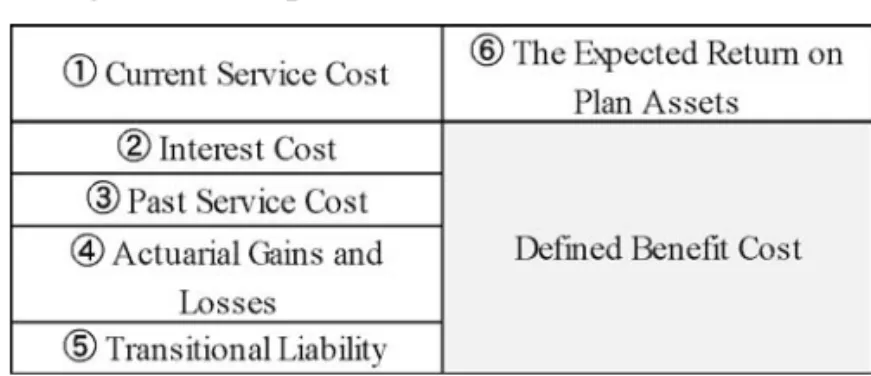
Defined benefit cost consists of six components: current service cost, interest cost, past service cost, actuarial gains and losses, transitional liability, and the expected return on plan assets2. Under Japanese accounting standards, the total of these components is recognized as defined benefit cost in operating income or expense.
Figure 1 Components of Defined Benefit Cost
IAS19 before the amendments made in 2011 (Prior IAS19) required disclosing one more cost, namely, gains or losses for the effect of any curtailments or settlements of a defined benefit plan (Prior IAS19, par.109), which is not currently required under accounting standards for employee benefits in Japan. In addition, Prior IAS19 did not specify whether a firm should present current service cost, interest cost, and the expected return on plan assets
2 In accordance with past service cost, actuarial gains and losses, and transitional liability, deferred recognition is applied for these costs. Therefore, these amortization costs in the fiscal year are included in the defined benefit cost.
as components of a single item of income or expense on the comprehensive income statement (Prior IAS19, par.119). Therefore, it allowed firms to recognize these components in items that did not affect operating income or expense. In fact, there were some firms that included interest cost and the expected return on plan assets in financial income or expense, due to the characteristics of these components that stem from financial activities for the payment of employee benefits after employees’ retirement3.
2.1 Current Service Cost
Current service cost is a retirement benefit resulting from employee service in the current period, and is measured at the present value of a defined benefit obligation (Accounting Standard for Employee Benefits, par.1.3). The defined benefit obligation is calculated based on the accrued benefit method, which “recognizes each period of service as giving rise to an additional unit of benefit entitlement and measures each unit separately to build up the final obligation” (IAS19, par.68). In principle, Japanese firms attribute benefits to periods of service on a straight-line basis over the average employees’ remaining service period (Accounting Standard for Employee Benefits, par.2(3)). With regard to IAS19, in principle firms attribute benefits to periods of service under the plan’s benefit formula. If an employee’s service in later years leads to a materially higher level of benefit than in earlier years, a firm will adopt the straight-line basis to allocate benefits (IAS19, par.70). In Japan, many firms state their employees’ salaries for all service periods systematically, and the labor market is not as fluid as those in the U.S. or in Europe. The prevailing economic situation in each area might reflect the difference between the Japanese accounting standard and IAS19. However, the Accounting Standards Board of Japan (ASBJ) issued Exposure Draft of Accounting Standard No.39: Proposed Amendment on Accounting Standard for Employee Benefits (ED39) in 2010, which beginning from fiscal 2012 will allow firms to choose straight-line basis or the plan’s benefit formula (ED39, par.19). In support of the use of the plan’s benefit formula, the ASBJ states that this method, by representing current service cost increases according to employees’ length of service, is more accurate and precise than straight-line basis (ED39, par.59). However, ASBJ offers firms the option to choose either straight-line basis or the plan’s benefit formula, because some international accounting standards state the plan’s benefit formula cannot be applied for some plans, such as cash balance pension plan (ED39, par.60).
2.2 Interest Cost
Interest cost is the cost that occurs from the passage of time because employees are one
3 Accounting Standards Board of Japan, Issues on Accounting Standard for Employee Benefits, Tokyo: ASBJ, January 2009, p.30.
year closer to retirement, based on the calculation of the present value of the defined benefit obligation at the beginning period (Accounting Standard for Employee Benefits, par.1.4). With regard to IAS19, interest cost can be categorized into financial expenses, whereas all defined benefit cost components are included in operating income or expense in Japanese accounting standard. It can be assumed that interest cost occurs from financial activities to manage employees’ pension fund.
2.3 Past Service Cost
Past service cost is recognized when a firm changes the benefits payable under an existing defined benefit plan (Accounting Standard for Employee Benefits, par.1.5).
In Japan, past service cost is recognized over the average remaining service lives of the firms’ employees. Past service cost for employees that have already retired can be recognized immediately. When negative past service cost arises, it is also recognized over the average remaining service lives of the employees. The amount of past service cost that has not been recognized as a part of net periodic defined benefit cost is unrecognized past service cost. The unrecognized past service cost will be shown on the balance sheet as a component of accumulated other comprehensive income for fiscal years ending after March 2012.
IASB previously stated that past service cost should be recognized as an expense using a straight-line basis over the average period until the benefits became vested. When the benefits were already vested at the time firms introduced, or changed to, a defined benefit plan, the past service cost was recognized immediately (Prior IAS19, par.96). Therefore, this accounting procedure depended on whether vesting had occurred or not4. IASB recognized the amount of past service cost for former employees as already having been realized, because the transaction between a firm and its former employees had occurred. When negative past service cost arose because of the reduction in the defined benefit liability, it was recognized in the same way as when positive past service cost was recognized (Prior IAS19, par.100).
IASB adopted deferred recognition, because in Discussion Paper: Preliminary Views on Amendments to IAS19 Employee Benefits (IAS19DP) it states “immediate recognition produces too much volatility in profit or loss” (IAS19DP, par.2.5). However, under IAS19, it adopts recognition of unvested past service cost in the period of plan amendment, because “past service cost can be assumed as increasing the present obligation that arises from employees’ past service” (IAS19DP, par.2.17).
Vesting is an important factor for the calculation of past service cost. In the U.S., the Employee Retirement Income Security Act (ERISA) was enacted in 1974. The major purpose
4 IASB defines vested employee benefits as employee benefits that are not conditional on future employment (IAS19, par.7).
of the law is to protect the right of vesting. The law defines minimum vesting standards to guarantee pension payments. In the U.K., vesting is provided immediately. When there are not enough funds to pay for guaranteed minimum pensions in a firm, the pension plan is transferred to the State Earnings-Related Pension Scheme (SERPS), a public entity, and this entity pays the guaranteed minimum pension5.
In Japan, the Defined Benefit Plan Act was enacted in 2002 to encourage the protection of vesting. However, the Act has some problems in its requirements for vesting. First, it does not regulate the grant date of vesting. Second, it allows firms to reduce their employees’ pension payment when their operating situation becomes worse and, in addition, two-thirds of their post-employment and current employees agree with the reduction of their pensions6. Third, it does not provide for a pension benefit guarantee system7. With these provisions, it seems to be difficult for the Act to guarantee firms’ pension payments to their employees and protect employees’ vesting. The grant date of vesting is different in each firm, so it can vary in length depending on the firm. With regard to allowing the reduction of employees’ pension payment under the Act, the amount of past service cost can have high uncertainty and volatility. Under Japanese accounting standards, these factors might allow firms to recognize past service cost over the average remaining service lives of the firm’s employees. Therefore, the Act might represent a difference in accounting method between Japanese accounting standards and IAS19.
2.4 Actuarial Gains and Losses
Actuarial gains and losses are caused by the following (Accounting Standard for Employee Benefits, par.1.6):
(a) a difference between the actual return on plan assets during a period and the expected return on plan assets for that period;
(b) a difference between the actual rate in calculating defined benefit obligations during a period and the estimated rate for that period; and
(c) a modification of estimated rates.
Therefore, a measurement of actuarial gains and losses permits firms to segregate the actual return into expected and unexpected elements. This feature of accounting standards for employee benefits differs from those of other standards8. Actuarial gains and losses are
5 Pension Fund Association, Pension Systems in Other Countries, Tokyo: Toyo Keizai, Inc., Japan, 1999, pp.237, 252-253.
6 Yamaguchi, Osamu, “Transition of Japanese Corporate Pension System and Accounting,” Kigyo Kaikei, Vol.62, No.7, July 2010, p.17.
7 There is another private defined benefit pension fund, i.e., the employees’ pension fund. It has a pension benefit guarantee system.
treated as a part of defined benefit cost, and they are included in profit or loss for the period. Further, there is an approach for determining whether actuarial gains and losses are recognized, depending on whether a significant change in assumptions has occurred. A significant change is considered to have occurred when the defined benefit obligations as measured using assumptions at the end of the year are compared to those at the end of the previous year, and this amount exceeds 10% of the previous year’s obligations (Practical Guidelines on Accounting Standard for Employee Benefits (Progress Report), par.18). Therefore, actuarial gains and losses are not recognized when there is no significant change in assumptions.
In contrast, when the actuarial gains and losses are recognized as a defined benefit cost, the cost can be spread over several years. Firms can choose the length of the period, and that choice tends to depend on the firm’s financial condition. Kagaya (2009) indicates that over 70% of Japanese firms adopt amortization periods longer than six years for actuarial gains and losses. His paper shows that firms seem to be able to reduce the impact to their financial statements by spreading actuarial gains and losses over the longer period.
IAS19 eliminates the expected rate of return on plan assets from actuarial gains and losses, because IASB recognizes that firms might be able to have an opportunity to manipulate profit or loss when they determine the expected rate of return (IAS19ED, par.BC41). With regard to the determination of the recognition of actuarial gains and losses, Prior IAS19 also had a specific approach for recognition of defined benefit obligations and plan assets, which was called the corridor approach. Under this approach, as of the beginning of the year, if the net cumulative actuarial gains and losses exceeds 10% of the greater of the present value of projected benefit obligation (PBO) or the fair value of any plan assets, the portion of unrecognized actuarial gains and losses are included as a component of net defined benefit cost of that year. When the portion of unrecognized actuarial gains and losses exceeds the 10% corridor at the end of the previous reporting period, the amount in excess of the 10% is divided by the expected average remaining working lives of the employees participating in that plan (Prior IAS19, par.IN6(k)). Under Prior IAS19, when a firm adopted a policy of recognizing actuarial gains and losses in the period in which they occurred, it might recognize them in other comprehensive income. They would not be recognized in profit or loss in a subsequent period (Prior IAS19, pars.93, 93A-D). The corridor approach differs somewhat from the Japanese approach. The approach in Japan entails determining whether or not the defined benefit obligation should be recalculated. Therefore, when the change in assumption rates is less than 10%, the actual amount of the defined benefit obligation cannot be recognized. The method employed by Prior IAS19 is related to the amount of actuarial gains
and losses, so we can recognize the actual amount of the defined benefit obligation by changing the assumption rates9.
IASB adopted the corridor approach due to the fact that actuarial gains and losses might offset one another in the long term (Prior IAS19, par.95). Under the current IAS19, the Board eliminates the corridor approach and uses immediate recognition for actuarial gains and losses for the following reasons (IAS19DP, pars. 2.10, 2.11):
(a) It is consistent with the framework and other accounting standards; (b) It represents faithfully the firm’s financial position;
(c) Amounts in the statements of financial position and comprehensive income under this recognition approach are transparent and easy to understand; and (d) It improves comparability across firms.
Additionally, both the Japanese accounting standard and IAS19 introduce accounting procedures to recognize defined benefit liabilities on the balance sheet (IAS19DP, par.3.9). It is expected that these revisions will provide the most useful information to users of financial statements (IAS19ED, par.BC10).
2.5 Transitional Liability
In fiscal 2001, the Japanese accounting standard for employee benefits was changed dramatically. Before the change, there was no certain standard for employee benefits10. However, generally when firms funded pensions via trust funds, they recognized the amount of the contribution as a cost. Therefore, deficit funding could not be recognized on the balance sheet. Given this condition, employee benefits could not be measured properly. In accordance with the accounting change, many firms had to recognize a lot of deficit funding at the end of the fiscal year in 2001. For these kinds of accounting changes, a transitional liability on accounting changes is recognized. Transitional liability is the difference between the PBO and the fair value of plan assets measured under the new standard11.
In Japan, the amount recognized by accounting changes can be amortized as income or expense on a straight-line basis over less than 15 years. When the accounting standard for employee benefits was introduced in fiscal 2001, firms were given a one-time option: If the amortization period was less than 5 years, the cost could be recognized as an extraordinary loss. If it was more than 5 years, the cost had to be recognized as an ordinary loss. Therefore, this rule might encourage firms to amortize the cost over a shorter period. The length of the
9 Imafuku, Aishi, Accounting for Retirement Benefits, Tokyo: Shinsei-sha Co. Ltd., 2000, pp.105-106. 10 There was a standard only for the specific case when firms transferred their pension plan to another
plan. The standard defined accounting methods only for the withdrawal of employee benefits, depreciation of past service cost, and disclosure on footnotes.
period firms chose depended on their financial condition.
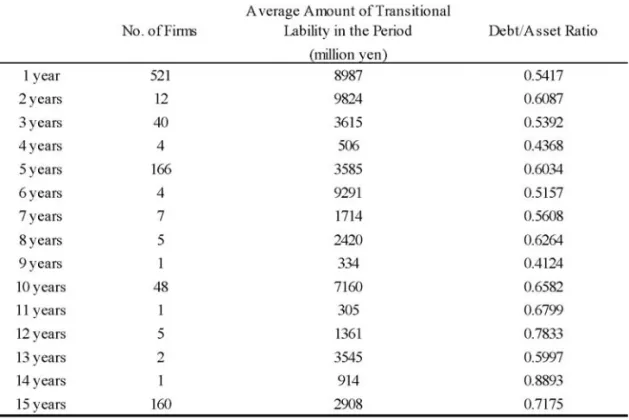
Table 1 shows the amortization period for transitional liability that firms adopted in fiscal 2001 for this significant accounting change. Firms that are treated in Table 1 (excluding banks and insurance companies) are listed on the Tokyo Stock Exchange. Firms were selected that set and disclose both discount rates and expected rates of return on plan assets on their financial statements. Most firms adopted less than 5-year amortization periods, because the cost could be recognized in an extraordinary loss. The shorter the amortization period is, the more transitional liability firms recognize. Firms adopting the longer amortization periods tend to have higher debt to asset ratios. Therefore, firms’ financial condition affects the length of the period firms choose.
Prior IAS19 allowed firms to adopt one of following methods. Transitional liability is recognized (IAS19, par.155):
(a) immediately, according to International Accounting Standard No.8: Accounting Policies, Changes in Accounting Estimates and Errors (IAS8); or (b) as an expense on a straight-line basis over a period of up to five years from
the date of adoption of IAS19.
A firm applying IAS 19 for the first time would have been required to compute the effect of the corridor approach. However, some commentators felt the method would be impractical and would not generate useful information. Therefore the corridor approach had not been adopted for this expense (Prior IAS19, par.BC96). Under current IAS19, this accounting procedure is deleted, and only the immediate recognition is allowed to recognize transitional liability.
The different length of the amortization period between the Japanese accounting standard and IAS8 might be due to the nature of transitional liability. The liability is not continuous and operational, so it is preferable to recognize it earlier, as prescribed by IAS19. Japanese accounting standard adopts the 15-year period to reduce the impact of accounting changes on financial statements. However it offered a one-time option to encourage firms to recognize the cost earlier.
2.6 The Expected Return on Plan Assets
The expected return on plan assets is an expected return resulting from the management of plan assets, and is subtracted from defined benefit cost (Statement of Position on Accounting Standard for Employee Benefits, par.4.2.(4)). Plan asset portfolio, management performance in the past, management policy, and market situation are considered in market expectations (Practical Guidelines on Accounting Standard for Employee Benefits (Progress Report), par.12). The return is calculated based on the expected rate multiplied by plan assets at the beginning of the period to reduce the volatility in the actual rate, and equalize the defined benefit cost every year12. The difference between the actual rate and the expected rate is recognized as actuarial gains and losses.
2.7 Curtailments and Settlements
Prior IAS19 required disclosing gains or losses on the curtailment of a defined benefit plan as a component of defined benefit cost when the curtailment occurred (Prior IAS19, par.109).
A curtailment occurs when a firm either:
(a) is demonstrably committed to make a material reduction in the number of employees covered by a plan; or
(b) amends the terms of a defined benefit plan such that the material element of future service by current employees will no longer qualify for benefits, or will qualify only for reduced benefits.
Curtailments can accrue when a firm closes a plant, discontinues an operation, or terminates or suspends a plan (Prior IAS19, par.111). These were recognized when they
occurred. In accordance with the immediate recognition for unvested past service cost under current IAS19, the same accounting procedure is applied to recognize curtailments as past service cost. Therefore, curtailments are included in past service cost (IAS19, par.BC160). IASB retains only (a) definition for curtailments in Prior IAS19 under revised IAS19 (IAS19, BC162).
IAS19 states that “a settlement occurs when a firm enters into a transaction that eliminates all further legal or constructive obligation for part or all of the benefits provided under a defined benefit plan” (IAS19, par.110). For example, plan participants receive a lump-sum cash payment in exchange for their rights to have specified post-employment benefits (IAS19, par.111). The gain or loss on a settlement is recognized when it occurs. It results from the difference between (IAS19, par.109):
(a) the present value of the defined benefit obligation being settled, as determined on the date of settlement; and
(b) the settlement price, including any plan assets transferred and any payments made directly by the entity in connection with the settlement.
The Japanese accounting standard for employee benefits does not state the accounting procedure for curtailments and settlements. However, Application Guideline for Accounting Standards No.1: Accounting Procedure for Transition Between Retirement Benefit Plans (Application Guideline No.1) regulates an accounting procedure for the termination of defined benefit plans which is a similar accounting treatment to that of Prior IAS1913. The termination of defined benefit plans indicates the removal or amendment of defined benefit plans, and the transition between retirement benefit plans that results reduces the amount of defined benefit obligations (Application Guideline No.1, par.4). The guideline also states the accounting procedure for mass retirement which includes the case of closing a plant or discontinuing an operation (Application Guideline No.1, par.8). It basically requires firms to recognize gains or losses on the termination of defined benefit plans (Application Guideline No.1, par.10). However, there is no definition for curtailments or settlements.
3. Transition of Defined Benefit Cost Presentation in IAS19
Under Japanese accounting standards, current service cost, interest cost, past service cost, actuarial gains and losses, transitional liability, and the expected return on plan assets are included in defined benefit cost. However, IAS19 regulates disclosing these components due to their characteristics. Firms distinguish these components among three categories; service cost, net interest on the net defined benefit liability, and remeasurements of the net defined benefit liability.
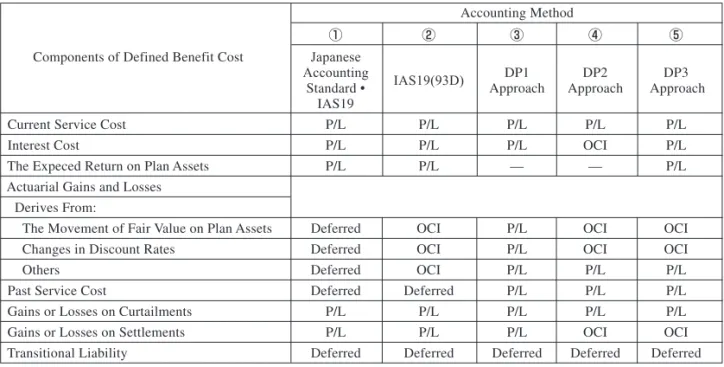
Before IASB revised IAS19 for defined benefit plans in 2011, the presentation of defined benefit cost was discussed in IAS19DP issued in 2008 and IAS19ED issued in 2010. Under IAS19DP, IASB suggested three approaches to present defined benefit cost. Table 2 shows the details of the accounting methods and presentation for defined benefit cost in IAS19DP.
In the prior accounting standard, the disclosure for defined benefit cost was designed to minimize volatility in recognition. This was achieved by employing deferred recognition in computing defined benefit cost . However, deferred recognition is eliminated from actuarial gains and losses and unvested past service cost, and applied only for transitional liability in IAS19DP. As explained above, IASB believes that immediate recognition will provide more useful information to financial statement users.
Table 2 Accounting Methods and Presentation for Defined Benefit Cost Components in IAS19DP
In DP1 approach, firms present all changes in the defined benefit obligations and in the value of plan assets in profit or loss (IAS19DP, par.3.11). This approach is consistent with other standards including the conceptual framework, IAS8, and International Accounting Standard No.37: Provisions, Contingent Liabilities and Contingent Assets (IAS37) (IAS19DP, par.3.17). It is the simplest approach which eliminates arbitrariness and complexity in allocating defined benefit cost to profit or loss (IAS19DP, par.3.27). With regard to DP2 approach, firms present only the costs of service and gains or losses on curtailments in profit
Accounting Method
① ② ③ ④ ⑤
Components of Defined Benefit Cost Japanese Accounting
IAS19(93D) DP1 DP2 DP3
Standard • Approach Approach Approach
IAS19
Current Service Cost P/L P/L P/L P/L P/L
Interest Cost P/L P/L P/L OCI P/L
The Expeced Return on Plan Assets P/L P/L — — P/L
Actuarial Gains and Losses Derives From:
The Movement of Fair Value on Plan Assets Deferred OCI P/L OCI OCI
Changes in Discount Rates Deferred OCI P/L OCI OCI
Others Deferred OCI P/L P/L P/L
Past Service Cost Deferred Deferred P/L P/L P/L
Gains or Losses on Curtailments P/L P/L P/L P/L P/L
Gains or Losses on Settlements P/L P/L P/L OCI OCI
Transitional Liability Deferred Deferred Deferred Deferred Deferred
Source: Accounting Standards Board of Japan, Issued on Accounting Standards for Employee Benefits, Tokyo: ASBJ, January
or loss; all other costs flow to other comprehensive income (IAS19DP, par.3.12). This approach distinguishes between the operating and financing components of post-employment benefit promises by recognizing only the service costs and the gains or losses on curtailments in profit or loss, while other components related to financing are recognized in other comprehensive income (IAS19DP, par.3.25).
For DP3 approach, firms present remeasurements that arise from changes in financial assumptions in other comprehensive income, and other changes in the amount of post-employment benefit cost in profit or loss (IAS19DP, par.3.15). Only this approach requires recognizing the expected return on plan assets. DP2 and DP3 approaches that recognize some components in other comprehensive income are inconsistent with the approach in some other standards (IAS19DP, par.3.17). Therefore, theoretically DP1 approach can be the most desirable method. However, it brings a lot of volatility to profit or loss in financial statements. Kagaya (2009) examines the relationship between net income (characterized in various ways) under these three approaches and six attributes of earnings referred to in the paper of Francis et al. (2004). For the purposes of this study, the category net income includes net income before taxes, net income being calculated based on DP1, DP2, and DP3 approaches. The six attributes of earnings are persistence, predictability, smoothness, value relevance, timeliness, and conservatism. This paper proves which type of net income has the strongest relationship with each category of earnings attribute. It concludes that net income before taxes has the strongest relationships with persistence, predictability, smoothness, and value relevance. DP1 approach indicates the most desirable timeliness. DP2 approach has the highest degree of conservatism. This result shows net income before taxes reflects economic volatility on financial statements the most stably, and DP1 approach does it the most timely. The paper mentions that the change in presentation for defined benefit cost components might affect corporate systems, such as dividend policies or pension systems.
Table 3 Accounting Methods and Presentation for Defined Benefit Cost Components in IAS19ED
Components of Defined Benefit Cost Accounting Method
Current Service Cost P/L
Service Cost Past Service Cost P/L
Gains or Losses on Curtailments P/L
Finance Cost Interest Cost P/L
Actuarial Gains and Losses Derives From:
Remeasurement Experience Adjustments OCI
Changes in Actuarial Assumptions OCI
Return on Plan Assets OCI
Gains or Losses on Settlements OCI
Table 3 represents a presentation approach for defined benefit cost stated in IAS19ED, and it is mostly based on DP3 approach in IAS19DP. IASB decided to adopt this presentation approach for the following reasons (IAS19ED, par.BC37):
(a) Some items that have different predictive value will be combined in DP1 approach; (b) The DP1 approach gives high volatility in profit or loss that is not related to the firm’s
operations; and
(c) This approach helps clear presentation of the risk that results from measuring plan assets and defined benefit liabilities at present value.
The board rejected recognition of the expected return on plan assets, because there is no objective way to determine the amount, and the recognition of the return might include a return that is not simply due to the passage of time (IAS19ED, par.BC26(a)).
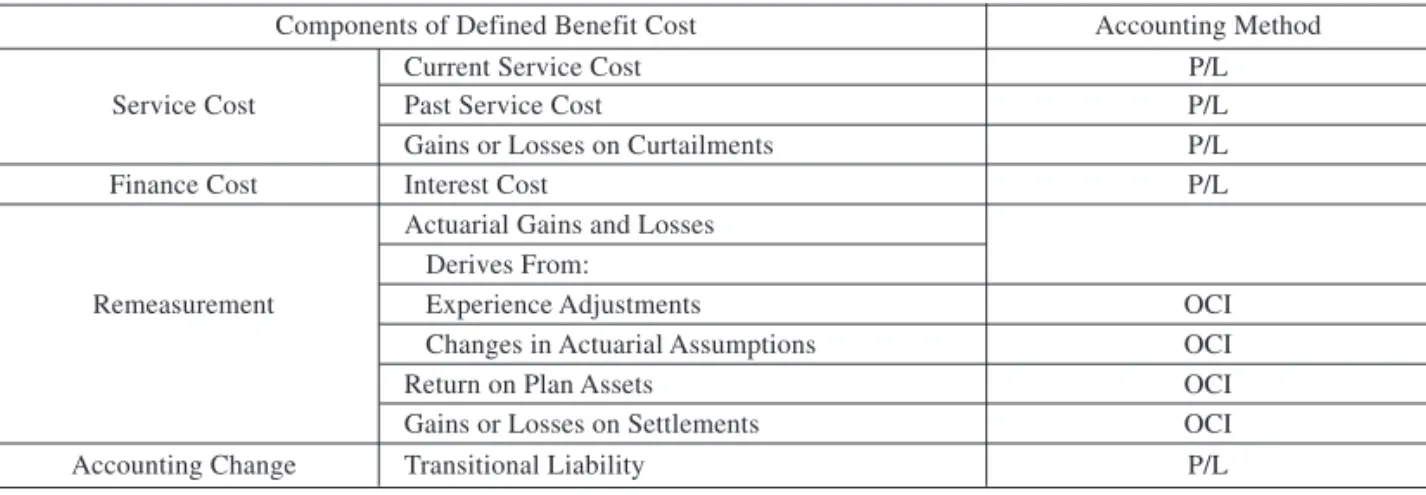
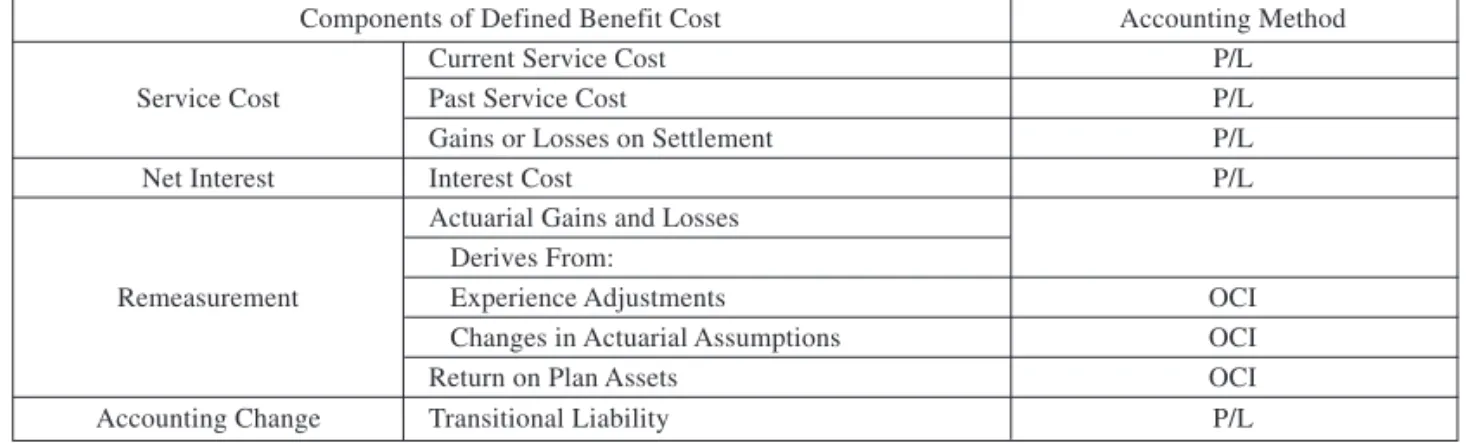
IAS19 adds some changes to IAS19ED. The new presentation approach for defined benefit cost under IAS19 is shown in Table 4.
There are two changes made from IAS19ED: (1) gains or losses on curtailments are included in past service cost, and (2) gains or losses on settlement are disclosed as a component of service cost. With regard to gains or losses on curtailments, it was necessary to recognize and disclose past service cost and curtailments separately before IAS19 was revised, because curtailments were recognized immediately, whereas unvested past service cost was recognized over the vesting period. However, after the amendments in IAS19 were made in 2011, the standard requires recognizing all defined benefit cost components immediately, and there is no reason to make a distinction between recognizing gains or losses on curtailments and those on unvested past service cost (IAS19, par.BC161).
As for gains or losses on settlement, these were categorized into remeasurements, and recognized in other comprehensive income in IAS19ED. However, they are treated in service
Table 4 Accounting Methods and Presentation for Defined Benefit Cost Components in IAS19
Components of Defined Benefit Cost Accounting Method
Current Service Cost P/L
Service Cost Past Service Cost P/L
Gains or Losses on Settlement P/L
Net Interest Interest Cost P/L
Actuarial Gains and Losses Derives From:
Remeasurement Experience Adjustments OCI
Changes in Actuarial Assumptions OCI
Return on Plan Assets OCI
cost, and recognized in profit or loss in IAS19, because (IAS19, par.BC166):
(a) there is overlap between the definitions of settlements, curtailments, and plan amendments and the transactions usually happen at the same time, so it can be difficult to allocate the gains and losses between them; and
(b) it is inconsistent with other IFRSs to recognize gain or loss on settlement in other comprehensive income.
Moreover, IASB concluded that past service cost and gains and losses on settlements should not be disclosed in remeasurements, because they are the result of a new transaction, as opposed to the remeasuement of a prior period transaction (IAS19, par.BC173).
4. Categories of Defined Benefit Cost
As explained above, IAS19 separates defined benefit cost into three categories as follows (IAS19, par.BC65):
(a) Service cost, relating to the cost of the services received;
(b) Net interest on net defined benefit liability, representing the financing effect of paying for the benefits in advance or in arrears; and
(c) Remeasurements of the net defined benefit liability, representing the period-to-period fluctuations in the amounts of defined benefit obligations and plan assets.
Service cost and net interest components are useful for users of financial statements for estimating the amount and timing of future cash flows, and the remeasurement component indicates the uncertainty of future cash flows (IAS19, par.BC88).
4.1 Service Cost
The service cost component comprises current service cost, past service cost, and gains or losses arising from settlements (IAS19, par.8). It is presented in profit or loss. As mentioned in Section 2.3, IASB states unvested past service cost should be recognized immediately, because “the attribution of unvested benefits to past service results in a liability as defined in IAS19” (IAS19ED, par.BC13). IASB implements immediate recognition for all components of defined benefit cost.
4.2 Net Interest on the Net Defined Benefit Liability
The net interest component includes interest income on plan assets, interest cost on the defined benefit obligations, and the effect of the asset ceiling mentioned in IAS19, paragraph 6414 (IAS19, par.124). It is presented in profit or loss. Net interest on the net defined benefit
14 Paragraph 64 in IAS19 states when an entity has a surplus in a defined benefit plan, it measures at the lower of (IAS19, pars.64, 83):
liability is the net defined benefit liability throughout the period multiplied by the discount rate specified in IAS19 as determined at the beginning of the period (IAS19, par.123). Interest income on plan assets is a part of the return on plan assets. The return on plan assets is classified into an amount that arises from the passage of time and other changes. The interest income on plan assets arising from the passage of time is calculated by multiplying the plan assets throughout the period by the discount rate used to discount the defined benefit obligations at the beginning of the period15 (IAS19, pars.BC77, 79). IAS19 adopts the same rate as the rate used to discount the obligations, because a firm can avoid subjective judgment of how to divide the return on plan assets into net interest and remeasurement components (IAS19, par.BC82). The amount is included in the net interest component. The return on plan assets arising from other changes is disclosed in the remeasurement component.
4.3 Remeasurements on the Net Defined Benefit Liability
The remeasurement component comprises actuarial gains and losses on the defined benefit obligations, the return on plan assets, and any changes in the effect of the asset ceiling described in paragraph 64 (IAS19, par.8). These are presented in other comprehensive income. The remeasurement component is transferred immediately to retained earnings, and it will not be reclassified to profit or loss in a subsequent period (IAS19, par.122). This component will help to assess the uncertainty and risk of future cash flows (IAS19, par.BC88).
5. Effects of Corporate Cultures and Concepts of Incomes
There are two major differences between Japanese accounting standards and IAS19, namely, (1) deferred recognition and immediate recognition for actuarial gains and losses, past service cost, and transitional liability, and (2) the presentation of remeasurement component, especially actuarial gains and losses. These differences in accounting methods and presentation may be affected by different corporate cultures and concepts of incomes.
Under Japanese accounting standard, all defined benefit cost components are included in a single item, i.e., defined benefit cost, and are disclosed in profit or loss. With regard to the recognition of actuarial gains and losses, past service cost, and transitional liability, deferred recognition is adopted. In Japan, there are many manufacturing firms, such as Toyota, Honda,
(b) the asset ceiling, determined using the discount rate determined by reference to market yields at the end of the reporting period on high quality corporate bonds.
15 IASB acknowledged it was difficult to find a practical method to recognize the change in the fair value of plan assets arising from the passage of time. It rejected two approximations to the calculation of the change including (1) the expected return on plan assets, and (2) dividends received on equity plan assets and interest earned on debt plan assets (IAS19, par.BC78).
Sony, Panasonic, Canon, Nintendo, and so on. Most of these firms prefer to have long-term relationships with stakeholders. Therefore, ordinary income has been an important financial indicator, which derives from firms’ major operating activities. This is one of the reasons that deferred recognition is adopted, i.e., to measure firms’ operating activities more precisely. In addition, this method minimizes the volatility caused by other activities. Deferred recognition helps to recognize all components in profit or loss without the significant negative effects from stock and bond price movements, which are not related to firms’ operating activities.
On the other hand, IAS19 states how to recognize the remeasurement component, including actuarial gains and losses, return on plan assets, and any change in the effect of the asset ceiling in other comprehensive income. Immediate recognition is adopted for all defined benefit cost components. As explained above, IASB acknowledges some advantages in adopting immediate recognition, such as the consistency with the accounting framework and other accounting standards, and comparability across firms. In Europe and the U.S., investors expect to have gains from their investments in a shorter period than in Japan. Therefore, all activities, including temporary effects, should be reflected in financial statements to provide useful information for investors to evaluate firms, and immediate recognition provides clarity to investors. However, it is not clear why the remeasurement component is recognized in other comprehensive income. The reason for this accounting treatment might be in the concepts of profit or loss, and other comprehensive income.
Total comprehensive income consists of profit or loss and other comprehensive income. Under International Accounting Standard No.1: Presentation of Financial Statements (IAS1), it is defined as “the change in equity during a period resulting from transactions and other events, other than those changes resulting from transactions with owners in their capacity as owners” (IAS1, par.7). With regard to profit or loss, IAS1 defines it as “the total of income less expenses, excluding the components of other comprehensive income” (IAS1, par.7). Framework for the Preparation and Presentation of Financial Statements (Framework) puts forward profit as “a measure of performance or as the basis for other measures, such as return on investment or earnings per share” (Framework, par.69). Presentation of Items of Other Comprehensive Income Amendments to IAS 1 (Amended IAS1) mentions IASB has no plan to eliminate profit or loss as a measure of performance (Amended IAS1, par.BC54C). IAS1 indicates that other comprehensive income comprises items of income and expense that are not recognized in profit or loss. It includes five components as follows (IAS1, par.7):
(a) changes in revaluation surplus;
(b) actuarial gains and losses on defined benefit plans;
(c) gains and losses arising from translating the financial statements of a foreign operation;
value through other comprehensive income; and
(e) the effective portion of gains and losses on hedging instruments in a cash flow hedge.
Firms had the option to present all items of income and expense either in a single statement of comprehensive income or two separate statements of profit or loss and other comprehensive income (IAS1, par.81). Amended IAS1 requires firms to present profit or loss and other comprehensive income separately in a statement of profit or loss and other comprehensive income statement (Amended IAS1, par.81A). Therefore, IASB recognizes that the nature of profit or loss is different from that of other comprehensive income, and both are important measures of performance. Representing these items separately would help financial statement users understand all non-owner changes in equity more clearly. However, IAS1 and the Framework do not describe a principle for classifying the items to be recognized into other comprehensive income or into profit or loss (IAS19ED, par.BC42). IASB needs to state more clearly definitions and principles for profit or loss and other comprehensive income.
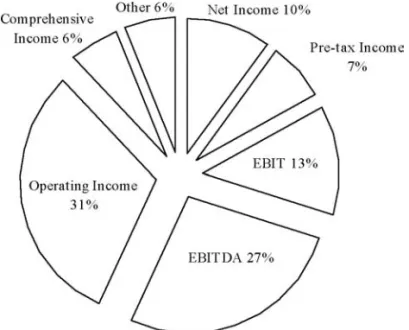
Figure 2 Primary Performance Metric in Income Statement
FASB and IASB (2009) performed a field test with analyst participation and summarized the results to test the proposals of the October 2008 discussion paper Preliminary Views on Financial Statement Presentation. One of the purposes of the field test was “to determine
Source: Financial Accounting Standards Board and International Accounting Standards Board,
“Financial Statement Presentation, Analyst Field Test Results,” IASB Meeting September 2009 (IASB agenda reference 9B), and FASB – Information Board meeting September 21, 2009 (FASB memo reference 66B), September 2009, p.9.
whether the proposed presentation model improves the usefulness of a firm’s financial statements for users in making decisions in their capacity as capital providers”. In the field test, these accounting standards boards asked analysts some questions, such as:
(a) How much do they rely upon certain sources of information?; (b) What metric do they create from the balance sheet?; and (c) How useful are the aspects of the proposed presentation model?
The results of the test show about 70 percent of respondents rely more than 50 percent on information from the annual report to make judgments in their work as analysts. The test also indicates which primary performance metric they use or create from a firm’s income statement. The results are shown in Figure 2.
Operating income has the highest proportion, with 31 percent of respondents identifying it as a primary performance metric. Pre-tax income and income calculated based on pre-tax income, including earnings before interest and tax (EBIT) and earnings before interest, taxes, depreciation and amortization (EBITDA) represent 47 percent. Some 10 percent of respondents recognize net income as a primary performance metric to evaluate firms. Comprehensive income has the lowest percentage, with only 6 percent of respondents. Therefore, 88% of respondents choose incomes reported above net income as their primary performance metric.
There are several prior research studies that have examined the usefulness of comprehensive income. Cheng et al. (1993) and Dhaliwal et al. (1999) examine the relationship between estimated comprehensive income and stock returns. These studies find no evidence that comprehensive income is more useful for investors to predict better future cash flows or income than net income. Cahan et al. (2000), Dehning and Ratliff (2004), Biddle and Choi (2006), Kubota et al. (2006), Chambers et al. (2007), Dastgir and Velashani (2008), and Kanagaretnam et al. (2009) study the relationship between reported comprehensive income and stock prices or returns. Cahan et al. (2000) and Dehning and Ratliff (2004) find investors value the information in comprehensive income. However, there is no benefit in disclosing the components of comprehensive income separately. Dastgir and Velashani (2008) do not support the proposition that comprehensive income is superior to net income for evaluating firm performance on the basis of stock return and price. Biddle and Choi (2006) find that comprehensive income dominates in explaining equity returns, and net income dominates in explaining chief executive compensation. They conclude each definition of income provides different usefulness for decision-making in different applications, and the disclosure of comprehensive income components is useful.
Kubota et al. (2006) investigate net income as the most important income measure for investors. However, foreign currency translation adjustments and unrealized gains and losses from securities available for sale in other comprehensive income provide useful information
to explain cumulative raw returns or risk adjusted returns. Chambers et al. (2007) find some other comprehensive income components, namely, unrealized gains and losses on marketable securities and foreign currency translation adjustments are valued by investors. Their evidence suggests that investors pay attention to other comprehensive income information. Kanagaretnam et al. (2009) recognize aggregate comprehensive income is more strongly associated with both stock prices and returns compared to net income and that it is a better predictor of future cash flows. They also observe that net income is a better predictor of future net income relative to comprehensive income.
Hirst and Hopkins (1998) report that different forms of accounting display can have some impact on analysts’ valuation judgment. Comprehensive income is useful when it is reported separately from net income, not as part of the statement of changes in stockholders’ equity. Maines and McDaniel (2000) also arrive at the same conclusion as Hirst and Hopkins (1998), i.e., that the volatility of comprehensive income is reflected in investors’ judgments of corporate and management performance only when it is presented in a statement of comprehensive income16. Therefore, there is no consistent result for the usefulness of comprehensive income from the field test FASB and IASB provides and these empirical research studies.
As explained above, all defined benefit cost components should be included in profit or loss to maintain the consistency with the accounting framework and other accounting standards. However, IASB has decided to recognize a remeasurement component in other comprehensive income, although at one time previously it had agreed to recognize all components in profit or loss. One possible reason is that many responses to the IAS19DP might have reflected the view that the remeasurement component should be in other comprehensive income due to the volatility in profit or loss17. If the remeasurement component is included in profit or loss, it affects all primary performance metrics for analysts in Figure 2. Actuarial gains and losses, especially, are somewhat affected by stock and bond prices, and the amount of the gains and losses are estimated to be quite significant. Therefore, the remeasurement component is included in other comprehensive income which does not affect return on investment or earnings per share.
6. Summary and Conclusion
IFRS is basically set on an asset-liability approach. However, two approaches existed, the
16 In the U.S. from1997 to 2011, comprehensive income was required to be reported in either a statement of comprehensive income or a statement of changes in stockholders’ equity. Currently, FASB does not permit firms to present other comprehensive income in the statement of changes in stockholders’ equity. 17 IASB believes that “a measure should be volatile if it faithfully represents transactions and other events
that are themselves volatile, and financial statements should not omit such information” (IAS19, par.BC72(c)).
asset-liability approach and revenue-expense approach in Prior IAS19, owing to the adoption of deferred recognition. Currently, IAS19 adopts immediate recognition for actuarial gains and losses and past service cost. This is based on the asset-liability approach that reflects the change of fair value in profit or loss, or other comprehensive income for the period. The IASB considered whether to disclose all defined benefit cost components in profit or loss and decided not to do so, because it would create too much volatility in financial statements.
There are two differences in accounting methods and presentation for defined benefit cost between Japanese accounting standards and IAS19: deferred recognition and immediate recognition for actuarial gains and losses, past service cost, and transitional liability, and presentation for remeasurement component. Japanese accounting standards adopt deferred recognition for actuarial gains and losses, past service cost, and transitional liability, and recognizes all defined benefit cost components in profit or loss to measure firms’ core business activities more precisely, and reduce the volatility from other activities in profit or loss. On the other hand, IAS19 adopts immediate recognition for actuarial gains and losses and past service cost, and recognizes service cost and finance cost in profit or loss and remeasurement component in other comprehensive income. The FASB and IASB (2009) test shows that 88% of respondents indicate incomes reported above net income are the most important primary performance metrics for analysts, with comprehensive income representing only 6 percent of respondents’ answers. From this result, IASB might reduce the volatility of remeasurement component by recognizing it in other comprehensive income, which does not have a significant effect on investors’ judgments. Therefore, even though IFRS is adopted for Japanese firms, it can be predicted that the presentation of defined benefit cost will not have a significant negative impact on Japanese firms’ financial statements.
References
Accounting Standards Board of Japan, Accounting Standard for Employee Benefits, Tokyo: ASBJ, June 1998.
Accounting Standards Board of Japan, Application Guideline for Accounting Standards No.1: Accounting Procedure for Transition Between Retirement Benefit Plans, Tokyo: ASBJ, January 2002.
Accounting Standards Board of Japan, Exposure Draft of Accounting Standard No.39: Proposed Amendment on Accounting Standard for Employee Benefits, Tokyo: ASBJ, March 2010.
Accounting Standards Board of Japan, Issues on Accounting Standard for Employee Benefits, Tokyo: ASBJ, January 2009.
Accounting Standards Board of Japan, Statement of Position on Accounting Standard for Employee Benefits, Tokyo: ASBJ, June 1998.
Journal, Vol.79, No.11, November 2009, pp.46-50.
Barth M.E., W. H. Beaver and W. R. Landsman, “The Market Valuation Implications of Net Periodic Pension Cost Components,” Journal of Accounting & Economics, Vol.15, No.1, March 1992, pp.27-62. Biddle, Gary C. and Jong-Hag Choi, “Is Comprehensive Income Useful?,” Journal of Contemporary
Accounting & Economics, Vol.2, No.2, June 2006, pp.1-32.
Cahan, Steven F., Stephen M. Courtenay, Paul L. Gronewoller and David R. Upton, “Value Relevance of Mandated Comprehensive Income Disclosure,” Journal of Business Finance & Accounting, Vol.27, No.9 & 10, November/December 2000, pp.1273-1301.
Chambers, Dennis, Thomas J. Linsmeier, Catherine Shakespeare and Theodore Sougiannis, “An Evaluation of SFAS No.130 Comprehensive Income Disclosures,” Review of Accounting Studies, Vol.12, No.4, December 2007, pp.557-593.
Cheng, C. S. Agnes, Joseph K. Cheung and V. Goparakrishnan, “On the Usefulness of Operating Income, Net Income and Comprehensive Income in Explaining Security Returns,” Accounting and Business Research, Vol.23, No.91, Spring 1993, pp.195-203.
Dastgir, Mohsen and Ali Saeedi Velashani, “Comprehensive Income and Net Income as Measures of Firm Performance: Some Evidence for Scale Effect,” European Journal of Economics, Finance and Administrative Sciences, Issue 12, October 2008, pp.123-132.
Dehning, Bruce and Paulette A. Ratliff, “Comprehensive Income: Evidence on the Effectiveness of FAS 130,” The Journal of American Academy of Business, Cambridge, Vol.4, No.1/2, March 2004, pp.228-232.
Dhaliwal, Dan S., K. R. Subramanyamb and Robert Trezevantb, “Is Comprehensive Income Superior to Net Income as a Measure of Firm Performance?,” Journal of Accounting and Economics, Vol.26, No.1-3, January 1999, pp.43-67.
Financial Accounting Standards Board and International Accounting Standards Board, “Financial Statement Presentation, Analyst Field Test Results,” IASB Meeting September 2009 (IASB agenda reference 9B), and FASB – Information Board meeting, September 21, 2009 (FASB memo reference 66B), September 2009.
Fitzpatrick, Brian D., Sudhakar S. Raju and Anthony L. Tocco, “Comprehensive Income Options: A Detriment To Transparency,” International Business & Economics Research Journal, Vol.9, No.8, August 2010, pp.21-28.
Fransis, Jennifer, Ryan Lafond , Per M. Olsson and Katherine Schipper, “Cost of Equity and Earnings Attributes,” The Accounting Review, Vol.79, No.4, October 2004, pp.967-1010.
Hirst, D. Eric and Patrick E. Hopkins, “Comprehensive Income Reporting and Analysts’ Valuation Judgments,” Journal of Accounting Research, Vol.36, Supplement, 1998, pp.47-75.
Imafuku, Aishi, Accounting for Retirement Benefits, Tokyo: Shinsei-sha Co. Ltd., 2000.
International Accounting Standards Board, Discussion Paper: Preliminary Views on Amendments to IAS19 Employee Benefits, London: IASB, March 2008.
IAS19, London: IASB, April 2010.
International Accounting Standards Board, Exposure Draft: Presentation of Items of Other Comprehensive Income Proposed amendments to IAS 1, London: IASB, May 2010.
International Accounting Standards Board, Framework for the Preparation and Presentation of Financial Statements, London: IASB, April 2001.
International Accounting Standards Board, International Accounting Standard No.1: Presentation of Financial Statements, London: IASB, September 2007.
International Accounting Standards Board, International Accounting Standard No.8: Accounting Policies, Changes in Accounting Estimates and Errors, London: IASB, December 2003.
International Accounting Standards Board, International Accounting Standard No.19: Employee Benefits, London: IASB, May 1999.
International Accounting Standards Board, International Accounting Standard No.19: Employee Benefits (revised), London: IASB, June 2011.
International Accounting Standards Board, International Accounting Standard No.37: Provisions, Contingent Liabilities and Contingent Assets, London: IASB, September 1998.
International Accounting Standards Board, Presentation of Items of Other Comprehensive Income Amendments to IAS1, London: IASB, June 2011.
Kagaya, Tetsuyuki, “Does the Convergence of the Pension Cost Presentation Affect Earnings Attributes?,” PIE/CIS Discussion Paper, No. 438, Tokyo: Institute of Economic Research, Hitotsubashi University, August 2009.
Kanagaretnam, Kiridaran, Robert Mathieu and Mohamed Shehata, “Usefulness of Comprehensive Income Reporting in Canada,” Journal of Accounting and Public Policy, Vol.28, No.4, July/August 2009, pp.349-365.
Kubota, Keiichi, Kazuyuki Suda and Hitoshi Takehara, “Reporting of the Current Earnings plus Other Comprehensive Income: Information Content Test of Japanese Firms,” a paper presented at the 2006 Annual Meeting of American Accounting Association, 2006.
Maines, Laureen A. and Linda S. McDaniel, “Effects of Comprehensive-Income Characteristics on Nonprofessional Investors’ Judgments: The Role of Financial-Statement Presentation Format,” The Accounting Review, Vol.75, No.2, April 2000, pp.179-207.
Pension Fund Association, Pension Systems in Other Countries, Tokyo: Toyo Keizai, Inc., 1999.
Picconi, M., “The Perils of Pensions: Does Pension Accounting Lead Investors and Analysts Astray?,” The Accounting Review, Vol.81, No.4, July 2006, pp.925-955.
The Japanese Institute of Certified Public Accountants, Report of Accounting Practice Committee Statement No.13, Practical Guidelines on Accounting Standard for Employee Benefits (Progress Report), Tokyo: JICPA, February 2009.
Yamaguchi, Osamu, “Transition of Japanese Corporate Pension System and Accounting,” Kigyo Kaikei, Vol.62, No.7, July 2010, pp.16-25.