
近畿大学学術情報リポジトリ
22
0
0
全文
(2) 教養・外国語教育センター紀要. Couple a teach-to-the-test academic atmosphere with a lack of regular interaction with native-speakers and oral proficiency becomes low priority. Even with TOEIC and TOEFL having incorporated a wider variety of geographical dialects, pronunciation practice remains mostly passive and receptive. Productive skills are infrequent in textbooks, relegated to short samples lacking explanation, absent of discourse-level context and natural speech patterns, and limited to examples of white, native-speakers only that ignores the fact that English is the most widely spoken second language in the world. If only the Standard English used for test preparation was sufficient, then the sole study of sound-level phonetic phenomena might be enough to differentiate words. However, in real world encounters, the majority of learners will face English in travel, music, television, or on business for which they will be listening and speaking to wait staff, shop clerks, and others using natural speech with all its variations. Discounting the importance of this not only makes communicative competence more difficult to achieve, but it can also negatively affect other aspects of language learning. 2.0 Features of Pronunciation Pronunciation can be broken down into two main elements. The first is the level, or the individual vowel and consonant phonemes that combine to make up words. The second is the. level, which incorporates all other. pronunciation phenomena, including intonation and stress, which take place at the word or sentence level of speech. This is not to be confused with the. of language,. which also concerns sentence-level phenomena such as intonation and stress but which focuses more on musical rhythm and poetic meter. Related to suprasegmentals is. , which denotes the speech phenomena. that developed organically to manage English s rhythm and alternating patterns of strong and weak stress. Occasionally this is termed. , variants of this can. be found in French, German, Finnish, and other languages. In English, the alternating pattern of strong and weak forms serves to delineate thought groups, and stress is used to distinguish the more important words in an otherwise fairly continuous stream of speech(Whalley & Hansen 2006) . Alternating stress patterns cause vowels to shift, be , to ensure unimportant squeezed between important stressed. words, such as pronouns and articles, can be words, namely nouns, verbs, and the like.. Natural speech saves time and ensures the most important stressed word is understood. −136−.
(3) Student Perceptions of Pronunciation. even in the case when a usually unstressed function word is highlighted. Natural speech phenomena include: • vowel and consonant reduction. • partial or full. • flapping. • vowel and consonant insertion. blending/assimilation. • linking. • vowel and consonant elision. • fusing(incorporating. • contractions. • trimming/elision. multiple phenomena). • glottalization. A possible utterance might change like this: Enunciated:. What are you. going to do. about. it,. buddy?. Connected:. Whatcha. gonna do. bout. _it,. bu dy?. Unfortunately, natural speech has been misinterpreted as being difficult to teach and maligned in some learning cultures as being vulgar. However, teacher-talk is anything but natural. It is overly enunciated, slow, lacking in natural vowel reduction at both the sentence and word levels, and does little to prepare learners for real-world conversations with native speakers. Many educators, material writers, and learners appear unaware or even indifferent to the importance of natural speech to intelligibility and to the fact that spoken language is more than a matter of receptive comprehension. Pronunciation education needs to include exercises in prediction, perception, and production equally of segmentals and suprasegmentals. Learners should be made cognizant of how the prosody of their language might adversely affect their study of another language and they should be trained in natural speech, yet without the pressure of feeling they have to attain native-like proficiency. 3.0 Literature Review 3.1. Effect of pronunciation on other language skills It is generally accepted that without sufficient awareness of second language(L2) pronunciation and prosody patterns, the first language(L1)rhythm can significantly interfere with L2 oral proficiency(Gilbert 2009) ; however, this unawareness can impact other aspects of language learning. Macleod(2011)argues that Japanese students are not taught to equate the specific phonemes they read or write as specific sounds to be used in speaking. Therefore, these learners will continue to use the same minimal. −137−.
(4) 教養・外国語教育センター紀要. phoneme chunks as in their L1, as in the case of a student writing“cat”but saying /kato/. For Japanese-speaking learners, this is a common error directly attributable to L1 transfer of the consonant-vowel pairings that create syllabic. , but intonation. and stress for meaning are also troublesome. In the case of morae interference and the lack of phonetic-to-letter recognition, learners are ill equipped when encountering new words ‒ not only in speaking, but also in reading. Stephens(2011)examined such effects of prosody on reading. She pointed out that, as languages go, English is unusually inconsistent in how its sounds and letters relate. Punctuation is not enough to convey all the meanings of written words.“Prosody s role is in clarifying meaning in ways that are not evident from written text alone,” (p. 69) , and that should be reason enough to overtly expose learners to prosody before literacy. Goetry et al.(2006)agreed. They found the. , or rhythm-based. main word stress, of Dutch to be directly responsible for inhibiting the learning of not only reading, but also spelling, for syllable-timed French-speaking learners. Vocabulary retention can also be affected by inadequate understanding of pronunciation at the sentence level. Neurolinguistics is beginning to show previously unknown relations in learning. One such study shows that in alphabetic languages, written words are first decoded with the visual mechanism, but over time they are stored phonologically(Walter 2009) . Tan(2005)notes that logographic languages, such as Japanese, require visual orthographic awareness to learn and read. Tan argues each character is a self-contained word, best learned through repetitive writing practice. On the other hand, alphabetic languages like English require phonemic awareness, which is better learned through repetitive listening practice that engages the parts of the brain related to phonology. Parents’reading aloud to their children, a common L1 learning technique, helps not only to develop phonetic-orthographic connections, but also serves as an example of the prosody vital to oral communication which is not otherwise apparent in a text(Fox 2010) . Word-by-word reading fails to capture the entirety of context or the nuance of phrasing. Fluent readers instinctively have this prosodic flow and can more easily delineate the thought groups so important to meaning and pragmatics. Unfortunately, Wilson(2008)feels that listening has been a neglected skill; so getting adequate repetitive listening practice to learn a phonetic-based language like English may be even more difficult to learn because the average Japanese student rarely interacts with English speakers. Vandergrift(2004)argues this has been because. −138−.
(5) Student Perceptions of Pronunciation. listening is viewed as difficult to teach so what aspects of listening are taught are vague and disassociated with other aspects. Also potentially problematic is that Standard English language instruction in Japan utilizes the same repetitive writing found effective for its own logographic language vocabulary development. However, using the same L1 techniques to learn an L2 is likely ineffective(Macleod 2011) . According to Macleod, while repetitive writing may be beneficial to spelling, it does not contribute to the mastery of pronunciation, the understanding of interlocutory thought groups, or long-term vocabulary retention. As this long-term storage is tied neurologically to phonology, current methods of teaching vocabulary and reading would be better off including a phonetic component. An approach that employs multiple interconnected language skills with discourse content, instead of parsed, may prove beneficial to learning at a neurolinguistic level. Similarly, to enable autonomous learning, explicit and predictable phonological skills should be included in basic English instruction from the elementary level. 3.2 Pronunciation related to register is the variety of English used in a given situation regardless of social or geographic dialect. Natural speech is found worldwide in conversations, television, movies, and music at all levels of register. While natural speech is considered informal in order to differentiate it from written language, it is not, in itself, informal. Many learners and teachers have been indoctrinated to believe natural speech is used only casually and that clearly enunciated phonemes with slight spaces between words are more proper. However, to not use natural speech sounds bookish, stilted, and potentially arrogant. Contractions, for example, are de rigueur in question formation across levels. “Which foods isn t he allergic to?”would sound awkward to anyone anywhere without the shift to a contraction. Even in business, North Americans are known for phrases like,“Nice ta meetcha,”which are intended to put customers at ease, but contribute to the notion of improper informality by other cultures. Shifts in register, such as discourse planning, syntax, and vocabulary, are commonly taught as aspects of reading and writing. However, the corresponding pronunciation shifts, beneficial for listening and speaking, are sadly underrepresented. For example, schwa /ə/ in word-stress is commonly taught whereas schwa in sentence stress less so, though it is based on a similar local phenomenon of vowel reduction. Joos(1966) , who initially designated the. −139−.
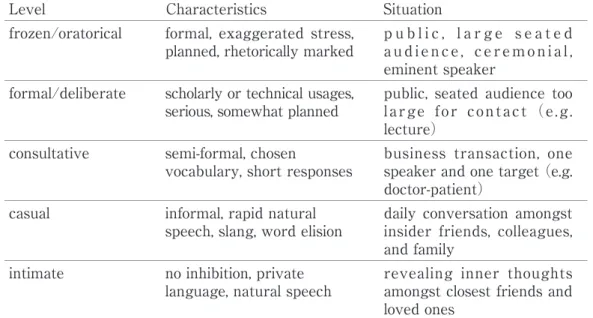
(6) 教養・外国語教育センター紀要. five levels of register, however, did not omit phonological features from his plan(Table One) : Level. Characteristics. Situation. frozen/oratorical. formal, exaggerated stress, planned, rhetorically marked. public, large seated audience, ceremonial, eminent speaker. formal/deliberate. scholarly or technical usages, serious, somewhat planned. public, seated audience too large for contact (e.g. lecture). consultative. semi-formal, chosen vocabulary, short responses. business transaction, one speaker and one target(e.g. doctor-patient). casual. informal, rapid natural speech, slang, word elision. daily conversation amongst insider friends, colleagues, and family. intimate. no inhibition, private language, natural speech. revealing inner thoughts amongst closest friends and loved ones. Table 1. . Joos(1966). Realistically, the typical Japanese learner of English will never reach the proficiency level of their teachers, give a formal presentation, or give a eulogy. The majority of Japanese English production will be at the. level of register where. speech is quick, elided, and connected. To effectively communicate at this level, it is essential that learners develop at least the awareness of natural speech phenomena even if they do not achieve productive capabilities. 3.3 To teach segmentals or suprasegmentals Some believe L2 pronunciation is too difficult to change. Lenneberg s(1967) Critical Period Hypothesis(CPH)posited post-pubescent difficulties in learning pronunciation. However, this theory has been questioned as simply being an excuse for not learning and neurolinguists have yet to find definitive proof. Fledge(1987)found CPH to be counter-productive, because it did not account for the variable patterns of individual learners. Derwing and Rossiter(2002)supported a weak form of CPH by positing that learners modify existing phonological parameters for their L2 instead of. −140−.
(7) Student Perceptions of Pronunciation. creating entire new ones. Therefore, errors in a learner s pronunciation are no longer considered to be random attempts to produce new sounds. Instead, these phonological errors are“reflections of the sound inventory, rules of combining sounds and the stress and intonation patterns of their native languages” (Swan & Smith, 1987) . This would suggest that any CPH might be overcome and that pronunciation education could continue to be actively addressed until L1 influence subsides and native-like proficiency is achieved. Though segmentals tend to be the most prominent aspect of pronunciation in textbooks and classrooms, teaching them leads to a series of problems. First, many letters of the alphabet represent different phonemes and, conversely, there are only 26 letters to represent the 44 main phonemes. Second, segmentals are arguably difficult to master after the fossilization of L1 phonemes given the fine motor coordination necessary to create new sounds. Last, phonemes may shift significantly in context or with dialect. While some suprasegmental features such as tone or intonation, may not seem easy to teach, they are too meaningful to communication to be ignored. Since the 1980s, traditional drilling of discrete segmentals has given way in Europe and North America pedagogy to methods that focus on the discourse-level since communication breakdowns are mainly attributable to meaning in context(c.f., Thomas, 1995; Jenkins, 2000; and Shockey, 2003) . Contrary to popular belief, most natural speech phenomena have been found to be easily learned and taught(Ito, 2006; Carreira, 2008) . Indeed, most natural speech phenomena follow easy to comprehend rules that have been laid out simply for learners and educators alike(c.f., Dickerson, 1989; Hahn & Dickerson, 1999) . Surprisingly though, suprasegmentals get shunted aside. Crawford and Ueyama(2011)studied 13 oral English course books commonly used at the Japanese university level, none from a Japanese publisher, plus 13 specialized texts on natural speech phenomenon, all but one from Japanese publishers. They observed that of the 26 forms of suprasegmentals found in those texts, no explicit rules were given for them. Sample forms were presented with some oral practice, but neither predictive practice nor recycling appeared later in the texts. Though a limited selection of books, they created a“comprehensive list”of suprasegmentals. This list lacked consistent nomenclature and was absent of several frequently occurring phenomena like vowel reduction to /ə/. This might reflect the relatively low for. −141−.
(8) 教養・外国語教育センター紀要. university level of false-beginner or beginner and the phenomena haven not been introduced yet, or it might indicate material developers themselves might be lacking the resources and knowledge to adequately present suprasegmental explanations to learners. Perhaps because of this, Crawford and Ueyama argued for a renewed process approach and for raising the awareness of natural speech phenomena. Another problem facing English language learners regarding pronunciation in Japan needs to be addressed ‒ the use of Japanese. phonetic characters in. elementary and junior high school level English texts. Though anecdotally said to be diminishing, this practice restricts Japanese learners to the five Japanese vowels. This forced conformation of the 13 common English vowels to match Japanese on the phoneme-level fails to account for the wide variability of world Englishes that learners might encounter. By basing pronunciation on. the phenomenon of superfluous. vowels between consonant clusters and at the end of words, known as. ,. cannot be avoided and the sentence-level conditions necessary for natural speech to occur simply cease to exist. While neither segmentals nor suprasegmentals are not without their difficulties, educators need to reconsider their approach and understanding of phonological education. Natural speech should be given at least equal time in the classroom. Critical to meaning, learners should be exposed to suprasegmentals and prosody with abundant listening input, and as with segmental features of language, at the earliest age possible. Regardless of limited space in textbooks and time in class, suprasegmental practice is essential at the discourse-level by providing meaning in context and training in it needs to contain explanations, oral exercises, and written prediction in addition to sample forms. 3.4 Effect of pronunciation issues on intelligibility, motivation, and identity There are other aspects of pronunciation pedagogy that weigh into the argument of whether or not phonological skills are important enough to be taught more explicitly in English language curricula in Japan. The main reason is obvious ‒. ,. defined by Smith (1992)as word recognition, utterance comprehension, and understanding hidden meaning. The Japanese language has experienced a large influx of English words which becomes problematic as they have become phonetically transformed into Japanese by. −142−.
(9) Student Perceptions of Pronunciation. being transcribed into. , a mostly consonant-vowel syllabary. As a result, the. numerous superfluous vowel additions from Japanese. become part of a. learner s intermediate learning stage between the L1 and the L2 called (Selinker 1972) . That Japanese learners simply do not recognize the superfluous vowels as being absent in written or spoken English might account for the difficulty in breaking their. habits. Any use of. and. in English education might. lead to a misconception that English and Japanese are more phonologically similar than they are and it severely disrupts the stress-timing critical to English. Studies on intelligibility also show prosodic features(i.e., aspiration, place or manner of phoneme, etc.)rather than phonemic features were more significant barriers to listener comprehension(c.f., Magen, 1998; Anderson-Hiseh, et al, 1994) . Kitzman(2007)found that the superfluous vowels specifically in. were an identifiable barrier to. the intelligibility of Japanese English speakers by native listeners, but that the lack of comprehension could be overcome with the addition of contextual clues. Ishiikawa (2002)found success in overcoming interfering interlanguage tendencies. By training Japanese learners of English to recognize syllabification they were able to parse English words and invented non-words in a more syllabic rather than moraic manner. Jenkins (2000)guidelines included consonant clusters and syllabic structures as a necessary core part of pronunciation education. Affective issues also influence pronunciation learning. Eliminating superfluous vowels or learning fine new motor skills takes significant concentration and effort, which might demotivate learners. Similarly, the misconception that pronunciation does not make a major contribution to communication might influence learners to feel antipathy for it when introduced. Fear of failure and loss of face present further barriers to language learning. Elson(1992)suggests anxious learners might actively choose to cease communication. By addressing these issues with a head-on awareness campaign, affective barriers can be lowered and learner autonomy can be encouraged. Finally, learners might not want to attain native-like accents for valid reasons. Daniels(1997)argues that learners might resist adopting a native-like accent due to individual or social pressures. Japan is an extremely homogenous and monolingual island nation where a strong culture of using foreign languages in daily life does not exist. The lack of societal support for solid English skills might also contribute to the difficulties Japanese learners’have in breaking their. −143−. habit. Furthermore, Drummond.
(10) 教養・外国語教育センター紀要. and Grogan(2010)found few role models for non-native speakers in EFL textbooks. Therefore, texts may be contributing to Japanese English learners feelings that they do not belong to the English-speaking group. This absence of peer role models might communicate a lack of success to learners causing lower motivation and, in some cases cause already at-risk learners to reject English. University students already undergo potential identity changes at this new stage in their lives. New and different values and expectations they experience in a classroom might also generate a feeling of pressure and not belonging. To mitigate these perceived negative effects, educators should introduce and foster the understanding and acceptance of. , the concept that a language learner adds L2 phonological. features and by doing so does not necessarily loose any L1 features that might be closely related to cultural or personal identity. In this way, learners can overcome any feeling of loss of their personal identity, known as. . Learners should. never have to deny their L1 identity, but they may have to make some compromises in their L1 accent to ensure intelligibility. 4.0 Present Study 4.1 Research questions 1. Do typical Japanese university students perceive a need to study pronunciation? 2. Which type of pronunciation error, segmental or suprasegmental, do students perceive contributes more to a lack of intelligibility? 3. Is there a perceived necessity to attain native-level pronunciation? 4.2 Subjects and method An 8-item survey was administered in two teachers oral communicationbased classes at Kinki University. Of the 378 volunteer respondents, 186 were male and 176 female. The average age was 19.4 with a standard deviation of 1.5. Table 2 Department. 学部. =378. %. Business Art and Literature Economics Law Engineering Sociology. 経営 文芸 経済 法 理工 社会. 183 87 69 31 6 2. 48 23 18 8 2 1. years. Most departments were represented though limited by the convenience style of sampling(Table Two) . The survey(Appendix I)was given at the end of the first of two semesters and. −144−.
(11) Student Perceptions of Pronunciation. after the explicit teaching of suprasegmental skills in class. This skill set included rhythm, content versus function words, sentence level strong and weak stress, linking, blending, trimming, unstressed vowel reduction, and the phoneme schwa /ə/‒ all as a means to improve listening comprehension of native conversational speech patterns. Each skill was introduced with clear rules and was followed by oral practice and written prediction exercises using the same purpose-created materials. These skills were reiterated by predicting, marking, and practicing them in the main dialog of the concurrent unit. Each skill was presented once for an average of 15 minutes by both teachers. Textbooks dialogs varied, but were practiced five times for each teacher. Owing to the lack of class time for drilling, students were not expected to reproduce natural speech in their own conversations. Whereas all the aforementioned suprasegmental skills where presented in the first semester, only half of the ten most commonly mistaken segmentals by Japanese, /l/, /r/, /Θ/, /δ/, /æ/, /a/, /wu/, /v/, /f/, and the /siy/ combination were covered during the same term and depended on the text. The remaining five were covered in the following semester. After the initial explanation, these segmentals were never drilled again. Pronunciation was not a focal point of any class. Points hindering intelligibility, imminent miscommunication, and/or serious disruptions occurred in the speech stream were corrected during dialog practice, but not free conversation. Initially, the survey was designed to establish whether students recognized the importance of suprasegmentals as it related to intelligibility as taught in class. It also included some needs analysis questions on students desirability and self-motivation and it queried them about their past experiences. Students were given the paper-based survey in English but were coached verbally in Japanese as to meaning and to giving one s honest opinion. After results were gathered, Items Five and Six, that sought to discover what and how often the participants previous teachers taught pronunciation, were deemed problematic. Item Five:“How many classes of English did you have in school last year/ semester?”was difficult for a number of reasons. First, the phrase“last year”that for some students meant high school while for other university. In addition, a few students, who had gone to an international high school with some courses taught in English, were not sure what constituted an English class. Ultimately, Item Five s results were completely rejected for lack of reliability.. −145−.
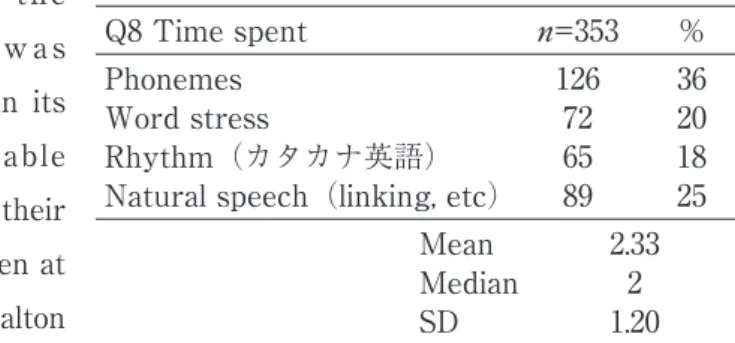
(12) 教養・外国語教育センター紀要. Item Six:“On average, how often did your teacher teach pronunciation in class last year/semester?”was originally posed to ascertain the relative exposure level to overt pronunciation teaching students had previously received and was intended for use with Item Five. While not directly about student perceptions, it would have been interesting to see if a greater exposure to in-class pronunciation instruction correlated to a greater perception of it being an important skill. Not surprisingly, there was no way for students to accurately calculate the average time in class that they were exposed to pronunciation teaching so the item eliminated. The anticipated correlation between class time and perceived importance proved very weak and Item Five was also deemed unreliable. Even though the question was rejected, a general understanding that more than half(54%)of the students were Table 3 exposed to some explicit and regular. Q6 Time spent. =378. %. teaching of pronunciation (Table. 0 1 2 3 4 5. 52 63 59 110 57 37. 14 17 16 29 15 10. Three) . The question of what type of classes or teachers are affected, in what year of school, whether and which segmental and suprasegmental. never once or twice a semester a couple of times per month once a week two or three times a week four or more times a week Mean Median SD. skills are introduced, and exactly how and how often these skills are being. 2.44 3 1.52. taught is an entire study of its own, not to be fully addressed here. Also problematic, Item Eight asked:“What have your teachers practiced most in class?”This question was posed to determine if students could identify different aspects of pronunciation after having been taught them. Because there are numerous aspects of pronunciation, had the question been open-ended, the respondents may have been at a loss as to how to answer. Therefore, four multiple-choice prompts of skills taught in the surveyors classes, and thus known to students, were chosen. The main reason to eliminate this question was because it was not worded well enough to allow respondents to accurately distinguish between the classes in question, whether it was the current class, a concurrent class, or a previous class. This item was phrased for purely an inhouse check of class-related materials and it cannot determine what is taught in other classes. However, it did give another rough overview of what the respondents perceived themselves to be studying. Similar to Derwing and Rossiter s (2002)findings, respondents had difficulty identifying which aspects of pronunciation they had been introduced to that semester even with −146−.
(13) Student Perceptions of Pronunciation. v e r b a l c o a c h i n g t o e n s u r e t h e Table 4 Q8 Time spent meaning of each choice was Phonemes understood. This was evident in its Word stress smaller 353-subject size (Table Rhythm(カタカナ英語) Four) . Respondents felt 36% of their Natural speech(linking, etc). Mean Median SD. pronunciation instruction had been at the segmental-level ‒ the level Dalton. =353. %. 126 72 65 89. 36 20 18 25 2.33 2 1.20. and Seidlhofer(1994)suggested is easier to teach. The arguably equally important sentence-level suprasegmental features seem not to be receiving as much attention as there was a total of 43% for both rhythm and natural speech issues combined. 5.0 Analysis 5.1.1 The Perceived Importance of Pronunciation Items One, Four, and Seven sought to identify whether students perceived pronunciation to be important. Item One, posed the question:“How important is studying pronunciation to you?”and Item Four, which asked:“How important is pronouncing English like a native?”Both of these required respondents to judge importance based on a 5-point Likert scale with“1”being“not important”and“5” being“important” . For Item One, there had been the option of ranking several language skills against each other to observe how pronunciation would fare against other skills like reading or speaking. This, however, would fail to elicit the subjects’perceptions about pronunciation for its own sake. Instead, choosing a Likert scale allowed subjects to reflect on the value of pronunciation skills alone, absent the influences of external cultural and academic expectations deemed to have inherent priority in Japan, such as grammar or vocabulary.. Table 5. For Item One, the median. Importance of a n s w e r w a s a s t r o n g “5 ” , pronunciation “important” , on the scale with more than half of participants (53%)answering so (Table Five) . A low standard deviation of .88 combined with a additional 29% responding with a “4” , “fairly important” , show an. 1 not important 2 3 4 5 important Mean Median SD −147−. Q1 General importance. Q4 Nativelike. =375. %. =376. %. 3 12 51 109 200. 1 3 14 29 53. 5 23 77 119 152. 1 6 20 32 40. 4.30 5 0.88. 4.00 4 0.99.
(14) 教養・外国語教育センター紀要. overwhelming total of 82% of respondents perceived pronunciation in and of itself to be “important” . Only three respondents(1%)reported it to be completely unimportant. Likewise for native-like speech, only five of the 376 respondents reported it to be unimportant(Item Four, Table Five) . There was a low standard deviation of .99 with responses grouped around the median“4” ,“fairly important” . Responses of“3” (20%) , “4” (32%) , and“5” (40%)were given for Item Four. Older, male respondents skewed slightly higher in valuing pronunciation and native-like speech than their younger, female counterparts with correlations of -.16 and .16, and -.15 and .11 respectively. Department was also a weak predictor: .12 for importance and .13 for native-like. The correlation between importance and native-like pronunciation was much stronger(.44) , but still not statistically significant. This again suggests that pronunciation is regarded by students to be relatively important but that native-like speech, while desirable, is not necessary. In the learning culture of a Japanese university, where learners typically get one to three 90-minute English lessons a week for 15 weeks, teachers are overwhelmed with teaching academic/cognitive skills. Typically, there is little teaching of the aspects of language learning ‒ the awareness of how any given language skill interacts with others or why any skill is more or less personally beneficial to the individual learner. Neither is there much discussion of language transmitting culture, language as identity, relative meanings of vocabulary or other important and influential concepts about language, which might affect deeper communication. It is also possible learners conflate intelligibility with native-like pronunciation. It would be interesting to reexamine this item after a thorough discussion of the significance of these points. Item Seven asked:“How often do you practice pronunciation by yourself?”The average respondent reports Table 6 studying only a few times per. Q7 Time spent. =378. %. 15-week semester. More than. 0 1 2 3 4 5. 83 112 79 60 21 23. 22 30 21 16 5 5. one quarter (28%)reported studying pronunciation by themselves at least once or more a week, but a similarly. never once or twice a semester a couple of times per month once a week two or three times a week four or more times a week Mean Median SD. substantial 22% reported they never did(Table Six) . A more. −148−. 1.72 1 1.42.
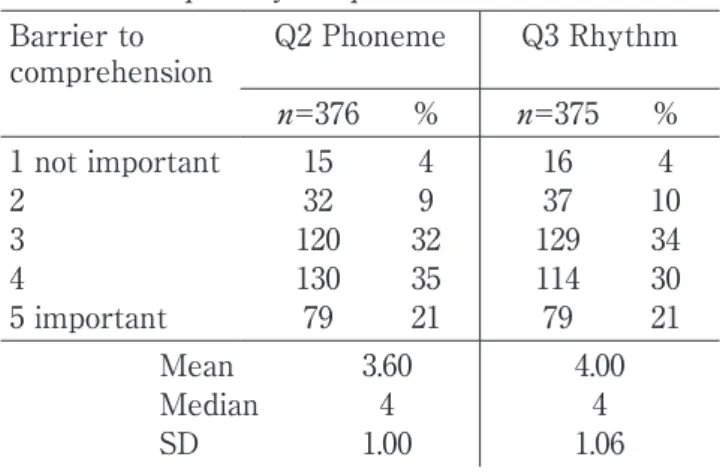
(15) Student Perceptions of Pronunciation. in-depth study could elicit the reasons for self-study and whether it is truly selfmotivated or externally required homework. The correlation between those who studied more on their own and between both those who felt pronunciation was important and a native-like accent was desirable was both .22(Appendix II) . This minor trend shows that, while respondents may value pronunciation, it is not enough to motivate them to work for it. This lack of self-study could be based on numerous external factors such as lacks of time to study, easily obtainable materials, or any method for confirming correct pronunciation, or it could be a prioritization of teacher directed topics, skills, or other homework. 5.1.2 Segmentals Versus Suprasegmentals as Barriers to Communication Items Two and Three sought to identify if students perceived a distinction between segmental and suprasegmental aspects of pronunciation and to what extent either or both contributed to intelligibility. While potentially oversimplifying rhythm to represent all suprasegmentals, students had been made aware that rhythm involves stress, vowel reduction, elision, and other phenomena. Item Two asked:“How important is saying the wrong sound in communication?”and Item Three asked:“How important is having the wrong rhythm to communication?”Respondents were well acquainted from class with the various components of“rhythm,”but verbal coaching in Japanese ensured the distinction between Items Two and Three. That suprasegmentals could potentially be greater barriers to communication than segmentals was highlighted during class, but for the most part it was the first time respondents were introduced to that idea. After years of exposure to only segmental instruction there was an expectation that respondents would be swayed, but which way ‒ toward“rhythm,”the newest. Table 7 Barrier to comprehension. intense exposure, or “sound,”. 1 not important 2 fact, the two were found to be 3 4 roughly equal(Table Seven) . 5 important The median of both was four and Mean the percentage for the highest Median SD (21%)and lowest(4%)were the after years of indoctrination? In. −149−. Q2 Phoneme. Q3 Rhythm. =376. %. =375. %. 15 32 120 130 79. 4 9 32 35 21. 16 37 129 114 79. 4 10 34 30 21. 3.60 4 1.00. 4.00 4 1.06.
(16) 教養・外国語教育センター紀要. same. Rhythm had a slightly higher mean(4.00)but by only .40 points. Correlations reveal those who valued pronunciation overall tended to feel misspoken sounds interfere with communication(.23)more than offbeat rhythm(.15) , but to no statistical significance. The strongest tendency was for respondents to report that any pronunciation error could inhibit communication regardless of whether it was a segmental or suprasegmental error with a correlation of .64. Interestingly, the expected correlation between Item Four, native-like, and Item Three, rhythm, was also insignificant. Correlations reveal respondents equate rhythm and sound barriers(.16) , albeit weakly. This suggests that students do not recognize that suprasegmentals, presented in class as“natural speech” , are a significant part of what constitutes nativelike speech. 6.0 Classroom implications and conclusions This exploratory survey provided enough information to warrant further study although the survey instrument would need improvements including a more balanced representation of departments, more teachers students surveyed, and more selective items. Additional learner-centered research could seek to ascertain methods of selfstudy, why native-like pronunciation was deemed important to some Japanese learners, if there were any correlation to be found between how much a teacher teaches pronunciation and how important the learner perceived it to be. The methods and value of pronunciation skills employed by teachers and textbooks could also be examined. The subjects seemed to perceive pronunciation to be important, and a surprisingly high number aspired to native-like proficiency. Nonetheless, the data indicates that this value does not translate to much self-study on their part and might just be indicative of learners’greater study habits. It might then be up to clever teachers to find ways to transform this perceived need into action. These students placed the almost equal value on both segmental and suprasegmental as being barriers to comprehension, but this was questionably only after overt practice in the classroom. Anecdotally, they did not come into the class with any previous knowledge of natural speech phenomena ‒ a case for further study. Self-reporting, even with coaching, appeared difficult, reflecting a lack of metalanguage and full comprehension of phonological issues. Had students been given proper pronunciation tools earlier in their education, they would be more prepared for the expectation and requirements of university-level English, especially in regards to. −150−.
(17) Student Perceptions of Pronunciation. oral communication classes and greater native-speaker interaction. This pressure to be intelligible in real-world encounters might demotivate students. Greater awareness of communication barriers, positive teacher support, and more productive practice of both segmental and suprasegmental features starting earlier in their education could mitigate this. Not only could this help students acquire metalanguage and processes, but also it would aid in overall intelligibility. Typical Japanese university students are not given adequate exposure to phonological education, especially natural speech phenomenon. Japanese learners of any foreign language need to be made aware of how their L1 may negatively influence not only their pronunciation of any new language, but also their spelling, listening comprehension, and reading capabilities. Learners should be explicitly taught how prosody is unique to each language and that suprasegmentals affect meaning as much or more than individual segmentals. Suprasegmental awareness is an essential tool and can be easily balanced with teaching segmentals. That natural speech is“casual”is a misnomer, and to continue to stigmatize it as such does language learners a gross disservice. Teachers and material developers in Japan both need to address suprasegmentals earlier and more explicitly. It is essential that learners comprehend the difference between English stress-timed and Japanese mora-timed rhythms early to give learners time in their education to develop and practice the complementary skills. Learners must be taught how unstressed weak forms are effectively squeezed and reduced to sit between stressed, strong forms. Learning to utilize stress at the sentence-level, not only at the word-level, is also invaluable for both listening and speaking. Segmental features that contribute heavily to meaning, such as contrast stress and choice intonation, should be introduced before learners are expected to use them, i.e., in a university oral English class. At higher levels, learners could employ a good conversation strategy by learning less important. can be subsumed in a conversation. Its practice could. lessen some of the affective burdens inhibiting many Japanese who have been trained to emphasize accuracy over fluency when speaking. Also useful would be to overtly teach that written forms are not as flexible as spoken ones. Finally, learning when to stress function words and other exceptions to the rules can be introduced. Simple rules like these, with some regard to frequency, would serve learners better than the short list of examples common in textbooks today. By teaching learners how to predict and. −151−.
(18) 教養・外国語教育センター紀要. reproduce natural speech phenomena aids autonomy and contributes to lifelong learning. Native-like pronunciation is not necessary as long as intelligibility is not compromised.. References Anderson-Hsieh, J., Johnson, R. and Koehler, K.(1992). The relationship between native speaker judgments of non-native pronunciation and deviance in segmental, prosody and syllable structure.. 42(4), 529-555.. Archibald, J.(2002). Parsing procedures and the question of full access in L2 phonology. , Amsterdam: University of Amsterdam Press, 11-21. Carreira, J. M.(2008). Effects of teaching reduced forms in a university preparatory course. In K. Bradford-Watts, T. Muller, & M. Swanson(Eds.), . Tokyo: JALT. Crawford, M. J. & Ueyama, Y.(2011). Coverage and instruction of reduced forms in EFL course books.. , 35(4), 55-61.. Cummins, J.(2001). The entry and exit fallacy in bilingual education. In C. Baker & N. Hornberger(Eds.),. .. Clevedon, UK: Multilingual Matters Ltd.(110-138). Dalton, C., & Seidlhofer, B.(1994).. . Oxford: Oxford University Press.. Daniels, H.(1997). Psycholinguistic, psycho-affective and procedural factors in the acquisition of authentic L2 pronunciation. In A. McLean(Ed.), (80-85). Whitestable: IATEFL. Derwing, T. M., & Rossiter, M. J.(2002). ESL learns perceptions of their pronunciation needs and strategies.. , 30, 155-166.. Dickerson, W. B.(1989).. .. Urbana, IL: University of Illinois Press. Drummond, H., & Grogan, M.(2010)An examination of the EFL textbooks at one Japanese university from a World Englishes perspective. In K. Bradford-Watts, E. M. Skier, & M. Walsh(Eds),. : JALT.. Elson, N.(1992) . Unintelligibility and the ESL learner. In P. Avery & S. Ehrlich(Eds.), (229-236). New York: Oxford University. −152−.
(19) Student Perceptions of Pronunciation. Press. Fox, M.(2010). Mem Fox.. . Retrieved from www.memfox.. com/welcome.html Gilbert, J. B.(2009). Rhythm and phonemic awareness as a necessary precondition to literacy: recent research.. , 40, 8-9.. Goetry, V., Wade-Woolley, L., Kolinsky, R., & Mousty, P.(2006). The role of stress processing abilities in the development of bilingual reading. , 29(3), 349-362. Fledge, J. E.(1987)The critical period for learning to pronounce foreign languages? , 8(2), 162-177. Hahn, L. D., & Dickerson, W. B.(1999). . Ann Arbor, MI, University of Michigan Press. Ishiikawa, K.(2002). Syllabification of intervocalic consonants by English and Japanese speakers.. , 45(4)355-385.. Ito, Y.(2006). The comprehension of English reduced forms by second language learners and its effect on input/intake process. In J. D, Brown & K. Kondo-Brown, (Eds.), (67-81). Honolulu: University of Hawai i Press. Jenkins, J.(2000).. . Oxford:. Oxford University Press. Joos, M.(Ed.) (1966). (4th ed.). Chicago: Chicago University Press. Kitzman, A. B.(2007). The Cornfield Test: A study into the Katakana Effect and intelligibility of Japanese pronunciation of English.. (1),. 15-28. Lenneberg, E. H.(1967).. . New York: Wiley.. Macleod, C.(2011). Phonics in the L1 classroom and lessons for English teaching in Japan.. , 20(1), 109-118.. Magen, H.(1998). The perception of foreign-accented speech.. 26,. 381-400. Selinker, L.(1972). Interlanguage.. 10,. 201-231. Shockey, L.(2003).. . Malden, MA: Blackwell Publishing.. −153−.
(20) 教養・外国語教育センター紀要. Smith, L. E.(1992). The spread of English and issues of intelligibility. In B. B. Kachru (Ed.),. (75-90). Urbana, IL:. University of Illinois Press. Stephens, M. A.(2011). Why exposure to prosody should precede the teaching of reading.. , 35(4), 68-73.. Swan, M., & Smith, B.(Eds) (1987). Cambridge: Cambridge University Press. Tan, L. H.,(2005). Reading depends on writing, in Chinese. Proceedings of the National Academy of Sciences, 102(24), 8781-8785. Thomas, J.(1995).. . London: Longman.. Vandergrift, L.(2004). Listening to learn or learning to listen? , 24, 3-25. Walter, C.(2009). Teaching phonology for reading comprehension.. , 40, 4-7.. Whalley, K., & Hansen, J.(2006). The role of prosodic sensitivity in children s reading development. Journal of Research in Reading, 29(3), 288-303. Wilson, J. J.(2008).. . Harlow: Pearson Education.. −154−.
(21) Student Perceptions of Pronunciation. Appendix I. English Pronunciation Student Survey Name: Sex:. Department: F. M. Age:. Student Number: Not Important. 1. How important is studying pronunciation to you?. 1. 2. Impotrant 3. 4. 5. 3. 4. 5. 2. How important is studying the wrong sound to communication? 1. 2. 3. How important is having the wrong rhythm to communication? 1. 2. 3. 4. 5. 4. How important is pronouncing English like a native? 1. 2. 3. 4. 5. 5. How many classes of English did you have in school last year/semester? 6. On average, how often did your teacher teach pronunciation in class last year/semester? 0 − never. 3 − regularly (once a week). 1 − rarely (once or twice a semester). 4 − often (two or three times a week). 2 − sometimes (a couple of times per month) 5 − a lot(four or more times a week) 7. How often do you practice pronunciation by yourself? 0 − never. 3 − regularly (once a week). 1 − rarely (once or twice a semester). 4 − often (two or three times a week). 2 − sometimes (a couple of times per month) 5 − a lot(four or more times a week) 8. What have all your teachers practiced most in class? a. different sounds (ex. /l vs. r/ or /th/). c. thythm(ex. カタカナ英語). b. word stress. d. natural speech (ex. linking, trimming). −155−.
(22) 教養・外国語教育センター紀要. II. Pearson Product-moment Correlation of Demographic and Survey Factors Survey Question 378 Q1 Q2 Q3 Q4 Q6 Q7 Q8. Importance Phoneme barrier Rhythm barrier Native-like Study in class Self study Study most. A. B. C. Q1. Q2. Q3. Q4. Q6. Q7. Q8. 362. 362. 378. 375. 376. 375. 376. 378. 378. 353. -.16 .01 -.02 -.15 -.04 .07 .00. .16 .07 .06 .11 -.04 .06 .13. .12 .00 -.04 .13 .10 .11 .00. .23 .15 .44 .06 .22 .01. .64 .16 .09 .03 -.03. .16 .09 .10 .00. .07 .22 .01. .22 .01. .03. -. A Age(positive correlation refers to younger students) B Gender(positive correlation refers to male students) C Department. −156−.
(23)
図

関連したドキュメント
This dissertation aimed to develop a method of instructional design (ID) to help Japanese university learners of English attain the basics of internationally
Comparing the present participants to the English native speakers advanced-level Japanese-language learners in Uzawa’s study 2000, the Chinese students’ knowledge of kanji was not
Although many studies have analyzed the differences in expressing gratitude between Japanese learners and native Japanese speakers, these studies do not fully explain whether
TABLE I~Iv, Fig.2,3に今回検討した試料についての
一丁 報一 生餌縦 鯉D 薬欲, U 学即ト ㎞8 雑Z( a- 鵠99
中国では漢方の流布とは別に,古くから各地域でそれぞれ固有の生薬を開発し利用してきた.なかでも現在の四川
16)a)最内コルク層の径と根の径は各横切面で最大径とそれに直交する径の平均値を示す.また最内コルク層輪の
雑誌名 金沢大学日本史学研究室紀要: Bulletin of the Department of Japanese History Faculty of Letters Kanazawa University.
