
Globalization and Liberalization : Potential
of New Life Style and Domestic Market
著者名(英)
Masao KOBAYASHI
journal or
publication title
The Bulletin of Faculty of Sociology,Toyo
University
volume
44
number
1
page range
23-38
year
2006-11
URL
http://id.nii.ac.jp/1060/00003019/
Creative Commons : 表示 - 非営利 - 改変禁止Social Change in Kathmandu Related
with Globalization and Liberalization
∼ Potential of New Life Style and Domestic Market ∼
カトマンズにおけるグローバル化・
経済の自由化にともなう社会変容
∼新しい生活様式の登場と国内市場の変化∼
Masao KOBAYASHI
小 林 正 夫
1.Democracy in 1990s and Regional Imbalance in Nepal
April, 1990, the first political revolution by the peoples’ power in Nepal changed Nepalese Politics from monarchy to democracy. Under liberal multi-party system, Nepalese economies became free from governmental control, and as a result, lead by some family trusts cooperated with foreign enterprises including Indian companies. According to Economic Survey every year, average number of new industrial establishment raised up to 5,000 – 9,000 every year after 1992 when establishment regulation had released, and GDP share of industry sector also grow from 8% before 1990 to 13% after 1994, on the other hand, share of agriculture decreased from 51% in 1990 down to 43% in 1994. For example, garment and carpet industries mainly exported to American and European market, based on cheap labor including children under 15 years. According to the Industrial Production Statistics of Japan, Nepal have a record of 9.4% production in the world cotton-garment products. Most of these factories was built in Kathmandu valley. As for Indian and its related enterprises in Tarai (Lower plain along with Indian border), oils and fats from plants and synthetic textiles are the leading sector of industries developed in 1990s.
In addition, tourism had also developed in 1990s. According to Statistics Yearbook, annual arrivals of tourist to Nepal grow from 180,000 in 1985, 260,000 in 1990, 350,000 in 1995 and the most of 490,000 in 1999.
balance rather than economic development, so that more investment had put into developing area of hill zone where infrastructure was poor. After the political change, new established private enterprises prefer urban area where basic infrastructures had well developed, so in 1990s, industrial establishments had concentrated in Kathmandu valley and a few industrial centers neighboring to India. These economic trend encouraged migration from rural to urban area throughout the nation, especially in male youth for employment.
2.Trans-world Employment and Life Strategy of Nepalese
Through the process of economic development under liberalization policy, access to the profitable chance was limited to a few urban center spatially. That means rural to urban migration had increased during 1990s. However, both garment and tourism sector depend on cheap, unskilled labor, so educated youth should seek other way of life, which was the trans-world employment.
In Nepal, temporally migration as unskilled labor or soldier for some 20 years had been one of traditional way earning money by rural male youth. After 1985, some middle eastern countries including Saudi-Arabia, Kuwait and UAE started gathering Nepalese labor for cleaning, hotel service or guard. In early 1990s, South Korean factories and late 1990s, factories of Malaysia and Thailand also joined to recruiting Nepalese labor. Excepting job in India where Hindi language is easy for Nepalese, trans-world employment require at least English conversation, and social or general knowledge. Such trans-world employment grow to the most important sector of Nepal earning foreign currency.
According to official statistics, after late 1990s, garment and carpet industry declined its market share in the leading market, because of severe criticism from Europe toward child labor, and changed tax policy by the United States. As for tourism, armed conflict started by the Nepal Communist Party-Maoist from February, 1996, gave fatal effect that means a negative image of Nepal as peace-less destination. In 2001, accident (murder) in the Royal Palace accelerate the decline, and annual number of tourists fall down to 280,000 in 2005.
On the other hand, Labor migration from Nepal to abroad, other than India, was less than 10,000 til 1997 annually, but rapidly grew 27,000 (1998), 52,000 (2000) , 104,000 (2002) and 140,000(2004) . Total amount of remittance from Nepalese abroad was 65.5 billion Nepalese Rupee (900 million US $), equal to 13.0% of GDP. That means Trans-world employment is now the second main economic activity next to agriculture in Nepal.
Table 1. Migration for Employment by Destination
Destination
Domestic India Mlaysia MiddleEast OtherCountries Average Remittance(NRs) 13,656 18,414 80,830 79,249 134,971 % Origin Nepal 48.2% 35.2% 3.3% 9.3% 3.5% Kathmandu 61.9% 4.3% 2.3% 4.0% 25.7% Class Highest10% 44.1% 50.7% 2.2% 2.6% 0.3% Lowest10% 55.1% 17.1% 4.2% 11.0% 11.8% NRs:Nepalese Rupees, 1 US $ = 74.20NRs (08 / 2006)
%:Distribution of Migrated People by Destination (Total Migrant from Every Origin = 100%). Class: Divided by Consumption Level
Data:Central Bureau of Statistics (2004) Nepal Living Standards Survey 2003/2004
Table 1 shows situation of non-agricultural employment for Nepalese people, based on the sample survey in 2002. That survey indicate that one third of households throughout Nepal is earning their income from some family member(s) working outside their main residence. Comparing Average income (remittance), it is clear that Trans-world employment, in Malaysia, Middle East or other countries including U.S., South Korea or Japan, is more profitable than traditional employment in India or Nepal. As for regional distribution, it is clear that Kathmandu, or economically higher level families are more accessible for such profitable employment, on the other hand, other area without Kathmandu, India is still the most important place for work. The reason is clear that the capital city Kathmandu is advantageous for accessing to global system.
Under these economic trends, Life strategy by Nepalese people is now concentrated into non-agricultural sector thorough rural to urban migration and earning educational background relating with global economy including IT industries recently developing in Nepal, like in India.
In the following chapter, some analysis about new trends recently seen in Kathmandu metropolitan area relating that social changes of Nepal, including spatial expand and regional division of urban area, new life style of rich new-comers etc.
3.Spatial Change in Kathmandu
1) Kathmandu and its demographic character
Kathmandu is the capital city of Nepal. According to administrative division, Kathmandu Metropolitan City has 671,846 of population (National Population Census 2001). Table 2 shows demographic characteristics of Kathmandu residents. National population of Nepal and Sex Ratio Index, it is clear that youth males of age 15-44 (especially 20-34) has gone to foreign nations because of declined sex ratio index. On the other hand, capital city Kathmandu is gathering these youth population (Sex Ratio index of these age groups is higher than that of total Katumandu population), however, sex ratio index of age between 20-29 is relatively lower tha 15-19 or 30-44 years. This indicates out-migration flow also from Kathmandu to trans-world employment.
Table 2. Population by Age Group and Sex, 2001 ( Nepal and Kathmandu )
Age Group Nepal Population Katumandu Population Share
Kathmandu Sex Ratio Nepal
Sex Ratio Kathmandu Male Female Male Female Male % Female %
Total 11,359,378 11,377,556 360,103 311,743 3.17 2.74 100 116 0-4 1,395,715 1,359,498 26,521 24,620 1.91 1.81 103 108 5-9 1,633,087 1,578,355 30,956 28,539 1.89 1.81 103 108 10-14 1,533,806 1,448,126 34,251 32,290 2.23 2.23 106 106 15-19 1,185,826 1,203,176 41,908 34,622 3.53 2.88 99 121 20-24 946,742 1,070,026 50,374 42,890 5.32 4.01 88 118 25-29 821,014 904,464 43,321 36,692 5.28 4.06 91 118 30-34 726,040 763,463 36,493 28,544 5.03 3.74 95 128 35-39 651,351 659,302 26,673 21,247 4.09 3.22 99 126 40-44 539,993 548,051 19,785 15,740 3.66 2.87 99 126 45-49 469,695 453,678 14,483 11,787 3.08 2.59 104 123 50-54 392,659 373,395 11,229 9,643 2.86 2.58 105 116 55-59 318,610 283,483 8,422 6,826 2.64 2.41 112 123
Sex Ratio = (male population)/ (female population)×100 Data:Central Bureau of Statistics (2003)Population Census 2001:Selected Urban Tables
Another index showing demographic character of Kathmandu is Population share by age. On Table 2, Share of Kathmandu is especially higher between age of 20-39, both of male and female. population. This generation, as clear from comparing volume and share between male and female, mainly male youth, is the core age group of the capital city Kathmandut in the year of 2001.
From the scope of economic class, coming-flow population of the youth generation is divided into two groups. One is migrants as unskilled labor seeking chance of employment at factory, tourism sector (service attendants), rapidly developed through 1990s. The other is those who came from rural Nepal to the capital for their strategic investment. They are preparing some capital for their strategic choice, for example, going trans-world employments, or managing small enterprises relating with garment industry, tourism or transportation likewise private bus-service1), taxi, etc.
The second type migrants has especially increased since 1996, when Nepal Communist Party- Maoist started armed struggle and oppress on rich family for ‘special tax’ in rural region. That party also compulsory recruit soldiers, so rich family member in general sent their youth member to Kathmandu, the peace zone, with some amount of capital for their strategic choice. After the struggle has started, foreign aid both governmental or non-governmental, in usual withdrew most of rural project. This situation also push rural rich for moving to Kathmandu, where concentrating foreign assistance and investment accelerated its potential for economic and technical development.
2) Spatial Expansion of Urban Area
Spatially, urban area of Dense populated zone of “Kathmandu” is now connecting with Lalitpur Sub-Metropolitan City (162,991 of population in 2001 census), neighboring. This is the core area of “Kathmandu Metropolitan Zone”. If suburban area should be counted, more than other districts including Baktapur and Kirtipur city will come into “Kathmandu Metropolitan Zone”. Core area of the Metropolitan Zone is on the Map 1, that will show us the inner site of “Ring Road”, surrounding city center zone is like size with Osaka city in Japan.
old Newar Residents New-Town Developments High-grade Apartment Buildings Office Buildings over 5 fl.
Main Road
JR Lines of Tokyo in the same scale
<Map 1> Urbanization of Kathmandu
In the first political democratic movements in 1990, the most radical movement was observed around the old Newar residents in the center of the Metropolitan Zone. The movements lead by the democratic party members was said to be supported mainly educated people likewise campus students and government officials, in addition the native race of Kathmandu and Lalitpur, Newars. In 1990, urban area was limited within the half of inside-Ring-Road area. Around the ring road that is almost equal to the Yamanote-Railline of Tokyo in size.
This year, April of 2006, demonstrating people gathered to some crossings on the Ring-Road, joining suburb area with the metropolitan center, like Kalanki, Baraju, Chakrapath, Gousala, Banesware, etc. I can show two reasons for that phenomena. One is that Ring-Road is the industrial road for Kathmandu, so most manufacturing factories are located near the Ring-Road. That means young labors are living near (around or just outside) Ring-Road. Another reason is that, in 2006, inside-Ring-Road area had filled up with houses. Educated people tend to choice their residence
not in the old city center where traditional cooperative (old and small) apartments distributed, home area of native Newar race, but rather new housing lots, surrounding central business zone.
In general, in outer half of inside-Ring-Road zone, separated houses are built by those who came to Kathmandu from rural prefectures outside the capital. Just like Japan before 1990, land price of Kathmandu, especially of good location for housing, is raising every year, because of increasing number of people coming from rural Nepal. On the other side, remittance from trans-world employment called raisin demand for housing land. For those who earned enough temporal property through employment abroad, building large house with some floors for rent is the most certain investment providing regular income, supported by the continuous rural to capital migration trend.
From the liberalization of 1990 till the second democratic movement in 2006, urban area of Kathmandu Metropolitan zone had in general disorderly spread to the Ring-Road zone.
3) New Landscape of Kathmandu
According to auther’s field work for checking housing situation around the Ring-Road area, and analysis of advertisements provided for rather rich class people through some English Language Newspapers or magazines, other type of housing, not yet seen till year of 2000, was observed. That isn’t for temporary labor, nor investors, but for those who will continuously live in Kathmandu, with their own family (mostly nuclear family) as a citizen of the capital city.
Some housing service enterprises have started to sell high-class apartment flats, with very strong structure, enough supply of water, at the convenient location or in good environment. And outside the Ring-Road, another type of ‘New Town’, connecting 20-50 new houses of 2-3 floor, has completed or sold out. If it were superior grade, some adding service or facilities likewise sports-club(training center and or swimming pool), community hall, or service counter for house-cleaning, cloth-washing etc. That means developers of this type new housing estates consider that their projects is just for the ‘superior class’, new rich families of Kathmandu metropolitan zone. The selling price is of course 30-60% higher than ordinary houses, even though rather remote location. Developers said that gathering large scale land in cheaper cost is the most important factor for such type of housing development, so that location is in
<Photo 1> Apartment at Baluwatar Area 03 / 2006
<Photo 2> Housing Estate at Kalanki New-Town Area 01 / 2006
These new housing types became popular now. The characteristic of these flats and houses is its luxurious materials or furniture, for instance wooden floorings, large size glasses, bath-tub, built-in-kitchen, chandelier, etc. Another characteristic is their location for using private vehicles. These are said to be ‘new housing trend’ in Kathmandu, spread by the advertisements of such superior estates.
<Photo 3> Inside of House at Kalanki New-Town Area 01 / 2006
Other new types of landscape emerging these days in Kathmandu metropolitan area are business facilities targeting to the rich families. This is shown on Map 1 and Map 2.
Increasing upper-class shopping center (called as ‘Department Store’ or ‘Super Market’ in Kathmandu) is observed from late 1990s. The first ‘Department store in Kathmandu was opened in 1986, where imported foods, living necessaries or electric goods are selling. For the first decade, that store including its branch shop, is mainly for foreigners staying Nepal. However, after rich Nepalese have increased, many shops or shopping malls opened continuously. In such stores, native Nepalese buy ‘ethnic (= foreign)’ seasoning and alcoholic drinks like Tabasco, ketchup, soy sauce, wine and vodka. Burgers, fried chicken, French fried(fried potato), spaghetti and macaroni, pizza, fresh-juice are now popular for Nepalese youth, and sometimes, served at wedding party in Kathmandu.
∼1990
Year of Established
2001∼
1991∼2000
<Map 2> Distribution of Department Store
<Photo 4> Shopping Center at Sundhara Area 03 / 2006
Chinese or Korean clothes and shoes, Electric appliances from various countries, baby-care goods and colorful toys, these goods are imported on the income of
remittance from Trans-world employees, said the trader of Born-China dish and bowls. European or Asian fashion become so popular that now youth people prefer pants or skirt more than traditional clothes like‘Kulta’ or ‘Sarry’. Globalization has also come into India, main supplier of various goods for Nepal, so quality and style of Indian goods also improved to ‘world standard’. Thanks for improved cargo transportation, frozen sea foods or fresh imported fruits are now available even some local markets.
<Photo 5> TV-set Shop in Department Store 03/2006
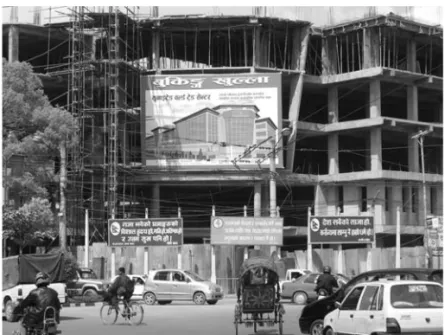
In short, this is a change of life style lead mainly by European or American culture distributing through movie, imported TV programs, satellite TV or internet. The wave of ‘IT’ industries are also rapid here in Nepal. Recently, business center building of new style are under construction everywhere throughout Kathmandu ( See business center on Map 1 and Photo 6). Air-conditioned floor with well equipped of electric lines are prepared for information and computer industries, media and social service enterprises. This is the leading sector of Nepalese service industry, and that will create new cultural trends of youth city life in Kathmandu.
<Photo 6> Business Center under Construction at Tripreswar Area 03/2006
4.Life Style of New Rich in Kathmandu and Perspective for Change
As discussed above, We can observe new city life or young culture in Kathmandu, now. The character of this culture is consumption. See Table 3 below. Residents in Kathmandu, many were migrated from rural Nepal, are relatively very richest in the country. And Table 4 indicates that consumption level is also higher, especially for ‘education’ sector and ‘others’, including luxury goods.
Table 3. Household Distribution by Class and Region
NEPAL Kathmandu Other cities C L A S S Lowest20% 20.0% 0.4% 7.4% Lower 20% 20.0% 1.2% 9.0% Middle 20% 20.0% 3.1% 13.7% Higher 20% 20.0% 10.0% 20.6% Highest20% 20.0% 85.3% 49.3%
Class: Divided by consumption level. Central Bureau of Statistics (2004) Nepal Living Standards Survey 2003/ 2004
Table 4. Average Income / Consumption / Unemployment by Region and Class
Per capita Income(NRs)
Consumption (%) Unemploy ment (%) Food Living Education Others
NEPAL 16,454 59.0 9.5 2.8 28.7 3.8
Kathmandu 45,928 28.8 24.2 7.4 39.7 10.8
Lowest 20% 6,657 73.0 5.8 1.3 19.9 4.0
Highest 20% 37,612 40.1 15.5 4.8 39.6 6.3
※Lowest 20% / Highest 20%: Household each divided by consumption level. Data: Central Bureau of Statistics (2004) Nepal Living Standards Survey 2003 / 2004
Under the liberalization policy of Nepal from 1990s, and also economic and social relation with global system, economic and social difference between highest and lowest class is expanding. Some negative influence are seen, the most severe one is the political struggle protested by the ‘Maoist’. Difference between rich and poor, urban (or capital city) and rural society, is of course one of most basic theme for development planning in countries like Nepal.
On the other hand, new economic power of Nepalese rich may provide chance for develop the domestic consumption market. Till 1990s, consumption market has limited and lead by foreign inhabitants. However, now consumption trend may be created by native Nepalese.
As mentioned in chapter 3-3), now the new life-culture is characterized as Europe-Americanized type. It may not distribute into rural area, where income and consumption level is far lower, imported goods are impossible to sell. However, for the rural residents, this new consumption culture in Kathmandu provides business chance for economic development. If this trend will be extended, it became rather easy for rural Nepalese to meet demand for the domestic market.
For example, JICA (including senior volunteer and JOCV)2) has promoted technical assistance for fruit production, mainly Japanese pear and persimmon. Nepalese native variety of these two fruits is far from juicy nor sweet, however, rural farmers have some experiences for cultivation. Japanese main technical assistance is, introduce variety of good taste, juicy and large kinds, and it was successful. As a result, market price of improved pears is about 140-160 NRs, on the other hand
who can buy such expensive fruits. However, in 2000s, ‘developed pear’ is sold in many department stores not for foreigner but for local Nepalese.
For the success, of course many other factors should be solved, however, this example shows that growing local market, especially lead by rich who in general don’t decrease eypenses even though domestic economic condition is not well, may help rural industries or some traditional economic activities to reform into developed style of product.
Developing countries like Nepal, imbalance between rural and urban, poor and rich is the severe problem. Solving the problem, marketing and technical support connecting different two ‘cultures’ is necessary, and economic and technical assistance for these field is expected.
Keywords:
Political liberalization, Economy depending upon Labor-migration, Growing market for Nepalese rich, Regional imbalance, Social imbalance
Thanks:
This paper is prepared on the base of one year stay for field study at Kathmandu from 03 / 2005 to 03 / 2006. I express thanks for Toyo University and concerning organizations supporting my study. I also express special thanks for those who give various information and hints in my field study, including fruit-project members of JICA and JOCV, concerning NGOs, agents of man-power recruiting interviewed in August 2005, and floor manager of G. and B. department store also for interview in Feb. and March, 2006.
Note:
1) In Kathmandu, there are some types of private transportation. ‘Public Bus’ service provided by the bus more than 30 passengers is managed by rather large transportation companies, or governmental sector. ‘Tempo’ service, very small vehicle for 10-12 person is provided by service cooperation. And another ‘Micro’ service provided van-type vehicle for 12-15 passengers are managed by the union organized with vehicle owners. ‘Micro’ service is easy for a person who want to join into the transportation service just like private taxi service.
2) JICA (Japan International Cooperation Agency) and JOCV (Japan Overseas Cooperation Volunteers) are agents providing technical and capital supports for Japanese governmental aids for developing countries.
References;
Central Bureau of Statistics, HMG of Nepal: Statistic Yearbook of Nepal (every year edition) Central Bureau of Statistics (2002) Population Census 2001 : National Report
Central Bureau of Statistics (2003) Population Census 2001 : Selected Urban Tables Central Bureau of Statistics (2004) Nepal Living Standards Survey 2003/ 2004 Ministry of Finance, HMG of Nepal: Economic Survey (every year edition)
【要旨】

![[書評] Praveen Jha ed., Progressive fiscal policy in India](data:image/gif;base64,R0lGODlhAQABAIAAAP///wAAACH5BAEAAAAALAAAAAABAAEAAAICRAEAOw==)