Implication from the UK Individual Labour
Dispute Resolution : A UK-Japan Comparative
Study
journal or
publication title
関西学院大学社会学部紀要
number
121
page range
29-43
year
2015-03-15
URL
http://hdl.handle.net/10236/13738
I. Introduction
Recently the number of collective labour disputes is declining, but individual labour disputes are increasing. This tendency is continuing. In these circumstances there are fewer individual labour dis-putes in Japan compared to other countries, including the UK. The number in Germany is about 600 thousand and that in France is about 160 thousand, but in Japan is only about 8 thousand a year.
In this article, I first argue the following four points regarding the manner in which individual la-bour disputes are conducted in the UK compared with Japan:
1. Differences between the role of tribunals in Japan and the role of administrative bodies in Ja-pan should be clarified.
2. Conciliations / Alternative Dispute Resolutions (ADR)/ are needed to become popular in Japan. 3. Mechanisms to promote conciliation are needed.
4. The norms at a workplace should be formed to be conciliated for the person concerned. II.Compared to the number of individual labour dispute resolutions in the UK 1. Situation of the UK and Japan
Firstly I will discuss the situation of individual labour dispute resolutions in Japan, compared to the UK; Advisory, Conciliation and Arbitration Service (ACAS).
Compared to the ratio of conciliations to consultations in the UK, the ratio in Japan is much lower. In 2013, there were inquiries to Prefectural Labour Offices 1,050,042 cases, of which concern-ing a law problem were 245,783 cases (Figure 1). And in the UK there were about 895,748 inquiries to ACAS, of which concerning a law were about 94,007. The number of conciliations of ACAS was about 54,000. On the other hand, in Japan the number of conciliations of Prefectural Labour Offices was only about 5,700.
In addition to these worse results of Japan, the ratio of discontinuity of conciliation of Prefectural Labour Offices in Japan was 55.4% (3,141 cases). That of ACAS was 32.2%. The resolution ratio of ACAS is significantly better.
In Japan the number of suits concerning individual labour disputes was 7,248 cases in 2009. In
Implication from the UK Individual Labour Dispute Resolution:
*A UK-Japan Comparative Study
Masaharu NOSE
**─────────────────────────────────────────────────────
*
Key words: conciliation, ADR, norm, Code of Practice, informal approach, individual labor
This article is an expansion of my article (2011): “The Issue of Individual Labour Dispute Resolution Systems in Japan: Comparisons with the UK”, which was written in Japanese.
**Professor, School of Sociology, Kwansei Gakuin University
the UK the number of conciliation cases in Employment Tribunal (ET) in 2013 was 53,946 including 17,375 cases which was the number of hearings in ET. The ratio of hearings after conciliation was 27.7% in the UK. 72.3% of all were resolved before hearings in the UK. Namely ACAS carries out a function instead of ET. It has carried out ADR (alternative dispute resolution) in the flow of an indi-vidual labour disputes resolution. ACAS designs itself its ADR function and conciliates the persons concerned.
2. ACAS’s feature
The reason why ACAS can carry out conciliation efficiently is due to four important features of ACAS’ service. (1) ACAS uses the code of practice flexibly. (2) Conciliation by ACAS is esteemed by ET. (3) ACAS’ conciliation is done according to a type of a labour dispute. (4) ADR is esteemed by ET.
Those practices back up ACAS’s conciliation and ACAS can carry it out efficiently. No law con-cerning individual labour disputes provids that the persons concerned should be conciliated by ACAS, however, ACAS has a duty to conciliate by law and in fact almost of all the persons concerned were conciliated.
In this kind of situation, the Enterprise and Regulatory Reform Act 2013 which provides that the persons concerned should be conciliated by ACAS came into force on April 2014. Tribunal claims as to individual labour dispute will not be accepted unless they are referred to ACAS.
In 2009 ACAS introduced the pre-claim conciliation system (PCC) in which ACAS could carry out a conciliation before a suit to ET by the party could be brought. This ACAS’ policy has devel-oped and has been backed up by the Enterprise and Regulatory Reform Act 2013. (But the policy in which ACAS tries to conciliate at an early stage of dispute should not go unheeded in Japan.)
Also, ACAS set an ET claim avoidance rate to look at the annual result of ADR. ET claims avoidance rate was 73.7% in 2009, 77.0% in 2012 and 82.6%1) in 2013 respectively. ACAS is carry-ing out its duty by conciliation in the scheme in which an individual labour dispute is resolved at an early stage. ACAS tries to avoid a hearing by ET through conciliating.
───────────────────────────────────────────────────── 1)HM Courts and Tribunals Service introduced fees at the end of July 2013.
Figure 1 The result of ACAS and Prefectural Labour Offices, 2013
ACAS Prefectural Labour Offices Consultation
Cases from ET
895,748 94,007*1
Consultation
Consultation as to civil affairs
1,050,042 245,783 Agreements by conciliation Withdrawal ET (Hearing) (Judgment by default) Sub Total 23,519 13,052 17,375 (14,930) (2,445) 53,946*2 43.6% 24.2% 32.2% (27.7%) 100.0% Agreements by conciliation Withdrawal Discontinuance Sub Total 2,225 307 3,141 5,673 39.2% 5.4% 55.4% 100.0% Rejection・Others 4,073 Others 15 Total 58,019*2 Total 5,688
*1. Net cases received for conciliation from the Employment Tribunal Service by all grounds of complaint. *2. Net ET1 conciliation cases.
(source) ACAS (2014) Annual Report and Accounts 2013/2014 and Ministry of Health, Labour and Welfare (2014)
Re-port of Individual Labour Disputeresolution 2013.
It is an excellent result for ACAS that in 2013 the ratio of resolutions (36,571) to all cases (94,007) was 38.9% compared to the ratio of resolutions by the Prefectural Labour Bureau in Japan (1.0%).2) Furthermore, it carries out its duty by ADR: Alternative Dispute Resolution as well as ADR: Amicable Dispute Resolution.
III. Regulation by Law and Code of Practice 1: Disciplinary and Grievance Procedures
ACAS issued three codes of practice. One of them is the Code of Practice 1: disciplinary and grievance procedures. ACAS can efficiently conciliate the persons concerned in an individual labour dispute. This code contributes to this efficiency. It is not a law but a guideline in a workplace, but it strongly affects judgments by ET. The norms of the workplace are based on it. This mechanism makes it possible to settle a dispute efficiently.
I mention this mechanism from viewpoints of a legal positioning and its change as follows.
1. The Code of Practice 1, Employment Act 2008 and workplace norms in an individual labour dispute resolution
The Code of Practice 1 outlines the basic principle of discipline, grievances and guidance to pro-mote good relations between employees and companies.
Functions of ACAS (Figure 2) are provided for by Chapter IV, “General: Functions of ACAS” of the Trade Union and Labour Relations (Consolidation) Act 1992, (TULRCA 1992). Sec.209 is “Gen-eral duty to promote improvement of industrial relations”, Sec.210 is “Conciliation”. Sec.211 is “Con-ciliation officers”, Sec.212 is “Arbitration”, and Sec.213 is “Advice”.
ACAS can issue code of practice according to sec.199. A procedure for issuing a Code is pro-vided for by Sec.200. Consequential revision of Code is propro-vided for by Sec.201. Revocation of Code is provided for by Sec.202.
───────────────────────────────────────────────────── 2)In 2010 the ratio of the resolutions to all cases was 31.1% (166,792 cases) compared to the ratio of resolution by the
Pre-fectural Labour Bureau in Japan (1.1%).
Figure 2 Trade Union and Labour Relations (Consolidation) Act 1992
(1) Functions of ACAS. CHAPTERⅣ.
Sec.209. (General duty to promote improvement of industrial relations) Sec.210. (Conciliation), Sec.211. (Conciliation officers),
Sec.212 (Arbitration), Sec.213 (Advice). (2) CODES OF PRACTICE
CHAPTERⅢ.
Codes of Practice issued by ACAS
Sec.199 (Issue of Codes of Practice by ACAS), Sec.200 (Procedure for issue of Code by ACAS), Sec.201 (Consequential revision of Code issued by ACAS), Sec.202 (Revocation of Code issued by ACAS).
(source) made by the author.
2. Features of the UK’s individual labour dispute resolution: Employment Act 2008 and Employ-ment Act 2002
Features of the UK’s individual labour dispute resolution after April 2009 include the deregula-tion of the procedure of workplace dispute resoluderegula-tion and the promoderegula-tion of informal resoluderegula-tion based on the norms of the workplace. The Code of Practice covers the norms of the workplace and the basic procedure for conciliation in the workplace.
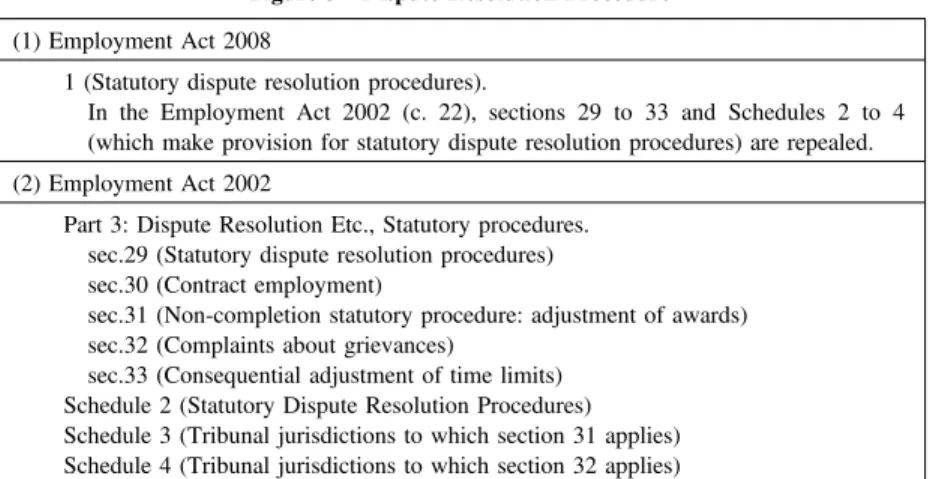
The procedures were considered very important factors both by the Employment Act 2002 and The Employment Act 2002 (Dispute Resolution) Regulations 2004 (Figure 3). But the UK came to think that complex procedures on which internal dispute resolution were based were inefficient in 2008. At present, the procedure of the code of practice which is not law promotes informal dispute resolution. Before the amendment, there were three procedures by which the persons concerned had to abide. These procedures were based on the Employment Act 2002 and the Employment Act 2002 (Dispute Resolution) Regulations 2004. Firstly, the employee had to make a complaint to a company or Manager. Secondly, the employer and employee had to have a meeting. Thirdly, if their disagree-ment was not resolved, the employee had to request and attend an appeal meeting which was not a mere informal conversation and not a mere adjustment. It was like a disciplinary hearing which was provided for in the Employment Relations Act 1999 (Employment Act 2002 Schedule 2 Part 4 s.14). These procedures made a conflict resolution difficult.
For example, a fixed term for conciliation by law made it difficult for the person concerned to re-solve a conflict efficiently. Also, the concerned, including ACAS, could not necessarily decrease days for conciliation. In fact there were comments of the concerned as follows: (1) Excessive procedures hindered conciliating, (2) An informal approach was needed to resolve conflicts, (3) The new rule was connected to ET procedures and internal resolving could not be done easily.
These three legal procedures mentioned previously hindered informal internal resolution, and pro-cedures of ET made it difficult to resolve informally a conflict at an early stage. The legal procedure interfered with ADR which resolved conflicts mutually and ACAS couldn’t easily help the persons concerned. In order to resolve a conflict it is necessary for the persons concerned to try to recognize the conflict contents, for example, what caused the conflicts, etc.
Figure 3 Dispute Resolution Procedure
(1) Employment Act 2008
1 (Statutory dispute resolution procedures).
In the Employment Act 2002 (c. 22), sections 29 to 33 and Schedules 2 to 4 (which make provision for statutory dispute resolution procedures) are repealed. (2) Employment Act 2002
Part 3: Dispute Resolution Etc., Statutory procedures. sec.29 (Statutory dispute resolution procedures) sec.30 (Contract employment)
sec.31 (Non-completion statutory procedure: adjustment of awards) sec.32 (Complaints about grievances)
sec.33 (Consequential adjustment of time limits) Schedule 2 (Statutory Dispute Resolution Procedures) Schedule 3 (Tribunal jurisdictions to which section 31 applies) Schedule 4 (Tribunal jurisdictions to which section 32 applies) (source) made by the author.
As the situation was worse than before after the Employment Act 2002 was enforced in 2004, the Employment Act 2002 was reconsidered3) and it was decided that the code of practice which had been enforced in 2004 should be revised.
Paragraphs were reduced from 116 to 45. The previous code’s paragraphs were revised funda-mentally. Informal resolution in the workplace become more important after this revision. We need to know that the norms as to individual labour dispute resolution in the workplace does not depend much on a law and the paragraphs were reduced.
The UK adopted a policy to give weight to informal resolution in the workplace. It took a policy not to regulate the persons concerned directly by a workplace dispute resolution procedure. It showed them how to take informal steps by code of practice in order to resolve individual labour dispute reso-lution.
We should note that, though the above-mentioned procedure (the code of practice) isn’t a law, ET reviews how the persons concerned try to resolve a dispute under the code of practice. And ACAS helps the persons concerned resolve a workplace conflict at an early stage4).
3. The code of practice as norm for resolving disputes
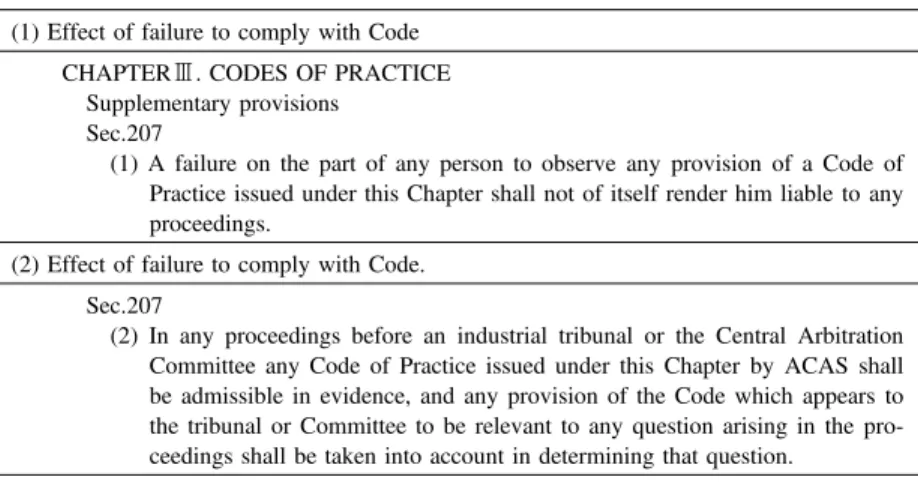
The code of practice doesn’t bind the persons concerned according to the preface of the code of practice and Sec. 207(1) of the Trade Union and Labour Relations (Consolidation) Act 1992 (Figure 4). The preface notes: “a failure to follow the Code does not, in itself, make a person or organization liable to proceedings”. However, the code of practice is not a mere guide but a norm which binds in-formally a person in their workplace.
The other important article we shouldn’t miss is Sec.207(2), which stipulates that in any proceed-ings before an industrial tribunal or the Central Arbitration Committee any Code of Practice issued un-der this Chapter by ACAS shall be admissable in evidence, and any provision of the Code which ap-pears to the tribunal or Committee to be relevant to any question arising in the proceedings shall be taken into account in determining that question (Figure 4).
───────────────────────────────────────────────────── 3)Employment Act 2008
4)Michael Gibbons proposed abolishing needless regulations. Michael Gibbons (2007).
Figure 4 Trade Union and Labour Relations (Consolidation) Act 1992
(1) Effect of failure to comply with Code CHAPTERⅢ. CODES OF PRACTICE
Supplementary provisions Sec.207
(1) A failure on the part of any person to observe any provision of a Code of Practice issued under this Chapter shall not of itself render him liable to any proceedings.
(2) Effect of failure to comply with Code. Sec.207
(2) In any proceedings before an industrial tribunal or the Central Arbitration Committee any Code of Practice issued under this Chapter by ACAS shall be admissible in evidence, and any provision of the Code which appears to the tribunal or Committee to be relevant to any question arising in the pro-ceedings shall be taken into account in determining that question.
(source) made by the author.
Namely, the ADR in the UK is promoted by the code of practice. The above-mentioned relation consists of the code of practice, judgment, laws and persons concerned. The chart as to their relations is “Chart 1. The relations concept: code, judgment, law and person concerned”.
4. Informal Dispute Resolution in a workplace
(1) In case of the UK
The Employment Act 2002 was revised and now the UK regards the new code of practice as im-portant. The new code of practice, which isn’t a law, was designed to promote informal resolution of disputes. Employment Act 2008, which was the revision of the Employment Act 2002, affects awards. I think this awards system is very important for ADR in a workplace (Figure 5).
As the above-mentioned three steps of the Employment Act 2002 and the Employment Act 2002 (Dispute Resolution) Regulations 2004 were abolished, the regulations don’t directly affect the persons concerned. But ET can still award in its consideration of a conflict situation of the workplace and can make an award raise of 0−25% according to the Employment Act 2008. And if a dismissal lacked re-quired legal conditions the dismissal was regarded as an unfair dismissal. Now this isn’t automatically done.
But ET can still award by a consideration of a conflict situation of the workplace. Namely, the code of practice sets with the norms which bind the persons concerned. It is not a law but an impor-tant rule as to an evidence ET considers in awards. Employees are not directly bound by it, but they are required to recognize the code of practice as the norms in their workplace (Chart 1). Though the
Chart 1 The Relations Concept; Code, Judgment, Law and the Persons Concerned
(source) made by the author.
Figure 5 Employment Act 2008
s.3. Non-compliance with statutory Codes of Practice (2) After section 207 there is inserted─
“207 A Effect of failure to comply with Code: adjustment of awards (2) If, in the case of proceedings to which this section applies, it appears to the employment tribunal that─
(a) the claim to which the proceedings relate concerns a matter to which a relevant Code of Practice applies, (b) the employer has failed to comply with that Code in relation to that matter, and
(c) that failure was unreasonable, the employment tribunal may, if it considers it just and equitable in all the circumstances to do so, increase any award it makes to the employee by no more than 25%.
(source) made by the author.
procedure is not a law, they feel strongly that they should obey the code of practice themselves. After the employment Act 2008, a talk together at a workplace is consistently regarded as important.
(1) In Japan
One of the reasons why there are few cases leading to law suits in Japan is due to a Japanese so-cial relations which are strongly based on collectivism. However, this culture is weaking. This trend changes the way of resolving conflicts in Japan. Recently in Japan this mechanism hasn’t worked well. Industrial relations in the UK are based on a collective laissez-faire. On the other hand, the num-ber of individual disputes is increasing. In this circumstance, to resolve individual disputes Employees need the norms in a workplace which are created and intended for the individual. The code of practice is the norms according to which the persons concerned informally resolve individual labour disputes in the workplace5).
Since Japan now faces similar issues to the UK, the Japanese system for resolving individual la-bour disputes needs mechanisms like the code of practice. A duty to strive to resolve a dispute is not legally binding in civil law. But a duty to strive is administratively important to make conditions of the workplace relations better. This mechanism in the UK shows in Chart 1. In the UK, the code of practice instead of Japanese collectivism has been developed and individual labour disputes are effi-ciently resolved.
The important role of this mechanism is carried out by the code of practice. The code of practice has the function of automatic adjustment between the persons concerned and an enterprise. In Japan the relations between employees and an enterprise in a workplace, which are collective relations, are changing rapidly and the relations are weaker than before as Japanese oriented relations are weaker.
Japanese policy to resolve an individual labour conflict is not a policy on which a law backs up the informal norms. But the Japanese way to resolve an individual labour conflict comes to be useless. It is very important for Japan, what is the way to resolve an individual labour conflict instead of the Japanese collectivism.
IV. Individual Labour Dispute Resolution: Investigation in Japan
In the UK an informal approach is thought of highly of as to resolving individual labour disputes. The Employment Act 2008 makes an informal approach possible. But is it an effective approach in Ja-pan?
1. Informal approach in Japan
I conducted the survey, “The situation of conflicts between an enterprise and individual and the way to resolve in 2007” (The survey 2007). I asked respondents whether the way to resolve in a workplace is a formal approach or an informal approach. Most answered “informal approach” (Chart 2).
A formal approach means a works council, a grievance committee and collective bargaining, etc. An informal approach means not using formal in-house methods but informal methods like communi-cation between a boss and a subordinate (Chart 2).
According to my 2007 survey, the ratio of employee respondents who prefer to resolve a conflict
───────────────────────────────────────────────────── 5)But the right of an attendance at a disciplinary with a colleague remains. (Employment Relations Act 1999s.10(1))
by informal ways is 56.6% and the ratio of respondents who resolve a conflict by formal ways is 20.8%. The ratio of “even” is 13.2%. According to my 2007 survey, the ratio of company respondents who preter to resolve a conflict by informal ways is 45.9% and the ratio of respondents who resolve a conflict by formal ways is 19.7%. The ratio of “even” is 27.9%.
The company respondents as well as the employee respondents think an informal approach is a good way to resolve workplace conflict. My 2008 Survey, which was conducted on researcher/engi-neers also similar results6). The result of this survey, which is similar to the UK, shows that an infor-mal way is useful for the persons concerned who are involved in individual labour disputes.
My survey about workplace conflict resolution, which was conducted in 2008 in the UK7) (Chart 3), also showed an informal way useful8). According to this survey, the ratio of respondents who were successful in conciliation and agreed an informal way would be useful is 94%.
The ratio of respondents who were not successful in conciliation and who agreed an informal way which would be useful is 96.7%. Regardless of conciliation’ result conciliation is thought highly of. On the other hand, all respondents are not favorable to “hearing in ET”9). An informal way is
con-───────────────────────────────────────────────────── 6)The percentage of “Resolving conflicts by almost all non-institutions” was 84.8%.
7)CIPD (Chartered Institute of Personnel and Development)
8)Pa L. Latreille (2008) Research Paper: Mediation at work: of success, failure and fragility, ACAS 9)A procedure of a compromise agreement is based on section 203 (3) of The Employment Rights Act 1996.
Chart 2 The way of Individual Labour Dispute: Institution or non-Institution
(source) by writer. Based on The Survey of Companies 2007 and The Survey of Employees 2007.
Chart 3 The Assessment of Conflicts Resolution Methods in the UK
(source) Based on Pa L. Latreille (2008) Research Paper: Mediation at work: of suc-cess, failure and fragility, ACAS.
sidered an important way to resolve a conflict in both the UK and Japan.
2. The nature of a conflict and in-house resolutions
Cases where a manager is suddenly sued by an employee are rare. Cases in which a manager hears complaints from an employee several times are usual. For example, many working hour lems start from an employee’s health problem or private matter problem. There are also many prob-lems which start from a manager’s leadership problem. At this early stage, there is not yet expression of grievances. But if the problem escalates, it develops to the stage of “employee’s expression of grievances and employer’s refusal to acknowledge the grievance”. Each way to address conflict is dif-ferent at each stage. Generally speaking, it becomes more difficult to resolve a conflict if it proceeds to a later stage. In particular the relations between an employee and an employer hardly continue10). Conflict resolution approaches depend on what stage the conflict belongs to.
Commonly, when an employee has a problem, he/she will first consult with his/her manager to resolve a problem informally. But if he/she cannot resolve it, whom can he/she consult with? When we look at the attitude of employees in the survey to companies in the case that a problem is not solved, employee attitude was divided into two categories.
The survey found five categories of conflict as follows: Case 1. conflict over performance pay system which is a change of pay systems from a seniority wage system to a performance wage system, Case 2. conflict over overtime works i.e. unpaid overtime, Case 3. conflict over bullying, Case 4. con-flict over restructuring and Case 5. concon-flict over research performance.
Persons whom an employee, having trouble, consuls with, include a third party, a college, a reli-able person, a trade union, a lawyer and labour office, etc. These persons are divided into two catego-ries. One is a trade union or an employee representative, the other is a colleague or a liable person.
According to this survey, as to a trade union or an employee representative, the ratio of Case 4: “a conflict of restructuring” is the largest number, 32.8% and subsequently, Case 1: “performance wage system”, 31.1%, Case 5: “research performance”, 26.2%, respectively.
On the other hand, as to a colleague or a liable person, the ratio of Case 3: “bullying” is the larg-est number, 31.1% and subsequently Case 2: “overtime work” is the larglarg-est number, 27.9%.
Who does an employee consult with depends on the nature of the conflict. As to bullying, we should pay attention to the large number of third parties which are consulted.
I tested the relations between “each of a third party, a college, a reliable person, a trade union, a lawyer and labour office” and the each case as mentioned before by Fisher’s exact test (Chart 4). As a result, I found employee attitude was divided into two categories. One category of counsellor is a trade union or an employee representative, the other is a colleague or a liable person.
Namely, the contents of one category is bullying and the others are a performance wage system, a restructuring and research performance. An employee of the former category relies on a third party: a colleague or a reliable person, etc. An employee of the latter relies on a trade union, a lawyer or la-bour office, etc.
In the case of overtime work an employee expects both over “a third party, a colleague or a reli-able person” and “a trade union, a lawyer and labour office”. In this survey I found that a non-institutional approach is a suitable way to resolve conflicts over bullying. On the other hand, an
insti-───────────────────────────────────────────────────── 10)This idea is shared by the ACAS way.
tutional approach is suitable way to resolve a conflict over performance wage system, restructuring and research performance. One of the reasons is that these conflicts are problems as to an agreement between an employee and an employer, and another reason is due to a company regulation.
A conflict of overtime work in the beginning is based on an informal matter, but when the con-flict develops, the concon-flict changes into a formal (legal) matter. This means the way to resolve such a conflict changes from an informal way to a formal way11). The result of this survey is similar to the result12)
of the survey 2008 in the UK which analyzed relations between ways to resolve a conflict. How to resolve a conflict depends on which stage the conflict belongs to. In this survey, conflicts cov-ered in the questionnaire are discrimination, bullying, improving relations between an employee and an employer, wage, labour conditions and dismissal, etc. As to improving employment relations, the percentage of conciliation supported is about 85%, as to bullying, about 75%, as to discrimination about 45%, respectively. Generally speaking, conciliation is appreciated as an informal way to resolve a conflict.
On the other hand, as to dismissal, the percentage of conciliation supported is about 35%, as to wage, about 25%, as to labour conditions, about 25%, respectively. As to these conflicts, conciliation is not appreciated. These conflicts are based on an institutional matter.
Regardless of the UK and Japan, the way to resolve a conflict depends on a nature of conflict and a situation. An informal way is suited to an informal matter such bullying.
V. The stages of conflicts and resolutions 1. The nature and the stage of conflicts
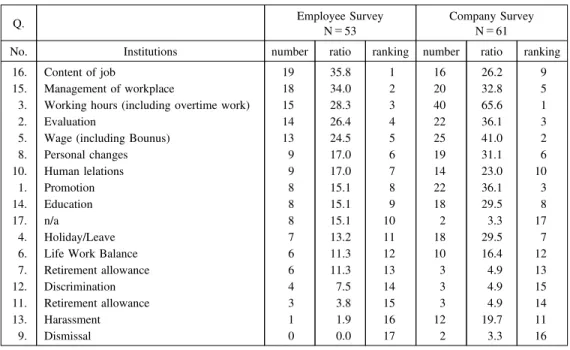
When I saw the situation of conflicts in a workplace, there were many conflicts suited informal resolution. According to the employee survey which enquired what grievances employees had (Figure 6), many grievances were “the job contents”, “workplace management” and “working hours (including overtime work), respectively 35.8%, 34.0%, 28.3%.
According to the company survey which enquired what grievances a company had, many griv-ances were “working hours (including overtime work)”, “wage (including bonus)”, “promotion” and
───────────────────────────────────────────────────── 11)The result of the employee survey showed that an informal way, for example, in case of a resolving a conflict of a bully-ing, was generally expected to be done by a colleague and a reliable person. But an formal way, for example, in case of a resolving a conflict of restructuring, was generally expected to be done by a trade union and an employee representa-tive.
12)ibid 8.
Chart 4 Comparison with Each Situation of Adviser by Case
Conflict Case 2. overworking 3. bullying 4. restructuring 5. Grievance of researcher. 1. Grievance about achievement pay system. .261 .004** .206 .530 2. Grievance about overworking. − .088 .324 .320 3. Grievance about bullying. − − .011* .039* 4. Grievance about restructuring. − − − .912 (note 1) *=p<.05, **=p<.01,
(note 2) Fisher’s exact test by SPSSver 18.
“evaluation”, respectively 65.6%, 41.0%, 36.1%, 36.1%. On the other hand, “dismissal” was rare (3.3%). The lager ratio is internal conflicts and the ratio of conflicts over rights is smaller.
Both employees and companies were interested strongly in the grievances of “working time”. But employees were more strongly interested in the grievances of “job contents” and “workplace manage-ment”. These differences are caused by which stage a conflict is. StageⅠ is “knowing an infringe-ment” (Figure 7). StageⅡ is “knowing a specified infringeinfringe-ment”. StageⅢ is “expression of griev-ance”. The large number of grievances reported by employee respondents were at stageⅠ・Ⅱ. But companies don’t know grievances unless grievances are at stageⅢ. A dispute at tribunal is at stageⅣ.
ACAS comes to try to conciliate at the early stages, I mentioned before. The pre-claim concili-ation (PCC) is such an example, as ACAS conciliate at the early stage which is stageⅠorⅡ. This ACAS policy as to PCC has developed and PCC is called “Early Conciliation” as of April 2014.
Figure 6 Grievances (the past one year, as of July 2007) (M.A)
Q. Employee Survey
N=53
Company Survey N=61
No. Institutions number ratio ranking number ratio ranking 16. Content of job 19 35.8 1 16 26.2 9 15. Management of workplace 18 34.0 2 20 32.8 5 3. Working hours (including overtime work) 15 28.3 3 40 65.6 1
2. Evaluation 14 26.4 4 22 36.1 3
5. Wage (including Bounus) 13 24.5 5 25 41.0 2 8. Personal changes 9 17.0 6 19 31.1 6 10. Human lelations 9 17.0 7 14 23.0 10 1. Promotion 8 15.1 8 22 36.1 3 14. Education 8 15.1 9 18 29.5 8 17. n/a 8 15.1 10 2 3.3 17 4. Holiday/Leave 7 13.2 11 18 29.5 7 6. Life Work Balance 6 11.3 12 10 16.4 12 7. Retirement allowance 6 11.3 13 3 4.9 13 12. Discrimination 4 7.5 14 3 4.9 15 11. Retirement allowance 3 3.8 15 3 4.9 14 13. Harassment 1 1.9 16 12 19.7 11
9. Dismissal 0 0.0 17 2 3.3 16
Note: the numbers with period are a choice number of the questionnaire.
(source) by the author. Based on The Survey of Companies 2007 and The Survey of Employees 2007.
Figure 7 Stages of Conflict and Adjustment
stage Ⅰ. Recognition Ⅱ. Specification Ⅲ. Expression Ⅳ. Outbreak a dispute conflicts knowing of infringements specifying a cause expression of grievances refusal of a grievance
stage Stage.Ⅰ Stage.Ⅱ Stage.Ⅲ Stage.Ⅳ adjustments internal mainly
internal
half in internal and half in extermal
mainly external (source) made by the author.
VI. Conclusion
Employment relations are continuous relations between an employee and a company. This is the reason why ADR is needed in resolving a conflict. In this paper I discussed individual labour dispute resolutions. It is necessary for Japan to establish a system to resolve effectively individual labour dis-putes by the three points as follows.
1. The differences between the role of the judicial system and the role of administrative bodies such as Prefectural Labor Bureau, Prefectural Labour, Office and Labour Relations Commission, etc. should be clarified. Japanese administrative bodies should positively conciliate with the person concerned.
2. A Japanese workplace needs the norms according to which the person concerned is effectively conciliated. The relation between an employee and a company has changed. The collective norms are not as strong as before. Norms instead of collective labour dispute resolution rule are needed, e.g. modeled on the code of practices in the UK.
3. The norms which are not a law but a guidance to promote conciliation are needed in a workplace. It is important to resolve individual labour disputes informally.
There are as many individual labour disputes submitted to the Prefectural Labor Bureau in Japan as in the UK. But there are very few conciliations in Japan. Informal resolutions are needed in Japan like in the UK.
The Prefectural Labor Bureau in Japan should back up persons concerned with conciliations. In order to resolve a workplace conflict, a law should not directly regulate an employee conduct, but a law should mold the norms in a workplace to promote conciliation.
References
ACAS (2003) Code of Practice 1: Disciplinary and Grievance Procedures. ─── (2009) Code of Practice 1: Disciplinary and Grievance Procedures. ─── (2010) Annual Report and Accounts 2009/2010.
─── (2014) Annual Report and Accounts 2013/2014. ─── (2010) Time off for trade union duties and activities. ─── (2010) Discipline and Grievances at Work: The Acas Guide.
─── (2010) Research Paper: Report of the Employment Tribunal/Acas pilot on attendance of Acas individual
conciliators at Case Management Discussion.
─── (2010) Research Paper: Service user perceptions of Acas’ conciliation in Employment Tribunal cases
2007.
─── (2013) Settlement Agreements (under section 111 A of the Employment Rights Act 1996) ─── (2014) Handling in a reasonable manner requests to work flexibly.
Cunningham, Naomi. and Michael Reed (2010) Employment Tribunal Claims, LAG Education and Service Trust Limited.
Gibbons, Michael. (2007) Better Dispute Resolution: A review of employment dispute resolution in Great Britain, Department of Trade and Industry.
Latreille, Paul L. (2010) Research Paper Mediation at work: of success, failure and fragility, ACAS.
Mitchell, Derek.and Wendy Mitchell (2010) Research Paper: An evaluation of the Acas in-depth advisory service, ACAS.
Nose, Masaharu. (2009) “The Reform of Researchers/Engineers’ Employment System: From the Perspectives of Legislation and Motives”, International Public Policy Studies, Vol.14 No.1 (No.25), Osaka University. Peters, Mark., Ken Seeds, Carrie Harding, Erica Garnett (2010) Findings from the Survey of Employment Tribunal
Applications 2008, Employment Relations Research Series No.107, Department for Business, Innovation and
Skills.
Silver, Isidore. (1967) “The Corporate Ombudsman” Harvard Business Review.
Takasi Araki (2004) “The function of in a legislation of a labour Law”, Soft Law Discussion paper Series, COE-SOFTLAW−2004−11, Tokyo Univrsity.
Kenji Arita (2009) “The Change of Employment Relations and The theory of the UK Labour Law. The New
De-velopment of the UK Labour Law, Seibunndo.
Takasi Shimoi (2008) “The resolution of Individual Labour Disputes: From the viewpoints of my experience of a coordination committee.
Shinobu Naito (2009) “A Study of Practice: The Function of Promoting Autonomous Action”, JIL Discussion
Pa-per 09−05.
Masaharu Nose (1998) “The New System of Individual Labour Dispute Resolution: Implication from the UK and the US” Japan Research Review Vol.8, No.6, Japan Research Institute.
─── (2002) “Enterprise in The NEW Era, Individual and Society: The Function ought to be built in” The
re-port Gakusikai, No.835.
─── (2006) Theory of Individual Employment Relations in the New Era: New Adjustment between Society,
En-terprise and Individual, second edition, Koyoshobou.
─── (2011) “The Issue of Individual Labour Dispute Resolution Systems in Japan: Comparisons with the UK”
The Japanese Journal of Labour Studies: Background and Resolution System of Individual Labor, No/613,
the Japan Institute for Labour Policy and Training.
Ryuich Yamakawa (2007) The report of Labour policy Study No.86: Middle Report of Research on the system of
in-house conflicts, resolution.
Kazuhiko Yamamoto, Aya Yamada (2009) ADR Arbitration Law, Nihon Hyouronsha. Annexed Table
Ⅰ. (The company survey) The investigation of the situation of labour conflicts between a company and an in-dividual and the way to resolve, 2007.
1. The subject of the investigation; 700 listed companies selected by random sampling at Feb. 2007. 2. A method of investigation; a mail survey.
3. The contents of survey. (1) profile
(2) a situation of HHM 1 ) a situation of revised institution 2 ) a situation of communication 3 ) a treat-ment of researcher and planner
(3) a situation of grievances 1 ) a tendency of grievances 2 ) a liaison of grievances 3 ) a situation of re-solving
(4) a way to resolve 1 ) categories to resolve 2 ) a way to resolve by a category 3 ) a way to resolve in the future
(5) an external adjustment system 4. Implementation Date; 01 July 2007.
5. Response rate: 8.7% (responded companies: 61)
Ⅱ. (The employee survey) The investigation of the situation of labour conflicts between a company and an in-dividual and the way to resolve, 2007.
1. The subject of the investigation; employees in the 700 listed companies of the company survey. 2. A method of investigation; a mail survey.
3. The contents of survey. (1) profile,
(2) a situation of HHM 1 ) a situation of revised institution 2 ) a situation of communication 3 ) a treat-ment of researcher and planner
(3) a situation of grievances 1 ) a tendency of grievances 2 ) a liaison of grievances 3 ) a situation of re-solving
(4) a way to resolve 1 ) categories to resolve 2 ) a way to resolve by a category 3 ) a way to resolve in the future
(5) an external adjustment system 4. Implementation Date; 01 July 2007.
5. Response rate: 7.6% (responded employees: 53)
Implication from the UK Individual Labour Dispute Resolution:
A UK-Japan Comparative StudyABSTRACT
Recently the number of collective labour disputes is declining, but individual la-bour disputes are increasing. Nevertheless, there are fewer individual lala-bour disputes in Japan compared to other countries, including the UK.
In this article, I first discuss the following four points regarding the manner in which individual labour disputes are conducted in the UK compared with Japan: 1. dif-ferences between the role of tribunal and an administrative bodies in Japan, 2. use of conciliation, 3. mechanisms of conciliation and 4. workplace norms.
After discussing these, I point out 1. Japanese administrative bodies should posi-tively conciliate with the person concerned, 2. Japanese workplaces need norms where the person concerned is effectively conciliated and, 3. norms which are not laws, but guidance to promote conciliation, are needed at the stage where conflicts form in the workplace.
Prefectural Labour Bureaus in Japan should support persons concerned with con-ciliations, and laws promoting conciliation should be procedures that create the norms in a workplace.
Key Words: conciliation, ADR, norm, Code of Practice, informal approach, individual
labour