計算複雑度から見たディジタルハーフトーニング
Computational Complexityof
Digital Halftoning浅野哲夫1 徳山豪2 松井知己3
Tetsuo Asano Takeshi Tokuyama Tomomi Matsui
1 北陸先端科学技術大学院大学情報科学研究科〒 923-1292石川県能美郡前出町旭台
$\mathrm{t}$-asano@jaist.$\mathrm{a}\mathrm{c}$.jp
2 東北大学大学院情報科学研究科〒 980-0812 仙台市青葉区片平 2-1-1
[email protected].$\mathrm{j}\mathrm{p}$
3東京大学大学院工学研究科計数工学専攻〒 113-8656東京都文京区本郷7-3-1
tomomi@misojiro.$\mathrm{t}.\mathrm{u}$-tokyo.$\mathrm{a}\mathrm{c}$
.
jpABSTRACT: Digital Halftoning is
a
technique to convert a gray image into a binaryimage. This paper discusses the computational complexity of the problem of obtaining
a binary image which is optimal in the sense that it looks most similar to the input
gray image. It is shown that it is $\mathrm{N}\mathrm{P}$-complete. computational complexity of the
one-dimensional version of the problem is also discussed.
Keywords: digital halftoning, $\mathrm{N}\mathrm{P}$-complete, Planar satisfibility
1
Introduction
One of the most fundamental techniques in image processing is digital halftoning. Mathematically, the input of the digital halftoning problem is atwo-dimensional $N\cross N$ array $A=(u_{j},)$ $1\leq i,j\leq N$
of real numbers satisfying$0\leq a_{i,j}\leq 1$, and its output is a binary $N\cross N$ array $B=(b_{i,j})$ (i.e. $b_{i,j}=0$
or 1) “approximating” $A$
.
The value $a_{i,j}$ corresponds to the brightness level (gray level) ofthe $(i,j)$pixel of the pixel grid. The intention ofthis method is to convert a given image which consists of
several bits for brightness levels into a binary image having only black and white pixels. This kind
of technique is indispensable when dealing with images which have to be printed on output devices
producing black dots only, such as facsimiles and laser printers.
Up to now, a large number of methods and algorithms for digital halftoning have been proposed
(see, e.g., [7, 4, 2, 8, 9]). A comprehensive summary of the results obtained in the literature can be
found in the Ph. D. Thesis by Ulichney [10]. However, there have been very few studies discussing
reasonable criteria for evaluating the quality of output images; maybe because the problem itself is
very practical. Actually, the most
common
criterionof almost all existing studiesondigital halftoningis to judge the quality of the output picture by human eyes. It is desirable to establish
a
goodevaluation system of halftoning methods (instead of the ($‘ \mathrm{h}\mathrm{u}\mathrm{m}\mathrm{a}\mathrm{n}$ eye’s judgement”), and to handle
the digital halftoning problem fully mathematically. Unfortunately, to the authors’ knowledge, no
concrete mathematical criterion is considered in the literature.
Theaimof this paper istoproposesuch
a
fullymathematical framework. Investigating the digitalhalftoning problem as a combinatorial optimization problem,
we
give a mathematical criterion of“goodness” of the approximation of the array $A$ with $B$, and discuss the complexity of the problem
for some fundamental cases.
Let$A$be aset ofmatriceswhoseentries arereal values in $[0,1]$, and let$B$ beitssubsetset consisting
ofall binary matrices. In the information theory,
a
natural way to approximatean
element $A$ of $A$respect to the distance. We adopt this idea, and define the distance by using the differnce of the
entries of two image matricesinaneighborhood surrounding eachpixel (usingasuitable neighborhood
family). In the formulation, given the output $B$, it is easy to compute the distance from the input $A$
.
However, ifwe want to compute the output minimizing the distance, we encounter
a
combinatorialoptimization problem, and it is shown that the complexity of the problem depends on the choice of
the neighborhood family.
Althoughtheproblemitselfis defined in the two-dimensional plane, it is possibleto define its
one-dimensional version in which
a
sequence of real numbersis given. Thisproblem itselfis an interesting combinatorialproblem, andwe
show that itcan
be solved in polynomialtime byusing negative cycledetection algorithms (Section 3). However, if the neighborhood family is essentially two-dimensional,
it is difficult to design a polynomial-time algorithm. Indeed,
even
if each neighborhood is a $2\cross 2$square, we
can
show that the problemis NP hard (Section 4).This implies that it is essentiallynecessary toconsiderapproximation $\mathrm{a}\mathrm{n}\mathrm{d}/\mathrm{o}\mathrm{r}$heuristicalgoirthms.
Even for the two-dimensional problem, if each neighborhoodis one-dimensional along a space-filling
curve, we can apply the algorithms for the one-dimensional
case.
Theuse
ofspace-filling $\mathrm{c}\mathrm{u}\mathrm{I}^{\cdot}\mathrm{v}\mathrm{e}\mathrm{S}$ ispopularin imageprocessing, andwethink this method (althoughit is merely a heuristicmethod since
neighborhood should be truely two-dimensional inpractice) is probably useful ifwe cangenerate
space-filling
curves
in somewhat random$\mathrm{m}\mathrm{a}\mathrm{n}\mathrm{n}\mathrm{e}\mathrm{r}[1]$.
We evaluatesomepopular error-propagating algorithmsin digital halftoning inouroptimizationcriterion. We have not yet succeeded to outperform the
error-propagating algorithms, and therefore, the design of theoretically better algoirthm is posed as
an
important open problem.
2
A
Mathematical Formulation of
Digital
Halftoning
Themain task of this section is to define the digital halftoningproblemas a combinatorialoptimization
problem by defining
a
reasonable concrete mathematical criterion. Aswe
definedin the introduction,let $A=(a_{ij})_{i,j1}=,\ldots,N,$ $0\leq a_{ij}\leq 1$, be a matrix representing an image in the grid array $G$ of size
$N\cross N$
.
Imagine that we look at some pixel $(i,j)$ of the gray-level image $A$
.
What happens is, weactu-ally perceive an average ofgray levels of
some
(small) neighborhood ofthat point. Using the sameobservation, the intensity around the pixel $(i,j)$ ofa binary image is proportional to the number of
black points in the corresponding neighborhood. Therefore, density values should be roughly equal
around any pixel between
an
output binary image of the digital halftoning and the input image $A$.
The observation motivates us to give the following mathematicalformulation:
For any region $R$ in the grid array $G$ (regarded as an $N\cross N$ rectangle subdividedinto $N^{2}$ pixels
each of whichcorresponds to
an
arrayentry), we consideran error
function $E^{R}(A, A’)$ describingthedifference between two pictures$A$and$A’$ within the region$R$
.
A typicalerrorfunction is thedifference
of
average density $|A(R)-A’(R)|/|R|$, where $A(R)$ is thesum
ofentries of$A$ located in$R$, and $|R|$ isthe numberofpixels in $|R|$
.
.. A family $\mathcal{F}$ ofregions in $G$ is called
a
neighborhood family if there exists
a
map $\phi$ from $G$ to $\mathcal{F}$such that the region $\phi(p)\in \mathcal{F}$contains the pixel
$P$ for each pixel$p\in G$
.
We call$\phi(p)$ the neighborhoodof$p$
.
The map $\phi$ need not be surjective nor injective. Note that this isa
quite weaker definitionthan
the neighborhood system in usual geometry. Fora neighborhood family$\mathcal{F}$,
we
define the$L_{\infty}$ distance
$Dist^{\mathcal{F}}( \infty A, A’)=\max E^{R\prime}R\in \mathcal{F}(A, A)$
between the images $A$and $A’$ withrespect to $\mathcal{F}$ and
the error function $E$
.
This distance is also calledthe maximum
error
between$A$and $A’$ (with respect to $\mathcal{F}$). We only consider the$L_{\infty}$ distance in this
paper for technical reason, although the $L_{p}$ distance defined by $( \sum_{R\in \mathcal{F}}(E^{R}(A, A’))\mathrm{P})^{1/p}$ might be a
We mainly consider the following family $\mathcal{W}$ consisting of (axis parallel) rectangular regions ofa
fixed shape $l\cross k$
.
Foran
$l\cross k$ rectangularregion $W$ in $G$, its center is the pixel$p(W)$on
the $\lceil l/2\rceilarrow \mathrm{t}\mathrm{h}$ row and $\lceil k/2\rceil$-th column counted from the north-westcorner
of$W$.
Note that$p(W)$ has the centerofgravity of$W$ in the closure of the pixel. We denote $W$ as $W(i,j)$ if$p(W)=(i,j)$
.
Thisdefines theneighborhoods for the pixels (called central pixels) $(i,j)$ satisfying $\lceil l/2\rceil\leq i\leq N-\lceil(l-1)/2\rceil$ and
$\lceil k/2\rceil\leq j\leq N-\lceil(k-1)/2\rceil$
.
For each of other pixels (called near-boundary pixels), we define itsneighborhood
as
the neighborhood of its nearest central pixelwith
respect to the Euclidean metric.This correspondence makes $\mathcal{W}$ to be
a
neighborhood familyConsider an input images $A$ and its output binary image $B$ in the digital halftoning. If the
difference between the average gray levelnear each pixel image is small, the picture $B$ is expected to
look very similar to the original picture $A$; at least $B$ is a very good approximation of $A$ (without
further knowledge of the contents of the image). Let us consider our neighborhood system. The
number $|W(i,j)|$ ofpixels in aneighborhood is independent of the choice of $(i,j)$
.
With that, insteadof the difference ofaverage density, it is natural to use
$E^{W(i,j)}(A, B)=|A(W(i,j))-B(W(i,j))|$
.
to evaluate the visual difference near $(i,j)$ between $A$and$B$, where$A(W(i,j))$ is the sumof elements
of$A$ within $W(i,j)$
.
Note that wedo not claim thatourchoice of the neighborhood family and theerror function is the
best for evaluating practical digital images: A broader neighborhood family is probably better, and
the
error
function can be generalized in various ways adapting to real applications, e.g., by assigninglarger weights to the pixels nearer to the center $(i,j)$ in the neighborhood to take the summation;
however, we consider the above simple model to investigate the complexity of its optimization. We
discuss somebroader choice of the neighborhood family in Section 3.2.
Ourgoal istobring the localerror $E^{W(i,j)}(A, B)$ closeto $0$ for any pixel $(i,j)$; That is, to minimize
the $L_{\infty}$ distance $Dist_{\infty}^{\mathcal{W}}(A, B)$
.
Hence, we have the following formulation of the digital halftoningproblem:
Design a method to compute a binary image $B$ such that $Dist_{\infty}\mathcal{W}(A, B)$ is as small as
possible for aninput image $A$
.
Forsimplicity, wewrite Dist$(A, B)$ for$Dist_{\infty}^{w}(A, B)$ unlesswewant toemphasis theneighborhood
system $\mathcal{W}$,
error
function, $\mathrm{a}\mathrm{n}\mathrm{d}/\mathrm{o}\mathrm{r}$ the $L_{\infty}$measure.
In particular, the binary image $B$ minimizingDist$(A, B)$ is called the optimized digital approximating of$A$ (withrespect tothe neighborhood family
$\mathcal{W})$
.
We investigate the time complexity of computing the optimized digital approximation.3
One
dimensional
problem
If $l=1$, each member in $\mathcal{W}$ is a horizontal strip of length $k$, and the problem can be solved on
each row independently. Therefore, wefirst consider the one-dimensional version of the problem. Let
$a=(a_{1}, a_{2}, \ldots, a_{n})$ be a rational vector such that $0\leq a_{j}\leq 1$ for all $j\in\{1,2, \ldots,n\}$ and $k$ be an
integer with $1\leq k\leq n$. We consider the neighborhood family $\mathcal{I}_{k}$ consistingofintervals of length $k$.
If $k$ is a constant, it is relatively easy to design a linear time algorithm with respect to $n$ by using
dynamic programming (in precise, $O(2^{k}n)$ time using $O(2^{k}+n)$ space) to compute the optimized
digital approximation $b$ (we omit it in thisversion). However, it is nontrivialto design an algorithm
which is polynomialon both$n$ and $k$
.
3.1
Polynomial
time
algorithmsThe one-dimensional optimized digital approximation of $a$ is the binary vector $b=(b_{1}, b_{2}, \ldots, b_{n})$
distance between $a$ and $b$ in our
measure:
minimize $z$
subject to $-z \leq\sum_{j=}^{i+k}i(a_{j}-b_{j})\leq z$ $(\forall i\in\{1,2, \ldots, n-k\})$, (1)
$b_{j}\in\{0,1\}(\forall j\in\{1,2, \ldots, n\})$
.
Since the variables $b_{1},$
.
$.,$ $,$
$b_{n}$ are 0-1 valued, we can replace the inequality
constraints (2) by
$\lfloor_{Z+}\sum_{j=}^{ik}+aij\rfloor\geq\sum_{j=}^{i+k}ib_{j}\geq\max\{\mathrm{r}_{-}Z+\sum^{ik}j^{+}=iaj\rceil, \mathrm{o}\}$ $(\forall i\in\{1,2, \ldots,n-k\})$
.
We introduce the variables $x_{0},$$\ldots,$$x_{n}$ satisfying$x_{i}-x_{0}=b_{1}+\cdots+b_{i}$ for $i\in\{1,2, . .’ , n\}$
.
Then theabove problem is transformed to the following problem
minimize $z$
subject to $x_{i+k}-xi-1 \leq\lfloor z+\sum_{j=i}^{i+k}a_{j}\rfloor$ $(\forall i\in\{1,2, \ldots, n-k\})$, (2)
$x_{i-1}-X_{i}+k \leq-\max\{\lceil-Z+\sum ij=iaj1+k,\}0$ $(\forall i\in\{1,2, \ldots, n-k\})$, (3)
$x_{j}-x_{j-}1\leq 1(\forall j\in\{1,2, \ldots,n\})$, (4)
$x_{j-1}-xj\leq.0(\forall j\in\{1,2, \ldots, n\})$, (5)
$x_{j}$ is an integer $(\forall j\in\{0,1,2, \ldots , n\})$
.
Let us considerthe problemfor checking the existence of the vector $(x_{0}, x_{1}, \ldots, X_{n})$ satisfying the
above constraints when the value $z$ is fixed. We show that the problem is transformed to
a
negativecycle detectionproblem. The method to find theoptimal value of$z$isdiscussedlater. Let $H=(N, E)$
be
a
directedgraph withavertexset $N=\{0,1,2, \ldots , n\}$and anarc
set $E=E_{1}\cup E_{2}\cup E_{3}\cup E_{4}$ where $E_{1}$ $=$ $\{(0, k+1), (1, k+2), \ldots, (n-k-1, n)\}$,$E_{2}$ $=$ $\{(k+1,0), (k+2,1), \ldots, (n, n-k-1)\}$,
$E_{3}$ $=$ $\{(\mathrm{o}, 1), (1,2), ..*’(n-1, n)\}$,
$E_{4}$ $=$ $\{(1,0), (2,1), \ldots, (n,n-1)\}$
.
The
arc
weight $w_{ij}$ ofan arc
$(i,j)\in E$ is defined by$w_{ij}=\{$
$\lfloor z+\sum_{ji}^{i+}=ka_{j}\rfloor$ (if$(i,j)\in E_{1}$),
$- \max\{\mathrm{r}_{-Z}+\sum^{i}j=ij\rceil+k_{a}, \mathrm{o}\}$ (if$(i,j)\in E2$),
1 (if$(i,j)\in E_{3}$),
$0$ (if$(i,j)\in E_{4}$),
where the variable $z$ is fixed. The arc sets $E_{1},$ $E_{2},$ $E_{3},$$E_{4}$ correspond to the constraints (2), (3), (4),
(5), respectively. Note that the graph has $O(n)$ arcs.
A negative cycle is
an
elementary directed cycle $C$satisfying that thesum
totalofthearc
weightsin $C$ is negative. The detection of
a
negative cycle in $H$can
be done in$O(n^{1.5}\log(n\Gamma))$ time by using
Gabow-Tarjan’s scaling algorithm, where $\Gamma$ is themaximum
weight, and hence $\log(n\Gamma)=O(\log n)$ in
our
graph.If thereexists
a
negative cycle, then the inequality system (2), (3), (4), (5) is infeasible. Indeed, let$C=$ ($(i0,$il),$(i_{1},$ $i_{2}),$
$\ldots,$$(i_{p-1},i)p’(i_{P},i_{0})$) bea negative cycle, i.e., $\sum_{(i,j)c^{w}j}\in i<0$
.
Then by addingthe inequalities corresponding $C$we have the following inequalities
$0=(x_{i}0-x_{i})1+(X_{i_{1}}-X_{i_{2}})+.. \cdots+(X_{i_{\mathrm{p}}x}-i\mathrm{o})\leq(u,v)\sum_{M’\in}w_{uv}<0$
On the other hand, if the graphcontains no negativecycle, we
can
findan
integer vector $(x_{0}, \ldots , x_{n})$which satisfies the inequalities (2), (3), (4), (5) as follows: If
a
strongly connected graph does not have any negative cycle, for any pair ofvertices $(i,j)$, the shortest path length from $i$ to $j$ is well defined.Here we denote the length of the shortest path from the vertex $i$ to $n$ by $x_{i}^{*}$. Then the optimality
principle implies that the solutionsatisfies the inequalities (2), (3), (4), (5). Sincethe arc weights are
integer valued, the shortest path length $x_{i}^{*}$ is also integer valued for each vertex $i$
.
The path lengths$x_{i}^{*}(i=1,2, \ldots, n-1)$
can
be also computed by using Gabow-Tarjan’s algorithm.Now,
we
discuss the method to find the optimal value of $z$ (i.e., smallest $z$ causingno
negativecycle). We employ the ordinary binary search technique. Each edge weight is represented by a step
function with$\mathrm{r}\mathrm{e}$,spectto $z$
.
Thus, weonly need toconsider the break points of the step functions. Ifwedefine $q(s,i)=s+0.5+ \sum_{j=i}^{i+k}a_{j}$ for integers $s$ and $i$, the set $Q=\{q(s, i)|1\leq i\leq n-k, -k\leq s\leq k\}$
contains all the break points. By applyingbinary search technique (with some care), we
can
find theoptimal value of $z$ by executing the above negative cycle detecting algorithm $\mathrm{O}(\log nk)=\mathrm{O}(1o\mathrm{g}n)$
times with additional $O(n\log n)$ time for each search process. Thus we canfind the optimal value of
$z$ in $\mathrm{O}(n^{1.5}\log n)2$ time in total.
Hence, we have the following theorem:
Theorem 3.1 The one-dimensional optimized digital approximation can be computed in$O(n^{1.5}\log n)2$
time. The space requirement is $O(n)$.
If$k$ is small (say, smaller than $n^{1/4}$), we canobtain a faster algorithm.
Theorem 3.2 The one-dimensional optimized digital approximation can be computed in $O(k^{2}n\log n)$
time using $O(nk)$ space.
Proof Wegivean$\mathrm{O}(k^{2}n)$ time algorithm for checking the existence of negative cycles of$H$. For each
index$p\in\{0,1,2, \ldots, n\}$, the subgraph of$H$ induced by thevertices $\{0,1, \ldots,p\}$ is denoted by $H_{p}$
.
Itis clear that $H_{p}$ is strongly connected. For each triplet ofvertices $(i,j,p)$ satisfying$i,j\in\{p-k, \ldots,p\}$
and $k\leq p,$ $d(i,j,p)$ denotes the shortest path length from $i$ to $j$ in the graph $H_{\mathrm{p}}$ when $H_{p}$ does not
contain any negative cycle. We first find a negative cycle in $H_{k}$, if it exists. If the graph $H_{k}$ does not
contain any negative cycle, we calculate the values $\{d(i,j, k)|i,j\in\{0, \ldots, k\}\}$ by using an all-pairs
shortest path algoirthm. It takes $O(k^{2.5}\log n)$ time so far byusing methods given in the proof ofthe
previous theorem.
Supposethat$H_{p}$hasnonegative cycle, and
we
havealready computed$\{d(i,i, m)|i,j\in\{0, \ldots, m\}\}$for all$m\leq p$
.
If thegraph$H_{p+1}$ hasnonegative cycle. Thenwe cancalculate the values$\{d(i,j_{P},+1)|$$i,j\in\{p-k+1, \ldots,p+1\}\}$ from the values $\{d(i,j,p)|i,j\in\{p-k, \ldots,p\}\}$ easily. It is because, a
shortest path $P$from $i$to $j$ in $H_{p+1}$ satisfies
one
of the following two conditions; (1) $P$ is contained in$H_{p}$, or(2) $P$is partitioned into a sequence of three subpaths $(P_{1}, P_{2}, P_{3})$such that $P_{1},$ $P_{3}$ arecontained
in $H_{p}$ and $P_{2}$ is a path consists of two arcs $a_{1},$$a_{2}$ where $a_{1}$ enters to the vertex$p+1$ and $a_{2}$ leaves
from$p+1$
.
Since both the in-degree and out-degree of each vertex is bounded by 4, we can calculatethe values $\{d(i,j,p+1)|i,j\in\{p-k+1, \ldots,p+1\}\}$from the values $\{d(i,j,P)|i,j\in\{p-k, \ldots,p\}\}$
in $\mathrm{o}(k^{2})$ when we maintain the values $\{d(i,j,p)|,j\in\{p-k, \ldots , p\}\}$by an $(k+1)\cross(k+1)$ array.
On the other hand, if$H_{p+1}$ has a negative cycle $C^{*},$ $C^{*}$ must containthe vertex $p+1$
.
Since wehave the shortest length in$H_{\mathrm{p}}$ between each (ordered) pair ofvertices in $\{p-k,p-k+1, \ldots,p\}$ and
each vertex in$H_{p+1}$ which is adjacent to$p+1$ is contained in $\{p-k,p-k+1, \ldots,p\}$,
we
cancheck theexistence ofanegative cycle easily. Since the degree of each vertex is bounded by a constant, we can
check the existence of
a
negative cycle in constant time. From the above, we cancheck the existenceofthe negative cycle of$H$ in $\mathrm{O}(k^{2}n)$ time.
When the variable $z$ is fixed and the graph $H$ does not have any negative cycle,
we can
find theshortest path lengths $x_{i}^{*}$ for $i=1,2,$$\ldots,$$n-1$ in $O(k^{2}n)$ time by usinga similar argument.
By replacing the $O(n^{1.5}\log n)$ time algorithm of Gabow andTarjanwith the above algorithm, we
have an $\mathrm{O}(k^{2}n\log n)$ time algorithm for our one-dimensionaldigital halftoning problem
3.2
Larger
neighborhood familyand modified
error functions
A well-known method to perform the one-dimensional digital halftoning is “rounding with
error-propagation”. Starting from the first entry, it determinesthe value of$b$greedily. First, itsimply round
$a_{1}$ to obtain $b_{1}=\lfloor a_{1}\rfloor$
.
Suppose that ifwe have determined $b_{1},$$..,$$b_{t}$
,
we consider the accumulatederror
sum
$(t)= \sum_{i=1}^{t}(a_{i}-b_{i})$. Then, $b_{t+1}$ is determinedas $0$ if$a_{t+1}+sum(t)\leq 1/2$ and otherwise 1.It is easy to obtain $\mathrm{t}\mathrm{h}\mathrm{a}\mathrm{t}-1/2\leq sum(t)\leq 1/2$
.
Therefore, for any interval $I,$ $|a(I)-b(I)|\leq 1$, where$a(I)= \sum i\in Ia_{i}$
.
Thismeans
that the algorithm givesan
output sequence $b$with dist$(a, b)<1$ for thefamily$\mathcal{I}=\bigcup_{k=1}^{n}\mathcal{I}_{k}$ of all intervals.
Our optimal solution described in previous subsections does not have the above property, since
we
have only considered the neighborhood family$\mathcal{I}_{k}$
.
However, we can consider more generalized formin which
we
consider the set $\mathcal{I}$ of all intervalsas
the neighborhood family,define the
error
function$E^{I}(a, b)=|a(I)-b(I)|/zI$, where $z_{I}$ is a constant dependent on $I$ for each $I$
.
Similarly to the$O(n^{1.5}\log^{2}n)$ time algorithm for$\mathcal{I}_{k}$, wecandesign an algorithm with a time complexity $o(n^{2}\cdot \mathrm{l}5\mathrm{o}\mathrm{g}n)2$
for this generalized problem, provided that each $z_{I}$ is a fractional number of a pair of $O(\log n)$ bit
integers. In particular, ifwe set $z_{I}=1$ for all intervals, the output satisfies that $|a(I)-b(I)|<1$ for
every interval $I\in \mathcal{I}$.
4
Two-dimensional
problem
4.1
Easycases
We have seen that the problem is polynomial time solvable if$l=1$
.
Of course, if the neighborhoodfamily is the set of intervals ofa space filling
curve
of the grid, it is essentially one-dimensional, andcan
be solved. Also, ifwe consider a neighborhood family consisting of regions of size 2 (dominoshapes located vertical, horizontal, or diagonal), the problem is polynomial-time solvable, since it is
formulated as a $2\mathrm{S}\mathrm{A}\mathrm{T}$ problem (we
omit details in this version). It is, however, not known whether
the problem is polynomial-time solvable or not for the neighborhood family consisting of all size-3
dominos each of which is located vertical or horizontal.
4.2
$\mathrm{N}\mathrm{P}$-hardcase
Let us considerthe case where $k=l=2$. In this case, the neighborhood of ($i,j\rangle$ is the $2\cross 2$ square
region consisting of $(i,j),$$(i+1,j),$$(i,j+1)$ and $(i+1,j+1)$
.
For this neighborhood family, we show the $\mathrm{N}\mathrm{P}$-hardness ofaproblemof determining whether givenaninput image$A$thereisabinary matrix
$B$ for which the maximum error is bounded by
some
given constant. More concretely,we
prove thefollowing:
Theorem 4.1 For the above neighborhood family, it is $NP$ hard to decide whether the optimized
approximation $B$
of
an input$A$satisfies
Dist$(A, B)\geq 1$ orDist$(A, B)\leq 1/2$.
Our input matrix $A$ is obtained
as
a matrix with half-integral entries (i.e., $0,1/2$, or 1). In orderto prove the theorem, we prepare some useful definitions and a lemnla. A zero-entry of $A$ is called
an absolute-zero entry if it is contained in a$2\cross 2$ square such that its allentries
are zeros.
A pair oftwo 1/2 entries is called a goodpair if there exists a $2\cross 2$ square regionconsistingof the pair and two
absolute-zero entries. The following lemma is immediate:
Lemma 4.2
If
Dist$(A, B)\leq 1/2$, each absolute-zero entry must become$0$ in B. Moreover, each goodpair must become a pair
of
a $0$ entry and $a$ 1 entry.We prove the theorem by using a reduction from the planar 3-SAT problem [6]. The instance of
three literals which
are
variables or their negations anda
planar graph is defined by the vertex set$\{E_{1}, E_{2}, \ldots , E_{m},u1, u_{2}, \ldots, u_{q}\}$ and the edge set
{
$(E_{i},u_{j})|E_{j}$ contains $u_{j}$or
$\overline{u_{j}}$}.
The nodes $E_{i}(i=$ $1,2,$$\ldots,$$m)$ are called the clause nodes, while the nodes$u_{j}(j=1,2, \ldots, q)$ are calledthe literal nodes.
Then, the problem is to decide whether there exists an assignment $F\subseteq\{u_{1},\overline{u_{1}}, u_{2},\overline{u_{2}}, \ldots , u_{q}, \overline{u_{q}}\}$
making the expression $E$ true.
Apolynomialtinlereductionfromaplanar
3-SAT
problem to the corresponding optimal halftoningis
established
asfollows: Suppose thatweare
givenaBoolean expression$E$ ofthe above form togetherwith a planar graph defined above. We embed
an
input graph ona
pixel grid of size polynomial inthe total number ofclauses and variables. Each literal node can be replaced witha tree of branching
degree 3 to give the same SAT instance.
Two pixels $(i,j)$ and $(i’,j’)$ in the grid is called adjacent if and only if the neighbor $W(i,j)$
contains $(i’,j’)$ or $W(i’,j/)$ contains $(i,j)$. Inour neighborhoodfamily, $(i,j)$ has eight adjacent pixels.
A planar graph of degree3
can
beembedded into the gridso
that each edge is represented by a seriesof adjacent nodes, in such a way that no pairof pixels in two different edges
are
not adjacent to eachother except their terminal pixels, which are either literal nodes, branching nodes or clause nodes.
Also, we can
assume
that there are enough grid space between each pair of nodes. In the following,we
further modify the embedding such that the SAT assignment information is represented by usingaimage matrix, and define aninput imagematrix $A$sothat if$E$ is satisfiablethen Dist$(A, B)\leq 1/2$,
otherwise Dist$(A, B)=1$.
For each variable node $(i,j)$ associated to $u_{s}$, we set $a_{i,j}=1/2$
.
Ifwe assign$0$ to the valuable$u_{s}$,
then $b_{i,j}=0$, else $b_{i,j}=1$
.
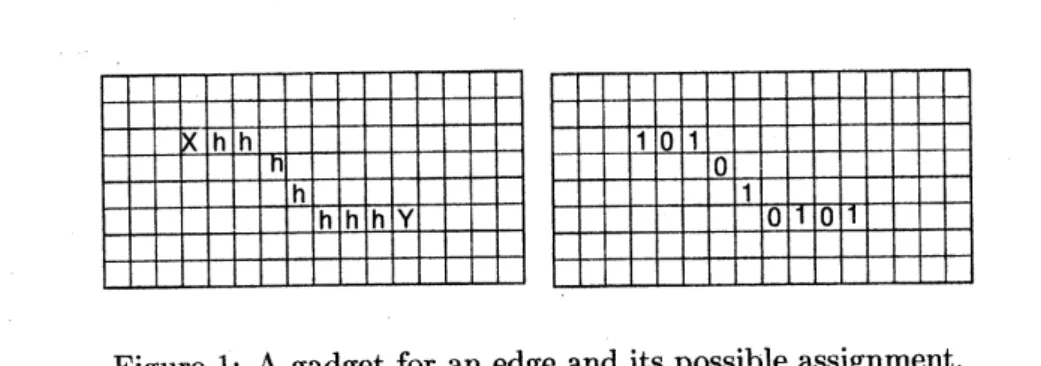
An edge between two nodes is a path consisting of adjacent pixels eachcontaining an 1/2. Moreover, each pair of adjacent pixels must form agood pair. Figure 1 shows an
edge between two nodes$X$and Y. For convenience’ sake, weomitto write$0$ entries inthefigures, and
also each 1/2 entry is representedbyan $h$ (meaning”half’). The nodes $X$ and$\mathrm{Y}$ also have values 1/2.
Note that the direction of the edge can be bent to any of four possible slopes ifwe have a sufficient
open space.
$i$From Lemma 4.2, if there exists an approximation
$B$ of$A$ with distance (at most) 1/2, there
are
only two possible assignments. One is shown in Figure 1, and the other is its opposite. This
means
that the value of $b_{Y}$ of $B$ at $Y$ is uniquely determined by $b_{X}$. In the case of Figure 1, $by=b_{X}$,
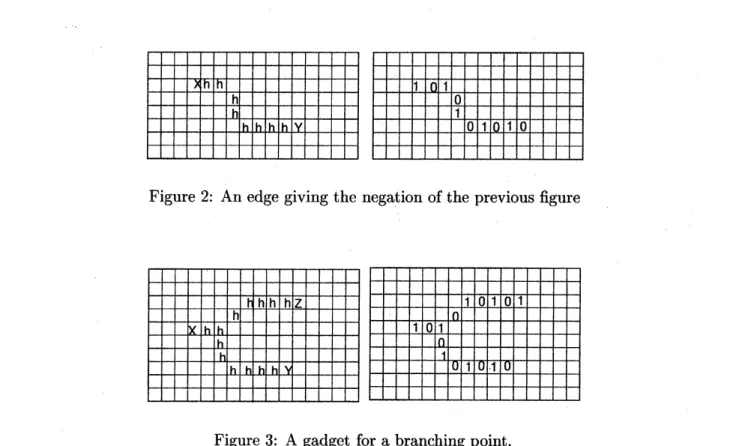
However, we candefine another path shown in Figure 2 forcing $by=\overline{b_{X;}}$ thus, it creates the negation
of a variable. Indeed, we can make both an odd-length path and an even-length path between two
nodes to control the assignment of the literal in each clause.
Figure 1: A gadget for anedge and its possible assignment.
A branching point (ofdegree 3) of is illustrated in Figure3. Note that allzero entriesof the input
matrix (left-side drawing) are absolute-zero entries.
The rest to show is thatwe cansimulateaclause nodeinthe planar3-SAT instance. Let the clause
be
$xyz$
, where $x,y$ and $z$are
literals or their negations. First,we
make a weaker gadget, whichcorresponds to $(x\vee yz)$A $(\overline{x}\vee\overline{y}\overline{z})$ (not-all-equa1-3SAT clause). See Figure4. Its upper drawing
gives the assignment of 1/2 in the input matrix $A$
.
The 0-1 value of$B$ at $X,$ $\mathrm{Y},$ $Z$ is determined byFigure 2: An edge givingthe negation of the previous figure
Figure 3: A gadget for abranching point.
If dist$(A, B)<1$,
once
we fix the values at $X,$ $Y$, and $Z$ in $B$, all values except the $h$ at thecenter crossing are uniquely determined Suppose that $X=Y=Z=0$
.
then, we have $B$ as the lowerdrawing. Then, we can
see
that there is no possible assignment at the center crossing$p$ (pixel withthe ? mark), since the $2\cross 2$ matrix containing
$p$
as
its south-eastcorner
has the entry sum3/2 in $A$,and hence its entry sum in $B$ must be either 1 or 2. Hence, the value at $p$ must be $0$ in $B$. However,
the $2\cross 2$ matrix contains $p$ as its north-west corner also has the entry sum 3/2 in $A$, and hence the
value at$p$ must be 1 in $B$, the contradiction. We can see that
$X=Y=Z=1$
is another impossibleassignment to make dist($A,$$B\mathrm{I}<1$; onthe other hand, all other assignments
are
$\mathrm{O}\mathrm{K}$.Figure4: A gadget for a $\mathrm{n}\mathrm{o}\mathrm{t}-\mathrm{a}\mathrm{l}1- \mathrm{e}\mathrm{q}\mathrm{u}\mathrm{a}1_{-}3\mathrm{s}\mathrm{A}\mathrm{T}$clause.
Next,
we
modify it to thematrix in Figure 5. It isea.sy
tosee that if$X=Y=Z=0$, there isno
$B$ such that dist$(A, B)<1$
.
However, if$X=Y=Z=1$, the right-hand side drawing shows that it ispossible to make dist$(A, B)=1/2$
.
A keydifference isthatwe
havea
1 entryin$A$, whichispermittedto become $0$ in $B$ without violatingthe
distance.condition:
We have thus obtained the following proposition:
Figure 5: A gadget for a$3\mathrm{S}\mathrm{A}\mathrm{T}$ clause.
$B$ satisfyingdist$(A, B)<1$. Moreover,
if
such $Bexi\mathit{8}tS,$ $dist(A, B)\leq 1/2$.Therefore, we have the $\mathrm{N}\mathrm{P}$-hardness. We can also consider the neighborhood family consisting of
all $2\cross 2$ matrices and all $1\cross 1$ matrices with the
error
function $|A(R)-B(R)|$ . Indeed, we replaceeach 1 entry of $A$ in the gadget of Figure5 with a 3/4 entry to obtain NP hardness for the family,
where dist$(A, B)\geq 1$ and dist$(A, B)\leq 3/4$ cannot be distinguished from each other. The NP-hard
result can begeneralized
as
follows (we omit the proof in this version):Theorem 4.4 For the neighborhoodfamily consisting
of
all$2k\cross 2k\mathit{8}quareS$, it is $NP$hard to decidewhether the optimized approximation $B$
of
an input $A$satisfies
Dist$(A, B)\geq 2/2k$ or Dist$(A, B)\leq$$1/2k$
.
$Al\mathit{8}\mathit{0}$, it is$NP$-hardto compute the optimal approximationfor
the neighborhood family consistingof
all $3\cross 3$ squares.5
Worst
case
examples, and performance
of
propagating
algorithms
5.1 Bad
sequences in
theone-dimensional
case
It isimportant to investigate what is the (asymptotically) worstcaseexample for the digital halftoning
with respect to our criterion. We can construct such anexample for the one-dimensional problem if
$k=o(n)$; in other words, the sequence $a$ maximizing the solution $z$ in Section 3. We have already
seenthat $z$ is less than 1 for any input sequence, sincethe propagatingalgorithm canattain it; hence,
it suffices to construct a sequence which forces $z$ to become 1 asymptotically.
Proposition 5.1 There exists an input sequence which makes $z=1-O(k/n)$
.
Proof For readability, we only give a proof for the case where $k=2$, i.e., each neighborhood is
an
interval of size 2. It is not difficult to modify it for a general $k$.
Consider a sequence $a=(a_{i})$$i=1,2,$$..,$$2p$definedby $0,1/(4_{P}-1),$$(4p-3)/(4p-1),$$3/(4p-1),$$(4p-5)/(4p-1),$
$\ldots\langle 2P-2)/(4p-$
$1),$$2p/(4p-1),\mathrm{w}\mathrm{h}\mathrm{i}\mathrm{c}\mathrm{h}$ satisfies $a_{i}+a_{i+1}=(4p-2)/(4p-1)$ and $a_{i+1}+a_{i+2}=4p/(4p-1)$ if
$i\geq 1$
is odd. There is a unique $b$ approximating $a$ with distance less than $(4p-2)/(4P-1)$
.
Indeed,$b=0,0,1,$$\mathrm{o},$$1,$$\mathrm{o},$$1,$$\mathrm{o},$
$\ldots,$$1,$
$\mathrm{o},$ $1$, which is the alternating sequence except the first two zeros. Let $a’$
be the
reverse
sequence of $a$, and consider the concatenation of $a$ and $a’$.
Naturally, the possibleapproximation must be the
concatenation
of $b$ and itsreverse
$b’$.
However, in the middle part, theinput is $2p/(4p-1),$ $2p/(4p-1)$, and the output is 1, 1. Thus, the differenceof the entry sum in this
neighborhood is
$2-4p/(4p-1)=(4p-2)/(4p-1)$
.
Hence, it is impossible to approximate within5.2
Performance
oftwo-dimensional
propagating
algorithmFor two dimensional case, as seen before in the $\mathrm{N}\mathrm{P}$-hardness proof, there exists
an instance $A$ (for
$2\cross 2$ square neighborhoods) that requires dist$(A, B)\geq 1$
. However, the authors do not know whether there exists an instance requiring dist$(A, B)>1$
or
not.A popular practical method in digital halftoning is the
error
propagation algorithm (we havealready
seen
its one-dimensional version): Scan the grid array in the scan-line order (i.e.,scan
row-wise from top
row
to bottom row, from left to right on each row), and greedily round the entriesof $A$ into binaries propagating the remaining
error
at each visited pixel toits unvisited neighbor
pixels. The outline of the algorithm is
as
follows: Weuse
four parameters $\alpha,\beta,\gamma$, and $\delta$ satisfying$\alpha+\beta+\gamma+\delta=1$
.
At first, error$(i,j)$ is set to be $0$ for each pixel $(i,j)$ in the grid. Whenwe
visit the pixel $(i,j),$ $b_{i,j}$ is obtained by rounding $a_{i,j}+error(i,j)$ to the
nearer
binary value. Now,compute $rem(i,j)=a_{i,j}+error(i,j)-bi,j$, which is theerrorremainedat $(i,j)$
,
and update theerrorvalues of its unvisited neighbors such as error$(i,j+1):=error(i,j+1)+\alpha rem(i,j),$ $error(i+$
$1,j):=err\mathit{0}r(i+1,j)+\beta rem(i,j),$ $error(i+1,j+1):=error(i+1,j+1)+\gamma rem(i,j)$, and
error$(i+1,j-1):=error(i+1,j-1)+\delta rem(i,j)$
.
We need somecare
forpixelsnear the boundaryof$G$, but we ignore it here for simplicity.
Proposition 5.2 Suppose that $B$ is the output
of
theerror
propagating algorithmfor
an input $A$.
Then,
for
the neighborhood family consistingof
$k\cross k$ squares, dist$(A, B)\leq k+(k-1)(\gamma+\delta)$.Moreover, there is an $in\mathit{8}tance$ A $\mathit{8}uCh$ that the distance exceeds $k+(k-1)(\gamma+\delta)-\epsilon$
for
any$\epsilon>0$if
we apply the errorpropagating algorithm.
Proof It is observed that $-0.5\leq rem(i,j)<0.5$ holds (ifwe round 0.5 to 1 in the algorithm). Fix
a $k\cross k$ square $R$ in $G$. Let $S_{in}$ be the set of pixels outside $R$ each of which has at least one pixel in $R$to which error ispropagated. Also, let $S_{out}$ be the set ofpixelsin $R$each of which has at least one
pixelof$G-R$ to which erroris propagated. Considerthe totalpropagating value coming into $R$ and
also the total propagating value goingout of$R$,
we
have $|A(R)-B(R)|\leq k+(k-1)(\gamma+\delta)$.
On theother hand, we can manage to create the input attaining $rem(i,j)=-1/2$ for each $(i,j)\in S_{in}$, and
$rem(i’,j’)>1/2-\epsilon/k$ for each $(i’,j’)\in S_{out}$
.
This gives the lower bound. ロIndeed, if$\gamma=\delta=0,$ $dist(\mathrm{A}, B)\leq k$ holds and it is tight.
6
Concluding
remarks
Thispaper gives an initial studyonthe optimization-basedevaluationof digitalhalftoningalgorithms.
There are lot ofopenproblems which are interesting from both viewpoints of theory and practice:
(1). For the neighborhood family consisting of $k\cross k$ squares $(k\geq 2)$, is it always possible to make
dist$(\mathrm{A}, B)<c$ where $c$is a constant strictly smallerthan $k$?
(2). If the
answer
to (1) is yes, canwe
design a polynomial time algorithm toassure
the condition?(Not seeking for the optimal solution).
Onepossible candidate is the useof random space filling
curves
[1], and performthe one-dimensionalpropagation algorithm along
curves.
Ifwe fix aspace fillingcurve, wecan
always construct an instanceso that dist$(A, B)>k-\epsilon$; however, it is difficult to construct an instance which performs bad for
many randomly chosen filling
curves
simultaneously.(3). Are there any good approximation algorithm which has a theoretical performanceratio?
(4). Find a very good neighborhood family and
error
function to evaluate the quality of digitalhalftoning in practice. If such a framework is firmly established, modern heuristic
$.\mathrm{m}\backslash .$
.ethods
can
beReferences
[1] T. Asano, N. Katoh, H. Tamaki, and T. Tokuyama: “Convertibility among grid filling curves,”
Proc. ISAAC98, Springer LNCS 1533 (1998),
pp.307-316.
[2] B. E. Bayer: “An optimum method for two-level rendition ofcontinuous-tone pictures,”
Confer-ence Record, IEEEInternational
Conference
on Communications, 1 (1973), $\mathrm{p}\mathrm{p}.(26- 11)-(26- 15)$.
[3] Y. Crama, P. Hansen and B. Jaumard: “The basic algorithm for pseudo-boolean programming
revisited,” Discrete Applied Mathematics, 29 (1990), pp.171-185, 1990.
[4] R. W. Floyd and L. Steinberg: “An adaptive algorithm for spatial gray scale,” SID75 Digest,
Society
for Information
Display, (1975) pp.36-37.[5] H. N. Gabow and R. E. Tarjan: “Faster scaling algorthms for netrowk problems,” SIAM J.
Comp., 18 (1989),
pp.1013-1036.
[6] M.R. Gareyand D. S. Jhonson: Computers andInteractability: A guide to theory
of
NPhardness,Feeman and Company, 1979.
[7] D. E. Knuth: “Digital halftones bydot diffusion,” ACM hans. Graphics, 6-4 (1987), pp.245-273.
[8] J. O. Limb: “Design of dither waveforms for quantized visual signals,” Bell Syst. Tech. J., 48-7
(1969), pp.
2555-2582.
[9] B. Lippel and M. Kurland: “The effect of dither
on
luminance quantization of pictures,” IEEETrans. Commun. Tech., COM-19 (1971), pp.879-888.