「人工感性」システムの実現を指向した多色配色の美的感性をもつ
計算モデルの構築
Construction of an Artificial KANSEI System Simulating the Mental Function of Multi-Color
Aesthetic Evaluation
方 思源
∗1 Siyuan Fang村松 慶一
∗2 Keiichi Muramatsu松居 辰則
∗3 Tatsunori Matsui ∗1早稲田大学大学院人間科学研究科
Graduate School of Human Sciences, Waseda University
∗2
埼玉大学 大学院理工学研究科
Graduate School of Science and Engineering, Saitama University
∗3
早稲田大学 人間科学学術院
Faculty of Human Sciences, Waseda University
In this research, we constructed an artificial KANSEI system simulating the mental function of multi-color aesthetic evaluation through back-propagation neural network. Helmut Leder’s psychological model served as the theoretical framework. We determined the macro-structure of the system via two psychological experiments using Semantic Differential method. The aesthetic score of a multi-color stimulus was defined as its factor score on
“Pleasure”factor extracted in the first experiment, and the three factors extracted in the second experiment, i.e.
“Staticness”,“Turbidity”and“Heaviness”, were regarded as simple physical visual features. Then, the number of hidden-layer nodes, the learning rate and the momentum constant of each neural network were optimized by genetic algorithm. Finally, the satisfactory performance of the system in two simulation tests suggests that the system possesses a high predicting power to the aesthetic score of any 4*4 grid multi-color stimulus.
1.
Introduction
This research aims to construct an artificial KANSEI sys-tem simulating the sense of beauty to multi-color objects by approximating the mapping relationships between the primary color information of multi-color objects and the aesthetic evaluation. Being a hybrid of a psychological ap-proach and a computational apap-proach to the topic of multi-color aesthetics, this research can be expected to shed new light on the study of the enigmatic psychological mecha-nism of multi-color aesthetic evaluation and at the same time make a contribution to the field of KANSEI (affec-tive) engineering by offering a computing tool of automatic aesthetic evaluation to multi-color objects.
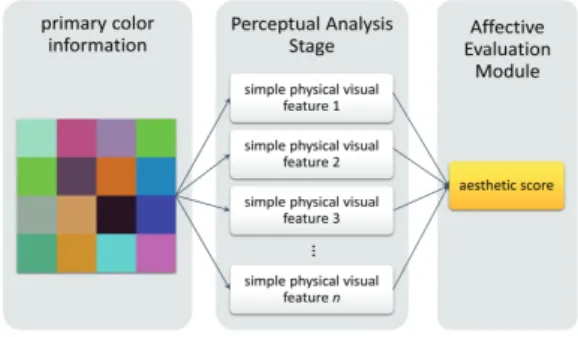
The theoretical framework of this research is Helmut Leder[Leder 04]’s psychological model. According to this model, during the psychological process of multi-color aes-thetic evaluation, the primary color information of a multi-color stimulus is firstly transformed into several simple physical visual features in the Perceptual Analyses Stage of the visual information processing module, and then, the results of the information processing in this module serve as the inputs into the affective evaluation module. The output of the affective evaluation module is the aesthetic evaluation to this stimulus. Figure 1 is a scheme of Leder’s psychological model.
The whole research is composed of three stages: The first stage is the conduction of two psychological experiments us-ing Semantic Differential (SD) method. The second stage is the building of the artificial KANSEI system using back-propagation neural network based on the empirical data
連絡先:方 思源,早稲田大学人間科学研究科,〒359-1165埼 玉県所沢市堀之内135-1フロンティア・リサーチセンター
213実験室, [email protected]
Figure 1: A scheme of Leder’s psychological model
obtained from the two experiments. The third stage is two simulation tests of the predicting power of the system. (The construction and the simulations of the system were imple-mented on MATLAB.)
2.
Research Background
Multi-color aesthetics has been a topic in computer sci-ence for several decades, especially in the areas of artificial intelligence, KANSEI engineering (affective computing) and digital image processing. We define the concept“ compu-tational multi-color aesthetics (CMCA)”as the research field which employs modern computational technology to study and (or) apply the psychological principles concern-ing multi-color aesthetics. Generally speakconcern-ing, there are two main approaches in CMCA:
The first approach is an exploratory one, trying to extract the psychological rules regarding multi-color aesthetics by machine learning techniques, e.g. artificial neural network, support vector machine or boost algorithms. Its typical
pro-1
The 29th Annual Conference of the Japanese Society for Artificial Intelligence, 2015
cedure is like this: Firstly, a set of primary color features of multi-color images are determined. Then, the mapping relationships between these features and the aesthetic score are extracted through a certain machine learning technique on the basis of a training set of multi-color images with their aesthetic scores labelled by human subjects. Most of the studies taking this approach are targeted to construct an automatic aesthetic evaluation system or an image clas-sifier system. The researches [Gedeon 08], [Matsuura 08] and [Ogawa 11] exemplify this approach.
The second approach is an implementary one which quan-tifies or directly practices some existing theory on multi-color aesthetics such as Moon & Spencer’s theory and Ou & Luo’s theory. Oftentimes, in the studies taking this ap-proach, the application of a certain theory on multi-color aesthetics functions as an auxiliary module working to auto-matically assess the aesthetic scores of multi-color images in integrated systems whose aims, in most cases, are to promote the automation in industry design, software (or website) user-interface design or color education. The typi-cal examples of this approach are [Meier 88], [Cohen-Or 06] and [Hsiao 08].
The present research is intended to construct a comput-ing system simulatcomput-ing the unknown mental mechanism of multi-color aesthetics through the extraction of the regula-tions hidden in experimental data by artificial neural net-work, rather than using an existing theory. Therefore, this research can be categorized to the first approach, i.e. the exploratory approach, in CMCA.
3.
Experiment I
The first experiment aims to quantify the concept“ aes-thetic evaluation”in Leder’s model. 35 computer-generated 4*4 grid multi-color squares (400*400 pixels) were employed as the experimental stimuli. The component colors of every stimulus were randomly determined in RGB color space. The multi-color square in the leftmost block in Figure 1 is one example of them.
In order to avoid the fatigue effect, this experiment was divided into two sessions carried out independently. 8 sub-jects (6 males & 2 females, aged from 20 to 22) partici-pated in the first session where 20 stimuli were used. 12 subjects (8 males & 4 females, aged from 20 to 24) took part in the second session where the rest 15 stimuli were used. The subjects were asked to evaluate the stimuli on 24 adjective pairs selected from a number of past researches on affective effects of color. (To see a detailed description of the experimental procedures, please refer to our previous paper[Fang 15].)
The evaluation data on these adjective pairs with re-gard to each stimulus were averaged across the subjects, and then imported into the factor analysis package of IBM SPSS Statistics (version 19). Three main factors“ Activ-ity”,“Pleasure”and“Potency”were extracted. Based on Osgood[Osgood 62][Osgood 69]’s interpretation of Pleasure factor, namely the factor conventionally named as“ Evalua-tion”, we define the aesthetic score of a multi-color stimulus
Figure 2: Macro-structure of the artificial KANSEI system
as the inverse of its factor score on Pleasure factor.
4.
Experiment II
The second experiment is devised to specify and quantify the simple physical visual features into which the primary color information of multi-color stimuli is transformed.
The same multi-color stimuli employed in Experiment I were used in this experiment. Like Experiment I, this ex-periment was also divided into two sessions conducted in-dependently. 15 subjects (11 males & 4 females, aged from 20 to 24) took part in the first session where 20 stimuli were used. 12 subjects (8 males & 4 females, aged from 20 to 24) participated in the second session where the rest 15 stimuli were used. An adjective pair list we created in a previous pilot study[Fang 15] was used in this experiment. This list contained 45 adjective pairs all concerning physical visual aspects of color image. After the completion of the experi-ment, the Cronbach’sαcoefficient of every adjective pair, averaged across the two sessions, was calculated. The eval-uation data on those adjective pairs with this coefficient higher than 0.60 (which means relatively high subject-wise consistency) were imported into the factor analysis package. Three main factors“Staticness”,“Turbidity”and“ Heavi-ness”were extracted. Each of them is regarded as represent-ing a simple physical visual feature, and the correspondrepresent-ing feature values of a multi-color stimulus are defined as its factor scores on the three factors.
5.
System Structure
As shown in Figure 1, this psychological model is com-posed of three levels: primary color information as the first level, simple physical visual features as the second level, and aesthetic evaluation as the third level. We chose to use 3-layer back-propagation neural network (BPNN) to under-take the inter-level connections. Thus, the artificial KAN-SEI system built in this research is a hierarchical BPNN system the macro-structure of which is shown in Figure 2.
As demonstrated in Figure 2, the system takes a 2-level structure. The first level consists of three parallel BPNNs.
2
The first BPNN (called“BPNN 1”for short) works to transform the primary color information of a multi-color stimulus, defined as the Lab values (CIE 1976 L*a*b* Color Space) of the component colors of the stimulus, into the vi-sual feature“Staticness”. BPNN 1 has 48 input nodes corresponding to the Lab values of every component color of the stimulus, and its sole output node simulates its fac-tor score on Staticness facfac-tor. The second BPNN (called
“BPNN 2”for short) serves to map the primary color in-formation of a multi-color stimulus to the visual feature
“Turbidity”. The input nodes of BPNN 2 are the same as those of BPNN 1, and the sole output node of BPNN 2 simulates the factor score of the stimulus on Turbidity factor. The function of the third BPNN (called“BPNN 3”
for short) is to transform the primary color information of a multi-color stimulus to the visual feature“Heaviness”. BPNN 3 shares the same input nodes with BPNN 1 and BPNN 2, but its sole output node simulates the factor score of the stimulus on Heaviness factor. A fourth BPNN (called
“BPNN 4”for short) forms the second level of the system. BPNN 4 operates to map the three visual features“ Stat-icness”,“Turbidity”and“Heaviness”of a multi-color stimulus to the variable“Pleasure Inverse”representing the inverse of the aesthetic score of the stimulus. The out-put nodes of BPNN 1, BPNN 2 and BPNN 3 serve as the input nodes of BPNN 4, and its sole output node simulates the factor score of the stimulus on Pleasure factor. Besides, the activation function of every node in the system was set as tansig function: f (x) = 1+exp(2−2x)− 1.
6.
System Parameter Optimization
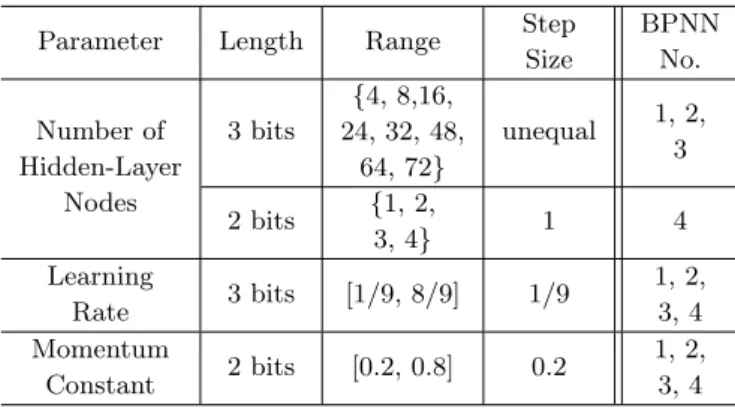
Having determined the macro-structure of the system, the next work was to find, for every constituent BPNN, the set of system parameter values producing the best perfor-mance by genetic algorithm (GA). The system parameters to be optimized were the hidden-layer node number, the learning rate and the momentum constant. Figure 3 is the flowchart of the GA program (coding operation parameters: Table 1; Gray code; Ranking Method; Stochastic Univer-sal Sampling; crossover rate=0.7; mutation rate=0.7/string length; population size=40; maximum generation=100th).
Figure 3: Procedure of the genetic algorithm program
Table 1: Coding operation parameters in the GA program
Parameter Length Range Step Size BPNN No. Number of Hidden-Layer Nodes 3 bits {4, 8,16, 24, 32, 48, 64, 72} unequal 1, 2, 3 2 bits {1, 2, 3, 4} 1 4 Learning Rate 3 bits [1/9, 8/9] 1/9 1, 2, 3, 4 Momentum Constant 2 bits [0.2, 0.8] 0.2 1, 2, 3, 4
With the optimization results displayed in Table 2, both the network structures and the learning algorithms of the BPNNs were determined. Next, we conducted two simula-tions to test the predicting capacity of the system.
7.
Simulation I
In the first simulation, the 35 stimuli used in Experiment I&II were divided into two groups: The training set con-tained 30 stimuli which had been used during the process of system parameter optimization, and the validation set contained the rest five stimuli. The validation-set stimuli could be deemed as qualified test targets due to the fact that they had not been involved in the construction process of the system.
The whole simulation consisted of 50 iterations each of which is composed of two phases: the training phase and then the prediction phase. In the training phase, the train-ing set was employed to train the four BPNNs with their as-sociated input-end information and output-end information (termination criteria of the training processes: maximum number of iterations=1000, mean square error=1.00E-05). Next, in the prediction phase, the primary color information of each validation-set stimulus was imported into the input layers of the first-level BPNNs, producing the prediction for the values of three visual feature“Staticness”,“ Turbid-ity”and“Heaviness”. Then, these three predictions were further transformed by BPNN 4 into the prediction (in the fashion of inverse) for the aesthetic score.
The simulation result demonstrates that the prediction
Table 2: Optimum parameter value sets BPNN No. Number of Hidden-Layer Nodes Learning Rate Momentum Constant 1 4 1/3 0.2 2 24 5/9 0.2 3 8 7/9 0.2 4 1 1/9 0.4 3
errors regarding four of the five validation-set stimuli are remarkably low, and the overall average error is 0.3453, ac-counting for merely 17.65% of the largest possible error 2.0, implying that the system may possess a remarkable pre-dicting power. In addition, Shapiro-Wilk Test shows that the predictions to the five validation-set stimuli can all be regarded as normally distributed (P s: 0.183, 0.676, 0.266, 0.475 and 0.627), implying the robustness of the prediction calculation by the system.
8.
Simulation II
In order to check out the possibility that the predict-ing ability of the system is limited within the multi-color stimuli used in Experiment I&II, we carried out the second simulation. In this simulation, all the stimuli employed in the two experiments were used as the training set, and 25 newly generated multi-color stimuli formed the validation set. The aesthetic scores of these validation-set stimuli were obtained through a third psychological experiment which shared the same procedure with Experiment I.
The simulation result exhibits that the average of the ab-solute value of prediction error is 0.2959, which accounts for only 14.8% of the largest possible error (2.0), and the distribution of error across the 50 iterations can be re-garded as following a normal distribution (Shapiro-Wilk Test: P =0.432) with an average value (0.016) fairly close to zero and a small standard deviation (0.382). Therefore it is cogent to believe that the system possesses a high ability to generalize to any 4*4 grid multi-color stimuli the knowl-edge it has learnt from the associated information of the training-set stimuli gained in Experiment I&II.
9.
Conclusion and Future Works
This research constructed, on the basis of Leder’s psy-chological model, an artificial KANSEI system which sim-ulated the mental function of multi-color aesthetic evalu-ation. Firstly, we quantified Leder’s originally qualitative model by defining the concept“aesthetic evaluation”as Pleasure factor in Experiment I and specifying the simple physical visual features as the three factors“Staticness”,
“Turbidity”and“Heaviness”in Experiment II. Then, the macro-structure of the system was built through BPNN. The hidden-layer node number, the learning rate and the momentum constant of each BPNN were optimized by ge-netic algorithm. Finally, we carried out two simulation tests to estimate the predicting capacity of the system to the aesthetic scores of the multi-color samples which the sys-tem had never met before. Its performance in both sim-ulations turned out to be satisfactory, indicating that the trained systems, especially the one in Simulation II, were able to predict with considerably high precision the aes-thetic score of any 4*4 grid multi-color objects. Further-more, from a psychological perspective, it is reasonable to regard the macro-structure of the system as a remarkably accurate approximation to the cognitive structure behind the sense of beauty to multi-color objects.
In regard to future application, this artificial
KAN-SEI system can be used in the development of automatic multi-color aesthetic evaluation systems, which can be inte-grated in pattern recognition modules in affective-content-based image search engines, and even systems generat-ing color images with high aesthetic scores. On the aca-demic plane, our future researches will continue the explo-ration of the converging points of psychology and artificial intelligence, and delve into the cognitive-psychology and cognitive-neuroscience underpinnings of the sense of beauty to multi-color stimuli.
References
[Leder 04] Leder, H., Belke, B., Oeberst, A. and Au-gustin, D.: A Model of Aesthetic Appreciation and Aesthetic Judgments, British Journal of Psychology, 95(4), pp. 489–508 (1984)
[Matsuura 08] Matsuura, A. and Matsui, T.: Rule Extrac-tion of Impression for Harmony among Multiple Colors Using Neural Network, Journal of the Color Science Association of Japan, 32(SUPPLEMENT), pp. 48–49 (2008)
[Ogawa 11] Ogawa, K., Muramatsu, K. and Matsui, T.: Color Kansei Evaluation Using Multiple Linked Neu-ral Network, Journal of the Color Science Association of Japan, 35(Supplement), pp. 70–71 (2011)
[Gedeon 08] Gedeon, T.: Neural Network for Modeling Es-thetic Selection, Neural Information Processing, Neu-ral Information Processing (Lecture Notes in Com-puter Science), 4985, pp. 666–674 (2008)
[Meier 88] Meier, B.: ACE: A Color Expert System for User Interface Design, Proc. of the 1st. Annual ACM SIGGRAPH Symposium on User Interface Software, pp. 117–128 (1988)
[Cohen-Or 06] Cohen-Or, D., Sorkine, O., Gal, R., Ley-vand, T. and Xu, Y.: Color Harmonization, ACM Transactions on Graphics, 25(3), pp. 624–630 (2006) [Hsiao 08] Hsiao, S., Chiu, F. and Hsu, H.: A Computer‐
Assisted Colour Selection System Based on Aesthetic Measure for Colour Harmony and Fuzzy Logic Theory, Color Research and Application, 33(5), pp. 411–423 (2008)
[Osgood 62] Osgood, C.: Studies on the Generality of Affective Meaning Systems, American Psychologist, 17(1), pp. 10–28 (1962)
[Osgood 69] Osgood, C.: On the Whys and Wherefores of E, P, and A, Journal of Personality and Social Psy-chology, 12(3), pp. 194–199 (1969)
[Fang 15] Fang, S., Muramatsu, K. and Matsui, T.: Ex-perimental Study of Aesthetic Evaluation to Multi-Color Stimuli Using Semantic Differential Method: To-wards the Construction of an Artificial KANSEI Sys-tem, Transactions of Japan Society of Kansei Engi-neering, 14(1), pp. 37–47 (2015)
4