INTRODUCTION
Placenta percreta is a subtype of placenta accreta in which the placenta invades the entire uterine wall and affects the adjacent organs. The incidence of placenta accreta ranges from one in 530 to one in 2,500 deliveries, and its incidence has been increas-ing due to an increase in cesarean sections (1). Ce-sarean sections with placenta percreta is mostly per-formed under general anesthesia. However, it is a
condition with a high surgical risk and generally re-quires an obstetric hysterectomy to control massive hemorrhage. It has been reported to have a mor-tality rate up to 7% (2). We report a case of placenta percreta with massive hemorrhage where a cell salvage device (Cell Saver!!; Haemonetics Japan)
and a rapid infuser (LEVEL 1 SYSTEM 1000!!;
Smith Medical Japan Ltd.) were life saving and ef-fective.
CASE PRESENTATION
The patient was a 39-year-old woman who was 157 cm in height and 58 kg in weight. She had four previous children, two of which had been delivered
CASE REPORT
A case of placenta percreta with massive hemorrhage
during cesarean section
Katsuyoshi Kume
1, Yasuo M. Tsutsumi
2, Tomohiro Soga
2, Yoko Sakai
1,
Noriko Kambe
2, Ryosuke Kawanishi
1, Eisuke Hamaguchi
2, Tomiya Kawahara
1,
Asuka Kasai
1, Yoshimi Nakaji
1, Yousuke T. Horikawa
2, Souichiro Nakayama
3,
Takashi Kaji
3, Minoru Irahara
3, and Katsuya Tanaka
2 1Department of Anesthesiology, Tokushima University Hospital, Tokushima, Japan,2
Department of An-esthesiology, Institute of Health Bioscience, the University of Tokushima Graduate School, Tokushima, Japan,3
Department of Obstetrics and Gynecology, Institute of Health Bioscience, the University of Tokushima Graduate School, Tokushima, Japan
Abstract : We describe a case of a 39-year-old woman diagnosed with placenta percreta complicated by massive hemorrhage during a cesarean section. At 27 weeks of gestation, she underwent an emergency cesarean section under general anesthesia for vaginal bleed-ing and an intrauterine infection. Soon after delivery, a massive hemorrhage was encoun-tered while attempting to separate the placenta percreta from the bladder wall. Although total abdominal hysterectomy and partial cystectomy were performed, massive hemorrhag-ing persisted. Bleedhemorrhag-ing was finally controlled followhemorrhag-ing bilateral internal iliac artery em-bolization. We used a cell salvage device and a rapid infuser for hemodynamics stabiliza-tion. Total blood loss was 47,000 mL, and anesthesia time was 12 h and 47 min. The patient was discharged on the 32ndpostoperative day without major complications. Placenta
ac-creta can be associated with life-threatening hemorrhage and it is vital to plan accord-ingly preoperatively. J. Med. Invest. 61 : 208-212, February, 2014
Keywords :placenta percreta, massive hemorrhage, cesarean section
Received for publication September 6, 2013 ; accepted Novem-ber 10, 2013.
Address correspondence and reprint requests to Yasuo M. Tsutsumi, MD, PhD, 3 - 18 - 15 Kuramoto, Tokushima, JAPAN 770 - 8503 and Fax : +81 - 88 - 633 - 7182.
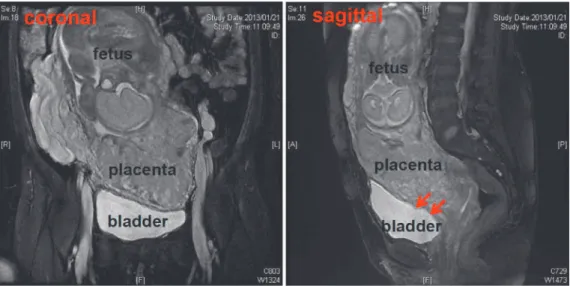
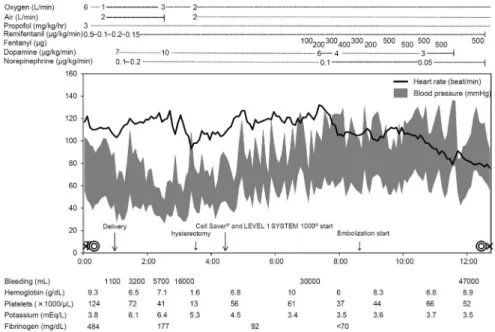
by cesarean section. She was diagnosed with pla-centa percreta by magnetic resonance imaging with a high suspicion that there was invasion into the muscularis of the bladder (Figure 1). Therefore, ce-sarean section was planned at 33 weeks of gestation. However, at 27 weeks of gestation, she underwent an emergency cesarean section due to vaginal bleeding and an intrauterine infection. We planned a cesarean section without exfoliating the placenta and cesar-ean hysterectomy. Pre-operative laboratory data are shown in Table 1. General anesthesia was induced using propofol, remifentanil, and rocuronium and an-esthesia was maintained using propofol, fentanyl, and remifentanil. Figure 2 shows the anesthetic chart including hemodynamics and laboratory data. During the surgery, because the uterine surface was highly vascularized due to the placenta percreta, the decision was made to avoid surgical resection of the placenta and to directly dissect the uterine base with a vertical incision and perform a com-plete hysterectomy and partial cystectomy. How-ever, hemostasis became difficult because the blad-der invasion by the placenta was abundant. Bleeding was ultimately controlled following bilateral inter-nal iliac artery embolization. Furthermore, we used catecholamines (dopamine and norepinephrine), a cell salvage device (Cell Saver"!; Haemonetics
Japan) and a rapid infuser (LEVEL 1 SYSTEM 1000"!; Smith Medical Japan Ltd.) for hemodynamic
stabilization. Intra-operative bleeding was 47,000 mL and total anesthesia time was 12 h and 47 min. A total of 120 units of red blood cells, 90 units of fresh frozen plasma, and 100 units of platelets were trans-fused. After the surgery, the patient was transferred
to the intensive care unit and was extubated 9 hours later. Post-operative laboratory data are also shown in Table 1. She was discharged on the 32th post-operative day without major complications.
The baby (898 g) was born 7 min after the opera-tion had started and was intubated immediately after birth with Apgar scores of 1 and 5 at 1 minute and 5 minutes, respectively. The baby was extubated 17 days after birth and discharged after the 95th day.
Figure 1. Magnetic resonance imaging of the plevis revealed invasion into the bladder by the placenta (red arrow).
Table 1. Vital sign and laboratory data before and after opera-tion
Before After
1hour 6hours Day1 Day3 HR (beat/min) 111 64 85 58 60 SBP (mmHg) 82 146 113 148 115 DBP (mmHg) 34 78 69 77 65 SpO2 (%) 98 100 100 98 100 Hb (g/dL) 9.5 8.2 9.0 8.1 12.7 Plt (
!
1000/μL) 155 63 48 29 112 PT- INR 0.92 1.36 1.37 0.99 0.96 APTT (s) 28.2 46.9 35.9 29.0 27.4 Fibrinogen (mg/dL) 484 167 305 447 501 BUN (mg/dL) 6 11 15 31 8 Creatinine (mg/dL) 0.46 0.58 0.9 1.10 0.69 Sodium (mEq/L) 133 147 146 146 143 Potassium (mEq/L) 3.5 3.3 3.4 3.4 2.7 Chloride (mEq/L) 101 113 112 112 110 HR= Heart rate, SBP = Systolic blood pressure, DBP = Diastolic blood pressure, SPO2= Saturation of peripheral oxygen, Hb =Hemoglobin, Plt= Platelets, PT- INR= Prothrombin time and inter-national normalized rate, APTT= Activated partial thromboplastin time, BUN= Blood urea nitrogen.
DISCUSSION
Placenta percreta is a rare subtype of placenta accreta in which the placenta invades the entire uterine wall and affects the adjacent organs (Table 2). It is a condition with a high surgical risk and generally requires an obstetric hysterectomy. Pla-centa accreta has been reported to have up to a 7% mortality rate as well as intra-operative and post-operative morbidity associated with massive blood
transfusions, infection, ureteral damage, and fistula formation (2). Prior delivery by cesarean section is a risk factor for placenta accreta. According to a re-port by Sumigama et al. (3), among 59,008 deliver-ies, 408 cases were diagnosed as placenta previa ; of these, 18 cases were placenta increta and 5 of placenta percreta. Mean intra-operative blood loss was 3,630!2,216 mL (increta) and 12,140!8,343 mL (percreta). One patient with placenta percreta died of hemorrhage (3).
Figure 2. Anesthetic chart
Table 2. Summary of reported case of placenta percreta Authors
(Reference number)
Year Method of diagnosis
Amount of transfusion (Red blood cells)
Treatments
Abbas et al (11) 2000 ultrasound 22 hysterectomy, bladder repair, bilateral internal iliac artery ligation Abbas et al (11) 2000 ultrasound 15 hysterectomy, bladder repair, bilateral internal iliac artery ligation Caliskan et al (12) 2003 ultrasound 13 hysterectomy, bladder repair, bilateral hypogastric artery ligation,
abdominal packing Takai et al (13) 2005 ultrasound
MRI cystoscopy
35 hysterectomy, bladder repair, bilateral internal iliac artery ligation
Shawish et al (14) 2007 ultrasound MRI cystoscopy
5 hysterectomy, bladder repair
Matsubara et al (15) 2009 ultrasound MRI
8 + 2(autologous) hysterectomy, bladder repair,
bilateral internal iliac artery balloon catheters occlusion Parva et al (16) 2009 ultrasound
MRI
2 hysterectomy, bladder repair,
bilateral internal iliac artery balloon catheters occlusion Sijanovic et al (17) 2011 no diagnosis
before surgery
20 hysterectomy, bladder repair, bilateral hypogastric artery ligation
Reitman et al (18) 2011 ultrasound 3 hysterectomy, bladder repair, uterine artery ligation Vahdat et al (19) 2012 ultrasound 20 radical parametrectomy, bilateral internal iliac artery ligation,
abdominal packing
In 1997, Dubois et al. reported that temporary bal-loon occlusion of the bilateral internal iliac artery is a method to control bleeding during cesarean hys-terectomy for placenta percreta (4). However, in this emergency case, the patient presented with vagi-nal bleeding and had an intrauterine infection, pre-venting any pre-operatively planning. Ultimately, bi-lateral internal iliac artery embolization was per-formed intra-operatively to control hemorrhaging and achieve hemodynamic stability. Ideally, multi-disciplinary pre-operative planning with the depart-ments of obstetrics and gynecology, radiology, and anesthesiology will be optimal in future cases.
A decrease in fibrinogen is one of the leading fac-tors involved in postpartum massive hemorrhage. Bleeding of!2,000 mL ; can result in dilutional co-agulopathy. When massive hemorrhage occurs, fi-brinogen is the first coagulation factor that becomes depleted resulting in coagulopathy. This is because other coagulation factors can deplete up to 80% of normal concentrations before coagulopathy is ob-served, whereas fibrinogen can only lose up to 60% of normal concentrations (100 mg/dL) before co-agulopathy (5). Fresh frozen plasma (FFP) is used to increase the fibrinogen concentrations. However, when massive hemorrhaging persists, administration of FFP cannot be expected to effectively supplement the fibrinogen concentrations (6). Moreover, there is a report that administration of a large quantity of FFP is associated with acute lung injury (7). In this case, although the patient did not develop acute lung injury, we should prepare a cryoprecipitate by concentrating FFP to 10 times, when massive hem-orrhage was expected (8).
Cell Saver!!is a cell salvage device used during
surgery to avoid allogeneic transfusions and the ele-vation of serum potassium concentration. Cell sal-vage has been used in obstetrics to a limited degree because of the fear of amniotic fluid embolism al-though the exact mechanism is still unclear. In con-trast, leukocyte depletion filtering of cell-salvaged blood obtained from cesarean section reduces am-niotic fluid components to a concentration equivalent to maternal venous blood (9). This device has been reportedly used safely in!400 cases (4, 10). In this case, the patient did not develop an amniotic fluid embolus. Moreover, Cell Saver!!reduced the need
for allogeneic transfusions and avoided the elevation of serum potassium concentration. During surgery the patient’s serum potassium concentration in-creased up to 7.6 mmol/L, but returned to a normal concentrations after using this device.
We describe a difficult case of placenta percreta with massive hemorrhage, where transfusions alone were not sufficient to maintain hemodynamics. The use of a cell salvaging device and rapid infuser, which are not routinely available during these pro-cedures were required to maintain hemodynamic stability. Ultimately, it is critical to have multidisci-plinary pre-operative discussions regarding strategic planning and potential complications in difficult cases such as these. Furthermore, pre-operative prepara-tion of a Cell Saver!!and LEVEL 1 SYSTEM 1000!!
with appropriate staffing is essential in cases where massive blood loss is expected.
REFERENCES
1. Miller DA, Chollet JA, Goodwin TM : Clinical risk factors for placenta previa-placenta accreta. Am J Obstet Gynecol 177 : 210-214, 1997 2. O’Brien JM, Barton JR, Donaldson ES : The
management of placenta percreta : conservative and operative strategies. Am J Obstet Gynecol 175 : 1632-1638, 1996
3. Sumigama S, Itakura A, Ota T, Okada M, Kotani T, Hayakawa H, Yoshida K, Ishikawa K, Hayashi K, Kurauchi O, Yamada S, Nakamura H, Matsusawa K, Sakakibara K, Ito M, Kawai M, Kikkawa F : Placenta previa increta/percreta in Japan : a retrospective study of ultrasound findings, management and clinical course. J Obstet Gynaecol Res 33 : 606-611, 2007 4. Dubois J, Garel L, Grignon A, Lemay M, Leduc
L : Placenta percreta : balloon occlusion and embolization of the internal iliac arteries to reduce intraoperative blood losses. Am J Obstet Gynecol 176 : 723-726, 1997
5. Hiippala ST, Myllyla GJ, Vahtera EM : Hemo-static factors and replacement of major blood loss with plasma-poor red cell concentrates. Anesth Analg 81 : 360-365, 1995
6. Stanworth SJ, Brunskill SJ, Hyde CJ,
McClelland DB, Murphy MF : Is fresh frozen plasma clinically effective? A systematic review of randomized controlled trials. Br J Haematol 126 : 139-152, 2004
7. Khan H, Belsher J, Yilmaz M, Afessa B, Winters JL, Moore SB, Hubmayr RD, Gajic O : Fresh-frozen plasma and platelet transfusions are associated with development of acute lung injury in critically ill medical patients. Chest 131 : 1308-1314, 2007
8. American Society of Anesthesiologists Task Force on Perioperative Blood Transfusion and Adjuvant Therapies : Practice guidelines for perioperative blood transfusion and adjuvant therapies : an updated report by the American Society of Anesthesiologists Task Force on Perioperative Blood Transfusion and Adjuvant Therapies. Anesthesiology 105 : 198-208, 2006 9. Waters JH, Biscotti C, Potter PS, Phillipson E : Amniotic fluid removal during cell salvage in the cesarean section patient. Anesthesiology 92 : 1531-1536, 2000
10. Catling S, Joels L : Cell salvage in obstetrics : the time has come. BJOG 112 : 131-132, 2005 11. Abbas F, Talati J, Wasti S, Akram S, Ghaffar S,
Qureshi R : Placenta percreta with bladder in-vasion as a cause of life threatening hemor-rhage. J Urol 164 : 1270-1274, 2000
12. Caliskan E, Tan O, Kurtaran V, Dilbaz B, Haberal A : Placenta previa percreta with uri-nary bladder and ureter invasion. Arch Gynecol Obstet 268 : 343-344, 2003
13. Takai N, Eto M, Sato F, Mimata H, Miyakawa I : Placenta percreta invading the urinary blad-der. Arch Gynecol Obstet 271 : 274-275, 2005 14. Shawish FM, Hammad FT, Kazim EM :
Pla-centa percreta with bladder invasion. A plea for multidisciplinary approach. Saudi Med J 28 : 139-141, 2007
15. Matsubara S, Ohkuchi A, Yashi M, Izumi A,
Ohwada M, Kuwata T, Usui R, Kuwata Y, Nakata M, Suzuki M : Opening the bladder for cesarean hysterectomy for placenta previa percreta with bladder invasion. J Obstet Gy-naecol Res 35 : 359-363, 2009
16. Parva M, Chamchad D, Keegan J, Gerson A, Horrow J : Placenta percreta with invasion of the bladder wall : management with a multi-dis-ciplinary approach. J Clin Anesth 22 : 209-212, 2010
17. Sijanovic S, Rubin M, Topolovec Z, Vidosavljevic D, Sijanovic I : Placenta previa percreta with bladder invasion. Med Glas (Zenica) 8 : 66-68, 2011
18. Reitman E, Devine PC, Laifer-Narin SL, Flood P : Case scenario : perioperative management of a multigravida at 34-week gestation diag-nosed with abnormal placentation. Anesthesi-ology 115 : 852-857, 2011
19. Vahdat M, Mehdizadeh A, Sariri E, Chaichian S, Najmi Z, Kadivar M : Placenta percreta in-vading broad ligament and parametrium in a woman with two previous cesarean sections : a case report. Case Rep Obstet Gynecol 2012 : 251381, 2012
20. Sultan P, Hilton G, Butwick A, Carvalho B : Continuous spinal anesthesia for Cesarean hys-terectomy and massive hemorrhage in a par-turient with placenta increta. Can J Anaesth 59 : 473-477, 2012