
関西学院大学リポジトリ
273
0
0
全文
(2) Abstract. i h. e s. h t. Under Acquisition,t. UG― based theoretical investigations on the Second Language dissertation ailns not only at elucidating the language competence. which develops at the intellllediate stage of granllnar in the way of L2 1earning,but also at giving an explanatorily adequate theoretical account to the syntactic lnechanism. ′ ′ η"α ゞ鮮 α JJセ α″′ R7α ″′ for the L2 1ettninge lt will be demonstrtted th江 」 “ “ “ “ 二′αJ7滋 gl%′ θFy(FTFL),whiCh Will be proposed in this dissert江 lon,is consistent with crosslinguistic L2 data and is explanatorily adequate on theoretica1/conceptual groundse. ln line with the nlinilnalist assumptions,which stipulate that the ultilnate. OtteCt Of a syntactic operadon is not a le対 cal item per se but ought to be fo111lal features with which the given lexical item is endowed in the lexicon,it will be argued in this dissertation that the L2 1ettning is the lettning of the speciflcation of syntactic. formal features within a given item in a tttget languageo. The 9-features in a target. iteln at the inteHnediate L2 1ettning stage are composed depending on the inarkedness of their feature speciicttion through. νrθ and through Fcα ′. r4′ 4g ttθ α. πrθ ルα4受 ヵr from the Ll fetture inventory Дttα ′. from a target item.. More speciflcally, it will be. maintained that the 9-feature composition of ttn itenゴ category at the interlnediate L2 1earning stage will be deduced through FTFL,the validity of which will be confllニ. ュ led. through experilnental surveys of the L2 1ettHling conceming renexive binding and multiple Speciflers。. Our theory to be newly proposed in this dissertation win be. shown to enable us to provide a necessary and sufflcient explanation to all the experilnental obseⅣ ations, 狙 d we hence arguc that it is theoreticany superior to. previous L2 hypotheses because it gives a theoretically coherent account to the syntactic lnechanism for the crosslinguistic L2 1eanling universally and uniforlnly..
(3) 要. 旨. 本論文 の 目的は、生成文法 理 論 に基 づ く第 二言語習得 理 論研 究 の 枠組 みにお いて 、第 二言語習得 の学習途 上 に現 れ る言語能力 の経験 的デ ー タに よる実証、及 び 、第 二言語習得 の統語的 メカ ニ ズムの理 論的解 明 である。本論 は、Fetture Transfer/Fetture Lcaming仮 説 を提 案 し、 そ の経験的整合性 と理 論的・概念 的妥 当性 を論証す る。 この 仮説 は、統語操作 の対象 は各語彙 そ の もので はな く当該語彙 に内包 され る形式素性 である と規定す る ミニマ リス ト統語論 の枠組み に基 づ き、言語 の習得 とは対象言語 の語彙 内 の形 式素性 の指定 の学習 に よつて捉 え られ るべ きである と主張す る。 そ の帰結 として 、第 二言 語 習得過程 にお い ては、母語 の素性指定 の選択的転移 と習得 対象語 彙 の素性指定 の選択的移入 とが有標性条件 に従 つて生 じることで 、 習得 過程 の言語知識 にお ける語 彙 の素性構成 は合 成的 に形成 され る こ とが導 かれ る。 よ り具 体的 には、習得過程 の語彙 と機能範疇 の各 Φ素性 の構成 が演繹的 に予測可能 とな る。更 に、正確 な統語理論 に 基 づい た調 査実 験的研 究 で得 られた再 帰代名詞 や多重指定部 の第 二 言語習得 にお ける様 々 な言語 間 の経験的事例 によ り、本論 の主張が 正 し く実証 され る こ とを示 す。本論 の理 論的優位 性 は、経験的観 察 を過不足 な く説 明す る こ とを可能 にす る必要十分 な理論的説 明 をも た らす こ とのみな らず 、そ の正則性 が言語 間 に共通す る普遍的 な言 語習得理論 として見倣 せ る こ とにある。.
(4) Acknowledgements First and foremost,I m indeed grateful to Hiroyuki Ura for his invaluable and constructive suggestions ttd very encouraging colnlnents on the rnaterials presented in this dissertation.. Without extensive ttd fruitful discussion with him throughout this. study9 this dissertation would not have been completed.. I would also like to express. my sincere appreciation to my dissertation comlnittee members, Kiyomi Kusumoto,. Noriko Ue, and Keiko 珈. 枷 oto, all of whom gave me insightful comments and. generous supporto Throughout this studtt it was lny pleasure to discuss the relevant. topic with Jun Abe,Tomohiro F可 五,Ken Hiraiwa,Masttoshi Koizumi,Toshifusa Oka,. Ytti Tak肛 10, Hiroyuki Tanよ a, Shigenori Wよabayashi, 劉ld Kazumi lhmada. Particular thanks go to a lttge number of p劉 飩icipants in my experilnental surveyso. I. would especially like to thank Daniel Gallilnore,Ai Koyama,Ikuyo Morilnoto,Hiromi. Nttkano,狙 d Akio Ogawa,for their generous cooperation in lny experilnental research. Many thanks are also duc to my friends and colleagues in Kwansei Gakuin University:. Shin'ya Asano,Eriko Hirasaki,Koyuki lchida,Kazuya Kudo,Hitohiko Mimura,Sacko. Oka,狙d Httime Tょ euchi.I am very thttkful to them for judgments and helpful conllnents. Portions of this dissertation were presented at Bunkyo University,. Doshisha University, Gifu University9 Keio Un市 ersity9 Kobe University9 Kyoto uin University9 0saka University9 0sを よa Un市 ersity of Foreign Studies,Kwansei G温 【. City University9 Tohoku University9 and Yokohama National University. I wish to thank the audience at thosc lneetings。. Finally9 1 would like to thank lny parents Hirohisa ttd Michiko lshino,Iny sister. Maki Ura,Iny grandmother Setsu Takegawa,and my son]Kle五 chirou lshino for their waln encouragement in every respect and for their smile and love..
(5) Contents Abstract.… …………………・. 1. Acknowledgements. 111. ‥.… ……・…・…・………・ Introduction.… 。 ・…・……………・… ・ ・…・…・‥・‥・…・‥・…. 1。. 1. Fralmework.… …………………………………………………………………………………………………… 5 1.1。. Goals.…. 1.2。. Theoretical Background of L2 Studies e…. 1。. 3.. Whtt is Transitional Grammar?.…. 5.. ….…. .… .…. Par〔 Ineter Resetting Approach e…. 1.6。. 1。. 1。 6。. 2.Lexical Transfer Approach.…. 1。 7。. 1。. ・……………………………・‥‥・¨ 14 … ・…・…… 20. .…. …….…. .… ・…. .… .… .…・… ・…・…・…・…・‥・…. .… .… .…・… ・ ・…・…・…・…・…・…・…・…・…・…¨. 26 29. ・… 30 ………… …… ………・… …・…0…・…・…・… …・………… …・…・ .… ・… ・………………………・‥‥・…・…・…………・…・…・. 30. .… ・… ・…・…・…・…・…・…・…・…・…・…・…・…・…・…・……. 34. 1.Theoretical Ail■ 。 …….…. 7.2. Empirical Ailn.… 。 ….…. Theoretical Assumptions.… ….…・…・…・…・…・…・…0…・…・ ・…・…・…・……・…・…・ 35. 1.8. 1。. 8。 1。. 1。 8。. 35. Feature Binding through∠ grθ θ. 2.Range ofFTFL.… ……………………………………… ・…・‥・ ・…・………・. .… ..… .…. 1。. 2.1。 2。 2。. 1。. Underspecifled Fettures。 …….… …..… ・…・ Strictly Specifled Features.…. .… .…. 3.Partially Specifled Features。 ….… ………………・‥・…. Markedness of Lcarnability… ….…. 2.. ・…・…・…・…・………・……・………… ….…・. 5 6 4 4. 2.1。. 3 4. Three― Way Criterion of O― Feature Speciflclttion e… ………・……・ ・ ・……………. 2 4. 1.. 39 2 4. Theory of Feature Transfer/Feature Learning…. 2。. ・ 8 ・…・…・…・…・…. .…. Mttor PrOposals ttd Their Conceptual Problems.… ……………………… 25. 1.7. Aims。. 2。. 5. ・ 6 ・…… ・…・…・‥・…・‥0… ・¨. exive Binding… ….…. Variations in Syntactic Properties of Re■. 1。 6。. 2.. .… .… .…. Feature Decompoisiton ttd Syntactic Par〔 Ineters e… .…. 1。 4。. 1。. .… .…・ …・ …・ … 0…・ ‥ 0… ・‥・…・ …・…・… 0… ・ … 0…・ …・ …・ …・ …・ …・ ‥・…・… ¨ ・. .…. 47. …. Fetture Transfer and Fetture Lcarning ・…・…・…・… ・…・…・…・…・…・‥・‥・‥¨ 49. 2.3。 2.3。. 1.Transferred and Overwritten.…. .… .… .…. 2.3。. 2. Transferred and Retained i。 ….…. .… .…. ・ 50 ・…・…・…・…・…・…・…0-0… 0…・‥. ・…・…・…・…・…・…・…・…・-0… ・…・…0 53.
(6) ..…. ・……・…………… ・……・…・ …・‥・. 60. Neutral lnterpretation and O― Fcature.… 。 ….…. .… .… ・… ・…・…・…・…・…・…・…・. 61. Distributive Rcading ttld A励. ………………………………………・ 61. ‐ Feature Specirlcation of Renexives.… 3。. 1。. 3。 2。. ….…. bθ r― feature.…. “. 3。 3。. Φ― Defectiveソ s.Φ ― Complete.… …………………………………………………………… ・ 65. 3。 4.. Minimalist Account for Syntactic Binding of O― 3。 4。. 1.Suttect Orientttion.…. 3.4。 2。. 3.5。. 1。. 3.5。 2。. 4。. ‥‥……………………¨ 66 ・ ・ ………………………………………. Locality on Binding]Dependency… ….… 。 …・…・…・…・‥・…・…・…・…・…0… 68. Sulnlna理 /on O― Feature Speciflcation.…. 3。 5。. 66. Defective Anaphora.…. 74. .… .… ・… ・…・………・…・…・………・…・. Ll English Renexives.… ………… …・‥・‥・…・…・…・‥・‥・‥・‥・……・ ・ 74 ・…… .・. Ll Japttese Reflexives。 …….… ………………………・ ・……・…………… 77 ・……・…・. 0‐ Feature Specirlcation of TG]Remexives:Prediction by FTFL and Experimental Results。 …….… ..… …………・‥・‥・‥・…・…・…・…。 ・…・ 81 ・… ・…… ・…… ・…・ Prediction ofthe L2 Lcarning ofthe English Renexives by Japanese. 4.1。. 81. Lcarners of English(JLsE).… …..… …・.… ・……・ ・…・…・………… Neutral lnterpretation.… Pθ rsθ κ―. 4。. 1.1。. 4。. 1.2。. 4。. 1.3. 氏ゝ. θ. (3θ 4α r― Neutral. bθ r― Neutral. ・ 83 ・…・…・…・…・…・…・…・…・…・…・……. .… .…. lnterpretation.… ….…・ ・…・……0 84 ・…・………・ ・…・…・……・…・ lnterpretation.…. .… .…. “. ・…・…・…・…・…・…・‥・…0‥・‥・…0 84. Locality on Binding]Dependency… ….… .… ・…0…・…・…0…・…・…・…・…・… 86. 4.1。. 4。. 4.1。. 5.SutteCt Orientttion.… ……………………………………………………………………… 87. 4.1。. 6。. E)istributive Rcading… ….…. .… .… .…. ・…・… 88 ・…・… ・…・… ・… ・…・…・…・…・… ・…. 4.2. Empirical Problems in Predictions by Previous Studies(PRA劉. ld LTA) 88 2 9. 4.3.. Experilnental Results on JLsE's TG Renexives。 …….… .…・…・…・ ・……・……. ………………………………………………………………. 4.3。. 2.Procedures of Experilnents。 ….…. 3 9. 1。. 2 9. SuЦ ects OfExperiments。. 4.3。. .…. 。 ・ ….…・…0… ・‥・…・…・…・…・…・…・…… 4 9. ・…0…・…・…・…・…・…・‥. 4。. 3.3.Test l.1:Pθ. 4。. r― Neutral lnterpretation.… 3.4. Test l.2:Gθ 4α θ. 4。. 3.5。. 4。. 3.6.Interiln Sunllnary of Our Experilnental Surveys.… 。 ・ 99 ….…・…・………・…. rsθ 4-Neutral. lnterpretation.…. .… .…. .… .…. ・ 96 ・…・…・…0…・…・…・…¨. Test l.3:Su′ ηbθ r― Neutral lnterpretation ttd lDistributive Reading¨. 97. Test l.4:SutteCt Orientttion. 100. 4.3.8.Test l.5:Locality on Binding. Dependency… ….… .… ……・…・…・…・…・¨102. 4.3。. 7。.
(7) 4。 4。. Experiments to Begil■ ner JLsE.… ….… ……………… ・…………………0104 ・……………・. 4。 5。. Follow― up Experiments to High― IntellllediJte JLsE.… ….…・ ・………………0109. Crosslinguistic lnvestigations on TG Remexives。 ….… .… .…・… ・… ・………・…0 112. 5。. 5.1. Chinese Zグ J. ー zグ J and Fetture Speciflcttion.… ttnd雲 タ. ……………………………112. 5.1.1.Prediction by Previous Studies(PRA ttd LTA).… 5。. 1.2。. 5。 1。. 5。. 2.. Prcdiction by FTFL.… ………………・‥‥・ ・118 ・ ・…… ・ ・ ・ ・ ・………0… ………… ・‥‥・ ・. 3.Experilnents.…. German SJθ 5。 2。 1。. 5。 2。 2。. 5。 2。 3。. 5。. .…. tt and SJθ. 。 ….…. .…. Prediction by Previous Studies(PRA andIILへ ).…. 1。. Experilnents.…. .… .… .… .… .… .…. ・…・…・…148. ・…・…… 158 ・…・…. .… .…. ・…・…・…・……170 ・…・…・…・…・…・…・…・‥・‥・…・…・…. ・…・…・…・…・‥・…0‥ ・‥. 0・. .…. 。 ….…. 0…. 0180. 00…・… ・‥・…・…・ ・…¨…. ・182 ・…・…・…… ・…・…・…・…・…・…・…・…・…. The English Renexives in the Tr〔 IIsitional Gramlnar of Chinese Lcarners of English.…. 5。. .… .…. Prediction by FTFL.… …………………・ ・……・ ・……・…・…・…………・……………0159. 2.4. Residual lssuc。 ….…. 5.3。. ・… ・…・… ・……133 ・…・… ・…・…・…・…・… ・…・…・…0… ・…. 力Sθ Jbs′ and Feature Speciflcation.…. C:rosslinguistic Variations e…. 5.3。. ・116 ・…・…… ・…. .… .… .…. .…. …….…. .…. ・‥・……………・…・¨0182 ・………・… ・…・…・…・. 3.2.The English Re■ exives in the Transitional Grammar of G}ellllan Learners ofEnglish.…. 5.3。. 3。. .… .… .… .…. ・… ・…・…・……0188 ・…・…・…0…・…・…・…・…・…. The Japanese Renexives in the Transitional G}raHIInar of English Learners of Japanese e…. .… .… .…. 190 ・…・…・…・…・…・…・…・…・…・…・…・…・…・…。. Part II 6。. Multiple Specirlers and O‐ Feature Speciflcation ……・…・…・…・…・…・…・…・…・201 6。 1。. Multiple Speciflers in Ll Japanese.… 。 ….…・…・…・…・…・…・‥・‥・‥・…・…・… 203. 6.2。. 0-Fetture Speciflcation ofT.… ….… ..… …・…・ ・208 ・……・……・……・……・…・0… …… 6。. 2.1。. Pθ rsθ 4-Feature Speciflcation ofT.…. ・…・……・…・…・…・…・…0-0208. .… .… .…. θ Fetture Speciflcation ofT.… ….…. G}θ 4α r‐. 6.2。. 2。. 6.2。. 3.Ru“ bθ. r―. ..…. ・………210 …・…………00… ……・. FeJ:ure Speciflcttion ofT.… ………….…. 0… 0…. ・210 ・……………………. Fetture Speciflcttion of D.… …………………………………………………………… Φ― ・212. 6。 3。. 6.3。. 1。. Pθ rsθ 4口 Feature Speciflcation of D.…. .… .…. ・212 ・…・… ・…0… ・…・‥・‥・…・‥¨. 6。 3。 2。. Gθ 4α θ r― Fed:ure Speciflcation of D.… ….…・ ・……214 …・…・………・……・………・. 3.3。. Su“ bθ r― FeJ:ure Speciflc(■ ion of D。 …….…・…・…・…・…・‥・…・……………0215. 6。.
(8) 0‐ Feature Specirlcation of Tノ D in Transitional Granllnar:Prediction by. 7。. FTFL and Experinlental Results。 ………………………………………………………………219 7。. ・…・……219 ・…・…・…・…. Prediction by Previous Studies(PRA and LTA)…. 1。. 7.1.1.PRA with Subset Princip19… 7。. 1.2。. .… .… .…. .… .…. ・…・…0219 ・… ・…・…・…・…0‥ ・…0… ・…・…. LTA.… ………………………. ‥.…. .¨. 。220. 7。. 2.. Prediction by FTFL.… ….… ・…・…………………00… ・…・‥・‥・……………・…・…・ ・…221. 7。. 3.. Experimental Results on JLsE's Speciflers。 …….…. ..…. ・………………225 ・ …・……. 7.3.1.SuttectS ttdAims ofExperiments。 ………………………………………… 225 7.3.2. Test l:Multiple NoΠ linative Construction.… 7。. 3.3。. 7。 3。 4。. 8。. Test 2:Multiple Genitive Construction.…. 0225. 226. .… .… ・… ・…・…・…・…・…・…・…. Sunllnary… ….… .… ・…・…・…・…・…・…・…・…・…・…・…・…・…・…・…・…・…・…・……227. Crosslinguistic lnvestigations on Multiple Speciflers in Transitional Grammar.…. 229. .… .… .… 。…・…・ … 0…・ ‥・…・…・-0…・ …・…・ …・ …・…・ …・… 0‥. Multiple Speciflers in ELsJ'sTG:Prediction by FTFL.… ……………………229. 8。 1。. Experilnents。 ….…. 8.2。. 9。. .… .… .…・… ・…・‥・-0-¨. .… .‥ .…. ・…・‥・…232 ・…・… ・…・…・…・… ・‥・…0… ・…・…・‥・…・‥・…. Split‐ Binding in Transitional Granlmar.… …………。 ・ ・…・…・…・‥・……236 ・……… …・ 9。. 1。. 9。. 2.. Split Binding through Agree.…. .…. 。 ・237 …・…0…・…・…・…・…・…・…・…・‥・…0… ・‥‥. Experilnents.… .… .… .… .…・…・…・…・…・…・…・‥0…・…・…・…・…・…・…・…・…・…・…244 9。. 2.1。. SuЦ ects ttd Procedures.… ………………………………………………… 245. 9.2.2.Results。 ….… 9。. 245. .… .… .… ・…0‥・… ・ ・‥・…・…・…・‥・…・…・…・…・…・…・…・…・…・……. 2.3.Explamttion.… …………………………………………………………………………………0248. Conclusion.…. 0252. .… .… ・… ・…・…・…・…・…・…・…・…・…・…・…・…・…・…・…・…・‥・…・‥・‥・…・…・…・…. References。 ‥‥.‥ .… ・…・…・…・…………・…・…・…0…. 0… ・……。 ・…・ ・…. 254.
(9) Introduction. In the litertture on the UG― based study of Second Language Acquisition(SLA),. the second language(L2)acquiSition of the English re■ exives by Japanese learners of. English(JLsE)has been extensively investigtttedo More speciflcally,it has widely been recognized,since Finer and Broselow(1986)鉗. ld Hir〔 ょawa(1990),thtt. JLsE are. apt to misunderstttd the locality of the binding dependency for the English re■. exives. 江 their inte.1lleditte acquisition stage(the granmar of which is called J4′ θrル κgπ αgι. r(Where``interlttguage"is meant to refer to〔 m intermeditte stage of μり gra“ α “ grammtt in the way of L2 1eamers to master their second language(C■ It seems,however,thtt most of the mttor previOus L2 studies hⅣ in drawing. Jν θ αθ scr″ ′ generalizttions. White 2003)).. e merely succeeded. about their empirical observttions/facts on the. basis of their experilnental surveys; that is, they have inductively shown how the renexives in JLsE's IL gr劉 匡ビntt behave in syntactic respects,but they have failed to explicate the theoretical rationale as to why JLsE's IL re■ exives syntactically behave as such.. This dissertation ailns to give a universal account to the syntactic lnechanism for. the L2 1ettning by proposing a hypothesis with the idea of the 9-feature (de)COmposition(whtt We hereinafeter call lセ α″Fι “. ttrα. Fα Jゾ ″. “. ″ fセ α″F′ 二 Jttli4g `α “ “. (FTFL)hypothesis).We Will propose thtt syntactic follllal fettures within a lexical itenl, but not lexical itelns per se nor syntactic properties inherent in a pttЁ construction,are to be leamed in the course of L2 1eanling.. icular. It will be stipulated that. the speciflcations of formal features are classifled into the following three types;that is,. αJ″ ψ θθ′θグ 74ル rψθθ′θグ,S″ Jθ の ψ θε′θ4狙 d′αr′ ′ ・ Then,we will propose th江.
(10) α ling from a target ″Fθ ルα 疑 ル α′ ルF frOm a native hnguage andル α″F′ 二′ “ “ “ language should t融le place tt some intermediate acquisition stage(whiCh iS referred to αr, ″ παF in Order to lnake a clear distinction from the tellll ltt grα αJ grα ″っ ““ “ “ More precisely,we will distinguish which has been oft― used in the L2 1iterature)。 aS″ Fα Si`:θ. three levels in transitional gralnlnar, and this distinction is, indeed, demttded νrθ ″α4ψ r theoretically by FTFL:(i)For beginners,FTFL delnttds thtt onlyル α′ should take place;that is,feature speciflcation in the Ll feature inventory should be transferred to trttsitional gramm霞. 江 a very ettly stage of their L2 1earning;(il)fOr. 4J″ g should t〔 よe place α″″ Jθ α′ interlneditte/adⅥ mced learllers,FTFL demands that′ フ. in their transitional gr〔 Inmar; that is, the transfeH・ ed. Ll feature should be. overwritten/replaced by the coHiesponding feature in the target language,when the Ll feature is different fronl the equivalent one in the target language in te111ls of the. markedness of their fetture speciication;〔nd(iii)fOr even more adv〔 mced learners,. FTFL demands thtt noル α′ γ″. Jθ. α′ κJκ g should t〔 永e place in transitional grammar,. when both Ll and target features are the same in telllls of the rnttkedness;that is,the. transferred Ll feature are very likely to fail to be overtt■. itten/replaced by the. corresponding feature in the tttget language.. With FTFL, we ctt deduce the feJ;ure speciflclttion of a reflexive item in transitional gramlnaro. Moreover,following the idea about the decomposition of the. 9-fettures,which was proposed by Bouchard(1984)and BurziO(1991),We will reveal dセ ノ ン ツ′Or ψィθη ル″・ Then, whether a refle対 ve item in transitional grammar is ψ―. `″. under the current minimalist assumptions ofbinding through∠. gF′ ′(J″ ′ θ r. Jtt Gallego α′. 2010), We will give a theoreticany consistent explanation to our crosslinguistic observations concerning the various syntactic properties of re■ exive itelns in transitional gral■ ln肛 ,which wc have obtained through our experilnental surveys..
(11) Of theoretically particu12r signiflcttce is that FTFL is applicable silnulttteously to the L2 1cttning of the presence/absence of lnultiple Speciflers with the assumption nd D detellllines whether the relev〔 thtt the speciflcttion ofthe 9-fettures in T(In」 り〔. mt. head can praect more thtt one Speciiero FTFL therefore is expandable empirically, the application ofwhich is expected to show the validity of FTFL.. This dissertation is organized as follows:The theoretica1/conceptual background for this dissert江. lon will be outlined in Chapter l.. In Chapter 2, the. deflnition/criterion of the speciflcation/value of cP― features will be introduced,狙 d the. conceptual rationale for the deflnitions and assumptions embraced in FTFL win be therein discussed in detailo. Then we will explain how the lnechanisln of FTFL works. in L2 1earners'transitional gramlnaro. The empirical puropose of this dissertation is. twofold:(I)Part I,Which consists of Ch〔 pter 3,4,and 5,aims to arguc激 )out the syntactic mech〔mism for the L2 1ettning of rene対 ve binding;and(II)Part Ⅱ,Which consists of Chapter 6,7,and 8,ailns to ttguc about the syntactic lnechanism for the L2. 1earning of the presence/absence of lnultiple Speciflers. In(Chapter 3,we will deflne the speciflcation/valuc of the 9‐ features in reflexive itelns in Ll English ttd Ll Japanese.. Then we will explain how the speciflcation/value ofthe cP―. features within a. given lexical item is concerned with various syntactic properties of a given renexive. r,and“ ν rsθ 4,gθ 4α θ (SuCh as the neutral interprttion in′ θ. bθ r,the. distributive reading,. “. the locality for the re■ exive binding ttd the suttect Orientttion of a 9-defective. renexive)under the current lninilnalist Binding Theory through∠. gF′ ′ 。In. Chapter. 4, we will deductively delnonstrate through FTFL the speciflcation/value of each 9-feature within the English renexives in JLsE's transitional gralnlnar, and we win present the detailed results of our experilnental surveys on the precise syntactic behaviors of the English re■ exives in JLsE's trmsitional gralnln鉗 .. Then,we win.
(12) elucidate the 9-feature composition of the English renexives in JLsiE's transitional gralnlnar and conclude that the English re■ exives in JLsE's transitional gralmar are cP―. defective. With the help of some independently motivated assumptions under the. nlinilnalist fr:孤. nework,we will coherently answer to the unsettled question as to why. the English re■ exives in JLsE's tr〔 IIsitional grammar behave as whtt we have discovered through our experimental suⅣ eys.. In Chapter 5,we will argue that FTFL. is applicable consistently to the crosslinguistic L2 data on Chinese renexives for Japanese learners, Ja/panese renexives for Chinese learners, Gelillan renexives for. Japanese learners, Japanese renexives for German learners, English renexives for Chinese leamers,English reflexives for German leamers,and Japanese renexives for English learnerso. ln Chapter 6, it will be demonstr〔 ■ed. th〔 ■ FTFL. is applicable. coherently to the L2 1eaming of the presence/absence of multiple Speciflers, the application of which is regarded as a signiflcantly important theoretical consequence of. FTFL.. In Chapter 7,we will present the detailed results of our experimental surveys. on the L2 1earning of presence/absence of lnultiple Speciflers by JLsiE,狙. d it will be. conflHned that a prediction by FTFL perfectly conforlns to our experilnental results.. In(Chapter 8,we will argり e that FTFL is also applicable to the crosslinguistic L2 data on multiple Speciflers for ELsJ.. In lChapter 9,we will discuss the split binding in. transitional gralnlnaro The syntactic mechanism for the L2 1ettning of the split binding is explainable when we tよ e it into consideration that FTFL is silnultaneously applied not only to the 9-fettures in a le対 cal item(suCh as a re■ e対 ve item)in. transitional grammar but also to the 9-fettures in a functional cttegory(suCh as T(In■ )).Finally,we will conclude the present dissertttion tt the last Chapter..
(13) Chapter l. Framework. 1。 1。. Goals Numerous researches into the L2 acquisition of renexive binding have been. conducted within the gener江 市e framework.As MacLaughlin(1995)correCtly points. out, one of the theoretically important issues addressed therein is: which one of 狙 aphora in the grammar of L2 1earners'nttive language(Ll),when Ll has more than. one anaphoric expression (suCh as zJbν 4 `SELF', zJbν. `SELF― self', and. 4-zJs′. “ ZJSJκ `herself')in Ll Japttlese, zJsJ“ `himself'〔 md ttυ 4げ ο― PRΘ NOL「 N+ZJSJκ (e.g.,′ 物 ″ ―. 狙. dZグ j`SELF'狙 d′α―zゲ J`himsELF/herSELF'in Ll Chinese),iS tO be selected as the. source of considerttion for L2 rescarchers to investigtte the syntactic beha宙 ors(Or ′ θrs)of L2 1ettners'IL re■ e対 ves in rα θ Jθ ′α whtt has often been referred to as,ノ κ′ αθ′ “. the course of the L2 acquisition? zJbν 4,zJbttκ ― zJs′ 4,or they le〔 In. More speciflcany9 which one oftheir Ll anaphora,. zJsJ4,do Japlttlese learllers of Chinesc(JLsC)select when λαrθ ―. the usage ofzグ J. ― or′ α Zグ Jin. one oftheir Ll anaphora,zゲ J. chinese as their L2? On the other hand,which. ― Zグ ちdO Chinese le〔 Iners or′ α. of Japttesc(CLsJ)select. zJsJκ in Japanese as their L2? αrθ ― zJsJ4 or λ when they leam the usage ofzJbγ 4,zJbν κ―. Independent proposals on this issuc,cach of which has been lnade so as to argue あ out an indi宙 dual casc(Such as Japanese leamers of the English rene対 ves or Chinese lealners of the Japl肛lese reflexives),have been developed in the L2 1iterJ:ure. and some ofthenl seem to be descriptively adequate,but no theoretically coherent and. explanatorily adequate account has been provided, as far as we can tell, that is applicable silnultaneously to crosslinguistic data on the L2 1earning of renexive.
(14) binding. What is selected froln the gr〔 Inmar of leamers' Ll in the course of the L2 1earning of renexive binding?. that is selected?. Is it a certain lexical iteln or its syntactic par〔. What else is indeed selected?. Ineters. Why is it that the renexives. appearing in the course ofthe L2 1ettning do not behave syntacticany the sme cither. as renexives in a native language or thosc in a target language? UG)― constrained. gralnlnar of L2 1earners look like?. What does the. Approaching these questions,we. ailn to give a universal account to the syntactic mechanisln of the L2 1earning of re■ exive binding under the frttework of the current feature―. based nlinilnalist syntax. (ChOmSky 1995 and its subsequent work).. 1。 2。. Theoretical Background of L2 Studies Back in the era fronl 1920s to 1950s,the L2 research was dedicated solely to. describing empirical data, the approach which was called Structural Linguistics。 Their contrastive analyses and approaches were extensively espoused in SLA studies. and brought a boom of researches in foreign language teachingo. Their approaches. tried to show how human languages differ by describing a number of differences in their syntactic behaviors in considerable detailso ln those days,it was considered that. languages were acquired through repetitive trainingo. Those SLA researchers have. descriptively carried out experilnent― based investigations, and they have drawn the conclusion that languages signiflcantly differ fronl each other and that it turns out to be. ilnpossible to acquire L2,because Ll is signiflcmtly different from L2 in linguistic properties。. In 1950s,Chomsky(1955/75)hypothesized,in the fleld of generttive gramm霞 that all hulnan beings are pre‐ equipped with universal linguistic principles, which is. ,.
(15) knowll as Universal Grammar(UG),狙 d hⅣ e an inntte genetic apparttus,whtt is called Lttlguage Acquisition Devicc(LAD).Under this hypothesis,the mysterious probleln can be readily resolved as to why all human beings,despite some differences. between individuals, can homogeneously acquire their native language through the same acquisition process to reach the stte level of language ability.. It was assumed. that all human beings acquire human language unexceptionally through LAD.. It was. assumed,under the approach of generative gramlnar,that in addition to UG there〔 various sub― rules that detelllline each graⅡ IInar of a particular language.. re. In contrast. with structural linguistics,which aims at the descriptive explanations of differences of languages,generative gr〔 Inln〔 r focuses on eliciting silnilarities of languages as well as their differences with recourse to UG.. RetuHling to the topic of SLA,we thus conclude that SLA researchers under the perspective of generative gralnlnar not only need to describe linguistic differences and. to classify them,but also need to m」 (e〔 m attempt to explain differences in the syntactic behaviors between native language and target language by utilizing abstract, theoretical methods.. A■ er rnore than 20 years had passed since the inception of generative gr劉 匡Lrnar, SLA studies made a substantial progress in the late 1970's, greatly agiected by the Principles and Par〔 Ineters approach in generative gramlnaro. Under the studies of FLA. (First Lttguage Acquisition),children have been considered to have UG innately and its conconlit〔 Ilt par〔 Ineters. in LAD.. It has also been assumed that certain set of. parameter values deternline language―. p劉 威icular. properties of each language.. Children tthalyzc Primary Linguistic Dtta(PLD)with the use of UG,and they set the. parameter values through positive evidence and successfully establish the core gr〔Inmar. oftheir Ll without fail..
(16) Since the early 1980s, UG― based SLA resettches have concentrated their attention on UG accessibility9 inquiring whether L2 1earners have no access, direct. access or indirect access to UG.. No Access Hypothesis is represented by. θttθ sJs(ci Bley‐ Vrom狙 1990),the hypothesis which θ″的′Dttrθ 46θ 夏豫フ “ supports the idea that UG suⅣ ives only as the language― speciflc Ll gral■ lntt and is. F"4`力. not available tt an in SLA. Given the heretofore well―. known fact that IL grammar is. constrained by UG,No Access Hypothesis has turned out to be inappropriate.. Under the UG― based SLA studies, it is assumed thtt L2 1earners have the granllnatically consistent systeⅡ l as their IL gralnlnar at their intermediate acquisition. stage, because gralnlnatical errors in the course of acquiring L2 represent rule―. govemed behaviors, which shows that they are constrained by UGo SLA. researchers then have shifted their concern fronl surveying whether l」 G is available in. SLA to theorizing how UG― constrained IL granlmtt of L2 1ettners is affected by. lettners'Ll gr… 鉗 (i.e。 ,Whtt is called``p鉗 狙. eter(re)Se■ ing");thtt is,肛 limport〔 mt. issue soon arises as to how L2 1ettners set the L2 parameter values when a target language has par〔 弧neters different from their native language.. SLA studies therefore made substantial progress, greatly affected by the Principles and Par〔 Ineters approach in generative gr〔 Inmaro. ln the late 1990s,. theoretical linguists within the generative pttadignl entered the new phase,Minimalist Progr〔 In,so. that the cuHlent SLA researches were conducted within the frttmtework of. Minilnalist Progr〔 In and ailned to establish feature― based L2 acquisition theories.. 1。 3。. Feature D)ecomposition and Syntactic Parameters The principles in UG apply uniformly to every human language,but l」. G cannot. contain everything thtt explains vttittions between all human l〔 mguageso The aspects.
(17) of UG which speclfy the systemttic,limited ways of lttguage vttittions are captured with the conception of′ αrα θ′ θrs(Ci Crain and Lillo口 Martin 1999)。 “. l lt has 10ng. been believed/accepted uncritically that par〔 Ineters indeed exist as a part of UG.. Parameters with(uSually binary)values therefore are proposed to cttture/explain crosslinguistic variations.2. 0n the other httld, several non― bintty pttameters(whiCh tte called ``rnulti―. valued par〔 Ineters'') haVe, indeed, been proposed in the liter〔. ■ure.. For. example,the traditional binding theory,which was proposed in Chomsky(1981),stttes that〔 Il. anaphor is bound in its governing category.3. Anaphors must be bound by its. syntactic antecedent,because they are regarded as referentially deflcient and cannot be. interpreted independently.. It has therefore been widely acknowledged that the. governing category of an anaphor is flve―. way par〔 Inetrized,as initially proposed by. Wexler ttd Manzini(1987)for Governing Cttegory Parmeter(GCP)).4 l Traditionally9 par〔. Ineters that describe superflcial,bintty variations in the realization. of syntactic structures tte called lnicro― partteters,contra so― called macro―. parmeters. that distinguish entire groups of languages fronl others(Ayoun 2003: 12).. 2 Pttameters in UG are ordinarily assumed to have bintty settings; for, language acquisition should be silnplifled,as indicated by the switch―. setting ttalogy provided in. Chomsky(1988)(ci Radford 1997).. 3 Governing Cttegory(ChomSky 1981:2H): βiS a gOVeming cttegory for a ifand only if. βis the minimal cttegory containing. α,a. governor of α,and a SUBJECT accessible to α .. 4 GCP(WeXler ttd Mattini 1987:53)sttteS that is the inilumal category which cont〔 uns α ttd. γis a gove面 ng cttegory for αi∬ γ.
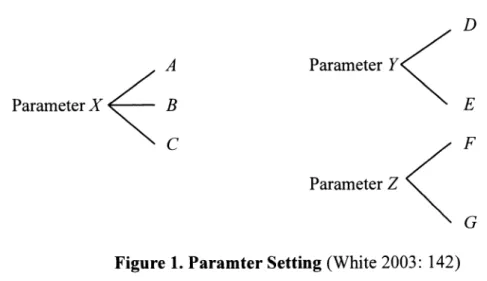
(18) As sttted above,most of the parmeters have bintty settings/values(whiCh are expressed by[土 ])and mutually exclusive. It has often been observed in experimental surveys in the L2 1iterature that L2 1eanrers'non口. native gr〔 Inmar has a par〔. Ineter valuc. which is different either from the value of their native language or from that of their. target languageo. There are two possible ways to show that L2 1eamers'non― native. gralnlnar has values which are expected to be different either from the native language. or from the target lttguage(c■ multi― valued settings(e.g。. White 2003).When a given parameter has. ,Governing Cttegory Parameter(Wexler and Manzini 1987),. 袖d Null Suttect Parttneter5(saleemi 1990),it Ctt be logically possible that L2 1earners'non口 native gramlntt has the setting other than their native language or their. target languageo. Look at Figure l below:. (a)haS II Sulject,or. (b)haS an INFL,or (C)haS a TNS,or (d)haS an indicative TNS,or (C)haS a r00t TNS. 5 we Omit going into any detail about Null Suttect Parmeter,for which the reader is referred to the proposal presented in Seelni(1990)田. 10. d Huang(1995)..
(19) E F. ∠ B C. Parameter χ. Pttaneter y. Parameter Z. Figure lo Paramter Setting(White 2003:142). In Figure l,par〔 Ineterゴ F has lnulti― valued settings;that is,parameterジ F has the three values of И, 3, and Co. When,for exttple,a native language has the valuc“ ∠ and a. target language has the valuc(3,L21ettners'non― native gralnlnar can have the setting. other than their n江 市e lttlguage or their target language(thtt iS, L2 1e2Hlers' non― n江 市e grammar hasthe value 3).. On the other hand, if we stipulate a di]brent par〔. Ineter for each syntactic. property of a given language, the properties which emerge in the intellllediate L2. acquisition stage can be explained with the combination of several par〔 Ineters. Suppose that a native language has the valuc D for par〔 Ineter ir and the valuc F for par〔 Ineter乏 7,and par〔 Ineter. a target language has the valuc」 E. for par〔. Ineter y and the valuc(3 for. Z,as showll in Figure l,L21ealttters'non― nttive gralnlnar is expected to. behave syntactically differently when it has the value」 E for parameter iF and the value F for par〔Ineter Z or when it has the valuc D for parameter y and the valuc G for. parameter Z(sec MaCLaughlin(1988)for relevant discussion on parameter se■ ings in SLA of reflexive binding with two par〔 Ineters,such as reflexive par〔 Ineter ttd Agr. parameter under Progovac's(1992,1993)Relativized sutteCt frmework).It haS thus been proposed in the L2 1iterature that the course of the L2 acquisition is expected to.
(20) be explained through demonstrating whether seelningly unrelated par〔Ineters in a target language and their values can be acquired or not。. Wexler ttd Manizini's(1987)GCP states thtt the binding domains of re■ are par〔 Inetrically. values stenl from?. e対 ves. deternlined;however,it is curious about where do the par〔 Inetric It has been adnlitted that a renelxive has its own parameteric. value concerning its locality of the binding domain when it is formed in a Lexicon. Given that each re■ exive iteln has its owll par〔 Ineter with respect to its binding domain as its priminitive property,UG adlnits tt least flve values for the locality of the binding. domain for a reflexive. constlutction―. Then, paEIneters have been proposed to be more. speciflc, the problem which is referred to as the ``atomization of. paralneters"(Saflr 1987). ThiS prOblem has been correctly pointed out by Bennis and Koster(1984:6)as fol10WS:``Too often ill― understood differences ttong languages tte silnply attributed to some new αグ乃θθpar〔 Ineter".. Accordingly9 it has been suggested. (Cf BOrer 1984,Fukui 1986, 1988, Cho]msky 1989,肛 ld Ouhalla 1991)thtt all parameters can be reduced to the iniectional system(Or functional cttegories).. Ltter in the history of the minimalist framework(ChomSky 1995〔 md its subsequent work),it has been widely acknowleged that pttametric differences in crosslingusitic variations stenl from some properties of lexical items and functional. categories/elements in languages concerned. The spirit of the minimalisln advocates. exclusion of theoretically unnecessary/redundant devices in order to explain the mechanisln of human languages and the process of the language acquisition with less syntactic devices.. We win ttgue in this dissertation that syntactic formal features. inherent in a lexical item and a functional category are regarded as the sole locus of syntactic par〔 Ineters which plays a crucial role in detelillining the syntactic properties. of a given languageo. We totally agree with the widely― accepted assumption that. 12.
(21) parameters detelllline the systematic differences between languages,but a theoreticany. signiflcant point here is how we can derive pttameterso To put it differently,where. do parameters come from?. Noticc here that the problem initially pointed out by. Bermis ttd Koster(1984)is still unsetteled if we attribute l〔 mguage differences to. some new αグ乃θ parameters"on forinal features. `“. In this dissertttion,we raect the widely― acknowledged idea thtt parmeters indeed exist as a a theoretically existent substance in UGo. We make the following. hypothesis,essentially following the Minilnalist spirit:The feature composition of a lexical item or a functional head deterlnines the syntactic properties of the relevant. itemo More speciflcally,when a le対 cal item(or a functional cttegory)iS Selected froln the lexicon and is inserted/extemally merged in a given syntactic derivation,the. syntactic properties of the relevant item(or itS mttimal prdectiOn)are determined by. だθκ夕gθ 4α θ the speciflcation of each 9-fetture(iee。 ,′ θ 4額ld“ π. bθ r― fettures)in. “ item.Thus,thc syntactic properties of lm item in transitional gramm鉗 often been referred to,in the L2 1itertture,asッ. rα θ′ Jθ βα 4化 ′. the. (which have. ∫)ought tO be γθ αθrソ α′ “. explained only with the speciflcation of the features that the item has in transitional. gramm鉗 .In this disse■ 激ion hereinatter,we aim to arguc(1)thtt all syntactic properties concerning the renexive binding in transitional gr〔Inm2r can be explainable. when we revealthe(de)cOmpOSition ofthe 9-feature speciflcttion for a given rene対 ve,. 袖 d th江. (五 )the. number of Speciflers thtt are a1lowed to be praccted in tralsitional. grammar can be explained when we reveal the(dc)COmposition of the 9-feature speciic江 lon for T(In■ )〔 nd D in transitional gramm鉗. .. Of theoreticany/conceptually signiflcant consequence here is that we have the following advantage:It is not necessary to stipulate any theoretically additional device; for,according to our proposal,all syntactic properties are properly explainable without.
(22) any recourse to conceptually unnecesstty syntactic par〔 Inetero. Now we would like to. stress that fonnal features,to which we attribute language variations,indeed,exist in UG for conceptual grounds;that is,formal features are regarded as virtually essential. for semantic interpretation and phonological realization. If we can explain the syntactic varieties in human language without assunling syntactic par〔 Ineters,they are no longer conceptually necesstty in the theory of human language.. We ctt therefore elinlinate the abovementioned problelns conceHling syntactic par〔Ineter. values: Are parameters multi口 valued or binarily valued?. parameter too construction― speciflc?. Is a given. In order to explain the syntactic properties of a. given language,we are no longer relying on the notion of syntactic parameter for each. syntactic property found in the languageo. Accordingly, it is demanded in this. dissertation that language acquisition should be considered as the acquisition of the 9-feature speciflcation in a relevant item in a target language.. Recently,the roles of. grammttical fettures in SLA have been investigtted extensively(ci Liceras,Zobl,and. Goodluck 2008,Lardiere 2008,2009,Travis 2008,Garcia Mayo and Hawkins 2009, 狙 ong others),so thtt the perspecitive in this dissert激 existing L2 studies on theoretical groundso. lon will surely contribute to the. Trying to share the ultilnate goal with. Hlinilnalist syntax,we will demonstrate that our theory,if reinforced with the idea of the 9-fetture(de)COmpOiSition,is conceptually plausible and theoretically superior to most of the traditional L2 studies,which have long adnlitted that syntactic pttameters with some settings/values are indeed built in UG independently.. 1。 4。. What is Transitional GlraⅡ. Hnar?. In this dissertation,in order to refer to the gralnmar which emerges at L2 1earners'. intellllediate acquisition stage, we usc a newly―. 14. 1/nOtion ″α″∫J′ Jθ 4α J coined tel三 二.
(23) grα. αr instead of J“ ′ θrル 4gγ αgθ μり ““. 1iterature.. grα. αr,which has long been used in the L2 ““. It is not an empirical description but rather a theoretical accout that the. goal of this dissertation is to give to the syntactic lnechanisnl for L2 1eanlingo. We. silnply assume that experilnental observations tte very signiflcant on empirical grounds in analyzing given linguistic data not only in the fleld of SLA but also in every fleld of linguistics.. As mentioned in§ 1.2,it has widely been acknowledged thtt L2 1ettners have a granllnatically consistent systeln as their IL gralnmar ttd it is assumed that their IL. granllnar is more or less constrained by UG.. It has oien been discussed whether the. initial state of IL gral― 霞 is fully or partially accessible to UGo. Moreover,it has also ially transferred to. been extensively discussed whether knowledge in Ll is fully or pa■. the initial state of IL gralnlnar,or whether it is not at all transferred to the initial state. of IL gral― are Therefore,Inany proposals about the initial state of IL gr〔 Inmar has ルα 。 ル r/Pα r′Jα J Иθθθss腕 グυJ(e.g., “ Tsimpli ttd Roussou 1991 and Hawkins and Ch狙 1997),力b ittα κφ r/FuJ′ ∠θθθss. been made in the L2 1itertture(such aS FttJ′. 拗 ル J(eogっ Epstein,Flyl■ nand Ma■ oharttono 1996),Fν JJルακψ. r/FuJ′. Иθεθss M9ル J. (e.g.,SChWartz 1996,1998,Schwtttz and Sprouse 1994,1996,2000,雛 ld White 2000)タ レα4Jer/FzJJ Иεθθ ssノンbα θ Pα ″ ′ Jα ′フ J(eog。 ,Vainikka and Young― И. Jルιss. J“ α. “ 助. Scholten's(1994,1996) フ αた Cθ 4′ Jκ γJク. fぅ夕θttθ Sお ,(which iS made in the context of ttθ '後. 乃θSJS fOr the Ll acquisition (scC Pinker 1984 and Clahsen et al.1994)), and θ′. ss腕 グυJ(e.g.,Eub〔mk's(1994,1996)フ レJν θJθ SS Fθ α′νrθ s Pα r′Jα J:ル α41推 ,r/Pα r′Jα J Иθθθ 五りpθ ′ 乃θSJS,and Eubttk,Bischot Hu]譴 tutler,Lcek ttd West 1997)(see White 2000,. 2003 for comparison of initial sttte and beyond)。. We alSO totally agree thtt L2. 1ettners' non― native gralnlnar is systematic and rule― governed. This dissertation,. however,emphasizes that we should elicit L2 1earners'non― native gralninar in their. 15.
(24) inte11llediate L2 acquisition stage in a deductive manner with some theoretical assumptions. We cannot fully capture their non― native gralnlnar only by experilnental observations.. Now,let us schemttize our aim in this dissertttion. Look tt Figure 2 below:. The Ll grammar of a native language. The Ll grammar of. L21earllers' 一. non― native gr〔 Inlnttr. 一. a target language(L2). Figure 2.L2Learners'Non‐ Native Clranlnlar. L21ettners'non― native gralnlnar looks like Figure 2. Note that Ll gr〔 1earners'tttget language has o■ en been refeHled to as二 2 grα grα ″ Jπ α r っ. InHlを r. of L2. αro The tellll二 2 ““. seems to be lnisleading,because some researchers also refer to L2 1emers'. ro Jη α っ non― native granlmar at the interlnediate acquisition stage as二 2 grα ″. l will not. follow either of the above usages. Throughout this dissertation,we will use the tellll rrα 4sJ′ Jθ 4α J. grα. αr for some flxed stage of the state for L2 1ettners'non― native ““. grammar and useニ ゴgrα. αr(√ α″rgθ ′Jα 4gν αgθ in order to avoid劉 ly confusion. ““ っ ″ ηαr only to refer to L2 Here,notice that we do not use the term′ rα κsJ′ Jθ ηαJ grα ″. 1earners' non口 native gr〔 Inlnfr but also to address a theoretically/conceptually signiflcant issuc as to how we should capture/explain the syntactic mechanisnl for L2 1earners'non― nttive gramman According to White(2003),we eXplain,following the widely― accepted notion of the interlanguage(IL)grammar(ci Selinker 1972),that IL. gragllnar is considered to be steady and systematic and shows rule口 governed behaviors.. Then,an important questiOn has been posed as to whether IL granllnar is constrained by principles ttd pttameters ofUG.. Notice that it has oftenl been observed in the L2. 16.
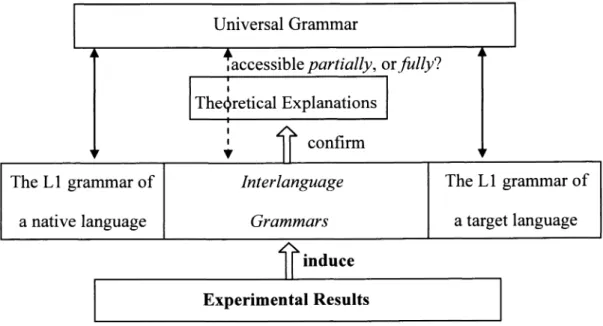
(25) literature that IL grammar is not steady and is different either froln the gral― ar of a native language or from the gralnlnar of a target language.. Then,how should we explain L2 1ettners'non― nat市 e grmmar(WhiCh has long ′ わι″ αr)? One method is to describe them j4グ "θ ““ otherwise,the other way is a dし dし にサJッ θexplanationo The fo.Hler inethod has been. been referred to as Z grα. ;. developed through most of the previous L2 studies,but the latter one is the approach we should ailn江 . Look tt Figure 3 below:. Universal G}ragllnar r′ Jα J″ ,OrjttJ″ ? Lccessible′ α. Theφ retical Explttations conflllil. The Ll grammar of. ルグθrJα 4gγ αgθ. The Ll gralnmar of. a native language. Grα ″っ″παrs. a target language. Induce Experilnental Results. Figure 3。 Data‐ based I■ メGraⅡ Hnars in L2 Studies. Previous/current L2 researchers have given priority to the issuc as to how to set out their experilnents;that is, how precisely they collect their experilnental results is a. matter of considerable concem to themo. Therefore, as showll in Figure 3 above,. before making a hypothesis about the status of IL granllnar, they inductively demonstrate,with wide― ranging experilnental data,how the theory for IL granllntt is forlnedo. Then, they conflilll whether or not their L2 data are properly explained. 17.
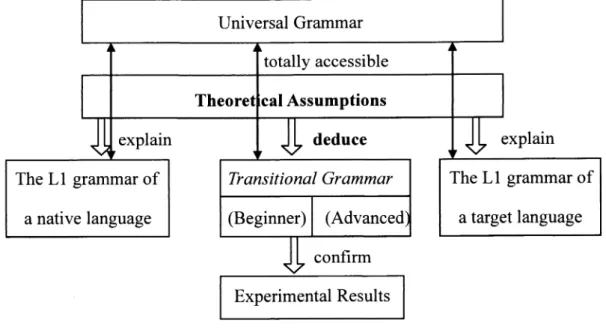
(26) through exsting L2 hypotheseso. lf there is any problem in procedures, given. sentences,background of experimental suttectS,and a way of setting out experiments, it will be expected that we will obtain a considerably different result from previous experilnental data.. As long as IL gr〔 Inmar is described according to experilnental. observations,it cannot help but remain unsteadyo. Empirically9 it seems prilna― facie. true that a granlmar varies somewhat from person to person.. It is presupposed. therefore thtt grammars should be idealized as one grammttical system(sec ChOmsky (1965)fbr thiS point). Reconsidering the study on L2 1earners'non―. native graΠ Inar,. we have two ways to investigJte how to formalize it; thtt is, the dJし. a―. based IL. grammar(as ShOWn in Figure 3)and the theory― oriented trttsitional grammat as shown in Figure 4 below:. Universal Gragllnar totally accessible. Theoret cal Assumptions deduce. explain. The Ll grammar of a native language. αr ““. ルα4sJ′ Jθ 4α J. G}rα. (Beginner). (Advanced. explain. The Ll grammar of a target language. conflHn Experimental Results. ″ παF Figure 4。 Theory‐ orientedル α sitio“ αJ GFα ″つ “. Figure 4 depicts our perspective hereina■. er;that is, current lninilnalist assumptions,. which are espoused to give a theoretically coherent accout to the lnechttisln of UG,. 18.
(27) should also be applied to L2 1ettl■ res'non― nttive grammar(trlmsitional grammar). Crain and Lillo― Martin(1999:55)sttte. that``Universal Grammar(UG)(is)a theOry of. the intemal organiz激 lon ofthe mind/brain of the l〔 mguage learnere… ….(S)inCe uG is. taken to be a theory of our biological endowlnent,the principles of UG should be observed in every natural language.". If UG is regarded mistakenly as one of the. language acquisition devices,as previous L2 researchers have argued,there soon arises 袖 issuc as to whether the initial state of L2 1eamers'non― native gramlnar is fully or partially accessible to UG,as shown in Figure 3。 under the current Minilnalist theorl‰. Notice that UG is no longer viewed,. as being a language acquisition device. As long. as L2 1emers' non― native gralnlnar is a type of the human language systenl, it is obvious thtt transitional grammtt is totally UG口 based(as shOWn in Figure 4),and the. abovementioned issuc as to whether the initial state of L2 1eamers' non口. native. gralnlnar is fully or partially accessible to UG is no longer the issue we should conslder.. This dissertation ailns to deductively elucidate and describe the syntactic mechanism for the totally UG― based transitional gralnlnar with theoretical assumptions which are stipulated to explain the syntactic lnechanism for Ll graglnaro is flrst required to idealize L2 1ettners'non― native granllnar.. Therefore it. Moreover,it is naturally. expected that each of their non― native granllnar can vary according to their leve1/stage. of their L2 1eanling and wc agree with L2 researchers in this respect. Now we strongly stress that we should flrst idealize L2 1earners' non口 native gralnlnar as. transitional grammar,however.As depicted in Figure 4(compared to Figure 3),we do not sce it as a problem that we do not cover a wide― ranging L2 1earners'non― native gralnlnar,which varies from learner to lettner.. We deduce the syntactic properties of. a given item in leamers'transitional gr〔 Inmar with some widely口 assumed theoretical. 19.
(28) hypotheses.. Then we next set out experilnents concerning the syntactic properties. resultso. When they. e r r u a o. 狙 d conflrin whether. theoretical deduction is consistent with the experimental. obtained data from. consistent with the experilnentally―. previous studies or from one's own experilnental surveys,it can be concluded that the validity of proposed theories/hypotheses is conflrmed on empirical grounds as well.. L21eamers'non― native gramlnar,which has been custon12rily called i配 ctt mel日 l various states of granllnar,depending on experilnental results。. ;grα. αr, ““. On the other. Jη α r refers to a particular state of graminar for an L2 1earnere っ hand,′ rα 4sJ′ Jθ 4α J grα ″. Therefore,our perspective on L2 1ettners'non口 native gramlnar in this dissertation is different drastically froln the one in the traditional L2 studies.. As we have seen in. ″ っ ηαr,Which we regard as theory― oriented,can be explained Figure 4,′ rα κsj′ Jθ 4αJ grα ″ through UG― based theoretical assumptions universally and uniforlnlyo. Consequently,. ηαr and rα 4sJ′ Jθ 4α J grα ′ we hereafter call L2 1eamers' non― native gralnlnar ′ “ distinguish it from the oft― used tettnotion Z grα. 1。 5。. αr in the previous L2 studiese ““. Variations in Syntactic Properties of Relmexive IBinding Trying to give a universal accountto the syntactic mechanism for the L2 1eaming. of renexive binding, we will brie■ y overview some various syntactic properties of. renexive binding. Anaphors can be divided into two morphological variations; namely9 simplex maphors(whiCh tte o■ en referred to as SE α4`フ 乃θrs)and COmplex 袖 a/phors(whiCh are o■ en referred to as SELF α″フ乃θrs)(Reinhart ttld Reuland 1993).. English,for example,has SELF anOphors alone,which are lnorphologicany made from. morphological variants of anaphora can be found in not a “ zJsJκ in Japanese, for instance,zJbπ 4,zJbπ 4-zJsJκ andん αrθ ―. 20. hoWever,universally,two. 響 師 .. a pronoun ttd the sθ J/suFIX,Such as ttJ“ sθ J/and ttθ rsθ. languages.. They are,. 袖 d女 2-zグ J in Chinese,.
(29) d∫ た乃 sθ Jbs′ in Gellll狙 ,zJε tt. sJθ 乃 肛. and zJθ. ttzθ. J/in Dutch,and sθ g and sθ g. sθ Jソ in. Norwegian. Syntactic properties of renexive binding, which are mainly concemed in this dissertttion are exempliied with the following four phenomena:(I)Locality of the binding dependency;(II)exiStence/absence ofthe suttect Orient[■ ion;(III)availability of the distributive reading;and(FV)availability of the neutral interpretation in′ θrsθ ″ ,. gθ ″ ル ζttd ttπ. bθ ′ .. “. According to the traditional Binding Theory A、 (ci ChOmsky 1981,and Cholnsky. and Lasnik 1993),an anaphOr lnust be bound in its syntactically local domain(what iS called bjκ 清4g aθ. a ・D. (1.1). αJ4).Look tt the English examples in(1。 1)be10W: “. Mary said[thtt JOhn criticized ttJ“ sθ グ]. Mav made[John criticize ttJ“. ∫ θ グ]. The embedded clauses which are in the brackets in(1。. 1)〔 re. regarded as the binding. domain of ttJ“ sι r and ttJ“ sθ J/must be bOund within each embedded clause by Jθ 乃4,. which is counted as its syntactic antecedent. The iEnglish renexives,therefore,are regarded as locally― boundo Returning to the well― knowll obSerVation that lnore than. ∫ 。complex)Can be found in quite a few languages,it has one re■ ex市 e folill(simplex ν widely been observed that a morophologically silnplex anaphor not only a1lows local binding but also a1lows long― distant binding, whereas a morphologically complex. anaphor only anows local binding except for some emphatic use as a logophor as found in the discourse binding(whtt iS Called“ Pica's(1987)generalizttion").Look 江 (1.2)beloW:. 21.
(30) ga zJb笏 (1.2) a. JohnJ_wa [Bilし ― John― ToP Bill― NOM Lit。. 41i/Ji―. ° hihansi― ta. to] it― ta.. SE― ACC Criticize― PAST C. `John said that Bill criticized°. KJohn/° KBill。. Say― PAST. ,. b.JohnJ― wa[Bilし ―ga zJbν 4-zお J刀 *:ノkarθ ―ZJSJ4*ィ ーo hihansi― ta to]it― ta. John口 ToP Bill― NOM. SELF/himself― ACC. Lit.`John said that Blll criticized*John/°. Criticize― KBill。. PAST C Say― PAST. ,. AInong the three forms of the Japanese reflexives,the silnplex fornl zJb露. ″is regarded. as a long― distant re■ ex市e(as ShOWn in(1.2a)),whereas the complex forms zjbν. れ"zJs加. andん αrθ ― zJsJ4 are regarded as locally― bound renexives(aS ShOWn in(1。 2b)). In the case of an embedded non― tensed clause(suCh as a caus江 市e construction),hOWever, one ofthe complex folilis zJbγ 4-zJsJ4 can be bound Over a non― tensed clause boundary, z″ ∫ J″ is still locany― bound, as as shown in(1。 3a), but the Other complex form λαrθ ―. shown in(1.3b)be10W:. (1.3). Johnプ ロwa John― ToP Lit。. [Bilし ―ni ZJbν 4-zJsJ4巧 rO hihans]― ase― ta. Bill― DAT. SELF― ACC. `John made lBill criticizc°. Criticize― cAUSE口 PAST. KJohry° KBill。. ,. o hihans]― aSe口 ta. ni λ α ″― zJsJ“ *ィ ー b.JohnJ― wa [Bilし ― John‐ ToP. Bill― DAT hilnself― ACC Criticize― cAUSE― PAST. Lit.`John made Bill criticize*Jolhゴ. °KBill。. ,. zJsJ4 with respect zJsJ4 syntactically behaves differently from λαrθ ― Why is it that zJbν ―. “. 22.
(31) to the locality on binding dependency?. It will be discussed in detail in§. 3.4。 2.. According to Faltz'(1977)typo10gical classiflcation,it has long been recognized that a silnplex anaphor with the property oflong― distant binding dependency shows the SuЦ eCt Orientation,as exemplifled by the Chinese example of zグ J in(1。 4)below. (Huang 1982,額 ld Huang and Tttlg 1991):. (1。. 4). Zhangsan, song Lisし yiZhang zグ Zhangsan. give. Lisi one― CLA. Lit.`ZhangsI弧 l gave Lisi a picture of°. Jノ. サ de xiangpian.. SE DE picture Kzhangsan/*Lisi.'. The silnplex fo111l zグ J Can be bound only by ttα 4gsα 4,which is assumed to be the. logical suttect, but nOt by ttJsJ, because ttJsJ does not have suttecth00do lt is zグ J, α―. therefore concluded thtt zグ J iS regttded as suttect― Orientedo ln the case of′. however,it also shows the suttect orientttion even though′. zゲ J iS mOrphologically α―. complex and locally bound,as shown in(1.5)beloW(See Xue 1991). (1.5). zグ j*〃 *た de zhaopi狙 ]. ZhttgsttJ shuO[Lisし song geiWLngwuた yizhttg″ ―. Zhangsan say Lisi give to Vぬ ngwu one― CLA hilnself DE picture Lit.`Zhangsan said Lisi gaveヽ Ⅳhngwu a picture of*Zhangstt°. KLisi/. *Wangwu.'. ― gsα 4,because the zゲ ′ Cannot be bound by Zhα κ The exttple in(1。 5)showS that′ α zグ α― embedded tensed clause boundtty inteⅣ enes between Zttα Qgsα 4 狙d ′. J・. In. zグ J,bec〔 mse it does not have sutteCth00d.Wh江 addition,物 4Pν callnot bind″ ―. induces the property ofthe suttect Orientation of a re■ exive? It will be discussed in. 23.
(32) detail under the current minimalist binding theories in§. 3。 4。 1。. Jソ θ srrJbγ ′ Another highlighted syntactic property of re■ exive binding is グ′. rθ. αttκ g.Look tt the Japanese rene対 ves in(1。 6)beloW:6. (1。. 6). [JOhtt tO Billた ]―. ga° LJbν 竹〇ノ KzJbπ 4-zJsJ竹 oた ―o. John and Bill― NOM. SE / SELF― ACC. sclnc― ta.. blame― PAST. Lit.`John bl劉田ted John,狙 d Bill blalned Bill。. '. The exmplein(1。 6)is acCeptable under the interpretation`John blttlned John,and IBlll bl〔. Ined lBill.'. We call the interpretationグ. distributively bound by Jb乃 ″袖 d」BJJJ.. ′ θrθ αグJ4g,becausc a reflexive is. Js′rJbν Jν. θ― zJ∫ J″ does not a1low On the other hand,λα″. the distribut市 e reading,resulting in the ill口 formedness of(1。. (1。. 7). *[JOh■ tO BilL』 ―ga. λα″ ― zた万4Jioた ―o. John and Bill― NOM hilnself― ACC. Seme―. ta.. blalme― PAST. Lit.`John blttmed John,and Bill blalned Bill。. Where does the difference between distributive reading come from? speciflcation in a reflexive in§. It. 7)beloW:. '. zJbν 4-zJsJ4 and karθ. ― zJs'4 with regard to the. will be explained with the aid of the 9-feature. 3。 2。. 6 ThrOughout this disse■ 江ion, the notttion ``為 Θ k'' means thtt X is bound distribut市 ely by tt ald. あthtt β. iS,if a cottoined antecedent[otJi ttld. 』cm bind a β. singular reflexive fornl,the reflexive is interpreted as being coreferential distributively. with each of%and β たdiStributively。. 24.
(33) Whether a re■ exive a1lows the neutral interpretation for each of the 9-features or not is another important point in detellllining the syntactic properties of the renexive。. For instance,the pronominal ptt within the English renexive乃 ′sθ J/cttries the. “. speciflcations for 3rd person,masculine,singular,狙 d the prononlinal part within the zゲ J Carries the speciflcations for 3rd person and singular,but it Chinese re■ exive′ α― zグ JC〔 m be bound either by a male ィ ルr;thtt is,た ― “ mtecedent or by a female tttecedent.The notion of the(under)SpeCiflC江 lon will be. a1lows the neutral inteTretttiOn in gθ. deflned in§ 2.1,2。 2,and 3。 1.. It is obvious from these observations that the abovementioned syntactic properties of reflexive binding are not regarded as Jα regarded as Jθ χJε α′properties.. gθ ― speciflc,but should be 4gγ α. Notice that it is necessary for most of the previous L2. studies to presuppose that an Ll anaphora, when Ll has more than onc anaphoric expression(as in Japanesc), iS tO be selected as the source of resetting or transfer, because the Syntactic properties of renexive binding vary froln itenl to iteln as have. been overviewed in this section.In the next section,we will outline some mttOr proposals in the L2 studies of renexive binding in JLsE's IL gr〔. Inmar and point out. conceptua1/1nethodological problelns inllnanent in them.. 1.6。. Major Proposals and Their Conceptual Problelms ln the UG― based studies on SLA,PARAMETER RESETTING APPROACH(hereafter,. PRA)(coge,Finer ttd Broselow 1986,Hirakawa 1990,Thomas 1995,MacLaughlin 1998, and Nま anabe et al.2008, a■ ong lnany others)), and LEXICAL TRANSFER APPROACH(hereafter,LTA)(e.g。 ,Yuan 1994,Ishino and Ura 2009,狙d lshino 2010, 狙 ong others)are widely recognized as a foremost approach to L2 acquisition of re■ exive. bindingo. As for the studies on the L2 acquisition of reflexives by JLsE,a. 25.
図
+7




関連したドキュメント
[r]
[r]
[r]
[r]
[r]
[r]
[r]
[r]
