of Policy Studies
journal or
publication title
Kwansei Gakuin University humanities review
volume
20
page range
165-188
year
2016-03-31
Kwansei Gakuin University Humanities Review
Vol.20, 2015 Nishinomiya, Japan
The Learning Assistance Center in the School of Policy Studies
1Jennifer JORDAN * Darby MCGRATH **
Leslie ONO***
I. Introduction
Academic writing presents a unique challenge to second language (L2) students. Not only does it assume a highly specific lexico-grammatical competency, but it also requires students to develop control of a suite of rhetorical devices that may be alien to them. The Learning Assistance Center (LAC), established in the English Language Program (ELP) at the School of Policy Studies on the Kwansei Gakuin University Sanda Campus, was conceived of as a means of helping students deal with this challenge. This article describes the development of the LAC over the four years it has been a part of the ELP. This includes the process of conception and inception, Learning Assistant (LA) training, and the means by which data are collected to maintain quality control and inform the continued evolution of the LAC. Additionally, it discusses how the LAC is aligned with writing-center theory and similar centers in other institutions, as well as what makes the LAC unique. This article is intended as a description of the LAC and its
1 Many people deserve acknowledgment for their effort and contributions to the establishment,
development, and continuous support of the Learning Assistance Center. First, much appreciation is owed to the whole team of Associate Lecturers of English who have worked in the English Language Program over the last four years for their contributions to discussions on the development of the LAC. In particular, Michael McAuliffe and John Rylander were the Writing Coordinators who worked on the initial conception of the LAC and its integration into the English Language Program writing curriculum. Additionally, we are indebted to Dr. Takako Yamada, the Associate Dean of Academic Affairs at the time, who oversaw the initial establishment of the LAC, and Mr. Noriyoshi Omori who has worked tirelessly as the administrator in charge of the LAC to ensure that the LAC has run smoothly.
* Associate Lecturer of English, School of Policy Studies, Kwansei Gakuin University. ** Associate Lecturer of English, School of Policy Studies, Kwansei Gakuin University.
*** Associate Professor, Director of the English Language Program, School of Policy Studies, Kwansei
function in the program. A subsequent article will discuss issues and refinements resulting from further, more detailed research.
II. The Context
The ELP is a required four-semester intensive English for Academic Purposes (EAP) course for first and second-year undergraduate students in the School of Policy Studies (SPS). Approximately 500 to 600 new students enter the program each year. Students join one of two ELP curriculum streams based on their entrance English proficiency levels as measured by the Institutional Test of English as a Foreign Language (TOEFL ITP). The average TOEFL ITP score for entering freshman cohorts is approximately 425, with a range of 320 to 610. The cut-off score for placement into the intermediate and advanced streams varies slightly each year, depending on the cohort size and performance on the TOEFL. The average cut-off is approximately 410, with students who received a score of 410 and below placing into the intermediate stream, and the remainder placing into the advanced stream. In Spring 2015, there were over 1100 students in the ELP - approximately 370 in the intermediate stream and 730 in the advanced stream.
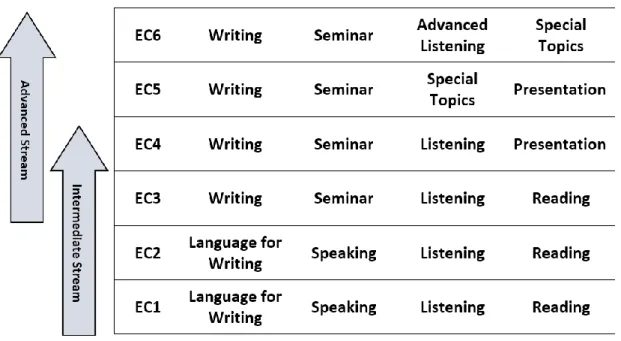
Within each stream, students participate in four, weekly 90-minute EC courses per semester over four semesters. By the completion of the two-year program, students will have finished approximately 336 hours of in-class English study. Figure 1 below provides an overview of the two-stream ELP curriculum.
Figure 1: The two-stream ELP curriculum
As figure 1 shows, the intermediate stream runs for four semesters from EC1 to EC4, and the advanced stream runs from EC3 to EC6. The first year of intermediate classes have a heavier focus on reading, grammar and vocabulary. The second year, beginning with EC3, is the point at which more intensive academic skills are introduced. EC1 and 2 can be considered preparatory classes for EC3 and 4. Advanced-stream students begin at EC3 and finish at the EC6 level, which requires academic discussions, research essay writing, listening to academic lectures, and a content-based integrated skills course. The entire program is intended to prepare students to study in English-medium university classes.
The ELP is a coordinated program in which a team of 11 full-time course coordinators develops the course materials and works with part-time instruction staff to ensure as consistent an experience as possible for students across all sections of a course. Additionally, the courses are vertically and horizontally integrated. In terms of vertical integration, this means that skills build according to level, so students in EC3 Writing can expect to learn paragraph writing skills that they will use, practice and build on to complete a researched problem-solution essay at the EC6 level. Horizontal integration is primarily thematic, although there are overlapping grammar, lexical and rhetorical goals across courses at each level.
Anywhere from 9 to 30 sections of each course are taught by up to 30 different teachers using a common syllabus. The common syllabus is designed to ensure that teachers cover the same material and assessment is as consistent as possible. The two main goals here are to ensure that all students, regardless of their teacher, are prepared for the next level, and that grading is fair across sections.
While the program as a whole is rigorous and demanding, students tend to find the writing courses the most difficult, in part because of the workload and in part because of the difficulty of the skill. As Vyncke (2012, p. 53) suggests, L2 academic writing students often struggle with “insufficient subject knowledge, lack of authorial ‘voice’ and lastly, the restrictive conventions and canonical structure of the essay genre”. The writing courses in the ELP tend to place the greatest demands on students’ time outside class. Additionally, the process writing approach taken in the courses places the onus on students to interpret and act on written feedback almost entirely independently. Time in class for face-to-face conferencing is very short. Also, part-time instructors teach the majority of courses in the ELP, and they have limited time on campus to meet with students outside normally scheduled classes.
III. The Stakeholders
EC students are the primary stakeholders in the LAC. From their perspective, the LAC is a place where they can ask questions about their papers or writing generally, or discuss writing problems with a senior student. The LAC is used primarily by students who struggle with both the lexical and grammatical aspects of writing and rhetorical structure.
The Learning Assistants (LAs) are the senior students who provide the LAC services. They are third and fourth-year students in the School of Policy studies. They are recruited based on a formula that takes into account their TOEFL scores (which range from 500 to 600 in the current cohort), and their final EC5 and EC6 Writing scores. Additionally, the final short-list of candidates is further screened based on their final test-essay in EC6 Writing. The aim is to ensure that the student has control over both rhetorical structure and English vocabulary and grammar usage. These procedures serve to remove candidates who may have responded particularly well to feedback while in the ELP, but who are unable to produce a coherent essay independently and are therefore unlikely to be able to assist students in developing their own writing skills.
Other key people involved in the LAC are the LAC Coordinator, the LAC Manager, the Writing Coordinators, and the ELP Director. The LAC Coordinator is a graduate student, ideally an LA who has stayed on to attend graduate school, who acts as translator and trainer, and handles some administration. The LAC Coordinator is available to liaise between the Writing Coordinators and the LAs and to provide the training sessions at the beginning of each semester. The LAC Manager is a full-time course coordinator who distributes LAC-related materials to the LAs. The Manager also oversees the website, holds extra LA tutorials, monitors LAC data, and screens new LAs. The Writing Coordinators are responsible for integrating the LAC into the writing curriculum, making sure that instructions to LAs are clear with respect to their courses, and ensuring that the LAC-related course assignment dates are accurate so that the administrators can plan and staff the LAC accordingly. The ELP Director manages the program, so she advises on the LAC Committee and consults with the SPS administration on LAC budgeting issues as needed.
Finally, there are two SPS administrative staff members who play a significant role in ensuring the LAC runs smoothly. They handle LA recruitment and scheduling, which involves reconciling the ELP course assignment timetable with the schedules of the individual LAs. This is a complex task and is essential to the smooth operation of the LAC throughout the semester. Additionally, the administration takes care of budgeting and paying the LAs. Finally, they help to administer the website in terms of keeping the online appointment system running smoothly throughout the semester.
IV. The LAC 1. Design
In 2011 the university allocated a special budget to each department for the purpose of supporting peer-assisted learning within the undergraduate programs. The SPS faculty leadership at that time consulted the ELP Director to determine how such funding could best be used to support SPS students in their academic English studies. Given the demanding nature of the writing courses and the particular challenges faced by L2 writing students, the decision was made to establish a writing center.
During the initial LAC planning stages, the writing curriculum developers met with the program director to discuss ways in which a peer-assisted tutoring system could work within the coordinated ELP context. One idea was to bring past successful students into the writing classes, effectively creating teacher assistants for in-class support. This was rejected because it would have been impossible to employ sufficient assistants to staff as many as 30 sections for each writing course. The size of the program meant that additional writing support would be more feasible outside EC class time, which led to the development of the LAC.
The overall goal of the LAC is to help students become better English writers. This goal is realized through providing bilingual assistance in understanding and responding to teacher feedback and a place where students can ask questions about essay organization and rhetorical structure. However, each writing course approaches this goal in a slightly different way.
At the EC1 and 2 levels, the longest piece of writing students undertake is a paragraph. For this reason, the function of the LAC at this level is twofold. While EC1 and 2 students do receive assistance in responding to feedback, there is also a focus on preparing them to take full advantage of the center in EC3 and 4. EC1 and 2 students are asked to complete an “LAC Task”. This task requires students to use the LAC website to register for a session in pairs. This session is essentially a truncated version of what they will have in EC3 and 4. They are required to reflect on the feedback their teacher has given them on a short paper, and discuss how they intend to respond to it. Additionally, they are tasked with adding an additional detail to their paragraphs. In this way, they use the LAC as a developmental tool to both understand and respond to teacher feedback and add depth to their writing.
At the EC3 and 4 level, the goals of the LAC are realized through 1) required attendance for students who receive a failing score on a first draft or who are sent by their teacher to get help with a specific area of their essay; 2) voluntary attendance for any student at any point in their writing process to ask questions or discuss ideas; or 3) an LAC bonus task. The required attendance policy assumes that a score of 60% or lower indicates that the student has failed to write a satisfactory paper. Teachers may also require attendance for students with passing grades if they feel the student will benefit from help with a certain aspect of their writing. Secondly, the LAC is available to any student who wishes to discuss their assignment at any stage of the writing process. For some students this involves bringing their preparation materials to the LAC to discuss
organization, for others it may be to ask questions about something they were unable to understand in class. Finally, there is an LAC bonus task. This task is available for students to earn up to 5 extra points on their writing score. The task requires them to prepare ideas for a paragraph on a set topic, and then further develop those ideas at the pre-writing stage with the help of the LAC. Finally, they write and submit the paragraph for their teacher to grade. The purpose is to help students to create a hierarchy of ideas from topic sentence level, to supporting idea, to supporting details. This is an optional task for extra course credit, and not all students choose to do it, but teachers can recommend it to those they feel would most benefit.
Integration of the LAC at the 5 and 6 level is similar to EC 3 and 4, but there is no bonus task. Students are still required to attend for first draft grades below 60% and if their teacher requires attendance for another reason. They may also voluntarily use the LAC at any stage of their writing process. This integration into the ELP ensures that students understand the purpose of the LAC and use it when they need it most.
Grammar and vocabulary are not explicitly mentioned in the goals of the LAC. There are several reasons for this. First, this is based on an assumption that LA input in these areas is unlikely to lead to generalizable improvement in a student’s control of grammar and vocabulary. This is because vocabulary, and to a lesser extent grammar, are highly context dependent. LAs are more likely to facilitate some improvement in students’ writing if they remain focused on more general skills, such as organizing an essay. Secondly, the LAs are non-native speakers of English. While their command of grammar and vocabulary is likely to be better than that of their student-clients, there is a concern that they will mislead students with respect to language in areas where their own knowledge is incomplete. By asking LAs to focus primarily on structure and content, the likelihood of accidental misinformation is reduced with regards to grammatical inaccuracy being passed on to students. This should be a consideration in any peer-assisted language support program in an EFL context. Finally, there is a concern to make sure the aims of the LAC coincide with those of the writing program as a whole. Priority in the writing classes in the ELP is on students gaining control of generic conventions in academic writing, and the LAC is intended to support this aim.
Most of the visits to the LAC come from students who need help responding to teacher feedback, either voluntarily or as required by their teachers. This is one of
the major benefits of having the LAC operating outside class time: it can be utilized to provide writing development support at the point when students can benefit most – at the revision stage between students’ first and second drafts. In the time between receiving feedback on a first draft and submission of their final draft, students often have little or no contact with their teachers. During this time, the LAC is available to help students in several ways. Often, students make their own attempt to respond to teacher feedback then visit the LAC to check that they are on track. Other times, they ask LAs for help interpreting the feedback and determining how best to respond. For those with limited language skills, understanding their teacher’s comments and suggestions for improvement can be a significant hurdle to making the improvements they need.
The LAC is located in a classroom allocated by the administrative office. The room permanently holds computers and other resources such as a dictionary, informational posters, and course materials packets. Up to three LAs and their client-students can work in the room at one time. This allows for a maximum of 51, 25-minute sessions per day at the busiest times in the semester. Appointments are booked via the LAC website. The website has basic information about the LAC as well as a simple booking system, all of which is linked to the larger ELP website. Students receive an email in both English and Japanese from the website upon making a successful booking. A link in the email can be used to cancel the booking if necessary. LAs can access the day’s appointments via a password-protected page on the website.
2. LA Training
Success in the ELP program is the main prerequisite for a student to become an LA. In this sense, the LAs already have considerable experience of both the writing program, and sometimes the LAC itself, prior to recruitment. They are therefore familiar with the metalanguage and concepts the courses aim to teach. These include the key points of essay organization, such as topic sentences, thesis statements, supporting ideas, as well as references and citations. This means that training can focus on how LAs can help their student-clients acquire the same understanding of the EC writing expectations. This is done during two LA training sessions held at the beginning of each semester and through the LA Guidelines document intended to provide further support for the LAs in their role (see Appendix A).
The training sessions at the beginning of each semester cover the job description, explanation of the technology involved, details about LAC integration into the three writing course levels, a short training video which models a successful LAC session, and thorough coverage of the LAC Guidelines document. It also provides an opportunity for new and returning LAs to get to know each other better and for returning LAs to offer advice gleaned from their experiences in the LAC. Finally, the LA training sessions provide an important chance for some of the LAC stakeholders, including the LAs, Writing Coordinators, and administrative support, to meet prior to the launch of the LAC each semester. There are a number of different groups involved in supporting the LAC system, and the training sessions represent the only real opportunity they have to come together and share their respective experience, and benefit from the perspectives of other stakeholders.
The LA Guidelines are an 8-page document that detail how a session should be conducted, how the LAC is integrated into the courses, and related administrative information. The LAs receive the guidelines in advance, so the LA coordinator is able to emphasize the salient points as well as alert new and returning LAs to any major changes in the courses. The advice to LAs on how to conduct a session focuses on helping LAs to act as coaches, encouraging students to find solutions to problems their teacher has identified in their writing. Perhaps the most salient point in the document directs LAs not to offer help beyond what is appropriate as a facilitator. The document offers practical advice on how to do this including putting the onus on the student to ask questions or direct the session, not having a pen or pencil in hand so as to avoid rewriting for students, and having students deconstruct a model to highlight weaknesses in their own work. Additionally, it suggests that LAs use the course materials to point students to an appropriate lesson, model essays, or other reference pages as needed.
3. On-going evaluation
A commitment to ongoing monitoring and evaluation of the LAC is vital to the success of the center. To this end, considerable effort has been made to develop methods for critical evaluation of the LAC. The data regularly collected on the LAC include an online session log, student feedback survey, teacher feedback survey, and LA feedback survey.
(i) LAC Online Log
The LAC Log allows for online record keeping of every scheduled LAC student visit. The log is currently run through ‘Cognito Forms’, an online form building service. At the beginning of each LA – client session, the LA enters basic information about the participants, including the names and student numbers of both the LA and student, the date and time of the session, and the writing course the student is attending. At the end of the session, the LA summarizes what was discussed during the session. This allows for useful monitoring of LAC attendance by course, by individual class, by individual student, and by the individual LA in charge of each session. This information can be exported and filtered to look for a number of trends, including how students within a particular course are using the LAC, the days and times that the LAC is most in demand, the writing issues that LAs are encountering by course and assignment, which writing courses and writing assignments are resulting in the most LAC visits, and any particular challenges LAs encounter.
(ii) Student Surveys
The student feedback survey is connected to the online session log, so that the email address entered for the student is automatically sent a link to an online survey (supported by SurveyMonkey.com) after the session. This allows students to comment on their session while it is still fresh in their minds. The survey is in Japanese to ensure students’ understanding of the questions and to reduce the imposition on their time. The survey provides an opportunity for students to provide feedback about their recent LAC session, as well as suggest ideas for LAC improvement.
(iii) EC Teacher Surveys
EC writing teachers receive a similar survey asking about their experiences with the LAC over the course of the semester. This allows the LAC Committee, and the Writing Coordinators in particular, to better understand teachers’ views on the LAC. In particular, questions address teachers’ understanding of the role of the LAC in the program, what writing issues teachers felt the LAC was able to address, and where the LAC could benefit from change or further clarification for students and teachers. For example, if teachers regularly comment on the LAC addressing grammar feedback, writing coordinators can address the purview of the LAC with the teachers. Finally, it allows teachers to offer suggestions for how the LAC could better serve students.
(iv) LA Survey
The LA feedback survey is also conducted through SurveyMonkey.com. The LA feedback survey allows the administrators to understand successes and frustrations for LAs as well as their overall satisfaction with the job. It also asks LAs to comment on their training and how that might be improved, as well as what resources could help make the job easier for them. Finally, they can comment on the assignments and materials, the website and its usefulness, and teacher feedback. The information collected here allows the LAC Committee to better understand how to make the LAC sessions more productive for students and easier for LAs. It also often has a washback effect on the program as LAs see more teacher feedback than writing coordinators, and can sometimes offer suggestions for how teachers can improve in this area.
The results of all of these surveys are shared with the Writing Coordinators, the LAC Manager, and the Program Director. The writing coordinators use the data to inform the future integration of the LAC into the writing courses, and sometimes to help direct course development. Early surveys, for example, highlighted that teachers and students needed a better understanding of the limitations of the LAC. Both groups seemed to view the LAC as a grammar workshop. Better course integration, explanations for teachers and students, and a clearer explanation of whythe LAC should not address grammar and vocabulary issues significantly reduced the confusions in this area. Additionally, the data have been used to improve the logistical workings of the LAC. The LAC website is an example of this. For some time, making an appointment for an LAC session was done on a sign-up sheet posted outside the LAC. This meant that students had to make and cancel appointments in person. Feedback data suggested that when appointments were cancelled it was sometimes difficult to see that there was space available, meaning students did not sign up in those spots and LAC sessions were wasted. Also, as students could not cancel from off campus, if they were unable to make their session, the session was wasted. The response was to introduce the online booking system, which has made it possible for students to make LAC appointments from their smart phones or computers. Additionally, appointments can be cancelled from home if the student cannot make the session. This has reduced the number of wasted LAC sessions. Finally, student feedback suggested that first year students in particular did not know what to expect from an LAC session and were therefore reluctant to make an appointment. This has led to the recent introduction of LA visits to writing classes in which they present a 5-minute overview of the LAC in Japanese and explain the help that students can get there.
It is hoped that these talks will reduce student anxiety about attending the LAC for the first time.
V. Placing the LAC in Writing Center Theory
The LAC shares a grounding in Writing Lab Theory with other centers in both native English settings and in EFL settings. This section will discuss the primary similarities and differences between the LAC and writing labs found elsewhere.
First, of central importance is that the goal of the LAC is the same as most writing centers: “to produce better writers, not better writing” (North, 1984, p. 438). North’s essay has had a significant impact on the development of writing centers, first in the United States and then elsewhere. His principle argument is that writing centers, while often seen by teachers and students as editing warehouses, should be designed to have students and tutors work together to improve writing skills with a piece of writing providing the medium. In principle, the LAC has goals common to writing labs, which aim to serve writers by helping them improve their writing skills. This is manifested in the LAC first as a focus on structure, and secondly on the idea that the LA act as coach, with the writer leaving the session with nothing more than they were able to produce independently.
Secondly, like other writing centers the LAC provides an alternative to the traditional classroom. Writing centers elsewhere are staffed by either peer tutors or professional teaching staff, but in either case they provide a one-to-one setting for the discussion of writing. The LAC follows the peer-tutor model of the writing center, which has the advantage of a more relaxed atmosphere as well as the shared experience of the ELP. As Bruffee discusses, peer-tutoring can change “the social context” of learning, giving students an alternative to the traditional classroom and the traditional teacher-student relationship (1984, p. 206). Students using the LAC have commented that they feel more comfortable asking for help from an upperclassman than asking their teacher. This may stem from either the different social construct in the LAC than in the classroom, or may be a result of being able to communicate in their native language. In either case, the LAC provides students an alternate context for learning and improving themselves as writers.
Writing Centers in EFL settings have unique challenges. While the emphasis in the LAC is on responding to feedback on organization, students often respond
much more readily to grammatical feedback. Rafoth observes that many non-native writers seem only to want to make grammatical changes because they are easy, however he goes on to suggest that rather than a lack of willingness to improve rhetorically, it is an inability to improve their structure that thwarts them (2009, p. 156). If students are unable or unsure of how to respond to feedback on content, they will likely be unwilling to spend the amount of time necessary to revise. The LAC was designed to help students in this area by having them explain the feedback they have received. LAs first ensure that the student has understood the feedback correctly, and finally ask the student to explain how they intend to respond. Additionally, keeping students involved and asking and answering questions serves to ‘reinforce the writer’s responsibility in the conference’ (Bruce, 2009, 37), which is key to ensuring that an LAC session is not about improving a single paper, but leads to improvement in the writer. The LAs then guide students through their responses to the feedback, asking questions to try to encourage the student to find solutions to their own writing problems.
The main difference between the LAC and a majority of writing centers elsewhere is the use of non-native tutors. This has several effects on the LAC’s fit in writing center theory. First, according to Staben and Nordhaus, native English speaking tutors reading non-native’s papers are likely to be so distracted by the language issues as to make it difficult to focus on how well the writer has conformed to the other expectations of academic conventions and structure (2009, p. 79). The question of whether this is also true for non-native tutors is not clear, but several things suggest that it might not be the case or may play a less significant role in a tutoring session. Tutors in the LAC share a native language with the writers which means that a sentence which would appear to have significant problems to a native tutor may be easily understood as a result of transfer and therefore not as distracting for the LA. Additionally, a non-native tutor may simply be able to ignore grammatical issues in a way that native tutors cannot. Finally, although students are made aware that the tutors are not there to ‘fix’ their papers, they may still approach the center with this expectation. However, non-native tutors are perhaps less likely to feel that their own grammar is up to the task of editing another student’s paper. This would likely lead to the LA guiding the student back to the larger structural issues.
The second major difference between the LAC and many other writing centers is its integration into the ELP. Most writing centers are program-independent, providing support for writers in any number of different courses, sometimes in more than one language (e.g. Waseda University’s Writing
Center) and even for faculty as well as students (e.g. Hanyang University’s English Writing Lab). The close integration of the writing center into the writing courses limits the center in a way that is both beneficial and detrimental. It ensures that students understand its purpose and make use of it. Also, because the range of writing genres, topics, and styles is restricted by the nature of the program, LA training can be directed specifically at a defined set of problems that students are likely to have. On the other hand, this reduced scope means that students cannot take advantage of the LAC for other purposes. While in other settings students could get help from a writing lab in preparing an English resume, for example, in the SPS LAC they cannot.
VI. Associated Research
Data collection is carried out every semester to facilitate the smooth operation of the LAC and continuity between semesters, regardless of changeover in personnel. In addition, the authors have conducted further research in the LAC including student interviews, LA focus groups, an LAC coordinator interview, teacher interviews, and administration interviews as well as observations of LAC sessions. Each round of data collection was done in a different semester to spread the workload out somewhat. The results of this research and how the ELP responded to it will be included in a future article.
VII. Conclusion
The LAC shares the goals of traditional writing centers, but approaches them quite differently. The effect of this is that the LAC produces benefits and faces challenges that diverge from those of a more traditional writing center. Most writing centers are more independent of the programs they serve, meaning they have a broader scope than the LAC, but are not in a position to offer the kind of focused assistance that the LAC can offer. The LAC can directly address the objectives of the writing program it is designed to serve, which was its foundational remit. The LAC is likely to continue to be closely aligned to the objectives of the ELP writing courses. This said, it is a work in progress and new data continue to point to ways in which the LAC can be oriented to help students satisfy the objectives of writing program.
VIII. References
Bruce, S. (2009). Breaking the ice and setting goals. In: Bruce, S. and Rafoth, B. ed. ESL writers: A guide for writing center tutors. Portsmouth, NH: Boynton/ Cook, 149-160).
Bruffee, K. (1984). Peer tutoring and the ‘conversation of mankind.’ In: Barnett, R.W. and Blumner, J.S. The Longman guide to writing center theory and practice. Tokyo: Pearson Longman, 176-188.
Hanyang CTL English writing lab. Retrieved August 12, 2014, from http://hanyangowl.org
North, S.M. (1984). The idea of a writing center. College English. 46(5), 433-446. Rafoth, B. (2009). Responding online. In: Bruce, S. and Rafoth, B. ed. ESL writers:
A guide for writing center tutors. Portsmouth, NH: Boynton/ Cook, 149-160). Rodis, K. (2008) Mending the damaged path: how to avoid conflict of expectation
when setting up a writing center. In: Barnett, R.W. and Blumner, J.S. The Longman guide to writing center theory and practice. Tokyo: Pearson Longman, 176-188.
Staben, J. & Nordhaus, K. (2009). Looking at the whole text. In: Barnett, R.W. and Blumner, J.S. The Longman guide to writing center theory and practice. Tokyo: Pearson Longman, 176-188.
Vyncke, M. (2012). The concept and practice of critical thinking in academic writing: An investigation of international students’ perceptions and writing experiences. Unpublished masters thesis, King’s College London. London, UK.
What is the writing center: Greetings from the director. (2014). Retrieved August 12, 2014, from http://www.cie-waseda.jp/awp/en/wc/message.html
IX. Appendix A
Guidelines for Learning Assistants – Spring 2015
Thank you for agreeing to work as a Learning Assistant (LA) in the Learning Assistance Center (LAC). Usage of the LAC is integrated into the following Spring 2015 courses: EC1 Language for Writing, EC3 Writing, EC5 Writing. Please carefully read the guidelines below. These guidelines will help you understand the nature of your work; in particular, what kind of help you can give, and what kind of help you should not give.
Basic job description
For EC3 and 5 Writing courses:
Your job is to work with students to help them understand the feedback from their teacher and to help them respond to this feedback with appropriate improvements. You should not correct spelling or grammar, write sentences for students, or tell them what to write. You can direct students to errors, but do not make the corrections yourself. One way to make sure you do not write is to make it a habit to keep your hands empty (i.e., without a pen or pencil) during these feedback sessions.
For EC1 Language for Writing:
Students will have a task that they must complete with you. LAs should accomplish two things: 1.) help students understand the feedback symbols their teacher has written on their assignment and 2.) confer with the students that relevant detail has been added to their paragraph. (As in EC3 and EC5 Writing,
you should not correct spelling or grammar, write sentences for students, or tell them what to write. You can direct students to errors, but do not make the corrections yourself). For more information, please see the information below following “EC1 Language for Writing”.
LAC Online Log
You must complete and submit an LAC log entry after each student session. The Spring 2015 LAC Log URL is:
At the start of each session, you should: 1) open a new log entry
2) gather the necessary basic information from the student and enter it into the log
(i.e. student name, ID#, course, class section, email address, and number of LAC visits this semester)
At the end of the session, you should add your “notes on the session”. For writing students, briefly note the main issues that were addressed during the 25-minute session. For example, in EC3 Writing, “We discussed teacher feedback on Assignment #1, 1st Draft. We talked about ways the student could add more detail to support his ideas. He also improved his concluding sentence.”
In the case of EC1 Language for Writing you can write a simple note such as
“Completed Feedback Symbols Task”.
How to lead a session for EC Writing students
1. Explain clearly to the student that you will try to help her or him where possible, but you cannot re-write their work. One way to begin a session might be to ask, “How can I help you?” or “Do you have any questions for me?” Another option would be to ask the student to explain the things they already have corrected or plan on correcting/changing for themselves. This may give you a larger picture of the kinds of things the student feels able to do by themselves and where they might need help.
2. Ask the student to explain what the teacher has given for feedback, and make sure that the student has clearly read and understands what their teacher has written and wants them to do. If the student does not clearly understand the feedback, then you should read through what the teacher has written, and, as far as you are able, explain to the student what should be done. If necessary, get the student to repeat back to you what you have said to make sure that they clearly understand what to do. At some point, you may feel the need to ask the student to reread the assignment directions or grading sheet from the student materials. Sometimes the problem comes from students not fully understanding how to do an assignment. Use whichever language – Japanese or English – you feel is best for clarifying the problem.
3. Ask the student how they are going to try to respond to their teacher’s feedback. This will probably be the most difficult part of the session, because the student may not know what to do. If this is the case, it may be necessary for you to repeat key points from the feedback. By repeating the teacher’s feedback and by encouraging the student to talk about how to respond to this feedback, you will probably help her or him to see more clearly what to do next. Try not to tell the student directly what to do. Instead, wait for the student to come up with ideas, and then either encourage and develop these ideas, or ask the student to think again.
Though it may be difficult at first, it is important for students to think of the solutions by themselves. Writing is generally about solving problems – either grammatical or organizational – and the best way for students to learn is to make their own decisions about how they plan to fix these problems. Our job as teachers and LAs is to coach the students and encourage their progress. 4. In cases where the organization of the assignment is weak, you can show the
student the models in the course materials and ask the student to compare their own work with the model. In cases where the content (ideas) of the work is weak, it is best to take time to get the student to describe clearly the main ideas of their assignment, get them to identify which ideas are weak and strong, and get them to explain how they can change or develop their weak ideas. By talking about their work, the student may come to see much better the changes that they should make. Saying things aloud will assist in helping students make more sense of an idea they are confused about. If you ask questions to help fill in missing parts, this can also assist in helping learners come up with possible solutions.
5. When the students you assist leave, their work should only show what they were able to do. What they were not able to correct or improve should remain as is. Otherwise, teachers will not clearly understand their students’ abilities. This may make it difficult for teachers to provide effective instruction and evaluate students’ actual performance. A very important point is to always remember that the job of the LA is not to fix but to coach.
6. If, for any reason, you feel that you cannot help the student effectively, ask the student to consult with their teacher.
Procedures for LAC attendance for each EC course EC1 Language for Writing
EC1 Language for Writing students are required to attend the LAC with their graded Assignment 2 paragraph (draft 1) in preparation for writing their second draft. LAs should accomplish two things: 1.) help students interpret the symbols and guide them in understanding how to correct mistakes and 2.) confer with students that relevant detail has been added to their paragraph. LAs will need to be familiar with feedback symbols and the language expected in providing detail (a guideline sheet will be provided). It is important to note that students will attend in pairs and bring a pink LAC Attendance form. At the end of the session, this must be stamped and signed by the LA. The student then returns this to their teacher to show that she/he attended.
EC3 Writing:
EC3 Writing students will mainly be attending the LAC to a) get help understanding teacher feedback on their first drafts of Assignments 1 and 2, and b) to complete the LAC Bonus task.
a. First Drafts of Assignments 1 and 2
If a teacher thinks a student should attend the LAC, the teacher will check the ‘LAC Required Attendance’ box on the bottom of their feedback form for the first draft. The teacher will indicate the reason why the student should attend by completing one of two options, a) to pay attention to the feedback the teacher has written, or b) to focus on an issue the teacher has specified. Usually, students who receive scores below 60% will be required to attend the LAC, but teachers can also require students with higher scores to attend.
The teacher will check the box on the bottom of the form and explain to the student why they must attend the LAC. The student takes the form to the LAC with her or his work, and the reverse side must be stamped and signed by the LA at the end of the session. The student then returns the stamped & signed part to the teacher to show that she / he attended.
Of course, some students may wish to attend the LAC even though their teacher has not required it. In this case, there is no form to stamp and sign. In this case, please simply stamp and sign the student’s paper so that teachers can see that the student has made the extra effort to get help on her or his assignment.
b) LAC Bonus Task
There is also an LAC bonus task in EC3 Writing that students may complete to receive up to a 5% bonus on their final grades. To complete this task, students must sign up for and attend the LAC and follow-up with a written paragraph.
Learning assistants will help students to plan a paragraph that they will write up after the session. The topic of the paragraph is ‘The Benefits of Having a Hobby.’ The full instructions are on pages 102-105 of the student materials. Learning assistants will help students develop their supporting ideas by helping students think of examples, reasons, and results of the ideas that they would like to explain.
Please note that the task does require students to do some preparation before their appointment, so Learning Assistants should not conduct a session with students who have failed to do so.
EC5 Writing:
Most students are not required to attend the LAC in EC5. The exceptions are students who receive a failing grade for an assignment (lower than 60) or whose teachers feel would benefit from visiting the LAC. These students will be informed on their essay grade sheets if they are required to visit the LAC. These students must visit the LAC by the date stipulated on the reverse side of the grade sheet (this depends on the assignment). LAs should check that date before giving students a date stamp. Date stamps should be put in the correct place on the reverse of the grade sheet.
Other students can visit the LAC if they feel it would help them to write a better essay, but they are not required to. They will not receive bonus points for visiting the LAC and they will not require a date stamp.
Each assignment has an attached grade sheet, where teachers assign grades as well as provide comments designed to help students improve their writing for the next stage of the process.
Students who are required to visit the LAC should attend a full LA session (i.e., 25 minutes) and focus their questions and comments on that specific assignment. If students have trouble explaining their problem, LAs should refer to the teacher comment box on the grade sheets and the student’s work. Students who attempt to express their opinions but are unsuccessful at changing or improving the work should still receive a data-stamp and signature.
If a student is clearly unprepared, especially if they have forgotten to bring an assignment with their teacher’s comments attached, they should be asked to make a new appointment and come back another time.
LAs should note that there are two different course packs with different deadline dates for visiting the LAC – one for Tuesday classes and one for Wednesday classes. It is important that LAs ask students which day they have their writing class before giving them a date stamp.