福島県立医科大学 学術機関リポジトリ
This document is downloaded at: 2021-11-07T23:22:28Z
Title Characteristics and gender differences in the medical interview skills of Japanese medical students( 本文 )
Author(s) 菅原, 亜紀子
Citation
Issue Date 2017-03-24
URL http://ir.fmu.ac.jp/dspace/handle/123456789/949
Rights
© 2017 by The Japanese Society of Internal Medicine. This thesis/dissertation is modified from "Intern Med.
2017;56(12):1507-1513. doi:
10.2169/internalmedicine.56.8135" with permission.
DOI
Text Version ETD
学 位 論 文
Characteristics and gender differences in the medical interview skills of Japanese medical students
(医学生の医療コミュニケーションスキルの特徴と性差)
Akiko Sugawara
Division of Hygiene and Preventive Medicine, Course for Researchers, Graduate School of Medicine,
Fukushima Medical University
菅原 亜紀子
福島県立医科大学大学院医学研究科医学専攻
高度医学研究者コース
衛生学・予防医学分野
Contents
Abstract ・・・・・・・・・・・・・・・・・・・・・・・・・・・・・・・・ 3
1. Introduction ・・・・・・・・・・・・・・・・・・・・・・・・・・・・・ 4
2. Methods
2.1. Study subjects ・・・・・・・・・・・・・・・・・・・・・・・・・・・ 6
2.2. An outline of medical interview training with SP ・・・・・・・・・・・・・ 6 2.3. The assessment of communication performance ・・・・・・・・・・・・・ 7
2.4. Statistical analysis ・・・・・・・・・・・・・・・・・・・・・・・・・ 7
2.5. Ethical considerations ・・・・・・・・・・・・・・・・・・・・・・・ 7
3. Results
3.1. Assessment by teachers ・・・・・・・・・・・・・・・・・・・・・・・ 9
3.2. Self-assessment by students ・・・・・・・・・・・・・・・・・・・・・・ 9
3.3. Assessment by SPs ・・・・・・・・・・・・・・・・・・・・・・・・・10
3.4. The relationship between the teacher-assessed and self-assessed scores ・・・・10 3.5. The effects of opposite gender dyads on the communication performance ・・・・11 4. Discussion and conclusion
4.1 Discussion ・・・・・・・・・・・・・・・・・・・・・・・・・・・・・12
4.2 Study limitations ・・・・・・・・・・・・・・・・・・・・・・・・・・13
4.3 Conclusion ・・・・・・・・・・・・・・・・・・・・・・・・・・・・14
References ・・・・・・・・・・・・・・・・・・・・・・・・・・・・・・・15
Figure legend ・・・・・・・・・・・・・・・・・・・・・・・・・・・・・・18
Figure 1 ・・・・・・・・・・・・・・・・・・・・・・・・・・・・・・・・19
Table 1A ・・・・・・・・・・・・・・・・・・・・・・・・・・・・・・・・20
Table 1B ・・・・・・・・・・・・・・・・・・・・・・・・・・・・・・・・21
Table 2 ・・・・・・・・・・・・・・・・・・・・・・・・・・・・・・・・22
Table 3 ・・・・・・・・・・・・・・・・・・・・・・・・・・・・・・・・23
Table 4 ・・・・・・・・・・・・・・・・・・・・・・・・・・・・・・・・24
Acknowledgements ・・・・・・・・・・・・・・・・・・・・・・・・・・・・25
Conflict of interest ・・・・・・・・・・・・・・・・・・・・・・・・・・・・25
Abbreviations ・・・・・・・・・・・・・・・・・・・・・・・・・・・・・・26
Abstract in Japanese ・・・・・・・・・・・・・・・・・・・・・・・・・・・27
Abstract
Objectives: To examine the characteristics and gender differences in the communication skills of Japanese medical students, I observed their performance during introductory medical interview training with simulated patients (SPs).
Methods: The subjects of the present study included fifth-year medical students (male, n=180,
female, n=99) who were undergoing clinical training at Fukushima Medical University in Japan from 2012 to 2014. Each student was assigned to one of four 10-minute clinical scenarios, which was conducted with an SP. Three or four teachers observed and assessed the performance of each of the students. The overall performance was rated on a 10-point scale, and nine basic communication skills that were common to each of the scenarios were rated using a four-point scale. The students also assessed their own performance on these items. The SPs assessed the students’ performance from a patient’s perspective on four items.
Results: There were significant correlations between the teacher and student scores. However,
the students tended to score themselves significantly lower than the teachers. The female students were rated significantly higher by the teachers on the following four items; ‘Eye contact and appropriate attitude’, ‘Nodding and back-channeling’, ‘Giving empathic verbal responses’, and ‘Acquisition of patient’s psychosocial information’. However, the self-assessments of the female students were only significantly higher than the male students in one item, ‘Acquisition of patient’s psychosocial information’. In contrast, self-assessments of the male students were significantly higher in two items; none of their items was scored higher by the teachers. There was no significant gender difference in the assessments made by the SPs.
Conclusion: There were significant gender differences in the communication skills of the medical students during introductory training, suggesting the possibility that there were gender-specific traits and gender-based differences in the students’ degrees of readiness.
1. Introduction
The ideal models of physicians are based on the changing expectations of patients and the public. The well-known competency models for physicians include the CanMEDS (Canada) [1], Good Medical Practice (UK) [2] and the ACGME Core Competencies (United States) [3]. The Ministry of Education, Culture, Sports, Science and Technology in Japan outlined the expected learning outcomes of undergraduate medical education in the Medical Education Model Core Curriculum in 2001 [4]. These models identify the multiple attributes required to meet healthcare needs as a medical expert [1–4]. Communication skills that enable the formation of relationships with patients and their families, leading to a patient-centered approach and which result in better health outcomes have come to be considered an essential requirement [5].
With the growing importance of communication skills, we have implemented clinical communication skills training programs with simulated patients (SPs) for medical students.
However, medical students in Japan have considerably fewer learning opportunities involving clinical scenarios with SPs in comparison to their counterparts in Western countries. Thus, little is known about the characteristics of the communication style and skills of medical students in Japan, which seem to be strongly affected by ethnicity, culture, religion and education.
Because of the equal opportunities to medical education and better parenting support in most countries, the number of female physicians has been increasing. In 2013, female physicians accounted for a mean of 45% of the physicians within the member countries of the Organization for Economic Co-operation and Development (OECD) [6]. At the same time in Japan, only 20%
of the physicians were women [6]; this is expected to increase to 27% in 2035 [7]. Regarding general education, gender differences in academic performance have been found in certain subjects [8, 9]. In response to this demographic feminization in medicine, medical educators need to acknowledge and consider gender differences in a learner’s performance, clinical
experience and career choice.
In the present study, I examined the characteristics of the communication skills of Japanese medical students during medical interview training with SPs and investigated the gender-based differences in their performance. We started medical interview training with groups of five to six students during their clinical clerkship in 2011 when the curriculum of medical universities was reformed in response to international accreditation standards. Using the cumulative educational data obtained over a 3-year period from students undergoing clinical clerkship training, we observed gender-based differences in the degrees of readiness and gender-specific traits among Japanese medical students.
2. Methods
2.1. Study subjects
Fifth-year medical students, who took part in mandatory medical interview training with SPs during a clinical clerkship in the academic years of 2012, 2013, and 2014 at Fukushima Medical University (n=293), were recruited. After obtaining their written consent for participation in this study, the data of 279 students (male, n=180; female, n=99) were analyzed.
2.2. An outline of the medical interview training with SP
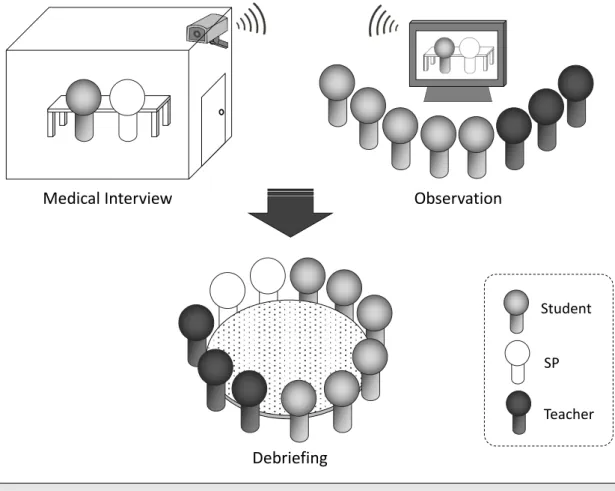
The medical interview training with the SPs was performed in a clinical skills laboratory as a half-day simulation-based training program during the students’ mandatory clinical rotations (Figure 1). Eighteen training groups, each consisting of five or six students, participated in the training each year, along with three or four teachers from different clinical backgrounds.
Four clinical scenarios were created: “Educating a diabetic patient”; “Urgent recommendation to visit a hematology specialist due to suspected leukemia”; “Breaking bad news (advanced-stage lung cancer)”; and “Dealing with a hypertensive patient with poor drug adherence”.
After briefing, each student was assigned to perform one of the scenarios as a doctor with an SP for 10 minutes. Two SPs participated at a time. Each SP undertook one scenario and repeated their performance two or three times. The consultations were observed remotely by the teachers and other students. A debriefing session was held after all of the students finished their medical interviews with the SPs. The clinical scenarios and staff (teachers and SPs) remained unchanged throughout the study period.
A total of 41 individuals (male, n=7; female, n=34) participated in the study as SPs. Fifty-one of the 279 medical interviews (18.3%) were conducted with male SPs, while 228 (81.7%) were
conducted with female SPs.
2.3. The assessment of communication performance
The students’ performance was objectively assessed by three or four teachers. The overall performance was rated on a 10-point Likert scale (1 = poor, 10 = excellent). Basic communication skills that were common to all scenarios and which consisted of nine assessment items, were rated on a 4-point Likert scale (1 = poor, 4 = excellent). The students assessed their own performance using the same assessment items. The SPs assessed the performance of the students on four items, as well as their overall performance, from a patient’s perspective.
2.4. Statistical analysis
The communication performance assessment scores were determined by the mean scores of the teachers. The differences between the genders in the assessments of the teachers, students and SPs were compared using the Mann-Whitney U test. The effect sizes were calculated as the difference between the scores of the male and female students according to the Mortsiefer method [10]. The relationships between the teachers’ assessments and the students’
self-assessments were examined using Pearson’s correlation coefficient and the Wilcoxon signed-rank test. Only valid data were included in the statistical analysis. The statistical analyses were performed using the IBM SPSS Statistics 22 software program. P values of < 0.05 were considered to indicate statistical significance.
2.5. Ethical considerations
This study was approved by the ethical review board of Fukushima Medical University (No.
1531). I gave written and verbal information of the study to all students who took part in medical interview training during the study period. Only the students who consented to
participate in the study were analyzed.
3. Results
3.1. Assessment by teachers
Table 1A shows the teacher-assessed communication performance scores. The students’ overall communication performance was 7.4 ± 1.3 (10-point scale). There were no significant differences between the male and female students.
Students showed scores of more than 3.0 in all of the basic communication skills (4-point scale). Among the nine basic skills, the students had high scores in ‘Greeting, self-introduction and patient identification’, ‘Eye contact and appropriate attitude’ and ‘Nodding and back-channeling’. In contrast, the students had low scores in ‘Use of appropriate question types’,
‘Giving empathic verbal responses’ and ‘Acquisition of patient’s psychosocial information’.
I found significant gender differences in four basic skills: ‘Eye contact and appropriate attitude’; ‘Nodding and back-channeling’; ‘Giving empathic verbal responses’; and ‘Acquisition of patient’s psychosocial information’. The female students showed significantly higher scores than the male students in all of these skills.
3.2. Self-assessment by students
Table 1B shows the self-assessed communication performance scores. The mean score of overall communication performance was 6.3 ± 1.6 (10-point scale). There were no significant differences between the male and female students in terms of the overall communication performance. Among the nine basic skills, the students scored themselves highly in ‘Greeting, self-introduction and patient identification’, ‘Eye contact and appropriate attitude’ and ‘Nodding and back-channeling’. Interestingly, these three basic skills were identical to those that were most highly assessed by the teachers. In contrast, the students gave themselves lower assessments in ‘Use of appropriate question types’, ‘Acquisition of patient’s psychosocial
information’ and ‘Holding a smooth and systematic interview’. Among these three skills, the first two scores were identical to the teachers’ assessments.
There were significant differences between the genders in three self-assessed scores. The male students gave themselves higher scores for ‘Providing medical information in an appropriate manner’ and ‘Holding a smooth and systematic interview’, whereas the female students gave themselves higher scores in ‘Acquisition of patient’s psychosocial information’.
3.3. Assessment by SPs
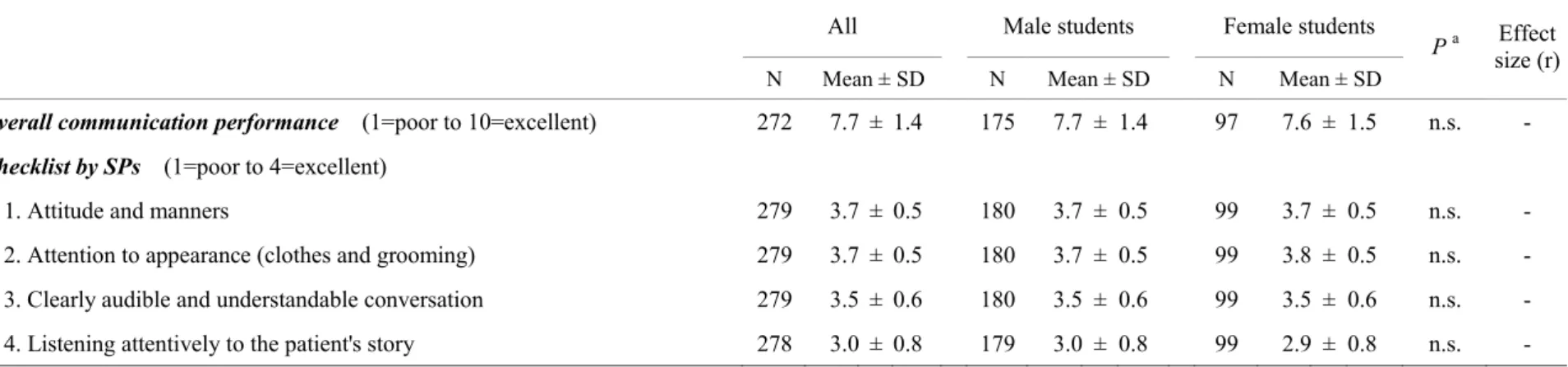
The SPs assessed the communication performance of the students after each medical interview according to a dedicated checklist (Table 2). The overall communication performance score was 7.7 ± 1.4 (10-point scale). There were no gender differences in the overall performance or in the four checklist items.
3.4 The relationship between the teacher-assessed and self-assessed scores
To reveal the characteristics of the communication skills of the medical students in detail, I examined the relationship between the teacher-assessed and student-assessed scores. The Pearson’s correlation coefficients, as well as the difference between teacher-assessed and student-assessed scores for the student’s overall communication performance and the nine basic communication skills, are shown in Table 3.
There was a strong correlation in the overall communication performance (r = 0.51), and significant positive correlations in the nine basic skills. ‘Greeting, self-introduction and patient identification’ had the strongest correlation (r = 0.65). In contrast, there were weak correlations in ‘Use of appropriate question types’, ‘Nodding and back-channeling’, ‘Avoidance of medical jargon’ and ‘Providing medical information in an appropriate manner’ (r < 0.30).
I also investigated the difference in the teacher-assessed and student-assessed scores using the
Wilcoxon signed-rank test. Interestingly, the students’ self-assessed scores in overall communication performance and in eight of the basic communication skills were significantly lower than the teacher-assessed scores.
3.5 The effects of opposite gender dyads on the communication performance
Next, I examined whether opposite gender dyads, male students as a doctor vs female SPs or female students as a doctor vs male SPs, affected the communication performance scores.
Opposite gender dyads did not significantly affect the overall communication scores in the assessments teachers, students (self-assessed) or SPs. In contrast, there were significant gender effects in the scores of several of the nine basic skills and the checklists of the SPs (Table 4).
4. Discussion and conclusion
4.1 Discussion
Communication between physicians and patients is known to be influenced by their demographic and sociocultural backgrounds [11–13]; however, few studies have examined the characteristics [14–16] and gender differences [17] of the communication performance of Japanese medical students. Although other studies measured the performance of the students in an objective structured clinical examination (OSCE), I examined them using an objective assessment in medical interview training with SPs during a clinical clerkship.
Several findings regarding gender differences in the performance of physicians or medical students have been reported. For instance, female medical students are found to perform better than their male counterparts in final medical examinations [18] and male physicians tend to exhibit better performance in laparoscopic surgical skills [19]. With regard to the communication skills on which the present study is focused, previous studies reported that female students tend to perform better than their male counterparts [20–22].
In this study, I observed no significant difference in the overall performance of male and female students; however, there were significant gender differences in some specific skills. The teacher-based assessments demonstrated that the female students performed better than the male students in four of the nine basic skills: eye contact and attitude, nodding and back-channeling, empathic verbal response, and acquiring psychosocial information. The assessment by the SPs did not observe any differences between the genders in terms of the overall performance or any of the four checklist items. A Japanese small-scale study [17], and some studies from other countries [23, 24], indicated that female students or physicians tend to focus more on the emotional aspects of communication than their male counterparts. The present study demonstrated the characteristics of medical students’ communication skills with a larger sample
size in Japan.
To determine whether the students could accurately evaluate their own performance level, I compared the objective assessments of the teachers and the self-assessments of the students. The correlation coefficient of their scores was above 0.5 in overall performance and above 0.3 in five out of the nine basic skills. This result suggests that the students were aware of their own performance level with a certain degree of accuracy; however, the students’ self-awareness regarding their performance in the use of question types, nodding and back-channeling was not consistent with the observations of their teachers. I also observed that the self-assessed scores of the students for overall performance and eight of the nine basic skills were significantly lower than the teacher-assessed scores, suggesting that communication skills should be assessed with the awareness that students tend to underestimate their own scores.
4.2 Study limitations
This study has two limitations. First, I only had one chance to assess the students’
communication skill in a specific clinical scenario. Repeated observations in different clinical scenarios, involving different SPs would yield better results. Second, 80% of the SPs who participated in this study were female. Thus, during the medical interview, the male students more frequently encountered SPs of the opposite gender and the female students more frequently encountered SPs of the same gender. Although gender dyads did not have a significant effect on the overall communication scores of the male and female students, we should pay attention to physician-patient gender dyads [25] since I observed significant effects on the assessment scores. In this regard, we also need to consider the effects of clinical scenarios containing sexual aspects. Gender dyads may affect communication in scenarios that include gender-specific contexts such as gynecological or urogenital problems.
4.3 Conclusion
In summary, the present study demonstrated significant gender differences as well as the lower self-estimation of communication skills among medical students during their introductory clinical training in Japan, suggesting the possibility of gender-based differences in the degree of readiness and gender-specific traits. Consequently, during the course of the ongoing reform of the medical education curriculum in Japan, it will be necessary to continue to observe the characteristics and gender differences in the communication skills of medical students.
References
1. CanMEDS 2015 Physician Competency Framework. Frank JR, Snell L, Sherbino J, eds.
Royal College of Physicians and Surgeons of Canada, Ottawa, 2015. [Internet]. [cited 2016 Oct 12]. Available from: http://www.royalcollege.ca/rcsite/canmeds/canmeds-framework-e 2. Good medical practice. General Medical Council, Manchester, 2013. [Internet]. [cited 2016
Oct 12]. Available from: http://www.gmc-uk.org/guidance/good_medical_practice.asp 3. Swing SR. The ACGME outcome project: retrospective and prospective. Med Teach 29:
648-654, 2007.
4. Medical Education Model Core Curriculum. Ministry of Education, Culture, Sports, Science and Technology (MEXT), Japan, 2011. [Internet]. [cited 2016 Oct 12]. Available from: http://www.mext.go.jp/b_menu/shingi/chousa/koutou/033-1/toushin/1304433.htm (in Japanese).
5. Roter DL, Hall JA. Consequences of talk: the relationship between talk and outcomes. In:
Doctors Talking with Patients/Patients Talking with Doctors: Improving Communication in Medical Visits. 2nd ed. Praeger, Westport, 2006: 143-164.
6. OECD. Doctors by age, sex and category. In: Health at a Glance 2015: OECD Indicators.
OECD Publishing, Paris, 2015: 82-83. [Internet]. [cited 2016 Oct 12]. Available from:
http://dx.doi.org/10.1787/health_glance-2015-22-en
7. Yuji K, Imoto S, Yamaguchi R, et al. Forecasting Japan's physician shortage in 2035 as the first full-fledged aged society. PLoS One 7: e50410, 2012.
8. OECD. PISA 2012 Results in Focus: What 15-year-olds know and what they can do with what they know. 2014. [Internet]. [cited 2016 Oct 12]. Available from:
http://www.oecd.org/pisa/keyfindings/pisa-2012-results-overview.pdf
9. Hedges LV, Nowell A. Sex differences in mental test scores, variability, and numbers of
high-scoring individuals. Science 269: 41-45, 1995.
10. Mortsiefer A, Immecke J, Rotthoff T, et al. Summative assessment of undergraduates' communication competence in challenging doctor-patient encounters. Evaluation of the Dusseldorf CoMeD-OSCE. Patient Educ Couns 95: 348-355, 2014.
11. Roter DL, Hall JA. The influence of physician characteristics on communication between the doctor and the patient. In: Doctors Talking with Patients/Patients Talking with Doctors:
Improving Communication in Medical Visits. 2nd ed. Praeger, Westport, 2006: 77-94.
12. Roter DL, Hall JA. The influence of physician gender on communication: why physician gender (especially) matters in communication. In: Doctors Talking with Patients/Patients Talking with Doctors: Improving Communication in Medical Visits. 2nd ed. Praeger, Westport, 2006: 95-106.
13. Roter DL, Hall JA. The influence of patient characteristics on communication between the doctor and the patient. In: Doctors Talking with Patients/Patients Talking with Doctors:
Improving Communication in Medical Visits. 2nd ed. Praeger, Westport, 2006: 57-76.
14. Mukohara K, Kitamura K, Wakabayashi H, Abe K, Sato J, Ban N. Evaluation of a communication skills seminar for students in a Japanese medical school: a non-randomized controlled study. BMC Med Educ 4: 24, 2004.
15. Abe K, Evans P, Austin EJ, et al. Expressing one's feelings and listening to others increases emotional intelligence: a pilot study of Asian medical students. BMC Med Educ 13: 82, 2013.
16. Ishikawa H, Hashimoto H, Kinoshita M, Fujimori S, Shimizu T, Yano E. Evaluating medical students' non-verbal communication during the objective structured clinical examination. Med Educ 40: 1180-1187, 2006.
17. Noro I, Abe K, Ban N. Effects of medical student gender on communication during Objective Structured Clinical Examination medical interviews. Medical Education (Japan)
41: 1-6, 2010 (in Japanese, abstract in English).
18. McDonough CM, Horgan A, Codd MB, Casey PR. Gender differences in the results of the final medical examination at University College Dublin. Med Educ 34: 30-34, 2000.
19. Grantcharov TP, Bardram L, Funch-Jensen P, Rosenberg J. Impact of hand dominance, gender, and experience with computer games on performance in virtual reality laparoscopy.
Surg Endosc 17: 1082-1085, 2003.
20. Cuddy MM, Swygert KA, Swanson DB, Jobe AC. A multilevel analysis of examinee gender, standardized patient gender, and United States medical licensing examination step 2 clinical skills communication and interpersonal skills scores. Acad Med 86 (10 Suppl):
S17-20, 2011.
21. Swygert KA, Cuddy MM, van Zanten M, Haist SA, Jobe AC. Gender differences in examinee performance on the Step 2 Clinical Skills data gathering (DG) and patient note (PN) components. Adv Health Sci Educ Theory Pract 17: 557-571, 2012.
22. Wiskin CM, Allan TF, Skelton JR. Gender as a variable in the assessment of final year degree-level communication skills. Med Educ 38: 129-137, 2004.
23. Roter DL, Hall JA, Aoki Y. Physician gender effects in medical communication: a meta-analytic review. JAMA 288: 756-764, 2002.
24. Marteau T, Humphrey C, Matoon G, Kidd J, Lloyd M, Horder J. Factors influencing the communication skills of first-year clinical medical students. Med Educ 25: 127-134, 1991.
25. Sandhu H, Adams A, Singleton L, Clark-Carter D, Kidd J. The impact of gender dyads on doctor-patient communication: a systematic review. Patient Educ Couns 76: 348-355, 2009.
Figure 1. An outline of the medical interview training with SPs. Fifth-year medical students underwent training at the clinical skills laboratory during their clinical clerkship. Eighteen groups of five to six students participated each year.
Student
SP Teacher
Medical Interview Observation
Debriefing
Curriculum A half-day simulation-based training in the mandatory clinical rotations of Fukushima Medical University
Learners Fifth-year medical students, five to six members per group Teachers Three to four teachers with different clinical expertise participated
(specialty: physician, nurse, clinical psychologist, medical technologist)
Simulated Patients Two SPs. Each SP undertook one scenario.
Training method Briefing ---> Individual medical interview ---> Debriefing Training hour Half day (4 hours)
Clinical scenarios Each student was assigned to perform one of four scenarios as a doctor with an SP for ten minutes.
Scenario 1: Educating a diabetic patient
Scenario 2: Urgent recommendation to visit a hematology specialist due to suspected leukemia Scenario 3: Breaking bad news (advanced-stage lung cancer)
Scenario 4: Dealing with a hypertensive patient with poor drug adherence
Learning room A consultation room with wall-mounted video cameras in the clinical skills laboratory;
Other members observed the session in another room
19
Table 1A. Communication performance assessment scores evaluated by teachers
All Male students Female students
P a Effect size (r) N Mean ± SD N Mean ± SD N Mean ± SD
Overall communication performance (1=poor to 10=excellent) 279 7.4 ± 1.3 180 7.4 ± 1.3 99 7.6 ± 1.3 n.s. -
Basic communication skills (1=poor to 4=excellent)
1. Greeting, self-introduction and patient identification 279 3.8 ± 0.5 180 3.8 ± 0.6 99 3.8 ± 0.5 n.s. - 2. Eye contact and appropriate attitude 279 3.5 ± 0.6 180 3.5 ± 0.6 99 3.7 ± 0.5 0.011 0.15 3. Use of appropriate question types (open-ended, closed-ended, or others) 279 3.0 ± 0.7 180 3.0 ± 0.6 99 3.0 ± 0.7 n.s. -
4. Nodding and back-channeling 279 3.6 ± 0.5 180 3.6 ± 0.5 99 3.8 ± 0.4 <0.001 0.20
5. Giving empathic verbal responses 279 3.0 ± 0.7 180 2.9 ± 0.7 99 3.2 ± 0.6 0.003 0.18
6. Avoidance of medical jargon 279 3.4 ± 0.6 180 3.4 ± 0.6 99 3.5 ± 0.5 n.s. -
7. Providing medical information in an appropriate manner 279 3.4 ± 0.6 180 3.3 ± 0.6 99 3.4 ± 0.6 n.s. - 8. Acquisition of patient’s psychosocial information 279 3.0 ± 0.7 180 2.9 ± 0.6 99 3.2 ± 0.7 0.008 0.16 9. Holding a smooth and systematic interview 279 3.3 ± 0.6 180 3.3 ± 0.6 99 3.3 ± 0.6 n.s. -
n.s. not significant at 0.05 level
a P values were for comparison between male and female students.
20 Table 1B. Communication performance self-assessment scores
All Male students Female students
P a Effect size (r) N Mean ± SD N Mean ± SD N Mean ± SD
Overall communication performance (1=poor to 10=excellent) 278 6.3 ± 1.6 179 6.4 ± 1.6 99 6.2 ± 1.6 n.s. -
Basic communication skills (1=poor to 4=excellent)
1. Greeting, self-introduction and patient identification 279 3.7 ± 0.6 180 3.6 ± 0.7 99 3.7 ± 0.5 n.s. -
2. Eye contact and appropriate attitude 278 3.2 ± 0.7 179 3.1 ± 0.8 99 3.2 ± 0.7 n.s. -
3. Use of appropriate question types (open-ended, closed-ended, or others) 278 2.7 ± 0.7 179 2.7 ± 0.7 99 2.7 ± 0.7 n.s. -
4. Nodding and back-channeling 279 3.2 ± 0.7 180 3.2 ± 0.7 99 3.2 ± 0.7 n.s. -
5. Giving empathic verbal responses 279 3.1 ± 0.8 180 3.0 ± 0.8 99 3.1 ± 0.8 n.s. -
6. Avoidance of medical jargon 279 3.0 ± 0.8 180 3.1 ± 0.8 99 2.9 ± 0.8 n.s. -
7. Providing medical information in an appropriate manner 279 3.0 ± 0.8 180 3.1 ± 0.8 99 2.8 ± 0.8 <0.001 0.21 8. Acquisition of patient’s psychosocial information 279 2.6 ± 0.8 180 2.6 ± 0.7 99 2.8 ± 0.8 0.047 0.12 9. Holding a smooth and systematic interview 279 2.8 ± 0.8 180 2.8 ± 0.8 99 2.6 ± 0.7 0.030 0.13
n.s. not significant at 0.05 level
a P values were for comparison between male and female students.
21
All Male students Female students
P a Effect size (r) N Mean ± SD N Mean ± SD N Mean ± SD
Overall communication performance (1=poor to 10=excellent) 272 7.7 ± 1.4 175 7.7 ± 1.4 97 7.6 ± 1.5 n.s. -
Checklist by SPs (1=poor to 4=excellent)
1. Attitude and manners 279 3.7 ± 0.5 180 3.7 ± 0.5 99 3.7 ± 0.5 n.s. -
2. Attention to appearance (clothes and grooming) 279 3.7 ± 0.5 180 3.7 ± 0.5 99 3.8 ± 0.5 n.s. - 3. Clearly audible and understandable conversation 279 3.5 ± 0.6 180 3.5 ± 0.6 99 3.5 ± 0.6 n.s. - 4. Listening attentively to the patient's story 278 3.0 ± 0.8 179 3.0 ± 0.8 99 2.9 ± 0.8 n.s. -
n.s. not significant at 0.05 level
a P values were for comparison between male and female students.
Table 2. Communication performance scores by SPs
22 Table 3. Relationship between teachers’ assessment and students’ self-assessment
N
Teachers’
assessment Students’
self-assessment
Pearson's correlation Wilcoxon's signed rank test Coefficient
(r) P a P b Effect
size (r) Mean ± SD Mean ± SD
Overall communication performance (1=poor to 10=excellent) 278 7.4 ± 1.3 6.3 ± 1.6 0.51 <0.001 <0.001 0.63
Basic communication skills (1=poor to 4=excellent)
1. Greeting, self-introduction and patient identification 279 3.8 ± 0.5 3.7 ± 0.6 0.65 <0.001 <0.001 0.25
2. Eye contact and appropriate attitude 278 3.6 ± 0.6 3.2 ± 0.7 0.35 <0.001 <0.001 0.45
3. Use of appropriate question types (open-ended, closed-ended, or others) 278 3.0 ± 0.6 2.7 ± 0.7 0.17 0.005 <0.001 0.30
4. Nodding and back-channeling 279 3.6 ± 0.5 3.2 ± 0.7 0.21 <0.001 <0.001 0.53
5. Giving empathic verbal responses 279 3.0 ± 0.7 3.1 ± 0.8 0.36 <0.001 n.s. -
6. Avoidance of medical jargon 279 3.4 ± 0.6 3.0 ± 0.8 0.23 <0.001 <0.001 0.43
7. Providing medical information in an appropriate manner 279 3.4 ± 0.6 3.0 ± 0.8 0.26 <0.001 <0.001 0.36 8. Acquisition of patient’s psychosocial information 279 3.0 ± 0.7 2.6 ± 0.8 0.35 <0.001 <0.001 0.42 9. Holding a smooth and systematic interview 279 3.3 ± 0.6 2.8 ± 0.8 0.34 <0.001 <0.001 0.57
n.s. not significant at 0.05 level
a P values were for Pearson’s correlation coefficient.
b P values were for paired comparison between teachers’ assessment and students self-assessment.
23 Table 4. Effects of the opposite gender dyads on communication performance assessment scores
There were significant gender effects on several assessment scores among nine basic skills and the checklist by SPs.
Doctor’s gender (students)
Assessor
Male Female
Opposite Patients’ gender (SPs)
Basic communication skills
8. Acquisition of patient’s psychosocial information ↓ → teacher
9. Holding a smooth and systematic interview ↓ → student (self-assessment)
Checklist by SPs
2. Attention to appearance (clothes and grooming) ↑ → SP
4. Listening attentively to the patient's story → ↓ SP
Arrowed lines represent the effects on assessment scores; ↓ lower, ↑ higher, → unchanged
Acknowledgements
I am very grateful to all the people who contributed to the work described in this thesis. In particular, I would like to express my sincere gratitude to my thesis advisors, Professors Tetsuhito Fukushima and Kazunobu Ishikawa, for their invaluable support and guidance throughout the research.
This study was supported by JSPS KAKENHI Grant Numbers 24790506 & 15K19153.
Conflict of interest
The author declare no conflicts of interest in association with this study.
Copyright
The content of this thesis was published in Internal Medicine, Vol.56 (2017), 1507-1513.
The copyright of the article belongs to the Japanese Society of Internal Medicine.
DOI: 10.2169/internalmedicine.56.8135
Abbreviations
ACGME: the Accreditation Council for Graduate Medical Education OECD: the Organization for Economic Co-operation and Development OSCE: Objective structured clinical examination
SD: Standard deviation SP: Simulated patient
Abstract in Japanese
目的: 医療コミュニケーションスキルは医師にとって重要なスキルのひとつである。
しかしながら、欧米に比べて本邦の医学生は模擬患者(Simulated Patient, SP)参加型教 育を受ける機会が少なく、コミュニケーションスキルの特徴も明らではなかった。本邦 の医学生のコミュニケーションスキルの特徴と性差を明らかにするため、SP との医療 面接実習における医学生のパフォーマンスを評価した。
方法:2012~2014年度に福島県立医科大学の医療面接実習に参加した医学部5年生293 名のうち、同意を得た279名を対象とした。医学生は4つの医療面接課題のうち1つを 担当し、SPと医療面接を行なった。実習を担当した3、4名の教員が医学生のパフォー マンスを観察し、パフォーマンス全体を10 段階で評価した。さらに、医療コミュニケ ーションの基本スキル9項目(1.あいさつ・自己紹介・患者確認、2.適切な視線・態度、
3.質問方法の使い分け、4.うなずき・相づち、5.共感の言葉、6.専門用語を避けたわかり やすい言葉遣い、7.適切な医学的情報の伝達、8.心理社会的情報の収集、9.面接の順序 立て・流れ)について4段階で評価した。医学生は、実習後に教員と同一の評価方法で 自身のパフォーマンスを評価した。また、SP は患者の視点から、医学生のパフォーマ ンス全体と4項目(1.態度・マナー、2.身だしなみ、3.わかりやすい言葉遣い、4.患者の 話への傾聴)について評価した。男子学生と女子学生のパフォーマンス評価の差、教員 評価と学生自己評価の相関・差を統計学的検定により検討した。
結果: 全ての項目で教員評価と学生自己評価の間に有意な相関を認めたが、基本スキ ル1項目を除く全てで、医学生は自身のパフォーマンスを教員よりも有意に低く評価し た。女子学生は、教員評価において「適切な視線・姿勢・態度」「うなずき・相づち」
「共感の言葉」「心理社会的情報の収集」の4 項目で男子学生よりも有意に高く評価さ れた。しかしながら、女子学生自身が男子学生よりも有意に高い自己評価をしたのは、
「心理社会的情報の収集」のみであった。一方、男子学生は、教員評価で女子学生より
も高く評価された項目はなかったが、「適切な医学的情報の伝達」と「面接の順序立て・
流れ」の2項目で女子学生よりも有意に高い自己評価をしていた。SPによる評価には、
男子学生と女子学生の間に有意な差を認めなかった。
結論:本邦の医学生の医療コミュニケーションスキルに有意な性差を認め、コミュニケ ーション学習の準備状況や特性に性差が存在する可能性が示唆された。医学教育改革が 進む昨今、継続的に医学生のコミュニケーションスキルの特徴を観察していくことが重 要と考える。