緒 言
1980 年代半ばに,気管挿管や気管切開などによる気 道確保を要さず,鼻マスクあるいはフェイスマスクを用 いて補助換気を行う非侵襲的陽圧換気療法(noninvasive positive pressure ventilation:NPPV)が登場し,その 後の機材の進歩や医療者の知識向上などに伴い,急性期,
慢性期ともに実地医療で広く使用されるようになった.
とりわけ,慢性閉塞性肺疾患(chronic obstructive pul- monary disease:COPD)急性増悪においては過去の大 規模臨床試験により,ガス交換の改善,挿管の回避,死 亡率の低下,治療関連合併症の低下などの項目において
NPPV 療法の有効性が確認され1)〜5),Global Initiative for Chronic Obstructive Lung Disease(GOLD)のガイド ラ イ ン で は エ ビ デ ン ス レ ベ ル A の 推 奨 療 法 と し て NPPV の最も良い適応と明記されている6).日本呼吸器 学会においてもNPPVに対するガイドラインが作成され,
急性呼吸不全と慢性呼吸不全に分けて疾患別の導入基準 や推奨度などが記載されているが,COPD 急性増悪に 対する推奨度は A と,肺結核後遺症増悪,心原性肺水 腫などと並び最も高いものとなっている7).医療システ ムや COPD 患者の体型・栄養状態など,海外と我が国 では異なる部分は多いが,COPD 急性増悪に対する NPPV療法を検討した国内での報告は少ない.このため,
我が国のガイドラインの検証も含めて聖隷三方原病院で の治療成績,転帰と治療の成否にかかわる患者背景因子 の検討を行ったので,ここに報告する.
対象および方法
対象は 2004 年 1 月から 2008 年 1 月までの 4 年間に,
聖隷三方原病院に入院した II 型呼吸不全を伴う COPD
●原 著
II 型呼吸不全を伴う慢性閉塞性肺疾患急性増悪に対する 非侵襲的陽圧換気療法の有用性について
―当院における治療成績―
安井 秀樹a,b 横村 光司a 松島紗代実a 大山 吉幸a 草ヶ谷英樹a,b 河野 雅人b 松井 隆a 須田 隆文b 千田 金吾b
要旨:2004 年 1 月から 2008 年 1 月までの 4 年間に,II 型呼吸不全を伴う慢性閉塞性肺疾患(chronic ob- structive pulmonary disease:COPD)急性増悪で聖隷三方原病院に入院し,noninvasive positive pressure ventilation(NPPV)療法を行った症例の治療成績を,後方視的に検討した.NPPV 継続が困難であった症例,
気管挿管に移行した症例,NPPV 継続中に死亡した症例を治療非完遂群,それ以外を治療完遂群と分類し,
患者背景,NPPV 導入時の呼吸状態,検査結果等を比較検討した.検討対象となったのは 47 例で,治療完 遂例が 41 例(完遂率 87%)と完遂率は高く,このうち 32/41 例(78%)は最終的に NPPV からの離脱が 可能であった.完遂例と非完遂例に分けて比較した場合,患者背景や NPPV 実施場所の違いはなかったが,
導入時の意識障害は非完遂群で多く認められた.また,完遂例では NPPV 開始 1 時間後の動脈血液ガス所 見で pH と PaCO2の改善が認められていた.今回の当施設での検討では,ガイドラインが推奨するように COPD 急性増悪において NPPV 療法は有効な手段であることが再認識され,治療開始時の意識状態や開始 1 時間後の動脈血液ガス所見が成否の目安になると考えられた.
キーワード:非侵襲的陽圧換気療法,慢性閉塞性肺疾患急性増悪,慢性閉塞性肺疾患
Noninvasive positive pressure ventilation, Acute exacerbations of chronic obstructive pulmonary disease, Chronic obstructive pulmonary disease
連絡先:安井 秀樹
〒433‑8558 静岡県浜松市北区三方原町 3453
a聖隷三方原病院呼吸器センター内科
b浜松医科大学第 2 内科
(E-mail: [email protected])
(Received 16 Apr 2012/Accepted 13 Nov 2012)
急性増悪の患者で,標準治療(酸素療法,気管支拡張薬 の吸入,抗菌薬投与,全身ステロイド投与)に加え NPPV 療法を必要とした 47 例.COPD 急性増悪は ATS ガイドラインの定義に準じて8)診断し,在宅 NPPV 療法 をすでに行っている症例,気管支喘息発作との鑑別が困 難な症例は除外した.当院での NPPV の導入基準は,
適切な酸素投与にかかわらず,①呼吸補助筋の使用と奇 異性呼吸を伴う呼吸困難があること,②pH が 7.35 以下 もしくは PaCO2 60 Torr 以上の呼吸性アシドーシスがあ ること,③呼吸回数>25 回/min という 3 項目のうち,
2 つ以上満たす場合としており,機器は,Philips 社の BiPAP Vision®を全例に使用している.NPPV 療法の「非 完遂」は,NPPV 継続が困難な場合,気管挿管へ移行し た場合,NPPV 使用中に死亡した場合とし,それ以外を
「完遂」と判定した.また意識障害については JCS 2 桁 以上の状態と定義した.
データ解析結果は,平均値±標準偏差で示し,NPPV 使 用 前 後 の pH,PaCO2の 比 較 は Studentʼs t-test の paired t-test を,NPPV 完遂群と非完遂群の 2 群間の比 較[年齢,性別,BMI,1 秒量(FEV1),在宅酸素使用 の有無,COPD の重症度,NPPV 開始前の患者状態,
WBC,Alb,CRP,BNP, 治 療 開 始 場 所 ] は Mann- Whitney のノン・パラメトリック検定を用いた.すべて の解析は StatView version5(SAS Institute Inc.,North Carolina,USA)を用いて検討し,統計学的有意差は p
<0.05 とした.
結 果
患者背景は,全例喫煙者で,男性 39 例,女性 8 例と 男性に多く,年齢は 77±9 歳と高齢であった.BMI は
17.7±3.1 kg/m2とやせが目立ち,在宅酸素使用者は 30 例(63.8%)であった.COPD の重症度としては軽症 0 例,
中等症 2 例,重症 8 例,最重症 37 例と重症・最重症が 全体の 95.7%と大半を占めていた.NPPV 導入時の動脈 血液ガス所見は pH 7.28±0.08,PaCO2 82.7±21.0 Torr であった.また意識障害を伴う症例が 14 例(29.8%)
あり,肺炎像を 12 例(25.5%)に認めていた(Table 1).
治療成績は完遂が 41 例(87.%),非完遂が 6 例(12.8%)
であった.41 例の完遂例のうち 1 例(0.2%)は,NPPV 離脱後に虚血性心疾患で死亡したが,その他はすべて軽 快した.完遂例のうち 32 例(78.0%)は退院時に NPPV の離脱が可能であり,8 例(19.5%)が在宅 NPPV を必 要とした.6 例の非完遂例の内訳は,NPPV 継続中の死 亡が2例,マスク装着の不快に伴う継続困難が4例であっ た.後者のうち1例は気管挿管を行い救命されているが,
3 例は挿管を希望されずその後死亡しており,非完遂例 6 例中 5 例が死亡の転帰をとっていた(Table 2).完遂 例と非完遂例に分けて患者背景を検討すると,年齢,性 別,COPD の重症度などいずれの項目も両群間に差は みられなかった(Table 3).NPPV 導入時の患者状態で は意識障害を有する症例は非完遂例に多かった(p=0.03)
が,X 線写真上の肺炎像の有無,NPPV 開始時の動脈血 液ガスの pH,PaCO2値,採血検査での WBC,Alb,
CRP,BNP 値等いずれの検査項目も差はみられず,
NPPV 実施場所による完遂率も ICU,呼吸器専門病棟 で差はみられなかった(Table 4).NPPV 導入時の pH,
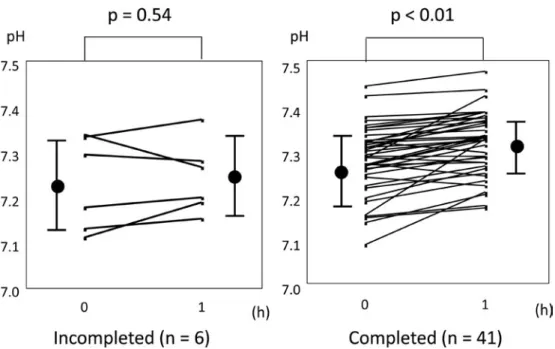
PaCO2に差はみられなかった一方で,NPPV 導入開始 1 時間後の動脈血液ガス所見において pH は完遂群で 7.28 から 7.32 へと有意に上昇し(p<0.01),非完遂群では上 昇 が 確 認 さ れ な か っ た(p=0.54)(Fig. 1). 同 様 に PaCO2は完遂群で 82.2 Torr から 73.4 Torr へと有意に 低下(p<0.01)していたが,非完遂群では低下が確認 されなかった(p=0.58)(Fig. 2).
合併症は完遂群にて 1 例に気胸が認められ,胸腔ドレ ナージを要したが,速やかに肺の再膨張が得られ,
NPPV 継続が可能であった.
Table 1 Characteristics of patients at the start of noninvasive positive pressure ventilation
Cases 47
Males 39 (83.0)
Age (years) 77±9
BMI (kg/m2) 17.7±3.1
Previous LTOT 30 (63.8)
Severity of COPD
Mild 0 (0)
Moderate 2 (4.3)
Severe 8 (17.0)
Very severe 37 (78.7)
pH 7.28±0.08
PaCO2 (Torr) 82.7±21.0
Impaired consciousness 14 (29.8)
Pneumonia 12 (25.5)
Data are presented as mean±SD or n (%). BMI, body mass index; LTOT, long-term oxygen therapy.
Table 2 Treatment outcome
NPPV failure 6/47 (12.8)
Total deaths 6/47 (12.8)
Respiratory failure 5/6
Acute myocardial infarction 1/6
Hospital LOS days 34±35
Withdrawal from NPPV in completed group patients 32/41 (78.0)
Data are presented as mean±SD or n (%). NPPV, noninvasive positive pressure ventilation; LOS, length of stay.
考 察
COPD 急性増悪は細菌やウイルスなどの感染が契機 となり9),気道の浮腫,気管攣縮,分泌物の増加などに より air trapping が増幅され,内因性呼気終末陽圧換気
(positive endexpiratory pressure ventilation:PEEP)
が増加した状態にあるとされている10).短時間作用型吸 入β刺激薬や全身ステロイド投与を行っても,呼吸回数 や呼吸困難感が改善しない症例では,さらに浅い頻呼吸
(rapid shallow breathing)となり有効換気が確保でき なくなる悪循環を生じ,呼吸性アシドーシスが出現する.
このような状況では,補助換気による pressure support を使用することで呼吸仕事量と呼吸筋への負荷を減らす ことが重要であり,内因性の PEEP に対する counter PEEP をかけることで換気の改善が期待される11).上記 のような機序から COPD 急性増悪に対して NPPV は有 用な補助換気療法と考えられており,事実過去の多数の 大規模臨床試験で呼吸困難感の改善,血液ガスの改善,
挿管率の低下,ICU 滞在日数や入院日数の減少,死亡 率の減少等の有効性が証明されている1)〜4),また NPPV では挿管人工呼吸器管理と比較して,人工呼吸器関連肺 炎(VAP)の発生率が低いことも利点として挙げられ
ている12)13).現在では GOLD ガイドラインにおいて,
COPD 急性増悪時における換気補助療法の際にまず試 みられるべき人工呼吸器と記載されている6).近年我が 国においても,COPD 急性増悪に対し NPPV を第一選 択の人工呼吸器管理としたところ良好な成績であったと いう報告も確認され14),また COPD 急性増悪を中心と した 75 歳以上の高二酸化炭素血症を伴う急性呼吸不全 に NPPV 療法が比較的有効であったという報告もあ り15),ガイドライン7)16)上も,訓練されたチーム下では NPPV 使用を強く推奨している.
当院は病床数約 800 床の地域の中核病院で,呼吸器内 科医が 8 名,呼吸器専門の理学療法士 4 名が常勤してい る.2004 年 1 月から 2008 年 1 月までの 4 年間で 185 例 の急性呼吸不全に対し NPPV を使用しており,比較的 Table 3 Comparison of patient backgrounds between completed and incompleted groups
Incompleted (n=6) Completed (n=41) p value
Age (years) 72±6 78±10 0.06
Male 6 (100) 33 (80.5) 0.24
BMI (kg/m2) 17.9±3.5 17.7±3.0 0.94
FEV1 (L) 1.06±0.50 0.73±0.26 0.21
Previous LTOT 3 (50) 27 (65.9) 0.45
Severity of COPD
Mild 0 (0) 0 (0)
Moderate 1 (16.7) 1 (2.4) 0.27
Severe 1 (16.7) 7 (17.1)
Very severe 4 (66.6) 33 (80.5)
Data are presented as mean±SD or n (%). BMI, body mass index; LTOT, long-term oxygen therapy.
Table 4 Comparison of patient conditions, laboratory findings before NPPV initiation, and type of care unit between completed and incompleted groups
Incompleted (n=6) Completed (n=41) p value Conditions before NPPV
Impaired consciousness 4 (66.7) 10 (24.4) 0.03
Pneumonia 2 (33.3) 10 (24.4) 0.64
pH 7.23±0.10 7.29±0.08 0.35
PaCO2 (Torr) 88.8±35.9 81.9±18.5 0.64
Laboratory findings
WBC (/mm2) 12,020±4,384 9,763±5,216 0.23
Alb (g/dl) 3.57±0.88 3.75±0.55 0.81
CRP (mg/dl) 6.10±6.65 6.41±7.54 0.91
BNP (pg/dl) 215±290 289±301 0.38
Care unit
ICU 1 (16.7) 5 (12.2)
General respiratory ward 5 (83.3) 36 (87.8) 0.78 Data are presented as mean±SD or n (%).
NPPV 使用頻度の高い,準備の整った施設といえよう.
今回,当院で II 型呼吸不全を伴う COPD 急性増悪に対 し NPPV 療法を行った 47 例は,平均年齢が 77 歳と高 齢で,導入時の pH が 7.28,PaCO2が 82.7 Torr と重度 の換気不全状態での治療導入にかかわらず,完遂例が 41 例(完遂率 87.2%)と多数を占め,良好な成績であっ た.NPPV 治療の成否にかかわる因子を検討した結果,
患者背景では過去の報告17)において意識障害を有する症 例にて NPPV 不成功例が多いと報告されているが,本 検討でも非完遂例における意識障害例が高率であった.
一方で意識障害を有した 14 例中 10 例は結果的に救命さ れており,本来は NPPV の適応とされにくい意識障害 を有する症例への適応基準は今後の検討課題と考えられ た.また当院では NPPV の受け入れが困難な症例に対 してはインターフェースの変更や圧設定の工夫を全例で 試みているがやはり継続は困難な場合が多く,過去の検 討18)と同様に治療成績や転帰は不良であった.NPPV 導 入場所はICUが6例(13%),呼吸器専門病棟が41例(87%)
と呼吸器専門病棟で導入する場合が多かったが,治療導 入場所による治療成績に差はみられなかった.症例数の Fig. 1 Changes in pH before and 1 h after NPPV initiation. Circles (●), mean; bars, SD.
Fig. 2 Changes in PaCO2 before and 1 h after NPPV initiation. Circles (●), mean; bars, SD.
多い施設であれば,関与する医療スタッフが NPPV に 習熟しており,ICU でなくても比較的安全に実施でき るとされており5),当院でも同様な結果が確認された.
また,動脈血液ガス分析の結果からは NPPV 開始 1 時 間後の pH の上昇と PaCO2の低下が完遂例で確認され ており,やはり過去の検討15)19)と同様に NPPV 開始初期 の動脈血液ガス所見は成否の目安となる可能性が高く,
NPPV 開始 1 時間後に pH の上昇,PaCO2の低下が確認 されない症例においては,その後の増悪が予想されるた め,必要であれば躊躇せず挿管人工呼吸器管理に移行す る判断も必要と考えられた.
今回我々が行った検討は,50 例に満たない少数例の 単一施設での後方視的な検討という制約はあるが,近年 我が国からの COPD 急性増悪に対する NPPV の有用性 を検討した報告は少数例での報告にとどまっており,当 院の 47 例での検討は比較的多数例での報告になると思 われる.また NPPV 導入時の PaCO2が平均で 80 Torr 以上と,過去の報告と比較しても重症例を対象としてい ること,肺炎像を認めている症例や意識レベルの低下し た症例においても一定の効果が確認されたことは一つの 知見である.II 型呼吸不全を呈する COPD 急性増悪に 対する NPPV 療法の効果を実臨床の場で評価し,ガイ ドラインの推奨どおり6)7),最初に試みられるべき有用な 呼吸管理方法であることが再確認されたことは,意義の ある結果と考えられた.
著者の COI(conflicts of interest)開示:本論文発表内容 に関して特に申告なし.
引用文献
1)Bott J, Carroll MP, Conway JH, et al. Randomised controlled trial of nasal ventilation in acute ventila- tory failure due to chronic obstructive airways dis- ease. Lancet 1993; 341: 1555‑7.
2)Brochard L, Mancebo J, Wyscocki M, et al. Nonin- vasive ventilation for acute exacerbations of chron- ic obstructive pulmonary disease. N Engl J Med 1995; 333: 817‑822.
3)Kramer N, Meyer TJ, Meharg J, et al. Randomised, prospective trial of noninvasive positive pressure ventilation in acute respiratory failure. Am J Respir Crit Care Med 1995; 151: 1799‑806.
4)Plant PK, Elliot MW. Chronic obstructive pulmo- nary disease 9: management of ventilatory failure in COPD. Thorax 2003; 58: 537‑42.
5)Lightowler JV, Wedzicha JA, Elliott MW, et al. Non- invasive ventilation in acute exacerbation of chron- ic obstructive pulmonary disease: Cochrane sys-
tematic review and metaanalysis. BMJ 2003; 326:
185‑90.
6)Global Initiative for Chronic Obstructive Lung Dis- ease. Global Strategy for Diagnosis, Management, and Prevention of COPD. Revised 2011. http://
www.goldcopd.com (accessed September 2012)
7)日本呼吸器学会.NPPV(非侵襲的陽圧換気療法)
ガイドライン.東京:南江堂.2006; 34‑38.
8)American Thoracic Society. Standards for the diag- nosis and care of patients with chronic obstructive pulmonary disease. Am J Respir Crit Care Med 1995; 152: S77‑S121.
9)Sapey E, Stockley RA. COPD exacerbations 2: aeti- ology. Thorax 2006; 61: 250‑8.
10)Rossi A, Gottfried SB, Higgs BD, et al. Respiratory mechanics in mechanically ventilated patients with respiratory failure. J Appl Physiol 1985; 58: 1849‑58.
11)Appendini L, Patessio A, Zanaboni S, et al. Physio- logic effects of positive end-expiratory pressure and mask pressure support during exacerbations of chronic obstructive pulmonary disease. Am J Respir Crit Care Med 1994; 149: 1069‑76.
12)Guerin C, Girard R, Chemorin C, et al. Facial mask noninvasive mechanical ventilation reduces the in- cidence of nosocomial pneumonia. A prospective epidemiological survey from a single ICU. Intensive Care Med 1997; 23: 1024‑32.
13)Girou E, Schortgen F, Delclaux C, et al. Association of noninvasive ventilation with nosocomial infec- tions and survival in critically ill patients. JAMA 2000; 284: 2361‑7.
14)Nishimura K, Yasui M, Nishimura T, et al. Clinical pathway for acute exacerbations of chronic ob- structive pulmonary disease: method development and five years of experience. Int J Chron Obstruct Pulmon Dis 2011; 6: 365‑72.
15)Kida Y, Minakata Y, Yamada Y, et al. Efficacy of noninvasive positive pressure ventilation in elderly patients with acute hypercapnic respiratory failure.
Respiration 2012; 83 (5): 377‑82.
16)日本呼吸器学会.COPD(慢性閉塞性肺疾患)診断 と治療のためのガイドライン第 3 版.東京:社団法 人日本呼吸器学会.2009; 137‑9.
17)Confalonieri M, Garuti G, Cattaruzza MS, et al. A chart of failure risk for noninvasive ventilation in patients with COPD exacerbation. Eur Respir J 2005; 25: 348‑55.
18)Carlucci A, Richard JC, Wysocki M, et al. Noninva- sive versus conventional mechanical ventilation. An epidemiologic survey. Am J Respir Crit Care Med
2001; 163: 874‑80.
19)Plant PK, Owen JL, Elliot MW. Non-invasive venti- lation in acute exacerbation of chronic obstructive
pulmonary disease: long term survival and predic- tors of in-hospital outcome. Thorax 2001; 56: 708‑12.
Abstract
The usefulness of noninvasive positive pressure ventilation therapy for acute exacerbations of chronic obstructive pulmonary disease with hypercapnic
respiratory failure in our hospital
Hideki Yasuia,b, Koshi Yokomuraa, Sayomi Matsushimaa, Yoshiyuki Oyamaa, Hideki Kusagayaa,b, Masato Konob, Takashi Matsuia, Takafumi Sudab and Kingo Chidab
aDepartment of Respiratory Medicine, Respiratory Disease Center, Seirei Mikatahara Hospital
bSecond Division, Department of Internal Medicine, Hamamatsu University School of Medicine
We retrospectively collected data concerning the treatment outcome of noninvasive positive pressure venti- lation (NPPV) therapy for patients of acute exacerbations of chronic obstructive pulmonary disease (COPD)
with hypercapnic respiratory failure who were admitted to our hospital from January 2004 to January 2008. A case of incomplete treatment was defined as difficulty in NPPV continuation, shift to intubation, or death during NPPV; the remaining cases were classified as completed treatments. Further, patient characteristics, respiratory status at the initiation of NPPV, and laboratory data were investigated to determine whether the treatment was in fact completed. In this study, we examined 47 patients, and NPPV was completed in 41 (completed rate, 87%).
Further, of the 41 completed cases, 32 (78%) exhibited withdrawal from NPPV. When the completed and incom- pleted groups were compared, no significant differences were observed in patient characteristics and places of NPPV initiation; however, a high rate of impaired consciousness was observed in the incompleted group. Fur- ther, pH and PaCO2 were significantly improved 1 h after NPPV initiation in the completed group. In this investi- gation at our hospital, we recognized that NPPV therapy was effective for acute exacerbations of COPD, as the guidelines recommended, and the level of consciousness at NPPV initiation and arterial blood gas analyses at 1 h after the initiation of NPPV were the predictors of treatment outcomes.