Ph.D. Thesis
Mobile Instant Messaging (MIM) Application and Organization
Communication: A Study in Thailand Based on Managers’
Perspective
January 2019
Tanaporn Tarin Siratanapanta
supervisor
Yoshio Ono
supervisor
Akihiro Ogura
supervisor
Chikako Hironaka
Graduate School of Economics
Risk Research in Economics and Management
(Doctor Course)
Abstract
This research investigates the increasing use of Mobile Instant Messaging (MIM) application in the workplace in Thailand from the manager’s perspective using the qualitative interview method. It is found that most popular MIM application with the most active users in Thailand is LINE. Nowadays LINE has become another communication media used widely in business organizations. The study shows the use of LINE for work by fifteen managers in five different business organizations in Bangkok, Thailand. The findings suggest that MIM communication among the team members is useful for leaders. It has become a standard of communication in organization as it is adopted and used by the managers to send different kinds of messages for various managing purposes, despite some disadvantages.
Keywords: Leadership, Organizational Communication, Mobile Instant Messenger (MIM)
application,
Acknowledgments
This thesis would not have been possible without the support from the Japanese Ministry of Education, Culture, Sports, Science and Technology (MEXT). I am especially indebted to Shiga University and Prof. Hideki Oshima of Faculty of Education, who welcomed me as a research student under the Japanese MEXT scholarship in 2014 and has been supportive of my academic goals and career ever since.
I would like to express my sincere gratitude to my advisor Prof. Yoshio Ono for the continuous support of my Ph.D. study and related research, for his patience, motivation, enthusiasm, and endless encouragement. His guidance helped me in all the time of research and writing of this thesis. I could not have imagined having a better advisor and mentor for my Ph.D. study.
I am deeply grateful to Prof. Akihiro Ogura and Prof. Chikako Hironaka for their dedication to the role as my secondary supervisor and the insightful comments and suggestions throughout my Ph.D. study.
I would also like to give special thanks to my thesis committee of the Graduate School of Economics and the faculty professors for their professional guidance and knowledge in teaching and researching. I am particularly grateful for the assistance given by all the staff members at the Graduate School of Economics for their tremendous support throughout the journey of my study.
names cannot be disclosed, but I want to acknowledge and appreciate their help during my research. Without their support, this thesis would not have been possible. I owed my deepest gratitude to you all.
My heartfelt appreciation goes to my fellow Ph.D. colleagues, with whom I have shared many precious moments and memories, especially May and Li. Thank you for the loveliest friendship and support. I would not have survived the first year without you guys. It is such an honor for me to have met and studied with you.
Lastly, but not least, a very special word of thanks goes for my family; my parents, Chalorat and Teera Sirtanapanta, my loving aunt, my two sisters, my brother-in-law, and my fiancé, Jeeranat Mavichak for their encouragement, dedication, love, and support. To Mom, you have always been my confidant and the greatest source of strength. Thank you for always believing in me.
Table of Contents
Acknowledgments... iii
Chapter I Introduction ...8
1. Background of the Study ...8
1.1 MIM in Thailand ...11
1.2 LINE Adoption in Organizations ...17
1.3 Data-driven Economy and Social Change ...19
2. Research contribution ...22
3. Research Questions ...23
Chapter II Literature Review ...24
1. Mobile Instant Messaging (MIM) Application: ...24
2. Previous Studies about MIM and Smartphones ...25
4. MRT and Culture ...30
5. MIM applications and organizational communication ...32
6. Organizational Communication and Leadership ...34
6.1 Task-Oriented Leadership ...34
6.2 Relationship-Oriented Leadership ...35
6.3 Supervisor Behaviors ...36
Chapter III Research Methodology ...38
Chapter IV Qualitative Analysis of the Managers’ Use of MIM...47
1. The Positioning of MIM in the Media Richness Theory ...47
2. The Interview Findings ...48
2.1 MIM (LINE) is an Effective Medium for Work ...49
2.2. Managers Use MIM for Various Managing Purposes. ...53
2.3 There are different purposes of MIM (LINE) used for work. ...67
2.4 MIM (LINE) Positively Affects Team Members. ...68
The Case Studies: A Manager’s Perspective of MIM(LINE) for Work ....72
1. Company D Thailand (Mr. C.L. - Assistant Manager) ...72
• Company D Manager Case Discussion ...76
Company E Thailand (Ms. N.S. -Governance Team Manager) ....78
• Company E Case Discussion ...83
Chapter V Conclusion and suggestion ...86
Chapter I Introduction
1. Background of the Study
Effective communication is a key factor in the success of any business organization or enterprise where groups people work together. For decades, organizational communication researchers have been trying to answer the question of what is meant by ‘Organization.’ As stated by Mumby and Stohl (1996) the clearest way to distinguish organizational communication researchers from corporate, management, and business communication researchers, is that the only the group of organizational communication researchers search for the meaning of ‘organization’ which is fundamental for them as scholars (Mumby & Stohl, 1996). However, these different groups of management scholars do share the same dominant conception of communication since it involves the linear transmission of information along relatively stable organizational channels. They also argued that, according to Weick’s (1979) term, ‘organization’ is ‘a precarious, ambiguous, uncertain process continually being made and remade’ and can only be seen as stable, rational structures when viewed retrospectively. Therefore, communication is the substance of organizing through discursive practices when organization members engage in the construction of a complex and diverse system of meanings. Despite the difference between different areas of management scholars, they share a common concern with problematizing and explaining organizational phenomena regarding a communication framework. (Mumby & Stohl, 1996).
Generally, organizational communication scholars and researcher are interested in examining the formal and informal communication structures and processes within and among organizations. They have established the study approach to understanding how individuals create and exchange messages to enable action to achieve tasks and goals of the organization. These approaches in this field of organizational communication studies include, but not limited to leadership, organizational structures, interpersonal relationships, diversity at work. In the 21st Century, emergent technologies have transformed the way organizational members reached both individual and collective goals and helped facilitate organizational communication and socialization. Therefore, it is also important for organizational researchers to realize this change in order to understand the organizational communication in this new environment.
In the past few years, the use of Mobile Instant Messaging (MIM) applications in the workplace has become subject to study by many scholars (Deng, Lu, Wei, & Zhang, 2010; Church & de Oliveira, 2013; Karimiyazdi & Mokhber, 2015; Oghuma, et al., 2015) whose research are in the field of organizational behaviors and communication.
MIM is a synchronous communication tool that works on mobile devices such as PDAs and cell phones (Chigona, Chigona, & Mpofu, 2008). Unlike SMS, MIM uses internet protocol to exchange messages. MIMs function in a way similar to computer-based instant messages (e.g., Messenger and ICQ). MIM has become a global trend for millions of users.
The key features of MIM are that it allows two-way communication between sender and receiver to instantly send and receive messages including pictures, and audios and
10
be operated on different mobile operating systems (e.g., Apple’s iOS, Google’s Android, and Microsoft’s Windows) (Oguhuma et al., 2016). MIM has been rapidly introduced as messaging tools among the public and business organization because of its features which can offer more than the traditional way of communication such as text message, telephone, and e-mail.
Users of MIM applications can send and receive messages and other media anytime on their Internet-connected smartphones. This convenience makes communication via MIM applications different from other ways of communication not only for personal use but also for communication within a workplace as well. Some of the features of MIM applications that support the use of communication about work are:
Two-way communication: From senders to individual receivers, as well as a group
of contacts, MIM applications enable users to send multimedia relating to work such as pictures, information, notices, or chat instantly with feedback (whether the message has already been ‘read.'
Convenience: MIM applications can be used anytime, anywhere on users’
smartphones and PCs whenever they are connected to the internet. They enable works to be accessible from any place, not limited to the workplace only.
Customized features: MIM applications users can customize their use according to
their preference. Contacts can be grouped based on work-related relationship. However, users can choose to ignore or accept the chat room or group if they wish to do so.
Combined means of communication: Not only MIM applications users can send
and receive text-based messages, but they also can make a call and video call through the application just like the traditional phone call.
1.1 MIM in Thailand
The Ministry of Digital Economy and Society (MDES) of Thailand was established in 2016 to replace the Ministry of Information and Communications Technology (MICT) with the aim to encourage all sectors to use digital technology to drive the country’s economy and society within 5 years (Ministry of Digital Economy and Society’s vision, http://www.mdes.go.th)
According to the data from the National Statistical Office of Thailand, an office under MDES (the former MICT) released in 2017, from 62.8 million of the Thai population aged 6 years and over, there were 51.1 million mobile phone users or 81.4%, while the number of smartphone users rose to 50.5% as demonstrated in Fig.1. The Information and Communication Technology survey in Household has been conducted annually since 2003 in order to know the number of computer users, the number of internet and mobile phone users, the behaviors of users, the number of households with information and communication technology devices.
12
Figure. 1. Percentage of Thai population aged six years and over who used information
and communication technology in 2012-2016.
Note: ‘Mobile phone’ includes feature phone and smart phone (Source: National Statistical Office of Thailand, http://web.nso.go.th)
It was also reported that the highest proportion of devices to access the internet was smartphone at 90.4% and the internet activities mostly used were for the social networks such as Facebook, Twitter, Google Plus, LINE, and Instagram at 91.5%. ("The 2015 Establishment Survey on the use of Information and Communication Technology," 2017)
In countries like Thailand and Japan, one of the most popular MIM applications is LINE. LINE messenger is an application developed by LINE Corporation based in Japan.
LINE is one of the fastest growing mobile messengers in the world where users can use it on their smartphones and personal computers. In January 2015, LINE Corporation revealed its fiscal year result that in 2014, The Monthly Active User (MAU) count for LINE was at 181 million, and in the Japan, Taiwan, and Thailand where LINE held the top share, the MAU was as high as 92 million. The number of new users and MAU had also continued to show strong growth for LINE as the total yearly revenue for LINE in 2014 was JPY 86.3 billion, a 114% increase compared to 2013.
Figure. 2. The yearly revenue of LINE Corporation from 2013-2014. Source: https://linecorp.com/en/pr/news/en/2015/915).
Thailand is the second-largest market for LINE after Japan, where the application was first created. It is estimated that the active users of LINE in 2017 is 33 million, representing more than 80% of smartphone users in Thailand (Phoosuphanusorn, 2017). Before LINE was available in Thailand, WhatsApp was the most used MIM application.
14
One of the reasons for the popularity of LINE over WhatsApp is the cuteness offered to the users in LINE. The application offers users personalized themes and stickers for showing emotions both free and paid. There are also other features that are different from WhatsApp and users deem as better. The following table show some examples of the differences between LINE and WhatsApp.
Table 1.
The Comparison of Features between LINE and WhatsApp Application
LINE WhatsApp
Stickers to show emotions No stickers
Cute (personalized theme) Plain user interface Does not show the user’s online time Show user’s online time No need to add a telephone number, the
user can add with ID Need to have a telephone number Can add more friends to one group chat
(max 499) Can add fewer friends in one group chat (max 256) Additional services such as LINE Pay,
LINE Man, LINE TV, and LINE mobile No additional services in the Thai market Used more in many organizations
including many governmental organizations
Not used in the governmental organizations
Official accounts to follow actors/actresses/, TV channels, products or services
No Official accounts
Has other related application such as
games and camera Does not have the related applications
As of the fourth quarter of 2016, 67 percent of the population in Thailand were active social media users. The most popular MIM application with the most active users
was LINE (53% of the population or approximately 33 million users), followed by Facebook Messenger (48%), WeChat (20%), and WhatsApp (18%) respectively as shown in Fig.3 (Statista, 2016).
Figure 3. The share of Thailand population in leading social networks in the 4th quarter
of 2016 (Retrieved from https://www.statista.com/statistics/284483/thailand-social-network-penetration/.)
From the statistic, the second used MIM in Thailand after LINE is Facebook Messenger. The author would like to argue that in the business context, LINE and Facebook Messenger have been used for an entirely different purpose. Facebook Messenger is used mainly privately with the contacts on Facebook such as sharing links on Facebook for friends and family members. It is usually uncommon to give out the Facebook
16
On the other hand, LINE is used more freely since it does not require a telephone number, a user ID is sufficient to add as a friend. It, therefore, gives users more privacy. According to the writer’s field research, Facebook Messenger was not mentioned as a means for the inter-office communication channel.
Since LINE had established dominance in Thailand, it becomes difficult for other MIM applications to penetrate the share of users. WeChat, another MIM application from China was launched in Thailand in 2012. However, it has never been able to rival with LINE which has the most active users as shown in Fig.4, the same as LINE’s former biggest competitor, WhatsApp.
Figure.4 The most used MIM applications in Thailand.
In early 2017, LINE has first launched a new service called ‘LINE Works’ in Japan which featured similar functions to other MIM applications for works such as Slack,
W ha ts Ap p •Laucnhed in 2011,18%, of the country's popuation use it in 2016 •Less functions than LINE •Able to add fewer contacts to the group •Plain user interface W eC hat • Launched in 2012 •-20%, of the country's popuation use it in 2016 • Similar services to LINE • Not used as widely as LINE LI NE •Launched in 2012 •53%, of the country's poppulation used it in 2016 • Used more widely on personal, organization ,and government al level. Fa ceb oo k M es sen ger •Launched in 2015 •65% of the country's popuation use it in 2016 •Associated with Facebook account so normally used with close contacts •Not used in business context
Microsoft Teams, and Workplace by Facebook. LINE works offered both free and paid services promised as ‘Business chat that anyone can use right away. Communicate your
emotions.’ However, it has not been available in Thailand yet as of 2018. Some of the
added functions of LINE Works are such as board, push notification, and ‘must read’ which helps to keep users updated. LINE Works users can set push notification for each board and receive real-time notification when a new post or a comment is posted. In addition, if the post is set as "must read," it will be exposed at the top for the extra reminder ("LINE Works," 2017). According to Mr. Katano Hideto who works at LINE Corporation in Japan, LINE Works helps to complement the missing information of the typical media such as telephone call.
“The core of our business is gradually being executed on the mobile environment. It is certain that, much like LINE’s service, mobile devices are becoming central in communication. When a service failure occurs, for example, you need to send detailed information. The content that can be sent through a phone call is limited, there is a definite need to send an e-mail or a text message (LINE,2017).”
1.2 LINE Adoption in Organizations
LINE has become one of the main tools of communication, especially among young generations. Nowadays many workplaces and organizations have adopted the use of MIM
18
of MIM application among the organization. The Deputy Director revealed that before the introducing of MIM application like LINE, the cost of sending SMS (Short Message Service) and MMS (Multimedia Messaging Service) between the central department and the provincial sectors such as to District Chief Officer and Assistant District Chief Officer was high. After using LINE, the local officers could conveniently send a real-time informal report. Therefore, LINE is considered one of the fastest and cost-effective means of communication to send and receive non-classified orders and feedbacks. It is normally used before the official government documents are sent to reconfirm. (Marukapitak, 2014).
Another example of the use of LINE in the government offices is the introduction of LINE in the Ministry of Agriculture and Cooperatives which oversees the administration of agricultural policies, irrigation, water resources, forestry, promotion and development of farmers and cooperative systems, including agricultural manufacturing and products. In December 2017, Mr. Krissada Boonraj, the then Deputy Minister of Agriculture and Cooperatives stated the operation policy for all the Ministry’s tangible projects which was to ‘continue,’ ‘complete,’ and ‘cut.’ To ‘continue’ was to keep working on the old policies which were already good and ‘complete’ the incomplete projects such as to increase the number of working people and the budget. To ‘cut’ was to cut off the projects which saw no future and change some projects to be more appropriate. In the provincial level, the Ministry would support the work of its officials both in districts and provinces by restructuring and cut down the work process. The officials would be allowed to use smartphones and LINE application to cooperate (Thairath, 2017).
1.3 Data-driven Economy and Social Change
The popularity of MIM and other social media in Thailand could be related to the soaring number of smartphone users. Nevertheless, despite the significance of smartphones for digital access, the use of smartphone devices is not equally prevalent across the nation.
“In the capital city of Bangkok, the country’s largest urban area, more than 70% of the overall population uses smartphones, according to the National Statistical Office survey. By contrast, the country’s less developed Northeastern region has a usage rate of just 39.3%—though overall mobile phone usage is higher, at 76.1% (Kressmann, 2017).
This statistic is according to the survey result which showed that Thailand ranked near the bottom in the Asia Pacific (see Table 2) in the overall ranking of the digital nation despite the Thai government’s aims to create the digital economy and society. However, the Ministry of Digital and Economy and Society or MDE has encouraged all sectors to use digital technology to drive the country’s economy and society within five years. The biggest challenge for the Thai government is how to transform from a digital economy into a digital nation since digital economy only focuses on digital literacy and entails passively waiting for foreign direct investment. Those economies only focus on broadband infrastructure improvement for universal access. On the other hand, a digital nation entails programs for workforce development and upskilling. This model supports startups, attracts
20
multinational digital companies and employs experimental approaches. (Leesa-nguansuk, 2017).
Table 2.
The National Ranking in Digital Literacy among Asia-Pacific Countries (Source: A study by AlphaBeta, a strategy and economic advisory business in Australia and Asia-Pacific https://www.alphabeta.com/wp-content/uploads/2017/05/DigiNations_FA.pdf).
Rank Overall
Ranking
Financial
Capital Products Digital Human Capital Community Digital
1 Singapore Australia South Korea Singapore Japan
2 Australia Singapore Japan Malaysia Singapore
3 South Korea Japan Taiwan New Zealand Australia
4 Japan Taiwan Australia India India
5 New Zealand Malaysia New Zealand Taiwan South Korea
6 Taiwan New Zealand Singapore Australia New Zealand
7 Malaysia India Malaysia South Korea Taiwan
8 India Indonesia Viet Nam Indonesia Indonesia
9 Indonesia Thailand India Japan Malaysia
10 Thailand South Korea Indonesia Thailand Thailand
11 Viet Nam Viet Nam Thailand Viet Nam Viet Nam
From the digital nation scoreboard in Table 2, it was seen that although the Thai government has been ready to promote national policy and plan on digital development for economic and society, Thailand was still ranked at the bottom among the Asia-Pacific nations.
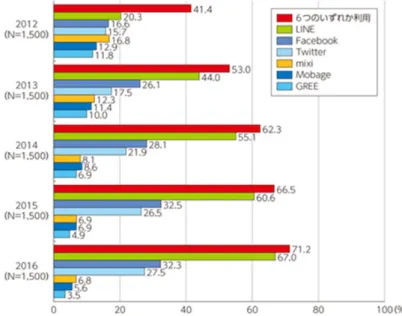
When comparing Thailand to Japan, Japan’s ranking was higher overall. Regarding digital products, Japan was ranked number two while being the first leader in the digital community. This is according to the Japanese Ministry of Foreign Affairs and Communications in 2016 that the use of Social Network Sites or SNSs had increased so that it would spread to the spread of smartphones. Some of the leading SNS and MIM in
Japan include LINE, Facebook, and Twitter. In the overall age group of users, the utilization percentage of these services rose from 41.4% in 2012 to 71.2% in 2016. This shows that the use of SNS has become more apparent in the smartphone society.
Figure 5. Changes in utilization rates of representative SNS in Japan from 2012-2016. (Source: Information and Communication Policy Research Institute, Ministry of Internal Affairs and Communications "Survey on Information Time and Information Behavior of Information and Communication Media")
Smartphones and SNSs (including MIM) draw similar trajectories, and it is thought that both are leading to the expansion of the use of smartphones and related services. SNS and MIM are used not only for communication tools but also for other services and cooperation with other services. For example, some examples are utilized for marketing, such as FinTech and sharing services to guarantee the reliability of individual transactions based on the usage status of SNS. Table 3. Shows the utilization ratio of major SNSs in
22 Table 3
The Utilization Ratio of Major SNSs in Japan by 2016 by Gender and Age.
(Source: Information and Communication Policy Research Institute, Ministry of Internal
Affairs and Communications "Survey on Information Time and Information Behavior of Information and Communication Media")
2. Research contribution
Since communication via MIM applications is becoming more popular in Thailand with millions of active users, it is interesting to study how MIM applications play a role in the workplace, especially the use by the managers. It will also discover how MIM application can play a major role in communication between managers and their subordinates. The researcher hopes that the study in the case of Thailand can help to understand a country’s work culture and can lead to the future study of using MIM application for work in other countries.
3. Research Questions
1. Is MIM application an effective communication medium for work? - To see how effective MIM is as a communication medium between the manager and the team.
2. How do managers in Thai company use MIM for managing purposes? - To investigate the managing roles of the Thai managers when they use MIM for work.
3. What are the MIM messages used for work by the managers? - To explore the types of messages in MIM used for work by the managers and the team.
4. Are there any positive or negative effects of using MIM for work with the team
members? – To see the effects of the manager’s use of MIM with the team members.
5. What are the leadership characteristics demonstrated by the managers’ use of
MIM? – To study the leadership characteristics of the managers from the use of MIM with
Chapter II Literature Review
1. Mobile Instant Messaging (MIM) Application:
MIM refers to Mobile Instant Messaging. According to Oguhuma et al. (2016), MIM is a new form of communicative technology with specific objectives and unique features. Before MIM, each online service requires its domain. With MIM, this need is no longer present as the application can serve as the platform and hub for online services. MIM applications use their network effect, mobility and ubiquity to connect various services on one single platform. Using MIM, users can update real-time information anywhere, anytime (Oguhuma et al., 2016).
Church & Oliveira (2013) describe MIM application that it allows the user to send and receive images, video, audio, and location-based messages to individuals or groups of friends using the users’ pre-existing data plan and at no cost. For example, an application called WhatsApp requires a mobile internet connection to function and both parties must have the proprietary software installed on their mobile phones. It also provides additional social information to its user (e.g., contacts can see when their friends are online, when they are typing and when they last accessed the application. It also provides delivery notifications when a message is sent and when it is delivered to the recipient's device (Church & Oliveira, 2013).
Similarly, according to Karimiyazdi & Mokhber (2015), MIM has become more important in the era of a high-speed data network such as 4G when people use mobile
instant messaging to communicate with others in everyday life. They also explain why it has become more popular than SMS:
“The emergence of MIM applications, exposed traditional SMS in danger of losing its market as the dominant mobile messaging service. MIM applications such as WhatsApp, Viber, LINE, etc which install and run on personal digital assistant such as tablets and smartphones, have become very popular worldwide and have generated significant demands and enable consumers to send and receive text, photo, and video message, at very low or no cost. MIM is more user-friendly and has more features in comparison with traditional short message services (SMS). In addition, MIM offers variety of instant communication options, and users can easily switch between MIMs (Karimiyazdi & Mokhber, 2015).”
The convenience of MIM has been stressed by many scholars, including Deng et al. (2010) who stated that MIM enables consumers, whether sitting at the computer or on the road, to connect instant message (IM) with existing communities and across the mobile Internet. It brings tremendous conveniences for customers and is widely adopted by young people (Lu et al., 2010). Some of the widely-used MIM applications worldwide are such as KakaoTalk, WhatsApp, WeChat, LINE, and Viber.
26
The existing MIM literature has covered some aspects such as customers continuance intention to use MIM (Oguhuma et al.,2015), viral marketing campaign on MIM (Karimiyazdi & Mokhber, 2015), and several on users’ behaviors and attitudes towards MIM applications, especially in Thailand. Other studies on organization communication using smartphones are such as the study by Kiddie (2014) who studied workplace communication in the United States whether youth entering the workforce would act as change agents to evolve primary business communication channels from email to text messaging. The results revealed that change agents and early adopters already in the company, not new hires, would affect a change in communication media that would involve new technology such as smartphones (Kiddie, 2014).
Lee et al. (2012) examined the use of an attitude toward smartphone specifically iPhone and Blackberry as a communication device by organizational members in Malaysia. They found that smartphone had been used as a communication tool by the interviewees with their superiors, colleagues, and clients for communicating verbal instruction and urgent matters, transmitting work-related and updated information, building rapport and affiliation, solving clients’ query and demand, and providing feedback. Smartphones were perceived as a communication tool in the workplace because of its various advantages. Also, smartphones were also used as a dynamic avenue for organizational communication and demonstrated high effectiveness as a new form of communication culture in Malaysian organizations (Lee et al., 2012).
Pitichat (2013) also studied the use of smartphones in the workplace. It was found that using smartphones in the workplace could be valuable in three ways: promoting autonomy, strengthening relationships with peers as well as superiors, and improving
knowledge-sharing. Additionally, these three main factors could increase employee job satisfaction, which leads to better efficiency in the workplace. Therefore, organizations would be better able to successfully adapt to changes by integrating the use of Smartphones in the workplace (Pitichat, 2013).
3. Media Richness Theory (MRT)
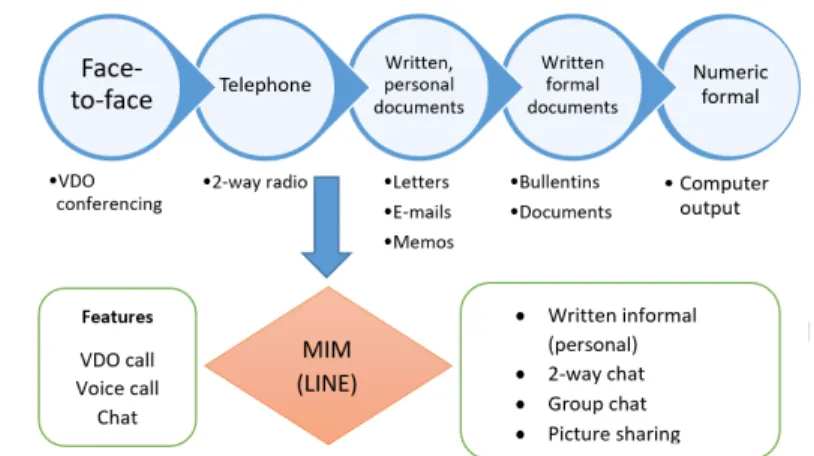
According to Daft and Lengel's theory (Daft & Lengel, 1984), richness is defined as the potential information carrying capacity of data. If the communication of an item of data provides substantial new understanding, it would be considered rich whereas the datum provides little understanding would be low in richness. Daft & Lengel, (1984) proposed that communication media used in organizations determine the richness of information processed. According to Lengel, communication media vary in the richness of information processed. Communication media include (1) face-to-face, (2) telephone calls,
(3) written personal, (4) written formal and (5) numeric formal. Based on MRT, each medium differs in (1) feedback capability, (2) communication channels utilized, (3) source and (4) language. Numeric formal •Computer output Written formal documents •Bullentins •Documents Written, personal documents •Letters •E-mails •Memos Telephone •2-way radio Face-to-face •VDO conferencing
28
Media richness theory or MRT is one of the most extensively studied frameworks of media choice in managers’ communication (Sheer & Chen, 2004). Sheer and Chen (2004) studied manager-subordinate communication from various organizations in Hong Kong and found that relational and self-presentational goals are also relevant in manager-subordinate interactions, particularly when messages differ in valence (Sheer & Chen, 2004).
According to Daft and Lengel, media capable of sending rich information such as face-to-face meetings are better suited to equivocal tasks whereas the less rich media such as computer-mediated communication are best suited to tasks of uncertainty.
Dennis, Valacich et al. (1998) found the lack of convincing supports in the stream of research where managers typically have been asked to choose which medium to use to send a set of hypothetical messages to determine whether their choices fit the predictions of media richness theory. They argue that in a number of cases, managers have made different choices than those predicted by media richness theory due to the insufficiency in the task-media fit in explaining media choice; therefore many researchers have concluded that media choice is affected by factors beyond the richness of the medium itself (Dennis, Valacich, et al. 1998). One explanation behind the lack of empirical support for media richness is that the task-media fit is insufficient in explaining media choice. Many researchers have thus concluded that media choice is also affected by factors beyond the richness of the medium itself such as the number of users required before a medium become widely used, the availability of the medium to the message sender and ability of the sender to use that medium (Dennis, Valacich, et al. 1998).
According to Dennis, Valacich et al. (1998), even though a medium’s ability to support the various communications processes occurring in a face-to-face context is important, there are also other media dimensions that are important to consider. These include computer-facilitated communication such as electronic mail, group support systems, voice mail and video teleconferencing which have become widely used after the development of MRT.
They also argue out that these different media dimensions may provide more effective support for specific communication processes than previously theorized by MRT. They suggested three important conclusions beyond the traditional MRT. First, no one medium has the highest values on all dimensions (i.e., none could be labeled as "richest" in Daft & Lengel's terms). Second, media are not monolithic since it is possible for one medium to possess different levels depending upon how it is configured and used (for example, one electronic mail system may have a very limited symbol variety by being limited to text only, while another electronic mail system may provide the ability to include graphics, pictures, and video in a mail message.) And, third, ranking media in absolute terms is not practical when past empirical research has repeatedly suggested that richness not be a continuum. Therefore, concluding that face-to-face communication is the "richest" media is inappropriate (Dennis, Valacich, et al. 1998).
On the studies of MRT in other types of media as proposed by Daft and Lengel, Dennis and Kinney (1998) studied the effect of media richness on decision making in two-person teams using “new media” (i.e., computer-mediated and video communication). They found that media richness matters, but it does not improve performance for the new
30
(i.e., letters and memos) whose levels of feedbacks and cues are lesser than those of the new media. “The new ‘lean’ media may be just rich enough to enable users to successfully communicate for moderately equivocal tasks (Dennis & Kinney, 1998)”.
Recent studies such as Lee (1994), and Markus (1994) have included the study of e-mail use in organizational communication and found that MRT failed to explain the richness of electronic medium like e-mail. In 2013, Mandal and McQueen studied social media adoption in micro businesses (Mandal & McQueen, 2013). They proposed that regarding richness, the social media interface of the Facebook business page is considered richer than email in its capacity (i.e., to express by photos, and to transmit web links). They also suggested that the incapability of MRT to explain rich communication through email is carried forward to social media adoption (Mandal & McQueen, 2013).
As on MRT and mobile instant messaging (MIM), Tseng et al. (2017) identified a lack of more recent studies in the role of media richness in determining customer loyalty to mobile instant messaging (MIM). Based on MRT, they examined how media richness influences customer perceived values, consequently contributing to customer loyalty to MIM. In their study, it is found that language variety has the strongest effect on user loyalty to MIM.
4. MRT and Culture
Media richness refers to the extent to which a communication tool provides contextual support for interaction by allowing for immediate feedback, body language, vocal cues, and the like (Setlock, Quinones, et al. 2007). In their research, Setlock et al. focused on three types of information that media can provide: visual cues of others’ facial expressions, movements and other nonverbal reactions, vocal cues (tone of voice), and
interactivity (immediacy of feedback). Richer media such as video conferencing have more of these features than leaner media such as Instant Messaging (IM). They hypothesized that communication among members of high-context cultures might be more disrupted by the use of leaner media than communication among members of low-context cultures.
“For members of low-context, Western cultures, studies have found that media richness affects such things as the efficiency of grounding or the formality of language, but rarely influences outcome measures such as task performance. Richer computer-mediated communication tools, such as video conferencing systems, provide added social context by making available information about participants’ surroundings, attention, gesture and demeanor (e.g., [5] [18]). Because high-context cultures theoretically place more value on visual and vocal cues than do low-context cultures (Setlock, Quinones et al. 2007).”
In their study, they compare the communication and performance of low-context American dyads, high-context Chinese dyads, and mixed American-Chinese dyads on a negotiation task under two possible media conditions: audio conferencing or video conferencing. Despite theoretical, cultural work and some prior research suggest that high-context Chinese dyads can benefit from the visual cues available in video-enabled systems, there is little support for this hypothesis (Setlock, Quinones, et al. 2007).
32
5. MIM applications and Organizational Communication
There have been some recent studies about MIM such as WhatsApp and Slack in organizations. These MIM tools have similar features to LINE yet; they are not used widely in Thailand. For example, Slack which claims to be ‘The Office Messenger Application’ has similar features compared to LINE. Users of Slack can create ‘Team’ based on company , department, or project-based. They can also create ‘Channel’ for a specific purpose such as marketing channel, promotional channel, or in a granular level like a special event. Within the team, members can be flagged in the conversation in the channels, send direct messages back and forth with other team members. This feature works like other messaging application. However, the difference between Slack and emails/ other MIM is that it is more instant and team-based than e-mail, making it easier to use with fewer barriers in opening/downloading. Like other MIM, it does not replace e-mail completely. Instead, it reduces the amount of e-mails threads with team members which is an advantage for every MIM.
The advantage of using Slack for work are such as:
• Flexibility- it depends on how the user sets it up (private group, tagged. Etc.) • Search-back ability (over 10,000 messages storage)
• Fast, efficient and accurate • Good level of encryption
• Integration with other tools: Trello-a web-based project management application,
One of the previous studies on Slack in the organization was carried out in a healthcare field. Gofine & Clark, 2017 has studied the integration of Slack into their research team of practitioners of epidemiology. According to them, the practitioners of epidemiology usually require efficient real-time communication and shared access to numerous documents in order to manage a study effectively. Much of this communication involves study logistics and does not require the use of Protected Health Information. Slack is used since it is a team collaboration app. It allows the team to communicate in real-time without the need to find email addresses or phone numbers or create contact lists. They found that Slack is easily integrated into the workflow at an urban, academic medical center and is adopted by users as a highly effective tool for meeting research teams’ communication and document management needs (Gofine & Clark, 2017).
Another interesting study on Slack and organizational communication is the study of Slack in team communication in reducing social loafing. Lam (2016) addressed the issue of social loafing by examining the importance of team communication by using Slack as a team communication application. He found that Slack influences communication quality and social loafing. From his study, the results of the preliminary data indicate that the use of Slack significantly improved communication accuracy and appropriateness. Therefore, the use of Slack significantly reduced social loafing (Lam, 2016).
Using MIM applications or digital tools can also bring advantages to the organization. It is suggested that using MIM applications such as SLACK, WhatsApp, Yammer, or Skype can enable fast, dialogic and public conversations within the company (Ristniemi et al., 2017). Nevertheless, the studies on MIM in Thailand is quite a new area
34
like to explore. Therefore, the researcher wishes to deeper investigates the use of MIM in business organization, hoping this will be one of the first studies about MIM in organization study in Thailand.
6. Organizational Communication and Leadership
6.1 Task-Oriented Leadership
One of the renowned behavioral approaches in leadership study is task-oriented
leadership. Task-oriented leadership theory describes a leader as a person whose actions
are centered on the task to achieve certain goals or to achieve a certain performance standard. Task-oriented Leadership can be defined as "a descriptive model of leadership which maintains that most leadership behaviors can be classified as performance maintenance or relationship maintenance” (Forsyth, 2010). The features of task management are covered in task-oriented leadership styles such as the leader’s coordination of job-related activities, administrative activities, and supervising. In other word, task-oriented leaders focus on completing necessary tasks in order to reach organization’s goals. As for their characteristics, these leaders are less concerned with the employees, but more concerned with following a planned path.
Task-oriented style leaders have many strengths such as the ability to complete jobs promptly as they focus on the necessary work procedures to have the duties fulfilled. This strength will ensure employees manage their time well as the leaders delegate work in a timely and productive manner (Rüzgar, 2018).Task-oriented leaders design workgroups for specific tasks to ensure the members have a clear understanding of their roles. Since
the task definition is clear and precise, the work targets are clear and understood by the employees. As a result, this style of leadership is suited to a well-structured work environment such as manufacturing assembly lines (Fiedler, 1964).
However, according to Bass (1990), task-oriented style of leadership does have some flaws of autocratic leadership including causing motivation and retention problems, since the leaders tend to think less of the team than the tasks (Bass, 1990).
6.2 Relationship-Oriented Leadership
As often compared with task-oriented leadership, relationship-oriented leadership theory describes a leader as a person who is motivated by and concerned with his/her interactions with the team members. Relationship-oriented leaders focus on job satisfaction, motivation and work-life balance of the employees. They are also focused on supporting, motivating, and developing their employees to encourage teamwork, collaboration, and encouraging communication to build a positive relationship within the employees. The relationship-oriented leaders often act as mentors to their employees. They also understand the welfare of the employees are prioritized, and the leaders do not hesitate to tend to their needs (Rüzgar, 2018).
The benefits of relationship-oriented leadership are that team members are in a setting where the leader cares about their well-being, and the positive dynamic of the group is created. Nevertheless, relationship-oriented leadership may have weaknesses that the development of team spirit may hinder completing the actual tasks and desired goals (Burke et al., 2006), or, if employees have too much responsibility without leader guidance,
36
the decision-making duty can become challenging and this may lead to lower performance, high employee turnover, or customer dissatisfaction (Rüzgar, 2018).
6.3 Supervisor Behaviors
One of the rigorous behavior approaches of leadership was proposed by Komaki, Zlotnick, and Jensen in 1986 (Komaki, Zlotnick, & Jensen, 1986). They categorized specific supervisor behaviors into seven categories. The first three categories are related to effective supervision (derived from operant conditioning theory): (1) Performance
consequences- indicating knowledge of performance, (2) Performance Monitors-collecting
information and performance, (3) Performance Antecedents- providing instructions for performance, (4) Own performance- referring to the manager’s performance, (5)
Work-Related- referring to work but not performance, (6) Non-Work Work-Related- not pertaining to
work, and (7) Solitary- not interacting with others (Bass, 1990). Fig. 7 shows the seven categories of supervisor behaviors.
Figure 7. Operant taxonomy of supervisory behavior proposed by Komaki, Zlotnick, and
Mumford, Fleishman, Levin, Korotkin, and Hein (1988) have also proposed an approach for the interrelationships among the leader-behavior dimensions. These include (1) The search for and structuring of information (acquisition, organization, evaluation, feedback, and control), (2). The use of information in problem-solving (identifying requirements, planning, coordinating and communication, (3). Managing personnel resources (acquisition, allocating, development, motivation, utilization and monitoring, and (4). Managing material resources (acquisition, maintenance, utilization, and monitoring) (Bass, 1990) which are demonstrated in Fig.8 This model of the interrelationships of supervisor’s behavior can perhaps help explain the managers’ managing behavior of using MIM in this study.
38 Chapter III Research Methodology
1. Research Method
Using a snowball sampling method, the author recruited fifteen middle managers from five different business organizations located in Bangkok, Thailand for a semi-structured interview during May-June 2017 and August-September 2018. Snowball sampling is regarded as a purposeful sampling that “typically proceeds after a study begins and occurs when the researcher asks participants to recommend other individuals to be sampled (Creswell, 2012)”.
According to the data from the National Statistical Office of Thailand, it was found that Bangkok showed the highest proportion of ICT users comparing to other regions. The users of computers, internet, and mobile phone (including smartphones) in Bangkok was the highest at 50.5%, followed by the Central Region, Northern Region, Southern Region, and Northeastern region with the user’s percentage of 31.5%, 30.1%, and 27.0% respectively.
It was also shown that Bangkok also had the highest numbers of smartphone users of 70.3%, followed by the Central region (56.3%), Southern region (48.7%), Northern region (45.2%), and Northeastern region (39.3%). The demographic age of the smartphone users showed that the age group between 24-35 was the highest at 73.6%, and the activity of using the internet was used mostly to Social Networks (including MIMs) ("The 2015 Establishment Survey on the use of Information and Communication Technology," 2017). Therefore, the research sites in this study are chosen on the ground of the locations, all of which are located in Bangkok, the capital city of Thailand in the Central
region which show the highest use of ICT services and devices. The different business profile of each company is another reason for the researcher to compare the studies of MIM use by the managers of different industries.
In this study, the five business organizations and their business industries are demonstrated below in Table 4.
Table 4
The Business Industries of the Companies Studied in this Research
The interviewees’ confidentiality of response was assured, and due to companies’ privacy reason, the companies and the managers’ names must remain anonymous. Only the manager’s initials and positions can be revealed. So, the names of the companies studied will be simply referred to Company A, Company B, Company C, Company D, and Company E. The interview data were recorded using an audio recorder and then were
40 2. The Research Sites
The details about the companies in this study and their business are described in the following section.
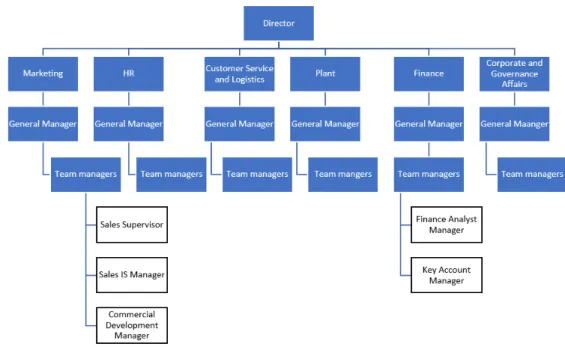
(1) Company A International (Thailand) Co., Ltd-:
Company A is a subsidiary of an international, Inc. - a world’s leading snacking powerhouse in consumer’s candy, gum and mints, cookies, crackers, chocolate, and powdered beverages. Company A (Thailand) is the number one market share in candy and gum in Thailand, with the biggest gum and candy plant among the company’s plants in the Asia Pacific. Another plant in the Northeastern of Thailand is also the largest sourcing hub for powdered beverages in the company’s Asia Pacific hubs. Company A’s three sites including the main headquarter in Bangkok have nearly 1,400 employees in 2017. The company’s organization divisions and the managers interviewed in this research are demonstrated in Fig.9.
Figure 9. Company A’s divisions and the managers interviewed in this research. Note: The managers are portrayed in the white boxes.
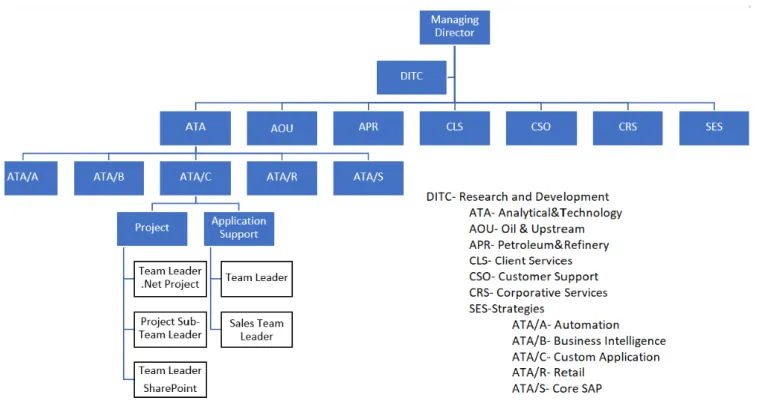
(2) Company B (Inc).:
Company B is a company offering a variety of information technology (IT) and communications service including solutions delivery, infrastructure management, applications management, training service, customer service, and hardware /software service. The company was founded in 2006 and is based in Bangkok, Thailand. Company B operates as a subsidiary of a Company Limited in Petroleum business. The company’s organization divisions and the managers interviewed in this research are demonstrated in Fig.10.
Figure 10. Company B ’s divisions and the managers interviewed in this research. Note: The managers are portrayed in the white boxes.
42 (3) Company C Thailand:
Company C Thailand is a subsidiary of Company C, Inc., a leading developer, and manufacturer of drug capsule used in biopharmaceutical and consumer health and nutrition industries. The main office of Company C is located in the central Bangkok with the manufacturing sites in Ayutthaya Province. Fig.11 shows the company’s organization divisions and the managers interviewed in this research.
Figure 11. Company C ’s divisions and the managers interviewed in this research. Note: The managers are portrayed in the white boxes.
(4) Company D Thailand:
Company D Thailand is the wholly-owned subsidiary of Company D Corporation (Japan). Company D controls the manufacturing of Company D’s cars in Thailand and supplies cars to various official dealers throughout the country. Company D export cars to
many regions of the world as well. The organization divisions and the managers of Company D interviewed in this research are demonstrated in Fig.12.
Figure. 12. Company D ’s Divisions and the Managers Interviewed in this Research. Note: The managers are portrayed in the white boxes.
(5) Company E Thailand:
Company E defines itself as a "Business to Specialist" Company. Company E Thailand is also a subsidiary of Company E Corporation (Japan). Company E Thailand
44
microscope systems, remote visual inspection products and non-destructive testing (NDT) systems), and imaging business (e.g. interchangeable lens cameras, compact digital cameras, digital camera accessories, software and applications, etc.) Company E’s organization divisions and the managers interviewed in this research are demonstrated below in Fig. 13.
Figure 13. Company E ’s Divisions and the Managers Interviewed in this Research Note: The managers are portrayed in the white boxes.
The managers in each company interviewed in this study and their positions are presented in the following Table 4.
Table 5
The Managers (with their positions) Interviewed in this Study
3. Research Framework
The research framework for this study is demonstrated below in Fig. 14 according to the assumptions that:
1. Managers use MIM for managing purposes.
2. There are different functions of MIM messages used for work by managers. 3. MIM is an effective communication medium for work and leadership. 4. MIM positively affects and motivates team members.
46
Chapter IV
Qualitative Analysis of the Managers’ Use of MIM
1. The Positioning of MIM in the Media Richness Theory
From the interview with the managers in Thailand in this study, the interview data supported the main hypothesis of this research that managers in Thailand use MIM
application for work. The number one most used MIM application by all the managers
from the five companies interviewed in this study (fifteen in total: eight females and seven males, between 30-40 years of age) is LINE application.
According to the Media Richness Theory (MRT), the data from the interview suggested that the richness of MIM, since it is a new media never been mentioned before, should be categorized between the richness of 2-way communication like telephone and written personal documents. The researcher argues that the richness of MIM is richer than the telephone since it can also be used as a voice call (Fig.15). Nevertheless, it still serves as written personal documents (in the same category as letters, e-mails, and memos) with the features of two-way chat, group chat, and other media sharing (such as pictures, audio, and VDO). MIM, although most used as an informally written form, is ‘richer’ than letters and e-mail because of its unique combination of functions since it can be used as informally written text, voice call, stickers showing emotions and sounds, or sent as a voice message.
48
Figure 15. Author’s proposal of media richness for MIM.
The other communication media used by the managers in all five companies are similar. The interview data demonstrated that besides face-to-face, the managers mainly used these media for work: 1. Telephone 2. Skype for Business 3. E-mail 4. MIM (LINE) as shown in Table 6.
Table 6
A Typical Use of Each Media
The findings of this research support the hypotheses of as follows:
2.1 MIM (LINE) is an Effective Medium for Work
The answers from the managers are slightly different in each of the company. In Company A, the managers suggested that LINE can create clear communication which will lead to good work performance.
For Company B, the managers suggested the ability of LINE for remote communication for team members who work separately. It enables them to communicate efficiently and will result in good work performance.
o “We always have to stay connected even though the members out of the
office.” – Mr. J.M.
o “Our work is not desk-based. We work on different projects in different
provinces, so effective communication is necessary." – Ms. W.Ji.
For Company A and Company C managers, the importance of team communication and information sharing which LINE can help create was suggested. The group call function was given as an example of work- supporting functions they always used.
o “You cannot work by yourself, so communication with other people is very
important. LINE is a great communication tool to stay connected with your team member.” – Mr. PJ (Company A)
o “LINE is an important tool for work because we need a clear, smooth
50
o “It is very important, especially when sending pictures or information from
the customers to the team." – Mrs. P.C. (Company C)
o “LINE is very important for group calling function which requires real-time
information for a team meeting." – Ms. T.S. (Company C)
For Company D and Company E managers, the commonality of LINE since it has become used widely makes it more convenient to be introduced at work.
o “Because of the popularity of LINE that everyone has, LINE become a part
of our lives both for private and work. It is difficult to ask everyone you meet to download a program they do not have on their smartphone like Slack so that you can contact them. The already availability of LINE makes it more common to use it with everyone.”- Ms. I.D (Company E)
o “If you are new in a company, instead of asking for your telephone number,
other people would ask for your LINE contact since everyone already has one.”- Ms. N.S. (Company E)
o “Since everyone uses LINE, the HR department of the company uses HR
LINE group to communicate with all the employees. They usually use LINE to promote new policy, inform about the employee’s benefits, or announce the meeting.”- M.R. C.L (Company D)
o “I think it has become an organizational culture to use LINE at work. Since
clients if they ask to be added as a contact.”- Mr. N.N. (Company D)
The managers believe that one of the reasons for the popularities of LINE in Thailand is the sticker functions. LINE stickers enable users to send stickers with meanings without having to type a message, therefore convenient to use when they are busy to reply. For example, instead of typing the word “Okay, I have got it/ I understand,” they can choose a sticker with the graphic or wording that reads ‘Okay,’ to the receiver. Also, according to the managers, stickers can also show the sender’s emotion to indicate what the sender is feeling at the moment.
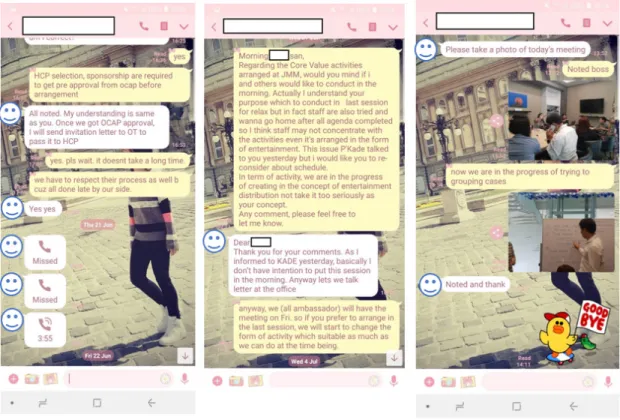
According to the interview findings, LINE is regarded as an effective medium used for work. The managers suggested that a clear communication among the team members is crucial and LINE is effective because of its swiftness that enables a clear communication, especially in a remote communication situation such as for the Sales team. There were many situations when the team members are away from the office so using LINE to communicate is cost-efficient. Therefore, LINE is often used by the managers and team members, and most of the managers stated that they use it for work regularly daily. The examples of the managers’ use are shown in the following Fig. 16 and 17.
52
Figure16. The examples of the managers’ use of LINE for work in the group of Project
Managers.
Figure.17. The examples of the managers’ use of LINE for work in the group of Project
2.2. Managers Use MIM for Various Managing Purposes.
It was found that managers use MIM for various purposes. For examples, LINE is most convenient when used for group chats as stated by one of Company A managers, Ms. K.S, “It can create group chats, so we can already control whom we are talking to either personal or work.” It is also used for remote communication, project monitoring, group chat, written evidence, and giving team support are also among the interview findings. Another interesting purpose of LINE use which is common in the answers of the managers is to use it when feeling considerate (as do not want to disturb the members by calling). There is no literal translation of the word from the Thai language which is ‘เกรงใจ' (Kreng- Jai). However, the managers meant the feeling when one does not want to bother or disturb the other. Some of the explanations by the managers are:
o “Sometimes we need to talk to someone but do not want to call them because
the matter is not so serious. Leaving a message on LINE is appropriate and free, so it is often used when there is no need for the other person to reply immediately.”- Mr. P.H. (Company A)
o “LINE is often used when you want to talk to or ask someone about
something, but it is not an urgent matter, so leaving a message for that person to answer back at his/her convenience seems appropriate.”- Mr. J.M
(Company B)
54
o “As a manager, I think LINE is appropriate to use when there is an issue
we forgot to talk at work, and I just realize it after the work hours. I would leave a message asking my team in LINE, and they can answer when they are free. Calling is not good in this situation because they are already out of work.”- Mr. S.T (Company D)
o “When I do not want to talk or bother them, I prefer to leave a message, so
my team can answer anytime when they are free.”- Ms. M.U (Company E)
Not only is LINE used by the managers to communicate with the team members, but it is also used by the managers’ supervisors and customers as well. Fig. 18 demonstrates an example of LINE communication between a manager and her supervisor.
As for the LINE communication with customers or clients. It was found that the managers use LINE to communicate with their customers/clients if the customers/clients feel comfortable to be contacted in LINE (depending on the situation).
o “I have different groups for each customer account, e.g., Big C, Tesco,
Tops. There are more than 10 and other smaller groups for my team members.”- Mr. K.S (Company A)
o “There are so many groups I belong to in LINE because I have to contact
with many team members and also customers.”- Mr. P.J. (Company A)
o “I use it to communicate with customers (depends on the customers)
informally.” – Ms. W. Ji (Company B)
o “LINE is used most often because it can create a group chat, making
communication between the team and with customers easier. We often invite customers to join LINE group for our and their convenience.” – Mr. P.T
(Company C)
o “Also, we have customers’ LINE group to confirm the monthly meeting. The
customers here I mean the car dealers. After sending the customers an e-mail about the details of the meeting, we resend the meeting details and agenda in LINE for their convenience.” Mr. C.L. (Company D)
o “I use LINE with my team members, colleagues and clients every day. It is
very convenient to send files and pictures instantly to the people I must deal with.”- Ms. I.D. (Company E)
56
The findings suggest that there are both vertical and horizontal communication when a manager uses MIM (LINE) for work as represented in Figure 19. Besides the intra-communication or internal intra-communication within the company, the study shows the external communication between the managers and the company’s customers’ as well. For the internal communication, on the vertical level, the managers use LINE to communicate with their boss or superior managers and with the team members. While on the horizontal level, the managers also use LINE with the other managers of other teams and with other colleagues as can be demonstrated in Fig. 19.
Figure.19. The vertical and horizontal communication of a manager using LINE for work.
However, it is found that there is also a hierarchy in the vertical LINE communication in the company. Many managers mentioned that even though sometimes
the key management people of the company were in a group chat, they are less likely to communicate directly to the operational-level employees. The managers, therefore, needed to play an active role to initiate the conversation. The following are from the interview with the managers in this study.
o “As for the disadvantages, if the LINE group has someone in a high
position, the members might not feel comfortable to answer the message. I think it is a kind of Thai culture to remain silent in order to avoid making a mistake in front of someone whose position is higher than you.” – Mr. J. M.
(Company B)
o “The management rarely use it (LINE) though, they ask us managers to
communicate with the team members. However, from my observation, they have LINE group of only the key management people. The other staffs in the lower positions also have smaller LINE groups according to their job roles and functions, normally with no managers in as the group members.”- Mr.
C.L. (Company D)
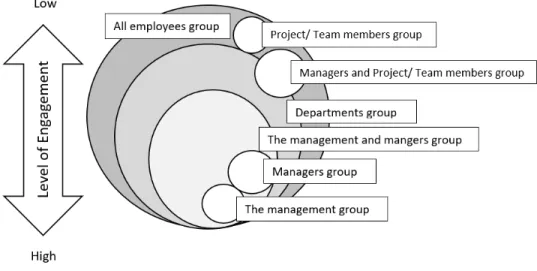
From the managers’ perspective, the smaller the LINE group chat means the higher rate of conversation and activity engagement since the junior employees would avoid engaging in a conversation in a large group of people, similar to showing their voices or opinion in the company’s meeting where everyone is required to attend. The example of LINE groups in an organization and the level of engagement in the groups can be illustrated
58
Figure 20. How LINE groups are used for work in an organization and the level of member
engagement.
The interview data also shows that LINE has both advantages and disadvantages. According to the managers, the advantages and the disadvantages of using LINE for work are presented in Table 7 as follows.
Table 7
The Advantages and Disadvantages of Using LINE for Work
Advantages Disadvantages
For work
• Monitoring
• Remote communication • Reducing work redundancy • Expediting work process
Informality
For managers • Convenient
• Showing good examples • Showing acknowledgment
Lack of confidentiality
For Team relationship • Giving team support • Defusing work tension
Mistake-prone • Confusion • Frustration
From the interview data, the advantages of using LINE for work can be categorized into three categories: The advantage for work, managers, and team relationship. The managers stated during the interview that LINE is used mostly for work monitoring which is practical when some of the team members must work away from the office, especially for the Sales team. Therefore, it is useful for remote communication between the managers and the team. It also reduces work redundancy when they communicate via LINE. Each team member can read the message and confirm the written text so there is no need to send another confirmation via e-mail which can help expedite the work process. However, in many cases, LINE and e-mail are used simultaneously.
o "I think it is convenient because all of the team members have LINE on their
phone. It reduces the problem of full e-mail inbox because some matters can be discussed and confirmed in LINE.” - Mrs. P.C (Company C)
o “It is convenient because everyone has it. It helps solve the problem of
excessive e-mails in the inbox because the team members can confirm with each other in LINE. Therefore, there is no need for sending e-mails to the team.” – Ms. W.J. (Company B).
o “LINE is the first step of team communication to talk with the team before
repeating the message via e-mail or telephone according to the situation.”
- Mr. C.L (Company D)
o “It reduces working time since it can be sent instantly with evidence.”- Mr. S.T. (Company D).