較 : 予備的考察
Author(s) 小林, 茂之
Citation 聖学院大学論叢, 24(2), 2012. 3 : 165-181
URL http://serve.seigakuin-univ.ac.jp/reps/modules/xoonips/detail.php?item_i d=3666
Rights
聖学院学術情報発信システム : SERVE SEigakuin Repository and academic archiVE
〈原著論文〉
Linguistic Comparison between Prose and Poetry in the Old English Version of Boethius’ De Consolatione Philosophiae:
A Preliminary Survey Shigeyuki KOBAYASHI
古英語版ボエティウス『哲学の慰め』における散文と韻文との言語学的比較
――予備的考察――
小 林 茂 之
古英語版ボエシウス『哲学の慰め』は,アングロサクソン時代のウェセックス王,アルフレッド 大王(在位 871-99)による作品である.同作品の原作は,ローマの哲学者,政治家,ボエティウス
(480-524)に書かれた.アルフレッドは,原作に存在しない部分をも書き加え,キリスト教思想に 基づいて,かなり自由に古英語に翻訳した.
古英語による本作品は,散文と後に散文に基づいて作成された韻文とで構成されている.古英語 における散文と韻文間における言語的・文体的違いはよく知られているが,同作品ではそれらを比 較・対照することが容易である.
当研究は,小規模な予備的調査としての同作品の散文と韻文間の言語学的比較である.特に,韻 文に対する韻律論文法を語序の分析に基づいて統語論的立場から検討することを目指した.従来,
韻律論的文法で説明されてきた動詞先頭語序は,統語論的にも分析される必要があることを示した.
Key words; Old English,Boethius,prose,poetry, Verb-movement Key words; 古英語, ボエティウス , 散文 , 韻文 , 動詞移動
0 Introduction
The Old English version of Boethius’De consolatione Philosophiaewas one of the works which King Alfred the Great, king of England (871-99), translated from Latin into Old English. Alfred translated Boethius’ work with considerable freedom. Boethius’ dialogue was changed to reflect the Christian meaning which the translator saw as the heart of the work.
執筆者の所属:人文学部・日本文化学科 論文受理日 2011 年 12 月 14 日
Boethius’ metres were translated into prose which was later turned into verse. These dual versions of the same material afford a comparison between the form and style of prose and those of poetry in Old English. The materials which were investigated for this study were not those in Latin: rather, they are the Old English of Alfred’s translation, which is preferable in studying Old English because the problem of the direct influence of Latin on works translated into Old English can thus be avoided, to a certain extent. The texts used for this study are Mitchell and Robinson (2006) for prose and metre (I) and Baker (2007) for prose and metre (XVII and X, respectively).
Although the differences between prose and poetry in OE mentioned above are well-known, the syntactic characteristics of poetry have to date been much less fully analysed. This paper aims to make a preliminary exploration of the field. In the later sections of this paper, the prose version and the corresponding metric version will be linguistically compared in relation to word order in main clauses, following a brief explanation of syntactic analyses of the various constructions.
1 Syntactic Analyses of Word Order
Some word order variations can be analysed syntactically in relation to verb-movement. I will introduce the analyses of word orders based on verb-movement in this section before analysing word order in the Old English Version ofBoethius.
1.1 V-to-T Movement
In Modern English, the main verb and its direct object are generally adjacent and adverbials and negative markers are unable to intervene between them, as follows:
(1) a.*Johnkisses oftenMary.
Johnoften kissesMary.
b.*Johneats notchocolate.
John doesnot eatchocolate.
(Roberts 2007: 41, (44))
In contrast to Modern English, in French, adverbials and negative markers intervene between the main verb and its direct object as follows:
(2) a.Jeanembrasse souventMarie.
*Jeansouvent embrasseMarie.
b.Jean (ne)mange pasde chocolat.
*Jean (ne)pas mangede chocolate.
(Roberts 2007: 42, (45))
This phenomenon is explained by V-to-T movement. The underlying structure for (2) is assumed as follows:
(3)
(Roberts 2007: 42, (46))
This type of verb movement is called V-to-T movement because the finite verb moves from within VP to T position. Thus the surface word orders of French in (1) and (2) are explained by assuming V-to-T movement. In contrast to French, V-to-T movement is not allowed in ModE.
1.2 V2 Word Order and V-to-C Movement in Old English
In Germanic languages finite verbs move to C, and the Spec of CP position is occupied by adverbial elements or DPs. V-to-T movement and T-to-C movement are shown in the figure below:1
(4)
(Fischer et al. 2000: 111, (28))
In Old English, V-to-C movement is allowed only in main clauses, not in subordinate clauses, while finite verbs in VP are not able to move to C position because C position has already been occupied by conjunctions in subordinate clauses.
The distinction of word order between the main clause and the subordinate clause is shown in the examples (5) and (6) below:
(5) Se Hælendwearðþa gelomlice ætiwed his leornung-cnihtum the Lord was then frequently shown his desiples
‘The Lord then frequently appeared to his desiples’
(Fischer et al. 2000: 114, (33),ÆCHomI, 15.220.21)
(6) Ðæt he wisdom mægewið ofermetta æfre gemengan that he wisdom may with pride ever mingle
‘that he may always combine wisdom with pride’
(Fischer et al. 2000: 115, (37),Meters of Boethius7.6)
In (5) the predicator wearð occupies the second position of the clause, following the first elementSe Hælend. In contrast to this, the predicatormægecannot move to the C position in the clause because it has already been occupied by the conjunctionÐæt.
It is notable that the Spec-CP position must always, by definition, be occupied by some elements when finite verbs move to the C position in V2 word order. Thus it is not clear whether the finite verbs in the verb-initial word order in OE occupy the C position or not. This problem will be discussed in later sections.
1.3 SV Word Order
In Modern English the subject position must be be filled. This phenomenon is explained by the extended projection principle (EPP). An analysis of Radford (2004: 307-8), from which the next example is cited, follows:
(7) They were arrested.
The analysis is shown quite briefly below. The underlying structure of (1) is as follows:
(8)
(Radford 2004: 307, (56))
The unvalued person/number features on BE should be valued according to the Feature- Copying operation. However, there is no element which can serve as a probe of the higher position thanBE in the structure (2) above.
The [EPP] feature of [T BE] requires the specifier of [T BE] in order to delete the [EPP]
feature. ThusTHEYmoves to the Spec-TP position to delete the uninterpretable [EPP] feature ofBE, which follows the Feature-Copying operation.
(9)
(Radford 2004: 308, (57))
1.4 VSO Word Order
VSO is the word order in which the placement of the finite verb becomes sentence-initial and is followed by the subject. VSO word order can also be analysed as V-to-T movement.
The usual word order in finite clauses in Welsh is VSO, as follows:
(10) a.Fe/miwelais i Megan.
PRT saw I Megan
‘I saw Megan.’
b.Fe/miwnesi weld Megan.
PRT did I see Megan (Roberts 2007: 46, (51))
According to Roberts (2007: 46-7), it is assumed that the verb moves over the subject in a VSO sentence like (10a). This analysis is supported by the fact that Welsh has an alternative way of expressing simple tense of a verb by using a construction involving the auxiliarygwneud(‘do’) and a non-finite form of the verb, as shown in (1b). If we assume that auxiliaries are in T as in English and omit the particlefe/miin order to simplify the analysis, the underlying structure for (10b) is (11):
(11)
(Roberts 2007: 46, (52))
The sentence corresponding to (11) without an auxiliary involves V-to-T movement. The underlying structure for (10a) is assumed to be (12):
(12)
(Roberts 2007: 47, (53))
The difference in surface word order between ModE and Welsh is determined by whether the subject moves to the TP-Spec position or not after V-to-T movement.
It is notable that VSO word order can also be analysed, in V-to-T movement, as SVO word order.1 The EPP property correlates with the movement of the subject to the TP-Spec position.
The subject is not driven to move to the spec-TP position by the EPP in VSO word order as it is in Modern English.
2 Word Order in Main Clauses in the Prose of King Alfred’s Old English Version of Boethius’de Consolatione Philosophiae
2.1 Verb-Second Word Order
Verb-Second is a usual word order in main clauses in OE. This word order is frequently
observed in King Alfred’s Old English Versionof Boethius, as follows:2
(13) Þa wæssum consul,
then was a certain consul (MR10a: 12)
‘At that time there lived a consul’ (Sedgefield1900: 01-13) (14) Þa onganhe smeagan and leornigan on him selfum ...
then began he think and study in himself (MR10a: 17)
‘He began to muse and cast about within himself ...’
(Sedgefield 1900: 02-02)
The appearance of a finite verb followed by the subject indicates that the finite verb has moved from T position to C. The finite verbs in (13) and (14) have apparently moved from TP to C position, as the subjects follow the finite verbs in (13) and (14), respectively.
2.2 SV Word Order
SV Word Order is generally recognized to be a variation of Verb-Second Word Order in Old English syntax. Observe the following examples:
(15) He wæsCristen,
he was Christian (MR10a: 06)
‘[He was] a Christian’ (Sedgefield 1900: 01-07)
(16) He gehet Romanum his freondscipe,
he promised Romans his friendship (MR10a: 07)
‘To the Romans he promised his friendship,’ (Sedgefield 1900: 01/09)
(17) se wæsin boccræftum and on woruldþeawum se rihtwisesta.
he was in scholarship and in worldly custom he righteousness (MR10a: 13)
‘[He was] a man of book-learning, and in worldly life most truly wise.’
(Sedgefield 1900: 01/15)
The first elements of the above examples are pronouns.
The first element of the following example is not a pronoun, but rather a proper noun with a determiner.
(18) Se Þeodric wæs Amulinga.
this Theodric was an Amuling (MR10a: 06)
‘Theodric was an Amuling.’ (Sedgefield 1900: 01/07)
Here, ‘Se Þeodric’ does not first appear in the context, but ‘Þeodric’ does first appear in the context of the passage shown in (18). Thus the semantic property of ‘Se Þeodric’ is common with that of pronouns, which usually bear old information in the information structure. This can be assumed to reflect the syntax.
The SV word order in prose inBoethiusis recognized to be a variation of Verb-Second as the elements of the subject in the above analysis seem to be quite limited. VS word order is analysed as V-to-T movement in 1.2.
2.3 Other Word Orders
The finite verb does not always move to the second position as shown in the following:
(19) Se þa ongeat þa manigfealdan yfel ...
He then understood then various evel (MR10a: 14)
‘He, perceiving the manifold wrongs ...’ (Sedgefield 1900: 01/15)
(20) He þa gemunde þara eðnessa and þara ealdrihta ...
He then remembered the ease and the ancient rights (MR10a: 16)
‘[He] began to recall the glad times and immemorial rights ...’
(Sedgefield 1900: 01/18)
These examples show that V2 constraint in Boethius wasnotrigid, and that the adverbial can intervene between the subject and the finite verb. It is not clear where the finite verb comes in these patterns of word order.
Examples of verb-initial word order are found in main clauses as follows:
(21) Sendeþa digellice ærendgewritu to þam kasere to Constentinopolim, sent then secretary letter to the emperor to Constentinople (MR10a: 20)
‘sending word privily to the Caesar at Constantinople ...’
(Sedgefield1900: 02/05)
(22) Bædonhine þæt ...
asked him that (MR10a: 23)
‘he prayed him ...’ (Sedgefield 1900: 02/09)
The subject position is obscure in this pattern of word order because the subjects of the finite verbs do not appear in the above examples. Example (22) shows that it is not VSO pattern, as the finite verb ‘Bædon’ is immediately followed by the object pronoun ‘hine’. These examples also indicate that Verb-Second word order is predominant in main clauses in Old English, but not rigidly so.
2.4 Word Order in Main Clauses in the Old English Version ofBoethius
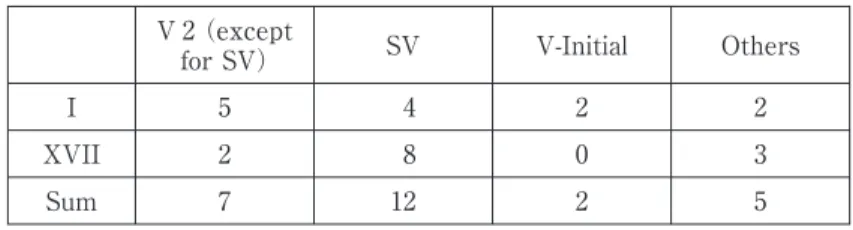
The results of preliminary investigation of the prose texts of the old English version ofBoethius are shown in the table below:
The total numbers of instances of Verb-Second word order (V2 and SV in Table 1) over other kinds of word order is predominant in Table 1 (19/26, 73.1%). A large portion of the Verb-Second word order is SV (12/19, 63%). Most of the first elements in the SV patterns are pronouns, as seen in 2.2. These prose texts of the Old English version ofBoethiusare quite characteristic of Old English.
Table 1 Word Order Patterns of Finite Verbs in the Old English Version ofBoethius
V 2 (except
for SV) SV V-Initial Others
I 5 4 2 2
XVII 2 8 0 3
Sum 7 12 2 5
3 Word Order in Main Clauses in Metre ofKing Alfred’s Old English Version of Boethius de Consolatione Philosophiae
3.1 Verb-Second Word Order
Verb-Second word order is also observed in the metres in King Alfred’s Old English Version of Boethius, as follows:
(23) Þeah wæsmagorinca mod mid Crecum,
there was many a spirit with the Greeks (M01: 26ab)
‘The hearts of the heroes held with the Greeks’ (Sedgefield 1900: 178/23)
(24) Þeah mægþone wisan on gewitlocan / þære gitsunge gelpes scamian there may the wise in container the avarice boast shame (M10: 12ab-13ab)
‘Yet may the sage deep in his spirit feel great shame (for the lost of glory,)’
(Sedgefield 1900: 193/2-3)
V2 word order is assumed to be V/T-to-C movement. The existence of V2 examples in metres leads us to assume that the syntactic structure of metre does not significantly differ from that of prose in OE, as V2 would be derived from such an underlying structure as seen in 1.2, in both cases.
3.2 Verb-Initial Word Order
In the prose texts the number of the verb-initial examples is quite a few, as seen in 2.3.
However, verb-initial word order is frequently observed in the meters, as the following examples show:
(25) Wæs gehwæþeres waa.
was in both respects woe (M01: 25b)
‘hard was the loss [in two respects]!’ (Sedgefield 1900: 178/25)
Verb-Initial word order is assumed to involve V-to-T movement, as discussed in section 2.3.
Thus this word order is analysed in the manner of some V-initial present-day languages, with some elaboration.
(26) Hæfdan him gecynde cyningas twegen,
had to them lineage kings two (M01: 06ab)
‘Akin to the clansmen kings were there twain’ (Sedgefield 1900: 178/03)
Example (26) shows that some elements intervene between the finite verbHæfdan and its subject cyningas twegen.4 The word order of (26) indicates VOS pattern. The verb phrase is assumed to have moved to the sentence-initial position, which is not CP.5
Adverbials intervene between the finite verb and its subject in (27), as follows:
(27) settonsuðweardes sigeþeoda twa.
set southwards victorious nations two (M01: 04ab)
‘Two tribes triumphant tramped to the south’ (Sedgefield 1900: 178/01)
It is assumed that the finite verbsettonmoves to the sentence-initial position, while the subject sigeþeoda twaremains in VP. The adverbial suðweardes is positioned according to metrical re- quirement, as will be seen in section 4.6
Some cases of verb-initial examples have null subjects, as follows:
(28) Stod þrage on ðam;
stood for a time on them (M01: 28a)
‘The leader stood on them for a time’ (Sedgefield 1900: 178; ‘Thus things stood’)
Verb-initial word order is partly dependent on null-subject because the finite verb moves to the position where the appearance of the subject appearance is not required. Thus null-subject is assumed to have a close relation to verb movement.7
In some verb-initial examples, the metrical factors are assumed to be related to this phe- nomenon. This problem will be taken up in section 4.
3.3 Other Forms of Word Order
SV word order is observed in meters as well as in prose texts, as follows:
(29) Hi wærongefyrn forðgewitene;
they were long ago departed (M10: 41ab)
‘Many long days ago these men departed;’ (Sedgefield 1900: 194/12)
(30) Se iseac to lytel swelcra lariowa,
that is also too little such of teachers (M10: 44ab)
‘Too slight is the glory of such teachers’ (Sedgefield 1900: 194/15)
The subjects are not limited to pronouns. In some cases, accompanying proper or common nouns are the subjects of the verbs, as follows:
(31) Rædgot and Aleric /foron on ðæt fæsten;
Raedgod and Aleric advanced into the stronghold (M01: 19b-20a)
‘Raedgod and Aleric carried the fortress’ (Sedgefield 1900: 178-19/20)
(32) Þeod wæsgewunnen / wintra mænigo,
people was conqured of winter many (M01: 28b-29a)
‘the folk was stressed many a winter’ (Sedgefield 1900: 178/28-29)
The subject phrase is proper nouns in (31), and a common noun in (32). The subject of the next example,Higesnotorum, is also recognized to be a common noun, ‘the wise’:
(33) Higesnotorum mæg / eaðe ðincan the wises can easily think (M10: 7b-8a)
‘So may the wise man easily deem’ (Sedgefield 1900: 192/25-26)
These examples indicate that SV word order in meters is not peripheral here, as it is in V2 word order in prose texts in the Old English version ofBoethius.
3.4 Word Order in Main Clauses in the Old English Version ofBoethius
The results of preliminary investigation of the meters of the old English version ofBoethiusare shown in the table below:
The number of examples of Verb-Initial order here is remarkable, since such examples are relatively rare in the prose texts. Some of those examples can be examined from a metrical.
4 Some Effects of Metre on Verb Order
Words in Old English are usually classified into three categories with three degrees of rhythmic stress: stress-words, particles, and proclitics. Stress-words include nouns, adjectives, non-finite verbs, many adverbs, and some heavy pronouns. The second, proclitics, are not normally stressed;
they include prepositions, demonstratives, possessives, copulative conjunctions, and prefixes. The third, particles, are sometimes, but not usually, stressed, and include finite verbs, demonstrative adverbs, personal pronouns, demonstrative pronouns, and some conjunctions.
According to the above classifications, verbs are separated into two types: Non-finite verbs always receive stress, but finite verbs do not usually receive stress. Verb-initial examples will be examined in relation to metrical characteristics in this section.
4.1 Non-infinitive Verbs
According to Kuhn’s Laws, non-infinitive verbs, which are particles, are placed in the first dip of a clause in a-verse, as follows:
(34) settonsuðweardes sigeþeoda twa.
set southwards victorious nations two (M01: 04ab)
‘Two tribes triumphant tramped to the south’ (Sedgefield 1900: 178/01)
(35) Stod þrage on ðam;
stood for a time on them (M01: 28a)
‘The leader stood on them for a time’ (Sedgefield 1900: 178; ‘Thus things stood’) Table 2 Word Order Patterns of Finite Verbs in Meters in the Old English
Version ofBoethius V 2 (except
for SV) SV V-Initial Others
Metre I 6 7 14 5
Metre X 2 3 2 4
Sum 8 10 16 9
In (35) it is natural thatStod‘stood’ is the first dip becauseþrage, ‘for a time’, which it follows, is alliterative. In (34)setton, ‘set’ does not receive stress becausesuðweardes, ‘southward’ in the a- verse, and sigeþeoda, ‘victorious nations’ in the b-verse, are alliterative. These finite-verbs are analysed as moving to the initial position in a-verse, where they do not receive stress, according to the alliterative requirement.
When the non-infinitive verb moves to the initial position in the b-verse, it can receive stress and alliteration, as follows:
(36) fulluhtþeawum. Fægnodonealle / Romwara bearn ...
rite of baptism rejoiced all Romans’ chidren (M01: 33ab-34a)
‘... to Baptism; a blessed day For the sons of Rome’
(Sedgefield 1900: 178/33-179/01)
(37) Boetius Breae longe ær / wlencea under wolcnum;
Boethius enjoyed for a long time before prosperity under cloud (M01: 75ab-76a)
‘... Boethius. Long had he borne [h]igh state worldly;’
(Sedgefield 1900: 180/75-76)
In the above examples,Fægnodon‘rejoyced’ in (36) andBreae, ‘enjoyed’, are finite verbs, each receiving stress in the initial position in the b-verse. Finite verbs in the b-verse move to the initial clause position when they are alliterative.
4.2 Infinitive Verbs
In contrast to non-infinitive verbs, infinitive verbs can receive stress in the initial position of the a-verse because they belong to stress words, as follows:
(38) Ne wende þonan æfre / cuman of ðæm clammum.
not expected therefrom ever come from the fetters Cleopode to Drihtne
call to the Lord (M01: 82b-83ab)
‘ever weening He should linger in fetters. He called on the Lord ...’
(Sedgefield 1900: 180/82-83)
In (38) the infinite verb cumin ‘come’ takes the initial position of the a-verse, which, syntactical- ly, is not the clause-initial position. This phenomenon should be explained as a metrical require- ment and as irrelevant to verb movement.
5 Conclusion
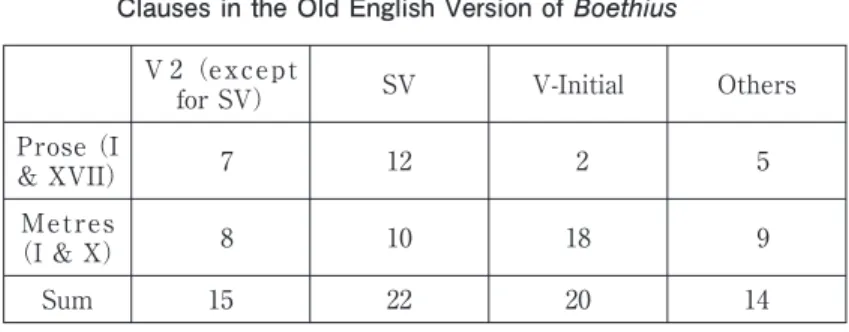
Although this preliminary research has been conducted on quite a small scale, a tentative comparison can be made:
It is remarkable that prose and metres differ in verb-initial word order in Table 3. As was seen in section 4, verb-initial word order has a close relationship to metrical rule. However, it can be assumed that Old English syntax allows for this word order through various syntactic derivational processes since verb-initial word order is also observed in prose texts, although the number of examples is relatively few.
Verb-second word order in Old English on the basis of verb-movement analysis has been intensively studied. However, verb-initial word order in OE has not been paid as much attention, probably due to the fact that verb-initial word order in OE is not as frequently observed as verb- second word order in prose texts; moreover, the diachronic study of languages is usually studied in prose texts.
The syntactic analysis of verb-initial construction, in comparison with VOS/VSO order in present languages on the basis of verb-movement, needs to be studied further. Further study would clarify what part v-initial order has taken in the diachronic change of English word order and its corresponding syntactic construction if syntactic construction of verb-initial word order is examined more appropriately. That a more comprehensive investigation of such metres in OE as the Old English version ofBoethiusshould be carried out is greatly desired.
Table 3 A Comparison between Prose and Metre of Word Order in Main Clauses in the Old English Version of Boethius
V 2 (except
for SV) SV V-Initial Others
Prose (I
& XVII) 7 12 2 5
Metres
(I & X) 8 10 18 9
Sum 15 22 20 14
Notes
1 What category finite verbs in Welsh move to is a matter of some controversy. Roberts (2004) argues that finite verbs in Welsh move to FinP.
2 MR designates Mitchell & Robinson.
3 M represents metre.
4 Cyningasandtwegencan be recognized as nominative plural forms. According to the glossary in Mitchell and Robinson, they are taken to be accusative plural forms.
5 Fischer et al. (2000: 155) adopt FP for the position which the finite verb moves to in OE. Roberts (2004) also describes the position as FinP. These projections are used to indicate that they are lower positions than CP and higher positions than TP. These projections are assumed to be suitable for the position of finite verb in sentence-initial verb order.
6 The position of adverbs in OE is syntactically uncertain. Fisher et al. (2000: 155) mention that
‘the positioning of adverbs in Old English is an under-studied topic.’
7 Biberauer (2010) discusses this relation.
References
Baker, P. S. (2007).Introduction to Old English. Second Edition. Oxford: Blackwell Publishing.
Biberauer, T. (2010). “Semi null-subject languages, expletives and expletive pro reconsidered,” in Biberauer, T., A. Holmberg, I. Roberts, and M. Sheehan (2010), 153-99.
Biberauer, T., A. Holmberg, I. Roberts, and M. Sheehan (2010).Parametric Variation: Null Subjects in Minimalist Theory. Cambridge: Cambridge University Press.
Biberauer, T. and I. Roberts (2010). “Subjects, Tense and verb-movement,” in Biberauer, T., A.
Holmberg, I. Roberts, and M. Sheehan (2010), 263-302.
Fischer, O., A. van Kemenade, W. Koopman, and W. van der Wurff (2000). The Syntax of Early English. Cambridge: Cambridge University Press.
Kendall, C. B. (1991).The Metrical Grammar of‘Beowulf’. Cambridge: Cambridge University Press.
Magennis, H. (2011).The Cambridge Introduction to Anglo-Saxon Literature. Cambridge: Cambridge University Press.
Mictchell, B. and F. C. Robinson (2006).A Guide to Old English. Seventh Edition. Oxford: Blackwell Publishing.
Pulsiano, P. and E. Treharne (eds.) (2000).A Company to Anglo-Saxon Literature. Oxford Blackwell Publishers.
Radford, A. (2004). Minimalist Syntax: Exploring the Structure of English. Cambridge: Cambridge University Press.
Rizzi, L (ed.) (2004).The Structure of CP and IP: The Cartography of Syntactic Structures, Volume 2. Oxford: Oxford University Press.
Roberts, I (2004). “The C-System in Brythonic Celtic Languages, V2, and the EPP,” in L. Rizzi (ed.) (2004). 297-328.
Roberts, I. (2007).Diachronic Syntax. Oxford: Oxford University Press.
Sedgefield, W. J. (1899).King Alfred’s Version of the Consolations of Boethius de Consolatione Philo- sophiae. Oxford: Clarendon Press.
Sedgefield, W. J. (1900). King Alfred’s Version of the Consolations of Boethius: Done Into Modern English. Oxford: Clarendon Press.
Terasawa, J. (2011).Old English Meter: An Introduction. Toronto: University of Toronto Press.