Learning to Learn in Elementary School Foreign Language Activities
A Dissertation Presented to
the Department of English Graduated School of Education
Hirosaki University
In Partial Fulfillment of the Requirement for the Degree of
Master of Education
by
Ayako Sasaki
January 2013
CONTENTS
CHAPTER 1 INTRODUCTION 1
CHAPTER 2 LITERATURE REVIEW 4
2.1 Foreign Language Activities in Elementary Schools 4
2.1.1 Foreign Language Activities in the Course of Study 4 2.1.1.1 Basic principles for the introduction of Foreign Language Activities 4 2.1.1.2 Views on the introduction of Foreign Language Activities 7 2.1.1.3 Overall objectives of Foreign Language Activities 8 2.1.2 Current practice of Foreign Language Activities 9
2.1.2.1 Materials and lessons 9
2.1.2.2 Pupils 10
2.1.2.3 Teachers 11
2.1.2.4 Evaluation 13
2.2 Learning to Learn 14
2.2.1 Learning strategies 14
2.2.1.1 Definition of learning strategies 15
2.2.1.2 Characteristics of learning strategies 16
2.2.1.3 Classification of learning strategies 17
2.2.2 Learning strategies instruction 18
2.2.2.1 Objectives of learning strategies instruction 19
2.2.2.2 Forms of learning strategies instruction 20
2.2.2.3 Portfolios 21
2.2.2.4 SILL 23
2.3 Cooperation among learners 23
2.3.1 Cooperative learning 24
2.3.2 Essential component of cooperative learning 25
2.3.3 Basic components of cooperative learning 26
27 2.4 Collaboration among teachers
2.4.1 Team-teaching between HRTs and ALTs/JTEs 28
2.4.2 Collaborative and reflective teaching practice 29
CHAPTER 3 PURPOSE 33
CHAPTER 4 METHOD 35 4.1 Participants 35
4.2 Materials 36
4.3 Procedure 37
CHAPTER 5 RESULTS AND DISCUSSION 40
40
5.1 Preliminary research
5.1.1 The 5th graders' perceptions of FLA 40
5.1.2 The 6th graders' perceptions of FLA 44
5.1.3 SILL in May 51
5.1.3.1 Memory strategies 53
5.1.3.2 Cognitive strategies 53
5.1.3.3 Compensation strategies 54
5.1.3.4 Metacognitive strategies 55
5.1.3.5 Affective strategies 56
5.1.3.6 Social strategies 57 58
5.2 Practice Ⅰ
5.2.1 Memory strategies 59
5.2.2 Cognitive strategies 61
5.2.3 Compensation strategies 64
5.2.4 Metacognitive strategies 67
5.2.5 Affective strategies 71
5.2.6 Social strategies 73
5.2.7 Reflections on PracticeⅠ 76
79
5.3 Practice Ⅱ
5.3.1 Cooperative learning in the 5th grade 79
5.3.2 Reflections on cooperative learning in the 5th grade 89
5.3.3 Cooperative learning in 6th graders 94
5.3.4 Reflections on cooperative learning in the 6th grade 103 108 5.4 Collaboration among teachers
5.4.1 Strategy instruction in FLA 108
5.4.2 Strategy integration in FLA 114
5.4.3 Individual teacher's professional development 117
CHAPTER 6 CONCLUSION 122
REFERENCES 129
APPENDICES 134
List of Tables Table.2.1 Definition of learning strategies
Table 5.1 Q1: Are you looking forward to taking FLA?
Table 5.2 Q2: What do you want to do in FLA?
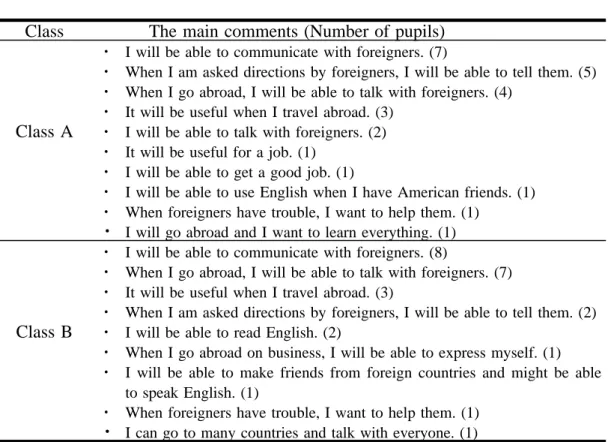
Table 5.3 Q3: If you can use English, what good things will it bring you in the future?
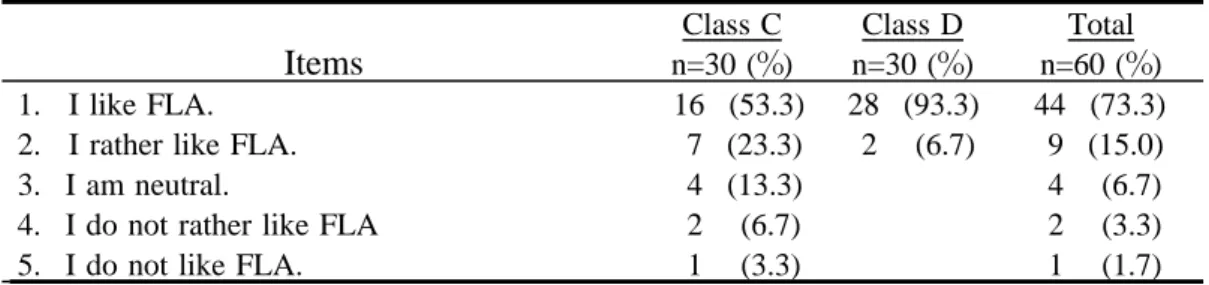
Table 5.4 Q1: Do you like FLA?
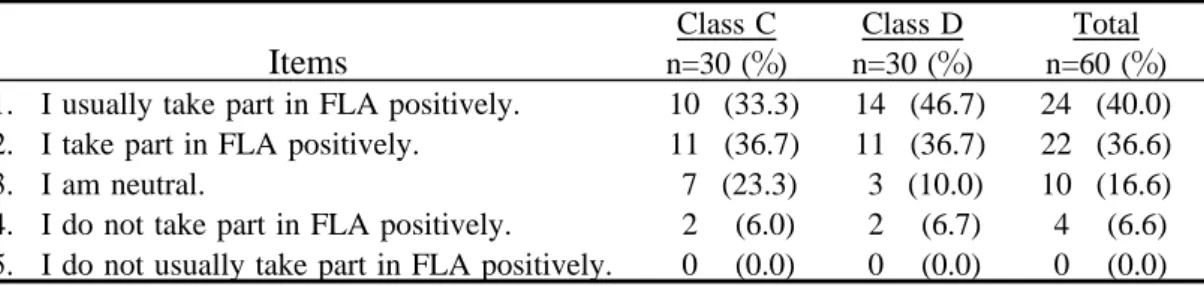
Table 5.5 Q2: Do you take part in FLA positively?
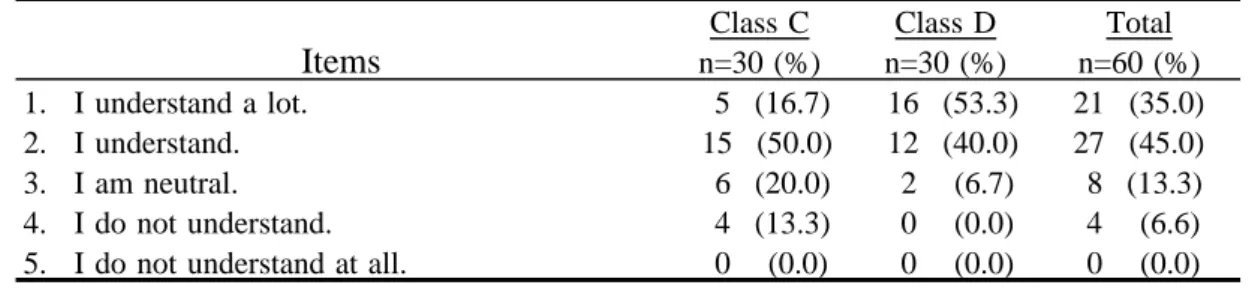
Table 5.6 Q3: How much do you understand lesson content in FLA?
Table 5.7 Q4: Do you want to be able to use English in the future?
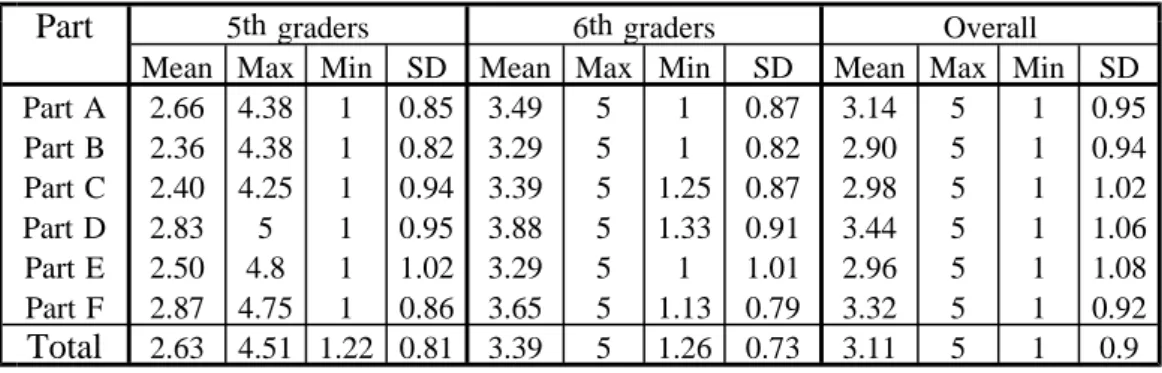
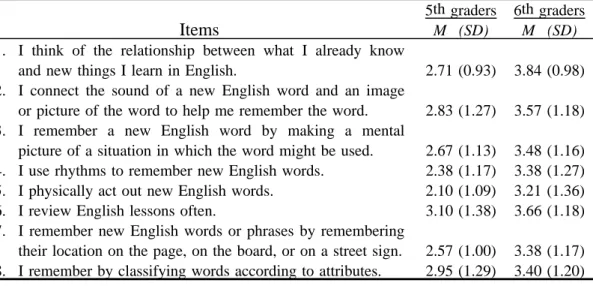
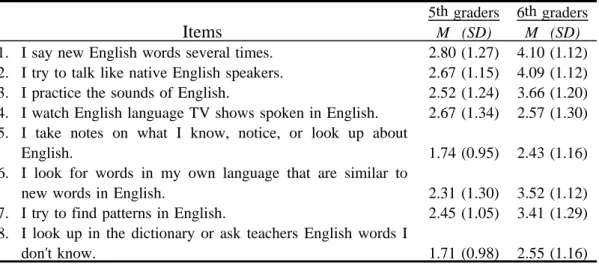
Table 5.8 Results of six strategies of each class, in May Table 5.9 Results of SILL of 5th and 6th graders, in May Table 5.10 Results of Part A: Memory strategies, in May Table 5.11 Results of Part B: Cognitive strategies, in May Table 5.12 Results of Part C: Compensation strategies, in May Table 5.13 Results of Part D: Metacognitive strategies, in May Table 5.14 Results of Part E: Affective strategies, in May Table 5.15 Results of Part F: Social strategies, in May Table 5.16 Results of SILL of the 5thand 6th graders Table 5.17 Results of Part A: Memory strategies Table 5.18 Results of Part B: Cognitive strategies Table 5.19 Results of Part C: Compensation strategies Table 5.20 Results of Part D: Metacognitive strategies Table 5.21 Results of Part E: Affective strategies Table 5.22 Results of Part F: Social strategies
List of Figure Figure 2.1 Diagram of the Strategies System: Overview
CHAPTER 1 INTRODUCTION
The present research is a case study of foreign language activities at a Japanese elementary school. Foreign language activities (FLA) has been as a part of compulsory education for 5th and 6th graders in Japanese elementary schools since 2011. By then over twenty years had been spent disputing whether or not English education should be taught in elementary schools. During that time, the previous Course of Study allowed English Activities to be implemented as a part of international understanding. In 2006, most schools conducted English Activities (the Survey on implementation of English Conversation Activities at Elementary Schools by MEXT). However, many differences in ways and content to teach in 2007
English depending on schools have prevented a smooth connection between elementary schools and junior high schools. Therefore, from the point of ensuring equal education, common teaching materials in English education in elementary schools are demanded with views of drawing on pupils' adaptability and responding to the advance of globalization. Now FLA is established in the new Course of Study (MEXT, 2008b, 2009a).
The main objective of FLA is not to develop language skills, but rather to form the foundation of pupils' communication abilities through foreign languages (MEXT, 2008b). Pupils are not expected to master language knowledge and skills, but, it is obvious that they learn foreign languages and cultures in FLA. If pupils are regarded as beginners in foreign language learning, in light of lifelong learning,
it seems to be significant for them to foster a foundation of autonomous language learning. Learning strategies instruction seems to be effective in promoting learner autonomy. Through actions or processes of thinking to learn foreign languages and it supports pupils in their efforts to enhance communication abilities. Learning strategies instruction, sometimes called learning-to-learn instruction, aims ultimately to promote autonomous learners (Chamot, et al., 1999; JACET, 2005, 2010;
Common O'Malley & Chamot, 1990; Oxford, 1990; Wenden, 2002). Just as the
(CEFR) suggests to instruct European Framework of Reference for Languages
learning strategies to promote learner autonomy (Council of Europe, 2001), it has been recognized that one of the aims of teaching foreign languages is to foster autonomous learners throughout the world (JACET, 2010). Even in FLA, instructing how to learn foreign language might foster a foundation of pupils' autonomy in language learning, which might enhance learning English in junior high or high school and motivate them to learn English.
Furthermore, in schools as a community of learning and practice, cooperative learning and collaboration among teachers have been required (Sato, 2006, 2010;
Akita, 2006, 2010). Cooperative learning is said to enhance learning through positive interdependence, promote learner autonomy, and provide opportunities to communicate (Barkley, Cross, & Major, 2005, JACET, 2010). Particularly social strategies instruction through cooperative learning might improve pupils' communication skills and foster positive attitudes toward communication.
Moreover, in a professional teaching context, it seems that collaborative teaching and reflection would promote each teacher's professional development (Akita,
2010; JACET, 2010; Richards & Farrell, 2005). Since many elementary school teachers have little experience to instruct FLA, it seems necessary to support them and develop their teaching abilities collaboratively.
The study aims to examine ways to what extent learning strategy instruction in FLA promote pupils' learning to learn and to what extent collaboration among FLA teachers assist them in professional development.
CHAPTER 2 LITERATURE REVIEW
This chapter outlines Foreign Language Activities (FLA) in Japanese elementary schools, learning to learn, cooperative learning and collaborative teaching.
2.1 Foreign Language Activities in elementary schools
In 1986,“the second report on education”by Ad Hoc Council on Education indicated that the beginning grade for English education should be reviewed. Since then, over twenty years have been spent discussing whether English education should be conducted in elementary schools or not. The Ministry of Education, Culture, Sports, Science and Technology (MEXT) announced the new Course of Study in 2008 and decided to implement Foreign Language Activities (FLA) compulsorily in 5th and 6th grades in elementary schools in 2011. FLA must officially be conducted for 35 hours per school year. This section will provide the basic principles for the introduction of FLA in the Course of Study, the views on the introduction, the overall objectives, and current practice of FLA, taking into account FLA instruction at the author's school.
2.1.1 Foreign Language Activities in the Course of Study
2.1.1.1 Basic principles for the introduction of Foreign Language Activities The Ministry of Education, Culture, Sports, Science and Technology (MEXT)
proposes the following three main reasons for introducing FLA in elementary schools (MEXT, 2009a, p.8; 2010, pp.1-2):
(1) Drawing on the Flexible Adaptability of Elementary School Pupils
Children today have a considerable number of opportunities for exposure to foreigners and foreign cultures through various types of media including TV, and are thus thought to have little resistance toward Foreign Language Activities (English Activities). Furthermore, even though children are currently introduced to English phrases through greetings and self-introductions at junior high schools, it is thought that these activities are more suitable at the elementary school level. In addition, the flexible adaptability of elementary school pupils helps foster a positive attitude toward and familiarize them with English sounds and basic expressions, and is thus an important factor for fostering their communication abilities.
(2) Responding to the Advance of Globalization
The demand for foreign language education at elementary schools has been growing with the advance of globalization, and foreign language education has been rapidly introduced around the world. Moreover, requests to make it compulsory are expressed by many parents, guardians and administrative officials.
Meanwhile, there are designated schools, such as research and development schools, where teaching English as a subject is carried out and studied. It is essential to improve foreign language education at elementary schools in order to foster the communication abilities and international perspectives of our children, who are to be responsible for our future society.
(3) Ensuring Equal Educational Opportunity
In 2007, over 97% of elementary schools conducted English Activities, mainly in the Period of Integrated Study. However, the teaching content and the number of lessons allocated to English Activities varied significantly from school to school. Considering these circumstances, it was necessary to ensure equal educational opportunity and provided necessary teaching content at the elementary school level and establish a common foundation in English among students when they enter junior high school.
From the above three points, the government decided to introduce FLA in elementary schools. Generally, it is said that elementary school students have flexible adaptability. Indeed they seem to able to pronounce English they listen to, and they try to communicate with other people more positively than junior high school students. In addition, as globalization is growing, it has been needed to foster pupils' communication abilities and international understanding.
In the previous Course of Study, English Activities (EA) could be conducted at each school's discretion during the Period of Integrated Study or Special activities,“as foreign language conversation etc. as a part of international Survey on understanding study” (MEXT, 2001, p.2). According to the
implementation of English Conversation Activities at Elementary Schools in 2007 (MEXT), over 80% of public elementary schools conducted EA in the Period of Integrated Study, and 97% of schools conducted EA in the Period of Integrated Study or Special Activities. In 6th grade, most of the schools conducted EA to familiarize students with English songs and games, which practiced simple English conversation and pronunciation. The annual average of school hours of EA in 6th grade has been increasing year by year.
Meanwhile, the number of public elementary schools designed as research and development schools where English is taught as a subject has been increasing.
In 2006, seventy-eight schools for structural reform taught English as a subject.
According to a MEXT survey provided by these schools, their students' motivation toward an interest in learning English and their skills have been improved to a certain extent.
However, when considering a smooth connection between elementary schools and junior high schools and ensuring equal education, these situations might have unfavorable effects on English language education at the junior high school level.
There are many differences from school to school in the way to teach English, the teaching content or objective, the number of lessons of EA and the starting grade to learn English, etc. These differences will lead to some troubles in teaching English in junior high schools. Besides, many elementary schools are likely to put too much emphasis on acquiring English abilities, which might cause some students to feel pressured and to hate English (Kan, 2008;「Eigo-note」Kenkyukai, 2008).
Therefore, it is necessary to establish common teaching content (MEXT, 2009a, p.9, 2010 p.3).
2.1.1.2 Views on the introduction of Foreign Language Activities
Recently, it has been supposed that children have less experiences with verbal communication and tend to have problems in communication with other people.
They need more verbal communication abilities to understand people around them and express themselves. Therefore, to foster communication abilities is an educational challenge, and it is also important to develop children's abilities to understand foreign cultures and explain Japanese cultures to others (MEXT, 2009a).
Based on the above challenges,
Foreign Language Activities at elementary schools has been established as a part of education to foster communication abilities in a broader sense. Language is a medium to communicate with others and is essential in order to coexist with
people from other cultures in our globalized modern society. FLA will contribute to the synergistic improvement of children's Japanese language abilities, through active comparison between foreign languages and the Japanese language. In this setting, children are exposed to languages different from Japanese, noticing the interesting aspects and richness of the languages, and are able to form a respectful attitude toward language (MEXT, 2009a, p.8, 2010, p.2).
This means that the primary aim of FLA is not to improve the skills to use conversational expressions and grammar of a foreign language. Instead, through learning foreign languages, pupils are expected to recognize richness of the Japanese language and Japanese cultures and to notice the importance of international understanding. Furthermore, it means that conducting suitable communication activities in a foreign language in elementary schools will establish the foundation of pupils' communication abilities and connect to develop the communication abilities which is the aim of English learning in junior and senior high schools.
2.1.1.3 Overall objectives of Foreign Language Activities
Based on the principles and the views mentioned above, the overall objectives of FLA in elementary schools are;“to form the foundation of pupils' communication abilities through foreign languages while developing the understanding of languages and cultures through various experiences, fostering a positive attitude toward communication, and familiarizing pupils with the sounds and basic expressions of foreign languages”(MEXT, 2008b, p.7).
These goals consist of three mainstays:“to develop the understanding of
languages and cultures through foreign languages through various experiences,”“to foster a positive attitude toward communication through various experiences,”and to familiarize pupils with the sounds and basic expressions of foreign languages
“
through various experiences.”It is stipulated that all of these mainstays should be conducted“through foreign languages”(MEXT, 2008b, p.7). It is important for pupils to experience integrated activities through these three mainstays. This establishes the foundation of pupils' communication abilities, which is further developed in junior and senior high schools. In addition,“the foundation of pupils' communication”is regarded as“understanding of languages and cultures through various experiences,”“a positive attitude toward communication”and“familiarity with the sounds and basic expressions of foreign languages,”which are fostered through FLA in elementary school level. The primary objective of the activities of FLA in elementary schools is not to improve pupils' foreign language skills but
“the foundation of pupils' communication abilities through foreign Languages” (MEXT, 2008b, pp.7-9).
2.1.2 Current practice of Foreign Language Activities 2.1.2.1 Materials and lessons
Many schools used“Eigo Note,”which was provided by MEXT in 2010 and 2011, now Hi, friends!, which is the new version of“ ” “Eigo Note, was provided in” 2012.“Eigo Note”and Hi, friends! follow the Course of Study and indicate some“ ” degree of orientation on how to instruct FLA. According to the survey by Benesse Eigo Note Eigo Note Instruction (2011), 89.6% of schools claimed to use“ ,”In
(MEXT, 2009c), every unit is composed in the following order: starting Materials
with listening to target expressions, then mimicry, memorization and acquisition of them, and communication activities using the expressions such as interviewing others or introducing themselves with“show and tell.”Naoyama (2012), who is an investigator in MEXT, announced that“Hi, friends!”was provided 99.4% of schools by MEXT. In the case of“Hi, friends!,”the process are some modified in the following order: activities to promote pupils noticing foreign languages and cultures, activities to be familiar with English sounds and expressions through repetition of listening and speaking, and activities to communicate with friends (MEXT, 2012c).
At my school,“Eigo Note”was used to instruct FLA in 2010 and 2011, and now“Hi, friends!”has been used as the main material since April, 2012 and FLA has been mainly conducted based on“Hi, friends!.”The pupils look cheerful and active but they are likely to follow teachers' directions and do activities passively.
Because the flow of lesson tends to be teaching-centered. In order to get pupils to take lessons of FLA more positively, it seems to be necessary that lessons should be leaning-centered.
2.1.2.2 Pupils
How do pupils feel FLA? According to the survey with first graders in junior
“ ”
high school by Benesse (2012), 62.9% of students answered I liked English well or“I rather liked English”when they were 6th graders. The main reasons were:“I enjoyed English. (73.3%)”and“English was always interesting. (30.2%).”On the
“ ” “ ” other hand, 36.2% students answered, I hated English or I rather hated English.
The main reasons were:“English was not always interesting (56.0%),”“English
” “ ”
lessons were not interesting (31.4%), and English lessons were difficult (21.4%).
I conducted questionnaires for the 5th and the 6th graders at my school in 2010. The answers of most pupils were:“I like FLA.”“I rather like FLA.”and“I enjoy FLA.” “or I rather enjoy FLA.”The main reasons why they enjoyed FLA were“playing games,”“singing English songs and chanting, and interacting with” “ friends, teachers and ALTs.”On the other hand, a few pupils answered“I hate FLA.” “or I rather hate FLA.”These pupils answered“I do not understand the contents of FLA,”“I do not understand the contents of FLA well. or I understand” “ half of the contents of FLA.”In this case, they might not be interested in English, or they might be interested in English but not know how to learn English.
Therefore, instructing pupils how to learn English would be able to assist them in understanding lesson contents and enhance their confidence or willingness to communicate in English. It is also important for them to develop learner autonomy and to be life-long learners. Instructing learning strategies might help them to foster the foundation to be autonomous language learners in the future.
2.1.2.3 Teachers
MEXT (2009a) advocates that homeroom teachers (HRTs) should lead lessons of FLA. The reason is that HRTs understand pupils deeply in terms of both their academic studies and their daily lives. Accordingly, they have the abilities“to create teaching content and activities that suit their pupils' developmental stages and
capture their attention and interest”and“to motivate their attention and interest”in order to realize the objective of FLA (MEXT, 2009a). It is often pointed out that even if HRTs can not speak English well, the important thing is to show pupils teachers' positive attitudes toward interaction in English, and that such attitudes will cause to enhance pupils' interest in foreign languages. Furthermore, MEXT states that HRTs' roles are expected in the three stages, which are design, implementation, and evaluation, of the lesson.
HRTs' roles are to both prepare and conduct activities as they have the best understanding of their pupils. During the actual lesson, HRTs lead the lesson while paying attention to the pupils' responses, observe and evaluate pupils' attitudes toward using the foreign language, thus linking the current lesson to the next lesson (MEXT, 2009a, p.17; 2010, p.6).
However, many teachers feel anxious about their FLA instruction. According to an investigation by the Benesse corporation (2011), 68% of teachers, who are in charge of 5th or 6th graders, are uncertain about their FLA instruction and 62% of them feel that it is a burden to be responsible for FLA.
Most teachers at my school also feel anxious about instructing FLA. The main reasons are that they lack experience to instruct FLA and self-confidence in skills and knowledge of foreign languages. In order to promote teachers' understanding of FLA and to help them learn how to instruct FLA effectively, lectures on FLA have been given by instructors from the board of education, and workshops have been conducted since 2008, discussing principles, objectives, how
to instruct, observation, evaluation, etc. Teachers in charge of 5th or 6th graders have been addressed to instruct FLA, with an ALT who is a native English speaker or a local Japanese person proficient in the target language, on a non-HRT in charge of FLA (core teacher). However, in order to develop each teachers' FLA instruction skills, collaboration among teachers should be more emphasized.
2.1.2.4 Evaluation
Evaluation is essential for FLA as well as other subjects in elementary schools. The Central Council for Education states,“It is appropriate to conduct a certain number of activities as a unit, considering the objective and content of FLA in elementary schools, but numerical evaluation used for subjects is not suitable for FLA”(MEXT, 2009a, p.23). Therefore, evaluation in FLA should be carried out comprehensively by integrating various methods. Moreover, evaluation should be done by statements describing pupils' progress based on objectives of FLA. The following concrete methods are exemplified: teachers' observation of pupils' activities or presentations, pupils' self-evaluation or peer evaluation, interviews, check list, questionnaires, and so on (MEXT, 2009a).
Various ways of evaluation are utilized in FLA at my school: teachers' observation and check lists based on three pillars of the objectives of FLA, questionnaires, and pupils' self-evaluation cards. Various ways of evaluation should be developed through practice and reflections.
2.2 Learning to Learn
Learning to learn is“the acquisition of attitudes, learning strategies and learning skills that will be applied in future learning situations and make future learning more effective. Study skills and learning strategies are examples of the domain of learning to learn”(Richards & Schmidt, 2010, p.332). This section outlines learning strategies and learning strategies instruction.
2.2.1 Learning strategies
In general, learning strategies are“the ways in which learners attempt to work out the meanings and uses of words, grammatical rules, and other aspects of the language they are learning.... In second language learning, a strategy is usually an intentional or potentially behavior carried out with the goal of learning” (Richards & Schmidt, 2010, p.331). In English education, as the paradigm has been shifting from teaching-centered to learning-centered, learning strategies have been focused on as one of the individual differences in second language acquisition. The reason is that the existence of both faster and slower learners in foreign language acquisition are recognized regardless of the same learning conditions and environments around them (JACET, 2005, 2010). Some researchers have tried to identify characteristics of“the good language learner”and compare strategies of more effective and less effective language learners (Chamot et al., 1999). Then, some research on learning strategies has been studied within the framework of cognitive psychology (JACET, 2005, 2010).
2.2.1.1 Definition of learning strategies
The definitions of language learning strategies differ among researchers. The reason is that not only criteria of definition of leaning strategies but also the framework of research are different (O'Malley & Chamot, 1990). Table 2.1 exemplifies various definitions of learning strategies.
Table 2.1 Definitions of learning strategies
Researchers Learning strategies:
Rubin (1987) Any set of operations, plans or routines by learners to facilitate the obtaining, retrieval, storage and use of information.
Oxford (1990) Specific actions taken by the learner to make learning easier, faster, more enjoyable, more self-directed, more effective, and more transferable to new situations.
O'Malley & Chamot The special thoughts or behaviors that individuals use to help them (1990) comprehend, learn, or retain new information
Wenden (1991) Mental steps and operations that learners use to learn a new language and regulate their efforts to do so.
Chamot, Barnhardt, Procedure or techniques that learners can use to facilitate a learning El-Dinary, & Robbins task.
(1999)
Macaro (2006) The raw material of conscious cognitive processing and their effectiveness and noneffectiveness derives from the way they are used and combined in tasks and processes.
While Rubin, Wenden, and Oxford consider learning strategies from the standpoint of second language acquisition research and the language teaching, O'Malley &
Chamot and Macaro situate learning strategies in the theoretic framework of cognitive psychology (JACET, 2005). Thus, there are a variety of definitions of learning strategies depending on researchers, yet these have a lot in common in a
general meaning; learning strategies are actions or processes of thinking so that learners can enhance comprehension, learning and retention of incoming information (JACET, 2010). The present research will adopt this definition, which seems to be suitable for FLA and pupils' developmental stage.
In FLA, before communication activities, pupils are required to understand, notice and learn incoming English expressions and the meanings, and memorize and intake them. That is to say, potential learning strategies used in the sequence of a lesson flow are a basis of communication activities in English. Therefore, learning strategies instruction seems to contribute to pupils' understanding of English more effectively, and it might cause pupils to get pleasure from understanding and learning English, motivate pupils to learn English or other foreign languages, and enhance their self-esteem.
2.2.1.2 Characteristics of learning strategies
Learning strategies have the following characteristics (JACET, 2010, p.76):
(1) While addressing tasks, not only a specific strategy but also plural strategies are used in connection with other strategies (Ozeki, 2000).
(2) Through instructions learners can acquire strategies which they have never used.
(3) Learners can transfer mastered strategies to a new and similar task.
(4) Learning strategies vary depending on learning environments.
(5) When learners use learning strategies, they always have some goals.
(6) Neither good nor bad strategies exist. It is important to use adequate strategies for tasks.
2.2.1.3 Classification of learning strategies
A variety of classifications of learning strategies are proposed as well as definitions of learning strategies, yet there are a lot of points of similarity with respect to classifications. The following makes reference to two major classifications: O'Malley & Chamot (1990) and Oxford (1990).
Oxford divided strategies into two major classes: direct and indirect. These two classes are subdivided into a total of six groups: direct strategies consist of memory, cognitive, and compensation, whereas indirect strategies consist of
metacognitive, affective, and social strategies (Figure 1):
. Memory Strategies
Ⅰ
Direct Strategies Ⅱ. Cognitive Strategies . Compensation Strategies
Ⅲ LEARNING STRATEGIES
. Metacoginitive Strategies
Ⅰ
Indirect Strategies Ⅱ. Affective Strategies
. Ⅲ. Social Strategies
Figure 2.1 Diagram of the Strategies System: Overview. (Oxford, 1999, p.16)
On the other hand, O'Malley & Chamot (1990) classified strategies into three categories: metacognitive, cognitive, and social/affective strategies. These definitions (pp.44-45) are:
(1) Metacognitive strategies: higher order executive skills that may entail planning for, monitoring, or evaluating the success of a learning activity.
planning, monitoring, problem-solving, evaluation
ex.)
(2) Cognitive strategies: operate directly on incoming information, manipulating it in ways that enhance learning.
practice, use resources, take note, vocalize
ex.)
(3) Social/affective strategies: represent a broad grouping that involves either interaction with another person or ideational control over affect.
ask questions to clarify, cooperate, self-talk, self-reinforcement, cultivate
ex.)
positive attitudes towards self/others
There are some overlaps between Oxford and O'Malley & Chamot in the classification. Memory strategies and compensation strategies in Oxford's classes are mostly included in cognitive strategies classified by O'Malley & Chamot (JACET, 2005, 2010). The present research will use the categories classified by O'Malley & Chamot because of few but adequate categories for FLA, taking into consideration pupils' developmental stage and the features of each strategy.
The following examples demonstrate how these strategies are likely to be used in FLA. Metacognitive strategies such as planning and evaluating might be used at the beginning and end of lessons or terms. Cognitive strategies might be used in listening and memorizing incoming English expressions and words. Social strategies might be used while addressing communication activities, and affective strategies might be used in carrying out presentations or show and tell.
2.2.2 Learning strategies instruction
This section will outline objectives and forms of learning strategies instruction, portfolios, and Strategy Inventory for Language Learning (SILL) (Oxford, 1990) utilized in order to compare pupils' indication of strategies before and after learning strategies instruction.
2.2.2.1 Objectives of learning strategies instruction
Instructing strategies is sometimes called learning-to-learn instructing. When learners know how to learn foreign languages, this can help them to learn more efficiently (Oxford, 1990). The major objectives of learning strategy instruction are said to foster competence to select and use learning strategies according to tasks and to enhance practical communication ability (JACET, 2005). Many researchers consider that the ultimate goal of learning strategies instruction is to foster autonomous learners (Chamot, et al., 1999; JACET, 2005, 2010; O'Malley &
Chamot, 1990; Oxford, 1990; Wenden, 2002), who can control their own learning with respect to self-regulation, metacognitive processes, and learning contents (Benson, 2001). Chamot et al. (1999, p.2) state that“the goal of learning strategies instruction is to assist students in developing awareness of their own metacognition and thus control of their own learning. Learners who are aware of their own learning processes, strategies, and preferences are able to regulate their learning endeavors to meet their own goals.”This is to say, learning strategies instruction cultivates learners to develop metacognition which is equivalent to autonomous learning.
In FLA, through instructing learning strategies, it seems to be valuable to foster metacognition and a foundation of learning to learn. Yamamoto, Kimura, Tsuda, Carreira-Matsuzaki, & Hiromori (2009) examined at a Japanese elementary school what effect might result from learning strategies instruction in elementary school activities regarding pupils' interests and attitudes toward their self-directed learning and their English ability. They placed an emphases on understanding and
using metacognitive strategies such as setting goals and self-evaluation. This study suggests that strategy instruction may well be integrated into English activities in the way strategies instruction is moderately implemented in a regular class with utilization of supportive materials such as Study Journal, which brings about favorable changes on pupils' strategic behavior without hiding their motivation.
Pupils learn foreign language in FLA even though they are not require to develop foreign language skills. Therefore, it seems to be important to instruct pupils how to learn foreign languages. This might foster a foundation of foreign languages learning, and could assist pupils in understanding lesson contents, communicating with others in foreign languages, and fostering the foundation of communication abilities. Moreover, instructing pupils suitable learning strategies for their developmental stage might develop their metacognition and foster the foundation of autonomy as life-long language learners.
2.2.2.2 Forms of learning strategies instruction
In recent years, it has been said that explicit instruction is an effective way:
selecting necessary learning strategies and instructing their strategies' names, how and when use them and how they are useful in the lesson(Chamot, et al., 1999, JACET, 2005, 2010; Oxford, 1990). Chamot et al. (1999) conclude that“explicit instruction is far more effective than simply asking students to use one or more strategies and also fosters metacognition, students' ability to understand their own thinking and learning processes”(p.123).
It is also said to be necessary that learning strategies instruction are instructed
properly while carrying out tasks JACET, 2005). It is essential to consider whether( strategies and tasks are suitable for learners and whether the strategies match the tasks. In case of beginner level proficiency, it is better to instruct only a small limited number of strategies than many learning strategies at once (O'Malley &
Chamot, 1990) and it is necessary to explain repeatedly how to use strategies and to teach clearly what part the strategies should be used in(JACET, 2005, p. 139).
Therefore, in FLA, explicit and repetitive instruction seems to be effective, and selected strategies which seem to be suitable for pupils should be instructed incorporating activities into lessons.
2.2.2.3 Portfolios
Quantitative and qualitative evaluation through observation and assessment of learners' strategies usage for a given period of time is needed in learning strategies instruction. Portfolios are a means to understand such time variation of strategies usage (JACET, 2005, 2006) and can be defined as collected learning materials so that learners implement self-evaluation of the degree of learning progress in a given domain or program (JACET, 2010).
Danielson & Abrutyn (1997) classify portfolios into three types: working, display, and assessment. Working portfolio is a type of filing learners' learning materials. Display portfolio is a type of storing of learners' best works. Assessment portfolio is a type of recording what learners learn in a curriculum. It has been showed that implementing assessment portfolio brings learners qualitative improvement on their own language abilities so that they can demonstrate
autonomous and positive attitudes toward learning (Mineishi, 2002).
Portfolios have been focused on both an agenda of leaners' autonomous development and an effective means to evaluate providing the framework of appropriate teaching for teachers (JACET, 2010). Portfolios are originally a means to evaluate students' learning, yet it is also utilized as a way of understanding and evaluating students' learning process in which students acquire languages using learning strategies (Chamot et al., 1999). Learners can do self-reflection on their own learning through self-evaluation of the degree of achievement of their own goals so that they can gradually develop their metacognitive strategies (Chamot, et al., 1999; JACET, 2005, 2006, 2010; Smolen, Newman, Wathen, & Lee, 1995).
Thus, portfolios are said to play an important role in education that enhances learners' self-evaluation and metacognitive abilities (Smolen, Newman, Wathen, &
Lee, 1995; JACET, 2010). Moreover, it is significant to incorporate portfolios not only into instruction programs but also into teaching and learning as a means of evaluating (JACET, 2010).
Portfolios are likely to be used particularly in the Period of Integrated Study in elementary schools. In addition, setting goals and self-evaluation not only for an aspect of learning but also for aspects of life and health are mostly implemented every term in elementary schools. Self-evaluation at the end of lessons in FLA are recommended (MEXT, 2009a) and some elementary schools carry out self-evaluation through portfolios. The potential contents of portfolios are observation of pupils' activities by teachers, self-evaluation and a check list, a mutual evaluation list, worksheets, and records of activities such as pictures and
works (MEXT, 2009a). In addition to such working portfolios and assessment portfolios, setting goals and reflection seem to be needed every term and at the end of the academic year. Moreover, through reflection on various learning strategies in portfolios pupils might become aware of their strategies usage and foster their metacognition.
2.2.2.4 SILL
SILL is one of the most used questionnaires to measure strategy traits by delayed consecutive introspection (JACET, 2010). The present research adopts the definition and clarification of learning strategies by Chamot et al., who do not exhibit a questionnaire like SILL. Therefore, this research will investigate with SILL pupils' tendencies to use learning strategies before and after learning strategies instruction. SILL Version 7.0 (Oxford, 1999, pp.293-297)will be utilized.
However, it is clearly too difficult for elementary school pupils to answer the questionnaire. I will select appropriate items for pupils, translate them into Japanese, and then implement the investigation.
2.3 Cooperation among learners
In recent years, cooperative learning has been raised attention in Japan (Akita, 2006, 2010; Sato, 2006, 2010). Cooperation in learning is working together with one or more peers to solve a problem, complete a learning task, share information or get feedback on performance. Such an approach to learning is said to promote students' learning since it is less threatening for many students and
increases the amount of student participation in the classroom (Richards & Schmidt, 2010).
This section outlines cooperative learning. In this thesis,“cooperation”is used for pupils, who need some support from others to learn and work together to accomplish shared goals in groups. On the other hand,“collaboration”is used for teachers, who are likely to be autonomous, and to teach and learn together in order to achieve the common goals.
2.3.1 Cooperative learning
Cooperative learning (CL) is“an approach to teaching and learning in which classrooms are organized so that students work together in small cooperative teams.
Such an approach to learning is said to increase students' learning”(Richards, &
Schmidt, 2010, p.135). Chamot et al. (1999, p.41) state that“CL is compatible with strategies instruction.”Especially, CL is said to connect with social strategies (Takeuchi, 2007) and provide many opportunities for students to communicate interactively (McCafferty, Jacobs, & DaSilva Iddings, 2006).
2.3.2 Definition of cooperative learning
The definitions of CL are slightly different among researchers. Johnson, Johnson, & Holubec (1993, p.9) define CL as“the instructional use of small groups so that students work together to maximize their own and each other's learning.” Jacobs, Power, & Loh (2002) consider that CL has value beyond the small group, and define CL as“principles and techniques for helping students work together
more effectively”(p.ⅸ). Fushino (2008, p.7) integrates these definitions and defines CL as principles and techniques that involve small groups as an instruction“ means so that students work together to maximize their own and each other's learning.”The present research will take the position of Fushino, because CL is likely to be used not only in small groups but also in the class as a whole in FLA.
All CL techniques include basic aims which are to promote each other's learning and raise individual's learning through learning and encouraging each other, and performing their own roles (Barkley, Cross, & Major, 2005). In second language teaching, CL provides many opportunities for input and output, communication and interacting in target languages, and promoting their communication skills and autonomy(McCafferty, Jacobs, & DaSilva Iddings, 2006; Fushino, 2011). Then, major advantages of incorporating CL into FLA might provide opportunities for input and output, and interaction and communication in a foreign language. This seems to suit the objectives of FLA: to familiarize pupils with the sounds and basic expressions of foreign languages and foster their positive attitude toward communication. Moreover, CL in FLA might bring pupils to use of social strategies such as cooperation. Through positive interdependence, pupils might learn foreign languages together and play their own roles in activities, so that they could develop learner autonomy.
2.3.3 Essential components of cooperative learning
For successful cooperative learning, there are various CL components or principles to be incorporated into CL proposed by CL proponents:
Five essential components by Johnson et al. (1993, 2002):
・
positive interdependence, individual accountability, face-to-face promotive interaction, interpersonal and small-group skills, and group processing.
Eight principles by Jacobs et al. (2002):
・
cooperation as a value, heterogeneous grouping, positive interdependence, individual accountability, simultaneous interaction, equal participation, collaborative skills, and group autonomy.
Nine principles by Fushino (2010, p.360):
・
(1) Positive interdependence.“The perception that you are linked with others in a way so that cannot succeed unless they do (and vice versa)”(Johnson et al., 2002, p.225).
(2) Individual accountability. Each member must fulfill his or her share of work so that the group can achieve its goal (Johnson & Johnson, 1999).
(3) (Face to face) promotive interaction. Students are urged to help, encourage, and support group members in achieving each other's goals as opposed to impeding other's success (Johnson & Johnson, 1999).
(4) Small group skills. Interpersonal and small group skills are essential in interacting effectively with other learners (Johnson & Johnson, 1999).
(5) Group processing. This illustrates the importance of“reflecting on a group session to describe what member actions were helpful and unhelpful and make decisions about what actions to continue or change”(Johnson & Johnson, 1999, p.236).
(6) Heterogenous grouping. Groups should consist of a wide variety of students so that they can learn how to deal with people who are different from themselves and thereby benefit from a variety of ideas and viewpoints (Jacobs et al., 2002).
(7) Maximum peer interaction. Both the number of students actively participating at any one moment and the amount of time students spend actively participating in an activity should be maximized (Kagan, 1994)
(8) Equal opportunity to participate. Everyone should have an equal chance to participate in group work by speaking, writing, or performing (Kagan, 1994) (9) Cooperation as a value. Students should be encouraged“to see mutual assistance
as a goal to strive for, to view others as potential collaborators, and choose cooperation as often as possible as a viable alternative to competition and
individual work”(Jacobs et al., 2002, p.4).
It seems to be difficult to strictly incorporate all components or principles of CL into FLA lessons. Therefore, the selection of elements is required so as to fit CL for FLA. Although CL involves various techniques such as“Group investigation”and“Jigsaw,”most of them emphasize two key elements, positive interdependence and individual accountability (Barkley, et al., 2005; McCafferty, et al., 2006). In FLA these two elements are crucially incorporated and the other elements are properly incorporated. For instance, group processing is carried out at the end of a lesson as group processing, and heterogenous grouping is employed in each group work.
2.4 Collaboration among teachers
Teachers also work, teach, and learn collaboratively to enhance learner development, while at the same time teachers are also expected to promote self-development collaboratively (Akita, 2007; Ford, McMahon; Harmer, 2001;
McPhee & Patrick, 2006; Sato, 2010). In an organizational context of schools, collaboration among teachers is essential. Teachers are frequently required to carry out planning, teaching and reflecting collaboratively in order to achieve shared common goals such as educational goals and each subject's goals. Team-teaching (TT) is a form of collaboration among teachers and it is likely to be introduced into FLA in many Japanese elementary schools in order to instruct FLA effectively. In addition, teachers are required to learn collaboratively through practice and
reflection (Akita, 2007; JACET, 2010; Richards & Farrell, 2005).
2.4.1 Team-teaching between HRTs and ALTs/JTEs
Richards & Farrell (2005) state that“team-teaching (TT) is a process in which two or more teachers share the responsibility for teaching a class”(p.159) and“TT involves a shared and collaborative approach to planning, developing, teaching, and evaluating lessons”(p.167). They also state that although there are likely to be some difficulties in implementing TT, there are many benefits to taking part in it on a regular basis: collegiality, different roles, combined expertise, teacher development opportunities, and learner benefits. For TT to be successful, teachers are needed to understand their different roles within the team so that they can choose and adopt those that best suit their situation (Richards & Farrell, 2005).
In Japanese elementary schools, most subjects are taught by HRTs alone, but some subjects are given lessons by TT in order to give more individualized and detailed instruction to pupils (MEXT, 2009a). FLA is also likely to be implemented by TT. The major reasons are, in addition to the above reason, that most teachers have not had the opportunity to acquire specialized knowledge and methods for teaching foreign languages, and that many teachers are not confident in their English knowledge and skills. In such cases, MEXT (2009a) recommends that HRTs can not only use audio-visual materials such as CDs, DVDs and ICT (Information and Communication Technology) but also opt TT by HRTs, ALTs, local persons proficient in the foreign language (GTs) and non-HRTs in charge of FLA, etc. TT is make it possible to provide and teach appropriate pronunciation,
and to create opportunities in which pupils can communicate with ALTs and GTs in that target language (MEXT, 2009a).
MEXT (2009a) proposes the roles of HRTs, ALTs and GTs in FLA. HRTs' roles are:
(1) To design lessons and prepare materials suited for the class condition (2) To manage the class and control the lesson
(3) To flexibly respond to the pupils' reaction (4) To be model learners of foreign languages (5) To participate in activities with pupils
(6) To assist pupils in understanding the ALTs language
ALTs' and GTs' roles are:
(1) As native and proficient speakers of the foreign language, to give pupils guidance on natural usage and pronunciation of the foreign language appropriate to given situations.
(2) To share the various customs and views of foreign language countries through their own experiences, and arouse the pupils' interest in foreign countries and languages.
(3) To collaborate with HRTs in preparing of materials and activities.
It is also claimed that HRTs or ALTs and GTs can demonstrate their interactions using the foreign language in the classroom so that pupils realize that language is a tool for communication. When planning TT with ALTs or GTs, HRTs should ensure that each makes full use of their roles, and they should have meetings before lessons and clearly understand the lesson content, activities and their respective roles (MEXT, 2009a).