
密 教 文 化
Monuments
of Buddhagaya
by Chikyo Yamamoto The GandhakutiPlie first monuments at Buddhagava must have been the
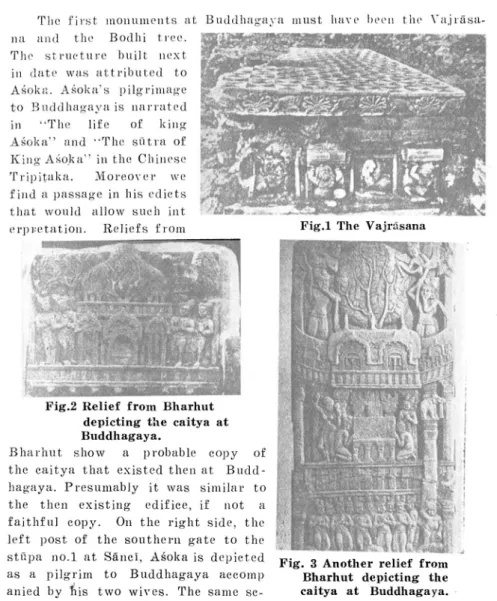
Vajrasa-na and the Bodhi tree. The structure built next in date was attributed to 1 Asoka. Asoka's pilgrinuige to Buddhagaya is narrated in "The life of king Asoka" and "The sutra of King Asoka" in the Chinese Tripitaka. Moreover we find a passage in his edicts that would allow such int erpretation. Reliefs from
Bharhut show a probable copy of the caitya that existed then at Budd-hagaya. Presumably it was similar to the then existing edifice, if not a faithful copy. On the right side, the left post of the southern gate to the stupa no. 1 at Sanci, Asoka is depicted as a pilgrim to Buddhagaya accomp anied by leis two wives. The same
Fig. 1 The Vairasana
Fig. 2 Relief from Bharhut depicting the caitya at Buddhagava.
Fig. 3 Another relief from Bharhut depicting the caitya at Buddhagaya.
one is represented on the outer side of the
third architrave, eastern gate, too. In the forme. i
a domed caitya is supported with six pillars in
front of the Bodhi tree and the Vajrasana is
seen below, while in the latter the top of the
roof is not depicted with a straight line but a
curved one as it would have appeared when it
surrounded the tree. The latter fact is
conf-irmed by the relief from Bharhut. Indeed, a
building with a small roof surrounded the
tree and the Vajrasana, so that they could be
seen from outside and anybody could approach
freely to worship them. Thanks to these
bas-reliefs we can now visualize the caitya of
Bu-ddhagaya as it would have appeared in ancient
time. According to Hiuen-Tsang such was the
small eaitya built by Asoka. The building was rebuilt in some unkno-wn age so that when Hiuen-Tsang visited Buddhagaya he saw a temple 160 or 170 shako high, and more than 20 steps wide at its base. He describes it in details. This extraordinarily high building corresponds to "the great tower" as it is called now. If it stands oil the very spot where the former building stood. we must surmise that the Bodhi tree that had been there was transplanted to the present position (a little to the north). Au inserpition found there calls the towe r Vajr-asana vrhad-gandhakuti We had better use the appellation of Gan-dhakuti in preference to the misleading name of "Great tower".
Hiuen-Tsawl, gays that the founder of the
Gandhakuti was a Brahmaa, but he fails
to mention the date. We have, however,
an object that suggests its date.
That is the teriacotta plaque found
out by Di. Spooner at Kumrahar., Patna.
He reported of it in the no. 1 of the
Jou-inal of the Bihar and Orissa Research
Society. In our country the late Prof.
Di. Ono first published it in his
Budd-hist art in Gandh. ra". (in Japanese).
And after him Dr. Henuni gave it in
"The, study in Buddhist art in India."
(in Japanse). The plaque is now kept in
the Patna Museum. In its center is
shown a very high square building surmounted with a 9tupa with Fig. 4 Relief on the
right side, the le ft post. South gate, Stuua no. l. S inci
Fig. 5 Terracotta plaque de-picting Buddhagaya. ブ ッ ダ ガ ヤ の 遺 跡
密
教
文
化
five umbrellas. No doubt this is the prototype of our Gandhakuti. Inside it is shown a big seated Buddha accompanied by attendants that stand both on the right and the left. These are, according to the Chinese pilgrim, silver statues of Avalokitesvara and Maitreya. In the sky above the temple Devatds are seen soaring and in front of it stands a stone pillar surmounted with an elephant. We see the same pillar in the Bharhut relief depicting Buddhagaya. The
balustr-ade surrounding the precinct of the temple on all the four sides is clearly visible, which is the very one whose remnants are still
preser-ved to our day. A big wall is seen on the facade within the entr-ance just outside the balustrade. There are some buildings here and
there, specially on the east side. They seem to be caityas. To our surprise, some trees and even pilgrims are represented. Among the trees we can discern a sort of the palm tree which is very commonly found in the sandy tracts of Bihar. The sap of the tree is called tack, a kind of intoxicant beverage, which was, according to the Bud-dhist tradition, once disputed by the bhiksus of Vaisdli as one of the ten misdeeds against the Buddhist discipline.
In view of the facts that the Buddha figure is already represen-ted in this plaque, that it bears a Kharosthi inscription, that this was found at the site no. 3,. Kumrahar at the depth 45 c. m. below the ground, and that copper coins of the Kusana period were found at a spot near by 1.82m. below the ground, this plaque can not be dated back beyond the 2nd century A. C. The late Dr. Ono suggested that the high temple in the plaque would be a copy of the well known stupa of Kaniska in Peshawar, which is an original and plausible opinion.
Here I wish to point out a sculpture kept in the Mathura Muse-um, numbered J. 24, (pl. III, Vogel's Catalogue) which is most
proba-bly a representation of the Gandhakuti at Buddhagaya. It has
more than one story of which the upper part is a high square building. Gautama the Buddha is seated below in front of the Bodhi tree. The shape of this temple is so peculiar beyond comparison. No similar example is known. Judging from the style of the Buddha the bas-relief can not be- later than the former half of the 2nd century, when the Gandhakuti in such way of construction had already been built. Cunninham found in his excavation of the site a relic-casket under the ground in front of the Vajrdsana. It contained coins of Hu-viska together with some small gold flowers. So he attributed
the foundation of the building to Huviska, an opinion agreed
by Dr. Coomaraswamy. I am, however, inclined to think that it
The history after that is known from the
account of Hiuen Tsang and the inscription found
on the spot. The temple was repaired about 450.
Sasauka persecuted the Buddhist religion in the
beginning of the seventh century. He cut the
Bodhi tree and enshrined an image of Siva
instead of that of the Buddha. A Purgavarman,
scion of Asoka revived the Bodhi tree and built
a stone fence so high as 2 jo and -4 shako. The
tree seen by the Chinese scholar was almost
hid-den by a stone fence, only the top issuing forth
above it by about 2 jo. The stone fence has
disa-ppeared. After the 11th century pious Burmese
repaired the monument on sevecal occasions until
in the 19th century the Archaeological Department
excavated the site and repaired it.
At present a seated statue of Buddha gilt
all over in Bhumisparsa mudra is enshrined in
the cella of the Gandhakuti. Like mane other
stat-ues of the Buddha in and outside the building it is of the Pala style and of a blue stone from Bengal. There are standing Buddhas in the niches on both sides of the entrance to the cella. The one on the right is in Ahhayamudra and the other on the left is in Varadamudra. Neither the wall of the cella nor the ceiling is adorned. Many small niches outside the Gandhakuti contains Buddha statues of the Pala period.
The main gate which stands now on the east consists of granite pillars with ornamental patterns in the Gupta style. here are four pillars of the same period in front of the small temple to the left. They are now painted with vermillion.
We have minute description by Hiuen Tsang of so ninny monumen-ts. But nothing now remains except the balustrade, the Buddha's Ca-nkrama and the tank of which the last lies to the. south of the precinct. Miniature votive stupas dating from the Mediaeval period were found out in great number. Many Mediaeval Buddha statues excavated here are now in the Calcutta and other museuurs. The area on the north of the temple that is occupied by the Hindu temple is remarkably higher than the precinct of the Gandhakuti. It must be composed of debris of so many ruins of ancient buildings. Otherwise we can not understand why the ground is so uneven in the plain. Before the excavations the precinct of the Gandhakuti itself was elevated several meters above the surrounding country. We can now
Fig. 6 ion of the akuti Railing
st, J. 24, Mathura Museum. ブ ッ ダ ガ ヤ の 遺 跡
密
教
文
化
trace, on the northern and western sides, the boundary of the ground where buildings once stood. Now it is covered with bamboo bushes and other shrubs. The western extremity was probably the spot where
stands the dharmasala constructed by the Burmese. On the east and south too, the precinct is elevated here and there, where dwelling houses and trees stand, thus rendering it impossible to identify the monuments mentioned by Hiuen Tsang.
The balustrade
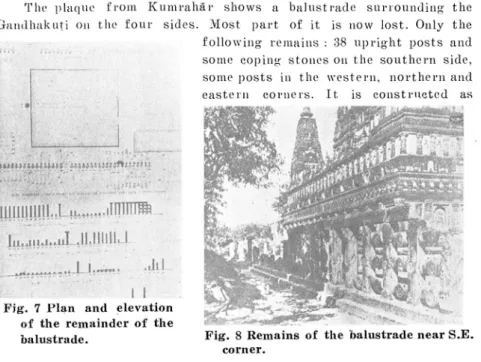
The plaque from Ianuahar shows a balustrade surrounding the Gaudhakuti on the four sides. Most part of it is now lost. Only the following remains: 38 upright posts and some coping stones on the southern side, some posts in the western, northern and eastern corners. It is constructed as
usual. The carving in bas-relief is on the posts. cross-bars and coping
stones both on the inner and outer sides. The coping stone is 35. 5 c. m.
high, upright posts about 2 meters high and the base 66 c. m., the
total height amounting to about 3 meters. The posts in the four corners
are square iu section, one side measuring 36. 2 e. m.
Looking at each post one by one, we notice that there are two
kinds of stone as the material of the sculpture, that the style of
the-bas-relief differs according to the material, that the two kinds of
posts are mired, and that some posts bear lenticular mortices pierced
in the midst of the bas-reliefs that were previously carved. This last
fact makes it doubtful whether the posts and coping-stones are exactly
Fig. 7 Plan and elevation of the remainder of the
balustrade. Fig. 8 Remains of the balustrade near S. E. corner.
in the same position as in ancient time. The two kinds of materials can
not date from the same period. The sandstone posts coming from
Kaimur are more suitable for the preservation of details of the
pture because of the fine grains than the coarse granite posts. The
former betrays by its style that it was executed in the Sunga period.
For example, the human head inside the open lotus flower is, roughly
speaking, similar to that of Bharhut. But its carving is deeper and
more massive. The delineation of the contour is more realistic. The
movement of the figures is represented with more freedom. They are
seen from the side, in three-quarters and from the front. But as a
whole, the human figures and other objects az-e rather simple and the
ornamental designs lack variety. There are no-such variety of motifs
and themes as we see at Sdnci and Bharhut.
The chronological view of Sir John Marshal is as follows: The coins
of king B rhammit ra and Indagimita whose names are found in the
iscriptions that are on the balustrade were circulated wide in north
India, and they can not be dated before the 1st century B. C. from
numismatic point of view.
But Agnimitra might be the second king of the Sunga dynasty. In
that case he must be regarded to have lived about 150 B. C. Then it
follows that the sandstone posts and cross-bars date from 150 B. C. at
the earliest and 70 B. C. at the latest. The coincidental opinion of many
authors on the date of Buddhagaya balustrade seems to be slightly
before or after 100 B. C. The granite posts and cross-bars are rough
and more weather-worn. The details are obliterated. Sonie of their
subject-matters are so vague that we can not make out their original
configuration. Such posts now stand specially on the western parts of
the southern side. Some subjects on the later posts seen to be copies of
the orginal ones, while others such as Kirttimukha and the arabesque
pattern are never found on the older posts. In the art of the pre-Gupta
period we can never see the tip of the wings of a bird changing into
an arabesque. The art thatt is before us, though dating from the Gupta
period, is not a product of that golden period that produced such fine
pieces as, for example, standing Buddha, no. A. 5 of the Mathura Museum
or the graceful statues from Sdrndth. It is even later than most of
the later caves at Ajantd. Thus we can not date it back beyond the
7th century. That the gateway of granite which forms the present
eastern gateway is of later Gupta style, and that the foundation in
front of the Gandhakuti is equally of granite seem to corroborate my
view.
Extensive repairs seem to have been carried out in the same date.
I am going to describe in the following pages the sandstone portion
ブ ッ ダ ガ ヤ の 遺 跡
密
教
文
化
of the balustrade referring now and then to the granite one. Besides the remnants of the balustrade kept at Buddhagaya, some coping sto-nes and crossbars are kept in the Calcutta Musuum and 3 posts are in
the Victoria and Albert Museum, London. First we shall see the sout-hern side from cast to west and then west side, north side coming to an end at the north east corner. The late Dr. Coomaraswamy, the em-inent scholar in Indian art and archaeology, published a fine book entit-led "La sculpture de Bodhgaya" with full illustration 41 the series of Ars Asiatica. I have adopted his number of posts to avoid possible confusion, and borrowed his plates for the illustration.
Jataka
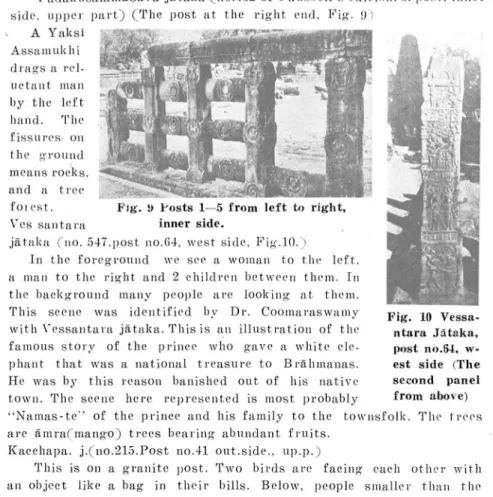
Padakusalamanava jataka (no. 432 of Fausholl's edition. 5. post. inner side, upper part) (The post at the right end, Fig. 9;
A Yaksi Assamukhi drags a rel-uctant man by the left hand. The fissures oil the aground means rocks. and a tree foi est. Ves santara
jataka (no. 547. post no. 64, west side, Fig. 10.
In the foreground wye see a woman to the left,
a man to the right and 2 children between them. In
the background many people are looking at them.
This seen was identified by Dr. Coomaraswaniv
with Vessantara jataka. This is all illustration of the
famous story of the prince who gave a white
ele-pliant that was a national treasure to Brahmanas.
He was by this reason banished out of his native
town. The scene here represented is most probably
"Namas -tc" of the prince and his family to the townsfolk. The trees are amra(mango) trees bearing abundant fruits.
Kacchapa. j. (no. 215. Post no. 41 out. side., up. p.)
This is oil a granite post. Two birds are facing each other witli all object like a bag in their bills. Below, people smaller than the
Fig. 9 Posts 1-5 from left to right, inner side.
Fig. 10 Vessa-ntara Jataka, post no. 64, w-est side (The second panel from above)
birds are raising their hands. looking upward. According to M. Foucher
this is a representation of Kacchapa jat. The object that seems like
a bag is in fact a tortoise. The story goes that when two haiiisas
were carrying a tortoise to the Himalaya by means of a pole
which the tortoise held in his mouth at its center, the latter wanted
to talk and opened his mouth, thereby causing his death. Such jataka
was probably represented on a sandstone post of the older period, and
the later artists copied it on the granite post.
Some scenes are probably from unidentified jatakas. On the post
no. 2. inner side. upper part, a woman and a child stand facing a
mutton that is on a platform. On the same post, outer side, upper
part, a man stands in front of an elephant. If the sculpture were of
post-Christian period, we would not hesitate to say that this is a scene
of Buddha's subjugation of elephant Nalagiri, which is, however,
impossible, for no Buddha was represented in the pre-Christian period.
Dr. Coomarasw: uuy tried to identify it with Chaddanta jataka. But
this is not certain.
On the post no. 9. inner side, upper part, a Yaksi Assamukhi and
a mail are seated playing with dice. The head of the man is gone and
that of the Yaksi is damaged. Both of them wear dhoti. We have no
such scene in Padakusalamatlava jataka. On the post no. 27. inner
side, upper part, a man is seated in front of an elephant and touches
a leg of the animal with a role. The same
post, outer side, upper part, is also
nnid-cutified. Two octagonal pillars stand of
which capitals are surrounded with small
railings and of which again the right one is
surmounted with three umbrellas. Above
the left one is a three-hooded nii-a covered
with au umbrella. Between the pillars and
beyond the right one are also railings, the
farther one being shown smaller. Two trees
are in the background. Below the pillar on the left there is something like a tortoise, which is iii fact a, jar. It might be a wine vessel.
Post no. 45. inner side, upper part.
Man and woman are seated on a stool
or charpai. The heads are damaged. She
clings her arm around the neck of the other
woman who is behind the couple. The latter
may be a maid-servant. Below the bed is
seen a vessel with food and fruits (either
Fig. 11 Post no. 27 inner side (left); outer side (right) ブ ッ ダ ガ ヤ の 遺 跡
密
教
文
化
amra or papaya).
Post no. 92, inner side, upper part.
A Brahtnanic ascetic is seated in front of a but together with a tiger. A tree on the right side indicates that it is in the forest. Behind the ascetic is seen a water-jar or a Iota. What seems at first sight to be a many-hooded Naga in front of the ascetic is a palmette just to fill the space.
The life of the Buddha
Indra. ailaguha (Post no. 3, outer face, upper part)
We see a balustrade and an arched entrance to a cave oil a rocky hill. There is a rectangular throne inside the cave. Outside the cave a man stands witli a villa
under the left artn. He is Gandha. rva Pancasikha. a follower of God Indra. This is the simplest pos-sible form of Indrasailag-uha. Neither wild beasts nor trees are shown as ill
the later has-refiefs front Gandharn. The composit-ion is simpler than that from Bharhut. But the fig
tine of Pancasikha is drawn in more advanced
style than at Bharhut. l-Ic is even elegant,
with the slightly boutt right leg and the right
arm.
The cave \\-here the Buddha retained his image
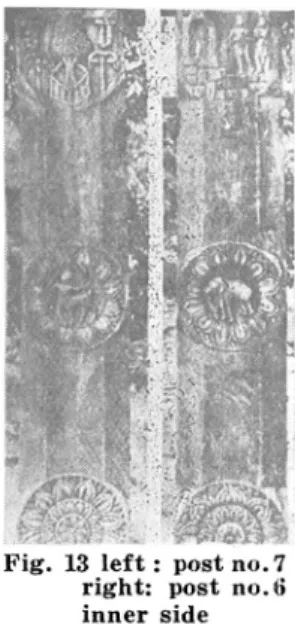
(Post no. 6, inner side, up. p. Fig. 13. right)
According to Fa-Hiau there was a stone
cave within a half yojana to the north-east
of Buddhag aya. The Buddha, lie says, entered
the cave before his enlightenmentt and left
his image. In his days it still existed. This
cave was situated in Pragbodhigiri called by
Hiuen-Tsang, who also mentions the cave,
where, he says, the Bodhisattva oil his way
to Buddhagaya retained his image for the sake
of a raga. But the image itself had disappea
red when lie visited the cave. The hill is now
called Mora. Such cave where Buddha was
Fig. 12 (from left to right) Posts nos 4. Y,. 2. 1, outer side.
Fig. 13 left: post no. 7 right: post no. 6 inner side
supposed to have left his image was at Kosambi as well as in Na-garahara in the N. W. India (now near Jellalabad, Afghanistan). The latter was specially well known. A similar scene on the inner side of the post no. 8 is yet unidentified.
Walking on felt on the river Neranjara. (Post no. 6, outer s., ill). p. Fig. 14)
This is the scene of the miracle of walking on the Meranjara when the Buddha converted the brothers of Kassapa. Those on board a boat arc Kassapa and his disciples going to rescue the Buddha who was
supposed to be drowned.
A little more complicated
scene of the same episode
is on the eastern rate of
the stupa 110. 1, Saner. The
figure of the disciple
han-dling a bamboo pole is well
delineated.
Donation of Jetavzuia(post
no. 10, out. s., up, 1). Fis. 15)
This is the scene of,
donation of Jetavana by
An t ha p ii ik a. Comparedd
with the santz scene oil the Bharhnt balustrade, this is simpler in its com,)osition. Two men cover the ground with gold coins and another
carries it bag-full of coins. The theme is concentrated to the action of covering the gold coins. So the meaning was clear enough for pious visitors. In the Bharhut relief. however, the continuous actions of the story are represented in one and the same medaillon. The modelling of the figures is more advanced at Bnddhagaya.
Objects of cult
The balustrade has many representati-ons of Bodhi tree, Dharmacakra and StOpa. which are the symbols of the Enlighten-ment, the First Sermon and the Nirvana
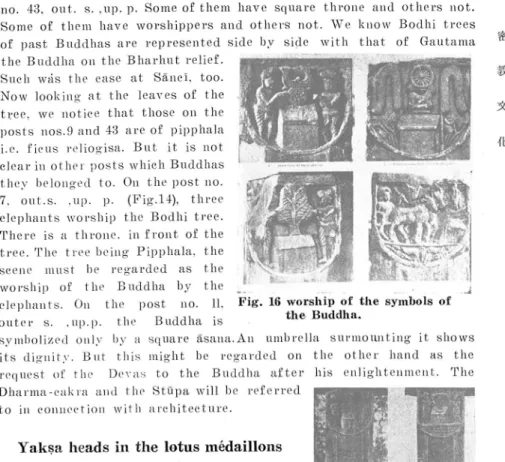
respectively. You can see the Bodhi tree: on the posts no. 5; out. s., tip. p.; no. 7. in.
s. up. p.: no. 9, out. s. up. p; no, 1. in. s.; Fig. 11 left to right: Posts nos 7. 6. 5. 4
outer side.
Fig. 15 Post no. 10 left: inner side right: outer side
ブ ヅ ダ ガ ヤ の 遺 跡
密
教
文
化
no. 43, out. s. up. p. Some of them have square throne and others not. Some of them have worshippers and others not. We know Bodhi trees of past Buddhas are represented side by side with that of Gautanta
the Buddha oil the Bharhut relief.
Sucti wri. s the ease at S, nei, too.
Now looking at the leaves of the
tree. we notice that those on the
posts nos. 9 and 43 are of pipphala i. e. ficus reliogisa. But it is not
clear in other posts which Buddhas
they belonged to. Oil the post no.
7, outs. up. p. (Fig. 14), three
elephants worship the Bodhi tree.
There is a throne. in front of the
tree. The tree being Pipphala, the
scene must he regarded as the
worship of the Buddha by the
elephants. On the post no. 11.
uter s. up. p. the Buddha is
symbolized only by a square asana. An umbrella surmounting it shows its dignity. But this might be regarded on the other hand as the reonest of the Devas to the Buddha after his enlightenment. The
Dharma-calcra and the Stupa will be referred
to in Connection with architecture.
Yaksa heads in the lotus medaillons
The following lot us medaillons have human
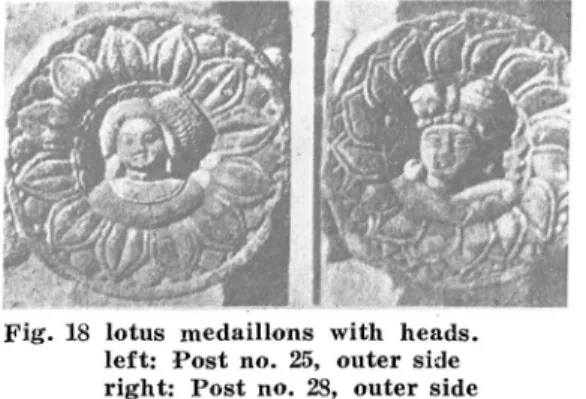
heads in the centre: no. 2 in, s. middle p.: cross-bar between 4 and 5 in. S. lower p; 110. 6 out., mid.: no. 7 out., mid.: no. 9. out. mid.; no. 9 out., mid.; no. 1l. out., mid.; no. 25. out. mid.: no. 27, in. mid.; and out-mid.; no. 40, in. and out., niid.; no. 44. in. mid. and out., mid.; no. 92, in. mid. They
represent male heads wearing turban mostly
with the upper part of the chest in more or
less similar way. No 25 is an exception in
bearing a female head. In most cases necklace
is omitted. Speaking of the male head
gener-ally, it has the eyes wide open, narrow upper
and lower eye-lids, wide nose-wing's and
comparatively low nose ridge. Just as in Bharhut images the mouth is Fig. 16 worship of the symbols of
the Buddha.
Fig. 17 Post no. 11 left: inner side right: outer side
rather small with a depre-ssion on each end of it. The face is rather round than oblong. Such is a general type that was prevalent not. only at Buddhagaya but throughout India in pre-Christian period since the Mauryan period. The post no. 45, in. s., mid. p. has a seated male figure.
No. 26, in. s., mid. p. is
very interesting. The face is similar to human one but the ears are
angular like those of an animal. It is singularly reminiscent of the
figures of demons in the wall paintings of Qumtura and Qyzyl near
Kncha, in Chinese Turkestan. The coincidence is so striking. It is not
of couree a human face but a spirit: you may call it a Yak,. Inferring
from this bast all of the other busts that first appeared to be human
must be regarded as Yaksa. The lotus flower was here represented
as an auspicious symbol of life-giving water together with the Yak a
presiding over the abundance of the earth.
Similar heads are found on the granite pillars. Conmared with the
sandstone one. they are so different. Firstly the lotus encircled with
series of beads is never found in the sandstone posts: secondly the
head has no head-dress, since he is a Yaksa, a minor deity: and thirdly,
though the face is effaced, it has eyes looking downward and a thick
lower lip. Such is the type of the Buddha of the Gupta and the
subsequent periods. This is not of pure Gupta style hut somewhat
degraded.
Life-size figures
The post no. 91, north side in the north-east corner has a pretty big male figure. Apparently it shows an advanced style. He stands on a fabulous animal with a bundle of flowers in his right hand. The animal has a human face and legs like those of a bull. The folds of drapery is somewhat schematically arranged with thin, low, parallel Hues but no doubt with elegance. It is reminiscent of the Yaksas. on the Bharhut balustrade. But this is not a Yaksa. According to Bach-hofer this is Indra who offered grass in disguise of a Brahmapa immediately before the enlightenment of the Buddha. Then what seems to be a stein of flower must be kuia (a kind of grass). Agreeing to
Fig. 18 lotus medaillons with heads. left: Post no. 25, outer side right: Post no. 28, outer side
ブ ッ ダ ガ ヤ の 遣 跡
密
教
文
化
this view. Dr. Coomaraswamy relates on it very minutely. But is this a Brahmatia. It was in disguise of a grass-cutterr that Iudra appeared on that occasion according to Hiuen Tsang. The grass-cutter is repre-sented sometimes in the sculptures from Gandhara. Thus the legend was not fixed in this respect. He was either a grass-cutter or a Brahmans. In the present case he is not a grass-cutter. But lie does not wear a Brahmanic garment either. The sculptor of this
figure might have imagined India assuming the appe-arance of human king since he is the king of gods. No wonder that he rides on an animal. Difficulty still remains unsolved. The head is covered with short hair but not with a turban. Moreover, the center of the head is elevated above the rest of the head. That baffled Dr. Coomaraswamy. He suggested that the protuberance may be the forerunner of usnisa on the head of the Buddha Image. That is not convincing enough, for the origin of usnisa can be explained otherwise.
Compared with the gateways of Sand, this figure is stylistically more advanced than some of the mediocre reliefs on the gateways. But the design of the goddess poured water by a pair of elephants in the upper part of the same post is very similar to the same motif on other sandstone posts. So long as I surmise that the upper and lower parts were made at the same time, I cannot but attribute the excellent workmanship of this particular bas-relief to a more capable sculptor.
We notice lenticular mortices not only on the south and west sides but also on the cast side of this post. Also we see a inortice on the east side of post no. 92. An entrance must have existed here.
Statue of a Yaksi(no. 1, out, s. ef. Fig. 12, 20)
A Yaksi entwines the stein of a tree with the left arm and left leg. Her right arm was raised up, but is now broken off. Probably she took a branch of the tree with her hand. Unlike at Bharhut, her right leg is supported by a seated male figure, a Yaksa. Both Yaksa and Yaksi are of elegant workmanship and full of life. The pose is true to nature. They can rival the figure of Iudra just mentioned in their accurate modelling. Her face is unhappily broken. This post stands on the south-east corner. It is of the same level of workmanship as post no. 91. Traces of red colour is still noticeable. Originally it must have been painted. On the inner face of this post there was a
lotus medaillon on which, in some subsequent age, a lenticular mortice Fig. 19 Life
s-ize figure on the post no. 91
was chiselled. Presumably, the balustrade continued on
the east side. Why had they to carve a medaillon?
Or else was the position of the post changed? There
is a mortice on the east side, too.
Figures of amorous couples
There are many figures of man and woman
re-presented side by side. Such figures appear by the
side of sacred symbols. In many cases a couple stand
side by side but in others we see more erotic
scen-es. They might be, as suggested by a scholar, gods
in the heavenly palaces of Indra or Kubera.
Psych-ologically speaking, however, are they not a
produ-ct of the atmosphere of enjoyment of life in the
sexually unrestrained society of ancient India? It
was unlike the present Indian society, for India has
changed since the Muhammadan invasions. Unlike
Hindus in the present day, people ate meat and took liqueur. These figures are so to speak "peinture de genre" of the Sung period. Post no. 11, S., mid. p. (Fig. 17)
Both man and woman are seated side by side. The man has a big goblet. To the proper right of the woman we see a leather bag prably of wine. Post no. 21, north s., nn. p.
This post together with post no. 22 composed the two sides of the south entrance. The bas-relief is elaborately executed. We see square panels instead of medaillons. On each side stands an octagonal pillar with a water-jar at its base and surmounted with an elephant. Three women stand by a seated prince, who converses with them with the left hand raised. The woman next to the prince bears a cauri, and the others have food probably. A garland hangs from the ceiling. Post no. 21, west s.
A seated man plays on vina and a woman dances to it in a simila-rly adorned room. She is almost broken off.
Post no. 22, north s. m. p. and east s, m. n.
Mail and woman stand in a room with the arm on the back of each other. A pot of wine(?) is beside them. In a subsequent age a mor-tise for a cross-bar was tried to be chiselled on the east side, but was left half done. On the south side there was originally a mortise. As a mortise is on the south side of no. 21, it is certain that there were rails on both sides of the south entrance.
Post no. 38, west s., lower p.
Fig. 20 Yaksi on a tree. Post no. 1
ブ ッ ダ ガ ヤ の 遺 跡
密
教
文
化
This post representing a couple of the upper class standing in a room, is in the south-west corner. Their garment is the
same as the above-mentioned ones. The
woman in the tipper compartment has a vina. Post no. 64, west s. (Fig. 10, 25)
This is the post in the north-west corner. This time the man holds the wo-man by the back, holding a vina in his left hand. Below in the lower part the figur-es are more active. A man holds a worn-an who is going away by the left hworn-and and the scarf below the breasts. She turns her head back. Her hip and breasts are apparent. Another woman, probably a
ma-id-servant peeps them from behind the
curtain. Evidently this happens in a bed room where he wants his wife to take off her clothes. The scene is erotic enough. This part. is so well prese-rved that even the red colour is traced as is seen oil the balustrade of the great stupa at Sanei.
Post no. 64, no. 64, north s.
It is slightly effaced. III the,
middle part a woman stands holding
up her hands joined and with her
waist twisted, whom a man looks at.
Beside her is a boy. There is a tool
made of bamboo or cane. In the lower
part, a man holds two women who
stand oil both sides by the shoulder
inside a room with a curtain.
Such figures of couple arc noticed
Oil some granite posts, too: Posts nos.
76 and 77 at the north entrance. It
is highly probable that posts hearing
the same motifs had been set up in
the Sunga period exactly at the same
spot and that the motifs were copies
of the previous ones. It might be of
some significance to remark that the
figures of this kind are seen on the prominent posts such as at the south and north entrances, south-west corner and north-west corner.
Fig. 21 Post no. 22
Fig. 22 Post no. 38, west side
Fig. 23 Post no. 64, no-rth side
The goddess poured water by two elephants
Posts no. 8, out. s, no. 22, east s. north s. (Fig. 21): no. 91. north s.
A goddess stands oil a lotus. Water is poured over her head by
two elephants which stand
equally on lotuses by her
sides from a water-jar
whieli they hold with their
truck. Chic motif was
pre-valent i Itromxhout India
in pre-Christian period.
Probably we see here an
auspicious symbol of
abu-ndance. In my view this
is the earth goddess
irri-gated by the monsoon
sh-ower which is the
indisp-ensable thing for the growth of vegetation, the life-bestowing elements for the agricultural produets.
Surya
Post no. (i4, north s. (Fig. 23, 25)
Sara is driving his carriage with four horses. He is represented en face. Behind his head is seen a halo in chiselled line denoting the rays. The halo of Surya might have someting to do with the halo that later appeared invariably at the back of the head of the. Buddha.
Above Surya's head we
see a parasol, symbol of
dignity. Oil both sides of him, two wives or maids
Jaya and vijaya shoot
Two the arrows of the
ra-y. Two of the' four
hor-ses run toward the right
and the others toward
the left. They are
rep-resented in profile but
not en face. for it
wo-uld require de pth of
sculpture to dep
Fig. 24 The goddess of the earth left: Post 22
right: Post 8
Fig. 25 Post no. 64 left: love scene right: Surya ブ ッ ダ ガ ヤ の 遺 跡
-49-密
教
文
化
jet the horses front the front. The technical difficulty was avoided in this way. Marshall imagined Greek influence oil this composition of Surya. But the idea of Surya or Aditya journeying through the sky was very old among the Aryans and other West Asiatic people of pre-historic period. Later on such idea was transmitted to Greece. So the resem-blance of this composition to Greek representation of Helios must he a coincidence. We cannot recognize ally sort of influence of Greek art on the balustrade of Buddhagaya.
Animals in the lotus medaillons
Generally speaking the lotus medaillons with various animals are eleg-ant and true to nature. We collie across many fabulous animals that appear in many other monuments not only of ancient India. but of western Asia as a whole.
Post. no. 3, in. s., m. p. human-faced lion
Post no. 4, in. in. lions oil the capital of a pillar. (Fi. 9) no. 5, in. in. a bull; out. m. a Makara
no. 6, in. in. an elephant with a bud of lotus (Fig. 13) no. 7, in. in. a horse with a human bust (Fig. 13)
no. 8, in. in. a winged bull no. 8, out. in. a horse no. 9, in. in. a winged lion
no. 10, in. Ill. a horse: out. tn. a winged horse (Fig. 15)
no. 12, in. in. a buffalo; out. In. a ute rinaid with an additional lotus flower
no. 20, out. in. a lion chasing a deer no. 25, in. tip. a yaksa on au animal
with serpentine tail
no. 25, out. up. almost the same as no. 25, i n. in.
no. 43, out. in. a harhsa reminding of that on an Asoka capital
Simple lotus medaillons
Besides the trees which are necessary to represent scenes from Jatakas and the life of the Buddha, the only plant used as a purely ornamental element was the lotus. But the decorative effect of the
Fig. 26 Post no. 12 left: inner side right: outer side
lotus here is far less than at the stupa no. 2 at Sane! and Bhurbut. In most cases a full open lotus blossom as seen from above is depicted filling the ntedaillon. The number of petals is not definite. The pe-tals in most of the medaillons in the middle part of the sandstone posts are 12, next come S. Rarely we conic across 6, 9, 10 and 16.
The form of each petal is similar. Here we can not see such variety of lotus designs as at the stupa no. 2 at SAW.
The lotus or, the granite posts somewhat resembles a flower of the crythanthemunt and the carving is feeble.
Architecture
Stupa
Stopas are represented on the relief with its balustrade that surrounds it. The latter is curved just to express its roundness. The examples are found on posts no. 3. in. up. (Fig. 9): no. 12, out. up. (Fig. 26): no. 40, in. up.: no. 43. in. up;. no. 92, out. up. A stupa inside a caitya is found on post no. 38, south side and west side. Compared with the stupa carved on the upper part, outer side, no. 34. and middle pan, ou-ter side, no. 50. these stupas are very different. The later form of the stupa is rather to he compared with the subsequent Mediaeval stupas, for example,
miniatu-re votive stupas in the precinct of Buddhagaya. Caitya
The simplest form of the entrance of caitya is sho-wn on the upper part. inner side. no. 10. (Fig. 15). Inside, a dharmacakra is placed on a square throne, which is supported by four small posts. Many caityas of this type superposed one on another ate shown in the south side of no. 38 (Fig. 27) and west side of the same post (Fig. 2'2). In this case a stnpa is enshrined instead
of a dharmacakra. From bottom upward we see an
atlas-yaksa, a dharmacakra pillar and a couple worshi-pping it and the great arches. Further above, two small ca it, ya-arches are superposed one on the other. The upper part of the west side is just identical with the upper part
of the south side. And below it a pyramidal crenel is carved.
A trefoil arch consisting of the bigger central arch and smaller
arches of aisles is noticed on the post no. 40. At Bhdja we can see
a real caitya cave of the same form. The pillars supporting the arch
Fig. 27 Post no. 38, south sue ブ ッ ダ ガ ヤ の 遺 跡
密
教
文
化
in this bas-relief slant slightly inward.
On the west side, no. 64 is a little more elongated form of the caitya than what we have seen (Fig. 10). The caitya is supported by pillars so as to form two stories on the north face, the same pillar (Fig. 23). In the lower story there is a big arched entrance with a dharnia-cakra on a square throne placed inside. In the upper story three small arches are placed side by side.
Mansions
The building represented in the upper parts of the inner and outer sides of the post no. 44 probably is not a religious one, but a reside-ntial mansion. In the inner side it has a large arched entrance
down-stairs as in the above-mentioned two storied caitya, and three
women standing in the veranda, upstairs. The roof is omitted. In the outer side, pillars are seen in the
lower story, while two arched entrances are represented in the upper story, gar-lands hanging down between them. Here are no religious symbols. The upper part of the inner side, post no. 4 (Fig. 9) is eff-aced but has a faint trace of a residence of this sort. Such form of architecture confirms its identity with the caitya in fundamental idea.
The hut of a hermit seen in the upper part, inner side of the post no. 92 is more developed than the huts that appear in the Bharhut reliefs. It has the square plan and an arch over the entrance. But the roof is not clear.
Only one type of pillar appears in the balustrade of Buddhagaya. (Fig 21, 22. 27)
The base consists of square boards one
placed over another surmounted with a water-jar. The shaft is
octago-nal with an inverted water-jar. A pair of bulls, lions. and sometimes
goats squat on the square abacus which is placed on the water-. jar.
The topmost element is a prop connected with the superstrite ture.
The small bell-shaped capital which had been adorned with petals
of a flower now changed into an inverted water-jar. In short, the
building that appears in the balustrade of Buddhagaya is of the caitya
type and the pillar is one of the several types shown in the
Bharhut reliefs.
Fig. 28 P ost no. 44 left: outer side right: inner side
The coping-stone
Most of the coping-stones in sandstone are kept in the eastern end of the south side (nos. 2, 3, 4, 7, 8, 10, 11) (Fig. 8. 9. 12, 14) and some others in the Calcutta Museum. Their original position has been changed. The carving is very low. Their motifs consist of an-imals and the lotus flower. The animals are classified into: 1) a
iiiakara and a figure 2) a yakSa running after fabulous anima-ls: and the lotus flo-wers into 1) series of open lotuses and 2) superposed open lotu-ses, 3) series of Lotus seen in profile. fish-tailed creatures stand between makaras put-ting their hands in the mouth of makara. In one example such
a creature worships a sacred tree. This is regarded by Dr.
Coomara-swamy as a spirit of waterr the god of abundance giving life to
eve-rything. Among fabulous animals we see horse, ox and lion each
with a beak. A yaksa chases them with an ax. The execution of
these effaced friezes is rather feeble. And the carving of the lotus
is very low. The petals of the flower are also different from those
on the posts. Nor can I find a parallel among the sculptures of
ancie-nt India. These coping-stones, therefore, seem to be slightly later
than the sandstone posts.
Buddha's cankrama
There is a platform lying east to west along the north side of
the Gandhakuti. This was believed to have been the place where the
Buddha walked after the enlightenment. Nineteen lotus flowers are
engraved on the upper surface of the platform. These are made of
granite, which do not date from the beginning of the temple as we
have seen before. To the east of the platform nine bases of
water-jar type are arranged in a row. Lotus petals are engraved
Fig. 29 Posts 4-10 (left to right) inner side
ブ ッ ダ ガ ヤ の 遺 跡
密
教
文
化
on the upper face of the Water-jars. Originally they
were twelve -in all. The lower part of an octagonal
shaft is left on one of them with a figure of yaksi.
The style of the pillar is the same as the ones in
has-reliefs mentioned above. Some fragments of the
capital were excavated under the ground. It was of
the same type as the one illustrated in the bas-reliefs.
Being of the same type as the goddess Sri poured
water by two elephants, this yaksi must be of the
same date as the sandstone posts and cross-bars of
the balustrade. This is nearly life-size like Indra on
the post at the north-east corner and yaksi in the
south-east corner. This is one of the representative
female figures of the late Sunga period. This sacred
promenade was probably covered with a superstructure
supported by such octagonal pillars.
Literature
For the architecture of Uandhakuti:
Cunningham, Archaeological Survey of India, Report. Vol. III. X1, X111. Cunningham. Mahabodhi or the great Buddhist Temple at Bodhgaya. 1892. Spooner. The Bodh-gaga Plaque. Journal of the Bihar and Orissa Research
Society. Vol. 1. 1916
I-owe very much to the following fully illustrated book:
Coomaraswamy. La sculpture de Bodhgaya. Ars Asiatica, tonic XVIII, Paris. 1935.
The following books are to be consulted for the photographs of he sculpture:
逸 見、 佛教 宵 芸 術 の精 華、 佛陀 伽 耶 大 正 14
Bachhofcr. Early Indian Sculpture. Pl. 34-45, 1929.
逸 見、 古 代印 度 美 術 ・資料 と解 説 昭16 Fig. 30 pillar



![[環境化学(Journal of Environmental Chemistry)Vol.20, No.2, pp.173 181, 2010]](data:image/gif;base64,R0lGODlhAQABAIAAAP///wAAACH5BAEAAAAALAAAAAABAAEAAAICRAEAOw==)