
ER_3 (E = Si, Ge, Sn, P)配位子を有する鉄錯体の合成と E-H 結合に対する反応性に関する研究
182
0
0
全文
(2) Table of Contents Preface. 5. List of Complexes. 12. Chapter 1. Syntheses of Iron Complexes Bearing Two Group 14 Element Ligands. 14. 1-1. Introduction. 15. 1-2. Preparation of Iron Complexes Bearing Two ER3 Ligands (E = Si, Ge, Sn). 17. 1-3 Plausible Reaction Mechanism for the Formation of the Bisgermyl Complex. 20. 1-4 Syntheses of Iron Complexes Bearing Two Different Group 14 Element Ligands. 21. 1-5 Synthesis of Phosphine and Pyridine Complexes Bearing a Group 14 Element Ligand. 23. 1-6 Reaction of the Phosphine Complexes with Et3EH (E= Si, Ge, Sn). 25. 1-7 Reaction of the Pyridine Complexes with Et3EH (E= Si, Ge, Sn). 26. 1-8 Ligand Exchange Reaction of the Iron Complexes Bearing. 31. Two Group 14 Element Ligands 1-9 Coupling Reaction. 38. 1-10 Conclusions. 39. 1-11 Experimental Section. 40. 1-12 References. 56. Chapter 2. Synthesis of Vinylgermane by Iron Catalyzed Hydrogermylation. 59. 2-1. Introduction. 60. 2-2 Stoichiometric Reactions of 1-Ge2 with Unsaturated Compounds. 62. 2-3 Optimization and Tuning of Catalytic Hydrogermylation of Phenylacetylene. 63. by an Iron Complex 2-4. Solvent Effects. 64. 2.
(3) 2-5 Scope of Substrates. 66. 2-6 Proposed Reaction Mechanism. 69. 2-7 Possibility of Radical Reaction Pathway. 71. 2-8 Conclusions. 72. 2-9 Experimental Section. 73. 2-10 References. 79. Chapter 3. Dehydrogenativeoxygenation of Hydrogermane by Iron Complex. 81. 3-1. Introduction. 82. 3-2 Dehydrogenativeoxygenation of Tertiary Germane. 84. 3-3 Dehydrogenativeoxygenation of Secondary and Primary Hydrogermanes. 85. 3-4 Optimizations of Oxygen Source and Amount of Catalyst. 87. 3-5 Scope of Substrates. 89. 3-6 Isolation and Reactivity of Carbene Intermediate. 92. 3-7 Reaction Mechanism. 95. 3-8 Conclusions. 97. 3-9 Experimental Section. 98. 3-10 References. 108. Chapter 4. Single and Double Hydrophosphination of Phenylacetylenes by Iron Complex 111 4-1. Introduction. 113. 4-2. Hydrophosphination of Phenylacetylene with Diphenylphosphine in 1:1 Ratio. 114. 4-3. Double Hydrophosphination of Phenylacetylene by Iron Complexes. 115. 4-4. Scope of Substrates. 117. 3.
(4) 4-5. Synthesis and Reactivity of Acyl Phosphine Complex. 120. 4-6. Time Conversion of the Double Hydrophosphination. 121. 4-7. Single Hydrophosphination of Phenylacetylene. 122. 4-8. Proposed Reaction Mechanism. 125. 4-9. Radical Reaction Pathway. 126. 4-10. Conclusions. 128. 4-11. Experimental Section. 129. 4-12. References. 139. Acknowledgment. 142. References for the Thesis. 143. 4.
(5) Preface A) Organometallic Catalysts Organometallic catalysts now have numerous applications in the pharmaceutical, fine chemical, and commodity chemical industries and will certainly contribute in the future to the resolution of our energy and environmental challenges. precious metal complexes perform excellent catalytic activity.. In many cases, In recent years,. research on alternatives to precious metal catalysts have been growing rapidly and expected to grow in the future. The most obvious reaction for replacing precious metals is that they are very expensive, often costing, more than 100, 1000 or 10000 times the cost of base metals.. The high cost is connected to the low abundance of. these metals, but it is not the only reason. Several precious metals are now mined in limited countries or areas. This situation involves potential to cause economic crisis and does not secure sustainable development in industries depending on precious metals.. Another reason for avoiding precious metals is that they are, in general,. environmentally and toxicologically harmful. Iron is one of the best precious metal surrogates because it is a highly abundant metal in the crust of the earth (4.7 wt%), thus cheap, and has low toxicity. defined as an environmentally friendly material.. It can be. Iron complexes have been studied. as an alternative for precious metal catalysts within recent years. The chemistry of iron complexes continues to expand rapidly because these catalysts play indispensable roles in today’s academic study as well as chemical industry.. B) Compounds with Heavier Group 14 Elements For several decades, many stoichiometric and catalytic reactions for CC bond formation reactions have been investigated because these reactions are essential for the preparation of an organic molecule.1. Recently, compounds or materials. containing heavier group 14 elements (silicon, germanium and tin) have received 5.
(6) much attention. Although these elements are situated below carbon in the periodic table and have usually a tetrahedral structure with four substituents like a carbon, their properties are quite different from that of carbon.. For example, a compound with. [SiSi]n backbone exhibits conductivity and an absorption of ultraviolet ray. This is attributed to transition, whereas that for alkenes and alkynes is due to transition.2. A compound with [SiOSi]n backbone has heatproof and. insulation properties.3 materials.4. These unique features are used for various sophisticated. In addition, organosilicon compounds with an SiC bond are often used. for the synthetic scaffold to make a CC bond in organic molecules via an SiC bond cleavage reaction.5. Although the high utilities of the silicon compounds are known,. the methodology for the formation of SiSi,6 SiOSi7 and SiC8 bonds to produce the silicon compounds was limited compared with that of organic compounds. Germanium and tin compounds have the optical and electric properties similar to those of silicon and have also their own properties and reactivity. Nevertheless, a quite limited number of germanium and tin compounds are known compared with those of silicon compounds.. C) Introduction to This Doctoral Thesis This thesis focuses on the chemistry of compounds consisting of an iron fragment and a group with a heavier group 14 element, especially piano-stool type iron complexes with silyl, germyl, and/or stannyl ligand(s).. Our research group has reported. excellent activities of CpFe(CO)2Me (1-1) in the following reactions. (i) A CCN bond in organonitriles is known to be strong (133 kcal/mol for MeCN). Thus, the selective bond cleavage is difficult. The reaction of an organonitrile with hydrosilane such as Et3SiH in the presence of a catalytic amount of 1-1 achieved CCN bond cleavage.9. 6.
(7) (ii) Cyanamides, described as R2NCN, have a very strong NCN bond.. It was. found that the bond was catalytically cleaved by 1-1 in the reaction of R2NCN with Et3SiH. This is the first example of catalytic NCN bond cleavage in cyanamides. The reaction mechanism was discussed in detail.10. (iii) The reaction of R3SiH with DMF in the presence of 1-1 catalyst produced the corresponding disiloxane (R3SiOSiR3) and NMe3.. In this reaction, DMF was. reduced to amine by hydrosilane, and hydrosilane was converted into disiloxane with removing the oxygen in DMF.11. In order to promote our project which aims at revealing new properties and reactivities of iron complexes and creating new catalytic systems based on iron complexes, reactions of 1-1 and the related complexes with hydrosilane, hydrogermane, and hydrostannane were investigated. Chapter 1 of this thesis described that the silyl, germyl and stannyl complexes of iron were synthesized in the reaction of 1-1 or the related iron complexes with hydrosilane (R3SiH), hydrogermane (R3GeH), or hydrostannane (R3SnH), and the produced complexes were characterized (iv).. The mechanism of the preparation of. these complexes was proposed on the basis of the observation of the 1H NMR spectra of the reaction mixture during the course of the reactions.. In addition, the reactivity. of these complexes towards Et3EH (E = Si, Ge, Sn) were investigated (v).. 7.
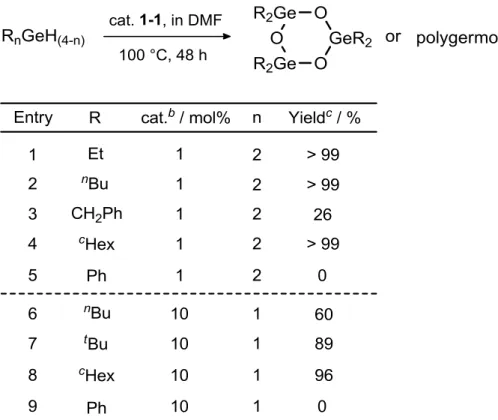
(8) Chapter 2 described the catalytic synthesis of vinylgermane with a GeC bond using a germyl iron complex or 1-1 (vi). hydrogermylation reaction of alkynes.. Various vinylgermanes were formed via a The catalytic mechanism was proposed on. the basis of the mechanistic study described in chapter 1 and results obtained when various iron complexes with germyl ligands were used.. Chapter 3 described the GeOE (E = Si, Ge, Sn) bond formation reactions promoted by 1-1 (vii).. The selective formation of the linear and cyclic product. could be achieved if appropriate substituents on the hydrogermane were selected. The mechanistic study on this catalytic reaction revealed that the iron complex with germoxy and carbene ligands was an intermediate.. 8.
(9) Chapter 4 described the catalytic PH bond addition of secondary phosphine (R2PH), to unsaturated organic molecules (hydrophosphination) by an iron catalyst (viii). The single or double hydrophosphination product was obtained depending on the reaction conditions and the kind of iron catalyst. This is the first transition metal catalyzed double hydrophosphination to produce the 1,2-bisphosphinoethane derivatives.. 9.
(10) References 1) (a) Miyaura, N.; Suzuki, A. J. Chem. Soc., Chem. Commun. 1979, 866. (b) Miyaura, N.; Yamada, K.; Suzuki, A. Tetrahedron Lett. 1979, 20, 3437. (c) Miyaura, N.; Suzuki, A. Chem. Rev. 1995, 95, 2457. (d) King, A. O.; Okukado, N.; Negishi, E. J. Chem. Soc., Chem. Commun. 1977, 683. (e) Negishi, E; King, A. O.; Okukado, N. J. Org. Chem. 1977, 42, 1821. (f) Negishi, E. Acc. Chem. Res. 1982, 15, 340. 2) Kunai, A. Organometallic News 2007, 82. 3) (a) Metlesicasn, W.; Zeiss, H. J. Am. Chem. Soc. 1960, 82, 3324. (b) Nanjo, M.; Sasage, T.; Mochida, K. J. Organomet. Chem. 2003, 667, 135. (c) Drager, M.; Haberle, K. J. Organomet. Chem. 1985, 280, 183. (d) Beckmann, J.; Jurkschat, K.; Rabe, S.; Schurmann, M.; Dakternieks, D.;. Duthie, A. Organometallics 2000, 19,. 3272. 4) (a) Murugavel, R.; Voigt, A.; Walawalkar, M. G.; Roesky, H. W. Chem. Rev. 1996, 96, 2205. (b) Duverneuil, G.; Mazerolles, P.; Perrier, E. Appl. Organomet. Chem. 1994, 8, 119. (c) Seyferth, D.; Alleston, D. L. Inorg. Chem. 1963, 2, 418. (d) Schmidbaur, H.; Schmidt, M. Chem. Ber. 1961, 94, 2137; (e) Malisch, W.; Kuhn, M. Chem. Ber. 1974, 107, 979. 5) (a) Hatanaka, Y.; Hiyama, T. J. Org. Chem. 1988, 53, 918. (b) Hiyama, T.; Hatanaka, Y. Pure. Appl. Chem. 1994. 66, 1471. (c) Hiyama, T. J. Organomet. Chem. 2002, 653, 58. 6) For examples, see: (a) Saxena, A.; Okoshi, K.; Fujiki, M.; Naito, M.; Guo, G.; Hagihara, T.; Ishikawa, M. Macromolecules 2004, 37, 367. (b) Holder, S. J.; Achilleos, M.; Jones, R. G. Macromolecules 2005, 38, 1633. (c) Jones, R. G.; Holder, S. J.; Polym. Int. 2006, 55, 711. 7) (a) Sharma, H. K.; Pannell, K. H. Angew. Chem. Int. Ed. 2009, 48, 7052. (b) Zhou, S.; Junge, K.; Addis, D.; Das, S.; Beller, M. Angew. Chem. Int. Ed. 2009, 48, 9507. (c) 10.
(11) Sunada, Y.; Kawakami, H.; Motoyama, Y.; Nagashima, H. Angew. Chem. Int. Ed. 2009, 48, 9511. 8) (a) Marciniec, B. Coord. Chem. Rev. 2005, 249, 2374. (b) Gillard, S.; Renaud, J.-L. ChemSusChem 2008, 1, 505. 9) (a) Nakazawa, H.; Kawasaki, T.; Miyoshi, K.; Suresh, C. H.; Koga, N. Organometallics 2004, 23, 117. (b) Nakazawa, H.; Kamata, K.; Itazaki, M., Chem. Commun. 2005, 4004. (c) Nakazawa, H.; Itazaki, M.; Kamata, K.; Ueda, K. Chem. Asian J. 2007, 2, 882. 10) Fukumoto, K.; Oya, T.; Itazaki, M.; Nakazawa, H. J. Am. Chem. Soc. 2009, 131, 38. 11) Itazaki, M.; Ueda, K.; Nakazawa, H. Angew. Chem. Int. Ed. 2009, 48, 3313. ibid, 48, 6938.. 11.
(12) List of Complexes. 12.
(13) 13.
(14) Chapter 1. Syntheses of Iron Complexes Bearing Two Group 14 Element Ligands. 14.
(15) 1-1. Introduction Transition metal complexes bearing two or more carbon donating ligands are important because these complexes can be considered as intermediates or active species for CC bond formation reactions.. Therefore, many organometallic. complexes have been explored and studied on their reactivities to create a new reaction and to improve the efficiency of the catalyst.. These researches led to the. development of many useful CC bond formation reactions such as Suzuki-Miyaura coupling reactions,1 Negishi coupling reactions2 and so on.. Recently, complexes. bearing a bond between a transition metal and a heavier group 14 element (Si, Ge, Sn), which are classified as inorganometallic complexes, have received much attention in association with the increase of the utility of these compounds or materials.. Their. properties have been widely exploited for the organic intermediate3 and sophisticated materials such as ceramics, oils, rubbers, coating agents and so on.4. To develop. more efficient and/or new methods for the production of compounds of heavier group 14 elements, the syntheses, isolations and structural studies of these transition metal complexes are actively in progress.5 Especially, transition metal complexes bearing two heavier group 14 element (E = Si, Ge and Sn) ligands are the attractive candidates as intermediates in the reactions of group 14 element introduction into unsaturated organic compounds6 and of formation of EE bonds.7 From the aspect of environmental burden, our group has been focusing on the creation of new catalytic reactions by an iron complex.. And we have already found. that the synthesis of CpFe(CO)(H)(SiR3)2 type complexes and their catalytic activity toward the coupling of the silyl ligands to form an SiOSi bond.7c. This indicates. that the similar germyl or stannyl complexes possibly show the activity for the preparation of the compounds with a GeOGe and SnOSn.. With the similar iron. complexes, although several examples with two silyl groups were reported,8 only a limited number of complexes with two stannyl groups have been known8a,9 and no example of complex bearing two germyl groups has been known to date. 15. Only one.
(16) example has been reported for the iron complex having different group 14 element ligands, although a complex bearing two different group 14 element ligands is interested not only in the structure and reactivity but also in an intermediate in the cross coupling reaction of two group 14 elements to form the compounds with SiOGe, SiOSn and GeOSn fragments.10 I herein report the synthesis of iron complexes having two same and different 14 element ligands, CpFe(CO)(H)(ER3)(E’R3), and their reactivities in a systematic way.. 16.
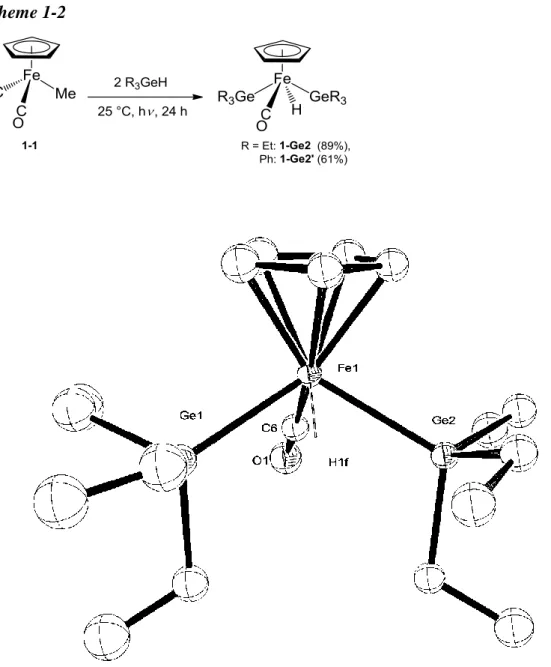
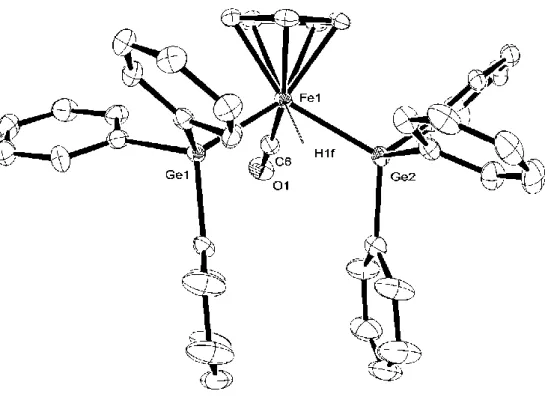
(17) 1-2 Preparation of Iron Complexes Bearing Two ER3 Ligands (E = Si, Ge, Sn) Bissilyl. complex,. CpFe(CO)(SiEt3)2(H). CpFe(CO)(SnEt3)2(H) 1-Sn2,. 8a. 1-Si2,7c. and. bisstannyl. complex,. were prepared by the literature method.. The. bisgermyl complexes, CpFe(CO)(GeR3)2(H) (R = Et: 1-Ge2, Ph: 1-Ge2’), were synthesized by the reactions of iron methyl complex, CpFe(CO)2Me (1-1), with 2 equiv of tertiary germane, R3GeH (R = Et, Ph), under thermal reaction conditions (Method A) or photoirradiation conditions (Method B). 1-Ge2’ were characterized by the 1H NMR and. 13. Complexes 1-Ge2 and. C NMR spectra, the elemental. analyses and the single crystal X-ray diffraction analyses.. In both 1-Ge2 and 1-Ge2’,. characteristic hydride signals were observed at -12.67 and -10.38 ppm in the 1H NMR spectra, respectively. The molecular structures of 1-Ge2 and 1-Ge2’ are depicted in Figures 1-1 and 1-2.. Two independent molecules crystalized in the unsymmetrical. unit. The ORTEP drawings of an Fe1 molecule are shown in the figures.. Both. molecules have a typical four-legged piano stool geometry with one Cp, one CO, one hydride and two germyl ligands.. The two germyl groups are situated trans to each. other. To the best of our knowledge, these are the first examples of iron complex having two germyl ligands. The fundamental structures of these complexes are comparable to the similar examples, CpFe(CO)(SiEt3)2(H)7c, CpFe(CO)(SnPh3)2(H).8a (Method A) Under thermal reaction conditions Treatment of 1-1 with 2 equiv of R3GeH (R = Et, Ph) in benzene at 60 ºC for 12 h resulted in the formation of the bisgermyl iron complex in 81% (1-Ge2) and 67% (1-Ge2’) yields, respectively (Scheme 1-1). Scheme 1-1. 17.
(18) (Method B) Under photoirradiation conditions Treatment of 1-1 with 2 equiv of R3GeH (R = Et, Ph) in benzene under photoirradiation at 25 ºC for 24 h resulted in the formation of the bisgermyl iron complex in 89% (1-Ge2) and 61% (1-Ge2’) yields, respectively (Scheme 1-2). Scheme 1-2. Figure 1-1. ORTEP drawing of the Fe1 molecule of 1-Ge2 with 50% thermal ellipsoidal plots.. Hydrogen atoms except for the hydride ligand were omitted for. clarify. 18.
(19) Figure 1-2. ORTEP drawing of the Fe1 molecule of 1-Ge2’ with 50% thermal ellipsoidal plots.. Hydrogen atoms except for the hydride ligand were omitted for. clarify.. 19.
(20) 1-3 Plausible Reaction Mechanism for the Formation of the Bisgermyl Complex A plausible reaction pathway for the formation of the bisgermyl complexes is shown in Scheme 1-3. Under thermal conditions, one of the CO ligands in the starting complex 1-1 inserts into the FeMe bond to form the acyl complex, CpFe(CO){C(O)Me}, which reacts with R3GeH (R = Et, Ph) to give CpFe(CO)(H){C(O)Me}(GeR3) (1-A).. Successive reductive elimination of. acetaldehyde and oxidative addition of another R3GeH molecule takes place to give the bisgermyl complex 1-Ge2 (R = Et) or 1-Ge2’ (R = Ph).. The formation of. acetaldehyde was confirmed by the 1H NMR spectrum of the resulting reaction mixture (a quintet signal at 9.23 ppm and a doublet signal at 2.34 ppm in C6D).. In. the case of photoreaction, one CO eliminates from the iron center and the resulting complex reacts with R3GeH to afford the methyl hydride complex (1-B).. Successive. reductive elimination of methane and oxidative addition of another R3GeH molecule give the product 1-Ge2 or 1-Ge2’. The formation of methane was comfirmed by the 1. H NMR measurement (a singlet signal at 0.15 ppm in C6D6).. Scheme 1-3.. 20.
(21) 1-4 Syntheses of Iron Complexes Bearing Two Different Group 14 Element Ligands The preparation of the silylgermyl complex was attempted in the reaction of this iron methyl complex with one equiv of Et3SiH and one equiv of Et3GeH. The desired, CpFe(CO)(H)(SiEt3)(GeEt3) 1-SiGe, was not obtained, but the bisgermyl hydride complex was obtained 1-Ge2 in 26% yield.. Next, a stepwise introduction of a group. 14 element ligand into the iron complex was planned. First, a complex having one group 14 element ligand (R3E) is prepared, and then it reacts with another group 14 element compound to introduce the second ligand (R3E’). Scheme 1-4.. According to the literature method, the silyl complex, CpFe(CO)2(SiEt3) 1-Si, was prepared in the reaction of {CpFe(CO)2}2 with Et3SiCl (Scheme 1-4).11. The. germanium and tin analogues, CpFe(CO)2(EEt3) (E = Ge: 1-Ge,12 Sn: 1-Sn), were obtained in the similar reaction with Et3GeCl or Et3SnCl.. The silyl complex 1-Si did. not react with hydrogermane or hydrostannane under thermal conditions even at 100 ºC.. In contrast, the photoreaction of the silyl complex with triethylgermane gave 21.
(22) three kinds of hydride complexes which are the bissilyl complex (1-Si2), the bisgermyl complex (1-Ge2) and the silylgermyl complex (1-SiGe) (Scheme 1-5). No reaction took place in the reaction of 1-Ge or 1-Sn with Et3SiH under thermal reaction conditions, and three kinds of hydride complexes were produced under photoirradiation conditions.. Scheme 1-5.. These results indicate that the CO ligand in cyclopetadienyl biscarbonyl iron complexes does not eliminate from the iron center under thermal conditions, but photoreaction can release CO ligand and introduction of an EEt3 group.. However,. the photoreaction caused the scrambling of the group 14 element ligands.. Therefore,. the method to prepare the 16e species without photoirradiation was planned.. 22.
(23) 1-5 Synthesis of Phosphine and Pyridine Complexes Bearing a Group 14 Element Ligand Because of the CO ligands in CpFe(CO)2(EEt3) coordinate strongly to the iron, CpFe(CO)(L)(EEt3) was selected as a starting complex which has one weakly coordinated. ligand. (L). in. place. of. the. CO. ligand.. Complexes. CpFe(CO)(PPh3)(EEt3) and CpFe(CO)(Py)(EEt3) were selected because PPh3 and Py are considered to coordinate weaker than CO toward the CpFe(CO)(EEt3) moiety. The silyl phosphine complex (1-SiP) was obtained in the reaction of the methyl phosphine complex (1-P)13 with triethylsilane in toluene at 80 ºC. Similarly, the germanium and tin analogues were prepared from the phosphine complex and triethylgermane and triethylstannane in 90% (1-GeP) and 88% (1-SnP) yields.. Scheme 1-6.. In our previous works, the photoreaction of the silyl complex 1-Si in the presence of pyridine gave the corresponding the silyl pyridine complex 1-SiPy in 89% yield (Scheme 1-7).14. This method could be applied to the synthesis of the germanium. and tin analogues (1-GePy and 1-SnPy).. 23.
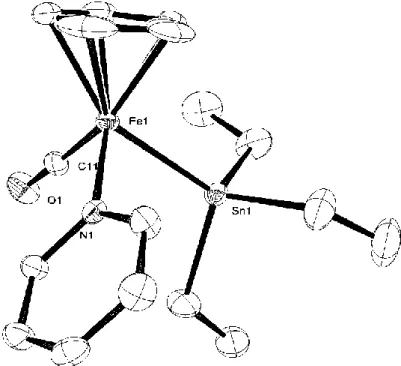
(24) Scheme 1-7.. These six complexes were characterized by the NMR measurements and elemental analyses. The molecular structures of 1-GeP and 1-SnPy were confirmed by X-ray crystallography.. The silyl triphenylphosphine complex, CpFe(CO)(PPh3)(SiEt3),13. and silyl pyridine complex, CpFe(CO)(Py)(SiEt3),14 have already been reported by Brookhart et al. and our group. However, 1-GeP, 1-SnP, 1-GePy, 1-SnPy had not been reported when this project was started.. 24.
(25) 1-6 Reaction of the Phosphine Complexes with Et3EH (E= Si, Ge, Sn) Treatment of the silyl phosphine complex 1-SiP with one equiv of triethylgermane at 80 ºC in C6D6 for 12 h resulted in the formation of the germyl phosphine complex 1-GeP in 95% NMR yield and the almost quantitative amount of Et3SiH (scheme 1-8). Similarly, the reaction of 1-SiP with triethylstannane gave the corresponding stannyl phosphine complex 1-SnP in 98% NMR yield.. But both reactions did not give the. target silylgermyl nor silylstannyl complex. To obtain the target compound, further examinations were carried out under various reaction conditions at higher or lower reaction temperature, increasing the amount of triethyl germane or stannane, photoirradiation.. Unfortunately, all attempts to prepare the complexes with two. different group 14 element ligands were unsuccessful.. Although the phosphine. ligand in 1-SiP, 1-GeP and 1-SnP may dissociate under milder conditions than the CO ligand in 1-Si, 1-Ge and 1-Sn, it seem to recoordinate to the Fe to give 1-GeP and 1-SnP.. Scheme 1-8.. 25.
(26) 1-7 Reaction of the Pyridine Complexes with Et3EH (E= Si, Ge, Sn) Previously, our group reported the reaction of the silyl pyridine complex 1-SiPy with Et3SiH took place even at room temperature to give the corresponding bissilyl hydride iron complex 1-Si2 in 83% yield (Scheme 1-9).6c. The mild reaction conditions may. allow to prepare iron complexes bearing two different group 14 element ligands.. Scheme 1-9.. Treatment of 1-SiPy with Et3GeH in 1:1 molar ratio for 48 h at room temperature produced three kinds of hydride complexes.. Comparison of the chemical shifts of. the hydride signals in the 1H NMR spectra revealed that two of them are assignable to the bissilyl complex 1-Si2 (-14.07 ppm) and the bisgermyl complex 1-Ge2 (-12.67 ppm) in 27% and 33% yields respectively.. And the last one is expected to be the. silylgermyl complex (-13.62 ppm) (Scheme 1-10).. The formed silylgermyl complex. 1-SiGe was isolated and fully characterized by the examinations shown below.. Scheme 1-10.. 26.
(27) The reaction pathway expected from the products is shown in Scheme 1-11. First, the Py dissociates then GeH bond oxidative addition takes place to give the silylgermyl complex 1-SiGe. Et3SiH may be eliminated from 1-SiGe and GeH bond oxidative addition takes place to give the bisgermyl complex 1-Ge2. The silane formed in the step from 1-SiGe to 1-Ge2 may react with CpFe(CO)(SiEt3) to give the bissilyl complex 1-Si2.. Scheme 1-11.. Similarly, three kinds of hydride complexes, 1-Si2, 1-Sn2 and 1-SiSn, were observed in the reaction of 1-SiPy with Et3SnH. The formation of these complexes was suggested by the 1H NMR spectrum of the reaction mixture.. Since these. complicated results might be caused by the elimination of hydrosilane, the similar reaction was conducted in the reverse order, that is, the reaction of 1-GePy and Et3EH.. 27.
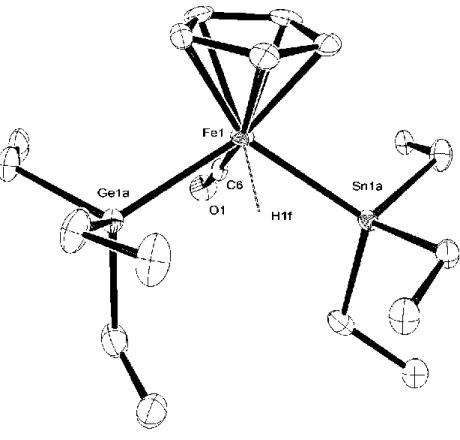
(28) The reaction of 1-GePy with Et3EH (E = Si, Ge) resulted in the isolation of the silylgermyl complex 1-SiGe and the bisgermyl complex 1-Ge2, respectively (Scheme 1-12).. Analoguesly the hydride complexes with the stannyl ligand, CpFe(CO)(H). (EEt3)(SnEt3) (E = Si: 1-SiSn, Ge: 1-GeSn, Sn: 1-Sn2), were also obtained by the reaction of 1-SnPy with Et3EH (E = Si, Ge, Sn), in good to high yields.. Scheme 1-12.. The molecular structures of 1-SiGe and 1-GeSn were determined by X-ray analyses and depicted in Figures 3 and 4. The complexes take a typical four-legged piano-stool geometry bearing one C5H5 in 5-fashion, one terminal CO ligand, one hydride ligand, one triethylgermyl ligand, and one Et3E ligand (E = Si: 1-SiGe, Sn: 1-GeSn). The two group 14 element ligands were situated trans position to each other but the positions were disordered with 0.5 occupancy. Only three types of crystal structures of transition metals with two different group 14 element ligands have been reported; cis-[Pt(GeMe3)(SnMe3)(PMe2Ph)2],15 Cp2W(SiMe3)(GeMe2Cl),16 Cp2W(GeR3)(SnR3) (R3 = MeCl2, R’3 = MeCl2; R3 = Me2Br, R’3 = Et2Br, R3 = Me2H, R’3 = Et2Br).17. Complexes 1-SiGe and 1-GeSn are the first examples of iron 28.
(29) complexes. Bis(stannyl)iron complexes, CpFe(CO)(H)(SnR3)2 (R = Me, nBu, Ph), which are similar to 1-Sn2, have been reported previously.8a. Figure 1-3. ORTEP drawing of the Fe1 molecule of 1-SiGe with 50% thermal ellipsoidal plots. Hydrogen atoms except for the hydride ligand were omitted for clarify.. 29.
(30) Figure 1-4. ORTEP drawing of the Fe1 molecule of 1-GeSn with 50% thermal ellipsoidal plots. Hydrogen atoms except for the hydride ligand were omitted for clarifies.. 30.
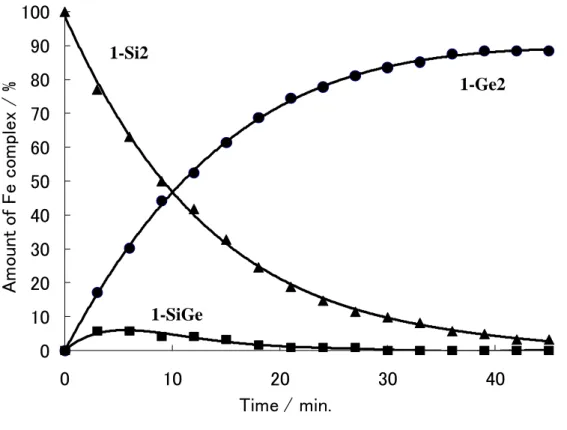
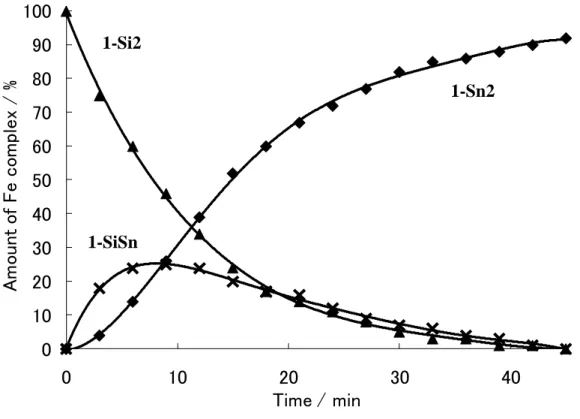
(31) 1-8 Ligand Exchange Reaction of the Iron Complexes Bearing Two Group 14 Element Ligands It might be interesting to examine the lability of the group 14 element ligand in CpFe(CO)(H)(EEt3)(E’Et3).. The reactions of CpFe(CO)(H)(EEt3)2 with Et3E’H. were monitored by the 1H NMR spectra.. The bissilyl complex 1-Si2 was dissolved. in benzene and a 10 fold molar excess of Et3GeH was added.. The reaction mixture. was heated at 60 ˚C. Figure 1-5 depicts the amounts of Fe complexes as a function of time. The starting complex 1-Si2 decreased and the bisgermyl complex 1-Ge2 increased with time.. In addition, the silylgermyl complex 1-SiGe was observed in. small amount and finally disappeared. The formation of eliminated Et3SiH was observed during the course of the reaction and totally 2 equiv of Et3SiH was formed at the end of the reaction.. 31.
(32) 100. Amount of Fe complex / %. 90. 1-Si2. 80. 1-Ge2. 70 60. 50 40 30. 20 10. 1-SiGe. 0 0. Figure 1-5.. 10. 20 Time / min.. 30. 40. Plot of the amounts of 1-Si2 (▲), 1-SiGe(■) and 1-Ge2 (●) as a. formation of time in the reaction of 1-Si2 with a 10-fold excess of Et3GeH. Scheme 1-13.. The reaction of the bissilyl complex with Et3SnH showed the similar time dependence curve.. And finally all of 1-Si2 was converted into the bisstannyl. complex in good yield within 1 hour. 2 equiv of Et3SiH were also observed.. 32.
(33) 100. Amount of Fe complex / %. 90. 1-Si2. 80. 1-Sn2. 70. 60 50 40 1-SiSn. 30 20 10. 0 0. Figure 1-6.. 10. 20 Time / min. 30. 40. Plot of the amounts of 1-Si2 (▲), 1-SiSn(✖) and 1-Sn2 (♦) as a. formation of time in the reaction of 1-Sn2 with a 10-fold excess of Et3SnH. Scheme 1-14.. In both of reactions (Schemes 1-13 and 1-14), 1-SiGe and 1-SiSn were continuously detected during the reactions in small amounts.. Therefore, Et3SiH. elimination from 1-Si2 followed by oxidative addition of Et3EH (E = Ge, Sn) takes place to give 1-SiGe and 1-SiSn, which then undergo the same reaction sequence to give the final products (1-Ge2 and 1-Sn2). 33.
(34) The reaction of the bisgermyl complex (1-Ge2) showed interesting results (Scheme 1-15). The reaction with 10 equiv of Et3SiH at 60 ºC for 1 h resulted in the formation of 1-Si2 (5% yield) and 1-SiGe (38% yield) with the detection of the unreacted 1-Ge2. Elongation of the reaction time and use of more excess Et3SiH did not improve this messy reaction.. In contrast, the reaction with 10 equiv of Et3SnH caused. quantitative formation of 1-Sn2 after 12 h at 60 ºC. A solution of bisstannyl complex 1-Sn2 and a 10-fold molar excess of Et3E’H (E’ = Si, Ge) was heated at 60 ˚C for 24 h, but the ligand exchange reaction of the Et 3Sn ligand for the Et3E’ group was not observed (Scheme 1-16). These results showed that SiH reductive elimination is easier than GeH reductive elimination, which is easier than SnH reductive elimination.. Scheme 1-15.. Scheme 16.. 34.
(35) Treatment of this silylstannyl complex with 10 equiv of Et3GeH for 30 min at 60 ˚C produced the germylstannyl complex by the selective exchange of the Et3Si group for the Et3Ge group. Similarly in the reaction of 1-SiGe with 10 equiv of Et3SnH, a germylstannyl complex was formed in 96% yield for 5 min at 60 ˚C by the selective exchange of the Et3Si group for the Et3Sn group. After 6 h, the exchange of the Et3Ge group for the Et3Sn group was completed to give the bisstannyl complex (1-Sn2) in 91% yield (Scheme 1-17). We also examined the reactivity of complexes 1-SiSn and 1-GeSn.. Reactions of 1-SiSn with 10 equiv of Et3GeH and Et3SnH at 60. ˚C afforded the corresponding complexes 1-GeSn and 1-Sn2 by the exclusive exchange of the Et3Si group for the Et3E (E = Ge, Sn) group in excellent yields (Scheme 1-18).. The isolated germylstannyl complex 1-GeSn was confirmed to be. converted into 1-Sn2 in the reaction with 10 equiv of Et3SnH for 6 h at 60 ˚C in 99% NMR yield (Scheme 1-19). These trends are the same as those for the complexes with two group 14 element ligands.. Although Si/Sn exchange reactions on an Fe center. have been reported,9c,18 this is the first example of Ge/Sn exchange on a transition metal other than Pt.19. Scheme 1-17.. Scheme 1-18.. 35.
(36) Scheme 1-19.. All ligand substitution reactions examined here show that the elimination of Et3EH from the Fe(IV) center takes place more readily in the order of Et3SiH > Et3GeH >> Et3SnH. The activation energies and bond energies of Fe-H and for Fe(IV) have not been reported to date.. However, Pannell and co-workers reported that the bond. strengths are ordered as FeSi > FeGe for Fe(II) complexes,20 and Koga and co-workers reported that the bond energy of Fe-Si is 41.7 kcal/mol and that of Fe-Sn is 36.3 kcal/mol for Fe(II) complexes.21. If the same trend is applicable for Fe(IV). complexes, the Fe(IV)Si bond would be stronger than the Fe(IV)Sn bond, being inconsistent with the order observed here. On the other hand, the bond energy of H3SiH (88.5 kcal/mol) is larger than H3GeH (81.9 kcal/mol), being stronger that H3SnH (75.4 kcal/mol).22. This order is consistent with the order observed here.. Therefore, the trend of the EH bond energy seems to be predominant rather than the FeE bond energy.. 36.
(37) 1-9 Coupling Reaction In our group, it was found that the bissilyliron complex 1-Si2 afforded the corresponding disiloxane in dimethylformamide (DMF) under photo-irradiation (Scheme 1-20).6c. Therefore, photoreactions of iron complexes bearing two group 14. element ligands in DMF were expected to form compounds with EOE’ bond. However, this type of reaction did not take place (Scheme 1-21). The reason for this is not clear now.. Scheme 1-20.. Scheme 1-21. 37.
(38) 1-10 Conclusions In this chapter, a series of iron complexes bearing two group 14 element ligands were described. CpFe(CO)(H)(EEt3)2 (E = Si: 1-Si2, Ge: 1-Ge2, Sn: 1-Sn2), were obtained by the reaction of CpFe(CO)2Me (1-1) with 2 equiv of R3EH (E = Si, Ge, Sn).. These reactions proceeded under thermal reaction conditions with the. formation of acetaldehyde or photoirradiation conditions with the formation of methane.. Iron complexes with two different group 14 element ligands could be. obtained by the stepwise introduction of ER3 groups. First, complexes bearing one group 14 element ligand, CpFe(CO)2(EEt3) (E = Si: 1-Si, Ge: 1-Ge, Sn: 1-Sn), were synthesized. Next, pyridine complexes, CpFe(CO)(Py)(EEt3) (E = Si: 1-SiPy, Ge: 1-GePy, Sn: 1-SnPy), were prepared by the photoreaction of 1-Si, 1-Ge or 1-Sn with pyridine.. Finally, these pyridine complexes were allowed to react with Et3E’H (E’. =Si, Ge, Sn) at room temperature to give, CpFe(CO)(H)(EEt3)(E’Et3) (E, E’ = Si, Ge: 1-SiGe, Si, Sn: 1-SiSn, Ge, Sn: 1-GeSn).. To prepare these complexes, the. combination of pyridine complex and Et3E’H is also important because the inappropriate reaction order leads to the mixture of three kinds of hydride complexes due to the ligand substitutions, for example of the reaction of 1-SiPy with Et3GeH gives a mixture of 1-Si2, 1-SiGe and 1-Ge2. The trend of the ligand substitution reactions was investigated by the NMR studies. The order of the substitution rates is Si > Ge >>Sn.. It seems that the order of the substitution depends on the thermal. stability of the Et3EH. This is the first systematic study on the exchange of group 14 element ligands in a coordination sphere of a transition metal.. 38.
(39) 1-11 Experimental Section General Procedures All manipulations were carried out using standard Schlenk techniques under a nitrogen atmosphere.. Benzene, hexane, ether and THF were distilled from sodium. and benzophenone prior to use and stored under a nitrogen gas. Other chemicals purchased were used without further purification.. NMR spectra (1H,. 13. C{1H},. 29. Si{1H}, 31P{1H} and 119Sn{1H}) were recorded on a JNM AL-400 spectrometer. 1H. and. 13. C{1H} NMR data were referred to residual peaks of solvent as an internal. standard. Peak positions of the 29Si{1H}, 31P{1H} and 119Sn{1H} NMR spectra were referenced to an external Me4Si ( = 0), 85% H3PO4 ( = 0) and Me4Sn ( =0). spectra were recorded on a Perkin Elmer FTIR-Spectrum one.. IR. Photoirradiation was. performed with a 400 W medium-pressure mercury arc lamp at 25 ºC.. Preparation of Et3SnH21 An ether solution (15 mL) with suspended LiAlH4 (300 mg, 8.0 mmol) was maintained at 0 ºC then Et3SnCl (890 L, 5.3 mmol) in ether (15 mL) was added slowly. The precipitated solids were filtered off and washed with ether (5 mL, twice). The solvent was removed under reduced pressure to give the title compound (803 mg, 72%).. 1. H NMR (400 MHz, C6D6): = 0.77-0.88 (m, 6H, Sn(CH2CH3)3),. 1.16-1.22 (m, 9H, Sn(CH2CH3)3), 5.05 (br, 1H, SnH).. Preparation of {CpFe(CO)2}224 A Cp2 (400 mL, 3.06 mol) solution containing Fe(CO)5 (60 mL, 0.306 mol) was refluxed (keep under 140 ºC bath temperature to avoid the formation of iron powder) for 15 h under a nitrogen atmosphere. After cooling the reaction mixture to room temperature, the precipitated purple solid was collected by filtration and washed with 39.
(40) hexane (10 mL) several times. The solid was dried under reduced pressure to give the title compound (49.07 g, 92%). Cp).. 1. H NMR (400 MHz, C6D6): δ = 4.21 (s, 10H,. 13. C{1H} NMR (100.4 MHz, C6D6): δ = 88.5 (s, Cp).. IR (cm–1, THF): ν(CO). 1989 (s), 1953 (s).. Preparation of CpFe(CO)2(Me) (1-1)25 NaK2.8 (1.7 mL) was added to a THF (50 mL) solution containing {CpFe(CO)2}2 (1.24 g, 3.50 mmol) under a nitrogen atmosphere. After stirring the solution for 1 h at room temperature, unsolved materials were filtered off with a glass filter and washed with THF (5 mL, twice).. The MeI (650 L, 10.5 mmol) was added to the. filtrate as soon as possible. The solution containing CpFe(CO)2 anion must be kept at less than -20 ºC until allowing it to react with MeI. After stirring the solution for 3 h at room temperature, volatile compounds were removed under reduced pressure. The residue was dissolved in hexane and loaded on an alumina column and eluted with hexane in air. The yellow band was collected and the solvent was removed under reduced pressure to give the title compound as a yellow powder (950 mg, 71%). 1. H NMR (400 MHz, C6D6): δ = 0.31 (s, 3H, Me), 3.98 (s, 5H, Cp).. Preparation of CpFe(CO)2(SiEt3) (1-Si)11 Complex 1-Si was prepared in a manner similar to that for 1-1.. NaK2.8 (1.8 mL) was. added to a THF (60 mL) solution containing {CpFe(CO)2}2 (1.28 g, 3.62 mmol). After stirring the solution for 1 h at room temperature, unsolved materials were filtered off with a glass filter and washed with THF (5 mL, twice). Et3SiCl (1.8 mL, 10.9 mmol) was added to the filtrate as soon as possible. After stirring the solution for 3 h at room temperature, volatile compounds were removed under reduced pressure. The residue was passed through an alumina column with a hexane eluent. 40.
(41) The yellow band was collected and the solvent was removed to give the title compound as a reddish yellow oil (2.10 g, 99%).. 1. H NMR (400 MHz, C6D6): δ =. 0.92 (q, JHH = 7.8 Hz, 6H, Si(CH2CH3)3), 1.11 (t, JHH = 7.8 Hz, 9H, Si(CH2CH3)3), 4.08 (s, 5H,Cp). 13C{1H} NMR (100.4 MHz, C6D6): δ = 9.4 (s, Si(CH2CH3)3), 12.2 (s, Si(CH2CH3)3), 83.2 (s, Cp) , 216.3 (s, CO).. 29. Si{1H} NMR (79.3 MHz, C6D6): δ. = 53.1.. Preparation of CpFe(CO)2(GeEt3) (1-Ge)12 Complex 1-Ge was prepared in a manner similar to that for 1-1.. To a THF solution. (60 mL) containing K[CpFe(CO)2] prepared from NaK2.8 (2.4 mL) and {CpFe(CO)2}2 (1.81 g, 5.12 mmol) was added Et3GeCl (1.8 mL, 10.8 mmol).. After stirring the. mixture for 3 h at room temperature, volatile compounds were removed under reduced pressure. The residue was passed through an alumina column with hexane eluent. The yellow band was collected and the solvent was removed to give the title compound as a reddish yellow oil (2.77 g, 80%).. 1. H NMR (400 MHz, C6D6): δ =. 1.08 (q, JHH = 7.8 Hz, 6H, Ge(CH2CH3)3), 1.19 (t, JHH = 7.8 Hz, 9H, Ge(CH2CH3)3), 4.08 (s, 5H,Cp). 13C{1H} NMR (100.4 MHz, C6D6): δ = 10.8 (s, Ge(CH2CH3)3), 12.7 (s, Ge(CH2CH3)3), 82.5 (s, Cp) , 216.5 (s, CO).. IR (cm–1, benzene): ν (CO) 1934 (s),. 1988 (s).. Preparation of CpFe(CO)2(SnEt3) (1-Sn) 1-Sn was prepared in a manner similar to that for 1-1.. To a THF solution (80 mL). containing K[CpFe(CO)2] prepared from NaK2.8 (3.9 mL) and {CpFe(CO)2}2 (2.92 g, 8.96 mmol) was added Et3SnCl (2.2 mL, 14.9 mmol).. After stirring the mixture for. 3 h at room temperature, volatile compounds were removed under reduced pressure. The residue was passed through an alumina column with hexane eluent. The yellow 41.
(42) band was collected and the solvent was removed to give the title compound as a reddish yellow oil (5.01 g, 80%).. 1. H NMR (400 MHz, C6D6): δ = 1.15 (q, JHH = 8.5. Hz, 6H, Sn(CH2CH3)3), 1.35 (t, JHH = 8.5 Hz, 9H, Sn(CH2CH3)3), 4.11 (s, 5H,Cp). 13. C{1H} NMR (100.4 MHz, C6D6): δ = 6.1 (s, JCSn = 114.4 Hz, Sn(CH2CH3)3), 12.7 (s,. JCSn = 10.8 Hz, Sn(CH2CH3)3), 81.3 (s, Cp) , 216.0 (s, CO). MHz, C6D6): = 166.51 (s).. 119. Sn{1H} NMR (148.9. IR (cm–1, benzene): ν (CO) 1925 (s), 1981 (s).. Elemental analysis; Calcd: C13H20O2SnFe: C, 40.78; H, 5.27; Found: C, 41.08; H, 5.23%.. Preparation of CpFe(CO)(Py)(SiEt3) (1-SiPy)14 A solution containing CpFe(CO)2(SiEt3) (1-Si) (380 mg, 1.30 mmol) and pyridine (0.50 mL, 6.50 mmol) in benzene (10 mL) was photoirradiated with a 400 W medium pressure mercury arc lamp at 25 °C for several hours under a nitrogen atmosphere. During the irradiation, the generated CO was released several times. Removal of volatile materials under reduced pressure led to the formation of a dark red oil, which was dissolved in hexane (1 mL). Cooling the hexane solution at –30 °C for 12 h resulted in the formation of dark red crystals, which were collected by filtration and dried in vacuo to give CpFe(CO)(SiEt3)(Py) (1-SiPy) (347 mg, 78%).. 1. H NMR (400. MHz, C6D6): δ = 0.92 (m, 6H, Si(CH2CH3)3), 1.19 (t, JHH = 7.8 Hz, 9H, Si(CH2CH3)3), 4.21 (s, 5H,Cp), 5.86 (t, JHH = 7.2 Hz, 2H, Py), 6.40 (d, JHH = 7.2 Hz, 1H, Py), 8.47 (t, JHH = 7.2 Hz, 2H, Py).. 13. C{1H} NMR (100.4 MHz, C6D6): δ = 10.2 (s,. Si(CH2CH3)3), 11.0 (s, Si(CH2CH3)3), 81.7 (s, Cp) , 122.9 (s, Py), 133.5 (s, Py), 157.7 (s, Py), 223.5 (s, CO).. IR (cm–1, benzene): ν(CO) 1879 (s).. MHz, C6D6): δ = 50.2.. Preparation of CpFe(CO)(Py)(GeEt3) (1-GePy). 42. 29. Si{1H} NMR (79.3.
(43) A solution containing CpFe(CO)2(GeEt3) (1-Ge) (538 mg, 1.60 mmol) and pyridine (0.80 mL, 7.99 mmol) in benzene (10 mL) was photoirradiated with a 400 W medium pressure mercury arc lamp at 25 °C for several hours under a nitrogen atmosphere. During the irradiation, the generated CO was released several times. Removal of volatile materials under reduced pressure led to the formation of a dark red oil, which was dissolved in hexane (1 mL). Cooling the hexane solution at –30 °C for 12 h resulted in the formation of dark red crystals, which were collected by filtration and dried in vacuo to give CpFe(CO)(GeEt3)(Py) (1-GePy) (501 mg, 81%).. 1. H NMR. (400 MHz, C6D6): δ = 1.09 (q, JHH = 8.0 Hz, 6H, Ge(CH2CH3)3), 1.26 (t, JHH = 8.0 Hz, 9H, Ge(CH2CH3)3), 4.19 (s, 5H, Cp), 5.86 (t, JHH = 7.6 Hz, 2H, Py), 6.40 (t, JHH = 7.6 Hz, 1H, Py), 4.32 (d, JHH = 7.6 Hz, 2H, Py). 13C{1H} NMR (100.4 MHz, C6D6): δ = 10.6 (s, Ge(CH2CH3)3), 11.3 (s, Ge(CH2CH3)3), 80.6 (s, Cp), 122.8 (s, Py), 133.7(s, Py), 157.9 (s, Py), 223.8 (CO). IR (cm–1, benzene): ν(CO) 1960 (s). Elemental analysis; Calcd: C17H25NOGeFe: C, 52.64; H, 6.50; N, 3.61%; Found: C, 52.03; H, 6.42; N, 3.46%.. Preparation of CpFe(CO)(Py)(SnEt3) (1-SnPy) A solution containing CpFe(CO)2(SnEt3) (1-Sn) (374 mg, 0.977 mmol) and pyridine (0.40 mL, 4.88 mmol) in benzene (10 mL) was photoirradiated with a 400 W medium pressure mercury arc lamp at 25 °C for several hours under a nitrogen atmosphere. During the irradiation, the generated CO was released several times. Removal of volatile materials under reduced pressure led to the formation of a dark red oil, which was dissolved in hexane (1 mL). Cooling the hexane solution at –30 °C for 12 h resulted in the formation of dark red crystals, which were collected by filtration and dried in vacuo to give CpFe(CO)(SnEt3)(Py) (1-SnPy) (407 mg, 96%).. 1. H NMR. (400 MHz, C6D6): δ = 1.10 (q, JHH = 8.5 Hz, 6H, Sn(CH2CH3)3), 1.41 (t, JHH = 8.5 Hz, 9H, Sn(CH2CH3)3), 4.19 (s, 5H,Cp), 5.83 (t, JHH = 6.1 Hz, 2H, Py), 6.38 (t, JHH = 6.1 43.
(44) 13. Hz, 1H, Py), 8.55 (d, JHH = 6.1 Hz, 2H, Py).. C{1H} NMR (100.4 MHz, C6D6): δ =. 3.5 (t, JCSn = 78.8 Hz, Sn(CH2CH3)3), 12.7 (t, JCSn = 10.0 Hz , Sn(CH2CH3)3), 79.0 (s, Cp), 122.9 (s, Py), 133.8 (s ,Py), 157.9 (s, Py), 223.6 (s, CO). (148.9 MHz, in C6D6): = 128.32 (s).. 119. Sn{1H} NMR. IR (cm–1, benzene): ν(CO) 1960 (s).. Elemental analysis; Calcd: C17H25NOSiFe: C, 47.05; H, 5.81; N, 3.23%; Found: C, 46.50; H, 5.72; N, 3.09%.. Preparation of CpFe(CO)(PPh3)(Me) (1-P)13 A solution containing 1-1 (192 mg, 1.00 mmol) and PPh3 (262 mg, 1.00 mmol) in toluene (10 mL) was stirred at 5 °C under photo-irradiation.. After 12 h, removal of. volatile materials under reduced pressure led to the formation of an orange solid of CpFe(CO)(PPh3)(Me) (1-P) (421 mg, 99%).. 1. H NMR (400 MHz, C6D6): δ = 0.32 (d,. JHP = 6.4 Hz, 3H, Me), 4.11 (s, 5H, Cp), 6.95-7.10 (m, 9H, Ph), 7.50-7.58 (m, 6H, Ph). P{1H} NMR (162 MHz, C6D6): = 84.52 (s).. 31. Preparation of CpFe(CO)(PPh3)(SiEt3) (1-SiP)11 A solution containing 1-P (133 mg, 0.31 mmol) and Et3SiH (154 μL, 0.95 mmol) in toluene (10 mL) was stirred at 80 °C.. After 2 h, removal of volatile materials under. reduced pressure led to the formation of an orange solid, which was washed with hexane, collected by filtration, and dried in vacuo to give an orange powder of 1-SiP (146 mg, 78%).. 1. H NMR (400 MHz, C6D6): δ = 0.66-0.79 (m, 3H, CH2), 1.01-1.12. (m, 3H, CH2), 1.22 (t, JHH = 7.8 Hz, 9H, Si(CH2CH3)3), 4.13 (s, 5H, Cp), 7.12-7.23 (m, 9H, Ph), 7.42-7.55 (m, 6H, Ph).. Preparation of CpFe(CO)(PPh3)(GeEt3) (1-GeP). 44.
(45) Complex 1-GeP was prepared in a manner similar to that for 1-SiP.. A solution. containing 1-P (152 mg, 0.356 mmol) and Et3GeH (170 μL, 1.07 mmol) in toluene (10 mL) was stirred at 80 °C.. After 2 h, removal of volatile materials under reduced. pressure led to the formation of an orange solid, which was washed with hexane, collected by filtration, and dried in vacuo to give an orange powder of 1-GeP (161 mg, 90%).. 1. H NMR (400 MHz, C6D6): δ = 0.75-0.88 (m, 3H, CH2), 0.99-1.09 (m, 3H,. CH2), 1.28 (t, JHH = 7.8 Hz, 9H, CH3), 4.15 (s, 5H, Cp), 7.00 (m, 9H, Ph), 7.60 (m, 6H, Ph).. 13. C{1H} NMR (100.4 MHz, C6D6): δ = 11.60 (s, Ge(CH2CH3)3), 12.53 (s,. CH2CH3), 82.44 (s, Cp), 129.40 (s, Ph), 133.69 (d, JPC = 10.0 Hz, Ph), 139.22 (d, JPC = 1.7 Hz, Ph), 139.62 (d, JPC = 1.7 Hz, Ph), 221.25 (d, JPC = 30.7 Hz, CO). NMR (162 MHz, C6D6): = 79.43 (s).. 31. P{1H}. IR (cm–1, benzene): ν(CO) 1900 (s).. Elemental analysis; Calcd: C30H35OPGeFe: C, 63.10; H, 6.18%; Found: C, 62.96; H, 6.20%.. Preparation of CpFe(CO)(PPh3)(SnEt3) (1-SnP) Complex 1-SnP was prepared in a manner similar to that for 1-SiP.. A solution. containing 1-P (136 mg, 0.32 mmol) and Et3SnH (156 μL, 0.96 mmol) in toluene (10 mL) was stirred at 80 °C.. After 2 h, removal of volatile materials under reduced. pressure led to the formation of an orange solid, which was washed with hexane, collected by filtration, and dried in vacuo to give an orange powder of 1-SnP (174 mg, 88%).. 1. H NMR (400 MHz, C6D6): δ = 0.75-0.88 (m, 3H, CH2), 0.97-1.12 (m, 3H,. CH2), 1.30 (t, JHH = 7.8 Hz, 9H, CH3), 4.14 (s, 5H, Cp), 7.05-7.12 (m, 9H, Ph), 7.52-7.64 (m, 6H, Ph).. Synthesis of CpFe(CO)(H)(GeEt3)2 (1-Ge2) A benzene solution (2 mL) containing CpFe(CO)2(Me) (35 mg, 0.18 mmol) and Et3GeH (59 L, 0.36 mmol) was stirred at 60 °C. 45. After 12 h, removal of volatile.
(46) materials under reduced pressure led to the formation of a dark red oil, which was dissolved in hexane (2 mL).. After the hexane solution was cooled at –60 °C for 24 h,. the resulting yellow crystals were collected by filtration and dried in vacuo to give 1-Ge2 (69 mg, 81%).. 1. H NMR (400 MHz, C6D6): = –12.67 (s, 1H, FeH), 1.10 (q,. JHH = 7.3 Hz, 12H, CH2CH3), 1.21 (t, JHH = 7.3 Hz, 18H, CH2CH3), 4.15 (s, 5H, Cp). C{1H} NMR (100.4 MHz, C6D6): = 10.61 (s, CH2CH3), 13.20 (s, CH2CH3), 81.64. 13. (s, Cp), 214.86 (s, CO).. IR (cm–1, benzene): ν(CO) 1926 (s). Elemental analysis;. Calcd: C18H36FeGe2O: C, 46.04; H, 7.73; Found: C, 46.11; H, 7.76%.. Synthesis of CpFe(CO)(H)(GePh3)2 (1-Ge2’) Complex 1-Ge2’ was prepared in a manner similar to that for 1-Ge2.. A benzene. solution (2 mL) containing CpFe(CO)2(Me) (35 mg, 0.18 mmol) and Ph3GeH (111 mg, 0.37 mmol) was stirred at 60 °C.. After 12 h, removal of volatile materials under. reduced pressure led to the formation of a dark red oil, which was dissolved in hexane (2 mL). After the hexane solution was cooled at –60 °C for 24 h, the resulting yellow crystals were collected by filtration and dried in vacuo to give 1-Ge2’ (92 mg, 67%).. 1. H NMR (400 MHz, C6D6): = –10.38 (s, 1H, FeH), 4.11 (s, 5H, Cp), 7.11. (m, 18H, Ph), 7.65 (m, 12H, Ph).. 13. C{1H} NMR (100.4 MHz, C6D6): = 85.75 (s,. Cp), 128.21 (s, Ph), 135.25 (s, Ph), 144.69 (s, Ph), 215.00 (s, CO), a signal of one phenyl carbon was not observed by overlapping the solvent peak.. IR (cm–1,. benzene): ν(CO) 1912 (s). Elemental analysis; Calcd: C42H36FeGe2O: C, 66.56; H, 4.79; Found: C, 66.46; H, 5.01%.. Preparation of CpFe(CO)(H)(SiEt3)(GeEt3) (1-SiGe) A solution containing CpFe(CO)(Py)(GeEt3) (1-GePy) (301 mg, 0.78 mmol) and Et3SiH (188 μL, 1.16 mmol) in benzene (4 mL) was stirred at 25 °C for 24 h. volatile components were removed under high vacuum. 46. The. Benzene (4 mL) and Et3SiH.
(47) (94 μL, 0.58 mmol) were added to the residue. 25 °C for 24 h.. The reaction mixture was stirred at. This process was repeated until the color of the solution was turned. from dark red to yellow.. Removal of volatile materials under reduced pressure led. to the formation of a yellow oil, which was dissolved in hexane (2 mL).. Cooling the. hexane solution at –65 °C for 24 h resulted in the formation of colorless crystals, which were collected by filtration and dried in vacuo to give 1-SiGe (229 mg, 69%). 1. H NMR (400 MHz, C6D6): δ = –13.62 (s, 1H, FeH), 0.91 (q, JHH = 7.3 Hz, 6H,. Si(CH2CH3)3), 1.00–1.17 (m, 15H, Ge(CH2CH3)3, Si(CH2CH3)3), 1.21 (t, JHH = 7.3 13. Hz, 9H, Ge(CH2CH3)3), 4.15 (s, 5H, Cp).. C{1H} NMR (100.4 MHz, C6D6): δ =. 9.7 (s, Si(CH2CH3)3), 10.9 (s, Ge(CH2CH3)3), 13.2 (s, Si(CH2CH3)3), 13.5 (s, Ge(CH2CH3)3), 82.5 (s, Cp), 214.7 (s, CO).. 29. Si{1H} NMR (79.3 MHz, C6D6): δ =. 42.5. IR (cm–1, benzene): ν(CO) 1923 (s).. Elemental analysis; Calcd:. C18H36OGeSiFe: C, 50.86; H, 8.54%; Found: C, 50.95; H, 8.57%.. Synthesis of CpFe(CO)(H)(SiEt3)(SnEt3) (1-SiSn) Complex 1-SiSn was prepared in a manner similar to that for 1-SiGe.. A solution. containing CpFe(CO)(Py)(SnEt3) (1-SnPy) (190 mg, 0.44 mmol) and Et3SiH (105 μL, 0.66 mmol) in benzene (4 mL) was stirred at 25 °C for 24 h. components were removed under high vacuum. 0.33 mmol) were added to the residue. 24 h.. The volatile. Benzene (4 mL) and Et3SiH (53 μL,. The reaction mixture was stirred at 25 °C for. This process was repeated until the color of the solution was turned from dark. red to yellow.. Removal of volatile materials under reduced pressure led to the. formation of a yellow oil, which was dissolved in hexane (2 mL).. Cooling the. hexane solution at –65 °C for 24 h resulted in the formation of colorless crystals, which were collected by filtration and dried in vacuo to give 1-SiSn (120 mg, 58%). 1. H NMR (400 MHz, C6D6): δ = –13.83 (s, JHSn = 11.0 Hz, 1H, FeH), 0.89 (q, JHH =. 7.3 Hz, 6H, Si(CH2CH3)3), 1.12–1.19 (m, 15H, Si(CH2CH3)3, Sn(CH2CH3)3), 1.35 (t, 47.
(48) JHH = 8.5 Hz, 9H, Sn(CH2CH3)3), 4.16 (s, 5H, Cp).. 13. C{1H} NMR (100.4 MHz,. C6D6): δ = 6.7 (s, JCSn = 124.4 Hz, Sn(CH2CH3)3), 9.7 (s, Si(CH2CH3)3), 12.3 (s, JCSn = 11.6 Hz, Sn(CH2CH3)3), 13.1 (s, Si(CH2CH3)3), 80.8 (s, Cp), 213.7 (s, CO). 29. Si{1H} NMR (79.3 MHz, C6D6): δ = 43.8.. = 149.0.. 119. Sn{1H} NMR (149.2 MHz, C6D6): δ. IR (cm–1, benzene): ν(CO) 1923 (s).. Elemental analysis; Calcd:. C18H36OSiSnFe: C, 45.90; H, 7.70%; Found: C, 45.89; H, 7.71%.. Synthesis of CpFe(CO)(H)(GeEt3)(SnEt3) (1-GeSn) Complex 1-GeSn was prepared in a manner similar to that for 1-SiGe.. A solution. containing CpFe(CO)(Py)(SnEt3) (1-SnPy) (171 mg, 0.39 mmol) and Et3GeH (96 μL, 0.59 mmol) in benzene (4 mL) was stirred at 25 °C for 24 h. components were removed under high vacuum. 0.29 mmol) were added to the residue. 24 h.. The volatile. Benzene (4 mL) and Et3GeH (48 μL,. The reaction mixture was stirred at 25 °C for. This process was repeated until the color of the solution was turned from dark. red to yellow.. Removal of volatile materials under reduced pressure led to the. formation of a yellow oil, which was dissolved in hexane (2 mL).. Cooling the. hexane solution at –65 °C for 24 h resulted in the formation of colorless crystals, which were collected by filtration and dried in vacuo to give 1-GeSn (165 mg, 81%). 1. H NMR (400 MHz, C6D6): δ = –12.93 (s, JHSn = 7.3 Hz, 1H, FeH), 1.07–1.15 (m,. 12H, Sn(CH2CH3)3, Ge(CH2CH3)3), 1.19 (t, JHH = 7.3 Hz, 9H, Ge(CH2CH3)3), 1.35 (t, JHH = 8.5 Hz, 9H, Sn(CH2CH3)3), 4.16 (s, 5H, Cp).. 13. C{1H} NMR (100.4 MHz,. C6D6): δ = 6.4 (s, JCSn = 128.5 Hz, Sn(CH2CH3)3), 10.6 (s, Ge(CH2CH3)3), 12.0 (s, JCSn = 11.6 Hz, Sn(CH2CH3)3), 13.1 (s, Ge(CH2CH3)3), 79.9 (s, Cp), 213.6 (s, CO). 119. Sn{1H} NMR (149.2 MHz, C6D6): δ = 173.2.. IR (cm–1, benzene): ν(CO) 1920 (s).. Elemental analysis; Calcd: C18H36OGeSnFe: C, 41.92; H, 7.04%. Found: C, 42.00; H, 6.89 %.. 48.
(49) Synthesis of CpFe(CO)(H)(SnEt3)2 (1-Sn2) Complex 1-Sn2 was prepared in a manner similar to that for 1-SiGe.. A solution. containing CpFe(CO)(Py)(SnEt3) (1-SnPy) (109 mg, 0.25 mmol) and Et3SnH (104 μL, 0.50 mmol) in benzene (4 mL) was stirred at 25 °C for 24 h. components were removed under high vacuum. 0.25 mmol) were added to the residue. 24 h.. The volatile. Benzene (4 mL) and Et3SnH (52 μL,. The reaction mixture was stirred at 25 °C for. This process was repeated until the color of the solution was turned from dark. red to yellow.. Removal of volatile materials under reduced pressure led to the. formation of a yellow oil, which was dissolved in hexane (2 mL).. Cooling the. hexane solution at –65 °C for 24 h resulted in the formation of colorless crystals, which were collected by filtration and dried in vacuo to give 1-Sn2 (123 mg, 87%). 1. H NMR (400 MHz, C6D6): δ = –13.25 (s, 1H, FeH), 1.11 (q, JHH = 7.3 Hz, 12H,. Sn(CH2CH3)3), 1.34 (t, JHH = 7.3 Hz, 18H, Sn(CH2CH3)3), 4.16 (s, 5H, Cp). 13. C{1H} NMR (100.4 MHz, C6D6): δ = 6.6 (s, JCSn = 130.20 Hz, Sn(CH2CH3)3), 12.2. (s, JCSn = 10.8 Hz, Sn(CH2CH3)3), 78.6 (s, Cp), 228.4 (s, CO). (149.2 MHz, C6D6): δ = 149.1.. 119. Sn{1H} NMR. IR (cm–1, benzene): ν(CO) 1914 (s).. Elemental. analysis; Calcd: C18H36OSn2Fe: C, 38.49; H, 6.46%. Found: C, 38.64; H, 6.47%.. Reaction of 1-SiP with one equiv of Et3GeH To a solution of 1-SiP (5.4 mg, 0.010 mmol) in C6D6 (0.5 mL) in an NMR tube were added Et3GeH (1.6 L, 0.010 mmol) and triphenylmethane (2.5 mg, 0.010 mmol) as an internal standard.. After heating the reaction mixture at 80 °C for 12 h, the germyl. phosphine complex 1-GeP was observed in 95%.. Reaction of 1-SiP with one equiv of Et3SnH To a solution of 1-SiP (5.8 mg, 0.011 mmol) in C6D6 (0.5 mL) in an NMR tube were 49.
(50) added Et3SnH (1.8 L, 0.011 mmol) and triphenylmethane (2.6 mg, 0.011 mmol) as an internal standard.. After heating the reaction mixture at 80 °C for 12 h, the stanyl. phosphine complex 1-SnP was observed in 98%.. Reaction of 1-Si2 with 10 equiv of Et3GeH To a solution of 1-Si2 (4.5 mg, 0.012 mmol) in C6D6 (0.5 mL) in an NMR tube were added Et3GeH (19 L, 0.12 mmol) and triphenylmethane (2.9 mg, 0.012 mmol) as an internal standard.. The 1H NMR spectra were recorded over 1 h at 60 °C.. After 3. min, the products in the NMR tube were CpFe(CO)(H)(SiEt3)(GeEt3) 1-SiGe and CpFe(CO)(H)(GeEt3)2 1-Ge2. course. of. the. reaction.. The amount of 1-SiGe is almost constant during the Finally,. all. complexes. were. converted. into. CpFe(CO)(H)(GeEt3)2 1-Ge2 in 92 % NMR yield.. Reaction of 1-Si2 with 10 equiv of Et3SnH To a solution of 1-Si2 (4.8 mg, 0.012 mmol) in C6D6 (0.5 mL) in an NMR tube were added Et3SnH (24.0 mg, 0.12 mmol) and triphenylmethane (2.9 mg, 0.012 mmol) as an internal standard.. The 1H NMR spectra were recorded over 1 h at 60 °C.. After. 3 min, the products in the NMR tube were CpFe(CO)(H)(SiEt3)(SnEt3) 1-SiSn and CpFe(CO)(H)(SnEt3)2 1-Sn2.. Finally, the all complexes were converted into. CpFe(CO)(H)(SnEt3)2 1-Sn2 in 94 % NMR yield.. Reaction of 1-Ge2 with 10 equiv of Et3SiH To a solution of 1-Ge2 (5.2 mg, 0.011 mmol) in C6D6 (0.5 mL) in an NMR tube were added Et3SiH (18 L, 0.11 mmol) and triphenylmethane (2.6 mg, 0.011 mmol) as an internal standard.. The 1H NMR spectra were recorded over 12 h at 60 °C. 50. After 1,.
(51) the products in the NMR tube were CpFe(CO)(H)(SiEt3)(GeEt3) 1-SiGe and CpFe(CO)(H)(SiEt3)2 1-Si2 in 5% and 38% yields, respectively. After 12 h, the conversion into 1-Si2 to 1-Ge2 was not completed and the yields of products were decreased due to the thermal decomposition.. Reaction of 1-Ge2 with 10 equiv of Et3SnH To a solution of 1-Ge2 (5.5 mg, 0.012 mmol) in C6D6 (0.5 mL) in an NMR tube were added Et3SnH (24.0 mg, 0.12 mmol) and triphenylmethane (2.9 mg, 0.012 mmol) as an internal standard.. The 1H NMR spectra were recorded over 12 h at 60 °C.. After. 0.5 h, the products in the NMR tube were CpFe(CO)(H)(GeEt3)(SnEt3) 1-GeSn and CpFe(CO)(H)(SnEt3)2 1-Sn2.. Finally, the all complexes were converted into. CpFe(CO)(H)(SnEt3)2 1-Sn2 in 99 % NMR yield.. Reaction of 1-Sn2 with equiv of Et3SiH To a solution of 1-Sn2 (16.0 mg, 0.028 mmol) in C6D6 (0.5 mL) in an NMR tube were added Et3SiH (46.0 μL, 0.28 mmol) and triphenylmethane (7.0 mg, 0.028 mmol) as an internal standard.. The 1H NMR spectra were recorded at 60 °C.. After 24 h,. 96 % of 1-Sn2 was observed remained unreacted and signals due to other complexes were not observed.. Reaction of 1-Sn2 with equiv of Et3GeH To a solution of 1-Sn2 (25.0 mg, 0.045 mmol) in C6D6 (0.5 mL) in an NMR tube were added Et3GeH (72.0 μL, 0.45 mmol) and triphenylmethane (11.0 mg, 0.045 mmol) as an internal standard.. The 1H NMR spectra were recorded at 60 °C.. After. 24 h, 95% of 1-Sn2 remained unreacted and signals due to other complexes were not 51.
(52) observed.. Reaction of 1-SiGe with 10 equiv of Et3SnH To a solution of 1-SiGe (5.0 mg, 0.012 mmol) in C6D6 (0.5 mL) in an NMR tube were added Et3SnH (24.0 mg, 0.12 mmol) and triphenylmethane (2.9 mg, 0.012 mmol) as an internal standard.. The 1H NMR spectra were recorded over 6 h at 60 °C.. After. 5 min, the product in the NMR tube was CpFe(CO)(H)(GeEt3)(SnEt3) 1-GeSn (96%) and. signals. due. to. other. complexes. were. not. observed.. Finally,. CpFe(CO)(H)(SnEt3)2 1-Sn2 was formed in 91 % NMR yield.. Reaction of 1-SiSn with 10 equiv of Et3GeH To a solution of 1-SiSn (13.0 mg, 0.028 mmol) in C6D6 (0.5 mL) in an NMR tube were added Et3GeH (45.0 μL, 0.28 mmol) and triphenylmethane (6.7 mg, 0.028 mmol) as an internal standard. The 1H NMR spectra were recorded at 60 °C.. After. 30 min, the product in the NMR tube was CpFe(CO)(H)(GeEt3)(SnEt3) 1-GeSn (97%).. Reaction of 1-SiSn with 10 equiv of Et3SnH To a solution of 1-SiSn (14.0 mg, 0.030 mmol) in C6D6 (0.5 mL) in an NMR tube were added Et3SnH (62.0 mg, 0.30 mmol) and triphenylmethane (7.3 mg, 0.030 mmol) as an internal standard.. The 1H NMR spectra were recorded at 60 °C.. 30 min, the product in the NMR tube was CpFe(CO)(H)(SnEt3)2 1-Sn2 (98%).. Reaction of 1-GeSn with 10 equiv of Et3SnH. 52. After.
(53) To a solution of 1-GeSn (13.0 mg, 0.025 mmol) in C6D6 (0.5 mL) in an NMR tube were added Et3SnH (52.2 mg, 0.25 mmol) and triphenylmethane (6.2 mg, 0.025 mmol) as an internal standard.. The 1H NMR spectra were recorded at 60 °C.. After. 6 h, the product in the NMR tube was CpFe(CO)(H)(SnEt3)2 1-Sn2 (99%).. X-ray diffraction structure analyses of 1-Ge2 and 1-Ge2’ Yellow crystals of 1-Ge2 and 1-Ge2’ suitable for an X-ray diffraction studies were obtained through crystallization from hexane.. The single crystal was mounted in a. glass capillary. All of data were collected at -70 ºC on Rigaku AFC-7/Mercury CCD area-detector diffractometer equipped with monochromated MoKα radiation. Calculations for 1-Ge2 and 1-Ge2’ were performed with the CrystalClear software package of Molecular Structure Corporation.. A full-matrix least-squares refinement. was used for the nonhydrogen atoms with anisotropic thermal parameters. Hydrogen atoms except for the FeH hydrogen of 1-Ge2 and 1-Ge2’ were located by assuming the ideal geometry and were included in the structure calculation without further refinement of the parameters.. Crystal Data for 1-Ge2: C18H36FeGe2O, M =. 469.50, yellow prism, 0.80 × 0.40 × 0.40 mm3, triclinic, space group P-1 (No. 2), a = 10.4400(12) Å, b = 14.1000(14) Å, c = 16.5000(14) Å, = 63.600(5)º, β = 98.592(3)°, = 89.180(8)º, V = 2143.4(4) Å3, Z = 4, Dcalc = 1.455 g/cm3, 9596 reflections collected, 8442 (I > 3σI) unique reflections were used in all calculations, number of variables = 437, R = 0.0447, Rw = 0.1009 and goodness of fit = 1.000. Crystal Data for 1-Ge2’: C42H36FeGe2O, M = 757.74, yellow prism, 0.28 × 0.28 × 0.10 mm3, triclinic, space group P-1 (No. 2), a = 12.931(2) Å, b = 14.400(2) Å, c = 19.151(3) Å, = 88.061(9)º, β = 87.698(8)°, = 74.396(7)º, V = 3431.0(10) Å3, Z = 4, Dcalc = 1.467 g/cm3, 13765 reflections collected, 12351 (I > 3σI) unique reflections were used in all calculations, number of variables = 829, R = 0.0802, Rw = 0.1833 and goodness of fit = 1.032. 53.
(54) X-ray diffraction structure analyses of 1-SiGe, and 1-GeSn Crystals of 1-SiGe and 1-GeSn suitable for X-ray diffraction studies were separately mounted in a glass capillary.. All of data were collected at –70 ºC on Rigaku. AFC-7/Mercury CCD area-detector diffractometer equipped with monochromated MoKα radiation.. All of calculations were performed with the CrystalClear software. package of Molecular Structure Corporation. A full-matrix least-squares refinement was used for the nonhydrogen atoms with anisotropic thermal parameters. The positions of Si, Ge atoms for 1-SiGe and of Ge, Sn atoms for 1-GeSn were refined as a disordered model with these atoms each having 0.5 occupancy.. Hydrogen atoms. except for the FeH hydrogen of 1-SiGe and 1-GeSn were located by assuming the ideal geometry and were included in the structure calculation without further refinement of the parameters. Crystal Data for 1-SiGe: C18H36FeGeOSi, M = 425.00, colorless prism, 0.17 × 0.06 × 0.05 mm3, monoclinic, space group C2/c (No. 15), a = 30.938(3) Å, b = 10.2592(8) Å, c = 14.0810(14) Å, β = 98.592(3)°, V = 4255.5(7) Å3, Z = 8, Dcalc = 1.327 g/cm3, 4684 reflections collected, 4192 (I > 3σI) unique reflections were used in all calculations, number of variables = 220, R = 0.0571, Rw = 0.1014 and goodness of fit = 1.000.. Crystal Data for 1-GeSn: C18H36FeGeOSn, M =. 515.60, yellow prism, 0.25 × 0.20 × 0.03 mm3, triclinic, space group P-1 (No. 2), a = 10.401(3) Å, b = 13.834(4) Å, c = 16.214(3) Å, = 75.504(17)º, β = 82.638(14)°, = 89.80(2)º, V = 2149.5(10) Å3, Z = 4, Dcalc = 1.593 g/cm3, 8925 reflections collected, 7944 (I > 3σI) unique reflections were used in all calculations, number of variables = 418, R = 0.0954, Rw = 0.1932 and goodness of fit = 1.086.. X-ray diffraction structure analysis of 1-SnPy Deep red crystals of 1-SnPy suitable for an X-ray diffraction study were obtained through crystallization from hexane.. The single crystal was mounted in a glass 54.
(55) capillary. All of data were collected at -70 ºC on Rigaku AFC-7/Mercury CCD area-detector diffractometer equipped with monochromated MoKα radiation. Calculation for 1-SnPy was performed with the CrystalClear software package of Molecular Structure Corporation.. A full-matrix least-squares refinement was used. for the nonhydrogen atoms with anisotropic thermal parameters.. Hydrogen atoms. were located by assuming the ideal geometry and were included in the structure calculation without further refinement of the parameters (Figure 1-5). Crystal Data: C17H25FeN OSn, M = 433.92, red platelet, 0.13 × 0.13 × 0.02 mm3, monoclinic, space group P21/c (No. 14), a = 15.038(4) Å, b = 7.8271(19) Å, c = 15.717(4) Å, β = 96.783(5)°, V = 1837.1(8) Å3, Z = 4, Dcalc = 1.569 g/cm3, 4174 reflections collected, 3439 (I > 3σI) unique reflections were used in all calculations, number of variables = 193, R = 0.0875, Rw = 0.1273, and goodness of fit = 1.065.. Figure 1-5. ORTEP drawing of 1-SnPy with 50% thermal ellipsoidal plots. Hydrogen atoms were omitted for clarify.. 55.
(56) 1-12 References 1) (a) Miyaura, N.; Suzuki, A. J. Chem. Soc., Chem. Commun. 1979, 866. (b) Miyaura, N.; Yamada, K.; Suzuki, A. Tetrahedron Lett. 1979, 20, 3437. (c) Miyaura, N.; Suzuki, A. Chem. Rev. 1995, 95, 2457. 2) (a) King, A. O.; Okukado, N.; Negishi, E. J. Chem. Soc., Chem. Commun. 1977, 683. (b) Negishi, E; King, A. O.; Okukado, N. J. Org. Chem. 1977, 42, 1821. (c) Negishi, E. Acc. Chem. Res. 1982, 15, 340. 3) (a) Hosomi, A.; Endo, M.; Sakurai, H. Chem. Lett. 1976, 941. (b) Hosomi, A.; Sakurai, H. Tetrahedron Lett. 1976, 17, 1295. (c) Hosomi, A.; Sakurai, H. J. Am. Chem. Soc. 1977, 99, 1673. (d) Wilson, S. R.; Price, M. F. J. Am. Chem. Soc. 1982, 104, 1124. (e) Tamao, K.; Akita, M.; Kumada, M. Organometallics 1983, 2, 1694. (f) Tamao, K.; Kakui, T.; Akita, M.; Iwahara, T.; Kanatani, R.; Yoshida, J.; Kumada, M. Tetrahedron 1983, 39, 983. (g) Tamao, K. Org. Synth. 1994, 73, 94. 4) (a) Piers, E.; Skerlj, R. T. J. Chem. Soc., Chem. Commun. 1987, 1025. (b) Mitchell, T. N.; Schneider, U.; Frohling, B. J. Organomet. Chem. 1990, 384, C53. (c) Nakano, T.; Senda, Y.; Miyamoto, T. Chem. Lett. 2000, 1408. (d) Senda, Y.; Oguchi, Y.-i.; Terayama, M.; Asai, T.; Nakano, T.; Migita, T. J. Organomet. Chem. 2001, 622, 302. (e) Nakano, T.; Senda, Y.; Fukaya, K.; Sugiuchi, N.; Ni-imi, S.; Takahashi, Y.; Kurihara, H. Appl. Organomet. Chem. 2005, 19, 563. 5) For reviews see: (a) Corey, J. Y. Chem. Rev. 2011, 111, 863. (b) Corey, J. Y.; Braddock-Wilking, J. Chem. Rev. 1999, 99, 175. (c) Schubert, U. Transition Met. Chem. 1991, 16, 136. 6) (a) Marciniec, B. Coord. Chem. Rev. 2005, 249, 2374. (b) Gillard, S.; Renaud, J.-L. ChemSusChem 2008, 1, 505. (c) Nishiyama, H.; Furuta, A. Chem. Commun. 2007, 760. (d) Shaikh, N. S.; Enthaler, S.; Junge, K.; Beller, M. Angew. Chem., Int. Ed. 2008, 47, 2497. (e) Langlotz, B. K.; Wadepohl, H.; Gade, L. H. Angew. Chem., Int. Ed. 2008, 56.
(57) 47, 4670. (d) Gutsulyak, D. V.; Kuzmina, L. G.; Howard, J. A. K.; Vyboishchikov, S. F.; Nikonov, G. I. J. Am. Chem. Soc. 2008, 130, 3732. (e) Tondreau, A. M.; Lobkovsky, E.; Chirik, P. J. Org. Lett. 2008, 10, 2789. (f) Smith, N. D.; Mancuso, J.; Lautens, M. Chem.Rev. 2000, 100, 3257. (g) Beletskaya, I.; Moberg, C. Chem. Rev. 2006, 106, 2320. 7) (a)Sharma, H. K.; Pannell, K. H. Chem. Rev. 1995, 95, 1351–1374. (b) Tilley, T. D. Acc. Chem. Res. 1993, 26, 22–29. (c) Itazaki, M.; Ueda, K.; Nakazawa, H. Angew. Chem. Int. Ed. 2009, 48, 3313, ibid 48, 6938. (d) Arii, H.; Nanjo, M.; Mochida, K. Organometallics 2008, 27, 4147. (e) Aitken, C.; Harrod, J. F.; Malek, A. J. Organomet. Chem. 1988, 349, 285. (f) Tanabe, M.; Hanzawa, M.; Osakada, K. Organometallics 2010, 29, 3535. 8) (a) Akita, M.; Oku, T.; Tanaka, M.; Moro-oka, Y. Organometallics 1991, 10, 3080. (b) Jetz, W.; Graham, W. A. G. J. Am. Chem. Soc. 1969, 91, 3375. (c) Jetz, W.; Graham, W. A. G. Inorg. Chem. 1971, 10, 4. (d) Jetz, W.; Graham, W. A. G. Inorg. Chem. 1971, 10, 1159. (e) Manojlovic-Muir, L.; Muir, K. W.; Ibers, J. A. Inorg. Chem. 1970, 9, 447. (f ) Smith, R. A.; Bennet, M. J. Acta Crystallogr. 1977, 833, 1118. (g) Brunner, H.; Fisch, K. J. Organomet. Chem. 1991, 412, C11. (h) Ueno, K.; Seki, S.; Ogino, H. Chem. Lett. 1993, 12, 2159. (i) Kawano, Y.; Tobita, H.; Ogino, H. J. Organomet. Chem. 1992, 428, 125. (j) Randolph, C. L.; Wrighton, M. S. J. Am. Chem. Soc. 1986, 108, 3366. (k) Ueno, K.; Tobita, H.; Seki, S.; Ogino, H. Chem. Lett. 1993, 1723. (l) Sato, T.; Tobita, H.; Ogino, H. Chem. Lett. 2001, 30, 854. 9) (a) Akita, M.; Oku, T.; Moro-oka, Y. J. Chem. Soc., Chem. Commun. 1989, 1790. (b) Zhang, S.; Brown, T. L. Organometallics 1992, 11, 2122. (c) Sharma, H. K.; Pannell, K. H. Organometallics 2001, 20, 7. 10) Gordon, C.; Schubert, U. Inorg. Chim. Acta 1994, 224, 177. 11) Scharrer, E.; Chang, S.; Brookhart, M. Organometallics 1995, 14, 5686. 12) Gladyshev, E. N.; Tatarnikov, A. N.; Abakumov, G. A. Izvestiya Akademii Nauk 57.
(58) SSSR, Seriya Khimicheskaya, 1987, 10, 2370. 13) Flood, T. C.; DiSanti, F. J.; Miles, D. L. Inorg. Chem. 1976, 15, 1910. 14) Nakazawa, H.; Itazaki, M.; Kamata, K.; Ueda, K. Chem. Asian J. 2007, 2, 882. 15) Sagawa, T.; Tanaka, R.; Ozawa, F. Bull. Chem. Soc. Jpn. 2004, 77, 1287. 16) Figge, L. K.; Carroll, P. J.; Berry, D. H. Organometallics 1996, 15, 209. 17) Khalimon, A. Y.; Dorogov, K. Y.; Churakov, A. V.; Kuzmina, L. G.; Lemenovskii, D. A.; Howard, J. A. K.; Nikonov, G. I. Dalton Trans. 2007, 2440. 18) Braunstein, P.; Charles, C.; Adams, R. D. C. R. Chim. 2005, 8, 1873. 19) Clemmit, A. F.; Glockling, F. J. Chem. Soc. D 1970, 705. 20) Guerrero, A.; Cervantes, J.; Velasco, L.; Gomez-Lara, J.; Sharma, S.; Delgado, E.; Pannell, K. J. Organomet. Chem. 1994, 464, 47. 21) Suresh, C. H.; Koga, N. Organometallics 2001, 20, 4333. 22) Basch, H. Inorg. Chim. Acta 1996, 252, 265. 23) Lambert, J. B.; Ciro, S. M.; Stern, C. L. J. Organomet. Chem. 1995, 499, 49. 24) Hallam, B. F.; Pauson, P. L. J. Chem. Soc. 1956, 3030. 25) Piper, T. S.; Wilkinson, G. J. Inorg. Nucl. Chem. 1956, 3, 104.. 58.
(59) Chapter 2. Synthesis of Vinylgermane by Iron Catalyzed Hydrogermylation. 59.
(60) 2-1 Introduction As represented by Grignard reagents, the organometallic reagents have been drawing much attention because of the utility as a building block for the CC bond formation reactions. The vinylgermane is one of the organometallic compounds that can provide a vinyl group for other organic compounds with the help of a transition metal catalyst under appropriate reaction conditions.. Silicon and tin analogues of. vinylgermane are widely employed for the formation of carbon and vinyl carbon bond. These reactions are called as Hiyama coupling reactions (i)1 and Stille coupling reactions (ii),2 respectively.. However, no applications of the vinylgermane are. known and only one application of the allylgermane has been reported to date.3. One. of the reasons for this, being presumably the main reason, stems from the lack of methodology to prepare the vinylgermane efficiently.. Although vinylsilane and. vinylstannane are often prepared by a catalytic addition of SiH bond in hydrogsilane (iii) or SnH bond in hydrostannane (iv) to alkyne which are straightforward and atom efficient synthetic routes to prepare these compounds, examples of the catalytic addition of GeH bond in hydrogermane hydrogermylation,. is. quite. limited.. to alkynes, which. Novel. transition. metal. is called catalyzing. hydrogermylation such as rhodium,4 platinum5 and palladium,6 and borane7 have been reported to date (v).. Although, the regio and/or stereo selectivity of the vinyl metal. compounds is important,8 all of the hydrogermylation reactions reported have no stereo- and/or regio-selectivity except one.9 From these backgrounds, regio- and stereo-selective hydrogermylation of alkyne promoted by an environmentally benign catalyst have been strongly required.. A transition metal complex bearing germyl. group can be considered as the intermediate in the hydrogermylation reaction. Therefore, the hydrogermylation reactions of unsaturated organic compounds by the bisgermyl complex, CpFe(CO)(H)(GeEt3)2 1-Ge2, described in chapter 1 was examined, and it was found that the synthetic precursor, CpFe(CO)2Me 1-1, as well as 1-Ge2 showed high catalytic activity for the hydrogermylation of various alkynes 60.
(61) (vi).. 61.
(62) 2-2 Stoichiometric Reactions of 1-Ge2 with Unsaturated Compounds To investigate the reactivity of the bisgermyl iron complex, 1-Ge2, with unsaturated compounds, the reaction of 1-Ge2 with methylphenyl ketone, styrene and phenyl acetylene were conducted. with 1-Ge2.. Methylphenyl ketone and styrene did not react. On the other hand, treatment of 1-Ge2 with one equiv of. phenylacetylene at 80 ºC for 24 h gave the corresponding trans addition product ((Z)-vinyl germane) in 80% NMR yield.. In this reaction, other stereo and/or regio. isomers were not observed.. Scheme 2-1.. Scheme 2-2.. 62.
(63) 2-3 Optimization and Turning of Catalytic Hydrogermylation of Phenylacetylene by an Iron Complex The hydrogermylation of phenylacetylene with Et3GeH catalyzed by several iron complexes was examined.. In the presence of 10 mol% of 1-Ge2, the. phenylacetylene reacted with 1.2 equiv of Et3GeH in benzene at 80 ºC for 24 h. After heating, the reaction mixture was cooled to room temperature and passed through a short silica gel column with a hexane eluent to remove the iron catalyst. The volatile compounds were removed under reduced pressure to give the product as a colorless oil in 83% yield.. Surprisingly, the synthetic precursor 1-1 as well as. 1-Ge2 showed the high catalytic activity for this reaction. However, the germyl complexes 1-Ge and 1-GePy have no or less catalytic activities. will be discussed in the mechanistic study section (chapter 2-6).. Scheme 2-3. 63. The reason for this.
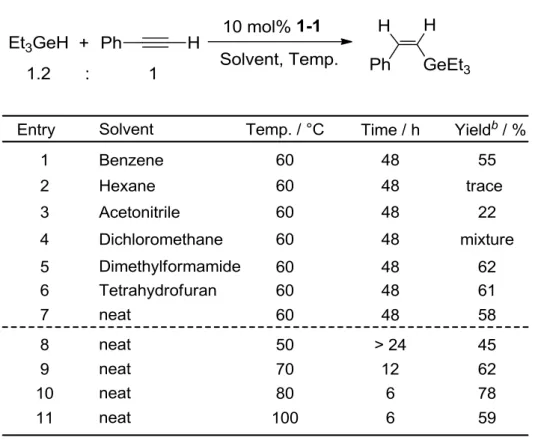
(64) 2-4. Solvent Effects The optimization of the reaction solvent, time and temperature in the reaction of triethyl germane with phenyl acetylene in the presence of 1-1 was performed. All attempted solvents were listed in Table 2-1 (Entries 1-7). No significant solvent effect was observed with the change from polar to non-polar solvents, except for hexane, dichloromethane and acetonitrile. The reaction in dichloromethane gave a complicated mixture and that in hexane afforded a trace amount of the product.. The. yield of the product in acetonitrile might be decreased due to the coordination of the acetonitrile to the active species in situ.. It should be noted that catalytic reaction. took place even without solvent. The times which were required until the amount of the product did not increase any more were listed in Entries 8-11.. The yield increased with increasing the reaction. temperature from 50 to 80 ºC, indicating that heating is required to undergo this catalytic reaction. However, the decrease of the yield was observed at 100 ºC. This may be caused by the decomposition of the catalytically active species. So, Entry 10 is the best reaction conditions. Next, the effect of the amount of the catalyst (1-1) on the yield of the product was examined (Table 2-2).. Reducing the amount of 1-1 from 10 to 5 mol% did not cause. a significant decrease of the yield, although a longer time was required for the completion of the hydrogermylation (Entries 1-3).. In contrast, 1 mol% of 1-1 gave. only 7% yield even under 120 h heating conditions (entry 4).. The well-balanced. time and yield of product was the reaction conditions in Entry 2, which was used for the following reactions.. 64.
(65) Table 2-1. Optimization of Reaction Solvent, Time and Temperaturea. a. Reaction conditions: in a Schlenk tube, [1-1]/[phenylacetylene]/[Et3GeH] = 1:100:120. b. Isolated yield.. Table 2-2. Optimization of the amount of 1-1a. a b. Reaction conditions: in a Schlenk tube, [phenylacetylene]/[Et3GeH] = 100:120, 80 ºC, neat.. Isolated yield.. 65.
図

+7

関連したドキュメント
Recently, it was reported that ketoconazole, which is a well-known inhibitor of CYP3A4, potently inhibits the morphine glucuronosyltransferase activity catalyzed by recombinant UGT2B7
名の下に、アプリオリとアポステリオリの対を分析性と綜合性の対に解消しようとする論理実証主義の
associatedwitllsideeffectssuchasgingivalhyperplasia,somnolencc,drymonth,andgcncral
しかしながら生細胞内ではDNAがたえず慢然と合成
Fig, 1.5 Comparison between result of plastic strain field by crystal plasticity FEA and fatigue test on crack initiation s ite in Ni alloy, a mapped region showing the grain
To accomplish the aim, the following investigations has been conducted; 1 explication of dominant factor determining fatigue crack initiation life in practical high strength
の点を 明 らか にす るに は処 理 後の 細菌 内DNA合... に存 在す る
図 21 のように 3 種類の立体異性体が存在する。まずジアステレオマー(幾何異 性体)である cis 体と trans 体があるが、上下の cis
