
JAIST Repository: FPGA用ソフトプロセッサのための自動最適化コンフィギュレータの構築 [課題研究報告書]
4
0
0
全文
(2) Building a Configurator to Optimize Soft Processors for FPGA Tetsuo Miyauchi (1310708) School of Information Science, Japan Advanced Institute of Science and Technology February 7, 2015. Keywords: FPGA, Verilog HDL, CPU, MIPS, configurator. Currently, using FPGA (Field Programmable Gate Array) for embedded applications is becoming popular because of its easiness of reconfiguration while FPGA is relatively lower density and slower compared with application specific integrated circuits. As FPGA is reconfigurable, that is its circuit can be modified after a product is developed, it is prevailing for embedded application due to higher productivity. Recently, a software processor core could be implemented in FPGA due to improvement of circuit integration. In the view of resource consumption, a processor core with a smaller size is better. So, in this thesis, in order to achieve effective use of resources in FPGA, building a configurator to create an optimized soft processor for an application is described. Several application programs are applied to this configurator and the effectiveness of this configurator from the view of the resource utilization and implement timing is illustrated. In chapter 1, the background and the method of this study are shown. In chapter 2, several related works are overviewed. First, several soft processor cores, which FPGA vendors provide, are shown. Then ASIP(Applicationdomain Specific Instruction-set Processor) is introduced. ASIP is a technology for creating application specific CPU and its environment. In chapter 3, CPU design for this study is explained. In order to verify effectiveness of this configurator, a MIPS architecture soft processor core c 2015 by Tetsuo Miyauchi Copyright ⃝. 1.
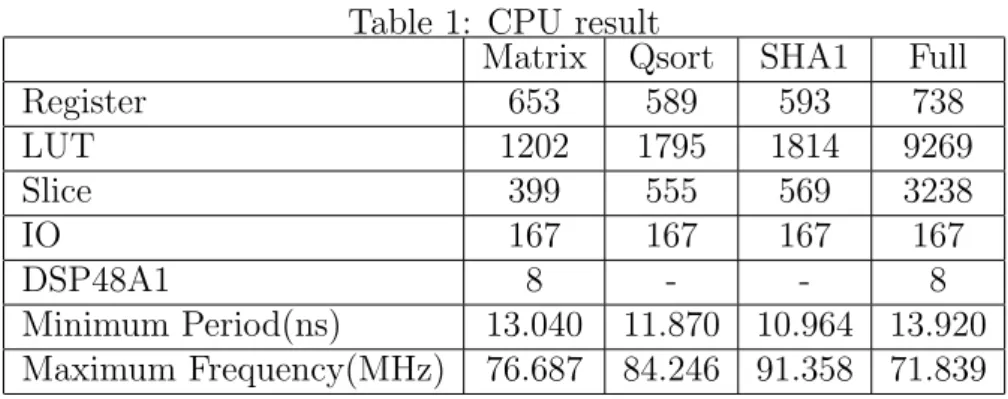
(3) is designed using Verilog HDL. Firstly, implemented CPU specification is illustrated in this chapter. Secondly, forwarding and stall detection units and classification of CPU resources are described. In order to build an optimized circuit, it is necessary to clarify the resources used for each CPU instruction. Additionally, cases in which the forwarding detection unit and the stall detection unit are used in this CPU are mentioned. In chapter 4, building the configurator for optimizing processor cores is described. Firstly, this configurator disassembles object codes for an application program and extracts instructions used in the program. Secondly, this configurator selects actually used resources such as multiplexers, stall detection units, forwarding detection units, comparison circuits, the multiplier, and the divider, according to the classification of CPU resources, as mentioned in the previous chapter, by the result of analyzing instructions which an application program uses. And also, GUI(Graphical User Interface) for this configurator is introduced. GUI is developed with Python. In chapter 5, evaluation and consideration are discussed. In order to confirm effectiveness of this configurator, several application programs written in C language are applied to the configurator. In this thesis, results of applying the configurator to application programs of matrix product, quick sort and SHA1 are shown. These programs are executed on the CPU explained in chapter 3, and it is confirmed that the correct result is obtained for each program. Resource utilization and implemented timing are evaluated for the circuit which the configurator created for each application program. The evaluation results are shown in the table below. Table 1: CPU result Matrix Qsort SHA1 Full Register 653 589 593 738 LUT 1202 1795 1814 9269 Slice 399 555 569 3238 IO 167 167 167 167 DSP48A1 8 8 Minimum Period(ns) 13.040 11.870 10.964 13.920 Maximum Frequency(MHz) 76.687 84.246 91.358 71.839. From these results, compared with a full implemented CPU, the circuit 2.
(4) which this configurator created is found to be effective from the view of resource utilization and implemented timing. And also, this configurator is effective for reduction of human resources in developing optimized soft processors. In chapter 6, CPU design, configurator development, and the result of evaluation are summarized and this thesis is concluded.. 3.
(5)
図
関連したドキュメント
議論を深めるための参 考値を踏まえて、参考 値を実現するための各 電源の課題が克服さ れた場合のシナリオ
Since the statistical methods used for change point detection gave contrasting results, we present the models obtained on the subseries delimited by change points, as well as for
【原因】 自装置の手動鍵送信用 IPsec 情報のセキュリティプロトコルと相手装置の手動鍵受信用 IPsec
(当時のリーガルテキスト) 84.71 Automatic data processing machines and unit thereof; (略) 8471.60-Input or output units, whether or not containing storage units in the
プロジェクト初年度となる平成 17 年には、排気量 7.7L の新短期規制対応のベースエンジ ンにおいて、後処理装置を装着しない場合に、 JIS 2 号軽油及び
地球温暖化対策報告書制度 における 再エネ利用評価
セキュリティパッチ未適用の端末に対し猶予期間を宣告し、超過した際にはネットワークへの接続を自動で
自動車環境管理計画書及び地球温暖化対策計 画書の対象事業者に対し、自動車の使用又は
