Title
Improving Extensive Reading of Japanese College Students :
based on the data from speed-reading training
Author(s)
Isa, Masako
Citation
英米文学研究 = STUDIES IN ENGLISH LITERATURE(23):
127-150
Issue Date
1987-12-25
URL
http://hdl.handle.net/20.500.12001/10381
Improving Extensive Reading of Japanese
College Students
-based on the data from
speed-reading
training--Masako Isa
Introduction
Although reading is the most important skill of all four skills (listen-ing, speak(listen-ing, reading and writing) for most students of English through-out the world, it has been much neglected compared to other skill areasi)This may be because, at the moment, no one is ready to say exactly how the process of reading operates: reading is a process which is related to perception.
Pesent attempts at teaching reading skills in the foreign language classroom are word-oriented. In most Japanese colleges, the emphasis is placed not on reading but on translation. Students tend to go through the textbooks very thoroughly, sometimes translating them word by word. It seems fair to say that hardly any emphasis is placed on extensive reading. Therefore the reading ability of Japanese students is low. In order to improve their reading comprehension in English, effective teach-ing techniques for extensive readteach-ing have to be considered. In this paper, I will first discuss the nature and the process of reading, and some factors which affect the reading comprehension. Next, as one way to improve extensive reading, speed-reading practice is introduced and the survey of speed-reading training of Japanese college students is reported on.
What is reading?
Reading has been called "the most thoroughly studied and least
c
127 Junderstood in education today.''2) Most scholarly discussion deals with native language (L 1) reading. The definitions range on a continuum between the stimulus-response theory and the cognitive theory. Three major camps with respect to the nature and process of reading are: a) Those who believe that reading is a bottom-up, stimulus-bound, textbased, interpretive process in which the reader has a very minor role to play.3
l They consider that "reading is a verbal response to printed (graphic) stimuli and the act of reading comprises skills and subskills."')
The reader progresses from letter features, to letters, to letter clusters, to morphemes, to words, and finally to sentences. Bloomfield (1942), Fries (1963) belong in this camp. This definition is linear and seldom concerns itself with discourse chunks bigger than sentences.5
) This point of view totally disregards "semantic and syntactic systems as well as the role of reading as communication and information processing."6
l
b) Those who think that reading is a top-down, reader-bound, knowled-ge- bound, constructive, and dialectic process in which the print or the visual stimuli have a minor role to play and that in the task of reading, the reader brings to bear his schemata (cognitive structure), prior know-ledge, experience, expectations, and his theory of the world.7
l The focus is on meaning. The reader is using world knowledge and previous exper-ience with language to make hypotheses and is thereby constructing meaning by applying this store of knowledge to the text.8
l Thorndike (1917), Goodman (1970), Smith (1975) and Page (1979) belong in this camp. c) Those (especially in the literary camps) who believe that reading is neither totally text-bound nor completely reader-bound, but somewhere in between.9
l These theorists argue that the reading process has two components-the text and the reader-and the comprehension is the outcome of an interaction or transaction between the two. According to this view-point, the reader must be willing to impose himself on the text. These people also strongly assert that "a story, for example, does not have a meaning, but meanings and that every reader assembles his own meaning from the openended text, depending on his background."10
l Maxine Greene (1975), Williams (1978) and Newman (1978-79) belong in this camp.
As far as reading instruction is concerned, no single model should be
adhered to at the expense of the other models since each model answers different pedagogical questions and emphasizes different aspects of read-ing.
Factors whict affect reading comprehension
Reading is a complex and dynamic process and many factors will affect success in reading. Some of the empirical research and experiments that have been done regarding reading comprehension are examined.
1) Vocabulary
Several first-language reading studies demonstrate the importance of vocabulary in the reading comprehension process. Davis (1971) conducted factor analysis of component skills in reading and found a knowledge of words to be an essential component in reading comprehension. I l l Chall
(1958) found that a measure of vocabulary load was the major factor in almost all readability formulas.12
' According to Loban (1970), studies of
children's language development show a high correlation between presc-hoolers' knowledge of word meanings and achievement in reading at higher grade level. 13
'
On the other hand, specifically, teaching the vocabulary of a text seems to have little impact on the student's understanding (Jenkins, Pany, and Schreck 1978, Johnson 1982). This apparent contradiction can be at least partially resolved by reference to Krashen's (1982) Monitor Model of second language acquisition theory:" Already acquired vocabulary aids reading comprehension, but vocabulary that is merely "learned" (in Kra-shen's terminology) can offer little assistance in a communicative situa-tion.~<'
In the ESL situation, a weak passive vocabulary is a serious problem for ESL students who need to read university-level material.l5l A 10 to 20 minute reading task for a native speaker becomes a 1-to-2 hour ordeal for the non-native speaker, as the reading process is broken into small fragments of discourse by constant (often excessive) recourse to a dictionary.
2) Background knowledge
Along with vocabulary, a reader's background knowledge has been shown to be an important component of reading comprehension. Schema theory research has provided evidence of the importance of background knowledge in reading comprehension. According to Goodman (1971), reading is considered as a cyclical process by which a reader reconstructs a text by sampling, predictxng, testing, and confirming. Once such an internal reconstruction of the textual message has taken place, the reader tests its accuracy against previous information.'6
J Previous information
can be the information extracted from a text as well as the reader's background knowledge on the topic of a text.m If there is some inconsi-stency or inaccuracy in the reconstruction of a text because of a conflict with the reader's background knowledge, the reader may reread the text or may not believe the information in the text until later when a more plausible reconstruction can be confirmed.
Fluent and proficient readers of a passage in their native language will recover quickly from wrong guesses for textual meaning.'8
J On the
other hand, ESL readers may not regain in such a successful manner and inaccurate information extracted from the text may lead to inaccurate later predictions for meaning. The reason is that "they may also depend more on· background knowledge of the topic than on linguistic analysis of the text for comprehension and reconstruction of a passage because of their incomplete knowledge of the language."19
J
Bartlett (1932) conducted a survey on the relation of background knowledge to text comprehension in processing and recalling information.
He proposed that the organization of a reader's past experiences directly influences the comprehension and retention of materials in a passage.20
) It is probably that readers understand a passage by analyzing the text according to their schema, an internal organization of past personal experiences.
The view of schema theory aseerts that activating or building readers' existing knowledge prior to reading would improve or alter reading comprehension and recall.
3) Syntax
Traditional approaches in foreign language teaching such as gram-mar-translation and audiolingual methods stressed the role of syntax. But conflicting findings already exist in 1980. In a study of Hebrew-speaking college students studying English, for instance, Aronson-Berman finds that the readers have a significantly easier time reading a syntactically simplified text than they do with a similar, unsimplified text.21l On the other hand, Ulijin's own project shows that readers of a foreign language technical text have more difficulty with content words (for example,
technical terms and nominalizations) than with syntactic function words. 22l
Yet for some researchers, syntax appears to be equally important.
To study reading speed, including the time necessary for processing syntax, MacNamara constructs some English non-sense passages in which the word order appropximates that of English and some with random
word order.23
> He does the same with passages in L 2 Orish). As
hypoth-esized, students did read the syntactically familiar L 1 more quickly than
they did the random L 1 passage.w Knowledge of syntax, therefore, appears to help readers predict and thus to read more quickly.25)
In a different approach to the study of the effect of syntax by Hatch, Polin and Part, they asked native English speakers and ESL students alike to mark through each occurrence of a specific letter, such as the letter e, in a text. The ESL students marked letters in all words; but the native speakers crossed out letters which appeared in context words, not those in function words, and those in stressed syllables. They hypothesize that ESL students need to focus more on syntax because it is unfamiliar to them.26l
According to schema theory, syntactic complexity of a text is not an absolute determinant of its level difficulty (Blau 1982).m As a matter of fact, rather than becoming more accessible, texts acutally become more difficult to read as the natural redundancy and relational markedness
of language are removed (Mckay 1982).28
> Therefore, it is a mistake to reduce the syntactic difficulty of a text in the expectation that this will make the text accessible to limited English proficiency students.
4) Text Structure
A number of research studies have provided empirical evidence that the rhetorical organization cif a text interacts with the formal sChemata of native English-speaking readers (the reader's background knowledge of and experience with textual organization) to affect reading. This effect of text structure on reading comprehension has been shown to be operative for both narrative and expository texts.m A large number of empirical studies have demonstrated that narratives typically have a hierarchical schematic structure, that child and adult native readers are sensitive to such structure, arid that when the structure is used to guide comprehension and recall, both are facilitated.30
l
Similarly, in the realm of expository prose, the research of Meyer has demonstrated that "information located high, in the hierarchial orga. nization of a passage is recalled better that information at lower levels, both immediately after reading or listening and also over time."3ll
A study by Carrell (1984 b) shows the effects of four different English rhetorical patterns on the reading recall of ESL readers of various native large background. It showed that the more tighty organized patterns of comparison, causation, and problem/ solution generally facil-itate the recall of specific ideas from a text more than the more loosely organized colllection of descriptions pattern.32) In this finding, ESL readers generally appear to be similar to the native readers tested by Meyer and Freedle (1984).
However, according to Hinds (1983 a. 1983 b), the Japanese structure (Ki-Sho-Ten-Ketsu pattern) is not only generally more difficult for the English readers, but. particular aspects of that rhetorical organization are extraordinarily problematic for English readers, especially in the delayed recall.33)
The Characteristics of ESL reading
There are, certainly, similarities in the sense that reading is a universal act. The reader who is proficient in his native language, once past the preliminary stages of the acquisition of graphemic correspondences and
mastery of certain subskills in L 2 can transfer his L 1 reading strategies.w However, the differences seem to overshadow the similarities. The ESL student's problems are twofold-cultural and linguistic.
As stated above, background knowledge soch as prior knowledge and life history directly affect the comprehension and retention of written discourse. And if the writer and reader are of diverse backgrounds, then the gap must be bridged if communication is to take place. Therefore, psychological, sociological and cultural factors are the most determinant of one's edocation.35)
Aside from the cultural and personal conflicts, the ESL student comes to the task of reading with serious linguistic problems. Reading in a foreign language is more a language problem for readers with lower language proficiency than reading proficiency. What is surprizing is that" even students who are well-read and fluent readers in their native language seem to suffer from slow reading in L 2 because not all reading skills can be transferred to L 2 situations (Clarke 1977),36
) and also because L 2 readers process information at a slower rate than L 1 readers (Coller & Tullis 1973).m
The Training Study for Extensive Reading
The student's reading activities may be classfied as intensive and extensive: intensive reading being related to further progress in language learning under the teacher's guidance, extensive reading development at the student's own pace according to his individual ability.
Intensive reading is used for translation purposes to teach vocabulary and strocture in context, to teach reading skills soch as scanning or guessing unknown words, and to prepare students to eventually read- and comprehend all kinds of written material in the target language.38
l It is very useful for developing general language proficiency.
On the other hand, extensive reading is to read directly and fluently in the foreign language the reading of large amounts of material for pleasure and information, just as students (hopefully) do in their own language. Material for extensive reading will be selected at a lower
standard of difficulty than that for intensive reading. Structures in the text will be already familiar to the student, and new vocabulary will be introduced slowly in such a way that its meaning can be deduced from the context or quickly ascertained. 39) Students will be encouraged to make
intelligent guesses at the meaning of unfamiliar items. What is important for Japanese students who were used to translation, are the skills of reading selectively and at a speed. These include the ability to scan a text for limited specific information without having to read every word, the ability to sequence and order information so to make sense of it, and the ability to skim a text for the gist!0
)
In order to sharpen these skills, speed-reading in English is one of the most useful acitivities for students. It includes training in skimming, in scanning, in guessing at the meaning from seeing just a few words, and in making a reading class more fun. Speed-reading urges the students to push themselves to read faster, and comprehension may go down for a while, but this is a natural and necessary step in the process of developing more efficient reading skills.
There is some research which deals with reading speed and reading comprehension by Kitao (1982) and Kodama (1984). They report that the average reading speed of Japanese college students is below 150 wpm, while the normal reading speed of English speaking people is 200-300 wpm, that of good readers 300-500 wpm, rapid reader, more than 500 wpm.
Purpose
The purpose of the present study is to report the results of the speed-reading training study of Japanese college students.
Subjects
The survey sample consisted of 57 sophomores majoring in English literature from English reading class (Eibunkoudoku 11) at my college. They have received the intensive reading in which the emphasis has placed
on translation of a text line by line in their high schools and when they were freshmen in this college. It is the first time that they take the extensive reading class by speed-reading. The study was conducted from April through February in 1986.
Materials
The textbook 'American Potluck-Improving Reading Speed and Rea-ding Skills' by Kenji Kitao and S. Katheleen Kitao was selected. The readings in this textbook include information on such diverse cultural areas as history, food, famous people, music and the American family. The vocabulary used in these readings is mostly limited to words on a 400-word list compiled by the Association of College English Teachers (JACET).w The main reading selections are written in essay form. The supplementary readings are authentic materials on subjects related to the main readings without limitations on the vocabulary. Difficult words and expressions are explained in easy English. Readings are grouped according to topic and level of difficulty. Each of the passages contained between 363 and 1380 words.
Training Procedures
As the purpose of this training is to help students develop reading skills and improve their reading speed without,translating word-for-word into Japanese, they were told to read directly and fluently. According to Taylor's (1983) training procedures,m the following instructions were given:
1) to read silently
2) to read for some purpose 3) to look at any pictures first
4) to read any larger, darker words before they read other words 5) to quickly notice any chapter or section titles
6) to read selectively, not totally 7) to skip uninteresting parts of text
8) to read many more pages of the language per day than they write 9) to read much more difficult language than they can write
them-selves-more complex grammar, unusual vocabulary
10) to almost never use a dictionary. Instead they were advised to guess at new words or to read to find contextual clues for the meaning of any unfamiliar words.
Especially, with respect to No. 6 and No. 7, two recommendations were given for students. One is to study the first sentence of each paragraph more carefully than the others, and also read the first and last paragraphs more carefully than the middle ones. The other is to relate the title, introduction, and conclusion carefully to the paragraphs in the text.
They were also told to focus their eyes on something on the page, and not to turn them to the sentences that they have already read.
Before reading, they glanced at the pre-reading exercise or skimming excercise. After reading, they answered these questions such as skimming excercise, true/ false questions, comprehension questions and so on. Lastly they read the story again.
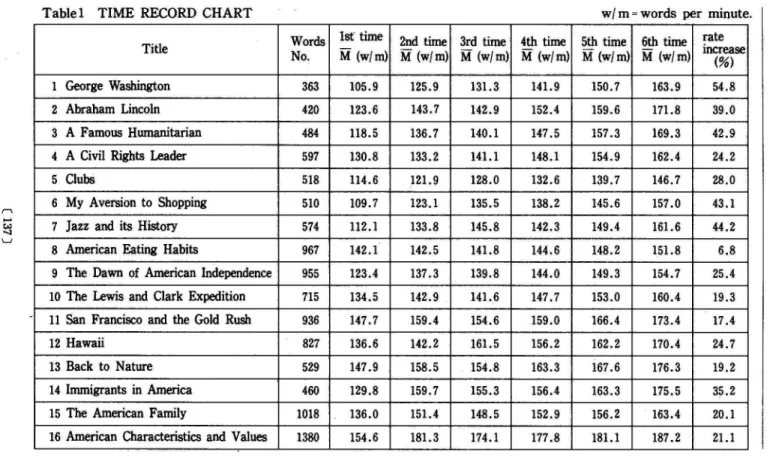
As students read each selection, they timed themselves, and recorded their reading speed and the number of words per minute .in the 'Time
Record Chart' (table 1).
( *
Table 1 deals with only the number of words per minute.)"
....
~
'-1
.
Table 1 TIME RECORD CHART Title
1 George Washington 2 Abraham Lincoln 3 A Famous Humanitarian 4 A Civil Rights Leader 5 Clubs
6 My Aversion to Shopping 7 Jazz and its History 8 American Eating Habits
9 The . Dawn of American Independence 10 The Lewis and Clark Expedition 11 San Francisco and the Gold Rush 12 Hawaii
13 Back to Nature 14 Immigrants in America 15 The American Family
16 American Characteristics and Values
Words 1st time No. M (w/m) 363 105.9 420 123.6 484 118.5 597 130.8 518 114.6 510 109.7 574 112.1 967 142.1 955 123.4 715 134.5 936 147.7 827 136.6 529 147.9 460 129.8 1018 136.0 1380 154.6
w/ m =words per minute. 2nd time 3rd time 4th time 5th time 6th time rate M(w/m) M (w/m) M(w/m) M (w/m) M (w/m) increase (%) 125.9 131.3 141.9 150.7 163.9 54.8 143.7 142.9 152.4 159.6 171.8 39.0 136.7 140.1 147.5 157.3 169.3 42.9 133.2 141.1 148.1 154.9 162.4 24.2 121.9 128.0 132.6 139.7 146.7 28.0 123.1 135.5 138.2 145.6 157.0 43.1 133.8 145.8 142.3 149.4 161.6 44.2 142.5 141.8 144.6 148.2 151.8 6.8 137.3 139.8 144.0 149.3 154.7 25.4 142.9 141.6 147.7 153.0 160.4 19.3 159.4 154.6 159.0 166.4 173.4 17.4 142.2 161.5 156.2 162.2 170.4 24.7 158.5 154.8 163.3 167.6 176.3 19.2 159.7 155.3 156.4 163.3 175.5 35.2 151.4 148.5 152.9 156.2 163.4 20.1 181.3 174.1 177.8 181.1 187.2 21.1
W/M
200 Figure 1 : The Record of Reading Speed
190
1st 2nd 3rd 4th 5th
American Chareteristics and Values
Back to Rature Immigrarts in America
San Franaisco and the Gold Rush Abraham Lincoln
Hawaii
A Famous Humanitarian George Washington The American Family A Civil Rights Leader Jazz and Its History
The Lewis and Clark Expedition My A version to Shopping
The Dawn of American Independence American Eating Habits
Clubs
time ( 138 J
r-.
....
~ '--'Table 2 The record of reading speed according to topic
Topics 1st time 2nd time
M{w/m)
M
1 Famous Americans George Washington 119.7 134.9 Abraham Lincoln A Famous Humanitarian A Civil Rights Leader 2 Daily LifeClubs 119.6
My Aversion to Shopping 130.3
Jazz and Its History American Eating Habits 3 History
The Down of American Independence 135.6 145.4 The Lewis and Clark Expedition
San Francisco and the Gold Rush Hawaii
4 Values
Back to Nature
142.1
Immigrants in America 162.7
The American Family
American Values and Characteristics
3rd time 4th time 5th time 6th time rate
M
M M M increase {%)138.9 147.5 155.6 166.9 39.4
137.8 139.4 145.7 154.3 29.0
149.4 151.7 157.7 164.7 21.5
-W/M 200 190 180 170 160 150 140 130 120 110 100 1st
Figure 2 : The record of reading speed according to topic
2nd 3rd 4th 5th
c
140) . 6th Values Famous Americans History Daily Life timeResults
Table 1 reports the record of the average reading speed of all sections from the first to sixth time. The record is also graphed in Figure 1. It shows that as the time of reading increases in length, the words per miunte also increases. On an average students improved their speed (wpm) by 28%. Figure 1 shows that students read 'American Characteri-stics and Values' fastest and 'Clubs' most slowly.
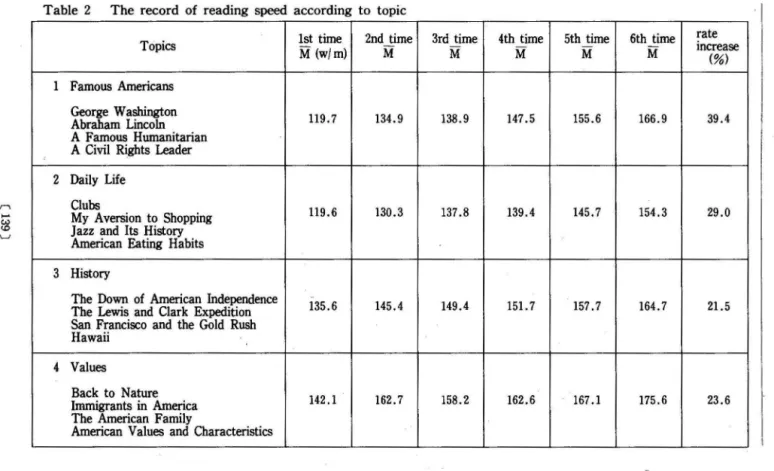
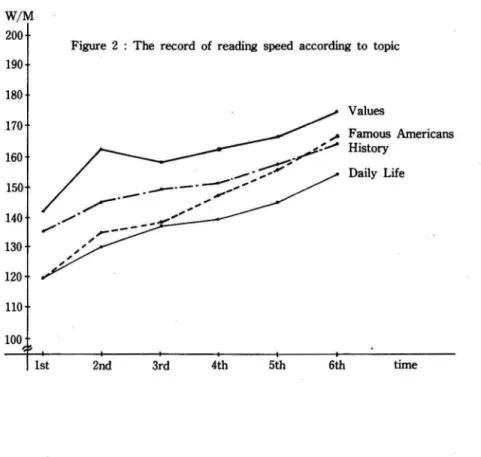
Table 2. is the record of reading speed according to topic. The record is also shown on the graph in Figure 2. The words per minute of the topic "Values" is the largest of the four topics, followed by "Famous Americans", "History", and "Daily Life". It shows that students like American modern life rather than the traditional stories such as history, famous people and jazz.
Why students like "Values" most is that the topic includes personal letters, American ancestors, marriage and American attitudes and values which students are very much interested in.
On the other hand, "Daily Life", which includes the selections of 'Clubs', 'American Eating Habits', 'My Aversion to Shopping' and 'Jazz and its History', are very difficult topics for students to read. For example,
in the 'Clubs', there are many different types of clubs for men, women and children which Japanese students don't know well. Japanese students are apt to associate clubs with sports. However, not all clubs in the U. S. are for the purpose of entertainment. Some clubs provide some type of help for members who are in trouble. Others provide emotional support and friendship.
In 'American Eating Habits', three meals a day, and dinner for holidays are beautifully described. But there is some difficult vocabulary such as the words of ingredients and menus. A weak vocabulary is a stumbling block to reading in English.
In 'My A version to Shopping', the author introduces her husband who is fond of shopping, and explains why she doesn't like shopping. They are interesting ideas, but they are beyond the imaginations of Japanese
college women who are lovers of shopping. In other words, when there is some inconsistenc:y in the reconstruction of a text because of a conflict with the reader's background knowledge, students may reread the text and the reading speed will slow down.
In 'Jazz and its History', where music came from is explained histor·
ically. It dates back to the 1640's. It may be difficult for students who are
not familiar with American history to read this selection.
With respect to the words of the readings, 'American Characteristics and Values' has the largest in the number (1380). Even if there are many
words in the story, students can read it quickly. It shows that as the
number of words in the selection increases, it is easier to understand because much evidence such as examples, comparison and/ or contrast, reason, and definition are incorporated.
In the vocabulary, the number of difficult words which are explained in simple English is as follows: "Values" (23), "History, (48), "Famous
Americans" (30), "Daily life" (47). It is obvious that the vocabulary of a
text has some impact on the student's reading.
Reading Speed & Reading Comprehension
In order to find out how the students improved their reading speed and reading comprehension, students were tested in their classroom during their reading class. They worked at their own rates, and consequently there is some variation in completion (20-30 minutes). The mean of the first test of True/False questions of Lesson 14 'Immigrants in America' was compared with that of the second test of the same questions. There was a seven month break between the first test and the second test. The results are as follows:
M (w/m) Mean of score (10)
the' first test 129.8 6.1
the second test 175.5 8. 7
It shows that students improved their speed by 35.2% and their
scores by 42%. It also shows that this course produces some effects on
student's reading habits. Generally students begin to turn their attention ( 142 J
more to the content of the text than to the vocabulary during the course. Next, to investigate the correlation between reading speed and reading comprehension, students were divided into two groups such as the upper students and the lower students based on the second test. The upper groups made up of those who got more than the mean (8.7) and the lower is those who are below the mean.
The upper group (41) The lower group (16)
M (w/m) 181.5 160
From this study, it may be seen that the correlation between scores and reading speed s very high. It shows that students who score higher can read faster. The same results are reported by the survey of Kitao (1982) and Kodama (1984).
Students Response
In the questionnaire, most of the students were in favor of this speed-reading class. They indicated that they considered an inadequate vocabulary to be their main difficulty at the beginnig of the semester. As the time has passed, they felt that the course had helped them most in reading appropriate strategies, and in learning to distinguish the main points in texts from the details without translation. They also reported that they developed a tolerance for inexactness, a willing to take chances and to make mistakes. Some students said that they could look for vocabulary clues from the context when they faced difficult words. Other students, who had no habit of reading in their first language (Japanese), said that they developed a reading habit in English and then went on to read more in their mother tongue.
Summary
Reading is a complex and dynamic process which is related to perception. Many factors such as vocabulary, background knowledge, syntax and textual structure· will affect reading comprehension. From one
year of speed-reading training, the following conclusions can be drawn:
1 Students improved their speed greatly.
2 Students read 'American Characteristics and Values' fastest and 'Club' most slowly.
3 Students like reading about modern American life rather than the traditional stories like history, famous people and jazz. 4 Along with vocabulary, a reader's background knowledge has
shown an important component of reading comprehension. Und-erstanding the rhetorical organization of text is also a great help to speed- reading.
5 There was a high correlation bttween reading ability and reading speed. Students with higher scores improved their reading speed much more than students with lower scores, while students with lower scores improved their scores more.
Implications for the Teaching of ESL Reading
Now that I have described and illustrated what reading is thought to be, what factors affect reading comprehension and the study of speed-reading training, let's see what this analysis of speed-reading could mean to ESL teaching.
As stated above, reading is not merely a passive process of extracting meaning from the printed page. but rather an active and interactive process in which the reader uses knowledge of the language to predict and create meaning based on the text.m Therefore, in order to improve students' reading ability, it is necessary to get meaning from the written words by guessing, not to understand the content through translation. Guessing requires the tolerance of accepting vagueness in meaning in the process of understanding throughly.w To sharpen this skill, speed-reading practice should be encouraged as much as possible because it urges the students to push themselves to read faster.
I' m going to suggest ways to develop students' reading comprehen-sion by speed-reading. One is that ESL reading teachers need to be aware of gaps in their students' knowledge of rhetorical devices, of an author's
style, of the culture represented by the text, and of general world knowledge which the author refers to. My training experiment demonst-rated that "explicit, overt teaching about the top-level rhetorical organi-zation of texts can facilitate ESL students' reading comprehension."m Therefore, pre-reading activities should be provided to insure that the cultural assumptions of ESL students and those of the writer are similar. In fact, it has been suggested that "the more pre-reading activities there are to familiarize the reader with a text and its cultural assumptions, the easier the text will be to read.''w
Another is that teachers should be aware of the importance of the general English language such as vocabulary, syntax and so on as it relates to the ability to make quick and accurate guesses at the meaning of what is seen on a page. However, teaching only 'the vocabulary of a text seems to have little impact on the students' understanding. Then, practice in getting the sense of new words from the context needs to be supplemented in the classroom.
Thus, wide-ranging reading by guessing is probably the most efficient way of extending students' acquaintance with the language Materials should be simple-well below the level of the current textbook. The more volumes of easy materials students read, the faster and better they will read. To promote such extensive reading more effectively, it is recommendable to organize a graded supplementary reader collection in the school library or build up a class library.
Though not proved by students yet, I believe that a lot of reading will improve their writing, as well as their reading abilities. Also it will build up vocabulary and give students a fresher knowledge of words and idioms. Further research is needed to sharpen English reading skills.
Notes
1) Toshoiyuki Tatsuyama, "Techniques to Help Students Improve Reading", The Daily Yomiuri, 20 Aug. 1987, p. 6.
2) Mark A. Clarke, ·'The Short Circuit Hypothesis of ESL Reading or
When Language Competence Interferes with Reading Performance, "Modern La·
nguage journal, 64, No. 2 (Summer 1980), p. 203.
3) Y eghia Aslanian, "The Enigma of Reading Comprehension, "]AL T
jour-nal, 5 (Oct. 1983), p. 17.
4) Ibid., p. 17.
5) L. Bloomfield, "Linguistics and Reading, •'Elementary English Review, 19,
(1942), p. 125-130.
6) Y eghia Aslanian, "The Enigma of Reading Comprehension, "]AL T four·
nal, 5 (Oct. 1983), p. 17.
7) Ibid., p. 18
8) Kyle Perkins, "Semantic Constructivity in ESL Reading Comprehension, "TESOL Q, 17, No. 1, (March, 1983), p. 20.
9) Yeghia Aslanian, "The Enigma of Reading Comprehension, "]ALT
jour-nal, 5, (Oct. 1983), p. 19.
10) Ibid. p. 19.
11) F. B. Davis, "Psychometric Research on Comprehension in Reading, "The Literature of Research in Reading with Emphasis on Models (East
Bruns-wick, NJ: Iris, 1971).
12) Jeanne Chall, Readabillity: An Appraisal of Research and Application
(Columbus: Ohio State Univ. Press, 1958).
13) W. loban, "Stages, Velocity, and Prediction of Language Development:
Kindergarten through Grade Twelve" (Washington, DG: USODE, 1970)
14) John F. Povey, "Literature for Discussion: A Reader for Advanced
Stud-ents of English as a Second Language," (New York: Holt, Rinehart and Winston, 1984), p. 179.
15) John T. Crow and June R. Quigley, "A Semantic Field Approach to
Passive Vocabulary Acquisition for Reading Comprehension, "TESOL Q. 19, No. 3
(Sept. 1985), p. 510.
16) Patricia Johnson, "Effects on Reading Comprehension of Building
Back-ground knowledge, " TESOL Q. 16, No. 4 (Dec. 1982), p. 503
17) Ibid., p. 503.
18) Ibid., p. 504.
19) Catherine Buck, "Miscues of non-native speakers of English," In K Goodman (Ed.) Miscue Analysis (Urbana, IL: ERIC Clearinghouse on Reading and Comprehension Skills, 1975)
20) Frederick C. Bartlett, Remembering(London: Cambridge Univ. Press 1932) 21) Aronson-Berman, "How Hard Is It to Read, "Syntactic Complexity as a Cause of Reading Difficulty, "Paper, AILA Congress, Montreal, 1978
22) Jan Uli.iin, "Conceptualization in Second Language Comprehension: Expe-rimental Findings on this Process in Relation to Reading the First Language, "AILA Congress, Montreal, 1978 (ERIC ED 171 110)
23) Marva A. Barnett, "Syntactic and Lexical/ Semantic Skill in Foreign Language Reading: Importance and Interaction, "ML journal. 70, No.4. (Winter, 1986), p. 343.
24) Ibid., p. 343. 25) Ibid., p. 343.
26) Evelyn Hatch, P. Polin and S. Part, "Acoustic Scanning or Syntactic Processing?", Paper, Western Psychological Association, San Francisco, 1970.
27) Eileen K. Blau, "The Effect of Syntax on Reliability for ESL Students in Puerto Rico. TESOL Q. 16 (4) p. 517-528.
28) Sandra Mckay, "Literature in the ESL Classroom", TESOL Q 16 (4) p. 529-536.
29) Patricia L. Carrell, "Facilitating ESL Reading by Teaching Text Structu· re", TESOL Q. 19. Vol. 4 (Dec. 1985), p. 727
30) Marilyn J, Adams, and Bertram C. Bruce, Background knowledge and Reading Comprehension (Illinois: Univ. of Illinois, Center for the Study of Reading, 1980)
31) ·Bonnie J, F. Meyer, The Organization of Prose and Its Effects on Memory (Amsterdan: North Holland Publishing Co. 1975)
32) Patricia L. Carrell, ''The Effects of Rhetorical Organization on ESL Readers, "TESOL Q 17. Vol. 4, p. 441-469.
33) John Hinds, "Contrastive Rhetoric: Japanese and English," Text3 (2), 1983, p. 188.
34) Yeghia Aslanian, "The Enigma of Reading Comprehension", /ALT jour-nal. Vol. 5, (Oct. 1983), p. 24.
35) Robert Kaplan, "Composition at the Advanced ESL Level: A Teacher's Guide to Connected Paragraph Construction for Advanced-level Foreign Students",
The English Record, 21, 1971, 'p. 53-64.
36) M. A. Clarke and S. V. Silberstein, "Toward a Relialization of Psycholi-( 147)
nguistic Principles in the ESL Reading Class", Langt«lge Learning 28, 1977, p. 135-154.
37) J. W. Oller and J. R. Tullius, "Reading Skills of Non-native Speakers of English", International Review of Applied Linguistics, 11, 1973, p. 69-79.
38) Julian Bamford, "Extensive Reading with Graded Readers", The Langt«lge Teacher (April 1984) p. 3.
39) Wilga M. Rivers, Teaching Foreign-Langt«lge Skills (The Univ. of Chicago Press, Chicago, 1970), p. 229.
40) Peter Viney, "Reading for Pleasure", The Langt«lge Teacher IX. No. 8 (August 1985) p. 6.
41) Kenji Kitao and S. K. Kitao, American Potluck (Asahi Press, 1985) p. 5.
42) Harvey M. Taylor, "Teaching Reading", Cross Currents, Vol. X. No. (Spring 1983) p. 34.
43) Ibid., p. 35.
44) Toshiyuki Tatsuya, "Techniques to Help Students Improve Reading" The Daily Yomiuri, 20 Aug. 1987. p. 6.
45) Patricia L. Carrell, "Facilitating ESL Reading by Teaching Text
Struct-ure", TESOL Q Vol. 19 No.4 (Dec. 1985) p. 741.
46) John F. Povey, Literature/or Discussion: A Reader for Advanced Students of English as a Second Langt«lge (New York: Holt, Rinehart and Wimton, 1984) p. 179.
Bibliography
Adams,Marilyn J. Background knowledge and Reading Comprehension (Diinois: Univ. of Illinois, Center for the Study ou Reading, 1980.
Aslanian,Yeghia. "The Enigma of Reading Comprehension, "/ALT journal, 5, (Oct. 1983), 17-24.
Bamford, Julian. "Extensive Reading with Graded Readers," The Language Tea· cher(April1984), 3.
Barnett, Marva A "Syntactic and Lexical/Semantic Skill in Foreign Language
Reading: Importance and Interaction," ML fournol, 70, No, (Winter 1986) 343.
Bartlett, Frederick C. Rememberi-ng, London: Cambridge Univ. Press, 1932.
Berman, Aronson. "How Hard Is It to Read. Syntactic Complexity as a Cause of
Reading Difficulty," Paper, AILA Congress, Montreal, 1978.
Blau, Eileen K. "The Effect of Syntax on Readability for ESL Students in Puerto
Rico, TESOL Q. 16 (4), 517-528.
Bloomfield, L. "Linguistics and Reading," Elementary English Review. 19 (1942)
125-130.
Buck, Catherine. "Miscues of Non-native Speakers of English," In K Goodman (Ed.) Miscue Analysis, Urbana, IL: ERIC Clearinghouse on Reading and Comprehension Skills, 1975.
Carrell, Patricia L. "The Effects of Rhetorical Organization on ESL Readers," TESOL Q 17 (4), 441-469.
·· · · ·· ··· · · ·. "Facilitating ESL Reading by Teaching Text Structure," TESOL Q 19 (4), 727-741.
Chall, Jeanne. Readability: An Appraisal of Research and Application. Columbus: Ohio State Univ. Press, 1958.
Clarke, Mark A "The Short Circuit Hypothesis of ESL Reading-or when Language Competence Interferes with Reading Performance, "ML journaL 64 (2) (Sum·
mer 1980), 203.
Clarke, Mark A and Silberstein. "Toward a Realization of Psycholinguistic Princ· iples in the ESL Reading Class," Language Learning, 28 (1977), 135-154. Crow, John T. and Quigley June R. "A Semantic Field Approach to Passive
Vocabulary Acquisition for Reading Comprehension," TESOL Q 19 (3) (Sept. 1985), 510.
Davis, F. B. "Psychometric Research on Comprehension in Reading," The Litera· ture of Research in Reading With Emphasis on Models. East Brunshick, NJ: Iris, 1971.
Hatch, Evelyn, Polin P. and Part. S. "Acoustic Scanning or Synactic Processing
? Paper, Western Psychological Association, San Francisco, 1970.
Hinds, John. "Contrastive Rhetoric: japanese and English," Text, 3 (2), 1983, 188. Johnson, Patricia. "Effects on Reading Comprehension of Building Background
Knowledge," TESOL Q 16 (4) (Dec. 1982), 503-504.
Kaplan, Robert. ··composition at the Advanced ESL Level: A Teacher's Guide to Connected Paragraqh Construction for Advanced-level Foreign Students," The English Record, 21 (1971), 53-64.
Kitao, Kenji, and Kitao, S. K. American Potluck, Asahi Press (1985),
Lodan, "Stages, Velocity, and Prediction of Language Developemnt: Kindergarten through Grade Twelve," Washington, DG: USOE, 1970.
Mckay, Sandra. "Literature in the ESL Classroom," TESOL Q 16 (4), 529-536. Meyer, Bonnie }. F. The Organization of Prose and Its Effects on Memory,
Amsterdam: North Holland Publishing Co. 1975.
Oller, ]. W. and Tullis, ]. R. "Reading Skills of Non-native Speakers of English," International Review of Applied Linguistics, 11, (1973), 69-79.
Perkins, Kyle. "Semantic Constructively in ESL Reading Comprehension," TESOL Q 17 (1), (March, 1983), 20.
Povey, John F. "Literature for Discussion: A Rroder for Advanced Students of English as a Second Language," New York: Holt, Rinehart and Winston, 1984, 179.
Rivers, Willga M. Troching Foreign-Language Skills, The Univ. of Chicago Press, Chicago, 1970, 229.
Tatsuyama, Toshiyuki. "Techniques to Help Students Improve Reading," The Daily Yomiuri, 20 Aug. 1987,6.
Taylor, Harvey M. "Teaching Reading, "Cross Currents, Vol. X. No.1 {Spring 1983)
34-35.
Ulijin, Jan. "Conceptualization in Second Language Comprehension: Experimental Findings on this Process in Relation to Reading the First Language," Paper, AILA Congress, Montreal, 1978, ERIC ED 171 llO.
Viney, Peter. "Reading for Pleasure, "The Language Trocher, IX, No. 8 (August 1985), 6.