エラジタンニンに含まれる多置換ジアリールエーテ
ルの統一的合成戦略
著者
廣兼 司
学位名
博士(理学)
学位授与機関
関西学院大学
学位授与番号
34504甲第528号
URL
http://hdl.handle.net/10236/12626
1. 2. C–O 6 2.1 6 2.2 8 2.3 45 10 2.4 oxa-Michael 11 2.5 12 2.6 14 2.7 18 3. A 20 3.1 20 3.2 20 3.3 21 4. 28 29 32
Ac = acetyl
AIBN = azobisisobutyronitrile aq = aqueous
ATR = attenuated total reflection Bn = benzyl Bu = butyl CC = column chromatography conc. = concentrated DBDMH = 1,3-dibromo-5,5-dimethylhydantoin DDQ = 2,3-dichloro-5,6-dicyano-p-benzoquinone
DEPT = distorsionless enhancement by polarization transfer DHDG = dehydrodigalloyl
DIBAL-H = diisobutylaluminium hydride DMAP = 4-(dimethylamino)pyridine DMF = N,N-dimethylformamide DMSO = dimethyl sulfoxide DNA = deoxyribonucleic acid
EDCI = N-(3-dimethylaminopropyl)-N'-ethylcarbodiimide ESI = electrospray ionization
Et = ethyl
HHDP = hexahydroxydiphenoyl
HMBC = hetero-nuclear multiple-bond correlation HRMS = high-resolution mass spectrum
IR = infrared spectrum Lit. = literature
LRMS = low-resolution mass spectrum Me = methyl
MOM = methoxymethyl m.p. = melting point MS = mass spectrum M-sieve = molecular sieve Nap = 2-naphthylmethyl
NMR = nuclear magnetic resonance Ph = phenyl PIFA = [bis(trifluoroacetoxy)iodo]benzene PMB = p-methoxybenzyl Pr = propyl rt = room temperature satd = saturated
TBAF = tetra-n-butylammonium fluoride TFA = trifluoroacetic acid
THF = tetrahydrofuran
TLC = thin-layer chromatography TMS = tetramethylsilane
1
Snyder
serial non-serial 2 1 serial
DNA Fig. 1-1 Figure 1-1. DNA non-serial 2 Fig. 1-2 10 2 H N N H H N O O O N H H N O O N H R2 R4 R1 R3 R5 R6 O R = H (glycine), Me (alanine), CH2Ph (phenylalanine) ...
N N N O O O P O O O N O P O O O O N N N HN N N O N N HN O P O O O N N O O O P O O O H H H O H H H N N N O O O P O O O O N O P O O O O N N N NH N HN O N N NH O P O O O N N O O O P O O O O H H O H H H DNA Protein Adenine Thymine Cytosine Guanine
Figure 1-2. non-seria serial non-serial 2 1 serial non-serial Snyder Friedel-Crafts Figure 1-3 3 3 4 4 3 C-8 Br 3 OAc limonene (+)-α-pinene OH geraniol O O H H iridoid camphene sabinene (+)-3-carene terpinene monoterpene (C10) H zingiberene α-cadinene H H HO H cedrol OH farnesol H H H H aromadendrene H H H H hirstene germacrene A sesquiterpene (C15)
Figure 1-3. Figure 1-4. Snyder HO O OH OH OH OH HO O OH OH OH OH HO O OH OH OH OH H H procyandin C-2 (2) HO O OH OH OH OH (+)-catechin (1) BnO O BnO OAc OBn OBn Br OAc 3 BnO O BnO OAc OBn OBn SPh 4 BF3·OEt2 CH2Cl2 95% BnO O OBn OAc OBn OBn BnO O OBn OAc OBn OBn H SPh Br NIS, CH2Cl 62% 5 HO O OH OH OH OH HO O OBn OH OH OH HO O OH OH OH OH H H n + BnO O BnO OAc OBn OBn 7 BnO O OBn OAc OBn OBn BnO O OBn OAc OBn OBn H Br H n>1: higher (+)-catechin oligomers
BnO O BnO OAc OBn OBn 6 6 OEE OEE 8 8 8 X1 H HA OMe MeO MeO MeO OMe OMe A B C carasiphenol C (11) from 16 BH X1 H OMe MeO MeO MeO OMe OMe A B C Br ampelopsin H (12) from 15 X2 HO OH OH resveratrol (8) HO HO OH OH OH OH quadrangularin A (9) H H OH HO HO HO OH OH pallidol (10) H H OH HO HO OH OH O HO HO HO H H HO HO OH OH O HO HO HO O OH OH OH carasiphenol C (11) ampelopsin H (12) X1 = H (13) X1 = Br (14) X1 = H, X2 = Br (15): 99% X1 = Br, X2 = H (16): 79% and NBS
4 Friedel-Crafts 5 5 SPh 6 Friedel-Crafts 7 24 Snyder Figure 1-4 5 full-Me-pallidol 13 HA HB 15 Br 12 X1 14 HA HB 16 11 1000 6 D -HHDP Fig. 1-5 Snyder serial Rubusuaviin A 17 , B 18 , C 19 DNA HHDP HHDP C–O C–O 2 C– O DHDG 40 C–O C–O
Figure 1-5. O O O G G O OG O OH OH O GO OG O O OH OH O O coriariin A (22) G HO O O G G Tergalloyl group Macaranoyl group loropetalin A (24) O OG OG HO HO HO O HO OH O OO OG O HO OH OH O O HO O HO OG OG O OH OH OH OH O OH OH OH OH O O O GO HO HO HO HO O HO HO OH O O O O O O HO O O O O O OH OG HO HO OH O O GO HO O O O G G loropetalin B (26) Dehydrodigalloyl (DHDG) group G G = Hexahydroxydiphenoyl (HHDP) group Varoneoyl group Dehydrohexahydroxydiphenoyl (DHHDP) group HO O OH OH O O O HO HO HO O HO OH OH O OO O G G O O OH OH O O O HO HO HO O HO OH OH O OO O G G O O OH OH O O O OG HO HO HO O HO OH OH O OO O G G rubusuaviin C (19) HO O OH OH O O O HO HO HO O HO OH OH O OO O G G O O OH OH O GO OG OG HO HO HO O HO OH OH O OO O rubusuaviin B (18) Sanguisorboyl group HO O OH OH O O O HO HO HO O HO OH OH O OO O G G OG rubusuaviin A (17) O OH OH O O O GO OG O O Gemin A (21) HO G G HO HO OH O O O O O O O G G G G O GO OG O HO HO HO O HO OH OH O OO tellimagrandine I (20) galloyl group =G O OH OH HO rugosin A (23) O OG OG HO HO OH O HO HO O O O OG O HO HO OH O OH eumaculin D (27) HO HO OH OH OH OO O OH OH OH O O HO OH OG O O O OG OG OG OG O euphorbin I (25) O O HO O HO OH OH OH OO O O OG OH OH HO O O OH OH O O O OH OH OH O O OG OG OG OG O
2
C–O
2.1. HHDP C– C 7 D -HHDP C–O C–O C–O C–O 8Feldman Diels-Alder Ullmann
Feldman 28 4 DHDG Scheme 2-1 9 1 28 Diels-Alder 29a 29b 2 Scheme 2-1. Feldman DHDG A 22 OBn O O CO2Bn O O OBn CO2Bn O O BnO BnO2C B(OAc)3 CDCl3 OBn O O CO2Bn O O OBn CO2Bn OBn O O CO2Bn BnO O BnO2C O
+
Regioisomer H H 1) AcONa AcOH 2) Na2S2O4 OBn OH O CO2Bn HO HO OBn CO2Bn OBn O HO CO2Bn BnO OH BnO2C OH + Smiles Rearrangement BnCl K2CO3 44% (4 steps) OBn OBn O CO2Bn BnO BnO OBn CO2Bn O TBSO TBSO OO Ph O NH CCl3 67% 1) LiOH, 62% 2) O TBSO TBSO OO Ph OBn OBn O O BnO BnO OBn O O O O TBSO OTBS OO Ph 7 steps 25% coriariin A (22) 28 29a 29b 30a 30b 31 32 33 283 30a 30b 4 30b 30a DHDG 31 31 DHDG A 22 10 C–O 1 Diels-Alder Figure 1-5 A 21 DHDG 2 A 23 Ullmann full–Me B 38 full–Me B 39 Scheme 2-2 11 Me 12 Me Bn Ullmann Feldman
Scheme 2-2. Ullmann C–O
MeO MeO OMe O MeO Br OBn MeO HO H O Cu, DMF, 200 °C (temp. of bath) 73% MeO MeO MeO O MeO OBn MeO O H O 6 steps 44% MeO MeO MeO O MeO HO MeO O TBSO OH OMe OMe OMe O (Me)3GO (Me)3GO MeO MeO MeO O MeO OMe O O OO MeO OMe OMe OMe O OMe O (Me)3GO (Me)3GO MeO MeO O O MeO OMe OMe O OO OMe OMe MeO MeO O OMe Full-Me-Isorugosin B (39) Full-Me-Rugosin B (38) and 9 steps 34 35 36 37 BnO BnO OBn O MeO Br
Cu, DMA, reflux 91% BnO BnO BnO O MeO O MeO O 40 42 HO MeO O O O Ph (3.0 equiv.) 41 O O Ph
13 40 2 41 Ullmann Ullmann 14 165 °C C–O 4 C–O C–O 2.2. C–O A 22 Fig. 1-5 D 27 C–O HHDP A 23 C–O Scheme 2-3 DHDG aryl–O–aryl o-15 o- o-SNAr 15 SNAr aryl–O–aryl oQ 45 oxa-Michael X 45 X
Scheme 2-3. C–O Scheme 2-4. oQ ★ O OBn BnO BnO H O 44 The C–O digallate-containing motifs
43 O O OR1 OR1 OR1 R1O R1O R2O OR2 BnO BnO BnO H O O oxa-Michael addition/ elimination O OBn BnO BnO H O X HO Aryl + 45 OH BnO BnO H O X 46 oxidation OR1 OR1 OR1 R1O R1O HO OR1 OR1 OR1 R1O HO R1O 49
(for valoneoyl group) (for tergalloyl group)50 R2O 2C HO 47 (for DHDG group) reductive aromatization R2O 2C CO2R2 R2O2C CO2R2 O O OR1 OR1 OR1 R1O R1O R2O OR2 O protecting groups H or cabohydrate(s) O O OH OH OH HO HO RO OR HO HO HO RO O O
H, alkyl, or sugar derivative(s)
R2O 2C HO BnO OBn O O Ph 48 (for DHDG group) ★ 53 O BnO H O X 51 O O O OBn CHO O O O O BnO OHC BnO O O + BnO X X H O H O 52a 52b (1) O OBn BnO BnO H O H CO2R2 HO O O Ph O OBn BnO BnO H O CO2R2 O O O Ph + O O BnO 56 CO2R2 O O Ph OBn BnO O OH HO BnO CO2R2 O O Ph BnO O 47 OH BnO BnO O CO2R2 O O O Ph (2) C–O coupling C–C coupling 57 54 55 (3) BnO H O X 58 O OBnOBn CO2R2 HO O O Ph + 47 BnO H O 59 O OBnOBn CO2R2 O O O Ph X X
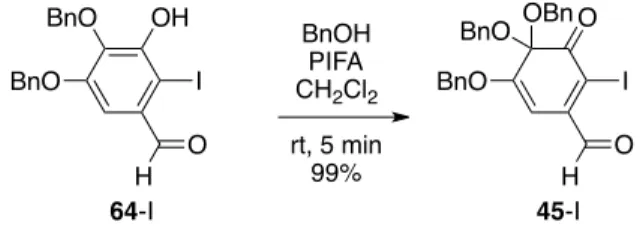
-Diels-Alder Scheme 2-4, 1 45 X H 53 2 47 oxa-Michael C–C 57 16 3 45 Scheme 2-3 X C–C 1,4-44 43 oQ 44 Aryl 47 oQ oQ 45 46 C–O 2.3. 45 oQ 45 45-Br 45-I 2 Scheme 2-5 60 2 Scheme 2-5. oQ HO HO OH MeO O HO MeO O PhCHCl2 pyridine 110 °C, 8 h 78% O O Ph methyl gallate (60) 41 BnO MeO O BnBr NaH DMF rt, 2 h 92% O O Ph 61 BnO DIBAL-H CH2Cl2 rt, 1.5 h 98% OH BnO 62 BnO H O2, Pd(OAc)2 pyridine, MS 3A DMF 90 °C, 73% OH BnO 63 O BnO H DBDMH CHCl3 rt, 24 h 80% OH BnO 64-Br O Br BnO H BnOH PIFA CH2Cl2 rt, 5 min 86% O 45-Br O Br OBn BnO OH BnO H OH BnO 64-I O I BnO H BnOH PIFA CH2Cl2 rt, 5 min 99% O 45-I O I OBn BnO I2, pyridine CHCl3 rt, 24 h 95%
41 17
61 DIBAL-H
62 62
18
63 TEMPO/NaClO219 TEMPO/PIDA20 Swern
21 MnO
222 Dess-Martin 23 HBr/DMSO24 63
63 1,3-dibromo-5,5-dimethylhydantoin
DBDMH 86% 64-Br
64-I
45-Br 45-I BnOH PIFA
oQ 2.4. oxa-Michael 45-Br 45-I oxa-Michael 41 64 Table 2-1 Entry 1 4 45-Br 41 Entry 1 45-I 41
Entry 3 C–O Entry
3 1.5 2 45-Br 41 Entry 1 oxa-Michael Entry 1 41 45-Br 1.3 41 1 68 Entry 5 Entry 2 5 oQ 45-Br 45-I oQ 45-Br 60 °C MeCN 70 °C DMSO 10 K2CO3 DMSO 70 °C 30 45-Br MeCN 70 °C 2 45-Br 12 K2CO3 1 Entry 5 Entry 6 1.3 K2CO3 3 DMSO 45-Br 0.17
Entry 7 DMF THF CH2Cl2 toluene EtOH MeNO2
pyridine 87 0 0 0 26 0 59 K2CO3
Table 2-1. oxa-Michael
Entry 45-X Phenol Solvent Time/h Yield/%
1 Br 41 MeCN 0.5 95 2 Br 64 MeCN 1 60 3 I 41 MeCN 1.5 89 4 I 64 MeCN 3.5 46 5 Br 41 (1.0 equiv.) MeCN 2.5 68a) 6b) Br 41 (1.0 equiv.) MeCN 4 68a) 7 Br 41 DMSO 0.17 98a) 8 Br 41 DMF 0.5 87a) 9 Br 41 THF 0.5 0 10 Br 41 CH2Cl2 0.5 0 11 Br 41 toluene 0.5 0 12 Br 41 EtOH 0.5 26a) 13 Br 41 MeNO2 0.5 0 14 Br 41 pyridine 3 59a)
a) Yield by 1H NMR analysis. Internal standard is acetone. b) K2CO3 (1.0 equiv.)
2.5. 65 Table 2-2 65 NaBH4 27 Luche 1,2- Entry 1 28 Et 3SiH TFA 45-Br O OBn BnO BnO H O X HO O O Ph + 41 (1.3 equiv.) MeO O O OBn BnO BnO H O O O O Ph MeO O 65 K2CO3 (3.0 equiv.) solvent 60 °C HO OBn BnO 64 (1.3 equiv.) MeO O 45-I or or O OBn BnO BnO H O O OBn BnO MeO O 66 or (1.0 equiv.)
Table 2-2.
Entry Reagents Solvent Temperature / °C Yielda / % 1 NaBH4, CeCl3·7H2O MeOH 0 0
2 Et3SiH, TFA CH2Cl2 rt 0
3 n-Bu3SnH, AIBN toluene 100 51
4 Pd(PPthen TBAF 3)4, Et3SiH toluene 80 69 5 Pd(PP3)4, Et3SiH DMF 80 92
a) Isolated yield.
Entry 2 Entry 3 n-Bu3SnH AIBN
100 °C 51% 67 Pd(PPh3)4 Et3SiH 68 TBAF 67 69% MeCN CH2Cl2 EtOH THF DMF DMF 68 67 92 65 66 6 69 DHDG O OBn BnO BnO H O O O O Ph MeO O 65 OH BnO BnO H O O O O Ph MeO O 67 O OBn BnO BnO H O O OBn BnO MeO O 66 OH BnO BnO H O O OBn BnO MeO O 69 Et3SiH Pd(PPh3)4 DMF 80 °C 95% (6) O BnO BnO CHO CO2Me O O O Ph 68 SiEt3
Scheme 2-6. Pd(PPh3)4 Et3SiH Pd(PPh3)4 Et3SiH Scheme 2-6 29 oQ 65 Pd(0) – 65a 65a 65b 65c 67 2.6. DHDG 77 Scheme 2-7 70 30 70 Ac 71 Na 2CO3 Ac 72 72 MOM 73 Ac 74 Bn 75 76 MOM 77 77 45-Br oxa-Michael Scheme 2-8 DHDG 93% oQ 78 75 79 H O OBn BnO BnO H O Aryl O 65 O BnO BnO H O Aryl O 65a Pd(II) BnO O BnO BnO H O Aryl O 65b Pd(II) O BnO BnO H O Aryl O 65c H Pd(0) BnOSiEt3 OH BnO BnO H O Aryl O 67 Oxidative addition Transmetalation Et3SiH Reductive ellimination Eolization
Scheme 2-7. 77 Scheme 2-8. oxa-Michael 79 Scheme 2-9 79 Bn 80 Pinnick 81 82 Bn 8 Me 83 11c, 31 83 1H 13C NMR Table 2-3 Table 2-4 O O OH OBn OH HO BnO HO O O BnO OBn O O OAc OBn OAc AcO BnO AcO O O BnO OBn Ac2O pyridine rt, 13 h 93% 70 71 O O OAc OBn OH AcO BnO HO O O BnO OBn Na2CO3 MeOH rt, 1 h 91% 72 MOMCl i-Pr2NEt DMF rt, 9 h 70% O O OAc OBn OMOM AcO BnO MOMO O O BnO OBn 73 O O OH OBn OMOM HO BnO MOMO O O BnO OBn N2H4·H2O MeCN rt, 20 min 87% 74 O O OBn OBn OMOM BnO BnO MOMO O O BnO OBn BnBr K2CO3 DMF rt, 5 h 97% 75 NaOMe MeOH THF reflux 88% O O OBn OBn OMOM BnO BnO MOMO MeO OMe 76 1) conc. HCl aq. i-PrOH, THF 60 °C, 100% 2) BnBr, NaH DMF, 46% O O OBn OBn OH BnO BnO BnO MeO OMe 77 O O OBn OBn O BnO BnO BnO MeO OMe 78 45-Br K2CO3, MeCN 60 °C, 1.7 h 93% O OBn OHC OBn BnO Br O OBn OHC OBn BnO Et3SiH Pd(PPh3)4 DMF 80°C, 10 min 75% O O OBn OBn O BnO BnO BnO MeO OMe 79 HO OBn OHC OBn O O OBn OBn OH BnO BnO BnO MeO OMe 77
Scheme 2-9. 83 O O OBn OBn O BnO BnO BnO MeO OMe 80 OBn OBn OHC OBn BnBr K2CO3 MeCN rt, 13 h 82% NaClO2 NaH2PO4 2-Me-2-butene t-BuOH, H2O THF rt, 2.5 h 66% O O OBn OBn O BnO BnO BnO MeO OMe 81 OBn OBn OBn OH O MeI K2CO3 DMF rt, 30 min 83% O O OBn OBn O BnO BnO BnO MeO OMe 82 OBn OBn OBn OMe O 1) H2, Pd/C acetone rt, 9 h 2) MeI, K2CO3 DMF, rt, 12 h 21% O O OMe OMe O MeO MeO MeO MeO OMe 83 OMe OMe OMe OMe O 79
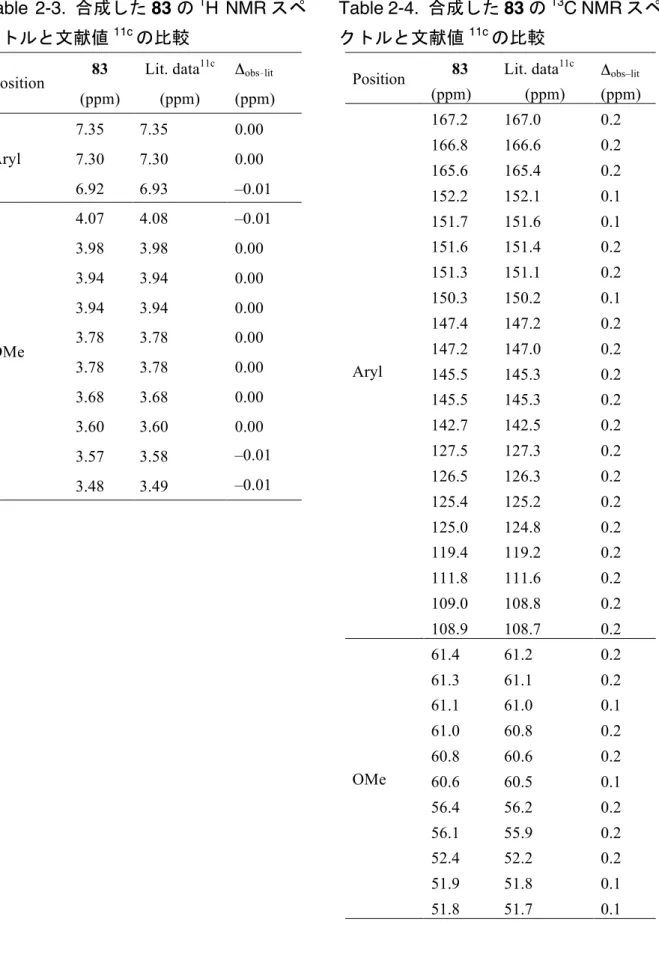
Table 2-3. 83 1H NMR 11c Position 83 (ppm) Lit. data11c (ppm) Δobs lit (ppm) Aryl 7.35 7.35 0.00 7.30 7.30 0.00 6.92 6.93 –0.01 OMe 4.07 4.08 –0.01 3.98 3.98 0.00 3.94 3.94 0.00 3.94 3.94 0.00 3.78 3.78 0.00 3.78 3.78 0.00 3.68 3.68 0.00 3.60 3.60 0.00 3.57 3.58 –0.01 3.48 3.49 –0.01 Table 2-4. 83 13C NMR 11c
Position 83 Lit. data
11c Δobs–lit (ppm) (ppm) (ppm) Aryl 167.2 167.0 0.2 166.8 166.6 0.2 165.6 165.4 0.2 152.2 152.1 0.1 151.7 151.6 0.1 151.6 151.4 0.2 151.3 151.1 0.2 150.3 150.2 0.1 147.4 147.2 0.2 147.2 147.0 0.2 145.5 145.3 0.2 145.5 145.3 0.2 142.7 142.5 0.2 127.5 127.3 0.2 126.5 126.3 0.2 125.4 125.2 0.2 125.0 124.8 0.2 119.4 119.2 0.2 111.8 111.6 0.2 109.0 108.8 0.2 108.9 108.7 0.2 OMe 61.4 61.2 0.2 61.3 61.1 0.2 61.1 61.0 0.1 61.0 60.8 0.2 60.8 60.6 0.2 60.6 60.5 0.1 56.4 56.2 0.2 56.1 55.9 0.2 52.4 52.2 0.2 51.9 51.8 0.1 51.8 51.7 0.1
2.7. C–O 92 Scheme 2-10 2 4 Bn 2-naphtylmethyl Nap Scheme 2-10. 92 90 Scheme 2-10 84 32 84 4 Bn 85 DDQ PMB 87 84 4 Nap 88 89 4 MOM 90 90 91 91 MOM DDQ Nap 92 88 33 92 oQ 45-Br oxa-Michael DHDG 37% Scheme 2-11 92 oQ 45-Br 45-Br 4 HO O OMOM BnO MOMO EDCI·HCl, DMAP CH2Cl2, rt, 3 h 100% 84 86 DDQ buffer (pH = 4.41) CH2Cl2 rt, 3 h 96% 89 HO O OMOM ONap MOMO EDCI, DMAP, CH2Cl2 rt, 6 h 97% 85 88 OPMB O O OMOM BnO MOMO HO OPMB 87 OH O O OMOM BnO MOMO O O O O BnO MOMO O O ONap OMOM MOM MOM conc. aq. HCl i-PrOH, THF 55 °C, 4 h 86% 90 O O O OH BnO HO O HO ONap OH CuCl2 n-BuNH2 MeOH rt, 15 min 93% O O HO BnO HO OH ONap OH O O 91 O O O BnO MOMO O OH OMOM O O 92 MOM MOM 1) MOMCl i-Pr2NEt DMF, rt, 1 h 78% 2) DDQ, CH2Cl2 buffer, rt 88% Nap =
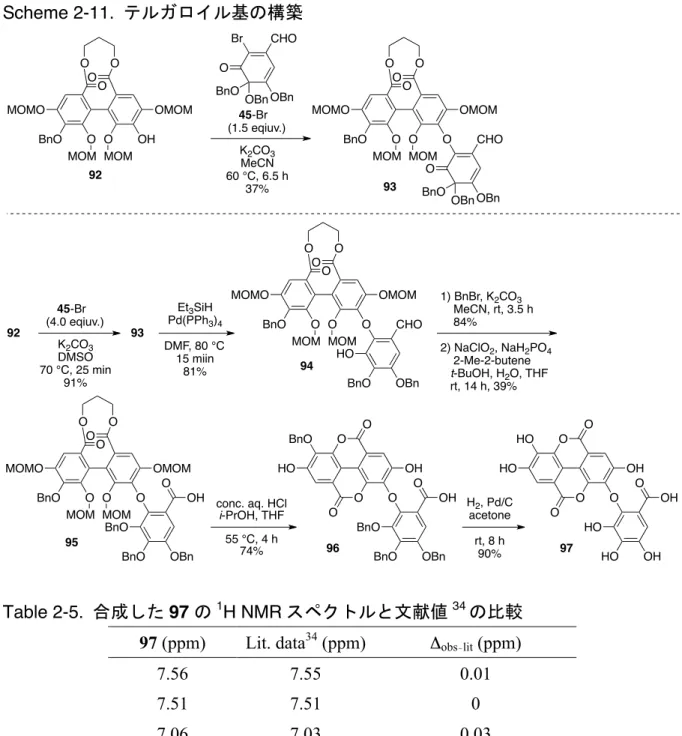
Scheme 2-11. Table 2-5. 97 1H NMR 34 97 (ppm) Lit. data34 (ppm) Δobs lit (ppm) 7.56 7.55 0.01 7.51 7.51 0 7.06 7.03 0.03 DMSO 70 °C 45-Br oxa-Michael 91 Scheme 2-11 81% 94 94 Bn Pinnick 95 MOM 96 74% 96 Bn 97 97 1H NMR 34 O O O BnO MOMO O O OMOM O O 93 MOM MOM K2CO3 MeCN 60 °C, 6.5 h 37% Br O CHO BnO OBn OBn 45-Br O BnO OBn OBn CHO O O O BnO MOMO O OH OMOM O O 92 MOM MOM (1.5 eqiuv.) 93 K2CO3 DMSO 70 °C, 25 min 91% 45-Br (4.0 eqiuv.) O O O BnO MOMO O O OMOM O O 94 MOM MOM Et3SiH Pd(PPh3)4 DMF, 80 °C 15 miin 81% HO BnO OBn CHO 92 O O O BnO MOMO O O OMOM O O 95 MOM MOM BnO BnO OBn OH O O O O OH O O HO BnO BnO BnO OBn OH O conc. aq. HCl i-PrOH, THF 55 °C, 4 h 74% O O O OH O O HO HO HO HO OH OH O H2, Pd/C acetone rt, 8 h 90% 96 97 1) BnBr, K2CO3 MeCN, rt, 3.5 h 84% 2) NaClO2, NaH2PO4 2-Me-2-butene t-BuOH, H2O, THF rt, 14 h, 39%
3.
A
3.1.C–O
A 23 1982
Rosa rugosa THUNB
35 Rosa gallica Meadowsweet
ilipendula ulmaria 23 36 36 HDC 37 3.2. Scheme 3-1 Scheme 3-1. A 23 77 98 98 45-Br oxa-Michael A 23 99 23 O G1O OG1 BnO BnO BnO O BnO OBn OH O OO OG1 O G1O OG1 BnO BnO BnO O BnO OBn O O OO OG1 HO OBn CHO OBn O O BnO BnO BnO OBn OBn OH OMe MeO O O BnO BnO BnO OBn OBn OMe MeO OBn H OH O O OBn O OBn OBn BnO CHO Br K2CO3, MeCN Et3SiH Pd(PPh3)4 DMF
Construction of Valoneoyl Group
Synthetic Strategy of Rugosin A
OBn OBn OBn O G1 = 98 99 45-Br 77 79 rugosin A (23) O OBn OBn BnO CHO Br K2CO3, MeCN Et3SiH Pd(PPh3)4 DMF 45-Br O GO GO HO HO HO O HO OH O O OO OG HO OH OH OH O rugosin A (23)
3.3. A 23 10038 Scheme 3-2 100 10139 i-Pr2NEt Scheme 3-2 106 1 40 DMAP 102 3,4,5-tri-O-gallic anhydride 101 4,6- 103 2 78 75 S (S)-HHDP 104 4,6- 103 41 4,6-HHDP 105 MOM 106 106 oQ 45-Br Scheme 3-3 1 O O O OH HO HO Ph O O O OG1 G1O Ph OG1 i-Pr2NEt, CH2Cl2 24 h, relfux then DMAP, rt α/β = >99 / 1 100 102 O OH HO OG1 G1O OG1 103 conc. HCl aq. i-PrOH, THF 55 °C, 22 h 78% (2 steps) EDCI·HCl, DMAP CH2Cl2 21 h, 0 °C to rt 74% 104 101 O G1O OG1 BnO BnO MOMO O BnO OBn OMOM O O O OG1 105 O G1O OG1 BnO BnO HO O BnO OBn OH O O O OG1 106 conc. HCl aq. i-PrOH, THF 60 °C, 26 h 92% BnO BnO MOMO OH BnO OBn OMOM OH O O BnO BnO OBn O Cl BnO BnO OBn O = G O O OBn OBn OMOM BnO BnO MOMO O O BnO OBn O O OBn OBn OMOM BnO BnO MOMO HO OH 3 M aq. NaOH MeOH, THF reflux, 61% 75 104
Scheme 3-3. 98 oxa-Michael 107 108 109 1:1:1 106 106 2 106 1.1 BnBr 4’ 98 4 110 full-Bn 111 106 4 2 Bn TBS Boc
2,2,2-trichloroethoxycarbonyl Troc Ts 9-fluorenylmethyloxycarbonyl Fmoc SEM Ms 2-(trimethylsilyl)ethoxycarbonyl Teoc O G1O OG1 BnO BnO BnO O BnO OBn OH O O O OG1 98 O G1O OG1 BnO BnO BnO O BnO OBn O O O O OG1 112
MOMCl, i-Pr2NEt
CH2Cl2 rt, 97% OMe H H H HMBC observed in THF-d8 106 BnBr Na2CO3 DMF rt, 5.5 h O G1O OG1 BnO BnO BnO O BnO OBn OH O O O OG1 98 G1O BnO BnO HO O BnO OBn OBn O O O 110 20% 19% 4 4' 4 4' full-Bn tellimagrandin (111) 21% 106 38% Br O BnO OBn OBn CHO K2CO3 MeCN 60 °C, 2 h 45-Br 106 G1O BnO BnO oQKO O BnO OBn OH O O O 108 (1) (2) (3) G1O BnO BnO BnO O BnO OBn OBn O O O 4 4' G1O BnO BnO oQKO O BnO OBn OoQK O O O 109 O G1O OG1 BnO BnO HO O BnO OBn O O O O OG1 107 O OBn CHO OBn BnO = oQK
4’ 98 MOM 3 MOM NMR THF-d8 HHDP HMBC A Scheme 3-4 98 Scheme 3-4. rugosin A 102 O G1O OG1 BnO BnO BnO O BnO OBn O O O O OG1 113 Br O BnO OBn OBn CHO K2CO3, MeCN 60 °C, 2 h 97% 45-Br O OBn CHO OBn BnO O G1O OG1 BnO BnO BnO O BnO OBn O O O O OG1 99 HO OBn CHO OBn Et3SiH Pd(PPh3)4 DMF 80 °C 45 miin 95% BnBr K2CO3 MeCN rt, 8.5 h 86% O G1O OG1 BnO BnO BnO O BnO OBn O O O O OG1 114 BnO OBn CHO OBn NaClO2, NaH2PO4 2-Me-2-butene t-BuOH, H2O THF, rt 77% O G1O OG1 BnO BnO BnO O BnO OBn O O O O OG1 115 BnO OBn OBn O OH H2 Pd/C acetone rt 97% rugosin A (23) 98 MeI K2CO3 DMF rt 53% O (Me)3GO OG(Me)3 MeO MeO MeO O MeO OMe O O O O OG(Me)3 full-Me-rugosin A (116) MeO OMe OMe O OMe
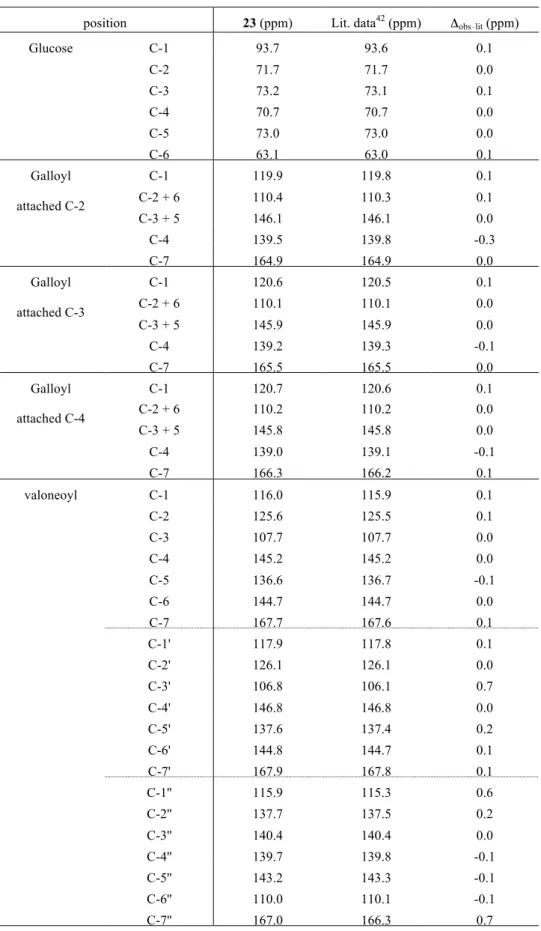
45-Br oxa-Michael 113 99 Bn 114 Pinnick 115 Bn A 23 23 1H 13C NMR Table 3-1 3-2 Table 3-1. A 23 1H NMR 42 position synthetic 23 (ppm) Lit. data42 (ppm) Δ (obs lit) (ppm) H-1 6.17 6.17 0.00 H-2 5.58 5.57 0.01 H-3 5.82 5.82 0.00 H-4 5.18 5.16 0.02 H-5 4.50 4.50 0.00 H-6 5.30 5.29 0.01 3.80 3.78 0.02 Aryl 7.10 7.09 0.01 7.00 7.00 0.00 6.98 6.98 0.00 6.49 6.47 0.02 6.37 6.32 0.05 7.12 7.14 –0.02
Table 3-2. A 23 13C NMR 42 position 23 (ppm) Lit. data42 (ppm) Δobs lit (ppm)
Glucose C-1 93.7 93.6 0.1 C-2 71.7 71.7 0.0 C-3 73.2 73.1 0.1 C-4 70.7 70.7 0.0 C-5 73.0 73.0 0.0 C-6 63.1 63.0 0.1 Galloyl attached C-2 C-1 119.9 119.8 0.1 C-2 + 6 110.4 110.3 0.1 C-3 + 5 146.1 146.1 0.0 C-4 139.5 139.8 -0.3 C-7 164.9 164.9 0.0 Galloyl attached C-3 C-1 120.6 120.5 0.1 C-2 + 6 110.1 110.1 0.0 C-3 + 5 145.9 145.9 0.0 C-4 139.2 139.3 -0.1 C-7 165.5 165.5 0.0 Galloyl attached C-4 C-1 120.7 120.6 0.1 C-2 + 6 110.2 110.2 0.0 C-3 + 5 145.8 145.8 0.0 C-4 139.0 139.1 -0.1 C-7 166.3 166.2 0.1 valoneoyl C-1 116.0 115.9 0.1 C-2 125.6 125.5 0.1 C-3 107.7 107.7 0.0 C-4 145.2 145.2 0.0 C-5 136.6 136.7 -0.1 C-6 144.7 144.7 0.0 C-7 167.7 167.6 0.1 C-1' 117.9 117.8 0.1 C-2' 126.1 126.1 0.0 C-3' 106.8 106.1 0.7 C-4' 146.8 146.8 0.0 C-5' 137.6 137.4 0.2 C-6' 144.8 144.7 0.1 C-7' 167.9 167.8 0.1 C-1'' 115.9 115.3 0.6 C-2'' 137.7 137.5 0.2 C-3'' 140.4 140.4 0.0 C-4'' 139.7 139.8 -0.1 C-5'' 143.2 143.3 -0.1 C-6'' 110.0 110.1 -0.1 C-7'' 167.0 166.3 0.7
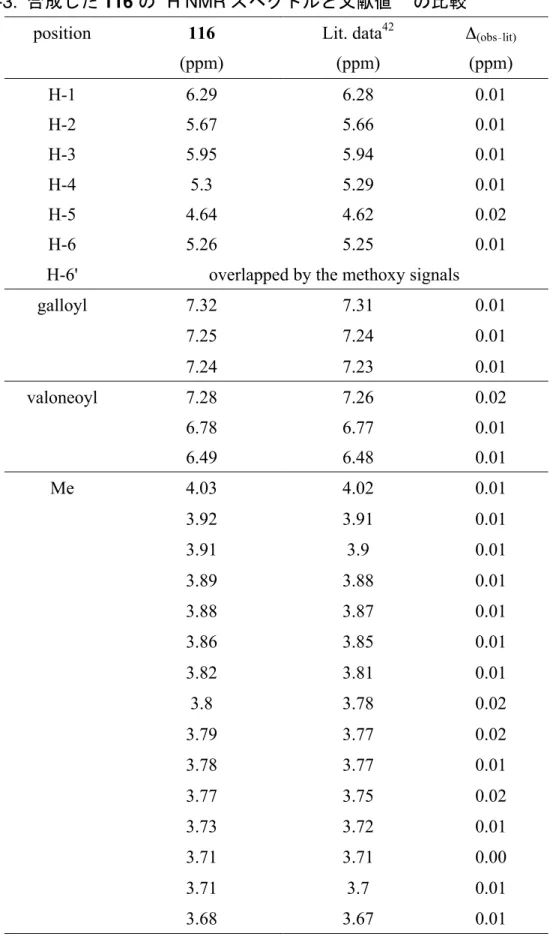
NMR NMR acetone-d6 D2O 1H NMR Fig. 3-1 1H NMR Figure 3-1. A 23 23 Me A Table 3-3 42 abunda nc e -0.6 -0.5 -0.4 -0.3 -0.2 -0.1 0 0.1 0.2 0.3
X : parts per Million : 1H7.1 7.0 6.9 6.8 6.7 6.6 6.5 6.4 6.3 6.2 6.1
acetone-d6 + 4% D2O
acetone-d6 + 2% D2O
Table 3-3. 116 1H NMR 42 position 116 (ppm) Lit. data42 (ppm) Δ(obs lit) (ppm) H-1 6.29 6.28 0.01 H-2 5.67 5.66 0.01 H-3 5.95 5.94 0.01 H-4 5.3 5.29 0.01 H-5 4.64 4.62 0.02 H-6 5.26 5.25 0.01
H-6' overlapped by the methoxy signals
galloyl 7.32 7.31 0.01 7.25 7.24 0.01 7.24 7.23 0.01 valoneoyl 7.28 7.26 0.02 6.78 6.77 0.01 6.49 6.48 0.01 Me 4.03 4.02 0.01 3.92 3.91 0.01 3.91 3.9 0.01 3.89 3.88 0.01 3.88 3.87 0.01 3.86 3.85 0.01 3.82 3.81 0.01 3.8 3.78 0.02 3.79 3.77 0.02 3.78 3.77 0.01 3.77 3.75 0.02 3.73 3.72 0.01 3.71 3.71 0.00 3.71 3.7 0.01 3.68 3.67 0.01
4
oQ 45-Br DHDG C–O 45-Br oxa-Michael oQ 1 2 2 4 aryl–aryl HHDP 3 C–O Scheme 4-1. C–O Scheme 4-2. A 23 O OBn BnO BnO H O Br HO Aryl + 45-Br OBn OBn OBn BnO BnO HO 77(for valoneoyl group) MeO2C HO 41 (for DHDG group) MeO2C CO2Me MeO2C HO BnO OBn O O Ph 64 (for DHDG group) O OBn BnO BnO H O Aryl O K2CO3 MeCN 60 °C or K2CO3 DMSO 70 °C OH BnO BnO H O Aryl O 44 43 oxa-Michael addition/
elimination aromatizationreductive
O O O OBn OMOM O HO MOMO O O 92
(for tergalloyl group) MOM MOM Et3SiH Pd(PPh3)4 DMF 80 °C O G1O OG1 BnO BnO BnO O BnO OBn OH O OO OG1 98 O G1O OG1 BnO BnO BnO O BnO OBn O O OO OG1 99 HO OBn CHO OBn 1) 45-Br, K2CO3 MeCN 60 °C, 2 h 97% 2) Et3SiH Pd(PPh3)4 DMF, 80 °C 45 min, 95% 3 steps 64% rugosin A (23)
1. Snyder, S.; Elsohly, A. M.; Kontes, F. Nat. Prod. Rep. 2011, 897-924.
2. Devon, T. K.; Scott, A. I. Handbook of NATURALLY OCCURRING COMPOUNDS
volume II Terpenes, (Elsevier, New York and London: 1972).
3. Ohmori, K.; Shono, T.; Hatakoshi, Y.; Yano, T.; Suzuki, K. Angew. Chem. Int. Ed. 2011,
50, 4862-4867.
4. Kanie, O.; Ito, Y.; Ogawa, T. J. Am. Chem. Soc. 1994, 116, 12073-12074. 5. Snyder, S. A.; Gollner, A.; Chiriac, M. Nature, 2011, 474, 461-466.
6. Pouységu, L.; Deffieux, D.; Malik, G.; Natangelo, A.; Quideau, S. Nat. Prod. Rep. 2011,
28, 853-874.
7. a) Feldman, K. S.; Ensel, S. M. J. Am. Chem. Soc. 1994, 116, 3357–3366. b) Khanbabaee, K.; van Ree, T. Synthesis, 2001, 1585–1610. c) Su, X.; Surry, D. S.; Spandl, R. J.; Spring, D. R. Org. Lett. 2008, 10, 2593–2596.
8. a) Feldman, K. S., Quideau, S., Appel, H. M. J. Org. Chem. 1996, 61, 6656-6665. b) Abe, H.; Sahara, Y.; Matsuzaki, Y.; Takeuchi, Y.; Harayama, T. Tetrahedron Lett. 2008, 49, 605–609. c) Lin, J-H. Ishimatsu, M., Tanaka, T., Nonaka, G., Nishioka, I. Chem.
Pharm. Bull. 1990, 1844-1851.
9. Feldman, K. S., Lawlor, M. D.; Sahasrabudhe, K. M. J. Org. Chem. 2000, 65, 8011– 8019.
10. Feldman, K. S., Lawlor, M. D. J. Am. Chem. Soc. 2000, 122, 7396-7397.
11. a) Lin, J-H. Ishimatsu, M., Tanaka, T., Nonaka, G., Nishioka, I. Chem. Pharm. Bull.
1990, 1844-1851. b) Abe, H., Sahara, Y., Matsuzaki, Y., Takeuchi, Y., Harayama, T.
Tetrahedron Lett. 2008, 49, 605-609. c) Shioe, K., Sahara, Y., Horino, Y., Harayama, T.,
Takeuchi, Y., Abe, H. Tetrahedron 2011, 67, 1960-1970.
12. Feldman, K. S.; Ensel, S. M. J. Am. Chem. Soc. 1994, 116, 3357–3366. 13. Quideau, S.; Feldman, K. S. Chem. Rev. 1996, 96,475–503.
14. Shioe, K.; Ishikura, S.; Horino, Y.; Abe, H. Chem. Pharm. Bull. 2013, 12, 1308–1314. 15. Betson, M. S.; Llayden, J.; Worrall, C. P.; Peace, S. Angew. Chem. Int. Ed. 2006, 45,
5803–5807.
16. Quideau, S.; Feldman, K. S. Chem. Rev. 1996, 96,475–503. 17. Domon, L.; Uguen, D. Tetrahedron Lett. 2000, 41, 5501–5505.
18. Nishimura, T., Onoue, T., Ohe, K., Uemura, S. J. Org. Chem. 1999, 64, 6750-6755. 19. Bode, BJ. W., Carreira, E. M. J. Org. Chem. 2001, 66, 6410-6424.
20. Jauch, J. Angew. Chem. Int. Ed. 2000, 39, 2764-265.
22. Fatiadi, A. J. Synthesis 1976, 133-167.
23. Dess, D. B. Martin, J. C. J. Org. Chem. 1983, 48, 4155-4156.
24. Li, C., Xu, Y., Lu, M., Zhao, Z., Liu, L., Zhao, Z., Cui, Y., Zheng, P., Ji, X., Gao, G.
Synlett 2002, 2041-2042.
25. Su, X., Surry, D. S., Spandl, R. J., Spring, D. R. Org. Lett. 2008, 10, 2593-2596.
26. a) Dolson, M.. Jackson, D. K., Swenton, J. S. J. Chem. Soc. Chem. Comm. 1979, 327-329. b) Mascall, K. C., Jacobi, P. A. Tetrahedron Lett. 2012, 53, 1620-1623.
27. a) Luche, J-L. J. Am. Chem. Soc. 1978, 100, 2226–2227. b) Gemal, A. L.; Luchem, J-L.
Tetrahedron Lett. 1981, 22, 4077–4080.
28. a) Sundararaju, B., Achard, M., Bruneau, C. Chem. Soc. Rev. 2012, 41, 4467-4483. b) Guibé, F. Tetrahedron 1998, 54, 2967-3042. c) Takemura, A., Fujiwara, K., Shimawaki, K., Murai, A., Kawai, H., Suzuki, T. Tetrahedron 2005, 61, 7392-7419.
29. Asakura, N., Fujimoto, S., Michihata, N., Nishii, K., Imagawa, H., Yamda, H. J. Org.
Chem. 2011, 76, 9711-9719.
30. Ishimaru, K.; Ishimatsu, M.; Nonaka, G.; Mihashi, K.; Iwase, Y.; Hishioka, I. Chem.
Pharm, 1988, 36, 3319-3327
31. Pandey, S. K., Kandula, S. V., Kumar, P. Tetrahedron Lett. 2004, 45, 5877-5879.
32. Xia, J., Abbas, S. A. Locke, R. D., Piskorz, C. F., Alderfer. J. L., Matta, K. L.
Tetrahedron Lett. 2000, 41, 169-173.
33. Yoshida, T., Yazaki, K., Memon, M. U., Maruyama, I., Kurokawa, K., Shigu, T., Okuda, T. Chem. Pharm. Bull. 1989, 10, 2655-2660.
34. Ishimaru, K.; Ishimatsu, M.; Nonaka, G.; Mihashi, K.; Iwase, Y.; Hishioka, I. Chem.
Pharm, 1988, 36, 3319-3327
35. Okuda, T.; Hatano, T.; Yazaki, K.; Ogawa, N. Chem. Pharm. Bull. 1982, 30, 4230-4233. 36. Ochir, S.; Nishizawa, M.; Park, B. J.; Ishii, K.; Kanazawa, T.; Funaki, M.; Yamagishi, M.
J. Nat. Med. 2010, 64, 275-280.
37. Nitta, Y.; Kikuzaki, H.; Azuma, T.; Ye, Y.; Sakaue, M.; Sakaue, M.; Higuchi, Y.; Komori, H.; ueno, H. Food Chem. 2013, 138, 1551-1556.
38. Barili, P. L.; Berti, G.; Catelani, G.; Cini, C.; D’Andrea, F.; Mastrorilli, E. Carbohydr.
Res. 1995, 278, 43-57.
39. a) Ren, Y.; Himmeldirk, K.; Chen, X. J. Med. Chem. 2006, 49, 2829-2837.b) Arapitsas, P.; Menichetti, S.; Vincieri, F. F.; Romani, A. J. Agric. Food Chem. 2007, 48-55. c) Dodo, K.; Minato, T.; Noguchi-Yachide, T.; Suganuma, M.; Hashimoto, Y. Bioorg. Med.
Chem. 2008. 16. 7975-7982. d) Zhang, W.; Liu, Y.; Chen, X.; Bergmeier, S. C. Bioorg. Med. Chem. Lett. 2010. 20. 2191-2194. e) Malik, G.; Natangelo, A.; Charris, J.;
Pouységu, L.; Manferedini, S.; Cavagnat, D.; Buffeteau, T.; Deffieux, D.; Quideau, S.
Chem. Eur. J. 2012, 18, 9063-9074.
40. a) Bols, M.; Hansen, H. C. Acta Chem. Scand. 1993, 47, 818-822. b) Binkely, R.; Ziepfel, J. C.; Himmeldirk, K. B. Carbohydr. Res. 2009, 344, 237-239. c) Naok, M.; Kaneko, Y.; Kasai, Y.; Tanigawa, K.; Hirokane, T.; Higasa, S.; Yamada, H. J. Org. Chem. 2013, 78, 4319-4328.
41. a) Yamaguchi, S.; Ashikaga, Y.; Nishii, K.; Yamada, H. Org. Lett, 2012, 14, 5928-5931. b) Yamaguchi, S.; Hirokane, T.; Yoshida, T.; Tanaka, T.; Hatano, T.; Ito, H.; Nonaka, G.; Yamada, H. J. Org. Chem. 2013, 78, 5410-5417.
42. Hatano, T.; Ogawa, N.; Yasuhara, T.; Okuda, T. Chem. Pharm. Bull. 1990, 38, 3308-3313.
General methods used in experimental procedures
All commercially available reagents were used without further purification. All moisture and air sensitive reactions were performed in glassware equipped with rubber septa (or a septum) under the positive pressure of argon or nitrogen. When necessary, the glassware was dried under reduced pressure by heating with a heat-gun and solvents were distilled prior to use. The reaction mixture was magnetically stirred. Concentration was performed under reduced pressure.
The reactions were monitored by TLC and MS. Anhydrous MgSO4 was used to dry
organic layers after extraction, and it was removed by filtration through a cotton pad. The filtrate was concentrated and subjected to further purification protocols if necessary. This sequence was represented as “the general drying procedure” in the following experimental methods.
TLC was performed on Merck pre-coated silica gel 60 F-254 plates or Merck RP-19 F-254 plates. Spots were visualized by exposure to UV light, or by immersion into a solution of 10% phosphomolybdic acid in ethanol, followed by heating at ca. 200 °C.
Column chromatography (CC) was performed on Merck silica gel 60 (63–200 or 40–63 µm) and Kanto Chemical silica gel 60 N (Spherical, neutral, 40–50 or 63–210 µm). The other carrier materials were noted in each case.
The melting points were uncorrected. Optical rotations were determined with a 100 mm cell at 589 nm. IR spectra were recorded with a spectrophotometer equipped with an ATR sampling unit, and the major absorbance bands are all reported in wavenumbers (cm–1). All MS were obtained using electrospray ionization (ESI) and time-of-flight (TOF) observation. NMR spectra (1H: 400 MHz, 13C: 100 MHz) were observed in the indicated solvent in each parenthesis. Either TMS or residual protons of deuterated solvent were used as an internal reference. The 1H NMR data are indicated by chemical shifts (δ), with the multiplicity, the coupling constants, and the integration in parentheses. The multiplicities are abbreviated as s: singlet, d: doublet, t: triplet, q: quartet, quin: quintet, m: multiplet, and br: broad. The 13C NMR data are reported as the chemical shift (δ) with the hydrogen multiplicity obtained from the DEPT spectra. The multiplicities are abbreviated as s: C, d: CH, t: CH2, and q: CH3. When the number
3,4-Dibenzyloxy-5-hydroxybenzyl alcohol (62).
To a solution of phenol 411 (1.00 g, 3.67 mmol) in a mixture of DMF and toluene (v/v = 3/1, 37 mL) were added NaH (60% in mineral oil 220 mg, 132 mg as NaH, 5.51 mmol) and BnBr (942 mg, 5.51 mmol). The mixture was stirred for 2 h at rt under N2 atmosphere. The reaction was
quenched by addition of satd aq NH4Cl (20 mL). The aq mixture was extracted with Et2O. The
organic layer was successively washed with H2O and brine. After the general drying procedure,
the resulting residue was purified by CC (30 g of SiO2, n-hexane/EtOAc = 20/1 to 5/1) to afford
the corresponding benzyl ether (1.22 g, 3.37 mmol, 92% yield) as white solid.
DIBAL-H (1.0 M in THF, 9.7 mL, 9.7 mmol) was added to a solution of the benzyl ether (1.00 g, 2.78 mmol) in CH2Cl2 (10 mL). The solution was stirred for 1 h at 0 °C under N2
atmosphere. To the reaction mixture was added 1 M hydrochloric acid (20 mL). The aq mixture was extracted with EtOAc. The organic layer was successively washed with 1 M hydrochloric acid (10 mL), H2O (10 mL), and brine (10 mL). After the general drying
procedure, the resulting residue was purified by CC (20 g of SiO2, n-hexane/EtOAc = 5/1 to
1/1) to afford 62 (935 mg, 2.78 mmol, 100% yield) as a colorless syrup: IR 3362, 3066, 3018, 2942, 2878, 1595, 1508, 1452, 1377, 1346, 1214, 1173, 1138, 1095, 966, 914; 1H NMR (in CDCl3) δ 7.48–7.32 (m, 11H), 6.63 (d, J = 1.8 Hz, 1H), 6.57 (d, J = 1.8 Hz, 1H), 5.67 (s, 1H,
OH), 5.15 (s, 2H), 5.08 (s, 2H), 4.57 (d, J = 3.4 Hz, 2H), 1.65 (t, J = 3.4 Hz, 1H, OH); 13C NMR (in CDCl3) δ 151.8 (s), 149.8 (s), 137.4 (s), 137.2 (s), 136.9 (s), 134.2 (s), 128.8 (d, 2C),
128.8 (d, 4C), 128.7 (d), 128.2 (d), 127.7 (d, 2C), 107.0 (d), 104.3 (d), 75.6 (t), 71.0 (t), 65.4 (t); HRMS m/z calcd for C21H20O4Na [M + Na]+ 359.1259, found 359.1266.
3,4-Dibenzyloxy-5-hydroxybenzaldehyde (63). HO MeO O O O Ph 41 1) BnBr, NaH DMF, 2 h 92% 2) DIBAL-H, CH2Cl2 rt, 1.5 h 98% BnO OH BnO 62 OH BnO H O2, Pd(OAc)2 pyridine, MS 3A DMF 90 °C, 73% OH BnO 63 O BnO OH BnO 62 OH
To a solution of alcohol 62 (220 mg, 654 µmol) in DMF (6.5 mL) were added pyridine (51.7 mg, 654 µmol), activated M-sieve 3A (300 mg), and Pd(OAc)2 (14.7 mg, 65.4 µmol).
The mixture was stirred for 18 h at 90 °C under O2 atmosphere. To the reaction mixture were
added Et2O (5 mL) and 1 M hydrochloric acid (15 mL). This aq mixture was extracted with
Et2O. The organic layer was washed with satd aq NaHCO3. After the general drying
procedure, the resulting residue was purified by CC (7.0 g of SiO2, n-hexane/EtOAc = 15/1 to
4/1) to afford aldehyde 63 (159 mg, 447 mmol, 73% yield) as white solid. 1H NMR data for
63 was identical to that of reported data2.
4,5-Dibenzyloxy-2-bromo-3-hydroxybenzaldehyde (64-Br).
DBDMH (428 mg, 1.50 µmol) was added to a solution of phenol 63 (1.00 g, 2.99 µmol) in CHCl3 (30 mL). The solution was stirred for 24 h at rt under N2 atmosphere. The reaction
was quenched with 10% aq Na2S2O3. The aq mixture was extracted with Et2O. The organic
layer was successively washed with H2O. After the general drying procedure, the crude
product was purified by recrystallization from a mixture of EtOAc and n-hexane to afford
64-Br (994 mg, 2.40 µmol, 80% yield) as a white solid: m.p. 114.5–115.5 °C; IR 3293, 3062,
3028, 1679, 1661, 1571, 1497, 1478, 1454, 1396, 1375, 1340, 1233, 1210, 1132, 1103, 1027, 954, 914, 868; 1H NMR (in CDCl 3) δ 10.72 (s, 1H), 7.48–7.45 (m, 2H), 7.43–7.32 (m, 8H), 7.27 (s, 1H), 6.15 (s, 1H, OH), 5.22 (s, 2H), 5.19 (s, 2H); 13C NMR (in CDCl3) δ 191.1 (d), 150.7 (s), 147.6 (s), 140.1 (s), 136.3 (s), 135.9 (s), 129.1 (d), 128.9 (d, 2C), 128.9 (d, 2C), 128.9 (s), 128.7 (d, 2C), 128.6 (d), 127.9 (d, 2C), 106.9 (s), 105.8 (d), 76.0 (t), 71.3 (t); HRMS m/z calcd for C21H17BrO4Na [M + Na]+ 435.0208, found 435.0201.
4,5-Dibenzyloxy-3-hydroxy-2-iodobenzaldehyde (64-I). BnO H OH BnO 63 O BnO H DBDMH CHCl3 rt, 24 h 80% OH BnO 64-Br O Br BnO H OH BnO 63 O BnO H I2, pyridine CHCl3 rt, 24 h 95% OH BnO 64-I O I
I2 (45.5 mg, 179 µmol) was added to a solution of phenol 63 (50.0 mg, 150 µmol) and
pyridine (29.1 mg, 369 µmol) in CHCl3 (1.5 mL). The solution was stirred for 4 h at rt under
N2 atmosphere. Further I2 (23.9 mg, 94.2 µmol) was added to the solution, and the mixture
was stirred for additional 20 h. The reaction was quenched with 10% of aq Na2S2O3; it was
added until the mixture became colorless (5 mL). The aq mixture was extracted with Et2O.
The organic layer was successively washed with H2O, 1 M hydrochloric acid, and brine. After
the general drying procedure, the resulting residue was purified by CC (3 g of SiO2, n-hexane/EtOAc = 15/1 to 7/1) to afford 64-I (65.6 mg, 143 µmol, 95% yield) as a white
solid: m.p. 126.5–127.0 °C; IR 3499, 3061, 3028, 2857, 1688, 1581, 1497, 1478, 1463, 1454, 1434, 1375, 1329, 1219, 1145, 1095, 1026, 1008, 946, 916, 865, 842, 813; 1H NMR (in CDCl3) δ 10.04 (s, 1H), 7.45 (m, 2H), 7.43(m, 9H), 6.36 (s, 1H, OH), 5.21 (s, 2H), 5.20 (s,
2H); 13C NMR (in CDCl3) δ 195.2 (d), 151.5 (s), 149.8 (s), 139.1 (s), 136.2 (s), 135.9 (s),
130.4 (s), 129.0 (d, 2C), 128.9 (d, 2C), 128.9 (d, 2C), 128.7 (d, 2C), 128.6 (d), 127.8 (d, 2C), 107.0 (d), 76.0 (t), 71.3 (t); HRMS m/z calcd for C21H17IO4Na [M + Na]+ 483.0069, found
483.0078.
4,4,5-Tris(benzyloxy)-2-bromo-3-oxo-1,5-cyclohexadiene-1-carbaldehyde (45-Br).
PIFA (563 mg, 1.31 mmol) was added to a solution of o-bromophenol 64-Br (360 mg, 872 µmol) in CH2Cl2 (2.0 mL) and BnOH (3.0 mL). The solution was stirred for 5 min at rt under
N2 atmosphere. The reaction mixture was diluted with Et2O (30 mL), and satd aq NaHCO3 (10
mL) was then added. The aq mixture was extracted with Et2O. The organic layer was
successively washed with H2O. After the general drying procedure, the resulting residue was
purified by CC (90 g of SiO2, n-hexane/toluene = 1/0 to 1/3) to afford 45-Br (390 mg, 751 µmol,
86% yield) as a red syrup: IR 3064, 3033, 2941, 2924, 2875, 1692, 1634, 1538, 1497, 1455, 1311, 1216, 1171, 1111, 1027, 881, 835; 1H NMR (in CDCl3) δ 10.26 (s, 1H), 7.37 (s, 5H),
7.31–7.26 (m, 10H), 5.89 (s, 1H), 5.01 (s, 2H), 4,75 (d, J = 11.7 Hz, 2H), 4.65 (d, J = 11.7 Hz, 2H); 13C NMR (in CDCl
3) δ 191.9 (d), 190.3 (s), 161.6 (s), 141.5 (s), 137.1 (s, 2C), 134.8 (s),
128.8 (d, 2C), 128.7 (d), 128.4 (d, 4C), 128.0 (d, 3C), 127.8 (d, 5C), 123.5 (s), 95.6 (s), 94.0 (d), 71.3 (t), 66.5 (t, 2C); HRMS m/z calcd for C28H23BrO5Na [M + Na]+ 541.0627, found
541.0606. BnO H OH BnO 64-Br O Br BnO H BnOH PIFA CH2Cl2 rt, 5 min 86% O 45-Br O Br OBn BnO
4,4,5-Tris(benzyloxy)-2-iodo-3-oxo-1,5-cyclohexadiene-1-carbaldehyde (45-I).
PIFA (336 mg, 782 µmol) was added to a solution of o-iodophenol 64-I (300 mg, 652 µmol) in CH2Cl2 (1.0 mL) and BnOH (5.0 mL). The solution was stirred for 5 min at rt under
N2 atmosphere. The reaction mixture was diluted with Et2O (20 mL), and satd aq NaHCO3
(10 mL) was then added. The aq mixture was extracted with Et2O. The organic layer was
washed with H2O. After the general drying procedure, the resulting residue was purified by
CC (9.0 g of SiO2, n-hexane/EtOAc = 50/1 to 15/1) to afford 45-I (366 mg, 646 µmol, 99%
yield) as a red syrup: IR 3087, 3064, 3030, 2931, 2868, 1691, 1631, 1524, 1497, 1455, 1374, 1306, 1215, 1168, 1105, 1073, 1027, 910, 833; 1H NMR (in CDCl
3) δ 9.96 (s, 1H), 7.36 (s,
5H), 7.30–7.26 (m, 10H), 5.93 (s, 1H), 5.02 (s, 2H), 4,74 (d, J = 11.7 Hz, 2H), 4.63 (d, J = 11.7 Hz, 2H); 13C NMR (in CDCl3) δ 196.0 (d), 191.3 (s), 162.4 (s), 145.3 (s), 137.1 (s, 2C),
134.8 (s), 128.8 (d, 2C), 128.7 (d), 128.4 (d, 4C), 127.9 (d, 2C), 127.8 (d, 6C), 105.0 (s), 95.5 (d), 95.1 (s), 71.4 (t), 66.5 (t, 2C); HRMS m/z calcd for C28H23IO5Na [M + Na]+ 589.0488,
found 589.0481.
oxa-Michael addition/ellimination
Methyl 3,4-O-Benzylidene-5-O-[4,5,5-tris(benzyloxy)-2-formyl-6-oxocylohexa-1,3- dienyl]gallate (65)
Table 2-1. Entry 1.
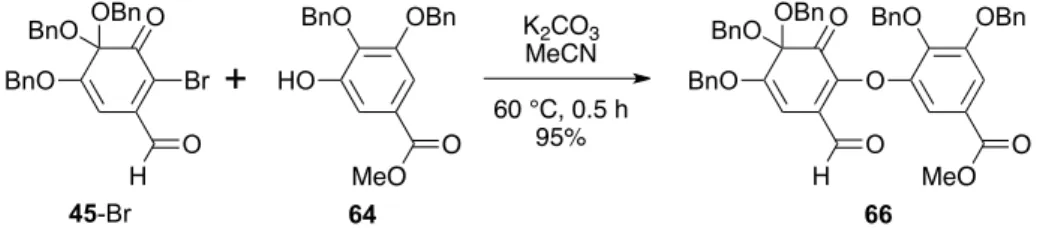
To a solution of 45-Br (53.4 mg, 103 µmol) in MeCN (1.4 mL) was added phenol 41 (36.5 mg, 134 µmol) and K2CO3 (71.2 mg, 515 µmol). The mixture was stirred for 30 min at 60 °C under N2
atmosphere. After being cooled to room temperature, Et2O (5 mL) and 1 M hydrochloric acid (5 mL)
were added to the reaction mixture. The aqueous mixture was extracted with Et2O. The combined BnO H OH BnO 64-I O I BnO H BnOH PIFA CH2Cl2 rt, 5 min 99% O 45-I O I OBn BnO 45-Br O OBn BnO BnO H O Br HO O O Ph
+
41 MeO O O OBn BnO BnO H O O O O Ph MeO O K2CO3 MeCN 60 °C, 0.5 h 95% 65organic layer was successively washed with saturated aqueous NaHCO3 and brine, dried over MgSO4,
and concentrated. The crude product was purified by column chromatography (2.0 g of SiO2,
n-hexane/EtOAc = 20/1 to 10/1) to afford ortho-quinone monoketal 65 (69.3 mg, 97.5 µmol, 95%
yield): IR 3066, 3030, 2948, 2883, 1717, 1629, 1498, 1438, 1387, 1364, 1323, 1306, 1243, 1215, 1177, 1069, 1019, 905 cm–1; 1H NMR (400 MHz in CDCl3) δ 10.39 (s, 1H), 7.54–7.51 (m, 2H), 7.43–7.35 (m, 10H), 7.27–7.23 (m, 10H), 7.02 (s, 1H), 5.80 (s, 1H), 4.98 (s, 2H), 4.75 (d, J = 11.7 Hz, 1H), 4.71 (d, J = 11.7 Hz, 1H), 4.61 (d, J = 11.7 Hz, 1H), 4.55 (d, J = 11.7 Hz, 1H), 3.72 (s, 3H); 13C NMR (100 MHz in CDCl3) δ 191.8 (s), 189.2 (d), 165.7 (s), 158.9 (s), 149.8 (s), 146.3 (s), 140.5 (s), 139.5 (s), 137.3 (s), 137.3 (s), 135.1 (s), 135.0 (s), 131.9 (s), 130.8 (d), 128.9 (d, 2C), 128.8 (d, 2C), 128.5 (d), 128.4 (d, 2C), 128.3 (d, 2C), 127.8 (d), 127.7 (d, 3C), 127.6 (d, 2C), 127.6 (d, 2C), 126.5 (d, 2C), 124.8 (s), 114.1 (d), 112.7 (d), 106.1 (d), 95.4 (s), 90.6 (d), 71.0 (t), 66.3 (t), 66.2 (t), 52.3 (q); ESI-HRMS m/z calcd for C43H34O10Na [M + Na]+ 733.2050, found 733.2063.
Table 2-1. Entry 3.
Following the procedure described for Entry 1, use of 45-I (43.0 mg, 75.9 µmol), phenol
41 (26.9 mg, 98.7 µmol), K2CO3 (40.9 mg, 29.6 µmol) and MeCN (1.0 mL) provided crude
products containing ortho-quinone monoketal 65 (48.1 mg, 67.6 µmol, 89% yield) Table 2-1. Entry 5.
Following the procedure described for Entry 1, use of 45-Br (68.5 mg, 132 µmol), phenol
41 (35.9 mg, 132 µmol), K2CO3 (54.7 mg, 396 µmol) and MeCN (1.7 mL) provided crude
products containing ortho-quinone monoketal 65. The yield of 65 was determined on the basis of the 1H NMR spectra of the crude product to be 68%
Table 2-1. Entry 6.
Following the procedure described for Entry 1, use of 45-Br (72.6 mg, 140 µmol), phenol
41 (381 mg, 14.0 µmol), K2CO3 (19.4 mg, 140 µmol) and MeCN (1.8 mL) provided crude
products containing ortho-quinone monoketal 65. The yield of 65 was determined on the basis of the 1H NMR spectra of the crude product to be 68%.
Table 2-1. Entry 7.
Following the procedure described for Entry 1, use of 45-Br (10.0 mg, 19.3 µmol), phenol
41 (6.8 mg, 25.3 µmol), K2CO3 (10.4 mg, 75.3 µmol) and DMSO (0.5 mL) provided crude
products containing ortho-quinone monoketal 65. The yield of 65 was determined on the basis of the 1H NMR spectra of the crude product to be 98%.
Table 2-1. Entry 8.
Following the procedure described for Entry 1, use of 45-Br (10.0 mg, 19.3 µmol), phenol
41 (6.8 mg, 25.3 µmol), K2CO3 (10.4 mg, 75.3 µmol) and DMF (0.5 mL) provided crude
products containing ortho-quinone monoketal 65. The yield of 65 was determined on the basis of the 1H NMR spectra of the crude product to be 87%.
Table 2-1. Entry 9.
Following the procedure described for Entry 1, use of 45-Br (10.0 mg, 19.3 µmol), phenol
41 (6.8 mg, 25.3 µmol), K2CO3 (10.4 mg, 75.3 µmol) and THF (0.5 mL) provided crude
products containing ortho-quinone monoketal 65. The yield of 65 was determined on the basis of the 1H NMR spectra of the crude product to be 0%.
Table 2-1. Entry 10.
Following the procedure described for Entry 1, use of 45-Br (10.0 mg, 19.3 µmol), phenol
41 (6.8 mg, 25.3 µmol), K2CO3 (10.4 mg, 75.3 µmol) and CH2Cl2 (0.5 mL) provided crude
products containing ortho-quinone monoketal 65. The yield of 65 was determined on the basis of the 1H NMR spectra of the crude product to be 0%.
Table 2-1. Entry 11.
Following the procedure described for Entry 1, use of 45-Br (10.0 mg, 19.3 µmol), phenol
41 (6.8 mg, 25.3 µmol), K2CO3 (10.4 mg, 75.3 µmol) and toluene (0.5 mL) provided crude
products containing ortho-quinone monoketal 65. The yield of 65 was determined on the basis of the 1H NMR spectra of the crude product to be 98%.
Table 2-1. Entry 12.
Following the procedure described for Entry 1, use of 45-Br (10.0 mg, 19.3 µmol), phenol
41 (6.8 mg, 25.3 µmol), K2CO3 (10.4 mg, 75.3 µmol) and EtOH (0.5 mL) provided crude
products containing ortho-quinone monoketal 65. The yield of 65 was determined on the basis of the 1H NMR spectra of the crude product to be 26%.
Table 2-1. Entry 13.
Following the procedure described for Entry 1, use of 45-Br (10.0 mg, 19.3 µmol), phenol
41 (6.8 mg, 25.3 µmol), K2CO3 (10.4 mg, 75.3 µmol) and MeNO2 (0.5 mL) provided crude
products containing ortho-quinone monoketal 65. The yield of 65 was determined on the basis of the 1H NMR spectra of the crude product to be 0%.
Table 2-1. Entry 14.
Following the procedure described for Entry 1, use of 45-Br (10.0 mg, 19.3 µmol), phenol
41 (6.8 mg, 25.3 µmol), K2CO3 (10.4 mg, 75.3 µmol) and pyridine (0.5 mL) provided crude
products containing ortho-quinone monoketal 65. The yield of 65 was determined on the basis of the 1H NMR spectra of the crude product to be 59%.
Methyl 3,4-Di-O-benzyl-5-O-[4,5,5-tris(benzyloxy)-2-formyl-6-oxocylohexa-1,3- dienyl]gallate (66)
Table 2-1. Entry 2.
Following the procedure described for Entry 1, use of 45-Br (20.3 mg, 39.1 µmol), phenol
11 (18.9 mg, 50.8 µmol), and K2CO3 (27.0 mg, 195 µmol) provided ortho-quinone monoketal
64 (18.9 mg, 23.5 µmol, 60% yield) as a red syrup. The reaction time was 50 min. Data for 66: IR 3064, 3031, 2949, 2882, 1719, 1684, 1641, 1590, 1498, 1455, 1425, 1386, 1326, 1214, 1179, 1072, 1027, 1004, 914, 753; 1H NMR (in CDCl 3) δ 10.07 (s, 1H), 7.53 (d, J = 1.8 Hz, 1H), 7.44–7.34 (m, 11H), 7.33 (d, J = 1.8 Hz, 1H), 7.29–7.17 (m, 14H), 5.76 (s, 1H), 5.15 (s, 2H), 5.14 (s, 2H), 5.00 (s, 2H), 4.71 (d, J = 11.7 Hz, 2H), 4.55 (d, J = 11.7 Hz, 2H), 3.70 (s, 3H); 13C NMR (in CDCl 3) δ 191.7 (s), 189.4 (d), 166.0 (s), 158.1 (s), 153.0 (s), 150.3 (s), 146.9 (s), 141.9 (s), 137.4 (s, 2C), 136.8 (s), 136.2 (s), 135.3 (s), 130.4 (s), 128.9 (d, 2C), 128.8 (d, 4C), 128.5 (d), 128.4 (d, 2C), 128.4 (d, 2C), 128.3 (d, 5C), 127.8 (d, 2C), 127.7 (d, 7C), 125.6 (s), 111.6 (d), 110.8 (d), 95.4 (s), 90.7 (d), 75.7 (t), 71.4 (t), 70.8 (t), 66.1 (t, 2C), 52.3 (q); HRMS m/z calcd for C50H42O10Na [M + Na]+ 825.2676, found 825.2683.
Table 2-1. Entry 4.
Following the procedure described for Entry 2, use of 45-I (10.0 mg, 17.7 µmol), phenol
64 (8.4 mg, 22.9 µmol) and K2CO3 (12.3 mg, 89.3 µmol) provided crude products containing
ortho-quinone monoketal 66. The yield of 66 was determined on the basis of the 1H NMR spectra of the crude product to be 98%.
45-Br O OBn BnO BnO H O Br HO OBn BnO
+
64 MeO O O OBn BnO BnO H O O OBn BnO MeO O K2CO3 MeCN 60 °C, 0.5 h 95% 66Reductive aromatization step
Methyl 3,4-O-Benzylidene-5-O-[2-hydroxy-3,4-bis (benzyloxy)-6- formylphenyl]gallate (67).
Table 2-2 Entry 1.
NaBH4 (1.5 mg, 40 µmol) was added to a mixture of ortho-quinone monoketal 65 (23.4
mg, 32.9 µmol) and CeCl3·7H2O (36.8 mg, 98.7 µmol) in MeOH (1.0 mL). The solution was
stirred for 5 min at 0 °C under N2 atmosphere. The reaction was monitored by TLC
(n-hexane/EtOAc = 2/1) and LRMS, but phenol 67 was not obtained. Table 2-2 Entry 2.
Et3SiH (5.7 mg, 50 µmol) was added to a solution of ortho-quinone monoketal 65 (23.6
mg, 33.2 µmol) and trifluoroacetic acid (0.4 mg, 3 µmol) in CH2Cl2 (1.0 mL). The solution
was stirred for 18 h at room temperature under N2 atmosphere. The reaction was monitored
by TLC (nhexane/AcOEt = 2/1) and LRMS-ESI, but phenol 67 was not obtained. Table 2-2. Entry 3.
AIBN (1.1 mg, 6.7 µmol) was added to a solution of ortho-quinone monoketal 19 (15.0 mg, 21.1 µmol) and nBu3SnH (12.3 mg, 42.2 µmol) in toluene (0.5 mL). The solution was
stirred for 1 h at 100 °C under N2 atmosphere. After being cooled to RT, to the reaction
mixture was added Et2O (2.0 mL) and satd aq NaHCO3 (2 mL). The aq mixture was
extracted with Et2O. The organic layer was washed with H2O. After the general drying NaBH4, CeCl3·7H2O MeOH O OBn BnO BnO CHO CO2Me O 65 OH BnO BnO CHO CO2Me O 67 O O O O Ph Ph Et3SiH, TFA CH2Cl2 O OBn BnO BnO CHO CO2Me O 65 OH BnO BnO CHO CO2Me O 67 O O O O Ph Ph O OBn BnO BnO CHO CO2Me O 65 OH BnO BnO CHO CO2Me O 67 O O O O Ph Ph n-Bu3SnH, AIBN toluene
procedure, the resulting residue was purified by CC (1.0 g of SiO2, n-hexane/EtOAc = 10/1
to 3/1) to afford 20 (6.5 mg, 11 µmol, 51% yield) as a yellow syrup.
Table 2-2 Entry 4
Pd(PPh3)4 (7.8 mg, 6.8 µmol) was added to a solution of ortho-quinone monoketal 65
(48.0 mg, 67.5 µmol) and Et3SiH (15.7 mg, 135 µmol) in toluene (1.0 mL). The solution
was stirred for 3 h at 80 °C under N2 atmosphere. The production of phenol 67 and silylated
21 was observed by monitoring TLC (n-hexane/EtOAc = 2/1) and LRMS. After being
cooled to RT, the reaction mixture was added TBAF (1.0 mol/L in THF, 0.10 mL, 100 µmol) and stirred for 10 min. After addition of Et2O (3.0 mL) and H2O (3.0 mL), the aq
mixture was extracted with Et2O. The organic layer was washed brine. After the general
drying procedure, the crude product was purified by CC (8.0 g of SiO2, n-hexane/EtOAc =
20/1 to 3/1) to afford 20 (27.2 mg, 45.0 µmol, 69% yield) as a colorless syrup.
Table 2-2 Entry 5.
Pd(PPh3)4 (4.8 mg, 4.2 µmol) was added to a solution of ortho-quinone monoketal 65
(59.6 mg, 83.9 µmol) and Et3SiH (19.5 mg, 168 µmol) in DMF (1.0 mL). The solution was
stirred for 15 min at 80 °C under N2 atmosphere. After being cooled to room temperature,
Et2O (5 mL) and 1 M hydrochloric acid (5 mL) were added to the mixture. The aqueous
mixture was extracted with Et2O. The combined organic layer was successively washed with
saturated aqueous NaHCO3 and brine, dried over MgSO4, and concentrated. The crude O OBn BnO BnO CHO CO2Me O 65 OH BnO BnO CHO CO2Me O 67 Et3SiH Pd(PPh3)4 toluene then TBAF,rt O O O O Ph Ph O OBn BnO BnO H O O MeO O 65 OH BnO BnO H O O MeO O 67 Et3SiH Pd(PPh3)4 DMF 80 °C 95% O O O O Ph Ph
product was purified by column chromatography (1.0 g of SiO2, n-hexane/EtOAc = 20/1 to
5/1) to afford 67 (48.8 mg, 80.7 µmol, 96%) as a pale yellow syrup: IR 3385, 3066, 3033, 2952, 2888, 1716, 1684, 1632, 1590, 1499, 1454, 1438, 1349, 1307, 1248, 1216, 1196, 1177, 1131, 1084, 1017, 911 cm–1; 1H NMR (400 MHz in CDCl3) δ 10.22 (s, 1H), 7.58–7.54 (m, 2H), 7.50–7.35 (m, 9H), 7.32–7.30 (m, 5H), 7.28 (d, J = 1.4 Hz, 1H), 7.18 (s, 1H), 7.11 (s, 1H), 7.07 (d, J = 1.4 Hz, 1H), 5.20 (d, J = 3.0 Hz, 1H), 5.20 (d, J = 3.0 Hz, 1H), 5.18 (s, 2H), 3.82 (s, 3H); 13C NMR (100 MHz in CDCl3) δ 188.0 (d), 166.1 (s), 149.5 (s), 149.4 (s), 142.9 (s), 141.6 (s), 141.3 (s), 139.9 (s), 139.7 (s), 136.4 (s), 136.1 (s), 135.3 (s), 130.7 (d), 129.0 (d), 128.9 (d, 2C), 128.9 (d, 4C), 128.7 (d, 2C), 128.5 (d), 127.9 (d, 2C), 126.4 (d, 2C), 124.7 (s), 124.5 (s), 112.8 (d), 112.3 (d), 105.1 (d), 102.3 (d), 75.9 (t), 71.3 (t), 52.3 (q); ESI-HRMS
m/z calcd for C36H28O9Na [M + Na]+ 627.1631, found 627.1642.
Methyl 3,4-O-Dibenzyl-5-O-[2-hydroxy-3,4-bis (benzyl-oxy)-6-formylphenyl]gallate (69).
Following the procedure described in Entry 3, use of 66 (52.0 mg, 64.8 µmol), Et3SiH
(15.1 mg, 130 µmol), and Pd(PPh3)4 (0.7 mg, 0.6 µmol) provided 21 (42.8 mg, 61.4 µmol,
95% yield) as a colorless syrup after the purification by CC (1.0 g of SiO2, n-hexane/EtOAc =
10/1 to 5/1). Data for 69: IR 3393, 3064, 3031, 2949, 2876, 1717, 1686, 1594, 1499, 1454, 1425, 1376, 1334, 1216, 1131, 1089, 1006, 911; 1H NMR (in CDCl3) δ 10.00 (s, 1H), 7.50– 7.34 (m, 14H), 7.29–7.26 (m, 7H), 7.18 (s, 1H), 6.92 (d, J = 1.8 Hz, 1H), 5.70 (s, 1H, OH), 5.23 (s, 2H), 5.21 (s, 2H), 5.18 (s, 2H), 5.14 (s, 2H), 3.81 (s, 3H); 13C NMR (in CDCl3) δ 188.2 (d), 166.2 (s), 152.9 (s), 152.4 (s), 149.4 (s), 142.8 (s), 141.5 (s), 140.0 (s), 137.2 (s), 136.5 (s), 136.4 (s), 136.2 (s), 128.8 (s), 128.8 (d, 5C), 128.8 (d, 2C), 128.7 (d, 2C), 128.7 (d, 2C), 128.5 (d), 128.4 (d, 2C), 128.3 (d, 2C), 127.9 (d, 2C), 127.8 (d, 2C), 125.5 (s), 124.9 (s), 109.9 (d), 109.9 (d), 102.3 (d), 75.8 (t), 75.4 (t), 71.4 (t), 71.3 (t), 52.4 (q); HRMS m/z calcd for C43H36O9Na [M + Na]+ 719.2257, found 719.2253.
O OBn BnO BnO H O O OBn BnO MeO O 66 OH BnO BnO H O O OBn BnO MeO O 69 Et3SiH Pd(PPh3)4 DMF 80 °C 95%
(2S,3S)-1,4-Dibenzyloxy-2,3-butandiyl (S)-5,5′-Bis(benzyloxy)-4,4′,6,6′-tetraacetoxy-1,1′- biphenyl-2,2′-dicarboxylate (71).
A mixture of 703 (802 mg, 1.02 mmol) in pyridine (3.0 mL) and Ac2O (3.0 mL) was stirred
for 3 h at rt. The reaction mixture was diluted with Et2O (10 mL) and 1 M hydrochloric acid (10
mL). The aq mixture was extracted with Et2O. The organic layer was successively washed with
1 M hydrochloric acid and satd aq NaHCO3. After the general drying procedure, the resulting
residue was purified by CC (30 g of SiO2, n-hexane/EtOAc = 5/1 to 2/1) to afford 71 (908 mg,
952 µmol, 93% yield) as a pale yellow syrup: [α]D23 +12° (c = 0.70 in CHCl3); IR 3087, 3063,
3030, 2936, 2869, 1775, 1753, 1605, 1566, 1496, 1481, 1454, 1426, 1368, 1332, 1314, 1178, 1142, 1048, 1013, 965, 904, 865; 1H NMR (in CDCl 3) δ 7.39–7.28 (m, 20H), 7.22 (s, 2H), 5.48 (br s, 2H), 5.13 (d, J = 11.4 Hz, 2H), 4.94 (d, J = 11.4 Hz, 2H), 4.59 (d, J = 12.2 Hz, 2H), 4.45 (d, J = 12.2 Hz, 2H), 3.70 (br s, 4H), 2.19 (s, 6H), 1.97 (s, 6H); 13C NMR (in CDCl3) δ 168.2 (s, 2C), 167.4 (s, 2C), 166.2 (s, 2C), 145.4 (s, 2C), 144.2 (s, 2C), 143.6 (s, 2C), 137.7 (s, 2C), 136.9 (s, 2C), 130.3 (s, 2C), 128.7 (d, 4C), 128.6 (d, 4C), 128.4 (d, 2C), 128.0 (d, 4C), 127.7 (d, 4C), 123.9 (s, 2C), 119.7 (d, 4C), 76.0 (d, 2C), 75.7 (t, 2C), 73.3 (t, 2C), 67.7 (t, 2C), 20.9 (q, 2C), 20.5 (q, 2C); HRMS m/z calcd for C54H48NaO16 [M + Na]+ 975.2840, found 975.2814.
(2S,3S)-1,4-Dibenzyloxy-2,3-butandiyl (S)-5,5′-Bis(benzyloxy)-4,4′-dihydroxy-6,6′- diacetoxy-1,1′-biphenyl-2,2′-dicarboxylate (72).
A mixture of 71 (257 mg, 270 µmol) and Na2CO3 (74.6 mg, 704 µmol) in MeOH
(3.0 mL) was stirred for 1 h at rt. The mixture was diluted with Et2O (5.0 mL) and 1 M O O OH OBn OH HO BnO HO O O BnO OBn O O OAc OBn OAc AcO BnO AcO O O BnO OBn Ac2O, pyridine 93% 70 71 O O OAc OBn OAc AcO BnO AcO O O BnO OBn 71 O O OAc OBn OH AcO BnO HO O O BnO OBn Na2CO3, MeOH 91% 72
hydrochloric acid (5.0 mL). The aq mixture was extracted with Et2O. The organic layer
was successively washed with 1 M hydrochloric acid and satd aq NaHCO3. After the
general drying procedure, the resulting residue was purified by CC (8.0 g of SiO2, n-hexane/EtOAc = 2.5/1 to 2/1) to afford 72 (213 mg, 245 µmol, 91% yield) as a
colorless syrup: [α]D26 +75° (c = 0.11 in CHCl3); IR 3389, 3094, 3068, 3032, 2944, 2869, 1753, 1604, 1496, 1454, 1420, 1364, 1187, 1053, 970, 917, 877, 799, 753; 1H NMR (in CDCl3) δ 7.43–7.33 (m, 14H), 7.32–7.28 (m, 6H), 6.98 (s, 2H), 5.63 (s, 2H, OH), 5.46 (br s, 2H), 5.07 (d, J = 11.2 Hz, 2H), 4.95 (d, J = 11.2 Hz, 2H), 4.58 (d, J = 12.3 Hz, 2H), 4.47 (d, J = 12.3 Hz, 2H), 3.70 (br s, 4H), 2.06 (s, 6H); 13C NMR (in CDCl3) δ 167.3 (s, 2C), 166.9 (s, 2C), 149.9 (s, 2C), 142.6 (s, 2C), 140.1 (s, 2C), 137.7 (s, 2C), 136.3 (s, 2C), 131.5 (s, 2C), 129.1–128.0 (overlapping 20 doublets, 6 peaks were observed), 118.3 (s, 2C), 112.4 (d, 2C), 76.2 (t, 2C), 75.9 (d, 2C), 73.4 (t, 2C), 67.7 (t, 2C), 20.6 (q, 2C); HRMS m/z calcd for C50H44O14Na [M + Na]+ 891.2629, found 891.2605.
(2S,3S)-1,4-Dibenzyloxy-2,3-butandiyl (S)-5,5′-Bis(benzyloxy)-4,4′-bis(methoxymethoxy)- 6,6′-diacetoxy-1,1′-biphenyl-2,2′-dicarboxylate (73).
A mixture of phenol 72 (860 mg, 989 µmol), iPr2NEt (2.0 mL), and MOMCl (239 mg,
2.97 mmol) in DMF (10 mL) was stirred for 11 h at rt under N2 atmosphere. After addition of
Et2O (10 mL) and 1 M hydrochloric acid (10 mL), the aq mixture was extracted with Et2O.
The organic layer was successively washed with satd aq NaHCO3 and brine. After the general
drying procedure, the crude product was purified by CC (30 g of SiO2, n-hexane/EtOAc =
10/1 to 2/1) to afford 73 (663 mg, 692 µmol, 70% yield) as a colorless syrup: [α]D23 +2.8° (c
= 0.55 in CHCl3); IR 3063, 3030, 2911, 1773, 1752, 1601, 1569, 1486, 1454, 1428, 1397, 1366, 1332, 1318, 1248, 1176, 1154, 1099, 1045, 1007, 972, 919, 879; 1H NMR (in CDCl 3) δ 7.42–7.28 (m, 20H), 7.23 (s, 2H), 5.49 (s, 2H), 5.29 (d, J = 6.4 Hz, 2H), 5.22 (d, J = 6.4 Hz, 2H), 5.22 (d, J = 10.8 Hz, 2H), 4.99 (d, J = 10.8 Hz, 2H), 4.61 (d, J = 12.0 Hz, 2H), 4.50 (d, J = 12.0 Hz, 2H), 3.78–3.71 (m, 4H), 3.51 (s, 6H), 1.94 (s, 6H); 13C NMR (in CDCl 3) δ 167.9 (s, O O OAc OBn OH AcO BnO HO O O BnO OBn 72 MOMCl, iPr 2NEt DMF, 70% O O OAc OBn OMOM AcO BnO MOMO O O BnO OBn 73
2C), 167.2 (s, 2C), 151.0 (s, 2C), 143.5 (s, 2C), 142.8 (s, 2C), 137.9 (s, 2C), 137.7 (s, 2C), 130.6 (s, 2C), 128.7 (d, 4C), 128.6 (d, 4C), 128.2 (d, 2C), 128.1 (d, 4C), 128.1 (d, 2C), 128.0 (d, 4C), 120.0 (s, 2C), 112.2 (d, 2C), 95.6 (t, 2C), 76.2 (d, 2C), 75.1 (t, 2C), 73.6 (t, 2C), 67.9 (t, 2C), 56.8 (q, 2C), 20.7 (q, 2C); HRMS m/z calcd for C54H52O16Na [M + Na]+ 979.3153,
found 979.3155.
(2S,3S)-1,4-Dibenzyloxy-2,3-butandiyl (S)-5,5′-Bis(benzyloxy)-4,4′-bis(methoxymethoxy)- 6,6′-dihydroxy-1,1′-biphenyl-2,2′-dicarboxylate (73).
A mixture of diacetate 73 (662 mg, 692 µmol) and N2H4·H2O (88.7 mg, 2.77 mmol) in MeCN
(3.5 mL) was stirred for 20 min at rt. After addition of Et2O (10 mL) and 1 M hydrochloric acid (10
mL), the aq mixture was extracted with Et2O. The organic layer was successively washed with satd
aq NaHCO3 and brine. After the general drying procedure, the crude product was purified by CC
(20 g of SiO2, n-hexane/EtOAc = 5/1 to 2/1) to afford 74 (526 mg, 603 µmol, 87% yield) as a white
amorphous solid: m.p. 55.2–57.0 °C; [α]D23 +11° (c = 0.11 in CHCl3); IR 3477, 3060, 3029, 2934, 1748, 1605, 1577, 1495, 1454, 1438, 1328, 1233, 1211, 1183, 1154, 1129, 1101, 1079, 1049, 978, 918; 1H NMR (in CDCl3) δ 7.44–7.28 (m, 20H), 6.88 (s, 2H), 5.92 (s, 2H, OH), 5.48 (br s, 2H), 5.29 (d, J = 6.8 Hz, 2H), 5.21 (d, J = 11.2 Hz, 2H), 5.20 (d, J = 6.8 Hz, 2H), 5.06 (d, J = 11.2 Hz, 2H), 4.63 (d, J = 12.4 Hz, 2H), 4.50 (d, J = 12.4 Hz, 2H), 3.78–3.71 (m, 4H), 3.50 (s, 6H); 13C NMR (in CDCl3) δ 168.0 (s, 2C), 149.6 (s, 2C), 148.3 (s, 2C), 137.8 (s, 2C), 137.2 (s, 2C), 137.0 (s, 2C), 130.5 (s, 2C), 128.8 (d, 4C), 128.6 (d, 6C), 128.6 (d, 4C), 128.0 (d, 6C), 113.8 (s, 2C), 106.1 (d, 2C), 95.3 (t, 2C), 75.8 (t, 2C), 75.7 (d, 2C), 73.5 (t, 2C), 67.8 (t, 2C), 56.6 (q, 2C); HRMS m/z calcd for C50H48O14Na [M + Na]+ 895.2942, found 895.2956.
O O OAc OBn OMOM AcO BnO MOMO O O BnO OBn 73 O O OH OBn OMOM HO BnO MOMO O O BnO OBn N2H4·H2O, MeCN 87% 74
(2S,3S)-1,4-Dibenzyloxy-2,3-butandiyl (S)-5,5′,6,6′-Tetrakis(benzyloxy)-4,4′- bis(methoxymethoxy)-1,1′-biphenyl-2,2′-dicarboxylate (75).
A mixture of phenol 74 (526 mg, 603 µmol), K2CO3 (833 mg, 6.03 mmol), and BnBr
(413 mg, 2.41 mmol) in DMF (6.0 mL) was stirred for 5 h at rt under N2 atmosphere. The
reaction was quenched with 1 M hydrochloric acid (10 mL). The aq mixture was extracted with Et2O. The organic layer was successively washed with satd aq NaHCO3 and brine.
After the general drying procedure, the resulting residue was purified by CC (15 g of SiO2, n-hexane/EtOAc = 5/1 to 3/1) to afford 75 (616 mg, 584 µmol, 97% yield) as a colorless
syrup: [α]D23 –6.6° (c = 1.21 in CHCl3); IR 3066, 3029, 2946, 2906, 2877, 1750, 1591, 1571, 1497, 1480, 1454, 1428, 1367, 1336, 1240, 1212, 1187, 1156, 1103, 1055, 1028, 1000, 959; 1H NMR (in CDCl 3) δ 7.38–7.27 (m, 20H), 7.14–7.11 (m, 6H), 7.08 (s, 2H), 6.99–6.96 (m, 4H), 5.48 (br s, 2H), 5.27 (d, J = 6.8 Hz, 2H), 5.17 (d, J = 6.8 Hz, 2H), 4.98 (d, J = 11.2 Hz, 2H), 4.92 (d, J = 10.8 Hz, 2H), 4.77 (d, J = 11.2 Hz, 2H), 4.63 (d, J = 12.4 Hz, 2H), 4.60 (d, J = 10.8 Hz, 2H), 4.50 (d, J = 12.4 Hz, 2H), 3.74 (br s, 4H), 3.50 (s, 6H); 13C NMR (in CDCl 3) δ 167.9 (s, 2C), 152.5 (s, 2C), 151.1 (s, 2C), 144.3 (s, 2C), 137.6 (s, 6C), 129.9 (s, 2C), 128.5 (d, 4C), 128.3 (d, 4C), 128.2 (d, 8C), 128.0 (d, 4C), 127.9 (d, 8C), 127.5 (d, 2C), 122.2 (s, 2C), 109.6 (d, 2C), 95.5 (t, 2C), 75.6 (t, 2C), 75.5 (t, 2C), 75.5 (d, 2C), 73.3 (t, 2C), 67.6 (t, 2C), 56.4 (q, 2C); HRMS m/z calcd for C64H60O14Na [M + Na]+ 1075.3881, found 1075.3895. Dimethyl (S)-5,5′,6,6′-Tetrakis(benzyloxy)-4,4′-bis(methoxymethoxy)-1,1′-biphenyl-2,2′- dicarboxylate (76). O O OH OBn OMOM HO BnO MOMO O O BnO 74 OBn O O OBn OBn OMOM BnO BnO MOMO O O BnO OBn BnBr, K2CO3 DMF, 97% 75 O O OBn OBn OMOM BnO BnO MOMO O O BnO OBn 75 OBn OBn OMOM BnO BnO MOMO MeO2C CO2Me 76 NaOMe, MeOH, THF reflux, 88%
A mixture of 75 (580 mg, 551 µmol) and NaOMe (149 mg, 2.75 mmol) in MeOH and THF (v/v = 1/1, 6.0 mL) was stirred for 18 h at reflux under N2 atmosphere. After
addition of Et2O (10 mL), the reaction was quenched with 1 M hydrochloric acid (20
mL). The aq mixture was extracted with Et2O. The organic layer was successively
washed with satd aq NaHCO3 and brine. After the general drying procedure, the crude
product was purified by CC (15 g of SiO2, n-hexane/EtOAc = 10/1 to 3/1) to afford
methyl ester 76 (396 mg, 486 µmol, 88% yield) as a colorless syrup: [α]D23 +28.4° (c =
0.395 in CHCl3); IR 3067, 3030, 2951, 2903, 2828, 1726, 1591, 1571, 1479, 1453, 1432, 1368, 1323, 1236, 1199, 1103, 1058, 1020, 977, 943; 1H NMR (in CDCl3) δ 7.64 (s, 2H), 7.39–7.35 (m, 4H), 7.30–7.26 (m, 4H), 7.25 (s, 2H), 7.16–7.11 (m, 6H), 6.86–6.84 (m, 4H), 5.29 (d, J = 6.4 Hz, 2H), 5.22 (d, J = 6,4 Hz, 2H), 4.97 (s, 4H), 4.87 (d, J = 10.8 Hz, 2H), 4.74 (d, J = 10.8 Hz, 2H), 3.60 (s, 6H), 3.55 (s, 6H); 13C NMR (in CDCl3) δ 166.7 (s, 2C), 151.0 (s, 2C), 150.2 (s, 2C), 146.0 (s, 2C), 137.9 (s, 2C), 137.4 (s, 2C), 128.5 (s, 2C), 128.5 (d, 4C), 128.4 (d, 4C), 128.1 (d, 2C), 128.1 (d, 4C), 127.6 (d, 4C), 127.5 (d, 2C), 125.8 (s, 2C), 113.9 (d, 2C), 95.7 (t, 2C), 75.5 (t, 2C), 74.6 (t, 2C), 56.6 (q, 2C), 52.0 (q, 2C); HRMS m/z calcd for C48H46O12Na [M + Na]+ 837.2887, found 837.2884.
Dimethyl (S)-5,5′,6,6′-Tetrakis(benzyloxy)-4,4′-hydroxy-1,1′-biphenyl-2,2′-dicarboxylate (76a).
To a solution of 76 (413 mg, 507 µmol) in THF (5.0 mL) were added a mixture of iPrOH and conc. hydrochloric acid (v/v = 50/1, 2.0 mL). The mixture was stirred for 24 h at 60 °C. After addition of Et2O (10 mL) and satd aq NaHCO3 (10 mL), the aq mixture
was extracted with Et2O. The organic layer was successively washed with H2O and brine.
After the general drying procedure, phenol 76a (367 mg, 504 µmol, 100% yield) was obtained as a colorless syrup: [α]D23 +33.2° (c = 0.770 in CHCl3); IR 3364, 3030, 2951,
2877, 1698, 1592, 1576, 1496, 1454, 1434, 1370, 1334, 1302, 1201, 1063, 1014, 970; 1H NMR (in CDCl3) δ 7.43 (s, 2H), 7.35–7.31 (m, 6H), 7.28–7.25 (m, 4H), 7.22–7.20 (m, 6H), 6.98–6.95 (m, 4H), 5.66 (s, 2H, OH), 5.10 (d, J = 11.2 Hz, 2H), 4.90 (d, J = 11.2 Hz, 2H), 4.82 (d, J = 11.2 Hz, 2H), 4.74 (d, J = 11.2 Hz, 2H), 3.63 (s, 6H); 13C NMR (in CDCl3) δ 166.9 (s, 2C), 149.8 (s, 2C), 148.9 (s, 2C), 142.4 (s, 2C), 137.5 (s, 2C), 136.7 (s, 2C), OBn OBn OMOM BnO BnO MOMO MeO2C CO2Me 76 OBn OBn OH BnO BnO HO MeO2C CO2Me 76a conc. aq HCl, iPrOH, THF 60 °C, 100%