教職課程履修者の教師観および教育観の構造分析
吉 田 広 毅
Pre-service Teachers’ Belief in Teachers’ Qualities and Education
Hiroki YOSHIDA
2015年11月19日受理 抄 録 Japanese school teachers are undergoing a drastic reformation of the system of teacher education and teacher training. It is anticipated that the change of the Japanese society along with the change of the circumstances of teachers in school must affect pre-service teachers’ views of teachers and education. Therefore, this study purposed to identify present Japanese pre-service teachers’ cognition and belief about teachers and education. A questionnaire survey targeting 45 pre-service teachers was conducted. As a result, 16 statements were identified as beliefs about teachers’ qualities, including four sub-scales: teaching ability, fairness and consistent behavior, motivation for self-development, and kindliness and consideration for the students. On the other hand, 17 statements were identified as beliefs about education with four sub-scales: diligence and commitment, cooperation and mutual support, saying what must be said, and consideration and appreciation.Keywords : 教師観,教育観,教員養成,構造分析,職能開発
Belief in teachers’ qualities, Belief in education, Pre-service teacher education, Structural analysis, Professional development 1. Introduction1 School teachers in Japan are experiencing a major reformation of the system of teacher education and teacher training. The Basic Act on Education which sets national aims and goals of education in Japan has been revised in 2006 for the first 1
This paper is based on a poster presented at the Second Asian Conference on Education for Sustainability held at KKR Hotel Hiroshima, Japan: March 23, 2015
time since its enactment in 1947, according to the great changes of the present day society (Ministry of Education, Culture, Sports, Science and Technology-Japan: hereinafter abbreviated as MEXT, 2006). Following the revision of the Basic Act, a teaching certificate renewal system was announced in 2009 with the purpose of improving the quality of teaching, and a valid period for ten years was set for regular and special education personnel certificates (MEXT, 2008).
On the other hand, school teachers are recently confronting an issue of “monster parents” who act aggressively and demandingly when they cope with matters related with their children (Onoda, 2008). It is noted that these parents “question the knowledge, authority and ability of their children’s teachers,” and in extreme cases, “demand the resignation of teachers and even resort to physical violence to express their dissatisfaction (Kemp, 2012).” Ogi (2008) conducted a nationwide survey with the purpose of identifying the actual conditions in schools, and noted that nearly 90 percent of the teachers recognize that the number of “monster parents” is increasing.
Apparently, the condition of teachers in Japan is radically changing. The Teaching and Learning International Survey (TALIS) 2013 (OECD, 2014) revealed that an average Japanese teacher works for 53.9 hours (M = 38.3 hours), which ranked top of the OECD member countries. It was also reported that 79.7 percent of the teachers commented that their schools lack qualified and/or well-performing teachers (M = 38.4 percent), and 72.4 percent of the teachers claimed that they are short of support personnel (M = 46.9 percent) (OECD, 2014). Furthermore, the ratio of teachers who take a leave of absence due to mental disorder has increased significantly from .010 percent in 1985 to 0.59 percent in 2010 (MEXT, 2012). Professional Development is a crucial factor of the quality of education. In order to enhance pre-service teachers’ practical teaching skills, the Central Education Council announced teacher colleges to establish a graduate school of education that focuses on teaching profession, the renewal system for teachers’ license, and a new curriculum in pre-service teacher education: namely, “seminar for teaching practice (Central Education Council, 2006)” was introduced. Following the announcement, the Act for Enforcement of the Education Personnel Certification Act was revised on April 1st, 2010, and requested teacher colleges to design and manage the new curriculum “seminar for teaching practice” as a compulsory curriculum for pre-service teacher training.
The “seminar for teaching practice” is to be held in the last semester of undergraduate education, and is to observe the following points: 1) classes must adopt active learning style seminars, 2) the class size limit is about 30 students per
class, 3) learning/teaching methods such as cooperative/collaborative group discussions, role-playing, field work, and microteaching must be incorporated in the classes, and 4) in-service teachers or former teachers must engage in the teaching process (Teacher Education Accreditation Board, 2008). Under these circumstances, it is important not only to deal with the significant changes in educational circumstances but also to have a consistent belief in quality teachers’ and education (Kageyama, 1995). There are many studies that reveal students’ views of teachers and education (Takagi & Hori, 1980). However, there are few studies on teachers’ belief in teachers and education, including Kato’s study (1979) that was conducted about thirty-five years ago. Takagi (1979) conducted a questionnaire survey targeting 85 primary school teachers and found that in-service teachers tend to have beliefs that teachers are bright, happy, honest, vigorous, cooperative, responsible, full of drive, and impartial.
It is anticipated that the change of the Japanese society along with the change of the circumstances of teachers in school must have an effect on pre-service and in-service teachers’ views of teachers and education. Therefore, this study purposed to identify present Japanese pre-service teachers’ cognition and belief about quality teachers and education. 2. Purpose The purpose of this study is to identify pre-service teachers’ belief in teachers’ qualities and education. The research questions to be addressed in this study are: 1) What kind of belief do pre-service teachers have in teachers’ qualities? 2) What kind of belief do pre-service teachers have in education? 3. Method
A questionnaire survey was conducted on October 29th, 2014, aiming to identify participants’ belief in teachers’ quality and education.
3.1 Participants
Participants were 45 fourth-year university students (18 men and 27 women) who were taking pre-service teacher education courses for elementary and secondary education. All of them had already experienced a four-week teaching practice, had took teacher employment examinations, and were participating in the “seminar for teaching practice.”
3.2 Questionnaire
A written form of open-ended self-report questionnaire was used to identify participants’ belief in teachers’ quality and education.
4. Results
All of the participants completed the questionnaire survey. This means that the response rate was 100.00 percent. Hereinafter, the results of the 45 answers will be introduced.
4.1 Belief in Teachers’ Qualities
Affinity diagramming (KJ method) was used to group participants’ belief statements with similar contents or characteristics together. As a result, 17 statements were identified as beliefs about teachers’ qualities (Table 1). Participants’ responses were classified using Hayashi’s quantification method type III. Item # 17 (Quality teachers teach students with enthusiasm.) was deleted from further analysis because few participants commented that they had this sort of belief, and if the item was included in the statistical analysis, they put too much category weight to all of the axes. Thus, 16 belief items were selected to be analyzed. Table 1 Participants’ Belief in Teachers’ Qualities Items Frequency % Quality teachers… 1. offer students silent support. 21 46.67% 2. give top priority to students. 17 37.78% 3. are always on students’ side. 17 37.78% 4. are trusted by students and parents. 16 35.56% 5. listen to students’ problems. 14 31.11% 6. have high teaching skills. 14 31.11% 7. bring out students’ abilities. 12 26.67% 8. provide easy-to-understand lessons. 12 26.67% 9. teach students the joy of learning 11 24.44% 10. provide interesting lessons. 11 24.44% 11. support students’ development. 10 22.22% 12. treat students fairly. 8 17.78% 13. never stop growing as a teacher. 7 15.56% 14. are sincere. 7 15.56% 15. are strict. 7 15.56% 16. learn together with students. 6 13.33%
17. teach students with enthusiasm. 4 8.89%
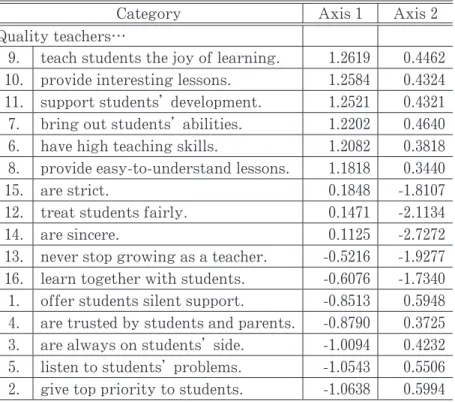
Table 2 shows the normalized category weights given to participants’ belief in teachers’ qualities. According to the tendency of the decrease of the eigenvalue (first axis: 0.9018, second axis: 0.7045, third axis: 0.3570, fourth axis: 0.1488) and the cumulative proportion (first axis: 33.15 percent, second axis: 59.04 percent, third axis: 72.16 percent, forth axis: 77.63 percent), two axes were determined and interpreted.
Table 2 Normalized Category Weights to Participants’ Belief in Teachers’ Qualities
Category Axis 1 Axis 2
Quality teachers… 9. teach students the joy of learning. 1.2619 0.4462 10. provide interesting lessons. 1.2584 0.4324 11. support students’ development. 1.2521 0.4321 7. bring out students’ abilities. 1.2202 0.4640 6. have high teaching skills. 1.2082 0.3818 8. provide easy-to-understand lessons. 1.1818 0.3440 15. are strict. 0.1848 -1.8107 12. treat students fairly. 0.1471 -2.1134 14. are sincere. 0.1125 -2.7272 13. never stop growing as a teacher. -0.5216 -1.9277 16. learn together with students. -0.6076 -1.7340 1. offer students silent support. -0.8513 0.5948 4. are trusted by students and parents. -0.8790 0.3725 3. are always on students’ side. -1.0094 0.4232 5. listen to students’ problems. -1.0543 0.5506 2. give top priority to students. -1.0638 0.5994 Results of the statistical analysis suggest that pre-service teachers’ belief in teachers’ qualities can be classified into four clusters. The first cluster consists of six items: item # 6 (Quality teachers have high teaching skills.), 7 (Quality teachers bring out students’ abilities.), 8 (Quality teachers provide easy-to-understand lessons.), 9 (Quality teachers teach students the joy of learning.), 10 (Quality teachers provide interesting lessons.), and 11 (Quality teachers support students’ development.) that had high category scores
on the first correlation axis and fairly high category scores on the second axis. As all of the six items are related with participants’ belief in teachers’ ability to teach and foster students, the first cluster was given the name “teaching ability.” The second cluster includes three items: # 12 (Quality teachers treat students fairly.), 14 (Quality teachers are sincere.), and 15 (Quality teachers are strict.) that had low category scores on the first axis and high negative scores on the second axis. Considering the three items related with teachers’ personality, the second cluster was named “fairness and consistent behavior.”
The third cluster consists of two items: # 13 (Quality teachers never stop growing as a teacher.) and 16 (Quality teachers learn together with students.) that had highly negative scores on both of the correlation axes. Both of the items explain participants’ belief in teachers’ eagerness to develop themselves, and therefore, the third cluster was named “motivation for self-development.”
The fourth cluster consists of five items: # 1 (Quality teachers offer students silent support.), 2 (Quality teachers give top priority to students.), 3 (Quality teachers are always on students’ side.), 4 (Quality teachers are trusted by students and parents.), and 5 (Quality teachers listen to students’ problems.) that had highly negative scores on the first correlation axis and relatively high scores on the second axis. As the five items are related with participants’ belief in teachers’ attitude toward students, the fourth cluster was given the label “kindliness and consideration for the students.” 4.2 Belief in Education The KJ method was used to group participants’ belief statements with similar contents or characteristics together. As a result, 19 statements were identified as participants’ beliefs about education (Table 3). Table 3 Participants’ Belief in Education Items Frequency % Education is to teach students… 1. the importance of cooperation. 17 37.78% 2. the spirit of mutual assistance. 16 35.56% 3. to cherish friendship. 15 33.33% 4. that unity is strength. 13 28.89% 5. to recognize each other. 13 28.89% 6. the spirit of compassion. 13 28.89% 7. to think of the people around them. 13 28.89% 8. the importance of gratitude. 11 24.44%
9. to cover for each other. 10 22.22% 10. to help each other develop. 10 22.22% 11. to always say thank you. 10 22.22% 12. to always do their best. 9 20.00% 13. to listen to others. 8 17.78% 14. to do what they have to do. 8 17.78% 15. to be serious about doing anything. 8 17.78% 16. to say the right thing in the right place. 8 17.78% 17. to be the first to say sorry. 8 17.78% 18. to always be cheerful. 5 11.11% 19. not to say bad things about others. 4 8.89%
Responses were classified by quantification method type III. Item # 18 (Education is to teach students to always be cheerful.) and 19 (Education is to teach students not to say bad things about others.) were deleted from further analysis as few participants mentioned that they had these two kinds of belief, and if they were included in the analysis, they put too much weight to all of the axes. Thence, 17 items were selected to be analyzed. Table 4 shows the normalized category weights given to participants’ belief in education. Referring to the tendency of the decrease of the eigenvalue (first axis: 0.9288, second axis: 0.7486, third axis: 0.6367, fourth axis: 0.1797) and the cumulative proportion (first axis: 29.36 percent, second axis: 53.03 percent, third axis: 73.16 percent, forth axis: 78.84 percent), three axes were determined and interpreted. Table 4 Normalized Category Weights to Participants’ Belief in Education
Category Axis 1 Axis 2 Axis 3
Education is to teach students… 14. to do what they have to do. 1.0395 -2.4532 -0.6515 12. to always do their best. 1.0094 -2.2497 -0.6548 15. to be serious about doing anything. 0.9936 -2.0956 -0.5975 10. to help each other develop. 0.7199 0.4752 0.8131 4. that unity is strength. 0.7189 0.5156 0.9430 3. to cherish friendship. 0.7024 0.5014 0.5848 1. the importance of cooperation. 0.6800 0.6022 0.7608 2. the spirit of mutual assistance. 0.6774 0.5069 0.6150 9. to cover for each other. 0.6611 0.6076 0.8848 11. to always say thank you. 0.1887 1.0083 -2.1165
16. to say the right thing in the right place. 0.1257 1.1564 -1.9830 17. to be the first to say sorry. 0.0599 1.2335 -2.5914 5. to recognize each other. -1.2339 -0.1460 0.2301 13. to listen to others. -1.5078 -0.2875 0.1597 8. the importance of gratitude. -1.5246 -0.3092 0.2151 7. to think of the people around them. -1.5362 -0.3217 0.2395 6. the spirit of compassion. -1.5362 -0.3217 0.2395 Results of the analysis suggest that participants’ belief in education can be categorized into four clusters.
The first cluster consists of three items: item # 12 (Education is to teach students to always do their best.), 14 (Education is to teach students to do what they have to do.), and 15 (Education is to teach students to be serious about doing anything.) that had high category scores on the first correlation axis and highly negative scores on the second and third axis. The three items explain participants’ belief in the importance of working hard so the first cluster was named “diligence and commitment.” The second cluster includes six items: # 1 (Education is to teach students the importance of cooperation.), 2 (Education is to teach students the spirit of mutual assistance.), 3 (Education is to teach students to cherish friendship.), 4 (Education is to teach students that unity is strength.), 9 (Education is to teach students to cover for each other.), and 10 (Education is to teach students to help each other develop.) that had high scores on all of the axes. All of the items are related with belief in the importance of helping each other. Therefore, the second cluster was named “cooperation and mutual support.” The third cluster consists of three items: # 11 (Education is to teach students to always say thank you.), 16 (Education is to teach students to say the right thing in the right place.), and 17 (Education is to teach students to be the first to say sorry.) that had low scores on the first axis, high score on the second axis, and high negative scores on the third axis. Considering the three items, the third cluster was named “saying what must be said.” The fourth cluster includes five items: # 5 (Education is to teach students to recognize each other.), 6 (Education is to teach students the spirit of compassion.), 7 (Education is to teach students to think of the people around them.), 8 (Education is to teach students the importance of gratitude.), and 13 (Education is to teach students to listen to others.) that had highly negative scores on the first axis, low scores on the second and third axes. As all of the items refer to belief in the
importance of thinking about other people, the fourth cluster was named “consideration and appreciation.”
5. Discussions and Conclusion
The purpose of the study was to identify Japanese pre-service teachers’ belief in teachers’ qualities and education.
Regarding the first research question “What kind of belief do pre-service teachers have in teachers’ qualities?,” results of the questionnaire survey show that participants’ belief in teachers’ qualities can be explained by 16 statements grouped into four factors: teaching ability, fairness and consistent behavior, motivation for self-development, and kindliness and consideration for the students. Referring to the second research question “What kind of belief do pre-service teachers have in education?,” results of the study indicate that participants’ belief in education can be explained by 17 statements with four subscales: diligence and commitment, cooperation and mutual support, saying what must be said, and consideration and appreciation.
As described earlier, school teachers in Japan are experiencing a major reformation of teacher training and teacher education. Under the teaching certificate renewal system, it means little to take teacher education courses without consistent belief in education and strong motivation to become a teacher. It is interesting that although in Kato’s study (1979) and Takagi’s study (1983), teachers’ belief in teachers’ qualities were manly about their personalities or traits, the present study relieved that current pre-service teachers’ belief in teachers’ qualities consists not only of their personalities but also their teaching abilities and relationships with students.
As the participants of the present study were Japanese pre-service teachers who are taking teacher education courses in university, it is recommended to use other samples from other ages, nationality, and prior teaching experience. Especially, it is meaningful to ask in-service teachers what they believe is important in teachers’ qualities and education. Given the findings of this study, it is expected to examine the relationships between pre-service teachers’ belief in education, and their motivation to become teachers, self-efficacy in teaching, prior teaching experience, and other educational, psychological, and personal variables. In addition, the findings of this study are expected to contribute to suggest teacher educators how to promote pre-service teachers’ belief in education, and consequently lead to produce highly motivated quality teachers to elementary and secondary schools.
References
Central Education Council. (2006). How teacher education should be conducted in the future. Ministry of Education, Culture, Sports, Science and Technology. Kageyama, S. (1995), What had Children Learned from Good Social Studies
Teaching, Bulletin of the Faculty of Education: Yokohama National University, vol. 35, pp. 115-130.
Kato, T. (1979). Pre-service and In-service Teachers’ Belief in School Education, Bulletin of Psychological Studies: Tsukuba University, vol. 1, pp. 35-53. Kemp, N. (2012). Teaching Across the Cultural Divide Hofstede’s Uncertainty
Avoidance Dimension and its Implications for the Language Learning Classroom, Bulletin of the Faculty of International Relations, Kyushu International University, vol. 7, no. 2, pp. 81-96.
Ministry of Education, Culture, Sports, Science and Technology-Japan. (2006). About the New Basic Act on Education, Available: http://www.mext.go.jp/b_ menu/kihon/houan.htm
Ministry of Education, Culture, Sports, Science and Technology-Japan. (2008). FY 2007 White Paper on Education, Culture, Sports, Science and Technology: Promoting Educational Reforms Based on the Revised Basic Act on Education/ Reform of Elementary and Secondary Education to Usher in a New Era of Education, ch 1, pp. 5-17, Ministry of Education, Culture, Sports, Science and Technology, Tokyo.
Ministry of Education, Culture, Sports, Science and Technology-Japan. (2012). The Present Conditions of School Teachers’ Mental Health, Available: http:// www.mext.go.jp/b_menu/shingi/chousa/shotou/088/shiryo/__icsFiles/ afieldfile/2012/02/24/1316629_001.pdf
OECD. (2014). TALIS 2013 Results: An International Perspective on Teaching and Learning, pp. 31-425, OECD Publishing, Paris France.
Ogi, N. (2008). The Realities of “Monster Parent,” Bulletin of the Faculty of Career Design, Hosel University, vol. 5, pp. 99-113.
Onoda, M. (2008). Parents are not Monsters, Gakuji Shuppan, Tokyo.
Takagi, H., and Hori, K. (1980), literature Review of Students’ Belief in Teachers, Educational Psychology, vol. 28, pp. 386-389.
Takagi, H. (1983). A Study of Teachers’ Self-Image, Role-Image, and Pupil-Image, Bulletin of the Faculty of Education and Human Sciences, Yokohama National University, pp.93-110.
Teacher Education Accreditation Board. (2008). Points to consider for conducting the seminar for teaching practice. Ministry of Education, Culture, Sports,
Science and Technology. 2008. Retrieved January 7th, 2014, from http://www. m e x t . g o . j p / c o m p o n e n t / a _ m e n u / e d u c a t i o n / d e t a i l / _ _ i c s F i l e s / afieldfile/2013/02/25/1267752_05.pdf