Study on Synthesis of Metal
Oxide/Hydroxide-Conductive Polymer Hybrid
Film and Its Electrochemical Properties
金属酸化物
/水酸化物-導電性高分子複合膜
の作製とその電気化学特性に関する研究
山梨大学大学院
医工農学総合教育部
博士課程学位論文
September 2019
YANG Guoshen
(杨国深)
CONTENTS
List of Figures and Tables ... IV
Chapter 1 Introduction ... 1
1.1 General Introduction ... 1
1.2 Energy Storage Mechanisms for Supercapacitors ... 2
1.2.1 Electrical Double Layer Capacitors ... 2
1.2.2 Pseudocapacitors ... 3
1.3 Electrode Materials for Supercapacitors ... 3
1.3.1 Carbon-based materials ... 4
1.3.2 Metal oxides/hydroxides ... 6
1.3.3 Conducting polymers (CPs) ... 9
1.3.4 Trends in supercapacitor electrodes ... 11
1.4 Electrolytes for Supercapacitors ... 12
1.5 Supercapacitor Systems ... 13
1.5.1 Symmetric supercapacitors ... 13
1.5.2 Asymmetric supercapacitors ... 14
1.5.3 Hybrid supercapacitors ... 14
1.6 Objectives and Scope of the Dissertation ... 14
1.7 Organization of the Dissertation ... 15
Reference ... 17
Chapter 2 Synthesis and Electrochemical Properties of CoAl, NiAl, CoFe and NiFe Layered Double Hydroxide Films ... 25
2.1 Introduction ... 25
2.2 Materials and Methods ... 26
2.2.1 Synthesis of the LDHs nanosheet structures. ... 26
2.2.2 Structural characterization and electrochemical measurement ... 26
2.3 Results and Discussion ... 27
2.3.1 Structural study ... 27
2.3.2 Electrochemical performance ... 29
2.4 Conclusion ... 31
Reference ... 33
Chapter 3 Enhanced Supercapacitor Performance Based on CoAl LDH-PANI Hybrid Electrodes by Hydrothermal-Electrodeposition Technology ... 35
3.1 Introduction ... 35
3.2 Materials and Methods ... 36
- II -
3.2.2 Synthesis of the CoAl LDH-PANI nanocomposites ... 36
3.2.3 Structural characterization, theoretical calculation and electrochemical measurement ... 37
3.3 Results and Discussion ... 38
3.3.1 Structural study ... 39
3.3.2 Electrochemical performance ... 43
3.3.3 Band structure and synergistic mechanism ... 54
3.4. Conclusion ... 57
Reference ... 58
Chapter 4 Effects of a Strong Magnetic Field on Microstructure Orientation in CoAl Layered Double Hydroxide Prepared by Hydrothermal and Slip Casting Methods ... 63
4.1 Introduction ... 63
4.2 Materials and Methods ... 64
4.2.1 Hydrothermal synthesis of CoAl LDH nanosheet films ... 64
4.2.2 Slip casting of CoAl LDH nanosheets ... 65
4.2.3. Structural characterization ... 65
4.3 Results and Discussion ... 66
4.3.1 Structural study ... 66
4.3.2 Growth process and mechanism of CoAl LDH on the Ti substrate ... 67
4.3.3 The study of magnetic field on hydrothermal growth of CoAl LDH ... 69
4.3.4 The study of oriented CoAl LDH by slip casting in magnetic field ... 73
4.4 Conclusion ... 75
Reference ... 76
Chapter 5 High-Performance Energy Storage Based on Hexagonal Tungsten Oxide-Polyaniline Hybrid Electrodes via Hydrothermal-Electrodeposition Route ... 79
5.1 Introduction ... 79
5.2 Materials and Methods ... 81
5.2.1 Synthesis of WO3 nanowire thin films on Ti substrate ... 81
5.2.2 Synthesis of WO3-PANI hybrid nanostructured films ... 81
5.2.3 Fabrication of all-solid-state symmetric supercapacitors ... 82
5.2.4. Structural characterization, theoretical calculation, and electrochemical measurement ... 82
5.3 Results and Discussion ... 84
5.3.1 Structural study ... 84
5.3.2 Growth process and mechanism of WO3 nanowire films on Ti surface . 87 5.3.3 Electrochemical performance ... 90
5.3.4 Symmetric supercapacitor performance ... 98
5.3.5 The study of the band structure and synergistic mechanism ... 100
5.4 Conclusion ... 103
Reference ... 104
Chapter 6 Summary and Prospects ... 109
6.1 Summary ... 109 6.2 Prospects ... 111 List of Publications ... 112 List of Awards... 112 List of Presentations ... 112 Acknowledgement ... 115
- IV -
List of Figures and Tables
Figure 1.1……… 1 Figure 1.2……… 2 Figure 1.3……… 3 Figure 1.4……….. 10 Figure 1.5……….. 11 Figure 1.6……….. 13 Figure 2.1. . . .27 Figure 2.2. . . .28 Figure 2.3. . . .29 Figure 2.4. . . .29 Figure 2.5. . . .30 Figure 2.6. . . .31 Figure 3.1. . . .36 Figure 3.2. . . .38 Figure 3.3. . . .39 Figure 3.4. . . .40 Figure 3.5. . . .41 Figure 3.6. . . .41 Figure 3.7. . . .42 Figure 3.8. . . .43 Figure 3.9. . . .45 Figure 3.10. . . .45 Figure 3.11. . . .. . . .46 Figure 3.12. . . .. . . .48 Figure 3.13. . . .. . . .49 Figure 3.14. . . .. . . .49 Figure 3.15. . . .. . . .50 Figure 3.16. . . .. . . .52 Figure 3.17. . . .. . . .52 Figure 3.18. . . .. . . .53 Figure 3.19. . . .. . . .54 Figure 3.20. . . .. . . .55 Figure 3.21. . . .. . . .56 Figure 4.1. . . .66
Figure 4.2. . . .67 Figure 4.3. . . .67 Figure 4.4. . . .69 Figure 4.5. . . .69 Figure 4.6. . . .70 Figure 4.7. . . .71 Figure 4.8. . . .72 Figure 4.9. . . .73 Figure 4.10. . . .73 Figure 4.11. . . .74 Figure 4.12. . . .75 Figure 5.1. . . .81 Figure 5.2. . . .84 Figure 5.3. . . .85 Figure 5.4. . . .85 Figure 5.5. . . .86 Figure 5.6. . . .87 Figure 5.7. . . .88 Figure 5.8. . . .89 Figure 5.9. . . .90 Figure 5.10. . . .92 Figure 5.11. . . .94 Figure 5.12. . . .95 Figure 5.13. . . .96 Figure 5.14. . . .98 Figure 5.15. . . .99 Figure 5.16. . . .100 Figure 5.17. . . .100 Figure 5.18. . . .101 Figure 5.19. . . .102 Table 3.1. . . .46 Table 5.1. . . .95 Table 5.2. . . .97
Chapter 1 Introduction
1.1 General Introduction
With the rapid development of the global economy, the depletion of fossil fuels, and increasing environmental pollution, there is an urgent need for efficient, clean, and sustainable sources of energy. However, the overall share of renewable energy in total final energy consumption has increased only modestly in recent years, despite tremendous growth in some renewable sectors, as shown in Figure 1.1. To further increase the utilization of renewable energy, one of the most urgent need is the development of high-performance energy storage devices.
Figure 1.1. Growth in global renewable energy compared to total final energy consumption,
2005-2015. Reproduced with permission (Source: REN21) 1.
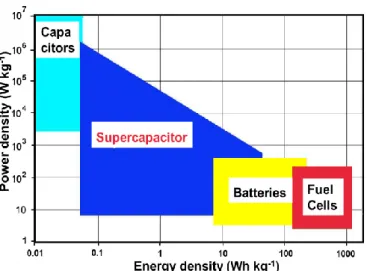
At the present stage, some of the most effective and practical technologies for electrochemical energy conversion and storage are capacitors, supercapacitors, batteries, and fuel cells. Figure 1.2 shows the energy and power densities of different electrical energy storage devices in the Ragone plot. In recent years, supercapacitors, as an energy storage device, have attracted significant attention due to their high power density, fast charge-discharge capability, long cycle life, and bridging function for the power/energy gap between batteries/fuel cells with high energy storage and traditional dielectric capacitors with high power output 2-4. The unique electrochemical performances of supercapacitors have a wide range of applications.
- 2 -
Figure 1.2. Ragone plot of power density and energy density of various energy storage devices 5.
1.2 Energy Storage Mechanisms for Supercapacitors
Based on their energy storage mechanisms, supercapacitors can be classified into electrical double layer capacitors (EDLCs) and pseudocapacitors (or faradaic capacitors), and their charge storage is based on the surface reactions of electrode materials, without ion diffusion within the bulk of the materials 6-7. EDLCs physically store charges in the double layer that
forms at the electrode-electrolyte interface via reversible ion adsorption. Pseudocapacitors chemically store their charges via redox reaction at the surface or near-surface of electrode materials 8. These two mechanisms can function simultaneously depending on the nature of the electrode materials. Generally, electrode materials for EDLCs are composed of carbon-based materials, while that for pseudocapacitors are transition metal oxides and conducting polymers.
1.2.1 Electrical Double Layer Capacitors
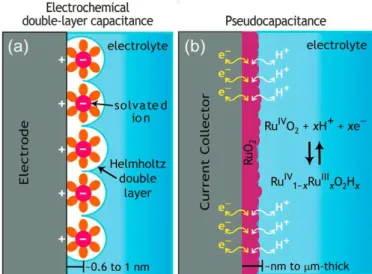
One is the EDLCs, where the capacitance comes from the pure physical charge accumulated at the electrode-electrolyte interface, and there are no redox reactions on the electrode material during the charging/discharging processes. The electrical charge is only physically stored in the double layer, naturally formed at the electrode-electrolyte interface under voltage, as shown in Figure 1.3a 9. During charging, the electrons travel through an external load from the negative electrode to the positive electrode. At the same time, anions move towards the positive electrode in the electrolyte while cations move towards the negative electrode. During discharge, the reverse processes take place. During charge and discharge process, there are no chemical reactions happen and active material transformations. This implies that the EDLCs devices are highly reversible and have a longer cycle life. Compare with conventional capacitors, the EDLCs have a significant increase in capacitance and internal resistance due to the use of the double layer charge storage at both electrodes. And their
electrode materials usually using high-surface-area materials such as activated carbons, with a much higher surface area (in the order of hundreds of m2/g) and much smaller thickness of double layers (in the range of 10-10 m) 10.
1.2.2 Pseudocapacitors
The other type is the pseudocapacitors or faradaic supercapacitors, in which fast and reversible faradic processes take place due to the electrode materials are electrochemically active. Pseudocapacitors are different from EDLCs. For pseudocapacitors, rapid and reversible redox reactions take place on the electrode materials through an external load and involve the passage of charge across the double layer, resulting in faradaic current passing through the supercapacitor device, as shown in Figure 1.3b. In fact, only part of the charge storage is assured by the double layer between electrode and electrolyte, while a greater amount of charge transfer and storage is due to faradic mechanisms (electrosorption, redox reactions, and intercalation). Since the electrochemical processes occur both on the surface and in the bulk near the surface of the solid electrode, pseudocapacitors exhibit far larger capacitance values and energy density than EDLCs 4. However, pseudocapacitors usually suffers from relatively lower power density than EDLCs because faradaic processes are generally slower than non-faradaic processes 11. Moreover, because redox reactions occur at the electrode surface, pseudocapacitors often lack stability during long-term cycling, similar to batteries.
Figure 1.3. Schematic of two different charge storage mechanisms (a) electrochemical double layer
capacitance and (b) pseudocapacitance. Reproduced with permission 9.
1.3 Electrode Materials for Supercapacitors
As mention above, supercapacitors are promising alternative or complement to batteries/fuel cells with high energy storage and traditional dielectric capacitors with high power output. However, due to the charge storage to the surface (or near the surface) of
- 4 -
electrode materials, the energy density of supercapacitors is much lower than that of batteries. The main challenge for supercapacitors is to develop them with a high energy density that is close to that of current rechargeable batteries, while maintaining their inherent characteristics of high power and long cycling life. As a result, many efforts have been made to enhance their energy density. It is well known that the electrode material is the most critical part of the supercapacitor, and it is also a key factor in determining its performance. To overcome the obstacle of low energy density, one of the most intensive approaches is the development of new materials for supercapacitor electrodes 12.
In general, the electrode materials of supercapacitors can be categorized into three types
13-14: carbon-based materials, transition metal oxides/hydroxides, conducting polymers.
1.3.1 Carbon-based materials
Carbon materials are considered the most widely used electrode materials due to their desirable physical and chemical properties. These properties include lower cost, non-toxicity, easy processing, higher specific surface area, high chemical stability, good electronic conductivity, and wide operating temperature range 15. Typically, carbon materials store charges mainly in an electrochemical double layer formed at the interface between the electrode and the electrolyte, rather than storing them in the bulk of the capacitive material. Accordingly, the capacitance predominantly depends on the surface area of the electrode materials that is accessible to the electrolyte ions. Many factors are influencing the electrochemical performance of carbon-based materials, such as specific surface area, pore-size distribution, pore shape and structure, surface functionality, and electrical conductivity. Among these, proper control over the specific surface area and the pore size adapted to an appropriate type of electrolyte solution are significant to obtain high performance of carbon-based electrode materials.
1.3.1.1 Activated carbons (AC)
In the carbon-based materials, activated carbons are the most widely used electrode materials due to their relatively good electrical properties, large surface area, and moderate cost. Activated carbons are generally produced from physical (thermal) and/or chemical activation of various types of carbonaceous materials (e.g., wood, coal, nutshell, etc.). It is well known that the porous structure of activated carbons obtained through activation processes has a wide range of pore size distribution consisting of micropores (< 2 nm), mesopores (2-50 nm) and macropores (>50 nm) 16. Several researchers have pointed out the discrepancy between the capacitance of the activated carbons and their specific surface area 6, 17. This is because the specific capacitance is not only determined by the specific surface area. Some other parameters such as pore size distribution, electrical conductivity, pore shape and structure, and surface functionality can also influence their electrochemical performance to a great extent. In addition, excessive activation will lead to large pore volume, which results in the drawbacks of low
material density and conductivity. These would in turn cause a low volumetric energy density and loss of power capability 18.
Besides the porous structure of activated carbons, the surface functionalities also play essential roles on the activated carbon electrode properties, due to they can affect the wettability of the carbon surface by the electrolyte ions and give additional pseudocapacitance 18-19.
In summary, activated carbons have been widely used as supercapacitor electrode materials. However, the limited energy storage and rate capability of the activated carbons limit their more widely commercial applications. Although activated carbons can provide a high specific surface area, the pore structure and control of pore size distribution are still challenging at the present stage. Therefore, the design of activated carbons to have suitable size distribution (access to transport of ions in the electrolyte) with an interconnected pore structure and short pore length together with controlled surface chemistry can offer the possibility to achieve an enhanced energy density of supercapacitors, without deteriorating their long cycle life and high power density.
1.3.1.2 Carbon nanotubes (CNTs)
The discovery of carbon nanotubes has much promoted the development of carbon-based electrode materials. Carbon nanotubes, as EDLCs electrode materials, have gained enormous attention due to their superior electrical properties, unique pore structure, and good mechanical and thermal stability 20-22. CNTs can be divided into single-walled/multi-walled carbon nanotubes, both of which have been widely used as supercapacitor electrode materials. Usually, due to their excellent electrical conductivity and readily accessible surface area, CNTs are considered as the choice of the high-power electrode materials. Besides, the open tubular network and high mechanical resilience of CNTs make them an excellent support for active materials. However, due to CNTs have a relatively small specific surface area (generally 500 m2/ g), the energy density of CNTs electrode is lower than activated carbon electrode. And
more important, it is the difficulty in retaining the intrinsic properties of individual CNTs on a macroscopic scale 21 and the electrolyte-dependent capacitance performance 20.
Recent studies show that aligned CNTs are more efficient in facilitating fast ionic transportation when compared with entangled CNTs, due to the irregular pore structures and high entanglement of the CNT structure in entangled CNTs 23. Therefore, the design of aligned CNT seems to be easier to obtain high power performance. Another way to enhance the electrochemical performance is by modifying CNTs with active materials to realize pseudocapacitance through faradic reaction.
In short, despite their superior performances, the limited surface area of CNTs restricted their use as high energy performance supercapacitors. Therefore, the present difficulty in purification and high cost of production still limit their more widely practical applications.
- 6 -
1.3.1.3 Templated carbons
A templating method, as a very useful synthesis method, can fabricate nanostructured carbons with well-controlled narrow pore size distributions, ordered pore structures, and large specific surface areas. In a typical synthesis process, templated carbons are infiltration of a carbon precursor into the pores of the template, followed by a carbonization treatment and finally the removal of the template to leave behind a porous carbon structure.
Based on different types of template and carbon precursors, some studies have produced various carbon structures with well controlled micropores, mesopores and/or macropores 24-26. Compared to activated carbons, whose micropores are essentially disordered and broad in pore size distribution, the templated microporous carbons are better for use as high energy density electrode materials due to their narrow pore size distribution, well adapted pore size to the electrolyte ions and the ordered straight pore channels. Besides, the well-controlled porous structure of templated carbons can facilitate efficient use of pseudocapacitance from the oxygenated and nitrogenated functionalities of the carbon materials.
Through careful selection of the template materials, carbon precursors and with good control over the carbonization process, templating method can obtain templated carbons with desirable physical and chemical properties. Despite the cost, templated carbons are suitable materials to study, which provide valuable information about the effect of pore size, pore shape, channel structures and other parameters on the ion diffusion and charge storage in the nanoconfined system.
1.3.1.4 Other carbon structures
Other carbon structures such as activated carbon fibers and carbon aerogels have also been studied for supercapacitor electrode material applications. The general rules for the selection of supercapacitor electrode materials are a high and an accessible specific surface area with good electrical conductivity. Activated carbon fibers typically have high specific surface areas, up to 3000 m2/g, and a more or less controllable pore size distribution 27. Carbon aerogels are other interesting material suitable for use as a supercapacitor electrode. They are ultralight, highly porous materials, predominantly with mesopores, and have the possibility of usage without binding substances 28.
1.3.2 Metal oxides/hydroxides
Compared to carbon materials for EDLCs, the metal oxides/hydroxides for pseudocapacitors can provide higher energy density due to their charge storage through both faradic redox reactions and the electrochemical adsorption/desorption of ions at the electrode/electrolyte interface.
The general requirements for metal oxides/hydroxides as supercapacitor electrode materials are: 4 (1) good electrical conductivity, (2) the metal can exist in two or more oxidation
states that coexist over a continuous range with no phase changes, and (3) enable protons to freely intercalate into oxide lattice on reduction, allowing facile interconversion of O2- OH-. To date, the most commonly used electroactive materials include ruthenium oxide (RuO2),
manganese oxide (MnO2), cobalt oxide/hydroxide (Co3O4/Co(OH)2), nickel oxide/hydroxide
(NiO/Ni(OH)2), iron oxide (Fe2O3 and Fe3O4), binary metal oxide, and other metal oxides.
1.3.2.1 RuO2
The earliest studied transition metal oxide was RuO2 due to its high theoretical specific
capacitance, high electric conductivity, high rate capability, wide potential window, good electrochemical reversibility, and long cycle life 29-32. In an acidic electrolyte, the
pseudocapacitive behavior of RuO2 can be described as a fast and a reversible faradaic reaction
accompanied by electro-absorption of protons on the surface of active material, which can be explained by reaction equation (1) 7:
RuO2+ xH+ + xe− RuO2−x(OH)x (1)
Despite the remarkable performance of RuO2 material, it is still not suitable for
commercial application in supercapacitors, due to its high cost and environmental harmfulness
33. To solve this problem, significant efforts have been devoted to developing low-cost and
environmentally friendly materials that present electrochemical behavior similar to that of RuO2.
1.3.2.2 MnO2
In order to reduce the cost of electrode materials, an alternative approach is to develop cheap metal oxides/hydroxides to replace RuO2. These alternative materials include MnO2,
Co3O4/Co(OH)2, NiO/Ni(OH)2, Fe2O3/Fe3O4, binary metal oxide, and other metal oxides.
As an alternative to replacing RuO2, various forms of MnO2 have been fabricated for
supercapacitor electrode materials due to their high theoretical specific capacitance (from 1100 to 1300 F/g) 34, low cost, large abundance, and environmental safety 35-36. The capacitance of MnO2 mainly comes from pseudocapacitance. There are two mechanisms proposed to explain
the MnO2 charge storage behavior 36-37. The first one implies the insertion of electrolyte cations
into the bulk of the electrode material.It can be expressed as an equation (2). The second one is based on the surface adsorption of electrolyte cations on the MnO2. It can be expressed as an
equation (3).
MnO2 + C++ e− ↔ MnOOC (2)
(MnO2)surface+ C++ e− ↔ (MnOOC)
surface (3)
where C+ denotes the protons and alkali metal cations (Li+, Na+, K+) in the electrolyte. Both the mechanisms involve a redox reaction between the III and IV oxidation states of Mn.
Although the theoretical specific capacitance of MnO2 is pretty high, the practical specific
capacitance of unmodified MnO2 is usually lower than 350 F/g, which is not comparable to
- 8 -
low surface area, and poor electronic conductivity. To solve these problems, the studies on MnO2 nanostructured 38-40 and MnO2 composite materials 41-44 are both feasible ways.
1.3.2.3 Co3O4/Co(OH)2
Co3O4 has been considered a promising electrode material for supercapacitor due to it
seems excellent reversible redox behavior, large surface area, high conductivity, long-term performance, and good corrosion stability 45-47. The redox reactions of Co3O4 can be described
as follows equation (4) and (5) 48:
Co3O4+ OH−+ H2O ↔ 3 CoOOH + e− (4)
CoOOH + OH− ↔ CoO2 + H2O + e− (5)
Co3O4, as a p-type semiconductor, has low electronic and ionic conductivity, leading to
the poor rate capability. Co3O4 structure also suffers from a large volume change during the
cycle process, resulting in a short cycle life 49. These recent studies indicate that the appropriate
morphology and microstructure are necessary to achieve an enhanced electrochemical performance of Co3O4-based supercapacitor 50-52.
Co(OH)2-based electrode materials are attractive due to their layered structure and large
interlayer spacing, which promises high surface area and a fast ion insertion/desertion rate 53. The redox reactions can be expressed in equation (6) and (7) 54-55. However, its shortcomings are still poor rate capability and cycle stability.
Co(OH)2+ OH− ↔ CoOOH + H
2O + e− (6)
CoOOH + OH− ↔ CoO2+ H2O + e− (7)
In summary, the specific capacitances of Co(OH)2-based supercapacitor electrodes higher
than that of Co3O4. However, such high specific capacitance of Co(OH)2 is only located in low
potential ranges, which limits its practical application in supercapacitors. 1.3.2.4 NiO/Ni(OH)2
Nickel oxide is considered an alternative electrode material for supercapacitor in alkaline electrolytes due to its easy synthesis, relatively high specific capacitance, environment friendliness, and low cost 56-57. The redox reaction of nickel oxide in a KOH electrolyte can be expressed by reaction equation (8) 58.
NiO + OH− ↔ NiOOH + e− (8)
At this stage, NiO electrode materials are suffering their poor cycle performance and low electrical conductivity. To address these problems, fabricating nanostructured NiO and composing NiO with other materials are both feasible.
Ni(OH)2 is a hexagonal layered structure and has two polymorphs, - and β-Ni(OH)259.
-Ni(OH)2 is a hydroxyl-deficient phase with interlayered anions and water molecules.
material, Ni(OH)2 can yield much higher specific capacitances. Further optimize its porous
structure, Ni(OH)2 can be achieved much better performance.
1.3.2.5. Binary metal oxides
Recently, binary metal oxides with spinel structures have received much attention, such as NiFe2O4 60, NiCo2O4 61, ZnMnO4 62, CoFe2O4 63, ZnCo2O4 64 and CoMn2O4 65. Some recent
studies indicate that the electrical conductivity of these binary metal oxides is higher than that of unitary metal oxides and contain both components contributions to the total capacitance, which result in better electrochemical performance than individual components 66-67.
1.3.2.6 Other metal oxides
Many other metal oxide materials, such as V2O568, SnO 69, Bi2O370, MoO2 71 and TiO2 72,
have also been extensively studied by researchers. But these materials usually suffer from low capacitance or some other drawbacks. They may become promising supercapacitive materials if researchers make breakthroughs in solving their shortcomings.
1.3.3 Conducting polymers (CPs)
Conducting polymers are generally attractive electrode material for supercapacitor as they have high conductivity, high voltage window, high storage capacity/porosity/reversibility, low cost, and low environmental impact 73-75.
Conducting polymers stores charge through a redox reaction. When oxidation takes place, ions are transferred to the polymer backbone, and when reduction occurs, the ions are released from this backbone into the electrolyte. The redox reaction in the polymer backbone occurs throughout the bulk of the material, not only on the surface 76. As the charging/discharging process does not involve any phase changes, the processes are highly reversible.
Conducting polymers can be p-doped with (counter) anions when oxidized and n-doped with (counter) cations when reduced. The simplified equations for these two charging/discharging processes are as follows:
CPs ↔ CPsn+(A−)
n+ ne− (p-doped) (9)
CPs + ne− ↔ (C+)
nCPsn− (n-doping) (10)
The conducting polymers that are most commonly studied for use in supercapacitor electrode material are polypyrrole (PPy), polyaniline (PANI), polythiophene (PTh), and their corresponding derivatives 77. PPy and PANI are usually in the form of p-doped type due to their n-doping potentials are much lower than the reduction potential of common electrolyte solutions. So, they are generally used as cathode materials. PTh and its derivatives can be in the form of p-doped and n-doped type.
- 10 -
Figure 1.4. Chemical structure of typical conducting polymer.
Unfortunately, swelling and shrinking of conducting polymer may occur during the doping/de-doping (intercalation/deintercalation) of ions. These problems often lead to mechanical degradation of the electrode, causes fading electrochemical performance under prolonged cycling. Conducting polymer, as an electrode material, usually remarkably degrade under less than a thousand cycles. It has been reported that the PPy electrodes showed an initial capacitance of 120 F/g at a current density of 2 mA/cm2, which was degraded by ~50% within one thousand cycles 78. PANI also suffered from a similarly serious problem due to its volumetric changes during the intercalation/deintercalation process. The capacity degradation of PANI nanorods could be as high as 29.5% within 1000 cycles between 0.2 and 0.8 V 79. As to PTh, the relatively poor stability of the n-doped state could lead to a continuous decrease in electrochemical performance under long cycling 80. Apparently, poor cycle life is a very serious
problem for conducting polymer materials when they are used as supercapacitor electrode. To solve the problem of low stability of conducting polymer electrodes, many efforts have been devoted to realizing improved electrochemical performance. (1) Design nanostructured conducting polymer materials. Nanostructured conducting polymers, such as nanofibers, nanorods, nanowires, and nanotubes, have received much attention. Because they could reduce cycling degradation problems caused by volumetric changes or mechanical forces by providing a relatively short diffusion length to enhance the utilization of electrode materials. It has been reported that the packed nanometer-scale PANI whisker discharge capacitance loss was about 5% after 3000 cycles, which indicated the materials have long-term electrochemical stability 81. (2) Fabricating composite electrode materials. It was demonstrated the development of composite conducting polymer electrodes such as couple other materials such as carbon materials or metal oxides could enhance the cycling stability. For example, PANI/GO composites showed excellent electrochemical performance, high electrochemical capacitance, and long cycling stability (~92% retention after 2000 cycles) 82. Compared with pure PPy
electrodes whose loss in specific capacitance was close to 50%, the MnO2/PPy nanocomposite
electrodes showed a relatively stable performance degrading only by ~10% in the initial 1000 cycles and a relatively stable performance at much higher specific capacity is seen in the subsequent 4000 cycles at a current density of 2 mA/cm2 78. Recent research finds that conducting polymer composite materials can give a wide distribution of capacitance values, which are also dependent on many parameters such as the electrolytes, current load, scan rate, constituents of composites, and the mass ratio of the components as well as cell configuration. Therefore, more efforts are still needed to optimize these parameters to achieve optimized electrochemical properties of these conducting polymer-based composites for supercapacitor applications 4.
1.3.4 Trends in supercapacitor electrodes
To develop new materials with optimal performance, two important research directions in supercapacitor electrode exploration are:
Figure 1.5. Typical nanomaterials and nanocomposites classification 83-84.
(1) Synthesis of novel nanostructured electrode materials
In the design of electrode materials, the favored properties of electrode materials include large active surface area, high electric conductivity of the active material, and excellent connection and contact between active materials and substrates. Apparently, the capacitance of supercapacitor heavily depends on the specific surface area of the electrode materials. Material morphology is closely related to the specific surface area and the diffusion of ions in the electrode. Nanostructured materials possess a high specific surface area. They can provide short transport/diffusion path lengths for ions and electrons, leading to faster kinetics, more efficient contact of electrolyte ions, and more electroactive sites for faradaic energy storage, resulting in high charge/discharge capacities even at high current densities.
(2) Design of composite electrode materials
The composite design is the future trend in the development of electrode materials. The individual substances in the composites can have a synergistic effect through minimizing particle size, enhancing specific surface area, inducing porosity, preventing particles from agglomerating, facilitating electron and proton conduction, expanding active sites, extending the potential window, protecting active materials from mechanical degradation. And the
- 12 -
composite can significantly improve cycling stability, and providing extra pseudocapacitance. As a result, the obtained composites can overcome the drawbacks of the individual substances and embody the advantages of all constituents.
1.4 Electrolytes for Supercapacitors
The electrolytes used in supercapacitor devices are as significant as the electrode materials, because they define the performance of supercapacitors, especially the energy density. Up to now, various types of electrolytes have been developed by researchers. The electrolyte used in supercapacitor can be classified into three types: (1) aqueous electrolyte, (2) organic electrolyte, (3) ionic liquids electrolyte, and (4) solid-state polymer electrolyte.
(1) Aqueous electrolyte
Compared with organic electrolytes, aqueous electrolytes gave higher capacitance and higher power than those with organic electrolytes, probably due to higher ionic concentration and smaller ionic radius. Besides, aqueous electrolytes can be prepared and utilized without stringently controlling the preparing processes and conditions, while organic ones need strict processes and conditions to obtain ultra-pure electrolytes.
Unfortunately, aqueous electrolytes have a large limitation in terms of improving both energy and power densities due to their narrow voltage window as low as about 1.2 V, much lower than those of organic electrolytes. This is the reason why organic electrolytes are often recommended.
(2) Organic electrolyte
Compared to aqueous electrolytes, organic electrolytes can provide a voltage window as high as 3.5 V. This is a significant advantage of organic over aqueous electrolytes. Among organic electrolytes, acetonitrile, and propylene carbonate (PC) are the most commonly used solvents. Acetonitrile can dissolve larger amounts of salt than other solvents, but suffers from environmental and toxic problems. PC-based electrolytes are friendly to the environment and can offer a wide electrochemical window, a wide range of operating temperature, as well as good conductivity. Besides, organic salts such as tetraethylammonium tetrafluoroborate, tetraethyl phosphonium tetrafluoroborate, and triethylmethylammonium tetrafluoroborate (TEMABF4) have also been used in supercapacitor electrolytes.
(3) Ionic liquids electrolyte
Recently, ionic liquids have received significant interest as alternative electrolytes for supercapacitors because of their negligible volatility, high thermal, chemical and electrochemical stability, low flammability, and wide electrochemical stability window of 4.5 V. The main ionic liquids studied for supercapacitor applications are imidazolium, pyrrolidinium, as well as asymmetric, aliphatic quaternary ammonium salts with anions such
as tetrafluoroborate, trifluoromethanesulfonate, bis(trifluoromethanesulfonyl)imide, bis(fluorosulfonyl)imide or hexafluorophosphate 85. The challenge for ionic liquids is to design them having a wider potential range together with high conductivity in a wide temperature range. (4) Solid-state polymer electrolyte
Solid polymer electrolyte-based supercapacitors have attracted considerable interest in recent years due to the rapidly growing demand for power for various types of electronics. The solid polymer electrolytes can act as ionic conducting media and electrode separators. There are three types of polymer-based solid electrolyte for supercapacitors: dry polymer electrolyte, gel polymer electrolyte, and polyelectrolyte. Among these, the gel polymer electrolyte has recently been the most extensively investigated electrolyte because of its high ionic conductivity. Additionally, the gel polymer electrolyte is known as a hydrogel polymer electrolyte when using water as the plasticizer. And this type of hydrogel polymer electrolyte generally possesses three-dimensional polymeric networks. Owing to easy preparation, excellent hydrophilicity, outstanding film-forming properties, non-toxic features, and low cost, poly(vinyl alcohol) (PVA) has been the most greatly investigated polymer matrix to date, and is commonly mixed with other aqueous solutions 86.
1.5 Supercapacitor Systems
According to the composition difference of electrode materials, supercapacitor devices can be classed as follows: symmetric supercapacitor, asymmetric supercapacitor, and hybrid supercapacitor, as shown in Figure 1.6. The classification of supercapacitor categories has been well reviewed recently 10, 87; herein, we briefly describe the characteristics of symmetric, asymmetric, and hybrid supercapacitors.
Figure 1.6. Classification of supercapacitor categories and classes 10, 87.
1.5.1 Symmetric supercapacitors
Symmetric supercapacitors are typically composed of two identical supercapacitor-type electrodes, including activated carbons (AC) and pseudocapacitive materials. It is noted that, although the symmetric supercapacitors are using the same supercapacitor-type materials as the
- 14 -
positive and negative electrode, the masses of the two electrodes are different based on the different electrolyte ions absorbed on the positive and negative electrodes during the charge-discharge process.
1.5.2 Asymmetric supercapacitors
Asymmetric supercapacitors are composed of two different supercapacitor-type electrodes, one electrode being of a double layer carbon material and the other being of a pseudocapacitance material. For example, AC//MnO2 is one type of promising asymmetric
supercapacitor and has recently been widely studied for energy storage 88.
1.5.3 Hybrid supercapacitors
Hybrid supercapacitors are typically composed of a supercapacitor-type electrode and a battery-type electrode 89-91. Recently, many hybrid systems have been reported in aqueous or nonaqueous electrolytes, such as AC//PbO2, AC//Ni(OH)2, AC//Li4Ti5O12, AC//graphite, and
AC//LiMn2O4 87.
1.6 Objectives and Scope of the Dissertation
As mentioned above, the electrode material is the most critical part of supercapacitor, and it is also a critical factor in determining its performance. Pseudocapacitor has the potential to achieve higher specific capacitance and higher energy storage compared to EDLC. In this thesis, the pseudocapacitors electrode materials are mainly studied, include metal oxides/hydroxides and conducting polymers. To obtain new electrode materials with high electrochemical performance, two major research directions are the synthesis of nanostructured electrode materials and composite materials.
Specifically, the intention of this dissertation research is to develop nanostructured metal oxide/hydroxide and metal oxide/hydroxide with conducting polymer hybrid electrodes to realize improved electrochemical performance in terms of specific capacitance, energy and power densities, and cycling stability.
In more specific terms, the main objective of this research is to develop nanostructured metal oxide/hydroxide and metal oxide/hydroxide with conducting polymer hybrid electrodes for supercapacitors with the following considerations.
(1) Development of porous nanostructured metal oxide/hydroxide electrodes with different morphologies by hydrothermal method. Usually, the nanostructured porous materials can facilitate ionic motion, improve the rate capability, and increase the utilization of active materials. In this thesis, the CoAl, NiAl and NiFe layered double hydroxides (LDHs) nanosheet films were first synthesized. The LDHs nanosheet films with porous structure were grown perpendicularly on the substrate as binder-free electrodes. In addition, the preparation of
oriented CoAl LDH nanosheet was achieved by hydrothermal grow and slip casting with the assistance of a strong magnetic field. The hexagonal tungsten oxide (h-WO3) nanowire films
with porous structure were also synthesized. The h-WO3 nanowire films can grow directly on
the substrate as a binder-free electrode.
(2) Design and fabrication of metal oxide/hydroxide with conducting polymer hybrid electrodes. Unfortunately, transition metal oxides/hydroxides are mostly low electric conductivity, and as a result, it is challenging to build effective supercapacitors based on pure metal oxides/hydroxides electrodes. In this thesis, we report a new strategy for achieving high performance supercapacitors and overcoming the low electric conductivity problems of transition metal oxides/hydroxides by hybridization metal oxides/hydroxides with a conductive polymer, polyaniline (PANI). A synergistic effect is observed in this strategy. The deposited PANI can efficiently improve the conductivity of metal oxides/hydroxides and enhance faradaic processes across the interface. In this thesis, we mainly synthesized CoAl LDH-PANI and WO3-PANI hybrid nanomaterials by the hydrothermal-electrodeposition method.
(3) Identification of the effect of PANI content in the hybrid materials on the electrochemical performance of supercapacitors in order to maximize the specific capacitance and energy density. The mechanism for the synergistic effects was proposed.
(4) Structural characterization of electrode materials using the following: Fourier transform infrared spectrometer (FTIR), X-ray diffraction (XRD), synchrotron X-ray diffraction (SXRD), field emission scanning electron microscopy (SEM), energy dispersive X-ray spectroscopy (EDX), and X-X-ray photoelectron spectroscopy (XPS).
(5) Evaluation and optimization of electrochemical performances, such as specific capacitance, rate ability, equivalent series resistance (ESR), energy density, power density, and cycle life of the fabricated supercapacitors using the synthesized materials.
1.7 Organization of the Dissertation
The structure of this dissertation can be summarized as follows.
In Chapter 1, it focuses on the literature review on supercapacitors, including energy storage mechanisms, electrode materials, electrolytes, and classification of supercapacitors.
In Chapter 2, a series of layered double hydroxides (LDHs) CoAl LDH, NiAl LDH, and NiFe LDH nanosheet films with porous structures were successfully synthesized by hydrothermal methods. The LDHs nanosheet films were grown perpendicularly on the substrate and examined them as binder-free electrodes for pseudocapacitors. The CoAl LDH has the best reversibility and the highest capacitance among the three types of LDHs, which make it promising candidates for practical application as supercapacitor electrode materials.
- 16 -
In Chapter 3, a novel inner/outer layer structured CoAl LDH-PANI hybrid nanomaterial was successfully synthesized through the hydrothermal-electrodeposition process. The hybrid architecture CoAl LDH-PANI exhibited greatly enhanced specific capacitance and cycling stability and was superior to the non-decorated CoAl LDH.
In Chapter 4, the preparation of oriented CoAl LDH nanosheets was studied by hydrothermal grow and slip casting with the assistance of an external magnetic field. The preferred growth orientation of CoAl LDH nanosheets was obtained with the assistance of an external magnetic field. The addition of a strong magnetic field has no change the crystal phase, but the obvious reduced the amount of interlayer water molecules in CoAl LDH. The supplemental strong magnetic field provides a novel strategy for developing an oriented microstructure.
In Chapter 5, the hybrid architecture WO3-PANI was successfully synthesized through the
hydrothermal-electrodeposition process. The hybrid architecture WO3-PANI exhibited an
outstanding areal specific capacitance, good rate capability, and excellent cycling stability. The fabricated all-solid-state supercapacitor device also exhibited high flexibility, high capacitance retention, and long lifetime.
In Chapter 6, it mainly concludes the dissertation with major findings and focuses on future research recommended for the future development of supercapacitors.
Reference
1. Zervos, A.; Network R., Renewables 2018 global status report - REN21. 2018.
2. Kandalkar, S.; Dhawale, D.; Kim, C.K.; Lokhande, C., Chemical synthesis of cobalt oxide thin film electrode for supercapacitor application. Synthetic Metals 2010, 160 (11-12), 1299-1302.
3. Largeot, C.; Portet, C.; Chmiola, J.; Taberna, P.L.; Gogotsi, Y.; Simon, P., Relation between the ion size and pore size for an electric double-layer capacitor. Journal of the American
Chemical Society 2008, 130 (9), 2730-2731.
4. Wang, G.; Zhang, L.; Zhang, J., A review of electrode materials for electrochemical supercapacitors. Chemical Society Reviews 2012, 41 (2), 797-828.
5. Yu, G.; Xie, X.; Pan, L.; Bao, Z.; Cui, Y., Hybrid nanostructured materials for high-performance electrochemical capacitors. Nano Energy 2013, 2 (2), 213-234.
6. Simon, P.; Gogotsi, Y., Materials for electrochemical capacitors. In Nanoscience And
Technology: A Collection of Reviews from Nature Journals 2010, 320-329.
7. Winter, M.; Brodd, R.J., What are batteries, fuel cells, and supercapacitors? ACS Publications: 2004, 4245-4270.
8. Yu, Z.; Tetard, L.; Zhai, L.; Thomas, J., Supercapacitor electrode materials: nanostructures from 0 to 3 dimensions. Energy & Environmental Science 2015, 8 (3), 702-730.
9. Long, J.W.; Bélanger, D.; Brousse, T., Asymmetric electrochemical capacitors-Stretching the limits of aqueous electrolytes. MRS Bulletin, 2011, 36(7): 513-522.
10. Conte, M., Supercapacitors technical requirements for new applications. Fuel cells 2010,
10 (5), 806-818.
11. Chuang, C.M.; Huang, C.W.; Teng, H.; Ting, J.M., Effects of carbon nanotube grafting on the performance of electric double layer capacitors. Energy & Fuels 2010, 24 (12), 6476-6482.
12. Arico, A.S.; Bruce, P.; Scrosati, B.; Tarascon, J.M.; Van Schalkwijk, W., Nanostructured materials for advanced energy conversion and storage devices. Materials For Sustainable
Energy: A Collection of Peer-Reviewed Research and Review Articles from Nature Publishing Group 2011, 148-159.
13. Choi, D.; Kumta, P.N., Nanocrystalline TiN derived by a two-step halide approach for electrochemical capacitors. Journal of the Electrochemical Society 2006, 153 (12), A2298-A2303.
14. Lee, H.; Cho, M.S.; Kim, I.H.; Do Nam, J.; Lee, Y., RuOx/polypyrrole nanocomposite
- 18 -
15. Zhang, Y.; Feng, H.; Wu, X.; Wang, L.; Zhang, A.; Xia, T.; Dong, H.; Li, X.; Zhang, L., Progress of electrochemical capacitor electrode materials: A review. International journal
of hydrogen energy 2009, 34 (11), 4889-4899.
16. Liu, C.; Li, F.; Ma, L.P.; Cheng, H.M., Advanced materials for energy storage. Advanced
materials 2010, 22 (8), E28-E62.
17. Kierzek, K.; Frackowiak, E.; Lota, G.; Gryglewicz, G.; Machnikowski, J., Electrochemical capacitors based on highly porous carbons prepared by KOH activation. Electrochimica
Acta 2004, 49 (4), 515-523.
18. Raymundo-Piñero, E.; Leroux, F.; Béguin, F., A high-performance carbon for supercapacitors obtained by carbonization of a seaweed biopolymer. Advanced Materials 2006, 18 (14), 1877-1882.
19. Seredych, M.; Hulicova-Jurcakova, D.; Lu, G.Q.; Bandosz, T.J., Surface functional groups of carbons and the effects of their chemical character, density and accessibility to ions on electrochemical performance. Carbon 2008, 46 (11), 1475-1488.
20. Frackowiak, E.; Jurewicz, K.; Delpeux, S.; Béguin, F., Nanotubular materials for supercapacitors. Journal of Power Sources 2001, 97, 822-825.
21. Futaba, D.N.; Hata, K.; Yamada, T.; Hiraoka, T.; Hayamizu, Y.; Kakudate, Y.; Tanaike, O.; Hatori, H.; Yumura, M.; Iijima, S., Shape-engineerable and highly densely packed single-walled carbon nanotubes and their application as super-capacitor electrodes. Nature
materials 2006, 5 (12), 987.
22. Niu, C.; Sichel, E.K.; Hoch, R.; Moy, D.; Tennent, H., High power electrochemical capacitors based on carbon nanotube electrodes. Applied Physics Letters 1997, 70 (11), 1480-1482.
23. Zhang, H.; Cao, G.; Yang, Y.; Gu, Z., Comparison between electrochemical properties of aligned carbon nanotube array and entangled carbon nanotube electrodes. Journal of The
Electrochemical Society 2008, 155 (2), K19-K22.
24. Ania, C.O.; Khomenko, V.; Raymundo-Piñero, E.; Parra, J.B.; Beguin, F., The large electrochemical capacitance of microporous doped carbon obtained by using a zeolite template. Advanced Functional Materials 2007, 17 (11), 1828-1836.
25. Li, W.; Chen, D.; Li, Z.; Shi, Y.; Wan, Y.; Wang, G.; Jiang, Z.; Zhao, D., Nitrogen-containing carbon spheres with very large uniform mesopores: the superior electrode materials for EDLC in organic electrolyte. Carbon 2007, 45 (9), 1757-1763.
26. Wang, D.W.; Li, F.; Liu, M.; Lu, G.Q.; Cheng, H.M., 3D aperiodic hierarchical porous graphitic carbon material for high-rate electrochemical capacitive energy storage.
27. Xu, B.; Wu, F.; Chen, R.; Cao, G.; Chen, S.; Zhou, Z.; Yang, Y., Highly mesoporous and high surface area carbon: a high capacitance electrode material for EDLCs with various electrolytes. Electrochemistry Communications 2008, 10 (5), 795-797.
28. Zhang, L.L.; Zhao, X., Carbon-based materials as supercapacitor electrodes. Chemical
Society Reviews 2009, 38 (9), 2520-2531.
29. Yan, J.; Wang, Q.; Wei, T.; Fan, Z., Recent advances in design and fabrication of electrochemical supercapacitors with high energy densities. Advanced Energy Materials 2014, 4 (4), 1300816.
30. Jia, Q.; Song, S.; Wu, X.; Cho, J.; Foltyn, S.; Findikoglu, A.; Smith, J., Epitaxial growth of highly conductive RuO2 thin films on (100) Si. Applied physics letters 1996, 68 (8),
1069-1071.
31. Kim, I.H.; Kim, K.B., Electrochemical characterization of hydrous ruthenium oxide thin-film electrodes for electrochemical capacitor applications. Journal of The Electrochemical
Society 2006, 153 (2), A383-A389.
32. Sakiyama, K.; Onishi, S.; Ishihara, K.; Orita, K.; Kajiyama, T.; Hosoda, N.; Hara, T., Deposition and properties of reactively sputtered ruthenium dioxide films. Journal of The
Electrochemical Society 1993, 140 (3), 834-839.
33. Fan, L.Z.; Hu, Y.S.; Maier, J.; Adelhelm, P.; Smarsly, B.; Antonietti, M., High electroactivity of polyaniline in supercapacitors by using a hierarchically porous carbon monolith as a support. Advanced Functional Materials 2007, 17 (16), 3083-3087.
34. Wei, W.; Cui, X.; Chen, W.; Ivey, D.G., Manganese oxide-based materials as electrochemical supercapacitor electrodes. Chemical society reviews 2011, 40 (3), 1697-1721.
35. Pang, S.C.; Anderson, M.A.; Chapman, T.W., Novel electrode materials for thin-film ultracapacitors: comparison of electrochemical properties of sol-gel-derived and electrodeposited manganese dioxide. Journal of the Electrochemical Society 2000, 147 (2), 444-450.
36. Toupin, M.; Brousse, T.; Bélanger, D., Charge storage mechanism of MnO2 electrode used
in aqueous electrochemical capacitor. Chemistry of Materials 2004, 16 (16), 3184-3190. 37. Zhu, J.; Shi, W.; Xiao, N.; Rui, X.; Tan, H.; Lu, X.; Hng, H.H.; Ma, J.; Yan, Q.,
Oxidation-etching preparation of MnO2 tubular nanostructures for high-performance supercapacitors.
ACS applied materials & interfaces 2012, 4 (5), 2769-2774.
38. Dubal, D.; Dhawale, D.S.; Salunkhe, R.; Lokhande, C., Conversion of interlocked cube-like Mn3O4 into nanoflakes of layered birnessite MnO2 during supercapacitive studies.
- 20 -
39. Nam, H.S.; Yoon, J.K.; Ko, J.M.; Kim, J.D., Electrochemical capacitors of flower-like and nanowire structured MnO2 by a sonochemical method. Materials Chemistry and Physics
2010, 123 (1), 331-336.
40. Xia, H.; Feng, J.; Wang, H.; Lai, M.O.; Lu, L., MnO2 nanotube and nanowire arrays by
electrochemical deposition for supercapacitors. Journal of Power Sources 2010, 195 (13), 4410-4413.
41. Bordjiba, T.; Bélanger, D., Direct redox deposition of manganese oxide on multiscaled carbon nanotube/microfiber carbon electrode for electrochemical capacitor. Journal of The
Electrochemical Society 2009, 156 (5), A378-A384.
42. Chen, S.; Zhu, J.; Wu, X.; Han, Q.; Wang, X., Graphene oxide-MnO2 nanocomposites for
supercapacitors. ACS nano 2010, 4 (5), 2822-2830.
43. Hou, Y.; Cheng, Y.; Hobson, T.; Liu, J., Design and synthesis of hierarchical MnO2
nanospheres/carbon nanotubes/conducting polymer ternary composite for high performance electrochemical electrodes. Nano letters 2010, 10 (7), 2727-2733.
44. Wang, Y.; Foo, C.Y.; Hoo, T.K.; Ng, M.; Lin, J., Designed smart system of the sandwiched and concentric architecture of RuO2/C/RuO2 for high performance in electrochemical
energy storage. Chemistry-A European Journal 2010, 16 (12), 3598-3603.
45. Liu, T.C.; Pell, W.; Conway, B., Stages in the development of thick cobalt oxide films exhibiting reversible redox behavior and pseudocapacitance. Electrochimica Acta 1999, 44 (17), 2829-2842.
46. Kim, H.K.; Seong, T.Y.; Lim, J.H.; Cho, W.I.; Yoon, Y.S., Electrochemical and structural properties of radio frequency sputtered cobalt oxide electrodes for thin-film supercapacitors.
Journal of power sources 2001, 102 (1-2), 167-171.
47. Srinivasan, V.; Weidner, J.W., Capacitance studies of cobalt oxide films formed via electrochemical precipitation. Journal of power sources 2002, 108 (1-2), 15-20.
48. Shan, Y.; Gao, L., Formation and characterization of multi-walled carbon nanotubes/Co3O4
nanocomposites for supercapacitors. Materials chemistry and physics 2007, 103 (2-3), 206-210.
49. Wang, H.; Holt, C.M.; Li,Z.; Tan, X.; Amirkhiz, B.S.; Xu, Z.; Olsen, B.C.; Stephenson, T.; Mitlin, D., Graphene-nickel cobaltite nanocomposite asymmetrical supercapacitor with commercial level mass loading. Nano Research 2012, 5 (9), 605-617.
50. Gao, Y.; Chen, S.; Cao, D.; Wang, G.; Yin, J., Electrochemical capacitance of Co3O4
nanowire arrays supported on nickel foam. Journal of Power Sources 2010, 195 (6), 1757-1760.
51. Wang, G.; Shen, X.; Horvat, J.; Wang, B.; Liu, H.; Wexler, D.; Yao, J., Hydrothermal synthesis and optical, magnetic, and supercapacitance properties of nanoporous cobalt oxide nanorods. The Journal of Physical Chemistry C 2009, 113 (11), 4357-4361.
52. Xu, J.; Gao, L.; Cao, J.; Wang, W.; Chen, Z., Preparation and electrochemical capacitance of cobalt oxide (Co3O4) nanotubes as supercapacitor material. Electrochimica Acta 2010,
56 (2), 732-736.
53. Gupta, V.; Kusahara, T.; Toyama, H.; Gupta, S.; Miura, N., Potentiostatically deposited nanostructured α-Co(OH)2: A high performance electrode material for redox-capacitors.
Electrochemistry Communications 2007, 9 (9), 2315-2319.
54. Liang, Y.; Schwab, M.G.; Zhi, L.; Mugnaioli, E.; Kolb, U.; Feng, X.; Müllen, K., Direct access to metal or metal oxide nanocrystals integrated with one-dimensional nanoporous carbons for electrochemical energy storage. Journal of the American Chemical Society 2010,
132 (42), 15030-15037.
55. Yu, Z.J.; Dai, Y.; Chen, W., Electrochemical deposited nanoflakes Co(OH)2 porous films
for electrochemical capacitors. Journal of the Chinese Chemical Society 2010, 57 (3A), 423-428.
56. Castro, E.; Real, S.; Dick, L.P., Electrochemical characterization of porous nickel-cobalt oxide electrodes. International journal of hydrogen energy 2004, 29 (3), 255-261.
57. Wu, M.S.; Huang, Y.A.; Jow, J.J.; Yang, W.D.; Hsieh, C.Y.; Tsai, H.M., Anodically potentiostatic deposition of flaky nickel oxide nanostructures and their electrochemical performances. International Journal of Hydrogen Energy 2008, 33 (12), 2921-2926. 58. Wang, Y.G.; Xia, Y.Y., Electrochemical capacitance characterization of NiO with ordered
mesoporous structure synthesized by template SBA-15. Electrochimica Acta 2006, 51 (16), 3223-3227.
59. Jayashree, R.; Kamath, P.V., Suppression of the →β-nickel hydroxide transformation in concentrated alkali: Role of dissolved cations. Journal of applied electrochemistry 2001,
31 (12), 1315-1320.
60. Wang, Z.; Zhang, X.; Li, Y.; Liu, Z.; Hao, Z., Synthesis of graphene-NiFe2O4
nanocomposites and their electrochemical capacitive behavior. Journal of Materials
Chemistry A 2013, 1 (21), 6393-6399.
61. Liu, X.; Zhang, Y.; Xia, X.; Shi, S.; Lu, Y.; Wang, X. L.; Gu, C.; Tu, J., Self-assembled porous NiCo2O4 hetero-structure array for electrochemical capacitor. Journal of Power
Sources 2013, 239, 157-163.
62. Kim, S.W.; Lee, H.W.; Muralidharan, P.; Seo, D.H.; Yoon, W.S.; Kim, D. K.; Kang, K., Electrochemical performance and ex situ analysis of ZnMn2O4 nanowires as anode
- 22 -
63. Xiong, Q.; Tu, J.; Shi, S.; Liu, X.; Wang, X.; Gu, C., Ascorbic acid-assisted synthesis of cobalt ferrite (CoFe2O4) hierarchical flower-like microspheres with enhanced lithium
storage properties. Journal of Power Sources 2014, 256, 153-159.
64. Karthikeyan, K.; Kalpana, D.; Renganathan, N., Synthesis and characterization of ZnCo2O4
nanomaterial for symmetric supercapacitor applications. Ionics 2009, 15 (1), 107-110. 65. Yu, L.; Zhang, L.; Wu, H.B.; Zhang, G.; Lou, X.W.D., Controlled synthesis of hierarchical
CoxMn3-xO4 array micro-/nanostructures with tunable morphology and composition as
integrated electrodes for lithium-ion batteries. Energy & Environmental Science 2013, 6 (9), 2664-2671.
66. Huang, L.; Chen, D.; Ding, Y.; Feng, S.; Wang, Z.L.; Liu, M., Nickel-cobalt hydroxide nanosheets coated on NiCo2O4 nanowires grown on carbon fiber paper for
high-performance pseudocapacitors. Nano letters 2013, 13 (7), 3135-3139.
67. Yang, W.; Gao, Z.; Ma, J.; Zhang, X.; Wang, J.; Liu, J., Hierarchical NiCo2O4@ NiO
core-shell hetero-structured nanowire arrays on carbon cloth for a high-performance flexible all-solid-state electrochemical capacitor. Journal of Materials Chemistry A 2014, 2 (5), 1448-1457.
68. Sathiya, M.; Prakash, A.; Ramesha, K.; Tarascon, J.M.; Shukla, A., V2O5-anchored carbon
nanotubes for enhanced electrochemical energy storage. Journal of the American Chemical
Society 2011, 133 (40), 16291-16299.
69. Pusawale, S.; Deshmukh, P.; Lokhande, C., Chemical synthesis and characterization of hydrous tin oxide (SnO2:H2O) thin films. Bulletin of Materials Science 2011, 34 (6),
1179-1183.
70. Gujar, T.; Shinde, V.; Lokhande, C.; Han, S.H., Electrosynthesis of Bi2O3 thin films and
their use in electrochemical supercapacitors. Journal of power sources 2006, 161 (2), 1479-1485.
71. Zheng, L.; Xu, Y.; Jin, D.; Xie, Y., Well-aligned molybdenum oxide nanorods on metal substrates: solution-based synthesis and their electrochemical capacitor application.
Journal of Materials Chemistry 2010, 20 (34), 7135-7143.
72. Xia, X.; Zeng, Z.; Li, X.; Zhang, Y.; Tu, J.; Fan, N.C.; Zhang, H.; Fan, H.J., Fabrication of metal oxide nanobranches on atomic-layer-deposited TiO2 nanotube arrays and their
application in energy storage. Nanoscale 2013, 5 (13), 6040-6047.
73. Zhou, Y.K.; He, B.L.; Zhou, W.J.; Huang, J.; Li, X.H.; Wu, B.; Li, H.L., Electrochemical capacitance of well-coated single-walled carbon nanotube with polyaniline composites.
74. Prasad, K.R.; Koga, K.; Miura, N., Electrochemical deposition of nanostructured indium oxide: high-performance electrode material for redox supercapacitors. Chemistry of
materials 2004, 16 (10), 1845-1847.
75. Kalaji, M.; Murphy, P.; Williams, G., The study of conducting polymers for use as redox supercapacitors. Synthetic metals 1999, 102 (1-3), 1360-1361.
76. Sharma, P.; Bhatti, T., A review on electrochemical double-layer capacitors. Energy
conversion and management 2010, 51 (12), 2901-2912.
77. Sivakkumar, S.; Saraswathi, R., Performance evaluation of poly(N-methylaniline) and polyisothianaphthene in charge-storage devices. Journal of power sources 2004, 137 (2), 322-328.
78. Sharma, R.; Rastogi, A.; Desu, S., Manganese oxide embedded polypyrrole nanocomposites for electrochemical supercapacitor. Electrochimica Acta 2008, 53 (26), 7690-7695.
79. Zhu, Z.Z.; Wang, G.C.; Sun, M.Q.; Li, X.W.; Li, C.Z., Fabrication and electrochemical characterization of polyaniline nanorods modified with sulfonated carbon nanotubes for supercapacitor applications. Electrochimica Acta 2011, 56 (3), 1366-1372.
80. Naudin, É.; El Mehdi, N.; Soucy, C.; Breau, L.; Bélanger, D., Poly(3-arylthiophenes): syntheses of monomers and spectroscopic and electrochemical characterization of the corresponding polymers. Chemistry of materials 2001, 13 (2), 634-642.
81. Wang, Y.G.; Li, H.Q.; Xia, Y.Y., Ordered whiskerlike polyaniline grown on the surface of mesoporous carbon and its electrochemical capacitance performance. Advanced materials 2006, 18 (19), 2619-2623.
82. Xu, J.; Wang, K.; Zu, S.Z.; Han, B.H.; Wei, Z., Hierarchical nanocomposites of polyaniline nanowire arrays on graphene oxide sheets with synergistic effect for energy storage. ACS
nano 2010, 4 (9), 5019-5026.
83. A. Alagarasi. Introduction to Nanomaterial. 2011, Retrieved from https://nccr.iitm.ac.in/2011.pdf.
84. Liu, R.; Duay, J.; Lee, S.B., Heterogeneous nanostructured electrode materials for electrochemical energy storage. Chemical Communications, 2011, 47(5), 1384-1404. 85. Lewandowski, A.; Galiński, M., Carbon-ionic liquid double-layer capacitors. Journal of
Physics and Chemistry of Solids 2004, 65 (2-3), 281-286.
86. Fei, H.; Yang, C.; Bao, H.; Wang, G., Flexible all-solid-state supercapacitors based on graphene/carbon black nanoparticle film electrodes and cross-linked poly(vinyl alcohol)-H2SO4 porous gel electrolytes. Journal of Power Sources 2014, 266, 488-495.
87. Wang, Y.; Song, Y.; Xia, Y., Electrochemical capacitors: mechanism, materials, systems, characterization and applications. Chemical Society Reviews 2016, 45 (21), 5925-5950.
- 24 -
88. Brousse, T.; Toupin, M.; Belanger, D., A hybrid activated carbon-manganese dioxide capacitor using a mild aqueous electrolyte. Journal of the Electrochemical Society 2004,
151 (4), A614-A622.
89. Ma, F.X.; Yu, L.; Xu, C.Y.; Lou, X.W.D., Self-supported formation of hierarchical NiCo2O4 tetragonal microtubes with enhanced electrochemical properties. Energy &
Environmental Science 2016, 9 (3), 862-866.
90. Yu, L.; Guan, B.; Xiao, W.; Lou, X.W., Formation of yolk-shelled Ni-Co mixed oxide nanoprisms with enhanced electrochemical performance for hybrid supercapacitors and lithium ion batteries. Advanced Energy Materials 2015, 5 (21), 1500981.
91. Yu, X.Y.; Yu, L.; Lou, X.W., Metal sulfide hollow nanostructures for electrochemical energy storage. Advanced Energy Materials 2016, 6 (3), 1501333.
Chapter 2 Synthesis and Electrochemical Properties of CoAl,
NiAl, CoFe and NiFe Layered Double Hydroxide Films
2.1 Introduction
Worsening depletion of energy resource and global warming have stimulated intense research on energy storage and conversion from alternative energy sources. Supercapacitors (also known as electrochemical capacitors), as promising energy storage devices, have attracted considerable attention due to their fast charge-discharge capability, high power density and long cycle life 1-3. Depending on different charge storage mechanism, supercapacitors can be classified into pseudocapacitors and electrical double layer capacitors (EDLCs) 4. Compared to EDLCs, pseudocapacitors have the potential to achieve high specific capacitances and high energy storage, and the research on pseudocapacitors has gradually become a hot research area of supercapacitor in recent years 5.
As well know, the electrochemical activity of electrode materials plays the key factor in determining its performance of supercapacitors. The electrode materials of supercapacitors. mainly include transition metal oxides/hydroxides, carbon-based materials and conductive polymers at this stage 6. Transition metal including layered double hydroxides (LDHs), also called anionic clays, have a general molecular formula of M2+1-xM3+x(OH)2(An-)x/n·mH2O,
where M2+ and M3+ are divalent and trivalent 7. Generally, Mg, Co, Zn and Al are used divalent and trivalent metal cations, which can be replaced by some transition metal. The unique hydrotalcite-like space structure of LDH not only makes it have thermal stability and structural controllability, but also provides large active specific surface area for redox reaction. Moreover, the interlayer variable valence anions can also provide a large number of electrochemical active sites to produce high capacitance 8. Based on it, LDHs may be ideal electrode materials for pseudocapacitors because of their high surface areas, high redox activity, low cost and environmentally friendly nature 9-10. Previously, the powder LDHs have been reported as electrode materials of supercapacitor 11-12. However, the powder LDHs need to be used as electrode with additives and binders 13. They restrict the active LDHs having large active specific surface area for redox reaction and thus greatly reduce the capacitance. In this study, we synthesized CoAl, NiAl, CoFe and NiFe LDH nanosheet structures directly grown on nickel substrates by facile hydrothermal methods and examined them as binder-free electrode for supercapacitor. We investigated the differences in structural morphology and electrochemical properties of the LDHs samples.