On Distribution and Morpho一ogy of Cu一tivated Rice in Senega一
Akinori Nakagama, Massamba Ngning*, Akio Sumi**
and Tadao C. Katayama
(Received for Publication October 19, 1987)
Introduction
During the period from October to November in 1985, the writers took a trip in Senegal for collecting the wild and cultivated rices under the project, "Studies on the Distribution
and Ecotypic Differentiation of Wild and Cultivated Rice Species in Africa", supported
by a Grant from the Ministry of Education, Science and Culture of the Japanese Government.
In this opportunity, cultivated rices distributed in Senegal were studied.On the distribution of cultivated rice in Senegal, some reports have already been publishedl''. In this trip, various types of cultivated rice,. distributed and under the cultivation, were collected in Senegal. In this report, only the habitat and record of morphological characters of unhusked grains of the cultivated rice collected in Senegal were described. Based on the analyses of the data obtained in the further morphological characters, varietal variations are going to be informed in the following papers.
The writers are most grateful to the government officials in Senegal. Thanks are
also due to the following persons ; Mon. Keba Birane CISSE, Mon. Dr. Balla Moussa Daffe,
Mon. Moctar Toure, Mon. Papa Ibrahima Thiongane, Mon. B. Sadio, Mon. FaYE, Mon.
M.Fall; Mon. W.Godderis, Mon. H.van Brandt, Mon. Alfred Sambou.
Abstract of distribution and habitat of cultivated rice
Geographical distributions and habitats of cultivated rice collected in Senegal were briefly illustrated in Figs. 1 and 2, in which the routes of trip and the collection-sites of seed samples are given, too.
● I. Oryza sativa L.
Seed samples of the species were collected from the following districts ; Guidel, Niaguis, Adeane, Diagnon, Kaour, Djibanar, Banbatou, Biaro, Kafoutine and Richard Toll. GAMBIA ; Banjul. Those were found in rain fed paddy fields, shallow water paddy fields and upland fields.
II. Oryza glabernma Steud.
Seed samples of the species were collected from the following districts ; Ziguinchor, Boutoupo, Agnack, Adeane, Diagnon, Goudomp, Simbandi, Amdoulaye, Dar es Salaam, Kitim,
* Institut Senegalais de Recherches Agricoles, Ziguinchor (ISRA), Repoblique de Senegal. * *Laboratory of Tropical Crop Science.
-51-sajqB;9i│;ux pasn J9q∈nu uibj;s9i#o;Suipuodsaヒod9jh9jnSxj91^;ux pasn sj9quinu-9pon
suavo;uimii⋮S9TDJIDU9dO.sB9JB UOpO9^03⋮sapjpp^im'suopBAJ9sqo jo S9;noj川S9UITP3WOQ'I亀ausQ
1
0
U
O
I
8
9
J
9
D
U
^
U
I
B
S
H
3
U
I
p
9
}
D
9
T
T
O
D
9
J
9
M
S
9
D
U
D
9
J
B
A
m
n
D
9
U
;
9
J
9
U
A
V
S
9
q
i
T
B
O
O
T
T
H
J
9
A
9
S
B
u
竃
i
o
v
j
s
c
t
e
j
¥
[
*
x
'
S
i
j
. 寸 r S I 31* S 9 │ q H ; a q ; u x p a s n j a q u m u u i b j ; s 9 q ; o ; S u i p u o d s 9 ヒ 0 0 9 j h 9 j n S x j 9 i p u i p a s n s j a q u i n u -a p o Q * s u a v ♀ U I B U I ⋮ S 9 p j p U 9 d O ' B 9 J H U O i ; D 9 U O D 川 9 p j p p a n i J ' s u o p H A J 9 s q o i o S 9 ; n o j ⋮ S 9 U I T p 9 } } O Q * l E x f e u 9 Q 1 0 U O I S 9 J U J 9 1 f l J O U U I p 9 } 0 9 コ o o s e a v 9 d u p 9 } B A m n o a m a j a u A v A}ITEDOT B Bu叫MOIJSdBTO'Z*SIJ o ト L
Table 1. Distribution and habitat of cultivated rice collected in Senegal, 1985. Abbrevia-tions : S ; Oryza sativa L., G ; Oryza glaberrima Steud., respectively
StrainSpeciesCollectingLocalandremarkg Nq^speciesname Oct. 30 Oct. 30 Oct. 30 Oct. 30 Oct Oct. 30 Oct. 30 Oct. 31 Oct. 31 Oct Oct. 31 Oct. 31 Oct. 31 Oct. 31 Oct. 31 Oct. 31 Oct. 31 Oct. 31 Oct. 31 Oct. 31 Nov. 1 Nov. 1 Nov. 1 Nov. 1 Nov. 1 Nov. 1 Nov. 1 N iassaran N 'bagnera Waga Bilikissa Lola coyo Lola wouhng Kunu mano Lola fingo Lola woulaigre Boucolondmg Tambango Moussou noring Mano moussou coyo Mano moussou coyo Rasta mano Mano moussou coyo
Coungsoungoutou mano
Mano moussou
Mano moussou fingo
Wouhngo
Ziguinchor. Road-side submerged paddy field '
Near Ziguinchor. Rainfed paddy field. A few plants growing as weed in O. sativa field
Near Ziguinchor. Rainfed paddy field. Growing as weed in O. sativa field.
Near Ziguinchor. Rainfed paddy field. Near Ziguinchor. Rainfed field.
Lruidei Vmage, near z,iguincnor. i^amiea paddy field.
Boutoupo Village, near Ziguinchor.
Rainfed paddy field. Growing as weed in O. sativa field.
Niaguis Village, between Ziguinchor and Diattacounda. Rainfed paddy field.
Agnack Village between Ziguinchor and Diattacounda. White gram.
The same field as No. 115. Red gram.
Agnack between and
Diattacounda. Swamp su汀ounded by paddy field Intermediate form between O. glabem〝∽
and O. breviligulata. Immatured.
Agnack Village between Ziguinchor and Diattacounda. Upland field.
Adeane Village between Ziguinchor and Diattacounda. Rainfed paddy field.
Adeane Village between Ziguinchor and Diattacounda. Rainfed paddy field.
Adeane Village between Ziguinchor and Diattacounda. Rainfed paddy field.
and
Diattacounda. Rainfed paddy field.
Diagnon Village between Ziguinchor and Diattacounda. Rainfed paddy field.
Diagnon Village between Ziguinchor and Diattacounda. Rain fed paddy field.
Kaour Village between Ziguinchor and Diattacounda. Rainfed paddy field.
Goudomp Village between Ziguinchor and Diattacounda. Upland field Mixed-growing with O
and
Kolda. Rainfed paddy field.
Simbandi Balante Village between Ziguinchor and Kolda. Submerged paddy field. Growing as weed in O. sativa field. Awned gram. The same field as No. 168. Awnless gram. Amdoulaye Village between Ziguinchor and Kolda. Upland field. A few plants remain-ing in the field where O. sativa was already harvested.
Sindima Village between Ziguinchor and Kolda. Rainfed paddy field Mixed-growing with O Black gram.
as No. 171. Red gram.
Banbatou Village between Ziguinchor and Kolda. Railぜed paddy field.
RFr I* 口:・ 184 I* M? I:?] 188 Nov. 1 Nov. 1 Nov. 2 Nov. 2 Nov. 2 Nov. 2 Nov. 2 Nov Nov. 2 Nov. 2 Nov. 3 Nov. 4 Nov Nov. 4 Nov. 4 Nov. 5 Nov. 6 Nov. 6 Nov. 6 Nov. 6 Nov. 6 Nov. 6 Nov Nov. 6 Nov. 6 Nov. 6 Nov. 7 Nov. 10 Mano ouaigue Fotou Bololo wouhngo Bololo wouhngo Bololo fingo
Mano nding wouling Mano nding wouhng Bololo wouling Kebero wouhng
Kebero wouhng
Wer wer
Eyona
Mano mano yafitte
Bololo wouhng Mano moussou Mano mano Mano mano Mano mano Mano mano Bololo blanc Mano mano Mano mano Barafita D-52-37
Dar es Salaam Village between Ziguinchor and Kolda. Rainfed paddy field. Mixed-growing with O. sativa.
Kitim Village between Ziguinchor and Kolda. Railぜed paddy field.
Kampissa Village between Kolda and Vehngara. Irrigated paddy field in low land. Mixed-growing with O. sativa. Red gram.
The same field as No. 176. Black grain. Kampissa Village between Kolda and Vehngara. Rainfed paddy field. Mixed-growing with O. sativa. Red grain. The same field as No. 178. Black grain. Kihdio Saboly Village between Kolda and Velingara. Rainfed paddy field. Mixed-growing with O. sativa. Red grain. The same field as No. 180. Black grain.
Biaro Village between Kolda and I Rainfed paddy field. Small grain.
The same field as No. 182. Similar type but larger grain than that of No. 182.
Bassさ, GAMBIA. Rainfed paddy field.
Mixed-growing with O. sativa.
Toubacouta Village between Kolda and Sefa. Rain fed paddy field. Mixed-growing with O. sativa. Awned gram.
The same field as No. 185. Awnless grain.
Oudoucar Village between Kolda and Sefa. Rainfed paddy field. Mixed-growing with
O. sativa.
Bonghari Village between Bignona and Ziguinchor. A few plants remaining m the field where O. sativa was already harvested.
Bandiana Village between Ziguinchor and ● ′
Bignona. Rainfed paddy field. Growing as weed in O. sativa field.
Banjul, GAMBIA. Rainfed paddy field.
Ridge cultur早・
Banjul, GAMBIA. Rainfed paddy field. Mixed-growing with O. sativa.
Banjul GAMBIA. Upland field. as weed in O. sativa field.
Pirang Village, GAMBIA, between Banjul and Kafuta. Rainfed paddy field. Growing as weed in O. sativa field. Red grain. The same field as No. 193. Black gram. Fraba Bantan Village, GAMBIA, between Banjul and Kafuta. Rainfed paddy field A few plants remaining in the field where O. sativa was already harvested. Red gram. The same field as No. 195. Black gram.
Collection site and habitat are of in-distinctness. White pericarp.
Lame Village, GAMBIA, between Banjul and Kafuta. Rain fed paddy field. Mixed-growing with O. sativa. Red gram. The same field as No. 198. Black grain. Kafoutine. Upland field.
Colonat Village, Richard Toll. Submerged paddy field.
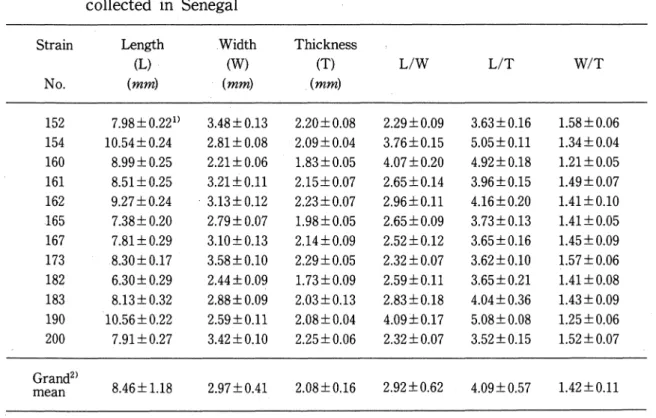
-55-Table 2. Some morphological characters of unhusked grains of 0. sativa collected m Senegal
Stra in Length Width Thic k ness (L) (W) (T) ( mm) (mm) ( mm) L/W / W/T 152 7.98±0.22D 3.48±0.13 2.20±0.08 154 10.54±0.24 2.81±0.08 2.09±0.04 160 8.99±0.25 2.21±0.06 1.83±0.05 161 8.51±0.25 3.21±0.11 2.15±0.07 162 9.27±0.24 3.13±0.12 2.23±0.07 165 7.38±0.20 2.79±0.07 1.98±0.05 167 7.81±0.29 3.10±0.13 2.14±0.09 173 8.30±0.17 3.58±0.10 2.29±0.05 182 6.30±0.29 2.44±0.09 1.73±0.09 183 8.13±0.32 2.88±0.09 2.03±0.13 190 10.56±0.22 2.59±0.11 2.08±0.04 200 7.91±0.27 3.42±0.10 2.25±0.06 2.29±0.09 3.63±0.16 1.58±0.06 3.76±0.15 5.05±0.11 1.34±0.04 4.07±0.20 4.92±0.18 1.21±0.05 2.65±0.14 3.96±0.15 1.49±0.07 2.96±0.11 4.16±0.20 .41±0.10 2.65±0.09 3.73±0.13 1.41±0.05 2.52±0.12 3.65±0.16 1.45±0.09 2.32±0.07 3.62±0.10 1.57±0.06 2.59±0.11 3.65±0.21 1.41±0.08 2.83±0.18 4.04±0.36 1.43±0.09 4.09±0.17 5.08±0.08 1.25±0.06 2.32±0.07 3.52±0.15 1.52±0.07 Grandsifi mean--4D±1.182.97±0.412.08±0.162.92±0.624.09±0.571.42±0.ll 1) Mean of 20 grains and standard deviation.
2) Mean of means in the respective strains (n-12) and standard deviation.
Kampissa, Kilidio Saboly, Sindima, Biaro, Toubacouta, Oudoucar, Bonghari and Bandiana. GAMBIA; Bassさ Banjul, Pirang, Fraba Bantan and Lame. Those were found in rain fed paddy fields, shallow water paddy fields, upland fields, irrigated paddy fields and swamps. Distributions of cultivated rices collected were listed up in Table 1. In this table, the strain number, the species name, the local name, the date of collection and some informations of the habitat were described.
Some morphological characters of unhusked grains
●
Thirteen strains of 0. sativa and 42 strains of 0. glaberrima were collected in this trip and those were used for morphological investigations of unhusked grains. One strain of 0. sativa and 1 strain of 0. glaberrima were removed from the investigations, because of the utter immaturities of those grains.
Investigations were done for length, width and thickness of unhusked grains/ using
20 grains of each strain. Measurements were done at the largest position of the respective
characters. Moreover, of the unhusked grains, calculations were done on the ratios of
the following components, namely, `length to width', `length to thickness', and `width to
●
thickness', using average values of the respective characters. I. O. sativa
6.30 mm and 10.56 mm. The shortest grain was obtained in strain No. 182. The longest gram was obtained in No. 190. Average value was found to be 8.46 mm. The standard deviations of each strain, /. e., showing intra-strain variation, were noted to be between
●
0.17 and 0.32.
Widths of grains were observed to be between 2.21 mm and 3.58 mm. The narrowest grain was obtained in No. 160. The widest grain was obtained in No. 173. Average value was found to be 2.97 mm. The standard deviations of each strain were noted to be between
0.06 and 0.13.
Thicknesses of grains were observed to be between 1.73 mm and 2.29 mm. The thinnest gram was obtained in No.182. The thickest grain was obtained in No.173. Average value was found to be 2.08 mm. The standard deviations of each strain were noted to be between 0.04 and 0.13.
To make clear the relationships of the three components, /. e., length and width, length and thickness, and width and thickness of unhusked grains, correlation coefficients were calculated. The correlation coefficient between length and width of unhusked grains was ascertained to be -0.14 showing no significant correlation even at 5 % level. The correlation coefficient between length and thickness of unhusked grains was ascertained to be 0.28
showing no significant correlation even at 5 % level. The correlation coefficient between
width and thickness of unhusked grains was ascertained to be 0.89 showing significant
correlation among them at 0.1 % level′ This relation indicated that the wider was the gram-width, the thicker was the grain-thickness.
Ratios of grain-length to grain-width of unhusked grains were observed to be between 2.29 and 4.09. The smallest value was obtained in No. 152. The largest value was obtained
■l
m No.190. Average value was found to be 2.92. The standard deviation of the whole strains, i. e., showing inter-strain variation, was 0.62.
●
Ratios of grain-length to grain-thickness of unhusked grains were observed to be between 3:52 and 5.08. The smallest value was obtained in No. 200. The largest value was obtained m No.190. Average value was found to be 4.09. The standard deviation of the whole strains was 0.57.
Ratios of grain-width to grain-thickness of unhusked grains were observed to be between 1.21 and 1.58. The smallest value was obtained in No. 160. The largest value was obtained m No.152. Average value was found to be 1.42. The standard deviation of the whole
strains was 0.ll.
As shown in Fig. 3, ba畠ed on the data obtained concerning the length and
grain-●
width of unhusked grains, the whole strains of 0. sativa used were classified into three grain types, i. e., A (short type), B (large type) and C (slender type), according to the tripartite classification by Matsuo3). In this figure, code-numbers used are corresponding to the strain number used in Table 1. One strain of them belonged to the A type, 3 strains to the B type and 8 strains to the C type, respectively. As shown in Table 3, average values of grain-length were found to be 6.30 mm in 1 strain belonging to the
●
-57-( u i U l ) i p 的 u a 1 3.0 Width (mm)
Fig.3. Classification of grain types of unhusked grains in cultivated rice collected in Senegal according to the tripartite classification by
Matsuo . Vertical axis ; length of grain, abscissa ; width of grain, open circle ; Oryza sativa L., filled circle ; Oryza glaberrima Steud., respectively. Code-numbers used in the figure are corresponding to the strain number used in Tables 2 and 4.
Table 3. Number of strains and average values of length and width of unhusked grains in 0. sativa belonging to the respective grain types
Grain" No. of Length Width
type strains ( mm) ( mm) A B C 1 3 8 6.30±0.00 2.44±0.00 9.37±0.92 3.17±0.32 8.39±0.94 2.96±0.46
1) For explanation, refer to Fig. 3.
A type, 9.37 mm in 3 strains to the B type and 8.39 mm in 8 strains to the C type, respectively. Average values of grain-width were found to be 2.44 mm in the A tytうe, 3.17 mm in the
B type and 2.96 ∽∽ in the C type, respectively. In grain-length, standard deviations of the whole strains in the B and the C types, i. e., showing inter-strain variations, were 0.92 and 0.94, respectively. In grain-width, standard deviations of the whole strains in the B and the C types were 0.32 and 0.46, respectively.
II. O. g/aberr/ma
The results are given in Table 4. Lengths of grains were observed to be between 7.47 mm and 9.38mm. The shortest grain was obtained in No.194. The longest grain
was obtained in No. 189. Average value was found to be 8.45 〝‡桝. The standard deviations of each strain, i e., showing intra-strain variation, were noted to be between 0.09 and 0.37.
● ●
Widths of grains were observed to be between 2.94 mm and 3.75 mm. The narrowest grains were obtained in Nos.189 and 193. The widest grain was obtained in No.158. Average value was found to be 3.30 mm. The standard deviations of each strain were noted to be between 0.06 and 0.16.
Thicknesses of grains were observed to be between 1.83 mm and 2.22 mm. The thinnest grain was obtained in No.194. The thickest grain was obtained in No.199. Average value was found to be 2.03 ∽∽ The standard deviations of each strain were noted to be between 0.04 and 0.09.
To make clear the relationships of the three components, /. e., length and width, length and thickness, and width and thickness of unhusked grains, correlation coefficients were calculated. The correlation coefficient between length and width of unhusked grains was ascertained to be 0.27 showing no significant correlation even at 5 % level. The correlation coefficient between length and thickness of unhusked grains was ascertained to be 0.20
showing no significant correlation even at 5 % level. The correlation coefficient between
width and thickness of unhusked grains was ascertained to be 0.77 showing significant
● ●
correlation among them at 0.1 % level. This relation indicated that the wider was the
gram-width, the thicker was the grain-thickness.Ratios of grain-length to grain-width were observed to be between 2.27 and 3.19.
-59-Table 4. Some morphological characters of unhusked grains of O. glabemma collected in Senegal
Strain Length Width Thic k ness
(L) (W) (T) L/W No. (mm) (mm) (mm) L/T W/T 147 8.13±0.241) 3.23±0.09 148 8.24±0.13 3.42±0.09 149 8.67±0.21 3.49±0.12 150 8.59±0.16 3.32 ±0.09 151 8.59±0.26 3.25±0.12 153 8.06±0.19 3.13±0.06 155 8.27±0.09 3.25±0.07 156 8.67±0.29 3.33±0.10 158 8.52±0.21 3.75±0.09 159 8.51±0.19 3.53±0.07 163 8.37±0.18 3.35±0.12 164 8.62±0.17 3.22±0.10 166 8.45±0.17 3.41±0.07 168 8.15±0.14 3.37±0.08 169 8.01土0.18 . 3.22±0.ll 170 8.96±0.18 3.48±0,08 171 7.96±0.16 3.33±0.10 172 8.19±0.17 3.34±0.09 174 ±0.14 3.39士0.09 175 8.30±0.15 3.27±0.06 176 8.64±0.26 3.30±0.10 177 7.64±0.23 3.17±0.07 178 8.60±0.23 3.42±0.ll 179 8.89±0.37 3.23±0.ll 180 8.82±0.21 3.33±0.16 181 8.42±0.18 . 3.40±0.08 184 8.04±0.15 3.29±0.09 185 8.63±0.20 3.29±0.10 186 8.54±0.19 3.41±0.08 187 8.83±0.33 3.35±0.12 188 8.19±0.16 3.25±0.10 189 9.38±0.17 2.94±0.ll 191 9.21±0.17 3.36±0.08 192 7.89±0.14 3.02±0.08 193 8.74±0.16 2.94±0.08 194 7.47±0.14 3.00±0.08 195 ・ 8.83±0.20 3.35±0.07 196 8.97±0.16 3.41±0.09 197 8.33±0.20 3.21±0.ll 198 7.75±0.22 3.14±0.10 199 8.66±0.19 3.46±0.10 1.93±0.08 2.52±0.10 2.10±0.07 2.42±0.13 2.18±0.08 2.49±0.07 2.08±0.04 2.59±0.09 1.87±0.07 2.65±0.13 1.94±0.05 2.57±0.05 2.05±0.05 2.54±0.06 2.08±0.05 2.61±0.ll 2.19±0.05 2.27±0.06 2.15±0.06 2.41土0.06 2.06±0.06 2.50±0.13 2.C ±0.04 2.68±0.10 2.04±0.06 2.48±0.08 2.00±0.06 2.43±0.07 1.98±0.06 2.49±0.10 2.12±0.09 2.58士0.06 2.04±0.07 2.39±0.ll 2.01±0.05 2.46±0.08 2.11±0.05 2.56±0.07 2.06±0.04 2.54±0.06 2.00±0.08 2.00±0.05 2.06±0.06 2.05±0.07 2.00±0.07 2.13±0.05 1.97±0.07 2.05±0.05 2.62±0.12 2.41±0.07 2.51±0.09 2.76±0.15 2.65±0.14 2.48±0.09 2.45±0.07 2.63±0.09 2.00±0.06 2.51±0.08 2.06士0.07 2.64±0.09 2.03±0.05 2.52±0.09 1.97±0.07 3.19±0.14 1.94±0.05 2.74±0.09 1.91±0.05 1.87±0.07 1.83±0.06 1.99± 0.06 2.06±0.05 1.94±0.07 2.03±0.07 2.22±0.09 2.61±0.08 2.97±0.ll 2.49±0.06 2.64±0.05 2.63±0.07 2.60± 0.08 2.48±0.10 2.51±0.09 4.22士0.22 1.68±0.09 3.93±0.09 1.63±0.07 3.99±0.17 1.61±0.09 4.13±0.09 1.60±0.05 4.60±0.24 1.74±0.ll 4.16±0.11 1.62±0.05 4.03±0.10 1.59±0.06 4.17±0.12 1.60±0.05 3.89±0.10 1.71±0.05 3.97±0.10 1.65±0.06 4.06±0.15 1.62±0.06 4.24±0.11 1.58±0.06 4.16土0.19 1.68±0.07 4.07±0.13 1.68±0.07 4.04±0.13 1.62±0.05 4.24±0.17 1.65±0.07 3.91±0.12 1.64±0.08 4.08土0.13 1.66±0.05 4.12士0.10 1.61±0.06 4.03±0.12 1.59±0.04 4.33±0.18 1.66±0.10 3.82±0.15 1.58±0.06 4.19±0.14 1.67±0.07 4.35±0.29 1.58±0.08 4.41±0.15 1.67±0.10 3.95±0.11 1.60±0.05 4.09土0.15 1.67±0.07 4.22±0.11 1.61±0.05 4.27±0.11 1.71±0.07 4.29±0.17 1.63±0.08 4.03土0.10 1.60±0.07 4.77±0.20 1.50±0.06 4.74±0.16 1.73±0.07 4.14土0.13 1.59±0.06 4.68±0.20 1.57±0.05 4.09±0.17 1.64±0.08 4.45±0.18 1.69±0.06 4.37±0.09 1.66±0.04 4.29±0.17 1.65±0.09 3.83±0.14 1.55±0.09 3.91±0.15 1.56±0.07 Grand2) mean 8.45±0.41 3.30±0.25 2.03±0.08 2.57±0.15 4.18±0.23 1.63±0.05
1) Mean of 20 grains and standard deviation.
Table 5. Number of strains and average values of length
and width of unhusked grains in 0. glaberri〝∽ be-●
longing to the respective grain types
Grainl* No. of Length Width
type strains ( mm) (mm)
B 22 8.60±0.18 3.40±0.ll 19 8.25±0.39 3.23±0.10
1) For explanation, refer to Fig. 3.
The smallest value was obtained in No. 158. The largest value was obtained in No. 189. Average value was found to be 2.57. The standard deviation of the whole strains, i e., showing inter-strain variation, was 0.15.●
Ratios of grain-length to grain-thickness were observed to be between 3.82 and 4.77. The smallest value was obtained in No. 177. The largest value was obtained in No. 189. Average value was found to be 4.18. The standard deviation of the whole strains was
0.23.
Ratios of grain-width to grain-thickness were observed to be between 1.50 and 1.74. The smallest value was obtained in No. 189. The largest value was obtained in No. 151. Average value was found to be 1.63. The standard deviation of the whole strains was 0.05.
As shown in Fig. 3, based on the data obtained concerning the length and grain-width of unhusked grains, the whole strains of O. glaberrima used were classified into two grain types, i. e., B and C types. Twenty-two strains of those belonged to the B type and 19 strains to the C type, respectively. As shown in Table 5, average values of grain-length were found to be 8.60mm in 22 strains belonging to the B type and 8.25mm in
●
19 strains to the C type, respectively. Average values of grain-width were found to be 3.40 mm in the B type and 3.23 mm in the C type, respectively. Strains belonging to the B type were relatively long in view of grain-length and wide in view of grain-width.
●
In grain-length, standard deviations of the whole strains in the B and the C types, i e., showing inter-strain variations, were 0.18 and 0.39, respectively. In grain-width, standard deviations of the whole strains in the B and the C types were 0.ll and 0.10, respectively.
Summary
During the trip from October to November in 1985 in Senegal, 55 strains of cultivated rice, i. e., 13 strains of 0.sativa and 42 strains of 0.glaberrima were collected. Their localities and habitats were reported (Table 1). Locality names are as follows ; Ziguinchor, Guidel, Boutoupo, Niaguis, Agnack, Adeane, Diagnon, Kaour, Goudoump, Djibanar, Simbandi, Amdoulaye, Sindima, Banbatou, Kitim, Kampissa, Kilidio Saboly, Toubacouta, Oudoucar, Bonghari, Kafoutine and Richard Toll. GAMBIA ; Banjul, Bassさ, Pirang, Fraba Bantan
-61-and Lame.
In the whole strains of 0. sativa collected, average values of length, width and thickness of unhusked grains were 8.46 mm, 2.97 mm and 2.08 mm, respectively. Of unhusked grains, correlation coefficients between length and width, length and thickness, and width and thickness were -0.14, 0.28 and 0.89, respectively. Of unhusked grains, ratios of length to width, of length to thickness and of width to thickness were 2.92, 4.09 and 1.42, in
I
average values, respectively.
Using grain-length and grain-width, the ′whole strains of 0. sativa used were classified into three grain types. One strain belonged to the A type, 3 strains to the B type and 8 strains to the C type, respectively.
In 0. glaberrima collected, of 42 strains forty-one were used for morphological investigations of unhusked grains. Average values of length, width and thickness of unhusked grains were 8.45mm, 3.30 mm and 2.03 mm, respectively. Of unhusked grains, correlation coefficients between length and width, length and thickness, and width and thickness were 0.27, 0.20 and 0.77, respectively. Of unhusked grains, ratios of length to width, of length to thickness and of width to thickness were 2.57, 4.18 and 1.63, respectively.
Using grain-length and grain-width, the whole strains of 0. glaberrima used were classified into two grain types. Twenty-two strains belonged to the B type and 19 strains to the C type, respectively.
References
1 ) Katayama, T.C. 1987. General remarks on cultivated rice in Africa concerned. Kagoshima Univ. Res. Center S. Pac. 0cc. Papers 10: 91-102.
2 ) IRAT-ISRA-ORSTOM. 1980. Prospection mission in Casamance (Senegal), December 1978-February 1979. Prospection of African Rice : 1-2.
3 ) Matsuo, T. 1952. Genecological studies on cultivated rice (in Japanese with English summary). Bull. Natl. Inst. Agr. Sci. Ser. D3: 1-111.
4 ) Second, G. 1975. Prospection des especes africaines de riz au Senegal et en Gambie (Oct. 1974-Jan. 1975). Rapport de Mission, ORSTOM. 1-21.