Studies on Pitting Corrosion of Aluminum
ToshiakiHATSUSHIKA TakashiSUZUKI YasumasaHAYAKAWA
(Received August 31,1979) Abstract Although the uniform corrosion of aluminum is inhibited by using corrosion inhibitors or by other techniques, a localized corrosion(pittillg)of it is often occurred. By inves・ tigating various phenomena taken place in an artificial pit drilled mechanically in an aluminum specimen, the authors desire to clarify the mechanism of the pitting corrosion. The results obtained from the experiments are following: 1) The corrosive effects in the artificial pit were more violent in case of setting platinum antielectrode at the head of the pit than those in cases at any other positions of the pit・ 2) The amount of dissolved aluminum in the pit was remarkably high compared with that of theoretical calculation along Faraday’s law. 1● Introduction As the surface of aluminum is always covered with extremely strong film, it is widely used as like an inactive metal in spite of its basic prop・ erty. Aluminum, however, shows its activity in alkaline aqueous solutions 1), and it usually shows uniform corrosion. Many papers on the studies of corrosion inhibitors have been presented by the authors 2)in order to inhibit uniform corrosion of aluminum. Although the uniform corrosion of an alumi− num vessel is inhibited by use of inhibitors or by other techniques, pitting corrosoin of it often takes place and it results in accidents. Thus, it is urgent to clarify the pitting mechanism in the 丘eld of engineering side. The term of‘‘pitting corrosion”used in this paper means the category of corrosion that pro・ motes vertically to the metal sdrface from the point of anode hapPened to occur at the defect of the surface丘lm by which uniform corrosion is inhibited. To observe the state in a pit, an arti丘cial ma− cro−pit was mechanically made in an aluminum specimen, the specimen was immersed into the aqueous solution of sodium chloride and the alu・ minum was set as negative pole and while plati・ num wire was inserted into the pit and was set as antielectrode. Then, the inside of the pit was activated by applying current and the change of liquid properties in the pit was studied.
2、Experimentals
2.1 Specimen and reagents 2.1.1 Aluminum Comme「cial grade No.1100 aluminum plate(pu. rity 99.0%, Si十Fe<1.0%, Cu<0・20%, Mn<0・05 %,Zn<0.10%;thickness 5 mm)was cut out as shown in Fig.1and a hole(diameter 4 mm, depth 20mm)was artificially drilled in it. Then the specimen was prepared by painting the surface of aluminum with anticorrosive insulating resin (Frontex)except the pit and terminal part. 2.1.2 Corrosive solutions 100ml batches of O.5N(ca.3%)and O・1N (ca.0.5%)aqueous solutions of sodium, potassium and ammonium chlorides(commercial guaranteed grade of Wako Junyaku KK)were used as cor− rosive solutions.→5ト mm 10mm 40rpm
25mm
↓A
B
ロ ’ ’ ; 1 , s t 〔 ; , ‘ I t L−“ 1←一一一130mm 、一芳 A:Terminal part not coated with resin B:Artificial pit(diameter 4mm, depth 20 mm) Fig.1Aluminum specimen. 2.1.3 0ther reagents For the analysis of chloride, KSCN, AgNO3,C6H5NO2, HNO3 and ammonium ferric sulfate
were used, and for that qf pH, pH test papers lnner thickness 2・5mm and of volume 200 ml was used by filling 100ml of the corrosive solution, and the agitation of the solution was carried out with a magnetic stlrrer. c)Current supPlier. A potentiogalvanostatt (NPGS−3010f Nikko keisoku)supPlied a constant current at every set potentia1. (BCG, BPB, BTB, TB, MR, CR of Toyo roshi KK)were used. For the preparation of refe− rence electrode, KCI, agar・agar and silver wire (diameter O.5mm)were used. 2.2Equipme皿ts 2.2.1 Electrolysis apparatus In a thermostatt bath an electrolysis cell was set. In the cell an aluminum specimen was pla・ ced at a certain position and the corrosive solu・ tion was poured, then platinum antielectrode was set at a constant depth in the pit. a)Thermostatt. A plastic vessel of size 25× 25cm and of depth 9cm was used and the agit− ation of the inner water was carried out with a rotating stirrer and with a circular pump. The temperature was kept constant at 30±1°C. b)Electrolysis cell. A glass vessel of’ diameter 55 mm, of height 95 mm, of 2.2.2 Platinum antielectrode The electrode was made with a glass tube of diameter 3 mm, length 20 cm and with platinum wire of diameter O.3mm, the tip O.5mm of which was left bare. The electrode was connected to amicro−mallupulator(made of Narishige seisak・ usho)movable toω,ッ, z axes directions and ins・ erted into the pit without any contacts with alu・ mlnum. 2.2.3 Silver−silver chloride reference electrode The tip(ca・20 mm)of silver wire(diameter O.5mm, length 10 cm)was immersed into dil HCl and then silver chloride film was formed on the surface of silver wire by electrolyzing with use of platinum cathode. Acapillary tube of diameter O.54 mm was made of glass tube(diameter 3 mm)with use of Tycoon micro−electrode puller(EH−120f Takahashi seiki kogyo). In the tube hot potassium chloride−agar solution(prepared by mixing 100 ml H20,3gKCl and l g agar・agar)was filled and Ag−AgCl wire was inserted therein as shown in F㎏.2. 2.3 Procedure 2.3.1 Constant current electrolysis Apotentiogalvanostatt and an electrometer(NE− 10f Nikko keisoku)were set as shown in Fig.3. Platinum antielectrode was placed in the arti丘cial pit,丘xed at the depths of O,10 and 19 mm, res・ pectively, and electrolyzed by constant currents30mm
⊥T
AgCI Agar ←0.54mmφ A:Silver wire(diameter O.5 mm,1ength 100 mm) AgCl:Silver wire covered by silver chloride film Agar:Agar agar gel saturated with potassium chloride Fig.2Reference electrode.国
口
FiA
B
A:Electrolysis vessel(dia・ meter 55mm, height 90 mm, volume 200 ml, gla・ ss) B:Electrolyte(alkali chlor・ ides solution)C:Aluminum specimen
D:Platinum electrode(dia・ meter O.3mm, length 100 mm, platinum wire) E:Reference electrode(Ag・ AgC1) F:Stirrer(by rotating ma’ gnet) PG:Potentiogalvanostatt V:Electrometer Fig.3ApParatus of constant current electrolysis・ (0.1,1.O and 10 niA, respectively, for 2・6cm2) for certain hours(1,3,5∼6,9and 12∼14 hours, respectively)・ Ag−AgCl reference electrode was also set as in 丘g.3for measuring the electrode potential of aluminum. 2.3.2Measurements of corrosion potential and corrosion current Platinum antielectrode was set at several point in the artificial pit and the current strength(cur− rent density)was measured at successive potent・ ials(20 mV/min). Then the polarization curve (E−logのwas drawn from the plots, and the cor’ rosion potential and corrosion current were obta− illed from the curve in the usual way. 2.3.3 Analysis of substances in the pit a)Pick−up method of test solution in the pit. (L
o
己 .2 烏 お 奉 8 8 .9 o 思 £s
o
0.55 oi50 After the treatmellt of aluminum specimen in 100ml corrosive solution was over, ca.0.25 ml solution in the pit was picked up by an injector and the solution was stored as the test solution. b)Analysis of chloride ion. About O.1ml test solution was used for KSCN titration along Vol・ hard’s method. Analytical procedure was sim・ plified by using nitrobenzen as a masking agent of silver chloride. c)Analysis of aluminum ion・ About O・1ml test solution was poured in a beaker, acidi丘ed, added Cu−Pan indicator 3), boiled and the alumi’ num was quanti丘ed by the titration of O.01 M−EDTA.
d)Measurement of pH・ About O・05 ml test solution was slightly dropped on the pH test pa’ pers and pH values were measured by their color changes. 3. Results and their discussio】[1Ls 3.1 Change of chloride io皿conce皿tration i皿the pit by lapse of time 3.1.1 1n case of simple immersion of specimen In case that the aluminum specimen was only immersed in 100 ml corrosive solution and was not electrolyzed, chloride ion in the artificial pit was slightly increased with lapse of time as shown in Fig.4. The relation between the concentration(N)of AICl3 and pH value was shown in F㎏・5・and 0 Fig.4 5 10 15 20 Lapse of tlme(hrs) The change of sodium chloride concentration in the artificial pit of the specimen by lapse of time without current.A
5 4 3 0.01 Fig.5o\
O \o \ Q\o 、。 ON。 0.030.05 0ユ 0.3 0.5 1.O Concentration of AICI3(N) Relation between the concentration of aluminum chloride solution and hydrogen ion concentration・from the figure the pH value seems to decrease with increasing concentration of aluminum by hy− drolysis. It is considered from the both facts that the
surface丘lm on aluminum was broken without
applying current, aluminum was dissolved, and the corrosion was increased with Iowering pH caused by the hydrolysis of dissolved aluminum. 3.1.2 Difference by the position of platinum antielectrode in the pit The difference was shown in Fig.6, in case of apPlying l mA and of using O.5N(ca.3%)so・ dium chloride solution. As clari丘ed in the丘gure, the chloride ion was most increased by setting platinum antielectrode at the head of artificial pit(depth O mm). In case of setting platinum electrode at the bottom of pit(depth 19 mm), chloride ion was kept co・ nstant at the initial stage and it was increased with lapse of time, but the quantity was lower than that of the former case. In case of setting platinum electrode at the centre of pit(depth 10 mm), the increase of chloride ion in the initial stage was same as in the case at the head of pit (depth Omm)but became as like in the case at the bottom of pit(depth 19 mm). 3.1.3 Difference by the kind of alkali cation Each change of chloride ion concentration in the solution(O.5N)of KC1, NaCl and NH4Cl in the pit by lapse of time was measured in the solution (the initial concentration O.5N) of ( ) .9 烏 七 5 目 8 ロ .9 o 霊 ヱs
o
0.60 0.55 0.50 Position of electrode: c−潤c−head of pit(depth Omm) 一・一△一一一centre of pit (depth 10mm) ! 一ローbottope of pit(depth 19mm)!1 !! !O !1 1’o 〆1 ,タら タ/ 〃’ ’i ! ♂O!’1O1
、/
△・一... 、△、 ! KCI, NaCl and NH4Cl and the results in case of apPlying l mA and setting Platinum antielectrode at the head of pit(depth Omm)was shown in Fig.7. The concentrations of chloride ions in the pit were increased with lapse of time in the order of KCI>NaCI>NH4Cl. This difference by the kind of cations was supposed to be caused by their differences of the degrees of dissociation(KC1>NaCl>NH4Cl)and of hydration(NaC1>KCI>
NH4Cl). 3.1.4 Difference by the strength of current Each change of chloride ion concentration in the pit by lapse of time was measured by varying the strength of current(0.1,1.O and 10 mA, respectively)and by setting Platinum antielect・ rode at the head of pit(depth Omm)and was shown in Figs・8and g・ Fig.8was obtained by using about O.5NKCI and NH4Cl as corrosive solution, and丘9.9was those about O.1N. The chloride concentrations of both cases were increased with increasing strength of current and with increasing lapse of time. At equal strength of current and at equal lapse of time, the chloride concentration was tremendously increased in case of KCI, compared with that in case of NH4Cl. The difference of the kind of cation in O.5N solution more afifected the concentration of chlo− ride in the pit than that in O.1Nsolution. 口’ 、A
之0.7 ) む 霊R
壱 号 蠕o・6 ℃ .9 甘 お る 呂0.5 0v
o−・一 KCl −一一・一「一・一一 NaCl −一・・一香[一一・ NH, Cl 〆諺三r
管1
/
,廿’ 0 Fig.6 20 40 60 80 Coulomb(1mA×sec) The change of sodium chloride concentration by lapse of time in case of setting antielect− rode at varrious positions in the pit. 10 15 Lapse of time(hrs) Fig.7 The difference of the change of alkali chloride concentration in the artificial pit by different positions of antielectrode.0.7 之 ) む 霊 ヱ
s
甘 0.6 .9 甘 1 巴 9 0 0.5 o KCI,10mA △ KCI,1mA 口 KCI,0.1mA ’一一一怦鼈鼈鼈黷mH CI 10mA −■一一」一一一一NH CI lmA −一一一。一・一一一NH C10.1mA 。/、 △/。 0 Fig.8 ’( ) v 窯 £6
お .9 烏 上 8 88
0.3 0.2 。.1il4 ○/△/
,● 只ンプ’ 5 10 15 Lapse・f time(hrs) The difference of change of chloride concentration in artificial pit by lapse of time in cases of applying various strengths of current(initial concentr・ ation:ca.0.5N;anode area;2.6cm2). O.6 了 乏o.4 三2
号o.28
0 Fig.10 20 40 60 80 Content of dissolved aluminum in pit(mg) The difference of change of dissolved aluminum concentration in artificial pit by lapse of time in case of applying current./
。’/ ///〆膓/
∠/
目三ヨ≡三…§ Table l pH values at various setting positions of platinum antielectrode(O.5N・ NaC1,1mA). ,■’一 ,_Y‘二P−一一 ! Position in pit 一・一揶黶E−KCI,10mA o KC1,1mA −一一一Z一一一一KCI,0.1mA −・塩m・−NH, Cl,10mA −一一。一一NH4 Cl,1mA −一一X一一・NH,Cl,0ユmA head centrebottom
Depth
(mm) 0 10 19Ohr
Electrolysis time 5.5 5.5 5.51hr
4.024hrs
2.0 3.5 4.5≡三三三三目…三
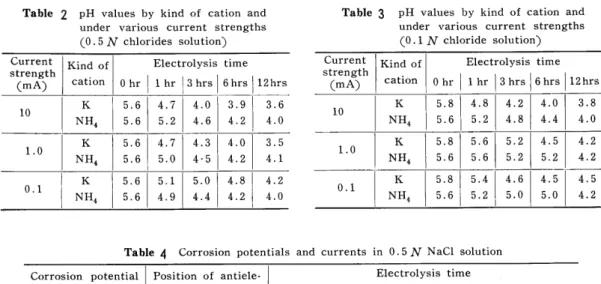
L−一一.一一一一一L−.一.一 0 Fig.9 5 10 15 Lapse of time (hrs) The difference of change of chloride concentration in artificial pit by lapse of time in cases of applying various strengths of current(initial concentr− ation:ca,0.IN;anode area:2.6cm2). 3.2Change’ of aluminum concentration in tlle pit by lapse of time The dissolved contellt of aluminum from the pit of aluminum specimen by apPlying l mA and by setting platinum antielectrode at the head of pit(depth O mm)was shown in Fig・10・ The dissolved content of aluminum was increased with lapse of time. The measured value of dissolved aluminum shown in丘9.10 is several hundred times as the value calculated from Faraday’s law. It is obli一 ged to consider that the surface丘lm is broken not only by electrolysis but by the deflocculation of the丘lm(3.1.4). 3・3Change of hydrogen ion co皿centration i皿the pit by lapse of time 3.3.1 Difference by the position of platinum antielectrode The value of pH was changed by setting posi・ tion of platinum antielectroed in the pit as listed in Table 1. The pH values listed in the table are those of O.5NNaCl and lmA. As clari丘ed in tabe11, the lowering of pH values was most remarkable in case of setting platinum antielectrode at the head of the pit (depth O mm)・ 3.3.2 Difference by kind of cation and by current strength The differences of pH values by the kind of cation and by the strength of current using O.5 Nor O.1Nchloride solution are listed in Table 2 0r 3, respectively・Table 2 pH values by kind of cation and under various current strengths (0・5Nchlorides solution) Table 3 pH values by kind of cation and under various current strengths (0・1Nchloride solution) Current strength (mA) 10 1.0 0.1 Kind of cation
K
NH4
K
NH4
K
NH4
Ohr
Electrolysis time 5.6 5,6 5.6 5.6 5.6 5.61hr
4.7 5.2 4.7 5.0 5.1 4.93hrs
4.0 4.6 4.3 4・5 5.0 4.4 6hrs 3.9 4.2 4.0 4.2 4.8 4.2 12hrs Current strength (mA) 3.6 4.0 10 3.5 4.1 1.0 4.2 4.0 0.1 Kind of cationK
NH4
K
NH4
K
NH4
Ohr
Electrolysis time 5.8 5.6 5.8 5.6 5.8 5.61hr
4.8 5.2 5.6 5.6 5.4 5.23hrs
4.2 4.8 5.2 5.2 4.6 5.0 6hrs 4.0 4.4 4.5 5.2 4.5 5.0 12hrs 3.8 4.0 4.2 4,2 4.5 4.2 Table 4 corrosion potentials and currents in o・52V Nacl solution Corrosion potential or current potential (Vvs・SCE) current (μA/cm2) Position of antiele・ ctrode in pithead
centre head centreOhr
1hr
Electrolysis time _0.74 _O.73 0.52 0.15 _0.74 _.078 1.4 0.533hrs
_0.73 −0.73 1.6 0.465hrs
_074
_069
1.5 2,09hrs
_0.70 3.8 The pH values in case of using O・5Nchloride solutions are more decreased than those in case of O.1Nsolutions, and the values are decreased with increasing strength of current. There shows the cation effect, namely potassium chloride solution more affects than ammonium chloride one. 3.4 Corrosion Potential and corrosio皿 current The corrosion potentials and corrosion currents were obtained from the polarization curve using O.5Nsodium chloride solution and the results are listed in Table 4. In case of setting antielectrode at the head of the pit, the corrosion potential was slightly cha− nged during the initial 5 hrs・, and it was shifted toward noble potential side with lapse of time. While in case of setting antielectrode at the centre of the pit, it moved toward less noble potential side at丘rst but it shifted toward noble side with lapse of time. The’ values of corrosion current seem to incre− ase with increasing time of electrolysis. 4. Conclusio皿s 1. It was clari丘ed that the concentration of chloride ion, the lowering of pH values and the dissolution of aluminum in the artificial pit were more violent in case of setting Platinum antiele− ctrode at the head of pit than those in case at the other positions in pit・ 2. The reason of this phenomenon was consi− dered by the authors that the agitation of liquid in pit by hydrogen gas evolved around the antie− 1ectrode takes place and the concentration effects of chloride and hydrogen ions are disturbed. 3.It was found that the amount of dissolved aluminum in arti丘cal pit was remarkably high compared with that of theoretical calculation from Faraday’s law. By the authors the dissolution of aluminum was supposed to be drived from the chemical dissolution of oxide film broken by con・ centrated chloride ion. The authors take this opportunity to express their hearty gratitude to Drs.1. Ishijima, K. Iwasaki and T. Matsumura of Lion Dentri丘ce Co. Ltd. for their excellent guidance and forpartly 丘nancial assistance during the course of the investigation. The authors wish to express their thanks to Mr. M. Yamada, T. Sakatani and M.Hasegawa who carried out the experiments.