九州大学学術情報リポジトリ
Kyushu University Institutional Repository
協調探索における通信戦略の研究
楢崎, 修二
https://doi.org/10.11501/3111011
出版情報:Kyushu University, 1995, 博士(工学), 論文博士 バージョン:
権利関係:
Chapter 4
Evaluation and Discussion
In this chapter, we evaluatf' two strategies through simulations using Trav ling Salt-sman Prob
lem (TSP) as an examplr of a search problem. Under varying conmmuicatiou costs, hot.h strategies show good performance .. Vve also discuss the adaptability and ext<'ntiouality of our strategies.
4.1 Traveling Salesman Problem as a Cooperative Search
We mueasure the quality of the strategies through simulations using the TmvPling Salf'stnan Problem (TSP). TSP wa'3 defined by
A.
J. Hoffman aud P. 'iVolfe in p. 2 of[LLAUI\:S 5]
as:The TSP for a graph with specified edge lengths is the probl<' l ll of fillCliug a Ha.mil
tonian cycle of shortest length.
A Hamiltonian cycle is a cycle that contains all the verticrs of thr graph exactly oJJC<'. TSP is a well-known NP-hard problem.
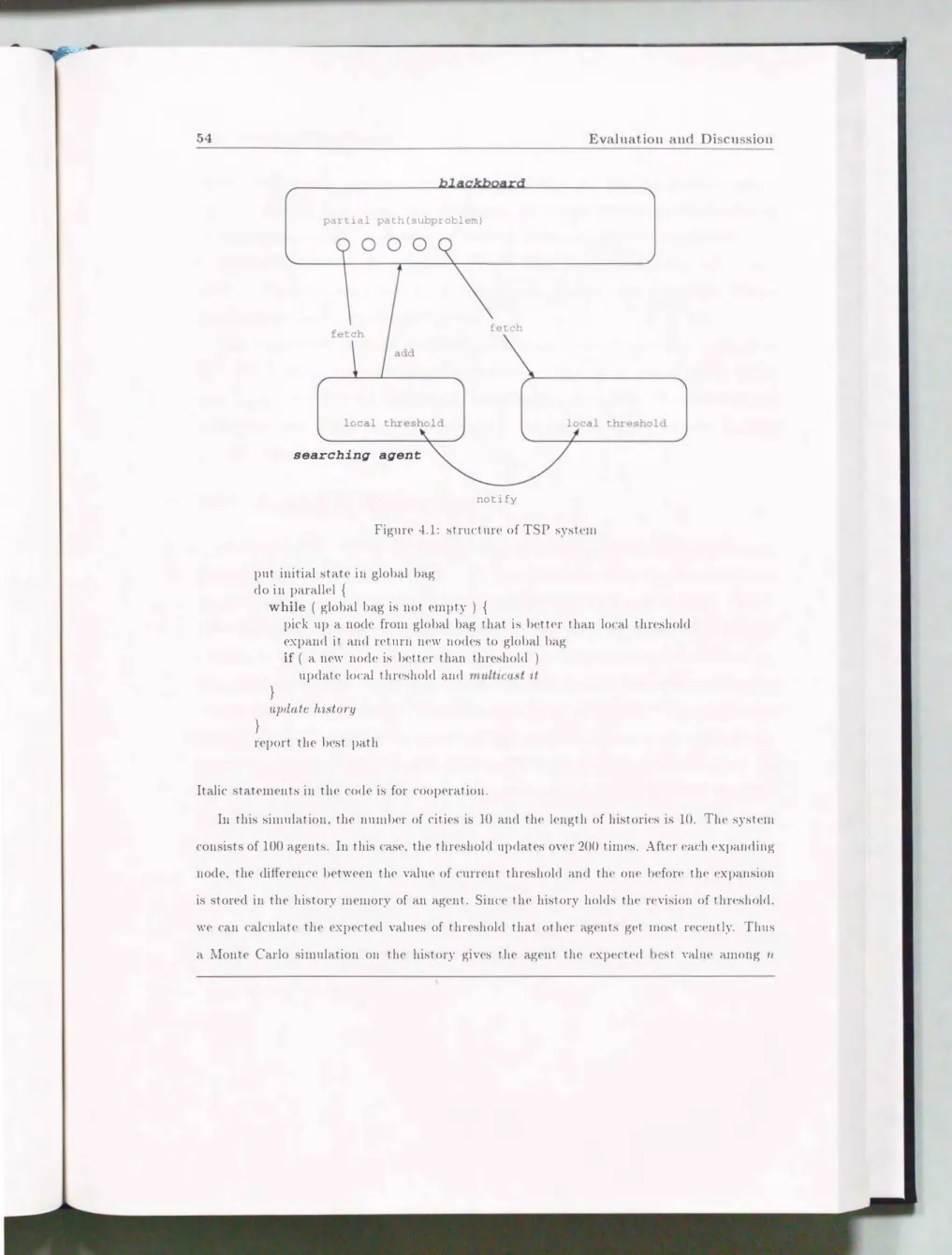
We implemented the range control strategi s on both fiat spatial structur<'s and hi(•ra.rchica.l ones, the frequency control strategy and a fixed strategy for comparison. And srarch algorithm we used is the branch-and-bound method on search agents that run in parallel. They exchaug the cost of the current best path as a threshold value. Since the' quality of the' thrrshold increases monotonously, merging some pieces of information (threshold) mrans only sdrcting the best one among them. It relieves the expectation cost. The pseudo-coded algorithm is thf' following:
53
54 Evaluation and Di cu sion
partial path(subproblem)
fetch
searching agent
notify
Figure 4.1: structure of TSP system
put initial state in global bag do in parallel
{
}
while
(
global bag is not empty) {
}
pick up a node from global bag that is better than local threshold expand it and return new nodes to global hag
if
(
a new node is better than threshold)
update local threshold and multicast it update history
report the best path
Italic statements in the code is for cooperation.
In this simulation, the number of cities is 10 and the length of histories is 10. h<' systrm consists of 100 ag nts. In this case, the threshold updates ovrr 200 timrs. Aft<•r <'ach rxpaudiug node, the difference between the value of current threshold and th<' one heforr thr <'Xpausiou is stored in the history memory of an agent. Since the history holds the rrvisiou of thr<'shold, we can calculate the expected values of threshold that other agents get most rer<'ntly. Thus a Monte Carlo simulation on the history gives the agent the expected b st value among n
4.2. Results of Simulations 55
agent . At en'r.r step. agt'nt: �drct a commuuicatiou strnctnrr. iun' tlH' simulator modd!->
asynchronous network, the rang(' control stratrgy on hierarchical structures rcqnirt's som<' st<'ps of communication in order to changr thr clu:tcr sizE'. If the probability of information updatrs is unifornwd distribution, thr expectation formula 3.6 in the pl-e,·ious chapter can he used instead of the �Ionte Carlo method. ·vrr ·will dcsrril)(' the result of a comparisou bdw<'<'n formula 3.6 and the :\Ionte Carlo simulation.
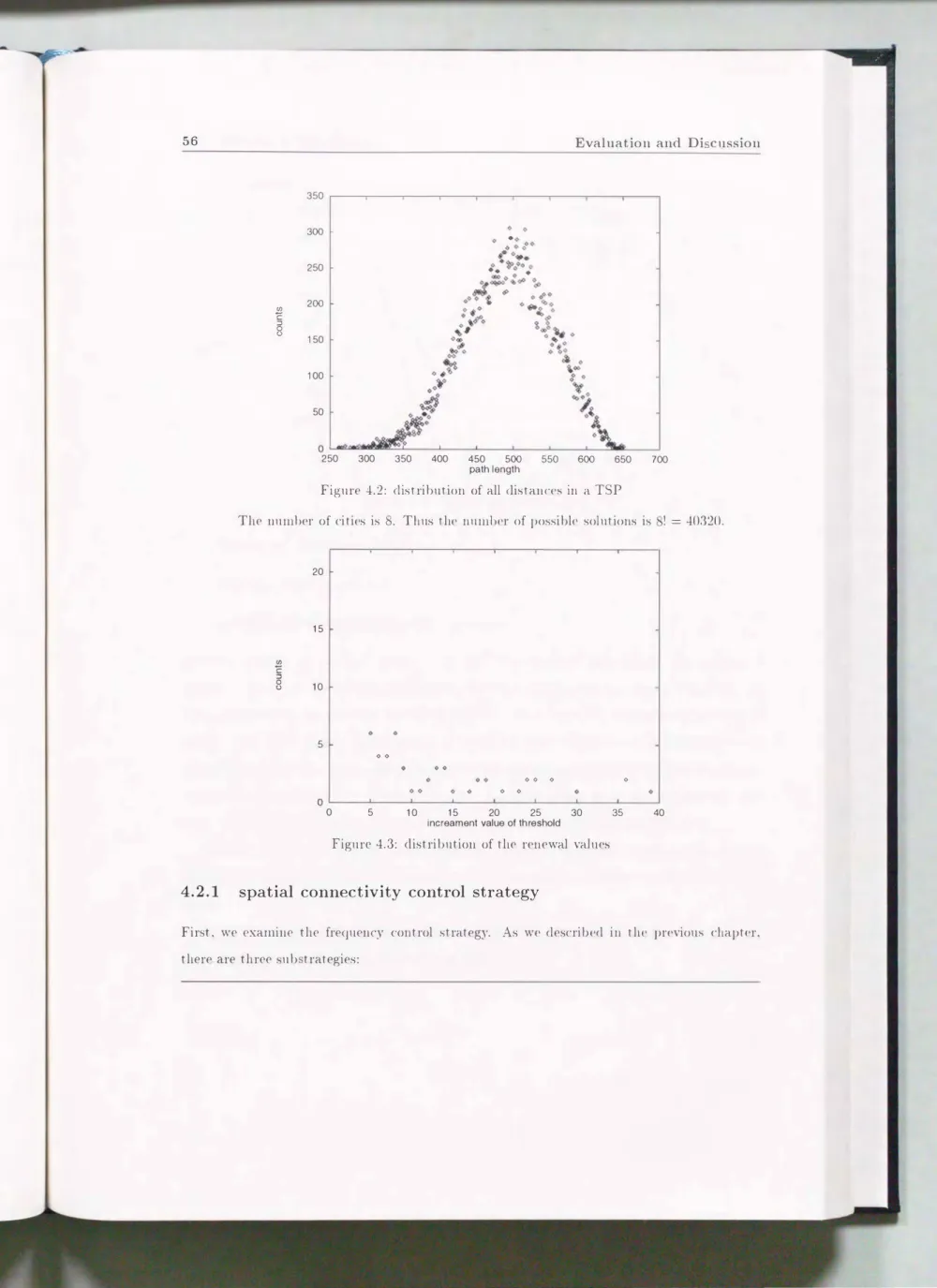
Here we show some propcrtirs of TSP. Figure 4.2 shows tlw distribution of answers in right city's TSP. Its range is large and the average i two time worsr than th(' optimal ansWl'r. Figur<' 4.3 shows a trace of the renewal of threshold iu solving by a single agent. The value of n'It<'waJ is almost random. \Ale can rxpert the assumption that renewals arc uuifonuly distributed 1s not bad e. timation.
4.2 Results of Simulations
Our simulator was build on Common Lisp. Exactly speaking, vV<' usr CLOS
/
MOP's featttr<'S.Each agent is implemented a<; an instance of a class. Its ddail. will be described in the ll('Xt chapter. Each agent runs iu round robin. Dispatch granularity is thr same <:ls a maiu mrthod.
Communications in a stage occur simultaneously at the (•ucl of the stage. �Then an ap;C'll t resumes, it checks its queue for received packets. Thus all nH'ssag<'s ar recrivcd th<' ll<'xt stage of the sending stage. Every range control st.rategys cau chaug<' thr commuuicatiou rang<·
(cluster size) in ±2 at each tep. Thry evaluate the utility of communication using t 11<' Jiv<' points: not change, increment by one or two, and decrenH'Ht by one or two. lu· strat(•gy selects best one out of them. Though this process can not select th(' ])('st siz<> at ouc(', this implementation avoids oscillation. Figure 4.4 shows a sample of thr rhang<'s of tlH' dust<'r size. We fixed the optimal size to 10. But at the first step, all dustrr siz('s arc' ou<': <'etch agent belongs to a cluster. They must change their clu tcr sizes to th(' optimal on<'s. Though some clusters achieve the optimal size quickly, in general, our strurtnrC'-cha.ugiug protocol that is mentioned at the previous chpater requires a long time for this transition. \VP C'xpc •ct tlt changes of the optimal size in real problem solving is small in a short pPriod.
Through all experimeuts, we ignore the cost of getting subproblrms from thr global bag.
56
4.2.1
Evaluation and Di cussion
350 300 250
(/) 200
c :::l 0 u 150
100 50
o L.����--�---L---L--�--�--�L-�
250 300 350 400 450 500
path length 550 600 650 Figure 4.2: distribution of all clistaHres in a TSP
700
The number of cities is 8. Thus the number of possible solutions is ! = 40320.
20
15
c (/) :::l
8 10
5
0 0
0 0
0 0 0 0
0 0 0 0
0 L_ ____ L_ ____ �----�---L---L----�----�----�
0 5 10 15 20 25 30 35 40
increament value of threshold
Figure 4.3: distribution of the renewal value's
spatial connectivity control strategy
First, we examine the frequency control strategy. As we descrilwd in the previous chapt<'r, there are three . u b trategies:
4.2. Results of Simulations
po ibility
Optimal size: 1 0
0.4 .---,---.,---.---,---.---r----,
0.35 0.3 0.25
2 4 6 8
cluster size 10 Figure 4.4: changes of clusters' size
• fixed in fiat structures
• fixed in clustered structures
• changing spatial structures during execution
stepS
step 10 ---
step 15 .. . .
step 30 step 45 ---
12 14
57
Here we examme all three strategies. The first two strat gics o11ly cbaug<' tlH' llllllll><'r of receivers. La t one ha. a threshold that is the trigger to change the . patia.l struct nn'. Iu this examinations, we gin• the threshold a priori. If an C'Xpected commmtication rang<' is smaller than the threshold. agents apt to use fiat structures. OthrnvisC', agruts attrmpt to liS<' cluster structures. Exactly speaking. in order to avoid a p('rturbation lwtwrcu two strnctnrC's, our implementation use a x threshold for the trigger t o transit from fiat to clust<'r<•d, and
1/a
x threshold for the reverse transition. We use 4.0 as the threshold and 0. 1 a.'i n.Results are shown iu Figure 4.5,4.8, and 4.9. They show that the stratc'gi<'s achiC'VC' good performance against affected communication costs. The data arc av<'rages of 10 "' 100 <'xpc·ri- ments.
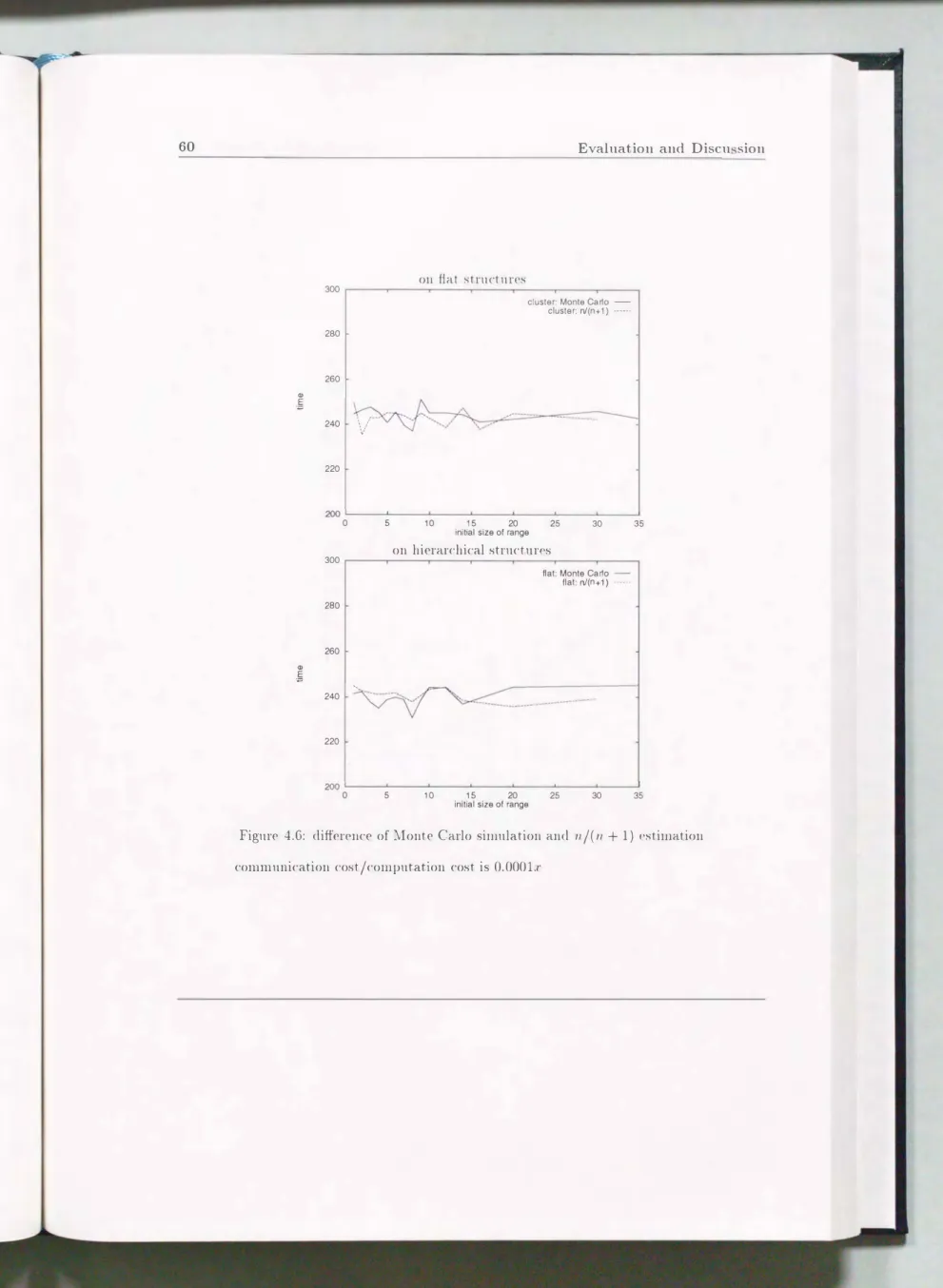
Figure ?? and 4. 7 compare the two estimation methods. Formula 3.6 could achirvr as good performance as the 11onte Carlo method in TSP.
58 Evaluation and Discus ion
The communication cost function iu Ffigurr -L) an' simple ones. Thr ones used in Figure 4.8 non linear functious. This non-linearity i- introduced to imitatr thr cong<'stiou ou udwork.
In Figure 4.9 that shows thr traces of thr sizr of thr rangr with thr coiunmuication cost at Figure 4.8 (a). thr solicl linr shows thr range control strategy 011 fiat structures. th<' da!--.h<'d linr shows the optimal size on hierarchical structures. and the clottccl linr is th(� r('al siz<' of clust<'rs on hierarchical structures. Strictly speaking. thr commlmication cost us<'d in Figun' -!.9 (h) is different from the one in Figurr 4.9 (a). Thr cost function hard})· affrcts t hr t<'n<i<'uc_r of t hr range change.
4.2. Results of Simulations
59 (A)
communication co t/computation cost = O.Ol.r (B) O.OOl.r�
. .§ Q)
1200r-�--.---.---.---.----�.---, 500 1100
1000 900 BOO 700 600 500 400
300
0 10
400
350
300
250
200
0 10
20 30 40
initial size of range
(C) O.OOOl.r
50
cluster
cluster at 4 ···
flat · fixed --
//_/·
/ //
-� .... ·.: .. ::·.:.:···
---
.§ Q)
60
-� Q)
450
I
400
350
300
250
200
0 10
500
450
400
·-·
350
300
20 30 40
initial size of range
(D) O.llog(.r)
_ . . . -··
... . -- ···
clsO
cls4 · flat t1xed
50
clsO
flat ···--·
fixed
250 L---L-__ L_ __ L_ __ L_ __ L_ __ �--�--�--��
20
§ Q)
30 40
initial size of range
400 380 360 340 320 300 280 260 240
220 0
50 60
(E)
eO.OOOl( x-l) _ 110 15 20
initial size of range
0 10 15 20 25 30 35 40 45 50
initial size of range
clsO
flat ···
fixed
25 30
Figure 4.5: results of spatial strategiE's(l)
The average time of a single agent system is 21501. Thus the region under 215 meaus superlinear.
60
60
Ql
.§
Ql
E
Evaluation and Discu sion
on fiat structures
300 .---�---r----�---.---�---r---,
280
260
240
\,/
220
___ ,
cluster: Monte Carlo - cluster: nl(n+ 1) ---
200 L_ ____ � ____ _L ____ _J ______ L_ ____ �---L----�
0 5 10 15 20
initial size of range
on hierarchical structurf's
25 30 35
300 .---�---r---.---.---�---r---.
280
260
240
220
·-
·-
flat: Monte Carlo - flat: nl(n+ 1) ---·
200 L---�---L--__ _J ______ L_ ____ �---L----�
0 5 10 15 20
initial size of range
25 30 35
Figure 4.6: difference of Monte Carlo simulation and n/(n + 1) <'stimation communication cost/computation cost is O.OOOl:r
4.2. Results of Simulations
1200 1100 1000 900 800
Ql
.§
700600 /��'V,
500 ,., .... /
400 300 0 5
650 600 550
500
Ql
.§
450 400 350 300 0 5
.. --�.-.. --_
10
on
fiat strncturC's
,-
cluster: Monte Car1o �- -' cluster: nl(n+
1}/,,<-'
·________ //_./_.�--/---··
__ // ___ .... ------
15 20 25 30 35
initial size of range
40 45 50
on hierarchical 't
r
uctur
es
10 15 20 25
initial size of range
flat: Monte Car1o - flat: nl(n+ 1) ----··
30 35 40
Figure 4.7:
difference
of 1onte Carlo .'imulation andn /(n
+1) <'stimation(2)
communication cost
/
computation cost is O.Ol:r61
62
400 380 360 340 320 300 280 260 240 220
Evaluation and Discus ion
0.01 + O.OOOl.r + 0.0001(0.02.1')2 0.01 + O.OOOOl.r + 0.0001(0.02.rf
400 380 360 340 320 300
__ ...... -···"'·
280
__ .... -··
.... --··
... ··
--�--- 260 __ ... -
··· ·-. . . 240
220
10 20 30 40 50 60
0.1 + O.OOOLr + 0.0001(0.02.r)2
400 rr---.---,----.---.---.----.--.
380 360 340 320 300
280 .
260 ·--... ··-.,�-:---\\ ________ __
··· · ···········
240
-----------
---
220 U---�----L---�---L----�----��
10 20 30 40 50 60
--- _,..,-·
10 20 30 40
No strategy (fixed size) ou fiat trnctnrc
on hierarchical structure
Figure 4.8: results of spatial strategies(2)
50 45 40 35
30 (!) Ol 1:::
" 25
1-<
20 15 10
0
0 50 100 150 200 250
step
changes of the communication range Figure 4. 9: results of spatial strategies(3)
50 60
4.2. Results of Simulation
10
(.-\) 011 dnst<'rrd structnrC's
· · · ...
(B)
011 two structurrsaehlvement rate - number of packet ---·
commumcat1on range cluster srze besllhreshold/1 000 - - - wO<s11hreshold/1 000 ---
Figure 4.10: traces of the s1ze of thr raugr
63
64 Evaluation and Discussion
4.2.2 frequency control strategy
The second category of strategies is the frcqurncy control strategy. Our curr<'ut irupl<'- mentation is basC'd on the manag<"r-work<'r model aud differrnt from a strudnr<' for thr ranp;r
Q.l E
·;:::;
Cii
§
(j) en ro
:0 0
"S E
c Q.l
�
Q.l Q.l.0
ca >
.� Cii
300 290 280 270 260 250 240 230 220
210 5
25
20
15
10
5
10 15
controlled( cost= 0.1) fixed ! cost = 0.1 l
controlled cost = 1 .0 fixed cost = 1 .0
20 25
initial interval
(a) execution time
cost= 2.0 cost= 1.0 cost= 0.5 cost= 0.1
30
0
L---�---L---�----�---L---�----�5 1 0 15 20 25 30 35
phase: interval between multicasts (
b)
changes of the broadcast frequency Figure 4.11: r sults of frequency strategy(
l)
The cost of communication is shown as the ratio compared with the compntatiou cost.
'Phase· is the local computation step betvv en two broadcasts.
4.2. Results of Simulations
300 ,---,---,---.---.---r---.
290 280
270
�
260:.::::;
cu :§ 250
240 230 220
controlled( cost= 0.1) fixed(cost = 0.1)
210 �----�----�---�---�---�----�
Q) E
·�
5 10 15 20
initial interval
25 30
300 .-�-.---.---.---.---�----�
290 280
270 260 250 240 230 220
' .. ,, ',,
' ... , ... ,
...
... _
controlled(cost = 1 .0) fixed(cost = 1.0)
---
210 �----�----�---�---�---�----�
5 10 15 20
initial interval
25
Figure 4.12: results of frequency strat<'gy(2)
30
65
control strategy in which agents are identical in the initial state. Ouly OIH' mauager drtrr- mines the frequency of mulitcast based on the result of its local computation. If it decidPs that it is a time to exchange local knowledge, it multicasts a request for exchanging informatiou.
Receivers send back their knowledge to the manager. Then the manager multicasts tlH· best knowledge of the received pieces. In this three-phase communi ation, every agrnt should stop local computation.
Most parameters for experiments for the frequency control strategy is the same as th<· ours
66 Evaluation and Di cu sion
in the experiment. for :patial connC'ctiYity control straJt'gy. Th<' number of agr11ts is 100: om' manager and 99 workers. Figure -!. 1 1. -!. 12 is th<' rr ·ults.
4.2.3 results
The propertie. WC' found arc ·ummarizccl below:
1. Changing the rang<' and the frequC'ncy during the <'X<'cntion is usdul. Tlw initial raug<'
hardly affects tlH' performance' in both fiat and hierarchical strudurrs. As Figure -!.10 shmvs, there are thrC'e stages from the view of the size of rang<'s on both structnrcs. Iu the first stage (at 0 rv 20 step) and the last . tage (over about 150 step) the COlllllllllli
cation range is relatively small. This result is dC'rin'cl from th<' uaturc of tltr srarchiug process. At the initial stage, for no agC'nt finds a new threshold, tlt<' strategy r<'clttn's the communication range. In the middle stage (at 20,..., 1GO step) wherC' the distributiou of agents' information becomes large, the range becomes very large. Iu particular, the strategy on hierarchical ·tructures changes sharply, b<'rausr an informatiou roll< ctor of a cluster controls the size of the cluster. The best answer was often found at 0 ,..., 150 step. At the last stage after finding and broadcasting the best answer, updatillg tlH' threshold never occurs aucl no more communication is needNl. In onclusion, t lH' more frequently information is renewed, th<' more frequeu tly or morr widdy idc'ntical ag<'nts communicate. But excessively frequent updates decreasr thr umnlwr of commnnication.
2. In the frequency control strategy, the frequ ncy of commuuication is aff<'Ct<'d l>y th<' communication (broadca: t) cost. Similarly, the size of commtmication raug<' d<'crNt.s<'s if its cost is high where the utility of communication becomes low.
3. There is no clear difference between fiat structurcs and hierarchical structurcs. Th<·
reason is the peak size of ranges i. not . o large in this simulat.iou and chaugiug dust<>r size requires some other communication ou hierarchical stratcgic>s. This rr luc s th<> utrrit of hierarchical structures. However, experiments with other cost functions showc'd largr communication cost. make the difference clear. For example, in Figurr 4.3
(
), (B);.mel
(C),
the difference becomes small in its order. Generally, th structur chauging st.rat gy is better than the strategy on cluster structures.4.3. Discussion 67
4. A communication range becomes larger after the cliffcrcnn' hctwt'l'll t lw best knowlC'clge and the wor t knowlrclgc in tinw brcom(' large. A history has Pllongh sensitiYity. This result corresponds to thr rrsulr that wr mrutionecl in thr prrYious chaptrr.
5. The best t hresholcl spread, quickly whrn it is found. Somctim<'s s<'arch t<'rmina t<'s lH'fon·
evt=-ry agent knows it. But U.'ually most agruts know it. inn'. compan'd to Hat structnr<'s.
duster structure, apt to make dosrcl groups in rach dust<'rs, <'Xpausion sp<'<'d t <'IHls to be slo\\rer than the onr on flat structures.
The properties described above are held in other communication cost functions from O(log( 11)) to 0( exp( n) ). They hardly depend on a cost function if it innras<'s monotonously. In coucln
sion, programmers need not care about thr communication topology hy using tlw stratq?,i<'s.
4.3 Discussion
4.3.1 applicability of the strategies
In this section, we discuss the applicability of these strategi('s to other firlcls and ways of implementing these strategies. Related works are also described.
another search algorithms
First, we think more about the branch-and-bound method. s we d<'scrilwcl, our irupl<·nt<'llta
tion ignores the communication cost for gatllE'ring subproblems into a blackboard. \iV<' jttstify this assumption as we can implement it as distributed memory rasily. But if so, we shonld deal with the local starvation of thr problem. Of course, any agrnt can multica.st or sc'ncl a request to neighbors when the local bag is empty. But agent must wait for its r<'sults. If w< do not want to make agents idle, agents sent a requrst of subproblems to othrr a.grnts brfor<' it becomes really idle. Thus we had better build a ooperativr communication stratt•gy Lo require' subproblems. A local history about the consumption rate will bf a help. Thrn we can use our strategy, where it control the flow of subproblems instead of a threshold. Furthrrmor(', by using a history of request from other agents, it would behav mor(' cooperatively.
68 Evaluation and Discussion
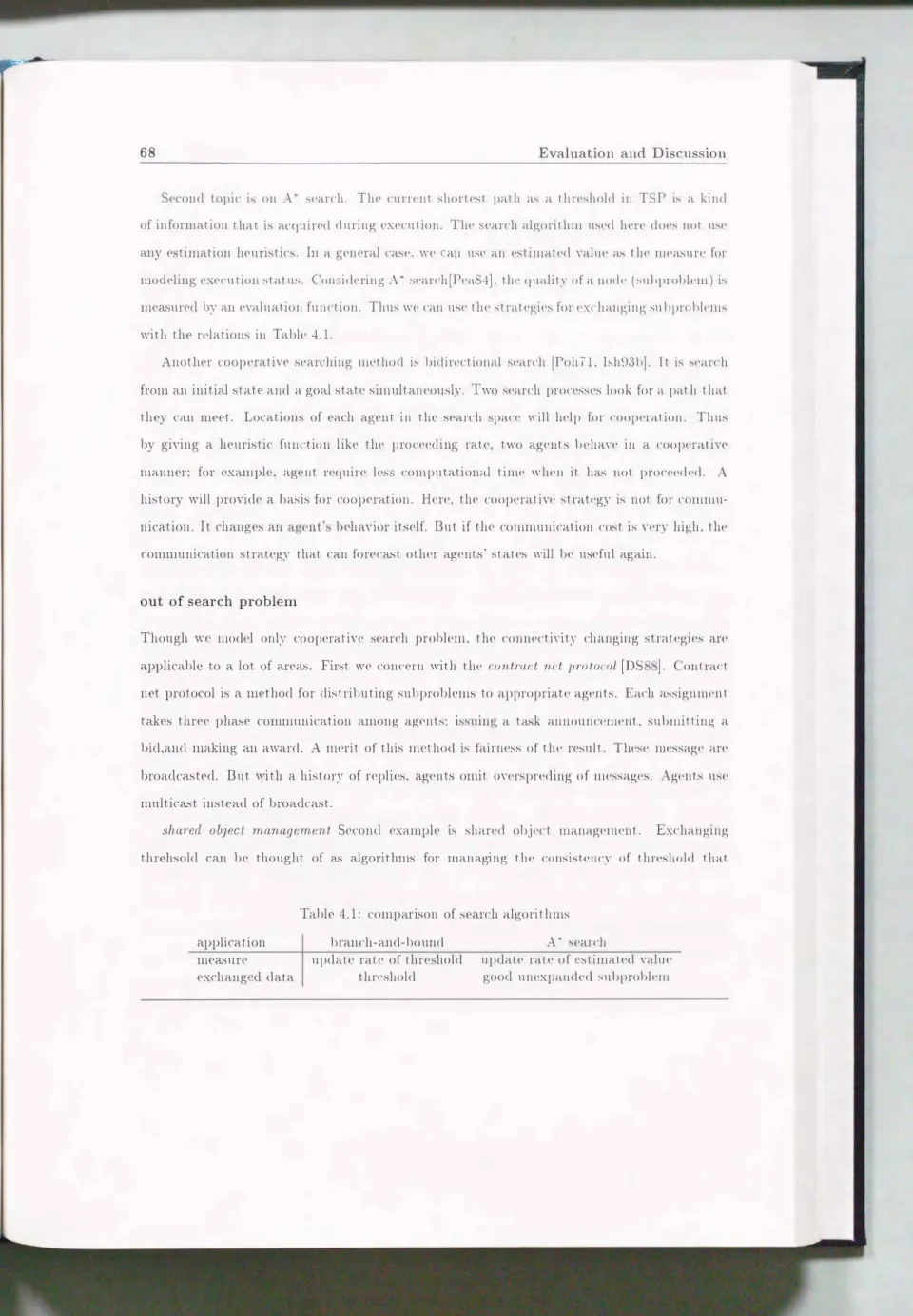
Second topic i.· 011 A· �rarch. The current shortest path as a thn'slwld in T P is a kind of information that is acquired during execution. The earch algorithm usrd h<'H' clo<'s Hot usc any e timation heuristic.-. In a general casr. wr an usc an rstimatrd valnr a� t ll<' llH'asnrr for modeling execution status. Con idcring A· s('arch
[
Pea8-l)
. thr qnality of a uod<' (snhprobkm) is measured by an evaluation function. Thus w<' can use the strategies for ('XC hanging su hprohkms with the relations in Table 4.1.Another cooperative searching metho l is bidirectional srarch
[
Poh/1, Ish93h)
. It is .·<·arch from an initial state and a goal state simultaneously. Two srarch processes look for a pat b that they can meet. Locations of each agent in the search ·pace will help for cooperation. Thus by giving a heuristic function like the procrecling rate, two agcn ts brhavr iu a cooprra.tivc manner; for example, agent require les computational timr \vlH'll it has not proc<'<'d<·d.history will provide a basis for cooperation. Here, the cooperativr stratrgy is not for commu- nication. It changes an agrnt'. behavior itself. But if the communicatiou cost is very high, thr communication strategy that can forecast other agents' states will be useful agaiu.
out of search problem
Though we model only cooperative search problem, the co1mrctivity changing stratrgies are applicable to a lot of areas. First \ve concern with the contmct net ]JTotocol
[DS ].
'ont ractnet protocol is a method for distributiug subproblems to appropriat.r agrnts. ach assigtllll<'lll takes three phase communication among agents: issuing a task auuouncrmrttt, submitting a bid,and making an award. A merit of this method is fairness of th<' r<'stdt. Thrsr llH'ssag<' rtr<' broadcasted. But with a history of replies, agents omit ovcrsprcdiug of messag<'S. g<'nts us<' multicast instead of broadcast.
shared object management Second example 1s shared ohjrct manag<'mcut. Exchcwging threhsold can be thought of a.s algorithms for managing the consistency of thrrslwld that
application measure exchang d data
Table 4.1: comparison of search algorithms
branch-and-bound update rate of thre ·hold
threshold
A"' search
update rate of stimatrd valtH' good unexp
a
udcd subprobl('lll4.3. Discussion 69
i shared weakly among a ,.�nt.·. In addition, the idea of using a local histor�· as a. modd of au environment can manage shared objC'cts with strong consist('nc�·. l\mall�-. strongl�· consist<'at objects are used much more than weak consist<'nt objC'cts 011 clistribntr<l syst<'lllS. Thus tlw pro
grammers' burden of keC'ping coherency rffrctiYely will br rrlir,·r<l iu a number of application areas.
In this rase. the measure of execution is the ratio of local access ancl n•motC' ac<'<'ss. \'alnrs Exchanged among processors arr sharrcl objrrts themsrln's. If thr rurr<'nt cost for r<'mot<' access is higher than the expected cost for managing coherency, a shan'd ohj<'ct should hr duplicated and distributed. On the other hand. if it i low, thr copie. should br nH'rgcd to reduce the cost in writing. If agents ( copiC's of a. harrd objC'ct) know tll<' access ratio sntticirutly with the access history, the ·trategir. would work well.
4.3.2 dealing with heterogeneity
Our approache assumes the homogeneity of agC'nts. HoweYrr, thr history-ha:;ecl expectatiou mechanism could apply to not only homogeneous enYironmruts but also ll<'tnog<>nrons ours.
The history of the revision of information at other agents in current implementations is not s parated from its own history. Ageut · exchange tlw informatiou with rach ot.lwr rUJd npdatr their histories with the received information. But in heterogC'urons network, this disp<'rsiou becomes an important problem. An implcmentatiou and thr eYaluation of stratrgirs hasc•d 011 separated histories are of a future plan. Such an implrmenta.tion will also work on bd<'rog<'JH'otts agents.
Another important heterogeneity is iu decision making: diversity of actious of ag<'n ts. If heuristics can find only the most promised search direction , the best path in timr clo s 11ot always lead to a way to the best answer. Thus for reducing tlw risk, divrrsity of srarch dirC'ct i cms in some degrees i required. Lesser called such a s-arch strategy that induclcs this diY<'rsity control as cooperative control
[
Les91]
. We think t mpora.l diversity of the S<'lrction of t.ll<' ll<'Xt problems can be acquired from probabilisti · way based ou the local history, that mak<·s rUl appropriate distribution of all agent. in the system in a search spac . But furthn study is required for this direction.70 Evaluation and Di cussion
Last heterogenrit�· is ahoont ag('nts goals. Siner \\'C' focus on PS in which thr goal is shared among all agents. situation like Pri.'onrr' · dilemma
[
.·<'�]
clo not tak<' plaC<. Tint akind of fluctuation or oscillation of decision making may take plan'. his prohl<'lll is discnssPd in
[h:HH89].
Since our nwthods. howrYer, usc historirs. we do not think drastic loss of th<' performance happens that is reported[I�HH 9].
Finally we summarize the limitations of tlw proposed sclH'lllr ag<:-tin:
1. Communication costs mu. t be known before execution. It wonlcl be difficult ou a syst<'lll that has a hierarchical topology or a large-scale open system.
2. The strategies as. ume homogeneity of agents. But we gaYe .'Olllc posiblr solutions to it above.
4.4 Summary
• Through simulations of TSP, we have evaluated the quality of onr strategies. They showed better result than fixed communication systems for a wide range of communication costs.
• A history is a good model of rxe ution status. There is no dear cliffrrrncr between the monte Carlo imulation and formula 3.6. They estimate t.hC' probability of information update well in the range control strategy.
• We discussed problems to apply our . trategies to other search algorithms or othrr appli
cation domains. By proposing extension plans, W(' claimed that many of them will lH' solved.
• We also discu sed some assumptions to use our strategiPs; the hetrrog< n ity of ag(•nts and knowledge on cost functions.
Chapter 5
Separate Description of
Communication Strategies
5.1 Communication Strategies as Metalevel Computa
tion
Our communication strategies change the behavior of an agent by using a history that is a measure almost independent of a problem-level program. They arc i11voked whrn somr chaugcs in agent local status are happen. And after fini. hing their job, thr control flow rcturus to the invoking point in the problem-level program. This flow reminds us a mmal subroutiu<· ca.lls.
But since when to invoke communication strategies is defined in tltr contrxt of the strat<'gi<'S themselves, the interpreter can know it. This means programnH'rs need not to writ<' proc<'dtLr<' calls down in their problem-level programs. In other words, comnmnicaticm strat<'gi<'S call IH' embedded into the semantics of reference and update of local variables in problem solving programs. It is a metalevel computation.
Thus we think deciding communication structures should be a kind of computational r<'
flection
[MN88].
This means communication strategies can he• S<'parated from probl<'m-l<'V<'l programs and be a metalevel description of program solving agents.This separation approach has two merits:
1. Programming is divided into two independent subta..,ks: building communication strat - gies and writing problem-solving codes. As a result, writing codes for communication
71
72 Separate Description of Conununication Strat gies
separation
,.---________________________ --_ -
-
-�-
_____ ---Agent----_,: I :
I I
I I
I I
i
problem solving :' module
MOP I
I I '
---�---1---·
��
p
)
gra�
>electclass for communication strategy
Progranuner library for cooperative processing
Figure 5.1: separate description
strategies can be omitted from problem-solving programmers' task. It also mak<'s r<'using the communication strategies ea.sy, if there is a gencralizfcl protocol h<'tW<'<'ll ag<'llt aHCl strategy. Communication strategies can be stored in a library. In vV<•rnrr's words, W<' can distinguish "system programmers" and "application programnwrs" with this fnuue- work
[
Wer92]
. As a t:esult, communication strategies and application programs can be developed and tested independently.2. Since the communication strategies are included in the semantics of a lauguag<', th<' st.ra.U'- gies are invoked automatically when needed. For example, if a commnuicatioll �trat<'gy is defined as metalevel computation of the assignment to a slot that holds information to exchange, every modification of the slot invok<'s the strategy. V·/c' can omit ('Xplicit invocation codes from problem-level program.
\1\le made such a system on an object-oriented language. Vve f'xplain this in the followin g sections.
5.2.
Implementation on CLOS Meta-Object Protocol
5.1.1 related works
73
Relation between agent programming and object-oriented prograuuniug laugnages lu-n·<' lH'<'ll inve tigatecl by a lot of researchers
[
XT90] [
Hew/7, �I
IT9
0, Y
TH /.�I\\'Y91. Gas921>.
FllFC91, EPT9-l]. �
Io. t ag nt-orientecl languages are based on first-ord<>r modal logic. since logic-based representation of specification ran infer the agents· nH'ntal �tat s likr hrlirf, d<'�irr and intention in a uniform mauner, which select the ageut behaYiors. On th<' otiH'r band.concurrent obj
e
ct-oriented languages with extensions for coopcratiou will lH' nsdnl <'SJ><'cially for DPS. Since our focas on language is how to separate prohlellls and stratcgi<'S, w<' do not intend to build a new language but build a programming style. But here W<' gin' a shortsummary on relation between DPS and OOPL.
[
MWY9
1]
i. an approach to chang<' b<'haviors in a group with mctaleYrl computation. Inthis system a group has a metalevel. This is different from dassira.l meta-object laugnagcs in which an object has a meta-object.
C
onsistency in the group can be held <'asily. On t h other hand, it requires frequent communication between nodes. Thus we do not think that this approach is rational in cooperative system on distributed sy. tems.Some concurrent reflective OOPLs like
[ FB88, FC91 ]
have been used for DPS. For exampl<>, Ferver'sM
ering IV[ FC91 ]
is ane
xample of object-oriented languages with mcta-lrvd cOlllJHltation for cooperative computation. His focus is providing high leYcl commtutication primi tivc•s to programmers and not providing adaptiYe cooperativr mrt hods based 011 local co111 J>ll tat ion.
But there was no clear separation between coop
e
rative strategy aud usN applicat.ion pro�ra.m.Some Object-oriented OS uses reflection for a method of loa.d-halauciug and proc<'ss mi
gration
[
OIT93, Yok9
3]
. But the facility is embedded iu OS and ca.u not usr tlH' s<'lllantics of application program well. We think more strongly ·ombination brtween stratrgy am\ application is required.
C
ompile
r's ·upport is crucial.5.2 Implementation on CLOS Meta-Object Protocol
Some object-oriented-programming languages have meta obje ts that repr<'sC'nt brhaviors of objects. In particular, CLOS (
C
ommon Lisp Object System) [ S+9o. l{ee89 ]
has flexible interface to meta level programming, which is known as CLOS MOP (Meta-Object Protocol)
74 Separate Description of Comn1uni ation Strategies
[EdRB9L Pae93b] .
Th
us we cleciclecl to build a DAJ platform with the stategies on CL
OIn the
next section, we gin' a sh
or
t drscriptiou of CLOj
:..IOP.5.2.1
meta-object protocol
A
merit
ofob
ject oriented programming language.· (OOPL) is modular
ity of progra.Hllllingcomponents or
objects. A defini
ti
on
of a data st
ructur
r and pr
oc<'dlll'('S for it a.rr capsulPdon a description
block called a class. An instance of a class heltaYC'S as ddincd in its class.
Some OOPLs an
cont
ro
l behaviors of a classi
t.elf,
that includes ways to 111akc'an instanc<'.
delete an instance, control method dispatch, inherit
super classes and so on. Thrs<' <'Xtrnsions are done by ma
king
class itself an instance of a class: a rnetnclass. Iu such la1 1gnag<'s.
all
classes have its metaclass. By
le
tti
ng all metada
ses ctccept samem
ethods (called vrotocols),
we
can changethe behavior. of
instancesof
a class ea.sily. V\'e ra.u srlcct most appropriate metadass for problem so
h·i
ng. Since such an rxtensiou to a us<'r ckfinC'd da.ss isnot modification of an exi. ting
system but an addition of n<'w behaviors for a particularclass, it is s
afe
and
easy for
programmer. . A group of research rs hadpr
oposed a pr
otocolfor the
CLOS cl
ass
structure. It became a standard known a.s MetaObj ct Protocol ( �IOP).CLOS
MOP provides a
way
to changethe
behavior to access to aslot,
npclatr of it, maJ�('a new instance of the
cla.'>s and so ou. Forexampl
, lOP has bN'n used to emulat<· oth<>r inheritance/message-passing mo
dels (Dvorak's hybrid knowle lg<' r<'presrntation tool[
B93] and
CLOVERS(ftp: I /swiss-ftp. ai. mit. edu/archi ve/ clovers/ clovers-design-notes. text))and to build a persistent OOPL sy tem
(for
ex
amp
le, PCLOS[
Pae93b]
, AllrgroSt.orr(a comnH'r-cial product based on Alegro Common Lit>p),
ITASCA ODBMS (ITASCS Syst<'ms Iuc.
).
1sp FAQ (http: I /www. cs. emu. edu: 8001/Web/Groups/ AI/html/faqs/lang/lisp/top. html) stunmarizes more implementation. ) .
Now the
following is a sum
mar
yof requirements
for S<'parcttc drscriptiou of our com
llllllli
cation trategies.
1. C
han
gethe behaviors o
f ac
e ssj
up
dat
c of ap
art
icular
slot of a11 agrut. Our strat <'girsstore the history of renewal of
a slot. The .trat
cg
i<'s that also iuclnd<· a procC'durr ofupdate the history should be invoked whenever the
slot is updated.Or
sonH' strat( gi<'s5.2. Implementation on CLOS Meta-Object Protocol 75
shold be inYokecl when the �lot is accessed. This is a kind of cxt<'usion of the s<'Uiantir�
of th<' languag<'.
2. The invocation should be transparent for programm<'rs. Prograntm<'rs who writ<' prohl<'m- solving program. should IH='Yer concern about commuuication stratq.;i.<'S ;-ts much as pos- sible. They do not want to call any procedurrs for a stra.t<'gy rxpliritly.
3. Communication strategies can send and recein· some sorts of llH'ssap;t's. Th<' llH'ssa.g<'s
should be imrisible from problem-levc•l programs. And a. particula.r lllC'ssap;C' dispatch<'r nut be invoked when a message is received. This dispatcher must coexist with th<' dispatcher in problem-level program.
CLOS MOP proYide features to meet the e requirements. Thus we decide to impl<'llH'nt tlw communication strategies with MOP. In the following ·ections, we explain our impknH'utation.
5.2.2 class structure
Figure 5.2 shows the class hierarchy in CLOS. It also includes our n<'w cla.-,srs for drsnibing communication stratrgies. In CLOS, every object is eith('r our in CLOS cla.-,s hierachy or one of a built-in type. all objects, eveu if they belong to a built-in data tYIW, arc su bda."is<'s of the object T1• T's superclass is T itself. top class of CLOS rlass hicraclty is standard-object.
It defines the primitive behaviors of all instances. Doth of slots and mdhods tlH'IllS<'IV<'s ar<' subclasses of standard-class.
agent-class and agent-meta-class
First we should define a new meta class agent-meta-cla.ss for a specifier of class lwltavion;.
Its definition is as simple as listed below. Since slots holding information for commnnica.t.ion strategies are stored in an instance of each strategy's clas:, agcnt-meta-da.<;s has no own slot.
It is used only for slot instantiation. With it, as a base class of usrrs' agrnt class, W<' cldiu<' agent-class.
(
defclass agent-m ta-dass(
)())
1 In the Lisp dialects, T means true usually.
76
Separate Description of Con11nunication Strat gies
t
CLOS MOP class structurestandard-object i
standard-slot-definition standard-class standard-method standard-effective-slot-definition i
Our extention
subclass agent-meta-class
strate
I
use-- communication-strategysub
;;>
a::'
�
classcooperation-eff ective-slot-class
spatial-control-strategy
\
use
user level program
agent-class
Figure 5.2: class hierarchy
(
defclass
agent-class () ; super class is T.((receive-counter :accessor receive-counter :initform
0)
(send-counter :accessor :send-counter :initform
0)
(agent-id :accessor ageut-id :initarg agent-icl))
( :metaclass agent-meta-class))
temporal-control-strategy
agent-class has two methods for inter-agent communication. Thry updat e thr above two slots in agent-class.
( defmethod
send ((self agent-class) (receiver/s object) ... )( defmethod
receive ((self agent-class) (messaget))
...
)5.2.
Implementation on CLOS Meta-Object Protocol
77slot structure
Our strategie use a history of :lot renewal. It is a model of progrcun cx<'cntiou. inc<' W<' ;-tssnnH' that a hi tory of the Yaluc renewal of a slot is used as the mr<-t.'mre of prog;ram <'X<'cution. th<' slot object must hold the history of itself. Thus it is rational to usc ·u1 instanc<' a.-; a wrapp<'r to hold them at the same time. All strategies haYe a comm011 int<'rfac<' (protocol): a pron'durc in accessing the Yaluc. one in updating the Yalue, and our i11 rcceiYing mcssagrs from anoth<'r agent. Thus we make each strategy a class. An abstract class: comrntt:n.imt-ion-.'itndeqy is on<' of their superclasse .. It can be defined as follow
(
defclass
communication-strategy () ((value) ; the wrapped ·value itself(model) ; a history of value
(communication-cost) ; a function to estimate cornrn:unication to8t )
)
(
defgeneric
ref-strategy ( ( clac;s communication-strategy) instance slot) (defmethod
ref-strategy ( ( da ·s communication-strategy) instance slot)nil)
(
defgeneric
set-strategy ( (class communication-strategy) instance slot) (defmethod
set-strategy ( (class communication-strategy) i11stanc<' slot)nil)
(
defgeneric
dispatcher ( ( dac;s communication-strategy) iustanc<' slot) (defvar
*out-of-local-computation-p*nil)
(
defmethod
eli pate her around ( (class communication-strategy) i11st.ance slot)(let
( (*out-of-local-computation-p*t))
(call-next-method)))
Note that method ref-strategy is required to update the history of local cou1putation
that i stored in model slot. *out-of-local-cornputation-p* is a flag variablr that is ust�d to distinguish the value from an another agent from one found locally.
specify metaclass-designator
78 Separate Description of Con1n1unication Strat gie
. . . .
. . .
instance str ct re u u '
. .
cooperation-effective-slot-definition vector for slots
std-i nstance-sl ots
. . . .
. . - -
. . . -
. r-- .,
. . . .
. . .
"·
.
. .
strategy object. .
. . .
set-strategy. .
. . .
ref-strtegy slot-definition-location.
.
. .
value. .
. .
model. .
. . . .
vector for slots
.
. . . .
. .
-
value-
. . .
standard-effective-slot-definition
Figure 5.3: slot structure
. . . .
. . . .
. . . .
- -
t
(
strategyAll classes must have a mctadass that is either the samr metada�s of their supc•rdass<·s or a valid metaclass. The generic function: validate-superclass checks its validu<•ss wh<'lH'\'<'r a
new class is defined. Thus we must add a method for our agent-mrtalrv 1-class.
(
defmethod pcl::valiclate-. uperclass( (class agen t-mctalevel-class) ( sup
e
rclas
s pd::standard-class)) t)
With this method, we an define any agent classes as subcla ·s of standard-class. Thry use cooperation-effective-slot-definition for specific slots.
5.2. Implementation on CLOS Meta-Object Protocol
add slot-access-using-class method
79
In CLOS, the most primitin' access/assign functions are slot-value-using-class all(l (setf slot-value-using-class) 2 respectively. Other slot accrs ·ors use t hrm internally. h us, now we must define two methods for accessing and updating a slot of agcut rlass. slot-value-using -class dispatches with an argument: slot-definition. "C"sual dass llS<'s pel:: standard-effective -slot-definition. \VE' add cooper at ion-standard-effective-slot-definition a.'> a sub- class of pel:: standard -effective-slot-definition as followi11g.:1
( defclass cooperation-standard -effective-slot-definition
#+CMUCL(pd: :standard-effective-slot-definition) ; if thf' sy.c;tern L'i CMUCL
#-CMUCL(. ·tandarcl-effective-slot-dcfinition) : otherwise
The following method is added for cooperation-standard-slot-definition. It is invoked during the class initialization process. In this case, a slot that has : cooperative-strategy keyword parameter of a subela of agent-class uses cooperation-standard-slot-definition as its descriptor.
( defmethod pcl::effective-slot-definition-dass
((class ageut.-metalevel-dass) initargs) (if (member :cooperation-strategy ini targs)
(pel: :find-class 'cooperation-standard-effecti VC'-slo t-defiHi t iou) (pel: :find-class 'pel:: standard-effective-slot -dcfiHi tiou)))
The main difference is that the stored value in a slot is wrapped by th(' stratq�y object.
whose definition is described below. The fir. t one is for value assigmneut.
( defmethod ( etf pcl::slot-value-using-class) ((new-value t) (cla. s agent-metalevel-class)
object (slotd comm-stanclard-effective-slot-defiHitiou))
, assign the new-value to slotd of object in class (let ((location (pel: :slot-definition-location slotd))
2 (setf slot-value-using-class) is a symbol whose name includes braces and a spac0.
3In CLOS/MOP ystem, there is another lot clt>finition class: standard-direct-slot-definition. Sinn' it is parallel to standard-effective-slot-definition, we ignore it in this th sis.
80 Separate Description of Con1munication Strategies
(slot-in ·tance))
( cond ( ( typep (pd: :Vc instancr-ref (pel: :std-in. ta.ucc-slots ohj<'ct) locatiou) 'commnnicatiou-stratrgy)
(let* ((slot (prl::lfcinstancr-rrf (pel::. td-instancr-slots object) location))) (upclatr-valuc slot nrw-valur) ; model (hisfoTy) is updated in uprlaff'-t'nltll/.(' (when *ont-of-local-compu tation-p*
(funcall (set-strategy ·lot) object slot-instance slotd)))) (t (setf slot-instanC('
(make-instance (stratcgy-da..<;s slotd)
:history (make-array ( nH'mory-siz(' slotcl) :iuitial-eknH'nt 0.0) :value new-valur)))))
new-value)
The rest is for its reference.
( defmethod
pcl::slot-value-using-class ( (class agent-metalevel-class)object
( slotd cooperation-effective-slot-definition)) (let* ((location (pcl::slot-definition-location .lotd))
(strategy-object ... ) ) :; same as the original method
(if (typep (pcl::%instance-rd (pcl::std-in. tancc-slots ohjt>ct) location) 'communication-strategy)
(progn (fun call (ref-strategy strategy-object) slot) (value strategy-obje t))
;; signal unbound error
(pcl::slot-unbound class object (pcl::slot-definition-namc slotd)))))
unboundness checking
In the initialization steps in make-instance. a strategy instance is created as tlw valur of a slot.
This means the standard method of slot -boundp returns t even if it has not b( rn nsrd. Wr de- fine the following method for communication-strategy-slot-class. It call slot-boundp-using-calss.
Thus we add new method as well as slot-value-using-class, which invokes slot-boundp for valnr in the strateg-y object.
5.2. Implementation on CLOS Meta-Object Protocol 81
5.2.3 interface to programmer
Now we must proYide an interface to problrm-soh·ing programnHTs. At first we }H'OYid<' a tH'W macro for class definition: de.fagent. Its task is adding :mctaclass option to class options and add some slots. Its definition is the following.
( defmacro defagcnt (class-name uper-dass-list &optional slot-clefs &:rest rest)
�
(
defclass ,class-name,(if (member 'agent-class suprr-dass-list) super-da. -list
(cons 'agent-class super-class-list)) ,slot-defs
,(Ql(cons '(:metaclass agent-meta-class) rest)))
Therefore the following form:
( defagent an-agent-class
( )
· (...
))is expanded as:
( defclass an-agen t-ela. s ( agen t-el ass) (
.
.. )( :metaclass agent-class))
defagent can hide the names of both the mctaclass and slots for communication st
r
a.
t<'giC's.make-instance
In CLOS, making an instance of a particular class is performed by make-instance. sually its arguments are for slot initialization.
Our communication strategies re gtire knowledge about a counmtniratiou cost. It dcp<'tJds on each environment. Thus when making an agent, we must giv a cost function to tlH' a.g<'llt as
well. However arguments required to the function depend on a strategy. Furth<'rmorr, au ag<'nt may use more than one strategies in our implementation. Thus wr nred a way to distiuguislt cost functions. Our solution is using a unique keyword for make-instance. Thr k<'yworcl is
82 Separate Description of Con1n1unication Strategi s
built as a concatenation of ·cost-function· and tlH' nanH' of thr stratrgy class. lms if wr us(' spatial-control as a strategy for exchanging the Yalue in slot foo in nsN-cldiiH'cl da.o..;s: C, and use temporal-control as a strategy for slot woo, its instaucr is crratrd
hy:
(make-instance
'C:communication-cost-for-:patial-control
#'(lambda
(nnm-of-packct) ... ):communicatiou-cost-for-temporal-rontrol
#'(lambda (
fn'<p
teuc�
·) ... )These keyword parameters are processed at initialize-instance method d<'finrd for agent-class.
As we described earlier, the former lambda function is storrd into cost-function slot of thr instance of clas spatial-control that is assigned to the slot: foo of the install<'('.
5.3 Applications
In this section, we investigate the applicability of the implementatiou by using two programs.
The first one is the TSP program that we used in Chapter 4. The later is shared object management in distributed environments.
5.3.1 traveling salesman problem
With this framework, writing TSP program in a separated way is straightforward. Both thr spatial connectivity control strategy and the frequency coutrol stratrgy should b<' invok<'d wll<'ll a slot renewal is occurred. The structure of the history depeuds ou the strategy. Its <1<-fiuitiou is included in the definition of strategy classes.
( defagent search-agent
(
) ( (threshold ; slot definition: et-strateg)' spatial-control)
... ) )
(
defclass
spatial-control (communication-strategy)((range :accessor range :initform 0 :initarg :range
:
type fixnum) (neighbor-list :accessor neighbor-list :initformnil)
(recommended-. ize :acce. sor recommended-:izc :initfonu 1 :initarg :recommended-size :type fixuum)))
5.3. Applications
( defmethod set-strategy ( (strategy spatial-control) inst auce)
;; range slot holds the new optimal ranqr
(setq (range trategy) (s<.>lect-b<.>st-rang<' (model strat('gy)))
;; send the body slot
(send (make-instance 'spartial-control-message
:body (list (class-name instance) ( Ya.l ue . trat<'gy)))
(choose-receivers (range strategy) (ncighbor-list strateg:v))))
;; In the program that -uses searching-aqent, (make-instance search-agE'nt
:communication-cost-for-spartial-strategy
#'cost-estimation-function)
( defmethod dispatcher ( ( cl� s spatial-control) slot instance messagr) (if (spatial-con trol-cla.ss-message-p message)
(when (betterp (body message) instance)
;; -update-val-ue is an internal method for commtmication-stmtegy (update-value class slot instancE' new-value))))
distinction of received data
83
In this program, a received threshold is assigned to t h local threshold slot. If W<' used (setf threshold) for the a signment, a communication strategy would bc invokrd CHIC<' mort-'.
It would cause rep tition of communi ation. Though the loop, howevE'r, would b(' t<'rllliuatc·d since the utility of communication clecreasE'd by the incrca.-,e of homogeneity of agrllts, if W<' want to avoid the loop, we should provide a raw assignment mcthod. But th r<'n wal should be a part of metalevel computation. Therefore receiving is not visibl<.> to the prohl<'m-l<'v<'l program but a task of metalevel computation inYokecl by the dispatching proc<'ss at mda.kv<'l.
It will use a raw level assignment method that does not invoke any communicatiou strat<'gy, which is called update-value in the above program.
84 Separate Description of Con1n1uni ation Strat gies
5.3.2
shared object n1anagement
shared object m.anagPment �lost clistributrcl programs use �harC'd objects amoug Jn·occss<'s.
They require strong consistency. Thi.' is the most importaut diff<'reuc< from thr<'shold in the previou. example. From our point of view, thrrshold requirC's only W<'ak consist<'IH'y:
the con istency is rrquirecl for effective execution. Obj<'cts with stro11g cousistency nut be made in two ways in distributed enYironments. First approach is using ·uirtu.al shared nu·nwry [Li86, Lh89]. The object is accessed by its address in th<' sanw way as local objC'cts. Ill this system, memory pages are shared by all nodes. A copy of each pa.gC' is loca.t cd whcr<' it is acces eel. Thus a running program has locality in nH'mOr)· accC'ss, it r<'clucC's tlH' iut<'r-uod<' communication cost..
The second approach is based on a distributed algorithm. Th<' object is impl<'IllC'nt<'d as local object on each node. They are identical; they haYC' thC' s<-UllC' valtH'. If a r<'nC'wal is required, by broadcasting notification, all objects are updated as atomic actiou. This is a mes age-passing tyle implementation.
Some virtual shared memory approaches tL e parallel cache algorithm (f.e. Suo py ·achC') to hold coherency amang copies. Thi. algorithm distribute copies at first step. Th<' numbrr of copies does not change. Thus it can be consider a variation of distrilntC' algorithm has<'d approach.
The main difference between these approaches is thE' number of icl<'ntical copi<'s. �lost viretual shared memorry approaches do not make copies of au objC'ct. Thus though th<' updat<''s cost is low, if the locality is low, the accessing costs will br high. On tltr ot.lwr hand, th<' s<'coud approach requires broadcasting whenever the renewal occmTs. WC' can imap;iH<' th<' adapt.in' approach: change the locations and the number of copies. Thrsr decisions should b(' ha.s<'d on the history of access
/
update pattern if we make it adaptive' dynamically. Ther<'forc• 011r history based approach will be useful for this problem. Shared object managemrut call b<' i11t <'rprd<'d as a problem of cooperation. Note that it is rather MAS than DPS, since <'adt ag<'nt' local desires conflict with each other.We should note that ome papers investigate control method for changing thC' impkmrn
tation of objects by program analysis (for example [KL95]). Bnt it u. es static, prc'-<'X<'Cutioll
5.3. Applications
server node
*-
agent�
shared object 'update
agent
� *-
' -access
' ' ' '
�
updat
� *-
implicit remote access
' ' ' '
' \
I' \
\0
� .... _
Q
access
- A
Figure 5.4: shared object eli tribution
information. Quantitative properties are ignored.
85
Here we describe a strategy that control the number of copies in a rcutralized mc-mucr [YNU95). A pre-fixed node become. the . erver. The others become o\vucrs or clients.
( defagent parallel-worker () ((shared-object
:cooperative-strategy sharecl-o b jcct-manager/ cen tral-ma11nrr)
...
) )( defclass sharecl-o b ject-manager/ central-manner ( comm uuicatiou-stratrgy) ((server-icl :type host-id)
(member-list :type list) ( owner-p :type boolean))
( defmethod server-p ( (self shared-abject-manager/ central-manner)) ( = ( server-id self) ( icl self)))
( defmethod set-strategy ((strategy shared-object-manager/ r ntral-mannrr) iustann') ( cond ( (server-p trategy) (broadcast-update-request strategy))