English language education helps teachers keep up to date with new trends, techniques and methods for classroom challenges. Since 1990, the Japanese Ministry of Education, Culture, Sports, Science and Technology (MEXT) has revised the English curriculum through the Course of Study guidelines, to increase communicative language teaching (CLT) in the EFL classroom.
The UMBC (University of Maryland Baltimore County) TESOL Methods Online Course for Secondary School Teachers is a professional development program offered to English teachers throughout Japan. This 11 week online course has been designed to provide Japanese teachers with up-to-date methodologies to create more effective and communicative language classrooms that accommodate the change in the English curriculum. An online course for teachers is not only a platform to learn, but also a means to experience different ways to teach.
This study describes a training program addressed to junior and senior high school English teachers in Japan to upgrade their current language teaching practices. The main focus is on strategies and techniques to develop learner-centered lessons that align the English language curriculum standards with learning objectives and assessments.
Key words: MEXT, Communicative Language Teaching (CLT), teacher-training, learner-centered lessons
Ⅰ.Introduction
The University of Maryland, Baltimore County (UMBC) has been offering online professional development courses to international English teachers since 2004. The online scholarship program, funded by the U.S. State Department, offers an opportunity for English
the EFL Classroom
─ Participating in a TESOL Methods Online Course for
Secondary School Teachers ─
コミュニケーションの向上を目指した学習者中心の英語授業の考察
─中学高校教員オンライン英語教授法コースに参加して─Haruko MORIMOTO
(森本 治子)
teaching professionals living outside the United States to take online graduate level classes through UMBC. The local U.S. embassies manage the selection and nomination of candidates to ensure advanced English proficiency.
In this course, participants practice a wide variety of methodologies and techniques for teaching English to speakers of other languages (TESOL). Through this program, participants learn to consider collaboratively and discuss their teaching problems for practical solutions.
The author was one of the twenty Japanese junior and senior high school English teachers who participated in the UMBC TESOL Methods Course from February 7th to April
24th in 2013.
The main purpose was to learn a wide variety of strategies to develop learner-centered communicative lesson plans for implementation in the EFL classroom.
Ⅱ.Background and Problem Identification
In 1989, the Ministry of Education, Culture, Sports, Science and Technology (MEXT) issued a new Course of Study influenced by communicative language teaching (CLT) and the concept of communicative competence (MEXT, 1989). The communicative goals of the 1989 curriculum were broadened in the 2003 follow-up plan around the slogan of Japanese with English abilities. According to MEXT (2003), instruction should emphasize acquisition of basic and practical communication abilities so that the entire public in Japan can conduct daily conversation and exchange information in English. In 2008, MEXT revised the curriculum for all subjects from kindergarten to high school. For English, the changes range from starting English education in the fifth year of elementary school to the requirement that high school English classes be taught, in principle, in English (MEXT, 2008a, 2008b; Stewart, 2009).
Implementation of the new Course of Study Guidelines for senior high schools in Japan began in April, 2013. It emphasizes nurturing communicative ability in English among students through the integration of listening, reading, speaking, and writing skills. More emphasis is given to speaking and listening, marking a notable shift from the traditional grammar-translation approach (MEXT, 2008a). This change aligns the new curriculum guidelines with the current trend in EFL toward using tasks requiring an integrated skills approach (Stewart, 2009). Each English class, in principle, should be conducted in English in order to increase exposure to the target language, turning previously non-communicative classes into communicative ones.
Another key issue is support for teachers when they have to accommodate the fundamental policy reforms (Tahira, 2012). Fenelly and Luxton(2011) state that teachers lack confidence since they are still unfamiliar with the knowledge or strategies which are useful in CLT. Nishino (2011) stresses the importance of opportunities for teacher development where teachers can continuously learn from their colleagues. These opportunities are essential since it can take a considerable amount of time for teachers to change their ways of teaching, to accumulate experience in using communicative approaches, and to overcome constraints including class size to adjust to their own local class.
Ⅲ.UMBC (The University of Maryland Baltimore County) TESOL Methods Online Course 1. Application Overview
The course is designed for highly motivated EFL teachers and administrators who are both dedicated to their own professional development and willing to share their knowledge with colleagues. Participants should have basic technology skills, regular access to a reliable, up-to-date computer with high-speed internet connection and be prepared to spend 8-10 hours per week to the coursework.
2. Course Description
The course provides opportunities to develop teaching skills in communicative lesson planning, as well as to build professional networks with their peers. These goals are achieved through online weekly discussions and a group project, all of which are assessed as part of the final evaluation. Online discussions allow participants to exchange ideas from different contexts about how to apply the concepts and techniques in their reading materials. The group project is designed to create a learner-centered communicative lesson plan so that participants can experience the benefits of providing their students with clear structure and instructions, including grading rubrics. Participants receive feedback from their instructors and peers throughout the course which allows them to see their own contexts from a new perspective. The program uses a Blackboard Learning System as the Learning Management System, providing participants with a distance-learning experience using the latest technology to create a professional network of colleagues online.
While exploring techniques to teach listening, speaking, reading and writing, including grammar and vocabulary, participants learn how to better create an effective and communicative language classroom. In addition, participants examine what the best practices are in the context of teaching English in the 21st century, where English is an international language and the use of English incorporates modern technologies.
3. Course Requirements
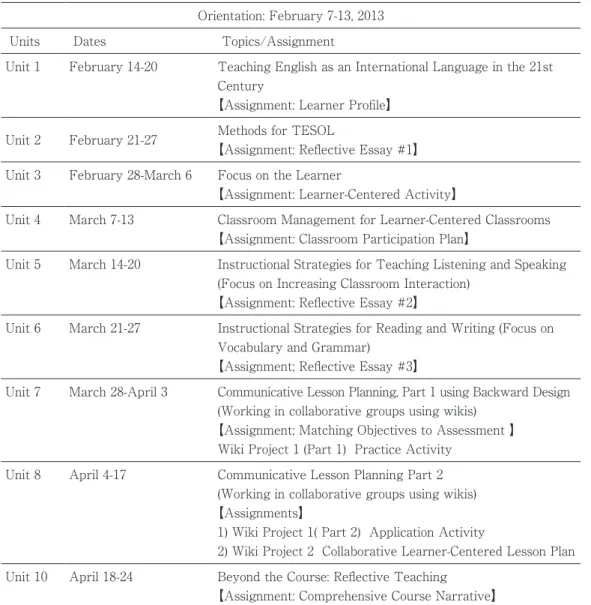
Participants are required to read assigned texts, submit reflective essays and post messages on the discussion board to demonstrate their understanding of key concepts. They are also expected to implement approaches and techniques learned in each module, share activities, and reflect on the implementation of the activities in collaborative writing assignments. The course is divided into nine units with individual topic and assignment as described in Table 1.
Table 1: Course Schedule at UMBC TESOL Methods Online Course Orientation: February 7-13, 2013
Units Dates Topics/Assignment
Unit 1 February 14-20 Teaching English as an International Language in the 21st
Century
【Assignment: Learner Profile】
Unit 2 February 21-27 Methods for TESOL
【Assignment: Reflective Essay #1】
Unit 3 February 28-March 6 Focus on the Learner
【Assignment: Learner-Centered Activity】
Unit 4 March 7-13 Classroom Management for Learner-Centered Classrooms
【Assignment: Classroom Participation Plan】
Unit 5 March 14-20 Instructional Strategies for Teaching Listening and Speaking
(Focus on Increasing Classroom Interaction) 【Assignment: Reflective Essay #2】
Unit 6 March 21-27 Instructional Strategies for Reading and Writing (Focus on
Vocabulary and Grammar)
【Assignment; Reflective Essay #3】
Unit 7 March 28-April 3 Communicative Lesson Planning, Part 1 using Backward Design
(Working in collaborative groups using wikis) 【Assignment; Matching Objectives to Assessment 】
Wiki Project 1 (Part 1) Practice Activity
Unit 8 April 4-17 Communicative Lesson Planning Part 2
(Working in collaborative groups using wikis) 【Assignments】
1) Wiki Project 1( Part 2) Application Activity
2) Wiki Project 2 Collaborative Learner-Centered Lesson Plan
Unit 10 April 18-24 Beyond the Course: Reflective Teaching
Ⅳ.Communicative Lesson Planning
The course is loosely divided into two parts; firstly the instructor gives the participants background information on methodology and issues surrounding communicative language teaching, and secondly the participants actually apply communicative language teaching to their contexts. The first part of the course (Unit 1-6) is mostly focused on methodology and issues surrounding communicative language teaching. The second part of the course (Unit 7-8, 10) is on learning strategies for managing learner-centered classrooms.
Teachers in a communicative classroom setting will find themselves talking less and listening more while becoming active facilitators of students’ learning (Larsen-Freeman, 1986). When a classroom’s atmosphere is collaborative, the teacher becomes a facilitator and a partner in learning.
Participants are required to complete two Collaborative Small Group Wiki Projects to learn the skills necessary in creating learner-centered lessons. They develop lessons that align the English language curriculum standards with learning objectives and assessments. 1. Creating a Learner-Centered Collaborative Lesson Plan
The Collaborative Small Group Wiki Projects are assigned to four groups of 3-5 members each. The groups post and work together on projects using Collaborative Wikis. Collaborative Wikis are pages where groups post and work together on online projects. Each member works on several drafts to write a final project with feedback from the instructor. Technical support is provided by an online instructional assistant.
(1) Communicative Lesson Planning Part 1- Collaborative Small Group Wiki Project 1 Wiki Project 1 is a practice activity, where participants work to create a rubric for a fundraising activity. The objectives are checked by the instructor before the groups start to work on the rubric. Using a rubric reading as a resource to guide them, participants can easily determine what is needed to improve the rubric in the practice activity.
The Wiki Project 1 starts by creating three objectives to develop performance assessment rubrics that correspond with the learning objectives. Focused specific objectives show what students should know or be able to do. Types of objectives are language, content, cultural strategies and skills. Language objectives incorporate linguistic function, structure and vocabulary, aligned to the topic and assessment.
Task 1 Creating Objectives for the Fundraising Plan
strong objectives for a fundraising activity in Table 2.
First, the students read about a natural disaster and explained the outline (e.g. the scale, reason, geographical damage, human loss) and listed what helped these victims in small groups. They later explained their findings to the class.
Table 2: Rubric Design Practice Activity at UMBC TESOL Methodology Course Use your knowledge of Rubric Design to improve this Rubric:
Objectives:
• Students in this practice activity will use simple past tense regular and irregular verbs to explain the process of their projects
• Students in this practice activity will provide an oral presentation that is understandable, enjoyable and uses the language of the project
• Students in this practice activity will design and present materials related to the process and product of their project
• Students in this practice activity will utilize vocabulary related to the project: natural disaster, needs, raise money, etc.
Next, students will design a fundraising plan to meet the victims’ needs based on the article they choose, and will make a 5-minute presentation using visual aids.
Finally, students will correctly use action words related to fundraising (e.g. raise money, collect daily necessities, support the victims) in their oral presentation.
(2) Communicative Lesson Planning Part 2-Collaborative Small Group Wiki Project 2 The aim of this wiki project is to have participants practice and develop learner- centered practices for teaching English in their local schools after the completion of this course. The teacher sets up the exercise, but since the focus is on students’ performance, the teacher must step back and observe, sometimes acting as referee or monitor.
Group 3 created a rubric to measure students’ performance and guide their learning based on the objectives. A rubric provides detailed description and feedback for identified performance as in Table 2.
Table 3
: Task 2 Creating a Rubric for the Objectives
Criteria Emerging ( 1) Developing ( 2) Expanding ( 3) Bridging ( 4)
Explain the outline (e.g. the scale, reason, geographical damage, human loss) The group uses 1 piece of information explaining the type, scale, damage, or the victims’ situation The group uses 2 pieces of information to explain about the type, scale, damage or victims’ needs The group uses 3 pieces of information about the type, reason, damage or the victims’ situation in detail The group explains more than 3 aspects of the natural disaster in detail
List what help these victims need and their findings The group uses fewer than 3 victims’ needs and can not explain their situation The group lists 3 victims’ needs and explains their situation or the reasons The group lists 3 victims’ needs and explains their situation or the reasons The group lists more than 3 victims’ needs and explains their situation or the reasons
Design a fundraising plan to meet the victims’ needs The group explains fundraising plan vaguely and it is not constructive The group explains fundraising plan, but it does not meet victims’ needs and are not practical The group explains fundraising plan that meets victims’ needs with practical activities The group explains fundraising plan with constructive and specific processes that meet victims’ needs
Time (approx. 5 minutes)
Presentation lasts 2 -3 m in ut es , b ut n ot a ll co nt en t is
relevant or well prepared
Finish within 2 minutes over or short and often have long pauses
Presentation is 4
-5 minutes,
but it is lacking some details
F in is h w ith in 3 0 se co nd s ov er
or short and have no long pauses
Use visual aids
The group uses at least 1 visu
al s up po rt , b ut it d oe s no t enhance presentation
The group uses more than 2 visual supports, but it does not enhance presentation The group uses more than 2 visual supports that enhance presentation The group uses more than 2 visual supports effectively that enhance presentation
Correctly use action words related to fundraising The group utilizes fewer than 3 words related to fundraising activity
T he g ro up u til iz es m or e th an
6 words and phrases related to fundraising activity with some mistakes
T he g ro up u til iz es m or e th an
6 words and phrases related to fundraising activity with few mistakes
T he g ro up u til iz es m or e th an
6 words and phrases related to fundraising activity correctly with no mistakes
Total _ / 24 points Final grade= Comments:
In Wiki Project 2, participants in this course developed three objectives for the language standard that was assigned to each group. Participants used the rubric template attached to the group wiki, added the rubric contents, and then uploaded it to the group Wiki Page online. By working in small group collaboration, participants aligned objectives and rubric that determine the instructional methods incorporated into the collaborative lesson plan in Wiki Project 2. Using the backward design approach (Wiggins, G., McTighe, J. 2001), participants first examined what the learners needed to learn and then targeted assessment and instructional strategies around those needs. They developed learner-centered activities that stimulated increased interaction and participation.
【Text Analysis】
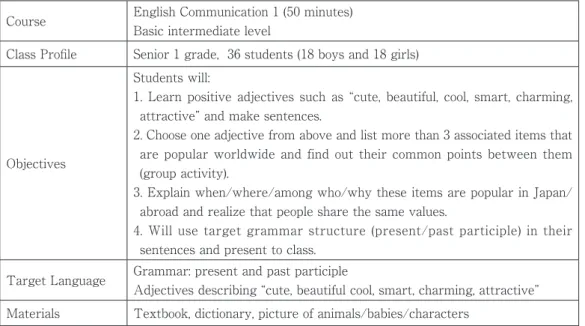
The members in Group 3 chose the following text to demonstrate the language standard assigned by the instructor. The language standards placed in each of the 4 groups were from the National Standards for Foreign Language Education in the US Communication.
Table 4 : Communicative Lesson Plan by Group 3 Standards for Foreign Language Learning
Standard 4.2: Students demonstrate understanding of the nature of language through comparison of the language studied and their own.
Source:http:www.actfl.org/advocacy/discover-languages/advocacy/discover-languages/ advocacy/discover-languages/resources-1
Course English Communication 1 (50 minutes)Basic intermediate level
Class Profile Senior 1 grade, 36 students (18 boys and 18 girls)
Objectives
Students will:
1 . Learn positive adjectives such as “cute, beautiful, cool, smart, charming, attractive” and make sentences.
2 . Choose one adjective from above and list more than 3 associated items that are popular worldwide and find out their common points between them (group activity).
3 . Explain when/where/among who/why these items are popular in Japan/ abroad and realize that people share the same values.
4 . Will use target grammar structure (present/past participle) in their sentences and present to class.
Target Language Grammar: present and past participle
Adjectives describing “cute, beautiful cool, smart, charming, attractive”
Source Vivid English Communication 1 (Daiichi Gakushusha)
http://www.daiichi-g.co.jp/shuppan/sinkatei/10/data/ec324/text.html
Procedure Task 1: Shows pictures of adjectives, ask questions. ( 5 minutes)
Oral practice of target grammar. ( 5 minutes)
Task 2: Students read the whole lesson to review and produce items associated to “cute” to complete a table.
(10 minutes)
Task 3: Presentation: Teacher asks students if there is anything “cute” originally in Japan which has become popular over the country recently (fashion, artists, characters). (10 minutes)
Prepare group presentation (4 students per group). (15 minutes)
・Each group is asked to make own sentences with adjectives including additional information for presentation.
(when/where/among who/why these items are popular) Example
Opener (1 student): Today, we will talk about our favorite character. It is Hello Kitty.
Sequencers (2 students): This smiling white cat is Hello Kitty. She is cute because she has big round eyes and wears a ribbon.
Hello Kitty is popular in Japan and around the world because she is so cute and friendly.
Closer (1 student): Being cute is important to be popular. That is why Hello Kitty is loved by people around the world.
Closing: Wrap up, homework – Each group will add more information and prepare visual aids for homework. (5 minutes)
Presentation will be held next period.
Table 5 : Lesson Plan Rubric
Group 3 created a rubric which is a scoring guide used to measure
students’ performance and guides student learning as below.
It provides detailed description and feedback for identified perform
ance. Criteria Undeveloped ( 0) Developing ( 1) Capable ( 2) Advanced ( 3) R ec og ni ze s th e m ea ni ng s of 6
adjectives and uses each word in sentences Recognizes the meaning of fewer than 3 adjectives, but cannot use them appropriately Recognizes the meaning of fewer than 5 adjectives, but makes some mistakes Recognizes the meaning of 6 adjectives and makes sentences with a few mistakes Matches each item with an appropriate adjective to make correct sentences
Lists more than 3 items associated to the specific adjective and finds out common points Lists fewer than 2 items associated to the specific adjective Lists 2 items associated to the specific adjective and finds out the common points, but makes some mistakes Lists more than 3 items associated to the specific adjective and finds out the common points with a few mistakes Lists more than 3 adjectives associated to the specific adjective and finds out the common points with no mistakes
Makes the table of background about the items (when/where/among who/ why) these items are popular The group cannot complete the background table The group completes the table, but some background information is unsuitable The group completes the table with appropriate background information with a few mistakes The group completes appropriate background information with no mistakes
Explains the analyzed category with the table and visual aids effectively Makes effort to explain the analyzed category, but explanation is not clear Explains the analyzed category, but makes a few mistakes Explains the analyzed category, but does not use visual aids effectively Explains the analyzed category and uses visual aids effectively
Add their thoughtful com
m en ts a bo ut t he o ut co m e to the presentation
Cannot make comments
A rough comment, but not based on the outcome Short comment based on the outcome Elaborated idea about awareness based on the outcome
Correctly uses the target language and grammar Does not understand the target language and grammar Makes effort to use the target language and grammar, but makes some mistakes
U se s th e ta rg et la ng ua ge a nd
grammar with a few mistakes Can utilize the target language and grammar with no mistakes
Total _ / 18 points Final grade = Comments:
Ⅴ.Reflective Teaching
The final unit of this course was about reflecting on what was learned during the past 11 weeks and how it will affect the participants teaching career beyond this point. Participants read materials on reflective teaching practices, which helped them to become more aware of how they teach, the kinds of decisions they make, and the consequences of particular instructional decisions that they make. Not only must they think about what happens in the classroom, both in terms of the teaching and the learning outcomes, they must also try to improve upon it.
The last assignment was assembling the course portfolio and developing a comprehensive narrative essay reflecting on the whole experience gained through this course. It provided an invaluable opportunity for teachers to analyze and ask questions about their objectives as well as to examine how they teach.
The course ended with a final action or training plan in which participants described how they would disseminate the knowledge and skills learned in this online course to other English teachers in their local, regional or national contexts.
Ⅵ.Conclusion
Globalization and the digital revolution present new challenges and opportunities for today’s students as unprecedented amounts of information becomes available by just a click of the mouse. Digital technologies facilitate students’ access to new program materials and multimedia resources enable them to create and share products. These are the skills that are required to succeed in today’s rapidly changing world and English plays a key role there.
By participating in the TESOL Methodology Online Course, the teachers were inspired to improve their lessons towards this goal. Every week, they had an opportunity to post their comments on discussion boards to exchange information and ideas with their colleagues. They learned how their colleagues incorporated technology in their classrooms and felt empowered by their creativity and hard work.
Professional development is an ongoing process that evolves as teachers assess and reexamine their teaching beliefs and practices. Through group collaborative wiki projects, the teachers developed objectives that were used to measure what they wanted their students to understand and learn. The purpose of the wiki projects was to extend what participants learned to develop a communicative lesson plan. Participants learned first hand how much work was needed when planning a learner-centered communicative approach for teaching English. The knowledge they have gained would allow them to further extend the
strategies that they learned, to build communicative lesson plans into their own classrooms. Learning new ideas through professional development makes teachers more creative. When teachers enjoy creativity within themselves, they create an environment for learning that activates, motivates and involves their students. They also create learner-centered lessons in which students learn how to apply their knowledge to solve problems in the real-world.
【References】
Bailey M, Curtis A. and Nunan D. (2001) Pursuing Professional Development: The Self as Source. Boston: Heinle.
Brown, H.D. (2002). English Language Teaching in the “Post-Methods” Era Toward Better Diagnosis, Treatment and Assessment in J.C. Richards & W.A. Renanyda. (Eds.). Methodology in Language Teaching: An Anthology of Current Practice. New York: Cambridge
Daiichi Gakushusha. (2012). Vivid English Communication 1. Tokyo: Daiichi Gakushusha.
Fennelley, M. and Luston, R. (2011). Are they ready? On the verge of compulsory English, elementary school teachers lack confidence. The Language Teacher, 35(2), 19-24
Hahn, A. (2013) Training Teachers, The Language Teacher, Reader’s Forum, JALT Journal 37(3), 19-22
Ministry of Education, Science and Culture (MEXT). (1989) Issues and developments of policies in education, science, and culture. Retrieved on September 18 from
http://www.mext.go.jp/b_menu/hakusho/html/hpae198901_2_103.html
Ministry of Education, Culture, Sports, Science and Technology. (MEXT). (2003). Regarding the establishment of an action plan to cultivate “Japanese with English abilities.” Retrieved on September 18 from http://www.mext.go.jp/english/topics/03072801.htm
Ministry of Education, Culture, Sports, Science and Technology (MEXT). (2008a). Koutougakkou gakushuushidouyouryou shinkyuutaishouhyou (Comparison of the senior high school government curriculum guidelines). Retrieved on September 18 from
http://www.mext.go.jp/a_menu/shotou/new-cs/youryou/kou/kou2.pdf
Nishino, T. (2011). Japanese High School Teachers’ Beliefs and Practices Regarding Communicative Language Teaching, JALT Journal, 33(2), 131-155
Nunan, D. (1989). Understanding Language Classrooms: A guide for teacher-initiated action, Englewood Cliffs. NJ: Prentice Hall.
Nunan, D. (2003). Practical English Language Teaching. New York: McGraw.
Stewart, T. (2009). Will the New English Curriculum for 2013 Work? The Language Teacher, JALT Journal, 31(11), 9-13
Tahira, M (2012). Behind MEXT’s new Course of Study Guidelines,The Language Teacher, JALT Journal, 35(3)
UMBC (2013) Methodology for TESOL, Course Syllabus, University of Maryland Baltimore County Wiggins, G., McTighe, J. (2001). Understanding by Design, Prentice Hall.
【Appendix】
UMBC TESOL Methods Course Evaluation Standards Course requirements were weighted out of 100% as follows:
25% Online Class Participation using the Discussion Board At least 3 posts weekly
15% Write 3 Reflective Essays that demonstrate the
comprehension of the unit content, which should include reference to the unit readings.
RE 1(Unit 2) RE 2(Unit 5) RE 3(Unit 6)
30% 2 Collaborative Small Group Wiki Projects
(15% each)
Units 7-8
15% Other Course Assignments:
Complete a Learner Profile
Develop a Learner-Centered Participation Plan Design a Learner-Centered Communicative Activity (5 % each)
Units 1, 3, 4
15% Assemble a Course Portfolio as evidence of learning
in this course
Write Comprehensive Narrative Essay
Unit 10
1) Instructors received weekly discussion board reports detailing student participation which was used to measure their comprehension and performance.
2) Participants received certificates upon completion of their course projects and other assignments with a score of 70% or higher.