Fair Value of Defined Benefit Obligations in
Japan
journal or
publication title
International review of business
number
13
page range
59-85
year
2013-03
1. Introduction
A common topic of discussion is how to measure defined benefit obligations, because employee benefits, especially the pensions employees receive when they retire, occur at some future date. To calculate defined benefit obligations, firms (1) estimate the future amount of defined benefit obligations at employee retirement, and (2) discount the amount to its present value. Many assumptions are included in the calculation of defined benefit obligations, including mortality, rates of employee turnover, discount rates, and rates of future salary increases. There are three concepts for defined benefit obligations. These concepts are different depending on the inclusion of unvested benefits, i.e., benefits for employees who have not been granted vesting for their employee benefits, and the consideration of future salary increases in the calculation of defined benefit obligations.
International Accounting Standards Board (IASB) adopts a method that includes both unvested benefits and future salary increases to calculate defined benefit obligations. However, the IASB suggests using alternative methods for measuring defined benefit obligations, and
Eriko KASAOKA*
Abstract
The calculation of defined benefit obligations includes many assumptions and future prospects. There are mainly two problems that should be considered in the concept of defined benefit obligations: the inclusion of unvested benefits and future salary increases. These components are related to future events, and their recognition leads to inconsistency with other accounting standards. With regard to unvested benefits, the applicable Japanese laws relating to pensions do not state the requirements of vesting clearly, and vesting is not a nonforfeitable right. Therefore, retirement benefits are not protected by law. Establishing requirements of vesting will improve the comparability among firms in their accounting. As for future salary increases, most research concludes that they are deemed as liabilities of the firm by investors. However, a liability is defined as a present obligation of the firm arising from past events. Therefore, conceptually future salary increases should not be included in the calculation of defined benefit obligations. Non-recognition of future salary increases will reduce the uncertainty in the calculation, and be more consistent with other international accounting standards including IFRS and SFAS.
it will discuss this topic in the next step of the IASB project. Because these unvested benefits and future salary increases are related to future events, their recognition leads to inconsistencies with other accounting standards. Japanese accounting standards also adopt the same accounting procedures to recognize defined benefit obligations as IASB does.
To address the various problems on recognition of unvested benefits and future salary increases and propose solutions, this paper will first explain the components of employee benefits, the definition of pension in accounting, and recognition and measurement for defined benefit obligations. Second, prior research examining the importance of unvested benefits and future salary increases are studied. With regard to unvested benefits, vesting is not defined clearly under Japanese defined benefit plans. Therefore, requirements of vesting in Japan are compared to those in the U.S., which are stated under the requirements of federal law, and it is considered whether the difference in these requirements for vesting gives rise to any problem in the recognition of unvested benefits.
2. Components of Employee Benefits
The Japanese accounting standards for employee benefits regulate only accounting procedures for retirement benefits. Statement on Establishing Accounting Standard for Retirement Benefits defines retirement benefits as benefits paid to firms’ employees after their retirement due to the services they provided to their firms in the past. Retirement benefits comprise retirement lump sum grants and retirement pensions including defined benefit plans and defined contribution plans (Statement on Establishing Accounting Standard for Retirement Benefits, par.3.1). Basically, the accounting standards indicate accounting procedures for defined benefit plans1. It also states that an accounting procedure for defined contribution plans which put briefly is that pension plan contributions are recognized as expenses (Statement on Establishing Accounting Standard for Retirement Benefits, par.3.3. (2)).
International Accounting Standard No.19: Employee Benefits (IAS19) states that “employee
1 There are two kinds of accounting procedures to be considered in recognition of defined benefit
obligations, plan assets, and defined benefit cost, i.e., (1) those for an entrusted part of employees’ pension fund, and (2) those for contributions from employees. With regard to an entrusted part of the employees’ pension fund, the fund has a distinctive system in which the fund amount consists of the earnings-related part of employees’ pension insurance (entrusted part) and the firm-specific part. The pension benefit levels and calculation methods are different for each part. However, firms manage both parts in a lump. It is difficult to recognize these parts separately, therefore, firms adopt the same accounting procedure for both the entrusted part and the firm-specific part. As for contributions from employees, firms include the contributions from their employees to their pension funds in the calculation of defined benefit obligations and defined benefit cost. The contributions are deducted from defined benefit cost after the total amount of defined benefit cost including the contributions is calculated (Statement on Establishing Accounting Standard for Retirement Benefits, par.3.3(1)).
benefits are all forms of consideration given by a firm in exchange for service rendered by employees or for the termination of employment” (IAS19, par.8). Employee benefits include the following components (IAS19, par.5):
(a) Short-term employee benefits, such as wages, salaries, and social security contributions; paid annual leave and paid sick leave; profit-sharing and bonuses; and non-monetary benefits (such as medical care, housing, cars and free or subsidized goods or services) for current employees;
(b) Post-employment benefits such as retirement benefits, including pensions and lump sum payments on retirement, and other post-employment benefits, such as life insurance and post-employment medical care;
(c) Other term employee benefits including term paid absences, such as long-service leave or sabbatical leave, jubilee or other long-long-service benefits, long-term disability benefits; and
(d) Termination benefits.
Retirement benefits including pensions are categorized in (b), and IAS19 mentions that “post-employment benefit plans are classified as either defined benefit plans or defined contribution plans, depending on the economic substance of the plan as derived from its principal terms and conditions” (IAS19, par.27). Therefore, the range of employee benefits in IAS19 is wider than that in Japanese accounting standards. Retirement benefits defined in Japanese accounting standards can apply to post-employment benefits in IAS19.
3. Definition of Pension in Accounting
“Pension” has three characteristics: future payment of employees’ salary, employees’ merit rewards, and income security for employees. In general, Japanese firms make payments for their employees’ pension as compensation for their work after their retirement (Statement on Establishing Accounting Standard for Retirement Benefits, pars.3.1, 3.2). Defined benefit cost for the period is recognized based on employees’ work period. Therefore, basically “pension” is defined as future payment of employees’ salary2.
Under IAS19, pension is treated as a part of post-employment benefits. The IASB states “IAS19 requires a firm to recognize a liability when an employee has provided service in exchange for employee benefits to be paid in the future. An expense has to be recognized when the firm consumes the economic benefit arising from service provided by an employee in exchange for employee benefits” (IAS19, Objective). Therefore, IASB also defines pension as future payment of employees’ salary.
2 However, there is a condition that firms have some discretion for reducing or cutting off their
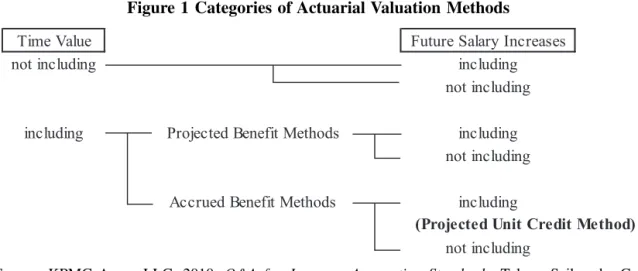
Figure 1 Categories of Actuarial Valuation Methods
Source: KPMG Azusa LLC, 2010. Q&A for Japanese Accounting Standards, Tokyo: Seibunsha Co. Ltd, p.82.
4. Recognition and Measurement for Defined Benefit Obligations
4.1 Projected Benefit Methods and Accrued Benefit Methods
There are several actuarial valuation methods to measure defined benefit obligations. Methods including time value in their calculations are categorized into projected benefit methods or accrued benefit methods. These methods are subdivided further depending on the consideration of future salary increases in their calculations.
Projected benefit methods are based on the premise that employee benefits occur equally throughout the employee’s entire service period. Therefore, under these methods, the estimated total amount of defined benefit obligations at retirement is calculated, discounted, and attributed to each period. The cost is equalized in each period, and these methods are not calculated on accrual basis.
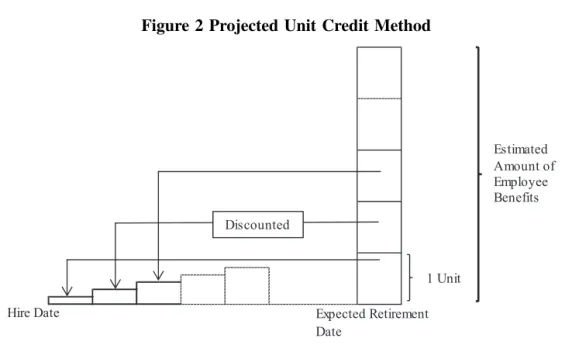
Accrued benefit methods accrue on the basis that employee benefits occur when employees provide their services. Under these methods, the estimated total amount of defined benefit obligations at retirement is calculated, attributed to each period, and discounted. One of these methods that includes time value and future salary increases in the calculation is the projected unit credit method, which is adopted under Japanese accounting standards and IAS19. The projected unit credit method assumes each period of service as adding a unit of benefit entitlement, and measures each unit separately to accumulate the final obligation (IAS19, par.68).
Prior Japanese accounting standards did not state which method should be adopted. Most firms adopted projected benefit methods because of the following reasons3:
Figure 2 Projected Unit Credit Method
(a) They meet the going concern assumption in accounting convention, in that defined benefit cost occurring from a significant amount of defined benefit obligations is amortized throughout employee’s lifetime service period. Notably, it can reduce firm’s arbitrariness in making accounting assumptions;
(b) Employee’s salary properly represents the value of the service provided to the firm by the employee. It is preferable to recognize a certain percentage of salary as defined benefit cost in the period; and
(c) In essence, accrued benefit methods are based on the fair value approach. However, deferred recognition for actuarial gains and losses and past service cost are inconsistent with this approach.
Japanese accounting standards introduced in fiscal 2000 state that the projected unit credit method, one of the accrued benefit methods, must be adopted. It appears that Japanese accounting standards eventually adopted this method to harmonize with other international accounting standards, such as International Financial Reporting Standards (IFRS), Statement of Financial Accounting Standards (SFAS) in the U.S. or Financial Reporting Standards (FRS) in the U.K..
At one point, IAS19 permitted firms to choose projected benefit methods or accrued benefit methods. However, projected benefit methods were eliminated, because such methods
3 Sawa, E., 1996. Reporting (No.2) and Comment on IASC “Retirement Benefits and Other Costs for
(IAS19, par.BC110):
(a) focus on future events (future service) as well as past events, whereas accrued benefit methods focus only on past events;
(b) generate a liability which does not represent a measure of any real amount and can be described only as the result of cost allocations; and
(c) do not attempt to measure fair value and cannot, therefore, be used in a business combination, as required by International Accounting Standard No.22: Business Combinations.
Currently IAS19 adopts the projected unit credit method, which is the most widely used accrued benefit method (IAS19, par.BC111). However, Discussion Paper: Preliminary Views on Amendments to IAS19 Employee Benefits (IAS19DP) suggests considering alternative measurement methods, including projected benefit, accumulated benefit, fair value, and settlement value, because the projected unit credit method in IAS19 is fundamentally different from the measurement models in other accounting standards (IAS19DP, par.1.11). 4.2 Concepts for Defined Benefit Obligations
There are three concepts to calculate defined benefit obligations: vested benefit obligation (VBO), accumulated benefit obligation (ABO), and projected benefit obligation (PBO). These are different owing to the recognition of unvested benefits as a liability and the consideration of future salary increases.
(1) VBO
VBO is the present value of legal obligations for employees who have granted their vesting for employee benefits.
(2) ABO
ABO is the present value of legal obligations for all employees regardless of the possibility of acquisition of their vesting.
(3) PBO
PBO is the present value of legal obligations reflected by employees’ future salary increases for all employees regardless of the possibility of acquisition of their vesting. ASBJ Statement No.26: Accounting Standard for Retirement Benefits (ASBJ Statement 26) states that defined benefit obligations occur from employees’ services in the past, and the benefits funded by their firms are provided to employees after their retirement. There is a long time lag between when employees provided their services to their firms and when their salaries are paid as pensions. Therefore, estimated defined benefit obligations at employees’ retirement are discounted to measure the present value of the obligation (ASBJ Statement 26, par.6). ASBJ Guidance No.25: Guidance on Accounting Standard for Retirement Benefits (ASBJ Guidance 25) states that the calculation includes employees’ future salary
increases which can be estimated in the future (ASBJ Guidance 25, par.99). Thus, Japanese accounting standards adopt PBO to calculate defined benefit obligations. However, there are some voices against the adoption of PBO, because of the inconsistency with provisioning. Corporate Accounting Principles state a provision is recognized when the obligation is related to a certain cost or loss in the future, results from a past event, is probable, and can be estimated reliably (Corporate Accounting Principles, footnote18). The concept of PBO includes future salary increases, which are expected future events. It is not appropriate to recognize obligations that do not result from past events, because it is inconsistent with the definition of a provision4. However, PBO is adopted to harmonize with other international accounting standards.
IAS19 also adopts PBO to calculate defined benefit obligations. IAS19 states defined benefit obligations reflect estimated future salary increases (IAS19, par.87). Some arguments have been made that estimated future salary increases should not be included in the measurement of defined benefit obligations, because they are related to future events and such estimates are too subjective (IAS19, par.BC140). The IASB believes that a firm should use the assumptions to measure an existing obligation based on a method which represents the most relevant measure of the estimated outflow of resources. It would be misleading to assume no change if a firm expects a change (IAS19, par.BC141). Therefore, IAS19 includes future salary increases in the calculation of defined benefit obligations.
Statement of Financial Accounting Standards No.87: Employer’s Accounting for Pensions (SFAS87) required firms to recognize an additional minimum liability. In principle, firms have to measure their defined benefit obligations based on PBO. However, the additional minimum liability was recognized when an unfunded ABO existed and (SFAS87, par.36):
4 Daigo, S., 1998. Coursework for Accounting, Tokyo: University of Tokyo Press, pp.213-214.
(a) an asset had been recognized as prepaid pension cost;
(b) the liability already recognized as unfunded accrued pension cost was less than the unfunded ABO; or
(c) no accrued or prepaid pension cost had been recognized.
SFAS87 adopted ABO for recognition in order to be consistent with the method adopted in the Employee Retirement Income Security Act (ERISA). ERISA is a U.S. federal law that sets minimum standards for most voluntarily established pension and health plans in private industry to protect employee benefits for individuals in these plans5. It states that, when a fund is dissolved, the obligations are measured based on ABO. However, Statement of Financial Accounting Standards No.158: Employers’ Accounting for Defined Benefit Pension and Other Postretirement Plans (SFAS158) eliminated the requirement under SFAS87. Both Japanese accounting standards and IAS19 have not adopted this additional minimum approach. IAS19 states that the reason for non-adoption is that the approach is potentially confusing and does not provide relevant information (IAS19, par.BC105).
4.3 Recognition and Measurement of Contribution-based Promises in IAS19DP
IAS19DP notes two problems in the benefit formula in IAS19: (1) the recognition of unvested benefits as a liability, and (2) the consideration of future salary increases in the projected unit credit method. These problems lead to inconsistency with other accounting standards (IAS19DP, par.1.11). It suggests using alternative measurement methods to calculate defined benefit obligations.
Under current IAS19, post-employment benefits are classified into two categories, defined benefit plans and defined contribution plans. IAS19 prescribes accounting procedures for both plans. IAS19DP suggests abolishing these categories and introducing new categories which consist of contribution-based promises and defined benefit promises6. IAS19DP states accounting procedures for post-employment benefit promises, because sometimes pension funds provide several different promises in one plan7. A contribution-based promise is defined as a post-employment benefit promise in which, during the accumulation phase, the benefit can be expressed as (IAS19DP, par.5.3):
(a) The accumulation of actual or notional contributions that, for any reporting period, would be known at the end of that period, except for the effect of any vesting or
5 United States Department of Labor. Employee Retirement Income Security Act — ERISA, [online]
Available at: <http://www.dol.gov/dol/topic/health-plans/erisa.htm>.
6 The IASB suggested that this issue should not be addressed in the amendments made in IAS19 in June
2011, and it will be reviewed in a possible future project (IAS19, pars.BC7, BC120).
7 Nakata, T., 2008. Review of Discussion Paper: Preliminary Views on Amendments to IAS19 Employee
Benefits. NFI Research Review, [pdf] Available at: <http://www.nikko-fi.co.jp/uploads/photos1/648. pdf>, p.1.
demographic risk; and
(b) Any promised return on the actual or notional contributions is linked to the return from an asset, group of assets, or an index. A contribution-based promise need not include a promised return.
The following promises are examples of contribution-based promises (IAS19DP, par.5.10): (a) promises that IAS19 classifies as defined contribution plans;
(b) promises of a return based on notional contributions; (c) promises that guarantee a fixed return on contributions;
(d) promises expressed as a fixed lump sum at retirement that is not dependent on service; and
(e) career average promises (i.e., promises based on the average of the employee’s salary over his or her entire service period).
On the other hand, the following promises are excluded from contribution-based promises (IAS19DP, par.5.11):
(a) any promise that includes salary risk; and
(b) other post-employment benefit promises, such as typical post-employment life insurance and medical care.
A defined contribution plan treated in IAS19 is included in contribution-based promises. However, the same accounting treatment as in IAS19 is adopted for this plan. A significant effect of this accounting change is on cash balance plan8. They are included in defined benefit plans under IAS19 and are categorized into contribution-based promises under IAS 19DP. A defined benefit promise is specified as a post-employment benefit that is not a contribution-based promise (IAS19DP, par.5.3).
Changes treated in IAS19DP are part of the IASB project on the accounting for post-employment benefit promises as a first step. This project is limited in scope to certain issues, including the deferred recognition of some gains and losses arising from defined benefit plans, presentation of defined benefit liabilities, accounting for benefits that are based on contributions and a promised return, and accounting for benefit promises with a higher of option (IAS19DP, par.IN4). Recognition and measurement of defined benefit promises will be discussed in the next step. Therefore, the projected unit credit method will be adopted for defined benefit promises until the discussion for the recognition and
8 A cash balance plan is a defined benefit plan that has some characteristics of a defined contribution
plan. In a typical cash balance plan, a pension participant’s account is credited each year with a pay credit (monthly standard salary multiplied by a certain rate) and an interest credit (the virtual balance of participant’s account at the balance sheet data in a previous year multiplied by the reassessment rate). A participant does not acquire the risk of the plan’s investments. Therefore, he can have the benefit amounts promised by the employer.
measurement of defined benefit promises is completed. On the other hand, IAS19DP suggests measuring contribution-based promises at fair value (IAS19DP, par.ITC11). All changes in any plan assets are presented in profit or loss (IAS19DP, par.9.11). The objective of the IASB is to select a measurement attribute for a contribution-based promise that provides useful information about the amount, timing, and uncertainty of future cash flows regarding the promise to financial statement users. The IASB believes that the measurement approach that includes the following characteristics would meet this objective (IAS19DP, par.7.7):
(a) an estimate of the future cash flows; (b) the effect of the time value of money; and (c) the effect of risk.
With respect to estimating future cash flows, there are four views that a firm should consider to make the estimation, including explicit estimates, consistency with observed market prices, unbiased use of all available information, and current estimates (IAS19DP, par.7.9). As for unbiased use of all available information, a contribution-based promise liability is measured based on an expected value approach. The expected present value is stated as “the probability-weighted average of the present value of the cash flows” (IAS19 DP, par.7.16). Therefore, the liability is calculated with consideration of expected variability such as under the cash balance plan or reassessment rate using a certain assumption9.
With regard to the effect of the time value of money, IAS19 requires discounting for defined benefit liabilities and defined contribution liabilities. IAS19DP also states that a current measure of the time value of money should be included in the measurement of contribution-based promises (IAS19DP, par.7.19).
The effect of risk comprises asset-based risk, demographic risk, credit risk, and risk that the terms of the benefit promise change. Asset-based risk includes changes in the value of the assets or indices, and it is similar to market risk for financial instruments. Market risk is defined as “the risk that the fair value or future cash flows of a financial instrument will fluctuate because of changes in market prices” (IAS19DP, par.7.22). The IASB believes inclusion of this asset-based risk is one of the main improvements in measuring contribution -based promises (IAS19DP, par.7.23). Demographic risk is longevity risk in particular. Credit risk is “the risk that a firm will be unable to make the necessary payments” (IAS19 DP, par.7.22). The IASB recognizes this is a significant change, and it could be difficult to include credit risk in the calculation of contribution-based promises, because there is no readily observable price to calculate the risk for the initial exchange of service for
post-9 Inoue, M., 2008. Current Condition and Future Prospects of Accounting Standard for Employee
employment (IAS19DP, par.7.28).
This measurement for contribution-based promises does not include future salary increases which are related to a future event. The definition of fair value in the measurement of contribution-based promises might serve as a useful reference for considering the alternative measurement for defined benefit promises, because it eliminates one of the problems of the benefit formula the IASB states in IAS19DP, namely, the consideration of future salary increases in the projected unit credit method.
From another point of view, Exposure Draft: Defined Benefit Plans Proposed amendments to IAS19 (IAS19ED) requires firms to disclose the present value of defined benefit obligations, adjusted to exclude the effect of future salary increases as an alternative measure of the long-term employee benefit liability (sometimes referred to as ABO) (IAS19 ED, par.125H). The amount is similar to the amount of the firm’s defined benefit obligation if the plan were to be terminated (IAS19ED, par.BC60(f)). These two measurement methods treated in IAS19DP for contribution-based promises and in IAS19ED might be a way to solve the two problems described above in the projected unit credit method.
5. Attribution Methods
Attribution methods are methods that attribute the present value of defined benefit obligations to employees’ service periods as service cost. There are several attribution methods as follows10:
(1) Straight-line basis
This method allocates defined benefit obligations and service cost in direct proportion to service periods.
(2) Salary amount basis
This method allocates defined benefit obligations and service cost in direct proportion to total salary. In most Japanese firms, employees’ salaries increase along with their length of service years. Therefore, the service cost is higher in later years.
(3) Benefit multiplier basis
This method allocates defined benefit obligations and service cost in direct proportion to the multiplier of salary.
(4) Point basis
Under this basis, points are granted monthly or annually, accumulated depending on employees’ service periods, job grade, title, qualification acquisition, etc. over service period, and multiplied by unit price to calculate the terminal benefits. This method
10 JP Actuary Consulting Co., Ltd. Glossary of Pension Terms, [online] Available at: <http://www.jpac.co.
cannot be stated clearly, because the definition of point is different in each firm.
In principle, straight-line basis was adopted in the prior accounting standards for retirement benefits. Other methods could also be adopted under certain conditions11. The characteristic of merit rewards that Japanese firms display had facilitated adoption of the straight-line method, which equalizes current service costs throughout the entire employees’ service period. However, firms will be allowed to choose straight-line basis or the method based on proportion to the multiplier (see above) from fiscal 2013 (ASBJ Statement 26, par.19). In Exposure Draft of Statement No.39: Exposure Draft of Accounting Standard for Retirement Benefits (ED39), the Accounting Standards Board of Japan (ASBJ) states that the benefit multiplier basis method is more accurate and precise than straight-line basis, because it represents increases of current service cost according to employees’ length of service (ED 39, par.59).
IAS19 states a firm attributes benefit to periods of service under the plan’s benefit formula (IAS19, par.70). Therefore, it adopts a benefit multiplier basis. However, it also states that, if an employee’s service in later years will lead to a materially higher level of benefit than in earlier years, which is called back-loading, straight-line basis is adopted to attribute benefits (IAS19, par.70). The ASBJ also states that firms must adopt a benefit multiplier basis which is adjusted to recognize service cost equally if a firm’s pension payment is back-loading (ED39, par.19(2)). Therefore, these accounting standards provide some attribution methods whereby firms can equalize their service cost in each period.
6. Recognition of Unvested Benefits and Future Salary Increases
There are several research studies concerning the importance of defined benefit obligations. Landsman (1986) examines whether defined benefit obligations and plan assets associated with defined benefit plans are valued by the securities markets as corporate assets and liabilities in the same way as other assets and liabilities. He concludes that defined benefit obligations measured by ABO12and plan assets are statistically significant. Therefore, the market values pension information. Barth et al. (1993) examine the effect of pension earnings and balance sheet disclosures on the structure of share prices from 1987 to 1990. Their results show that the coefficients of PBO have the correct sign for all four years and are significant in three of the four years. The t-values in three of the four years range from -3.47 to -1.76, and the coefficients run from -5.47 to -1.13. They are volatile from year to year. They conclude that defined benefit obligation is an important factor for investors to
11 The method based on proportion to salary could be adopted only when the labor value rationally
reflected the pensionable salary used in the calculation. With regard to point basis, it could be adopted only when the increase in points rationally reflected the value of labor in each period.
evaluate firms.
As mentioned above, there are two problems in the benefit formula for defined benefit obligations that the IASB describes: (1) the recognition of unvested benefits as a liability, and (2) the consideration of future salary increases in the projected unit credit method. With respect to the recognition of unvested benefits as a liability, there is the issue that Japan’s defined benefit plan acts do not define requirements of vesting clearly. On the other hand, in the U.S., the requirements of vesting are defined in specific terms and vesting is treated as a nonforfeitable right. In comparing these requirements of vesting in Japan and the U.S., problems in Japan’s defined benefit plan acts arise, which will be discussed below. Regarding the consideration of future salary increases in the projected unit credit method, there are several prior research studies examining the importance of future salary increases. Therefore, these studies are referred to in order to consider if future salary increases should be included in the measurement of defined benefit obligations.
6.1 Unvested Benefits
Japan’s retirement benefit plans started with a retirement lump sum grant to employees to encourage them to work longer for their firms. The first retirement lump sum grant as a monetary allocation was introduced in 1905 by a cotton-spinning firm13. Until tax-qualified pension plans were introduced by the Japanese government, some firms adopted their own defined benefit plans to address the social need of providing income security to their employees after retirement. However, because tax treatments for defined benefit plans were inconsistent and inadequate, these pension plans were not widely implemented. To meet the need for a uniform tax system for defined benefit plans, the tax-qualified pension plan was introduced in 1962, and subsequently the employees’ pension fund was established in 196614. Thereupon many firms transferred their funding from retirement lump sum grants to defined benefit plans. In consequence, Japanese defined benefit plans have characteristics of both merit rewards, which retirement lump sum grants have, and income security after employees’ retirement. Requirements for vesting are not established because, given the merit reward component, the pension might not be provided to employees under certain conditions such as punitive dismissal.
There are two defined benefit plans in Japan: employees’ pension fund and defined-benefit corporate pension15. There is no unified act for these pension plans in Japan, i.e., each pension plan operates under different law. Defined-benefit corporate pension is
13 Utani, R., 1993.History of Corporate Pension, Tokyo: Japan Life Planning Co., Ltd., pp.212-214. 14 Nakakita, T., 2001.The Future of Corporate Pension, Tokyo: Chikumashobo Ltd., pp.43-44.
15 There were three defined benefit plans: employees’ pension fund, defined-benefit corporate pension,
Table 1 Requirements for Vesting Protection Defined-Benefit
Corporate Pension
Employees’ Pension
Fund ERISA (U.S.) Grants of Vesting Not defined Not defined Defined Funding Obligations Defined Defined Defined Institution Guaranteeing
Payment Not established Established
Established (PBGC) regulated by the Defined-Benefit Corporate Pension Act, and the employees’ pension fund is regulated by the Employees’ Pension Insurance Act. To assure employees’ pension payment, the following requirements should be considered: grants of vesting in accordance with employees’ length of service, funding obligations, and payment guarantee institutions.
With regard to grants of vesting in accordance with employees’ length of service, vesting is granted to employees while in their firms, and it is not possible for firms to seize employees’ vesting or reduce their pension amounts after the grant date of vesting. In Japan, under both employees’ pension funds and defined-benefit corporate pensions, there is no requirement for grants of vesting, and it is possible to seize or reduce employees’ pensions when there are serious infractions by employees, such as criminal acts, leakage of firm’s secrets, or long absence without any legal excuse (Defined-Benefit Corporate Pension Act, par.54). The absence of this regulation for grants of vesting in accordance with employees’ length of service is related to a problem on portability of defined benefits. It is difficult for employees under both employees’ pension fund and defined-benefit corporate pension to transfer their pension funds when they change their jobs, because grants of vesting are not defined distinctly and the possession of their funds is not clear at their retirement. It also creates a problem for labor liquidity.
As for funding obligations, defined-benefit corporate pensions have requirements for funding obligations, actuarial review, and verification of funding status, and elimination of pension deficits to ensure firms’ pension payment for their employees16. Employees’ pension funds also require firms to disclose their actuarial verification of funding status. In terms of the institution guaranteeing payment, only employees’ pension fund has the institutional machinery that assures a certain amount of pension payment for beneficiaries when their funds go into liquidation or there is a funding shortage. To calculate the
16 Ministry of Health, Labour and Welfare. Outline of Defined-Benefit Corporate Pension Act, [online]
Years of Service 3 4 5 6 7 or More The Nonforfeitable Percentage 20 40 60 80 100 contribution amount to pension funds, firms have to consider the payment guarantee limit in the calculation. When firms’ funding does not meet the level their funds require, fund management experts must consult or advise their firms’ financial reorganization17.
In addition, the Defined-Benefit Corporate Pension Act states two other rules to protect vesting rights, namely, the responsibility of fiduciaries and information disclosure requirements for their beneficiaries. Fiduciaries have some responsibilities regulated under the Defined-Benefit Corporate Pension Act, such as the fiduciary’s duty of loyalty to beneficiaries and diversification in investment, and a code for their conduct, including conflict of interest actions, is specified. Employers have to disseminate their pension contracts to their employees, and also disclose contribution payments, asset management, and financial conditions to their beneficiaries, and also report them to the Minister of Health, Labour, and Welfare18. These regulations also facilitate the protection of vesting.
In the U.S., vesting is defined more clearly. All pension plans are regulated under ERISA, which is a unified basic act in the United States Code (USC). ERISA states vesting is a nonforfeitable right. In the case of a defined benefit plan, a plan has to satisfy the requirements of either of the following clauses (USC29, §1053):
(a) An employee who has completed at least five years of service has a nonforfeitable right to 100 percent of the employee’s accrued benefit derived from employer contributions; or
(b) An employee has a nonforfeitable right to a percentage of the employee’s accrued benefit derived from employer contributions, determined under the following table:
ERISA forbids changing a defined benefit plan to reduce employee benefits that have already accrued. It also states benefit accrual requirements to restrict occurrences where the rate of pension paid increases sharply at or near the end of employees’ retirement date19 (USC29, §1054). These benefit accrual requirements ensure a certain amount of employee benefits for employees who retire before their normal retirement age and protect vesting effectively20. With regard to funding obligations, the Pension Protection Act of 2006 was signed into law to enhance and protect pension savings, and it affects ERISA. The Act states that, as a funding requirement, a plan has to stay fully funded. If the plan is not fully funded, the contribution to the pension fund also includes the amount necessary to amortize
17 Employees’ Pension Fund Association, 1999.Pension Systems in Other Countries, Tokyo: Toyo Keizai,
Inc., p.112.
the pension funding deficits over seven years. There is also an institution established within the Department of Labor to guarantee employees’ pension payment, known as the Pension Benefit Guaranty Corporation (PBGC). The PBGC has specific powers to encourage the continuation and maintenance of voluntary private pension plans, and to provide for the timely and uninterrupted payment of pension benefits (USC29, §1302). These include the power21:
(a) to obligate firms which have pension funding deficits to report the details of their pension plans;
(b) to have an executive right granted to the corporation to make firms adhere strictly to the minimum funding requirement; and
(c) to attach its security right to employers who fall behind their plan termination insurance fee.
ERISA was enacted to protect employees’ vesting and establish an institution guaranteeing payment to prepare for the bankruptcy of pension plans. It creates a system whereby employees can receive the benefits stemming from their services in the past. Therefore, it is based on the concept that a pension is a future payment of employees’ salary. Compared to requirements for vesting protection in Japan, those in ERISA define vesting more clearly and protect payments for employees after their retirement.
The following two research studies observe whether unvested benefit obligations should be included in defined benefit obligations. Lorensen and Rosenfield (1983) compare the VBO method with the projected unit credit method. In their study, they discuss when a defined benefit obligation is incurred, and indicate two conditions to determine whether a
19 Benefit accrual requirements are as follows (USC29, §1054):
(a) The accrued benefit should not be less than 3 percent of the normal retirement benefit to which he would be entitled at the normal retirement age if he commenced participation at the earliest possible entry age under the plan and served continuously until the earlier of age 65 or the normal retirement age specified under the plan, multiplied by the number of years of his participation in the plan; (b) The annual rate at which any individual who is or could be a participant can accrue the retirement
benefits payable at normal retirement age under the plan for any later plan year should not be more than 133 1/3 percent of the annual rate at which he can accrue benefits for any plan year beginning on or after such particular plan year and before such later plan year; and
(c) The accrued benefit should not be less than a fraction of the annual benefit commencing at normal retirement age to which he would be entitled under the plan as in effect on the date of his separation if he continued to earn annually until normal retirement age the same rate of compensation upon which his normal retirement benefit would be computed under the plan, determined as if he had attained normal retirement age on the date any such determination is made.
20 Yamaguchi, O., 2004. A Study on the Present Value of Defined Benefit Obligations in Japan. Yokohama
Business Review, The Society for Business Administration of Yokohama National University, 25(2/3), p.40.
defined benefit obligation exists at a particular date as follows:
(a) There is at present an obligation to make a future sacrifice to another entity, that is, an obligation that is a result of past transactions or events; and
(b) It is at present probable that a sacrifice will be made in the future.
They mention that the VBO method satisfies these two conditions, whereas the projected unit credit method satisfies only the second condition, because it includes unvested benefit obligations and future salary increases which are related to future events. Regarding unvested benefit obligations, there is no defined benefit obligation to employees before vesting, because they have to work additional time to become entitled to receive pension payments until their vesting is granted. Therefore, the authors conclude that the VBO method is more suitable for measuring defined benefit obligations.
Gopalakrishnan and Sugrue (1993) divide PBO into its three components – vested benefits, non-vested benefits, and future salary increases – and adopt cross-sectional valuation models to regress market value of equity on these components of defined benefit obligations. The following model is adopted to examine whether investors perceive future salary increases as a liability of the firm, and whether investors regard the three components of PBO to assess a firm’s market value:
MVEi= b0 + b1ASSETi +b2LIABYi+ b3PASSETi+ b4VBOi+ b5NONVESTi
+ b6SALARYi +ei
The sample years are 1987 and 1988, which represent mandatory disclosure years of SFAS87. In the result on non-vested benefits (NONVEST), the component is highly significant for 1987, and significant only at the six percent level for 1988. They conclude that investors regard non-vested benefits as corporate liabilities, but the unstable magnitude of the component means that investors might not perceive it as similar to VBO.
As explained above, there are several alternative measurement methods IAS19DP suggests for defined benefit obligations. If unvested benefit obligations are not included in the calculation of defined benefit obligations due to the fact that they are not accrued, grants of vesting must be defined to enhance the comparability of financial statements. Establishing requirements for grants of vesting and a payment guarantee institution is important for the measurement of defined benefit obligations in accounting standards, and for social security to protect employees’ livelihoods after their retirement. However, in Japan employees generally work longer for their firms than those in other countries. If vesting is granted five to seven years after employees work for their firms as ERISA states, it will be highly possible that their unvested benefit obligations are realized. It might be better not to include unvested benefit obligations for all employees. However, as IAS19DP suggests “providing
more useful information about the amounts, timing, and uncertainty of the cash flows generated by those obligations and rights to financial statement users” (IAS19DP, par.7.18), the probability that unvested benefit obligations will be realized in each firm should be included in the calculation of defined benefit obligations as a faithful representation of the firm’s obligations. With regard to IFRS, many countries adopt this accounting standard. The legal structure, work environment, or social system is different in each country. Also, the requirements of vesting must be different. Therefore, the measurement methods suggested in IAS19DP would be useful to reflect the distinctive characteristics each country has, and including the probability in the calculation would provide a more faithful representation of the defined benefit obligations on a firm’s financial statements.
6.2 Future Salary Increases
Most financial accounting standards concern recognition of items resulting from past events. However, the measurement of defined benefit obligations includes future events, i.e., discount rate, expected rate of return, future salary increase, and so on. An important issue is whether future salary increases are included in the measurement of defined benefit obligations, which affects the concept of defined benefit obligations. Beaver (1991) mentions that “uncertain future events are inherently multidimensional because they have a probabilistic nature. Given this multidimensional quality, it is difficult to characterize the probabilistic nature of future events within the deterministic format of current financial statements.” It might give firms an opportunity to apply arbitrary treatment of future events. The probabilistic quality of future events is generally considered as subjective or judgmental, because what information people use to condition their beliefs is an important factor in assessing probability.
There are several papers that examine the importance of future salary increases. Lorensen and Rosenfield (1983) indicate two conditions to determine the amount of a liability at a particular date, as listed in Section 6.1 above. They mention that a future salary increase is not a result of past transactions or events, which leads to the conclusion that the amount of a defined benefit obligation at a particular date should be the VBO at that date. Barth (1991) studies which measures of defined benefit obligations it appears investors implicitly use in valuing a firm. The result indicates that ABO is the defined benefit obligation measure that appears to be most relevant and reliable to investors for the full sample. When the sample is partitioned to compare the effects of defined benefit measurements, i.e. PBO and ABO, on stock prices, these results show that the PBO has less measurement error than the ABO on the subsample incorporating expected productivity changes. This means investors recognize future salary increases as part of the firm’s defined benefit obligations.
its three components, vested benefits, non-vested benefits, and future salary increases, and examine the relationship between equity and these components of defined benefit obligations, using firms’ data in 1987 and 1988. In the results of the regression analysis, the component of future salary increases (SALARY) is highly significant only for 1988. In 1987, it is significant at only the seven percent level. They also conduct an F-test to test the equality of regression coefficients of these three components and conclude that investors regard these components as liabilities of the firm. Nakano (2000) adopts two methods to compare the importance of the information in PBO to that in ABO, namely, the incremental information content test and relative information content test. Biddle et al. (1995) states that “incremental information content focuses on whether one accounting measure or set of measures provides information content beyond that provided by another. It applies when one measure is viewed as given and an assessment is desired regarding the incremental contribution of another. Relative information content asks which measure has greater information content, and it applies when making mutually exclusive choices among alternatives, or when rankings by information content are desired.” In the incremental information content test, he disaggregates PBO into ABO and future salary increases, and treats the information of future salary increases as incremental information content. He examines the relationship between PBO (broken down into ABO and future salary increases) and market value of equity. The result shows that the information of future salary increases is significant, therefore, PBO is more useful for investor’s decision-making than ABO. With regard to the relative information content test, the following hypotheses are adopted:
H0:
MVEi=!0+!1(BVAi– BVLi) +!2(PAi – ABOi) +!3NONPENi +!4PENXi +"i (1)
H1:
MVEi=!0+!1(BVAi– BVLi) +!2(PAi – PBOi) +!3NONPENi+!4PENXi +"i (2)
MVE (Market Value of Equity) BVA (Book Value of Asset) BVL (Book Value of Liability) PA (Plan Asset)
NONPEN (Non-Pension Flow) PENX (Pension Expense) To test these hypotheses mutually, the following equations are given: MVEi=!0+!1(BVAi– BVLi) +!2(PAi – ABOi) +!3NONPENi +!4PENXi
+!5 [Predicted Metric from Equation (2)] +"i (3)
MVEi=!0+!1(BVAi– BVLi) +!2(PAi – PBOi) +!3NONPENi+!4PENXi
+!5 [Predicted Metric from Equation (1)] +"i (4)
added to the H0 as the fifth regression coefficient. If the hypothesis of equation (3) is not rejected, H0 is not rejected by H1. If it is rejected, H0 is rejected by H1. Equation (4) is tested in the same way as equation (3). The result also shows that PBO has greater information content than ABO.
Picconi (2006) explores the ability of investors and analysts to establish prices and make earnings forecasts through available pension information. In a part of this study, he examines whether various pension plan parameters make it difficult for investors and analysts to estimate the long-run earnings and cash flow implications, and whether the magnitude of these parameters is useful information to predict firms’ short and long-run returns. The parameters are the firm’s funded status, the firm’s PBO, and the levels of the three disclosed pension rate assumptions, including expected rate of return, discount rate, and rate of future salary increases. He adopts a regression analysis of future returns on pension rate assumptions. The result on future salary increases show that firms adopting low rates of future salary increase tend to experience significantly lower cumulative returns than firms adopting high rates. The cumulative return is statistically significant for four out of five years. Therefore, the research indicates investors consider information on future salary increases when making earnings forecasts. A rate of future salary increases firms’ management chose might show their expectation for future firm performance.
Hann et al. (2007b) study whether the discretion in the choice of actuarial assumptions including the discount rate and future salary increases improve or impair the value relevance of the PBO. They develop a measure of nondiscretionary PBO by replacing the firms’ discount rate and future salary increases assumptions with their respective industry medians, and compare the nondiscretionary PBO with PBO as stated in the footnotes to the financial statements. They suggest that discretionary choices in actuarial assumptions made by managers provide useful information to the market about the underlying economics of PBO. They provide no results related only to future salary increases. However, they indicate the discretionary choices in actuarial assumptions in each firm improve the communication of value-relevant information through the PBO.
Rue and Tosh (1987) study the importance of future salary increases from a different standpoint, namely, the unit problem that Devine (1985) defines. Devine (1985) explains the unit problem: “whether to select small units and aggregate them so long as they prove to be useful, or to select a large unit and use imputation devices until interest wanes. Many of the arguments and controversies in accounting result from undisclosed differences in points of view with regard to the accountability units selected22.” Rue and Tosh (1987) apply this idea
22 Devine, C.T., 1985. The Unit Problem. Essays in Accounting Theory, Sarasota, Fla.: American
for the recognition of future salary increases, and mention that if the question is limited to the defined benefit obligation for a particular employee, the obligation may not be sufficiently probable to merit recognition. However, if it is viewed from the perspective of the total number of employees in a firm, the uncertainty related to individual cases in future salary increases is diversified away, and the conclusion would be different. Therefore, if the unit is defined as the total number of employees, employees’ future salary increases can be predicted based on past experience, and the uncertainty in the prediction will be reduced. They suggest adopting PBO to measure defined benefit obligations.
Reiter (1991) has a different result from the research cited above. This paper examines the relationship between bond risk measures and unfunded defined benefit obligations. Some 209 new-issue electric utility bonds, debentures, and long-term notes issued from 1981 to 1984 are selected as the sample. The risk premium model includes several factors such as year to maturity, level of treasury yields, debt to equity ratio, or property funding ratio, and adds unfunded pension variables. Pension variables are accumulated net assets (liabilities), projected net assets (liabilities), and economic net assets (liabilities) which are calculated based on Economic Benefit Obligations (EBO) that assume all benefits are adjusted for inflation. The result shows that when economic net assets (liabilities) or projected net assets (liabilities) are added to the model including the accumulated net assets (liabilities), there is no significant increase in explanatory power. Therefore, ABO measures provide adequate information to bond market participants to determine the default risk related to defined benefit promises. The study finds no evidence on the importance of future salary increases. Bader (2003) suggests adopting ABO, which does not include future salary increases. The study mentions that future salary increases are not a corporate liability, nor should defined benefit obligations occurring from those increases be included in a liability. PBO overstates the economic reality of the defined benefit plan.
There are two main reasons that some people support PBO rather than ABO: (1) the premise of a going concern, and (2) estimation of future cash flow. With respect to the premise of a going concern, if a firm has no plan to terminate the pension fund, the amount of ABO is not adequate to measure the firm’s defined benefit obligation at a practical level. As for estimation of future cash flow, PBO reflects future cash outflow based on a premise of a going concern. On the other hand, some people support ABO rather than PBO, because ABO is consistent with the definition of liability, and the uncertainty in PBO is higher than ABO23.
23 Nakano, M., 1996. Measurement of Defined Benefit Obligations under Corporate Pension Accounting
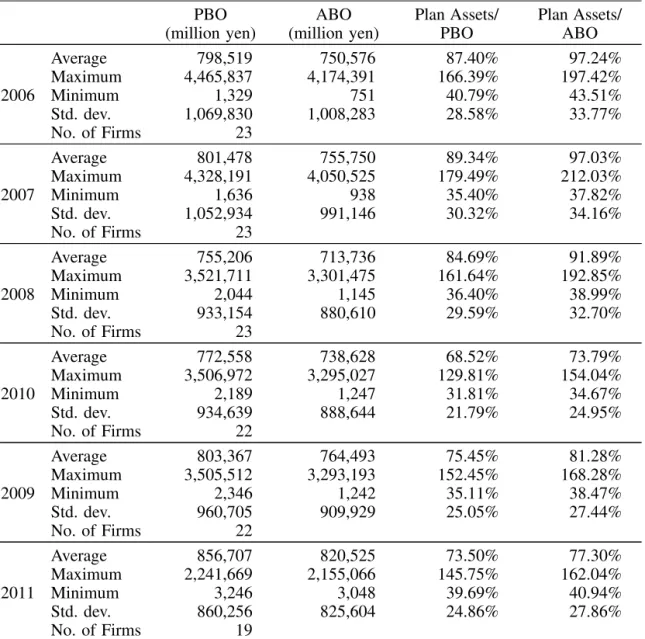
Table 2 Funding Status under PBO and ABO PBO (million yen) ABO (million yen) Plan Assets/ PBO Plan Assets/ ABO Average 798,519 750,576 87.40% 97.24% Maximum 4,465,837 4,174,391 166.39% 197.42% 2006 Minimum 1,329 751 40.79% 43.51% Std. dev. 1,069,830 1,008,283 28.58% 33.77% No. of Firms 23 Average 801,478 755,750 89.34% 97.03% Maximum 4,328,191 4,050,525 179.49% 212.03% 2007 Minimum 1,636 938 35.40% 37.82% Std. dev. 1,052,934 991,146 30.32% 34.16% No. of Firms 23 Average 755,206 713,736 84.69% 91.89% Maximum 3,521,711 3,301,475 161.64% 192.85% 2008 Minimum 2,044 1,145 36.40% 38.99% Std. dev. 933,154 880,610 29.59% 32.70% No. of Firms 23 Average 772,558 738,628 68.52% 73.79% Maximum 3,506,972 3,295,027 129.81% 154.04% 2010 Minimum 2,189 1,247 31.81% 34.67% Std. dev. 934,639 888,644 21.79% 24.95% No. of Firms 22 Average 803,367 764,493 75.45% 81.28% Maximum 3,505,512 3,293,193 152.45% 168.28% 2009 Minimum 2,346 1,242 35.11% 38.47% Std. dev. 960,705 909,929 25.05% 27.44% No. of Firms 22 Average 856,707 820,525 73.50% 77.30% Maximum 2,241,669 2,155,066 145.75% 162.04% 2011 Minimum 3,246 3,048 39.69% 40.94% Std. dev. 860,256 825,604 24.86% 27.86% No. of Firms 19
Source: Nikkei Economic Electrionic Databank System (2011)
Table 2 shows funding status from 2006 to 2011 calculated by PBO and ABO of Japanese firms adopting SFAS87, which requires disclosing ABO in a footnote. The difference between average funding status under PBO compared with ABO is about 5% to 10%. Firms which disclose larger amounts of PBO or ABO, such as Hitachi, Panasonic, or Toyota, have 200,000 to 300,000 consolidated employees. On the other hand, firms which disclose smaller amounts of PBO or ABO, such as Advantest, Makita, or Konami, have
5,000 to 20,000 consolidated employees. The date of the firm’s foundation affects the difference between the amount of PBO and ABO in a firm. The later the firm was established, the wider the difference between the amount of PBO and ABO is. The average of employees’ service years is not related to the amount of PBO or ABO in this result. Even though a firm has a small amount of PBO or ABO, employees in these firms work as long as in firms with a large amount of PBO or ABO.
There is no consistent result with respect to determining whether future salary increases should be included in the calculation of defined benefit obligations. Conceptually, future salary increases should not be included in the calculation, because in Discussion Paper: Conceptual Framework for Financial Accounting (Conceptual Framework) ASBJ states that “a liability is recognized when it is probable that the event will occur in the future” (Conceptual Framework, Introduction). Future salary increase is based on future events which require employees’ continuous work in the future. These amounts of ABO and PBO can be equal at employees’ retirement. However, they are different depending on the inclusion of future salary increases in the calculation of defined benefit obligations until their retirement. Under PBO, defined benefit obligations are divided over employees’ entire service period more equally than under ABO, and reduces the volatility in the calculation of defined benefit obligations. Future salary increases might be predictable if firms build employees’ salary structure systematically. However, employees’ salaries are affected by economic conditions, which can not be predicted based on past experience. Therefore, only liabilities resulting from past events do not bring much uncertainty into the calculation of defined benefit obligations.
7. Summary and Conclusion
There are three concepts to measure defined benefit obligations: VBO, ABO and PBO. These are different due to the recognition of unvested benefits and future salary increases as a liability. Currently, both Japanese accounting standards and IAS19 adopt PBO. However, there are various debates concerning the recognition of these items, which are related to future events.
With regard to unvested benefits, Japan’s Defined-Benefit Corporate Pension Act and Employees’ Pension Insurance Act do not state requirements of vesting clearly. The grant date of vesting is different depending on each firm. Vesting is not defined as a nonforfeitable right, therefore firms can reduce retirement benefits that have already accrued. Moreover, an institution guaranteeing payment is not established under defined-benefit corporate pensions. Under these conditions, retirement benefits are not protected by these acts. Before entering upon a discussion of the recognition of unvested benefits, requirements of vesting should be established to provide retirement benefits to employees with certainty.
It will improve the comparability among firms in their accounting. In Japan, employees tend to work longer for their firms than those in other countries. If vesting is granted five to seven years after employees’ hire date as ERISA states, a high proportion of unvested benefit obligations might be realized. Therefore, to provide more useful information about the amounts, timing, and uncertainty of the cash flows generated by those obligations and rights in financial statements, the probability that unvested benefit obligations will be realized in each firm can be included in the calculation of defined benefit obligations.
As for future salary increases, most research conclude that future salary increases are recognized as liabilities of the firm by investors. A liability is defined as a present obligation of the firm arising from past events. Therefore, conceptually future salary increase should not be included in the calculation of defined benefit obligations, because it results from future events. However, there are two main reasons that some people support PBO rather than ABO: the premise of a going concern, and estimation of future cash flow. Table 2 shows the difference between the average funding status under PBO and that under ABO of Japanese firms adopting SFAS87 is from 5% to 10%. Future salary increases have a significant effect on the calculation of defined benefit obligations. These amounts of PBO and ABO can be equal when employees retire. They are different before their retirement. PBO includes future salary increases in the calculation, and seems to equalize the periodic service cost to reduce volatility. On the other hand, ABO reduces the uncertainty in the calculation of defined benefit obligations, because the obligation is recognized when it is accrued. It is more consistent with other standards. Therefore, only liabilities resulting from past events should be recognized.
The measurement of defined benefit obligations includes many assumptions, and it makes financial statements difficult for users to understand. To provide useful information and clear understanding for those users, accounting standards for employee benefits should be consistent with other standards, and have less uncertainty in their calculation. It should be determined whether unvested benefits and future salary increases are included in the calculation of defined benefit obligations with consideration of these points.
References
Accounting Standards Board of Japan, 2012. ASBJ Guidance No.25: Guidance on Accounting Standard for Retirement Benefits, Tokyo: ASBJ.
Accounting Standards Board of Japan, 2012. ASBJ Statement No.26: Accounting Standard for Retirement Benefits (revised), Tokyo: ASBJ.
Accounting Standards Board of Japan, 2006. Discussion Paper: Conceptual Framework for Financial Accounting, Tokyo: ASBJ.
Accounting Standards Board of Japan, 2010. Exposure Draft of Statement No.39: Exposure Draft of Accounting Standard for Retirement Benefits, Tokyo: ASBJ.
Bader, L.N., 2003. Treatment of Pension Plans in a Corporate Valuation. Financial Analysts Journal, 59(3), pp.19-24.
Barth, M.E., 1991. Relative Measurement Errors Among Alternative Pension Asset and Liability Measures. The Accounting Review, 66(3), pp.433-463.
Barth, M.E., Beaver, W.H. and Landsman, W.R., 1993. A Structural Analysis of Pension Disclosures under SFAS87 and Their Relation to Share Prices. Financial Analysts Journal, 49(1), pp.18-26.
Beaver, W.H., 1991. Commentary on Problems and Paradoxes in the Financial Reporting of Future Events. Accounting Horizons, 5(4), pp.122-134.
Biddle, G.C., Seow, G.S. and Siegel, A.F., 1995. Relative versus Incremental Information Content. Contemporary Accounting Research, 12(1), pp.1-23.
Business Accounting Council of Japan, 1998. Accounting Standard for Retirement Benefits, Tokyo: BAC. Business Accounting Council, 1998. Statement on Establishing Accounting Standard for Retirement
Benefits, Tokyo: BAC.
Daigo, S., 1998. Coursework for Accounting, Tokyo: University of Tokyo Press.
Devine, C.T., 1985. Essays in Accounting Theory, Sarasota, Fla.: American Accounting Association. Employees’ Pension Fund Association, 1999. Pension Systems in Other Countries, Tokyo: Toyo Keizai,
Inc.
Financial Accounting Standards Board, 1985. Statement of Financial Accounting Standards No.87: Employers’ Accounting for Pensions, Stamford, CT: FASB.
Financial Accounting Standards Board, 2006. Statement of Financial Accounting Standards No.158: Employers’ Accounting for Defined Benefit Pension and Other Postretirement Plans, Norwalk, CT: FASB.
Gopalakrishnan, V. and Sugrue, T.F., 1993. An Empirical Investigation of Stock Market Valuation of Corporate Projected Pension Liabilities. Journal of Business Finance & Accounting, 20(5), pp.711-724. Hann, R.N., Heflin, F. and Subramanyam, K.R., 2007a. Fair-value Pension Accounting. Journal of
Accounting & Economics, 44(3), pp.328-358.
Hann, R.N., Lu, Y.Y. and Subramanyam, K.R., 2007b. Uniformity versus Flexibility: Evidence from Pricing of the Pension Obligation. The Accounting Review, 82(1), pp.107-137.
Inoue, M., 2008. Current Condition and Future Prospects of Accounting Standard for Employee Benefits – Summary of IASB Discussion Paper and the Effect –. Weekly Keiei Zaimu, 2897.
International Accounting Standards Board, 2008. Discussion Paper: Preliminary Views on Amendments to IAS19 Employee Benefits, London: IASB.
amendments to IAS19, London: IASB.
International Accounting Standards Board, 2011. International Accounting Standard No.19: Employee Benefits (revised), London: IASB.
KPMG Azusa LLC, 2010. Q&A for Japanese Accounting Standards, Tokyo: Seibunsha Co. Ltd.
Landsman, W., 1986. An Empirical Investigation of Pension Fund Property Rights. The Accounting Review, 61(4), pp.662-691.
Lorensen, L. and Rosenfield, P., 1983. Vested Benefits – A Company’s Only Pension Liability. Journal of Accountancy, 156(4), pp.64-76.
Ministry of Health, Labour and Welfare, 2001. Defined-Benefit Corporate Pension Act, Tokyo: MHLW. Ministry of Health, Labour and Welfare, 2011. Employees’ Pension Insurance Act, Tokyo: MHLW. Nakakita, T., 2001. The Future of Corporate Pension, Tokyo: Chikumashobo Ltd.
Nakano, M., 1996. Measurement of Defined Benefit Obligations under Corporate Pension Accounting – ABO and PBO –. The Japan Industrial Management & Accounting, 56(3), p.90-101.
Nakano, M., 2000. Empirical Research on ABO v.s. PBO in Corporate Pension Accounting – Analysis of Incremental Information Content and Relative Information Content –. Kigyo Kaikei, 52(5), pp.101-110. Picconi, M., 2006. The Perils of Pensions: Does Pension Accounting Lead Investors and Analysts Astray?.
The Accounting Review, 81(4), pp.925-955.
Reiter, S.A., 1991. Pension Obligation and the Determination of Bond Risk Premiums: Evidence from the Electric Industry. Journal of Business Finance & Accounting, 18(6), pp.833-859.
Rue, J.C. and Tosh, D.E., 1987. Continuing Unresolved Issues of Pension Accounting. Accounting Horizons, 1(4), pp.21-27.
Sawa, E., 1996. Reporting (No.2) and Comment on IASC “Retirement Benefits and Other Costs for Employee Benefits” from Drafting Committee. JICPA Journal, 8(8), pp.21-26.
The Investigation Committee on Financial Accounting Systems, 1949. Corporate Accounting Principles, Tokyo.
Utani, R., 1993. History of Corporate Pension, Tokyo: Japan Life Planning Co., Ltd.
Yamaguchi, O., 2004. A Study on the Present Value of Defined Benefit Obligations in Japan. Yokohama Business Review, The Society for Business Administration of Yokohama National University, 25(2/3), pp.35-58.
JP Actuary Consulting Co., Ltd. Glossary of Pension Terms, [online] Available at: <http://www.jpac.co.jp/ english/glossary/> [accessed 28 November 2012].
Ministry of Health, Labour and Welfare. Outline of Defined-Benefit Corporate Pension Act, [online] Available at: <http://www.mhlw.go.jp/topics/0102/tp0208-1a.html> [accessed 28 November 2012]. Nakata, T., 2008. Review of Discussion Paper: Preliminary Views on Amendments to IAS19 Employee
Benefits.NFI Research Review, [pdf] Available at: <http://www.nikko-fi.co.jp/uploads/photos1/648.pdf> [accessed 28 November 2012].
The Senate and House of Representatives of the United States of America in Congress, 2006. Pension Protection Act of 2006, [pdf] Available at: <http://www. gpo.gov/fdsys/pkg/PLAW-109publ280/pdf/ PLAW-109publ280.pdf> [accessed 28 November 2012].
United States Department of Labor.Employee Retirement Income Security Act – ERISA, [online] Available at: <http://www.dol.gov/dol/topic/health-plans/erisa.htm> [accessed 28 November 2012].