1. Introduction
English language teaching (ELT) is unique in developing language proficiency. This is different from other school subjects where students’use of their mother tongue is taken for granted. Although a layman’s idea that native speaker (NS) teachers of English are better than non-native speaker (NNS) teachers has been denied and terms for NNS teachers, such as proficient users and language experts, have been suggested (Selvi, 2011(1)), it is
consented that NNS English teachers should be competent users of the language for being called proficient users or language experts. The proficiency globally required for this is Common European Framework of Reference for Languages (CEFR) C1 level or above.
Relevantly, Ministry of Education, Culture, Sports, Science and Technology (MEXT, 2013(2))
announced a minimum requirement of English proficiency of English teachers at the secondary level as EIKEN Pre-1 Grade or TOEIC scores of 730, i.e., CEFR B2 level. Although this proficiency level is set lower than the global standard, it reflects the status quo of English proficiencies of junior and
senior high school teachers: 32.0% and 62.2% of English teachers respectively at junior and senior high schools are at CEFR B2 level or above (MEXT, 2016(3)).
However, arguably, university students who are supposedly interested in ELT do not study English so eagerly. Why don’t these students try to use English more when it has been recognized as the lingua franca in this global age? Why don’t they try to improve their English proficiency more aggressively, knowing that they will need to teach English in English at secondary schools, and that they will have to use as much English as possible in ELT at primary schools?
Since there has been no research conducted on this topic, Miyasako (2016a(4)), with a view to
answering these questions, first examined university students’ (n = 68) second language (L2) learning motivation, defined as motivation relevant to one’s L2 learning, in terms of L2 Motivational Self System (Dӧrnyei, 2005(5); 2009(6)), in 2013.
Here, this system was devised based on Self-Discrepancy theory (Higgins, 1987(7)) and
Possible-Self theory (Markus & Nurius, 1986(8)). A
What is Ideal ELT Self for University Students
Who are Enrolled in an ELT Certificate Program?
MIYASAKO Nobuyoshi
*
(平成 29 年 6 月 13 日受付,平成 29 年 12 月 4 日受理)
英語教員免許を取得するために教職課程を履修する学生の
ELT 理想自己はどのような内容か
宮 迫 靖 静
*
本論は,英語教育(ELT)に関心のある大学生の ELT 理想自己を探るものである。まず,大学生の ELT 関連及び L2 学 習動機づけを質問紙により探り,これらの動機づけ諸要因の関係を調べた。続いて,英語学習に関する意図・努力が異な る 3 群間で,動機づけ諸要因を比較した。その結果,英語教育に関心のある大学生の ELT 理想自己は(a)教師として高い 英語能力を有し,学習者の英語使用を促進し,授業理解を重視するというもので,(b)英語学習に対する姿勢と関係があり, (c)英語学習に関する意図・努力が高い者は,ELT 理想自己,L2 理想自己,英語学習に対する姿勢も高いこと,等が示さ れた。 キーワード:教員養成,英語科教育法,L2 学習動機づけ
* 福岡教育大学(University of Teacher Education Fukuoka)
key concept of the theories is possible selves that one can think of becoming either in a good or bad sense, which are ideal self that one wishes to be or ought self that one wishes to avoid becoming. When one recognizes a discrepancy between one’s ideal or ought selves and one’s present self, or what she is, she is assumed to try to fill the gap between them. These concepts, ideal and ought selves, in Self-Discrepancy and Possible-Self theories were imported into ELT and Applied Linguistics by Dӧrnyei (2005), who had been looking for what could replace integrativeness, as ideal and
ought-to L2 selves. They composed L2 Motivational Self
System with L2 learning experience concerning one’s learning environment. Ideal and ought-to L2 selves are respectively defined as what one wishes to be and what one wishes to avoid becoming as a L2 user.
The students took an ELT training course taught as content-based instruction (CBI), which was mandatory for the English teaching certificate at the secondary level. Their perceptions of CBI on ELT and L2 learning motivation were examined with questionnaires, showing: (a) ideal L2 self and attitudes to learning English were main motivation factors (MFs), explaining about 30% of their perceptions of CBI on ELT; and (b) their English proficiency and content understanding had relationships with L2 learning motivation: with positive MFs, ideal L2 self and promotion-focused instrumentality, and with negative MFs, ought-to L2 self and prevention-focused instrumentality. Hence, it was shown that L2 learning motivation may affect university students’ intention or effort to improve their English proficiency and actual English use.
Second, Miyasako (2016b(9)) investigated
how L2 learning motivation as well as international posture (IP) and willingness to communicate (WTC) were different between would-be English teachers (WETs) (n = 43) and would-be non-English teachers (WNETs) (n = 45) at a teacher training university. WETs and WNETs were respectively students in a mandatory course for the secondary-school English teaching certificate and those in a liberal-arts general English course.
Here, IP is a motivational concept that Yashima (2002(10)) devised particularly for Japanese
learners of English, concerning their “general
attitude[s] towards the international community that influence English learning and communication” (Yashima, 2002, pp. 62 & 63). It represents the degree to which they try to involve themselves with international people and events. This concept, English proficiency and WTC are acknowledged to make a triangular relationship (Yashima, 2009(11)). WTC is
another motivational concept showing one’s willingness to communicate with others in L2. It originated in L1 communication research, explaining why people are different in their willingness to communicate in an identical situation (McCroskey & Baer, 1985(12)),
or how probable it is that they may voluntarily have communication (MacIntyre, et al., 1998(13)). When
used in L2 learning, WTC can be more complex with various factors affecting it.
The WET and WNET students, respectively in ELT training and general English courses, were examined with questionnaires and compared on factors composed of L2 learning motivation, IP and WTC. The results were: (a) WETs were generally higher than WNETs in their L2 learning motivation, IP and WTC, particularly in positive-natured factors, such as ideal L2 self, attitudes to learning English and promotion-focused instrumentality; (b) WETs may have extra factors involved, including ideal
ELT self, that is what one wishes to be as a teacher
of English (Miyasako, 2016a); and (c) WETs and WNETs may be at different motivational stages, i.e., respectively at executive and initiating fantasy stages, reflected in the differences of their L2 WTC and frequency of communication. Therefore, it was shown that WETs with ideal ELT self are generally more motivated and intending to study English than WNETs.
Naturally, this finding raised another question: what is ideal ELT self that WETs seem to possess? This is also a concept based on Self-Discrepancy and Possible-Self theories, which assumes that English teachers, as well as WETs, try to close gaps between their present and ideal ELT selves when noticed (Miyasako, 2016a). In order to explore WETs’ ideal ELT selves, their beliefs and values about ELT and English teachers should be looked at.
However, despite a recent increase in research conducted on teacher cognition, beliefs and values [for example, Tsui (2003(14)), Borg (2006(15)),
and Farrell (2014(16))], there is not much research
that is relevant to the new concept of ideal ELT self of WETs in a particular English-as-a-foreign-language (EFL) context, especially Japan, except for the studies below. Hosaka (2013(17)) reported
characteristics of ideal English teachers for junior- and senior-high-school students as possessing good personalities and high English proficiency, and having developed their English abilities to pass entrance examinations. Shizuka (2012(18)) examined
the effects of phonetics instruction on beliefs about ELT of university students with interest in ELT, showing a positive change in their teacher beliefs. Ito (2010(19)) investigated such students’ ideal
English teachers, revealing that they value teacher personality factors more than English skills. Nekota (2014(20)) looked into students’ beliefs of ELT in
relation to an ELT preparation course, reporting difficulty in changing them according to the instructor’s expectations.
Accordingly, it is necessary to directly explore WETs’ ideal ELT self. Unveiling the nature of this MF would help us understand more specifically and precisely how WETs are different from WNETs and regular university students, and why WETs do not try to improve their English proficiency more aggressively or to use English more actively. Consequently, we began to explore what ideal ELT self is. This study shows our first step of this exploration.
2. Study
The present study aimed to explore what ELT motivation, particularly what ideal ELT self, concerning a teacher’s and students’ English use, is for university students with interest in ELT, so that it might provide us with clues to answer the questions about the students’ insufficient effort on improving their English proficiency. Here ELT motivation means motivation relevant to one’s ELT practice, the main MF of which is ideal ELT self. This study first investigated the students on MFs composing L2 learning and ELT motivation. Second, it looked into relationships of ideal ELT self with the other ELT and L2 learning MFs. Third, it examined MFs except for the criterion measures (CMs) between three groups with higher, middle and lower English learning intention. Accordingly, research questions
were addressed as: (1) what ideal ELT self do university students with interest in ELT have concerning a teacher’s and students’ English use?; (2) what relationships does ideal ELT self have with the other ELT and L2 learning MFs for university students with interest in ELT?; and (3) are there any differences in ELT and L2 learning MFs between university students with higher, middle and lower English learning intention?
3. Method 3.1 Participants
The participants in the present study were 68 students, mainly sophomores with juniors and seniors, in a class at a university in western Japan. They took an ELT training course, Studies
on English Language Education A, which was
mandatory for the English teaching certificate at the secondary level, in the 2015 fall semester. This means that they were interested in English pedagogy. However, their prospect of securing English teaching positions, whether full-time or part-time, was about as low as 30%. Their English proficiencies were mainly in the range of CEFR A2 and B1 levels.
3.2 Instruments
Two questionnaires were used for the investigation. One was a 32-item 6-point-Likert-scale questionnaire designed by the author for examining the participants’ ELT motivation, pertaining to the following three MFs: ideal ELT self (k = 20), ought-to ELT self (k = 6), and attitudes to learning ELT (k = 6) (Questionnaire A; Table 1; Appendix). Items for ideal ELT self were worked out by the author, referring to implications of second language research (SLA) on ELT in Harmer (2007(21)) and Lightbown and Spada (2013(22)). Out
of them, nine items concerning a teacher’s English use relevant to English teaching were named ideal ELT self T. The other 11 items concerning ideas and techniques to promote students’ use of English in English classes were named ideal ELT self S.
Items for ought-to ELT self and for attitudes to learning ELT were contrived respectively based on those for ought-to L2 self in Taguchi, et al. (2009(23)), and those for attitudes to learning English
2009(24)). Ought-to-ELT-self items concerned the
participants’ avoiding negative outcomes in their teaching English in English, contrasting with ideal ELT self T.
The other questionnaire was a 31-item 6-point-Likert-scale questionnaire, pertaining to the following five MFs: ideal L2 self (k = 5), ought-to L2 self (k = 4), international contact (k = 4), English anxiety (k = 6), and L2 self-confidence (k = 4), intended learning effort (CMs; k = 8) (Questionnaire B; Table 1; Appendix). Intended learning effort was used as CMs, following the standard procedure in L2 motivation surveys. Another reason for using it lay in its showing the participants’ perceptions of their learning effort at the time of the survey, which was different from their English proficiency that had been developed through their learning.
Items for ideal L2 self and ought-to L2 self came from Taguchi, et al. (2009), and those for the other MFs from MFQ (Ryan, 2009). Here, items for L2 learning experience in L2 Motivational Self System, which had been rarely included in such research despite its importance, were reserved for future research.
The survey was performed at the end of the course, when the students were given explanation of the purposes and our ethical treatment of the data, and consented to taking them.
3.3 Analyses
The questionnaire data were statistically described, based on which reliability of MFs composing ELT motivation and L2 learning motivation were examined. Consequently, only MFs with acceptable skewness, kurtosis and reliability were analyzed. First, with the descriptive statistics what ideal ELT self the participants had was looked into for the first research question. Second, correlation and regression analyses were conducted, for the second research, mainly to show
relationships of the CMs and ideal ELT selves T and S with the other MFs question. Third, analyses of variance (ANOVAs) were performed, for the third question, to examine differences in the MFs except for the CMs between students with higher, middle and lower English learning intention, as measured by the CMs.
4. Results and Discussion 4.1 Ideal ELT self
Table 2 shows question items of ideal ELT selves T and S, and their descriptive statistics. The skewness and kurtosis were adequate in the range of .97 and -.95. Figure 1 shows the item means with its base line set at their whole mean value (M = 4.12,
SD = 1.17), which clearly makes a contrast between
the two MFs. Ideal ELT self T had five items rather lower than the base line with two items above it, but ideal ELT self S had eight items above the line with three items a little below the line. This contrast may reflect the nature of the participants’ ideal ELT self.
The lower mean items for ideal ELT self T concern teaching English in English: like a master (T3; M = 3.62, SD = 1.35), everything (T4; M = 3.06,
SD = 1.29), when supporting students' presentations
(T7; M = 3.87, SD = 1.26), when giving feedback on students' mistakes (T8; M = 3.97, SD = 1.20), and when demonstrating tasks (T9; M = 3.87, SD = 1.04). Seemingly, the students with interest in ELT may not intend to teach all in English, particularly where they require making themselves understood for students’ learning to take place.
On the other hand, the higher mean items for ideal ELT self S mainly concern increasing students’ English use: with topics and tasks familiar to them (S1; M = 4.60, SD = 1.11), with English songs and quiz games (S2; M = 4.25, SD = 1.08), by building their confidence (S4; M = 4.47, SD = 1.03), with as much comprehensible English as possible (S5; M = 4.26, SD = 1.18), by having them read extensively what may interest them (S6; M = 4.18,
SD = 1.13), by having them speak English without
worrying about making mistakes (S7; M = 4.46, SD = 1.01), by having them write what they feel and think (S8; M = 4.35, SD = 1.10), and by having them internalize grammar in using English (S10; M = 4.29
SD = 1.13). It seems that the students with interest in
all of the four skills by psychologically supporting them.
4.2 Ideal L2 self
A question raised at this point was why students with interest in ELT may often withhold their English use in class, despite their willingness to enhance students’ overall English use. Is this because their English proficiencies are not developed enough to fine-tune for students to understand their instruction satisfactorily? Or is it because they can think of students who may not be able to understand fully even with optimally simplified English? In order to answer these questions, the participants’
ideal L2 self (Table 3) was looked at for comparison. The participants’ ideal L2 self was rather high in three items concerning their future English use: with foreigners (Item 2; M = 4.72, SD = .98), as someone who is able to speak English (Item 3;
M = 4.46, SD = 1.15), and when required by the
things she wants to do (Item 5; M = 4.76, SD = 1.36). The other two items had lower means, which is understandable because living abroad (item 1; M = 3.16, SD = 1.62) is not directly relevant to English teachers in Japan, and they have other work to do than teaching English (item 4; M = 3.68, SD = 1.33). Thus, their ideal L2 self would be higher than the mean value (M = 4.16, SD = .94) with more suitable questions.
When this high ideal L2 self is taken into account, the questions about the participants’ ideal ELT selves T and S can be interpreted as showing that their unwillingness to teach all in English may not mainly come from their unsophisticated English proficiency, but from their teaching values to put students’ understanding first. Therefore, ideal ELT self for students with interest in ELT, answering
the first research question, seems to include the following characteristics concerning a teacher’s and her students’ English use: (a) she wishes to be a good speaker of English; (b) she wishes to enhance her students’ English use in class; and (c) she wishes to adapt her English use, with code switching when necessary, to her students’ understanding. 4.3 ELT and L2 learning motivation
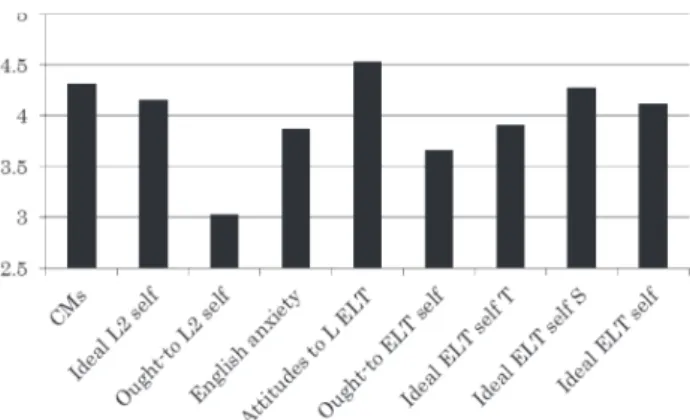
Table 4 shows descriptive statistics and reliability of ELT and L2 learning MFs. The skewness and kurtosis were acceptable except for international contact (M = 5.04, SD = .73, skewness = -1.78, kurtosis = 4.56). Since this MF had the participants’ choices concentrated on higher values, it was excluded from the analyses. Another weakness was seen in the reliability of L2 self-confidence, where the coefficient was .49 even after one question item was deleted for the adjustment. This unreliable MF was also excluded from the analyses because its concept can be reversely reflected in another MF English anxiety. Consequently, the graph of the means of MFs analyzed is shown in Figure 2.
The means of positive MFs were above 4.0, except for ideal ELT self T (M = 3.91, SD = .85) as shown above, with the highest value for attitudes to learning ELT (M = 4.53, SD = .97). This highest MF makes sense because the participants were students with interest in ELT. Contrastingly, the means of negative MFs, ought-to L2 self (M = 3.03, SD = 1.09) and ought-to ELT self (M = 3.66, SD = 1.04), were lower. This result was in line with a finding that WETs are higher in positive MFs and lower in negative MFs (Miyasako, 2016b). However, the mean of another negative MF English anxiety (M = 3.87, SD = 1.14) was not as low as the others, suggesting this MF’s involvement in teacher English use.
4.4 Relationships between MFs
Table 5 shows correlations between the ELT and L2 learning MFs. Admittedly, first, the correlation between ideal ELT selves T and S
was high (r = .74, p < .01). However, since they overlapped just 54.8% (r2 = 54.76), it statistically supports that these MFs reflect different aspects of ideal ELT self. Ideal ELT self T, concerning a teacher’s English use, had a stronger relationship with ideal L2 self (r = .74, p < .01). Instead, ideal ELT self S, concerning ideas and techniques enhancing students’ English use, had moderate correlations with intended learning effort (r = .64, p < .01) and with attitudes to learning ELT (r = .55, p < .01).
Second, intended learning effort had moderate correlations with four positive MFs (.52 ≤ rs ≤ .64, p < .01). This is the CMs, assuming that students’ intended effort proceeds to their actual learning to improve their English proficiency. It seems natural that this MF, known to be correlated with ideal L2 self (Miyasako, 2016a; Ryan, 2009; Taguchi, et al., 2009), is related to these ELT MFs, attitudes to learning ELT, ideal ELT selves T and S, because developing their English proficiency is a must for students with interest in ELT.
Third, ideal L2 self is another MF that enjoyed high and moderate correlations with four MFs (.42 ≤ rs ≤ .74, p < .01). When one is interested in English pedagogy, one should think of not only becoming a good user of English, but also using it in class.
On the other hand, fourth, the opposing MF, ought-to L2 self, had nearly moderate and moderate correlations with attitudes to learning ELT (r = .35,
p < .01). The latter can be taken for granted because both of them are similarly negative MFs. The former seems to have been affected by ought-to ELT self because there was no significant partial correlation between ought-to L2 self (x) and attitudes to learning ELT (y) when ought-to ELT self (z) was controlled (rxy-z = .13, ns).
Fifth, English anxiety had a weak but negative correlation (r = -.36, p < .01) with ideal ELT self T. The involvement of this MF in a teacher’s English use, speculated above, seems to be the case. Since this MF had no relationships with intended learning effort or attitudes to learning ELT, just worrying about something does not seem to help fix it.
4.5 Explanatory MFs
So far, noticeable relationships between the ELT and L2 learning MFs have been looked at based on the descriptive statistics and correlations between them. At this point, in order to statistically identify MFs responsible for ideal ELT self and ideal ELT selves T and S, as well as the CMs, stepwise regression analyses were performed. Table 6 shows results of the analyses.
First, the analysis for ideal ELT self, the integration of ideal ELT selves T and S, was run with the ELT and L2 learning MFs except for the CMs
and ideal ELT selves T and S. The result showed that ideal L2 self (β = .58, t = 6.28, p < .01) and attitudes to learning ELT (β = .28, t = 3.07, p < .01) were responsible for the MF, together explaining 55% of the variance [F (2, 65) = 39.21, p < .01, R2 = .55]. Since ideal L2 self, as the primary contributor, could account for 48% out of 55% of the variance, it was confirmed that students’ wishes to be good users of English matter.
Second, ideal ELT selves T and S were separately analyzed, with the ELT and L2 learning MFs except for the CMs and ideal ELT self, to examine the different nature of these MFs discussed above. Results were: (a) ideal ELT self T had three contributors: ideal L2 self (β = .66, t = 8.02, p < .01), English anxiety (β = -.23, t = -2.81, p < .01), and ought-to L2 self (β = .17, t = 2.11, p < .05), together explaining 61% [F (3, 64) = 33.16, p < .01,
R2 = .61] of the variance; and (b) ideal ELT self S had two contributors: ideal L2 self (β = .41, t = 3.96,
p < .01), and attitudes to learning English (β = 38, t
= 3.71, p < .01), together accounting for 44% [F (2, 65) = 25.14, p < .01, R2 = .44] of the variance.
One thing that attracts our attention is that ideal ELT self and ideal ELT selves T and S shared the primary contributor, i.e., ideal L2 self, respectively explaining 87.3% (.48 /.55), 88.5% (.54 / .61) and 72.7% (.32 / .44) of the total variances.
This dominant role that ideal L2 self played in these MFs suggests that being good English users is vital as far as their images of good English instruction in the future are concerned.
Another concerns what differentiated ideal ELT selves T and S were their secondary and tertiary contributors: English anxiety and ought-to L2 self for the former, and attitudes to learning ELT for the latter. The involvement of English anxiety with the former, as discussed above, was confirmed here. The involvement of these two negative contributors may be interpreted as showing that students with interest in ELT, acknowledging their insufficient English proficiency, may feel that they need to learn and use English despite their unease in English use. On the other hand, the secondary contributor to ideal ELT self S, attitudes to learning ELT, was also confirmed as a collaborator, as pointed out above, enhancing ideas and techniques for good English pedagogy in the future.
Third, the CMs were analyzed with the ELT and L2 learning MFs except for ideal ELT self. Consequently, what was responsible for intended learning effort were ideal ELT self S (β = .29, t = 2.62, p < .05), ideal L2 self (β = .34, t = 3.32, p < .01) and attitudes to learning ELT (β = .28, t = 2.82,
p < .01), together accounting for 56% of the variance
[F (3, 64) = 26.95, p < .01, R2 = .56]. Seemingly, one who intends to invest effort on learning English wishes to teach English successfully, with effective teaching techniques, as a competent English user.
Finally, the following summary of ideal ESL self can answer the second research question.
Overall ideal ELT self is mainly related to ideal L2 self and attitudes to learning ELT. More specifically, ideal ELT self S shares its mainly relevant MFs with overall ideal ELT self, but ideal ELT self T is mainly related to ideal L2 self, English anxiety, and ought-to ELT self. Therefore, it is deduced that ideal ELT S may be at the core of ideal ELT self for students with interest in ELT.
4.6 Effects of learning intention
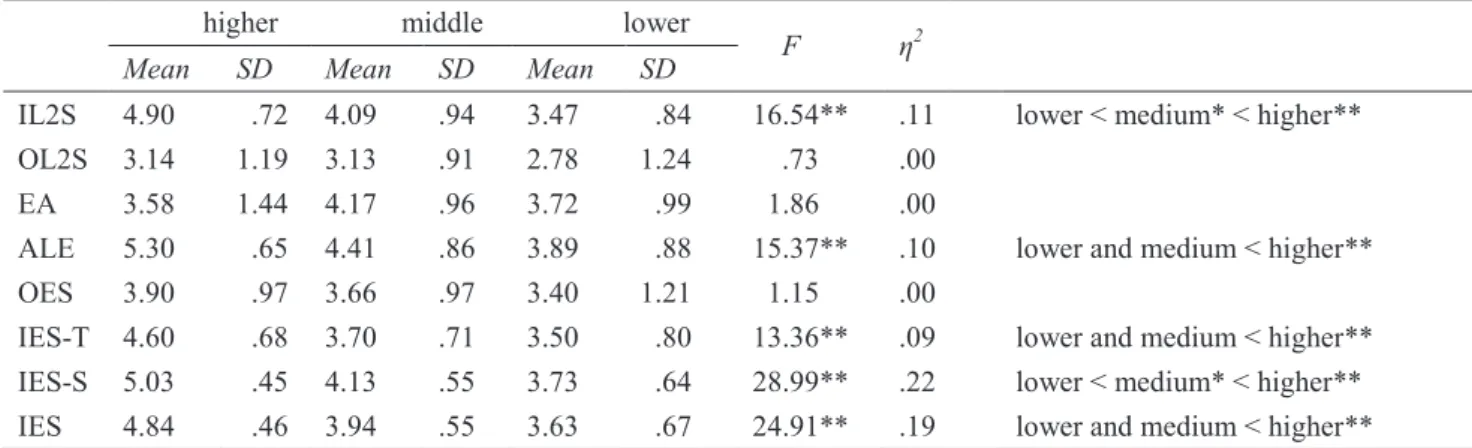
This section examines with ANOVAs whether ELT and L2 learning MFs were affected by intended learning effort. For the analyses, the participants were divided into three groups with higher (n = 20), middle (n = 19) and lower (n = 29) English learning intention. The criterion for this was .5 SD above and below the CMs mean (M = 4.32, SD = .71; lower G ≤ 3.96, 4.68 ≤ higher G). Between these groups, one-way factorial ANOVAs were conducted to see if there were any mean differences in the ELT and L2 learning MFs.
Table 7 shows the data and results. All the ELT MFs, except for ought-to ELT self, showed significant results, but L2 learning MFs had significance only in ideal L2 self as follows: (a) ideal ELT self had a significant mean difference between the groups [F (2, 65) = 24.91, p < .01, η2 = .19 (large)], with the post hoc Bonferroni test showing that students with higher learning intention were higher in this MF than the others (Mdiff ≥ .90, p < .01); (b) ideal ELT self T had a significant mean difference between them [F (2, 65) = 13.36, p < .01, η2 = .09 (medium)], with the post hoc test showing that the
higher learning intention students were higher in this MF than the others (Mdiff ≥.90, p < .01); (c) ideal ELT self S had a significant mean difference between them [F (2, 65) = 28.99, p < .01, η2 = .22 (large)], with the post hoc test showing that the higher students were higher than the others (Mdiff ≥ .90 , p < .01), and the middle students were higher than the lower students (Mdiff = .40, p < .05); (d) attitudes to learning ELT had a significant mean difference between them [F (2, 65) = 15.37, p < .01, η2 = .10 (medium)], with the post hoc test showing that students with higher learning intention were higher in this MF than the others (Mdiff ≥ .89, p < .01); and (e) ideal L2 self had a significant mean difference between them [F (2, 65) = 16.54, p < .01, η2 = .11 (medium)], with the post hoc test showing that the higher students were higher the others (Mdiff ≥ .81, p < .01), and the middle students were higher than the lower students (Mdiff = .62, p < .05).
These results can answer the third research question. Students with higher, middle and lower English learning intention have differences in the means of ideal ELT self, ideal ELT selves T and S, attitudes to learning ELT, and ideal L2 self. There are gaps between the higher students and the rest in these five MFs, and between the middle and lower students in ideal ELT self S and ideal L2 self.
Here, there are a couple of points to be attended. First, it makes sense that the four ELT MFs and ideal L2 self had significant effects because ideal ELT self S, attitudes to learning ELT and ideal L2 self are, as shown above, explanatory MFs of the CMs. Also, ideal ELT self and ideal ELT self S are shown above to have ideal L2 self and attitudes to learning ELT for their explanatory MFs. Seemingly, intended learning effort, ideal L2 self, ideal ELT self S, and attitudes to learning ELT, affecting each other, play significant roles in considering the motivational concept, ideal ELT self.
Second, the five MFs with significant differences were similarly affected by intended learning effort. Students with higher learning intention were also higher in the MFs, making a gap between the higher students and the rest, as substantiated in the large and medium effects (.09 ≤ η2s ≤ .22). Moreover, ideal L2 self and ideal ELT self S showed the middle and lower students to be distinct from each other, reflecting the relationships
with the CMs (rs = .62 and .64).
Although these relationships never mean causality, they help to answer our original question: why do students with interest in ELT not try to improve their English proficiency more aggressively? Considering the MFs affected by intended learning effort, supposedly leading to their actual learning effort to some extent, we can speculate that students who are higher in ideal L2 self, attitudes to learning ELT, and ideal ELT self, particularly ideal ELT self S, are likely to invest more effort on learning English.
If it is so, the students whose means of the MFs are fairly high, in the range of 4.16 and 4.53, would try to improve their English more aggressively, but this is not the case. One probable reason for this may lie in our assumption of the CMs. There must be a gap between one’s intended and actual learning effort. One does not necessarily execute what one vaguely thinks of doing. In other words, admittedly, one’s intended learning effort may reflect one’s intention at the time a survey is taken. However, this can be just a fantasy that comes before making a learning plan, but never leads to the execution of it.
Another concerns the ratio of students who actually make efforts on the development of their English proficiency. Students with higher learning intention (n = 20), who enjoyed higher mean MFs (4.84 ≤ Ms ≤ 5.30) and were more likely to actually make learning effort, made up 29.4% of the participants (n = 68). This ratio nearly coincides with that of the students with prospect of securing English teaching professions, about 30%, conceivably consisting of mainly higher and several medium or lower learning intention students. In this case, about 20 out of 68 students, no matter how vigorously they may be tackling the improvement of their English proficiency, are not enough to give their teachers the impression that the students as a whole are hard working.
Before concluding, finally, three negative MFs with no significant differences are touched upon, which are ought-to L2 self, English anxiety and ought-to ELT self. These results show that students with higher, middle and lower learning intention similarly felt not only uneasy when trying to speak English, but also pressed to improve their
English proficiency and to become teachers helping students to use English through English teaching in English. This makes sense because they were students seeking for the English teaching certificate, regardless of their perceptions of how much they were making efforts in learning English.
6. Conclusion
This exploratory study primarily looked into ideal ELT self, concerning a teacher’s and students’ use of English, of university students with interest in ELT. Main findings were: (a) their ideal ELT self has characteristics such as being a good user of English, enhancing her students’ English use, and prioritizing their understanding with code switching when necessary; and (b) ideal ELT self is mainly related to ideal L2 self and attitudes to learning ELT; and (c) students with higher English learning intention are higher than the rest in ideal ELT self, attitudes to learning ELT, and ideal L2 self.
Moreover, based on the third finding, issues relevant to a key question, i.e., why do students with interest in ELT not try to develop their English proficiency?, was discussed, showing: (a) the CMs may be just a measure of one’s fantasy of investing effort on learning English; and (b) an overall image of students with interest in ELT, that they do not make much effort on learning English, may not reflect a smaller number of individuals, particularly those with higher learning intention who actually make effort.
In order to deal with the former, learners can be investigated over a span of time repeatedly, or a more dynamic approach can be taken (Dӧrnyei & Ushioda, 2011(25)), where learners are often observed
or interviewed continuously in a qualitative manner. This qualitative approach can also cope with the latter by showing learners’ learning behavior more clearly. Moreover, this approach can handle another limitation of this study, i.e., question items that were concocted by the author referring to research insights, particularly those for ELT MFs. Preferably, learners’ images of ideal ELT self should have been openly collected before that.
Despite these limitations, the findings of this study may be a step forward in the pursuit of unveiling perceptions, beliefs and values on ELT that WETs and students with interest in ELT possess.
Although understanding their ideal ELT self is just a part of it, it can make an indirect contribution to the betterment of English teacher training, development and education.
References
( 1 ) Selvi, A. F.(2011). The non-native speaker teacher. ELT Journal 65 (2), 187-188.
( 2 ) MEXT. (2013). Gurobaruka ni taioshita eigo
kyoiku kaikaku jisshi keikaku [An action plan on the improvement of English language education to deal with globalization]. Available at http://www.
mext.go.jp/b_menu/houdou/25/12/__icsFiles/afiel dfile/2013/12/17/1342458_01_ 1.pdf
( 3 ) MEXT. (2016). Heisei 28 nendo “Eigo
kyoiku jisshi jokyo chosa” (chugaku / kotogakko kankei) [The 2015 survey of English language education at junior and senior high schools].
Available at http://www.mext.go.jp/component/ a_menu/education/detail/__icsFiles/afieldfi le/2017/04/07/1384236_01_1.pdf
( 4 ) Miyasako, N. (2016a). University students’ perceptions of content-based instruction on English language teaching and their relevance to the students’ L2 motivational self system: An exploratory study. JACET Journal, 60, 1-19. ( 5 ) Dӧrnyei, Z. (2005). The psychology of the
language learner: Individual differences in second language acquisition. Mahwah, NJ: Lawrence
Erlbaum.
( 6 ) Dӧrnyei, Z. (2009). The L2 motivational self system. In Z. Dӧrnyei, & E. Ushioda, (Eds.)
Motivation, language identity and the L2 self (pp.
9-42). Bristol: Multilingual Matters.
( 7 ) Higgins, T. (1987). Self-discrepancy: A theory relating self and affect. Psychological Review, 94
(3), 319-340.
( 8 ) Markus, H., & Nurius, P. (1986). Possible selves. American Psychologist, 41(9), 954-969. ( 9 ) Miyasako, N. (2016b). How different is L2
Learning motivation between would-be English teachers and would-be non-English teachers at the tertiary level. International Journal of Curriculum
Development and Practice, 18, 15-26.
(10) Yashima, T. (2002). Willingness to communicate in a second language: The Japanese EFL context.
The Modern Language Journal, 86, 54-66.
the ideal L2 self in the Japanese EFL context. In Z. Dӧrnyei, & E. Ushioda. (Eds.) Motivation,
language identity and the L2 self (pp. 144-163).
Bristol: Multilingual Matters.
(12) McCroskey, J., & Baer, E. (1985). Willingness to communicate: The construct and its measurement. Paper presented at the Annual Meeting of the Speech Communication Association.
(13) MacIntyre, M., Dörnyei, Z., Clément, C., & Noels,K. (1998). Conceptualizing willingness to communicate in a L2: A situational model of L2 confidence and affiliation. The Modern Language
Journal, 82, 545-562.
(14) Tsui, A. B. (2003). Understanding expertise
in teaching: Case studies of ESL teachers. New
York: Cambridge University Press.
(15) Borg, S. (2006). The distinctive characteristics of foreign language teachers. Language Teaching
Research 10 (1), 3–31
(16) Farrell, T. S. (2014). Promoting teacher
reflection in second language education: A framework for TESOL professionals. London:
Routledge.
(17) Hosaka, Y. (2013). Risotekina eigokyoshizo
ni kansuru jisshokenkyu [An empirical study on
professional skills of English teachers in high schools]. Bulletin of the Graduate School of
Education, Hiroshima University, Part. II, 52,
127-133.
(18) Shizuka, T. (2012). “Kyoshoku nyumon” oyobi
“eigoka shidoho” no juko koka no kensho [An
examination of effects of Introduction to Teaching
Profession and ELT Preparation]. Journal of Saitama University, Faculty of Education. 65 (1),
41-56.
(19) Ito, A. (2010). Riso no eigo kyoshizo no
kojinbetu taido kozo bunseki [Individual
attitude-structure analysis of ideal English teachers].
Bulletin of Seinan-Gakuin University, Studies in English Language and Literature, 50(1-3),
281-297.
(20) Nekota, K. (2014). Eigoka kyoiku gairon wo
jukoshita gakusei no eigo kyoju / gakushu ni tuiteno birifu no henka [Changes of students’
beliefs about English language teaching and learning in a pre-service teacher education introductory course]. Journal of Yanagychi
University, Part III, 64, 175-191.
(21) Harmer, J. (2007). The practice of English
language teaching (4th ed.). London: Pearson
Education.
(22) Lightbown, P. M., & Spada, N. (2013). How
languages are learned (4th ed.). Oxford: Oxford
University Press.
(23) Taguchi, T., Magid, M., Papi, M. (2009). The L2 motivational self-system amongst Chinese, Japanese, and Iranian learners of English: A comparative study. In Z. Dӧrnyei, & E. Ushioda. (Eds.), Motivation, language identity and the L2
self (pp. 66-97). Bristol: Multilingual Matters.
(24) Ryan, S. (2009). Self and identity in L2 motivation in Japan: The ideal L2 self and Japanese learners of English. In Z. Dӧrnyei, & E. Ushioda. (Eds.) Motivation, language identity
and the L2 self (pp.120-143). Bristol: Multilingual
Matters.
(25) Dӧrnyei, Z., & Ushioda, E. (2011). Teaching
and researching motivation (2nd ed.). London:
Longman.
Appendix: Questionnaires A and B Questionnaire A
Ideal ELT self (20): see Table 2 Ought-to ELT self (6)
Teaching English in English is important because it is directed in the Course of Study. / Teaching English in English is important because I can earn respect of my colleagues and students and their parents. / Not teaching English in English will badly affect my position as an English teacher. / Teaching English in English is important because good English teachers do so. / Teaching English in English is important because I can earn respect as an English teacher. / Not teaching English in English will disappoint people around me.
Attitudes to learning ELT (6)
Do you like learning ELT? / Learning ELT is really great. / I really enjoy learning ELT. / I'm always looking forward to my ELT training classes. / I find learning ELT really interesting. / Learning ELT is one of the most important aspects in my life.
Questionnaire B
*Ideal L2 self (5): see Table 3 *Ought-to L2 self (4)
I study English because close friends of mine think it is important. / I have to study English,
because, if I do not study it, I think my parents will be disappointed with me. / Learning English is necessary because people surrounding me expect me to do so. / My parents believe that I must study English to be an educated person.
**International contact (4)
I think that English will help me meet more people. / I would like to be able to use English to get involved with people from other countries. / I would like to be able to use English to communicate with people from other countries. / If I could speak English well, I could get to know more people from other countries.
**English anxiety (6)
I am worried that other speakers of English would find my English strange. / If I met an English speaker, I would feel nervous. / I get nervous and confused when I am speaking in my English class. / I'm not very good at volunteering answers in our English class. / I would feel uneasy speaking English with a native speaker. / I would get tense if a foreigner asked me for directions in English. **L2 self-confidence (5)
I am sure I will be able to learn a foreign language. / I worry that the other students will laugh at me when I speak English. / Learning a foreign language is a difficult task for me. / I think I am the type who would feel anxious and ill at ease if I had to speak to someone in a foreign language. / I always feel that my classmates speak English better than I do.
**Intended learning effort (CMs) (8)
I am working hard at learning English. / It is extremely important for me to learn English. / If an English course was offered in the future, I would like to take it. / When I hear an English song on the radio, I listen carefully and try to understand all the words. / I can honestly say that I am really doing my best to learn English. / If I could have access to English-speaking TV stations, I would try to watch them often. / I am the kind of person who makes great efforts to learn English. / If English were not taught in school, I would try to go to English classes somewhere else.