• 検索結果がありません。

分担研究者  大成圭子 産業医科大学  神経内科学  講師

N/A
N/A
Protected

Academic year: 2021

シェア "分担研究者  大成圭子 産業医科大学  神経内科学  講師 "

Copied!
37
0
0

読み込み中.... (全文を見る)

全文

(1)

厚生労働科学研究費補助金  労働安全衛生総合研究事業 平成 30 年度  分担研究報告

累積振動ばく露量に基づく振動工具取扱い者の神経伝導速度検査による 手指末梢神経の評価

分担研究者  足立弘明 産業医科大学  神経内科学  教授

分担研究者  大成圭子 産業医科大学  神経内科学  講師

分担研究者  池上和範

産業医科大学  産業生態科学研究所  作業関連疾患予防学  講師 分担研究者  安藤  肇

産業医科大学  産業生態科学研究所  作業関連疾患予防学  助教

研究要旨:振動工具取扱い者のこれまでの作業歴を詳細に調査することで得られた振 動ばく露の累積値(累積振動ばく露量)を用いて,手指の神経伝導と累積振動ばく露 量との関連を明らかにし,振動障害のスクリーニングとして,神経伝導速度検査の有 用性検討した。

研究協力者

野澤弘樹  産業医科大学・産業生態科学研 究所・作業関連疾患予防学

道井聡史    産業医科大学・産業生態科学 研究所・作業関連疾患予防学

菅野良介    産業医科大学・産業生態科学 研究所・作業関連疾患予防学

白坂泰樹  産業医科大学・産業生態科学研 究所・作業関連疾患予防学

A. 研究目的

  本研究の目的は,振動工具取扱い者のこ れまでの作業歴を詳細に調査することで得 られた振動ばく露の累積値(累積振動ばく 露量)を用いて,手指の神経伝導と累積振

として,神経伝導速度検査の有用性を明ら かにすることである。本研究は,振動障害 の早期発見および振動ばく露による末梢神 経の障害部位の解明に寄与すると考える。 

B. 研究方法 

i) 研究デザインとセッティング    前向きコホート研究で、 調査期間は 2016 年 6 月から 2019 年 2 月に実施され た。各年夏期 (7– 9 月)と冬期(12– 2 月)の年 2 回の調査を実施した。最終的には,2 年 6 カ月間で全 6 回の調査を実施した。イン タビュー調査は産業医科大学で実施され,

神経伝導速度検査は産業医科大学の臨床検

(2)

ii) 参加者 

  福岡県内の振動工具取り扱い業務がある 複数の製造事業所で本研究被験者の募集を 行い,72 名の男性から参加の申し込みが 得られた。本研究においては, 振動障害の 既往歴がない者を被験者に選定した。研究 開始前に質問紙による手指の自覚症状の調 査、医師によるインタビュー調査を実施 し、振動障害の国際的な振動障害症度分類 であるストックホルムスケールにおいて stage0(レイノー現象が存在しない)に該 当する 71 名の参加者をコホートに登録し た。 


iii)手順 

  我々は,各調査の前に参加者に生活歴や 現病歴,職業歴,自覚症状に関する質問紙 と振動工具の取り扱い状況に関する質問紙 を送付し,回答を収集した。調査日には,

各参加者の質問紙の回答について,医師に よるインタビュー調査を実施した。続い て,神経伝導速度検査を実施した。検査へ の影響を可能な限り避けるため,被験者に は検査前 12  時間以降は禁酒,検査前 3  時間以降は禁煙,カフェインなどの刺激物 の摂取も避けるよう調査開始前に指示し た。 


iv)生活歴および職業歴に関する質問紙    本研究では質問紙を被験者の自宅に郵送 し,調査前に記入の上、調査当日に持参す るように指示した。持参した質問紙の全設

聴取し,記載内容について最終的な確認を 実施した。 

  用いた質問紙は振動障害の診断ガイドラ イン 2013 の参考資料として用いられてい る二次健診用の自覚症状・業務問診票を用 い、年齢,現病歴,既往歴,現在の喫煙状 況などの生活習慣,職業歴について調査し た。 


v)振動工具取り扱いに関する質問紙  振動工具の過去および現在の取扱いの有 無を全参加者に確認した。振動工具取扱い が有る参加者に対して,今までに取り扱っ てきた振動工具の種類と作業内容、作業・

休憩時間、保護具の使用状況、振動工具作 業の記録、振動障害に係る健康診断の受診 の有無、振動工具に係る教育受講の有無を 確認した。振動工具取扱い状況について,

振動工具の種類とモデルについて尋ねた。

過去の振動工具取扱い頻度については,初 めて振動工具を使用した年から初回調査ま で 1 年毎に,振動工具の種類別に 1 日当 たりの合計作業時間,使用頻度(ほぼ毎 日,週に 3〜4 回,週に 1〜2 回,月に 1〜

2 回,数か月に 1 回,全くなしの六件法)

を尋ねた。現在の振動工具取扱い頻度につ いては,半年ごとに調査毎振動工具の種類 別に 1 日当たりの合計作業時間,6 カ月間 の月平均使用日数を尋ねた。 


vi)  累積振動ばく露量の定義( Cumulative

exposure level of vibration)「チェーンソー

(3)

号)」では,1日当たりの振動ばく露を制 限する考えにより日振動ばく露量 

A(8)[unit: m/s ] = a × √(T/8) が定義されて いる。 

本調査では、日振動ばく露量の定義を用 い、被験者の累積振動ばく露量を算出する ための質問紙を作成した。振動工具の周波 数補正振動加速度実効値の 3 軸合成値は,

2009 年に厚生労働省指針(基発 0710 第 2 号)に準拠した値を各工具メーカーがホー ムページ上で公開している。本研究では,

質問紙調査により各振動工具の型番を確認 し,周波数補正振動加速度実効値の 3 軸合 成値を取得することを試みた。しかし,質 問紙調査で型番に関する情報はほとんど得 られなかった。そこで,各工具メーカーが

ホームページ上で公開している振動工具の 周波数補正振動加速度実効値の 3 軸合成値 から中央値を求め,振動工具の種類別の周 波数補正振動加速度実効値の 3 軸合成値換 算表を作成した。 

使用頻度は,週あたりの労働日を 5 日と して,振動工具を「ほぼ毎日」使用した場 合の使用頻度係数を 1.00 とした。更に,

週に 3〜4 回使用した場合の使用頻度係数 は 0.60,週に 1〜2 回は 0.20,月に 1〜2 回は 0.04,数か月に 1 回は 0.01,全くな しは 0 とした。作業者が使用した全ての工 具類に対して日振動ばく露量と使用頻度に よる相対値を用いた振動ばく露量を年ごと に積算し、その総和を累積振動ばく露量と 定義し解析に使用した(式 1)。 

( (8)[unit: m/s ]) × (Coefficient of use frequency) n=vibration tool handling years

…式 1 


(4)

vii) Nerve Conduction Study (NCS)  手指末梢神経を皮膚上で電気刺激し、誘 発された電位を記録し、伝導速度、振幅,

遠位潜時を測定することによって末梢神経 機能を評価する検査である。正中神経およ び尺骨神経それぞれの運動神経および感覚 神経を測定することにより,末梢神経障害 の有無,障害部位や障害の程度,障害の範 囲を評価する。 


viii)  グループ化 

viii-a)  過去累積振動ばく露量によるグル ープ化 

  振動工具取扱い群の振動ばく露による末 梢血流障害の長期的影響を評価するため,

初回調査で得られた過去の振動工具取扱い による累積振動ばく露量(過去累積振動ば く露量)を用いて,グループ化を行った。

過去累積振動ばく露量の中央値で振動工具 取扱い群を 2 群に分け、High exposure  group と Low exposure group  に分類し た。振動工具取扱い歴がないものを Non–

exposure group ̲1 とした。 


viii-b)現累積振動ばく露量によるグループ 化 

  振動工具取扱い群の振動ばく露による末 梢血流障害の短期的影響を評価するため,

研究期間(2.5 年間)中の振動工具取扱い による累積振動ばく露量(現累積振動ばく 露量)を用いて,グループ化を行った。振 動工具取扱い群において 3 回以上調査に参

Current high–exposure group とした。な お、6.25 は、日振動ばく露量の対策値で ある 2.5m/s

2

に相当する振動工具を調査期 間の 2.5 年間にわたり毎日使用した場合に 得られる累積振動ばく露量である。振動工 具取扱い歴がなく,本調査に 3 回以上参加 したものを Non–exposure group̲2 とし た。 


ix)  倫理的配慮 

本調査は,産業医科大学倫理委員会での 承認を得て実施した。調査参加者には本調 査の概要を説明し調査協力への承諾ならび に同意書を取得した上で実施した。本調査 へ不参加を希望する場合には自由意志に基 づき中止可能であることや、 被験者自身が 検査 中に体調不良を認めた時は,即時検査 を中止することを説明した。


x)  統計学的分析 

はじめに,カイ二乗検定または一元配置 分散分析を用い,振動工具取扱いによる 3 群あるいは 2 群の分類で個人要因と職業性 要因の比較を行った。

続いて,末梢血流に影響を与える要因を 評価するため, Linear mixed model  (LMM)による分析 を行った。LMM は,

目的変数として NCS の各指標 とした。従

属変数について,参加者は random effect

として処理し,振動工具取扱い状況(3 群

または 2 群),調査点,年代(30 歳未満、

(5)

(Body mass index≥ 25)の有無,糖尿病 の有無,現在の喫煙の有無は fixed effects として処理した。その後の多重比較検定 は,Bonferroni 法を用いた。  統計解析に は,IBM SPSS 24.0J(IBM corp., New  York)を使用した。有意水準は p<0.05 と した。 

  C. 結果

i) 参加者の属性

全累積振動工具ばく露量による分類による 各群の参加者数は,振動工具非取扱い群    (Non-exposure group 1 )29 名、振動工具 高取扱い群(High exposure group )21 名、

振動工具低取扱い群(Low exposure group)  21 名であった(図 6a)。また,現累積振 動ばく露量による分類による分類による各 群の参加者数は,現振動工具高取扱い群  (Current high exposure group )」11 名、

振動工具非取扱い群(Non-exposure group  2 )27 名であった(表 6a)。 


iii) 神経伝導速度検査 

図 6b-6l に右正中神経および尺骨神経の 3 群間比較の結果,図 6m-6w に左正中神 経および尺骨神経の 3 群比較の結果,図 6x-6ah に利き手の右正中神経および尺骨 神経の 3 群間比較の結果を示す。図 6ai- 6as に右正中神経および尺骨神経の 2 群間 比較の結果,図 6at-6bd に左正中神経およ

び尺骨神経の 2 群比較の結果を示す。 


(6)

  図 6a.  研究のフローと参加者の人数 


6a.

参加者の属性

Vibration tool exposure status Non–exposure group

(n=29)

Low exposure group (n=21)

High exposure group (n=21)

n/mean (SD/%) n/mean (SD/%) n/mean (SD/%)

Age 41.9 (11.0) 30.5 (10.4) 37.8 (7.7)

Obesity (BMI> 25) 10 (34.5) 9 (42.9) 9 (42.9)

Diabetes 2 (6.9) 2 (9.5) 2 (9.5)

Cigarette Smoking 6 (20.7) 11 (52.4) 11 (52.4)

Left hander 2 (7.0) 1 (4.8) 1 (4.8)

Vibration tool exposure status Non–exposure group

(n=27)

Current High exposure group (n=11) n/mean (SD/%) n/mean (SD/%)

Age 42.1 (10.8) 33.1 (6.3)

Obesity (BMI> 25) 9 (33.3) 5 (45.5)

Diabetes 2 (7.4) 0 (0.0)

Cigarette Smoking 4 (14.8) 4 (36.3)

Left hander 2 (7.4) 0 (0.0)


Non-handling participants  (n=29) 

Vibration tool handling participants  (n=42) 

Non-exposure group̲1  (n=29) 

Low exposure group    (n=21) 

Current high exposure group  (n=11) 

Non-exposure group̲2  (n=27) 

High exposure group    (n=21)  Group categorization ̲1 

Group categorization ̲2 

Vibration tool handlers who participated in this survey more than 4 of 6 times

&

More than10 of cumulative exposure level for survey periods (2.5 years)

Non handlers who participated in this survey more than 4 of 6

times

Dividing vibration handlers to two group using

median of cumulative exposure level

(7)

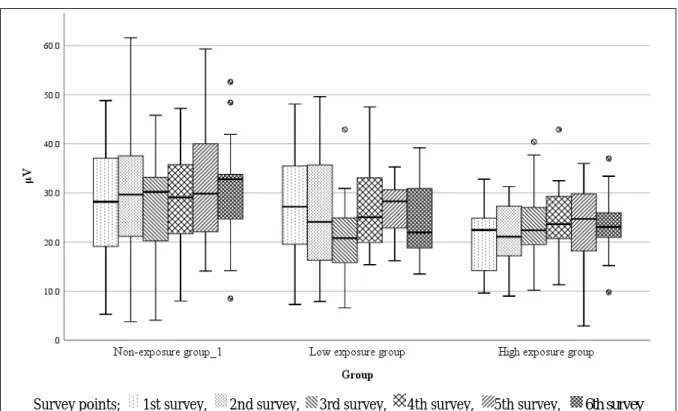
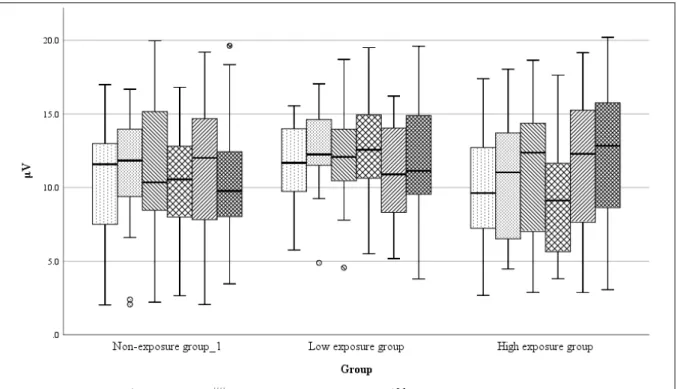
Survey points;  1st survey,  2nd survey,  3rd survey,  4th survey,  5th survey,  6th survey   図 6b. 右正中神経感覚神経振幅の 3 群別推移

Group of cumulative vibration exposure: P=0.004, Post hoc – test: Non–exposure group–High exposure group: P=0.006

Survey points;  1st survey,  2nd survey,  3rd survey,  4th survey,  5th survey,  6th survey  

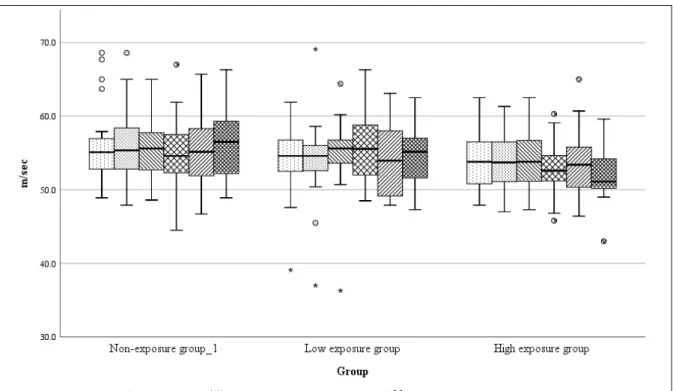
図 6c.右正中神経感覚神経伝導速度の 3 群別推移

Group of cumulative vibration exposure: P=0.013, Post hoc – test: Non–exposure group–High

(8)

Survey points;  1st survey,  2nd survey,  3rd survey,  4th survey,  5th survey,  6th survey  

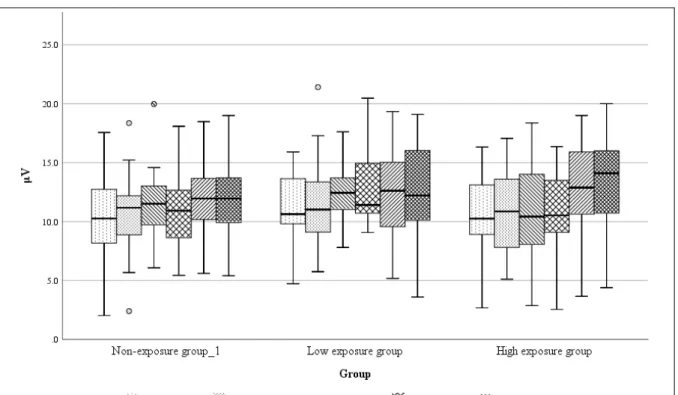
図 6d.右尺骨神経感覚神経振幅の 3 群別推移

Group of cumulative vibration exposure: P=0.012, Post hoc – test: Non–exposure group–High exposure group: P=0.011

Survey points;  1st survey,  2nd survey,  3rd survey,  4th survey,  5th survey,  6th survey   図 6e. 右尺骨神経感覚神経伝導速度の 3 群別推移

Group of cumulative vibration exposure: P=0.069

(9)

Survey points;  1st survey,  2nd survey,  3rd survey,  4th survey,  5th survey,  6th survey   図 6f. 右正中神経運動神経遠位潜時の 3 群別推移

Group of cumulative vibration exposure: P=0.003, Post hoc – test: Non–exposure group–High exposure group: P=0.004

Survey points;  1st survey,  2nd survey,  3rd survey,  4th survey,  5th survey,  6th survey   図 6g. 右正中神経運動神経振幅の 3 群別推移

Group of cumulative vibration exposure: P=0.079

(10)

Survey points;  1st survey,  2nd survey,  3rd survey,  4th survey,  5th survey,  6th survey   図 6h. 右正中神経運動神経伝導速度の 3 群別推移

Group of cumulative vibration exposure: P=0.057

Survey points;  1st survey,  2nd survey,  3rd survey,  4th survey,  5th survey,  6th survey   図 6i. 右尺骨神経運動神経遠位潜時の 3 群別推移

Group of cumulative vibration exposure: P=0.054

(11)

Survey points;  1st survey,  2nd survey,  3rd survey,  4th survey,  5th survey,  6th survey   図 6j. 右尺骨神経運動神経振幅の 3 群別推移

Group of cumulative vibration exposure: P=0.115

Survey points;  1st survey,  2nd survey,  3rd survey,  4th survey,  5th survey,  6th survey   図 6k. 右尺骨神経運動神経(手首―肘下)伝導速度の 3 群別推移

Group of cumulative vibration exposure: P=0.173

(12)

Survey points;  1st survey,  2nd survey,  3rd survey,  4th survey,  5th survey,  6th survey   図 6l. 右尺骨神経運動神経(肘下―肘上)伝導速度の 3 群別推移

Group of cumulative vibration exposure: P=0.624

Survey points;  1st survey,  2nd survey,  3rd survey,  4th survey,  5th survey,  6th survey   図 6m. 左正中神経感覚神経振幅の 3 群別推移

Group of cumulative vibration exposure: P=0.007, Post hoc – test: Non–exposure group/Low

exposure group: P=0.017, Non–exposure group–High exposure group: P=0.032

(13)

Survey points;  1st survey,  2nd survey,  3rd survey,  4th survey,  5th survey,  6th survey   図 6n. 左正中神経感覚神経伝導速度の 3 群別推移

Group of cumulative vibration exposure: P=0.007, Post hoc – test: Non–exposure group–High exposure group: P=0.007

Survey points;  1st survey,  2nd survey,  3rd survey,  4th survey,  5th survey,  6th survey   図 6o. 左尺骨神経感覚神経振幅の 3 群別推移

Group of cumulative vibration exposure: P=0.240

(14)

Survey points;  1st survey,  2nd survey,  3rd survey,  4th survey,  5th survey,  6th survey  

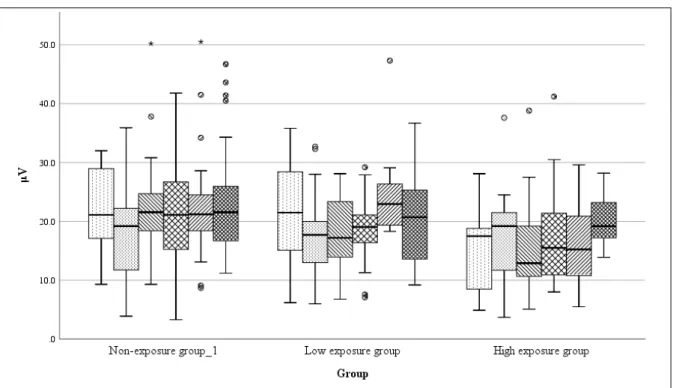
図 6p.左尺骨神経感覚神経伝導速度の 3 群別推移

Group of cumulative vibration exposure: P=0.054

Survey points;  1st survey,  2nd survey,  3rd survey,  4th survey,  5th survey,  6th survey   図 6q. 左正中神経運動神経遠位潜時の 3 群別推移

Group of cumulative vibration exposure: P=0.054

(15)

Survey points;  1st survey,  2nd survey,  3rd survey,  4th survey,  5th survey,  6th survey  

図 6r. 左正中神経運動神経振幅の 3 群別推移

Group of cumulative vibration exposure: P=0.033, Post hoc – test: Low exposure group–High exposure group: P=0.029

Survey points;  1st survey,  2nd survey,  3rd survey,  4th survey,  5th survey,  6th survey   図 6s. 左正中神経運動神経伝導速度の 3 群別推移

Survey points;  1st survey,  2nd survey,  3rd survey,  4th survey,  5th survey,  6th

(16)

Survey points;  1st survey,  2nd survey,  3rd survey,  4th survey,  5th survey,  6th survey   図 6t. 左尺骨神経運動神経遠位潜時の 3 群別推移

Group of cumulative vibration exposure: P=0.213

Survey points;  1st survey,  2nd survey,  3rd survey,  4th survey,  5th survey,  6th survey   図 6u. 左尺骨神経運動神経振幅の 3 群別推移

Group of cumulative vibration exposure: P=0.423

(17)

Survey points;  1st survey,  2nd survey,  3rd survey,  4th survey,  5th survey,  6th survey   図 6v. 左尺骨神経運動神経(手首―肘下)伝導速度の 3 群別推移

Group of cumulative vibration exposure: P=0.678

Survey points;  1st survey,  2nd survey,  3rd survey,  4th survey,  5th survey,  6th survey   図 6w. 左尺骨神経運動神経(肘下―肘上)伝導速度の 3 群別推移

Group of cumulative vibration exposure: P=0.379

(18)

Survey points;  1st survey,  2nd survey,  3rd survey,  4th survey,  5th survey,  6th survey   図 6x. 利き手正中神経感覚神経振幅の 3 群別推移

Group of cumulative vibration exposure: P=0.001, Post hoc – test: Non–exposure group/Low exposure group: P=0.014, Non–exposure group–High exposure group: P=0.002

Survey points;  1st survey,  2nd survey,  3rd survey,  4th survey,  5th survey,  6th survey  

図 6y. 利き手正中神経感覚神経伝導速度の 3 群別推移

Group of cumulative vibration exposure: P=0.005, Post hoc – test: Non–exposure group–High

Survey points;  1st survey,  2nd survey,  3rd survey,  4th survey,  5th survey,  6th

(19)

Survey points;  1st survey,  2nd survey,  3rd survey,  4th survey,  5th survey,  6th survey   図 6z. 利き手尺骨神経感覚神経振幅の 3 群別推移

Group of cumulative vibration exposure: P=0.011, Post hoc – test: Non–exposure group–High exposure group: P=0.010

Survey points;  1st survey,  2nd survey,  3rd survey,  4th survey,  5th survey,  6th survey  

図 6aa. 利き手尺骨神経感覚神経伝導速度の 3 群別推移

Group of cumulative vibration exposure: P=0.063

(20)

Survey points;  1st survey,  2nd survey,  3rd survey,  4th survey,  5th survey,  6th survey  

図 6ab. 利き手正中神経運動神経遠位潜時の 3 群別推移

Group of cumulative vibration exposure: P=0.047, Post hoc–test: not significant among groups

Survey points;  1st survey,  2nd survey,  3rd survey,  4th survey,  5th survey,  6th survey  

図 6ac. 利き手正中神経運動神経振幅の 3 群別推移

Group of cumulative vibration exposure: P=0.089

(21)

Survey points;  1st survey,  2nd survey,  3rd survey,  4th survey,  5th survey,  6th survey  

図 6ad. 利き手正中神経運動神経伝導速度の 3 群別推移

Group of cumulative vibration exposure: P=0.196

Survey points;  1st survey,  2nd survey,  3rd survey,  4th survey,  5th survey,  6th survey  

図 6ae. 利き手尺骨神経運動神経遠位潜時の 3 群別推移

Group of cumulative vibration exposure: P=0.067

(22)

Survey points;  1st survey,  2nd survey,  3rd survey,  4th survey,  5th survey,  6th survey  

図 6af. 利き手尺骨神経運動神経振幅の 3 群別推移

Group of cumulative vibration exposure: P=0.116

Survey points;  1st survey,  2nd survey,  3rd survey,  4th survey,  5th survey,  6th survey  

図 6ag. 利き手尺骨神経運動神経(手首―肘下)伝導速度の 3 群別推移

Group of cumulative vibration exposure: P=0.407

(23)

Survey points;  1st survey,  2nd survey,  3rd survey,  4th survey,  5th survey,  6th survey  

図 6ah. 利き手尺骨神経運動神経(肘下―肘上)伝導速度の 3 群別推移

Group of cumulative vibration exposure: P=0.737

Survey points;  1st survey,  2nd survey,  3rd survey,  4th survey,  5th survey,  6th survey  

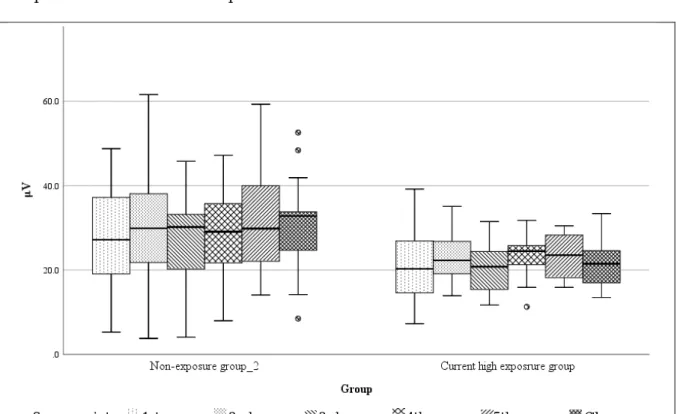
図 6ai. 右正中神経感覚神経振幅の 2 群別推移

Group of cumulative vibration exposure: P=0.003

(24)

Survey points;  1st survey,  2nd survey,  3rd survey,  4th survey,  5th survey,  6th survey  

図 6aj. 右正中神経感覚神経伝導速度の 2 群別推移

Group of cumulative vibration exposure: P=0.008

Survey points;  1st survey,  2nd survey,  3rd survey,  4th survey,  5th survey,  6th survey  

図 6ak. 右尺骨神経感覚神経振幅の 2 群別推移

Group of cumulative vibration exposure: P=0.002

(25)

Survey points;  1st survey,  2nd survey,  3rd survey,  4th survey,  5th survey,  6th survey  

図 6al. 右尺骨神経感覚神経伝導速度の 2 群別推移

Group of cumulative vibration exposure: P=0.049

Survey points;  1st survey,  2nd survey,  3rd survey,  4th survey,  5th survey,  6th survey  

図 6am. 右正中神経運動神経遠位潜時の 2 群別推移

Group of cumulative vibration exposure: P=0.011

(26)

Survey points;  1st survey,  2nd survey,  3rd survey,  4th survey,  5th survey,  6th survey  

図 6an. 右正中神経運動神経振幅の 2 群別推移

Group of cumulative vibration exposure: P=0.970

Survey points;  1st survey,  2nd survey,  3rd survey,  4th survey,  5th survey,  6th survey  

図 6ao. 右正中神経運動神経伝導速度の 2 群別推移

Group of cumulative vibration exposure: P=0.002

(27)

Survey points;  1st survey,  2nd survey,  3rd survey,  4th survey,  5th survey,  6th survey  

図 6ap. 右尺骨神経運動神経遠位潜時の 2 群別推移

Group of cumulative vibration exposure: P=0.327

Survey points;  1st survey,  2nd survey,  3rd survey,  4th survey,  5th survey,  6th survey  

図 6aq. 右尺骨神経運動神経振幅の 2 群別推移

Group of cumulative vibration exposure: P=0.009

(28)

Survey points;  1st survey,  2nd survey,  3rd survey,  4th survey,  5th survey,  6th survey  

図 6ar. 右尺骨神経運動神経(手首―肘下)伝導速度の 2 群別推移

Group of cumulative vibration exposure: P=0.926

Survey points;  1st survey,  2nd survey,  3rd survey,  4th survey,  5th survey,  6th survey  

図 6as. 右尺骨神経運動神経(肘下―肘上)伝導速度の 2 群別推移

Group of cumulative vibration exposure: P=0.480

(29)

Survey points;  1st survey,  2nd survey,  3rd survey,  4th survey,  5th survey,  6th survey  

図 6at. 左正中神経感覚神経振幅の 2 群別推移

Group of cumulative vibration exposure: P=0.040

Survey points;  1st survey,  2nd survey,  3rd survey,  4th survey,  5th survey,  6th survey  

図 6au. 左正中神経感覚神経伝導速度の 2 群別推移

Group of cumulative vibration exposure: P=0.027

(30)

Survey points;  1st survey,  2nd survey,  3rd survey,  4th survey,  5th survey,  6th survey  

図 6av. 左尺骨神経感覚神経振幅の 2 群別推移

Group of cumulative vibration exposure: P=0.021

Survey points;  1st survey,  2nd survey,  3rd survey,  4th survey,  5th survey,  6th survey  

図 6aw. 左尺骨神経感覚神経伝導速度の 2 群別推移

Group of cumulative vibration exposure: P=0.128

(31)

Survey points;  1st survey,  2nd survey,  3rd survey,  4th survey,  5th survey,  6th survey  

図 6ax. 左正中神経運動神経遠位潜時の 2 群別推移

Group of cumulative vibration exposure: P=0.142

Survey points;  1st survey,  2nd survey,  3rd survey,  4th survey,  5th survey,  6th survey  

図 6ay. 左正中神経運動神経振幅の 2 群別推移

Group of cumulative vibration exposure: P=0.678

(32)

Survey points;  1st survey,  2nd survey,  3rd survey,  4th survey,  5th survey,  6th survey  

図 6az. 左正中神経運動神経伝導速度の 2 群別推移

Group of cumulative vibration exposure: P=0.475

Survey points;  1st survey,  2nd survey,  3rd survey,  4th survey,  5th survey,  6th survey  

図 6ba. 左尺骨神経運動神経の 2 群別推移

Group of cumulative vibration exposure: P=0.946

(33)

Survey points;  1st survey,  2nd survey,  3rd survey,  4th survey,  5th survey,  6th survey  

図 6bb. 左尺骨神経運動神経振幅の 2 群別推移

Group of cumulative vibration exposure: P=0.313

Survey points;  1st survey,  2nd survey,  3rd survey,  4th survey,  5th survey,  6th survey  

図 6bc. 左尺骨神経運動神経(手首―肘下)伝導速度の 2 群別推移

Group of cumulative vibration exposure: P=0.893

(34)

Survey points;  1st survey,  2nd survey,  3rd survey,  4th survey,  5th survey,  6th survey  

図 6bd. 左尺骨神経運動神経(肘下―肘上)伝導速度の 2 群別推移

Group of cumulative vibration exposure: P=0.111 D. 考察

振動障害の病態の有無に関しては、自覚 症状の有無や神経学的所見の異常の有無が 大切であるとされているが、本研究では、

自覚症状のない振動工具を扱う従事者に関 して、神経伝導検査の振動工具を取り扱わ ない非暴露群と共に 3 年間の追跡研究を行 った。本研究では、神経伝導検査を正中、

尺骨神経の運動神経・感覚神経で施行し、

非暴露群と暴露群との比較を統計学的に検 討した。 

両側正中感覚神経では、振幅・伝導速度 ともに高濃度取扱い群において非取扱い群 と比べて研究開始当初より有意に低下して いた。さらに、利き手に対象群を絞ると低 濃度被曝群においても非取扱い群に比べて、

正中感覚神経の振幅が有意に低下していた。

濃度取扱い群で有意な低下がみられた。こ れらの障害は、3 年間の経時的な解析でも 障害の進行が明らかになった。 

正中・尺骨神経の両者で運動神経よりも 感覚神経の異常が目立った。整形外科の手 術における回復過程において、運動神経の 回復が知覚神経の回復よりも数段優れてい ることから、感覚神経線維の方がより損傷 を受けやすいと考察されている。さらに、

振動障害では遠位優位に末梢神経が障害さ れるとされている。正中・尺骨神経の感覚 神経伝導速度を部位で比較した振動障害の 研究では、手指・手掌では 50〜70%、手掌・

手首では 10〜25%に伝導速度の異常を認

めることから、より末梢の神経障害が生じ

やすいと考えられる。通常の神経伝導検査

においては、感覚神経伝導速度は指先から

(35)

位部までを測定しており、運動と感覚神経 で測定部位が異なる。本研究で感覚神経障 害が運動神経障害より顕著であったことは、

感覚神経の検査がより遠位部で行われてい ることが影響している可能性がある。特に 正中神経感覚神経においては、自覚症状の ない時期より遠位部の末梢神経障害が進行 すると考えられる。 

前述のように運動神経では伝導速度には 振動工具取扱群と非取扱群間で有意差はみ られなかったが、遠位潜時は右正中神経に おいて高濃度取扱い群で有意に延長してい た。振動工具を使用している労働者は、工 具を握って手関節や肘関節に負担がかかる 姿勢を取るため、手根管症候群や肘部管症 候群などの絞扼性末梢神経障害が起こるこ とが報告されている。本研究でも、正中神 経遠位部に生理的圧迫部位である手根管で の圧迫性の障害が加わっている影響が考え られる。症候学的、また神経伝導検査上も 手根管症候群と診断される例もあり、手根 管での圧迫性ニューロパチーの病態が加わ る可能性がある。 

一方、手根菅と同様に代表的な絞扼部位 である尺骨神経の肘部菅での伝導速度では、

研究開始以前の経年的な障害は検出できな かったものの、3 年の経過では障害される ことが判明した。手根管に比して肘部管は より近位部になるが、暴露がより長引くと 障害される可能性があるかもしれない。 

一般的に振動障害による末梢神経障害の 病態は末梢側優位の神経障害と絞扼性神経

の今回の研究においても、末梢側優位に絞 扼部位でより障害されることが明らかにな った。 

E. 結論 

本研究によって、末梢側、かつ絞扼部位で の正中あるいは尺骨感覚・運動神経の障害 は、振動工具の使用によって早期から非暴 露群に比べて有意に障害されることが判明 した。なかでも、正中感覚神経は、振動工 具を取り扱う労働者の健診において最も重 要なマーカーになると考えられる。 


(36)

参考文献


労働省労働基準局.  振動工具の取り扱い業 務に係る特殊健康診断の実施手技について,

昭和 50  年度  基発 609  号. 1975 

労働省労働基準局.  振動障害の認定基準に ついて  昭和 52  年度  基発 307  号. 1977  日本産業衛生学会振動障害研究会.  振動障 害の診断ガイドライン 2013. 2013 

Loriga  G  (  1911)  Il  lavoro  con  i  martelli  pneumatici Boll Ispett Lav 2:35-60 

山田信也ら.  手腕振動障害その疫学・病態 か ら 予 防 ま で .  労 働 科 学 研 究 所 出 版 部.2004 

労働基準局.  チェーンソー以外の振動工具 の取扱い業務に係る振動障害予防対策指針 について  昭和 50 年 10 月 20 日付け基発 第 608 号. 1975 

業種別・年度別振動障害の労災新規認定者 数調査.  厚生労働省.2016 

Shinsuke  Kikuchi,  Keisuke  Miyake,  Yuki  Tada,  Daiki  Uchida,  Atsuhiro  Koya,  Yukihiro  Saito,  Takehiko  Ohura  and  Nobuyoshi  Azuma , Laser  speckle  flowgraphy  can  also  be  used  to  show  dynamic  changes  in  the  blood  flow  of  the  skin  of  the  foot  after  surgical  revascularization. 

blood flow responses to thermal stimulation,

European Journal of Applied Physiology,  Aizawa,  N.;  Yokoyama,  Y.;  Chiba,  N.; 

Omodaka,  K.;  Yasuda,  M.;  Otomo,  T.; 

Nakamura,  M.;  Fuse,  N.;  Nakazawa,  T.,  Reproducibility  of  retinal  circulation  measurements obtained using laser speckle  flowgraphy-NAVI  in  patients  with  glaucoma.  Clinical  ophthalmology  (Auckland, NZ) 2011, 5, 1171. 

Fujii, H.; Nohira, K.; Yamamoto, Y.; Ikawa,  H.; Ohura, T., Evaluation of blood flow by  laser speckle image sensing. Part 1. Applied  Optics 1987, 26 (24), 5321-5325. 

Fujii,  H.;  Konishi,  N.;  Lee,  M.-C.,  Blood  flow analyses with laser speckle flowgraphy. 

Chinese  Optics  Letters  2007,  5  (101),  S235-S236. 

Juntunen J, Matikainen E, Seppalainen AM,  Laine  A:  Peripheral  neuropathy  and  vibration  syndrome.  Int  Arch  Occup  Environ Health 52:17-24.1983 

黒沢  洋,須賀  吉,石垣  宏ら.  振動障害患 者の神経学的検査結果の経過.  日本職業・

災害医学会会誌;第 50 巻 2 号:93–96.2002  平田  衛,榊原  久ら.  振動障害患者におけ る上肢の感覚神経伝導速度の測定.  産業衛 生学雑誌;44(臨増):274.2002 

振動障害の検査指針検討会(厚生労働省). 

(37)

労働基準局.  チェーンソー以外の振動工 具の取扱い業務に係る振動障害予防対策指 針について.  平成 21 年 7 月 10 日  基発 0710 第 2 号.2009 

ISO. Mechanical vibration and shock –Cold  provocation  tests  for  the  assessment  of  peripheral  vascular  function   –Part  1:Measurement  and  evaluation  of  finger  skin temperature. ISO 14835–1:201.2016  Sakakibara  H,  Kondo  T,  Miyno  M  et  al: 

Digital  nerve  conduction  velocity  as  a  sensitive  indication  of  peripheral  neuropathy  in  vibration  syndrome.  Am  J  Ind Med 26:359-366.1994 

Lukas  E:Lesin  of  the  peripheral  nerve  system due to vibration. Clin Neurophysiol  110:1276-1283.1970 

藤居  仁.レーザー散乱を利用した血流画像 化 法 .  日 レ 医 誌 ; 第 26 巻 . 第 3 号 .266–

271.2005 

知行  前.  レーザースペックルフローグラ フ ィ ー .   日 本 神 経 眼 科 学 会 誌 32:384–

386.2015 

二塚  信ら.  九州の国有林における振動 障 害 に 関 す る 疫 学 的 研 究 .  産 業 医 学 18 巻.vo18.3–10.1976 

本間浩樹,加地浩,高城政久,本田広樹.当 院における振動障害者の手指動脈造影所見  日職災医誌,第 54 巻:123–128.2006  日本産業衛生学会振動障害研究会.  振動障 害における 10℃10 分法冷水浸漬手指皮膚 温  検査判定基準に関する報告.  産衛誌 50 巻:57–66. 2008 

久賀  圭祐.  レイノー現象の定量的評価 の試み  手指皮膚温の検討.  日本臨床免疫 学会会誌  第 8 巻  第 2 号:91–98.1985  黒澤洋一、那須吉郎、石垣宏之、篠原泰 司:振動障害の血管と神経障害の 15 年間 の follow-up.日職災医誌  49:474-477.2001  那須吉郎、石垣宏之、黒澤洋一:正中神 経、尺骨神経伝導速度分布パターンに及ぼ す加齢と振動工具使用の影響.  日職災医誌  51:58-66.2003 

山本啓二、児玉直樹、坂口康道:振動障害 と肘部管症候群.  骨・関節・靭帯 5:1395- 1400. 1992


図 6c.右正中神経感覚神経伝導速度の 3 群別推移
図 6d.右尺骨神経感覚神経振幅の 3 群別推移
図 6p.左尺骨神経感覚神経伝導速度の 3 群別推移
図 6r.  左正中神経運動神経振幅の 3 群別推移
+7

参照

関連したドキュメント

東北大学大学院医学系研究科の運動学分野門間陽樹講師、早稲田大学の川上

1991 年 10 月  桃山学院大学経営学部専任講師 1997 年  4 月  桃山学院大学経営学部助教授 2003 年  4 月  桃山学院大学経営学部教授(〜現在) 2008 年  4

学識経験者 小玉 祐一郎 神戸芸術工科大学 教授 学識経験者 小玉 祐 郎   神戸芸術工科大学  教授. 東京都

  中川翔太 (経済学科 4 年生) ・昼間雅貴 (経済学科 4 年生) ・鈴木友香 (経済 学科 4 年生) ・野口佳純 (経済学科 4 年生)

学識経験者 品川 明 (しながわ あきら) 学習院女子大学 環境教育センター 教授 学識経験者 柳井 重人 (やない しげと) 千葉大学大学院

経済学研究科は、経済学の高等教育機関として研究者を

話題提供者: 河﨑佳子 神戸大学大学院 人間発達環境学研究科 話題提供者: 酒井邦嘉# 東京大学大学院 総合文化研究科 話題提供者: 武居渡 金沢大学

関西学院大学産業研究所×日本貿易振興機構(JETRO)×産経新聞