岩手医科大学 審 査 学 位 論 文
(博 士)
Original
JIMA Vol. 68, No. 1 (April 2016) pp.l-11.
The burden of caregivers present during deaths at home:
Findings in a regional city in Japan and examination thereof
Yuki KoGIT A 1), Ken taro FUKUMOTO 2),
Hikaru NAKAMURA 3l and Ko taro OTSUKA 2l· 3l
11 Yuki clinic, Hanamaki, Japan
21 Department of Neuropsychiatry, School of Medicine, Iwate Medical University, Morioka, Japan
31 Department of Disaster and community Pshichiatry, School of Medicine, Iwate Medical University, Yahaba, Japan
(Received on September 2, 2015 & Accepted on September 11, 2015)
Abstract
We examined the burden on caregivers in case of death at home, which is a major issue in Japan.
The subjects of this study were pairs of caregivers and patients who wished for end-of-life care under the long-term care insurance system and then died after enrollment in this system (end-of-life group), and pairs of caregivers and patients who were not in the end-of-life stage at the time the survey was conducted (non山end-of-life group). The end向。ιlife group was further divided into death-at-home group and death同away山from-home group). A questionnaire survey was conducted on the caregivers to determine
the burden on caregivers as measured by the Japanese version of the Zarit caregiver burden scale (ZBI). There was no significant difference in total ZBI score between the end-of-life group and the non-end-of-life group. Otherwise, the total ZBI scores were higher amongst caregivers in the death
away”from-home group than amongst those in the death-at-home group. Anxiety about the future and financial insecurity were suggested as the reasons why caregivers who selected death away from the home felt a stronger burden compared to caregivers who were present for deaths at home.
Key words : death at home, careg/vers’burden, Zant caregiver burden scale, care at the end of life, long-term care insurance system
I. Introduction
Japan is rapidly aging in comparison to advanced Western countries and the so-called
"late elderly" aged 75 and above are expected to increase in number to 22. 21 million and account for 20. 7 % of the total population of Japan by 2040 ll. The long-term care insurance system was introduced in Japan in 2000 in response to this in order to support the independent living of the elderly and reduce
the burden on caregivers. The long-term care insurance system divides patients into two stages for patients requiring support and five stages for patients requiring long“term care.
The payment limits differ for each category.
The introduction of the long-term care insurance system served as an opportunity to think about the home care of patients in the end-of-life period. A S江rvey by the Ministry of Health Labour and Welfare revealed that
2 Yuki KoGITA, et al.
63. 3 % of people wanted to spend their end
of-life period at home, yet it would be di伍cult to provide care at home in 66. 2 % of cases.
The reason for this difficulty, in many cases, is the burden placed on the family members providing care 2l.
There have been many studies that have looked at the care burden for patients who die at home. It has been noted that while caregivers who have been present for the death at home exhibit high levels of satisfaction 3l, they had also been subjected to a prolonged period of care and a heavy care burden 4·5l. A survey has also revealed that 90 % of caregivers felt they had reached their limit 6l. However, while the caregivers' burden has been studied from various angles so far, there have been almost no reports that have examined factors behind patients who desired medical care at home during the end-of-life period and died at home in accordance with their wishes using the care burden scale.
Although various scales of caregiver burden have been developed 7-9l, the 22-item questionnaire developed by Zarit lOl (Zarit Burden Interview: ZBI) is the most commonly used. A Japanese version has also been created, and its validity and reliability have been confirmed 11). We attempted to examine the factors behind patients who desired medical care at home during the end-of-life period and died at home in accordance with their wishes from the perspective of care burden using the ZBI.
II. Materials and methods
The subjects of this study were patients and caregivers living in Hanamaki, Iwate Prefecture receiving and providing home
medical care under the long-term care insurance system. The study was performed in accordance with the Declaration of Helsinki.
All subjects provided their informed consent for study participation. Care taken to guard personal information and the protect privacy.
They were 264 subject pairs- 77 pairs of caregivers and patients who wished for end
of-life care under the long-term care insurance system and then died after enrollment in this system in the period of 7 years and 9 months from April 2005 to December 2012 (end削of
life group), and 187 pairs of caregivers and patients who were not in the end-of」ife stage at the time the survey was conducted in June 2005 (non-end-of-life group).
The end-o壬life gro江p was further divided into subject pairs where the patient died at home ( 54 pairs, death-at-home group) and subject pairs where nursing care at home became difficult and the patient was transferred to a medical institution before death ( 23 pairs, death-away-from-home group).
We defined the end-of-life period as "the final stages of an irreversible disease during which there are no methods of treatment in addition to the current treatment and the patient is expected to die in the near future", and the end-oιlife period was determined by the examining physician.
The questionnaire used in the survey was self-administered, and consisted of the Japanese version of the Zarit Burden Interview (ZBI) as well as items such as the age and gender of the caregiver and patient, the level of care required, and the presence/ absence of a primary care physician (Table 1 ). ZBI was created as a scale capable of measuring the overall care burden taking into account
Original: Caregivers burden in deaths at home 3
Table 1. Subject basic attributes and home care situation
Caregiver age (years) Caregiver gender
Relationship to patient
Factors
63.3土11.0 Male
Female Wife Husband Son Daughter Daughter in law Other
38 (14.4) 226 (85助 59 (22.3) 14 (5.3 22 (8.3 61 (23.1) 88 (33.3
12 (4.7) 4.3土4.9 4.4土3.1 2.4土0.9 258 (97.7) Care period (years)
Family structure (no. of persons) No. of generations living together Primary care physician
Previous care experience Caregivers other than yourself
Yes No Yes No Yes No
6 (2.3
Patient age (years) Level of care required
Mean ± standard deviation 1
60 (22.7) 204 (77.3) 117 (44.3 147 (55.7) 83.0 ± 7.9
62 (23.5) 51 (19.3 46 (17.4) 32 (12.1) 33 (12.5) 40 (15.2) 60 (22.7) 201 (76.1) Dementia
2 3 4 5
No response Yes
No Unknown
factors such as physical burden, psychological burden and 五nancial di伍culties. Each question is answered on a five-point scale from 0 (Never) to 4 (Nearly Always) (for a maximum.
possible score of 88 points). The results of exploratory factor analysis by Whitlatch et al.
confirmed the possibility of dividing ZBI into subscales of personal strain (which indicates the burden from the care itself, questions 1, 4, 5, 8, 9, 14, 16, 17, 18, 19, 20 and 21) and role strain (which indicates the burden of being
3 (1.1)
):%
unable to live as one had previously as a result of commencing care, questions 2, 3, 6, 11, 12 and 13 ), and these subscales were also used in this study.
SPSS ver 20 was used for statistical analysis, and the ιtest was used for intervals/ratio scale. The Pearson correlation coefficient was also calculated between the total ZBI score and each of the above factors to clarify factors related to care burden. The significance level was set at 5 % or less.
4 Yuki KoGITA, et al.
Table 2. Non-enιof-life group and end-of」ife group basic attributes and home care situation Non-end司of-life Non判end-of-life
Factors group group p
(N=l87) (N=l87)
Caregiver mean age土standard deviation 63.2 ± 11.1 63.4 ± 10.9 0.916
Caregiver gender: male 32 (17.1) 6 (7.8) 0.055
Patient mean age 二と standard deviation 82.5 ごと 7.7 84.0 ± 8.5 0.154 Level of care required: mean ± standard deviation 2.5 ± 1.4 3.1 ごと 1.3 0.005 Care period (years): mean土standard deviation 4.7 ± 5.2 3.3 ± 4.1 0.025 Family structure (no. of persons): mean土standard deviation 4.6土3.5 4.1土1.9 0.205 No. of generations living together: mean ± standard deviation 2.4士0.8 2.4 ± 0.9 0.806
Primary care physician: Yes 181 (96.8) 77 (100) 0.185
Previous care experience: Yes 38 (20.3 22 (28.6) 0.150
Caregivers other than yourself: Yes 78 (41.7) 39 (50.6) 0.220
Patient dementia: Yes 26 (13.9) 34 (44.2) 0.001
Analysis method: intervals I ratio scale: t-test, nominal scale: Fisher exact test
( ):%
III. Results
1. Subject basic attributes and home care situation
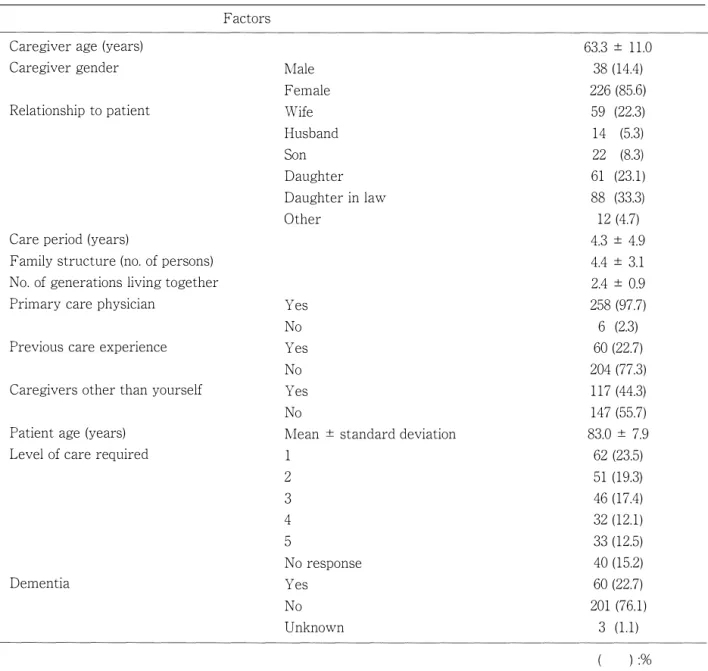
The mean age of the 38 male and 226 female caregivers was 63. 3 こと 11. 0 years. 88 ( 33.3%) of caregivers were the daughters-in
law of the patient, 61 ( 23 . 1 %) were daughters of the patient, and 59 ( 22. 3 %) were spo江ses of the patient. The mean care period was 4. 3 ±
4. 9 years, and 77. 3 % of the caregivers had no prior experience of providing care. The mean age of the patients was 83.0土 7.9, the mean level of care required was 2. 7 ± 1. 4, and 22. 7% of the patients suffered from dementia (Table 1 ). A correlation was observed between both the level of care required and total ZBI score (rニ0.23; p < 0. 001) and the care period and total ZBI score (r= 0. 24; p < 0. 001 ).
2. Non-end-of-life group and end『of-life group caregiver and patient basic attributes and care burden
Subject basic attributes and the home care situation were also compared between the 187
subject pairs in the non-end-of-life group and the 77 subject pairs in the end-of-life gro臼p.
As indicated in Table 2 the level of care required was significantly higher in the end
of-life group compared with the non-end-of
life group. However, the period of care was significantly longer in the non-end-of-life group.
The survey also revealed that the proportion of patients with dementia was significantly higher in the end-of-life group.
No significant difference in total ZBI score was observed between the non-end-of
life group ( 32. 5 ごと 18. 9) and the end-of-life group ( 32.1 ± 18.6) (Table 3). In addition, no significant difference was observed in the total personal strain and role strain scores between the non-end-of-life group and the end-of-life group. Looking at each question, the non-end
of-life group had higher scores in response to question 7 ("Are you afraid of what the future holds for your relative?”) and question 13 ("Do yo江 feel uncomfortable about having friends over because of your relative?"), while the end-
Original: Caregivers burden in deaths at home 5
Table 3. Non司end山of-life group and end同O壬life group total ZBI score
Factors Non-end-of山life group (N=l87) Non-end叩of-life group (N = 187) p
Question no. 1 1.1 ± 1.3
2 1.6 ごと 1.3
3 1.9 ± 1.4
4 1.8 ± 1.3
5 1.5土1.3
6 1.2士1.3
7 2.0 ± 1.4
8 2.5 ± 1.4
9 1.6 ± 1.4
10 1.2土1.3
11 0.9土1.2
12 1.3 ± 1.3
13 1.1 ± 1.4
14 1.9 ± 1.6
15 1.4 ± 1.5
16 1.4 ± 1.4
17 1.7土1.5
18 1.4土1.4
19 1.2 ごと 1.2
20 1.0 ± 1.1
21 0.6 ± 1.0
22 2.4土2.1
Personal strain score 17.7士9.8
Role strain score 7.9 ± 6.5
Total score (22 questions) 32.5 ± 18.9
1.2 ± 1.3 1.9土1.1 1.8 ± 1.4 1.7 ± 1.3 1.3土1.2 1.1土1.1 1.6 ± 1.4 3.0 ± 1.2 1.6 ± 1.3 1.1 ± 1.2 0.7 ± 1.1 1.2土1.2 0.8 ± 1.1 2.5 ± 1.5 1.1 ± 1.4 1.4 ± 1.4 1.9土1.3 1.2 こと 1.3 1.4土1.2 1.2 ± 1.2 0.8 ± 1.0 1.9土1.3 19.1 ± 10.3
7.4 ± 5.6 32.1 ± 18.6
0.632 0.125 0.602 0.579 0.133 0.756 O.Ql8 0.013 0.877 0.419 0.149 0.605 0.038 0.008 0.077 0.734 0.532 0.362 0.218 0.225 0.242 0.054 0.322 0.512 0.873 Analysis method: t-test.
The values in the table are all mean ± standard deviation.
of-life group had higher scores in response to question 8 ("Do you feel your relative is dependent on you?") and question 14 ("Do yo立 たel that your relative seems to expect you to take care of him/her as if you were the only one he/ she could depend on?”).
3. Death-at-home group and death away from home group caregiver and patient basic attributes and care burden
The end問of-life group was further divided into subject pairs where the patient died
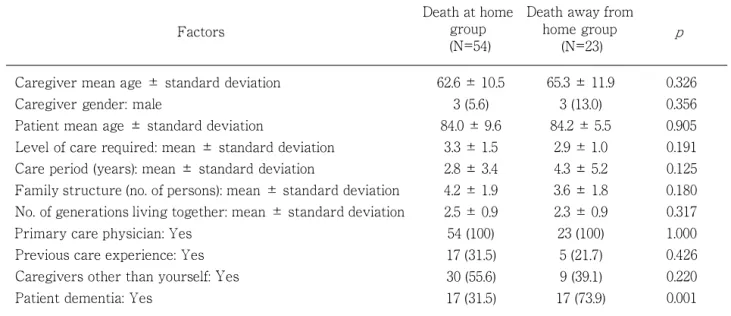
at home ( 54 pairs, death-at-home group) and subject pairs where nursing care at home became difficult and the patient was transferred to a medical institution before death ( 23 pairs, death拘away-from-home group), and the subject basic attributes and home care situation were also compared between the death-at-home group and the death away from home group. As indicated in Table 4, the only statistically significant difference between the two groups was the higher proportion of
6 Yuki KoGIT A, et al.
Table 2. Non司end-of-life group and end-of-life group basic attributes and home care situation
Factors
Caregiver mean age ± standard deviation Caregiver gender: male
Patient mean age土standard deviation
Level of care required: mean土standard deviation Care period (years): mean土standard deviation
Death at home Death away from group home group
(N=54) (N=23)
62.6 ごと 10.5 65.3土11.9 3 (5.6) 3 (13.0) 84.0 ± 9.6 84.2 ± 5.5
3.3 ± 1.5 2.9 ± 1.0
2.8土3.4 4.3土5.2
p
0.326 0.356 0.905 0.191 0.125 Family structure (no. of persons): mean ± standard deviation 4.2 ± 1.9 3.6土1.8 0.180 No. of generations living together: mean ± standard deviation 2.5 ± 0.9 2.3士0.9 0.317
Primary care physician: Yes 54 (100) 23 (100) 1.000
Previous care experience: Yes 17 (31.5) 5 (21.7) 0.426
Caregivers other than yourself: Yes 30 (55.6) 9 (39.1) 0.220
Patient dementia: Yes 17 (31.5) 17 (73.9) 0.001
Analysis method: intervals I ratio scale: t”test, nominal scale: Fisher exact test
( ):%
patients with dementia in the death”away
from-home group.
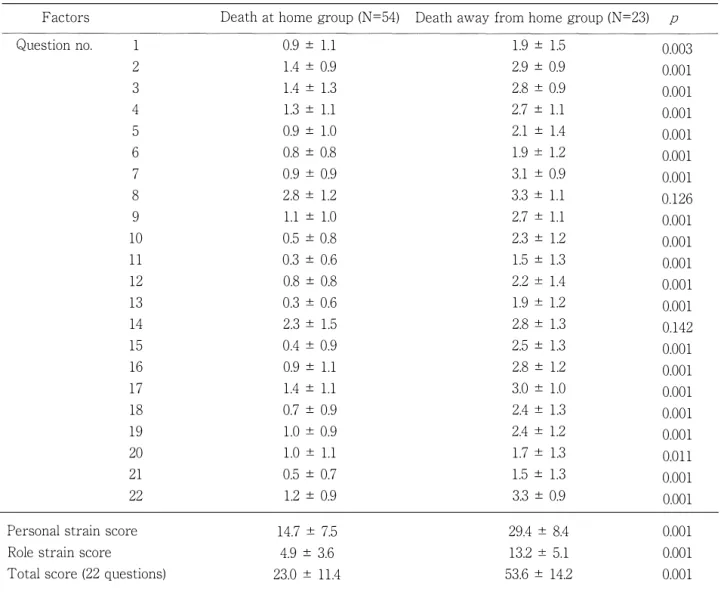
As indicated in Table 5 the total ZBI score was significantly higher amongst the death-away-from-home group ( 53. 6土 14.2) compared with the death-at-home group ( 23.0
± 11. 4 ). Similarly, the total scores for personal strain and role strain were also significantly higher amongst the death-away-from“home group. Looking at each question, the death
away-from占ome group had signi五cantly higher scores in response to every question except for questions 8 and 14. Notably, differences of at least 2 points could be observed between the groups in their responses to question 7 ("Are you afraid of what the future holds for your relative?") [death-at-home group: 0. 9
± 0. 9, death”away-from-home group: 3 . 1土 0. 9] and question 15 ("Do you feel that you don t have enough money to take care of your relative in addition to the rest of your expenses?") [death-at-home group: 0. 4土 0. 9 and death-away-from-home group: 2. 5
± 1. 3]. A difference of more than 2 points could also be observed between the groups in their responses to question 22, which asked them to give an overall evaluation ("Overall, how burdened do you feel in caring for your relative?") [death-at-home group: 1. 2土 0.9, death-away-from-home group: 3. 3土 0.9].
IV. Discussion
In this study the ZBI scale was used to examine the care burden of caregivers during end-o壬life period home care by patient condition and outcome.
There have been many studies that have reported on care burden. This study focused on caregivers and patients enrolled in the long
term care insurance system in the Japanese city of Hanamaki (Iwate Prefecture). Morycz Sl classified the factors behind care burden into ( 1) factors related to the elderly (attributes and symptoms, etc.), ( 2) factors related to the caregiver (attributes and attitudes, etc.), and ( 3) factors related to the environment (financial
Original: Caregivers burden in deaths at home 7
Table 5. Death at home group and death away from home group total ZBI score
Factors Death at home group (N =54) Death away from home group (N =23) p
Question no. 1 0.9土1.1 1.9土1.5 0.003
2 1.4 ± 0.9 2.9土0.9 0.001
3 1.4 ± 1.3 2.8 ± 0.9 0.001
4 1.3土1.1 2.7土1.1 0.001
5 0.9土1.0 2.1土1.4 0.001
6 0.8土0.8 1.9 ごと 1.2 0.001
7 0.9 ± 0.9 3.1 ± 0.9 0.001
8 2.8 ± 1.2 3.3 ± 1.1 0.126
9 1.1土1.0 2.7 ± 1.1 0.001
10 0.5ニt 0.8 2.3土1.2 0.001
11 0.3土0.6 1.5土1.3 0.001
12 0.8土0.8 2.2 ごと 1.4 0.001
13 0.3 ± 0.6 1.9 ± 1.2 0.001
14 2.3 ± 1.5 2.8 ± 1.3 0.142
15 0.4 ± 0.9 2.5土1.3 0.001
16 0.9土1.1 2.8土1.2 0.001
17 1.4土1.1 3.0士1.0 0.001
18 0.7土0.9 2.4 ± 1.3 0.001
19 1.0 ± 0.9 2.4 ± 1.2 0.001
20 1.0 ± 1.1 1.7 ± 1.3 0.011
21 0.5土0.7 1.5土1.3 0.001
22 1.2土0.9 3.3土0.9 0.001
Personal strain score 14.7 ± 7.5 29.4 ± 8.4 0.001
Role strain score 4.9土3.6 13.2 ごと 5.1 0.001
Total score (22 questions) 23.0 ± 11.4 53.6 ± 14.2 0.001
Analysis method: t司test.
The values in the table are all mean 二t standard deviation.
situation, care network, etc.). Looking at the basic attributes and home care situation of the subjects of this study, there were no major differences in the level of care required 13) and care period ll) compared with other studies that have covered other regions of Japan. In addition, although there was a large proportion of daughters-in」aw (relationship with the patient) as caregivers in this study 14), there was no major inconsistency with the figures in other reports. The mean total ZBI score of the
subjects of this study ( 32. 4土 18.8) was also similar to those in studies conducted by Saito et al. ( 29. 6)15), Arai et al. ( 38. 7)11) and Takemasa ( 34. 3) 16). The above suggests that although this study was conducted in one small city of Japan, it can be considered as representative of the care burden in home care and end-of-life care across Japan in general.
This study showed a correlation between both the level of care required and ZBI, and the care period and ZBI. There have been
8 Yuki KoGITA, et al.
previous reports on ZBI scores that have in di ca ted a correlation with the level of care required 17), but no reports indicating a correlation with the care period. According to Sh江lz 18 ), there are three types of relationship between the care period and the care burden.
The first is that the care burden of the caregiver becomes greater the longer the care period (Wear-and-tear model). The second is that the caregiver becomes accustomed to care the longer the care period, and the care burden is red江ced (adaptation model).
The third is that the care burden doesn't really change regardless of the care period (trait model). The relationship between the care period and the care burden is thought to depend on the personality and qualities of the caregiver, however it is possible that the present study includes many cases to which the wear-and-tear model applies.
Comparing the end-of-life group and the non-end-of』life group, where the patient prognosis differs, there was no significant difference in the total ZBI score or in scores for the subscales of personal strain and role strain. The reason for this may be that many of the patients in the non-end-of-life group were expected to progress into the end『of
life period. In addition, it is also assumed that as the care period was longer and the level of care required was higher in the end-of
life group, these items that have a correlation with ZBI score may have basically offset one another.
There are also a number of reports, both from Japan and abroad, concerning the increase in care burden when caring for patients with dementia. Kamiya 19l and Dauphinot et al. 20l reported a correlation
between MMSE score and care burden, and Black et al. reported a correlation between the behavioral and psychological symptoms of dementia and care burden 21). However in this study there was no signi五cant difference in total ZBI score between the end-of-life group and the non-end-of-life group, despite the proportion of patients with dementia being higher in the end-oιlife group. Perhaps this was because the survey in this study only asked whether patients had dementia and did not consider the severity of the dementia nor the behavioral and psychological symptoms of dementia. Examining the responses to each question, the items concerning "reliance from the patient" (question 8 and 14) elicited strong feelings of burden from the caregivers in the end-of-life group.
Comparing caregivers in the end-of-life period whose patients died at home and whose patients died outside the home, caregivers in the death away from home group had higher total ZBI scores as well as personal strain and role strain scores compared with caregivers in the death-at-home group, suggesting they feel a heavy care burden.
The only signi五cant difference in the basic attributes between the death-計四home group and the death-away-from-home group was in the proportion of patients with dementia.
However, there was no significant difference in the total ZBI scores between the non-end司 of-life period and end-of-life period groups, despite the significant difference in the proportion of patients with dementia, so the difference in the scores between the death
at叩home group and the death幽away”from
home group cannot be explained solely by the presence of dementia. Therefore, this
Original: Caregivers burden in deaths at home 9
study examined the factors which increase the burden on caregivers caring for patients who wish to die at home by looking at the responses to each question item with the exception of question 22. Of particular note are the questions in which differences of at least 2 points could be observed between the groups-question 7 (anxiety about the future) and question 15 (financial insecurity). It is suggested that even in a situation such as end
of-life period home care in which the prognosis can be predicted to some extent, anxiety about the future and/ or financial insecurity, similarly to the results of other studies 22J, are factors oriented towards death away from the home.
This study had several limitations. First, the study period of the end-of-life group and the non-end-of-life gro江p differed. Also, in addition to the severity of dementia, which, as mentioned earlier 19-21J is considered to affect the care burden, the degree of patient life disorder, the provision of care services and the type of care services provided were also factors left unexamined in this study.
The correlation between the adequacy of care services and total ZBI score has previously been reported, so perhaps care services should also have been examined in this study 23J.
In this study we used the ZBI scale to
examine the care burden of caregivers in the home care of the elderly by patient condition and outcome. Although the s江rvey was conducted in one small city in Japan, an examination of the literature has led the authors to believe it reflects the care burden in home care and end-of-life care across Japan.
This study showed a correlation between both the level of care required and ZBI, and the care period and ZBI. No signi五cant difference in care burden was observed between the end-of-life group and the non-end-of-life gro江p.
The continuity from the non-end-of-life period to the end-of-life period and the offsetting of the basic attributes between the two groups are suggested as the reasons for the absence of a significant difference. Anxiety about the future and financial insecurity were suggested as the main reasons why caregivers who selected death away from the home felt a stronger burden compared to caregivers who were present for deaths at home.
Acknowledgements
We sincerely thank all caregivers for their time and contributions to this end-of-life care research.
Conflicts of interest: The authors have no con出ct of interest to declare.
References 1) National institute of population and social security
research: Population projections for Japan (January 2012): 2011 to 2060. March 30, 2012.
Available at: http://www.ipss.go.jp/site-ad/index_
english/ esuikei/ gh240le.asp.
2) National institute of population and social security research: The result of investigation about end
o壬life care. December 2010. Available at: http:/ I www.mhlw.go.jp/seisakunitsuite/bunya/kenkou_
iryou/iryou/ saisyu_iryou/ dl/ saisyu_iryoul l.pdf.
3) Kobayashi N: Factors related to caregiver satisfaction after attending an elderly person dying at home. J Jpn Acad Com Health Nurs l, 30-35, 1999.
4) Nakamura Y, Miyahara Sand Hitomi H: Deaths at home and social welfare issues in urban areas.
Kawasaki J Med W elf 10, 225-230, 2000.
5) Hitomi H, Nakamura Y, Osawa G, et al.: The
10 Yuki KoGITA, et al.
Factor to Make the Palliative Care at Home of Elderly People Possible in Countryside. Kawasaki J Med Welf 10, 87-95, 2000.
6) Toshiaki I, Saito S, Amo E, et al.: Factors inhibiting home care of the elderly. ] Public Health Pract 64, 135-138, 2000.
7) Robinson B and Thurnher M: Taking care of aged par ents: a family cycle transition.
Gerontologist 19, 586-593, 1979.
8) Morycz RK: Caregiving strain and the desire to institutionalize family members with Alzheimeピs d i s e a s e . P o s s i b l e p r e d i c t o r s a n d m o d e l development. Res Aging 7, 329-361, 1985.
9) Kosberg JI and Cairl RE: The Cost of Care Index:
a case management tool for screening informal care providers. Gerontologist 26, 273-278, 1986.
10) Zarit SH, Reever KE and Bach-Peterson J:
Relatives of the impaired elderly: correlates of feelings of burden. Gerontologist 20, 649-655, 1980.
11) Arai Y, Kudo K, Hosokawa T, et al.: Reliability and validity of the ] apanese version of the Zarit caregiver burden interview. Psychiatry Clin Neurosci 51, 281-287, 1991.
12) Whitlatch CJ, Zarit SH and von Eye A: Efficacy of interventions with caregivers: a reanalysis.
Gerontologist 31, 9-14, 1991.
13) Ministry of Health, Labour and Welfare of ] a pan:
2012 year report on the status of long叩term care insurance. Available at: http:/ /www.mhlw.go.jp/
topics/kaigo/ osirase/jigyo/12/
14) Fujiwara K, Kamijou K, Koike S, et al.: Study of gender di宜erences and coping care burden in family caregivers of elderly people at home with dementia: Characteristics of male and female caregivers. ] pn ] occupat therapy res 17, 31-40, 2014.
15) Saito E, Kunizaki C and Kanagawa K: Positive
perceptions encouraging continued caregiving at home among family caregivers. ] pn ] Public Health 48, 180-189, 2001.
16) Takemasa S, Degawa M, Sugimoto M, et al.: Factors affecting quality of life in family caregivers of home同based care stroke persons.
Bull Sch Health Sci Kobe 21, 23-30, 2005.
17) Tanaka K, Takemasa Sand Shimada T: Factors affecting quality of life in family caregivers of the home向bound elderly disabled. Bull Sch Health Sci Kobe 23, 13-22, 2007.
1 8 ) Schulz R and W illi amson G M : A 2-year l o n g i t u d i n a l study o f d e p r e s s i o n a m o n g Alzheimeピs caregivers. Psychol Aging 6 , 569-578, 1991.
19) Kamiya M, Sakurai T, Ogama N, et al.: Factors associated with increased caregivers' burden in several cognitive stages of Alzheimer's disease.
Geriatr Gerontol Int 14 (Suppl. 2), 45-55, 2014.
20) Dauphinot V, DelphiIトCombe F, Mouchoux C, et al.: Risk factors of caregiver burden among patients with Alzheimer's disease or related disorders: a cross叩sectional study. ] Alzheimers Dis 44, 907-916, 2015.
21) Black W and Almeida OP: A systematic review of the association between the behavioral and psychological symptoms of dementia and burden of care. Int Psychogeriatr 16, 295-315, 2004.
22) Aneshensel CS, Pearlin LI and Schuler RH:
Stress, role captivity, and the c essation of caregiving.] Health Soc Behav 34, 54-70, 1993.
23) Kuzuya M, Enoki H, Hasegawa J, et al.: Impact of caregiver burden on adverse health outcomes in community-dwelling dependent older care recipients. Am ] Geriatr Psychiatry 19, 382-391, 2011.
68, 1号(平成28年4月) 1-11
在宅死を看取る介護者の負担感について:
日本の地方都市における調査結果とその検討
小木田勇輝 1),福本健太郎2),中村 光3) ,大塚耕太郎2), 3) 1)ゅうきクリニック
2)岩手医科大学医科学部,神経精神科学講座 3)岩手医科大学医学部,災害・ 地域精神医学講座
(Received on September 2, 2015 & Accepted on September 11, 2015)
己日
本研究は, 在宅死の選択に際して大きな問題となる 介護者の負担感について検証することを呂的とした.
介護保険制度下で終末期医療を希望した終末期群77 組および非終末期群187組の合計264組を対象とし,
終末期群はさらに, 最終的に在宅死となった54組,
途中で介護困難となり在宅から医療機関に移行した非 在宅死群23組に分類した介護者に対してアンケー ト調査を行い, 介護者および被介護者の背景因子に加
え, Zarit 介護負担尺度(ZBI)日本語版にて介護負担感 を調査した終末期群, 非終末期群聞においてZBI総
を認めなかった一方で在宅死群および非 在宅死群では, 後者でZBI総得点が高値であったさ らに在宅死を完遂した介護者に比して非在宅死を選択
した介護者の負担感が強い要因として将来への不安や 経済的不安の存在が示唆された
11