総 説
l
東 女 医 大 誌 第 同 第5号 ) 頁 140~ 147 平成26年10月l
最終講義急性脳血管症候群としての一過性脳虚血発作
東京女子医科大学医学部神経内科学内山真一郎
( 受 理 平 成26年8月13日) Final LectureTransient Ischemic Attack As an Acute Cerebrovascular Syndrome Shinichiro UCHIY AMA
Department ofNeurology, Tokyo Women's Medical University School ofMedicine
During the early period after transient ischemic attack (TIA), patients are at a very high risk of suffering strokes. Therefore, TIA in acute settings should be treated as a medical emergency. There are no means of dif -ferentiating TIA from acute ischemic stroke (AIS) using the duration of symptoms alone. Acute TIA and AIS are on the same spectrum of acute ischemic syndrome of the central nervous system. Thus, we proposed a new con -cept termed “acute cerebrovascular syndrome" (ACVS), which inc1udes acute TIA and AIS. Immediate evalu -ation and the initiation of treatment in TIA c1inics have been reported very effective in reducing the risk of stroke early after TIA. TIA patients with ABCD2
score, positive diffusion-weighted image (DW i,)I ntracranial or extracranial arterial stenosis, multiple episodes of TIA, and atrial fibrillation, should be admitted. Dual antiplate -let therapy in patients with noncardioembolic TIA, and novel oral anticoagulants in TIA patients with atrial fib -rillation, may be effective in preventing early stroke recurrence. Carotid endarterectomy or stenting, or bypass surgery, should be considered for patients resistant to medical treatment. The l-year follow-up data of an inter -national observational study (TIAregistry.org) demonstrated a remarkable reduction of stroke risk, the usefulness of ABCD2
score and DWI positivity, the dangers of multiple DWI lesions, and the high residual risk of atherothrombotic TIA.
Key Words: transient ischemic attac,kacute cerebrovascular syndrome, ABCD2 score, TIA c1inic, medical emergency はじめに 一 過 性 脳 虚 血 発 作 (transientischemic aUack : TIA)は発症直後ほど脳梗塞を続発する危険性が高 いので,救急疾患として対処する必要がある. TIA を持続時間のみで脳梗塞(虚血性脳卒中)と区別す るのは意味がない.発症後早期の TIAは急性期脳梗 塞 ( 急 性 虚 血 性 脳 卒 中 )(acute ischemic stroke : AIS)と同一スペクトラム上にある病態であり,急性 脳血管症候群 (acutecerebrovascular syndrome : ACVS)という概念に包括し救急診療体制の下に早 期診断・早期治療を行う必要がある.実際, TIA に対する救急対処は脳卒中予防の水際作戦としてき わめて有効で、ある.
1
.
一過性脳虚血発作の脳卒中早期発症リスク TIAは脳梗塞の前兆であり 脳梗塞患者の 15--- -30%に TIAの既往がある ω.一方, TIAは治療なし に症状が自然に消失してしまうため,患者や家族に 無視あるいは軽視されがちである3) それどころか, TIAは予後良好な軽症の脳卒中として一般医家に さえ後回しにされやすい4) しかしながら,発症後早期の TIA患者は脳卒中発 症率が非常に高く, TIA発症後 7日間, 1ヵ月間, 3-140-9 60
Combined d
a
t
a
f
r
o
m
1
0
MRI s
t
u
d
i
e
s
(
n
=
8
1
8
)
50 n u n u n u a 崎 司 o q 4 ( 京)
2
2
0
﹀
=
一
ω
o
a
10。
0-1 1-2 2・3 Duration of symptoms (hours) 3・6 6・12 12・18 18-24 Fig.1 Duration of neurological symptoms and positive diffusion-weighted imaging Therewas no particular correlation between diffusion-weighted imaging positivity andthe duration of transientischemic attack (TIA). Therefore. there is norealiable means of di旺er -entiating TIA from ischemic stroke by the duration of symptoms alone. (quoted andmodified from re.f9) ヵ 月 間 の 脳 卒 中 発 症 率 は そ れ ぞ れ8%.
1
1
.5
%
, 17.3%であったと報告されている5
¥
さらに, TIA 発症後2
週間以内に脳卒中を発症した患者の 30% 前後は実に2
4
時間以内に発症していたとの報告が あるー したがって, TIAは迅速な対応が必要な救急 疾患であるとの認識が必要である.2
.
一過性脳虚血発作の定義の変遷と新しい概念 の提唱 TIAの定義については国際的なコンセンサスが 得られていない.古典的な診断基準によれば,2
4
時間以内に消失する脳または網膜の局所的な虚血に よる神経症候であると定義されている6
¥
しかしなが ら,米国では, TIAは対応する虚血病巣を伴わないl
時間以内に消失する脳または網膜の虚血症候と改 定された7) その後,米国心臓協会と米国脳卒中協会 は,持続時間にかかわらず,虚血病巣を伴わない脳, 網膜または脊髄の一過性の局所的虚血性神経症候で あると再定義している8) 古典的な定義による TIA患者の MRI拡散強調画 像 (di宜usion-weightedimage : D WI)での持続時間 別 の 虚 血 病 巣 陽 性 率 に は一 定 の 傾 向がない (Fig.1
)
9
)
.
TIA患者における統合解析によれば, DWI 陽性率は 33%であったが,これらの DWI病巣の多 くは,その後撮像した T2強調画像や FLAIR画像で 慢性虚血病巣になっていたという9) したがって, TIAは症候の持続時聞からは虚血性脳卒中と区別 できないといえる. 著者らは,医師主導型の国際多施設共同研究に より TIAの 観 察 研 究 (TIAregistry.org)(www.
t
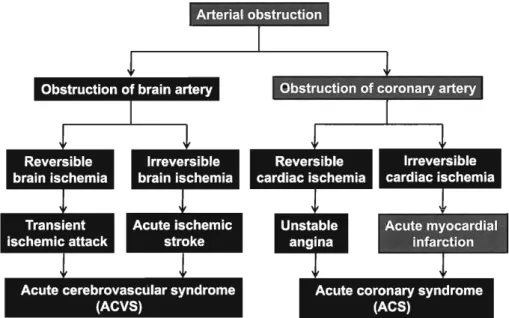
ia registry.org)を行っているが, 2008年に開催された 第 1回運営会議において発症後早期の TIAと AIS を包括する ACVSという概念を用いることを決定 した.ACVSは 急 性 冠 症 候 群 (acutecoronary syndrome : ACS)に対応する概念である(Fig.2)10) 脳動脈の閉塞により脳に症候性の可逆的虚血が生じ れば TIAであり,不可逆的虚血が生じれば AISで ある.一方,冠動脈の閉塞により心臓に症候性の可 逆 的 虚 血 が 生 じ れ ば 不 安 定 狭 心 症 (unstable angina: UA)であり,不可逆的虚血が生じれば急性 心筋梗塞 (acutemyocardial infarction : A MI)であ る.すなわち, TIAは U Aに相当し, AIS は AMI に相当する. ACVSという概念は発症後早期の TIAにおいて AISの続発を予防するため迅速な評価と治療開始を 強調するのにきわめて有用な概念であるといえる. ACVSにおいて MRIは 病 理 組 織 診 断 の 代 用 マ ー カーになりうるが ACVSはあくまで臨床的概念で あり,病理学的診断名ではない.発症後早期の TIA は不安定な脳虚血状態であり,脳に不可逆的な血栓 塞栓イベン トが生じる前兆である.ACVSの概念 は,発症後早期の TIAを AISと同様に救急、疾患と して認識することにこそ意義がある A 吐↓ ↓
-m町理想明言~古言百四聖切開明暗・・・・・・~理・・・・・・
Fig.2 Concepts of acute cerebrovascular syndrome and acute coronary syndrome Acute cerebrovascular syndrome isa conceptcomparable toacutecoronarysyndrome. That is, transient ischemicattackiscomparable tounstable angina, and acute ischemic strokeiscomparable to acutemyocardial infarction. (quoted and modifiedfromre.f10) Table 1 ABCD2 scorell) A:Age >60years (1point) B: Blood pressure> 140/90 mmHg (1point) C:Clinicalfeatures:unilateralweakness(2points), speech disturbancewithout weakness(1point) D:2Diabetes(1point)anddurationof symptoms (1point for 10-59 minand2 points for>60 min) 3. 一過性脳鹿血発作の危険度の評価 発症後早期のTIAはAISを続発する危険性が高 く , 3ヵ月以内の AISを発症する患者の約半数が2 日以内に発症するので特に発症リスクの高いTIA 患者は直ちに緊急入院させて早期診断・早期治療を 行う必要がある.そこで,高リスクのTIA患者を選 別するさまざまな評価法が考案されたが,その中で も現在世界で最も広く用いられている臨床評価スコアがABCD2スコアである (Table
1
)
11). ABCD2スコアには年齢,血圧,症候,持続時間,糖尿病の
5
項 目があり,合計点は 0~7 点に分布するが, TIA発症 後9
0
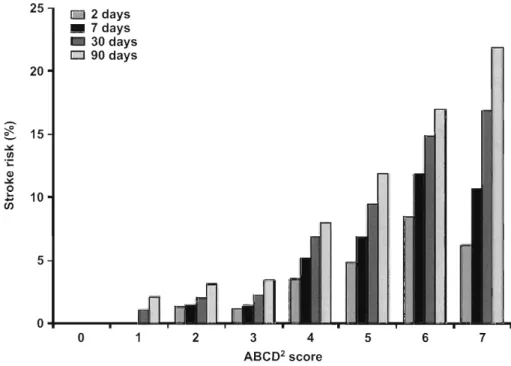
日以内の脳卒中累積発症リスクはABCD2ス コアと締麗に相関する (Fig.3) 11). ABCD2スコアは特 殊な検査項目や専門的な事項を含まないという点で 優れたスコアであり,一般医家によるプライマリー ケアには最も有用な評価法である.また ,ABCD2 ス コ ア は TIAの 正 診 率ωや 続 発 す る AISの 重 症 度l勺こも相関することが報告されている 4. 一過性脳虚血発作患者の初期対応 発症後早期のTIA患者の中でも特にABCD2スコ ア高得点(特に4
点以上), DWI陽性,頭蓋内外主幹 動脈の狭窄 (50%以上),反復性TIA(dualTIA) , 血液凝固異常症は脳卒中早期発症リスクが高いので 緊急入院の トリアージが必要で、ある(Table2)11ト16¥ これらの高リスク患者では入院時に心血管性危険因 子を検索するため脳と血管の画像検査,血液検査, 心臓の評価が必要である(Table3)10). 迅速な検査後 には,降圧薬,スタチン,血糖降下薬とともに抗血 栓療法が必要となる (Table4) 10)げ 抗血栓療法に関しては,非心原性TIAでは高度 の血小板活性化を抑制するため抗血小板薬の二剤併用療法(dualantiplatelet therapy : DAPT)の有効性
が期待され,心房細動による心原性TIAには初期の 脳卒中再発予防のため迅速に凝固活性化を抑制でき る 新 規 経 口 抗 凝 固 薬 (neworal anticoagulant : NOAC)の適応があるべ 最近,中国で発症後
2
4
時間以内のTIAまたは 軽症AISを対象にしてアスピリン・クロピドグレ ル併用療法とアスピリン単独療法の有効性と安全性 を 比 較 す る CHANCE(Clopidogrel inHigh Risk
Patientswith Acute Nondisabling Cerebrovascular Events) 19)が行われ,アスピリンとクロピドグレルに
よる DAPTがアスピリン単独療法より脳卒中の再
発予防に有効であり,重大な出血合併症は差がな
-11 25
1
0 2 days 園園 7days 圃圃 30days Eコ
90days 20ミ
:
.
15 」ωLa.t A喝 。O Ld t • 10 的 5。
。
2 3 4 5 6 7 ABC02 scoreFig. 3 ABCD2 score and strokeriskwithin90 days after
There was a clearcorre1ationbetween ABCD2 score and stroke rate after transient isch -emic attack (TIA).IfABCD2 scoreis higher, strokeriskwithin90 days afterTIA isa1so
higher. (quoted and modified from re.f11)
Table 2 Patientswith transient ischemic attack
(TIA) who requirehospita1ization10) 1) High clinicalrisk scores such as出eABCD2 score 2) Positivedi旺usion-weightedMRI imaging 3)Intracranial or extracranialarterial stenosis 4)MultipleepisodesofTIA including crescendo TIA 5)Non同valvularatrial fibrillation 6)Hypercoagulability sllchas antiphospholipidsyndrome Table 3 Radio1ogicaland physiological examinations forthe initia1evaluation ofpatientswith acutetran -sientischemicattack10) 1)Brainmagneticresonanceimaging, inclllding di旺llsion weightedimaging 2)Intracranialand extrac1'anial magnetic 1'esonance angiog -raphy orcomputertomographic angiog1'aphy 3) Carotidand ve1'tebrallllt1'asonography 4)Electrocardiography with continllollsmonitoring 5)Transthoracicand/o1'transesophageal echocardiography 6)T1'anscranial Doppler llltrasound かったという結果が示された.CHANCEでは,初日 に
300mg
という大量のクロピドグレルを負荷して 発症直後の高度の血小板活性化を抑制したことと,DAPT
を3
週間のみに止めたことにより出血リス クを増大させなかったことが成功の要因と考えらTable 4 Initialmanagement approachesin patients
with transientischemic attack (TIA)lO)
1.Management ofrisk facto1's 1)Single01'dualantihypertensivedrugs 2) Lipidlowering withstatins 3)Blood glllcose-Ioweringdrugs 2. Antith1'ombotictherapy 1) Dual antiplatelettherapy(DAPT) or single antiplatelet therapy 2)Novel o1'al anticoagulants(NOACs) or warfarin 3.Sll1'gicalor int1'avaSClllarinte1'vention forTIA patients 1'esistantto medical the1'apy 1)Carotid endarterectomy 2)Carotid01'verteb1'ala1'te1'Y stenting 3)Intracranial bypasssurge1'y れ,日常診療にも示唆を与えるエビデンスとなった. 欧州のガイドラインでは,脳卒中発症後のNOAC 開始時期をト
3
-
6
-
1
2
日ルールにより決定すること を推奨しているー 脳損傷の程度により抗凝固療法 に伴う脳内出血のリスクが異なることを考慮し,TIA
で は 初 日 軽 症 脳 卒 中 で は3
日目,中等症では6
日目,重症脳卒中では1
2
日目から開始することを 提唱している. 高度の頚動脈狭窄があり 内科的治療に抵抗性の あるTIA
患 者 で は 頚 動 脈 内 膜 剥 離 術 (carotid endarterectomy : CEA) , 頚 動 脈 ス テ ン ト 留 置 術 -143-Fig.6 First steering comittee of TIAlegistry.org
(2008, Paris)
Photo of the first Steering Committee Meeting of TIAregistry.org in 2008, Paris. From theright, Profs.
Hennerici (Germany), Albers(US), Tiel (Canada), Uchiyama Uapan), and Wong (HongKong), and from
the second nex,tProfs. Donnan (Australia) and Ama-renco(France, Principle Investigator), and theleft front, Pro Morina (f. Spain) や一般医家に対する啓発活動をさらに積極的に推進 する必要性を痛感している.
5
.
国際多施設共同観察研究 著者らは,発症後 7日以内の TIAまたは軽症AIS を登録し,5
年間追跡調査する医師指導型の国際多 施設共同観察研究(TIAregistnぬrg)を行っているF
i
g
.
6
は2
0
0
8
年にパリで開催された第l
回運営会 議の写真である.症例登録は2
0
1
2
年1
2
月末日で終 了したが,全世界で4
.
7
8
9
例が登録され,日本からは3
4
5
例 が 登 録 さ れ た 最 近 こ れ ら の 症 例 の1
年間の 追跡調査が解析され いくつかの重要な事実が判明 した. まず,TIA発症後9
0
日以内の脳卒中の発症 率は,EXPRESS
研究では10%
を超えていたが, TIAregistry.orgではこの発症率が半減しており,1
0
年間での診療の進歩が伺われた.診療形態別の転帰 に関しては,他のいかなる診療形態よりも TIAクリ ニックでの脳卒中発症率が明らかに低く,改めて TIAクリニックの有用性が再認識された.ABCD2 スコア別の解析では スコアが高得点なほど再発率 が高かった.画像診断に関しては ,DWI陽性群では 陰性群より発症率が高く ABCD2スコアと DWI陽 性は現在でも高リスクの予知因子として重要である ことが確認された.また, DWI陽性群の中でも,多 発病巣群では単一病巣群より脳卒中発症率が高かっ たが,多発病巣群には心房細動合併例など心原性 13 TIAが多く含まれる可能性が示唆された病型別解 析によれば,アテローム血栓症が他の病型よりも脳 卒中発症率が高く,この病型の残存リスクをいかに 低減するかが今後の課題であると考えられた.TIA regsitry.orgのl
年追跡調査の論文は現在]AMAに 投稿中である. おわりに 前述した ACVS患者の国際共同観察研究 (TIA registry.org)のベースラインデータと中間解析結果 を紹介するとともに 世界のト ップリーダーが一同 に会して ACVSを め ぐ る 諸 問 題 を 討 議 す る 国 際 TIA/ACVS会議を2
0
1
3
年1
1
月に東京で著者は会 長として主催した.また,この国際会議に先駆けてI
TIA as Acute Cerebrovascular SyndromeJ
(Uchiyama S et al eds, Kargar A G, Base,
l
2
0
1
3
)
とい う著書を出版した.本書はACVSとしてのTIAに 関する概念,定義,疫学,病態,画像,診断,治療, 予防,ガイドラインのトピックをすべて網羅してお り,各章は世界のトップリーダー達に執筆いただい たので一読していただければ幸いである 開示すべき利益相反状態はない. 文 献1)Hankey GJ, Warlow CP:Treatment and second -ary prevention of stroke: evidence, costs, and ef
-fects onindividualsand populations.Lancet 354:
1457-1463,1999
2) Rothwell PM, Warlow CP: Timing of TIAs pre -ceding stroke: time window for preventionisvery shor.tN eurology64:817-820, 2005 3)宮 松 直 美 :一般 市 民 の 脳 卒 中 知 識 調 査 と キ ャ ン ペーン に よ る 啓 発 活 動 に 関 す る 疫 学 調 査
.
1
循 環 器 病研究振興財団助成金報告書J,pp62-67 (2006) 4)鈴 木 理 恵 子 -一般 開 業 医 と 脳 卒 中 専 門 病 院 と の 連 携.ITIA(一過性脳虚血発作) 急性 期 医 療 の 実 際j (峰松一 夫上原敏志編,)pp1l2-117,診断と治療社, 東 京 (2013) 5) CoullAJ, Lovett JK, Rothwell PM: Population based study ofearlyrisk ofstrokeafter transient sichaemic attack ormonirostroke:implicationsfor public education and organization of services.BMJ 328:Epub 2004J an 26, 2004 6) Specialreportfrom the NationalInstitute of Neuro -logical Disorders and Stroke: Classi五cationof cere -brovasculardiseasesIII.Stroke 21:637-676,1990 7) AlbersGW, Caplan LR, EastonJD et al: Tran -sientischemicattack: proposalfor a new definition. N EnglJ Med 347: 1713-17l6, 2002 8) Easton JD, Saver JL, Albers GW et al: Definition and evaluation of transientischemicattack:a scien -tificstatement forhealthcare professionals from the American HeartAssociation/ American Stroke Associaton Stroke Council: Council on Cardiovascu --145-lar Surgery and Anesthesia; Council on Cardiovas -cular Radiology and Intervention; Council on Car -diovascular Nursing; and the Interdiciplinary coun -cil on Peripheral Vascular Disease. The American Academy of N eurology affirms the value of吐lIs statement as an educational tool for neurologists. Stroke 40: 2276-2293. 2009 9) Shah SH, Saver JL, Kidwell CS et al: A multicen -ter pooled. patient-level data analysis of diffusion -weighted MRI in TIA patients. Stroke 38: 463. 2007 10) Uchiyama S: Concept of acute cerebrovascular syndrome.InTIA as Acute Cerebrovascular Syn -drome. First Edition. (Uchiyama S. Amarenco P.
Minematsu
K
.
Wong KSL eds). ppl1-18. S. Kargar AG. Basel (2013) 11) Johnston SC, Rothwell PM, Nguyen-Huynh MN et al: Validation and refinement of scores to predict very early stroke risk after transient ischaemic at -tack. Lancet 369: 283-292. 2007 12) Sheehan OC, Merwick A, Kelly LA et al: Diagnos -tic usefulness of the ABCD 2 score to distinguish transient ischemic attack and minor ischemic stroke from noncerebrovascular events:The North Dublin TIA Study. Stroke 40: 3449-3454. 2009 13) Chandratheva A, Geraghty OC, Luengo-Fernan -dez R et al: ABCD2 score predicts severity rather than risk of early recurrent events after transient ischemic attack.Stroke 41: 851-856. 2010 14) Johnston SC, Nquyen-Huynh MN, Schwarz ME et al:N ational Stroke Association guidelines for the management of transient ischemic attacks. Ann Neuro160:301-313.2006 15) Gi1es MF, Albers G W, Amarenco P et al: Addition of brain infarction to the ABCD2 Score (ABCD2I): a collaborative analysis of unpublished data on 4574 patients. Stroke 41: 1907-1913.201016) Merwick A, Albers G W, Amarenco P et al: Addi -tion of brain and carotid imaging to the ABCD 2 score to identify patients at early risk of stroke af司 -146-ter transient ischemic attack: a multicenter obser -vational study. Lancet Neuro19: 1060-1069.2010 17) Rothwell PM, Giles MF, Chandratheva A et al: Effect of urgent treatment of transient ischaemic attack and minor stroke on early recurrent stroke (EXPRES study): a prospective population-based sequential comparison. Lancet 370: 1432-1442.2007 18) Uchiyama S, Ibayashi S, Matsumoto M et al: Dabigatran and factor Xa inhibitors for stroke pre司 vention in patients with nonvalvular atrial fibrilla司 tion.
J
Stroke Cerebrovasc Dis 21: 165-173.2012 19) Wang Y, Wang Y, Zhao X et al:Clopidogrel withaspirin in acute minor stroke or transient ischemic attack. N Engl
J
Med 369: 11-19.2013 20) Heidbuchel H, Verhamme P, Alings M et al: Euro -pean Heart Rhythm Association Practical Guide on the use of new oral anticoagulants in patients with non-valvular atrial fibrillation. Europace 15: 625 -651
.
201321)Furie KL, Kasner SE, Adams
RJ
et al: Guidelines for the prevention of stroke in patients with stroke or transient ischemic attack. A guideline for health -care professionals from the American Heart Assci -ation/ America Stroke Association. Stroke 42: 227 -276.2011 22) Brott TG, Halperin JL, Abbara S et al:2011 ASA/ACCF/AHA/AANN/AANS/ACR/ASNR/CNS/SAIP /SCAI/SIR/SVM/SVS guideline on the management of patients with extracranial carotid and vertebral artery disease: executive summary. Catheter Cardiovasc Interv 81: E76-E123. 2013 23) Lavallee PC, Meseguer E, Abboud H et al: A tran
-sient ischaemic attack c1inic with round-the-c1ock access (SOS-TIA): feasibility and e任ects.Lancet N eurol 6: 953-960. '2007 24) Hoshino T, Mizuno S, Shimizu S et al:Clinical fea -tures and outcome of stroke after transient ischemic attack.
J
Stroke Cerebrovasc Dis 22: 260 -266.2013内 山 真 一 郎 教 授 職 歴 1974年北海道大学医学部卒業,東京女子医科大学総合内 科研修医 1976年同大学神経内科助手 1981~ 1983年 米 国MayoClinic(Thrombosis Research Laboratory)研究員 1987年東京女子医科大学神経内科講師 1995年同助教授 2001年同教授 2008年同主任教授 2009年同脳神経センタ一所長 2014年4月 よ り 国 際 医 療 福 祉 大 学 臨 床 医 学 研 究 セ ン ター教授および山王病院・山王メデイカルセンター脳血 管センター長,東京女子医科大学名誉教授 圏 内 学 会 役 員 日本栓子検出と治療学会理事長 日本神経学会前理事および名誉会員 日本脳卒中学会理事 日本血栓止血学会理事 日本脳神経超音波学会前理事および名誉会員 日本脳ドック学会理事 日本脳循環代謝学会幹事 日本内科学会評議員 日本神経治療学会評議員 日本成人病学会評議員 国 際 学 会 役 員 世界脳卒中機構理事 アジア太平洋脳卒中機構理事 米国心臓協会 (AHA)脳卒中評議会評議員 (FAHA) AHA動脈硬化症・血栓症 ・血管生物学評議会評議員 アジア脳卒中諮問会議理事 日韓脳卒中学会理事 インド脳卒中学会国際諮問委員会委員・名誉会員 国際心脳会議国際諮問委員会委員・運営委員 国 際 学 会 員 国際脳卒中学会 国際血栓止血学会 国際神経学会 国際動脈硬化学会 学 術 雑 誌 編 集 15