
トップページ - 横浜国立大学学術情報リポジトリ
40
0
0
全文
(2) 90 particular, are estimated to number at least IO,OOO species (Santisuk et al., l991). Inevitably, human !and use and forest exploi-. tation in Thailand, and even its Asian neighbors, are serious problems that confront these. regions atpresent. The misuse of forest lands and deforestatlon in the past and even nowadays. causes erosion, floods, drought, loss of biodiversity and soil fertility, climatic changes. and so on. Importantly, strategies for rehabilitation of tropicai forest ecosystems are the least. known but the most urgently needed.. Objectives of study Objectives of study are the following:. 1. To develop technology for restoration of tropical forest ecosystems, 2. To recreate native forests based on ecologi-. cal approaches (understanding natural forest ecosystems),. 3. To upgrade deforested areas,. 4. To educate and promote the participation of school students and local people in iRter-. preting forest values and the impacts from deforestation,. 5. To promote biodiversity New scher]ne for ecological res£oration. By definition, "restoration" refers to the recreation, reconstruction, recovery, or return of. Project sites. {・. The project's sites are 3 areas, as follow-. an ecosystem to its origina} pre-damaged condi-. (Figure 1):. tion, with dominance by a group of native or-. 1, Ban Bor Wee Suan Phung District,. ganisms that are within the natural limits for the structure and function of the ecosystem for. Ratchabuyi Province This area is located in the west of the country. thelocalgeographicarea(CairnsandBuikema,. (180 km west of Bangkok), about 10 krn from the. l984; ilowe}1, 1986).. Thai-MyanrnarBorder. Theannualprecipita-. Forthetropics,restorationwithfast-growlng. tion is about 1300-1400mm. Average tempera-. species is most cemmonly seen, Monecul£ure. ture is approximately 28 degrees Celsius. In. is most popular. This leads to ecologica} im-. addition the elevation is 200m above mean sea. balance. A good illustration is even-aged stands. In addition monoculture stands are. level. Formerlythisareawascoveredwithdry evergreen forest. From effects of human use of. easily damaged by insects and diseases.. the eRvironments over 30 years ago, this land is. '. '. In 1991, Professor Kaztte Fujiwara, eminent. degraded toward savannas and shows other. Professor Akira Miyawaki, Professor Shunji Murai and Dr. Yoshlaki Honda, in cooperation. symptoms of enviyonmental degradation. Vegetation covers are dominated by grass species such as Jnzperata aylindrica,. with the Office of HRH Princess Maha Chakri. Sirindhorn"s Projects, Chitralada Palace Bangkok Thailand, launched the Re-Green Movement(RGM) in Thailand. The principie. Empatorium odoratum and other weed species.. of RGM is to foster the creation of native forests. 2. Ban Na Nok Peed Pakchom District, Loie Province. which have high biodiversity. There are three. This site is representative of abandoned rural areas.. rnain purposes: first, the biologica} effects to. The location of this site is in the northeast of. conserve species and green environments for. the country. It is another site representlng the. humanity; second, the pltysical objective to. ruralNortheastRegion. TheannuairaiRfallis. conserve the water balance, to protect against. 1300-1400mm, with average temperature around. soil erosion and to prevent fire; finally, the. chemical aim to produce oxygen and to reduce. 29degreesCelsius, Thee}evationis500mabove mean sea level. This area is, at present,. air pol}ution,. degraded by shifting cultivation and human actlvltles over years,.
(3) 91. BaxR Na Nok E'ee(i,. 20. -tt. Pak Choxn Mstrict. .}iTANelln MAE ltL. itlATAO. ". ". #t. e. lt. 4V・$Oll. ft-.. NAN. ,. '. ft. ;-tlAtlOzaA. 20. Loefi. ". AMPA thza. IIIIAe. IItrl. )t nlth. E. , th. lt. Mx・. t. IrlAllAOT. v'". ". t ,tlAt・M tA l. ,Attot-t. lrONIIIANI. t."Fl. t" , ft Rfien-C;; llleANtJU " IEIel・T K bl " ". AMrHJve} ft IIET, .,.. s KFtet. -. Kltf)rt. ilktlA Avl. '. '. SilM3TN. iHicFirT. tiP e, "・v. 15. ' ' ¥ i,g ij. l'. 'fi}. en・l',t,. 'it'. ag ・・. 't -'. i ff. ,. ,,!le. t ft. 15. StSAX. vnl. ft. tAY. tA T;1tsT"th Sbj. Chitx'alada PaRace,. Bangkok. g. It'i{. 1.VAtttlKOK. 7.SAMItWllAKAN ;$AMIItSA"tMtl. BANGKeKt2,n} 2q}"l3GS. 4SAMVtSOMIKIIIIAM. llolt. S, NOTIITIAt)Ilhl. e rAtllVM MNII r,NAKIIt)NVAIIIOM eAVIITlltAVA. nAN6t e. 'A e. SU{llN. U rhtlAl. :g'. ua. J. VnAr1}IAN. ie.NAKIIOIItlAYOX lt hlle tNONe'. '. NAKIfOII. vti. -1 ft lt)IIIIIel VtlOVetl"t:'. '. * l}WMttM"AMI,t)tiT. lllAMMAT. "PIft1". '. 10. IJ 5tlS,ttA"ttVtlt S4, CltAt Nhr. ,. SIIiet vm. wt'---. tz sTrlpt n!tlll. ft e. IeA. T,I}A}tC.1. '. 't. glIIt"1l".. lllJ. Jrtl rTA. IAHIIOH IATCftASIMA. enAc Avffi. ,. ft lllltlN. rnbeHIHevnt. i'. Ratchaburi 10. ;:,-. ' eeSi le. Suan Pkung IDistx'ict. 11[)tt. . iOSAO. ijurl,t,"・. Ban Bor'Wee,. IA no. t・t Ti>:. I,,. ilAICI. Axlt. th ". 1. fi- . j. k li}tl '1. '. s. 101 U. 'S ・x. !t"'. i'. tln. IM. i. sc. i'. 'llAIVAVt. .gtw. ':,T. .IJttB. AIte. oNonl. SA IM. tAtrtttSOhO. ". '. ft. 11 I. '. AnAt SVtAT.. AL. Figurel. Locationofpyojectsites,. 3. ChitraladaPalace,Bangkok.. wet period from May to October, during the southwestern monsoon, and a dry period from. This site is in the metropolis of Bangkok.. November to April, with dry continental north-. [I]hus it represents an urbaR area for study.. east monsoon (Donner, 1978). Thus, several. Annual precipitation is about 1200-1300mm;. types of humid tropical forest vegeta£ion occur. average temperature is around 28 degrees. in Thailand. Actually,the piant biodiversity. Ceisitts. This is a flat area ofthe centyai plain,. very much depends on geography, elevation, physiography, and climate. Generally, the forest of Thailand can be divided into 2 catego-. Review of vege£atien eovers of Thailand. Thailand has a monsoonal climate. It has a. ries: Evergreen aRd Deciduous, [rhe description of vegetation types in Thailand, based on.
(4) 92 FAO (1981), Sabhasri (1984), and Whitrnore. these forests: Pinus hesiya and Pinus merhusii... (1984), is presented in this paper.. Fresh Water Swamp Forest occurs along the de-. A. Evergreenforests. pressions inland. The soil is either alluvia} or. The evergreen forest inc}udes varlous degrees. sandy. Main species are Hovdnocarlpus. ofspeciesrichness, Thistypeofvegetationcan. anthelinticus, and Xanthophyllum glaucum.. be subdivided into several types:. Mangrove Forest, which is a unique type of. 1) Tropical evergreen rainforest. forest, is found along the estuaries of rivers and. This type of forest occurs along the wet belt of. muddy seashores, where the soil is deep. thecouRtry, with very high precipitation ( 2500. alluvium with a high saline content. This. mm upward). It is found in ihe south penin-. forest is inundated daily by the tide, In. sula which is affected by the monsoon from the. addition, this forest is found on the west coast. southwest. Thisforesttypeiscontinuousfrom the Malay Peninsula up to latitude 50 N in. species are Rhizophora spp., Br"g"iera spp.,. Thailand, The main tree stratum is very. Xylocarp"s spp., Ceriops spp. and Avicennia. diverseandabout24-36m high. Dipterocarzpus. spp. Strand Forest occurs on the coastal sand. dominate in the emergent stratum, especially. dunes, rocky seashores and elevated seashore. Shorea curtisii, Shorea leprosula, Shorea parvofolia, Balanocacpus heimii and Dblera. eoasts, most commonly along the east coast.. Most species are Casuarina equisetijblia,. costulata (FAO, 1981).. Terminalia catappa and Calophyllum. and within the Gulf of Thailand, DominaRt. 4,. 2) Dry evergreen forest. inophyllum (Sabhasri, 1984-; Miyawaki, et al.. The dominant forrn of evergreen forest in. 1985).. Thailand is the dry evergreen forest. This type of forest is scattered all over the country, where. B, Deciduousforest Deciduous forest occurs along the dry belt of. annual rainfall is between 1000 and 2000mm.. the country where rainfail is under IOOOmm and. Domlnant species are Dipterocailpus spp.,. the climate is more seasonal, During the dry. Hopea spp., Shorea spp., fntsia spp.,. season trees shed their leaves. Such forest can. Anisoptera spp., Dalbergia eoehinchinensis,. be subdivided into 3 main sub-eypes: Mixed. Fagraea cochinchiensis, Cinnamomunz spp., and Lagerstroemia spp. (FAO, 1981). This. species in a mixed association, A common. forest is another so-called seasonal rain forest. species is Tectona grandis. Dry dipterocarp. because each year is broken into wet and dry. forest, is found on undulating peneplains and. weather cenditions (Santisuk, 1988). The latitude of this forest is approximately. ridges where the soil is either sandy or gravely,. 5e -20' N,. dominate in this forest. Further, the forest is. Deciduous Forest consists of various deciduous. Species of the family Dipterocarpaceae. In addition, there is also HM Evergreen. rather open, with common species being decidu-. Forest, This forest type occurs to an e}evation. ous Dipterocarpus spp,, decidttous Shorea spp,,. above 1000m. It 2s most}y found in the north. Terrninaliaspp.,andPentacmespp, Savanna. mountainous country. Domlnant species are Quercus spp., Lithocarpus spp., Castanopsis. forest occurs as a result ofslash-and-burning. It. is most common in the northeastern and. spp. Theclimate is very humid and therainfall. northern region where sh2fting cttltivation has. is 1500-2000mm per annttm. Coniferotts Forest. been practiced (Figure 2). Annua} precipita-. or Ptne Forest occurs in smal! pieces of land ln. tionisrelativelylow(about50-500mm). Smail. the northeast highlands (Korat plateau) and in. pieces of savanna of different stages are found. the north highlands, at elevation between 200-. all over the country, Common trees are. 1300m, The annual rainfall is appyoximately. Gardenia erythroclada and Carebla arborea. 1000-1500mm, Only2speciesofconiferoccurin. (Sabhasri, 1984)..
(5) 93. t+ t ttt tltt. (m) 2500. -. L.. hontane forest 'r. o. " o. tL'・. N. .. - t;,t. H. as. A. pt. Laser rirDntane forest. k. pu. n. forest v (Dry tropical forest) (T,C" D &tt. co. 1. cr)Q R. N. n. H. {Mmesfnne). y. "yx t. Quercus brandishiana (Pinus kesiya plantaeion). a e. q o. Quercus lenata cornm.. po. e. l500. sima conlm.. . Dry Dipterocarpus. pt. 2000. (I Fbntaneforest ) Castanopsis diver$ifolta-C. acuminatis-. v. .H. o. Quercus glabricupla -Lithocarpus aggregatus comm.. 1000. COInlTl. (Granit) L()Her montane forest. -"-mny---t. DSpterocarpetum obtu- Hopea odorata coraTn.. ). sifolio-tubercu] atus. .. 500. Hopea ferrea colvum.. rd. U. ・H. ri. m. 1. l. o. t. k. Dry evergreen forest. e. Everqreen. Forest. DectducxJs. t}rpe. Figure 2.. CDry Dipterocarpus fiorest) [)ecidwws forest. everqreen. 1 CDry evergreen fOreSt)t '. o. Evergreen and Tnixed. evelgreen forest. Distribution of forest types in central to north Thailand (Fujiwara, 1993).. Problems of defores£ation. 40% of the total land as forest area (Office of the. InThailandapproximately489,600hectaresor NationalEconornicandSocialDevelopment 4896sq.km(3.06mMionRai)offoresthasbeen Board,1992).Yet,theforestarea2satpresent clearedperyear(Paivinenetal.,1991),The approximateiy27%ofthetotalland(Table1, NationalForestPolicyofthecottntryproposed Figure3). Table1. ForestareainThailand(1938-1991). years. forestareas(sq. km). 9(olof. totalland. averagerateofdepletion per year(sq. km). 1938. 369,440. 72.00. 1947. 359,200. 70.00. 1,137.77. 1954. 307,840. 60.00. 7,337.14. 1961. 273,628. 53.33. 4,887.42. 1973. 221,707. 43.22. 4,326.75. 1976. 198,417. 38.67. 7,763.33. 1978. 175,224. 34.15. 11,596.50. 1982. 156,600. 30.52. 4,656.00. i985. 150,866. 29.40. L911.33. ,1988. 143,803. 28.03. 2,354.33. 1989. 143,417. 27.95. 386.00. 1991. 136,698. 26.64. 3360. Source: Royal Forest DepartmeRt (1989) Paivinen Note: total areas of the country is 513,115 sq, km. , et al,, l991. .rm.
(6) 94. 80.00. 70.00 60.00 as. o. 50.00. -tu. -. to. oza o. ge. 40.00. I. ---y-forestarea(including secondary forest and plantation areas). 30.00 20.00 1O,OO o.oo. +--,. co ts .c O Kt O ot o) o) v w"" rFigure 3 .. :. v- oots co co ov co ut co c"ONN cr) o) ot ot c" co a). rr years T" TT T- r. Changeoftotalremainingforestarea1938. or co ot. r. roorr T-. - 1991 (data based on table 1),. was applied in Thailand in 1991. In addition, Causes and effects of deforestation. the methodology is based on ecologica} ap-. proaches of potential natural vegetatlon.. r{"he causes of forest depletion are mainly. Intentionally, natural forest will be restored in a. human impacts. Generally, shifting cttltiva-. shbrter tlme than through naturai succession.. tion is the main cause for forest disappearance,. In other words, it is an attempt to assist the. but like other developing countries, other causes. natural regeneration system. The process for. are agricu}tural expansion, industrial develop-. practica] implementation is shown in figure 5.. ment, destructive logging, illegal forest land oc-. cupation (for resorts/golf ¢ourses), dam projects, highways into forested areas and toumsln,. Feasibility study. The preliminayy work for a restoration. rl"he main resulting problems are erosion and. system is a feasibility study of environmental. floods. Theerosionisamoreseriousproblem,. conditions and necessary related information.. particulariy in the north of Thailand where. In practice, the activities can be d2vided into. there are mountainous watershed areas. The central region encounters f}oods, especially in. Bangkok (Figure 4).. sttb-groups as follow:. 1) Phytosociological survey. Phytosociologica} fie}d survey benefits not only the recognising and deflning of plant com-. Methodology and proeess of restoration system The eco}ogical restoration method (ERM) is. munities, but also comprehensive recording of vegetation samples as basic units of natural en-. vironrnentsandvariousscientificstudies. The populay method for field survey, classification. to restore native forest ecosystems by plantation. and description of vegetation is based on Braun-. of canopy tree species. Firstly, this method. Blanquet and the "TUxen school" of.
(7) Causes ofdefbrestation in Thai}and. Effeets of deforestation in Thailaitd. Popultttien growth. Agricultural expansion. Landlessness & poverty. Drought Ranchingschemes. Destructive}ogging. Seil erosion Industrialization. Village settlement. Loss of biological. Impacts of. DEFORESTATION in Thailand. pu diversity. deferestatioit upder wet and dry season. in Thailand. Mfi' }/overishment. NiiS'. Shifting cultivation. Highway Gelfcourse. Climatic changes. am proje¢ts. Teurism. 8 Figure 4.. Csused and effects of deforestation in Thailand,.
(8) 96. Feasibilitystudy phytosociological survey integrated environmental assessmaent. Seedlingproduetion species selection seed collection. pre-sowlng treatment forest nurseries. Sitepreparation mechanical clearance manual clearance soil amendment digging holes Planting density 2-3 seedlings per sq.m. randomly soak seedlings with water. Mulehing nce straw or grass. Maintenanee weed control fire prevention. animal damage prevention. Figure 5.. Flow diagram of ecological restoration p}antat2on,.
(9) 97 phytosociology. Importantly, the key points. and data which should be collected can be classi-. deal with: 1) the selection of optim al field survey. fied into 2 main groups as fol]ows:. locations; 2) measurement of the "total. General information is essential such as. estimate" (cover plus abundance), sociability,. socio-cultural aspects, political institutional. '. and their relationship; 3) the correct method of. situation, econom!c, occupation, incomes, edu-. tablework and its simplification; 4) description. cation, attitude towards forests, population,. ofplant communities; and 5) deve}opment and. labor force, empioyment, willingness to cooper-. application of the results (FuFwara, 1987).. ate and acceptance by }ocal population.. From synthesis and classification of field. Environmental information is, for instance,. surveys leads to species tselection for rehabilita-. site evaluation, soil map, existing vegetation. tion of ecosystems.. cover, water resource, precipitation, nutritional. Unfortunately, during the first 3 years (in. value, and other related environrnents.. Finally, all information should be. 1991-1993), phytosociological surveys were not. implemented. Species selection was based on. integratively processed and analyzed for active. Iocal peoples' knowledge. In June, 1994, a. work,. phytosociological survey was carried out,. Soil type of Ban Bor Wee plantation site is. Consequently, species for plantation have been. Muak Lek loam with 5-12 % slope. Soil depth is. selected based on field survey, In practice,. shallow(below50cm.deep). Texturalprofile. complete process for restoration system is. is loam from gravely fine sandy clay loam to. shown in figure 5.. very gravely clay ioam with color proflle of dark brown/very dark grayish brown to strong. 2) IRtegrated environmental assessment. Apart from phytosociological survey, other related environmental information is also need-. brown. Further, the physical properties are well drained, moderate permeability (Figure. ed, A checklist of cornprehensive information. 6).. [erester office. te Ban Bo K]utTg. SL pt. li @' "-+'jt. -- 1 nv. Gal,R. -" //. N. 1. ..-...-./. x. TO AMPIIOE. SUAN PUNG. Y, Pechi. Pran Buri loam. river. Lat Ya loam. Slopp 5 ]2 X. Hvnk tph loAm Alluviup. / /I. Slope 12-aOX. BAri Be WEE. JJ"1. --. --) Slope complex. (. to Ban l{ual Mtiang. s favating cement ditch Figure 6.. Soil map Ban Bor Wee, Suan Phung District Ratchaburi Province (source: Fujiwara,1993.)..
(10) 98. ThesoiipHrangetendstobefromllghtlyacid. Never£he}ess, nitrogen and phosphorus elements. to neutral, as shown in table 2 at depth of O-IOO. are low. Available potassium is very high,. cm. Soil organic matter (OM) is ranging from. which maybe caused by repeated slash-and-. O.98 to 2.78 which is a medlum level.. bum (Table 2),. Tab}e 2.. Soil properties of Ban Bor Wee plantation site.. sample. depth(em). pH. OM. N(ppm). P(ppm). K(ppm). 1. O-30 O-30 O-30 O-30 O-30 O-30 O-30 O-30 O-30 O-30. 5.7. 1.34. O.09. 2.5. 240.0. 6.2. 2.59. O.15. 7.0. 330.0. 5.5. 2.40. O.14. 2.1. l25.0. 6.3. 2.12. O.15. 4.9. 195.0. 6.3. 2.78. O.18. 4.6. 130.0. 6.4. i.88. O.12. 4.7. 270.0. 6.0. l.98. O.13. 4.6. 215.0. 7.9. O.98. O.08. 9.9. l50.0E.. 6.1. 2.19. O.13. Z5. 310.0.. 6.2. 2.59. O.15. 7.8. 385.0. 6.4. 1.59. O.09. 3.0. l50.0. 5.8. 1.26. O.09. 2.6. 280.0. 2 3 4 5. 6 7. 8 9. 10 ll. 12. 50-IOO 50-IOO. SeedJing production 1) Species selection. species is d'ifferent from one to another. Therefore seed source, timing, and methods of. coilection are technically considered, Seeds. Whichspeciesshouldbeplanted? Thisisone ofthemostimportantdecisions. Themainob-. can be collected by picking up nat・uyal fallen. jectiveisbasedonecologicalapproach, These-. pick seeds from branch, and so on, Seed col-. seeds from mother trees, cut twigs wlth seeds,. lection of plant species is therefore confiBed to. lecting method depends on indSviduals species.. indigenousspecies. Reasonably,suchaspecles. One of the possible ways to collect seeds is by. is already adapted to the environment and ap-. schoolstudents. Theteachers,whoaretrained. propriate fornatural regeneration, Its benefit. by the forest propagation station, teach how to. is also in protection from diseases and pest. select mother trees for seeds and guide students. damage. Furthermore, it is clearly of more. for seed coilection trip, Apart from obtaining. ecological value than exotic specles for. seeds, school students gain practical know}-. biodiversity. The site for plantation is also. edge.. considered with species (site-species selection).. As soon as seeds are obtained, techniques on. However, in the project initiated, limitations in. seed cleaning and extraction are immediately. availability ofspecies occurred. Therefore few. indigenous were planted, Later, more canopy. practiced. Seeds are sown into a seed bed which is filled with a fertile medium, Some. species have been increasingly planted. The list. species need pre-sowing treatments, for. of species planted is shown in table 3.. instance, the wings of diptero¢arp seeds should. 2) Seed collection. be taken off.. Seeds of canopy trees from nataral forests. Af£er germination (about l month) baby seedlings are transferred in plast2c pots of 11cm in. were picked up during harvesting time. The proper time for harvest of individual. diameter which are fil}ed with fertile soil,.
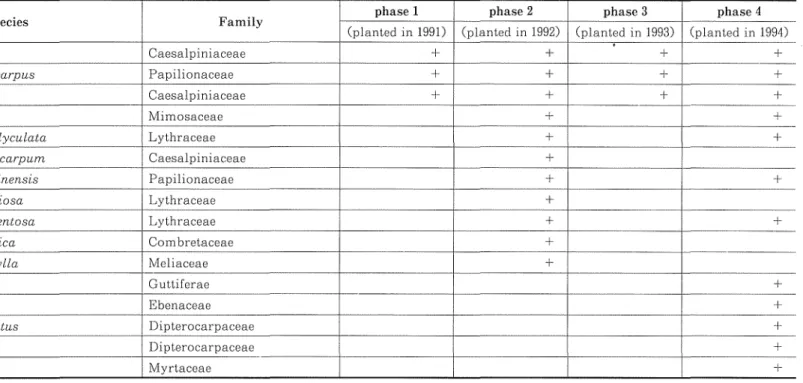
(11) Table 3.. Family. Species. Species for planting.. phase1. phase2. phase3. phase4. (plantedin1991). (plantedin1992). (plantedin1993). (plantedin1994). *Lagerstroemiacalyculata. Lythraceae. + + + + +. I'eZtrophorumpterocarpum. Caesalpiniaceae. --. + + + + +. *Af2eliaxylocarpa. Caesalpiniaceae. Pterpcarpusmacrocarpus Sindorasiamensis. Papilionaceae. *Xyliaxbllocarpa. Mimosaceae. Caesalpiniaceae. Dalbergiacochinchinensis. Papilionaceae. Lagerstroemiaspeciosa. Lythraceae. Lagerstroemiatomentosa. Lythraceae. *Terminaliabellerica. Combretaceae. + + +. + +. + + + + + " +. Swieteniamacrophylla. Meiiaceae. *Mesuaferrea *Diospyrosmollis. Guttiferae. *Dipterocarpusalatus. Dipterocarpaceae. *Hopeaodorata *Syzygiumcumini. Dipterocarpaceae. + + + +. Myrtaceae. --. Note:. Ebenaceae. * Natural eanopy speeies. 8.
(12) loe A}1 pots are placed in nuysery. After 6 months,. free of charge by Royal Development Division,. baby seedlings can grow 40-70 cm in total. PIanting techniques. height.. Planting is an important operation. Poor. The advantages for transferring baby seed-. techniques and unskilled pianting cause high. liRgs in plasti¢ pots are th at the root system can. morta}ity. The planting techniques are differ-. be well develeped and easily handled for trans-. ent from conventional planting in Thailand.. portatlon.. The main diffeyence is that the spacing of indi-. viduals is dense and random. A density of 2-3 Site establishment and preparatlon. seedlings/sq.m is employed, The seedlings have to be soaked in water before p}anting, in. Locatlng Lhe plantation site in the field and. order to increase moisture for the plant in its. setting its boundaries is the first step ln the plan-. first few days. There are severa} other guide-. tation process. Such important work can. lines: 1) avoid damaging roots by breaking and. prevent land conflict with nearby peoples' land.. crushing,2)plantseediingsinthesoiluptoroot. Then, the open-air site is ploughed by tractor. collar, 3) press around seedlings with hands,. and followed up by manual clearance by the. not feet (Figure 9).. }ocal peop}e. The existing vegetation cover of. the site must be preserved and protected from ploughing. There is no burning involved in the. Mulehing. site preparation, since burning increases weed. After young seedlings are planted, mulching. occurrence, Since Ban Bor Wee site is a gentle. with grass and rice straw is necessary. The. slope (about 5-12%), additional substrate con-. yice straw/grass of the plantation forest are. struction is not needed.. functional}y }ike the litter in the natural forest.. Since the soil has iow fertility, adding. Tke advantages of mulching are as follow: 1) to. compost fertilizer is necessary. The rate for. prevent high evaporation and keep soil. fil}ing is around 2 tons per Rai (6,25 Rai=:: 1. moisture, 2) to prevent erosion and rapid runoff. hectare).. on steep slopes, 3) to decompose and become. Small holes (2 times bigger than the seedling. good ferti}izer for newly planted seedlings, for. pots) should be dug before planting. This. examp}e, nutrients for plant to take up in devel-. activity is done by local villagers and school. opiRg its root system in the earlier stages, 4) to. students (Figure 7).. reduce weed growth,. At pyesent the demand for rice straw is in-. PlantiRg Day Arrangement Planting should of course be done at the begin-. creasing. Its cost is a}so higher because the. demand has increased, For example, large ranching schemes need rice straw to feed cattle. Ring of the rainy season, during June and July,. during the dry season. Instead, grass such as. Each year, the number of participants is about. alang alang (Jmperata cylindrica) can be used. 600 local people, villagers, school s£udents, and teachers (Figure 8).. for mu}ching,. Before p}anting, the participants are instructed in the value of the forest and impacts. Quality control after planting. from deforestation. Village leaders, who are. Toimprovethequalityoftheplanting,careful. already trained in p}anting techniques, are the. checking just after planting is needecl. For. foremen and help the unexperienced volunteers. examp}e filling with soil to cover newly planted. on how to plant seedlings, Facilities such as. individuals is not good. Some forgotten seed-. transportation and lunch are supplied to them. }ings have not been planted yet. Sometimes,.
(13) 鰯. 出. 懸 醗欝欝、. Compost f奄rtiIizer §. Figure 7 Preparatlon before plantlng.
(14) 欝 羅糠. ・藻. 難. 髪 ㌔ 《羅 u墨≧ 、膿‘ 結テ. 撒灘 難懸 i罵煕 綴鵠穂齪鰻…親 まぶゆ ゑバ き. 鍵叢/. Figure 8. Plantlng Day.
(15) "r'. TS irm'F-tEV..:':-s'.・:,;'N.'t,i'・;',.. x I/':';;"t:". '"J't"s".:tf". Nv--"/. 1. lv e. N Dig hole (40x40x30 cm.). ,Z ..:, ).. ,. X ' li./llfl". ,.7'7.t..-:)... "'. :. Zir'. xth. X. 4M. O. (llliiillllill. 30. 6H. 2o. 6 -.. IO. h.・,. = ;':Y. --= . IAN. .7,.;:d'x. 71t'J<Nt .i?. mulcking. Soak with water. Trop icai R ain. ;s- X・・N. forest. tt -. tt. ". ,.f "/ ''1・li'?1:'11'li・':'i;III:・・. f. ,, press softly around planted seedling ・.,:.z・.i:;sl". ts sY t. ::::t '11 ,/;.t'.ti`. `:'!'ttt'ti. fill with mixed topsoil. Remove seedling from the pot and transfer into the hole. Figure 9.. Planting techniques.. g.
(16) 104. mulching materials cover the top or some parts. harvested by thelabor force. Manual weedlng. ofseedlings. Plastic bags have not been taken. by hoeing with bushknives or brush hooks is. out properly, Those seedlings which are not. done, This temporary control by hooks,. well planted must be re-planted. While walklng to check the plantation avoiding. however, involves some risk of cutting. There. stepping onjust-planted seedlings and pay more. soil pollution and other side-effects,. is no chemical weed control, in order to reduce. Weed community and weed control. attention to soil compaction.. Only one week after planting, various weeds emerge and grow rapidly (Table 4). If the rice. Maintenance. straw mulch is applied in a thick layer, weed. Maintenance was done by school students,. growth tends to be lower, since weeds need more. parents and villagers, mainly weed control, fire. sun light for gerrnination, There are both. preventionandanimaldamage. Weedcontrol. annualandperennlalweeds. Annualweedsdie. has to be conducted because grasses, herbs and. in the dry season (in March-May), but their. shrubs, unwanted trees, creepers, and perenni-. fallen seeds can germinate in the following. als grow faster than newly planted seedlings.. ramy season.. Weeds and the other unwanted speeies are. Table 4.. List of weeds of the plantation area.. Species. 1year. 2years. 3years. plot. plot. plot. grass climber. + + +. + +. grass. +. +. Euphorbiageniculata. grass herb. Echinochloacrus"galli. grass. Pennisetumpolystachyon. Mimosapigra. grass herb. + + + +. Eupatoriurnodoratum. shrub. Anzaranthussblcblathuya. herb. Sidarhombifolia. sub-shrub sub-shrub. Emphorbiahirta. herb. Elusineindica Passiflorafoetida. Dactyloctenium 'aegyptLacunz. Cenchrusechinatus. Abutilonsp.. Leersiahexandra Clitoriasp.. grass cllmber. Celastruspaniculatus. climber. Passifloraedulis. climber. Tridaxprocumbens. herb. Solanumnegrem. shrub. Digitariabiformis. grass. + +. di. + + + +. + +. + s + + s + + + + + +.
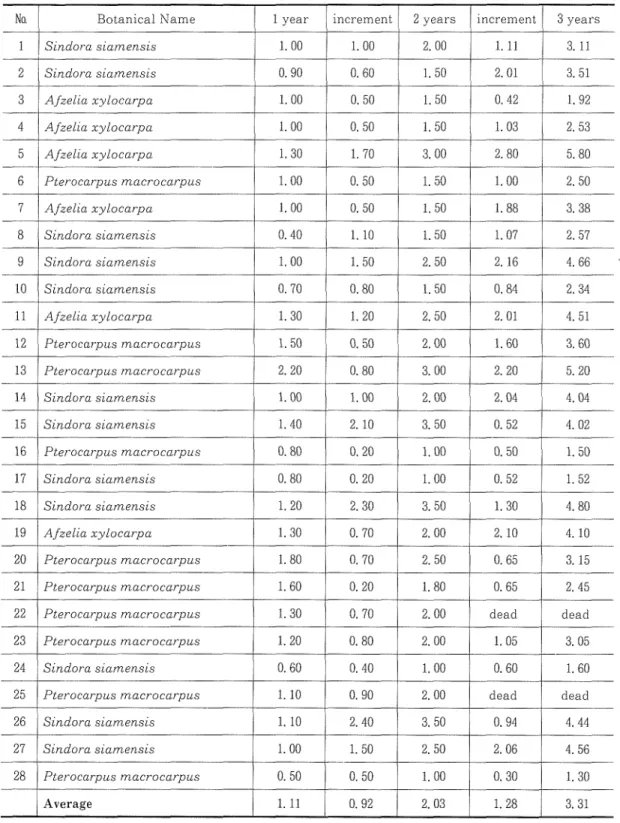
(17) 105 Fire prevention. for instance, making fire- break strips, fire ob-. Fire preventiofi is very important. Fire, whieh. servatlon.. mainly is caused by humans, can destroy the. Animal damage. efforts of years within a few minutes. Burning. Anima} damage, particularly from grazing. may a}ter the composition of the pioneer flora. domestic animals such as cattle is sometimes a. and will reduce the amounts of vegetative sprouts and surviving seedlings (Whitmore,. main problem with planted seedlings. Not. 1990). Evergreen forest spec2es hardly recover. seedlings but they also compact the soil.. after fire, and deciduous species easily cateh fire. Thus fire preventfon, has to be practiced in dry season, particularly in March to April,. ,. only do animals eat grass including the planted. Results Planta£ion on phase 1-4 was done as Table 5.. Table 5.. Place. BanBorWee. BanNaNok Peed. Chitralada Palace. stage. Project progress (as of November 1994). planted. plantedseedlings. area. phase1. 25June91. O.8ha. 17,250seedlings. phase2. 20June92. O.6ha. 10,OOOseedlings. phase3. 20June93. O,8ha. 12,eOOseedlings. phase4. 2July94. 1ha. 20,OOOseedlings. phase1. 16August91. O.5ha. 7000seedlings. phase2. 12August92. O.3ha. 5,OOOseedlings. 13June1994. 3xlO. sq,m.. 250seedlings. are shown, for plot PQI-1, in Flgure 11 and. 1. Growth rate of mixed-speeies stands of planted seedlings. To collect raw data on the growth rate of planted seedlings, permanent quadrants (PQ) of 4x4 m or 5x5 rn had been set up on the plantation site,. 1) Height growth rate The growth of individual p}anted seedlings in total height and its increments are shown, for. Table 10. The average basal diameter is 1,ll ern, 2.03 cm, and 3.31 cm in the first, second and. third years respectively. Afaelia xylocarzpa, which has a characteristic good s£em form, has. the greatest basal diameter, followed by. Pterocarpus macrocarzpus and Sindora siamensis respectively.. 2. Comparison of weed control and an unweeded eontrol ple£. plot PQI-1, in Figure 10 and Table 9, The average height i$ 57,21cm, 134.96cm, and. This yesearch focuses on whether weed control. 174.42cm in the first, second and third years re-. is vita}ly needed for implementation or not,. spectively. Sindora siamensis had the greatest. based on study of growth performance of. height, foliowed by Pterocarzpus macrocarlpus. plantedseed!ingsinaweededcontrolpiot(PQI-. and Afzelia xylocacpa.. 2) and an unweeded control plot (PQI-3). The. 2) Diameter growth rate. growth・ratesofthetwoplotsareshowninTable. The average basal diameter and its increments. II-14 and Figure 12,1, 12.2, 13,1 and l3.2..
(18) 106. 300.00 250.00. .- :・. 200.00. E. M 3years. .S l.. rr. lse,oo -. pa 2years. ,9. o. x. es1year. 1OO.OO 50.00 o.oo `'i. co・. ca・. di. di. co・. co・. c,i. diuidicvxx di cu x' cu. E. d. E. d. E. d. E. d. E. d. (is. >as. individual seedlings. FigurelO. Heightgrowthin. Plot PQI - 1.. diameter (cm}. p o o s,s.. N tp .pt. r o o. 9 oo. Yi. o o. -----Lta---t-- s- t-- +--- -- --- t-. s.s,. -- -- -- --. s.s.. men. = m co. -= 'vs -v= es. --. --J -..----s i. -+-t-----PP -- -- -- -- "--1--'. s,s.. l------E-J-l-s'. ".. ve. -. --li--. -- t- "----liE"-t '. s,s.. --Lp------ny4--t... M 3 years. ss-. "--t--. s.s,. -------+------t -T -- -- s-S--t t- --- l-. a.x.. -s- -- -- -.- --s- -L. t- --. a.x.. /. -----ib-----. va 1 year. -. ----l----t-------. a.x.. za 2 years. 1X'. -. .--l--L-----. ×. --l -' tt --E- --' -- --- -- "----1-. ----b-----------s. p.m,. -- -ll -l -- -l l- -- --. Figure ll.. Diameter growth in plot PQI - 1.. --tl =. ----11-S------t--E'. p.m.. tt --- -l "- E-t- -- -t -- -t -- --S --S. -----sit--. p.m.. -- -- ---- l- -- l- -- -S --. Species. -Lt -- -- -- --- -t. s.s. := Sindora siamensis. '4Hnt'-h-.. f/ /. ----- -- -l -- -- -- --- --. '. p,m,=:Pterocampusmacrocarzpus a.x,="Akeliaxylocarzpa. ----.----------------. p.m,. --- -- L- tt -- -t "--t------------i-. p.m.. -- -- --t -t sS -- --t- -t -- -l --. -t------silii---s. '. s----t. ave.. t--t -- -- ll -t -- -- -- s-l -l st. -. '.
(19) 107. 350.00 300.00 i. 250.00 『. ハ E ε. □3years. 200.00. 望 .9. §. 圖2years. / /. 150,00. ①. 團1year. \. \\. 拠. , \. 二. 10α00. \. /. \. ・\. \. /i…….. 50.00. 、. /. !\. \. /. r. } 「. \. 0.00一. 十. の. の. の. わ. の. の. 干. }. う. 諺誇誇霧怨塞宏膀霧霧巨器 individual seedllngs Figure l2,1. He{.ghむgrowth in p三QもpQ蓋.一2. (weed−contro玉. P玉ot) S.S.=SlηObrαSごα17ZθπSごS ρ.∼η.篇Pオθ1℃cα∼↑ρ㏄s1παcノ^ooα∼ws α.κ.皿・喰疏ακ)’Zooα∼↑ρα. 300.00. 25αOO 200,00 ε ハ ε. 日3years. 三 得0.00. 囲2years. .9. 園壕year. Φ. ‘. 100。00. / o. 5 ・. 9. \ \. 5α00. /. ・. 辱 、 凸 :. 0.00. 猛琶巨&. 監糊陽陽闘霧紹翻 lndividual seedlings. Figure 12.2. Height growth圭n p}ot PQi−3. (unweeded control plot).
(20) 108. dinnieter (cni). 9 o o. p th. o. r. o o. Lh O NP99 ouo th Oooo oooo " .A L.h. rth o. s.s.. s.s,. s,s.. s,s.. co. en. = s.s.. L'`. ve. oco s.s.. -"=. 'v s.s.. U3years. 's b'. su2years. = s.s.. --. fi 1 year s,s.. Figure 13. 1.. s.s.. Diameter growth in plot PQI-2 (weed - controi plot). s.s,. Species s.s. =:Sindora siamensis. s,s.. p.m.:=:Pterocarlpusmaeroearlpus s.s,. a,x. == A.feelia xylocarpa. p.m. ave.. ctiameter {cm). co .pt .pt an o .o b Aen ro NO 'an b itn b o o ao o o b th b -)L. p.m.. ooo oooo. '. p.m. p.m. p.m. '. to. =a =v o. '. s.$,. st. s.s.. v. '. s.s.. o m -es= v> i---. ttt. p.m,. s,s,. M 3 years ----.-t. M 2 years. .t-. X1 year. '. s,s,. s.s. s,s, s.s. s,s. s,s,. '. s,s, a.x, t.. a,x,. Figure 13. 2.. DiametergrowthinplotPQI-3 (unweeded control plot).
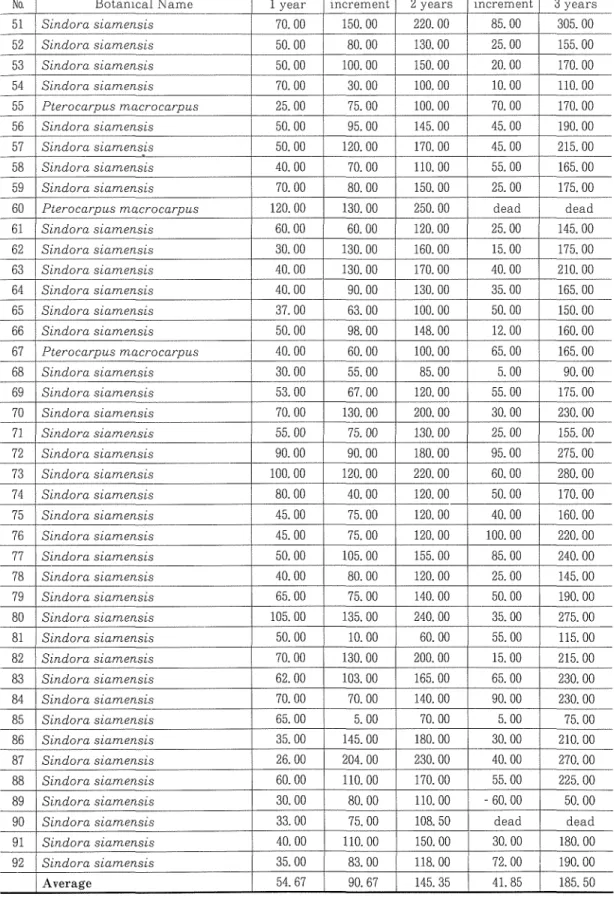
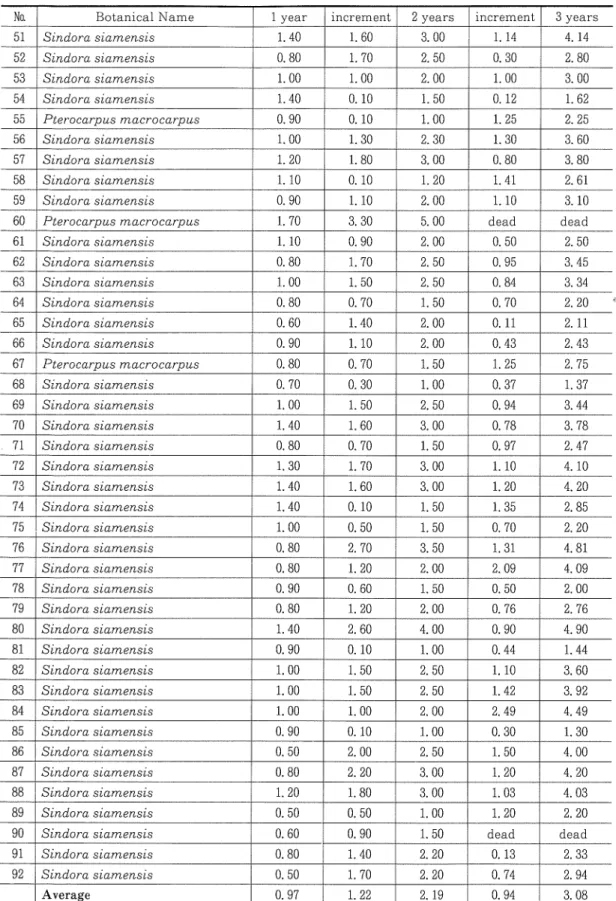
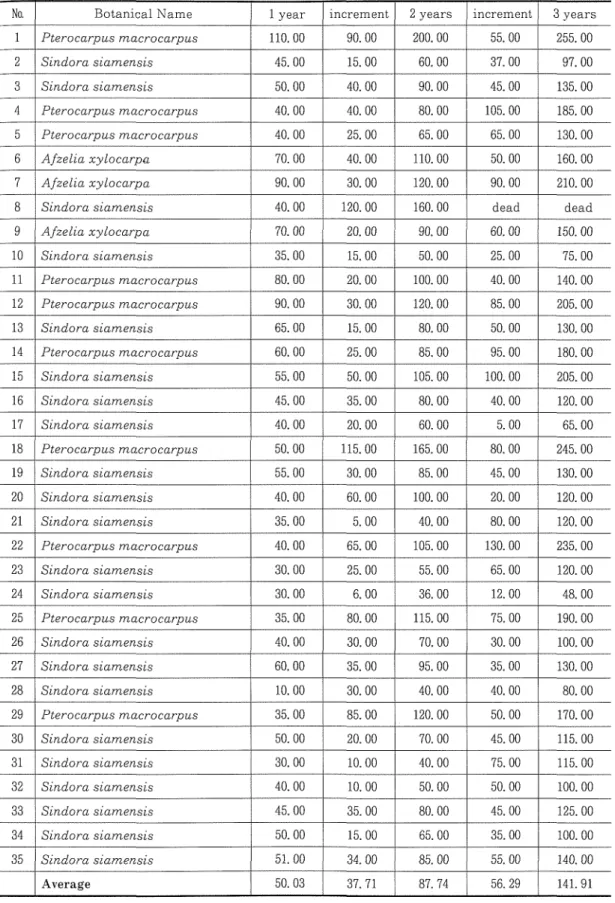
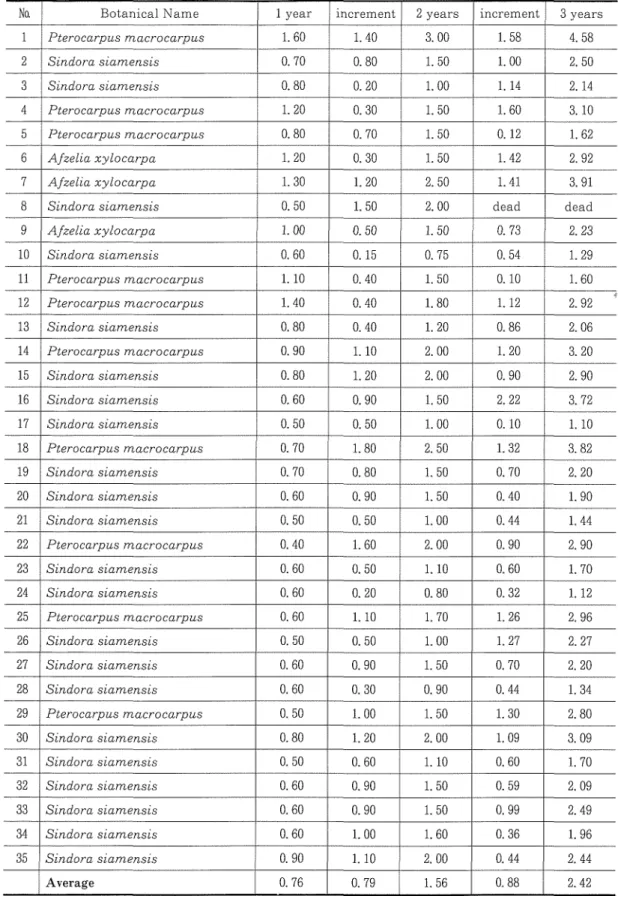
(21) 109. The average heights of the weed control plot were 54,67cm, 145.35crn, and 185.50cm, in the. first, second and third years respectively.. co. y. cu. Corresponding values of the unweeded control. or. x. ca. plot were 50,03cm, 87.74cm, and 141.91cm, The average diameters of the weed control plot. k>. were O.97cm, 2.19cm, and 3.08cm, in the first,. ,H. >k sop. second and third years respective}y,. oR. Corresponding values of the unweeded control p}ot were O.76cm, 1.56cni, and 2.42cm.. o kes. o. cu -・ co. respectively (Table 6). The probability associ-. on x oo ev. on. ou. .. co. ts・. di. co. g・.. ed. k opa. ated with a Student's t-test (P) < O.05 shows sigg・. nificant difference at £he 95% confidence level.. E. [E'able6. T-distributiontest.. t6. sourceof variation. diameter. a & Eg. 1. year. p :=: O.O0208. 2. years. p =O.OOO153. 3. years. p =O.O025. 8 :. co. p -O.33. p:. veryfew. p "O.OO08. .. ts co. ts・. co. oc. owo. ts. n' co. wti .-H. r--. oo co o'. oo o' n. ou. nec on. F. o -. Csq. F. .. a N' F. ts to o'. T'-. ts. CL". or M' ev rl. o o -. om・. ou. Affo. v. tihD. ed. k. or. o. oo. opt. su・. rirt. co. oo. ・as. nc. N k. x. edo. h. -cu. height. co. oee. x. es¢. ferences between £he weed control treatment and unweeded control treatment at 1, 2 and 3 years. co・. oe ts. ¢. k. A T-test was used to determine s!gnificant dif-. co co. T--. ou ts・. - n. g. e. TMI. w ts ts・. o o tio. co. o n. co. O o' R. su co. co. csu. co. .. .. ts. su・. co・. an. B. g Based on the table above, weed control very signif2cantly affects the diameter growth rate of. g o. (p<O,05). Nevertheless, weed harvesting. [lb. first year (p> O.05), although it appears very. k o. ed xoo. sp. planted seedlings during the first 3 years appears not significant for height growth in the. co. g. M s ge. <. highlysignificantinthesecondandthirdyears.. ts・. This is because, in the first year, planted seed-. fl. Ag v es. v. .rv-. gi. Height growth differences in the weed-control. k. os¢. x. N. o. p s. h. es. g-). 3. Survivalrateandviability. or. .. .. o ou. high and there are no insects and disease.. ev. c-q. o. o N. -o -. N. LO. m o. ts. ots o. co. T-1. oc. co. su. Iw-. 1T{. 1-. d-. or. tr. r--. .. or. -EII. R. cr pt. vgc. -di Q". -. 7. 0bviously, survival of planted seed}ings is relative!y high. Similarly,the viab2Iity is also. .. co. 6o. The percentage survival rate is shown in Table. oco. .. Tm'l. .. aj. treatment and unweeded treatment were therefore not significaRt.. .. co. ked. iings need to estab}ish their root system.. -. co co. -Ste. Q". el. .. e pt. .. pa. n o. .. m.
(22) llO. when neighboring seedlings beg in to touch and. 4. Dynamicsofs£aRdgrowth. overlap. Some trees are slower than others. A. range of tree sizes emerges,. Tree growth is non-uniform and depends on both genetic control and environment factors.. with different. crowns.. The dynamics of growth of planted seedlings is. thuscontinuallychanging. The stand groweh,. 5. Some ecologieal factors from ERM. which is spectacular, is shown in Figure 16. In. method. the first year, newly pianted seedlings need root. system development and adjust to environment. Vegetationleftoverafterploughlnggrowfast,. conditions in the new slte. There is high com-. Therearesomespeciesofants,earthwormsand. petition amoRg root systems for moisture and. termites which have functions in the p}antation. nutrients, between p}anted seedlings and a. site. Inmostsoilstermitesareamajorcompo-. variety of weeds, particularly during the first 48. nent of the so-called soil macrofauna. months. Inthesecondyear,s£anddevelopment. (Whitrnore, 1990). Besides, seedlings around. is rapid. Interestingly, light competiiion occurs. termite- made rnounds grow well.. weeded. AE e8 , o keh. xeb xe .l-;. 200. - s.s. 150. -P.M. IOO. -"Ar--" AX.. unweeded. 50. + s.s. .pt. o. 2years 3years. 1 year. )*e---・P.M.. -- -gb--- A.X.. age tyear) Figure 14.. ・---. Height growth of individual species,. S.S,=::Sindorasiamensis P.M. = Pterocarpus rnacrocarpus. A.X.==Afzeliaxylocarpa. 4. weeded --e-- ss. 3.5. AE u ts. s. E. .£. v. 3. - P.M. 2.5. '--kr--' A,X.. 2. unweeded --rlx--- s.s. 1.5. 1. ---)ee--- p. M.. O.5. " A.X.. o 2 years. 1 year. age tyear) Figure 15.. Diameter growth of iB dividual species.. 3 years.
(23) 三. Figure 16 Growもh dynamlcs of mlxed−specles stands.
(24) 乳㌦∵㌦爽よ 璽 艦爾㌔\ポジ 撫・帯罫. 器. ㌦鷹・1触㌦}. 鑛. 一離騰簸膿購・鰹羅. 慧 騨ξ. Figure 16 (cQntlnued). Growth dynamlcs of mlxed−spec主es stands.
(25) 113. 6. Urban rehabilitation and microenvironmen£al changes at Chitralada Palace Site. leaves and other decomposing materia}s are used. The mound is then covered with soil, Topsoil of 30cm thickness should be added in case soil is oflow fertility and nutrition. The. ThissitestartedinJune1994. Themainfocus. mound heigltt is approximately ha}f of the base. is rehabilitation in urban Bangkok, The site is also representatlve of flat areas wlth high water. width. Pianting on the mound is done with canopy species, Then rice-straw mulch is. level.. added,. 1) Planting technique on flat areas. The planting technique on f}at sites is, of. To compare environmental changes due to planting, meteorological instruments for tem-. course, different from that on sloplng sites.. perature, soil moisture and rainfall are set up. Mound construction is needed to increase suit-. ontheplantationareaandbareland. Thedata. abi}ity for plants. In the rniddle ofthe mound,. are recorded regularly.. materials such as dead wood, trunks, coconut. Figure l7. Plantation forest and meteorological instruments. at Chitraiada Palace site.. 2) Growth rate. The average height is 48.44cm and 61.39cm and 1.09cm. The growth performance of planted seed}ings. with average diameter of O.68cm. at Chi£ralada Pa}ace site is shown in Tables 15 and 16 and Figures 18 and 19.. after 1.5 and 5 months respectively..
(26) ll4. 200,OO 180.00 360.00. A E. .S l.. E. ,9 tu. =. 140.00 /. 120.00. " 5 months. 100.00. Xt.5 months. 80,OO. -. 60.00 x. 40.00 t. 20.00 o.oo. o. ii. o ii. 2・ oo di <<<d. oui. o F. dl・. > ru. iRdividualseedlings Figure I8.. Height growth at Chitralada Palace site, Bangkok.. diameter (cm}. o oo H.O.. o or o. -x o orAMo. N a o. o o o. Species. H.O.= Hopea odorata C.I. -- Calophyllum inophyllum. H,O.. S.C,==Syzygium cumini A.X.==Afzeliaxylocarpa D.A.= Dipterocarpus alatus. H.O.. T.G. = Tectona grandis. H.O. ca. o vo-. L.C,:=:Lagerstroemiacalyculata. C.L. sc. '"'. o. ca -ny. C.L. thsmonths 1. S-Ci. M1.5months1. as. =. 's -> l-. v= ---t. A.X A.X.. A.X. DA T.G ave. Figure 19.. Diameter growth at Chitralada Palace site, Bangkok,.
(27) ll5. 7. Climaticchanges. Chitralada Palace site Bangkok ,cluriRg13June-. 12 November 1994. 1) Temperature. is shown in Figure 20.1 and. 20.2,. Temperature of the plantation forest at io. Sl). -l. oA "4. ". "v. oA "v. 4; r.3. g N. es. E?ii ue$g'kgrwgg'h¥g'tr(geh gaue"agup. E. 44. 9. ok ・?s pt :-s -m}. -l. ,V7・. 1'5. 21,. g:-. g. :s. 9. V"',. "'-..1,'. ' r .-,.r・-,.s,......v..-.y. 1'. t.mttt. ttat. -.. .tt-Mt-.-. 2・e. """" ,xx. ytf"'IV'. :' :i. 2・O. thttAtsthuY-krmimwLLtLulalliminttiniNimth-halualtmiminimlldiuzlathulluMltLu. :e. IS 7.tl tS, SX'1 1tr, e!1 Its le/tlS !lfl. IS. 7,il {: /t',,'l ;,: ?,Xl IS teg':・ it.. IWL. date (month/day). date (month/day). Figure2e.I. Dailyhouriytemperatureinthe. Fig ure. 20. 2.. plantation area.. Mean daM>・' temperature in t・he. plantation area,. From the above figures, the daily hourl>r tem-. peratureoftheplantationforestisrangingfrom. 2) Soil moisture Soil moisture of the plantation area. and lawn. 24.00 C to 41.20 C, with the mean temperature. at Chitralada Pa}ace site }3angkok,. in a day from 24,50 C to 30,50 C, during l3. June- 12 November 1994, is shown in figure'. June- 12 November 1994,. 21.1-21,4,. rJ. / -Ml 11. !.7. a o. t).L. o ts. L,8. ・ ,11. 2- A. ..i.lriiiill.. E`iiiiiLiiitiaLiiL;'`ejrhF・r/f'i.;i/:1. ul.tiwl. i. 2.S fS tt,.s. ji. O 2,4. ,i,,i"iiiiW WLiig,,,,,tseqfvi tiitsi vJvrv,"jLll"l. v. O 2・,:ig. ,z. !,F・. o G. ・Z 2. ,s. oca. .3 diuilntellati. IS 7/1. iuimLimduzimhfufuabesJimmhudeitli. l,L,. L 1ts 7・11 tt, imanmudnimimhnmunirm e,'G E e/'l tts lgt'tlk. H.il. tr. e/l ls s/l ls lg/t!i lat't. Date (monthfday). Date (monthlday). Fig ure 21. I.. Daily hourly soil moisture. Fig ure21.2. 9ailyhourlysoilmoistureinthe. lawn area,. of plantation area,. 11-,.11 i・-. :-J,. 2- ,7. ¢ 2.4. O 2,i g t,a. "'"'' ' " "''''"' '' l.igtvau/ILtyvn i/ rivi'-"' vrrrff. "t"Vtti. i..1'..il. /.. Z.3 2.S e 2,,. H i2. e Lt,2 ts ". s ,.. T. t,6 ,,,. :: .s. o. '. m .e. OC. t.2. 1:tt. 7!1 ttr, E:!1 IS S/1 IS leftIE Date (monthfday). Figure 21. 3.. Mean daily soil moisture of plantation area.. " ., re ij vi,, K.g Ml,v 1. s. ・XL O L8. tta"o !s. r.b. ,Lq・. g t,a. .s. C. iil ltsEs. OE L3 g . Ls .-. t,2-. ::Hf. during 13. t. ..i...,(1]v"・t. ls",r.t"V ivi. i. imtiin-dim-imnftthnd-nd IS T・11 tS ell 1tr, e!1 tS lbft1lt. 1]!'1 Date (month/day). Figure21.4. Meandailysoilmoistureinthe lawn area..
(28) 116. The soi! moisture of the plantation area varies. 3) Air humidity. less than that of lawn area. Even young seed-. Air humidity of plantation forest and contro}. lings can keep the soil mois£ure more than lawn. at Chitralada Palace site Bangkok, during 13. area.. June- 12 November 1994,is shown in figure 22.1-22.4.. Iee. l re. 90 IA iR so. V 70. b. lg:, ". l. El 1. l. i. IV. I. i. "'. I. ,i. e yo sk= 40 3e -T."-. u. lj.l. r. ts., es. !ee e・i.ii'. iili. 1. ee. A V 7e. }S eo. b. ts.4 eo. ': se stpt .hCl. .ts :.s. N 2e IO. o. 2g te. i 1ts. 7s'1 t. S/1 tE. 911 tS. 101t IE. s IS 7!1. 11/' 1. Figure 22 .1. Dai}yhourlyairhumidity of plantation area.. Figure 22. 2.. Dai}y hourly air humidity. 100 JAv,A,,,Ai,"vi--'" VAJ]VliwiAjuif"friHVX<bvN.,.,. A eo. so. A V 70. ftVXyxYrSt,,ew)vvM aL ]">li'"YJYx, ,,... lsi9 eo. *v 70. b. b se. ts.- so. b se. 'g se. ..=. : go. .ts. 3D. .tt 20. !o to. I. .st= 4D. e 4o. Le l). s,. of lawn.. lee. a. 11!1. Date (morrthfday). Date (monthfday). so. tS S,tl tt S/' 1 tS 10t't15. IS 7/1 !tr, B!1 !S S/1 IS leltIS. 11fl. o '1ts 7fl tS efl tr, e!1LtuLi"tullbinJ lb!L IS !$. Date (month!day). Fig ure 22. 3.. Mean daily air hurnidity of plantation ayea.. From the above figures, the air humidity of plantation forest and open air are similar. A reason for this is that planted seedlings are still. 1211. Date (month/day). Figure22.4. Meandailyairhumi oflawn.. dity. instrument was set at 1.30 m. 4) Rainfall Rainfall at the piantation forest at Chitralada. young (only 5 months, with an average 61.39cm.. Palace site Bangkok, during 13 June-12. in total height). In contrast, the air moisture. November 1994, is shown in figure 23.1-23.2..
(29) 117. tt.--tJtt.'-tTt---t "'thiF,r,:-t : dt.・Ll /t i,Ihde :fdll,1".・H. ";m.,i F.・,`. :)/:kl[i]. iStt'. '/tVl'h.1] 1;.:4L:: /;・. ,'1ec/.. lILcblLlh,/LLI÷ t. ilg'mg :,t -CIGIj. 4i. I I. .{:-s "/ ・/l]. te;.!i. l l. jlilbL"rt ::ee. l. l. 1. tt)':.・!l. ll. -j]s. li.si'Trt+:ir'-. ll,it,":tc.tt.E:IE,;tP":b:-. H)10. n.-l- -l l. lttt'[op,・. ...j-.kt- ". " .v -....l.."i-,..i-.. ・H:(,;il/:lrt. h-. l:)t.・!j:・'..31,):t.::・E-:plfi. i. ・Cttelh"l/,. -:":11:li'J±],. 1)Ol]r)apt"d/dTj::d I・([illp:ll'・ICI-).I't1:・1. llliti,l/LiZ.-.1l,l.2:::・. I・i'?/il'・'.ii:;!.',T・is';za". '--ttft----l b. l. t. ;・r,. tz. I/Li. g・. ・L・. e・. 5,. :・. tr,. ・'. s. J,i. Sl,. ,//,. ,t. 'i"". ・;s. '・L,. iP.. g. tft. t'. rj. /r.. /:. :.1l. ig・. ;. t?'. Ll. ;r;. f.'i. ・1). "lewdid I'.t4-th"... IrFFrl'F'FrFF C"-su). M.S t.,s 1:'-./33.lts -tE.・/S,iotE). /l・・i. ;-4 :J,. let. ii. LIi. f'i. c,. lt/. tt.. r.r.1-,. ;).. Ll. :l,i. l-. lk・. iEe,. i. l・;. I{・. :i';. 1,),. "". i:-f'r. ;,"[tn-slE]Ot,.Blll. r'. ,i. I'4/. lk・. .IG;. I,t. l;li. FF,. L,:ur3,tr] : I. aLLe"-L. l,/r.,. Rainfall o fplantation forest during 13 June to 31 J uly 1994,. Figure 23. 1.. i::・.,`:-・d" 3,"i!lii '"'---- lgihia;.;tr-r,-r-,;.. 1I,tMr!t:u'). Rilll・tr・,s-l,il・H. t'. /tt.-/{.- Sl lt:tl:t':#.,:.,. l 1i・l'J"'l]O:t. i l. 1. H}efiilt) H):・pt)l.). H N H. -・tdl・5,.)tl). -i:tttt]erl. tOIS')OO lt±-ttt)Lin.). l.":"::sei']. 1. I. jhiklt,i.-.tiL.. i -..L. i i,t:diel.11,J.1,. l. 1 l i l l i. l l. i l. ii.,ts.if,t :.lkif;e. l. I l. li u・. ..k,-.H-.l/L.tl.i. 'l' iii. lt"・';'hpT・ ':.-.,:;..;・1gs:['tr-D.・. i'. ilil±I. .X,jT].. ,KJ...t-.-LlT1-L.. ..1;-;op',・. :,x l!.tr・: IS:lli, ,.11aniol. L・. i' iOIIIt)O(,t:if'J.'±O. 1. i,ttleno2.-. i. l ': :, !ltlttti i・/n-・do:・.. l. I::.it:.:t:.2.ll..:.:.. l. iK.V.V,'1;-'r:tl'・,・.・,t. t. I --..;-,-vd.",...ttlsli,o5;. It-r:i','e-trtftt・i-kde,. }-; crr. FE'. n. i.li. ct. tt "-. m. L't. tr,. :. [-;・,. ':". r),:. l. :ti'. I;-lil. :'t. Is. lg. El・. ・:・). i!. ti tt. s:. ,:r:. 't't. T:.:. ril. g;. ;. s・. .yt.,. l;.I・r.. l・, ie"-'・. ie). :i'. ;・)l. :1: It;.. le.,'./ u,: '!l. ti ---,/(, t" t- -,n ,SJ +). f. /,1-:. ew t tg;t'i ',/' r ,.ll. tttt tt tt]s. ls rl ;- I,J,. .ti. I,t,. a. f:'. Fj ill. iT・. I:Tt-ww. -tt-tt- ---rt-t.tt.J-t-wwt. Figure 23. 2.. lF'SFFFFFFFF <ft'/rtLg. PtTS t.o ISSS.w/S ・(E・tFt"m.1.. <rlle. :tt・N-・tlCilLellt. [:,llt's・tr] : 1. vaL--HS-F'-.----r.. Rainfa}1 of plantation forest durin g 31 July to 12. November 1994, The pattern of rainfall in piantation foyest. which is applied in this study, is different from. shows that the beginning of August is the peak. conventional reforestatlon programme, as. peyiod of precipitation. Yet there is rainfall. shown in Table 8.. from July to October. Unfortunately, there is. 1) P}anting cukure. no precipitation instrument set on bare }and to compare with the plantation forest.. The planting method is a mu}ticulture with mixedspecies. Incontrast,theexistingmethod is monoculture. As a resu}t of the ERM, the plantation forest develops into a mixed stand,. 8. Cemparisonofconventionalreforesta£ion. programme and ecolegieal restoration. programme The ecological restoration method (ERM),. 2) Species. The species whick have been planted are natura} canopy species, while ordinary plantations focus on fast-growing species. There are.
(30) 118. Table 8.. Differences between the conventional and ERM methods for restoration,. CoRventionai. Issue. Method. Ecolog2cal Restoration. Advantage. Method Planting. monoculture. mixedspecies. higher diversity. 'specles. fast-growing'specles. indigenous. morenatural. 'specles. density. lowerdeRsity. higherdensity. lessweeding. plantingtechnique. lessintensive. moreintensive. greater. survivaland. growthrate mulching. nomu}ching. mulching. keep. moistureand 'mcrease fertilizer. seedling. noll-seiected. selected. thinning. thinning. nothinning. 'prunmg. 'prunlng. chemical. pesticideuse. Il]ucal){ptus camaldulensis, A2adiracta indica,. Melia azedarach, Gmelina arborea, Acacia. rapid establishment. 'noprumng. nopesticides. lowcost lowcost lowcost. 6) Seedling selection. The seedlings for ready planting shou}d have. catechu, Leucaena leucocephala, and so on. The. well developed root systems and be healthy.. caRopy species which have been selected gradu-. With such $election, the rapid establishment of. a}ly develop into a more natural forest and show. newly planted seedlings can be obviousiy seen.. higher ecological productivity.. 7) Low maintenance. 3) Density. The ERM technique is a dense method, with 2-. Major maintenance which is done by }ocal people is needed for only 2-3 years after. 3 seed5ngs per sq. m. The aim is to let free. planting, after which nature itself can continu-. competition ofsun}ight occur.. ouslycontribute. Silviculturepracticessuchas. 4) Planting technique. thinningandpruningarenotnecessary. These aredonenaturally,andthecostformaintenance. The intention of planting is more specific than. usual, This includes soaking seedlings with. is therefore relatively lo w.. water before planting, taking care with seed-. 8) Chemical pollution. l.ings during real planting, and softly pressing. There are not any chemical (pesticide and in-. around seedlings with hands. Such intensive. secticide) applications. Thus soil pollut2on is. planting shows high survival and growth rate.. avoided. Micro-organisms can function.. 5) Mulching. Besides, the plantation cost is less.. Mulching with rice straw and grass are practiced in this method, in order to reduce high. evaporation and keep soil moisture for new seedling growth.. Conclusion Growth rate and growth dynamics of stands ,. aj.
(31) 119 planted in 1991, provide some indication of. Ban Bor Wee and Ban Na Nok Peed for partici-. possible performance in ecological restoration,. Weed controlis needed for 3 years. The fre-. pationinp}anting. Wealsowouldliketothank Dr. Elgene O. Box, University of Georgia. quency and timing are as follow: 1) year 1 : 3. (U.S,A,), for he}p with Eng}ish correcting of. weedings (in September, December and March),. this paper.. 2) year2: 2 weedings (in June and December), 3) year 3: 1 weeding (in June), and 4) after 3 years, there is Iitt}e management.. Local participation is essential to impiement. Referenees Cairns, J., Jr. and Buikema, A. L., Jr. 1984.. the activities. Through educational process,. Restoration of Habitats Impacted by Oil. local people are willing and want to participate.. Spills. Boston:ButterworthPublishers,. The target groups of participants, unlimited in. ageandsex,areschoolstudents,parents,villagers and people ottts!de the viliage.. The natural potential species, planted in. Donner,W. I978. TheFiveFacesofThailand An Economic Geography, A PublicatioR of The Institute of Asian Affairs, Hamburg.. London, C.Hurst&Company. 930pp.. Chitralada Palace site, have grown and devel-. Evans, J. 1992. Plantation Forestry in the. oped well. The plantation area can keep soil. Tropics, Oxford University Press. Oxford.. moisture better than lawn area which maybe eaused by mulching with rice straw.. 403pp.. FAO. 1981, Tropicai Fores£ Resources Assessmen£ Projeet (in the framework of. Discussion. The Ecological Restoration Method (ERM) is. GEMS) Forese Resources of the Tropical Asia. Food and Agriculture Organization of. an appropriate technology because of its sim-. theUnitedNations. Rome. pp.429-447 Fujiwara, K. 1987. Aims and methods of. plicity and low cost, The help frorn local. Phytosociology or "Vegetation Science". pp,. peoplecontributedtotheprojectactivities. The. 607-628. Papers on Plant Ecology and Taxonomy to the Memory of Dr. Satoshi. application of this method can be suitably prac-. tensive forestry, and other multipurpose. Nakanishi, . 1993. Rehabilitation of Tropical. planting for sustainable utilization.. forests from Countryside to Urban Areas.. ticed for agro-forestry, community forestry, ex-. From project experience, the integrat2on of. both methodology and people-participation. Restoration of Tropical forest Ecosystems, pp. 119-13I, Kluwer Academic Publishers.. strategies to rehabilitate degraded areas is. Gomez-Pompa, A., Whitmore, T.C., and. possible but also need more effort and energy.. entific ecological knowledge should be taken. Hadley,M. 1991, Rainforestregeneration and management. Man and the biosphere series Volume 6. Published by UNESCO,. into account. Yet, restoration is a very hard. Paris and The Parthenon Publishing Group,. Further, muki-disciplinary approaches ofsci-. task, costly and time consuming. Therefore, the best is to prevent degradation,. USA, 457pp. Howell,E.A, 1986. Woodiandrestoration:An. overview. Restoration and Management Acknowjedgments We wish to express our sincerely thank to Aeon fund, Japan for a grant during October. Notes, 4(1):13-17,. Hunt, D, M, 1994. RehabilitationofGreen Environments in Urban Areas of Eastern North America. In Vegetation in Eastern. 1993-September1994, Thejapanesemembersof. North America, University of Tokyo Press.. Re-Green Movement (RGM) and local people of. pp. 431-456..
(32) l20. Miyawaki, A. (Ed.), 1985. Ecological Studies. Royal Forest Department. 1989. Forest. on the Vegetation of Mangrove Forests in. StatisticsofThailand1989. ForestStatistics. ThaRand, 152pp. (Japanese with English summary), YokohamaNationalUniversity.. Sub-DivisioR, Royal Forest Department.. Miyawaki, A., Fujiwara, K., Ozawa, M. I993. Native Forest by Native Trees-Restoration. Bangkok. Sabhasri,S. 1984. Humanimpactonthevegetation of Thailand. In Vegetation Ecoiogy. of indigenous forest ecosystem-. and Creation of New Enviyonments. (Reconstruction o£ Environmental Protection. (Miyawaki,A. etal. eds.). Proceedings. Forest by Prof. Miyawaki's Method.. of the International Symposium in Tokyo and. Bul}etin ofInstitute of Environmental Science. Phytogeographical Excursion through central. and Technology, Yokohama Nationa}. Honshu. TokaiUniver.sity Press. pp. 271-. University. 19(1): 73-107,1993.. 275,. Miyawaki, A., Iwatsuki, K., Grandtner, Miroslav M. 1994. Vegetation in Eastern. Santisuk, T. I988, An Account of the Vegetation of Northern Thai}and,. North America. University of Tokyo Press.. Geoecologicalresearchvol.5, Franzsteiner. 515pp. Miyawaki, A., T(ixen, R. 1977, Vegetation Science and Environmental Protection. Proceedings of the international symposium. verlag wiesbaden gmbh, Stuttgart, 101 pp,+75,. in Tokyo oR protection of the environment and. inThailand. RoyalForestDepartment. 48. excursion on vegetation science through. Japan. MarRzenCo.Ltd. 576pp,. Noda, K.et a}. 1994. Major weeds in Thailand, Proiect Manual No.1 National Weed Science Research Institute Project by Japan International Cooperation Agency and. Department of Agricultural, Ministry of Agriculture and Cooperative, Thailand.. 0ffice of the National Economic and Social. figures,. ,etal, 1991. P}antsforOurFuture: Botanical Research and ConservatioR Needs. pp・ Science Society of Thai}and and Scientific. Research Society of Thailand. I991. Biodiversityi Research priorities for Sustainab}eDevelopment, Bangkok. 24pp. SiamSociety. 1989. CultureandEnvironment in Thailand. A Symposium of the Siam Society. The Siam Society under Royal. Nationa} Econom2c and Social Deveiopment Plan (1992-1996), Priminister Office.. Patronage, Bangkok. Whitmore,T.C, 1984. Tropical Rain Forests oftheFar East. Oxford University Press. Oxford. 352pp,. Bangkok.. Whitmore, T.C. 1990, An Introduction to. Development Board. 1992, The seventh. Paivinen,R.,etal, 1991. ThaiForestrySector. Master Plani Forest Inventory Team. (working document). Royal Forest Department, Bangkok.. Tropical Rain Forest. Clarendon Press,. Oxford.226pp. ,,.
(33) 121. Appendixes Table 9.. Height growth and increments (cm) of plot PQ 1 -1 at. BotanicalName. No.. l, 2, and 3 years.. 1year. 'mcrement. 2years. 'mcrement. 3years. 1. Sindorasiamensis. 50.00. 90.00. 140.00. 55.00. 195.00. 2. Sindorasiamensis. 45.00. 95.00. 140.00. 85.00. 225.00. 3. Afzeliaxylocarpa. 37.00. 53.00. 90.00. 15.00. 105.00. 4. Afeeliaxylocarpa. 39.00. 51.00. 90.00. 65.00. 155.00. 5. Afzeliaxbllocarpa. 100.00. 75.00. 175.00. 15.00. 190.00. 6. Pterocarpusmacrocarpzes. 60.00. 70.00. 130.00. 30.00. 160.00. 7. Afzeliaxblloearpa. 60.00. 70.00. 130.00. 25.00. 155.00. 8. Sindorasiamensis. 30.00. 85.00. 115.0e. 20.00. 135.00. 9. Sinclorasiamensis. 50.00. 100.00. 150.00. 35.00. 185.00. 10. Sindorasiamensis. 45.00. 60.00. los.eo. 40.00. 145.00. 11. Afzeliaxylocarpa. 60.00. 108.00. 168.00. 42.00. 210.00. 12. Pterocarpusmacrocarpus. 80.00. 80.00. 160.00. 40.00. 200.00. 13. Pterocarpusmacrocarpus. 100.00. 90.00. 190.00. 55.00. 245.00. 14. Sindorasiamensis. 65.00. 75.00. 140.00. 40.00. 180.00. 15. Sindorasiamensis. 80.00. 110.00. 190.00. 5.00. 195.00. 16. Pterocarpusmacrocarpus. 50.00. 10.00. 60.00. 55.00. 115.00. 17. Sindorasiamensis. 30.00. 50.00. 80.00. 30.00. 110.00. 18. Sindorasiamensis. 70.00. 130.00. 200.00. 95.00. 295.00. 19. Afzeliaxylocarpa. 50.00. 60.00. 110.00. 105.00. 215.00. 20. Pterocarpusmacrocarpus. 45.00. 115.00. 160.00. 25.00. 185.00. 21. Pterocarpusmacrocarpus. 65.00. 5.00. 70.00. 2.00. 72.00. 22. Pterocarp"smacrocarpus. 35.00. 125.00. 160.00. dead. dead. 23. Pterocarpusmacrocarpus. 50.00. 120.00. 170.00. 30.00. 200.00. 24. Sindorasiamensis. 45.00. 20.00. 65.00. o.oo. 65.00. 25. Pterocarpusmacrocarpus. 36.00. 105.00. 141.00. dead. dead. 26. Sindorasiamensis. 90.00. 110.00. 200.00. 55.00. 255.00. 27. Sindorasiamensis. g3.eo. 47.00. 140.00. 80.00. 22o.oe. 28. Pterocarpusmacrocarpus. 42.00. 68.00. 110.00. 13.00. 123.00. Ayerage. 5Z21. 77.75. 134.96. 40.65. 174.42.
(34) 122. Table 10.. Diameter growth and increments (cm) of plot PQ 1- 1 at 1, 2,. BotaRicalName. No.. and 3 years.. lyear. 'mcrement. 2years. 'mcrement. 3years. l. Sindorasiamensis. 1.00. 1.00. 2.00. 1.11. 3.11. 2. Sindorasiamensis. O.90. O.60. 1.50. 2.01. 3.51. 3. Afzeliaxygocarpa. 1.00. O.50. 1.50. O.42. l.92. 4. Afzeliaxylocarpa. 1.00. O.50. 1.50. 1.03. 2.53. 5. Af.7-,eliaxovlocarpa. 1.30. 1.70. 3.00. 2.80. 5.80. 6. PterocarpLtsnzacrocarpus. 1.00. O.50. 1.50. 1.00. 2.50. 7. AfzeZiaxylocarpa. 1.00. O.50. 1.50. 1.88. 3.38. 8. Sindorasiamensis. O.40. 1.10. 1.50. L07. 2.57. 9. Sindorasiarnensis. 1.00. 1.50. 2.50. 2.16. 4.66. 10. Sindorasiamensis. e.7o. O.80. l.50. O.84. 2.34. 11. Afzeliaxylocarpa. 1.30. l.20. 2.50. 2.01. 4.51. 12. Pterocarpusmacrocarpus. 1.50. O.50. 2.00. 1.60. 3.6e. 13. Pterocarpusmacrocarpus. 2.20. O.80. 3.00. 2.20. 5.20. 14. Sindorasiamensis. 1.00. 1.00. 2.eo. 2,04. 4.04. 15. Sindorasiamensis. 1.40. 2.10. 3.50. O.52. 4.02. 16. Pterocarpusmacrocarpus. O.80. O.20. 1.00. O.50. l.50. 17. Sindorasiamensis. O.80. O.20. 1.00. O.52. 1.52. 18. Sindorasiamensis. 1.20. 2.30. 3.50. 1.30. 4.80. 19. Afzeliaxylocarpa. l.30. O.70. 2.00. 2.10. 4.IO. 20. Pterocarpusmacrocarpus. l.80. O.70. 2.50. O.65. 3.I5. 21. Pterocarpusmacrocarpus. 1.60. O.20. 1.80. O.65. 2.45. 22. Pterocarpusmacrocarpus. 1.30. O.70. 2.00. dead. dead. 23. Pterocarpusmacrocarpus. 1.20. O.80. 2.00. 1.05. 3.05. 24. Sindorasiamerzsis. O.60. O.40. 1.00. O.60. 1.60. 25. Pterocarpusmacrocarpus. l.10. O.90. 2.00. dead. dead. 26. Sindonasiamensis. 1.10. 2.40. 3.50. O.94. 4.44. 27. Sindorasiamensis. 1.00. 1.50. 2.50. 2.06. 4.56. 28. Ptenocarpusmacrocarpus. O.50. O.50. l.OO. O.30. 1.30. Average. 1.Il. O.92. 2.03. 1.28. 3.31. tt.
(35) l23. Table ll. "TO,. 51. 52 53 54 55 56 57. 58 59. 60 61. 62. 63 64. 65 66 67. 68 69. 70 71. 72. 73 74 75 76 77. 78 79. 80 81. 82 83 84 85 86 87. 88 89 90 91. 92. Height growth and increments (em) of plot PQ 1-2 at 1, 2,. and 3 years.. 1year. 'merement. 2years. 'mcrement. 3years. Sindorasiamensis Sindorasiamensis. 70.00. 150.00. 220.00. 85.00. 305.00. se.oo. 80.00. 25.00. 155.00. Sindorasiamensis Sindorasiamensis. 50.00. 100.00. 150.00. 20.00. 170.00. 70.00. 30.00. 100.00. 10.00. 110.00. Pterocarpusmacrocarpus Sindorasiamensis Sindorasiamensis Sindorasiamensis Sindorasiamensis Pterocarpusmacrocarpus Sindorasiamensis Sindorasiamensis Sindorasiamensis Sindorasiamensis Sindorasiamensis Sindorasiamensis Pterocarp"smacrocarpus Sindorasiamensis Sindorasiamensis Sindorasiamensis Sindorasiamensis Sindorasiamensis Sindorasiamensis Sindorasiamensis Sindorasiamensis Sindorasiamensis Sindorasiamensis Sindorasiamensis Sindorasiamensis Sindorasiamensis Sindorasiamensis Sindorasiamensis Sindorasiamensis Sindorasiamensis Sindorasiamensis Sindorasiamensis Sindorasiamensis Sindorasiamensis Sindorasiamensis Sindorasiamensis Sindorasiamensis Sindorasiamensis Average. 25.00. 75.00. 100.00. 70.00. 170.00. 50.00. 95.00. l45.00. 45.00. 190.00. 50.00. 120.00. 170.00. 45.00. 215.00. 40.00. 70.00. 110.00. 55.00. 165.00. 70.00. 80.00. 150.00. 25.00. 175.00. 120.00. 130.00. 250.00. dead. dead. 60.00. 60.00. 120.00. 25.00. 145.00. 30.00. 130.00. 160.00. 15.00. 175.00. 40.00. 130.00. 170.00. 40.00. 210.00. 40.00. 90.00. 130.00. 35.00. 165.00. 37.00. 63.00. IOO.OO. 50.00. 150.00. 50.00. 98.00. 148.00. 12.00. 160.00. 40.00. 60.00. 100.00. 65.00. 165.00. 30.00. 55.00. 85.00. 5.00. 90.00. 53.00. 67.00. 120.00. 55.00. 175.00. 70.00. 130.00. 200.00. 30.00. 230.00. 55.00. 75.00. 130.00. 25.00. 155.00. 90.00. 90.00. 180.00. 95.00. 275.00. 100.00. 120.00. 220.00. 60.00. 280.00. 80.00. 40.00. 120.00. 50.00. 170.00. 45.00. 75.00. 120.00. 40.00. 160.00. 45.00. 75.00. 120.00. IOO.OO. 220.00. BotanicalNTame. 50.00. 105.00. 155.00. 85.00. 240.00. 40.00. 80.00. 120.00. 25.00. 145.00. 65.00. 75.00. 140.00. 50.00. 190.00. 105.00. 135.00. 240.00. 35.00. 275.00. 50.00. 10.00. 60.00. 55.00. 115.00. 70.00. l30.00. 200.00. 15.00. 215.00. 62.00. 103.00. 165.00. 65.00. 230.00. 70.00. 70.00. 140.00. 90.00. 230.00. 65.00. 5.00. 70.00. 5.00. 75.00. 35.00. 145.00. 180.00. 30.00. 210.00. 26.00. 204.00. 230.00. 40.00. 270.00. 60.00. 110.00. 170.00. 55.00. 225.00. 30.00. 80.00. 110.00. -60.00. 50.00. 33.00. 75.00. 108.50. dead. dead. 40.00. 110.00. 150.00. 30.00. 180.00. 35.00. 83.00. 118.00. 72.00. lge.oo. 54.67. 90.67. 145.35. 41.85. 185.50.
(36) 124. Table 12.. Diameter growth and increments (cm) of plot PQ 1-2 at 1, 2, and 3 years.. 1year. 'mcrement. 2years. 'mcrement. 3years. 1.40. l.60. 3.00. Ll4. 4.14. Sindorasiamensis. O.80. 1.70. 2.50. O.30. 2.80. Sindorasiamensis Sindorasiamensis. 1.00. 1.00. 2.00. 1.00. 3.00. 1.40. O.10. 1.50. O.12. 1.62. Pterocarpusmacrocarpus Sindorasiamensis Sindorasiamensis Sindorasiamensis Sindorasiamensis Pterocarpusmacrocarpus Sindorasiamensis Sindorasiamensis Sindorasiamensis Sindorasiamensis Sindorasiamensis Sindorasiamensis Pterocarpusmacrocarpus Sindorasiamensis Sindorasiamensis Sindorasiamensis Sindorasiamensis Sindorasiamensis Sindorasiamensis Sindorasiamensis Sindorasiamensis Sindorasiamensis Sindorasiamensis Sindorasiamensis Sindorasiamensis Sindorasiamensis Sindorasiamensis Sindorasiamensis Sindorasiamensis Sindorasiamensis Sindorasiamensis Sindorasiamensis Sindorasiamensis Sindorasiamensis Sindorasiamensis Sindorasiamensis Sindorasiamensis Sindorasiamensis Average. O.90. O.10. 1.00. 1.25. 2.25. 1.00. 1.30. 2.30. 1.30. 3.60. 1.20. 1.80. 3.00. O.80. 3.80. L10. O.10. L20. 1.41. 2.61. O.90. 1.10. 2.00. 1.IO. 3.10. 1.70. 3.30. 5.00. dead. dead. L10. O.90. 2.00. O.50. 2.50. O.80. 1.70. 2.50. O.95. 3.45. l.OO. 1.50. 2.50. O.84. 3.34. O.80. O.70. 1.50. O.70. 2.20. 51. BotanicaiNTame Sindorasiamensis. 52. 53. Na. 54 55. 56 57. 58 59. 60 61. 62 63 64. 65 66 67 68 69 70 71. 72 73. 74 75 76 77 78 79. 80 81. 82 83 84. 85 86 87 88 89 90 91. 92. O.60. 1.40. zeo. O.11. 2.Il. O.90. 1.10. 2.00. O.43. 2.43. O.80. O.70. 1.50. 1.25. 2.75. O.70. O.30. l.OO. O.37. 1.37. 1.00. 1.50. 2.50. O.94. 3.44. 1.40. 1.60. 3.00. O.78. 3.78. O.80. O.70. 1.50. O.97. 2.47. 1.30. 1.70. 3.00. L10. 4.10. 1.40. l.60. 3.00. 1.20. 4.20. 1.40. O.IO. 1.50. 1.35. 2.85. 1.00. O.50. 1.50. O.70. 2.20. O.80. 2.70. 3.50. 1.31. 4.81. O.80. 1.20. 2.00. 2.09. 4.09. O.90. O.60. 1.50. O.50. 2.00. O.80. l.20. 2.00. O.76. 2.76. 1.40. 2.60. 4.00. O.90. 4.90. O.90. O.10. 1.00. O.44. l.44. 1.00. 1.50. 2.50. L10. 3.60. 1.00. 1.50. 2.50. 1.42. 3.92. 1.00. 1.00. 2.00. 2.49. 4.49. e.go. O.10. l.OO. O.30. 1.30. O.50. 2.00. 2.50. 1.50. 4.00. O.80. 2.20. 3.00. 1.20. 4.20. 1.20. 1.80. 3.00. 1.03. 4.03. O.50. O.50. 1.00. 1.20. 2.20. O.60. O.90. 1.50. dead. dead. O.80. 1.40. 2.20. O.13. 2.33. O.50. 1.70. 2.20. O.74. 2.94. O.97. 1.22. 2.19. O.94. 3.08. ny,.
(37) l25. Table l3.. Height growth and increments (cm) of plot PQ 1-3 at 1, 2,. BotanicalName. No.. and 3 years.. lyear. 'mcrement. 2years. 'lncrement. 110.00. 90.00. 200.00. 55.00. 255.00. 3years-. l. Pterocarpusmacrocarpus. 2. Sindorasiamensis. 45.00. l5.00. 60.00. 37.00. 97.00. 3. Sindorasiamensis. 50.00. 40.00. 90.00. 45.00. 135.00. 4. Pterocarpusmacrocarpus. 40.00. 40.00. 80.00. 105.00. 185.00. 5. Pterocarpusmacrocarpus. 4e.oo. 25.00. 65.00. 65.00. 130.00. 6. Afzeliaxbllocarpa. 70.00. 40.00. 110.00. 50.00. 160.00. 7. Afzeliaxylocarpa. 90.00. 30.00. 12o.eo. 90.00. 210.00. 8. Sindorasiamensis. 40.00. 120.00. 160.00. dead. dead. 9. Afzeliaxylocarpa. 70.00. 20.00. 90.00. 60.00. 150.00. 10. Sindorasiamensis. 35.00. 15.00. 50.00. 25.00. 75.00. 11. Pterocarpusmacrocarpus. 80.00. 20.00. IOO.OO. 40.00. 140.00. 12. Pterocarpusmacrocarpus. 90.00. 30.00. 120.00. 85.00. 205.00. 13. Sindorasiamensis. 65.00. 15.00. 80.00. 50.00. 130.00. l4. Pterocarpusmacrocarpus. 60.00. 25.00. 85.00. 95.00. 180.00. 15. Sindorasiamensis. 55.00. 50.00. 105.00. 100.00. 205.00. l6. Sindorasiamensis. 45.00. 35.00. 80.00. 40.00. 120.00. 17. Sindorasiamensis. 40.00. 20.00. 60.00. 5.00. 65.00. 18. Pterocarpusmacrocarpus. 50.00. 115.00. 165.00. 80.00. 245.00. 19. Sindorasiamensis. 55.00. 30.00. 85.00. 45.00. 130.00. 20. Sindorasiamensis. 40.00. 60.00. IOO.OO. 20.00. 120.00. 21. Sindorasiamensis. 35.00. 5.00. 40.00. 80.00. l20.00. 22. Pterocarpusmacrocarpus. 40.00. 65.00. los.eo. 130.00. 235.00. 23. Sindorasiamensis. 3e.oo. 25.00. 55.00. 65.00. l20.00. 24. Sindorasiamensis. 30.00. 6.00. 36.00. 12.00. 48.00. 25. Pterocarpusmacrocarpus. 35.00. 80.00. 115.00. 75.00. 190.00. 26. Sinelorasiamensis. 40.00. 30.00. 70.00. 30.00. 100.00. 27. Sindorasiamensis. 60.00. 35.00. 95.00. 35.00. 130.00. 28. Sindorasiamensis. lo.eo. 30.00. 40.00. 40.00. 80.00. 29. Pterocarpusmacrocarpus. 35.00. 85.00. 120.00. 50.00. 170.00. 30. Sindorasiamensis. 50.00. 20.00. 70.00. 45.00. 115.00. 31. Sindorasiamensis. 30.00. 10.00. 40.00. 75.00. 115.00. 32. Sindorasiamensis. 40.00. IO.OO. 50.00. 50.00. 100.00. 33. Sindorasiamensis. 45.00. 35.00. 80.00. 45.00. 125.00. 34. Sindorasiamensis. 50.00. 15.00. 65.00. 35.00. 100.00. 35. Sindorasiamensis. 51.00. 34.00. 85.00. 55.00. l40.00. Average. 50.03. 3Z71. 87.74. 56.29. 141.91.
(38) l26. Table 14.. Diameeer growth and increments (em). BotanicalName. No.. ofplotPQ1-3at. l, 2, and 3 years.. 1year. 'mcrement. 2years. .Increment. 3years. 1. Pterocarpusmacrocarpus. 1.60. 1.40. 3.00. 1.58. 4.58. 2. Sindorasiamensis. O.70. O.80. 1.50. 1.00. 2.50. 3. Sindorasiamensis. O.80. O.20. 1.00. l.14. 2.14. 4. Pterocarpusmacrocarpus. 1.20. O.30. 1.50. 1.60. 3.IO. 5. Pterocarpusmacrocarpus. O.80. O.70. 1.50. O.12. 1.62. 6. Afzeliaxovlocarpa. 1.20. O.30. 1.50. 1.42. 2.92. 7. Afzeliaxovlocarpa. 1.30. 1.20. 2.50. L41. 3.91. 8. Sindorasiamensis. O.50. 1.50. 2.00. dead. dead. 9. Afzeliaxylocarpa. 2.00. O.50. l.50. O.73. 2.23. 10. Sindorasiamensis. O.60. O.15. O.75. O.54. 1.29. 11. Pterocarpusmacroearpus. 1.10. O.40. 1.50. O.10. 1.60. 12. Pteroearpusmacrocarpus. 1.40. O.40. 1.80. 1.12. 13. Sindorasiamensis. O.80. O.40. 1.20. O.86. 2.06. 14. Pterocarpusmacrocarpus. O.90. 1.10. 2.00. l.20. 3.20. 15. Sindorasiamensis. O.80. 1.20. 2.00. O.90. 2.90. 16. Sindorasiamensis. O.60. O.90. 1.50. 2.22. 3.72. l7. Sindorasiamensis. O.50. O.50. l.OO. O.10. 1.10. l8. Pterocarpusmacrocarpus. O.70. 1.80. 2.50. 1.32. 3.82. 19. Sindorasiamensis. O.70. O.80. l.50. O.70. 2.20. 20. Sindorasiamensis. O.60. O.90. 1.50. O.40. 1.90. 21. Sindorasiamensis. O.50. O.50. 1.00. O.44. 1.44. 22. Pterocarpusmacrocarpus. O.40. 1.60. 2.00. O.90. 2.90. 23. Sindorasiamensis. O.60. O.50. 1.10. O.60. 1.70. 24. Sindorasiamensis. O.60. O.20. O.80. O.32. 1.12. 25. Pterocarpusmacrocarpus. O.60. 1.10. 1.70. 1.26. 2.96. 26. Sindorasiamensis. O.50. O.50. 1.00. l.27. 2.27. 27. Sindorasiamensis. O.60. O.90. 1.50. O.70. 2.20. 28. Sindorasiamensis. O.60. O.30. O.90. e.44. 1.34. 29. Pterocarpusmacrocarpus. O.50. 1.00. 1.50. 1.30. 2.80. 30. Sindorasiamensis. O.80. 1.20. 2.00. 1.09. 3.09. 31. Sindorasiamensis. O.50. O.60. 1.10. O.60. 1.70. 32. Sindorasiamensis. O.60. O.90. 1.50. O.59. 2.09. 33. Sindorasiamensis. O.60. O.90. 1.50. O.99. 2.49. 34. Sindorasiamensis. O.60. 1.00. 1.60. O.36. 1.96. 35. Sindorasiameresis. O.90. 1.10. 2.00. O.44. 2.44. Average. O.76. O.79. 1.56. O.88. 2.42.
(39) 127. Table 15.. Height growth (cm) of plot PQ 1 at Chitralada Palace site, Bangkok (planted in June 1994).. BotanicalName. No.. 1.5months. 5months. 50.00. 52.00. 1. Hopeaodorata. 2. Hopeaodorata. 50.00. 63.00. 3. Calophylluminophyllum. 39.00. 63.00. 4. Syzygiumcumini. 40.00. 65.00. 5. Calophylluminophyllum. 42.00. 45.00. 6. Af2eliaxylocarpa. 41.00. 42.00. 7. Dipterocarpusalatus. 74.00. 80.00. 8. Afzeliaxylocarpa. 4LOO. 43.00. 9. Dipterocarpusalatus. se.eo. 110.00. 44.00. 65.00. 10. Hopeaodorata. 11. Sovzygiumcumini. 30.00. 65.00. 12. Afzeliaxylocarpa. 44.00. 50.00. 13. Tectonagrandis. 14.00. 80.00. 14. Pteroearpusneacrocarpus. 30.00. 32.00. 15. Calopdylluminophyllum. 29.00. 50.00. 16. Dipterocarpusalatus. 83.00. 85.00. 17. Afzeliaxylocarpa. 43.00. 45.00. 18. Hopeaodorata. 46.00. 50.00. 19. Tectonagrandis. 29.00. 50.00. 20. Hopeaodorata. 45.00. 61.00. 21. Hopeaodorata. 49.00. 65.00. 22. Syaygiumcumini. 46.00. 90.00. 23. Hopeaodorata. 55.00. 60.00. 24. llopeaodorata. 50.00. 52.00. 25. Lagerstroemiacalblculata. 33.00. 68.00. 26. Afzeliaxcrlocarpa. 68.00. 70.00. 27. Hopeaodorata. 67.00. 70.00. 28. CalophylZuminophyZlum. 28.00. 30.00. 29. Afzeliaxylocarpa. 50.00. 65.00. 30. Dipterocarpusalatus. 90.00. 100.00. 31. Afzeliaxylocarpa. 50.00. 52.00. 32. Hopeaodorata. 49.00. 55.00. 33. Hopeaodorata. 66.00. 75.00. 34. Afzeliaxbllocarpa. 52.00. 53.00. 35. Hopeaodorata. 50.00. 55.00. 36. Syzygiumcumini. 4ZOO. 54.00. Average. 48.44. 61.39.
図

+6


関連したドキュメント
Tank Mixtures (Preplant/Preemergence) for Roundup Ready Flex Cotton For Control of Annual Weeds in a Residual Herbicide Tank Mix: Refer to the ANNUAL WEEDS CONTROLLED section, Tables
For Control or Suppression of Perennial Weeds in a Residual Herbicide Tank Mix: Refer to the Perennial Weeds Controlled section, Table 3, for application rates and timing.. Use
For Control or Suppression of Perennial Weeds in a Residual Herbicide Tank Mix – Refer to the PEREN- NIAL WEEDS CONTROLLED section, Table 4, for application rates and timing.. Use
Princep 4L or Princep Caliber 90 plus Roundup brands: Use as tank mixture for preemergence and postemergence control of certain broadleaf and grass weeds where corn will be
• Maximum Couraze 4 insecticide allowed per crop season when making soil applications: 10.0 fluid ounces per acre (0.31 Ib active ingredient per acre) Application: Apply
静岡大学 静岡キャンパス 静岡大学 浜松キャンパス 静岡県立大学 静岡県立大学短期大学部 東海大学 清水キャンパス
静岡大学 静岡キャンパス 静岡大学 浜松キャンパス 静岡県立大学 静岡県立大学短期大学部 東海大学 清水キャンパス
Precautions: In the event of escape of annual weeds following an early preplant, preplant surface, preplant incor- porated, or preemergence treatment of Bicep II Magnum applied alone
