ゲームを通じて習得する英語と 21 世紀型スキル
-ニューヨーク市のラーニング・スペースから日本の高等教育に向けて-
ハーディケン ピーター
ヨーク ジェームズ
ディハーン ジョナサン
Learning English and Other 21st Century Skills Through Games:
Lessons for Japanese Higher Education from Learning Spaces in New York City
By1
Peter HOURDEQUIN, Tokoha University
James YORK, Tokyo Denki University
Jonathan DEHAAN, Shizuoka Prefectural University
Received November 19, 2016
Abstract
This paper explores progressive approaches to literacy through games as modeled by several educational institutions in the New York metropolitan area. After introducing some foundational concepts from the New Literacy Studies (NLS) tradition, the paper examines several game-based models that undergird much of what we learned about pedagogical practice in progressive settings that use digital and board games for a variety of educational purposes. Next we discuss the sites themselves and explore how games fit into different classroom, curricular, and extra-curricular contexts. In a final section, we reflect on the lessons we learned through our New York-area site visits and readings on theory and practice. Based on this, we explore the applications we see for game-based learning in our contexts in Japanese higher education.
Keywords: SLA, game-based learning, multiliteracies, TBLT
1
The three authors of this paper are part of a growing research community focused on the applica-tions of game-based learning models in Japanese higher education. We blog about research in our three respective contexts at www.japangamelab.org
Introduction
This paper explores progressive approaches to literacy through games as mod-eled by several educational institutions in the New York metropolitan area. After introducing some foundational concepts from the New Literacy Studies (NLS) tradition, the paper examines several game-based models that undergird much of what we learned about pedagogical practice in progressive settings that use digi-tal and board games for a variety of educational purposes. Next we discuss the sites themselves and explore how games fit into classroom, curricular, and ex-tra-curricular contexts. In a final section, we reflect on the lessons we learned through our New York-area site visits and readings on theory and practice. Based on this, we explore the applications we see for game-based learning in our contexts in Japanese higher education.
New Literacies
Much educational research over the past several decades (e.g. Piore & Sable, 1984; Gee, 1994; Cope & Kalantzis, 2009) has emphasized the fact that as econo-mies, governments, technologies and languages evolve, intersect, and globalize, contemporary students need to cultivate a multitude of skills to be able to fully participate in personal, public and professional aspects of their respective societ-ies.
As a means of coming to terms with increasing cultural diversity and tech-nological change in many educational contexts, a group of scholars known as the New London Group (NLG) drew upon concepts from a variety of fields, including social semiotics, applied linguistics, sociology, and anthropology to formulate a new understanding of what it means to be a literate user of a language. The NLG articulated a significant break with traditional cognitivist approaches when they published their paper entitled “A Pedagogy of Multiteracies: Designing Social Futures” in 1996 (New London Group, 1996). Here, they argued for a new under-standing of literacy that took into account two expanding effects of globaliza-tion: increasing cultural diversity (requiring multiculturalism) and technological change in available media that required an accounting for new interpretive prac-tices (multimodality). The group saw these two trends as interrelated and as both requiring a reconsideration of appropriate pedagogies. As they write:
First we want to extend the idea and scope of literacy pedagogy to account for the context of our culturally and linguistically diverse and increasingly globalized societies, for the multifarious cultures that interrelate and the
plurality of texts that circulate. Second, we argue that literacy pedagogy now must account for the burgeoning variety of text forms associated with information and multimedia technologies” (New London Group, 1996, p.61).
The unit of analysis most associated with the work on multiliteracies spawned by the New London Group is discourse. Broadly, discourses were con-ceived of as currents of meaning and meaning-making practice that are carried out by and reproduced by different cultures and subcultures. This understanding finds its roots in the work of Foucault (e.g. Foucault, 1988), whose work exam-ined ways that discourses, or regimes of “truth” in society worked to define and thus subjugate human subjects. Discourses were revealed to be powerful, but po-litically and historically contingent ways of making sense of the world, allowing, for example, certain members of society to be defined and marginalized as devi-ant or mentally ill in one age, whereas such people might exist in more main-stream discursive spaces in another age.
The concept of discourse in the hands of the NLG scholars, particularly James Paul Gee and Norman Fairclough, took a different approach from that of Foucault. Gee, in particular has focused on the way discourses are almost insepa-rable from certain types of practices by certain groups of people in particular cultural, historical, political, and economic conditions. Much of his work has thus focused on practices in educational contexts where literacy and numeracy are not qualities that students either possess or don’t possess, they are a set of skills that are closely connected to cultural practices that are enforced and rewarded in a variety of contexts. It is the contexts themselves that offer certain affordances for certain types of practices. For example, it is very hard for children to become avid readers if they have very limited access to books and to role models of people like them reading books.
Put another way, literacy began to be conceived as much more than decipher-ing phonemes and understanddecipher-ing and rememberdecipher-ing “content.” The NLG, and the New Literacy Studies (NLS) movement they helped spawn pushed the focus of lit-eracy to a conversation about a variety of literacies, skills and practices essential for survival in a rapidly changing, globalized world.
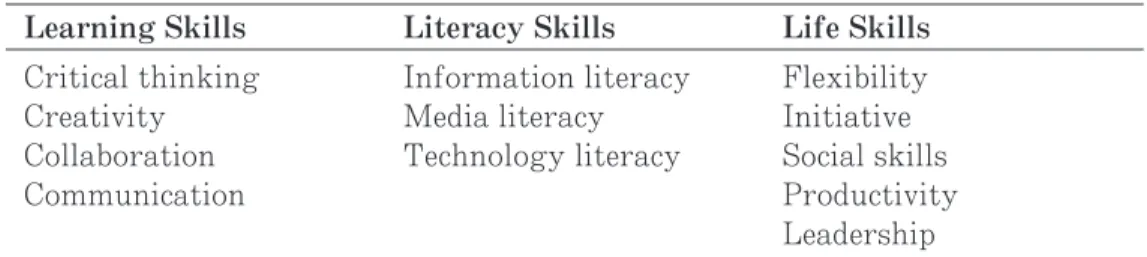
One set of such skills are what are termed “higher order thinking skills.” These include evaluating and creating media (Anderson and Krathwohl, 2001; Bloom, 1956), and these are thus closely related to the new literacies identified by NLS scholars. Together, these essential capacities are often referred to as “21st Century Skills” (Shaffer, 2006; The Partnership for 21st Century Skills, 2011) and are outlined in Table 1
Table 1: Categorized Examples of 21st Century Skills.
Learning Skills Literacy Skills Life Skills
Critical thinking Creativity Collaboration Communication Information literacy Media literacy Technology literacy Flexibility Initiative Social skills Productivity Leadership
Focused tasks, as described in Ellis (2003), that scaffold student development with and around carefully chosen board games can develop students’ 21st Centu-ry skills. Mayer and Harris (2010), writing from the perspectives of librarians providing extracurricular learning opportunities, focus primarily on the literacy skills that board gamers can practice, but also touch on several life and learning skills that games and gamers can foster. They describe the multiplicity of infor-mation sources (typical of today’s media) that players must “read, decode, ana-lyze, assess and take action on” (p. 25): text, graphics, images, numbers, and oth-er playoth-er’s speech. They explain how gamoth-ers must critically evaluate the information before them, then make the best decision at the time, yet remain flexible over the course of the game, as this information will change due to other players’ actions and game system operations. They show how board games help students practice communication skills (e.g., giving advice, sharing information, presenting ideas, solving problems) during games and collaborative teamwork around game-based tasks before or after gameplay. Mayer and Harris note that “designer games provide multiple entry points” (p. 48) to the English and Lan-guage Arts curriculum (e.g., storytelling, basic literacy skills of reading and writing, persuasive and critical language applications) and make specific mention of second language learners and board games, arguing that games “offer sophis-ticated experiences that promote the use of language in a communicative and in-teractive manner” (p. 51), mirroring the language and learning goals set by MEXT (2003, 2013, 2014).
Games can be applied in the classroom to help students practice critical and creative thinking skills, managing information, and working and communicating with others, and a thorough debriefing (described later) can help students make connections between the 21st Century skills they encounter or practice in games and the application of those skills in real-life public or professional settings out-side the game or classroom. Skill development through board games does not have to occur at the expense of content learning. The Partnership for 21st
Centu-ry Skills (2011) called for skill work to connect and work in conjunction with clas-sic (e.g., math, art, history) and modern subjects and themes (e.g., global aware-ness, health literacy, financial literacy). Mayer and Harris (2010) offer numerous examples of different complexities of modern games that offer players simula-tions of a wide variety of classic and modern themes, and describe how these games align with curricular content standards in English and language arts, so-cial studies (i.e., history, economics), math and science. Empirical evidence sup-ports their claims that analog games can teach educational subjects. The party card game “Apples to Apples” has been used to teach comparative and superlative English grammar, as well as let students practice creativity (Tsuchiya, 2013; Sugimoto, 2015). Siegler and Ramani (2008) used a simple line game to improve the numeracy skills (comparison and estimation) of preschoolers from low-in-come families. Eisenack (2013) describes players’ developed understandings of the systems and issues of climate change as a result of play and debriefing of an analonded g game. Analog games can provide students with numerous opportu-nities for both skill and content knowledge development.
Current game-based learning models
Game-based learning (henceforth GBL) is a relatively new field where re-searchers are concerned with the learning potential of games, particularly digital games, in educational settings. Gee (2007) ranked games as one of the most pow-erful tools for educational instruction, and Oblinger (2004) provides a list of cog-nitive reasons for promoting GBL: 1) they activate prior learning; 2) they provide a rich context for learning; 3) they provide swift, appropriate feedback and as-sessment (i.e. ranks, levels, difficulty settings); 4) knowledge gained in games can be transferred to different environments, or even different games; 5) they provide learners with rich, subjective experiences that engage multiple senses; 6) they are social environments which promote community creation (thus, belonging and identity), and in turn joint problem-solving, a highly-regarded form of learning (Palincsar & Brown, 1984). Similarly, Squire (2011) promotes the use of games to develop systemic thinking skills due to how games introduce a specific system to players that must be learned in order to play successfully (Gee, 2005).
The affective benefits of GBL are also a huge reason for adopting games in educational contexts. The allure of video games is that students may learn course content while being thoroughly engaged, on-task, and enjoying their experiences. Games excel at keeping players engaged in this way by providing new problems to solve in a timely manner (Koster, 2005). The short-, mid-, and long-range goals of games thus guiding players on both the micro and macro scale in a state that
Csikszentmihalyi calls flow (1996).
Shifting focus to language learning contexts, digital game-based language learning (DGBLL) is a growing field of studies that has been approached from a number of theoretical perspectives. Thus, there is no single theory for DGBLL currently. Trends in DGBLL research include learner perceptions of learning gains (Wang, Petrina, & Feng 2016; Peterson, 2012; Allen Crossley, Snow, & Mc-Namara, 2014), assessing the affordances of games for language learning (Rama, Black, van Es & Waschauer, 2012; Reinhardt & Sykes, 2012), and the applicability of games for language learning from a policy-maker or educator perspective (Franciosi, 2015). Following, we review a number of current DGBLL frameworks.
Research frameworks for DGBLL
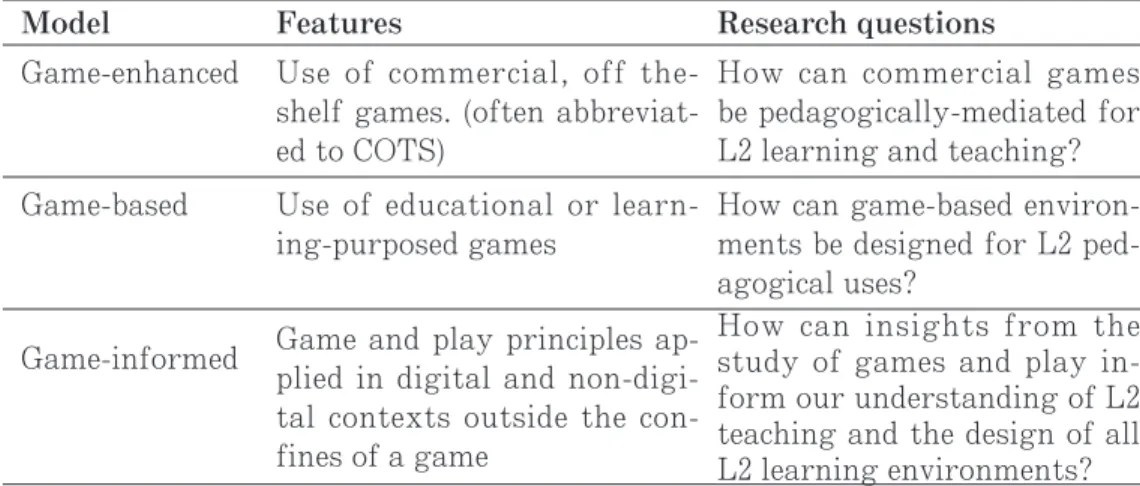
There have been numerous attempts to integrate games into second language teaching and learning contexts as seen in papers by Gaudart (1999), Baierschmidt (2013), Nicholson (2012), and Hastings (2014). Reinhardt and Sykes (2011) propose three approaches to the use of games in language learning context. For an over-view, see Table 2. Following is a critical evaluation of these models.
Table 2: Digital games and language learning research practices (adapted from Reinhardt and Sykes, 2014)
Model Features Research questions
Game-enhanced Use of commercial, off the-shelf games. (often abbreviat-ed to COTS)
How can commercial games be pedagogically-mediated for L2 learning and teaching? Game-based Use of educational or
learn-ing-purposed games
How can game-based environ-ments be designed for L2 ped-agogical uses?
Game-informed Game and play principles ap-plied in digital and non-digi-tal contexts outside the con-fines of a game
How can insights from the study of games and play in-form our understanding of L2 teaching and the design of all L2 learning environments?
Game-enhanced research
The use of COTS games, which are designed primarily for entertainment, provide authentic target language content for language learners. Language in the game is not specifically designed to teach particular linguistic elements, but for target language speaking players. This means that COTS games can provide
learners with a rich world of text, and in the case of online multiplayer games, authentic native-speaker communication (Cornillie, Thorne, & Desmet, 2012). Due to the lack of support for language learners in terms of structured, level-appro-priate content, gaenhanced research involves the creation of pedagogical me-diation to exploit the language learning potential of such games. One particular framework for teaching languages with COTS games is the Explore, Examine and Extend model (henceforth EEE model), created by Reinhardt and Sykes (2011). The EEE model is a theoretically grounded, pedagogic consideration de-signed specifically for the implementation of COTS games in language learning contexts. Although there are currently no empirical studies which utilize this model, we introduce it below. Table 3 provides an overview of the model.
Table 3: EEE sequence overview
Phase Learning activities
Explore ● Playing the game personally or observing others playing the game ● noticing lexical items or collecting discourses with guidance.
Examine
● playing the game with more intensive focus
● completing analysis activities on discourses targeted to meet the specific lesson objectives
Extend
● active and reflective creation of new discourses with or through the game
● participation in attendant discourses.
The model initially requires learners to play games with a focus on discourse that the player comes into contact with during play (Explore). This could be the language used, overarching stories, or other narrative elements. Play can be ei-ther experienced personally, or by observing oei-thers. For instance, learners could be paired up where one learner is in control of the avatar, and the other learner watches. Thus, whilst becoming familiar with a game’s rules, learners should also pay attention to the words, phrases, or other linguistic elements of the game. Upon completing this stages learners are then asked to replay the game with the objective of focusing more critically on in-game discourses (Examine). The examine phase then is designed to get learners to experience the game as a fluent player with more understanding of the rules, strategies or narrative ele-ments. Finally, in the Extend phase, learners use the knowledge they have col-lected to produce new, extended materials such as a presentation about their ex-periences or by participating in a community around the game.
This model, despite the lack of empirical studies, represents a solid, Task-based Language Teaching (TBLT)-inspired approach to the use of video games as a teaching tool in language learning contexts.
Game-based research
Games may also be developed for educational purposes. This type of research therefore differs significantly from game-enhanced research. Instead of creating pedagogical supporting tasks for the inclusion of COTS games in educational contexts, game-based researchers are concerned with the development of a game designed with predisposed learning goals.
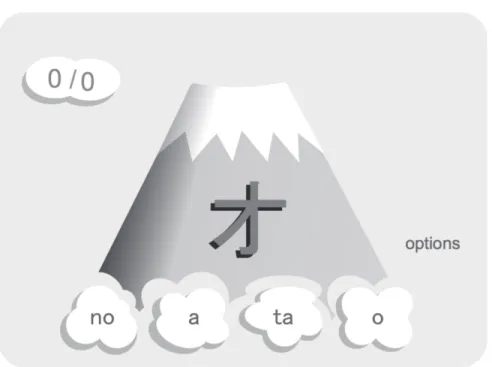
From a language learning perspective then, such games may be developed to encourage players to both encounter and interact with a foreign language. Tra-ditional game-based tuition sees learners interact with a computer and receive feedback on their inputs. An example can be seen in Figure 1, which represents a simple read-and-click game to learn Japanese katakana characters (Katakana Quiz, n.d.). This game can be considered a “drill and kill” type game (Resnick, 1997).
Figure 1: An example of a simple educational game for learning Japanese ka-takana characters
One issue with games designed for educational settings is the notion of “sug-ar-coating” learning goals with games. In other words, where COTS games are created from an entertainment perspective first and are highly motivating arte-facts, games that are created with a learning outcome first often try to obfuscate this with the arbitrary addition of game-like systems. This has been referred to as “chocolate-covered broccoli” (Bruckman 1999) where the gaming element of the product is used as a separate reward upon completion of the learning content. This mismatch between educator goals and student motivations for playing is a critical factor when designing such simulations. It has been shown that individu-als with pre-existing gaming experience prefer not to play educational games (Chik, 2014). One reason for this is due to their preconception of what a video game is, and the inability of educational games to meet their expectations.
The use of synthetic environments for language learning is also a common theme in the literature on game-based language learning. Examples include Hen-derson, Huang, Grant and Henderson (2012) who created an interactive virtual environment as a tool for learning Chinese, Peterson (2012) who investigated the sociocultural affordances for language learning with Japanese EFL learners, Cornillie, Clarebout and Desmet (2012) who created a virtual learning space to in-vestigate learner perceptions on the use of corrective feedback in such digital en-vironments, and more recently Wang, Petrina and Feng (2016) who developed a Virtual Immersive Language Learning and Gaming Environment (VILLAGE) measuring participants level of immersion based on the addition of certain non-player characters (NPCs).
Game-informed research
Game-informed research is concerned with the application of the the often highly motivating elements (or “mechanics”) found in digital games to real-life situations. These elements typically include leaderboards, points systems, and quests (or missions). Game-informed research falls under the umbrella term gam-ification (Kapp, 2012), a term that first appeared in 2008 and then more promi-nently from 2010 (Deterding, Dixon, Khaled, & Nacke, 2011). Zichermann and Cunningham describe it as “game-thinking and game mechanics to solve prob-lems and engage audiences” and is often associated with marketing campaigns that want to increase customer engagement. Examples of gamified educational contexts also exist including Sheldon’s (2011) Multiplayer Classroom concept which aimed to apply the game mechanics often found in MMOs to evaluate his students, and York (2012) who emulated Sheldon’s original concept specifically
for use in an EFL classroom environment.
Site Visits
To understand how progressive educators in the New York city area are us-ing games in their classrooms, curricula, and extra-curricular contexts two of the three authors of this paper coordinated visits to several sites in August, 2016. In all cases, we spoke with teachers and other key actors involved in the use of games in a variety of contexts.
In order to build upon the theoretical base we had developed in this area, we sought to explore the following questions:
1. What lessons from progressive educational settings in the US can be ap-plied to our foreign language classrooms and other higher educational learning spaces in Japan (SAC’s etc) ?
2. How can tools and pedagogy designed to teach 21st Century Skills be ap-propriated for developing English communication skills ?
3. What lessons can be applied to EFL contexts based on the way ELLs are taught in game-based learning contexts in the US ?
We visited or corresponded with representatives from three institutions fo-cused on the use of digital and/or analogue games in educational contexts. The centerpiece of our visit was a New York City Department of Education teacher training event held at New York University’s (NYU) Tisch School of the Arts in the facilities of the NYU Game Center. In what follows, we summarize the game-related activities of all three institutions, and discuss areas we see possible applications to our EFL teaching and self-access learning contexts.
New York City Department of Education
We were participant-observers in a teacher training session for elementary and middle school teachers in the New York metropolitan area. The focus was on helping teachers develop skills for improving digital literacy among their young learners. GBL and participatory learning played an important role in the peda-gogical recommendations put forward in this course.
One example was an online programing tool called “Scratch” that students can use to develop basic coding concepts and skills. Scratch is an online educa-tional tool developed by the Lifelong Kindergarten Group at MIT’s Media Lab, and funded by the National Science Foundation, Google, LEGO, Intel, and several other private companies and foundations. Using a drag-and-drop interface,
Scratch allows users to program interactive stories, animations, and games. The application’s website states that “Scratch helps young people learn to think cre-atively, reason systematically, and work collaboratively - essential skills for life in the 21st century” (About Scratch, N.D.).
We inquired with the organizers and instructors of the teacher training ses-sion about the affordances and constraints that the digital literacy curricular implementations in general and the use of applications like Scratch specifically offer for English language learners (ELLs) in New York City schools. They high-lighted the fact that coding is another language layer on top of ELL’s native lan-guage and English they encounter in the classroom, and therefore they advise teachers to allow ELLs to use their native language for many tasks. In addition, many web-based applications themselves offer multilingual support: for instance, with the click of a button, menus and commands can be converted to any of 40 different languages in Scratch. This means, for example, that students could code a narrative or game in their native language, but then perhaps explain it or cap-tion it in English. In this way they are able to draw upon their existing thinking, imaginative capacities and schema for the creation of work of significant com-plexity. The multimodal user and viewer interface also allows for visual commu-nication, which is more universal than verbal or text-based language, and thus potentially useful for communication across cultural and linguistic divides.
Institute of Play
The Institute of Play (IoP) is a New York-based NPO that develops game-ori-ented curricula and materials for client schools and other organizations around the U.S. Materials often consist of in-house developed games which are created to foster specific skills based on state standards. IoP’s flagship school is a New York City public middle and high school: Quest to Learn (Q2L). IoP developed a game-based learning curriculum for this school in partnership with an education reform organization called “New Visions for Public Schools,” and they opened this school using the IoP game-based curriculum in 2009. Curriculum develop-ment was overseen by Katie Salen, with James Gee listed as a core advisor (Salen, 2011). The five key practices emphasized are:
1. Systems Thinking 2. Play Design
3. Intelligent Resourcing 4. Meaning Production 5. Tinkering
Though we do not have specific data to confirm this, we were told that many of the members of Quest to Learn’s first graduating class of 80 students have been accepted to some of America’s top universities. The Game-based curriculum is controversial in its attempts to bring systems and design thinking to Ameri-ca’s increasingly proscriptive “common core” standards regime.
IoP also provide teacher training for in-service teachers who want to use game-based learning in their classrooms. This scheme is known as TeacherQuest, and provides participants with the same level of training that Q2L teachers re-ceive. States may sponsor particular teachers to attend training workshops (In-stitute of Play, 2013).
Brooklyn Game Lab
The Brooklyn Game Lab is an after-school program and summer camp aimed at promoting critical thinking and literacy skills in 7 - 13-year-old students. They also have social gaming programs aimed at adult participants, but here we will focus on the program for young learners. The structure for each session is summarized in Table 4. Although there are no formal reports or studies related to the Brooklyn Game Lab (henceforth BGL), their lab session framework played a large role in the creation of our own.
Table 4: Brooklyn Game Lab model
Activity
Learn game rules from instructors.
Play the game
Critical reflection of game session
Application of game-design elements
Details
Students are grouped together based on skill-level and interests.
Students play with instructor supervision.
Students have the opportunity to reflect on the gameplay session from a number of perspectives.
Students rate or validate each other’s reflections.
Students apply what they learnt from both the gameplay sessions and reflection stage into a similar game of their own creation.
Alternatively, students may design rules for the COTS game they played, and replay with their modifications.
Participants in BGL are first introduced to the rules of the game in an in-structor-led session, much like a priming phase of the TBLT model. Following this, they play a game that was predetermined by the staff. Games are chosen
based on how appropriate they are at promoting a focus on one of four key skills. Again, without making a direct reference to Reinhardt and Sykes’ model, BGL recognises that games are structured artifacts that promote social interaction. The four types being:
1. Trading, building and prediction: Skills include negotiation, resource management, probability, long term predictions, strategy, and resource management.
2. Collaboration: Players are generally required to act out a special role as part of a cooperative team. The team must strategize together in order to achieve game goals.
3. Competition: As well as strategy formation, there is a focus on spatial reasoning, alliance-formation, game theory and critical thinking.
4. Mystery and deduction: Players analyze each other’s words and actions to discern other players’ secret roles. The focus is on deduction, social strategy and communication.
Following the play session, are two further activities. First, participants re-flect on their gameplay session in groups by choosing a worksheet to complete. This session is equivalent to the report phase of TBLT or “Debriefing,” a concept we outline in more detail below. Worksheets ask students to think about their play session from a number of perspectives. Titles include “Winning tactics,” “Lessons learned,” Expansion idea,” and “Rule change.” Upon filling in the work-sheets individually, they present their ideas to their group. At this stage, partici-pants receive two stickers that they may stick on other participartici-pants’ worksheets, acting as a seal of approval. In this way, BGL recognizes the value of both peer evaluation, and promotes student agency by providing them with the opportuni-ty to choose and complete one of a number of reflective worksheets. The Brook-lyn Gamelab website explains that:
“It seems like fun-and-games, but this is extreme brainsport: Critical think-ing & reasonthink-ing! Risk & resource management! Negotiation & deduction! Just as important are the values the lab instills: fair play, diplomacy, collab-oration and good sportsmanship.” (Brooklyn Game Lab, 2013)
Finally, is the “Game Lab” session. This section of the framework is analo-gous to the Extend phase of Reinhardt and Sykes’ EEE model. Participants en-gage with peers and instructors on the design of their own game. Essentially, they extend what they just played into something outside of the gameplay
ses-sion, participating in a broader discourse with others, and applying the skills they have just learnt to develop their own version. These creations are also play-tested by their peers, and so bring the focus of the Play, Review and Extend cycle full circle.
In summary then, BGL demonstrates a robust model for the development of critical thinking and literacy skills in young learners. Although it does not ex-plicitly target language learning contexts, critical reading skills are a large focus throughout. The model sees participants go from passive observers (learning the rules) to active participants and finally creators.
Pedagogical Implications
Despite the significant differences of all of the educational contexts consid-ered in this paper among themselves and with our own contexts (which them-selves vary significantly) there are some common threads visible that point to teaching and learning practices worth exploring and developing further in Japa-nese higher educational contexts.
First, we were able to see that multiculturality and multimodality can and should go hand-in-hand in contemporary classrooms, curricula, and extra-curric-ular learning spaces. Both analogue and digital games were observed to offer a variety of affordances for engaged play, cooperation, creativity, critical thinking, reflection, leadership and many other “21st century skills.” While games them-selves vary in their contents and affordances, the spirit of play, exploration, and creativity engendered by all good games has great potential for engaged implicit and explicit language learning.
Second, focusing strictly on second language acquisition, the use of games appears to align well with a TBLT approach to language learning. This was evi-dent particularly with the curricula of BGL. Game play itself has been likened to the concept of a focused task (Ellis, 2003). For instance, quests in MMOs could provide learners with the opportunity to engage in a reading activity where they receive instant, corrective feedback based on their performance (Waters, 2007). Analog games were also shown to provide affordances for oral, face-to-face com-munication that involves speech genres that learners might not might only oth-erwise encounter in the context of literature (and would thus likely never use in oral communication contexts). Used in Japanese higher education contexts, games thus serve to enable the nurturing of students that can “assertively make use of their English skills, think independently, and express themselves” (MEXT, 2014, p.3). Additionally, games afford the notion of affinity spaces (Gee & Hayes, 2012) which offer the opportunity for learners to participate in local and virtual
interest-driven communities around games as well as through game play itself. Finally, the many examples and ideas associated with “tinkering,” “tweak-ing,” and “remixing” that we observed seem to be a good fit for engaging stu-dents in the learning foreign languages, where a spirit of play and genre aware-ness is essential. By developing understanding about how game design structures player interactions, and by tinkering with or remixing those designs, students can gain skills for “reading” cultural interactions and thinking about activity systems as a whole. These are some of the most essential 21st century thinking skills “around” language learning that lead to what Claire Kramsch (2006) has termed “symbolic competence,” a concept that is operationalized as “the produc-tion of complexity, the tolerance of ambiguity, and an appreciaproduc-tion of form as meaning” (p. 251).
Conclusion
Our research on classroom, curricular, and extra-curricular applications of game-based learning models in New York City pointed to many directions for applying game-based learning in Japanese higher education. As noted, the con-texts we studied vary significantly from the concon-texts where we engage with our students, but with some tweaking and remixing, game-based learning models of-fer vast possibilities for transforming classrooms and other educational spaces here into sites where student engage with much more than just the four skills of reading, writing, listening, and speaking. Games offer opportunities for educa-tors to intermix the development of these skills with “multiliteracies” that devel-op the whole learner and better equip him or her for life in our rapidly changing 21st century world.
Works Cited
About Scratch. (n.d.). Retrieved November 16, 2016, from https://scratch.mit. edu/about
Allen, L. K., Crossley, S. A., Snow, E. L., & McNamara, D. S. (2014). L2 writing practice: Game enjoyment as a key to engagement. Language Learning and Technology, 18(2), 124-150.
Anderson, L. W., Krathwohl, D. R., & Bloom, B. S. (2001). A taxonomy for learn-ing, teachlearn-ing, and assessing: A revision of Bloom’s taxonomy of educational objectives. Allyn & Bacon.
Bloom, B. S. (1956). Taxonomy of educational objectives: The classification of ed-ucational goals . Retrieved from http://psycnet.apa.org/psycin-fo/2003-00041-000
Brooklyn Game Lab, “Mission” (N.D.) Retrieved November 18, 2016 from http:// brooklyngamelab.com/post/67097446845/the-key-word-is-lab-after-game-play-students
Baierschmidt, J. (2013). A principled approach to utilizing digital games in the language learning classroom. Jaltcall Journal, 9(3), 307-315.
Chik, A. (2014). Digital gaming and language learning: Autonomy and communi-ty. Language Learning & Technology, 18(2), 85-100
Cope, B., & Kalantzis, M. (2009). “Multiliteracies”: New literacies, new learning. Pedagogies: An International Journal, 4(3), 164-195.
Cornillie, F., Thorne, S. L., & Desmet, P. (2012). ReCALL special issue: Digital games for language learning: challenges and opportunities. ReCALL, 24(03), 243-256.
Cornillie, F., Clarebout, G., & Desmet, P. (2012). Between learning and playing? Exploring learners’ perceptions of corrective feedback in an immersive game for English pragmatics. ReCALL, 24(03), 257-278.
Csikszentmihalyi, M. (1996). Flow and the psychology of discovery and invention. New York: Harper Collins.
Deterding, S., Dixon, D., Khaled, R., & Nacke, L. (2011, September). From game design elements to gamefulness: defining gamification. In Proceedings of the 15th international academic MindTrek conference: Envisioning future media environments (pp. 9-15). ACM.
Ellis, R. (2003) Task-based language learning and teaching. Oxford: Oxford Uni-versity Press
reason. Vintage.
Franciosi, S. J. (2015). Acceptability of RPG Simulators for Foreign Language Training in Japanese Higher Education. Simulation & Gaming.
Gaudart, H. (1999). Games as Teaching Tools for Teaching English to Speakers of Other Languages, 30(3), 283-291.
Gee, J. P. (2007). What video games have to teach us about learning and literacy (2nd ed.). New York, NY: Palgrave Macmillan
Gee, J. P. (2005). Why are Videogames Good For Learning? Spectrum, 32, 25-32. Retrieved from http://cmslive.curriculum.edu.au/leader/default.as-p?id=16866&issueID=10696
Gee, J. P., & Hayes, E. (2012). Nurturing affinity spaces and game-based learn-ing. Games, learning, and society: Learning and meaning in the digital age, 123.
Hastings, C. R. (2014). Social Learning Spaces: An Investigation into the Effects of Using Collaborative Strategic Board Games as Modes of Oral Practice in Combination with Explicitly Teaching Interactional Competence on the Oral Proficiency and Discourse of Japanese Learners. Unpublished M.A. Thesis for Oxford Brookes.
Henderson, M., Huang, H., Grant, S., & Henderson, L. (2012). The impact of Chi-nese language lessons in a virtual world on university students’ self-efficacy beliefs. Australasian Journal of Educational Technology, 28(3), 400-419.
Institute of Play (2013) TeacherQuest. Retrieved November 18, 2016, from http:// www.instituteofplay.org/work/projects/teacherquest-2/
Kapp, K. (2012). The Gamification of Learning and Instruction: Game-based Methods and Strategies for Training and Education. San Francisco, CA: Pfeiffer
Katakana Quiz (n.d.) Retreived November 22, 2016, from http://www.easyjapa-nese.org/kataquiz.html
Koster, R. (2005). A Theory of Fun. Paraglyph Press, New York
Kramsch, C. (2006). From Communicative Competence to Symbolic Competence. The Modern Language Journal, 90(2), 249-252. https://doi.org/10.1111/ j.1540-4781.2006.00395_3.x
Ministry of Education, Culture, Sports, Science, and Technology. (2014) On Inte-grated Reforms in High School and University Education and University En-trance Examination Aimed at Realizing a High School and University Artic-ulation System Appropriate for a New Era. Retreived November, 1, 2016, from http://www.mext.go.jp/component/english/__icsFiles/afield-file/2015/03/31/1353908_1.pdf
The New London Group. (1996). A Pedagogy of Multiliteracies: Designing Social Futures. Harvard Educational Review, 66(1), 60-92.
Nicholson, S. (2012, March). Completing the experience: Debriefing in experien-tial educational games. In Proceedings of the 3rd international conference on society and information technologies (pp. 117-121).
Oblinger, D. (2004). The next generation of educational entertainment [Special Is-sue on the Educational Semantic Web]. Journal of Interactive Media in Edu-cation, 8(1), 1-18.
Palinscar, A. S., & Brown, A. L. (1984). Reciprocal teaching of comprehen-sion-fostering and comprehension-monitoring activities. Cognition and in-struction, 1(2), 117-175.
Peterson, M. (2012). Learner interaction in a massively multiplayer online role playing game (MMORPG): A sociocultural discourse analysis. ReCALL, 24(03), 361-380.
Rama, P. S., Black, R. W., van Es, E., & Warschauer, M. (2012). Affordances for second language learning in World of Warcraft. ReCALL, 24(3), 322-338.
Ramani, G. B., & Siegler, R. S. (2008). Promoting Broad and Stable Improve-ments in Low-Income Children’s Numerical Knowledge Through Playing
Number Board Games. Child Development, 79(2), 375-394. https://doi. org/10.1111/j.1467-8624.2007.01131.x
Reinhardt, J., & Sykes, J. (2011). Framework for Game-enhanced Materials De-velopment. Tucson, AZ: Center for Educational Resources in Culture. Lan-guage, and Literacy.
Reinhardt, J., & Sykes, J. M. (2012). Conceptualizing digital game-mediated L2 learning and pedagogy: Game-enhanced and game-based research and prac-tice. In Digital games in language learning and teaching (pp. 32-49). Palgrave Macmillan UK.
Resnick, M. (1997). Turtles, termites, and traffic jams: Explorations in massively parallel microworlds. Mit Press.
Salen, K. (2011). Quest to learn: Developing the school for digital kids. MIT Press.
Shaffer, D., & Gee, J. P. (2008). How Computer Games Help Children Learn (2006 edition). New York: Palgrave Macmillan.
Sheldon, L. (2011). The multiplayer classroom: Designing coursework as a game. Cengage Learning.
Squire, K. (2011). Video Games and Learning: Teaching and Participatory Cul-ture in the Digital Age. New York: Teachers College Press.
Wang, Y. F., Petrina, S., & Feng, F. (2016). VILLAGE-Virtual Immersive Lan-guage Learning and Gaming Environment: Immersion and presence. British Journal of Educational Technology.
Waters, J. K. (2007). On a quest for English. The Journal, 34(10), 27-28. Cunningham, G. Z. and Cunningham. (2011). Gamification by Design, 1-210.
York, J. (2012) English Quest. Modern English Teacher 21(4).
Zichermann, G., & Cunningham, C. (2011). Gamification by design: Implementing game mechanics in web and mobile apps. “ O’Reilly Media, Inc.”.