publication title
volume
14
page range
163-193
year
2007-07-31
Humans and Cultures
――introducing Danish movies and culture to Japanese students――
Christian M. Hermansen
Introduction
Humans and Cultures (Jp. Ningen to bunka 人間と文化) is the umbrella name for a new course type offered by the full time language teachers at the School of Law and Politics at Kwansei Gakuin University. It is targeted at the older college students, those in their third or fourth year. The linguists among the language teachers run a similar course named Languages and cultures. For many years now, the full time teachers have been offering a lecture type of course for the freshmen and sophomores under the rubric Human Culture Lectures (Jp. Jinbun enshu¯). The Humans and Cultures variants open a way for the professors to teach their area of specialty while giving the students a chance to reflect on the subjects from a more mature vantage point than possible in the first years of their college life. Humans and Cultures were initially intended to be conducted in a seminar style, but at one point the administration recommended the lecture style to admit more students per class. Finally, the Human Culture Lectures and the Humans and Cultures (seminars) differ in frequency and duration. The former is a one year course offered by all full time teachers every year, whereas the latter only lasts a term
and is offered bi-annually by the individual professor. As one of the language teachers I taught a course of the new type in the autumn 2006, focusing on Danish movies.
Here I will first describe my motivations and intentions with the course, next the course as such, and then examine the results as they have been manifested in the students’ final reports. Through this examination I want to identify strengths and weaknesses in the course and the course type, and in turn point out possible improvements. Should the reader have comments or recommendations, I shall be most grateful to receive them.
Danish Movies
Three things motivated my choice of movies for this course ; my observation of the students’ interest in movies, experience with students’ lack of accounting for circumstantial influences on contents and execution of cultural products, and experience with teaching about Denmark at Kwansei Gakuin and the research I did to write a course book for that teaching.
Two years ago, I was asked to contribute to a textbook for a course on Denmark − its history, culture and society (Hermansen 2006). That course is open to all students at the university and has been offered for quite some years. As one course book existed already the purpose of the new book was to supplement the older by addressing new themes or add new perspectives to the subjects treated earlier. Through my teaching I knew the students to be generally interested in movies, and as Denmark has experienced a boom in the movie industry through the 1990s and into the early 21stCentury, it seemed appropriate to write a short introduction
to Danish movies for the textbook. In the article I reflect on movies as a cultural mirror, obviously in the motives and modes but even more so in the production conditions. With these perspectives in mind I thought it worth trying to make the most of students’ interest in movies and open up for discussions on culture and cultural differences besides themes, genres and techniques in movies as such.
Another decisive inspiration was what to me seemed to be a lack of training in description and analysis among younger Japanese. I often encounter this phenomenon in my language teaching, where many students appear to be at a loss when asked to describe an object or a situation, and simply state their unsubstantiated opinions instead. I also once participated in a study group on Japanese comics, where few of the members, though most of them university students, ever brought up for discussion the techniques used. At that time, I thought their singular focus on stories and negligence of medium/ techniques were due to an unawareness of the medium’s importance or an under-stimulation of the fact in their academic life. But frankly, I was surprised, because visual communication is dominant in Japan, which had led me to expect [especially young] people to have (been taught) a high level of media literacy that is, to have a long training in media analysis that can only be successfully accomplished if based on careful description. The reaction of my language classes’ students indicates that either they have not trained such skills extensively or they do not know how to express their findings in English. Anyway, this has become an important part of their education in my classes. Consequently, I also wanted to incorporate stimulation of those skills in my class on Humans and Cultures.
The course
Conditions
13 times 90 minutes. That was the maximum amount of class time each student would be investing in this course. With my design, they would also have to spend some time researching and writing a report. There are no textbooks on Danish movies in Japanese, and as I prepared the course, I realized, I would not have ready access to that many different kinds of Danish movies available with Japanese subtitles. I could therefore only count on creating an understanding of the variety in genres and executions in class.
1170 minutes is not a very long time to introduce even the very most influential directors, studios, trends, actors in movies, besides social and cultural conditions for film production in Denmark. I had asked several colleagues about their experiences of teaching using films, and all recommended screening shorter excerpts and have students watch the full movie at the library, but they also warned me that few students would actually go and see the movies. Film researching colleagues in the US and Denmark have informed me that their students, majoring in film studies, will have a combination of full time lectures and separate screening/ library viewing options every week. Knowing that my students were not majoring in film, being aware of the work load most of them shoulder inside and outside the university, and finding it important to impress the students with a complex yet not confusing image, I decided to show representative movies as complete as possible in class.
The movies selected had to : be available on videotape or DVD ; be significant works of a specific genre, form or significant director ; as such
be pieces in the composite picture that would inspire the students to see international trends and local peculiarities that is (Danish) culture in the movies.
Technical challenges
While the university has many advanced pieces of audio-visual equipment, they are not available in all class rooms at all times. I taught my class in a spacious room with tables set up in a large square quite suitable for discussions in plenum. Each table provides work space for three persons. This makes them less flexible for group discussions. Because I needed to show movies in almost every class, the side of the square nearest the blackboard was rarely used by anyone but me. The equipment for film presentation was a standard 25’ television, a standard NTSC system video player and dark curtains. My institute kindly bought a multi region portable Bluedot DVD player that could be connected to the television. It is handy but, has no chapter search option or counter display function which sometimes resulted in my spending much time searching for scenes I wanted to show the class. Unlike the DVD player, the video player could not play the European PAL format. So, when I wanted to show Paul Henningsen’s “Danmarksfilm,” for instance, which is only available on video tape in PAL format, I had to have it copied in NTSC. The movie is from 1935 and the quality of the existing version is mediocre, and the transfer to NTSC format further reduced the quality wherefore contrasts and nuances of the pictures at times were hard to distinguish. This necessity of transfer prevented me from using clippings from videos on the spur of inspiration
Academic challenges
The course was meant to be accessible to anyone with a genuine interest in movies and cultural studies. Starting from there, they should proceed through analyses of contents, forms and backgrounds and reach the goal where they produced an original discussion of a Danish and a Japanese movie. Within the short span of time available, I introduced what I considered important stepping stones on the path to that goal. The introduction was given in handouts and dialogs, and as far as possible supported visually by the selected movies.
Students’ motivations
A class survey conducted in the first session revealed, as expected, a disparate number of motivations for course participation. Some students had followed the university’s General Introduction to Denmark course. Most had little or no foreknowledge of Denmark. All were interested in movies, overall as a pastime and entertainment. None of them had previous experience in movie analysis but, as students of law and politics for three or more years I expected them to be trained in analytic work as such. Many professed an interest in getting to know Denmark through the movies, a few said they simply wanted to enjoy watching movies.
Contents
The general idea of the course was outlined above. Here I shall first introduce the movies shown and then discuss the most important themes taken up in class.
The movies shown during the course are listed in the sequence of presentation. The list includes the original Danish title with the official English/Japanese titles in parentheses [if non-existing my translation is
given in square brackets], director(s)’ name, year of production, classification and international recognition.
1. Bennys badekar (Benny’s Bathtub / ベンニくんの風呂) (Jannik Hastrup and Flemming Quist M!ller, 1971). Animation. Included on the Danish Ministry of Culture’s Cultural Canon (2006). 2. Afgrunden (The Abyss [ドン底]) starring Asta Nielsen. (Urban
Gad, 1910). Melodrama, silent movie.
3. Visions of Light (Todd McCarthy et al. 1992). Documentary on cinematographers.
4. Danmarksfilmen [Denmark the Movie / デンマークを紹介] (Poul Henningsen, 1935). Documentary made on commission by the Danish Ministry of Foreign Affairs.
5. Ordet (The Word / 奇跡) (Carl Th. Dreyer, 1955). Drama. Awarded “Golden Globe” USA 1955 and “Golden Lion” Venice 1955. One of fifteen films selected for the category Religion on a list of “Some important films” on the 100 th Anniversary of Cinema (Pontifical Council for Social Communications 1995). 6. Olsen Banden ser r!dt [The Olsen Gang Sees Red [オルセンギャン
グは激怒する]) (Erik Balling, 1975). Comedy.
7. Dogme #32−Se til venstre, der er en svensker (Old, New, Borrowed and Blue [結婚準備]) (2003 [Natasha Arthy]). Comedy. 8. Babettes gæstebud (Babette’s Feast / バベットの晩餐会) (Gabriel
Axel, 1987). Drama. Awarded Oscar “Best Foreign Language Film” 1987. One of fifteen films selected for the category Religion on a list of “Some important films” on the 100 th Anniversary of Cinema (Pontifical Council for Social Communications 1995). 9. Gummi-Tarzan (Rubber Tarzan [グミ・ターザン]) (S!ren
Kragh-Jacobsen, 1981). Children’s movie. Awarded the UNICEF prize at Berlin International Film Festival 1982.
10. Breaking the Waves (奇跡の海) (Lars von Trier, 1996). Drama/ Romance. Awarded Grand Prize of the Jury, Cannes 1996. 11. Dogme #12−Italiensk for begyndere (Italian for beginners / 幸せ
になるためのイタリア語講座) (2000 [Lone Scherfig]). Comedy. Won four prizes including a Silver Bear at Berlin International Film Festival 2001.
12. Valhalla (Valhalla [ワルハッラ]) (Peter Madsen and Jeffry James Varab, 1986). Animation.
One shortcoming of the selection is the ratio of women to men directors. Since the 1940s, several of the most successful Danish directors have been women, and one of them, Alice O’Fredericks, created two of the most viewed series with a theatrical release in Denmark one of which included the all-time best selling movie De R!de Heste [The Red Horses / 赤い馬等 ] (1950) with about 2.4 million admissions.
Language posed a challenge when showing the films. As mentioned above, I sought movies preferably with Japanese subtitles or at least English ones. The first kind obviously only exits if the movie has been released in Japan, while some DVD releases of Danish movies include optional English subtitles, possibly to increase sales outside Denmark, but most films are marketed with subtitles in other Scandinavian languages only or none at all. So although technical advances make it fairly easy to add several languages to a DVD editions, Danish films appear still to be believed to be of interest only to the local market. This has been the situation since the introduction of sound on movies around 1929. Before that time, Danish movies had had international distribution. One example
in the course was the 1910 film Afgrunden. The silent movie has, of course, inter titles and since the DVD edition is a carefully restored version the text was easy to read.
Important themes discussed in the course
At the content level most of the movies relate to family and love and half of them also portraits religiosity. In class we did not discuss family values as such, but I drew the students attention to the picture painted in movies no. 1, 9 and 11. Ib Bondebjerg (2005) Filmen og det moderne identifies the comedy as the dominant template for Danish film production between 1940 and 1972 and discusses major variants of it : the social comedy, the romantic comedy, the farce and the parody (p. 30). The family as a social unite was often the subject of Danish comedies or made up their frame. The comedy is still one of the major genres for Danish movies, and the family in its many variants still a beloved subject among directors.
Technical elements
Above I mentioned my earlier puzzle over the lack of accounting for the techniques and art deployed to create comics in a study group focused on comics, so in one session I showed the first half of the documentary on cinematography Visions of Light. It deals with camera work in the black/ white age, before and after the sound was added. My purpose was to bring the students awareness of how on one side the techniques condition movie production, and on the other hand how directors, cinematographers and other technicians work to overcome technical limitations. I followed up on the points made by introducing the Dogma 95.
The Dogma 95 manifest was written by the four Danish directors Lars von Trier, Krisitan Levring, Thomas Vinterberg and S!ren Kragh-Jacobsen and first published in Denmark, then, on the occasion of the centennial celebration of film, in Paris March 1995. We read the ten dogma and the oath signed by those who wished to have their film approved as Dogma 95, thereby getting a Danish example of a recurring phenomenon in the film production world, where directors refuse to let techniques and money dictate their creativity and, second, aim for reality that is become the fly on the wall merely observing and recounting the observed as it is. (http : //www.dogme 95.dk/menu/menuset.htm-Manifesto) The certification of films was stopped in 2005. (http : //www.dogme 95.dk/ news/interview/pressemeddelelese.htm) People from the film industry and film researchers disagree among themselves as to the significance of Dogma 95, but at the very least the action stimulated a prolific debate about techniques, money, and quality. The move has also been assessed as a branding method.
Censorship
Censorship on film was introduced in Denmark in 1913. The purpose was to protect the moral wellbeing of the nation. Cinemas were to allow entrance for adults only except when censors permitted a movie to be shown to spectators of a designated younger age. This did not allow everything to be screened, though, for like many other nations Denmark prohibited licentious prints whether in words or pictures. The film directors, like authors and publishers, challenged the censorship. During the 1960s, Danish parliamentarians gradually changed the laws, so the prohibition of pornographic literature was lifted in 1967 and the one on pictures was abolished in 1969. From that year, adults, by law anyone
more than 18 years old, were allowed to see what she or he liked. Censorship was focused on children, whereby a state sponsored panel approved films to be screened for children older than 16 or 12 or all but later adding a 7-year boarder. The concern of the censors was more with violence than sex. The animation Bennys badekar (1971) includes a sequence with sexy mermaids in a flower-power style, very unlike the mermaids portrayed in Disney’s Peter Pan (1953) or The Little Mermaid (1989). Only in 1997 did the state give up its attempts to distinguish between good and bad on behalf of its citizens. The censor system was abolished, and replaced by a Media Council for Children and the Youth
!
(Medieradet for b!rn og unge) that issues certificates of suitability but those are only guidelines for parents, like the British and the American systems (cf. Danish Ministry of Culture, 2007). By law any child has access to anything with a parent’s consent. The limitations stipulated by censorship have influenced film production in Denmark (again, like anywhere else, I suppose). As most of the participants in the course were students of law and politics, I thought this theme would be of special relevance to them.
The question of what is acceptable in a “mainstream” movie, that is a movie screened in public cinemas, was recurrent through the course. The 1910 movie Afgrunden (Eng. The Abyss) starring Denmark’s first, some say the world’s first, movie star Ms. Asta Nielsen illustrated the question very well. In one scene, Nielsen dances a gaucho dance very erotically. Before Afgrundens release in Sweden that scene had been cut out by the Swedish authorities, who fortunately kept the film cut, so when the movie was restored for DVD publication it was possible to insert that well preserved bit. In one session, I lectured on the history of censorship in Denmark and we went on to discuss the need for limitations − either in
production or in access. The students argued that censorship is illegal under the Japanese constitution, and a majority favored a situation where the individual of any age has the freedom to choose what medial contents to consume. We did not have time for further discussions on the current policies of the media producers in present day Japan. For an outsider observer, the moral conventions seem to more ready to accept violence than nudity (not to mention sex) thus following the trends of Hollywood. In Breaking the Waves a scene has the two main characters Bess and Jan spend their honeymoon in bed and both are shown in complete nude but their genitals are prudently covered by the Japanese custom’s mosaic.
Danish (Social Democratic Party) culture policy
Given this was a course within the frame of Humans and Cultures, and given the students affiliation within the university, it was natural to look into the relation between cultur politics and film production in Denmark. One aspect was the censor policies discussed above. In the 1920s it became clear to some that movies held a great potential as an educational means and vehicle of propaganda. In Denmark this coincided with the seizure of political power by the Social Democratic Party (SDP) which used the popular medium, as did the state. (An aside : Though the cultural radical critic and famous designer of lamps Poul Henningsen (1894―1967) did not subscribe to SDP’s visions, he was chosen to direct a propaganda movie about Denmark by the Ministry of Foreign Affairs under the SDP government in 1935. The government and other people of the establishment did not appreciate the result, so it was not used as intended, but it has survived and been re-released by the Danish Film Institute, wherefore I had the opportunity to show it in my class.) The SDP used to argue for the equality of people and the importance of
education as the means to not only avail everything to everybody but also let everybody appreciate everything. Movies were no exception. All citizens were to have access to good movies, wherefore the state organized a Film Central (Statens Filmcentral) from 1938 that lent out movies to schools and libraries. Under the new film law of 1997, the Film Central was merged with two other public film institutions creating Det Danske Filminstitut (The Danish Film Institute), but public libraries are still allowed to lend out movies on video and DVD as part of their service. In some townships school cinema clubs were set up from the 1940s through the 1980s screening movies deemed to be of high quality for club members at a nominal entrance fee.
Not only were movies made available for common consumption. So was production. The Danish Film School was founded in 1968 and like other state-operated tertiary educational institutions school fees and an income regulated scholarship for all students are financed via the taxes. As is the case of other schools for creative education only a limited number of students are admitted per year and admission depends on documented talent. These characteristics of the educational system became a sub-theme for discussion, but it is of equal interest to understand the school as an example also of the trend beginning in the 1960 s to replace apprenticeship with institutionalized schooling1). Among
the directors of films shown during the course, S!ren Kragh-Jacobsen (b. 1947), Lone Scherfig (b. 1959), Natasha Arthy (b. 1969) and Lars von Trier (b. 1956) are graduates of the school, as are other of the craftsmen
1)There are other ways of experimental schooling available in Denmark since 1971, but time did not allow us to discuss these alternatives in class. See for instance Filmvaerkstedet ( http : / / www . dfi . dk / filmstoette / filmvaerkstedet / filmvaerkstedet.htm)
behind the screen − cinematographers, clippers, producers, etc. − born after 1945.
Simply having been born in the age when the Social Democratic Party was ruling Denmark that is, on and off between 1930 and 1982, does not mean one supports its values and thoughts, but one was brought up relating, positively or negatively, to those values and ideas.
The 1960s was a decade of transition from censorship to sponsorship. The Ministry of Culture was established in 1960. Above I outlined the gradual abolishment of censorship on movies for adults, and noted the establishment of a national film school. Others have demonstrated how the film industry fought a loosing battle with television over the spectators resulting in still fewer movies with a sustainable economy (cf. Bondebjerg 2005). In reaction, typical of a (Social Democratic led) government that has replaced the King as patron of art, various systems of destributing financial support to the movies were tried out before 1974 when a new law concerning film production was given−a law the Danes modestly have characterized as “the worlds’ best film law”. The law stipulated the ways film producers and directors could apply for public funding and set up a councillor to sort among the applications and help the potentially good ones becoming better. A fourth of the annual budget was earmarked for children’s and youth films. When the law was revised in 1997 it was held important to note that money and expertise was to be used for film production as well as distribution, i.e., copying the movies, sending them out, keeping facilities for showing the movies in, and overseas promotion (http : //www.dfi.dk/omdfi/Lovgrundlag/lov/filmloven. htm).
Love
Afgrunden (1910), Ordet (1955), Babettes Gæstebud (1987), Breaking the Waves (1996), Italiensk for begyndere (2000), and Se til venstre der er en svensker (2003) are all focused on love. Watching this selection of Danish movies spanning almost a hundred years gives an impression of the eternal relevance and highly varied perceptions of love. In the movies from 1955, 1987 and 1996 human and divine love are discussed intensively, while the others focus solely on human love. While we did not discuss the theme as such in class, the students wrote short reports on their reactions to Afgrunden and we discussed the others.
Se til venstre follows a woman preparing her wedding coming up shortly. It begins two days before the ceremony, when the former boyfriend of her sister turns up at her and her boyfriend’s apartment. They get drunk together and the following day he helps her find the things prescribed for brides by tradition − old, new, borrowed, blue. The blue is ecstasy pills the two of them try out. The borrowed is a cellphone, and in the church when the pastor asks her if she will marry the man standing next to her, the phone rings, she answers it, her sister’s former boyfriend says he loves her, and she leaves the church just like that. The students were astonished. They felt sorry for the guy left behind and they thought it incredible that the movie was categorized as “comedy.”
As I discuss below, several students picked movies focused on love in their individual reports.
Religiosity
I had not intended to emphasize religion in this course, but except for Afgrunden the movies that deal with love also involve one or more long scenes taking place in the church or starring a pastor. The students found
Ordet (Dreyer 1955) too religious, saying they did not like it so much because they were not interested in religion. Breaking the waves, on the other hand, seemed less a problem for them though that movie like Ordet discusses religion, church, and faith. Breaking the waves (von Trier 1996) runs 159 minutes, so obviously the portions presented in class added up to less than half of the total but I thought them representative.
There are several major differences between the two films but also some similarities. The Japanese title for Breaking the waves is Kiseki no umi奇跡の海 [Sea of Miracle] and this adds a reference to von Trier’s idol Carl Th. Dreyer and his film Ordet called Kiseki 奇跡 (The Miracle) not present in the Danish titles. Both movies are set in the countryside and the inhabitants are religiously serious people. Dreyer depicts two rivaling groups of revival Evangelical-Lutheran Christians living on the West coast of Denmark in the 1930s, one of which is more liberal and the other more pietistic. The people in von Trier’s movie lives on the eastern shores of the 1970s’ Scotland (across the sea from the Danish West coast) and they belong to a very strict Scottish Presbyterian church with no need for bells (perhaps von Trier is ironically referring to Danish folklore that says the Devil cannot stand the sound of church bells, a point that may be hard to grasp in Japan where most protestant churches do not have a bell). Both movies are carefully crafted in the directors’ signatory styles, that is Dreyer’s has long takes shot in black and white with a steady camera. The pictures are calm while the dialog carries the drama. By contrast, Trier’s is a composite of short takes in colors recorded with hand held (video) cameras which results in rough pictures that easily get hectic like the story. In Breaking the waves Trier did not observe the ten dogma of Dogma 95, though he aimed for creating an illusion of reality as had also been Dreyer’s goal.
I shall refrain from writing up the details of the stories, but in both movies the heroine die. Dreyer’s Inger dies after a miscarriage where the child had to be cut into pieces to get out, von Trier’s Bess dies from the wounds she has got by prostituting herself to a couple of seamen shunned by other prostitutes for their preference of sexual violence. The miracle in Ordet (The Word ) is the resurrection of Inger − we see her breath and hear her talk again. In Breaking the waves Bess’ husband Jan, who was paralyzed in a work accident, regains full bodily control, and the bells of heaven ring over the sea. If this miracle is a result of Bess’ sacrifices is left untold whereas Inger is revived thanks to her older daughter’s full confidence in her uncle Johannes who in the name of Jesus asks God to let the word work. By contrast (von Trier’s response?), Bess in one scene explicitly tells the other church members that one cannot love a word. “The Word” referred to in Dreyer’s movie title is the word in the famous prologue to The Gospel according to John (John 1 : 1―5) that is, God the life giver.
As mentioned above, some students were turned off by Ordet because, as they said, they were not interested in religion. That explanation fits well with several surveys of Japanese youth’s attitude to religion, but in addition I suspect the style and tempo of Dreyer’s work felt strange. In retrospect at the end of the course, I felt the selection probably overrepresented Christianity as cultural factor in modern Denmark. Though more than 85 percent of the Danes are Christians, most have a rather indifferent attitude to the church, which is well illustrated in Italiensk for begyndere. I therefore decided to show Valhalla (1984) the animation of a highly successful comic book based on the Nordic mythology. Not very many people believe in the ancient gods today, but the stories were revived in the 19th century and retold sufficiently often
Language dilemma
Movies nos. 1, 4, 6, and 7 on the list are in Danish only. My solution to the language problem was turning down the volume and summarizing the dialog in Japanese. I believe it worked well without being perfect. At the very least the combination of pictures and summary gave the students an idea of themes and perspectives.
Another aspect of the language issue was the language of instruction. From the very beginning the course was announced to be in English. Some of the participants did have a sufficient level to follow the class while others seemed to be at a loss during my lectures and the movie shown. In my lectures I compensated by adding or mixing in Japanese explanations.
Reception
The Humans and Cultures courses were initially supposed to be of the seminar style. Before the courses were launched however, we were told to use the lecture style instead. Though I find dialog a potentially more rewarding teaching method, the need to convey many facts made the traditional lecture style more feasible, but I made an effort to open up for student feed-back. It began with a survey of expectations and in subsequent sessions I aimed at bringing topics up for discussion. The discussions were usually based on immediate impressions, but occasionally I asked for short written reflections. For instance, in preparation for viewing Poul Hennings’ 1935 Danmarksfilm I assigned homework asking the students to write up a brainstorming list of items
they would include if commissioned to direct a movie about Japan to be shown abroad. The following session began with group work, where they pooled their ideas and wrote a plot or scenario for their “Japan, the movie”. They seemed to appreciate this activity, and in the future it would be interesting to have students work through the full process of producing a movie manuscript.
The students’ most detailed feed back was their final report.
Students’ reports
From the very beginning of the course I made it clear that participants would have to write a final report in-lieu of an examination.
Conditions given
I asked them to see more Danish movies on their own at the library and choose one they liked for further use. They were then to pick a Japanese movie that matched the Danish on at least one point, for example the year of production, the genre, the style, or the story line. The report should include analyses of the two movies and a discussion on the points they held in common or that made them apart. The reports should be about 4000 Japanese characters long, preferably typed on A 4 paper.
On examining the students’ choices listed in Table 1 below it becomes evident that among Danish movie directors Lars von Trier is strongly represented with Dancer in the dark (seven times), Breaking the waves (five times), and Dogville (three times) and that, Trier aside, Dogma 95 movies have been selected in six cases − Italiensk for begyndere (Scherfig, three times) and Elsker dig for evigt (Bier, three
Number Danish movie
Original title , official English title where dif-ferent from the original, Japanese title (translit-eration), Director, (co-financing countries), year of release.
Japanese movie
Original title (translit-eration), official [or my translation] English title where different from the original, Director, year of release.
Focus of comparison
301 Don’s Plum あのころ僕
らは (ano koro orera wa) R. D. Robb, (US/DK/S) 2000 Lovers’ Kiss ラヴァーズ・ キス及川中 Oikawa Ataru, 2002 Age of protagonists − late teens, early twen-ties ; (homo) sexuality ; the use of symbols ( mirror and moon ) ; technical differences: b/w vs. colors, camera work
302 ? プラトニック・セックス
[Platonic Sex] 永山耕三 Nagayama Sakumitsu, 2002
Not clear. Realism/ sex?
303 Dancer in the Dark, ダ ン ザ ー・イ ン・ザ・ダ ー ク (danzaa in za daaku), Lars von Trier, (DK / D/ NL / USA / UK / F / S / Fin/ Iceland / N), 2000 嫌 わ れ 松 子 の 一 生 (kiraware matsuko no isshou) Memories of Matsuko, 中 島 哲 也 Nakashima Tetsuya, 2006
Theme and genre − a woman’s tragic life story / musical
304 Dancer in the Dark, ダ ン ザ ー・イ ン・ザ・ダ ー ク(danzaa in za daaku), Lars von Trier, (DK / D/ NL / USA / UK / F / S / Fin/ Iceland / N), 2000
解夏 (Gege), [Gege], 磯村 一路 Isomura Itsumichi, 2003
Plots − illness and mi-raculous healing
305 Dogville, ドッグヴィル (dogguviru), Lars von Trier, (DK / D/ NL / USA / UK / F / S / Fin/ Iceland / N) 2003 バ ト ル・ロ ワ イ ア ル ( batoru rowaiaru ) , Battle Royal, 深作欣二 Fukasaku Kinji, 2000
Plots − personality in-fluenced by environment; survival
306 Breaking the waves, 奇 跡の海 (kiseki no umi), Lars von Trier, (DK / S / N / Iceland / F/ NL), 1996
も の の け 姫 (mononoke
hime / Princess Mononoke) (宮崎駿 Miyazaki Hayao) 1997
Censorship
307 Dancer in the Dark, ダ ン ザ ー・イ ン・ザ・ダ ー ク (danzaa in za daaku), Lars von Trier, (DK / D/ NL / USA / UK / F / S / Fin/ Iceland / N), 2000 嫌 わ れ 松 子 の 一 生 (kiraware matsuko no isshou) Memories of Matsuko, 中 島 哲 也 Nakashima Tetsuya, 2006
Music; storyline; Camera work
308 Breaking the waves, 奇 跡の海 (kiseki no umi), Lars von Trier, (DK / S / N / Iceland / F/ NL), 1996
下 弦 の 月 ― ラ ス ト・ クォー タ ー (kagen no tsuki − Last Quarter), Last Quarter, 二 階 健 Nikai Ken, 2004
Story elements : self sacrifice ; absolute love ; religiosity
309 Dogme # 12 − Italiensk
for begyndere, Italian for beginners, 幸せになるため イタリア語講座 (shiawase
ni naru tame itariago kouza), Lone Scherfig, 2000.
電車男 (densha otoko),
Train Man, 村 上 正 典 Murakami Masanori, 2005
Camera work, realism
310 Breaking the waves, 奇 跡の海 (kiseki no umi), Lars von Trier, (DK / S / N / Iceland / F/ NL), 1996
ジョゼと虎と魚たち (joze
to tora to sakana tachi),
Josee, the Tiger and the Fish, 犬童一心 Inudou Isshin, 2003
Comp. with Hollywood movies ; calm , real , penetrating love
311 Dogme #12 − Italiensk
for begyndere, Italian for beginners, 幸せになるため イタリア語講座 (shiawase
ni naru tame itariago kouza), Lone Scherfig, 2000.
パ ッ チ ギ! (pacchigi),
Pacchigi, 井 筒 和 幸 Idutsu Kazuyuki, 2004
Story; lifestyle of country; camera work
312 Dogme #28 − Elsker dig
for evigt, Open Hearts し
あ わ せ 孤 独 (shiawase
kodoku), Susanne Bier, 2002
ジョゼと虎と魚たち (joze
to tora to sakana tachi),
Josee, the Tiger and the Fish, 犬 童 一 心 Inudou Isshin, 2003
Similarities and differences in stories ; realism
313 Dogme #28 − Elsker dig
for evigt, Open Hearts し
あ わ せ 孤 独 (shiawase kodoku), Susanne Bier, 2002 い ま、会 い に 行 き ま す (ima, ai ni yukimasu), Be with You, 土井裕泰 Doi Nobuhiro, 2004 Emphasis in movie : mood (J) vs. story (DK) ; techniques used to achieve appropriate effects; camera work
315 Dancer in the Dark, ダ ン ザ ー・イ ン・ザ・ダ ー ク (danzaa in za daaku), Lars von Trier, (DK / D/ NL / USA / UK / F / S / Fin/ Iceland / N), 2000
スワロウテイル (suwarou
teiru), Swallow tail , 岩 井俊二 Iwai Shunji, 1996
Stories, immigrants as main character ; songs
401 Breaking the waves, 奇 跡の海 (kiseki no umi), Lars von Trier, (DK / S / N / Iceland / F/ NL), 1996 バ ト ル・ロ ワ イ ア ル ( Batoru rowaiaru ) , Battle Royal, 深作欣二 Fukasaku Kinji, 2000
Directors; plot: individual and group ; last scene
402 Dancer in the Dark, ダ ン ザ ー・イ ン・ザ・ダ ー ク (danzaa in za daaku), Lars von Trier, (DK / D/ NL / USA / UK / F / S / Fin/ Iceland / N), 2000
鉄 道 員 (Tetsudou in Poppoya), Railroad Man, 降 旗 康 男 Furuhata Yasuo, 1999
Common: Age of production; human dramas. Differences: tragedy vs. happy end (J. preference); genre (musical vs. ordinary); Techniques; film and culture 403 Breaking the waves, 奇
跡の海 (kiseki no umi), Lars von Trier, (DK / S / N / Iceland / F/ NL), 1996
Limit of Love(海 猿) (Limit of love : umizaru) [Limit of love : sea monkey], 羽 住 英 一 郎 Hasumi Eiichirou, 2006
What is true love ? (Themes)
404 Dogme #12 − Italiensk
for begyndere, Italian for beginners, 幸せになるた め イ タ リ ア 語 講 座 (shiawase ni naru tame
itariago kouza), Lone Scherfig, 2000.
世 界 の 中 心 で 愛 を 叫 ぶ (sekai chuushin de ai wo
sakebu), Crying out love
in the center of the world, 行定勲 Yukisada Isao, 2004
Theme ; perspective of story telling : objective (J) vs. Subjective (DK).
405 Dogville, ドッグヴィル (dogguviru), Lars von Trier, (DK / D/ NL / USA / UK / F / S / Fin/ Iceland / N) 2003 バ ト ル・ロ ワ イ ア ル ( Batoru rowaiaru ) , Battle Royal, 深作欣二 Fukasaku Kinji, 2000 Contents ; realism
406 Dancer in the Dark, ダ ン ザ ー・イ ン・ザ・ダ ー ク(danzaa in za daaku), Lars von Trier, (DK / D/ NL / USA / UK / F / S / Fin/ Iceland / N), 2000 嫌 わ れ 松 子 の 一 生 (Kiraware matsuko no isshou) Memories of Matsuko, 中 島 哲 也 Nakashima Tetsuya, 2006 Techniques: CG; LvT − Dogma − realism, choice of actors (plain looking) vs. J style. Common: theme and genre: musical/ tragedy
times). Incidentally the latter two were directed by two women of the younger generation, but none has commented on that fact. The choices likely reflect inspiration from the course on the one hand and on the other the range of Danish films with Japanese subtitles available at our university library. There are other movies in the library, but they are older or without Japanese subtitles. The students’ choice of Japanese movies for comparison has more variation. Battle Royal, Gege, Joze to tora to sakana tachi, Kiraware Matsuko no isshou, and Mononoke hime were all used by two or more students. A few of the films were made in the
407 Dogme #28 − Elsker dig
for evigt, Open Hearts し
あ わ せ 孤 独 (shiawase
kodoku), Susanne Bier, 2002 解夏 (gege), [Gege], 磯村 一路 Isomura Itsumichi, 2003 Thematic resemblance, differences in storyline ; realism
501 Dancer in the Dark, ダ ン ザ ー・イ ン・ザ・ダ ー ク (danzaa in za daaku), Lars von Trier, (DK / D/ NL / USA / UK / F / S / Fin/ Iceland / N), 2000
恋 に 唄 え ば♪ (koi ni utaeba), [To sing of love]), 金子修介 Kaneko Shuusuke, 2002
Common : production year ; genre (musical) ; differences : realization ; endings. J = Entertain-ment only vs. DK = En-tertainment+
502 白くまになりたかった子 ども (The boy who wanted
to be a bear/ Drengen der ville g!re det umulige),
Jannik Hastrup, (DK / F) 2002
も の の け 姫 (mononoke
hime / Princess Mononoke), 宮崎駿 Miyazaki Hayao, 1997
Common : adoration of human coexistence with nature (?)
408 Dogville,ド ッ グ ヴ ィ ル (dogguviru), Lars von Trier, (DK / D/ NL / USA / UK / F / S / Fin/ Iceland / N) 2003
The Last Samurai, ラスト サムライ (rasuto samurai), Edward Zwick, (USA) 2003
Compares : settings (dif-ferent); plot (both simple and predictable); ending − mass killing (both) but hopeful (Last Samurai) vs. fatal (Dogville). Actors (both have top-class).
The students’ choices of Danish and Japanese movies for comparison, and the elements they chose to compare.
1990s, but most were released after 2000. I suppose their choices were based on the students’ familiarity with films from the past six years, and the fact that the Danish films’ age all are less than ten years old combined with my suggestion to compare films of the same age.
In two cases the choice seem to be at odds with the stipulation that asked for a Danish and a Japanese movie. Don’s Plum by R.D. Robb in one case and Edward Zwick’s The Last Samurai in the other can in my opinion hardly qualify as Danish respectively Japanese. The chooser of Don’s Plum has argued that the Danish film company Zentropa co-financed the movie, and the student using the latter argues “The Last Samurai is a Hollywood movie co-produced with New Zealand and Japan but, the main cast is Japanese and it takes place in Japan, so I think it is a Japanese movie.” Neither argument are too convincing, but they reflect that many films today depend on international co-operation, especially at the financial level. Danish movies certainly confirm this trend and Lars von Trier’s perhaps more than most − his successes attract foreign investors to his projects. This situation calls for criteria by which we can identify a movie’s nationality. Morten Piil, ed. (2000) has set up a list of criteria (cf. Table 2) and any movie that gets six or more points qualify as “Danish” (p. 9).
Unit Point
Danish director 3
Danish manuscript author 1
Based on Danish literature 1
Principal producer Danish 2
Supportive producer Danish 1
In Danish language 2
Danish leading actor(s) 1
Applying these criteria on Don’s Plum and The Last Samurai and using the data available on the Internet site “International Movie Data Base” (http : //www.imbd.com) it is evident that both are US movies. However, I have not emphasized this system in class, and have therefor chosen to accept both for the arguments sake.
Focus of comparison
The foci of the individual reports can be summarized under the two headings, contents and techniques. Doing so may help us to see to what extent the students have taken in my message of paying attention to form and backgrounds along with the story.
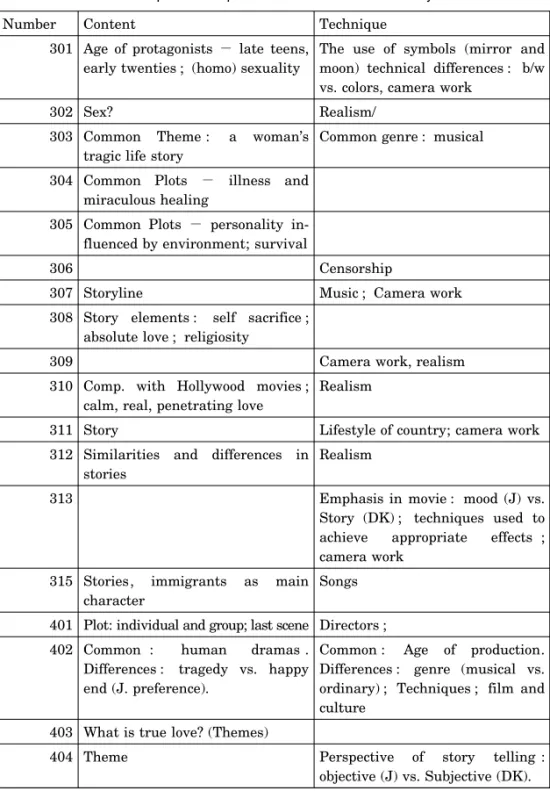
It is evident from table 3 that most of the students addressed issues of contents as well as of technical elements understood in a wide sense. Only one, no. 306, focused exclusively on a meta-level question by comparing censorship in Japan and Denmark. Many discussed the question of realism and concluded that the Danish movie they saw tended to be more realistic than the Japanese as a consequence of the camera work and story line. Some inferred from their particular observation that such is the general difference between Danish and Japanese film. They may have felt their impression confirmed by some of the movies they saw during the course, as discussed above. However, while one cannot deny that some directors like Dreyer and von Trier, and movies instructed according to the Dogma 95 principles, consciously seek to create an illusion of realism it is not difficult to find Danish movies which do not have that ideal. Von Trier’s Dogville where the houses are reduced to chalk markings on a wooden theater scene floor could qualify as an ideal example of non-realism.
Number Content Technique 301 Age of protagonists − late teens,
early twenties ; (homo) sexuality
The use of symbols (mirror and moon) technical differences : b/w vs. colors, camera work
302 Sex? Realism/
303 Common Theme : a woman’s tragic life story
Common genre : musical
304 Common Plots − illness and miraculous healing
305 Common Plots − personality in-fluenced by environment; survival
306 Censorship
307 Storyline Music ; Camera work
308 Story elements : self sacrifice ; absolute love ; religiosity
309 Camera work, realism
310 Comp. with Hollywood movies ; calm, real, penetrating love
Realism
311 Story Lifestyle of country; camera work
312 Similarities and differences in stories
Realism
313 Emphasis in movie : mood (J) vs.
Story (DK) ; techniques used to achieve appropriate effects ; camera work
315 Stories, immigrants as main character
Songs
401 Plot: individual and group; last scene Directors ; 402 Common : human dramas .
Differences : tragedy vs. happy end (J. preference).
Common : Age of production. Differences : genre (musical vs. ordinary) ; Techniques ; film and culture
403 What is true love? (Themes)
404 Theme Perspective of story telling :
objective (J) vs. Subjective (DK).
Tendencies and short comings
Problems in instruction
My language of instruction was probably one key to problems for the students. I did emphasize from the very beginning that English would be the primary language, but supplemented with summaries in Japanese. I made sure that hand-outs were predominantly in Japanese, not only to make it easier for the students to understand, but also to introduce important resources they could use for their own research. One exception was the instruction on the report writing, because I needed to be sure that the requirements were precisely formulated to which end I did not trust my Japanese. In class, I repeatedly gave opportunities for questions, but despite their seniority, the students seemed hesitant to ask. To reduce the risk of confusion if offering the same course in the future I would need to prepare more instructions in Japanese.
Number Content Technique
405 Contents Realism
406 Common : theme Techniques : Computer Graphics ; Lars von Trier − Dogma − realism, choice of actors (plain looking) vs. J style. Common genre : musical/ tragedy
407 Thematic resemblance, differences in storyline
realism
501 Differences : endings. Common: production year; genre (musical); differences: realization; J = Entertainment only vs. DK = Entertainment+
502 Common : adoration of human coexistence with nature (?) 408 Compares : plot (both simple and
predictable); ending − mass killing (both) but hopeful (Last Samurai) vs. fatal (Dogville).
Compares : settings (different) ; Actors (both have top-class).
Wikipedia, copyright, citation
Almost every term, I have students in one course or another submitting writings that turn out to be “copy-paste.” This happens despite my warnings and efforts to explain why such an act constitutes theft of intellectual property. In this course my instructions included my usual warning that failure to identify sources and a lack of indication of direct quotations would render the report unacceptable so the student would fail. Unfortunately, this course proved no exception to the rule. Five students failed. The main sources copied from turned out to be the Internet sites of the Japanese Wikipedia (ja.wikipedia.org/wiki) and the Japanese goo (movie.goo.ne.jp/movie/). It is an unfortunate situation when otherwise sensible adults take that kind of shortcuts and make a fool of me. I wonder if it would be possible for us, their teachers, to come up with a way of instructing on this particular point, which would lead to a decrease in the number of copyists.
Criteria of evaluation
For the evaluation I took a fairly relaxed attitude to the students presence in class, though of course encouraged it, and relied mostly on the reports written during the term above all on the final report. That was their chance to demonstrate initiative and creativity, because my instructions were focused on form rather than content. On reading the reports, I first examined the internal logic of the content and form, made a preliminary assessment, then checked for uncredited elements and made my final assessment with a lenient attitude, that is, if a source had been credited somehow, I would accept it, even if the style was not always clear. In some cases, however, no credit had been given at all and as much as two third of the text was a composite of disparate copied bits. This gave
me no impression of the students degree of understanding of the subject and thus could not qualify the report.
Conclusion
Summary
My aims with this course within the frame of Humans and Cultures were (1) to introduce a branch of Danish culture industry that has claimed international success in recent years with a product I assumed had the interest of the students’ age group, (2) via that introduction to bring up a number of issues for individual reflection and discussion in class, including subject matter like “love” and meta level issues like “education policies”, (3) to let the students reflect in writing on one or more issues important to them, based on observations from a comparative study of a Danish and a Japanese movie, preferably paying due attention to outside/ cultural factors that might have influenced the products. The final reports all together demonstrate that despite mutual uncertainties in terms of language the students did in fact achieve the goal. Those who eventually failed did so because they ignored the fundamental convention in academic writing of acknowledging authors on whose work one relies.
Evaluation
The course can be improved in several ways. The choice of movies reflected major points in Danish film history, but it did not cover all of them. Above, I have mentioned the imbalance of gender among the directors. More attention could be paid to introducing actors and the variety of genres. To do so will require much time to prepare potpourris of film clippings and to show the results in class. Ideally speaking, the class
time ought to include sessions of lectures and discussion, and sessions of viewing. It has been suggested to me to have students see the movies out of class, for instance at the library, but I wonder if sufficiently many will do so to enable fruitful discussions in class. One way of ensuring preparation and full participation in class would be to assign records for submission of the movies they see and ask them to observe on how certain themes are treated followed by reflections on cultural similarities and differences they identify.
References
Bondebjerg, Ib. 2005. Filmen og det moderne : filmgenrer og filmkultur i Danmark
1940-1972. Copenhagen, Gyldendal.
Danish Ministry of Culture 2007. Film−Fakta. Homepage : http : //www.kum.dk/ sw 623.asp (viewed 6 April 2007).
Hermansen, Christian M. 2006. transl. Morimoto Noriko「デンマークの映画――鏡 に映る田マー君の姿」. In Asano et al. eds. 2006「デンマークの歴史・文化・社会」 大阪 : 創元社
International Movie Data Base http : //www.imdb.com
Piil, Morten, ed. 2000. Gyldendals Filmguide. Danske film fra A til Z . Copenhagen, Gyldendal.
Pontifical Council for Social Communications. 1995. Some Important Films for the
100 th Anniversary of Cinema. http : //www.decentfilms.com/sections/articles/ 2572#vfl
About Christian M. Hermansen
Christian M. Hermansen (ヘアマンセン) was born in Denmark in 1962. He is associate professor and missionary at the School of Law and Politics, Kwansei Gakuin University, where he teaches English, courses on humans and cultures, introduction to Denmark, and introduction to Japanese history and religions. His research interest is in the Japanese understanding and practice of altruism towards the poor stranger, and he pursues the topic from historical and religious perspectives. His doctoral thesis was on the organization and work of hinin in early modern Osaka. His most recent articles are “Poverty−Methodism−Japan : Some Preliminary Observations” (Kwansei Gakuin University Journal of Studies on Christianity and Culture, No. 8 (2006), pp. 75―101) and “The Least of my brethren : Kamagasaki ecumenical Network” in Ruben L.F. Habito and Keishi Inaba, eds. The Practice of Altruism : carinig and religion in global perspective. (Cambridge Scholars Press), 2006, pp. 43―59, also translated by TAKEMORIYo¯ko¯ into Japanese as「私の兄弟である最も小さい
もの―釜ヶ崎の協友会―」in「宗教と福祉 : IAHR 2005 東京大会パネル記録」 皇學館大学出版部 2006 年. History, poverty, and religion aside, he is very interested in rhetoric, comics, and movies.