The Agglomeration Structure of the Animation
Industry in East Asia : A Case Study of Tokyo,
Seoul and the Shanghai Region
著者
Yamamoto Kenta
journal or
publication title
The science reports of the Tohoku University.
7th series, Geography
volume
57
number
1/2
page range
43-61
year
2010-03
URL
http://hdl.handle.net/10097/48558
The
Aggl
omerat
i
on St
ruct
ure
of
t
he
Ani
mat
i
on
I
ndus
t
ry
i
n Eas
t
As
i
a:
A Cas
e
St
udy
of
Tokyo,Seoul
and
t
he
Shanghai
Regi
on
Kenta YAMAMOTO
Abstract This article examines the agglomeration mechanism of the ani ma-tion industry in metropolises in Japan,South Korea and China,based on the results of an empirical study. Animation firms tend to agglomerate in metropolises not only in Japan but also in South Korea and China,where development processes are different from those of Japan. In order to clarify the structure of this agglomeration,firms and workers were surveyed by questionnaire and interview. The following three general factors were found to be causes of industrial agglomeration:related content industries,which are major clients,are concentrated in specific regions;instantaneous and flexible division of labor relationships are developing among other firms in the indus -try;and the agglomeration structure produces a flexible and specialized labor force. On the other hand,the agglomeration of the industry in each metropoli -tan region is accompanied by regionality. The scale of the domestic market, the role of the industry in international division of labor relationships,and government initiatives for industrial development are important regional f ac-tors. The agglomeration of the industry is sustained and enhanced by the interaction of these general and regional factors.
Key words:agglomeration,animation industry,Tokyo,Seoul,Shanghai
1. Introduction
The animation industry is the one of the major content industries that lead metropolitan economies in advanced countries. The purpose of the present study was to examine how and why the structure of the animation industry agglomerates in metropolitan areas.
Content industries have recently attracted scholarly attention because firms construct extensive and mutually complementary transactional relationships and complex networks consisting of various actors proximate to each other(Scott,2001), and networks for the social division of labor formed in central metropolitan areas function as creative and progressive generators of a culture(Scott,2000). Previous
JSPS Research Fellow,The University of Tokyo
studies have noted that one of the characteristics of a content industry is that the division of labor develops on an international scale(Coe,2001;Miller and Leger,2001; Goldsmith et al.,2003;Elmer and Gasher,2005;Govil,2005;Yamamoto,2009),while social relationships evolve among firms and individuals within the region(Coe,2000; Yamashita,2000;Hanzawa,2001;Hara,2005;Yamamoto,2007;2008;2009).
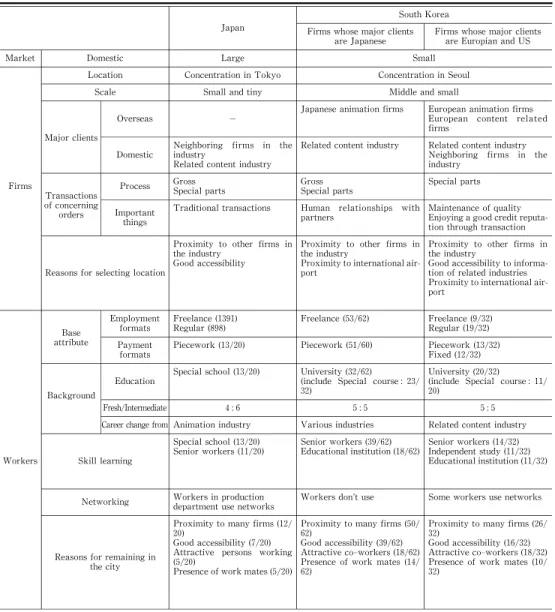
Table 1 Outline of survey results
Japan
South Korea Firms whose major clients
are Japanese Firarmse Eur whosopie majan andor cl USients Market Domestic Large Small
Location Concentration in Tokyo Concentration in Seoul Scale Small and tiny Middle and small
Major clients
Overseas −
Japanese animation firms European animation firms European content related firms
Domestic
Neighboring firms in the industry
Related content industry
Related content industry Related content industry Neighboring firms in the industry
Firms
Transactions of concerning
orders
Process GrSpeciossal parts SpeciGrossal parts Special parts Important
things
Traditional transactions Human relationships with partners
Maintenance of quality Enjoying a good credit reputa tion through transaction
-Reasons for selecting location
Proximity to other firms in the industry
Good accessibility
Proximity to other firms in the industry
Proximity to international air port
Proximity to other firms in the industry
Good accessibility to informa tion of related industries Proximity to international air port - -Base attribute Employment
formats FrReguleelance(ar(898)1391) Freelance(53/62) FrReguleelance(ar(19/32)9/32) Payment
formats
Piecework(13/20) Piecework(51/60) Piecework(13/32) Fixed(12/32) Background
Education Special school(13/20) (Uniinclverude Specisity(32/62)al course:23/ 32)
University(20/32) (include Special course:11/ 20)
Fresh/Intermediate 4:6 5:5 5:5 Career change from Animation industry Various industries Related content industry Workers Skill learning
Special school(13/20) Senior workers(11/20)
Senior workers(39/62) Educational institution(18/62)
Senior workers(14/32) Independent study(11/32) Educational institution(11/32) Networking Wordeparkertments in pr usoducte networionks Workers dont use Some workers use networks
Reasons for remaining in the city
Proximity to many firms(12/ 20)
Good accessibility(7/20) Attractive persons working (5/20)
Presence of work mates(5/20)
Proximity to many firms(50/ 62)
Good accessibility(39/62) Attractive co-workers(18/62) Presence of work mates(14/ 62)
Proximity to many firms(26/ 32)
Good accessibility(16/32) Attractive co-workers(18/32) Presence of work mates(10/ 32)
Firms and workers of the animation industry in Tokyo,Seoul and the Shanghai region were surveyed by questionnaire and interview,and the following three general factors were identified as causes of the agglomeration process in this industry:related content industries,which are major clients,are intensively concentrated in these areas; instantaneous and flexible division of labor relationships are developing among other
Table 1 Continued
South Korea China Firms whose major clients
are Domestic FirmsShanghai located in FirmsWuxi located in Market Domestic Small Large(immature)
Location Concentration in Seoul Concentration in metropolitan area Scale Middle and small Small and large Middle and small
Major clients
Overseas
European animation firms European content related firms
Japanese animation firms European animation firms
Japanese animation firms
Domestic
Related content industry Neighboring firms in the industry TV stations Neighboring firms in the industry ― Firms
Transactions of concerning
orders
Process Special parts Special parts Special parts Important
things
Maintenance of quality Enjoying a good credit reputa tion through transaction
Certain method of payment Improvement of the producing technology
Specific to subcontracting from Japanese firms
-Reasons for selecting location
Proximity to other firms in the industry
Proximity to related industry Fame of location
Proximity to international air port
Low initial investment Good labor market Geographical proximity to cli ents
Time proximity to clients
Availability of international airport
Cheep labor Massive labor face Preferential treatment by gov ernment -- -Base attribute Employment
formats ― FrReguleelance(ar(44/58)8/58) RegulFreelance(ar(38/53)12/53) Payment formats ― Piecework(31/58) Fixed(10/58) Piecework(41/53) Background
Education ― ColUnilverege(sit27/58)y(12/58) HiJunighor hi School(gh/t22/53)raining school (14/53)
Fresh/Intermediate ― 5.5:4.5 4:6
Career change from ― Related content industry Various industries Workers Skill learning ―
Senior workers(24/58) Independent study(17/58) Training by firms(17/58) Study session with work mates(11/58)
Study session with workmates (33/53)
Senior workers (21/53) Networking ― tWorasksker uss wie nettworh a varks iety ofdeparWorkers itment usn managemente networks
Reasons for remaining in
the city ―
Attractiveness of Shanghai (22/58)
Proximity to many firms(24/ 58)
Attractive co-workers(13/58) Presence of work mates(17/ 58)
Good accessibility to job infor mation(13/58)
Proximity to many firms(42/ 53)
Number of workers(23/53) Good accessibility to job infor mation(19/53)
Welfare at workplace(18/53)
firms in the industry;and the agglomeration structure produces a flexible and special -ized labor force. Regional factors also play a role in agglomeration. For example, important regional factors in Tokyo are the growth of the domestic market growing up large enough to support the industry independently and the presence of a specialized school that supplies the industry with workers trained in the necessary basic skills.
The animation industry this agglomerates due to the interaction of these general and regional factors. Table 1 shows the various factors that contribute to agglomer a-tion;this article examines how each factor influences agglomeration in the examined metropolitan regions.
2. Animation industry in Japan
The agglomeration process in Japan is related to the market structure of Japanese animation and location selection by animation firms. The Japanese animation indus -try has evolved by satisfying domestic demands since the 1960s,and most firms are located in Tokyo.
2.1 Major markets and locations of firms
According to the Digital Content Association of Japan(2006),the total sales of the Japanese animation industry in 2005 were estimated at$2,493,000,000. The largest portion of these sales were video sales,which accounted for$631,697,700 (25%), followed by television animation production at$464,749,000(19%). Overseas markets account for only 9% of sales($216,582,100);thus,the primary market of the Japanese animation industry is the domestic market.
There are 350 animation firms in Japan,278(79.4%)of which are located in Tokyo (Figure 1). This fact suggests that the agglomeration process is enhanced not only by the transactional relationship between the various firms in the animation industry, but also by the relationship between animation firms and related content industries, which are major clients for the animation industry in most business opportunities.
According to a study by Konagaya and Tomisawa(1999),this agglomeration was caused by smaller companies spinning off from major companies and then more smaller companies spinning off from them. The companies need to be located close to each other because they need to transport products between companies during the progression of specific operations and to facilitate the cooperation in the labor force during busy times.
2.2 Agglomeration structure in Tokyo
Figure 2 shows the agglomeration process of the animation industry in Tokyo. Major clients such as television stations,publishing companies,game companies,and
Figure 1 Location of animation firms in Tokyo Source:Yamamoto(2007)
Figure 2 Agglomeration structure of the animation industry in Tokyo Source:Yamamoto(2007)
other related content companies are located intensively in Tokyo. Animation firms in Tokyo consist of two kinds of firms:primary contractors and professional s ubcon-tractors. Primary contractors produce and manage the creative process of animation, while professional subcontractors are responsible for the specific process. The busi -ness of primary contractors relies on their relationships with clients in the related content industries located in Tokyo. These relationships tend to be firm,and are the source of most of the business of animation firms. In the case of Tokyo,then,it is important for the primary contractors to maintain geographical proximity to their clients in order to sustain business relationships and agglomerates.
There is mutual assistance to complement the labor force between primary contractors. Additionally,the transactional relationship between primary contr ac-tors and subcontractors is coordinative and is generally carried out in a short period of time,such as a single day. It is difficult to determine the volume or contents of such transactions under the existing relationship structure,with the result that it is common not to stipulate contractual coverage. Since contracts are uncertain,there exists the possibility of contract delinquency,and firms therefore make a considerable effort to establish reliable relationships with other firms in the industry.
This system of flexible and trusting transactional relationships is contributes to the agglomeration process,and it has enhanced the process in western Tokyo. Primary contractors conduct business with companies from the animation industry more frequently than with companies from the related content industries,and ther e-fore remain in western Tokyo.
Some firms also conduct business with firms in Korea or China and build relati on-ships that are technically complementary and/or that improve the division of labor. These firms may use joint transportation with other firms in the industry for inter na-tional transactions,for example.
In the labor market of the animation industry,new graduates hired as regular employees generally have three possible career paths:leaving the job,moving to another animation company,or freelancing. Freelancers who graduate from a profes -sional school or who have work experience with certain production companies can usually find a job in the production processes with their high technical skills and flexible attitude toward career opportunities. The freelancers develop relationships with senior staff members and learn important techniques from them. However,their incomes are unstable and they may need several jobs,which would be obtained through connections with other freelancers or employees in the animation industry. Freel an-cers are an essential component of the specialized labor force of the Japanese ani ma-tion industry. The opportunities for learning through relationships with senior staff members together with the pressures of an unstable income are common among freelancers in the animation industry and require them to maintain relationships with
other freelancers;this situation enhances the agglomeration of the animation industry in Tokyo.
There are many different media used in animation products and several types of products are consumed throughout Japan. Those who want to work in the animation industry often choose to go to a professional school. These schools are the largest source of labor in the industry. Furthermore,animation production companies and professional schools mutually benefit from their association in that the companies provide senior staff to the school as mentors,whilethe schools preferentially provide the companies with new labor.
3. Animation industry in South Korea
The market structure of the animation industry and the location of firms are factors of the agglomeration process that also apply to the Korean animation industry. In Korea,the animation industry has developed under the influence of the international division of labor with the Japanese,European and American animation industries. Subcontracted production from overseas firms,which sustains the sales of the Korean animation industry,is also a contributing factor.
3.1 Animation industry in South Korea
According to the Korean Culture& Contents Agency(2004),overseas transactions account for 106.6 million dollars,which is 52.2% of the annual sales of the Korean animation industry. Subcontracting from overseas firms accounts for the greatest share(41.5%),while creation and copyright is the largest(26.0%)sector in the domestic market,accounting for 48% of annual sales.
Of the 164 firms involved in animation production and animated cartoon production according to the Paran telephone number search,74.4% (122)are located in Seoul. Additionally,a total of 276 firms can be identified from the Paran telephone number search,the 2004 Korea Animation Corporation Directory, the KAPA2004 Animation Information Book and the Introduction for KAPA Members as animation firms located in Seoul(Figure 3).
Animation production firms surround Jung-gu where many administrative agencies are located. Firms have agglomerated particularly in Gwanak-gu Silli m-dong(28)in the southwest,in Seocho-gu Jamwon-dong(7)in the southeast,and in Gangnam-gu Sinsa-dong (9)and Seocho-gu Yangjae-dong (15). They have also agglomerated in Guro Digital Industrial Park(10),Yangcheong-gu Hyundai Dream Town(9),and Yangcheong-gu Booyoung Green Town(8).
3.2 Agglomeration structure in Seoul
An interesting feature of the Korean animation industry is that Korean firms are influenced by many different major client countries. This leads to the regionality of the animation industry,with firms are located in Seoul regardless of their individual characteristics. Nevertheless,different firms prefer different locations within Seoul (Figure 4).
In the case of firms that conduct business primarily with Japan,the major clients specialize in animation production. Firms therefore need to be located near the other firms in the industry in order to use the labor force most effectively,and need to be near the international airport for daily transactions requiring joint transportation with Japanese firms. Japanese firms trade in semi-finished products from Korean firms frequently in short term transactions. Korean firms share tasks and thus need to be close to each other both to receive a wider range of tasks from Japanese firms and to satisfy the quality demands and required deadlines of the Japanese firms. Korean firms must therefore be located in Seoul in order to satisfy these requirements.
Workers in firms that conduct business with Japanese firms have various aca-demic backgrounds and work histories,but most employees are freelancers. Workers
Figure 3 Location of animation firms in Seoul Source:Yamamoto(2008)
learn skills from senior workers at production sites after employment. Firms hire workers with high technical capabilities,and workers improve specific skills in order to increase production and avoid unstable employment. Freelancers continue to work in Seoul because of the proximity to the industry and the relationships with colleagues. Thus,the pool of workers offers a flexible and technically adept labor force to firms that conduct business with Japanese firms.
On the other hand,in the case of the firms whose major clients are Western companies or firms that target the domestic market,the active business of the major clients covers not only the animation industry but also related content industries. A location in Seoul,especially in the Central Business District,is advantageous in such cases because of the proximity to other companies in the same trade,the fame and trustworthiness of the location,and its proximity to Incheon International Airport.
Firms that conduct business with European companies employ mostly freelancers as well as workers from firms whose major clients are Japanese. With respect to skill learning,workers have various opportunities depending on the occupational descri p-tion they wish to attain. Firms chose workers not only for their technique but also for their creativity,and workers get jobs from both the firm they belong to and from other
Figure 4 Agglomeration structure of the animation industry in South Korea Source:Yamamoto(2008)
firms. Workers choose to work in Seoul because of the proximity to the industry,and the potential for further employment through relationships with colleagues. There is also a labor pool surrounding firms whose clients are mainly from the West,which supplies a flexible and specialized labor force based on workersrelationships.
4. Animation industry in China
After the 1990s,the animation industry in China developed by taking on the lower processes of animation production ordered from Japan or the European countries. In this respect,the Chinese animation industry developed in the same way as the Korean industry. However,the agglomeration structure in China is different from that in Korea because of government initiatives for industrial development and distribution, the scale of the domestic market,and the role of the international division of labor.
4.1 Government support
According to Zhang(2006),the Chinese government has expected the growth of the animation industry since 1995,and has launched various policies,such as those for industrial attraction and broadcast regulation,in order to develop the domestic market. Since these policies came into effect,the Chinese animation industry has been in a stage of industrial promotion until the present.
Shanghai is the largest region producing and consuming animation in China. However,the market sustaining the growth of the Shanghai animation industry is not domestic but overseas. Overseas firms produce most products in the domestic market,and Japanese products account for the greatest turnover of animation pr od-ucts. According to the State Administration of Radio,Film and Television Devel op-ment and Revolution Research Center(SARFTDRRC)(2006),the government con-siders the animation industry to be a knowledge-intensive,labor-intensive,and high technology-intensive cultural industry. On other hand,the China Animation Year Book 2006 states that the Chinese industry still remains in the early stages of development and that manual-laborers subcontract jobs from the strong animation industries in Japan,Korea and the US. In addition,SARFTDRRC(2006)estimates the production of Chinese animation in 2005 at around 43,000 minutes,30,000 of which were ordered by overseas firms. This suggests that more than 50% of the output of Chinese laborers goes overseas(SARFTDRRC,2006). As Qin (2006)points out,Japanese products accounted for 10 of the top 15 animation programs in annual broadcasting time in China in 2004.
4.2 Location of firms
production from 2004 to 2006 shows concentrations in Beijing(39),Shanghai(27)and Guanzhou(27)(Figure 5). Among the 39 organizations in Beijing,27 are under direct government control and one is affiliated with the Peoples Liberation Army;the remaining 11 are private enterprises. Other firms are located in the area surrounding Beijing,including Shanghai and Guanzhou. The Internet telephone book Benxinsou
Figure 5 Location of animation firms in China Source:Yamamoto(2009)
(http://www.locoso.com/) lists animation firms involved in yingshi or yingshi production. Most of these cities are under the preferential treatment policy,which may have had an effect in attracting these firms to this area.
4.3 Market structure in China
Although the Chinese animation industry has a potentially huge domestic market, it is the overseas market that sustains the industry,particularly the Japanese market. Chinese firms take orders from Japan through joint transportation,as in the case of the Korean industry. Of the 9 Chinese firms involved in joint transportation in March of 2008,4 were located in Shanghai,3 in Wuxi,and 1 each in Hangzhou and Jiaxing. Additionally,5 of the 11 Wuxi firms shown in Figure 5 conducted business with Japanese firms. Thus,in terms of product supply in the domestic market and international transactions,the Shanghai region,including Wuxi and other cities,is the agglomeration site of the Chinese animation industry.
Figure 6 shows the distribution of firms in Shanghai based on data offered by the Animation Association of China. Companies in Shanghai are widely distributed but many firms are concentrated in the western part of the nei-huan (inner ring)area. The Shanghai Animation Film Studio,the leading company in the Chinese animation
Figure 6 Location of animation firms in Shanghai Source:Yamamoto(2009)
industry,is located in this area,and firm α is also located in a neighboring area. However,there are only 6 firms located in Pudong-xinqu,the region under the Shanghai government support policy. Most firms are located outside the government support area.
Figure 7 shows the distribution of animation firms in Wuxi. Except for 2 firms located outside the scope of the figure,every firm is located within 5 kilometers from the center of Shanghai,and they tend to be distributed in the west.
4.4 Agglomeration structure in the Shanghai region
Figure 8 shows the structure of the agglomeration process of the animation industry in the region surrounding Shanghai. Firms with strong ties to foreign founders or to investors in Shanghai firms come to Shanghai because they need the accessibility to Pudong International Airport and to the Shanghai labor market.
The domestic market is dominated by relatively larger companies whose clients are mostly from related content industries and who establish themselves in Shanghai because they need proximity to their clients.
With respect to transaction relationships among other firms in the industry, primarily small companies have instantaneous transactions with each other. They build mutual trust between parent or corporate firms in order to avoid the risk of unstable business opportunities. In such transactions,firms mutually complement the labor force or labor skills,and agglomerate in Shanghai for the proximity to other firms in the industry,which provides daily opportunities for business.
Figure 7 Location of animation firms in Wuxi
Note:One firm in the Animation industrial base and another in iPark located off the map
Although workers in Shanghai are guaranteed their status as regular employees, their salaries are unstable and they are required to have high and work-ready skills. Nevertheless,the animation industry is promising and less time-sensitive than other industries,and it provides workers with opportunities for creativity. Workers learn their skills through various opportunities that require them to meet corporate needs.
Although many workers belong exclusively to a single firm,they get jobs through connections with colleagues. Regardless of their job descriptions,workers stay in Shanghai because they want to be close to the industry and to their colleagues. A labor market of such workers is indispensable for firms wishing to penetrate the domestic market,as well as for firms stabilizing management.
The firms surveyed in Wuxi were established as production bases for Japanese firms. The Wuxi location was chosen for 4 reasons:it is close to Shanghai Pudong International airport;the Wuxi government grants preferential treatment to the animation industry;work conditions in Wuxi are more relaxed than those in Shangh-ai;and the labor force is cheap. These four factors are essential for rapid,cheap and extensive production.
Because the firms in Wuxi take certain types of tasks,the skills of the workers
tend to be specialized within the production process. Workers learn skills through relationships with other workers at the production site. Although there are many workers with outside job offers,they often have ample work in their home firm. The workers remain in Wuxi because of practical advantages such as welfare at the workplace and opportunities to learn skills or build relationships with colleagues, through whom other job opportunities may arise.
5. Conclusion
5.1 General factors that promote agglomeration of the animation industry Figure 9 shows the agglomeration structure of the animation industry in metropol -itan cities. There are 3 general factors that encourage agglomeration in the ani ma-tion industry:the regional concentration of the major clients,mostly from the related content industries;the flexible and immediate division of labor with colleagues;and a structure that produces a flexible and specialized labor force.
5.2 Local concentration of related content industries
The major clients of animation production firms are from related contents indus -tries such as television stations,advertising firms,publishing companies and video game production firms,all of which tend to concentrate in large cities. The Japanese
animation industry has developed by satisfying domestic demand derived primarily from the television industry. Production firms agglomerate in Tokyo for the numer -ous opportunities for business with related content industries,including the television station located in central Tokyo. In South Korea and China,where the domestic market is small,the firms are located in Seoul or Shanghai in order to do business with the related content industries. Although the related content industries as a major client are different in each market,transaction opportunities with these industries in a metropolis bring about the agglomeration of animation firms.
5.3 Division of labor relationship
Animation products differ in their labor requirements. Labor-intensive pr oduc-tion is required in some production process,such as motion pictures and coloring. Additionally,the animation firm has to choose its partners in order to be able to respond flexibly and quickly to the required characteristics and schedule of the ordered product. Therefore,firms agglomerate because they require proximity to the other firms in the industry. Repeated transactions with these other firms increases the trust between firms and helps firms to avoid unstable or unreliable transactions. Close relationships form between executive officers who used to be colleagues,and implicit understanding exists among firms in the industry. Mutually complementary immedi -ate and flexible division-of-labor relationships with colleagues are further supported by transactional practices based on trusting relationships among firms.
5.4 Structure producing a flexible and specialized labor force
Workers in the animation industry learn special production skills,and animation firms need to be able to constitute their labor force flexibly according to the character -istics of the required product,such as its story or design. Production firms therefore agglomerate to have access to a labor force specialized in many fields. Workers learn skills and get jobs through the social relationships formed as part of this agglomer a-tion. They also develop various skills through these relationships and provide flexible and specialized skills to the firm. The social relationships among workers at the production site enhance the concentration of the labor force and produce a strong and highly skilled labor force.
5.5 Regionality of the agglomeration of the animation industry
Although some of the factors that lead to agglomeration are universal,the environments surrounding the industry in the three metropolitan regions under consi d-eration are different.
The large domestic market is the key to regionality in Japan. The firm can stabilize management through transactions with related content industries,and pr
ox-imity to these domestic related content industries is more important to Japanese firms than to Korean or Chinese firms. Technical schools,which provide a labor force to Tokyo firms,are another regional factor Some firms in Tokyo send their workers to technical schools as tutors and thereby identify talented students early in their career.
In Seoul and Shanghai,it is the overseas market that sustains the industry. The domestic market is immature in both these cities,and the viability of most firms depends on overseas transactions. Thus,firms need to be easily accessible geographi -cally to the overseas market to retain their overseas clients. The international airport satisfies this requirement and the availability of the airport is one cause of the agglomeration of the Korean and Chinese animation industries.
Firms in Seoul and Shanghai also need to satisfy the quantitative and qualitative needs of overseas production firms. Especially in Seoul,the influence of this requir e-ment is obvious in the selection of location by firms.
The distribution of firms in Shanghai,however,is not dependant on client national -ity,and regional factors influencing agglomeration in Shanghai include political factors such as regulation and policies for industrial development. The Chinese government does not permit people to use land freely and the desires of firms are not fully reflected in their site selection. However,a firm chooses Shanghai seeking the advantages of its external economy,such as an existing industrial infrastructure, accessibility to clients,and a highly skilled labor force.
The Chinese government has great expectations for the development of the animation industry,and enforces the industrial development policy in many cities. In Wuxi,160 km west of Shanghai,the animation industry is supported by its proximity to Shanghai Pudong International Airport,government support,and a cheap and massive labor force. The agglomeration of the industry in Wuxi is based on both dependence on overseas transactions and political regulation.
The present study clearly shows that the animation industry consistently aggl om-erates in a metropolis,however,this agglomeration is driven both by universal factors found in any metropolis and by regional factors particular to any specific location.
Acknowledgement
The author would like to offer special thanks to Mr.Shinnosuke Iijima,for his helpful sugges -tions. This investigation was funded by a Grant-in-Aid for JSPS Research Fellowships for Young Scientists(No.20-3145).
Note 1) 100 yen=1.13 dollar(December 18,2008).
2) The firms were identified from the following sources: Animation production on the i -townpage(http://itp.ne.jp/), Animation production in the Yahoo!address book (http:// phonebook.yahoo.co.jp/),and the Anime Business Handbook 2005 (Tokyo International Anime Fair Executive Committee,2005).
3) Yamaguchi(2004)states that the Japanese animation industry began with moviemakers noting the popularity of animation in overseas countries and requesting animation from young cartoonists. This was before the rise of television,and animation was sold as a movie product;animation products began to be supplied to television in the early 1960s. Yamagu-chi also observes that,in the early days of animation,the location of animation production companies was highly dependent on the location of movie and cartoon production companies. 4) Data were drawn from the following sources:the Paran Telephone number search was
conducted using Paran local information(http://local.paran.com/;last access,6 July,2008), the 2004 Korea Animation Corporation Directory was published by the Korean Culture& Contents Agency,the KAPA2004 Animation Information Book was published by the Korea Animation Producers Association,and the Introduction for KAPA Members can be found on the KAPA homepage.(http://www.koreaanimation.or.kr/;last access,6 July,2008) 5) Hyundai Dream Town and Booyoung Green Town are collective housing areas,and the
firms are located in collective housing. There is a nearby television station as well as an agglomeration of related content industries. Guro Digital Industrial Park,Hyundai Dream Town and Booyoung Green Town were put on the market in earnest after 2000.
6) The word yingshi means dianyin(movie) and dianshi(televison). Thus,both yi ng-shi and yingshi production mean movie and/or television production here.
7) Also in the responses of Japanese firms to our questionnaire,Wuxi was the primary location of companies placing orders.
References
( in Japanese, in Japanese with English abstract, in Korean, in Chinese) Coe,N.M.(2000):The view from out West:embeddedness,inter-personal relations and the
development of an indigenous film industry in Vancouver. Geoforum ,31,391-407. Coe,N.M.(2001):A hybrid agglomeration? The development of a satellite-Marshallian indus
-trial district in Vancouvers film industry. Urban Studies ,38,1753-1775.
Digital Content Association of Japan (2006):Digital Content White Paper 2006 . Digital Content Association of Japan,Tokyo.
Elmer,G.and Gasher,M.(2005):Contracting Out Hollywood : Runaway Productions and Foreign Location Shooting. Rowman& Littlefield Publishers,Oxford.
Goldsmith,B.,ORegan,T.and the Australian Film Commission and Australian Key Centre for Cultural and Media Policy and Creative Industries Research and Applications Centre (2003):Cinema Cities, Media Cities : The Contemporary International Studio Complex. Australian Film Commission,Sydney.
Govil,N.(2005):Hollywoods effects,Bollywood FX. In Elmer,G. and Gasher,M.,eds.: Contracting Out Hollywood : Runaway Productions and Foreign Location. Rowman& Littlefield,Oxford,92-114.
Hanzawa,S.(2001):The structure and developing changes in the animation industry agglomer a-tion in Tokyo . Annals of the Japan Association of Economic Geographer,47,288-302.
Hara,S.(2005):Competitive advantage and innovation of digital content industrial clusters in Japan in the global competition era:the case of the SD GUNDAMFORCE Project . Annals of the Japan Association of Economic Geographer,51,368-386.
Konagaya,K. and Tomisawa,K.(1999):Maruchi media toshi no senryaku (The Strategies of Multimedia Cities) . Toyo Keizai Shinposha,Tokyo.
Korean Culture& Contents Agency(2004):DaeHanMingGuk Aenimeishion SanEop BaekSeo (Korea Animation Industry White Paper) . Korean Culture& Contents Agency,Seoul. Miller,T.and Leger,M.C.(2001):Runaway production,runaway consumption,runaway citi -zenship:the new International Division of Cultural Labor. Emergences : Journal for the Study of Media & Composite Cultures ,11,89-115.
Qin,X.(2006):Zhongguo donghuapian de chanye jingjixue yanjiu (Economic study of the Chinese animation industry) . China Market Press,Beijing.
Scott,A.(2000):The Cultural Economy of Cities. Sage,London.
Scott,A.(2001):Globalization and the rise of city-regions. European Planning Studies ,9,813-826.
State Administration of Radio Film and Television Development and Revolution Research Center(2006):2006 Report on Development of China s Radio, Film and Television . Social Sciences Academic Press,Beijing.
Yamaguchi,Y.(2004):Nippon no anime zenshi ―sekai wo seishita Nippon anime no kiseki ―(General History of Japanese ANIME : the Miracle of Japanese Animation that Wins in the World) . Ten Books,Tokyo.
Yamamoto,K.(2007):Agglomeration mechanism of the animation industry in Tokyo:focus on business-to-business and the labor market . Geographical Review of Japan,80,442-458. Yamamoto,K.(2008):Agglomeration and the characteristics of the animation industry in
Seoul:focus on the international division of labor and the labor market . Quarterly Journal of Geography ,60,185-206.
Yamamoto,K.(2009):Agglomeration of the animation industry in the Shanghai Region,China: Special reference of firms based on overseas transaction . Geographical Sciences ,64, 228-249.
Yamashita,M.(2000):Producers roles and their careers in the Japanese film industry . Japanese Journal of Administrative Science,14,15-31.
Zhang,S.(2006):Huigu zhongguo donghua 80 nian fazhan licheng. Zhungguo donghua ni an-jian bianjibu:Zhungguo Donhua Nianjian 2006 (China Animation Yearbook 2006) . Zhonguo guangbo dianshi chubanshe,Beijing,722-730.
Zhongguo donghua nianjian bianjibu(2006):Zhongguo Donghua Nianjian 2006 (China Anima-tion Yearbook 2006) . Zhonguo guangbo dianshi chubanshe,Beijing.