Japan Advanced Institute of Science and Technology
JAIST Repository
https://dspace.jaist.ac.jp/
Title Sharing and Applying of Knowledge in Reflective Teacher Education
Author(s) Shimada, Nozomi Citation
Issue Date 2007-11
Type Conference Paper
Text version publisher
URL http://hdl.handle.net/10119/4116
Rights
Description
The original publication is available at JAIST Press http://www.jaist.ac.jp/library/jaist-press/index.html, Proceedings of KSS'2007 : The Eighth International Symposium on Knowledge and Systems Sciences : November 5-7, 2007, [Ishikawa High-Tech Conference Center, Nomi, Ishikawa, JAPAN], Organized by: Japan Advanced Institute of Science and Technology
Sharing and Applying of Knowledge in Reflective Teacher Education
Nozomi Shimada
School of Knowledge Science
Japan Advanced Institute of Science and Technology
[email protected]
Abstract
The aim of this paper is to explain the process of sharing and applying of knowledge in reflective teacher education. Background of this paper is transformation of teacher’s work. In modern society, teacher is defined as a routine worker. In contrast, teacher is recently defined as a knowl-edge worker, reflective practitioner or learner and so on. In this paper I focus on teacher as a re-flective practitioner which is based on concept of Schön. This reflective process facilitates teachers to recognize their daily practice.
In order to facilitate reflection and sharing or applying of knowledge, relationship between teachers is crucial factor. For example relation-ship of mentoring is important factor for reflec-tive process. Because, mentor encourages novice teachers to recognize their practice and their cul-ture which has influence to teacher’s thinking. I describe a process of teacher education with the aim of developing teacher’s capacity for cur-riculum development in order to explain these process and mechanism concretely. Through analyzing the case, I will show importance of a reflection and mentoring in teacher education.
Keywords: Teacher Education, Reflection,
Mentor, Knowledge Sharing and Application
Introduction
Transformation to knowledge society asks teachers to change their work activities. Because, in knowledge society, definition of a concept of “profession” or “professionalism” is dramatically changing. Hargreaves(2003)[1] points out a change in the teaching and teacher’s work.
In the past, teachers learned the rudiments of teaching by watching the teachers who taught them. Teaching for today’s knowledge society is technically more complex and wide-ranging than teaching has ever been. It draws on a base
of research and experience about effective teaching that is always changing and expand-ing. Today’s teachers therefore need to be committed to and continually engaged in pursuing, upgrading, self-monitoring, and re-viewing their own professional learning.[2] As Hargreaves points out, teachers in knowledge society have not only to learn the basic skills of teaching but also to reflect own experiences and share knowledge which is generated from par-ticular classroom. Through these collaborative opportunities enable teachers to development their teaching skills and deliberate on their daily practices. In fact, continuous learning opportuni-ties for teacher are needed to slot in a section of teacher’s work. In this perspective, teacher is a learner or knowledge worker rather than a tech-nical worker.
In this paper, I will show crucial points which are needed for a discussion about teaching and teacher’s work. And I focus on teacher’s knowl-edge, especially practical knowledge. Then, I will take a case of teacher education program which is held by board of education in Ishikawa prefecture and analyze some implication for practice-based teacher education.
1 Perspectives on Teacher
1. 1 Traditional Perspective: Teacher as a Technical Expert
In recent years, teacher and teacher’s work are re-considered. In tradition, teaching is understood from scientific perspective. Therefore, research-ers on teaching and teacher’s work tried to extract a universal rule of teaching. For example, de-velopment of “teacher proof curriculum” in America is a status symbol of teacher’s work as technically. In this perspective, its core is appli-cation of theory which is based on eduappli-cational research to practice. However, teaching is not a just technical work, rather an improvisatial and
intuitive work. In follow, I argue with new per-spective on teaching and teacher’s work.
1.2 Teacher as a Reflective Practitioner
In these days, a concept of “reflective practitio-ner” which is showed by Schön has a great impact on teacher and teacher’s work. Schön(1983) [3]
pointed out as follow.
Every competent practitioner can recognize phenomena-families of symptoms associated with a particular disease, peculiarities of a certain kind of building site, irregularities of materials or structures-for which he can not give a reasonably accurate or complete de-scription. … Even when he makes conscious use of research-based theories and techniques, he is dependent on tacit recognitions, judg-ments, and skillful performances.[4]
As Schön pointed out, practitioner achieves not only technical skill or theory but also con-text-based cognitive skills. For example, context of classroom, student’s achievement and interest have an effect on teaching practice. Therefore, teaching is not necessarily assessed whether success or failure from scientific or objective standard which is extracted from theory-based research.
So, reflection in action and practice are crucial point for understanding teaching context and teacher’s judgment in classroom. Through un-derstanding teacher’s thinking in practice context, we can describe a detail of teaching and analyze classroom events which is affected from concrete relation between students and teacher. Moreover, the role of teacher’s reflection in not only to recognize the present practice but also to under-stand own practice relatively. Why it is needed for teacher to recognize own practice relatively? For this question, Shön shows crucial and im-portant aspect of reflection.
Further, as a practice becomes more repetitive and routine, and as a knowing-in-practice be-comes increasingly tacit and spontaneous, the practitioner may miss important opportunities to think about what he is doing.[5]
The reason why I focus on a teacher‘s reflection is its process enables teachers to recognize and
develop their practices. This reflective process is crucial foundation for teacher development. Its process enable for teachers to realize problem in their practices, and tackle it. This tide affects a form of teacher education. I will mention recent teacher education in next section.
2 Transformation of Teacher Education
2.1 Types of Teacher Education
As I mentioned above, teacher’s reflection, rec-ognition, and assessment for own practice play the important role of teacher development in practice. Once teacher’s thinking in concrete contexts is recognized as a functional action, we have to rethink about effective form of teacher education.
For example, Zeichner(1983)[6] classifies four types of teacher education: behavioristic teacher education, personalistic teacher education, tradi-tional-craft teacher education and in-quiry-oriented teacher education. Figure 1 shows relationship between four types.
“INQUIRY-ORIENTED” “BEHAVIORISTIC” “TRADITIONAL-CRAFT” “PERSONALISTIC” PROBLEMATIC CERTAIN REFLEXIVE RECEIVED
Figure 1. A Summary of Four Paradigms of Teacher Education [7]
The behavioristic teacher education is viewed teaching and learning as a “applied science” and teacher as a passive recipient of professional knowledge. This view accords with perspective of technical expertise. The personalistic teacher education aims to promote the psychological maturity and based on view of phenomenological epistemology and perceptual and developmental psychology. The traditional-craft teacher educa-tion is viewed process of teacher educaeduca-tion from apprenticeship perspectives. In this view, knowledge is defined accumulation by trial and
error. That is to say, teacher development in this view is understood as a shift from beginner to competent practitioner. However, knowledge in such a community is rarely regarded changeable one. In other words, reproduction of knowledge is primary purpose in these apprenticeship com-munities.
In contrast these views, Zeicher insists on im-portance of inquiry-oriented teacher education. The aim of this view is to promote development of skill of critical inquiry. However, this doesn’t suggest that technical skills and its acquisition is unnecessary. This means acquisition of technical skills itself is not ultimate purpose, rather it is included in the process of inquiry. The essential question of this view is whether teacher can de-velop their skill for reflective thinking. And this style of teacher’s thinking is developed through a process of inquiry-oriented teacher education.
3 Teacher’s knowledge
3.1 Classification of teacher’s knowledge
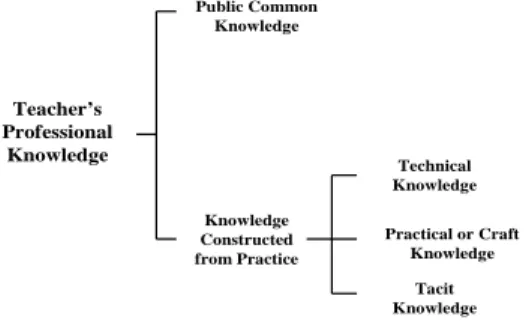
As I mentioned above, teacher’s work and teacher education are ask us to change traditional perspective on teacher’s knowledge. In this sec-tion, firstly I will mention a classification of teacher’s knowledge. Secondly, I will mention a teacher’s practical knowledge and its functions. For example, Myers and Simpson(1998)[8] clas-sify a professional knowledge of teacher. Figure 2 is their classification of teacher’s knowledge.
Teacher’s Professional Knowledge Public Common Knowledge Knowledge Constructed from Practice Technical Knowledge Practical or Craft Knowledge Tacit Knowledge
Figure 2. Classification of Professional Knowledge of Teacher
Firstly, they roughly divide teacher’s profes-sional knowledge; public common knowledge and knowledge constructed from practice. Fur-thermore, the latter is classified three kinds of knowledge; technical knowledge, practical or
craft knowledge and tacit knowledge. Public codified knowledge is general pool of informa-tion about teaching and learning which is col-lected by researcher and scholar. In traditional perspectives on teaching and teacher’s work, application of public common knowledge to each practice is understood as an important task for educational researcher and teacher. That is to say, main focus is knowledge which is generated from outside of practice. However, as I mentioned above, these perspectives neglected the con-text-specific events and teacher’s thinking for it. Public common knowledge is functions as a vi-sion, framework and principle. But its knowledge is difficult to explain practice concretely. In contrast, knowledge constructed from practice is composed with teacher’s critical or investiga-tive thinking and daily practice. So, a practical knowledge plays the role of functional solution or decision making. In following section, I will review some essential research on teacher’s practical knowledge.
3.2 Functions of Practical Knowledge
Schwab is pioneer who point out importance of practical knowledge for teacher’s work. Schwab (1971)[9] indicate that practical knowledge has a functional role.
Educators have sought theory (theory of cur-riculum, theories of teaching and learning) as if such theories would be sufficient to tell us what ant how to teach. Educators have applied theories from the behavioral sciences toward solution of practical problems as if these bor-rowed theories could be applied simply and directly. … Theories of curriculum and of teaching and learning cannot. Lone, tell us what and how to teach, because questions of what and how to teach arise in concrete situa-tions loaded with concrete particulars of time, place, person, and circumstance. [10]
As Schwab pointed out, we have to understand that practical knowledge play an important role in teacher’s work. Because, “practical wisdom” is core of professionalism on teacher’s work. The function of practical wisdom is to present prob-lems, choice and judge solutions by reflection and deliberation. That is to say, practical wisdom is composed of aggregate of multiple knowledge. Furthermore, practical knowledge is
character-ized by “case knowledge”. For example, Doyle (1990) [11] regard classroom knowledge as a case knowledge which is base of classroom manage-ment. Its character is composition which is based on several events in a classroom. Moreover, as against general knowledge, classroom knowledge as a case knowledge is particularistic and situ-ational. That is to say, case knowledge of teacher has variability. Its main function is following. Firstly, it is used for interpretation of particular situation. Secondly, it serves to solve particular problems in classroom.
Teacher’s work in a classroom is always situ-ational and based on practical or case knowledge for their decision making and problem solving. So, as some researchers say, we have to explain several functions of practical knowledge by analyzing concrete practice in classroom.
3.3 Categories of Practical Knowledge of Teacher
Shulman (1987)[12]showed categories of the knowledge base for teachers. His work is proto-type of teacher’s knowledge. It is composed of seven knowledge; content knowledge; general pedagogical knowledge; curriculum knowledge; pedagogical content knowledge; knowledge of learners an their characteristics; knowledge of educational contexts; knowledge of educational ends, purpose, and values, and their philosophical and historical grounds. He especially focuses on pedagogical content knowledge, because it represents compound which includes teacher-specific judgment on subject matter, learner, organization of lesson, and so on. Teacher’s knowledge has complex structure and is not easy to share and application to own prac-tice. Because its is context specific knowledge. In following section, I will mention a relationship between teachers as a crucial point of knowledge sharing and application.
3.4 Knowledge Sharing and Applying Between Teachers
The collaborative relationship between teachers is one of the most important factors on teacher development. However, some problems put ob-stacles in the way of teacher collaboration (Lortie, 1975; Hargreaves, 1994)[13]. For example, closed or encapsulated structure of classroom prevents teachers from collaboration which includes frank
exchange of ideas about teaching.
One solution of this problem is mentoring be-tween teachers. A mentoring bebe-tween novice teacher and advanced teacher serves to encourage novice teacher to think reflectively. Of course, individualistic culture in school is obstacle to collaboration between them. Therefore, we have to consider arrangement of a environments around teachers. Halai (2006)[14]defines functions of mentoring as follow.
Some key roles that the mentor described themselves playing included, guide and, pro-vider of support and key information (per-taining to formal policies and culture) to the beginning teachers. … Implicit in these roles and relationships is the notion that the mentors provide emotional support and guidance to mentees who are novices and in need of just such support.[15]
Some researchers point out that mentoring differs from relationships in apprenticeship communities. The former aims to reproduction knowledge in the community. In contrast, the latter aims to reflect knowledge itself in community through mentoring. Reflection here means that teacher has opportunities to recognize some problems on their practice from perspectives of advances teacher. Furthermore, these processes of men-toring has possibility of knowledge sharing, ex-change and application between teachers. In fol-lowing sections, I mention relationship between mentoring and teacher’s knowledge by describing concrete case of teacher education.
4 Case Analysis
4.1 Outline of Case
The object of case analysis is a teacher education program in Ishikawa, Japan. This program aims to develop a capacity of novice teacher by col-laboration with an expert teacher as a mentor. That is to say, the core activity of this program is a mentoring process.
In this program, participants are divided into several groups. The group is composed of 3-5 novice teachers and 1 expert teacher as a mentor. Furthermore, an outstanding characteristic of this program is collaborative activity of diverse teachers who works in different schools in
Ishi-kawa. In general, school-based teacher education is held in a single school. In comparison with general form of teacher education, this case en-ables participants to discussion and exchange teaching skill and knowledge with various teachers.
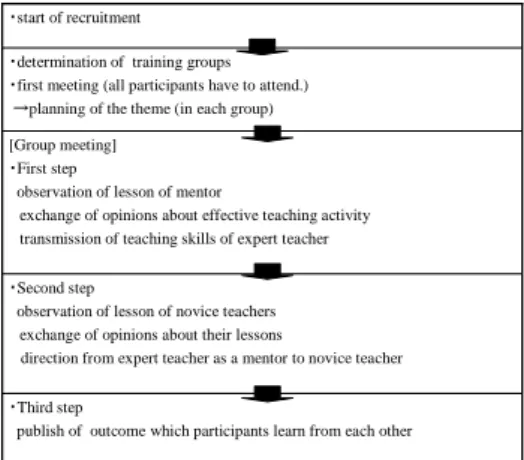
The brief process is showed in following table 1. The core activity in this program is “lesson study” and they discuss some lesson with member.
・Third step
publish of outcome which participants learn from each other ・Second step
observation of lesson of novice teachers exchange of opinions about their lessons
direction from expert teacher as a mentor to novice teacher [Group meeting]
・First step
observation of lesson of mentor
exchange of opinions about effective teaching activity transmission of teaching skills of expert teacher ・determination of training groups ・first meeting (all participants have to attend.)
→planning of the theme (in each group) ・start of recruitment
Table 1. A brief process of program In addition to this, an outstanding characteristics in this program are as follow. Firstly, training theme in an each groups is determined by par-ticipants. In conventional teacher education, training theme is determined by supervisor or administrator. This conventional style of teacher education is obstacle for teachers to commit ac-tively. Because theme of training program affects a motivation of teacher.
Secondly, this program offers novice teachers a valuable opportunity to exchange and discussion about teaching skill and knowledge. As some researchers point out, teacher’s work in a school is so individualistic. Therefore, an activation of opportunity to discuss between teachers is crucial issue for teacher development. Because, these opportunity is enable teacher to learn some prac-tice from another teacher and reflect or develop practice of one’s own.
For example, Oshima (2007)[16] points out prob-lem of lesson study and teacher development in Japan.
Although lesson study in Japan is a systematic and well-established approach to teacher pro-fessional development, its implementation does not guarantee changes in teacher’s ex-pertise in the light of changing contexts of
Japanese education. [17]
As he points out, lesson study in Japanese school is conventional practice. It is rather fixed practice than innovative and developmental process. In this traditional style of teacher education, it is difficult to support and encourage teacher de-velopment. In this paper, I show the process of mentoring through case analysis. From case analysis, I will show an importance of collabora-tive relationship to learn from each other.
4.2 Effort toward innovative lesson study
In this section, I will take up one group and show the details of activity. This group is composed of five teachers. One teacher is expert teacher who is assessed as an excellent teacher, another are teachers who have 3~7 year teaching experiences in an elementary school in Ishikawa prefecture. Their purpose is to develop a capacity for Japa-nese lesson. In following, I will describe a detail of this group activity by using interview date of one teacher in group. This teacher has six year teaching experiences in an elementary school. His school places an emphasis on mathematics research. However, because he wants to brush up own skill of Japanese lesson, and he applied this teacher education program.
The member of this group which includes him has teaching experiences in elementary school. So, they have a common understandings about classroom management, planning of lesson and basic knowledge about Japanese class. But they except mentor teacher had not experience on intensive discussion and education about Japa-nese class. Therefore, this teacher education program has potential factor for development of their capacity of teaching.
4.3 Date analysis
I interviewed one teacher of this group. In this section, I describe their efforts by using a inter-view date. According to him, they repeatedly discuss the questions how to plan a Japanese class and how to grasp the present condition of students. The achievement and interest of student is an important polestar to plan a lesson for teacher. Without this understanding, they can not plan a worthwhile scheme.
However, as he said, it is difficult to grasp the details of condition of student and classroom. So,
he hoped to talk with mentor teacher. His mentor teacher have a talent for coordination between lesson plan and student’s condition. Mentor teacher showed him some idea about a manage-ment of classroom settings. These perspectives was constructed from her practices, therefore this is regarded as her practical knowledge. As I show figure 4, throughout he and mentor teacher tack-led with some object, her practical knowtack-ledge was shared and transferred to him. Furthermore, this interactive relationship enabled them to rec-ognize their own knowledge. These processes are regarded as a reflective teacher education. These collaborative relationships enabled novice teacher to reflect and develop own knowledge.
Conclusion
In this paper, there is two crucial points. First is role of mentor as a important factor for reflection and teacher development. Second is reflection process as a knowledge development. In these processes, knowledge is exchanged, reflected and developed. I will show the germ of new form of teacher education by case analysis.
References
[1]. Hargreaves, A. Teaching in the Knowledge Society: Education in the age of insecurity.
Teachers College Press, New York. [2]. Ibid., p.21.
[3]. Schön, D. The Reflective Practitioner: How Professionals Think in Action. Basic Books,
New York., 1983. [4]. Ibid., pp.49-50. [5]. Ibid., p.61.
[6]. Zeichner, K.M. Alternative Paradigms of Teacher Education. Journal of Teacher
Education, 34(3): 3-9, 1983.
[7]. Ibid., p. 7.
[8]. Myers, C.B. & Simpson, D.J. Re-creating
School: Places Where Everyone Learn and Like It. Corwin Press Inc, Thousand Oaks.,
1998.
[9]. Schwab, J.J. The Practical: Arts of Electic.
School Review, 79: 493-543, 1971.
[10]. Ibid., pp.493-494.
[11]. Doyle, W. Classroom Knowledge as a Foundation of Teaching. Teachers College
Record, 91(3): 347-360.
[12]. Shulman, L. Knowledge and Teaching: Foundations of the new reform. Harvard
Educational review, 57(1): 1-22.
[13]. Lortie, D.C. School Teacher: A
Sociologi-cal Study. The University of Chicago Press,
Chicago., 1975. Hargreaves, A. Changing
Teachers, Changing Times: Teacher’s Work and Culture in the Post Modern Age.
Teachers College Press, New York., 1994. [14]. Halai, A. Mentoring in-service Teachers:
Issues of Role Diversity. Teaching and
Teacher Education, 22: 700-710, 2007.
[15]. Ibid., p.702.
[16]. Oshima, J., Horino, J., Oshima, R., & al. Changing Teacher’s Epistemological Per-spectives: A Case Study of Teacher-Researcher Collaborative Lesson Studies in Japan. Teaching Education, 17(1): 43-57, 2006.
![Figure 1. A Summary of Four Paradigms of Teacher Education [7]](https://thumb-ap.123doks.com/thumbv2/123deta/6109516.1077222/3.892.472.784.609.840/figure-summary-paradigms-teacher-education.webp)