IV. 添付資料集
資料 II − 6 − 2
過去の⼤規模イベント時の レビュー報告書等に関する調査
厚生労働行政推進調査事業費補助金 健康安全・危機管理対策総合研究事業
大規模イベント時の健康危機管理対応に資する研究
令和元(2019)年度報告書
過去の大規模イベント時のレビュー報告書等に関する調査
目次
1. アテネオリンピックAthens Olympics (1) 基本情報
(2) 実施体制(体制図)
(3) 事前の公衆衛生対応 (4) テロ対策
(5) 医療体制
(6) 大会期間中の運用・課題 2. 北京オリンピックBeijing Olympics
(1) 基本情報
(2) 実施体制(体制図)
(3) 事前の公衆衛生対応
3. ロンドンオリンピックLondon Olympics (1) 基本情報
(2) 実施体制
(3) 事前の公衆衛生対応 (4) テロ対策
(5) 医療体制
(6) 大会期間中の運用・課題 4. バンクーバー・オリンピック
(1) 基本情報
(2) 実施体制(体制図)
(3) 事前の公衆衛生対応 (4) テロ対策
(5) 医療体制
(6) 大会期間中の運用・課題
1. アテネオリンピック Athens Olympics
(1) 基本情報
1) 実施期間
2004年8月13日~29日(17日間)
出所)公益財団法人日本オリンピック委員会、https://www.joc.or.jp/games/olympic/athens/schedule/
2) 会場の状況
図 1-1 2004年アテネオリンピック会場(競技場分布図)
出所)公益財団法人日本オリンピック委員会、https://www.joc.or.jp/games/olympic/athens/map/
表 1-1 2004年アテネオリンピックの会場
出所)FOUNDATION FOR ECONOMIC & INDUSTRIAL RESEARCH, The impact of the 2004 Olympic Games on the Greek economy, January 2015, http://iobe.gr/docs/research/en/RES_05_F_15012015_REP_EN.pdf
3) 参加国・選手数 201カ国、10,625人
出所)IOCホームページ、https://www.olympic.org/athens-2004
4) 観客動員数 約50万人
出典)Chiristos Hadjichristoduolou et al. "Management of environmental health issues for the 2004 Athens Olympic Games: is enhanced integrated environmental health surveillance needed in every day routine operation?"
BMC Public Health. 2006 Dec 18;6:306., https://bmcpublichealth.biomedcentral.com/articles/10.1186/1471- 2458-6-306
5) ホストシティの人口規模 66万4千人(2011年)
出所)Hellenic Statistical Authority, https://www.statistics.gr/en/statistics/-/publication/SAM03/2011
6) 気候・気象条件
世界気象機関によるアテネ市の気象データは以下の通り。
表 1-2 アテネ市の月別最高・最低気温、降水量、降雨日数
出所)World Meteorological Organization, World Weather Information Service, https://worldweather.wmo.int/en/city.html?cityId=177
7) その他
-(なし)
Jan 5.2 12.5 56.9 12.6
Feb 5.4 13.5 46.7 10.4
Mar 6.7 15.7 40.7 10.2
Apr 9.6 20.2 30.8 8.1
May 13.9 26 22.7 6.2
Jun 18.2 31.1 10.6 3.7
Jul 20.8 33.5 5.8 1.9
Aug 20.7 33.2 6 1.7
Sep 17.3 29.2 13.9 3.3
Oct 13.4 23.3 52.6 7.2
Nov 9.8 18.1 58.3 9.7
Dec 6.8 14.1 69.1 12.1
Month
Mean Daily Minimum Temperature (°C)
Mean Daily Maximum Temperature (°C)
Mean Number of Rain Days Mean Total Rainfall
(mm)
(2) 実施体制(体制図)
図 1-2 2004年アテネオリンピックの実施体制
出所)FOUNDATION FOR ECONOMIC & INDUSTRIAL RESEARCH, The impact of the 2004 Olympic Games on the Greek economy, January 2015, http://iobe.gr/docs/research/en/RES_05_F_15012015_REP_EN.pdf
(3) 事前の公衆衛生対応
a. “Mass gathering preparedness: the experience of the Athens 2004 Olympic and Para- Olympic Games.”より
l Abstract
Planning for environmental health management of the Athens 2004 Olympic Games included assessment of the capacity and deficiencies of relevant public health agencies in Athens and the other four Olympic cities with 17 detailed questionnaires.
Different estimates of the expected number of visitors were made on the basis of experience from previous Olympic Games. Potential public health risks were identified and prioritized.
A number of deficiencies in personnel, resources, training, and coordination were identified in most agencies. One hundred and ninety-six environmental health inspectors were expected to work during the Olympic period. Around 18,000 athletes and escorts from 201 countries were expected to participate in the Olympic Games and 7,000 to participate in the Para-Olympic Games. Three different scenarios regarding the number of expected visitors were explored; the most probable estimate being 1,950,000 visitors.
Foodborne diseases, waterborne diseases, and heat-related illnesses were considered of high priority during the Olympic period, as were traffic accidents. The Olympic Games are a
difficult assignment that demands extensive planning, appropriate resources, and timely reporting and coordination among the various public health agencies.
(上記の和訳)
2004年アテネオリンピックの環境衛生管理の計画作成において、17回の詳細なアンケートにより、
アテネおよび他の4つのオリンピック都市の関連する公衆衛生機関の能力と欠陥の評価を行った。
予想される訪問者数のさまざまな推定値が、過去のオリンピック大会の経験に基づいて作成された。
潜在的な公衆衛生リスクが特定され、優先順位が付けられた。
ほとんどの機関で、人員、リソース、トレーニング、および調整の多くの欠陥が特定された。オリ ンピック期間中に196名の環境衛生検査官が働くと見込まれた。201か国から約18,000人のアスリ ートと支援スタッフがオリンピックに参加し、7,000 人がパラオリンピックに参加することが予想 された。予想される訪問者の数に関する3つの異なるシナリオが作成された。最も可能性の高い推 定としては、訪問者1,950,000人となった。
オリンピック期間中は、交通事故と同様に、食物媒介性疾患、水媒介性疾患、および炎暑に関連す る疾患が優先度の高いものと見なされた。オリンピック大会は、広範な計画、適切なリソース、お よび様々な公衆衛生機関の間でのタイムリーな報告と調整を必要とする難しい課題である。
出所)Hadjichristodoulou C他、"Mass gathering preparedness: the experience of the Athens 2004 Olympic and Para-Olympic Games." Journal of Environmental Health. 2005 May;67(9):52-7.,
https://www.ncbi.nlm.nih.gov/pubmed/15957323
2) サーベイランス
a. "Algorithm for statistical detection of peaks--syndromic surveillance system for the Athens 2004 Olympic Games."より
l Abstract Introduction:
No generally accepted procedure exists for detecting outbreaks in syndromic time series used in the surveillance of natural epidemics or biologic attacks.
Objectives:
This report evaluates the usefulness for syndromic surveillance of the Pulsar approach, which is based on removing long-term trends from an observed series and identifying peaks in the residual series of surveillance data with cutoffs determined by using a combination of peak height and width.
Methods:
Simulations were performed to evaluate the Pulsar method and compare it with other approaches. The daily syndromic counts in emergency departments of four major hospitals in the Athens area during August 2002-August 2003 were analyzed for two common syndromes.
A standardized residual series was generated by omitting trends and noise in the original data series; this series was examined for the presence of peaks (i.e., points having magnitude higher than at least one of three probabilistically determined cutoffs). The whole process was iterated, and the baseline was recalculated by assigning reduced weight to the identified peaks.
Results:
For the specific simulation schema used, the Pulsar method fared well when compared with other approaches in meeting the performance criteria of sensitivity, specificity, and timeliness.
Conclusions:
Although the suggested algorithm needs further validation regarding the correspondence between detected peaks and true biologic alerts, the Pulsar technique appears effective for observing peaks in time series of syndromic events. The simplicity of the algorithm, its ability to detect peaks based not only on height but also on width, and its performance in the simulated data sets make it a promising candidate for further use in syndromic surveillance.
(上記の和訳)
序論:
自然の感染症または生物学的攻撃のサーベイランスに使用するための、症状の時系列におけるアウ トブレイクを検出するための一般的に容認された手続きは存在しない。
目的:
本論文は、パルサーアプローチによる症候サーベイランスの有用性を評価する。これは、観測され た系列から長期的な傾向を取り除き、ピークの高さと幅を組み合わせることにより決定されたカッ トオフとともに、サーベイランスデータの残差存系列におけるピークを同定することに基づく。
方法:
パルサー法を評価し、他のアプローチと比較するためにシミュレーションを実施した。 2002年8 月から2003年8月までのアテネ地域の4つの主要病院の救急部門での1日あたりの症候群数を、
2種類の一般的な症候群について分析した。標準化された残差系列を、元のデータ系列の傾向とノ イズを省略して生成した。この系列について、ピーク(すなわち確率的に決定された3つのカット オフのうちの少なくとも1つよりも大きいポイント)の存在を検証した。プロセス全体を繰り返し、
同定されたピークの重みを減じることでベースラインを再計算した。
結果:
使用した特定のシミュレーションスキームにおいては、感度、特異性、および適時性のパフォーマ ンス基準を満たす他のアプローチと比較した場合、Pulsar法はうまく機能した。
結論:
提案されたアルゴリズムは、検出されたピークと真の生物学的アラートとの対応に関してさらなる 検証を必要とするが、パルサー法は症候群イベントの時系列のピークを観察するのに効果的である。
アルゴリズムの単純さ、高さだけでなく幅にもとづいてピークを検出する能力、およびシミュレー トされたデータセットでの性能により、症候群サーベイランスにおける今後の使用に対する有望な 候補となる。
出所)Urania G. Dafni他、"Algorithm for statistical detection of peaks--syndromic surveillance system for the Athens 2004 Olympic Games." MMWR Suppl. 2004 Sep 24;53:86-94.,
https://www.cdc.gov/mmwr/preview/mmwrhtml/su5301a19.htm
b. "Methodological aspects of a GIS-based environmental health inspection program used in the Athens 2004 Olympic and Para Olympic Games."より
l Abstract Background:
In this study, GIS technology was used to help county departments of Public Health to implement environmental health surveillance for the Athens 2004 Olympic and Para Olympic Games.
Methods:
In order to assess the workload in each Olympic county, 19 registry forms and 17 standardized inspection forms were developed to register and inspect environmental health items requiring
inspection (Hotels, restaurants, swimming pools, water supply system etc), respectively.
Furthermore, related databases were created using Epi Info 2002 and a geographical information system (GIS) were used to implement an integrated Environmental Health inspection program. The project was conducted in Athens by the Olympic Planning Unit (OPU) of the National School of Public Health, in close cooperation with the Ministry of Health and Social Solidarity and the corresponding departments of Public Health in all municipalities that were scheduled to host events during the Athens 2004 Olympic and Para Olympic games
Conclusion:
Our computerised program exhibited significant efficiency in facilitating the prudent use of public health resources in implementing environmental health inspections in densely populated urban areas as well as in rural counties. Furthermore, the application of simple algorithms in integrating human and other resources provided tailored and cost-effective applications to different public health agencies.
(上記の和訳)
背景:
この研究では、GIS技術を使用して、2004年のアテネオリンピックとパラオリンピックのために関 連する自治体(群)公衆衛生当局が公衆衛生面の査察を実施するのを支援した。
方法:
オリンピックが実施される郡(オリンピック自治体)のワークロードを評価するために、19の登録 フォームと17の標準化された検査フォームを開発し、検査が必要な環境健康設備(ホテル、レス トラン、プール、給水システムなど)をそれぞれ登録・検査した。さらに、Epi Info 2002を使用し て関連するデータベースを作成し、地理情報システム(GIS)を用いて統合された環境衛生検査プ ログラムを実行した。このプロジェクトは、保健社会連帯省および2004年アテネオリンピックお よびパラオリンピック大会中にイベントを主催する予定の全自治体の対応する公衆衛生局との緊 密な連携のもと、国立公衆衛生学院のオリンピック計画局(OPU)によってアテネで行われた。
結論:
我々のコンピューター化されたプログラムは、人口密集した都市部や農村部の郡で環境衛生検査を 実施する際に、公衆衛生リソースの慎重な利用を促進する上で大きな効率を示した。さらに、人的 リソースと他のリソースの統合における単純なアルゴリズムのアプリケーションは、さまざまな公 衆衛生機関に合わせたコスト効率の高いアプリケーションを提供した。
l 査察対象施設のマッピングとオリンピック自治体(Olympic County)の査察ワークロ ードの評価
A total of 44,741 premises of environmental health interest were registered using several reporting forms. As a result, 44,741 addresses were geocoded into GIS databases and developed into appropriate working maps. In Table 1 we present the total number of registered premises in each Olympic County Department of Public Health. In Figure 1 we provide an example of a GIS map produced, representing all premises of environmental health interest of the central section of Athens, which was the most important Olympic county since most of the Olympic events took place within its boundaries.
(上記の和訳)
複数の報告フォームを使用して、合計 44,741 の公衆衛生上関心のある施設が登録された。その結 果、44,741件のアドレスがGISデータベースに登録され、適切な作業マップに展開された。表 1-3 に、各オリンピック郡公衆衛生局に登録されている施設の総数を示す。図 1-3では、生成されたGIS
マップの例を示す。これは、オリンピック自治体で最も重要なアテネ(オリンピックイベントのほ とんどが当該行政区内で行われた)の中心部における公衆衛生に関連するすべての施設を表してい る。
表 1-3 ギリシャにおけるオリンピック自治体の公衆衛生部局(CDPH)における公衆衛 生上関連のある全施設数(Table 1)
出所)"Methodological aspects of a GIS-based environmental health inspection program used in the Athens 2004 Olympic and Para Olympic Games.", https://www.ncbi.nlm.nih.gov/pmc/articles/PMC1232856/pdf/1471- 2458-5-93.pdf、2019年11月7日取得
図 1-3 アテネ中心部における査察対象施設(ホテル、レストラン、プール、冷却塔等)
出所)"Methodological aspects of a GIS-based environmental health inspection program used in the Athens 2004 Olympic and Para Olympic Games.", https://www.ncbi.nlm.nih.gov/pmc/articles/PMC1232856/pdf/1471- 2458-5-93.pdf、2019年11月7日取得
l 査察プログラム
Based on the sixth scenario described in the methods section, we determined the exact number and type of premises that were to be inspected in each CDPH during the Pre-Olympic and Olympic period. For instance, the workload of the central section of Athens was estimated at 1,250 hours or 420 person-days for the inspection of 1,010 environmental health items.
Therefore, the total inspection time for 5 pairs of inspectors was estimated at 4.7 months. In Table 2 we compare the application of two different scenarios; the first and the sixth scenario;
for all Olympic CDPH and in Figure 2 we present a GIS image of the recommended scenario in the central section of Athens.
(上記の和訳)
方法のセクションで説明した6番目のシナリオに基づいて、オリンピック前およびオリンピック期 間中に各CDPHが検査を行う施設の正確な数と種類を決定した。たとえば、アテネ中心部のワーク ロードは、1,010の公衆衛生施設の検査で1,250時間、すなわち420人日と推定された。したがっ て、5組の検査員の合計検査時間は4.7ヶ月と推定された。表 1-4では、2つの異なるシナリオと して、すべてのオリンピックCPDHに対する第1と第6のシナリオを比較している。図 1-4には アテネ中心部における推奨シナリオのGISイメージを示す。
表 1-4 シナリオ1(全施設の査察)とシナリオ6(特定の施設の査察)の比較
出所)"Methodological aspects of a GIS-based environmental health inspection program used in the Athens 2004 Olympic and Para Olympic Games.", https://www.ncbi.nlm.nih.gov/pmc/articles/PMC1232856/pdf/1471- 2458-5-93.pdf、2019年11月7日取得
図 1-4 アテネ中央部で査察が必要な施設
出所)"Methodological aspects of a GIS-based environmental health inspection program used in the Athens 2004 Olympic and Para Olympic Games.", https://www.ncbi.nlm.nih.gov/pmc/articles/PMC1232856/pdf/1471- 2458-5-93.pdf、2019年11月7日取得
l 施設の配分
The partitioning of every Olympic county was based on the available number of inspectors (pairs) employed in each county. For example, the central section of Athens, where five pairs of inspectors were employed, was partitioned in five parts with equal workload as it is shown in Figure 3.
(上記の和訳)
各オリンピック自治体の配分は、各自治体(郡)で採用される検査官(ペア)の利用可能数に基づ く。たとえば、図 1-5に示すように、5組の検査官が採用されているアテネ中心部は、等しいワー クロードで5つの部分に分割される。
図 1-5 査察対象施設の配分
出所)"Methodological aspects of a GIS-based environmental health inspection program used in the Athens 2004 Olympic and Para Olympic Games.", https://www.ncbi.nlm.nih.gov/pmc/articles/PMC1232856/pdf/1471- 2458-5-93.pdf、2019年11月7日取得
l その他のGISアプリケーション
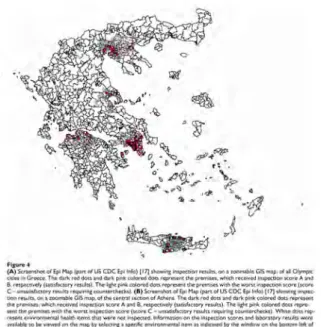
The results of all environmental health inspections and all laboratory tests (microbiological examinations of the field samples obtained), were displayed on the electronic maps, in different colors according to the inspection score (score categories A, B or C), so that we would be able to automatically detect those premises that failed inspection and schedule counterchecks. For example, as we present in Figure 4 for the whole country and in figure 5 for the central section of Athens, 272 out of 781 premises of environmental health interest (34.83%) in the central section of Athens, inspected for the first time, received score A, 270 (34.57%) of the premises received score B and the remaining 239 (30.60%) received score C. All premises receiving score C had to undergo counterchecks within a month from the first inspection.
(上記の和訳)
すべての公衆衛生査察とすべてのラボ試験(得られた現場サンプルの微生物学的検査)の結果につ いて、検査スコア(スコアカテゴリA、B、またはC)に応じて異なる色で電子マップに表示した。
検査で不合格となった施設を自動的に検出し、再チェックのスケジューリングが行える。例として 図 1-6では国全体、図 1-7ではアテネ中心部を示す。アテネ中心部で公衆衛生に関係する781施設 のうち272施設(34.83%)が初回の査察でスコアAを受け、270施設(34.57%)がスコアBを受 け、残りの239施設(30.60%)がスコアCを受けた。スコアCを受けた全施設は、最初の検査か ら1か月以内に再チェックを受けなければならなかった。
図 1-6 査察結果を示すEpi Map(ギリシャ全土)
出所)"Methodological aspects of a GIS-based environmental health inspection program used in the Athens 2004 Olympic and Para Olympic Games.", https://www.ncbi.nlm.nih.gov/pmc/articles/PMC1232856/pdf/1471- 2458-5-93.pdf、2019年11月7日取得
図 1-7 査察結果を示すEpi Map(アテネ中心部)
出所)"Methodological aspects of a GIS-based environmental health inspection program used in the Athens 2004 Olympic and Para Olympic Games.", https://www.ncbi.nlm.nih.gov/pmc/articles/PMC1232856/pdf/1471- 2458-5-93.pdf、2019年11月7日取得
l レジオネラの例
For example, as it is presented in Figure 6, if a case of Legionnaires' disease would be detected in a person, who lived in a given address, all buildings of public health interest around the specific location, and included in a buffer of 200 meters would be evaluated automatically for previous inspection scores and laboratory results for legionella. Using this method the most possible source of infection could be identified.
(上記の和訳)
たとえば、図 1-8に示すように、ある住所に住んでいる人でレジオネラ症の症例が検出された場合、
特定された場所周辺で公衆衛生上関係があり、200mの緩衝領域内にあるすべての建物について、
以前の査察スコアとレジオネラの試験結果が自動的に評価される。この方法を使用して、最も可能 性のある感染源を特定できる。
図 1-8 仮想的なレジオネラ発症時のEpi Map表示
出所)"Methodological aspects of a GIS-based environmental health inspection program used in the Athens 2004 Olympic and Para Olympic Games.", https://www.ncbi.nlm.nih.gov/pmc/articles/PMC1232856/pdf/1471- 2458-5-93.pdf、2019年11月7日取得
出所)Christos Hadjichristodoulou他、"Methodological aspects of a GIS-based environmental health inspection program used in the Athens 2004 Olympic and Para Olympic Games.", BMC Public Health. 2005 Sep 2;5:93., https://www.ncbi.nlm.nih.gov/pmc/articles/PMC1232856/pdf/1471-2458-5-93.pdf
c. "Waterborne diseases prevention: evaluation of inspection scoring system for water sites according to water microbiological tests during the Athens 2004 pre-Olympic and Olympic period."より
l 概要
Study objectives:
To evaluate the inspection grading system for water sites implemented during the Athens 2004 Olympic inspection programme.
Design:
The relation between the standardised inspections results of 716 water supply systems and 289 public swimming pools, and microbiological test results of 2358 samples collected during inspections was examined.
Setting:
Athens, Thessaloniki, Patra, Volos, and Iraklio, Greece. Inspections and sampling conducted during a two year period before the 2004 Olympics.
Conclusions:
This study shows the utility of standardised inspection grading systems in waterborne diseases prevention planning and implementation strategies of policy makers and regulators. Future water quality assessment should be based on the implementation of a robust standardised inspection system and reduce the need of microbiological tests.
(上記の和訳)
調査の目的:
アテネオリンピック査察プログラムにおいて実施された調査地点(water site)の査察等級付けシス テムを評価する
研究デザイン:
716 の水供給システム、289 カ所の公共プールの標準化された査察結果と、289 査察中に収集した 2358サンプルの微生物学的試験結果との関係を解析した。
研究のセッティング:
ギリシャのアテネ、テッサロニキ、パトラ、ボロス、イラクリオを対象として、2004年アテネオリ ンピック前の2年間に査察とサンプリングを実施した。
結論:
この研究は、水系疾病の予防計画および政策立案者と規制当局の実施戦略における標準化された査 察等級付けシステムの有用性を示している。将来の水質評価は、頑健な標準化された査察システム の実施に基づいて行い、微生物学的試験の必要性を減らす必要がある。
l 方法
ü 公衆衛生査察システム
In 2001, the Hellenic Ministry of Health established the Olympic Planning Unit, which was responsible to devise a plan for the environmental health surveillance system and provide scientific support to the county departments of public health in Athens and the other four Olympic cities (Thessaloniki, Patra, Volos, and Iraklio). The final plan developed by the Olympic Planning Unit for environmental health surveillance concerned a number of targets of public health importance including potable and recreational water safety.
(上記の和訳)
2001年にギリシャ保健省はオリンピック計画部門を設立した。同部門は、公衆衛生監視システムの 計画を策定し、アテネおよび他の4つのオリンピック都市(テッサロニキ、パトラ、ボロス、イラ クリオ)の自治体(郡)保健部門に科学的支援を提供する責任を有していた。オリンピック計画部 門が公衆衛生監視のために策定した最終計画は、飲料水やレクリエーション用の水の安全性を含む、
公衆衛生上重要な多くの目標に関するものであった。
ü 標準化された査察システム
The swimming pool standardised inspection form included 48 scored items and nine of those were designated as ‘‘critical’’ (appendix 1). The inspection items were classified in seven group categories: permit, construction, support facilities, personnel, injury control, record keeping, and on site manually conducted tests. In each group category, several related items were included and negatively scored accordingly.
The water supply system standardised inspection form included 42 scored items and 10 of those were designated as ‘‘critical’’ (appendix 2).
APPENDIX1: Critical items in the swimming pool inspection form
‒ Free chlorine manually tested during inspection: 0.5–1 mg/l
‒ Water is from an approved source.
‒ Microbiological monitoring includes test for heterotrophic plate count, coliform bacteria, Escherichia coli, Staphylococcus aureus, and Pseudomonas aeruginosa.
‒ The water recirculation equipment is capable of recirculating the water through the filter at an appropriate rate.
‒ The pH value is monitored
‒ The residual chemical disinfectant is monitored
‒ Properly installed outlets and drain grates to prevent suction entrapment.
‒ Adequate rescue equipment and continuously available to lifeguards.
‒ Adequate number of showers, toilets, hand washing facilities.
APPENDIX2: Critical items in the water supply system inspection form
‒ Shower heads are free of scale and dirt.
‒ The water temperature in the water storage tank is below 25°C
‒ The difference between the highest and lowest temperature recorded at the taps after one minute flow time is not greater than 10°C
‒ When outlets are not in regular use, weekly flushing of these devices is carried out.
‒ The water system is disinfected and cleaned if the system has been out of use for more than one month
‒ Free chlorine tested during inspection: 0.2–0.5 mg/l
‒ Microbiological monitoring every six months
‒ The inside of cold water storage tank kept in good condition and free of debris,
‒ Disinfection and cleaning of the system carried out every year
‒ Water at all taps and showers in guest rooms running for several minutes at least once a week
(上記の和訳)
スイミングプールの標準化された検査フォームには、48項目の採点項目が含まれており、そのうち 9項目は「クリティカル」に指定された(付録1)。検査項目は、許可、建設、支援施設、人員、傷 害管理、記録管理、および現場でのマニュアル試験の7つの分類カテゴリーに分類された。各分類 カテゴリーには、いくつかの関連項目が含まれており、それに応じて負のスコアが付けられた。
水供給システムの標準化された検査フォームには、42の採点項目が含まれており、そのうちの10 は「クリティカル」に指定された(付録2)。
付録1:スイミングプール査察フォームのクリティカル項目
‒ 査察中のマニュアル試験による遊離塩素:0.5–1 mg / l
‒ 承認された水源からの水利用
‒ 微生物学的モニタリングには従属栄養菌のプレートカウントを含む(大腸菌群、大腸菌、黄 色ブドウ球菌、および緑膿菌
‒ 水再循環設備は、再循環水を適切な流速でフィルターを通過させることが可能
‒ pH値の監視を実施
‒ 残留する消毒剤の監視を実施
‒ 吸い込みを防止するため、配管と配水管用格子を適切に設置している
‒ 適切な救急設備と継続的に利用可能なライフガード
‒ 十分な数のシャワー、トイレ、手洗い施設
付録2:給水システム検査フォームのクリティカル項目
‒ シャワーヘッドにはスケールや汚れがない
‒ 貯水タンクの水温が25℃以下
‒ 1分の流水後に蛇口で記録された最高温度と最低温度の差が10°C以下
‒ 排水口が通常使用されていない場合、これらの器具の排水を毎週実施
‒ 給水系が1か月以上使用されていない場合、給水系の消毒・洗浄を実施
‒ 査察中に試験した遊離塩素:0.2–0.5 mg / l
‒ 6か月ごとの微生物学的モニタリング
‒ 冷水貯蔵タンクの内部は良好な状態に保たれ、ごみがない
‒ 毎年システムの消毒と洗浄を実施
‒ 客室のすべての蛇口とシャワーの水は、少なくとも週に1度は数分間通水する
l 査察結果
A total of 393 swimming pools and 997 water supply systems of 887 hotels and 140 Olympic venues were registered as potential inspection sites using standardised data collection forms in all five Olympic cities.
(上記の和訳)
全5カ所のオリンピック都市において、標準化されたデータ収集フォームを用いて、393カ所のス イミングプールと997カ所の水供給システム、887件ホテルと140カ所のオリンピック会場が潜在 的な検査サイトとして登録された。
l 査察スコアリングシステムの評価
Environmental health inspection scores and violations of water supply systems and swimming pools were related to the water microbiological test results of those sites. The mean score of swimming pools with positive microbiological test results were significantly higher from the mean scores of inspections with negative microbiological test results (table 1).
Moreover, the risk for producing positive microbiological test results was higher when unsatisfactory inspection grading results of swimming pools was recorded (RR=2,51; table 2).
(上記の和訳)
公衆衛生査察のスコアと、水供給システムおよびプールの違反は、それらの場所の水系微生物学的 試験結果に関連していた。微生物学的検査結果がポジティブなプールの平均スコアは、微生物学的 検査結果がネガティブの検査の平均スコアよりも有意に高かった(表 1-5)。
表 1-5 平均査察スコアと微生物学的モニタリングとの関連
出所)"Waterborne diseases prevention: evaluation of inspection scoring system for water sites according to water microbiological tests during the Athens 2004 pre-Olympic and Olympic period.",
https://www.ncbi.nlm.nih.gov/pmc/articles/PMC2566045/pdf/829.pdf, 2019年11月7日取得
さらに、スイミングプールの不満足な査察等級付けの結果が記録された場合、微生物学的検査結果 がポジティブになるリスクは高かった(RR = 2,51; 表 1-6)。
表 1-6 査察スコアとポジティブな微生物学モニタリング結果との関連
出所)"Waterborne diseases prevention: evaluation of inspection scoring system for water sites according to water microbiological tests during the Athens 2004 pre-Olympic and Olympic period.",
https://www.ncbi.nlm.nih.gov/pmc/articles/PMC2566045/pdf/829.pdf, 2019年11月7日取得
l 違反と微生物学的試験結果との関連
During inspections of public swimming pools, six violations significantly associated with positive microbiological test results were found (table 4). One of those six violations was among those designated as ‘‘critical’’ water safety hazards in the standardised inspection form:
free chlorine tested during inspection: 0.5–1 mg/l. The lack of free chlorine residual of 0.5–1 mg/l was associated with 20% of positive microbiological results (table 4).
(上記の和訳)
公共プールの査察中に、微生物学的検査のポジティブな結果と有意に相関する6つの違反が見いだ された(表 1-7)。これらの6つの違反の1つは、標準化された検査フォームで「クリティカル」
な水安全性ハザードとして指定された違反の1つであった(査察中に試験した遊離塩素:0.5–1 mg/l)。
0.5〜1 mg/lの遊離残留塩素がない場合、ポジティブな微生物学的結果の20%と相関があった(表
1-7)。
表 1-7 スイミングプールにおけるポジティブな微生物学的試験結果に関連する違反
(Table 4)
出所)"Waterborne diseases prevention: evaluation of inspection scoring system for water sites according to water microbiological tests during the Athens 2004 pre-Olympic and Olympic period.",
https://www.ncbi.nlm.nih.gov/pmc/articles/PMC2566045/pdf/829.pdf, 2019年11月7日取得
出所)Christos Hadjichristodoulou他、"Waterborne diseases prevention: evaluation of inspection scoring system for water sites according to water microbiological tests during the Athens 2004 pre-Olympic and Olympic period.", J Epidemiol Community Health. 2006 Oct;60(10):829-35.,
https://www.ncbi.nlm.nih.gov/pmc/articles/PMC2566045/pdf/829.pdf
d. "Management of environmental health issues for the 2004 Athens Olympic Games: is enhanced integrated environmental health surveillance needed in every day routine operation?"
l 概要
Background:
Management of environmental health issues is an integral part of public health systems. An active integrated environmental health surveillance and response system was developed for the Athens Olympics to monitor and prevent exposure to environmental hazards. The potential for permanent implementation of the program was examined.
Methods:
The environmental health surveillance and response system included standardization, computerization and electronic transmission of data concerning environmental inspections of 17 site categories (restaurants, swimming pools etc) of public health interest, drinking and recreational water examinations and suggested corrective actions. The Olympic Planning Unit integrated and centrally managed data from 13 public health agencies, recommended, supervised and coordinated prompt corrective actions. Methods used to test the effectiveness of the program were the assessment of water quality test and inspection results trends over time using linear regression and epidemiological surveillance findings.
Lessons learned for future events include timely implementation and installation of communication processes, and rapid and coordinated response to unsatisfactory inspection results. Routine national programs need to adopt enhanced environmental health surveillance aimed at public health decision-making, but with a different perspective.
(上記の和訳)
背景:
環境保健の管理は、公衆衛生システムの不可欠な部分である。アテネオリンピックのために、環境 ハザードへの曝露を監視し防止するために、アクティブな統合環境保険サーベイランス・対応シス テムが開発された。プログラムの恒久的な実施の可能性を検討した。
方法:
環境保険サーベイランス・対応システムは、公衆衛生上の関心のある17の施設分類(レストラン、
プールなど)の環境の査察、飲料水およびレクリエーション用水の水質検査、推奨される是正措置 に関するデータの標準化、電子化、および電子的送信を含んでいた。オリンピック計画部門は、13 カ所公衆衛生機関からのデータを統合して一元管理し、迅速な是正措置の推奨、監視、調整を行っ た。線形回帰と疫学的調査結果を使用して長期間の水質試験と査察結果のトレンドを評価すること により、プログラムの有効性をテストした。
結論:
将来のイベントのために学んだ教訓には、コミュニケーションプロセスのタイムリーな実施と実装、
不十分な検査結果への迅速で調整された対応が含まれる。ルーチンの国家プログラムは、公衆衛生 の意思決定を目的としつつも、異なる視野を有する環境保健サーベイランスを採用する必要がある。
l 標準化された査察と水質サーベイランスプログラムの開発
A total of 17 standardized scored inspection forms were developed (Table 1) including establishment name, unique code, inspection identification code, county, date of inspection, overall score, specific violations cited, manually tested measurements during inspection (free chlorine, pH, temperatures), inspectors, and time spent on inspection. The results of the inspections were graded as: "A", satisfactory, "B", relatively satisfactory, or "C", unsatisfactory, respectively.
The main objective of the water quality surveillance program was to assess the quality of the water at the point of use. The following seven standardized sample collection forms were developed to standardize sampling procedures: sample collection forms for swimming pools, water distribution systems, bottled-water plants, seacoasts, water distribution systems (Legionella spp. detection), cooling towers (Legionella spp. detection), and decorative fountains (Legionella spp. detection).
(上記の和訳)
施設名、一意的コード、検査識別コード、郡、検査日、全体のスコア、言及された具体的な違反、
査察中にマニュアル測定した測定値(遊離塩素、pH、温度)、検査官、検査時間などを含む合計17 種類の標準化されたスコア式査察フォームが開発された(表1)。検査の結果は、それぞれ「A」、
「満足」、「B」、比較的満足、「C」、不満足のいずれかに分類された。
水質監視プログラムの主な目的は、使用場所における水質を評価することであった。次の7つの標 準化されたサンプル収集フォームを作成して、サンプリング手順を標準化した:プール、水供給シ ステム、ボトリング工場、海岸、水供給システム(Legionella spp検出)、冷却塔(Legionella spp検 出)、噴水(Legionella spp検出)。
l 査察結果
A total of 44,741 premises of environmental health interest were identified as potential inspection sites. From January 2003 through July 2004, 196 environmental health inspectors registered via on-site visits a total of 5,724 premises using standardized registration forms.
During the preparation years of 2002, 2003 and 2004, a series of 46 "test events" were held to evaluate venues and logistics. 5,956 inspections were carried out from January 2003 through July 2004 (Table 1).
(上記の和訳)
合計44,741カ所の環境衛生に関係のある施設が潜在的な検査場所として特定された。2003年1月
から2004年7月までの間に、196人の環境衛生検査官が現場訪問に登録され、標準化された登録 フォームを使用して合計5,724の施設を訪問した。
2002, 2003, 2004年の準備期間中、46回の一連のテストイベントが開催され、会場とロジスティク
スの評価が行われた。2003年1月から2004年7月までに5,956回の査察が実施された(表 1-8)。
表 1-8 オリンピック前および大会中の4期間における査察結果(Table 1)
出所)"Management of environmental health issues for the 2004 Athens Olympic Games: is enhanced integrated environmental health surveillance needed in every day routine operation?",
https://www.ncbi.nlm.nih.gov/pmc/articles/PMC1764887/pdf/1471-2458-6-306.pdf、2019年11月7日取 得
l 水質サーベイランスプログラム
Out of 4242 water samples collected from January 2003 through July 2004, 995 were collected within and 3247 outside the Olympic Venues (Table 2). During the Olympic period, out of a total of 782 water samples, 571 were collected within the Olympic Venues and 211 outside the Olympic Venues (Table 2). Out of 2497 samples tested for Legionella spp, 415 (16.6%) were positive.
None of the 105 samples collected from swimming pools and water supply systems, and tested turned positive for Cryptosporidium spp., Giardia spp., or Norovirus.
(上記の和訳)
2003年1月から2004年7月までに収集された4,242件の水サンプルのうち、995件はオリンピッ ク会場内、3,247件は会場外で採取された(表 1-9)。オリンピック期間中、合計782の水サンプル
のうち、571はオリンピック会場内で収集され、211はオリンピック会場外で採取された(表 1-9)。
Legionella sppについてテストされた2,497サンプルのうち、415(16.6%)が陽性であった。
スイミングプールと水供給システムから採取・テストされた105のサンプルのいずれも、クリプト スポリジウム、ジアルジア、またはノロウイルスについて陽性ではなかった。
表 1-9 オリンピック前・開催中の4期間における水中の微生物学的検査結果(Table 2)
出所)"Management of environmental health issues for the 2004 Athens Olympic Games: is enhanced integrated environmental health surveillance needed in every day routine operation?",
https://www.ncbi.nlm.nih.gov/pmc/articles/PMC1764887/pdf/1471-2458-6-306.pdf、2019年11月7日取 得
l コンピューターネットワークの構築
All data from the registrations and the inspection results were entered into the electronic databases in the PDPH and were delivered to the Olympic Planning Unit. Data from the microbiological test results were entered into the electronic databases in the Central Public Health Laboratory as well as the Peripheral Public Health Laboratories and were delivered to the Olympic Planning Unit and the PDPH. It was the responsibility of the Olympic Planning Unit to relate all data and to produce reports once a day, which were sent to the Ministry of Health and Social Solidarity and the Athens 2004 Olympic Games Organizing Committee (Figure 1).
(上記の和訳)
登録および査察結果のすべてのデータは、PDPHの電子データベースに入力され、オリンピック計 画部門に配信された。微生物学的試験結果のデータは、中央公衆衛生研究所および地方公衆衛生研 究所の電子データベースに入力され、オリンピック計画部局およびPDPHに配信された。すべての データを関連付け、1日に1回レポートを作成し、それを厚生労働省と2004年アテネオリンピッ ク組織委員会に送信することは、オリンピック計画ユニットの責任であった(図 1-9)。
図 1-9 2004年オリンピック時の環境保健サーベイランスシステムの情報フロー 出所)"Management of environmental health issues for the 2004 Athens Olympic Games: is enhanced integrated
environmental health surveillance needed in every day routine operation?",
https://www.ncbi.nlm.nih.gov/pmc/articles/PMC1764887/pdf/1471-2458-6-306.pdf、2019年11月7日取 得
l システムのパフォーマンス
An outbreak of salmonellosis among the German junior rowing team, which prevented them from participating at the respective rowing championship test event, occurred in August, 2003.
The restaurant of the hotel accommodating the team, which was linked to the outbreak, had received one of the lowest unsatisfactory inspection results seven days before the outbreak occurred. No other disease outbreak was recorded by the enhanced communicable diseases surveillance system before or during the Olympic Games within the Olympic cities.
(上記の和訳)
2003年8月に、ドイツのジュニア・ボートチームの間でサルモネラ症が発生し、これにより、彼ら はそれぞれのボート競技選手権のテストイベントに参加することができなかった。アウトブレイク に関連していたチームを収容していたホテルのレストランは、アウトブレイクが発生する7日前に 最低の不満足な査察結果を受領していた。オリンピック都市でオリンピック前または大会中に、強 化された感染症監視システムにより他の疾病の発生は記録されなかった。
出所)Christos Hadjichristodoulou他、"Management of environmental health issues for the 2004 Athens Olympic Games: is enhanced integrated environmental health surveillance needed in every day routine operation?", BMC Public Health. 2006 Dec 18;6:306., https://www.ncbi.nlm.nih.gov/pmc/articles/PMC1764887/pdf/1471- 2458-6-306.pdf
e. "Leading interagency planning and collaboration in mass gatherings: public health and safety in the 2012 London Olympics."より
本論文は文献リストではロンドンオリンピック、アテネオリンピックの両方に関連する とされているが、要約を見る限り、ロンドンオリンピックを主対象にしていると考えられる。
本文が入手できず要約しか確認できないため、以下に参考として要約を掲げた。
l Abstract OBJECTIVES:
Planning and implementing public health initiatives in mass gatherings such as the Olympic Games pose unique challenges for interorganizational collaboration, which involves interaction among multiple and diverse agencies. Nonetheless, there is limited empirical evidence to support interagency collaboration and public health planning decisions in mass gatherings and how leadership can shape such interactions. We empirically explored these topics in the 2012 London Olympics to identify lessons to inform planning for future mass gatherings.
STUDY DESIGN:
This is a qualitative case study.
METHODS:
Data comprised 39 semistructured interviews with key informants conducted before, during, and after the games; in addition, direct observations of field exercises and documentary analysis were also used. Open coding and thematic analysis was used to analyze the data.
RESULTS:
We identified two main leadership challenges that influenced interagency collaboration:
organizational public health leadership and coordinating collaborative decision-making. Two facilitative conditions helped overcome the previous challenges: nurturing interorganizational linkages and creating shared understanding by activating codified frameworks at the organizational level.
CONCLUSIONS:
Our study highlights leadership issues in interagency collaboration in mass gatherings.
Practical implications arising from this study may inform the ways the organizers of mass gatherings, public health and safety agencies, and professionals can engage in effective partnerships and joint working.
(上記の和訳)
目的:
オリンピックなどの大規模な集まりでの公衆衛生イニシアチブの計画と実装は、複数の多様な機関 の間での相互作用を含む組織間コラボレーションに特有の課題をもたらす。それにもかかわらず、
大規模集会における省庁間の協力と公衆衛生計画の決定、およびリーダーシップがそのような相互 作用をどのように形成できるかを裏付ける実証的証拠は限られている。2012 年のロンドンオリン ピックにおいて、これらのトピックを経験的に調査し、今後の大規模集会の計画策定に対する教訓 を明らかにした。
研究デザイン:
本研究は定性的なケーススタディである。
方法:
データは、大会前、大会中、大会後に行われた主要な情報提供者への39回の半構造化されたイン タビューから構成された。さらに、フィールドでの直接観察と文書の分析も使用された。オープン コーディングと主題分析を用いてデータを分析した。
結果:
組織間のコラボレーションに影響を与えた2つの主要なリーダーシップの課題、すなわち組織的な 公衆衛生のリーダーシップと協調的な意思決定の調整が明らかになった。これまでの課題を克服す るために2つの促進条件が貢献した。それは、組織間連携の育成と成文化されたフレームワークを
組織レベルで活性化することによる共通理解の作成である。
結論:
我々の研究は、大規模集会における組織間のコラボレーションにおけるリーダーシップの問題に焦 点を当てるものである。本研究から生じる実際的な示唆は、大規模集会の主催者、公衆衛生および 安全機関、および専門家が効果的なパートナーシップと共同作業に従事する方法について情報を与 える。
出所)A.Bistaraki他、"Leading interagency planning and collaboration in mass gatherings: public health and safety in the 2012 London Olympics."Public Health. 2019 Jan;166:19-24,
https://www.sciencedirect.com/science/article/abs/pii/S0033350618303214
3) 環境対策(熱中症等含む)
-(なし)
4) 食品衛生
a. "Standardized inspections of food premises during the 2004 Athens Olympic Games:
descriptive analysis and risk factors for unsatisfactory results."より l Abstract
Standardized inspections of food premises are part of environmental health systems implemented worldwide. The food safety strategy for the 2004 Olympic Games included standardized inspections to ensure uniformity and consistency of procedures and effective electronic management of data. Inspections were carried out by 196 inspectors in the five Olympic cities: Athens, Thessalonica, Volos, Iraklio, and Patra. From January 2003 to September 2004, a total of 1,249 food premises were inspected.
An unsatisfactory inspection result (C grade) was received by 347 (27.8%) food premises, a relatively satisfactory result (B grade) was received by 332 (26.6%), and a satisfactory result (A grade) was received by 570 (45.6%). About 16% of inspected premises did not hold a valid permit. Unsatisfactory inspection results were more frequent for premises located in the two largest Greek cities in comparison with the other smaller cities (relative risk = 1.95, 95%
confidence interval [CI] = 1.36 to 2.80). Based on logistic regression analysis, unsatisfactory inspection results were positively associated with food premises that were not located on a ground floor (odds ratio [OR] = 2.56, 95% CI = 1.39 to 4.73) and negatively associated with application of hazard analysis critical control point (HACCP) principles (OR = 0.27, 95% CI
= 0.10 to 0.71). Food hygiene education through formal training programs should be encouraged to improve compliance of food premises. Food premises located on hotel floors and serving buffet meals are at higher risk for unsatisfactory conditions. Businesses that implemented a HACCP system within their operations to ensure food safety operated under more hygienic conditions. Future inspections by Public Health Authorities should involve elements of audit after the legislation for the application of HACCP principles.
(上記の和訳)
標準化された食品施設の検査は、世界中で実施されている環境衛生システムの一部である。 2004 年オリンピックの食品安全戦略では標準化された検査が行われ、手順の均一性と一貫性、およびデ ータの効率的な電子管理を確保することとした。5ヶ所のオリンピック都市、アテネ、テッサロニ
カ、ヴォロス、イラクリオ、パトラで196人の検査官が検査を実施した。 2003年1月から2004年 9月までに、合計1,249か所の食品施設が検査された。
不十分な検査結果(Cグレード)は347(27.8%)の食品施設で、比較的満足のいく結果(Bグレー
ド)は332(26.6%)で、満足のいく結果(Aグレード)は570(45.6 %)であった。検査対象施設
の約16%が有効な許可を保持していなかった。不十分な検査結果は、他の小さな都市と比較して、
ギリシャの2つの大都市にある施設でより頻繁に発生した(相対リスク= 1.95、95%信頼区間[CI] =
1.36〜2.80)。ロジスティック回帰分析に基づいて、不十分な検査結果は、1階に設置されていない
食品施設と正の関連があり(オッズ比[OR] = 2.56、95%CI = 1.39〜4.73)、危害分析重要管理点の 原則(HACCP)の適用と負の相関があった(OR = 0.27、95%CI = 0.10〜0.71)。食品施設のコンプ ライアンスを改善するために、正式なトレーニングプログラムによる食品衛生教育を奨励する必要 がある。ホテルにあり、ビュッフェ式の食事を提供している飲食施設は、不満足な状況のリスクが 高くなる。食品安全を確保するために事業活動内でHACCPシステムを運用している企業は、より 衛生的な条件下で操業していた。公衆衛生当局による今後の検査には、HACCP原則の適用に関す る法制化後の監査要素を含めるべきである。
出所)Christos Hadjichristodoulou他、"Standardized inspections of food premises during the 2004 Athens Olympic Games: descriptive analysis and risk factors for unsatisfactory results.", J Food Prot. 2008 Aug;71(8):1632-40., https://meridian.allenpress.com/jfp/article-lookup/doi/10.4315/0362-028x-71.8.1632
5) その他健康関連
a. "Health promotion programs related to the Athens 2004 Olympic and Para Olympic games."より
l 概要
Background:
The Olympic Games constitute a first-class opportunity to promote athleticism and health messages. Little is known, however on the impact of Olympic Games on the development of health-promotion programs for the general population. Our objective was to identify and describe the population-based health-promotion programs implemented in relation to the Athens 2004 Olympic and Para Olympic Games.
Methods:
A cross-sectional survey of all stakeholders of the Games, including the Athens 2004 Organizing Committee, all ministries of the Greek government, the National School of Public Health, all municipalities hosting Olympic events and all official private sponsors of the Games, was conducted after the conclusion of the Games.
Conclusions:
Greece has made a small, however, significant step forward, on health promotion, in the context of the Olympic Games. The International Olympic Committee and the future hosting countries, including China, are encouraged to elaborate on this idea and offer the world a promising future for public health.
(上記の和訳)
背景:
オリンピックは、運動と健康に関するメッセージを促進する第一級の機会である。しかしながら、
一般市民の健康増進プログラムの開発に対するオリンピックの影響についてはほとんど知られて いない。我々の目的は、2004年のアテネオリンピックとパラリンピックに関連して実行された集団 ベースの健康促進プログラムを明らかにし、それについ説明することであった。
方法:
2004年アテネ五輪組織委員会、ギリシャ政府の全省庁、国立公衆衛生学校、オリンピックイベント を主催するすべての自治体、および大会のすべての民間オフィシャルスポンサーなど、大会のすべ ての利害関係者に対する横断調査を大会終了後に実施した。
結論:
ギリシャは、オリンピックに関連して、健康増進に向けて小さな、しかし大きな前進をした。IOC と中国をなどの将来の開催国は、このアイデアを精査し、公衆衛生のための有望な未来を世界に提 供することが奨励される。
l 関連主体における健康増進プログラムの策定状況
A total of 44 agencies were contacted by phone and/or facsimile, 40 agencies completed the questionnaire, and 10 health-promotion programs, implemented prior to, and/ or during the Olympic Games, were identified. The average cost for the implemented programs was about 95,000 Euros (€) with a range between 20,000€ and 600,000€. The total cost of the health- promotion programs was about 943,000€, and constituted a small fraction (0.08%) of the overall cost of the games, even after excluding the cost of construction, preparation of athletic facilities, and security. The Athens 2004 Olympic Games Organizing Committee implemented two programs: (a) a non-smoking policy in all premises related to the Organizing Committee and (b) the distribution of condoms, free of charge, in the Olympic Village Polyclinic. In the Table, we describe the different programs implemented along with the responsible agency, the type of activity, the time period covered and the target population. The vast majority of the programs included the development and distribution of brochures on several health-related topics targeting visitors, spectators of the Games, and the general population.
(上記の和訳)
合計44機関に対して電話またはFAXで連絡を行い、40機関がアンケートに回答し、オリンピッ ク前またはオリンピック中に実施された10の健康促進プログラムが特定された。実行されたプロ グラムの平均費用は約95,000ユーロ(€)で、範囲は20,000€から600,000€である。健康増進プログ ラムの総費用は約943,000ユーロで、建設費、運動施設の準備費、セキュリティ費を除いた後でも、
大会全体の費用のごく一部(0.08%)であった。 2004 年アテネオリンピック組織委員会は、(a)
組織委員会に関連するすべての施設での禁煙ポリシーと(b)オリンピック村ポリクリニックでの コンドームの無料配布を2つのプログラムで実施した。
実施されたさまざまなプログラムについて、実施主体となった組織、活動の種類、対象期間、およ び対象母集団などを表に示す。プログラムの大部分では、観光客、大会の観客、および一般市民を 対象とした、いくつかの健康関連トピックに関するパンフレットの作成と配布が行われていた。
表 1-10 アテネ大会前及び大会中に実施された健康プログラム
出所)"Health promotion programs related to the Athens 2004 Olympic and Para Olympic games.",
https://bmcpublichealth.biomedcentral.com/track/pdf/10.1186/1471-2458-6-47、2019年11月7日取得
出所)Elpidoforos S Soteriades他、"Health promotion programs related to the Athens 2004 Olympic and Para Olympic games.", BMC Public Health. 2006 Feb 24;6:47.,
https://bmcpublichealth.biomedcentral.com/track/pdf/10.1186/1471-2458-6-47
b. "Readability levels of health pamphlets distributed during the Athens 2004 Olympic Games."より
l Abstract
The Olympic Games are one of the most celebrated and broadcasted events around the world.
During the Olympic Games, spectators, visitors, and the host country’s population are exposed to a considerable number of messages and advertisements including health messages. The readability levels of health messages distributed via printed materials constitute an important factor for their effectiveness in reaching targeted segments of the population and motivating changes in health behaviour. People with a low health literacy level are more likely to report poor health, have more outpatient visits and hospitalizations due to a lack of understanding of their health problems and treatment, and also have higher healthcare expenses.
Although the importance of health literacy has been established in the medical and social science literature in relation to health behaviour motivation as well as health outcomes, little is known about the readability levels of health messages distributed at sports events in general and the Olympic Games in particular. This study examined readability levels of health pamphlets written in the English language and distributed during the Athens 2004 Olympic Games through the Greek Ministry of Health and Social Solidarity, the Ministry of Rural Development and Food, and the National School of Public Health.
Three well-known and validated readability measures were used for the evaluation of all