A Preliminary Study of the Physical Properties of a New Anti-Adhesive Material Made of Thermally Cross-Linked Gelatin Film
Tsunehito HORII*, Hiroyuki TSUJIMOTO **, Hiroe MIYAMOTO*, Junki IKEDA ***, Taichi ORIKASA***, Kazuyuki NARITA****, Hideki TAKAMORI **, *****, Shinichiro MORITA ****, *****, Mamoru URABE **, ******,
Eiji NAKAMACHI ** and Akeo HAGIWARA**
(Received January 18, 2013)
To generate a more effective and safer anti-adhesive material, we developed a new thermally cross-linked gelatin film. We previously reported that this film had superior anti-adhesive effects compared to cellulose film and could be used safely on the intestinal anastomosis in canine models. To evaluate the handling of the gelatin film during surgery, we investigated the physical properties of the gelatin film and compared it with cellulose film.
We performed tensile and shear tests to evaluate the maximum loads, the elastic modulus and the fracture strains of the gelatin film, paying special attention to the relationship between the time required for the thermal cross-linking and those physical properties.
The maximum tensile and shear loads of each thermally cross-linked gelatin film were significantly higher than those of cellulose film. The fracture strains of each gelatin film were also significantly higher than those of cellulose film. However, there were no significant differences in the elastic modulus between the gelatin films and the cellulose film in terms of both the tensile and shear tests. There were no significant differences in these physical properties among the gelatin films allowed to thermally cross-link for different lengths of time.
In conclusion, thermally cross-linked gelatin film has a higher physical strength and ductility than cellulose film, regardless of the time allowed for thermal cross-linking. These physical properties of the gelatin films are considered to be advantageous for their handling during surgery.
.H\ZRUGV : gelatin, anti-adhesion, tensile, shear, scaffold
.,QWURGXFWLRQ
Postoperative adhesion, where injured sites become attached to the surrounding peritoneum or organs, is a serious problem after abdominal and
gynecological surgery1), because it often leads to severe complications such as intestinal obstruction2), female sterility and chronic abdominal pain3, 4). To prevent such adhesion, various kinds of anti-adhesive materials have been developed and been used experimentally and
* Undergraduate Sophomore, Department of Medical Life System, Doshisha University, Kyoto Telephone:+81-774-65-6878,E-mail: [email protected]
** Department of Medical Life System, Doshisha University, Kyoto
***Graduate Student, Department of Medical Life System, Doshisha University, Kyoto
**** Bio-Medical Material Research Center, Doshisha University, Kyoto
*****Reserch and Department, Gunze Ltd. Ayabe-shi, Kyoto
****** Kusatsu General Hospital, Shiga Corresponding Author: Akeo HAGIWARA
Telephone:+81-774-65-6878,E-mail: [email protected]
setting. When placed on the injured sites during an operation, it rapidly turns to a gel form absorbing the surrounding moisture and remains in place for about a week, thereby preventing direct contact between the injury and other tissues as a physical barrier6).
However, the cellulose film has several drawbacks. First, it is quite difficult to handle the cellulose film due to its fragility. In addition, the cellulose film has been contraindicated for wrapping directly the stapled and sutured lines of gastro-intestinal anastomoses because several studies reported that the film induced a high frequency of leakage7).
To solve the problems of the cellulose film, we have developed a new anti-adhesive material made of thermally cross-linked gelatin film. We previously reported that the gelatin film had superior anti-adhesive effects compared to the cellulose film with excellent peritoneal regeneration and that it could be used safely on the intestinal anastomosis in canine models8).
To evaluate the handling of the gelatin film, we investigated its physical properties and compared them with those of cellulose film. We performed tensile and shear tests to evaluate the maximum loads, the elastic modulus and the fracture strains of the gelatin film, paying special attention to the relationship between the time allowed for the thermal cross-linking and the physical properties.
.0DWHULDOVDQG0HWKRGV 2.1 Materials
Medical grade gelatin extracted from porcine skin (type-I collagen, Medigelatin®) with an isoelectric point of 5 was supplied by Nippi Co. (Shizuoka, Japan). To prepare the gelatin film, the gelatin was dissolved in distilled water to a final concentration of 4.8%. Next, the solution was cast in plastic plates (Kanto Chemical
plates, thermal cross-linking was induced by a vacuum oven (AVO-250N, As One, Osaka, Japan) at 140 oC for 0 h (no heating), 1 h, 3 h, 8 h or 14 h.
As a control material, we used a commercial cellulose film (Seprafilm®, Genzyme Co., Cambridge, MA, USA), which is a commonly used anti-adhesive material for abdominal surgery. The cellulose film has an approximately 50 µm thickness. Finally, each film was cut into an oblong-shaped piece of 10 × 50 mm in size, and was kept in a dry state in a desiccator until the following physical analyses were performed.
2.2 Evaluation of the physical properties of the films 2.2.1 Tensile test
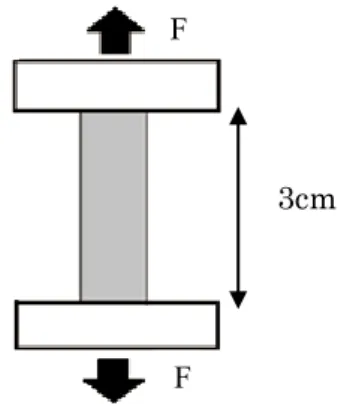
Each oblong piece of film was set on two folders of the testing apparatus (CPU gauge: MODEL-RX10, TESTSTAND: MODEL-1356R, Aikoh Engineering, Osaka, Japan), by grasping both film ends at a distance of three centimeters, as shown in Fig. 1. Next, the film was drawn automatically into opposite directions at the fixed speed of 5 mm/minute. To analyze the maximum tensile load, the fracture strain and the Young’s modulus, six oblong pieces of each type of film were used and the stress-strain (σ nom = f (ε nom)) diagrams were recorded until the films were broken. Six pieces of each gelatin and cellulose film were examined. The value was calculated using the equation.
σ nom = F/A0 and ε nom = δ/L0
where, F was applied force; A0, the initial cross-section;
δ, the change in gauge length; L0, the initial gauge length.
Fig.1. A schema of the tensile test.
2.2.2 Shear test
Each oblong piece of film was set on two specific folders of the testing apparatus (CPU gauge:
MODEL-RX10, TESTSTAND: MODEL-1356R, Aikoh Engineering) by grasping both film ends and the film center to give two distances of one centimeter each, as shown in Fig. 2. Next, the film was drawn automatically into opposing directions at the fixed speed of 5 mm/minute. To analyze the maximum shear load, the fracture strain and the shear modulus, six oblong pieces of each film were used and the stress-strain diagrams (τ
nom= f (γ nom)) were recorded until the films were broken.
Six pieces of each gelatin and cellulose film were examined. The value was calculated using the equation.
τ nom = F/2A0 and γ nom = δ/L0
where, F was the applied force; A0, the initial cross-section; δ, the change in gauge length; L0, the distance between folders (1 cm) (Fig. 2).
Fig. 2. A Schema of the shear test and a front view
2.2.3 Statistical evaluation
The measured values were shown as the means ± standard deviation (SD). After processing by a one-way layout analysis of variance, the Tukey test was used as a post-hoc test. A p value <0.05 was considered to be significant for the test.
.5HVXOWV 3.1Tensile test
The maximum tensile loads of the gelatin films thermally cross-linked for 0, 1, 3, 8 and 14 h were 30.9
±7.5N, 32.6±1.7N, 33.4±4.8N, 34.0±5.9N and 30.0
±8.8N (mean±SD) respectively. The tensile load of the cellulose film was 19.4±2.5N (mean±SD) (Fig. 3).
The maximum tensile load of each of the gelatin films was significantly higher than that of the cellulose film (p<0.05). However, there were no significant differences among the gelatin films.
The fracture strain of the gelatin films cross-linked thermally for 0, 1, 3, 8 and 14 h were 8.98±2.84%, 11.02±1.93%, 8.34±1.85%, 9.03±1.37%
and 7.75±2.19%, (mean±SD) respectively. The fracture strain of the cellulose film was 3.42±1.15% (mean±SD) (Fig. 4). The fracture strain of each of the gelatin films was significantly higher than that of the cellulose film (p<0.05). However, there were no significant differences among the gelatin films.
The data regarding the Young’s modulus are shown in Fig. 5. There were no significant differences 3cm
F
F
F
F
1cm
Fig. 3. The maximum tensile load in the tensile test (n = 6).
*p<0.05 relative to cellulose film
Fig. 4. The fracture strain in the tensile test.
*p<0.05 relative to the cellulose film
Fig. 5. Young’s modulus in the tensile test.
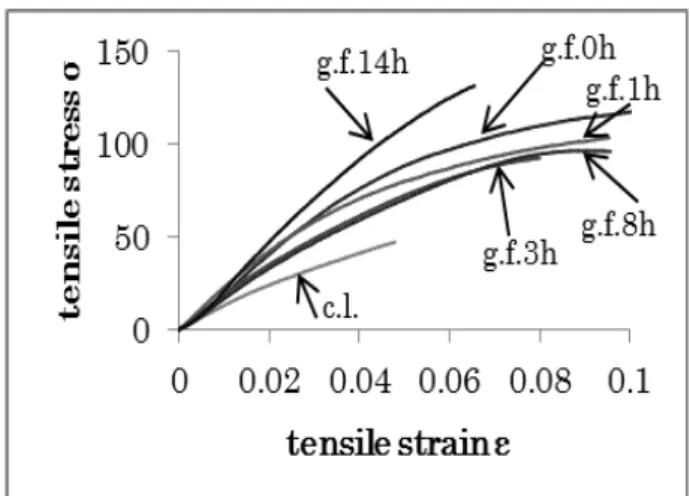
Fig. 6. Representative stress-strain diagrams in the tensile test.
3.2 Shear test
The maximum shear loads of the gelatin films thermally cross-linked for 0,1, 3, 8 and 14 h were 15.3±3.5N, 17.4±2.3N, 17.2±3.2N, 16.8±1.5N and 18.0±2.0N (mean±SD) respectively. The maximum shear load of the cellulose film was 7.6±1.0N (mean±SD). The maximum shear load of each gelatin film was significantly higher than that of the cellulose film (p<0.05) (Fig. 7). However, there were no significant differences among the gelatin films.
The fracture strain of the gelatin films thermally cross-linked for 0, 1, 3, 8 and 14 h were 12.56±4.13%, 17.39±4.28%, 14.82±3.65%, 14.53±1.83% and 22.93±3.69%, (mean±SD) respectively. The fracture strain of the cellulose film was 5.01±0.79% (mean±SD) (Fig. 8). The fracture strain of each of the gelatin films was significantly higher than that of cellulose film (p<0.05). However, there were no significant differences among the gelatin films.
The data regarding the shear modulus are shown in Fig. 9. There were no significant differences between the shear modulus of each of the gelatin films and that of the cellulose film.
The representative stress-strain diagrams in the shear test is Fig. 10.
Fig. 7. The maximum shear load in the shear test.
n = 6, *p<0.05 relative to the cellulose film
Fig. 8. The fracture strain in the shear test.
n = 6, *p<0.05 relative to the cellulose film
Fig. 9. The shear modulus in the shear test.
Fig. 10. Representative stress-strain diagrams in the shear test.
.'LVFXVVLRQ
As needed physical conditions of ideal anti-adhesive films, it should be hardly broken and be handled easily during surgery10). In addition, the film should be able to be crumpled and folded without tearing when it is used in laparoscopic surgery. However, cellulose film does not satisfy these conditions due to its fragility, although it has been used clinically. In this study, to examine whether the thermally cross-linked gelatin film met these requirements, we measured the physical strength of the film, and compared it with the cellulose film.
In both the tensile and shear tests of this study, there were no significant differences in the elastic modulus between the thermally cross-linked gelatin films and the cellulose film. This means that both films have similar elasticity. In contrast, the maximum tensile and shear loads of the gelatin films were significantly higher than those of cellulose film, even though the thicknesses of the thermally cross-linked gelatin films are thinner than that of the cellulose film. These results indicate that the thermally cross-linked gelatin films have higher physical strength than the cellulose film.
In terms of the fracture strain, there were also significant differences between the gelatin films and the cellulose film. Therefore, the gelatin films were considered to have higher ductility than the cellulose
between the physical properties of the gelatin films and the length of time allowed for thermal cross-linking.
However, there were no significant differences in the physical properties, such as the maximum load, the fracture strain and the elastic modulus among the gelatin films allowed to cross-link for different lengths of time.
This result indicates that the gelatin film may have stable physical properties, regardless of the thermal cross-linking. However, a previous report showed that chemical cross-linking with genipin significantly decreased the fracture strain of the gelatin films, although it did not affect the maximum stress11). Therefore, the modality used for cross-linking may affect the physical properties of the gelatin films, rather than the degree of the cross-linking.
.&RQFOXVLRQ
Thermally cross-linked gelatin film has higher physical strength and ductility than cellulose film, even though the thickness of the gelatin film is thinner than that of the cellulose film. These properties of the gelatin films are considered to be advantageous for its handling during surgery.
5HIHUHQFHV
1) M. Wallwiener, H. Brölmann, P. R. Koninckx, P.
Lundorff, A. M. Lower, A. Wattiez, M. Mara and R.
L. Wilde. “Adhesions after abdominal, pelvic and intra-uterine surgery and their prevention”, Gynecol Surg, 9(4), 465–466 (2012).
2) S. Maetani, S. Kashiwara, S. Kuramoto, H. Tanaka, Y. Kagawa, S. Matsusue, T. Aoki and Y. Nakamura .
“On the question why adhesions lead to an intestinal obstruction”, The Japanese Society of Gastroenterological Surg, 9(6), 874-881 (1976).
3) E. Caspi, Y. Halperin and I. Bukovsky. “The
chronic pelvic pain”, Prog Urol, 20(12), 1003-1009 (2010). (in French)
5) D. Robertson, G. Lefebvre, N. Leyland, W.
Wolfman, C. Allaire, A. Awadalla, C. Best, E.
Contestabile, S. Dunn, M. Heywood, N. Leroux, F.
Potestio, D. Rittenberg, V. Senikas, R. Soucy and S.
Singh. “Adhesion prevention in gynaecological surgery”, J Obstet Gynaecol Can, 32(6), 598-608 (2010).
6) M. Lalountas, K. D. Ballas, A. Michalakis, K.
Psarras, C. Asteriou, D. E. Giakoustidis, C.
Nikolaido, I. Venizelos, T. E. Pavlidis and A. K.
Sakantamis. “Postoperative adhesion prevention using a statin-containing cellulose film in an experimental model”, Br J Surg, 99(3), 423-429 (2012).
7) D. Beck, Z. Cohen, J. Fleshman, H. Kaufman, H.
Goor, B. Wolf. “A prospective, randomized, multicenter, controlled study of the safety of Seprafilm adhesion barrier in abdominopelvic surgery of the intestine”, Dis Colon Rectum, 46(10), 1310-1319 (2003).
8) H. Tsujimoto, A. Tanzawa, M. Matoba, A.
Hashimoto, S. Suzuki, S. Morita, Y. Ikada and A.
Hagiwara. “The anti-adhesive effect of thermally cross-linked gelatin film and its influence on the intestinal anastomosis in canin models”, Wiley Periodical Inc, 99-109 (2012).
9) A. Tanzawa, H. Tsujimoto, M. Matoba, A.
Hashimoto, S. Suzuki, S. Morita, Y. Ikada and A Hagiwara. “Physical and Biological Properties of Novel Anti-Adhesive Material Made of Thermally Cross-Linked Gelatin Film –Preliminary Study for Mechanism of the Anti-Adhesive Effect and Influence on Intestinal Anastomosis-”, The Science and Engineering Review of Doshisha University, 52(2), 57-63 (2011).
10) K.E. Greenwait, M.J. Coit, R.L. Corazzini, O.L.
Syrkina, T.H. Jozefiak. “Remote efficacy for two different forms of hyaluronate-based adhesion barriers”, J Invest Surg, 25 (3), 174-180 (2012).
11) A. Bigi, G. Cojazzi, S. Panzavolta, N. Roven, N.
Ruvini. “Stabilization of gelatin films by
crosslinking with genipin”, Biomaterials 23(24), 4827-4832 (2002).