The Role of Local Firm's Learning on Technology Transfer and Human Resources Development" 11
The Role o f L o c a l F i r m l s L e a r n i n g on Technology T r a n s f e r and Human Resources Development:
A study of international alliances between Thai and Japanes巴firmsin the supporting industry
技術移転と人的資源開発に関する現地企業学習の役割
ータイのサポーテインク産業におけるタイと日本の国際提携企業の研究
Patomviriyavong
,
Sathima (パトムウィリヤウォング・サーティマー)School of Business Administration
,
Department of International Business and Management Kanagawa University
Contents
Chapter 1 Introduction
1.1 Statements of problem 1.2 Objectives of th巴study 1.3 Methodology of the study 1.4 Scope of the study
Chapter 2 Theoretical and Conceptual Framework 2.1 Theoretical Background
2.2 Conceptual Framework and Research Model
Chapter 3 Data Analysis and Conclusion 3.1 Hypotheses Testing 3.2 Conclusion Referenc巴s
Key Words: Organizational Learning, Strategic Alliances, Local Firm's Learning, Technology Transfer, Human Resource Developm巴nt,Supporting Industry, Partner Attributes, Relationship Attributes, Know1edge Attributes
12 研 究 年 報 第6号
CHAPTER 1 Introduction
international alliance and its possible consequences This study intends to fill some gaps in the area of strategic alliances in th巴literatureof international alliances between Thai and Japanese firms by examining the perspectives of the Thai local partners After the Plaza Accord in the mid‑1980s, and the Japanese partn巴rs.A broader way to treat Japanese firms adopted a new approach to business by international alliance is to define it as any form of relocatinσtheir manufactul・inb σfacilitiesto lower‑cost collaboration between two firms that includes locations in order to maintain their international substantial contributions by partners of either competitiveness. Thailand has been one of the preferred technology transfer or human resources developmen t. investment locations. The reason for this has been that
Japan巴S巴firmshave felt more resource‑constrained in
1 . 2
Objectives of the study Thailand due to an increasingly competitive worldeconomy. The importance of Japanese direct investment in Thailand has risen dramatically.
Obviously, th巴patternsof Japanese direct investments have changed from period to period and the number of Thai and Japanese international allianc巴shas increased dramatically. The bulk of Japanese investment in Thailand's manufacturing industries is through collaboration with local Thai investors. It is also interesting to learn what exp巴riencesthe int巴rnationalalliance associates have gained from their cooperation
1.1 Statements of problems
1n the last decade in the arena of Thai and Japanese international alliances, th巴rehas been a proliferation of strategic alliances between two or more potentially competitive firms. Local partners in Thai land are treated as passi ve partners.
Researchers on international alliances have
日uggestedthat a mutual gain between partners is the essence of successful strategic alliances. However, most studies have focused mainly on the interests of foreign multinational corporations (MNCs). Local partners. in particulaにthosefirms of the local partners in developing countries are treated as passi ve partners. The strategic attributes affecting the outcome of the participation in the allianc巴shave received no attention frolll researchers. By neglecting the perspective of local Thai plrtners. the understanding of the essence of
日trategicalliances is limited and thus far. there have been no widely accepted theories on the forlllulation of
The study focuses on the criteria that multinational corporations have depended on the r巴sourcesof strategic alliance partners overseas to comlllercialize their Illanagement, technology and
Illanpower. The major objectives of this study were to clarify the nature of the relationship between the firm's learning technology transfer and human resource's development through international alliances between Thailand and Japan in the Thai supporting industry. The main objectiv巴sof this study are as follows.
1. To analyze th巴attributesof partner firms, partner's relationships, the knowledge gaining by local firm's learning and the impact of this on technology transf,巴rand human resources development in Thailand
2. To discover how Thai and Japanese international alliances shared mutual learning through firm's learning in order to巴xplainthe d巴velopmentof technology transfer and human resources d巴velopmentin Thailand.
1 . 3
Methodology of the StudyThe two‑wave procedure in collecting th巴data from the international alliances between Thai and Japanese in the supporting industry was conducted. These were listed in the directory of th巴Boardof 1nvestment (B01) Promoted Companies 1999.
The first wave was to interview an interview survey, at this stage; thirteen top managers and twenty local Thai workers wer巴interviewed.The second wave consisted of sending the questionnaires to the top
The Role of Local Firm's Learning on Technology Transfer and Human Resources Development" 13
management of 100 international allianc巴firms.The
cover letter explained th巴objectivesof the stlldy and
2 . 1
Theoretical Background asked both the Thai and Japanese top management andthe local Thai worker to complete the qllestionnaire. For data analysis, mllltiple regression analyses provide a us巴fulway for analyzing the data when there are several dependent variables that have inter‑ correlation. The relationships with each of the hypotheses were examined with the linear strllctural relationship equation model (LISREL mod巴1)
1
.4 Scope of studyThis study concentrated on two sllb‑sectors in the supporting industry in Thailand (electrical, electronics parts and automotive parts indllstries). Generally supporting industry" is defined as an industry that supplies the parts and processing materials. The replacement equipment and parts (after sales) are a part of supporting industry'¥
The main reason to select local supporting industry firms as local firms in Thailand for the case study is that supporting indllstry is promoted by the Board of Investment (BOI), a mechanism for local firms to develop their technological competitiveness and human resollrces competitiveness. In this study, the electrical, electronics parts and automotive parts industries are select巴dto examine as supporting industry because of their importance to the Thai economy in terms of technology transfer and human resources developm巴nt.
According to th巴scopeof strategic alliances perspectives, this study will cover a qllalitative analysis as follows:
1. This study focllses only on th巴relationshipin int巴rnationalalliances between Thai and Japanese firms in Thailand.
2. In this stlldy learning" refers to the local firm's learning from the alliances.
CHAPTER 2
Theoretical and Conceptual Framework
1 Michael Y. Yoshino and U. Srinivasa Rangan. (1995).
"Strategic Alliance: An Entrepreneurial Approch to
This stlldy begins by reviewing the literature of strategic alliances, which are becoming increasingly important in today's intensified competitiv巴
international bllsiness wor1d. Next, the literature of organizational learning is incorporated with the perspective of innovation to provide an lInderstanding of how learning takes place at the firm leve. 1Lastly, the affecting of firm's learning on technology transfer and human resources development are examined.
2.1 .1 Strategic Alliances
Scholars in the field of international business view strategic alliances as a temporary mechanism for the巴xpansionof multinational巴nterprises(Beamish,
1988; Contractor and Lorange, 1988; Osborn and Hagedoorn, 1977). However, studies in th巴topicof strategic alliances still lack consenslls with the lIsage of the termstrategic alliances" (Simonnin, 1991).
Strategic alliances link specific facets of th巴
business巴sof two or more firms. At its core, this link is a trading partnership that enhances the effectiv巴ness of the competitive strat巴giesof the participating firms by providing for the mutllally beneficial trad巴of technologies, skills and prodllcts. An alliance can take a variety of forms, ranging from an arm' s length contact to a joint ventllre.1
Strategic alliances can have a variety of organizational arrangements, sllch as joint v巴ntllres、 licensing agreements, distribution and sllpply agreements, research and development partnerships, and technical exchanges. Broadly speaking, the govemment structures of the variolls fonns can be differentiated as either eqllity alliances or non叫lIityalliances. Eqllity alliances involve the transfer or creation of eqllity ownership either through direct investment or the creation of an eqllity joint ventllre. Non‑eqllity alliances do not involve any transfer of eqllity nor do they lIsllally entail the creation of a new organization. Strategic alliances represent a means for hllngry firms to pllrslle their strategies despite limited
Globalization". Harvard Business School Press. pp.4.5
14 研 究 年 報 第6号
resources in some areas, basically envisioned as two 01
more organizations sharing resources to achi巴vesome common business pu中oses.
Dunning (1988) argues that the motive for international alliances is to assist firms to globalize their value chain. Porter's value chain framework (1985) and his concept of five competitive forces (1980) helps to isolate alliances by type. In the value chain, this includes the support activities (firm infrastructure, human resource management, technology, development, procurement) and the primary activities (inbound logistics, operations outbound logistics, marketing, sales, and services).
Contractor and Lorang巴(1988)hypothesize a c1assification of cooperative arrangem巴ntsbased on inter‑organizational d巴pendence.These rank from a low to a high level of dependence and include cooperative arrangements, patent licensing, franchising, know‑how licensing, management and marketing service agreem巴nts,research partnership, development co‑production and equity joint ventures.
Pucik (1992) suggests that strategic alliances can take el出巴ra form oft巴chnicalexch如geand cross licensing, co‑ pr<吋uctionand Original Equipment ManufactUling (OEM) agreement, sale and distribution ties, joint product development programs, or creation of joint venture firms
with equity distributed among the par加巴rs. 2.1.2 Organizational Learning
Organizational learning has b巴巴ndiscussed in the literature for over 20 years (Argyris & Schon, 1978; Bateson, 1971; Simon, 1969). Th巴t巴rm organizational learning" has used since the 1970s. It came to be used to emphasize that organizations, just as individuals, can acquire new knowl巴dgeand skills with the intention of improving their future p巴rformance.Organizational learning and the importance of incr巴asingknowledge have long been recognized as having a major impact on a firm's performance.
The theoretical approach by Argyris and Schりn id巴ntifiesthe learning into 3 lev巴Is;higher, middle, and lower level of learning. The routine learning improvements within the boundaries of existing organizational knowledg巴asthe low巴st'level. The middle level involves changes to the boundaries or structures of existing knowledg巴bases,which imply a 'reframing' of organizational systems and perspectives. The highest level is learning how to learn through reflexive cognitiv巴processes;it is proactive and generative. These three learning levels are as following table 2.1.
Table 2.1. Levels of organizational learning
Lev巴Is Theoretical approach Higher Learning; deutero learning
Learning how to learn so as to improve the quality of the organizational learning process itself.
Middl巴 Reframinιdouble‑Ioop
Changes of existing organizational frameworks. lnvolv巴squestioning s
叫ur刊'vlva討1in changing巴nvironm巴n川nはta剖l conditions.
Lower Routine; singl~IQQIJ
lmprovements and adjustments to optimiz巴performancewithin the
i I
mits of existing organizational framework and syst巴mSourc巴 Argyrisand Schon (1978), 'Organizational Learning; Th巴ory,Method, and Practice",
Pragmatic approach Strategic learning
Changes in managerial mindsets, especially in und巴rstandingth巴
criteria and conditions for organizational succ巴ss.
With an emphasis on learning. How to achieve better int巴grationof organizational activities.
'[echnical learning
Th巴acquisitionof new specific techniques such as more advanced production sch巴duling,or managerial techniques such as mor巴advanced s巴lectiontests.
Addison‑Wesley Publishing Company, p.118
The Role of Local Firm's Learning on Technology Transfer and Human Resources Dev巴lopment" 15
Argyris and Schりnalso argue that lower‑level l巴arningmay be apparent from observing the actions that are takcn and the structural changes are mad巴.On the other hand, middle‑level and higher‑level learning represents changing associations, frames of reference and programs that beg a methodology that analyzes the more in‑depth functioning of an organization.
In most int巴rnationalalliance firms in developing countries lower‑level learning is the adjustment of overall firm's learning. There need more time and ne巴dlong term effects and impact the whole organization to adopt to higher‑level learning. Over tim巴,every organization faces the ne巴dfor renewal for skill and knowledge of its and basic capabilities.
Lyles & Mitroff (1980) argue that lower‑level learning of local firm in developing countries is a result of repetition and routine and involves association building. Cyert and March (1963) identify standard operating procedures or success programs, goals, and decision rules as illustrative of learning based on routine work.
Dancan and Weiss's (1979) definition is offered here: Organizational learning is defined as the process by which knowledge about action outcome
twofold. First, Penrose's arguments on the process of technical change of the firm and its growth have hitherto b巴en isolated from and peripheral to mainstream industrial economic and business management literature such as th巴oryof the firm, industrial organization, cooperate strategy, and innovation process. Second, with the integration of Penrose's theory, it can be argued that the organizational learning in international alliance can be very useful in understanding the process of technical change and manpower developm巴ntof the firm in developing countries.
In Penrose's theory, she described a firm as a bundle of physical and human resources engaged in a collection of complementary activities which create wealth by process巴s,or by the final consumer for consumption. Moreov巴r,the firm always operates in an environment which challenges its ability to match the performance of other firms by seeking to reduce unit costs, and by creating new products or continuously improving the dimensions of its existing product. Furthermore, the firm acts as a d巴positoryof exp巴riential,practical and tacit knowledge2
relationships between the orgnization and the 2.1.4 Technology Transfer environment is developed." Organizations often adopt
cooperative strategies with the specific intention of The d
φ
, 1Itiol1 of techn%gy transfer used here is acquiring new knowledge and know‑how. Successful α /eamillg process wherein techn%gica/ knowledge cooperation itself requires a learning process by the is continuαI/y accwnu/ated into hwnan resollrces that partners (Inkpen, 1995a). are engaged in prodllctioll activities; a sllccessflll technology transfer will eventually lead to a deeper 2.1.3 Penrose's theoryPenrose's theory of the growth of the firm emphazied the importance of firm's learri.ing and its main argument was that the implementing technical change and manpower s巴rvice(Penrose 1959).
Th巴oretically,this study aim巴dto pres巴ntand illuminate Penrose's theory on technical change and manpower development of th巴firm.The reasons ar巴
2 The Penrosian notion of the firm that produces both products and knowledge establishes her concept of the firm as "a learning theory of the firm'¥Richardson extends Penrose's theory of the firm to justify the need and existence for inter.firm. According to Richardson. firms will internalize similar activities and externalize
and wider aCCUlIllllatioll of knowledge. "
Technology transfer process is the learning process that eventually leads to an accumulation of knowledge in human resources. This implies that the process does not mean m巴relya physical transfer of production machinery or the setting up of a manufacturing plant, but rather a human capital formation through the accumulation of technological knowledge. In order that this leaning process results in
complementary activities through collaborative relations with other producers. Richardson (1972) provides the conceptual justification for inter.firm cooperation as an alternative to market (external) or hierarchical (internal) coordination (Best. 1990)
16 研 究 年 報 第 6 号
t e c h n o l o g i c a l ma s t e r y , i t h a s t o 巴 x p a n di n b o t h d e p t h "
a n d w i d t h 勺
l n a proper l e a r n i n g process , engin 巴 e r s , o p e r a t o r s , o r work 巴 r sw i l l c o n t i n u a l l y g a i n a d e 巴 p e r u n d e r s t a n d i n g o f t h e t e c h n o l o g y t h e y a r 巴 d e a l i n gw i t h . T h i s i s t e r m 巴 d a d e e p e n i n g " e f f e c t . The l e v e l s o f
u n d e r s t a n d i n g c a n b e d i v i d 巴 di n t o f o u r i n t e r r e l a t e d s t a g e s . a c q u i s i t i v e c a p a b i l i t y , o p e r a t i v e c a p a b i l i t y , a d a p t i v e c a p a b i l i t y , and i n n o v a t i v e c a p a b i l i t y a s d e s c r i b e d i n t h e f o l l o w i n g .
1 ) A c q u i s i t i v e C a p a b i l i t y
T h i s c a p a b i l i t y i n v o l v e s t h e a b i l i t y o f t h 巴 f i r mt o s e a r c h f o r p r o c 巴 s s o r p r o d u c t t 巴 c h n o l o g y , t o a s s 巴 s s t h e s u i t a b i l i t y o f v a r i o u s po s s i b l e c h o i c e s , t o c o n d u c t a f e a s i b i l i t y a n a l y s i s , t o n e g o t i a t e w i t h t h e f o r e i g n s u p p l i e r and p r o c u r e t h 巴 t e c h n o l o g y , t o i n s t a l l t h e t e c h n o l o g y o r p r o d u c t i o n p r o c e s s i n t h e f a c t o r y , a n d t o c a r r y o u t t h e n e c e s s a r y t e s t r u n s p r i o r t o s t a r t ‑ u p .
2 ) O p e r a t i v e C a p a b i l i t y
T h i s c a p a b i l i t y d e a l s w i t h t h e e f f i c i e n c y w i t h which t h 巴 f i r m i s a b l 巴 t o u s e and o p e r a t e t h e t e c h n o l o g y o n c e i t h a s b e e n a c q u i r e d , a n d i t may i t s e l f dep 巴 nd c r u c i a l l y on t h 巴 under s tanding o f t h e t e c h n o l o g y p r o c e s s t h a t t h e f i r m a c q u i r e d d u r i n g t h e i n i t i a l a c q u i s i t i o n o f t h e t e c h n o l o g y . The t y p e s o f a c t i v i t i e s t h a t c h a r a c t e r i z e o p e r a t i v e c a p a b i l i t y i n c l u d 巴 p r o c e s s o p e r a t i o n a n d c o n t r o l ; q u a l i t y c o n t r o l o f b o t h p r o d u c t s a n d i n p u t s ; manpower d 巴 v e l o p m e n t p r o g ram s t o e n h a n c e human c a p i t a l a n d emp l o y e e i n v o l v 巴 m 巴 n t ; s e r v i c e , maintenance , and c a l i b r a t i o n p r o c e d u r e s r e l a t i n g t o machinery and equipment; i n v e n t o r y c o n t r o l o f p r o d u c t s , i n p u t s , and s p a r e p a r t s ; and s u b c o n t r a c t i n g a n d i n p u t s o u r c i n g a r r a n g e m 巴 n t s
3 ) A d a p t iν e C a p a b i l i t y
T h i s c a p a b i l i t y i s r e f l e c t e d i n t h e a b i l i t y o f t h e f i r m t o c a r r y o u t i n c r e m e n t a l m o d i f i c a t i o n s and i m p r o v e m e n t s t o e x i s t i n g p l a n t a n d p r o c e s s e s a s w e l l a s m i n o r p r o d u c t d e s i g n c h a n g e s . I t g e n e r a l l y r e q u i r e s t h e development o f a n i n ‑ d e p t h knowledge o f t h e p r o d u c t o r p r o c e s s t 巴 c h n o l o g y a n d i s l i k e l y t o i n v o l v e
3 P r a y o o n S h i o w a t t a n a . ( 1 9 8 9 ) . " T e c h n o l o g y T r a n s f e r i n T h a i l a n d ' s E l e c t r o n i c s l n d u s t r y " . The U n i v e r s i t y o f
t h e e s t a b i l shment o f a b a s i c R&D f a c i l i t y , a p r o d u c t d e s i g n f a c i l i t y , o r b o t h .
4 ) I n n o v a t i v e C a p a b i l i t y
T h i s c a p a b i l i t y i s p r e s 巴 n t when t h e f i r m can make r a d i c a l o r major modifications and impr ovements t o p r o d u c t s o r p r o c e s s e s o r i n v e n t c o m p l e t e l y new p r o d u c t s o r p r o c e s s e s .
For 巴 i g ninvestment h e l p s t o b r i n g i n n 巴 W
p r o d u c t i o n t e c h n o l o g i 巴 st h a t g e n e r a l l y do n o t e x i t p r e v i o u s l y i n t h e c o u n t r y . 1 n mo s t c a s 巴 s , however , t h e s e t e c h n o l o g i e s a r e f r a g m e n t e d a n d u s u a l l y p r o d u c t low v a l u e ‑ a d d 巴 dr e s u l t s , which i n d i c a t e s t h a t t h e d e e p e n i n g e f f e c t a l o n e w i l l n o t h e l p i n t h e m a s t 巴 r y o f t e c h n o l o g y i n t h e p r a c t i c a l s e n s e . Th 巴 l e a r n i n gp r o c e s s m u s t b e e x t e n d 巴 d t o c o v e r r e l a t 巴 d a n d n e c 巴 s s a r y a r e a s . Developing c o u n t r i e s would f i r s t have t o mast 巴 r t 巴 chnology a t t h e p e r i p h e r y , which i s t h e p a r t t h a t
m o s t f o r e i g n i n v e s t m e n t would b r i n g i n , a n d g r a d u a l l y extend i t s l e a r n i n g proces s t o cover t o c o r e technology. A f t e r t h e mast 巴 r y of necessary t e c h n o l o g i e s i n s u c h a p r o c e s s , t h e l e a r n i n g p r o c e s s would g r a d u a l l y b e s h i f t e d t o t h e more hlghend"
p r o c e s s e s o f components m a n u f a c t u r i n g a n d m a t e r i a l p r o c e s s l n g
2 . 1 . 5 Human R e s o u r c e s development
Human Re s o u r c e development ( HRD ) i s t h e p r o f e s s i o n a l f i e l d t h a t u s e s d 巴 v e l o p m e n t a lp r a c t i c e s t o b r i n g a b o u t more q u a l i t y , h i g h e r p r o d u c t i v i t y , and g r e a t e r s a t i s f a c t i o n among w o r k e r s , managers , and o t h e r o r g a n i z a t i o n memb 巴 r s . Human r 巴 s o u r c e dev 巴 lopment i s defined by i t s p h i l o sop hy of developmen t . HRD p r o f e s s i o n a l s a r e dedicated educated and p r 巴 p a r e dt o a s s i s t employees , t h e i r m a n a g e r s , a n d o t h 巴 r s i n t h 巴 o r g a n i z a t i o n t o i n c r e a s e t h e c o s t ‑ e f f e c t i v e n e s s o f i n d i v i d u a l s , groups , and
s y s tem s
P 巴 n r o s e ( 1959 ) d i s c u s s e d human r e s o u r c e s t h a t t h e developm 巴 n t o f s k i l l a n d knowledge o f manpower
w i I I t o a l a r g e 巴 x t e n t d e t e r m i n e t h e r 巴 s pon s e o f t h e
T o k y o p r e s s . p p . 1 7 4 . 1 7 8 .
The Role of Local Firm's Learning on Technology Transfer and Human Resources Development" 17
firm to chang巴sin the external world and also
determine what it sees' in the external world 2.2 Conceptual Framework and Research (Penros巴, 1959)・"Penrose often emphasizes the Model
essence of manpower through the concept of unused productive resources'. She contends that advantages accruing to one particular firm rather than to another tend to stem from the availability of unused resources (stock of skill and knowledge) within it. These potential resources are a driving force to innovate an incentive to expand, and a source of competitive advantage
HRD has been described as the integrated use of training and development, organization development, and career developm巴ntto improve individual, group, and organizational effectiveness". HRD leads to the achievement of greater efficiency and contribut巴S
value to products and services4.
The core of HRD is in learning. Ther巴aremany other human resources areas in organizations, but the uniqueness of HRD is its use of learning to reach the objectives of the individual and the organization. Although th巴majorfocus of HRD is on learning, provided by employers for employees, it is important to recognize the place of the employer. Without th巴
employ巴rthere would not be HRD.
N adler (1980) penetrates d巴巴perinto the organization of training and management actions by regarding input resourc巴sand activities within the training process as the main criteria for a management plan. Nadler explains that the activities in the training process can be considered with regard to the training type and duration. This illustrates how th巴activi ties in th巴trammgprocess ar巴formed(if they use on‑the‑job training or formal training techniqu巴s),and how long each type of activity takes. Nadler also explains the trainin!! oYroc巴ssneeds aσ白ainst the availabilitvJ of resources, both within and outside the organization The categories of resources are mentioned as, personnel, instructors, finance, equipment and training facilities 5.
This study's framework start by assuming that the nature of firm's learning depends on the difference between the knowledg巴inthe local firms in th巴
developing country and the knowledge in the foreign firms in the developed country. Th巴 developed country's firm transfers its advanced technology to the developing country's firm, through cooperation between alliance firms. Thus, int巴rnationalalliances are the channel of technology transfer.
There are several argum巴ntsconcerning the differ巴ntbetween the knowledge and technology level in firm. Although the managerial, behavioral, structural of the firm are built on different theor巴ticalgrounds, they share in common that firms can learn to accumulate knowledge and technology in order to d巴velopits technical and human resource. So this study, attempts to explain th巴processof acquisition and accumulation of knowledge and technology, in which the organizational learning theory reveals a proc巴ssof acquisition and accumulation of skill and knowl巴dge.
This study attempted to illustrate two main theories, which originate th巴principleof the firm's learning affecting technology transf巴rand human resources developm巴nt.First, the organizational learning th巴orygenerated by Argyris & Schりn(1978) and other scholars in organizationallearning literature. Second, Penrose's theory of the growth of firm (1959).
Even though the organizational learning theory approach and the Penrosian approach have been developed from different theoretical settings, they have one point in common. The common concept point is the learning process in firms.
Although these two approch yield considerabl巴 understanding about how firms can leam and grow, they do not sufficiently addr巴ssthe relationship between changes in firm's human resources abilities betw巴巴n industrial managers and their staff, and technological chang巴afterthe technology is transferred in the firm.
4 R.Wayne Pace. Phillip c. Smith, Gordon E. Mills, (1991) 5 Leonard Nadler, Zeace Nadler, (1989). Developing Human Resource Development", Prentice‑Hall, Inc., p.2. Human Resource'¥Tossey‑Bass Pubsishers. pp. 9 .12
18 研 究 年 報 第6号
2.2.1 Research Model
So far, there has not been such an organizational learning model that can be used as a manag巴menttool in order to manage human resources and improve technology transfer. For these r巴asons,this study would Iike to study and develop an organizational learning models of the factors affecting technology transfer and human resources development among alliance firms.
ln this study, three groups of independent variables will be id巴ntifiedas partner attributes (Cultural similarity, Receptivity, Trust), relationship attributes (Ownership structure, Partner /'
complementarily), and knowledge attributes (Trialability, Usage advantage). These three attributes will involve t巴chnologicalcolIaborations and human resources development at the practicalleve l.
Th巴conceptualframework guiding this study has been developed in the research model process diagrammed in figure 2.1.
Figure 2.1 represents出efram巴workfor deterrnining if local firm's learning occurred and what learning occurred as a result of international alliance in local firrns in production process activities. The figure shows the inter‑relatedness of firm's learning and the roles that firm's learning plays in improvement of technology transfer and human resources developm巴nt. /
Figure 2.1 The model of local firm's learning
Partner Attributes Relationship Attributes Knowledge
‑Cultural similarity ‑Ownership structure Attributes
‑Receptivity ‑Partner complementarity ーTrialability
‑Trust
Transfer
The νariables of locα1 firm's learninl!
In the model of local firm's I巴 釘ning,three dependent variables are categorized as relating to the partner firm' s attributes, partn巴rs'relationship attributes, and knowledge attributes. Th巴sevariable are conducted in th巴questionnairessurv巴yfor Thai and Japanese executives or engineers was indicated as follows:
1) Partner attributes
1 hypothesize that factors involving partner attributes /'
‑Usage advantage
Developm巴nt
such as cultural similarity (e.g., Schein, 1985; Con町actor and Lorange, 1988), receptivity (e.g., Hamel, 1990), and trust (巴.g.,Badaracco, 1991) positively relate to the local partner firm's learning. These three variables have r巴ceiveda considerable amount of recent attention in the literature of strategic alliance focusing on the technological collaboration. It has been conceptualized in previous studies that these characteristics of partner firrns enhance knowledge acquisition and learning.
• Cultural similarity
Cultural similarity refers to the degree to which one perceives another pむtyas similar to one's own group in
The Role of Local Firm's Learning on Technology Transfer and Human Resources Development" 19 perceptual and behavioral patterns (Kim, 1991). Partners
may h巴sitateto openly communicate and exchange information when they believe that the oth巴rp紅tyholds dissimilar frames of referenc巴 forinterpreting, understanding, and signaling (Geringer, 1988b). Highly dissimilar partn巴rswould need to expend greater effoロs and resources toward leaming (Parkhe, 1997). The internal integration of individuals within a shared culture facilitates le紅ning(Schein, 1985).
• Receptivity
Receptivity is the capacity of organizations to learn from their p紅tners(Hamel, 1990). Spinello (1998) proposes that strengths and capabilities of a firm's r巴soureesconcem the limitation or opportunity to import knowledge from outside. Companies with a strong internal awareness will know what to look for as they scan their ext巴malenvironm巴nts.Knowledge enc1aves訂isewhere there is no sharing within the firm As a result, few employees benefit from knowledge that has been cultivated within the corporate hierarchy.
• Trust
Trust is the incentiv巴forpartner firms to mutually forbear (Madhok, 1995), ensuring a sound and cooperative working r巴lationshipbetween th巴
partners. Th巴higherthe trust, the rnore efficient the alliance will be in the transforrnation of the input of cooperation into a collaborativ巴output(Buckley and Casson, 1988). Trust is essential for the development of enduring partnerships (Williamson, 1985; Morgan, 1994) because it facilitates constructi ve dialogue and cooperative problem solving (Pruitt, 1981). Firms are
Jimited in th巴irlearning by the willingness of external sources to fully cooperate (Pisano, 1988). Inkpen (1998) suggests that increasing trust between alliance partners may mltlgate partner protectlveness.
2) Relationship Attributes
Relationship attributes such as ownership 町ucture and complem巴ntaritybetween partners have been conceptualized as important factors creating synergy from collaboration. It has been argued that thes巴factors positively influence learning of partner firms in alliances
since they provide an opportunity to access and to cornplement the partner's knowledge, as w巴11as providing a basic understanding about the partner's skills.
• Ownership structure
Th巴ownershipstructure in this study refers to the alliance firms whose capital is shared by two or more organizations. Each partner expects a proportlOnat巴sh紅eof dividends as compensation and each activity p紅白cipatesin decision‑making activities (Contractor and Lorange, 1988; Geringer, 1988)
There is an argument regarding which ownership form enables th巴 flowof knowledge transfer. It is suggested that non‑巴quitycollaborations are 1巴ss committ巴d forms of involvement than equity collaborations and offer gr巴aterflexibiJity, as entry and exit standards are lower (Harrigan, 1983). On the other hand, equity collaborations are consid巴redan important measure by which partners address their concerns about malfeasance in alliances (Gulati,
1995a)ーLylesand Salk (1997)巴mpiricallyfound that shared ownership influ巴ncedthe degree of knowledge acquisition. The structure of the relationship det巴rmin巴sthe barriers and gateways to the inter匂 organizational knowledge flow (Tiemessen, 1997). The equity alliances potentially offer the highest degree of inter‑firm cooperation because the owners have a legal right to jointly manage the alliances and they jointly assum巴therisk (Tiemess巴n,1997)
• Partners complementarity
Dymsza (1988) suggests that factors involved in the success and failures of alliances in developing countries incJude complementarity and synergy of contributions by partners. In other words, when members contribute dissimilar resources, it may create a syn巴rgythat leads to alliance success (Ham巴1,1991) The diversity between partners will have implications for what they n巴edto 1巴am(Parkhe, 1991). Partner perceptions of unequal contribution in strategic alliances ar巴 also another reason for failure Complementarity involves the uniquen巴ssand symmetry dimensions of partn巴rs' resource contributions to the alliance (Johnson, 1997). A lack of strategic symrnetry destabilizes the relationship.
20 研 究 年 報 第6号
3) Knowledge Attributes
behavior and thus become trapped by their distinctiv巴
∞
mpetence (Levinthal and march, 1993). Rogers and Shoemaker (1971) suggest the concept of relative Knowledge has become the most important or advantage of technology, which is viewed in this study strategic factor of production (Spender, 1996). It is as th巴usageadvantage of the knowledgec1ear that knowledge is an essential element in learning
(100, 1998). Transferred knowledge can reside in Lhe variables concerninf! local emvlovees in the design, production, installation, sales and distribution, mvrovement of vroduction efficiencv
operation and maintenance, or management (Zander and Kogut, 1995). Information is always pooled when firms cooperate. The巴xtentto which a firm can truly internaliz巴newskills and techniques may be partially dependent on th巴attributesor characteristics of the technology (Steensma, 1996).
• Trialability
Rogers and Shoemaker (1971) suggest that the trialability of innovation affects the rate of adoption of innovation. Trialability is the degree to which an innovation may be experiment巴dwith on a limited basis. New ideas, which can be tried on the installment plan, will generally be adopted more quickly than innovations, which ar巴notdivisible. Larson (1992) suggests that incremental movement that edges organizations and individuals closer and closer characterizes th巴trialphase of the network's operation. In the process, explicit and implicit rules begin to emerge. Rogers (1983) argues the same thing and adds that innovation that is able to be trialed represents less uncertainty to the individual who is considering it for adoption, as it is possible to learn by doing.
• Usageadνantage
Firms collaborate to get access to resources they otherwise could not secure (Hamel, 1991). Commitment dev巴lopslargely as a function of percei ved b巴nefitsof the relationship (Cullen, Johnson, and Sakano, 1995). Levitt and March (1988) have observed that the behavior of firms depends on the relationship between the outcomes they observe and the aspirations they have for those outcomes.
Organizational actions adapt to experience incrementally in response to feedback about the outcomes. When confronted with learning opportunities, the firm may see little need to change
In this study, the factors affecting local employee's production efficiency improvement are assumed as the local employee's job satisfaction and foreign partn
、 町
job suggestion and technology transfer that were the effect of local firm's learning at the individual worker level. Organizational theories address process measures such as job satisfaction and top management suggestion performance in technology transfer process which influences a local worker's learning (Parkhe, 1991; Harrigan, 1985; Killing, 1983; Kogut, 1988)
It is constructive to view effectiveness of the international alliance firms in terms of th巴factorsthat effect local firm's learning. The factors that may effect overall effectiveness are the top manag巴ment characteristics and the bottom‑Ievel worker characteristics. The summ紅yof factors affecting local firm's learning at individual worker level are as follows.
1) Localemployee's job satisfactions
Employee' s job satisfactions are considered highly important by most organization. Furthermore, th巴overalljob satisfaction of the employee is one of the success factors for organizations. Satisfied employe巴S
are a precondition for increasing productivity, responsiveness, customer servic巴sand quality. In addition, to provide product or service satisfaction, the satisfied巴mployeesshould serv巴customers.Employee satisfaction could be surveyed or measured by different methods such as involvement with decisions, recognition for doing a good job, access encouragement to be creative and use initiative, suppoロlevelfrom staff functions, and overall satisfaction with the company. In this study, the job satisfactions are work principles, work environment, work responsibility and job position, salary or per diem, holiday or rest period, promotion
The Role of Local Fi口n'sLearning on Technology Transfer and Human Resources Development" 21
and authority limitation, response to p訂entcompany's foreign partner to local partner. Top management regulation and relationship with foreign staff. characteristics in technology transfer are oft巴nseen as an important factor for providing the 1巴ad巴rshipto 2) Foreign pa同ner's job suggestion and effectively achieve the goals of the organization. ln this technology transfer study foreign employee's suggestion and technology The effectiveness of technology transfer in transfer was provided as enthusiasm, ability in training, mt巴rnationalalliance firms requires both partners to sugg巴stionand transferring technology, lead巴rship, sustain an active effort. That is, the donor of cooperation in the organization, motivation in work technology should manifest its willingness to transfer, development and work responsibility.
while the r巴cipientshould develop its ability to absorb th巴knowl巴dge.All of the activities that both partners take will incur costs. The learning opportunities will arise when each partner inten to transfer knowledge and technology into a cooperative relationship.
CHAPTER
3
Data Analysis and Conclusion
Therefore, the performance of foreign partners who conducting and suggesting various activities to ensure th巴
transfer of know‑how and technology in this regard needs to be highlighted. There must be a willingness by the foreign partner to transfer technology to local alliance firms. Therefore, it can be said that the success of technology transfer d巴pendson the willingness of such activities, which involve the transfer of knowledge from
This chapter reports the results of th巴data analysis and conc¥usion. Firstly, discussion of data analysis and th巴hypothesest巴stingare conducted Finally, conc¥usion of the study is provided.
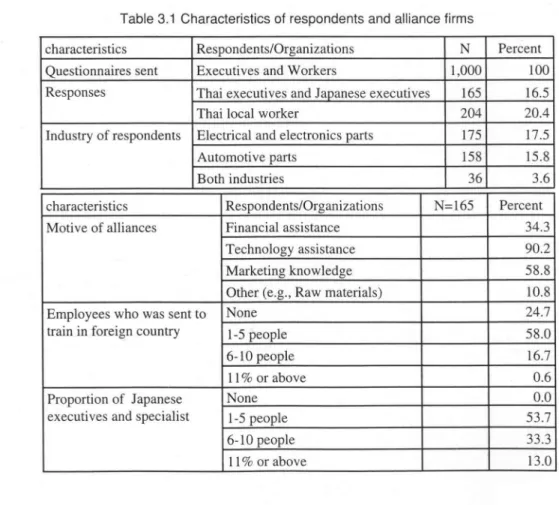
The analysis of th巴characteristicsof Thai and Japanese executives and Thai local workers c¥assifi巴d by demographic data are as following table 3.1
Table 3.1 Characteristics of respondents and alliance firms
characteristics R巴spondents/Organizations N Percent Questionnaires sent Executives and Workers 1,000 100 Responses Thai executives and Japanese executives 165 16.5 Thai local worker 204 20.4 Industry of respondents EI巴ctricaland electronics parts 175 17.5 Automotive parts 158 15.8 Both industries 36 3.6 characteristics Respondents/Organizations N=165 Percent Motiv巴ofalliances Financial assistance 34.3
Technology assistance 90.2 Marketing knowl巴dge 58.8 Oth巴r(e.g., Raw materials) 10.8 Employ巴eswho was sent to None 24.7 train in foreign country 1‑5 people 58.0 6‑10 people 16.7 II % or above 0.6 Proportion of Japanese None 0.0
巴xecutivesand specialist 1‑5 people 53.7 6‑10 people 33.3
11 % or above 13.0
22 研 究 年 報 第6号
3.1 Hypotheses Testing
This study used the multiple regression analyses to test five hypoth巴sesof local fmn's leaming and the linear structural r巴lationshipequation m吋 巴1(LISREL model) is used to explain the cause‑e百ectrelationship of the role of local firm's leaming on technology transfer and human r巴sourcedevelopm巴ntin Thai and Japanese alliance白ms.
The hypotheses of出巴localfmn' s over all leaming concem th巴relationshipsbetween depend巴ntvariables (白m'sleaming, t巴chnologytransfer and human resourc巴S
development) and i岱 independentvariables (partnership a位ibutes,relationship a位ibutes釦dknowledge attributes, iムcul加ralsimilarity, r,氏epuvlty, 国st,ownership s回cture,
complementarity, tJialab出tyand usage advantage). Moreover, the local fmn's leaming at an individual worker level concerns the relationships between the depend巴ntvariable (local employee's production efficiency improvement) and its independent variables
(local employee's job satisfactions and foreign partner's job suggestion and technology transfer).
The hypotheses testing mentioned above are presentedぉfollows.
• Hypothesis 1
Hl: The greater the degree of partner attributes
,
the higher the firm's learning and the greater improvement in technology transfer and human resource development.1.1 Cu加ralsimilarity signi仕 組tlyaffec岱 白 血m's leaming釦dimprovement in technology transfer and human resource developmen. t
1.2 Receptivity significantly affects the firm's leaming and improvement in technology transfer and human resource developm巴n.t
1.3 Trust significantly affects the firm's leaming and
江nprovementin technology transfer and human resource d巴velopment.
Table 3.2 Dependent and Independent variables of hypothesis 1 Ind巴pendentvariables R伊 ndentvariables
Pa巾ler Indicators Variables Indicators A位ibutes
Vl: ーCongruenc巴invalue and norm V4: Overallleaming
Cultural ‑Compatible philosophy 1ぷ>caI 品。ductione伍.Clencyunprovement S出u1arity Firm's ‑Production technology improvement
Leaming ‑Production know‑how and production skill improvement
‑Mo陀convenienceand bet町
commurucauon among partners V2: Knowl巴dge回nsferactivities V5 日Dductionstandard development Rec定:ptivity ‑In‑house回ining Technology ‑Product design patents
ーO任housetraining Transfer ー百lai1andIndustJial Standards 伺S)
‑On‑the‑job training certificate
‑Training aboarせ ‑ISO 9α)() series
‑Coぱ巴ぼnce,meeting and memo,記port ーISO14α)() series
Firm's s出ngth ‑TIS 18α)() (,∞cupational h出 血 釦d
‑Fin3f1cial s田ngth safety management)
‑Human resource development
‑Pr吋uctiontechnology d巴V巴lop口1ent V6: 目。ductivityand manpower 品。ductionmanagement and Human development
quality control Resources ‑Deti氏tiverat巴,improvement
‑Ability to use foreign language Development ‑Reωm product improvement to commurucate ‑Machine's capacity u副ization
‑Executive's int巴,restin advancing ‑Number ofR&D p町民t
employees' knowledge ‑Man‑hour production improvement
‑Regulation and govemment relations V3: ‑Trust and陀lythat partner紅巴
Trust capable飢dcomponent
‑Trust and allow local employe巴saccess to promotlOn
The Rol巴ofLocal Firm 'sLearning on Technology Transfer and Human Resourc巴sDevelopm巴nt" 23
Table 3.3 The correlation and square multiple correlation 01 dependent and independent variables Correlation Estimate
VI 〈ーー〉 V2 0.501
V2 〈 ー 〉 V3 0.643
VI 〈ーー〉 V3 0.530 Squared Multiple Correlation(R') Estimate Vl, V2, V3 一 〉 V4 0.514 Vl, V2, V3 一 〉 V6 0.129 Vl, V2, V3 一 〉 V5 0.175
Wh
e陀as:‑correlation value is among ‑1.∞
and 1.∞
0.80 ‑
1 . ∞ =
lugh relationslup 0.60・0.79= quite lugh relationslup 0.40 ‑0. 5
9 = medium relationslup 0.20 ‑0.39 = qui低lowrelationslupO . ∞ ‑
0. 1
9 = low relationslupTable 3.4 The regression weights 01 dependent and independent variables Regression Weights
V4 V4 V4
Wh
ereas: ‑S.E.= Standard Error
c . R . =
Critical Ratio P =Le
vel of significance〈ーー
くーー
く ‑
Estimate VI 0.593 V2 0.372 V3 0.888
Remark: statistics significance at 0.05 (α=0.05).
S.E. C.
R .
P 0.228 2.598 0.009 0.083 4.473 0.000 0.196 4.526 0.000百leconsistency between empirical data and the linear structural relationslup model
i n
血is model were not different from zero at血e0.05 significance level when p孟0.05Table 3.5 The standardized regression weights 01 dependent and independent variables Standardized Regression Weights (s) V3 V2 Vl V4
V4 0.339 0.328 0.172 0.000 V6 0.122 0.118 0.062 0.359 V5 0.142 0.137 0.072 0.419
24 研 究 年 報 第6号
• The Hypothesis 1 testing
Hypothesis 1 tested whether partner attributes (cultural similarity, r巴ceptivityand trust) were the factors influencing the firm's learning. Whereas, the partner attributes (cultural similarity, receptivity and trust) were independent factors effecting each relationship to the other. The correlation matrix indicated that cultural similarity related positively to receptivity (correlation = 0.501), receptivity relat巴d positively to trust (correlation = 0.643), and cultural simi出ityrelated positively to trust (correlation
=
0.530). This indicated that th巴relationshipbetween r巴ceptivity and trust is quite high, whereas the relation betwe巴n cultural similarity and r巴ceptivityand the relationship between cultural similarity and trust are approximately at the medium level as illustrated in tabl巴3.3.When considering the ind巴pendentvariable as cultural similarity, it is found that cultural similarity was th巴factordirectly affecting a firm's learning at the 0.05 significance statistic level (p = 0.009) wher巴
the critical ratio is 2.598 and th巴standardized regression weight is 0.172 as illustrated in table 3.4 and table 3.5.
Considering the independ巴nt variable as r巴ceptivity,in this analysis receptivity was knowledge transfer activities and a firm's strength. Receptivity factors (knowledge transfer activities and firm's strength) w巴resignificant to a firm's learning and affect巴dtechnology transfer and the human resources dev巴lopm巴nt.It is found that receptivity was the factor directly affecting the firm's learning at the 0.05 significance statistic level (p = 0.000), where the critical ratio is 4.473 and the standardized regression weight is 0.328 as illustrated in table 3.4 and table 3.5. Considering the independent variable as trust, the multiple regression analysis indicated that the relationships b巴tweentrust and firm's learning were positive and consistent with the hypothesis. It is found that trust was the factor directly affecting the firm' s learning at the 0.05 significance statistic lev巴1(p = 0.000), where the critical ratio is 4.526 and the standardized regression weight is 0.339 as illustrated in table 3.4 and tabl巴3.5.
Th巴hypoth巴sistesting also revealed that the partner attributes (cultural similarity, receptivity and trust) significantly affected the firm's learning. The corr巴lationbetween partner attributes (cultural similarity, receptivity and trust) and firm's learning positi vely affected the firm' s learning at 51.4%
(squared multiple correlation = 0.514). And partner attributes (cultural similarity, receptivity and trust) indirectly influenced the dependent variable (technology transf巴rand of human resources development) at 17.5% and 12.9% (square multiple correlation = O. 175 and O. 129 respectively) as illustrat巴din table 3.3
The multiple regression analysis indicated that the relationships between firm' s 1巴arningand technology transfer and human resources development were positive (standardized regression weight = 0.419 and 0.359 respectively) as illustrated in table 3.5.
This result shows that the relationship b巴tween firm' s learning, technology transfer and human resource d巴velopmentwere positive as hypothesized in hypothesis 1. It indicates that all of the independent variables of partner attributes (cultural similarity, receptivity and trust) could predict all dependent variables (firm's learning, technology transfer and human resources development). Thus, the hypothesis 1 is supported by the data as shows in the following figur巴3.1.
The Role of Local Firrn's Learning on Technology Transfer and Human Resources Development" 25 Figure 3.1 The analysis of linear structural relationship in hypothesis 1
Firm's
V6=Human Resources
Figure 3.1 illustrat巴sthat partner attributes affecing firm's learning and their influences on technology transfer and human resources developmen t.
The Linear Structural Relationship Equation Model in th巴t巴rmsof statistics significanc巴(α=0.05) are as follows: L
V4 = O.I72(Vl) + 0.328(V2) + 0.339(V3) V5 = O.072(Vl) + 0.137(V2) + 0.142(V3) V6 = 0.062(Vl) + 0.118(V2) + 0.122(V3)
2.1 Ownership structure significantly affects. the firm's
• Hypothesis 2 learning and improvement in technology transfer H2: The greater the degree of relationship and human resources development
attributes
,
the higher the firm's learning and 2.2 Partner compl巴mentaritysignificantly affects the the greater improvement in technology transfer firm's learning and improvement in technology and human resources development. transfer and human resources developmentTable 3.6 Dependent and Independent variables of hypothesis 2
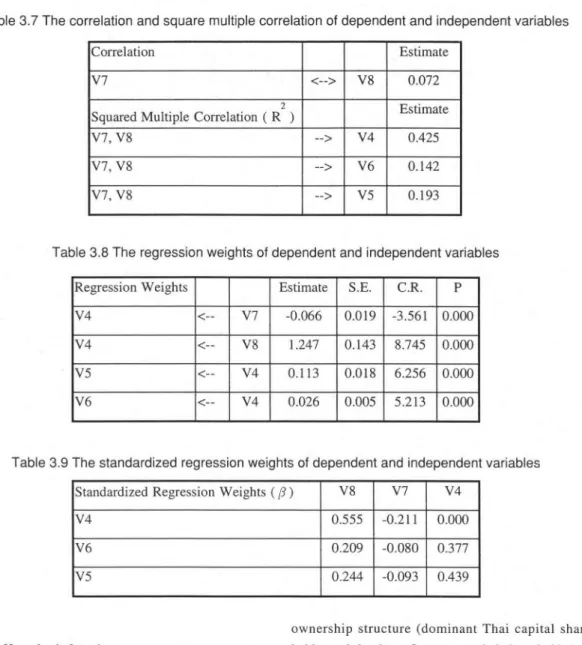
Independent variables Dependent variables Relationship A位ibu臨 Indicators Variables Indicators
V7 ‑Domin釦tThai V4
O‑RV叫ErB1I1ICHleoanrne1nmg ciEIICympmvemEIlt Ownership Struc加re P紅tnercapl凶 LocalF町n's
shareholder Leaming ‑‑PbroEddulICcHtiOoIn I包hCMowo‑lhoogy wmanpd mpIv0巴dmlecnbton SKIll
‑Dominant Japanes巴
ph紅armehero叩ldePr1凶 ‑mMopImO Vc巴omrlVeEnItlimcemd bemr V8:
ーc百o1natripb紅ut白ioEnrs commurucatJon among p紅 白ers Partner Complem巴ntarity V5: Production standard development
‑CJOapIl組 ,trib巴Su巴tJons TTemcnhsnfoerl ogy ‑Product dInedsuigstnI iapl atents
ー百lailandIndustrial Stand紅ds行lS) ce抱負cate
ーIS09α)()series
‑IS0 14α)() series
‑11S 18α)()(
∞
cupational h凶l由 加dsafl巴ty management)V6: Productivity and manpower development Human
ERMMNh出ue岡飢公m血ヨc山d出hIIv叩FCe'ooSmf凶pd駒RMP&田鉱d
D
町u岬司F可pp別ω旦nuj幽V回I
問間包B
班岨四型1to並空nF1t ResourcesDevelopment