【総 説】
薬剤感受性試験とブレイクポイント,その問題点と今後の展望
石 井 良 和
東邦大学医学部微生物・感染症学講座*
(平成
23
年7
月15
日受付・平成23
年7
月22
日受理)薬剤感受性試験結果は感染症治療に有用な抗菌薬の選択において有用な情報を提供する。投与される 抗菌薬は単に最小発育阻止濃度(Minimum Inhibitory Concentration:MIC)を基に選択されるわけでは なく,感染部位における抗菌薬濃度も加味して選択されなければならない。微量液体希釈法と
Walk-
Away
やPhoenix,Vitek 2
などの自動機器によってもたらされる感受性試験法結果が異なることがある。それに加えて,正しい薬剤感受性試験成績を得るために重要なことは精度管理を厳密に行うことで あ る。Clinical and Laboratory Standards Instituteや
European Committee on Antimicrobial Suscepti-
bility Testing
のブレイクポイントは科学的根拠や臨床的根拠を基に毎年変更されている。本稿ではMIC
測定とブレイクポイント改訂の意義および問題点について概説する。Key words: drug-susceptibility,minimum inhibitory concentration,breakpoint
薬剤感受性試験によって得られる最小発育阻止濃度(Mini-
mum Inhibitory Concentration:MIC)は,抗菌薬療法を行う
うえで重要な抗菌薬選択の指標の一つであると考えられてい る。MIC値をいかに解釈し,抗菌薬を選択し,そしてその投 与設計をするのかによって感染症治療の成否が大きく違って くることは言うまでもない。感染症の原因微生物に対して小 さなMIC
値を示す抗菌薬の治療効果が優れると考える医療 従事者が少なくないのも事実である。MIC
値をはじめとする薬剤感受性試験成績を誰でも簡単 に解釈するために提唱されたのがブレイクポイントである。すなわち,ブレイクポイントは,in vitroの薬剤感受性検査結 果から,抗菌薬の治療効果を予測するために使用する基準値 である。ブレイクポイントには本学会が提唱している呼吸器 感染症,敗血症および尿路感染症に対する抗菌薬ブレイクポ イント1〜4),アメリカの
Clinical and Laboratory Standards In- stitute(CLSI)あるいはヨーロッパの European Committee on Antimicrobial Susceptibility Testing
(EUCAST)が提唱し ているブレイクポイントがそれぞれ存在する5,6)。いずれのブ レイクポイントにも優れた点はあるが,日本ではCLSI
のブ レイクポイントが多くの施設で使われているのが現状であ る。本稿では
MIC
測定およびブレイクポイント改訂の意義や 問題点について焦点を当てて概説する。I. 薬剤感受性試験における精度管理の重要性 MIC
は,抗菌薬の抗菌力を表す指標の一つである。具 体的には,抗菌薬の2
倍希釈系列を作成した培地中に一 定量の供試菌を接種して一晩培養後,菌の発育を肉眼で観察して,菌の発育を認めない最小の抗菌薬濃度を
MIC
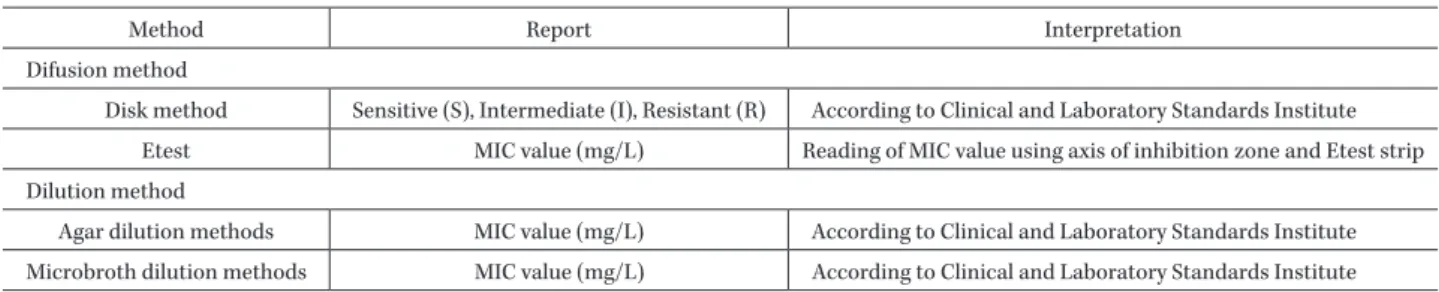
とすると定義している(Table 1)7)。日常検査でMIC
値を 求める多くの場合微量液体希釈法が用いられている。正 しく薬剤試験成績が得られていることを担保するために 精度管理(Quality control:QC)を実施することが重要 である5)。しかし,細菌検査の現場で
QC
を適切に実施すること は不可能である。通常,薬剤感受性試験を実施する場合,なるべく多くの抗菌薬のデータを提供するために,後述 のブレイクポイント付近の抗菌薬濃度を中心に測定して いるのが現状である。多くの場合,
QC
株のMIC
値はブ レイクポイントとして設定されているレンジと比較して 低い値であり,実際のMIC
プレートに作成されている希 釈レンジにない。すなわち,CLSI
のガイドラインに記載 されているQC
株でQC
を実施しても,正しくMIC
値が 報告されていることを担保できない現状がある。II. 自動菌種同定・感受性測定システム
世界的に汎用されている自動菌種同定・薬剤感受性測 定システムであるVitek 2
(Sysmex,神戸),WalkAway(Siemens,東京)あるいは
Phoenix
(日本BD,東京)の
うち,微量液体希釈法でMIC
値を算出しているのはWalkAway
だけである。Vitek 2やPhoenix
は薬剤感受 性試験成績を報告するが正確に言えばこれはMIC
値ではない。
Bulik
らは46
株のカルバペネマーゼ産生肺炎桿菌を対象に,
CLSI
のガイドラインに従った微量液体希釈 法 に よ るMIC
値 とSensititer,Vitek 2
お よ びWalk- Away
などの自動機器で報告された感受性試験成績を比*東京都大田区大森西
5―21―16
Table 1. Methods and reporting values of antimicrobial susceptibility testing and their interpretations
Method Report Interpretation
Difusion method
Disk method Sensitive (S), Intermediate (I), Resistant (R) According to Clinical and Laboratory Standards Institute Etest MIC value (mg/L) Reading of MIC value using axis of inhibition zone and Etest strip Dilution method
Agar dilution methods MIC value (mg/L) According to Clinical and Laboratory Standards Institute Microbroth dilution methods MIC value (mg/L) According to Clinical and Laboratory Standards Institute
較している8)。その結果,微量液体希釈法による
MIC
値とVitek 2
およびSensititer
による感受性試験成績は大き く異なり,それぞれ26.1%(12
株!46
株)および8.7%
(4株!
46
株)に上るvery major error
が発生したと述べ ている。同じ自動機器でもCLSI
のガイドラインに従っ た方法 でMIC
値 を 測 定 す るWalkAway
で は2.2%(1
株! 46
株)がvery major error
となった。すなわち,同じ 単位の値が報告される薬剤感受性試験であっても自動機 器の場合の違いをよく理解する必要がある。III. MIC
変動の要因接種菌量の差が
MIC
値に大きな影響を与えることは 良く知られている。抗菌薬分解酵素や修飾酵素を産生す る菌株において,inoculum effect
と呼ばれる接種菌量が 多いとMIC
が高くなる現象がその1
例として挙げられる。特に
KPC―型カルバペネマーゼ産生肺炎桿菌におい
て接種菌量の僅かな差が
MIC
値に大きな影響を与えた ことは良く知られている9)。他にもスキップ現象や僅かな 沈殿が認められる場合など,MIC
の判定が困難な局面と 遭遇することは決して少なくない。IV. ブレイクポイントとは
報告された
MIC
値は,抗菌薬の治療効果を推定(判断)する基準の一つであるブレイクポイントに照らし合わせ て抗菌薬が選択される。決して
MIC
値が小さいという理 由から抗菌薬が選択されることはない。日本では,CLSI
あるいは
EUCAST
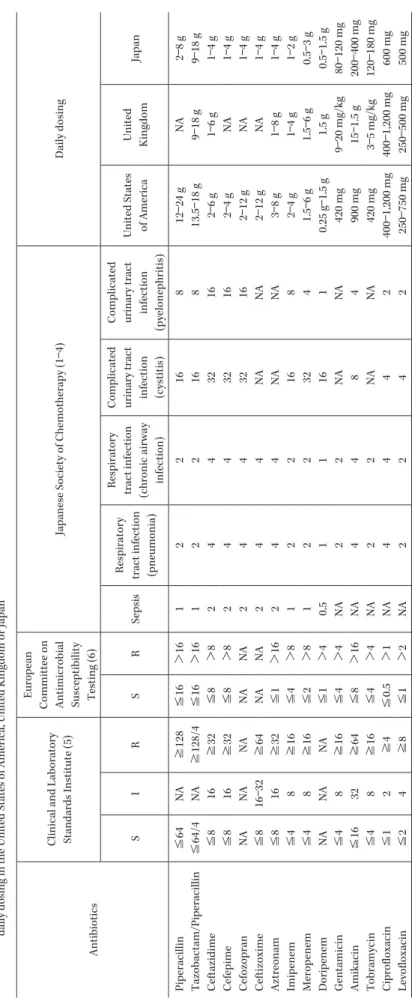
といったブレイクポイント定義機関,あるいは日本化学療法学会によって設定されたブレ イクポイントが使われている(Table 2)。このうち,多く の施設で使われているブレイクポイントは
CLSI
のもの であろう。CLSIは,菌種(属)ごとにブレイクポイント を設定しており,単純で使いやすいこと,その値を疫学 調査に転用しやすいこと,さらに世界的に使われている ことなどが日本でも汎用される理由であろう。ブレイクポイントは,治療効果を判断するための基準 の一つであり,疫学的カットオフとは異なる。疫学的 カットオフは野生型と非野生型を分ける基準であるのに 対して,ブレイクポイントは,薬剤感受性試験成績を基 に感性(sensitive:S),中間(intermediate:I)および 耐性(resistant:R)に分類するものが多い5,6)。
V. 肺炎球菌におけるペニシリン G
のブレイクポイント
ブレイクポイントは正当な理由があれば変更される。
その変更理由の例として,投与量の変更,投与方法の変 更,耐性菌に対する知見の蓄積,臨床効果に対する知見 の蓄積などが挙げられる。CLSIは頻繁にブレイクポイ ントの変更を行っており,
2008
年の肺炎球菌に対するペ ニシリンG
のブレイクポイントが変更されたのは記憶 に新しい10)。髄膜炎以外の感染症に対する非経口ペニシ リンのブレイクポイントが8 μ g! mL
以上に変更され た。これは,米国のペニシリン系薬の投与量を基準に設 定されたもので,日本の実情には合わない基準であると 考えられる。しかし,髄膜炎以外の感染症に対する経口 ペニシリンのブレイクポイントおよび髄膜炎に対する非 経口ペニシリンのブレイクポイントは従来のままであ る。一方,ペニシリン耐性肺炎球菌のブレイクポイント は,厚生労働省の院内感染対策サーベイランスの耐性菌 判定基準(Ver. 2.0)では0.125 μ g! mL
以上と定義されて いる。http:!! www.nih-janis.jp! section! standard!
drugresistancestandard̲ver2.0̲20101203.pdf VI. 腸内細菌科におけるセファロスポリン薬の
ブレイクポイント
2010
年にCLSI
のドキュメントは,薬物の作用を薬物 動態学(Pharmacokinetics,PK)と薬力学(Pharmacody-namics,PD:PK-PD)理論を導入してセファロスポリン
薬のブレイクポイントを大幅に改訂した11)。CLSI
の新し いブレイクポイントは,旧ブレイクポイントと比較して セファロスポリン薬の臨床効果をより高い精度で推定す ることが可能になったと考えられる。しかし,このブレ イクポイントは,血中の抗菌薬濃度をもとに設定されて おり,感染病巣における抗菌薬濃度は考慮されていない。したがって,感染臓器によっては抗菌薬の選択をこのブ レイクポイントのみから行うことはできない場合もあろ う。
改訂されたセファロスポリン薬のブレイクポイントに は抗菌薬ごとにその投与量が定められている。例えばセ ファゾリンのブレイクポイントは,Sが≦2
μ g! mL,I
Table 2. Comparison between breakpoints of the Clinical and Laboratory Standards Institute, European Committee on Antimicrobial Suscepti bility Testing and Japanese Sociery of Chemotherapy and daily dosing in the United States of America, United Kingdom or Japan Antibiotics Clinical and Laboratory Standards Institute (5) European Committee on Antimicrobial Susceptibility Testing (6)
Japanese Society of Chemotherapy (1 ― 4) Daily dosing S I R S R Sepsis Respiratory tract infection (pneumonia) Respiratory tract infection (chronic airway infection) Complicated urinary tract infection (cystitis) Complicated urinary tract infection (pyelonephritis)
United States of America United Kingdom Japan Piperacillin ≦ 64 NA ≧ 128 ≦ 16 > 16 1 2 2 1 6 8 12 ― 24 g N A 2 ― 8 g Tazobactam/Piperacillin ≦ 64/4 NA ≧ 128/4 ≦ 16 > 16 1 2 2 1 6 8 13.5 ― 18 g 9 ― 18 g 9 ― 18 g Ceftazidime ≦ 81 6 ≧ 32 ≦ 8 > 8 2 4 4 32 16 2 ― 6 g 1 ― 6 g 1 ― 4 g Cefepime ≦ 81 6 ≧ 32 ≦ 8 > 8 2 4 4 32 16 2 ― 4 g N A 1 ― 4 g Cefozopran NA NA NA NA NA 2 4 4 3 2 1 6 2 ― 12 g N A 1 ― 4 g Ceftizoxime ≦ 81 6 ― 32 ≧ 64 NA NA 2 4 4 N A N A 2 ― 12 g N A 1 ― 4 g Aztreonam ≦ 81 6 ≧ 32 ≦ 1 > 16 2 4 4 N A N A 3 ― 8 g 1 ― 8 g 1 ― 4 g Imipenem ≦ 48 ≧ 16 ≦ 4 > 81 2 2 1 6 8 2 ― 4 g 1 ― 4 g 1 ― 2 g Meropenem ≦ 48 ≧ 16 ≦ 2 > 8 1 2 2 32 4 1.5 ― 6 g 1.5 ― 6 g 0.5 ― 3 g Doripenem NA NA NA ≦ 1 > 4 0 .5 1 1 16 1 0.25 g ― 1.5 g 1.5 g 0.5 ― 1.5 g Gentamicin ≦ 48 ≧ 16 ≦ 4 > 4 N A 2 2 N A N A 420 mg 9 ― 20 mg/kg 80 ― 120 mg Amikacin ≦ 16 32 ≧ 64 ≦ 8 > 16 NA 4 4 8 4 900 mg 15 ― 1.5 g 200 ― 400 mg Tobramycin ≦ 48 ≧ 16 ≦ 4 > 4 N A 2 2 N A N A 420 mg 3 ― 5 mg/kg 120 ― 180 mg Ciprofloxacin ≦ 12 ≧ 4 ≦ 0.5 > 1 N A 4 4 4 2 400 ― 1,200 mg 400 ― 1,200 mg 600 mg Levofloxacin ≦ 24 ≧ 8 ≦ 1 > 2 N A 2 2 4 2 250 ― 750 mg 250 ― 500 mg 500 mg NA: not available
Table 3. Criteria for defining drug resistant bacteria in the Japan nosocomial infection surveillance program by the Ministry of Health, Labour and Welfare
Organisms Criteria
MRSA (methicillin resistant Staphylococcus aureus) Microbroth dilution method
*: ≧4 μ g/mL for cloxacillin
Disk difusion method
**: ≦10 mm for cloxacillin or ≦21 mm for cefoxitin VRSA (Vancomycin resistant Staphylococcus aureus) Microbroth dilution method: ≧16 μ g/mL for vancomycin
Disk difusion method: ≦14 mm for vancomycin VRE (Vancomycin resistant Enterococci) Microbroth dilution method: ≧16 μ g/mL for vancomycin
Disk difusion method: ≦14 mm for vancomycin
PRSP (Penicillin resistant Streptococcus pneumoniae) Microbroth dilution method: ≧0.13 μ g/mL for penicillin G
Disk difusion method: ≦19 mm for cloxacillin or exception of sensitive for penicillin G MDRP (Multidrug resistant Pseudomonas aeruginosa) Microbroth dilution method: resistance for carbapenems, ≧32 μ g/mL for amikacin
and resistance for fluoroquinolones
Disk difusion method: carbapenem resistance, ≦14 mm for amikacin and fluoroqui- nolone resistant
MDRA (Multidrug resistant Acinetobacter spp.) Microbroth dilution method: resistance for carbapenems, ≧32 μ g/mL for amikacin and resistance for fluoroquinolones
Disk difusion method: carbapenem resistance, ≦14 mm for amikacin and fluoroqui- nolone resistant
http://www.nih-janis.jp/section/standard/drugresistancestandard_ver2.0_20101203.pdf
*
: MIC value
**
: diameter of inhibition zone using Kirby-Bauer (KB) disk
が
4 μ g! mL, R
が≧8μ g! mL
と定められている。ただし コメントとして,このクライテリアはセファゾリンを2 g, 8
時間間隔で投与した場合に適応されると記載されて いる11)。本邦におけるセファゾリンの1
日最大投与量は5 g
であることから,日本の投与量に従う限りこのブレイ クポイントをそのまま使用するのは困難である。また,新しいブレイクポイントを採用すれば,基質特 異性拡張型
β
ラクタマーゼなどの耐性因子の確認試験 をしなくてもブレイクポイントをもとに抗菌薬の選択が 可能であるとしている11)。しかし,そのブレイクポイント を用いた場合にどの程度の耐性菌をR
として判定して いるのかなどの検証が十分なされているとは言えない。各国,各医療施設間で検出される耐性菌の種類が異なる ため,本邦において細菌学的および臨床的な検証を実施 することは必須であると考えている。
他にも同じような投与量で同様の体内動態をする抗菌 薬に対して異なるブレイクポイントが設定されているも のがある。反対に同じような投与量で明らかに体内動態 が異なる抗菌薬に同じブレイクポイントが設定されてい るものもある。さらに,セファマイシン薬に対するブレ イクポイントはまったく見直されていない5)。これらの問 題点に関しては
CLSI
における今後の検討課題となると 考えている。VII. 腸内細菌科におけるフルオロキノロン薬の
ブレイクポイント2011
年にCLSI
は腸内細菌科菌のフルオロキノロン薬 に対するブレイクポイントの変更を予定していた。腸管 以外の感染部位から分離されたサルモネラ属菌に対して ナリジクス酸スクリーニング試験が実施されていたが5),これを削除する目的で検討されてきた。フルオロキノロ ン薬に感性を示すチフス菌による感染症の治療に同系統 の薬剤を用いても治療無効例があったことが報告され た12)。このような菌株のスクリーニングにナリジクス酸 が有用である。このスクリーニング試験によりフルオロ キノロン薬に感性を示す菌株のうち,キノロン薬の作用 標的に突然変異のある菌株を効率よく検出することが可 能である。本年,その変更は見送られたが,近い将来
CLSI
はフルオロキノロン薬のブレイクポイントを引き下げ,ナリジクス酸スクリーニング試験を削除すると思われ る。
VIII. カルバペネム薬のブレイクポイント 2010
年6
月にドキュメントのアップデートがなされ,腸内細菌科菌のカルバペネム薬のブレイクポイントの変 更とドリペネムのブレイクポイントの追加収載が実施さ れた13)。カルバペネム薬のブレイクポイントが変更され た背景には,KPC―型カルバペネマーゼのなかにカルバ ペネム薬に比較的低い
MIC
値を示す菌株が散見された ことがある9)。そのため,イミペネム,メロペネムのブレ イクポイントを引き下げた。ドリペネムのブレイクポイ ントはイミペネムやメロペネムのブレイクポイントと同 一に設定されている。しかし,メロペネムやドリペネム の投与量はイミペネムのものと比較して多いことから,筆者はこれらのブレイクポイント設定に疑問をもってい る。また,CLSIは
2012
年にアシネトバクター属菌や緑 膿菌のカルバペネム薬に対するブレイクポイントの変更 を予定しており,2〜3管引下げられる可能性が高い。IX. 各種薬剤耐性菌判定基準
厚生労働省院内感染対策サーベイランスの薬剤耐性菌
Table 4. Reporting criteria for drug resistant bacteria in the act on prevention of infectious diseases and medical care for patients suffering in- fectious diseases
Organisms Criteria
MRSA (methicillin resistant Staphylococcus aureus) Microbroth dilution method
*: ≧4 μ g/mL for oxacillin Disk difusion method
**: ≦10 mm for oxacillin VRSA (Vancomycin resistant Staphylococcus aureus) Microbroth dilution method: ≧32 μ g/mL for vancomycin VRE (Vancomycin resistant Enterococci) Microbroth dilution method: ≧16 μ g/mL for vancomycin PRSP (Penicillin resistant Streptococcus pneumoniae) Microbroth dilution method: ≧0.125 μ g/mL for penicillin G
Disk difusion method: ≦19 mm for oxacillin
MDRP (Multidrug resistant Pseudomonas aeruginosa) Microbroth dilution method: resistance for carbapenems, ≧32 μ g/mL for amikacin and ≧4 μ g/mL for ciprofloxacin
Disk difusion method: carbapenem resistance, ≦14 mm for amikacin and ≦14 mm for ciprofloxacin
MDRA (Multidrug resistant Acinetobacter spp.) Microbroth dilution method: resistance for carbapenems, ≧32 μ g/mL for amikacin and ≧4 μ g/mL for ciprofloxacin
Disk difusion method: carbapenem resistance, ≦14 mm for amikacin and ≦14 mm for ciprofloxacin
*
: MIC value
**
: diameter of inhibition zone using Kirby-Bauer (KB) disk
判 定 基 準(Table 3:http:!!
www.nih-janis.jp! section!
standard! drugresistancestandard̲ver2.0̲20101203.pdf)
は,基本的に
CLSI
のドキュメントの数値を参考に設定 されたと思われる。しかし,厚生労働省院内感染対策サー ベイランスの薬剤耐性菌判定基準は,臨床的に効果が期 待される抗菌薬を選択するための基準ではなく,厳密な 意味での疫学的カットオフとも異なる。CLSIのブレイ クポイントは科学的根拠に基づいて改定が繰り返され る。今後,CLSI
の耐性ブレイクポイントと厚生労働省院 内感染対策サーベイランスの薬剤耐性菌判定基準が異な る菌種と抗菌薬の組み合わせが問題になることが予想さ れる。医療現場ではいくつもの基準が使われることは好 ましいことではない。今後,本邦でも独自のブレイクポ イントを設定することを考慮すべきかもしれない。さらに,本邦では感染症法の報告基準が定められてい る (
Table 4
:http: !! www.kenkou.pref.mie.jp ! kijyun̲
new! T-Kijyun! kijun̲all.pdf)。この基準は法律に基づく
数値であるため,簡単に変更することができない。現時 点において厚生労働省院内感染対策サーベイランスの薬 剤耐性菌判定基準と感染症法の報告基準の間に大きな矛 盾はない。しかし,今後CLSI
のブレイクポイントが変更 された場合,厚生労働省院内感染対策サーベイランスの 薬剤耐性菌判定基準は国際的データと比較するために変 更される可能性が否定できないと考えている。X. ブレイクポイントと取り巻く問題
耐性菌サーベイランスを実施するためには菌種ごとに 耐性あるいは感性のカットオフが必要である。その目的 に日本化学療法学会のブレイクポイントは適さないた め,
CLSI
のブレイクポイントが長年使われてきた経緯が ある。最近になって,アメリカと比較してヨーロッパに おける抗菌薬の投与量が本邦のものと近いことから,EUCAST
のブレイクポイント6)が注目されている。確かに,いくつかの例外を除けば
EUCAST
のブレイクポイ ントはCLSI
のものと比較して低く設定されている(Ta-ble 2)
5,6)。しかし,最近のCLSI
のブレイクポイントの変 更によって,CLSI
のブレイクポイントがEUCAST
のも のに近づいているように感じられる。これからも毎年CLSI
やEUCAST
のブレイクポイントは改正されるが,日本でも菌種(属)ごとのブレイクポイントを作成する 必要があると考えている。その理由として,抗菌薬の投 与量が欧米と比較して日本では少ないものが多く,
CLSI
や
EUCAST
のブレイクポイントはそのまま用いることができないからである。
さらに,ブレイクポイントが変更されても自動機器の データベースに組み込まれるには時間を要する。その理 由として,感受性試験で用いられる感受性パネルの抗菌 薬濃度を変更しなければならないため,新規パネルの開 発が必要となることがあげられる。さらに,それに伴う
S, I, R
のクライテリア判定用プログラムの作成など,自 動機器に新たなブレイクポイントを導入するには多くの 段階を踏まなければならない。確かにこれらの作業は煩 雑で時間のかかるものであるが,自動機器を販売してい る各社には迅速な対応を期待したい。XI. お わ り に
ブレイクポイントは,専門的な知識がなくても抗菌薬 感受性試験成績をもとに臨床的に有用性が高い抗菌薬を 選択できるように定められた判定基準の一つである。そ して,この基準はさまざまな知見をもとに改定されてい る。したがって,基本的に最新のものを使用することが 患者の利益に繋がると考えられる。しかし,ブレイクポ イントを使うことで治療効果をあげるためには,適切な 薬剤感受性試験が行われ,正しい検査結果が得られてい
ることが最も重要である。薬剤感受性試験で用いられて いる
QC
株の問題を含めてその試験法をもう一度検討し 直すことが必要である。さらに,日本独自の菌種(属)別 ブレイクポイントをつくるために,CLSIやEUCAST
のブレイクポイントの検証が必要であると考えている。文 献
1)
Saito A : Clinical breakpoints for antimicrobial agents in pulmonary infections and sepsis: report of the Committee for Japanese Standards for Antimi- crobial Susceptibility Testing for Bacteria. J Infect Chemother 1995; 1: 83-8
2)
Saito A, Inamatsu T, Okada J, Oguri T, Kanno H, Kusano N, et al: Clinical breakpoints in pulmonary infections and sepsis: new antimicrobial agents and supplemental information for some agents already released. J Infect Chemother 1999; 5: 223-6
3) 日本化学療法学会抗菌薬ブレイクポイント委員会:
呼吸器感染症,敗血症および尿路感染症におけるブレ イクポイント:新規抗菌薬の追加(2009年)。日化療 会誌
2009; 57: 343-5
4) 日本化学療法学会抗菌薬感受性測定・臨床評価委員 会:呼吸器感染症および敗血症におけるブレイクポ イント:新規抗菌薬の追加(2005年)。日化療会誌
2005; 53: 557-9
5)
Clinical and Laboratory Standards Institute : Per- formance Standards for Antimicrobial Susceptibility Testing ; Twenty-First Informational Supplement.
Vol. 31. M100-S21. Wayne, Pennsylvania: CLSI, 2011
6)European Committee on Antimicrobial Susceptibil-
ity Testing: Breakpoint tables for interpretation of MICs and zone diameters. Version 1.3. Munich and Basel: European Society of Clinical Microbiology and
Infectious Diseases, 2011
7)
Clinical and Laboratory Standards Institute : Meth- ods for Dilution Antimicrobial Susceptibility Tests for Bacteria That Grow Aerobically ; Approved Standard-Eighth Edition. Vol. 29. M 7-A 8. Wayne, Pennsylvania: CLSI, 2009
8)
Bulik C C, Fauntleroy K A, Jenkins S G, Abuali M, LaBombardi V J, Nicolau D P, et al: Comparison of meropenem MICs and susceptibilities for carbapenemase-producing Klebsiella pneumoniae isolates by various testing methods. J Clin Microbiol 2010; 48: 2402-6
9)
Bratu S, Landman D, Alam M, Tolentino E, Quale J:
Detection of KPC carbapenem-hydrolyzing enzymes in Enterobacter spp. from Brooklyn, New York. Antim- icrob Agents Chemother 2005; 49: 776-8
10)
Clinical and Laboratory Standards Institute : Per- formance Standards for Antimicrobial Susceptibility Testing; Eighteenth Informational Supplement. Vol.
28. M100-S18. Wayne, Pennsylvania: CLSI, 2008
11)Clinical and Laboratory Standards Institute : Per-
formance Standards for Antimicrobial Susceptibility Testing ; Twentieth Informational Supplement. Vol.
30. M100-S20. Wayne, Pennsylvania: CLSI, 2010
12)Crump J A, Barrett T J, Nelson J T, Angulo F J: Re-
evaluating fluoroquinolone breakpoints for Salmo- nella enterica serotype Typhi and for non-Typhi sal- monellae. Clin Infect Dis 2003; 37: 75-81
13)