STABLE MAPS AND BRANCHED SHADOWS OF 3-MANIFOLDS MASAHARU ISHIKAWA AND YUYA KODA
1. INTRODUCTION
In this note,
we
define the notion of stable map complexity fora
compact orientable 3-manifold bounded by (possibly empty) tori counting the minimal number of singular fibers of codimension 2 of stable maps into the real plane, and prove that this numberequals the minimal number of vertices of its branched shadows. As
a
consequence, wegive a complete characterization of hyperbolic links in the 3-sphere whose exteriors have stable map complexity 1 in terms of Dehn surgeries. We also provide relation between the stable map complexity, shadow complexity, and hyperbolic volumes. This note is adapted from the talk at the Camp-style Seminar “Topology, Geometry and Algebra of low-dimensiional manifolds (2015)” held in Numazu. We refer the readers to [11] for the details. Throughout the note,
we
will work in the smooth category unless otherwise mentioned.2. PRELIMINARIES
2.1. Shadows and branched shadows of 3-manifolds. A compact polyhedron $P$ is
said to be almost-special if each point of $P$ has
a
neighborhood homeomorphic toone
ofthe five local models shown in Figure 1: A point of $P$ having a neighborhood shaped on
(iv) (v)
FIGURE 1. The local models of
an
almost-special polyhedron.the model $(iii\rangle$ is called a true vertex of $P$, and we denote the set of true vertices of$P$ by
$V(P)$
.
The set ofpointsof$P$ having neighborhoodson
the models (ii), (iii)or
(v) is calledthe singular set of$P$, and
we
denote it by $S(P)$. The set ofpoints having neighborhoodsshaped on the models (iv) or (v) is called the boundary of $P$, and
we
denote it by $\partial P.$A point having a neighborhood shaped on the model (v) is called a boundary-vertex of
$P$, and we denote the set ofboundary-vertices of $P$ by $BV(P)$
.
Throughout the note, we set $c(P)=|V(P)|+|BV(P)|$
.
The polyhedron $P$ is said to be closed if $\partial P=\emptyset.$ $A$component of$P\backslash S(P)$ is called a region.
Thefirst-named author issupported by theGrant-in-Aid for Scientific Research (C), JSPS KAKENHI Grant Number 25400078.
Thesecond-named authoris supported by theGrant-in-Aid for YoungScientists (B),JSPS KAKENHI
Grant Number 26800028. Received December 11, 2015.
Let $P$ be
an
almost-special polyhedron. A coloring of $\partial P$ isa
map from the set ofcomponents of $\partial P$ to $\{i, e, f\}$
.
Then with respect to the coloring, $\partial P$ decomposes intothree peaces $\partial_{i}P,$ $\partial_{e}P$ and $\partial_{f}P$
.
An almost special polyhedron is said to beboundary-decorated if it is equipped with
a
coloring of $\partial P$.
If$\partial_{f}(P\rangle=\emptyset,$ $P$ is said to be proper.Definition 2.1. Let $M$ be a compact orientable 3-manifold and La (possibly empty)
link in $M$
.
A boundary-decorated almost-special polyhedron $P$ properly embedded in acompact oriented smooth 4-manifold $W$ is called
a
shadow of $(M, L)$ if$\bullet$ $W$ collapses onto $P$ after equipping the natural PL structure $oX1W$; $\bullet$ $P$ is locally flat, that is, each point
$p$ of$P$ has a neighborhood $Nbd(p;P)$ that lies
in a 3-dimensional submanifold of$W$; and $\bullet$ $(M, L)=(\partial W\backslash IntNbd(\partial_{e}F;\partial W), \partial_{i}P)$.
When $L=\emptyset$,
we
say that $P$ isa
shadowof $M$ for simplicity.In [22, 23], Turaev proved that any pair of a compact orientable 3-manifold with
no
spherical boundary components and $a$ (possibly empty) link in it has a shadow. In [6, 8],
the shadow complexity of $(M, L)$, denoted by $sc(M, L)$,
was
defined to be the minimal number of true and boundary vertices in any of its shadows.A branched polyhedron is defined to be
an
almost-special polyhedron $P$ equipped withan
orientation of each ofits regionsso
as
tosatisfy the following condition:$\bullet$ the orientations
on
each component of $S(P)\backslash V(P)$ induced by the three germsofregions do not coincide (See Figure 2).
(i) $\langle ii)$ $\langle i)\dot{\lambda})$ く$iv\rangle$ ($v$)
FIGURE 2. The local models ofa branched polyhedron.
Werefer the readertoBenedetti-Petronio [4] for generalproperties ofbranched polyhedra. Definition 2.2. Let $M$ be a compact orientable 3 manifold and $La$ (possibly empty) link in $M$
.
A shadow $P$ of $(M, L)$ equipped witha
branching is called a branched shadowof $(M, L)$
.
In [6, Theorem 3.1.7] and [7, Proposition 3.4], Costantino showed that any pair ofa compact orientable 3-manifold with
no
spherical boundary components and $a$ (possiblyempty) link in it has
a
branched shadow.Definition 2.3. Let $M$be
a
compactorientable 3-manifold and La (possiblyempty) linkin $M$
.
The branched shadow complexityof $(M, L)$, denoted by $bsc(M, L)$, is the minimalnumber oftrue and boundary-verticesinanyof its branched shadows. A branched shadow
$P$of $(M, L)$ is said to be minimal if it satisfies $c(P)=bsc(M, L)$, that is, it contains the
least possible number oftrue and boundary-vertices.
A gleamon an almost-special polyhedron $P$ is acoloring ofall the interior regionsof$P$
with half integers satisfyinga certain condition. We call an almost-special polyhedron $P$ equippedwith gleams a shadowed polyhedron. In [22, 23], Turaev showed the following:
(1) If
an
almost-special polyhedron $P$ is embedded ina
compact oriented smooth4-manifold $W$ is
a
shadow of $\partial W$, then there existsa
canonical coloring of theinterior regionsof $P$with half integers, that is,
we
have the canonical gleamon
$P.$ (2) (TUraev’s reconstruction) Roma
shadowed polyhedron $P$,we
can
reconstructa
compact oriented smooth -manifold $W$ and
an
embedding $P\mapsto W$ ina
uniqueway (up to diffeomorphism) so that $P\subset W$ is ashadow of$\partial W$ andthe canonical
gleam on $P$ given by the embedding $P\mapsto W$ coincides with the prefixed gleam
on $P.$
We note that, in this correspondence, the gleam ofa regionof
a
shadow is the generaliza-tion of the Euler number of closed surfaces embedded in oriented 4-manifolds.2.2. Stable maps and their Stein factorizations. Let $M$ be a closed orientable
3-manifold. Let $f$ be
a
smooth map of $M$ into $\mathbb{R}^{2}$.
We denote by $S(f)$ the set ofsingularpoints of $f$, that is, $S(f)=\{p\in M|$ rank $df_{p}<2\}$
.
A map $f$ of $M$ into $\mathbb{R}$ issaid
to be stable if there exists an open neighborhood of $f$ in $C^{\infty}(M, \mathbb{R}^{2})$ such that for any
map $g$ in this neighborhood there exist diffeomorphisms $\Phi$ : $Marrow M$ and
$\varphi$ :
$\mathbb{R}^{2}arrow \mathbb{R}^{2}$
satisfying $g=\varphi ofo\Phi^{-1}$
.
Here $C^{\infty}(M, \mathbb{R}^{2})$ is the set ofsmooth maps of$M$ into$\mathbb{R}^{2}$with
the Whitney $C^{\infty}$ topology. If
$f$ is stable, there exist local coordinates centered at $p$ and
$f(p)$ such that $f$ is locally described in
one
of the following way:(1) $(u, x, y)\mapsto(u, x)$;
(2) $(u, x, y)\mapsto(u, x^{2}+y^{2})$; (3) $(u, x, y)\mapsto(u, x^{2}-y^{2})$;
(4) $(u, x, y)\mapsto(u, y^{2}+ux-x^{3})$
.
In the
cases
of (1), (2), (3), and (4), $p$ is called a regular point, adefinite fold
point,an
indefinite fold
pointanda
cusp point, respectively. Further,we
require that(5) $f^{-1}\circ f(p)\cap S(f)=\{p\}$ for
a
cusp point$p$;(6) restrictionof$f$to$S(f)\backslash$
{
cusp points} isan
immersion with only normal crossings.Conversely, if a smooth map satisfies the above conditions, then it is a stable map. The
stable maps form
an
open dense set in the space $C^{\infty}(M, \mathbb{R}^{2})$.Let $M$ be a compact orientable -manifold with (possibly empty) boundaryconsisting
of tori. A smooth map $f$ of$M$ into$\mathbb{R}^{2}$
is called
an
$S$-map if(1) the restrictionof$f$to Int$M$is
a
stablemap(herea
stablemapmeans
that,as
in thecase
where $M$is closed, there exists an open neighborhood of$f$ in $C^{\infty}(IntM, \mathbb{R}^{2})$such that for any map $g$ in this neighborhood there exist diffoemorphisms $\Phi$ :
$Marrow M$ and $\varphi$ :
$\mathbb{R}^{2}arrow \mathbb{R}^{2}$
satisfying $g=\varphi ofo\Phi^{-1}$);
(2) for each $p\in\partial M$ there exist local coordinates $(u, x, y)$ centered at $p$, where $\partial M$
corresponds to $\{x=0\}$, and local coordinates of $f(p)$ such that $f$ is locally described
as
$(u, x, y)\mapsto(u, x)$.
As in Saeki [20],
we
denote by $S_{0}(f)$ and $C(f)$ the sets ofdefinite fold and cusp points,respectively, of the restriction of$f$ to Int$M.$
Let$f$ bean$S$-map ofacompactorientable -manifold$M$with (possibly empty)
bound-ary consisting of tori into$\mathbb{R}^{2}$
. We say that two points$p_{1}$ and$p_{2}$
are
equivalentif they arecontained in the same component of the fibers of$f$. We denote by $W_{f}$ the quotient space
of$M$ with respect to the equivalencerelation and by
$q_{f}$ the quotient map. We define the
map $\overline{f}:W_{f}arrow N$ so that $f=\overline{f}oq_{f}$
.
The quotient space $W_{f}$,or
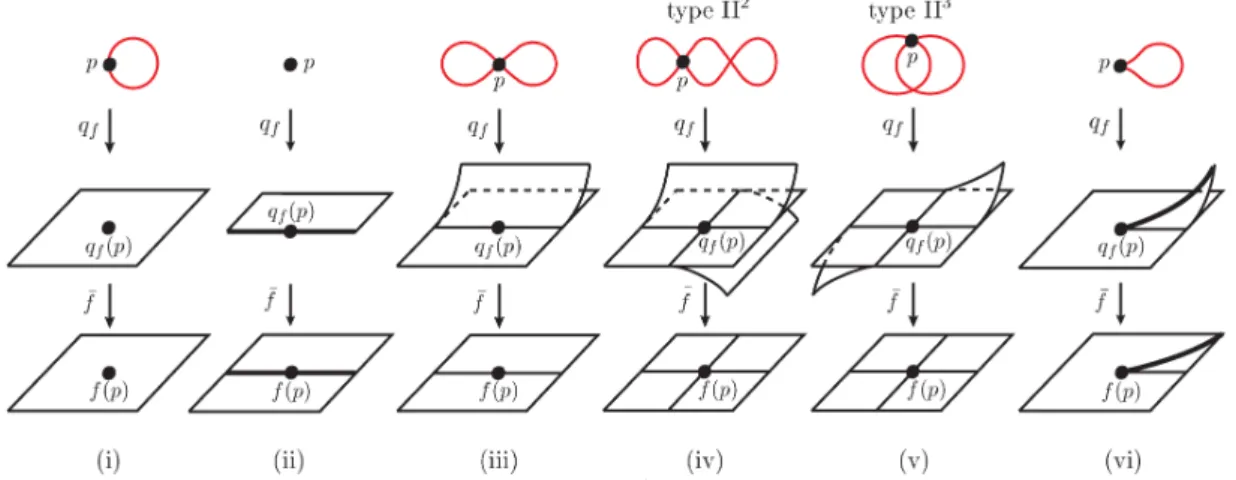
the composition $\overline{f}oq_{f}$polyhedron, that is, the underlying space ofafinite 2-dimensional simplicial complex. By Kushner-Levine-Porto [13] and Levine [16], the local models of theSteinfactorization$W_{f}$
can
be summarizedas
in Figure 3. In thecase
of Figure 3 (iv) ($(v)$, respectively), thetype$I1^{2}$
type$II^{\theta}$
(i) (ii) (\"ui) $(iv\rangle$ (v) $(vi\rangle$
FIGURE 3. Thelocalmodels of
a
stablemapandits Stein factorizationfor:(i) a regular point; (ii) a definite fold point; $(iii)-(v)$ indefinite fold points; (vi) a cusp point.
singular fiber $q_{f}^{-1}oq_{f}(p)$ is said to be of type $II^{2}$ (II3, respectively) (cf. Saeki [21]). We denote by$II^{2}(f)$ and $11^{3}(f)$ the sets of singular fibers of types $II^{2}$
and$II^{3}$
, respectively, of
$f.$
Stable maps are defined without any condition of the dimensions of both
source
and target manifolds. Theyare
especially used for obtaining topological information of the sourcemanifold fromthe typesoftheir singularities and singular fibers. Atypical exampleis the usage of critical points ofa Morse function, which is nothingelse but
a
stable map of a manifold into the real line. Here weprovide ahistory of the study of stable maps of 3-manifolds into $\mathbb{R}^{2}$:
(1) (Levine [15]) The cusp points of a stable map of a closed 3-manifold into $\mathbb{R}^{2}$
can
be eliminated by a homotopical deformation. This implies that every closed 3-manifold admits a stable map into $\mathbb{R}^{2}$without cusp points.
$(2\rangle$ (Burlet-de Rham [5]) Ifa closed 3-manifold $M$ admits a stable map into
$\mathbb{R}^{2}$
with onlydefinite foldpoints,then $M$iseither the -sphere
or
connectedsums
of$S^{2}\cross_{l}9^{1}.$(3) (Saeki [20]) A closed
3-manifold
admits a stable map with neither non-simplecrossings
nor
cusp points if and only if $M$ isa
graph manifold. Herewe
recallthat acompact orientable3-manifoldiscalled agraph
manifold
ifwecan
cut it offby embedded tori into $S^{1}$-bundles over surfaces. (This is
a
generalization of (2)above.)
(4) (Costantino-Thurston [8], Gromov [10]) For a stable map $f$ from a closed 3-manifold $M$ into$\mathbb{R}^{2}$
, the following holds:
$||M||\leq 10 (\#II2(f)+\#II^{3}(f))$
.
Here $||M||$ is the Gromov norm of M. (This is a generalization of the “only if’
Definition 2.4. Let $M$be
a
compact, orientable3-manifold with (possibly empty)bound-ary consisting of tori and La (possibly empty) link in $M$
.
Let $f$ : $Marrow \mathbb{R}^{2}$ bean
$S$-map.Wesaythat $f$ is an $S$-map
of
$(M, L)$ (orsimply $ofL$) if$S_{0}(f)\supset L$.
An $S$-map $f$ of$(M, L)$is said tobe proper if $S_{0}(f)=L$. When $M$is
a
closed 3-manifold, we call $f$ a stable mapof $(M, L)$
.
3. BRANCHED SHADOW COMPLEXITY AND STABLE MAP COMPLEXITY
The following is one of
our
main theorems.Theorem 3.1. Let $M$ be a compact, orientable
3-manifold
with (possibly empty) $boundarrow$$ary$ consisting
of
tori and $La$ (possibly empty) link in M. Thenwe
have $bsc(M, L)=$$smc(M, L)$
.
The inequality$bsc(M, L)\leq smc(M, L)$ follows essentially fromCostantino-Thurston [8,
Theorem 4.2]. In fact, the Stein factorization $W_{f}$ ofa given $S$-map of$(M, L)$ is already
“almost” a branched shadow of$(M, L)$. However, thelocal model of$W_{f}$ shownontheleft
hand side of Figure 4 is not allowed
as
a local model ofa branched shadow. This modelcorresponds to a type $II^{3}$
singular fiber of $f$ (recall Figure 3). Replacing each of these
parts of$W_{f}$ with the
one
shownon
the right hand sideofFigure 4,we
obtaina
branchedshadow of $(M, L)$.
FIGURE 4. Local replacement of$W_{f}.$
The proof of $bsc(M, L)\geq smc(M, L)$ is much more complicated. We
can
show that, givena
minimal branched shadow $P$ of $(M, L)$, onecan
actually constructan
$S$-mapso
that each vertex of $P$ corresponds to a type $II^{2}$singular fiber, and no other types $II^{2}$
or
$II^{3}$
singular fibers are created.
Remark 3.2. Let $(M, L)$ be
as
in Theorem 3.1, and let $f$ : $(M, L)arrow \mathbb{R}^{2}$ bean
S-map. If$II^{3}(f)=\emptyset$, the Stein factorization $W_{f}$ is exactly a branched shadow of $(M, L)$
.
Suppose that $II^{3}(f)\neq\emptyset$, and let $N_{1},$ $N_{2}$,
. .
.
,$N_{n}$ be closed neighborhoods of the singularfibers of type $II^{3}$.
As we have seen in Figure 3, each $N_{i}$ is a genus 3 handlebody. By the
proofof Theorem 3.1, wemay construct amap $g_{i}:N_{i}arrow \mathbb{R}^{2}$usingtheshadowed branched
polyhedron depicted in Figure 4. Exchanging$f$with$9i$ inside$N_{i}$for each$i\in\{1, 2, \cdots, n\},$
we get a new $S$-map $(M, L)arrow \mathbb{R}^{2}$ having no singular fibers of type $II^{3}.$
Theorem 3.1 and an easy combinatorial argument allow us to obtain thesubadditivity of the stable map complexities under connected sums and torus sums. Further, we have the following.
Corollary3.3. Let$M$ be acompact, orientable
3-manifold
with (possibly empty) boundary consistingof
tori and$L$ $a$ ink in M. Then we have $smc(M)\leq smc(M, L)=smc(E(L))$.
$A$ (possibly empty) link in
a
compact orientable 3-manifold is called a graph linkif its exterior is a graph manifold. The following proposition is a direct consequence ofSaeki[20], Costantino-Thurston [8, Proposition 3.31] and Theorem 3.1.
Proposition 3.4. Let$M$ be acompact, orientable
3-manifold
with(possibly empty)bound-ary consisting
of
tori and $La$ (possibly empty) link in M. Then the following conditionsare equivalent:
(1) $sc(M, L)=0$, (2) $bsc(M, L)=0$, (3) $L$ is a graph tink.
4. STABLE MAPS OF LINKS
Let $L$ be
a
link in $S^{3}$, and $D_{L}$ be its diagramon a
disk $D$.
It is easy tosee
that themapping cylinder
$P_{D_{L}}^{*}=((L\cross[0,1])uD)/(x, 0)\sim\pi(x)$
is a non-proper shadow of $(S^{3}, L)$. Fixing an orientation of$L$, we may equip
a
branching of$P_{D_{L}}^{*}$ in a natural way. Suppose that theregion $R$of$P_{D_{L}}^{*}$ touching$\partial D$ isanannulus andthe orientations of the arcs of $R\cap D_{L}$ induced by $L$
are
compatible. Then by collapsing the branched polyhedron $P_{D_{L}}^{*}$ from $\partial D$, we obtain a proper shadow $P_{D_{L}}$ of $(S^{3},$ $L\rangle$.
Bythe argument of Theorem 3.1, we
can
actually constructa
stable map of $(S^{3}, L)$ whoseStein factorization is homeomorphic to $P_{D_{L}}.$
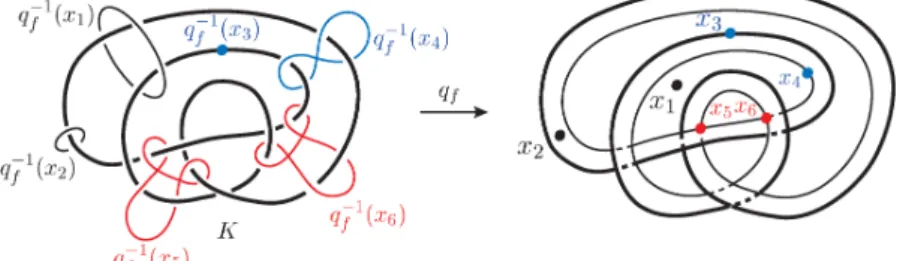
Example 4.1. The left-hand side in Figure 5 shows a diagram $D_{K}$ of the figure-eight
knot $K$
.
The right-hand side in the figure illustrates the branched polyhedron $P_{D_{K}}$con-structed from $D_{K}$
.
Then we havea
proper stable map $f$ : $(S^{3}, K)arrow \mathbb{R}^{2}$ with Steinfactorization $(S^{3}, K)arrow^{q_{f}}P_{D_{K}}arrow^{f^{\overline{}}}\mathbb{R}^{2}$
such that $|II^{2}(f)|=2,$ $1I^{3}(f)=\emptyset$ and $C(f)=\emptyset.$
The configuration of the preimages of the points $x_{1},$$x_{2}$,
.
..
,$x_{6}$ in $P_{D_{K}}$ is shown in thefigure.
FIGURE 5. Regular and singular fibers ofa stable map of the figure-eight knot. $q_{f}^{-1}(x_{1})$ and $q_{J}^{-1}(x_{2})$ are regularfibers of$f.$ $q_{f}^{-1}(x_{3})$ is a singular$fit$)$er$
of type $I^{0}.$
$q_{f}^{-1}(x_{4})$ is a singular fiber of type $1^{1}.$ $q_{f}^{-1}(x_{6})$ and $q_{f}^{-1}(x_{6})$
are
singular fibers of type $II^{2}.$
The following is a consequence ofCorollary 3.3 and the above observation.
Corollary 4.2. Let $M$ be
a
closed orientable3-manifold
obtainedfrom
$S^{3}$ by surgeryalong
a
non
trivial link$L\subset S^{3}$. Then there exists astable map $f$ : $Marrow \mathbb{R}^{2}$ without cusppoints such that $|II^{2}(f)|\leq cr(L)-2$ and$II^{3}(f)=\emptyset.$
Remark 4.3. A result similar to Corollary 4.2 is obtained in Kalmar-Stipsicz [12,
The-orem 1.2]. The numbers of singular fibers of types $II^{2}$
and $II^{3}$
, and cusp points in our Corollary 4.2 areless than theirs $(in$ particular, $C(f)=\emptyset$ in our result).
5. LINKS WITH BRANCHED SHADOW COMPLEXITY 1
Developing the technique obtained in theprevious sections,
we can
provide the complete list of hyperbolic links in $S^{3}$ with $smc(S^{3}, L)=1.$Theorem 5.1. Let $L$ be a hyperbolic link in $S^{3}$
.
Then $smc(S^{3}, L)=1$if
and onlyif
the exteriorof
$L$ is diffeomorphic to a3-manifold
obtained by Dehn filling the exteriorof
one
of
the six links$L_{1},$ $L_{2}$, ..
.,$L_{6}$ in$S^{3}$ along someof
(possiblynone
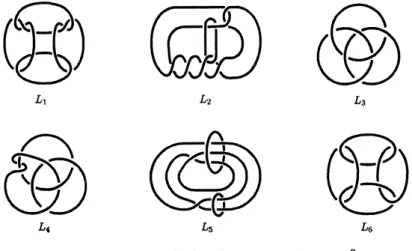
of) boundary tori, where$L_{1},$ $L_{2}$,. . .,$L_{6}$ are illustrated in Figure 6.
$L1 L_{2} L_{3}$
$L_{4} L_{S} L_{6}$
FIGURE 6. The links $L_{1},$$L_{2}$,
.
..
,$L_{6}$ in $S^{3}.$Each ofthe links $L_{1},$ $L_{2}$,
..
.,$L_{6}$ ofthis theorem isa
hyperbolic link having thevolume$2V_{oct}$, where $V_{oct}=3.66\ldots$ isthe volumeofthe ideal regular octahedron. See Costantino-Thurston [8, Proposition 3.33]. We note that by Agol-Storm-Thurston [3, Theorem 9.1], the link $L_{1}$ is a minimal volume hyperbolic link that contains a meridional
incompress-ible planar surface. See also Agol [1, Example 3.3]. In [24] Yoshida proved that the
complement of$L_{6}$ isthe minimal volume orientable hyperbolic -manifoldwith 4 cusps.
The idea of proof ofTheorem 5.1 is
as
follows. We first list up the possible shapes ofthe neighborhood of the singular sets ofthe branched polyhedra having a single vertex.
Every branched shadow $P$ of
a
hyperbolic link $L$ with $bsc(S^{3}, L)=1$ is obtained byattaching a piece of polyhedra (called a tower) shown in Figure 7. This
comes
from theassumption that the exterior of $L$ does not admit
an
essential torus. Then wecan
see
FIGURE 7. A tower.
that attaching atower to abranched shadow corresponds to Dehn filling the
the natural projection from
a
closed 3-manifold onto its shadow induces a surjectiveho-momorphism from their fundamental groups. $($Note that $a$ shadow $of (S^{3}, L)$ is also a
shadow of $S^{3}.$) The correspondence
between links in $S^{3}$ and the neighborhoods of the
singular sets of branched polyhedra having a single vertex
are
shown in Figure 8. Here,$\iota$ $\iota$
$\emptyset$
FIGURE 8. Thecorrespondencebetween links in$S^{3}$ and theneighborhoods
ofthe singular sets of branched polyhedra having asingle vertex.
there isno links COl.responding to the branched polyhedron illustratedonthe bottom left side of Figure 8, because in what way
we
attach towers to it, the polyhedron cannnot besimply-connected.
The next corollaryfollows from Theorems 3.1 and 5.1. Corollary 5.2. Let $L$ be a hyperbolic link in $S^{3}$.
Then there exists a stable map $f$ :
$(S^{3}, L)arrow \mathbb{R}^{2}$ without cusppoints such that $|II^{2}(f)|=1$ and $II^{3}\langle f$) $=\emptyset$
if
and onlyif
the exteriorof
$L$ is diffeomorphic to a3-manifold
obtained by Dehnfilling the exteriorof
oneof
the $S\dot{i}X$ tinks $L_{1},$ $L_{2},$ $\rangle L_{6}$ in Theorem 5.1 along someof
(possibly none of) boundarytori.
Example 5.3. For the figure-eight knot $K$, there exists a stable map with a unique singular fiber of type $II^{2}$
as
shown in Figure 9, and no singular fibers of type $II^{2}$.
Since the only links of the stablemapcomplexity $0$ aregraph links by Proposition 3.4, wehave $smc(\mathcal{S}^{3},$$K\rangle=1.$
6. STABLE MAPS AND HYPERBOLIC VOLUME
Throughout the section, weconsider a particular type of polyhedron, a special polyhe-dron. An almost-special polyhedron $P$ is said to be special if there is no loop without
FIGURE 9. A configuration of the singular fiber of type $II^{2}$
in the figure-eight knot complement.
vertices in $S(P)$ and each region of $P$ is
a
disk. We note that in this case, $S(P)$ iscon-nected and $P$ is closed. We call a shadow of
a
-manifold that is aspecial polyhedron aspecial shadow of$M$. Remark that every closed orientable 3-manifold admitsa branched,
special shadowby the
moves
described in Turaev [23] and Costantino [6].Let $M$ be a closed orientable 3-manifold with special shadow $P$ and $\pi$ : $Marrow P$
be the projection induced by the collapsing $W\searrow P$, where $M=\partial W$
.
Set $M_{S(P)}=$$\pi^{-1}(Nbd(S(P);P$ Costantino-Thurston [8] showed that $M_{S(P)}$ admits a complete,
fi-nite volume hyperbolic structure realized by gluing $2c(P)$ copies of a regular ideal
oc-tahedron. Thus, in particular, we have $vol(M_{S(P)})=2c(P)V_{oct}$
.
Since each region ofa
special polyhedron is a disk, $M$ is obtained from $M_{S(P)}$ by attaching solid tori, i.e., by
Dehn fillings. In particular, by the 6-Theorem of Agol [2] and Lackenby [14] and the
Geometrization Theorem ofPerelman [17, 18, 19], if all slope lengths ofthe Dehn fillings
are more
than 6 then $M$ admits acomplete finite volume hyperbolic structure. Sincethehyperbolic structure of$M_{S(P)}$ is explicitly given by the ideal octahedra, the slopelengths
of Dehn fillings can be calculated in terms of the combinatorial structure of the special polyhedron $P$ and the gleams on its regions.
Let $P$ be a shadowed, special polyhedron. For each region $R$ of $P$, set $s1(R)=$
$\sqrt{(2g)^{2}+k^{2}}$, where $g \in\frac{1}{2}\mathbb{Z}$ is the gleam on $R$ and $k$ is an integer counting how many
timesthe boundary of the closure of$R$passes through the vertices of$P$
.
Wecan
show that$s1(R)$ is nothing but the slope length ofthe Dehn filling for the corresponding boundary
toruswhenweobtain $M$fromthehyperbolic manifold $M_{S(P)}$
.
We set $s1(P)=\min_{R}s1(R)$,where $R$ varies over all regions of $P.$
Proposition 6.1. Let $M$ be a closed orientable
3-manifold.
Let$P$ be a branched, specialshadow
of
M.If
$s1(P)>2\pi$, then we have$2 smc(M)V_{oct}(1-(\frac{2\pi}{s1(P)})^{2})^{3/2} \leq 2c(P)V_{oct}(1-(\frac{2\pi}{s1(P)})^{2})^{3/2}$
$\leq vol(M)<2smc(M)V_{oct}.$
In fact, thefirst inequalityfollows essentially from Theorem 3.1 and Futer-Kalfagianni-Purcell [9, Theorem 1.1]. Here
we
recall that $s1(R)$ is nothing but the slope length of theDehn filling for the corresponding boundary torus when we obtain $M$ from the hyper-bolicmanifold $M_{S(P)}$. The second inequality is a consequence ofCostantino-Thurston [8,
Theorem 3.37] and Theorem 3.1.
From Proposition 6.1 we have the following result that concerns the coincidence of shadow complexities, branched shadow complexities and stable map complexities.
Theorem 6.2. Let $M$ be
a
closed orientable 3-manifold, and let$P$ be a branched, specialshndow
of
M.If
$s1(P)>2\pi\sqrt{2c(P)}$, then we have $sc(M)=bsc(M)=smc(M)=c(P)$ .REFERENCES
[1] Agol, I., Lowerboundsonvolumes ofhyperbolic Haken 3 manifolds, $a\mathfrak{r}Xiv:math/9906182.$
$|$2] Agol, I., Bounds onexceptional Dehn filling, Geom. Topol. 4(2000$\rangle$, 431-449.
[3] Agol, I., Storm, P. A., Thurston, W.P., Lowerbounds onvolumes of hyperbolic Haken 3-manifolds. Withanappendix by Nathan Dunfield, J. Amer. Math. Soc. 20 (2007), no. 4, 1053-1077.
[4] Benedetti, R., Ietronio, C., Branchedstandardspinesof3-7nanifolds, Lecture Notes in Mathematics 1653, Springer-Verlag, Berlin, 1997.
[5] Burlet, O., de Rham, G., Sur certainesapplications g\’en\’eriques $d^{\rangle}une$ variety close \‘a3 dimensions
dars leplan, Enseignement Math. (2) 20 $\langle$1974), 275-292.
[6] Costantino, F.,Shadows and branched shadows of3 and 4-manifolds,Edizionidella Normale, Scuola
Normale Superiore, Pisa, Italy, 2005.
[7] Costantino, F., Branched shadows and complex structures of -manifolds, J. Knot Theory
Ramifi-cations 17 (2008), no. 11, 1429-1454.
[8] Costantino, F., Thurston, D., 3 manifolds efficiently bound 4-manifolds, J. Topol. 1 (2008$\rangle$, no. 3,
703-745.
[9] Futer, D., Kalfagianni, E., Purcell, J. S., Dehn filling, $volume_{\rangle}$ andthe Jonespolynomial, J.
Differ-ential Geom. 78 (2008), no. 3, 429-464.
[10] Gromov,M.,Singularities, expandersand topology of maps. I. Homologyversusvolume inthe spaces
ofcycles, Geom. Funct. Anal. 19 (2009), no. 2, 743-841.
[1] Ishikawa, M., Koda,
y.,
Stable maps and branched shadows of 3-manifolds, arXiv:1403.0596.[12] Kalm\’ar, B., Stipsicz, A. I., Mapson 3-manifoldsgiven by surgery, Pacific J. Math. 257 (2012), no.
1,9-35.
[13] Kusbner, L., Levine, H., Porto, P., Mapping three manifoldsintothe plane. I, Bol.Soc. Mat. Mexi-cana(2) 29 (1984), rxo. 1, 11-33.
[14] Lackenby, M., Word hyperbolic Dehnsurgery, Invent. Math. 140 (2000), no.2, 243-282.
[15] Levine, H., Elimination of cusps, Topology 3 $\langle$1965), suppl. 2, 263-296.
[16] Levine, H., Classifying immersions into$\mathbb{R}^{4}$
overstable maps of 3-manifolds into$\mathbb{R}^{2}$
, Lecture Notes in Mathematics 1157, Springer-Verlag,Berlin, 1985.
[17] Perelman, G., The entropy formula for the Ricci flow and its geometric applications, arXiv:$math/021\lambda 159.$
[18] Perelman, G., $R\dot{s}cci$flowwith surgery onthree-manifolds, $arXiv:math/0303109.$
[19] Perelman, G., Finite extinction time for the solutions totheRicciflow on certainthree-manifolds,
$arXiv:math/0307245.$
[20] Saeki, O., Simplestable maps of 3-manifolds intosurfaces, Topology 35 (1996), no. 3, 671-698.
[21] Saeki, 0., Topology ofsingularfibers ofd\’ifferentiable maps, Lecture Notes in Mathematics 1854, Springer-Verlag, Berlin,2004.
[22] Turaev, V. G., Shadow links and face models of statistical mechanics, J. Differential Geom. 36 (1992), no. 1, 35-74.
[23] Turaev, V. G., Quantum invariants
of
knots and 3-manifolds, de Gruyter Studies in Mathematics1S,Walter de Gruyter& Co., Berlin, 1994.
[24] Yoshida, K., The minimal volume orientable hyperbolic 3-manifold with 4 cusps, Pacific J. Math. 266 (2013), no. 2, 457-476.
$MATHEMATICAI_{A}$ INSTITUTE
TOHOKU UNIVERSITY, SENDAI, 980-8578, JAPAN
$E$-mail address: $i$shikawaQm.tohoku.ac.jp
DEPARTMENT OF $MA^{r}$
THEMATICS
HIROSHIMA UNIVERSITY, 1-3-1 KAGAMIYAMA, HIGASHI HIROSHIMA, 739-8526, JAPAN