CO-ORIENTABLE SINGULAR FIBERS OF
STABLE
MAPS OF3-MANIFOLDS
WITHBOUNDARY
INTOSURFACES
九州大学マス・フオア・インダストリ研究所佐伯修
OsamuSAEKI
Institute of Mathematics forIndustry, Kyushu University
九州産業大学工学部山本卓宏
TakahiroYAMAMOTO
Faculty ofEngineering, Kyushu Sangyo University
ABSTRACT. In [12] the authorsclassifiedthe singular fibers of proper$C^{\infty}$ stable maps
of3-dimensional manifolds withboundaryinto surfaces, andcomputed the
cohomol-ogy groups of the associated universal complex ofsingular fibers with coefficientsin
$\mathbb{Z}_{2}$. Inthispaper, weclassifythe co-orientable singularfibersof suchstablemaps and
compute the cohomologygroupsofthe associateduniversalcomplexwith coeficients
in$\mathbb{Z}.$
1. INTRODUCTION
Let $M$ and $N$ be smooth manifolds, where $M$ may possibly have boundary, while
$N$ has no boundary. For a $C^{\infty}$ map
$f:Marrow N$ and a point $q\in N$, we call the map
germ along the pre-image $f^{-1}(q)$
$f:(M, f^{-1}(q))arrow(N, q)$
the
fiber
over $q$, adopting the terminology introduced in [6]. Furthermore, if a point$q\in N$ is a regular value of both $f$ and $f|_{\partial M}$, then we call the fiber
over
$q$ a regularfiber; otherwise, a singular
fiber.
We define natural equivalence relations among fibers as follows. Let $f_{i}:M_{i}arrow N_{i}$
be $C^{\infty}$ maps with $q_{i}\in N_{i},$ $i=0$ ,1. The fibers
over
$q_{0}$ and $q_{1}$
are
said to be$C^{\infty}$
equivalent (or $C^{0}$
equivalent) if for
some
open neighborhoods $U_{i}$ of$q_{i}$ in $N_{i}$, there existdiffeomorphisms (resp. homeomorphisms) $\Phi:f_{0}^{-1}(U_{0})arrow f_{1}^{-1}(U_{1})$ and $\varphi:U_{0}arrow U_{1}$
with $\varphi(q_{0})=q_{1}$ that make the following diagram commutative:
$(f_{0}^{-1}(U_{0}), f_{0}^{-1}(q_{0}))arrow^{\Phi}(f_{1}^{-1}(U_{1}), f_{1}^{-1}(q_{1}))$
$f_{0}\downarrow \downarrow f_{1}$
$(U_{0}, q_{0}) arrow^{\varphi} (U_{1}, q_{1})$.
Denote by $C^{\infty}(M, N)$ the set ofall $C^{\infty}$ maps $Marrow N$ equipped with the Whitney
$C^{\infty}$ topology. A $C^{\infty}$ map
$f:Marrow N$ is stable $(or$
more
precisely, $C^{\infty}$ stable) if thereexists a neighborhood $N(f)$ of $f$ in $C^{\infty}(M, N)$ such that every map $g\in N(f)$ is $C^{\infty}$
2000Mathematics Subject Classification. Primary$57R45$; Secondary$57R35,$ $57R90,$ $58K15,$ $58K65.$
right-left
equivalent to $f[3]$, where two maps $f$ and $9\in C^{\infty}(M, N)$are
$C^{\infty}$right-lefl
equivalent if there exist diffeomorphisms $\Psi:\Lambda Iarrow M$ and $\psi:Narrow N$ such that$fo\Psi=\psi og.$
The notion of singular fibers of $C^{\infty}$ maps between manifolds without boundary
was
first introduced in [6], where the singular fibers of stable maps $Marrow N$ with$(\dim M, \dim N)=(2,1)$, $(3, 2)$ and $(4, 3)$
were
classified up to the above equivalences.Later, singular fibers ofstable maps of manifolds without boundary
were
studied in[6, 7, 10, 11, 15, 16, 17], especially in connection with cobordisms. The first author
[6] established the theory of universal complex of singular fibers of $C^{\infty}$ maps
as
ananalogy ofthe Vassiliev complex for map germs [5, 14]. Its cohomology groups
can
beused for getting certain cobordism invariants of singular maps. For example, in [6], cobordism invariants for stable Morse functions
on
closedsurfaces
were
obtained, andthe authors obtained a complete cobordism invariant for closed oriented 4-dimensional
manifolds in terms of singular fibers in [10].
In
our
previous paper [12],we
studied singular fibers of proper $C^{\infty}$ stable maps of3-dimensional manifolds with boundary intosurfaceswithout boundary. By computing
the cohomology groups of the associated universal complex with coefficients in $\mathbb{Z}_{2}$,
we
obtained
a
non-trivial $\mathbb{Z}_{2}$-valued cobordism invariant for admissible stable Morsefunc-tions
on
compact surfaces with boundary. Here, a mapon
a
manifold with boundaryis said to be admissible if it is submersive near the boundary. Two admissible stable
Morsefunctionson surfaceswith boundary
are
said to be$\mathcal{A}S_{pr}$-cobordant if there existsa cobordism between them which is admissible (for details,
see
Definition 3.4). Theabove cohomology class, in fact, gives rise to
a
non-trivial $\mathcal{A}S_{pr}$-cobordism invariantfor
admissiblestable Morse
functions
on
surfaces
with boundary [12].In this paper,
we
classify the co-orientable singular fibers of proper $C^{\infty}$ stable mapsof 3-dimensional manifolds with boundary into surfaces without boundary. Then,
we
compute the cohomology groups with integer coefficients of the associated universal
complex. It will turn out that the cohomology groups
are
non-trivial, but that theas-sociated $\mathbb{Z}$-valued $\mathcal{A}S_{pr}$-cobordisminvariants are, unfortunately, trivial. This supports
the conjecture that the $\mathcal{A}S_{pr}$-cobordism groupof admissible stable Morse functions
on
compact surfaces with boundary is isomorphic to $\mathbb{Z}_{2}$ (see Conjecture 6.4).
The paper is organized as follows. In \S 2, we recall the classification of fibers of
proper $C^{\infty}$ stable maps of 3-dimensional manifolds with boundary into surfaces
with-out boundary, with respect to the $C^{\infty}$ equivalence. In
\S 3,
we
briefly recall the theoryof universal complex ofsingular fibers of
a
certain class of$C^{\infty}$ maps. In\S 4, we
formu-late thefiberswhichare
(strongly) co-orientable and construct the associated universalcomplex with integer coefficients. In
\S 5, some
specific classes of stable maps andad-missible stable maps together withcertain equivalence relations amongtheir fibers are
introduced. In \S 6,
we
compute the cohomology groups of the universal complex ofco-orientable singular fibers of proper (admissible) $C^{\infty}$ stable maps of 3-dimensional
manifolds with boundary into surfaces without boundary and discuss their associated
cobordism invariants. In
\S 7, we
consider fibers of maps of orientable manifolds andcompute the cohomology groups of the corresponding subcomplexes. Our results
sup-port the conjecture that the orientable $\mathcal{A}\mathcal{S}_{pr}$-cobordism group of admissible stable
Morse functions
on
compact orientable surfaces with boundary is isomorphic to $\mathbb{Z}_{2}$Throughout the paper, all manifolds and maps between them
are
smooth of class$C^{\infty}$ unless otherwise specified. For a map $f:Marrow N$ between manifolds,
we
denoteby $S(f)$ the set ofpoints in $M$ where the differential of $f$ does not have maximal rank
$\min\{\dim M, \dim N\}$. For
a
space $X,$ $id_{X}$ denotes the identity map of $X.$2. CLASSIFICATION OF SINGULAR FIBERS
Inthis section, werecallthe classification ofsingular fibers of proper $C^{\infty}$stable maps
of 3-dimensional manifolds with boundary into surfaces without boundary.
Let us first recall the following characterization of$C^{\infty}$ stable maps. In the following,
for a 3-manifold $M$ with boundary and
a
point $p\in\partial M$, weuse
local coordinates$(x, y, z)$ around$p$ such that Int$f|/I$ and
$\partial M$ correspond to the sets $\{z>0\}$ and $\{z=0\},$
respectively.
Proposition 2.1 (Shibata [13], Martins and Nabarro [4]). Let $lI\prime I$ be a
3-manifold
possibly with boundary and $N$ a
surface
without boundary. A proper$C^{\infty}$ map$f:Marrow$ $N$ is $C^{\infty}$ stable
if
and onlyif
itsatisfies
thefollowing conditions.(1) (Local conditions)
(1a) For $p\in$ Int$M$, the germ
of
$f$ at $p$ is right-left equivalent toone
of
thefollowing:
$\{$
$(x, y)$, $p$: regular point,
$(x, y, z)\mapsto$
$(x, y^{2}+z^{2})$, $p$:
definite fold
point,$(x, y^{2}-z^{2})$, $p$:
indefinite fold
point,$(x, y^{3}+xy-z^{2})$, $p$:cusp point.
(1b) For$p\in\partial M\backslash S(f)$, the germ
of
$f$ at$p$ is right-left equivalent to oneof
thefollowing:
$\{$
$(x, y)$, $p$: regular point
of
$f|_{\partial M},$$(x, y, z)\mapsto$
$(x, y^{2}+z)$, $p$: boundary
definite fold
point,$(x, y^{2}-z)$, $p$: boundary
indefinite
fold
point,$(x, y^{3}+xy+z)$, $p$: boundary cusp point.
(1c) For$p\in\partial lII\cap S(f)$, the germ
of
$f$ at $p$ is right-left equivalent to the mapgerm
$(x, y, z)\mapsto(x, y^{2}+xz\pm z^{2})$.
(2) (Global conditions) For each $q\in f(S(f))\cup f(S(f|_{\partial M}))$, the multi-germ
$(f|_{S(f)\cup S(f|_{\partial\Lambda I})}, f^{-1}(q)\cap(S(f)\cup S(f|_{\partial11I})))$
is right-left equivalent to one
of
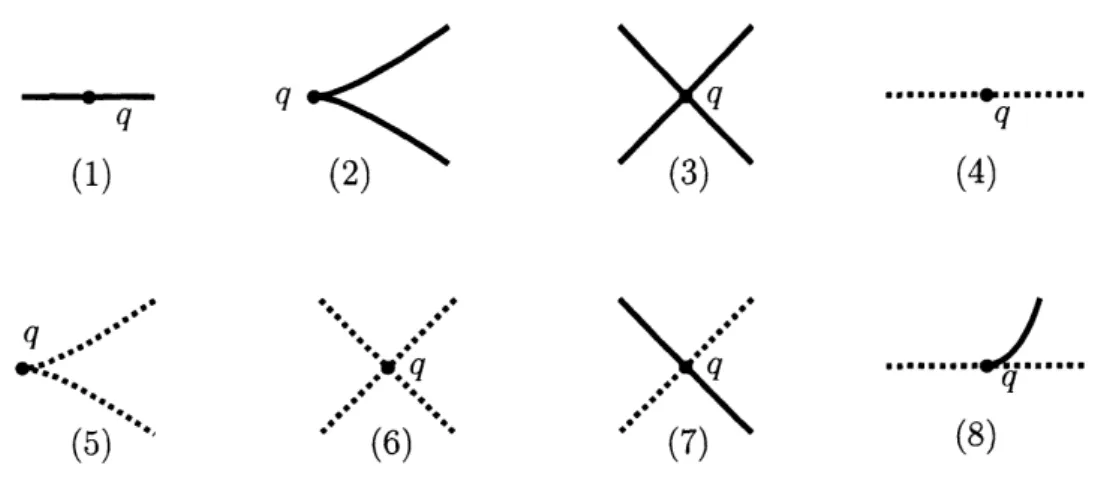
the eight multi-germs as depicted in Figure 1,where the ordinary curves correspond to the singular value set $f(S(f))$ and
the dotted curves to $f(S(f|_{\partial M}))$: (1) corresponds to a single
fold
point, (4)corresponds to a single boundary
fold
point, (3), (6) and (7) represent normalcrossings
of
two immersion germs, eachof
which corresponds to afold
pointor a boundary
fold
point, (2) corresponds to a cusp point, (5) corresponds to a$\overline{q}$
(1) (4)
(5).
(6) (8)FIGURE 1. Multi-germs of$f|_{S(f)\cup S(f|_{\partial M})}$
Note that if
a
$C^{\infty}$ map$f:Marrow N$ is $C^{\infty}$ stable, then
so
is $f|_{\partial M}$ : $\partial Marrow N.$In the following, a map germ at a point
on
the boundary right-left equivalent to thenormal form
$(x, y, z)\mapsto(x, y^{2}+xz+z^{2})$ $or$ $(x, y, z)\mapsto(x, y^{2}+xz-z^{2})$
is called a
definite
$\Sigma_{1,0}^{2,0}$ point oran
indefinite
$\Sigma_{1,0}^{2,0}$ point, respectively.Definition 2.2. Let
us
consider finitely many fibers of smooth maps with all thedimensions of the
sources
and the targets being the same. Then, their disjoint union isthe fiber corresponding to the single map defined on the disjoint union of the sources,
where the target spaces
are
all identified toa
single small open disk. This dependson
such identifications; however, in the following,
we can
take “generic identifications”’ insuch a way that the resulting map is $C^{\infty}$ stable and is unique up to $C^{\infty}$ equivalence,
as
longas
the identificationsare
generic.By using the method developed in [6], the authors [12] have obtained the following
classification of singular fibers.
Theorem 2.3. Let $f:Marrow N$ be
a
proper $C^{\infty}$ stable mapof
a3-manifold
$M$ withboundary into a
surface
$N$ without boundary. Then, everyfiber of
$f$ is equivalent tothe disjoint union
of
one
of
thefibers
in the following list, afinite
numberof
copiesof
a
fiber
of
the trivial circle bundle, and afinite
numberof
copiesof
afiber of
the trivial$I$-bundle, where $I=[-1, 1]$:
(1)
fibers
as depicted in Figure 2, $i.e.\overline{b0}^{0},$ $\overline{b0}^{1}$, and $\tilde{bI}^{\mu}$
with $2\leq\mu\leq 10,$
(2) disconnected
fibers
$\overline{bII}^{\mu,v}$with $2\leq\mu\leq\nu\leq 10$, where $\overline{bII}^{\mu,\nu}$
means
the disjoint unionof
$\tilde{b}I^{\mu}$and$\tilde{b}I^{\nu},$
(3) the connected
fibers
$a\mathcal{S}$ depicted in Figure 3, i.e.$\overline{bII}^{\mu}$
with $11\leq\mu\leq 39,$ $\overline{bII}^{a},$
$\overline{bII}^{b},$ $\overline{bII}^{c},$ $\overline{bII}^{d},$ $\tilde{bII}^{e}$
and $\overline{bII}^{f}$
In Figures 2 and 3, $\kappa$ denotes the codimension of the set of points in the target $N$
whose corresponding fibers are $C^{\infty}$ equivalent to the relevant one (see [6] for details).
Furthermore, the symbols $\overline{b0}^{*},$ $\tilde{bI}^{*}$
, and $\overline{bII}^{*}$
mean
thenames
of the corresponding$\kappa=0$
$\overline{b0}^{0}$
$O$
$\overline{b0}^{1}$$||[$
$\kappa=1$
$\tilde{b}I^{2}$ $\bullet$ $臼^{}3 \int \tilde{b}I^{4} \tilde{b}I^{5} \iota 1-\iota-\iota 1_{1\underline{1} ,x_{1}^{1}}^{--}-$
$\tilde{bI}^{6}$ $\blacksquare$ $\tilde{bI}^{7}$ $\Theta$ $\overline{bI}^{8}$ $\iota\#_{I}^{\iota^{1}}1^{-}\underline{},$ $\tilde{b}I^{9}$
$\tilde{bI}^{10}$
FIGURE 2. List of the fibers of proper $C^{\infty}$ stable maps of 3-manifolds
with boundary into surfaces without boundary; 1
has its own number or letter, and a “disconnected fiber”’ has the name consisting of
the numbers of its “connected components”, with the regular fiber components being
ignored. Note also that each figure represents a map germ along the corresponding
fiber and not just the inverse image ofa point.
Remark 2.4. Our classification result of singular fibers of stable maps of compact
3-dimensional manifolds with boundary into surfaces has already been applied in
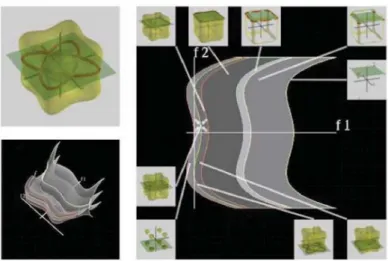
com-puter scienceforvisual data analysis. More precisely, it helps to visualize characteristic
features of certain multi-field data (see Figure 4). For details,
see
[8, 9].Remark 2.5. The list of the $C^{\infty}$
equivalence classes of singular fibers of proper stable
Morse functions on surfaces with boundary can be obtained in a similar fashion. The
result corresponds to those appearing in Figure 2 with $\kappa=0$, 1. In fact, it is not
difficult to show that the suspensions of the fibers of such functions in the sense of
Definition 3.1 coincide with those appearing in the figure. However, in the following,
by abuse of notation, we use the symbols in Figure 2 with $\kappa=0$, 1 for the fibers of
stable Morse functions as well.
3. UNIVERSAL COMPLEX
In this section
we
briefly recall the theoryof universal complex of singular fibers. As$\kappa=2$
$\overline{bII}^{11}$ $\overline{bII}^{12}$ $\overline{bII}^{13}$ $\tilde{bII}^{14}$
$\overline{bII}^{15}$ $\overline{bII}^{16}$ $\overline{bII}^{17}$
$/1,\iota|^{--}--K_{1}^{-}-\iota-$
$\overline{bII}^{18}$
$\backslash -/^{-}--\mathfrak{Q}_{1_{\underline{|}}}^{1}-$
$\overline{bII}^{19}$ $\overline{bII}^{20}$
$\otimes$ $\overline{bII}^{21}$ $\ovalbox{\tt\small REJECT}$
$\overline{bII}^{22}$
$\overline{bII}^{23}$ $\overline{bII}^{24}$ $\overline{bII}^{25}$
$\prime_{\mathfrak{l}X}^{-}\sim.-1^{-},-1^{-}$
$\overline{bII}^{26}$
$bII$ $bII$ $bII$
$\sim 27$ $\sim 28$ $\overline{bII}^{29}$ $\sim 30$ $\overline{bII}_{-}^{31,^{-\Theta_{-}^{-}\prime}},$ $\overline{bII}^{32}$ $\overline{bII}^{33}$ $\int$ $\overline{bII}^{35}$ $\overline{bII}^{38}$ $\infty$
$\overline{bII}^{39}$ $\overline{bII}^{a}$ $\overline{bII}^{b}$ $\prec$ $\overline{bII}^{c}$ $c\frac{1}{}-\underline{(}$
$\overline{bII}^{d}$
FIGURE 3. List of the fibers of proper $C^{\infty}$ stable maps of 3-manifolds
FIGURE 4. User interface for visualizing singular fibers
Throughout this section, $b$ is an $m$-dimensional manifold which is not necessarily
closed, and $N$ is
an
$n$-dimensional manifold without boundary. The codimension ofa smooth map $f:Marrow N$ is defined to be the difference $\dim N-\dim M\in \mathbb{Z}$
.
Toconstruct the universal complex of singular fibers of $C^{\infty}$ maps,
we
fixan
integer $\ell\in \mathbb{Z}$for the codimension of the maps, and consider the following:
(1) a set $\tau$ offibers ofproper Thom
mapsl
of codimension$\ell$, and
(2) an equivalence relation $\rho$ among the fibers in $\tau.$
We further assume that the set $\tau$ and the relation
$\rho$ satisfy the following conditions.
(a) The set $\tau$ is closed under adjacency relation, i.e. if a fiber is in $\tau$, then so are
all nearby fibers.
(b) Each $\rho$-class is a union of $C^{0}$
equivalence classes.
(c) Let $f_{i}:1II_{i}arrow N_{i}$ be proper Thom maps and $q_{i}\in N_{i},$ $i=0$, 1. Suppose that
the fibers
over
$q_{0}$ and $q_{1}$are
in $\tau$ and that theyare
equivalent with respectto $\rho$
.
Then, there exist open neighborhoods$U_{i}$ of
$q_{i}$ in $N_{i},$ $i=0$ , 1, and a
homeomorphism $\varphi:U_{0}arrow U_{1}$ satisfying $\varphi(q_{0})=q_{1}$ and $\varphi(U_{0}\cap \mathcal{F}(f_{0}))=U_{1}\cap$
$\mathcal{F}(f_{1})$, for each pclass $\mathcal{F}.$
In particular, the above conditions imply that for each proper Thom map $f:Marrow N$
and each $\rho$-class
$\mathcal{F},$ $\mathcal{F}(f)$ is a $C^{0}$ submanifold of constant codimension unless it is not
empty, where
$\mathcal{F}(f)=$
{
$q\in N|$the fiber over $q$ belongs to the class$\mathcal{F}$
}.
The codimension of$\mathcal{F}$ is defined to be that of$\mathcal{F}(f)$ in $N$, and is denoted by $\kappa(\mathcal{F})$.
We call a proper Thom map $f:Marrow N$ a$\tau$-map if all of its fibers are in $\tau.$
For each $\kappa\in \mathbb{Z}$, let $C^{\kappa}(\tau, \rho)$ be the formal $\mathbb{Z}_{2}$-vector space spanned by the
$\rho$-classes
of codimension $\kappa$ in $\tau$. If there are no such fibers, then we set $C^{\kappa}(\tau, \rho)=0.$
$1A$ Thom map is a $C^{\infty}$ stratified map with respect to Whitney regular stratifications such that it
is a submersionon each stratum and satisfies certain regularity conditions. See, for example, [2] for
We
can
naturally definea
$\mathbb{Z}_{2}$-linear map $\delta_{\kappa}:C^{\kappa}(\tau, \rho)arrow C^{\kappa+1}(\tau, \rho)$ by usingadja-cencies to obtain the cochain complex
$C(\tau, \rho)=(C^{\kappa}(\tau, \rho), \delta_{\kappa})_{\kappa},$
which is called the universal complex
of
singularfibers
for
$\tau$-maps with respect to theequivalence relation $\rho$, and denote its cohomology group of dimension
$\kappa$ by $H^{\kappa}(\tau, \rho)$.
In order to formulate
cobordisms
and their invariants associated with cohomology classes ofthe universal complexwe
need the following notion of suspension ofa
Thom map.Definition 3.1. For
a
proper Thom map $f:Marrow N$, letus
consider the product map$f\cross id_{\mathbb{R}}:M\cross \mathbb{R}arrow N\cross \mathbb{R}.$
We call $f\cross id_{\mathbb{R}}$ and the fiber of $f\cross id_{\mathbb{R}}$
over
a point $(q, 0)\in N\cross \mathbb{R}$ the suspension of$f$ and the suspension ofthe fiber of$f$
over
$q\in N$, respectively.Let $\tau$ be a set of fibers for proper Thom maps of codimension $\ell$
as
above. Fora dimension pair $(m, n)$ with $n-m=\ell$, let $\tau(m, n)$ denote the set of fibers in $\tau$
for proper Thom maps of manifolds of dimension $m$ into those of dimension $n$. The
equivalence relation
on
$\tau(m, n)$ induced by $\rho$ is denoted by $\rho_{m,n}.$In addition to conditions $(a)-(c)$ above, we
assume
the following two additionalconditions.
(d) The suspension of each fiber in $\tau(m, n)$ belongs also to $\tau(m+1, n+1)$
.
(c) If two fibers in $\tau(m, n)$ are equivalent with respect to $\rho_{m,n}$, then their
suspen-sions
are
also equivalent with respect to $\rho_{m+1,n+1}.$For each $\kappa\in \mathbb{Z}$, the suspension induces the $\mathbb{Z}_{2}$-linear map
$s_{\kappa}:C^{\kappa}(\tau(m+1, n+1), \rho_{m+1,n+1})arrow C^{\kappa}(\tau(m, n), \rho_{m,n})$,
where for a $\rho_{m+1,n+1}$-class $\mathcal{F},$ $s_{\kappa}(\mathcal{F})$ is the
sum
of all$\rho_{m,n}$-classes of codimension $\kappa$
whose suspensions
are
in $\mathcal{F}$. Note that$s_{\kappa}$ is well-defined. We
can
show that thesystem of $\mathbb{Z}_{2}$-linear maps $\{s_{\kappa}\}$ defines
a
cochain map$\{s_{\kappa}\}:C(\tau(m+1, n+1), \rho_{m+1,n+1})arrow C(\tau(m, n), \rho_{m,n})$.
Definition 3.2. Let
$c= \sum_{\kappa(\mathcal{F})=\kappa}n_{\mathcal{F}}\mathcal{F}$
be a $\kappa$-dimensional cochain of $C(\tau, \rho)$ with $n_{\mathcal{F}}\in \mathbb{Z}_{2}$. For a $\tau$-map $f:Marrow N,$ $c(f)$
denotes the set ofpoints $q\in N$ such that the fiber
over
$q$ is in$\mathcal{F}$ with $n_{\mathcal{F}}\neq 0$
.
If $c$ isacocycle, then
we
can show that $c(f)$ isa
$\mathbb{Z}_{2}$-cycle ofclosed support of codimension $\kappa$in $N.$
It is known that if two cocycles $c$ and $c’$ are are cohomologous, then the $\mathbb{Z}_{2}$-cycles
$c(f)$ and $d(f)$
are
$\mathbb{Z}_{2}$-homologous in $N$ for each $\tau$-map $f:Marrow N.$Definition 3.3. Let $[c]$ be a $\kappa$-dimensional cohomology class of $C(\tau, \rho)$ represented
by a cochain $c$
.
For a $\tau$-map $f:\lrcorner tlarrow N$, define $[c(f)]\in H_{n-\kappa}^{c}(N;\mathbb{Z}_{2})$ to be the $\mathbb{Z}_{2^{-}}$homology class represented by the$\mathbb{Z}_{2}$-cycle $c(f)$ of closed support. This is well-defined
Furthermore, define the $\mathbb{Z}_{2}$-linear map $\varphi_{f}:H^{\kappa}(\tau, \rho)arrow H^{\kappa}(N;\mathbb{Z}_{2})$ by $\varphi f([c])=$
$[c(f)]^{*}$, where $[c(f)]^{*}\in H^{\kappa}(N;\mathbb{Z}_{2})$ is the Poincar\’e dual of $[c(f)]\in H_{n-\kappa}^{c}(N;\mathbb{Z}_{2})$.
Let
us
introduce a geometric equivalence relation for $\tau$-maps.Definition 3.4. Two $\tau$-maps $f_{i}:M_{i}arrow N,$ $i=0$, 1, of compact manifoldswith
bound-ary into amanifold without boundary
are
$\tau$-cobordant if there exista
compactmanifold$X$ with corners and a $\tau$-map $F:Xarrow N\cross[O$, 1$]$ that satisfy the following conditions: (1) $\partial X=M_{0}\cup Q\cup M_{1}$, where $M_{0}$, ]$|_{i}l_{1}$ and $Q$ are codimension $0$ smooth
submani-folds of $\partial X,$ $M_{0}\cap M_{1}=\emptyset$, and $\partial Q=(M_{0}\cap Q)\cup(M_{1}\cap Q)$,
(2) $X$ has corners along $\partial Q,$
(3) $F|_{M_{0}\cross[0,\epsilon)}=f_{0}\cross id_{[0,\epsilon)}$ and $F|_{M_{1}\cross(1-\epsilon,1]}=f_{1}\cross id_{(1-\epsilon,1]}$, where $M_{0}\cross[0, \hat{c}$) and
$M_{1}\cross(1-\epsilon, 1]$ denote $the$ collar neighborhoods $($with corners) of $M_{0}$ and $M_{1}$
in $X$, respectively.
In this case, we call the map $F$ a$\tau$-cobordism between $f_{0}$ and $f_{1}.$
Notethat the $\tau$-cobordism relation is
an
equivalence relation among the $\tau$-mapsintoa fixed manifold $N$. For
a
manifold $N$, we denote by $Cob_{\tau}(N)$ the set of all equivalenceclasses of$\tau$-maps of compact manifolds into $N$ with respect to the $\tau$-cobordism.
It is known that, for each cohomology class $[c]\in H^{\kappa}(\tau(m+1, n+1), \rho_{m+1,n+1})$ and
an
$n$-dimensional manifold $N$ without boundary,we
obtain the map$I_{[c]}:Cob_{\tau}(N)arrow H^{\kappa}(N;\mathbb{Z}_{2})$
defined by $I_{[c]}(f)=\varphi_{f}([s_{\kappa*}c])$, which does not depend on the choice of a
represen-tative $f$ of a given $\tau$-cobordism class, where $s_{\kappa*}:H^{\kappa}(\tau(m+1, n+1), \rho_{m+1,n+1})arrow$
$H^{\kappa}(\tau(m, n), \rho_{m,n})$ is the homomorphism induced by the suspension. In other words,
each element in
$H^{\kappa}(\tau(m+1, n+1), \rho_{m+1,n+1})$
induces a $\tau$-cobordism invariant for $\tau$-maps intoan $n$-dimensional manifold $N$ through
suspenslon.
4. Co ORIENTABLE FIBERS
In this section, we consider fibers that are (strongly) co-orientable in the sense of [6,
Definition 10.5]. In the following, $\tau$ is a certain set of fibers and
$\rho$ is an equivalence
relation for fibers in $\tau$
as
in the previous section.Definition 4.1. A $\rhorightarrow$-equivalence class
$\tilde{\mathcal{F}}$
of fibers of $\tau$-maps is strongly $co$-orientable
if for a $\tau$-map $Marrow N$ and
a
point $q\in N$ whose fiber belongs to$\tilde{\mathcal{F}}$
, every local
homeomorphism around $q\in N$ preserving the adjacent equivalence classes necessarily
preserves the orientation of the normal direction to the submanifold corresponding to
$\tilde{\mathcal{F}}$
. For
a
$\rho\mapsto$-class of co-orientable fibers, it is $co$-oriented if the orientation of the abovenormal direction is given.
For each$\kappa\in \mathbb{Z}$
, let $CO^{\kappa}(\tau, \rho)$ be theformalfree$\mathbb{Z}$-modulespanned bythe
$\rho\mapsto$-classes of
co-orientedfibers of codimension $\kappa$in$\tau$. Here, a
$\rho$-classwiththe reversed co-orientation
is identified with the $(-1)$-times the original class. If there
are
no such fibers, then weWe
can
naturally definea
$\mathbb{Z}$-module homomorphism $\delta_{\kappa}:CO^{\kappa}(\tau, \rho)arrow CO^{\kappa+1}(\tau, \rho)$by using adjacencies and co-orientations to obtain the cochain complex
$C\mathcal{O}(\tau, \rho)=(CO^{\kappa}(\tau, \rho), \delta_{\kappa})_{\kappa},$
which is called the universal complex
of
$co$-orientablefibers for
$\tau$-maps with respectto the equivalence relation $\rho$, and
we
denote its cohomology group of dimension$\kappa$ by
$H^{\kappa}(C\mathcal{O}(\tau, \rho);\mathbb{Z})$.
As in the previous section, for each $\kappa\in \mathbb{Z}$, the suspension induces the $\mathbb{Z}$-module
homomorphism
$s_{\kappa}:CO^{\kappa}(\tau(m+1, n+1), \rho_{m+1,n+1})arrow CO^{\kappa}(\tau(m,n), \rho_{m,n})$.
We can also show that the system ofhomomorphisms $\{s_{\kappa}\}$ defines a cochain map
$\{s_{\kappa}\}:C\mathcal{O}(\tau(m+1, n+1), \rho_{m+1,n+1})arrow C\mathcal{O}(\tau(m, n), \rho_{m_{\rangle}n})$.
5. UNIVERSAL COMPLEX FOR STABLE MAPS OF $n$-DIMENSIONAL MANIFOLDS WITH BOUNDARY INTO $(n-1)$ -DIMENSIONAL MANIFOLDS
In order to discuss
more
specific cases, fora
positive integer $n$, let $bS_{pr}(n, n-1)$be the set of fibers for proper $C^{0}$ stable Thom maps of
$n$-dimensional manifolds with
boundary into $(n-1)$-dimensional manifolds without boundary. We put
$bS_{pr}= \bigcup_{n=1}^{\infty}bS_{pr}(n, n-1)$.
Remark 5.1. Ifthe dimension pair $(n, n-1)$ is in the nice range, then $C^{0}$ stable maps
are $C^{\infty}$ stable (for example,
see
[1]), and consequently they are Thom maps. Forexample, this is the
case
if$n\leq 8.$Furthermore, let $\rho_{n,n-1}(2)$ be the $C^{0}$ equivalence relation modulo two regular
fibers
forfibersin$bS_{pr}(n, n-1)$: i.e., twofibersin$bS_{pr}(n, n-1)$
are
$\rho_{n,n-1}(2)$-equivalent iftheybecome$C^{0}$equivalent after weadd
some
regularfibersto eachofthem with the numbersof added components having the same parity. Note that, under this equivalence, for
$n=2$ ,3, we do not distinguish the fibers of types $\overline{b0}^{0}$
with $\overline{b0}^{1}$
Therefore, in the
following, we denote both ofthem by $\overline{b0}.$
We denote by $\rho(2)$ the equivalence relation on $bS_{pr}$ which is induced by $p_{n,n-1}(2)$,
$n\geq 1$. Note that the set $bS_{pr}$ and the equivalence relation $\rho(2)$ satisfy conditions
$(a)-(e)$ described above.
For a $C^{0}$ equivalence class $\tilde{\mathcal{F}}$
ofsingular fibers, denote by $\tilde{\mathcal{F}}_{o}$
(or $\tilde{\mathcal{F}}_{e}$
) the equivalence
class with respect to $\rho_{n,n-1}(2)$ which consists of singular fibers oftype
$\tilde{\mathcal{F}}$
with
an
oddnumber $\underline{(re}sp$.
even
number) of regular fiber components. For $n=2$,3, we denote by$\overline{b0}_{o}$
and $b0_{e}$ the equivalence class with respect to $\rho_{n,n-1}(2)$ which consist exclusivelyof
an odd (resp. even) number of regular fiber components.
We will also consider a certain restricted class of stable maps. For a positive integer
$n$, let $\mathcal{A}S_{pr}(n, n-1)$ be the set of fibers for proper admissible $C^{0}$ stable Thom maps
of $n$-dimensional manifolds with boundary into $(n-1)$-dimensional manifolds without
boundary, where
a
$C^{0}$ stable map$f:Marrow N$ of
a
manifold with boundary intoof $\partial M$
.
In particular,a
stable map$f:Marrow N$ of
a 3-dimensional
manifold withboundaryinto a surface withoutboundary is admissible ifand onlyifit has
no
definite$\Sigma_{1,0}^{2,0}$ points nor indefinite $\Sigma_{1,0}^{2,0}$ points.
Note that stable Morse functions on compact surfaces and their suspensions are
always admissible.
Furthermore, set
$\mathcal{A}S_{pr}=\bigcup_{n=1}^{\infty}\mathcal{A}S_{pr}(n, n-1)$.
Note that the above set together with the equivalence relation induced by $\rho(2)$, which
we
still denote by$\rho(2)$ by abuse ofnotation, satisfy conditions $(a)-(e)$ mentionedbefore.6. UNIVERSAL COMPLEX OF CO-ORIENTABLE SINGULAR FIBERS OF STABLE MAPS
By analyzing the adjacencies offibers, we easily get the following.
Lemma 6.1. Those equivalence classes with respect to $\rho_{3,2}(2)$ which are strongly
co-orientable$re\overline{b0}_{*}-4,6-4,8\tilde{b}I_{*}^{2},\tilde{b}I_{*}^{3},\tilde{bI}_{*}^{4}-6,8-13’\sim 22\tilde{b}I_{*}^{6},\tilde{bI}_{*}^{8},\overline{bII}_{*}^{2,3\prime}\overline{bII}_{*}^{2,4}-23-24a$a
’ $\overline{bII_{*}^{2,6}-}b$ ’ $\overline{bII}_{*}^{2,8},$ $\overline{bII}_{*}^{3,4},$ $\overline{bII}_{*}^{3,6}-f$ ’
$bII_{*}$ , $bII_{*}$ , $bII_{*}$ , $bII_{*}$ , $bII_{*},$ $bII_{*},$ $bII_{*},$ $bII_{*},$ $bII_{*},$ $bII_{*},$ $\overline{bII}_{*}^{c},$ $\overline{bII}_{*}^{d},$
$\tilde{bII}_{*}^{e},$
$bII_{*},$
$where*denote\mathcal{S}O$
or
$e$. The other equivalence classes are not strongly $co$-orientable.Letusfixa co-orientation for eachco-orientable equivalence classofcodimension
one
in such a way that the co-orientation points from $b0_{e}$ to $\overline{b0}_{o}$
. For each co-orientable
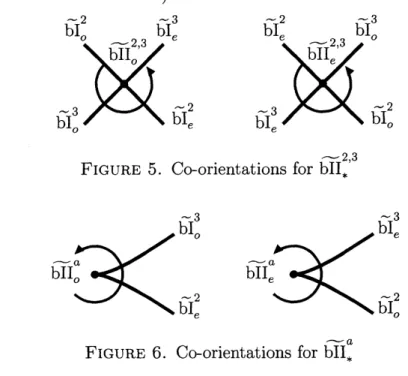
equivalence class of codimension two, we fix a co-orientation
as
in Figures 5, 6 and7. (For those equivalence classes which do not appear in the figures, we fix their
co-orientations in
a
similar fashion.)FIGURE 5. Co-orientations for $\overline{bII}_{*}^{2_{)}3}$
FIGURE 6. Co-orientations for $\overline{bII}_{*}^{a}$
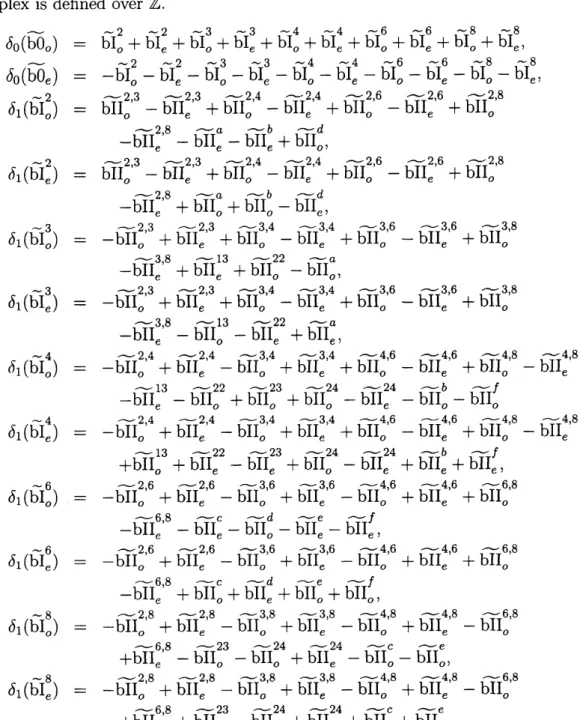
Then, for the universal complex $C\mathcal{O}(bS_{pr}(3,2), \rho_{3,2}(2))$ of co-orientable fibers, the
FIGURE 7. Co-orientations for $\overline{bII}_{*}^{d}$
complex is defined over $\mathbb{Z}.$
$\delta_{0}(\overline{b0}_{o})$ $=$ $\tilde{b}I_{o}^{2}+\tilde{bI}_{e}^{2}+\tilde{b}I_{o}^{3}+\tilde{b}I_{e}^{3}+\tilde{b}I_{o}^{4}+\tilde{b}I_{e}^{4}+\tilde{bI}_{o}^{6}+\tilde{bI}_{e}^{6}+\tilde{b}I_{o}^{8}+\tilde{b}I_{e}^{8},$ $\delta_{0}(\overline{b0}_{e})$ $=$ $-\tilde{bI}_{o}^{2}-\tilde{bI}_{e}^{2}-\tilde{b}I_{o}^{3}-\tilde{bI}_{e}^{3}-\tilde{b}I_{o}^{4}-\tilde{b}I_{e}^{4}-\tilde{b}I_{o}^{6}-\tilde{b}I_{e}^{6}-\tilde{b}I_{o}^{8}-\tilde{b}I_{e}^{8},$ $\delta_{1}(\tilde{b}I_{o}^{2})$ $=$ $\overline{bII}_{o}^{2,3}-\overline{bII}_{e}^{2,3}+\overline{bII}_{o}^{2,4}-\overline{bII}_{e}^{2,4}+\overline{bII}_{o}^{2,6}-\tilde{bII}_{e}^{2,6}+\tilde{bII}_{o}^{2,8}$ $-\overline{bII}_{e}^{2,8}-\overline{bII}_{e}^{a}-\overline{bII}_{e}^{b}+\overline{bII}_{o}^{d},$ $\delta_{1}(\tilde{b}I_{e}^{2})$ $=$ $\overline{bII}_{o}^{2,3}-\overline{bII}_{e}^{2,3}+\overline{bII}_{o}^{2,4}-\overline{bII}_{e}^{2,4}+\overline{bII}_{o}^{2,6}-\overline{bII}_{e}^{2,6}+\overline{bII}_{o}^{2,8}$ $-\overline{bII}_{e}^{2,8}+\overline{bII}_{o}^{a}+\overline{bII}_{o}^{b}-\overline{bII}_{e}^{d},$ $\delta_{1}(\tilde{b}I_{o}^{3})$ $=$ $-\overline{bII}_{o}^{2,3}+\overline{bII}_{e}^{2,3}+\overline{bII}_{o}^{3,4}-\overline{bII}_{e}^{3,4}+\overline{bII}_{o}^{3,6}-\overline{bII}_{e}^{3,6}+\overline{bII}_{o}^{3,8}$ $-\overline{bII}_{e}^{3,8}+\overline{bII}_{e}^{13}+\overline{bII}_{o}^{22}-\overline{bII}_{o}^{a},$ $\delta_{1}(\tilde{bI}_{e}^{3})$ $=$ $-\overline{bII}_{o}^{2,3}+\overline{bII}_{e}^{2,3}+\overline{bII}_{o}^{3,4}-\overline{bII}_{e}^{3,4}+\overline{bII}_{o}^{3,6}-\overline{bII}_{e}^{3,6}+\overline{bII}_{o}^{3,8}$ $-\overline{bII}_{e}^{3,8}-\overline{bII}_{o}^{13}-\overline{bII}_{e}^{22}+\overline{bII}_{e}^{a},$ $\delta_{1}(\tilde{bI}_{o}^{4})$ $=$ $-\overline{bII}_{o}^{2,4}+\overline{bII}_{e}^{2,4}-\overline{bII}_{o}^{3,4}+\overline{bII}_{e}^{3,4}+\overline{bII}_{o}^{4,6}-\overline{bII}_{e}^{4,6}+\tilde{bII}_{o}^{4,8}-\overline{bII}_{e}^{4,8}$ $-\overline{bII}_{e}^{13}-\overline{bII}_{o}^{22}+\overline{bII}_{o}^{23}+\overline{bII}_{o}^{24}-\overline{bII}_{e}^{24}-\overline{bII}_{o}^{b}-\overline{bII}_{o}^{f}$ $\delta_{1}(\tilde{b}I_{e}^{4})$ $=$ $-\overline{bII}_{o}^{2,4}+\overline{bII}_{e}^{2,4}-\overline{bII}_{o}^{3,4}+\overline{bII}_{e}^{3,4}+\overline{bII}_{o}^{4,6}-\overline{bII}_{e}^{4,6}+\overline{bII}_{o}^{4,8}-\overline{bII}_{e}^{4,8}$ $+\overline{bII}_{o}^{13}+\overline{bII}_{e}^{22}-\overline{bII}_{e}^{23}+\overline{bII}_{o}^{24}-\tilde{bII}_{e}^{24}+\overline{bII}_{e}^{b}+\tilde{bII}_{e}^{f},$ $\delta_{1}(\tilde{b}I_{o}^{6})$ $=$ $-\overline{bII}_{o}^{2,6}+\overline{bII}_{e}^{2,6}-\overline{bII}_{o}^{3,6}+\overline{bII}_{e}^{3_{)}6}-\overline{bII}_{o}^{4,6}+\overline{bII}_{e}^{4,6}+\overline{bII}_{o}^{6,8}$ $-\overline{bII}_{e}^{6,8}-\overline{bII}_{e}^{c}-\overline{bII}_{o}^{d}-\tilde{bII}_{e}^{e}-\overline{bII}_{e}^{f},$ $\delta_{1}(\tilde{b}I_{e}^{6})$ $=$ $-\overline{bII}_{o}^{2,6}+\overline{bII}_{e}^{2_{\}}6}-\overline{bII}_{o}^{3,6}+\overline{bII}_{e}^{3,6}-\overline{bII}_{o}^{4,6}+\overline{bII}_{e}^{4,6}+\overline{bII}_{o}^{6,8}$ $-\overline{bII}_{e}^{6,8}+\overline{bII}_{o}^{c}+\overline{bII}_{e}^{d}+\overline{bII}_{o}^{e}+\overline{bII}_{o}^{f},$ $\delta_{1}(\tilde{b}I_{o}^{8})$ $=$ $-\overline{bII}_{o}^{2,8}+\overline{bII}_{e}^{2,8}-\overline{bII}_{o}^{3,8}+\overline{bII}_{e}^{3,8}-\overline{bII}_{o}^{4,8}+\overline{bII}_{e}^{4,8}-\overline{bII}_{o}^{6,8}$ $+\overline{bII}_{e}^{6,8}-\overline{bII}_{o}^{23}-\overline{bII}_{o}^{24}+\overline{bII}_{e}^{24}-\overline{bII}_{o}^{c}-\overline{bII}_{o}^{e},$ $\delta_{1}(\tilde{b}I_{e}^{8})$ $=$ $-\overline{bII}_{o}^{2,8}+\overline{bII}_{e}^{2,8}-\overline{bII}_{o}^{3_{)}8}+\overline{bII}_{e}^{3,8}-\overline{bII}_{o}^{4,8}+\overline{bII}_{e}^{4,8}-\overline{bII}_{o}^{6,8}$ $+\overline{bII}_{e}^{6,8}+\overline{bII}_{e}^{23}-\overline{bII}_{o}^{24}+\overline{bII}_{e}^{24}+\overline{bII}_{e}^{c}+\overline{bII}_{e}^{e}.$
Note that in a particular case, similar formulas have been obtained in [7,
\S 6].
Proposition 6.2. The cohomology groups
of
the universal complex$C\mathcal{O}(bS_{pr}(3,2), \rho_{3,2}(2))$
of
$co$-orientablefibers
for
properstable mapsof 3-manifolds
with boundary intosurfaces
without boundary, are described as
follows:
(1) $H^{0}(C\mathcal{O}(b\mathcal{S}_{pr}(3,2), \rho_{3,2}(2));\mathbb{Z})\cong \mathbb{Z}$, generated by $[\overline{b0}_{o}+\overline{b0}_{e}],$
(2) $H^{1}(C\mathcal{O}(bS_{pr}(3,2), \rho_{3,2}(2));\mathbb{Z})\cong \mathbb{Z}$, generated by
$\gamma_{1}=[\tilde{b}I_{o}^{2}+\tilde{b}I_{e}^{3}+\tilde{b}I_{e}^{4}+\tilde{b}I_{o}^{6}+\tilde{b}I_{e}^{8}]=-[\tilde{b}I_{e}^{2}+\tilde{b}I_{o}^{3}+\tilde{b}I_{o}^{4}+\tilde{b}I_{e}^{6}+\tilde{b}I_{o}^{8}].$
Note that the ranks of $CO^{i}(bS_{pr}(3,2), \rho_{3,2}(2))$, $i=0$, 1,2, are equal to 2, 10 and 40,
respectively.
Suppose that we have a stable Morse function $f:Varrow W$ of a compact surface
$V$ with boundary into a 1-dimensional manifold without boundary. Furthermore,
we
assume
that $W$ is oriented. Using the orientation of $W$, wecan
co-orient eachco-orientable singular fiber (of codimension 1) of $f$. In this way, we
can
definea
$bS_{pr^{-}}$cobordism invariant for such stable Morsefunctions
as
above for each cohomology classof the universal complex.
Unfortunately, it turns out that the $bS_{pr}$-cobordism invariant $s_{1*}\gamma_{1}$ is trivial, which
can be proved by using the same argument as in [6, Lemma 14.1]. This reflects the
fact that any two stable Morse functions on compact surfaces
are
$bS_{pr}$-cobordant.For admissible maps,
we
get the following.Proposition 6.3. The cohomology groups
of
the universal complex$C\mathcal{O}(\mathcal{A}S_{pr}(3,2), \rho_{3,2}(2))$
of
$co$-orientablefibers for
proper admissible stable mapsof
$3-manifold_{\mathcal{S}}$ with boundaryinto
surfaces
without boundary, are described asfollows:
(1) $H^{0}(C\mathcal{O}(\mathcal{A}S_{pr}(3,2), \rho_{3,2}(2));\mathbb{Z})\cong \mathbb{Z}$, generated by $[\overline{b0}_{o}+\overline{b0}_{e}],$
(2) $H^{1}(C\mathcal{O}(\mathcal{A}S_{pr}(3,2), \rho_{3,2}(2));\mathbb{Z})\cong \mathbb{Z}$, generated by
$\gamma_{2}=[\tilde{b}I_{o}^{2}+\tilde{b}I_{e}^{3}+\tilde{bI}_{e}^{4}+\tilde{b}I_{o}^{6}+\tilde{b}I_{e}^{8}]=-[\tilde{bI}_{e}^{2}+\tilde{bI}_{o}^{3}+\tilde{bI}_{o}^{4}+\tilde{bI}_{e}^{6}+\tilde{bI}_{o}^{8}]$
Note that the ranks of$CO^{i}(\mathcal{A}S_{pr}(3,2), \rho_{3,2}(2))$, $i=0$, 1, 2,
are
equal to 2, 10 and 34,respectively.
Unfortunately, it turns out again that the $\mathcal{A}S_{pr}$-cobordism invariant $s_{1*}\gamma_{2}$ is trivial,
which is shown by using the
same
argumentas
in [6, Lemma 14.1].This supports the following conjecture.
Conjecture 6.4. The $\mathcal{A}\mathcal{S}_{pr}$-cobordism group
of
stable Morsefunctions
on compactsurfaces
with boundary with values in $\mathbb{R}$ is isomorphic to $\mathbb{Z}_{2}.$Note that the $\mathcal{A}S_{pr}$-cobordism classes as above form
an
abelian group, where theaddition is given by the disjoint union, and the inverse element of a given map $f$ is
given by $-f$. Then, for each cohomology class of the universal complex of co-orientable
fibers with coefficients in$\mathbb{Z}$
, the associated cobordism invariant gives a homomorphism
into $\mathbb{Z}$
. Therefore, if the answer to the above conjecture is affirmative, then such a
7.
SUBCOMPLEXES
CORRESPONDING TO ORIENTABLE MANIFOLDSWe
can
naturally define the subcomplex$C(bS_{pr}(3,2)^{ori}, \rho_{3,2}(2))$ ofthe universalcom-plex$C(bS_{pr}(3,2), \rho_{3,2}(2))$ with $\mathbb{Z}_{2}$-coefficients which is generated by the classes offibers
of maps of orientable manifolds. Inthiscase, its cohomologyclassesgive$bS_{pr}$-cobordism
invariants of maps of orientable manifolds with respect to orientable cobordisms.
Remark 7.1. If the
source
3-manifold is orientable, then the singular fibers of types$\tilde{b}I^{9},$ $\tilde{bI}^{10},$ $\overline{bII}^{26}\overline{bII}^{27},$ $\overline{bII}^{28},$ $\overline{bII}^{29},$ $\overline{bII}^{30},$ $\overline{bII}^{31},$ $\overline{bII}^{32},$ $\overline{bII}^{33},$ $\overline{bII}^{34},$ $\overline{bII}^{35},$ $\overline{bII}^{36},$ $\overline{bII}^{37}$
$\tilde{bII}^{38}$
, and $\overline{bII}^{39\prime}$
never
appear. Thus, the above-mentioned complex is obtained byjust ignoring these fibers.Then, using results of [12],
we
get the following.Proposition 7.2. The cohomology groups
of
$C(bS_{pr}(3,2)^{ori}, \rho_{3,2}(2))$are
describedas
follows:
(1) $H^{0}(C(bS_{pr}(3,2)^{ori}, \rho_{3,2}(2)))\cong \mathbb{Z}_{2}$, generated by $[\overline{b0}_{o}+\overline{b0}_{e}],$
(2) $H^{1}(C(bS_{pr}(3,2)^{ori}, \rho_{3,2}(2)))\cong \mathbb{Z}_{2}\oplus \mathbb{Z}_{2}$, generated by
$\beta = [\tilde{b}I^{6}+\tilde{b}I^{7}+\tilde{b}I^{8}]=[\tilde{bI}^{2}+\tilde{bI}^{3}+\tilde{bI}^{4}+\tilde{bI}^{7}],$
$\gamma = [\tilde{b}I_{o}^{2}+\tilde{bI}_{e}^{3}+\tilde{bI}_{e}^{4}+\tilde{bI}_{o}^{6}+\tilde{bI}_{e}^{8}]=[\tilde{bI}_{e}^{2}+\tilde{b}I_{o}^{3}+\tilde{bI}_{o}^{4}+\tilde{bI}_{e}^{6}+\tilde{bI}_{o}^{8}].$
By the
same reason as
before, thesecohomology classes give rise to trivial cobordisminvariants.
For admissible maps,
we can
also consider the subcomplex $C(\mathcal{A}S_{pr}(3,2)^{ori}, \rho_{3,2}(2))$of the universal complex $C(\mathcal{A}S_{pr}(3,2), \rho_{3,2}(2))$ with $\mathbb{Z}_{2}$-coefficients which is generated
by the classes of fibers of maps of orientable manifolds. In this case, its cohomology
classes give $\mathcal{A}S_{pr}$-cobordism invariants of maps of orientablemanifolds with respect to
orientable cobordisms.
Then, using results of [12],
we
get the following.Proposition 7.3. The cohomology groups
of
the universal complex$C(\mathcal{A}S_{pr}(3,2)^{ori}, \rho_{3,2}(2))$
for
admissible stable mapsof
orientable3-manifolds
with boundary tosurfaces
withoutboundary with respect to the $C^{0}$ equivalence modulo two
regular
fiber
componentsare
described
as
follows:
(1) $H^{0}(C(\mathcal{A}S_{pr}(3,2)^{ori}, \rho_{3,2}(2)))\cong \mathbb{Z}_{2}$, generated by $[\overline{b0}_{o}+\overline{b0}_{e}],$
(2) $H^{1}(C(\mathcal{A}S_{pr}(3,2)^{ori}, \rho_{3,2}(2)))\cong \mathbb{Z}_{2}\oplus\mathbb{Z}_{2}\oplus \mathbb{Z}_{2}$, generated by $\alpha = [\tilde{b}I^{2}+\tilde{b}I^{3}+\tilde{b}I^{4}+\tilde{b}I^{5}],$
$\beta = [\tilde{b}I^{2}+\tilde{b}I^{3}+\tilde{b}I^{4}+\tilde{b}I^{7}]=[\tilde{b}I^{6}+\tilde{b}I^{7}+\tilde{b}I^{8}],$
$\gamma = [\tilde{b}I_{o}^{2}+\tilde{b}I_{e}^{3}+\tilde{b}I_{e}^{4}+\tilde{b}I_{o}^{6}+\tilde{b}I_{e}^{8}]=[\tilde{b}I_{e}^{2}+\tilde{b}I_{o}^{3}+\tilde{b}I_{o}^{4}+\tilde{b}I_{e}^{6}+\tilde{b}I_{o}^{8}].$
Thenon-trivial example givenin [12, Corollary 4.9] isastable Morsefunction
on
$D^{2},$which is orientable. Therefore, we seethat $\mathcal{S}_{1*}\alpha$again induces anon-trivial$\mathbb{Z}_{2}$-invariant
of the orientable $\mathcal{A}\mathcal{S}_{pr}$-cobordisms of stable Morse functions
on
compact orientableWe
can
also consider the subcomplex$C\mathcal{O}(bS_{pr}(3,2)^{ori}, \rho_{3,2}(2))$ ofthe universalcom-plex $C\mathcal{O}(bS_{pr}(3,2), \rho_{3,2}(2))$ with coefficients in $\mathbb{Z}$
which is generated by the classes of
fibers ofmaps of orientable manifolds. In this case aswell, itscohomology classes give
$bS_{pr}$-cobordism invariants of maps of orientable manifolds with respect to orientable
cobordisms.
Then, using the coboundary formulas in \S 6,
we
get the following.Proposition 7.4. The cohomology groups
of
the universal complex$C\mathcal{O}(bS_{pr}(3,2)^{ori}, \rho_{3,2}(2))$
of
$co$-orientablefibers for
proper stable mapsof
3-manifolds
with boundary intosurfaces
without boundary, are described as
follows:
(1) $H^{0}(C\mathcal{O}(bS_{pr}(3,2), \rho_{3,2}(2));\mathbb{Z})\cong \mathbb{Z}$,
9enerated
by $[\overline{b0}_{o}+\overline{b0}_{e}],$(2) $H^{1}(C\mathcal{O}(bS_{pr}(3,2), \rho_{3,2}(2));\mathbb{Z})\cong \mathbb{Z}$, generated by
$\gamma_{1}=[\tilde{b}I_{o}^{2}+\tilde{b}I_{e}^{3}+\tilde{b}I_{e}^{4}+\tilde{b}I_{o}^{6}+\tilde{b}I_{e}^{8}]=-[\overline{b}I_{e}^{2}+\tilde{b}I_{o}^{3}+\overline{b}I_{o}^{4}+\tilde{b}I_{e}^{6}+\tilde{b}I_{o}^{8}].$
Finally, for the subcomplex
$C\mathcal{O}(\mathcal{A}S_{pr}(3,2)^{ori}, \rho_{3,2}(2))$
of the universal complex $C\mathcal{O}(\mathcal{A}\mathcal{S}_{pr}(3,2), \rho_{3,2}(2))$ with coefficients in $\mathbb{Z}$ which is
gener-ated by the classes of fibers of maps of orientable manifolds,
we
have the following.Proposition 7.5. The cohomology groups
of
the universal complex$C\mathcal{O}(\mathcal{A}S_{pr}(3,2)^{ori}, \rho_{3,2}(2))$
of
$co$-orientablefibers
for
proper admissible stable mapsof
orientable $3-manif_{C)}lds$ withboundary into
surfaces
without boundary,are
described asfollows:
(1) $H^{0}(C\mathcal{O}(\mathcal{A}S_{pr}(3,2)^{ori}, \rho_{3,2}(2));\mathbb{Z})\cong \mathbb{Z}$, generated by $[\overline{b0}_{o}+\overline{b0}_{e}],$ (2) $H^{1}(C\mathcal{O}(\mathcal{A}S_{pr}(3,2)^{ori}, \rho_{3,2}(2));\mathbb{Z})\cong \mathbb{Z}$, generated by
$\gamma_{2}=[\overline{b}I_{o}^{2}+\tilde{b}I_{e}^{3}+\tilde{b}I_{e}^{4}+\tilde{b}I_{o}^{6}+\tilde{b}I_{e}^{8}]=-[\tilde{b}I_{e}^{2}+\tilde{b}I_{o}^{3}+\tilde{b}I_{o}^{4}+\tilde{b}I_{e}^{6}+\tilde{b}I_{o}^{8}]$
We can showagain that all these cohomology classes in Propositions 7.4 and 7.5give
trivial cobordism invariants.
These results support the following conjecture.
Conjecture 7.6. The orientable $\mathcal{A}\mathcal{S}_{pr}$-cobordism group
of
stable Morsefunctions
oncompact orientable
surfaces
with boundary with values in $\mathbb{R}$is isomorphic to $\mathbb{Z}_{2}.$
ACKNOWLEDGMENT
The authors would like to express their sincere gratitude to Shigeo Takahashi,
Daisuke Sakurai, Hsiang-Yun Wu, Keisuke Kikuchi and Hamish Carr for
stimulat-ing discussions, for posstimulat-ing intereststimulat-ing questions, and for developing the
user
interfaceas
shown in Figure 4. Thefirst author has been supported in part by JSPS KAKENHIGrant
Number 23244008, 23654028,25540041.
The second author has been supportedREFERENCES
[1] $A_{:}du$Plessis and T. Wall, The geometry
of
topological stability, London Math. Soc.Monographs,New Series 9, Oxford Science Publ., The ClarendonPress, Oxford Univ. Press, New York, 1995.
[2] C.G. Gibson, K. Wirthm\"uller, A.A. du Plessis and E.J.N. Looijenga, Topological stability of
smooth mappings, LectureNotes in Math., Vol. 552, Springer-Verlag, Berlin, New York, 1976.
[3] M. Golubitsky and V. Guillemin, Stable mappings and theirsingularties, Grad. Texts in Math.,
Vol. 14, Springer, New York-Heidelberg, 1973.
[4] L.F. Martins and A.C. Nabarro, Projections
of
hypersurfaces in $\mathbb{R}^{4}$with boundary to planes,
Glasgow Math. J. 56 (2014), 149-167.
[5] T. Ohmoto, Vassiliev complex
for
contact classesof
real smooth map-germs, Rep. Fac. Sci.Kagoshima Univ. Math. Phys. Chem. 27 (1994), 1-12.
[6] O. Saeki, Topology ofsingularfibers ofdifferentiable maps, Lecture Notes in Math., Vol. 1854,
Springer, Berlin, 2004.
[7] O. Saeki, Cobordism ofMorse
functions
onsurfaces, the universal complexof
singularfibers andtheirapplication to map germs, Algebr. Geom. Topol. 6 (2006), 539-572.
[8] O. Saeki and S. Takahashi, Visual data mining based on differential topology: a survey, Pacific Journal of Mathematics forIndustry6 (2014), Article 4.
[9] O. Saeki, S. Takahashi, D. Sakurai, Hsiang-Yun Wu, K. Kikuchi, H. Carr, D. Duke and T.
Yamamoto, Visualizing multivariate data using singularity theory, The Impact of Applications
on Mathematics, Proceedings of Forum (Math-for-Industry” 2013, pp. 51-65, Springer, 2014.
[10] O. Saeki and T. Yamamoto, Singularfibers
of
stable maps and signaturesof
4-manifolds, Geom.Topol. 10 (2006), 359-399.
[11] O. Saeki and T.Yamamoto, Singular
fibers
and characteristicclasses, TopologyAppl.155 (2007),112-120.
[12] O. Saeki and T. Yamamoto, Singularfibers ofstable maps
of
3-manifolds with boundaw intosurfaces and their applications, preprint, 2014.
[13] N.Shibata, Onnon-singularstable maps of 3-manifolds with boundary into theplane, Hiroshima
Math. J. 39 (2000), 415-435.
[14] V.A. Vassilyev, Lagrange and Legendre characteristic classes, rbanslated from the Russian,
Ad-vanced Studies in Contemporary Mathematics, Vol. 3, Gordon and Breach Science Publishers,
NewYork, 1988.
[15] T. Yamamoto, Classification ofsingularfibres ofstable mapsof 4-manifolds into3-manifolds and
its applications, J. Math. Soc. Japan 58 (2006), 721-742.
[16] T. Yamamoto, Euler numberformulas in terms ofsingularfibers ofstable maps, in “Real and
complexsingularities”, pp. 427-457, World Sci. Publ., Hackensack, NJ, 2007.
[17] T. Yamamoto,Singular
fibers of
two-coloredmaps andcobordism invariants, PacificJ. Math. 234(2008), 379-398.
INSTITUTE OF MATHEMATICS FOR INDUSTRY, KYUSHU UNIVERSITY, MOTOOKA 744,
NISH1-KU, FUKUOKA 819-0395, JAPAN
$E$-mailaddress: [email protected]
FACULTY OF ENGINEERING, KYUSHU SANGYO UNIVERSITY, 3-1 MATSUKADAI 2-CHOME, HIGASH1-KU, FUKUOKA, 813-8503, JAPAN