
TAUTOLOGICAL
ALGEBRAS OF MODULISPACES
-SURVEY ANDPROSPECT-SHIGEYUKI MORITA
1. INTRODUCTION
This paper is based
on
the author’s talk at the Numazu workshop which in turnwas
based
on
ajoint workwithTakuyaSakasai andMasaaki
Suzuki. It reproduces the actual talk rather closely. The contentsare
roughlyas
follows. In\S 2, we
brieflyrecallknownre-sults about the tautological algebrasof variousmodulispaces. In particular,
an
importantconjecture, called the Faber conjecture, concerningthetautological algebraofthemoduli
space of
curves
is mentioned. In\S 3, we
summarizeour
formertopological approachtothetautological algebra. In
\S 4, a
complete description is given how the space of symplectic invariant tensors degenerates with respect to the genus. Then in\S 5, we
sketchour new
results whichare
obtained by combininga
theoremof Manivelon a
plethysm of certainGL-representations and the result mentioned in
\S 4.
Finally in \S 6,we
present several openproblems.
2.
TAUTOLOGICAL ALGEBRAS OF MODULI SPACES $G_{k}(\mathbb{C}^{n})$,$A_{g},$ $M_{g}$In thissection,
we
recallknownresults about thetautologicalalgebrasof variousmodulispaces. Firstwe consider the elementary
case
ofthe Grassmann manifold $G_{k}(\mathbb{C}^{n})=${
$V\subset \mathbb{C}^{n}$; $k$-dimensional linearsubspace}.
Let $\xiarrow G_{k}(\mathbb{C}^{n})$ denote the tautological bundle
over
$G_{k}(\mathbb{C}^{n})$ which isa
$k$-dimensional vector bundle andwe
have the following exact sequence$0arrow\xiarrow G_{k}(\mathbb{C}^{n})\cross \mathbb{C}^{n}arrow Qarrow 0$
where $Q$ denotes the quotient bundle. We denote by $c_{1}(\xi)$,
. . .
,$c_{k}(\xi)\in H^{*}(G_{k}(\mathbb{C}^{n});\mathbb{Z}\rangle$ theChern classes of$\xi.$Theorem 2.1 (well-known). We have thefollowing presentation
$H^{*}(G_{k}(\mathbb{C}^{n});\mathbb{Q})\cong \mathbb{Q}[c_{1}(\xi), \cdots, c_{k}(\xi)]$/relations
relations: $c_{i}(Q)=[ \frac{1}{1+c_{1}(\xi)+\cdots+c_{k}(\xi)}]_{2i}=0$
for
all$i>n-k$andit
satisfies
Poincare dualityof
$\dim=2k(n-k)$.Next, let $\mathfrak{h}_{g}$ denote the Siegel
upper
half spaceon
which the Siegel modular group$Sp(2g,$$\mathbb{Z}\rangle$ acts properly discontinuously. The quotient space
$A_{9}=\mathfrak{h}_{g}/Sp(2g, \mathbb{Z})$
The authorwas partially supported byKAKENHI $(No.15H03618)$, iapan Societyfor the Promotion ofScience, Japan,ReceivedDecember 31, 2015.
is the moduli space of principally polarized abelian varieties. The Siegel modular group
plays therole of the orbifold fundamental group ofth\’ismoduli space, thus
$Sp(2g, \mathbb{Z})\cong\pi_{1}^{orb}A_{g}.$
On
the other hand, $Sp(2g, \mathbb{Z})$ is contained in $Sp(2g, \mathbb{R})$as
a
discrete subgroup and themaximalcompactsubgroupofthelatter group isthe unitary
group
$U(g)$.
Hencewe
havethe Chernclasses
$c_{\tau}\epsilon H^{*}(A_{g};\mathbb{Q})\cong H^{*}(Sp(2g, \mathbb{Z});\mathbb{Q})$
.
Thenthe tautological algebra in cohomology of$A_{g}$ is defined
as
$\mathcal{R}^{*}(A_{g})=$ subalgebraof$H^{*}(A_{g};\mathbb{Q})$ generated by $c_{i}’ s.$Theorem
2.2
(van derGeer
[5], true at the Chow algebra level). The followingpresen-tation holds
$\mathcal{R}^{*}(A_{g}\rangle\cong \mathbb{Q}[c_{1}, \ldots,c_{g}]/$relations
where the relations
are
describedas:
(i) $p_{i}=0$ (Pontnjagin classes) (ii) $c_{g}=0$.
Also itsatasfies
Poincar\’e duatityof
$\dim=g(g-1)$.It isalso known that, additively $\mathcal{R}^{*}(A_{g})\cong H^{*}(S^{2}\cross S^{4}\cross\cdots\cross S^{2g-2};\mathbb{Q})$.
Finally
we
consider themoduli space ofcurves.
Let $e_{i}\in H^{2i}(\mathcal{M}_{g};\mathbb{Q})$ denote the MMMtautological class ([27][20][19]) where $\mathcal{M}_{g}$ denotes the mapping class
group
ofa
closedoriented surface of
genus
$g$. Thenthe tautological algebra of$\mathcal{M}_{g}$ is definedas
$\mathcal{R}^{*}(\mathcal{M}_{g})=$ subalgebra
of
$H^{*}(\mathcal{M}_{g};\mathbb{Q})$ generated by$e_{t}’ s.$Let $A^{i}(M_{9})$ be the Chow algebra of the moduli space of
curves
of genus 9 defined byMumford [27] and let
$\kappa_{i}\in A’(M_{g})$
be theMumford kappa class. Then the tautological algebraof$M_{g}$ is defined
as
$\mathcal{R}^{*}(M_{g})=$ subalgebra of$\mathcal{A}^{*}(M_{g})$ generated by$\kappa_{i}s$
) .
There exists acanonical surjection $\mathcal{R}^{*}(M_{g})arrow \mathcal{R}^{*}(\mathcal{M}_{g})(\kappa_{i}\mapsto(-1)^{i+1}e_{i})$ and the latter group is also called the tautological algebrain cohomologyof$M_{g}.$
Conjecture 2.3 (Faber [3]). (1) Gorenstein conjecture, including Poincare duality
$\mathcal{R}^{*}(M_{g})\cong H^{*}$( tsmooth projective variety”
of
$\dim=g-2;\mathbb{Q}$)?$\langle$2) $\mathcal{R}^{*}(M_{g})$ is generated by the
first
$[g/3]MMM$-classeswith
no
relations in degrees$\leq[g/3].$
(3) Explicit
formula for
the intersection numbers, namely proportionality in degree$g-2:\mathcal{R}^{g-2}(M_{9})\cong \mathbb{Q}$ (proved by Looijenga [15] and Faber [3]).
There
are
generalizations of this conjectureto thecases
of$\overline{M}_{g,n\rangle}M_{g,n}^{ct},$$M_{g,n}^{rt}$ etc. andmany results due tomany people, including Looijenga, Faber, Zagier, Getzler,
Pandhari-pande, Vakil, Graber, Lee, Randal-Williams, Pixton, Liu, Xu, Yin, have been obtained
(we refer to Faber’s survey paper [4] for details
as
wellas
references). Returning to the(1) is still open, Faber (and Faber and Pandharipande)
verified
the claim for $g\leq 23$using the Faber-Zagier relations.
On
the other hand, Pandharipande and Pixton [28]showed that the Faber-Zagier relations
are
actualones.
(2)
was
proved by M. [23] at the cohomological level, and later by Ionel [10] at theChow algebra level. No relation part is due to Harer [9] (and improvements by Ivanov
and Boldsen).
(3) There
are
three proofs, first by Givental [6], and the others by Liu-Xu [14] andBuryak-Shadrin [2].
More recently, Faber and Pandharipande found that
some new
situation happens for$g\geq 24$ (again
see
[4]for
details).3. TOPOLOGICAL STUDY OF THE TAUTOLOGICAL ALGEBRA OF $M_{g}$
In this section,
we
recalla
topological approach of investigating the structure ofthetautological algebra. Let $\Sigma_{g}$ be
a
closed oriented surface of genus $g(\geq 1)$as
before.We denote $H_{1}(\Sigma_{g};\mathbb{Q})$ simply by $H_{\mathbb{Q}}$ which is the
fundamental
representation of Sp $=$$Sp(2g, \mathbb{Q})$
.
Let$\mu:H_{\mathbb{Q}}\otimes H_{\mathbb{Q}}arrow \mathbb{Q}$
be theintersectionpairing. Ifwefix asymplectic basis of$H_{\mathbb{Q}}$, then
as
is well known thereexists
an
isomorphismAut$(H_{\mathbb{Q}}, \mu)\cong Sp(2g, \mathbb{Q})$
.
The Torelligroup
isthe subgroupof
$\mathcal{M}_{g}$ defined by$\mathcal{I}_{g}=Ker(\mathcal{M}_{g}4 Aut (H_{\mathbb{Q}}, \mu)\cong Sp(2g,\mathbb{Q})\rangle$
where$\rho_{0}$ denotes the natural homomorphism induced by the action of$\mathcal{M}_{g}$
on
$H_{\mathbb{Q}}.$Theorem 3.1 (Johnson [11]).
$H_{1}(\mathcal{I}_{g\rangle}\cdot \mathbb{Q})\cong\wedge^{3}H_{\mathbb{Q}}/H_{\mathbb{Q}} (g\geq 3)$. Let
us use
the following notation:$U_{\mathbb{Q}}$ $:=\wedge^{3}H_{\mathbb{Q}}/H_{\mathbb{Q}}=$ irrep. $[1^{3}]_{Sp}.$
In [21],
a
linear representation$\rho_{1}:\mathcal{M}_{g}arrow H_{1}(\mathcal{I}_{g};\mathbb{Q})xSp(2g, \mathbb{Q})$
of$\mathcal{M}_{g}$
was
constructed andit induces the following homomorphism$\Phi:H^{*}(U_{\mathbb{Q}}=\wedge^{3}H_{\mathbb{Q}}/H_{\mathbb{Q}})^{Sp}arrow H^{*}(\mathcal{M}_{g};\mathbb{Q})$
.
Theorem 3.2 (Kawazumi-M. [12]).
${\rm Im}\Phi=\mathcal{R}^{*}(\mathcal{M}_{g})=\mathbb{Q}[MMM$ classesJ/relations.
Here recall that Madsen and Weiss [17] determined Harer’s stable cohomology group
([9]) of the mapping class groupto be
Then by analyzing the natural action of$\mathcal{M}_{g}$
on
the third nilpotent quotient of$7r_{1}\Sigma_{g},$theauthor
constructed
in [22] the following commutative diagram$7r_{x^{\Sigma_{g}}}arrow [1^{2}]_{Sp\cross}^{\sim}H_{\mathbb{Q}}$
$\downarrow$ $\downarrow$
$\mathcal{M}_{g,*}\frac{\tilde{\rho}_{2}}{\prime}(([1^{2}]\mathscr{X}\oplus[2^{2}]_{Sp})\sim\cross\Lambda^{3}H_{\mathbb{Q}})xSp(2g,\mathbb{Q})$
$\downarrow p \downarrow$
$\mathcal{M}_{g}arrow^{\rho_{2}} ([2^{2}]_{S_{I)}}\tilde{\cross}U_{\mathbb{Q}})xSp(2g, \mathbb{Q})$.
Here $\mathcal{M}_{g,*}=\pi_{0}Diif_{+}(\Sigma_{9}, *)$ denotes the mapping
class group
of $\Sigma_{g}$ relative to the basepoint $*\in\Sigma_{g}$ and $[2^{2}]_{S_{I}},$ $cH^{2}(U_{\mathbb{Q}})$ is thesummand identified by Hain [7].
Theorem 3.3 (Kawazumi-M. [13]). In a certain stable range, the $h_{omomo7}phism\rho_{2}^{*}$
on
cohomology induces
an
isomorphism$(H^{*}(U_{\mathbb{Q}})/([2^{2}]_{Sp}))^{s_{1)}}\cong \mathbb{Q}[MMM$
-ciassesJ.
Similarly, in a certain stable range, $\tilde{p}_{2}^{*}$ induces
an
isomorphism$(H^{*}(\wedge^{3}H_{Q})/([1^{2}]_{Sp}^{torelli}\oplus[2^{2}]_{Sp}))^{Sp}\cong \mathbb{Q}$[$e,$$MMM$-classes].
4. DEGENERATION OF SYMPLECTIC INVARIANT TENSORS
Let
us
consider the Sp-invariant subspace$(H_{Q}^{\otimes 2k})^{Sp}$
of the tensor product $H_{\mathbb{Q}}^{\otimes 2k}$
.
We analyze thestructureofthisspace completely. Considerthe following mapping
$\mu^{\otimes 2k}:H_{\mathbb{Q}}^{\otimes 2k}\otimes H_{\mathbb{Q}}^{\otimes 2k}arrow \mathbb{Q}$
defined by
$(u_{1}\otimes\cdots\otimes u_{2k})\otimes(v_{1}\otimes\cdots\otimes v_{2k})\mapsto II_{i=1}^{2k}\mu(u_{i}, v_{i}) (u_{l}\prime, v_{i}\epsilon H_{\mathbb{Q}})$. Clearly $\mu^{\otimes 2k}$ is
a
symmetric bilinear form.Theorem4.1 (M. [25]). Thesymmetric$pair’ing\mu^{\otimes 2k}$ on $(H_{\mathbb{Q}}^{\otimes 2k})^{S_{i)}}$ ispositive
definite for
any$g$so
that itdefines
a
metric on $th?\dot{s}$ space. Furthermore, there existsan
orthogonal directsum
decomposition$(H_{\mathbb{Q}}^{\otimes 2k})^{Sp} \cong\bigoplus_{|\lambda|=k,h(\lambda)\leq g}U_{\lambda}$
$\uparrow/4here$
for
a
Young diagram $\lambda,$ $|\lambda|$ denotes the numberof
boxes and $h(\lambda)$ denotes thenumber
of
rows.
Also$U_{\lambda}\cong(\lambda^{\delta})_{6_{2k}}$ as
an
$\mathfrak{S}_{2k}$-moduleand there exists a bijective correspondence
$\{\lambda;|\lambda|=k\}$
bijective
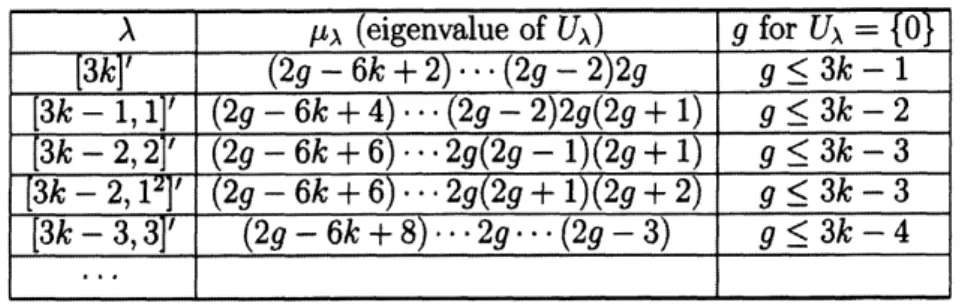
Table 1
below
indicates how thespace
$(H_{\mathbb{Q}}^{\otimes 2k})^{Sp}$ degenerates according to thegenus
$g$changesfrom the stable
range
$g\geq 3k$ to $g=3k-1,$$3k-2$,..
.,1.
TABLE 1. 0rthogonal decomposition of$(H_{Q}^{\otimes 6k})^{Sp}$
Remark 4.2. Related eigenvalues already appeared in
Hanlon-Wales
[8] in the context ofBrauer’s centralizer algebras.Now
we
considerthe following mappings$(H_{\mathbb{Q}}^{\otimes 6k})^{Sp}arrow(\wedge^{2k}U_{\mathbb{Q}})^{Sp}\epsilonurj.arrow \mathcal{R}^{2k}(\mathcal{M}_{g})$surj.
together with the following degenerations of symplec invariant tensors
$[3k]’\mapsto 0$ $(g\leq 3k-1)$ (enough to prove Faber conjecture (2))
$[3k-1, 1]’\mapsto 0 (g\leq 3k-2)$
$[3k-2, 2]’[3k-2, 1^{2}]’\mapsto 0 (g\leq 3k-3)$
$[3k-3,3]’[3k-3, 21]’[3k-3, 1^{3}]’\mapsto 0 (g\leq 3k-4)$
$[6k-8, 8]’[6k-8,62]’\cdots[6k-8, 2^{4}]’\mapsto 0 (g\leq 3k-5)$
.
In thisway,
we
obtain many (hopefullyall? the) relations andwe
proposed the following.Conjecture 4.3 (M. [24]).
$\mathcal{R}^{*}(\mathcal{M}_{g})\cong(\wedge^{*}U_{\mathbb{Q}}/([2^{2}]_{Sp}))^{Sp},$
$\mathcal{R}^{*}(\mathcal{M}_{g,*})\underline{\simeq}(\wedge^{*}(\wedge^{3}H_{\mathbb{Q}})/([1^{2}]_{Sp}^{t\circ oelti}\oplus[2^{2}]_{Sp}))^{Sp}$
5.
PLETHYSM OFGL
REPRESENTATIONS AND TAUTOLOGICAL ALGEBRAInthissection,
we
consider certain plethysm of GL-representations.Recall
that plethysmis
a
composition oftwo Schur functors. Determination ofa given plethysm isa
veryim-portant but extremely difficult problem and
a
completeanswer
is known for only thefollowing four
cases.
Theorem 5.1 (Formula of Littlewood). There exists a complete description
of
thefol-lowing plethysms
$S^{*}(S^{2}H_{\mathbb{Q}}) , \wedge^{*}(S^{2}H_{Q})$, $S^{*}(\wedge^{2}H_{Q}) , \wedge^{*}(\wedge^{2}H_{Q})$
.
Thefollowing result ofManivelplays
a
keyrole inour
work. Herewe
describe his resultin
a
simplified form and we refer to his original paper fordetails.Theorem
5.2
(Manivel [18]). The plethysm $S^{k}(S^{l}H_{\mathbb{Q}})t$uper stabilizes”
as
$karrow\infty.$Furthermore the super stable decomposition
of
$S^{\infty}(S^{3}H_{\mathbb{Q}})i\mathcal{S}$ given by$S^{*}(S^{2}H_{\mathbb{Q}}\oplus S^{3}H_{\mathbb{Q}})$
.
We
applythe well-known
involutionon
thespace
of symmetric polynomials (see [16])tothe following particular
case
$H_{k}H_{3}dua\Leftrightarrow^{)}\mathcal{B}_{k}E_{3}$
where $E_{k}$ denotes the k-th elementary symmetric polynomial and $H_{k}$ denotes the k-th
complete symmetric polynomial. Weobtain the following result.
Theorem
5.3
(SakasaiSuzuki-M.
[26]). $Let\wedge^{k}(A^{3}H_{\mathbb{Q}})$ be the k-th exteriorpower
of
the third exterior powerof
$H_{Q}$ and let$\wedge^{k}(\wedge^{3}H_{\mathbb{Q}})=\bigoplus_{\lambda,|\lambda|=3k}m_{\lambda}\lambda_{GL}$
be the stable irreducible decomposition
as
a $GL$-module. Then,for
any $k$, the mapping$A^{k}(\wedge^{3}H_{\mathbb{Q}})arrow\wedge^{k+1}(\wedge^{3}H_{\mathbb{Q}})$
induced by the operation $\lambda\mapsto\lambda^{+}=[\lambda 1^{3}]$ is injective and bijective
for
the part $\lambda_{GL}^{+}$with
$2k\leq h(\lambda)\leq 3k$
.
In other words,we
have the inequality$m_{\lambda}\{\begin{array}{l}\leq m_{\lambda+}=m_{\lambda+} (2k\leq h(\lambda\rangle\leq 3k) .\end{array}$
Theorem 5.4 (Sakasai Suzuki-M. [26]). We have $deter\gamma nined$ the super stable irreducible
decomposition $of\wedge^{\infty}[1^{3}]_{GL}$ up to codimension 30.
Table 2 below indicates the super stable irreducible decomposition of $\Lambda^{\infty}[1^{3}]_{GL}$ up to
codimension
10.
Corollary5.5 (Sakasai-Suzuki-M. [26]). We havedetermined thesuperstable$Sp$-invariant
part $\langle\wedge^{\infty}[1^{3}]_{GL}\rangle^{Sp}$ up to codimension
30.
Table
3
below indicates thesuper stable Sp-inval.iant part $(\Lambda^{\infty}[1^{3}]_{GL})^{Sp}$up toTABLE
2.
Super stable irreducible decomposition $of\wedge^{\infty}[1^{3}]_{GL}$TABLE
3.
Super stable irred. summands $of\wedge^{\infty}[1^{3}]_{GL}$ with double floorsLet us consider thefollowingseriesofmappings (see [4] for the definitionofthe
Goren-stein quotients).
$\mathcal{R}^{*}(M_{9})arrow \mathcal{R}^{*}(\mathcal{M}_{g})arrow G^{*}(M_{g})$ (Gorensteinquotient),
$\mathcal{R}^{*}(M_{g}^{1})arrow \mathcal{R}^{*}(\mathcal{M}_{g_{)}*})arrow G^{*}(M_{g}^{1})$ (Gorenstein quotient).
Here $M_{g}^{1}$denotes the moduli
space
ofcurves
ofgenus
$g$ with
one
marked point.Expectation 5.6 (Faber-Zagier [3][4]; Faber Bergvall [1], Y\’in [29]). The number
$p(k)-\dim G^{2k}(M_{g})=$ number
of
relationsof
codimension $k$depends only on
$P=3k-1-g$
in the range $2k\leq g-2$ $(i.e. k\geq\ell+3)$. Similarly thenumber
$1+p(1)+\cdots+p(k)-\dim G^{2k}(M_{g}^{1})$
depends only on $\ell=3k-1-g$ in the range $2k\leq g-2$ $(i.e. k\geq\ell+3)$,
Expectation
5.7
(continued, Faber-Zagier [3][4]; Faber-Bergvall [1], Yin [29]).If
the$f_{07}mer$part
of
the previous Expectation holds, then the above number can be described as$a(\ell)=$? number
of
partitionsof
$\ell$ withparts:1, 2, 3, 4, 6, 7,$g$,10,12,13,$15,\backslash 16$,.
..
$n\neq 2$ is excluded
if
$n\equiv 2$ mod3.Similarly,
if
the latterpartof
the previous Expectation holds, then the above numbercan
be described
as
$b(P)?= \sum_{i=0,i\neq 3m+2}^{\ell}a(P-i)=a(P)+a(P-1)+a(P-3)+(t(l-4)+\cdot \cdot\cdot$
We
have the following theorems which mayserve
as
a supporting evidences for theabove expectations.
Theorem 5.8 (Sakasai-Suzuki-M. $[26]\rangle$
.
(1) The number$\tilde{a}(l) :=p(k)-\dim(\wedge^{2k}U_{\mathbb{Q}}/([2^{2}]_{Sp}))^{s_{I)}}$
depends only
on
$\ell=3k-1-g$ inthe range
$2k\leq g-2$ $(i.e. k\geq\ell+3)$. (2) The number$\tilde{b}(\ell):=1+p(1)+\cdots+p(k)-\dim(\wedge^{2k}(\wedge^{3}H_{Q})/([1^{2}]_{Sp}^{torelh}\oplus[2^{2}]_{S_{I)}}))^{Sp}$
depends only
on
$\ell=3k-1-g$ in thesame
range.Furthermore, wehave the following
more
preciseresult.orthogonal complement of$(\Lambda^{2k}(A^{3}H_{\mathbb{Q}}))^{s_{I)}}$in$(\Lambda^{2k}(\wedge^{3}H_{\mathbb{Q}}^{\infty}))^{Sp}mod ([1^{2}]_{Sp}^{tore11i}\oplus[2^{2}]_{Sp})^{Sp}$
$\Rightarrow$ tautological relations in $\mathcal{R}^{2k}(\mathcal{M}_{g,*})$
orthogonal complement of$(\wedge^{2k}U_{\mathbb{Q}})^{Sp}$in$(\wedge^{2k}U_{\mathbb{Q}}^{\infty})^{Sp}mod ([2^{2}]_{Sp})^{Sp}$
$\Rightarrow$tautological relations in $\mathcal{R}^{2k}(\mathcal{M}_{g})$
.
Theorem 5.9 $(Saffisai-S\mathfrak{u}zuki-M.)$
.
If
we
fix
$P=3k-1-g$
, then all the aboveor-thogonal complements
are
canonically isomorphic to each other in the range $2k\leq g-$$2$ $(i.e. k\geq P+3)$
.
6. PROBLEMS
Problem 6.1.
Construct
the“fundamental
cycles” $\mu_{g,*}\in(\Lambda^{2g-2}(\wedge^{3}H_{\mathbb{Q}}^{\langle g\rangle}))^{Sp}$$\mu_{g}\in(\wedge^{2g-4}U_{\mathbb{Q}}^{\langle g\rangle})^{Sp}$
and give
a
topologicalproofof
the intersection numberformula.
Problem
6.2.
Givea
topological proofof
the Faber-Zagier relations.Problem 6.3. Study the relation between
our
tautological relations with thoseof
Problem 6.4 (suggested by Faber [4]). Which part (and/or in which degrees)
of
the following $homomo\gamma$phisms is isomorphicor
non-isomorphi$c^{}$ :$\mathcal{R}^{*}(M_{g})arrow \mathcal{R}^{*}(\mathcal{M}_{g})arrow G^{*}(M_{g})$ (Gorenstein quotient),
$\mathcal{R}^{*}(M_{g}^{1})arrow \mathcal{R}^{*}(\mathcal{M}_{g,*})arrow G^{*}(M_{g}^{1})$ (Gorenstein quotient).
Problem 6.5
(suggested by Faber [4]). (1)Are
Faber-Zagier relations linearlyinde-pendent2
(2)
Are
Faber-Zagier relations complete up to thehalf
$dimension^{9}$(3) Are there
more
relations $($above thehalf
dimension$)^{g}$REFERENCES
[1] Q. Bergvall, Relationsin the tautologicdring
of
the universal curve, Masterthesis,KTHStockholm,2011.
[2] A. Buryak, S. Shadrin, $\mathcal{A}$
newproofofFaber’s intersection number conjecture, Adv. Math. 228
(2011), 22-42.
[3] C.Faber,$\mathcal{A}$
conjecturaldescriptionof ofthe tautologicalringofthe moduli space
of
curwes, in “Moduliofcurvesand abelianvarieties”, 109-129, AspectsMath., E33,Vieweg, Braunschweig, 1999.
[4] C. Faber, Tautological algebras
of
the modulispaceof
curves, in “Moduli Spaces ofRiemannSur-faces”, IAS/ParkCity Mathematical Series, Vol. 20, 197-219, Amer.Math. Soc., 2013.
[5] G. van der Geer, Cycles onthe moduli space
of
abelianvarieties, in “Modulioicurvesand abelianvarieties 65-89, Aspects Math., E33, Vieweg, Braunschweig, 1999.
[6] A. Givental, Gromov-Wiuen invariants and quantization
of
quadratic Hamiltonians, Mosc. Math. J. 1 (2001), 551-568.[7] R. Hain, Infinitesimalpresentations ofthe Torelli groups, J. Amer. Math. Soc. 10 (1997)597-651.
[8J P. Hanlon, D. Wales, On the decomposition
of
Brauer’s centralizer algebras, J. Algebra 121 (1989)409-445.
[9] J.Harer,Stability
of
the homologyof
themappingclass groupsoforientablesurfaces, Ann.of Math.(2$\rangle$ 121 (1985),
215-249.
[10] E. Ionel, Relationsinthe tautologicalring of$\mathcal{M}_{g}$, DukeMath. J. 129 (2005), 157-186. [11] D. Johnson, $\mathcal{A}n$abelian
quotient ofthe mappingclass group$\mathcal{I}_{9}$, Math. Ann. 249(1980) 225-242.
[12] N. Kawazumi, S.Morita, Thepr\’imaryapproximateontothecohomologyofthemoduli spaceofcurves
and stablecharacteristic classes, Math. Res. Lett. 3 (1996) 629-642.
[13$|$ N.Kawazumi,S.Morita, Theprimary approximationtothe cohomology
of
themoduli spaceof
curvesand cocycles
for
theMumford-Morita-Miller
classes, preprint, Univ. of Tokyo,2001.[14] K. Liu, H. Xu, Computingtopintersections in the tautologicalring
of
$\mathcal{M}_{g}$, Math. Zeit. 270 (2012),819-837.
[15] E. Looijenga, Onthe tautological ring of$\mathcal{M}_{g}$, Invent. Math. 121 (1995), 411-419.
[16] I. Macdonald, “Symmetric Functions and Hall Polynomials”, Oxford Mathematical Monographs,
2nd edition, Oxford UniversityPress, 1995.
[17] I. Madsen, M. Weiss, Thestable moduli space ofRiemann surfaces:
Mumford’
s conjecture, Ann.ofMath. (2) 165 (2007), 843-94.
[18] L. Manivel, Gaussianmapsand plethysm,In: AlgebraicGeometry(Catania, 1993/Barcelona, 1994),
Lecture NotesinPureandAppl. Math., vol. 200, 91-117, Dekker (1998).
[19] E.T.Miller, The homology
of
themapping class group, J. Differential Geometry 24 (1986) 1-14.[20] S. Morita, Charactenstic dasses of surface bundles,Invent. Math. 90 (1987) 551-577.
[21] S. Morita, A linearrepresentationofthe mapping class group oforientablesurfaces and
character-istic classes of surface bundles, from: “Proceedings of theTaniguchi Symposium on Topologyand
Teichm\"ullerSpaces”, held in Finland, July 1995, WorldScientific (1996) 159-186.
[22J S.Morita,Structure
of
themapping classgroupandsymplectic representationtheory, l’Enseignement Math. Monographs 38 (2001),577-596.[23] S.Morita, Generatorsfor the tautologicalalgebraofthemoduli space ofcurves,Topology 42$\langle$2003), 787-819.
[24] S.Morita, Cohomologicalstructure
of
themappingdass groupand beyond,in: “ProblemsonMappingClass Groups and related Topics edited by Benson Farb, Proc. Sympos. Pure Math. 74 (2006),
American Mathematical Society,329-354.
[25] S. Morita, Canonical metric on the space of syrnplectic invariant tensors and its applications,
pre.)rint, arXiv:1404.3354[math.GT].
[26] S. Morita, T. Sakasai, M. Suzuki, A topological study
of
the tautological algebraof
the modulispaceofcurves, inpreparation.
[27] D. Mumford, Towards an enumerative geometry
of
the moduli spaceof
curves, in; Arithmetic andGeometry, Progress in Math. 36(1983), 271-328.
[28] R. Pandharipande, A. Pixton, Relations in the tautological ring ofthe moduli space of curves, preprint, arXiv:1301.4561[math.AG].
[29] Q.Yin, Tautological cyclesoncurves and Jacobians, thesis, 2013, Nijmegen-Paris.
GRADUATE SCHOOL OF MATHEMATICALSCIENCES, THE UNIVERSITY 0 TOKYO, 3-8-1 KOMABA,
MEGURO-KU, TOKYO, 153-8914, JAPAN
![TABLE 2. Super stable irreducible decomposition $of\wedge^{\infty}[1^{3}]_{GL}$](https://thumb-ap.123doks.com/thumbv2/123deta/5950675.1054932/7.892.185.727.133.486/table-super-stable-irreducible-decomposition-wedge-infty-gl.webp)
