COMBINAT0RIAL SUPERRIGIDITY FOR GRAPHS ASSOCIATED TO SURFACES
JAVIERARAMAYONA
ABSTRACT. We introduce a number of conditions on graphs built from arcs and/or
curves on a topological surface. We prove that, under these conditions, every
injec-tive alternatingsimplicialmap between two of thesegraphs is induced by asubsurface
inclusion between the underlyingsurfaces.
We then explain why pantsgraphs satisfythese conditions, thus recovering the
su-perrigidityresult obtained in [1]. We also describe a more sophisticated version of the
conditions that gives a similar result for flip graphs, as obtained in [2]. Finally, we
explain why Hatcher-Thurston graphs and curve graphs do not satisfy the conditions, and explain a moregeneralrigidity phenomenonfor Hatcher-Thurston graphs, recently
obtained by J. Hern\’andez [7].
1. INTRODUCTION
A large number of problems in the study of $Teich\fbox{Error::0x0000}$uller spaces and mapping class
groups may be understood in combinatorial terms, through the various graphs of
arcs
and/or
curves
thatone can
associate toa
surface. Prominent examples of such graphsincludethe
curve
graph, thearc
graph, the pants graph, etc.A common feature ofthese graphs is that they are simplicially rigid: every
automor-phismofthegraph is induced by anelement ofthe mapping classgroupof the underlying
surface. In fact, Brendle-Margalit [3] have recently proved that this is the
case
for anycomplex of
curves
that satisfies certain general conditions.Expanding
on
these rigidity results, itwas
shown in [1] that pants graphs (see Section4) are superrigid. More concretely, if $S$ has complexity at least 2, then every injective
simplicial map $\mathcal{P}(S)arrow \mathcal{P}(S’)$ between pants graphsis induced by asubsurface inclusion
$S\mapsto S’.$
Using
a
similar array ofideas, although in asignificantlymorecomplicated setting, theanalogous result holds for flip graphsofsurfaces (seeagainSection4): if$S$is “complicated
enough”, theneveryinjective simplicialmap between flip graphs is induced by
a
subsurfaceinclusion [2].
The purpose ofthis note is to $\langle$
abstract out”’ the ideas behind the proof of the main result in [1], interms ofrather general conditions onthe class of graphs associated to the
surface, with the hope that theseideas may be applicable to other classes ofgraphs.
Rather informally, suppose that toeach connected orientablesurface $S$wehave
associ-ated a simplic\’ial graph $\mathcal{G}(S)$, built from arcs and/or
curves
on $S$, which satisfies certainaxiomatic conditions: these
arc
the conditions $(G1)-(G7)$ described in the next section. In this setting,we
will prove thata
certain class of injective maps between two of thesegraphs
are
always induced by an inclusion between the underlying surfaces:Theorem 1.1. Suppose the class
of
graphs $\mathcal{G}$satisfies
the conditions $(Gl)-(G7)$introduced in Section 2. Suppose $S$ and $S’$ are connected orientable
surfaces for
which there exists an injective alternating map$\mathcal{G}(S)arrow \mathcal{G}(S’)$. Then$\phi$ is induced by asubsurface
inclusion $S\mapsto S’.$
Remark 1.2. In recent work, Erlandsson-Fanoni [4] have proved that every injective
simplicial map between two “multicurve graphs”’ is induced by a subsurface inclusion,
subject to certain conditions
on
the topology of the underlying surfaces and the number ofcurves defining a vertex of the graph. As the authors point out, it is not true that an arbitrary injection between multicurve graphs arises in this way. In particular, thegraphsconsidered in [4] donot satisfytheaxiomsgiven in Section 2,
more
concretely axiom(G7);see
[4] for details.The plan of the paper is
as
follows. In Section 2 we will introduce all the necessary background andterminology,as
wellasthe conditions $(G1)-(G7)$ mentioned in Theorem 1.1. InSection 3 wewill giveaproofof Theorem 1.1. Finally, in Section 4, wewill explorea
number of known classes ofgraphs (e.g.curve
graphs, pants graphs, etc), explaining in eachcase
whether they (do not) satisfy the conditions $(G1)-(G7)$ of Theorem 1.1. Acknowledgements. These ideassproutedduringavisittothe UniversidaddeZaragozaunder a 2014 Campus Iberus grant. I would like to thank the Campus Iberus scheme for
financial support, and the University of Zaragoza for its hospitality. I feel indebted to T.
Koberda and H. Parlier for many insightful exchanges. Iamalso grateful to V. Erlandsson and F. Fanoni for conversations.
2. GRAPHS
2.1. Arcs and
curves.
Throughout, $S$ will denotea
connected, orientable surface offinite topological type, and $Pa$ (possibly empty) set of marked points on $S$
.
By acurve
on
$S$we
mean
a
free isotopy class of essential simple closedcurves on
$S$; here,a
simpleclosed
curve
is said to be essential if it does not bound a disk with at most one markedpoint. By an arc we mean
an
isotopy class, relative endpoints, ofsimple arcs on $S$ withboth endpoints on $P$, and whose interior is disjoint from $P$
.
The arc and curve complex$AC(S)$ is the simplicial complex whose $d$-simplices are sets of $d+1$ pairwise disjoint
arcs/curves on $S.$
2.2. A class of graphs. We now proceed to describe the class of graphs that we will
consider. To eachorientable surface $S$
we
will associatean abstract simplicialgraph$\mathcal{G}(S)$built from arcsand/or curveson $S$, and which satisfiesthe conditions $(G1)-(G7)$ below.
The first one describes what is the vertex set of$\mathcal{G}(S)$:
(G1) There exists a positive integer $d=d(\mathcal{G}(S))$ such that each vertex of $\mathcal{G}(S)$ is a
$(d-1)$-simplex in $\mathcal{A}C(S)$
.
In other words, every vertex $v$ of$\mathcal{G}(S)$ has the form$\{a_{1}, \cdots, a_{d}\},$
where each $a_{i}$ is either an
arc
or acurve
on $S$.
We stress the fact that $d$ maydepend on $S.$
The next condition informally asscrts that edges of$\mathcal{G}(S)$ correspond to “flipping” an
arc or a curveon $S$:
Also,
we
want to consider connected graphs only:(G3) The graph $\mathcal{G}(S)$ is connected.
Roughly speaking, the next condition ensures that
one
can flip every element ofevery vertex of$\mathcal{G}(S)$:(G4) For every vertex $v\in \mathcal{G}(S)$ and all $a\in v$, there exists $v’\in 1k(v)$ with
$v\backslash (v\cap v’)=\{a\}.$
Here, lk(v) denotesthe link of the vertex$v$, that is theset ofverticesadjacentto it. Before
we state the next cond\’ition, we need the following definition:
Definition 2.1 (Extendable set). Let $MC\mathcal{A}C(S)$ be a non-empty finite set. We say
that $M$ is extendable ifthere exists a vertex $v$ of$\mathcal{G}(S)$ with $M\subset\wedge v$. We say that $M$ has
deficiency $k\geq 1$ if there exists an extendable set $M’$ on $S$ such that $M^{l}$ has $k$ elements and $M\cup M’$ is
a
vertexof$\mathcal{G}(S)$.
Remark 2.2. Observe that if an extendable set on $S$ has deficiency $k$, then it has
$d(\mathcal{G}(S))-k$ elements. Observe also that if$u,$$u’,$$v$ arevertices with $u,$$u’\in 1k(v)$ then
$u\cap u’=u\cap u’\cap v$
is either empty or else is an extendable set, in which
case
it has deficiency 1or
2.The following condition asserts that the graphs $\mathcal{G}\langle S$) behave well with respect to
con-sidering subsurfaces.
(G5) If $S$ is an essential subsurfacc of $S’$, then $\mathcal{G}(S)\subset \mathcal{G}(S’)$. Moreover, if $M$ is an
extendable set on $S$ then
$\mathcal{G}_{M}(S)\cong \mathcal{G}(S-M)$,
where$\mathcal{G}_{M}(S)$ denotes the subgraph of$\mathcal{G}(S)$ spanned by thosevertices of$\mathcal{G}(S)$that
contain $M.$
The next property provides
a
$\langle$base case”’ for the superrigidity of the graphs $\mathcal{G}(S)$:
$(G6\rangle Let S, S’ be$ surfaces, with $S$ connected $and d(\mathcal{G}(S))=d(\mathcal{G}(S’))$. thereexists an injective simplicial map
$\mathcal{G}(S)arrow \mathcal{G}(S’)$
then $S’$ is the disjoint union of connected surfaces
S\’i, .. .
,$S_{k}’$, in such waythat, upto reordering indices:
(a) $\mathcal{G}(S_{i})=\emptyset$ for $i=2$, .. . ,$k$, and
(b) The restricted (injective)map $\mathcal{G}(S)arrow \mathcal{G}(S_{1}’)$ isinduced byahomeomorphism
S $arrow$
S\’i.
We
now
proceed to stateour
final condition, which guarantees the existence of certainspecial closed paths in $\mathcal{G}(S)$
.
Before doingso
we need the following definition, whichis adirect translation to
our
setting of the concept of (alternating tuple”’ for thepants graphfrom [1].
Definition 2.3 (Alternating circuit). An alternating circuit $\tau$ in $\mathcal{G}(S)$ consists of $n\in$
$\{4$, 5$\}$ vertices $v_{1}$,
}$v_{n}$, and paths $\gamma_{1}$, .
. .
,$\gamma_{n}$ in $\mathcal{G}(S)$ such that (counting indices mod$n)$:
(2) $\gamma_{i}\cap\gamma_{j}=\emptyset$ if $|i-j|>1$, and $\gamma_{i}\cap\gamma_{i+1}=\{v_{i+1}\}.$
(3) The$set\cap\{u|u\in\gamma_{i}\}$ is an extendableset of deficiency 1.
(4) If$u\in\gamma_{1}-\{v_{i+1}\}$ and $v\in\gamma_{i+1}-\{v_{i+1}\}$ then$u\cap v$ is
an
extendable set ofdeficiency2.
Informally, exactly $d-1$ arcs/curves do not change along $\gamma_{i}$ , and it is
one
of thesearcs/curves that is “flipped” when passing from $\gamma_{i}$ to $\gamma_{i+1}$
.
We remark that the existenceof
an
alternating circuit in $\mathcal{G}(S)$ immediately implies that $d(\mathcal{G}(S))\geq 2$.
The fact that$n\leq 5$ in the definition above has the following observation
as
animmediate consequence;we state it
as
a separate lemmaas
it will be useful in the proofof Theorem 1.1: Lemma 2.4. Suppose $\tau\subseteq \mathcal{G}(S)$ is an alternating circuit. Then$M=\cap\{u|u\in\tau\}$
is either empty orelse is
an
extendable setof
deficiency 2. Armed with the definition above, the last condition is:(G7) Let $u,$ $v,$ $w$ be vertices with $u,$$w\in 1k(v)$, and such that $u\cap v\cap w$ is
an
extendableset of deficiency 2. Then there exists
an
alternating circuit in $\mathcal{G}(S)$ containing$u, v, w.$
2.3. Alternating maps. Before closing this section, we define thenotionof an alternat-ing map, and observe that such maps send alternating circuits to alternating circuits. Definition 2.5 (Alternating map). We say that a map $\phi$ : $\mathcal{G}(S)arrow \mathcal{G}(S’)$ is alternating
if, for every$u,$ $v,$ $w$ vertices of $\mathcal{G}(S)$ with $u,$$w\in 1k(v)$, we have:
$u\cap v\cap w$ has deficiency 2 $\Leftrightarrow\phi(u)\cap\phi(v)\cap\phi(w)$ has deficiency 2.
The following is
an
immediate consequence of the definitions of alternating map and alternating circuit:Lemma 2.6. Let$\phi$ : $\mathcal{G}(S)arrow \mathcal{G}(S’)$ be an injective alternating map. For
everltalternating circuit $\tau\subset \mathcal{G}(S)$, the path $\phi(\tau)\subseteq \mathcal{G}(S’)$ is an alternating circuit.
Proof.
Let $\tau\subset \mathcal{G}(S)$ bean
alternating circuit. Making reference to the notation in thedefinition of alternating circuit above, let $v_{1}$,
.
. .
,$v_{n}$ be the vertices and $\gamma_{1}$,. . .
,$\gamma_{n}$ be thepaths between them, with $n\in\{4$,5$\}$. We consider the path $\phi(\tau)\subset \mathcal{G}(S’)which_{\}}$ again
withrespectto thesamenotation, has vertices$\phi(v_{1})$,
.
. . ,$\phi(v_{n})$ and paths$\phi(\gamma_{1})$,. . . ,$\phi(\gamma_{n})$between them.
We now verify that $\phi(\tau)$ satisfies conditions (1) $-(4)$ in Definition 2.5. First, it is
immediate that it satisfies (1), since $\phi$ is simplicial, and (2), as it is injective. For (3),
let $w_{1}$,
. .
.
,$w_{k}$ be the vertices of$\gamma_{i}$, where $w_{1}=v_{i}$ and $w_{k}=v_{i+1}$.
Since $\phi$ is alternating,we
have that $\phi(w_{j})\cap\phi(w_{j+1})\cap\phi(w_{j+2})$ has deficiency 1. Since thesame
is true for$\phi(w_{j+1})\cap\phi(w_{j+2})\cap\phi(w_{j+3})$, it follows that
$\phi(w_{j})\cap\phi(w_{j+1})\cap\phi(w_{j+2})\cap\phi(w_{j+3})$
also has deficiency 1. Repeating this argument weobtain that $\phi(\tau)$ satisfies property (3).
This, combinedwith the fact that $\phi$ isalternating, implies that it also satisfies (4), which
3. PROOF OF THEOREM 1.1
In this section we will prove of Theorem 1.1. A large part of the argument needed is contained in the following lemma:
Lemma 3.1. Suppose that the class
of
graphs $\mathcal{G}$satisfies
conditions $(Gl)-(G7)$ above,andthat $d(\mathcal{G}(S))\geq 2$. Let$S,$$S^{l}$ be $surface\mathcal{S}$
for
which there exists an alternating injective map$\phi:\mathcal{G}\langle 8)arrow \mathcal{G}(S’)$
.
Then $d(\mathcal{G}(S\rangle)\leq d(\mathcal{G}(S’))$
.
Moreover,if
the inequality is strict then there existsan
ex-tendable set $M$ on $S^{J}$,with $d(\mathcal{G}(S’))-d(\mathcal{G}(8))$ elements, such that $MC\phi(v)$
for
everyvertex$v$
of
$\mathcal{G}(S)$.
Proof.
Fix $an$arbitrary vertex $v$ of$\mathcal{G}(S)$, which wewilluse toidentify the extendable set$M$ ofthe statement. By (G1),
we
may write$v=\{a_{1}, \cdots , (x_{d}\},$
where $d=d(\mathcal{G}(S\rangle)$
.
From (G2) and (G4), weknow thatthere exist $v_{1,}v_{d}\in 1k(v)$ suchthat
$v\backslash (v\cap v_{i})=\{a_{i}\}$
for all$i=1$,$\cdots$ ,$d$
.
Byconstruction, if$i\neq j$ then$v_{i}\cap v_{j}=v\cap v_{i}\cap v_{j}$ hasdeficiency 2, andtherefore $\phi(v)\cap\phi(v_{i})\cap\phi(v_{j})$ also has deficiency 2
as
$\phi$ is alternating. It followsthat theintersection of$k$ distinct $\phi(v_{i})$’s is either emptyor else is an extendable set of deficiency
$k$
.
Since every vertexof$\mathcal{G}(S’)$ has $d^{l}=d(\mathcal{G}(S’))$ elements, wededuce that$d\leq d’,$
so the first part of the theorem holds. Suppose from now on that $d<d’$, which in turn implies that
$M:=\phi(v_{1})\cap.. .\cap\phi(v_{d})$
is is
an
extendable set of$d’-d$ elements.Once
we
have identifieda
candidate extendable set $M$ on $S$, we now claim if$u$ is any vertex of$\mathcal{G}(S)$, then$M\subset\phi(w)$ for everyvertex$w\in 1k(u)$.
We first provethe claimin thespecial case when $u=v$
.
Let $w\in$&(v),
and $v_{1}$,. . .
,$v_{d}$ be the vertices identified above.Then there exists exactly
one
$i=1$,. . .
,$d$ such that$v\cap v_{i}=v\cap w=\{a_{i}\}.$
Since $\phi$ is alternating, then $\phi(v)\cap\phi(v_{i})\cap\phi(w)$ has deficiency 1, and
as
such$M\subseteq\phi(v)\cap\phi(v_{i})=\phi(v)\cap\phi(v_{i})\cap\phi(w)$
.
In particular, $M\subset\phi(w)$,
as
$desi_{1}\cdot ed.$Consider
now
the generalcase
$u\neq v$.
As $\mathcal{G}(S)$ is connected, by (G3), it suffices toestablish the claim in the case when $u\in 1k(v)$
.
Let $w\in 1k(u)$; we want to show that$M\subseteq\phi(w)$. To this end, observe first that $u\cap v\cap w$ is an extendable set ofdeficiency 1
or 2. Suppose first that $u\cap v\cap w$ has deficiency 1. In this case, $\phi(u)\cap\phi(v)\cap\phi(w)$ has
deficiency 1 as well, since $\phi$ is alternating, and therefore $M\subseteq\phi(w)$, as
$Mc\phi(u)\cap\phi(v)=\phi(u)\cap\phi(v)\cap\phi(w)$
.
Therefore, it remains to consider the
case
when $u\cap v\cap w$ has deficiency 2, which inBy condition (G7) above, there exists an alternating circuit $\tau\subset \mathcal{G}(S)$ containing $u,$ $v,$$w.$ Using Lemma 2.6, the image path$\phi(\tau)$ isalso an alternating circuit. Let $z$be the unique vertex of $\tau$ that is distinct from $u$ and spans
an
edge with $v$, noting that $M\subset\phi(z)$ bythe discussion in the paragraph above; in particular,
$M\subset\phi(z)\cap\phi(v)\cap\phi(u)$
.
As $\phi(z)\cap\phi(v)\cap\phi(u)$ has deficiency 2, Lemma 2.4 tells us that
$\phi(z)\cap\phi(v)\cap\phi(u)=\phi(z)\cap\phi(v)\cap\phi(u)\cap\phi(w)$,
andthus $M\subseteq\phi(w)$, as desired.
$\square$
Remark 3.2. Observe that, in fact, inthe above lemma wehave not madeuse of
condi-tions (G5) and (G6), and hence the result holds in slightly more generality.
At this point,
we
are
ina
position to prove Theorem 1.1:Proof
of
Theorem 1.1. Let$S$and$S’$beconnected orientable surfaces for which there existsan injective alternating map
$\phi:\mathcal{G}(S)arrow \mathcal{G}(S’)$.
Write$d=d(\mathcal{G}(S))$ and $d’=d(\mathcal{G}(S’))$. By Lemma 3.1, we know that
$d\leq d’.$
If$d=d’$, then (G6) implies
$S’=S_{1}’u\ldots uS_{k}’,$
in such way that, up to reordering indices, $\mathcal{G}(S_{i})=\emptyset$ for $i=2$, .
.
.
,$k$, and the restricted(injective) map$\mathcal{G}$(S) $arrow \mathcal{G}$(S\’i) isinducedbyahomeomorphism$Sarrow S_{1}’$
.
Asaconsequence,the map $\phi$ is induced by
a
subsurface embedding $S\mapsto S’$,as
we wanted to prove.Onthe otherhand, if$d<d’$ then Lemma3.1 again implies that there exists an extend-able set $M\subset S’$, with $d’-d$ elements, such that
$\phi(\mathcal{G}(S))\subseteq \mathcal{G}_{M}(S’)\cong \mathcal{G}(S’-M)$,
wherethe above isomorphism is guaranteed by condition (G5). Now, $d(\mathcal{G}(S’-M))=d,$
andwe conclude
as
above with $S’-M$ instead of $S’.$ $\square$4. EXAMPLES AND NON-EXAMPLES
In thissection we will discuss certain well-known classes of graphs ofarcs or
curves
on$S$ and, in each case, we will explain why they (do not) satisfythe conditions $(G1)-(G7)$
described above. To the best ofour knowledge the only example ofaclass of graphs that
satisfy such conditions is that ofpants graphs ofsurfaces; see below. Thus we ask:
Problem 4.1. Is there
a
naturalclassof
graphs associated to asurface, other than pants graphs, thatsatisfies
conditions $(Gl)-(G7)$ abov$e^{}?$Next, we will examine the interesting
case
of the flip graph,as
it does not satisfyconditions (G1) $-(G7)$ but still forms a superrigid class of graphs, as shown in [2].
Although the ideas ofthe proofofthis result are similar in spirit to those discussed here,
the situation is significantly more involved, especially to due to the presence of vertices
Next,
we
discuss thecase
of Hatcher-Thurston graphs and explain why they do not satisfy conditions $(G1)-(G7)$. We will commenton a more
general classification, due toJes$\mathfrak{U}S ノ$ Hern\’andez [7], of the possible simplicial injections between two Hatcher-Thurston
graphs in the
case
where the domain surface is closed.Finally, we discuss the case of curve graphs, and explore some possible versions of
supel.rigidity for them.
4.1. Pants graphs. Let $S$ be
a
connected orientable surface. The pants graph$\mathcal{P}(S)$ isthe simplicial graph whose vertices
are
pants decompositions on $S$, up to isotopy, andwhere two such decompositions
are
adjacent in $\mathcal{P}(S)$ if$a1$ only if they are related byan
elementarymove.
Recall that the lattermeans
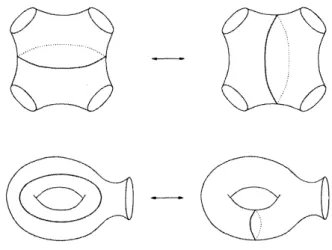
that the two decompositions have allbut one curves in common, and the remaining two curves either intersect once and fill a one-holed torus, or intersect twice and fill a four-holed sphere. See Figure 1.
FIGURE 1. The two typesof elementary move.
We now explain why $\mathcal{P}(S)$ satisfies the conditions $(G1)-(G7)$ above, provided $S$ has
complexity at least 2. In a nutshell, and rather informally, the
reason
boils down to the fact that $\mathcal{P}(S)$ is “built from”’ Farey graphs, which are simplicially rigid; moreover, thereisabijective correspondencebetween Farey graphsin $\mathcal{P}(S)$ and multicurves ofcardinality
one less than the complexity of$S.$
First, $\mathcal{P}(S)$ evidently satisfies (G1) and (G2), with
$d=d(\mathcal{P}(S))=3g-3+p,$
where $g$ and$p$ are, respectively, the genus and number ofpunctures of $S$
.
The fact that$\mathcal{P}(S)$ is connected is due originally to Hatcher-Thurston [5]; see also [8] for a
combina-torial proof. The fact that $\mathcal{P}(S)$ satisfies (G4) is also obvious: every curve in a pants
decompositionmay be the subject of
an
elementarymove.
Condition (G5) is easyas
well:if$S$is anessential $sub_{Su1}\cdot$face of$S’$, then apantsdecomposition $P$ of$S$extends (ina
non-unique way) to
a
pants decomposition $P’$ of $S’$ by first choosinga
pants decompositionAs mentioned above, all the difficulty is reduced to proving that $\mathcal{P}(S\rangle$ satisfies (G6)
and (G7). We first treat condition (G6). Since $d(\mathcal{P}(S))$ is precisely the complexity of$S,$
in this particular
case
condition (G6) asserts:(G6) Let $S,$ $S’$ be orientable
surfaces
of
thesame
complexity $\geq 2$, with $S$ connected, andsuppose there is an injective simplicial map $\mathcal{P}(S)arrow \mathcal{P}(S)$
.
Then$S’=S_{1}’u\ldots uS_{k}’$
in such way that:
(1) $\mathcal{P}(S_{i})=\emptyset$
for
$i=2$, . ..,$k$, and(2) The restricted (injective) map $\mathcal{P}$(S) $arrow \mathcal{P}$(S\’i) is induced by a homeomorphism
$Sarrow S_{1}’.$
Let $S,$ $S’$ be surfaces
as
above, and $\phi$ : $\mathcal{P}(S)arrow \mathcal{P}(S’)$ an injective simplicial map. Thefact that
$S’=S_{1}’u\ldots uS_{k}’,$
with (up to reordering the indices) $\mathcal{P}(S_{i})=\emptyset$ for $i=2$,
.
..
,$k$ is contained in the proof ofTheorem3(c) of [1], whose argumentessentially boils down tothe combination ofLemma 3.1 above and the fact that Farey graphs
are
simplicially rigid.Thus we get that, abusing notation, $\phi$ gives
an
injective simplicial map$\phi:\mathcal{P}(S)arrow \mathcal{P}(S_{1}’)$
.
Now,
S\’i
hasthesame
complexityas $S$, by Theorem 3(b) of [1], whose proof is essentiallycontained that of Lemma 3.1. Therefore $d(\mathcal{P}(S))=d(\mathcal{P}(S_{1}’))$
.
Again by the rigidityof Farey graphs (for details, see Claim III of the proof of Theorem 3 of [1]), the map
$\phi$ : $\mathcal{P}$(S) $arrow \mathcal{P}$(S\’i) is also surjective and therefore an isomorphism. Since $d(\mathcal{P}(S))\geq 2,$
the classification ofpants graphs up to isomorphism (which appears
as
Lemma 12 in [1]) implies that there isa
homeomorphism $Sarrow S_{1}’$ (andthusa
subsurface inclusion $S\mapsto S’$)which induces $\phi$,
as
claimed.Finally, the fact that $\mathcal{P}(S)$ has (G7) is Lemma 10 of [1], although the terminology
is different; namely, in $[1],($alternating circuits”’ are called “alternating $n$-tuples (with
$n=4$,5$)$ See the case of the Hatcher-Thurston graph below for the proof of the
analogous statement, which follows a similar, although simpler, argument.
In the light of the discussion above,
we
obtain from Theorem 1.1 that,so
longas
$S$has complexity 2, every alternating injective simplicial map $\mathcal{P}(S)arrow \mathcal{P}(S)$ is induced by
a subsurface inclusion $S\mapsto S’$
.
Moreover, it turns out that every injective map betweenpants graphs is always alternating (see Lemma 7 of [1], whose proof rests again upon the
simplicial rigidity ofFarey graphs) and therefore we have the main result in [1]:
Theorem 4.2 ([1]). Let$S,$ $S’$ be connected orientable surfaces, such that$S$ has complexity
at least 2.
If
there exists an injective simplicial map $\phi$ : $\mathcal{P}(S)arrow \mathcal{P}(S’)$ then there existsa
subsurface
inclusion $S\mapsto S’$ that induces $\phi.$4.2. Flip graphs. Let $S$ be
a
compact, connected and orientablesurface, of genus$g\geq 0$with$b\geq 0$ boundarycomponents. Moreover,
assume
that $S$has$p+q>0$ markedpoints,with$p\geq 0$ in the interior of$S$ and the other $q\geq 0$ in $\partial S$, subject to the condition
that
every component of$\partial S$ must contain at least
one
markedpoint.A triangulation on $S$ is a set of arcs on $S$ that is maximal with respect to inclusion.
flip graph$\mathcal{F}(S)$ is thesimplicial graph whose vertices
are
triangulations of $S$, and wheretwo triangulations are adjacent if and only if they share exactly $d(S)-1$ arcs. Note
this implies that the remaining two
arcs
intersect exactly once;we
say that the twotriangulations differ by a “fiip” Observe that $\mathcal{F}(S)$ is locally finite,
as
every vertex hasvalence at most (but not always equal to) $d(S)$
.
Flip graphssatisfy some,but not all,oftheconditions $(G1)-(G7\rangle$
.
The majorobstaclein this direction isthepresence of triangulations with “unflippable” arcs. Moreconcretely,
there
are
triangulations $v$ which containan arc
$a$ with the property that there does not exist any vertex $v’$ with$v-(v\cap v’)=\{a\}$
(see Figure 2). In otherwords, condition $(G4)$ does not hold for $\mathcal{F}\langle S$).
It is immediate, however, that $\mathcal{F}(S)$ satisfies (G1) and (G2) with $d=6g+3b+3p+$
$q-6$
.
Similarly,one sees
that $\mathcal{F}(S)$ has properties (G3) (i.e. it is connected) and (G5).With considerable effort, and
as
longas
$S$ is not exceptional it is possible to bypass thefailureofcondition (G3) and provethat $\mathcal{F}(S\rangle$ satisfies aweakening of condition (G7); see
Propositions 2.2 and 2.3 of [2]. Here, we say that the surface $S$ is exceptionalif it is an
essential subsurface of (and possibly equal to) a torus with at most two marked points,
or
a sphere with at most four marked points. This property turns out to be enough toshow, after
a
significant amount ofwork, that $\mathcal{F}(S)$ alsohas property (G6),see
Theorem1.4 of [2].
At this point
one
may apply a similar strategy to the one described in the previoussection to prove that alternating injective maps between flip graphs are always induced
by subsurfaceinclusions. However, as wasthecasewith pants graph, alternatinginjective
maps between flip graphs are automatically alternating, and thus one has the following
result, proved in [2]
Theorem 4.3 ([2]). Suppose $S$ is non-exceptional. Then every injective simplicial map
$\phi$ : $\mathcal{F}(S)arrow\overline{f-}(S’)$ is induced by
a
subsurface
inclusion $Sarrow S’.$FIGURE 2. An unflippable
arc
ofa triangulation4.3.
Hatcher-Thurston graphs. Let$S$bea
connected orientablesurface ofgenus$g\geq 2,$possibly with punctures. A cut system
on
$S$ isa
set $M$ of$g$ pairwise disjointcurves
such that the result ofcutting $S$ open along the elements of $M$ is homeomorphic to a spherewith punctures.
The Hatcher-Thurstongraph (or cutgraph)) $\mathcal{K}(S)$ is thesimplicial graphwhose vertices
are
cut systems on$S$, and where two cut systemsare adjacent in $\mathcal{K}(8)$ ifand only if theyhave $g-1$
curves
in common, and the remaining twocurves
intersect exactlyonce.
Thegraph $\mathcal{K}(S)$ (in fact, a certain 2-complex obtained from it)
was
used by Wajnryb [10] toBy construction, $\mathcal{K}(S)$ satisfies (G1), (G2) with $d(\mathcal{K}(S))=g$
.
Wajnryb proved [10]that $\mathcal{K}(S)$ is connected and thus satisfies (G3). The fact that it also satisfies (G4) is also
obvious. To verify (G5)
we
argueas
in thecase
of pants graphs. Supposewe
are
given $S\subset S’$, and choose a cut system $M$ of$S’-S$; then every cut system $v$ of$S$ extends tothe cut system $v\cup M$ of$S’.$
To see that (G7) holds for $\mathcal{K}(S)$, let $u,$$v,$ $w$ be vertices of$\mathcal{K}(S)$ with $u,$$w\in 1k(v)$, such
that $u\cap v\cap w$ is an extendable set of deficiency 2. As such, we may write:
$u=\{a’, b, C_{3}, . . . , c_{g}\},$
$v=\{a, b, c_{3}, . .., c_{g}\},$
and
$w=\{a, b’, C_{3}, . .., c_{g}\},$
with $i(a, a’)=1$ and $i(b, b’)=1$
.
If$i(a’, b’)=0$, then the closed path$uarrow varrow warrow Zarrow u$
is
an
alternating circuit (with $n=4$), where $z=\{a’, b’, c_{3}, . . . , c_{g}\}$. So suppose that$i(a’, b’)\neq 0$
.
Choosea nonseparatingcurve
$b”$ such that $i(b”, a)=i(b”, a’)=i(b”, c_{j})=0$for all $j$, and
$i(b”, b)=1.$
Consider the vertex $w’=\{a, bc_{3}, . . . , c_{g}\}$
.
Now, $w$ and $w’$ may be connected bya
path$\rho$ in $\mathcal{K}(S)$ which misses $w$ and whose every vertex contains the
curves
$a’,$$c_{3}$,. . .
,$c_{g}$; see,for instance, Lemma 3 of [6]. Considering the vertex
$z=\{a’, bc_{3}, . . ., c_{g}\},$
we
see
that the closed path$uarrow varrow warrow^{\rho}W’arrow Zarrow u$
is an alternating circuit (with $n=4$ again).
In spite of the surge of optimism after this discussion, we remark the statement of
Theorem 1.1 does not hold for Hatcher-Thurston graphs,
as
there exist injective maps between Hatcher-Thurston graphs thatare
not induced by subsurface inclusions. To construct examples of these, start with a closed surface $S$ of genus $g\geq 2$ and endow $S$ witha
hyperbolic metric. We realize every simple closed curve on $S$ by the uniquegeodesic in its isotopy class. The union of all such geodesics has
measure
zero, and thuswe can choose a point$p$ in the complement, thus obtainingan injective simplicial map
$\mathcal{K}(S)arrow \mathcal{K}(S-\{p\})$;
observe that there are no continuous injective maps $Sarrow S-\{p\}$
.
We may now repeatthis process a finite number oftimes, and”attach” pairs ofpunctures onthe new surface
to obtain, for any$g\geq 2$,
an
injective simplicial map$\mathcal{K}(S_{g,0})arrow \mathcal{K}(S_{g’,n})$,
where $S_{h,k}$ denotes the surface ofgenus $h$ and with $k$ punctures. In ongoing work, Jes\’us
Hernandez [7] has proved that, in fact, every injective alternating map between Hatcher-Thurston graph arises in this way,
as
longas
the domain surface is closed and has genus4.4. Curve graphs. The
curve
graph $C(S)$ is the simplicial graph whose verticesare
(isotopy classes ofessential simple closed) curves
on
$S$, and where two such curvesare
adjacent in $C(S\rangle$ ifthey
can
be realized disjointly on $S.$We
see
that $C(S)$ satisfies (G1) and (G2) with $d=d(C(S))=1$.
A pleasant exerciseshows that $C(S)$ isconnected as long as $S$ has complexityat least 2.
Sincethere
are
no extendable sets with respect to $C(S)$, we immediately get that $C(S\rangle$satisfies (G4), (G5) and (G7).
However,
curve
graphs do not satisfy (G6),as
there are simplicial injections betweencurve graphs that do not arise from homeomorphisms, or
even
inclusions, between the underlying surfaces. Indeed, usingthesame
argumentas
in the caseofHatcher-Thurstongraphs, we
see
that there are injective simplicial maps$C(S)arrow C(S-\{p\})$,
which cannot beinduced by
a
subsurface inclusion if$S$ is closed, for instance. Motivatedby the result of J. Hern\’andez on Hatcher-Thurston $gra\mathfrak{x}$)$hs$ mentioned above, we ask:
Problem 4.4. Let $S$ be a closed
surface
of
genus$g\geq 2$.
Let$\phi$ : $C\langle S$) $arrow C(S-\{p\})$ bean injective simplicial map, and$7|$ : $C(S-\{p\})arrow C(S)$ the natural puncture-forgetting”
map. Is it true that$\pi 0\phi$ is always
an
isomorphis$m^{J}?$REFERENCES
[1] J. Aramayona, Simplicialembeddings between pants graphs. Geometriae Dedicata, 144 (2010).
[2] J. Aramayona,T. Koberda, H. Parlier, Injective maps between flipgraphs. To appearinAnnalcs de
l’InstitutFourier.
[3] T. Brendle, D. Margalit, work in progress.
[4] V. Erlandsson, F. Fanoni, Simplicial embeddings between multicurvegraphs, preprint.
[5J A. E. Hatcher, W. P. Thurston, A presentationfor the mapping class group ofa closed orientable
surface, Topology, 19 (1980)
[6] E.Irmak, MKorkmaz, AutomorphismsoftheHatcher-Thurston complex. Israel J. Math. 162 (2007$\rangle$
[7] J. Hernandez, work inprogress.
[8] A. Putman, A note on the connectivity ofcertain complexes associated to surfaces, Enseign. Math.
(2) 54 (2008)
[9] K.J.Shackleton, Combinatorialrigidityincurvecomplexes andmappingclassgroups,Pacific Journal ofMathematics, 230, No. 1, 2007
[10] B. Wajnryb, A simple presentationfor the mapping class group of an orientable surface. Israel J.
Math. 45 (1983)
DEPARTMENTO $D\Sigma$ MATEM\’ATICAS, UNIVERSIDAD AUT\’oNOMA DE MADRID