A REPORT ON EXPERIMENTS ON RANDOM BRAID HIDETOSHI MASAI
1. INTRODUCTION
We report apartof authors computer experiments onrandom braids. Here byarandom braid,
we
mean
a
braid which is obtained by taking random walkson
braidgroups.
Let$B_{n}$ denote the braid group ofdegree $n$,
or
the$n$-strand braid group. We fix the standardgenerating set $S_{n}$ $:=\{\sigma_{1}, . .. , \sigma_{n-1}\}$ for $B_{n}$, where
$\sigma_{i}$ is obtained by crossing i-th string
over
$i+1$-th string. Recall that the braid groups can be regardedas
the mapping classgroups ofpunctured discs. Random walks on mapping class groups have been studied by several authors. Amongthem, one typicalmotivation is to study what kind ofproperties hold with asymptotic probability one. It is also interesting to consider the $speed^{\rangle}$’ of
convergence of the probability foragiven property. A random walk is called simpleif it is
determinedby the uniform
measure
on asymmetric generatingset. In thisreport, weonly consider the simple random walk associated to the symmetric generating set $S_{n}\cup S_{n}^{-1}.$ Namely, we define a probability measure $\mu$ : $B_{n}arrow[0$, 1$]$ by$\mu(x)=\{\begin{array}{ll}\frac{1}{2n-2} if x\in S_{n}\cup S_{n}^{-1}0 otherwise.\end{array}$
Let $B_{n}^{N}$ denote the space ofsample paths. We denote by
$\omega_{i}$ the i-th coordinate of$\omega\in B_{n}^{N}.$
A subset $[x_{1}, x_{2}, . . . , x_{n}]$ $:=\{\omega\in B_{n}^{N}|\omega_{i}=x_{i}\}$ is called a cylinder set. Any probability
measure
$\mu$on
$B_{n}$ induces the probabilitymeasure
$\mathbb{P}$on
$B_{n}^{N}$ so that $\mathbb{P}([x_{1}, x_{2}, . , ., x_{n}])$ $:=$$\mu(x_{1})\mu(x_{1}^{-1}x_{2})\cdots\mu(x_{n-1}^{-1}x_{n})$. We consider the probability
measure
$\mathbb{P}$that is determined by the symmetric
measure
$\mu$ given above.By the well-known Nielsen-Thurston classification, abraid is eitherperiodic, reducible,
orpseudo-Anosov. Among the three types ofbraids, pseudo-Anosovis the most $\langle(generic$” one in many
senses.
In particular, for the simple random walk on $B_{n}$, Maher [7] proved(original statement is much
more
general, but we here only state for the simple random walk) the probability that we get non pseudo-Anosov braids decays exponentially. Theorem 1.1 ([7]). There exist $K>0$ and$c<1$ such that,$\mathbb{P}$(
$\omega_{n}$ is pseudo-Anosov) $>1-Kc^{n}.$
However it is in general difficult to compute the constants $K$ and $c$ in the statement.
The purpose of this paper is to report a computer experiment toward the question, Question 1.2. Foragiven$n$, howmanystepsdoweneed tohavepseudo-Anosov elements by the simple random walk on $B_{n}.$
This question is somewhat vague. Hence we first formalize it in terms of threshold phenomena in
\S 2.
Then in \S 3, we explain how to see if given braids are pseudo-Anosovor not. We use two methods, Thurston’s gluing equations and strict angle structures.
Advantage and disadvantage of those methods in our context is also discussed in
\S 3.
Finally in $\S 4_{\}}$ we show results ofcomputer experiments.
2. THRESHOLD PHENOMENA
A threshold phenomena, or a phase transition is first observed by Erd\"os-R\’enyi [4] for random graphs. In this section,
we
formalize it in the context of braid group $B_{n}$. Let $P$be aproperty ofbraids. We say that a function $F_{P}$ : $\mathbb{N}arrow \mathbb{N}$ is a threshold function if
$\lim_{narrow\infty}\mathbb{P}(w_{N(n)}$ is
$P)=\{\begin{array}{ll}0 if \lim_{narrow\infty}N(7f)/F_{P}(n)=0,1 if \lim_{narrow\infty}N(n)/F_{P}(n)=+\infty_{\backslash ,\prime}\end{array}$
We want to consider the threshold phenomena for the property being pseudo-Anosov.
The existence ofthis function is known to be a dificult problem. For example, even for well-known3-SAT $pro$})$lem$, theexistence ofsuch afunction\’is open. Thereforeit is worth
having computer $ex\mathfrak{x}$)eriments for this question. In this report, we focus on the second
property, namely we wi givean experiment regarding to a function $PA(n)$ such that for $\lim_{narrow\infty}N(n)/PA(n)=+\infty$,
we
have$\lim_{narrow\infty}\mathbb{P}$($\omega_{N(n)}$ ispseudo-Anosov) $=1$. 0bviously
$PA(n)>n-1$ since for a braid with word length less than $n-1$, there must be astring unchanged. This implies the braid is reducible.
3. DETECTING PSEUDO-ANOSOV
Thereareseveralmethods toseeif given braids are pseudo-Anosov or notby computer.
Oneof therecent progressisdue to Bell, who developedacomputer$p^{I^{\cdot}O}$gramcalledflipper
[1]. By flipper, we can decide Nielsen-Thurston type of braids rigorously However, although flipperis implemented very carefully and quick in certain sense, it is not enough for our purpose. This is because to have a good picture for the threshold phenomena,
we
need to deal with very long words in the braid group of high degree. Since our goal is to have reasonable computer experiments, we only consider approximate computation. Here we usethe work of Thurston which says; abraid is pseudo-Anosov ifand only if its mapping torus is hyperbolic. We nowexplain two well known methodsto check ifa given manifold is hyperbolic by computel$\cdot.$3.1. Thurston’s gluing equation. Foragivenmanifold$M$,Thurstonfoundasystemof
complex polynomial equations whose solution with positive imaginary part corresponds to the hyperbolic structure on $M$
.
Thurston:s gluing equation can be approximatelysolved by SnapPea:
or
SnapPy [3] developed by Culler Dunfield-Weeks et. al. Here by approximately solved, we mean that SnapPea uses floating point arithmetic for the computation and the result is not rigorous. (We can make it rigorous by using intervalarithmetic [6].) But this is good enough for
our
purpose. Indeed, as faras
the authorknows, SnapPeahavenevergiven false positive. Note thatSnapPeatriestofindhyperbolic structures, and hence its failure (evellwith verified version in [6]) would never imply
non-hyperbolicity of the manifolds. Nevertheless, SnapPea
can
give certain information for the function $PA(n)$.
3.2. Strict angle structure. One another way to compute hyperbolicityis to
use
strict angle structure. Roughly speaking strict angle structure is obtained by solving a “linear part”’ ofThurston’s gluing equation. For$Thurston^{\}}s$gluing equationand strict angleto the hyperbolic structure, Casson proved that if
a
manifold $M$ admitsa
strict anglestructure, then $M$ is hyperbolic (see e.g. [5, Theorem 1.1]). Burton-Budney-Pettersson
et.al developed a computer program called Regina [2] which computes strict angle struc-tures (if any) ofagiven manifold. To have a strictangle structure, wemust findapositive solution of a linear equation of type $Ax=b$ where $A$ is a singular matrix. Hence unlike the solution of Thurston’s gluing equation, the space of strict angle structures may have positive dimension. For our purpose it suffices to find
one
strict angle structure. Regina tries to find strict angle structures by a linear programing method. Thiscan
give arigor-ous certificate of the hyperbolicityofa given manifold. However even though the method Regina uses is sophisticated, it is not fast enough for
our
purpose. Hencewe
againre-sign to approximatesolution. There areseveral numerical and iterative methods to solve
linear equations. However unlike the
case
of$Thurston^{\rangle}s$ gluing equation, simpleapplica-tions of those methods do not work well. (Recall that SnapPea
uses
Newton’s methodto solve Thurston’s gluing equation. It works well since the solution if any, is unique by
Mostow-Prasad rigidity.) This is because the equations for strict angle structures may
have bothpositiveandnon-positivesolution, and it oftenhappens that by iterative meth-ods, solutions converge to non-positive solutions
even
if there exist positive solutions. Toovercome
thissituation,weused randomlygenerated numbers. Sincedetailedexplanation ofthis method isbeyond the scope of thisreport,we
givea
rough ideaof the method. Aniterative method gives a function $F$
so
that the sequence $\{x_{n}\}$ given by$x_{n+1}$ $:=F(x_{n})$ converges to a solution. A naive idea to use randomness is to give randomly
an
initial value $x_{0}$ and try iterative methods. Inour
case
this idea $didn^{\rangle}t$ work well, in mostcases
even after reasonably many trials, we only get non-positive solution for manifolds which
are quite likely to be hyperbolic (e.g. manifolds which SnapPea thinks they
are
hyper-bolic). Then next possible way is touse
randomness at each step of iterative methods. Namely at each step w$e’$‘push” randomly $x_{n}$ to the positive direction; $x_{n}’:=F(x_{n})+r_{n}$where $r_{n}$ is some randomly chosen positive vector. Remember that we are looking for a
positive solution. After carefully settingwhen and what random positive vectors we add,
we
can
implement a reasonable program to checkif agiven manifold admits strict angle structure. As is thecase
ofSnapPea, our programuses
approximate computation and is not rigorous. However wehave not seen any false positive with this program as well.3.3. Advantage and disadvantage. As we have
seen
in this section, strict angle struc-ture seems to have disadvantages to the solution of Thurston’s gluing equation; eventhoughequations are linear, it is harder tosolve, and it does not correspondtothe hyper-bolic structure of the manifold. However the last disadvantage, not correspondingto the hyperbolic structure, does become an advantage for our purpose for the following
reason.
As pointed out by Rivin [8,
\S 5.4],
mapping tori obtained from randomwalks on mapping class groups have injectivity radius converging to $0$as
the number ofsteps. Hencemap-ping tori of random braids are expected to have $vel\cdot y$ small injectivity radius. Since the solution of Thurston’s gluing equation does correspond tothe hyperbolic structure, ifthe injectivity radius is too small for computer to treat, we have less hope to compute the solution by computer. However since strict angle structure is irrelevant to the hyperbolic structure, even for the manifold with small injectivity radius, it may be possible to com-pute strict angle structure by computer. This observationwill be made clearin theresult ofthe experiment.
4. EXPERIMENTAL RESULT
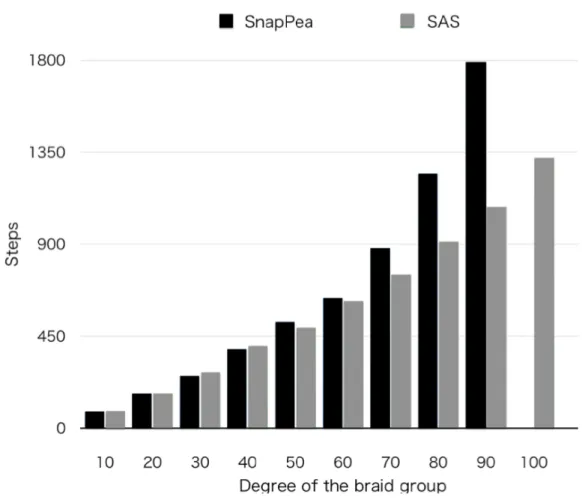
Theresult ofthe experiments is summarizedin the Figure 1. With authors PC, it took around three days to get the data for $B_{90}$ by SnapPea, hence data for $B_{100}$ by SnapPea is not given. Figure 1 shows the number of steps
we
needed to havemore
than 90% of pseudo-Anosovbraids. Moreprecisely, for agiven$n$, wefirst generated 100randombraids (by using python’srandom function which is basedon
the Mersennetwvister) of length $k.$Thencheckifgiven braids arepseudo-Anosov by using SnapPea
or
strict angle structure. HerewhenweuseSnapPea, wecountasolution of type “alltetrahedrapositivelyoriented”’and “contains negatively oriented tetrahedra”
as a
hyperbolic solution. For each method,we
gradually increase $k$ and record when number of pseudo-Anosov braids is greaterthanorequalto 90 among 100randomly generated braids. As we have pointed out in \S 3, both methods can miss pseudo-Anosov braids. It
seems
that for larg$e^{\rangle}$ manifolds, SnapPeamisses
more
than using strict angle structures. (Mapping tori of braids represented by length 1800word in $B_{90}$are
decomposed into about 2000 tetrahedra).M
smappea
$\mathscr{B}SAS$ $3$see
$?3\Re Q$a$n
$\Phi$ $9\mathfrak{M}$ee
450 $\langle\}$$\uparrow\xi\}$ $2\zeta\}$ $s\Im$ $4\Omega$
se
s
$\Omega$ $7\zeta\}$sc
ee
$300$beqreeef the braid qroup
FIGURE 1. Experimental result, SAS stands for strict angle structure.
By the datathat we get by SnapPea, it
seems
quite likely that the function $PA(n)$ isan exponential function of$n$
.
Furthermore by computing the growth ratio, even the data from strict anglestructure suggest that $PA(n)$ is exponential. Thereforewe
concludethisQuestion 4.1. Does $PA:Narrow \mathbb{N}$ grow exponentially?
ACKNOWLEDGEMENT
The author thanks organizers of the conference “Topology, Geometry and Algebra of low-dimensional manifolds” for giving him the opportunity to participate. The author would like to thank Mark Bell for helpful conversation. This work is partially supported by JSPS fellowship for young scientists.
REFERENCES
[1] Mark Bell: flipper (Computer Software), pypi.python. org/pypi/flipper, (2013-2015).
[2] B. Burton, R. Budney, W. Pettersson, et al., Regina:
Software for
3manifold topology and normal surface theory, http:$//$regina. sourceforge.$net/$, 1999-2014.$[3_{!}^{\backslash }\fbox{Error::0x0000}$ M. Culler, N. Dunfield, and J. Weeks, SnapPy. a computerprogram
for studying the topology of 3-manifolds, Available athttp:$//$snappy.computop.org.
[4] P. Erd\"os, A. $R\’{e} nyi_{i}$ On the evolution of random graphs, Publ. Math. Inst. Hungar. Acad. Sci 5
(1960): 17-61.
[5] IiJ. Futerand F. Gu\’eritaud, Fromangled tnangulationstohyperbolicstructures,Interactions,Between Hyperbolic Geometry, Quantum Topology and Number Theory, Contemp. Math., vol. 541, Amer.
Math. Soc., Providence, RI, 2011, pp. 159-182.
[6] N. Hoffman, K. Ichihara, M. Kashiwagi, H. Masai, S. Oishi, andA. Takayasu, Verifiedcomputations
for hyperbolic 3-manifolds, Exper. Math., 25 (2016), Issue 1, 66-78.
[7] J. Maher, Exponential decay in the mapping class group, J. Lond. Math. Soc. (2) 86 (2012), no. 2,
366-386. A correction for the proofof Lemma2.11 canbe found in Maher’s webpage: http:$//www$
.
math. csi.cuny.edu/maher/research/index.html[8] I. Rivin, Statistics of Random 3-Manifolds occasionally fibering over the circle, preprint, arXiv:1401.5736v4 [math. GT].
GRADUATE SCHOOL OF MATHEMATICAL SCIENCES, THE UNIVERSITY OF TOKYO